Chapter 2 Atoms Molecules and Ions Chapter 2














- Slides: 115
Chapter 2 Atoms, Molecules, and Ions
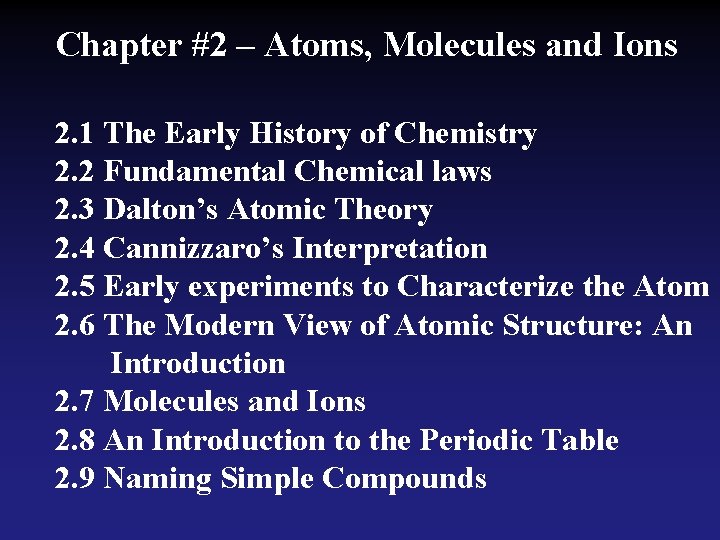
Chapter #2 – Atoms, Molecules and Ions 2. 1 The Early History of Chemistry 2. 2 Fundamental Chemical laws 2. 3 Dalton’s Atomic Theory 2. 4 Cannizzaro’s Interpretation 2. 5 Early experiments to Characterize the Atom 2. 6 The Modern View of Atomic Structure: An Introduction 2. 7 Molecules and Ions 2. 8 An Introduction to the Periodic Table 2. 9 Naming Simple Compounds
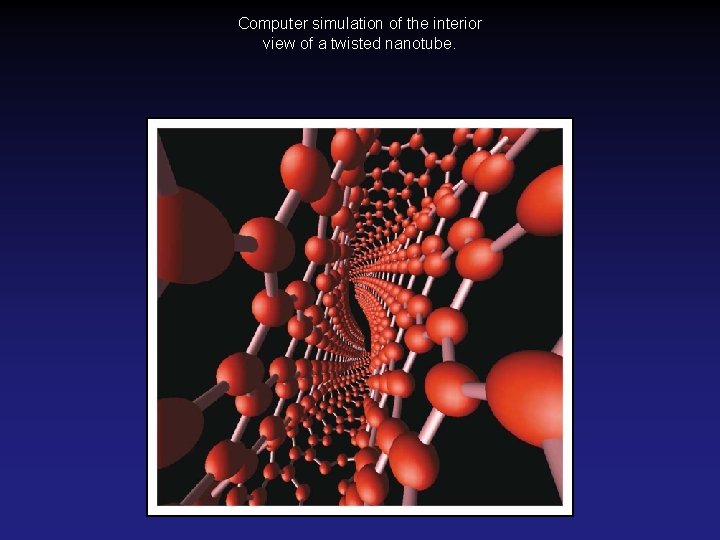
Computer simulation of the interior view of a twisted nanotube.
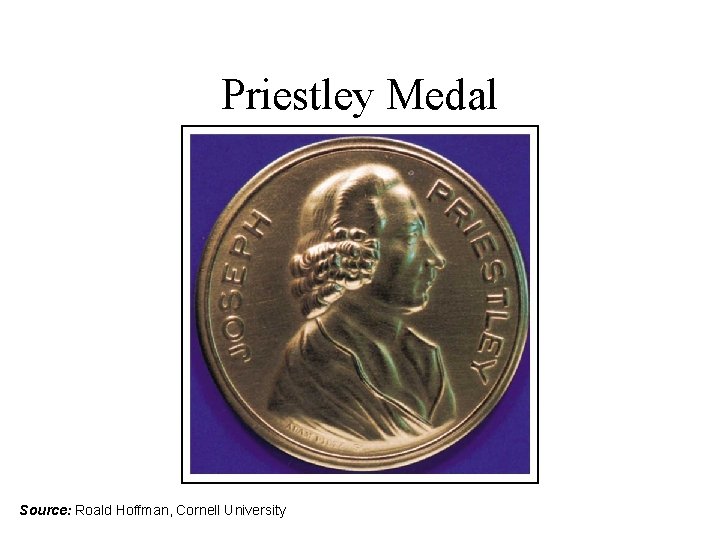
Priestley Medal Source: Roald Hoffman, Cornell University
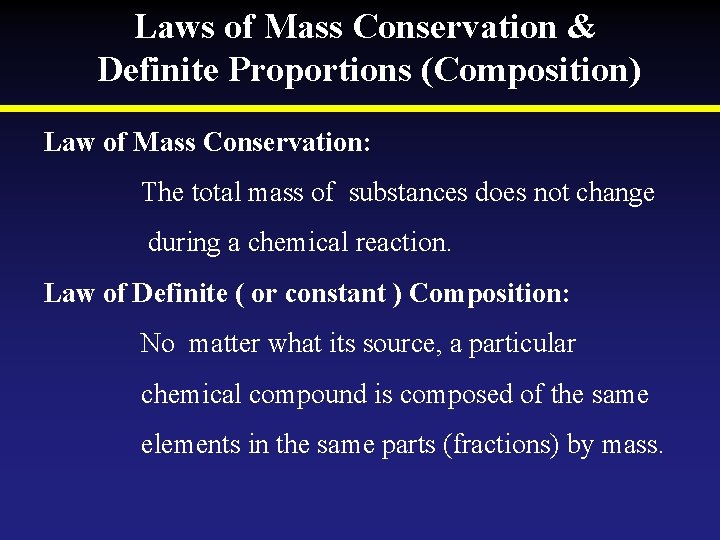
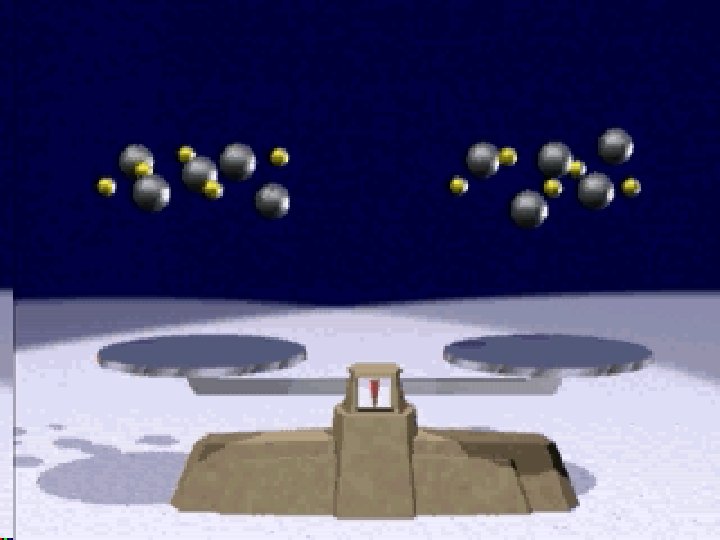
Laws of Mass Conservation & Definite Proportions (Composition) Law of Mass Conservation: The total mass of substances does not change during a chemical reaction. Law of Definite ( or constant ) Composition: No matter what its source, a particular chemical compound is composed of the same elements in the same parts (fractions) by mass.
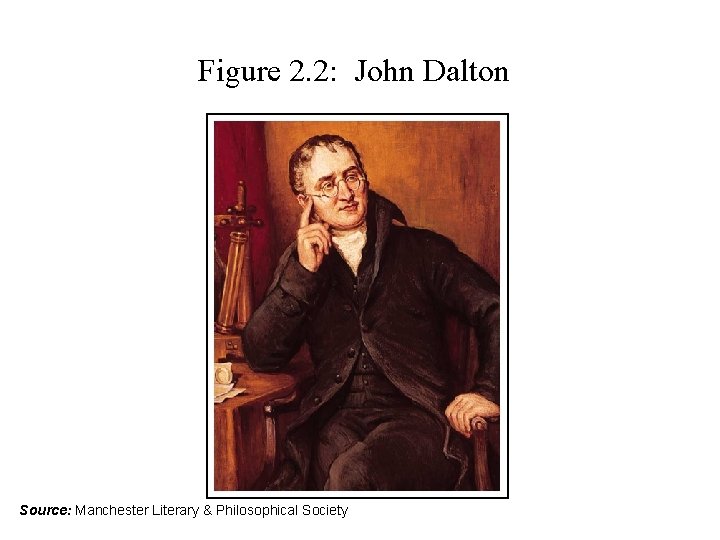
Figure 2. 2: John Dalton Source: Manchester Literary & Philosophical Society
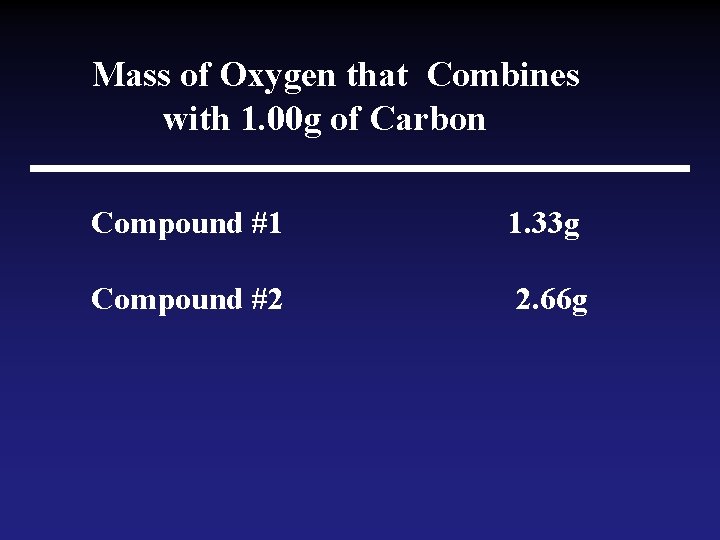
Mass of Oxygen that Combines with 1. 00 g of Carbon Compound #1 1. 33 g Compound #2 2. 66 g
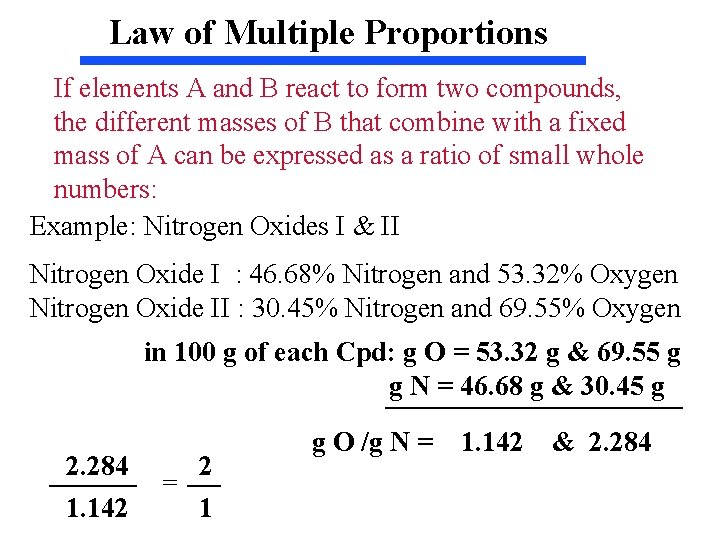
Law of Multiple Proportions If elements A and B react to form two compounds, the different masses of B that combine with a fixed mass of A can be expressed as a ratio of small whole numbers: Example: Nitrogen Oxides I & II Nitrogen Oxide I : 46. 68% Nitrogen and 53. 32% Oxygen Nitrogen Oxide II : 30. 45% Nitrogen and 69. 55% Oxygen in 100 g of each Cpd: g O = 53. 32 g & 69. 55 g g N = 46. 68 g & 30. 45 g 2. 284 1. 142 2 = 1 g O /g N = 1. 142 & 2. 284
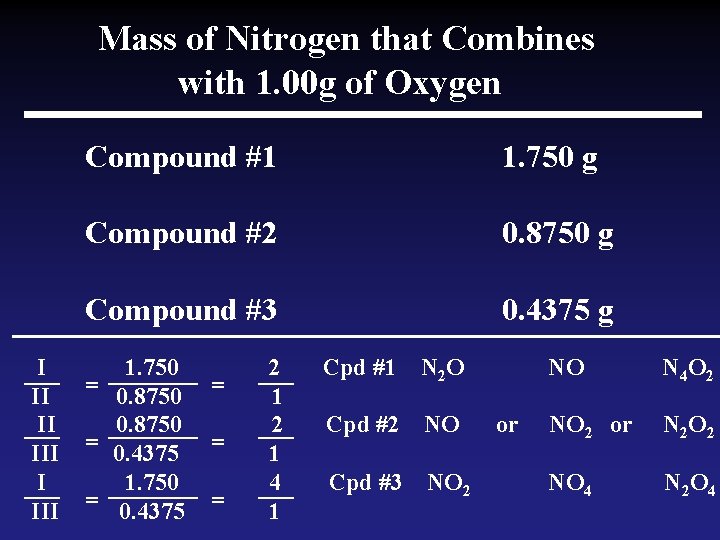
Mass of Nitrogen that Combines with 1. 00 g of Oxygen I II III Compound #1 1. 750 g Compound #2 0. 8750 g Compound #3 0. 4375 g 1. 750 = 0. 8750 = 0. 4375 1. 750 = 0. 4375 = = = 2 1 4 1 Cpd #1 N 2 O Cpd #2 NO Cpd #3 NO 2 or NO N 4 O 2 NO 2 or N 2 O 2 NO 4 N 2 O 4
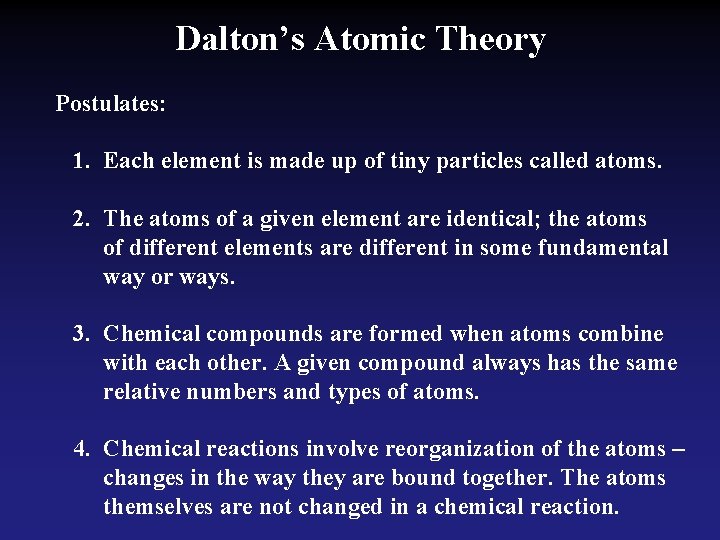
Dalton’s Atomic Theory Postulates: 1. Each element is made up of tiny particles called atoms. 2. The atoms of a given element are identical; the atoms of different elements are different in some fundamental way or ways. 3. Chemical compounds are formed when atoms combine with each other. A given compound always has the same relative numbers and types of atoms. 4. Chemical reactions involve reorganization of the atoms – changes in the way they are bound together. The atoms themselves are not changed in a chemical reaction.
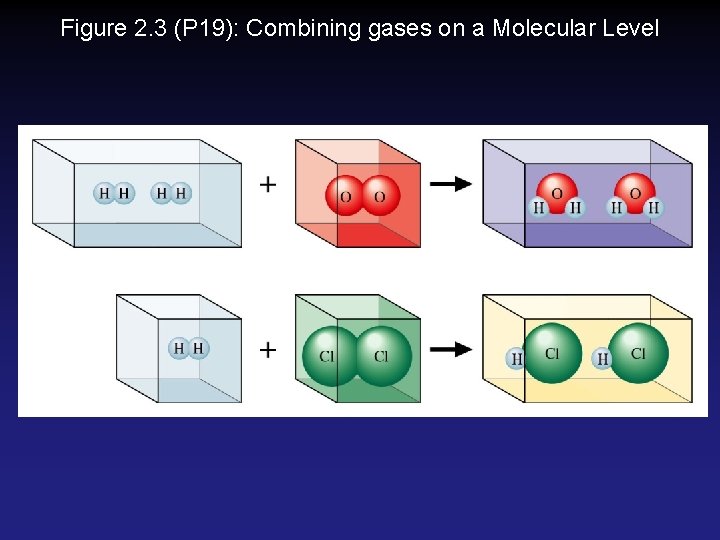
Figure 2. 3 (P 19): Combining gases on a Molecular Level
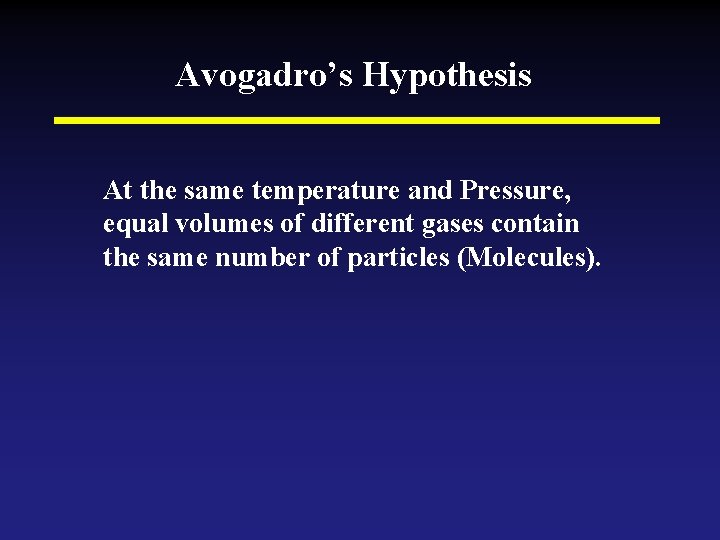
Avogadro’s Hypothesis At the same temperature and Pressure, equal volumes of different gases contain the same number of particles (Molecules).
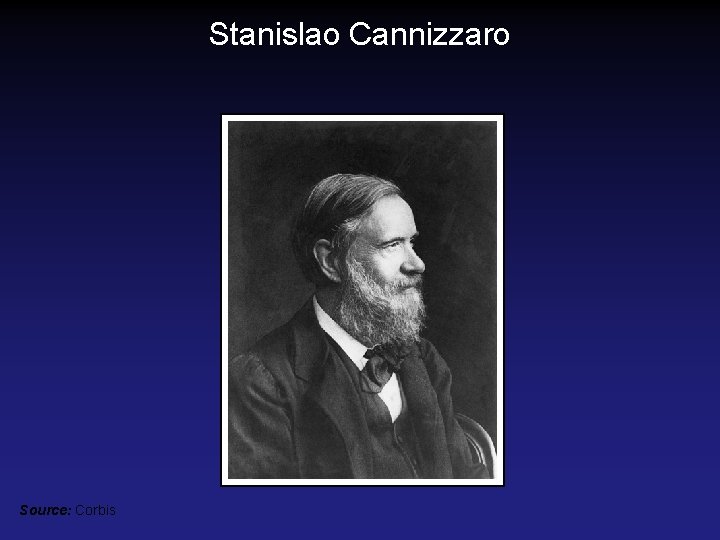
Stanislao Cannizzaro Source: Corbis
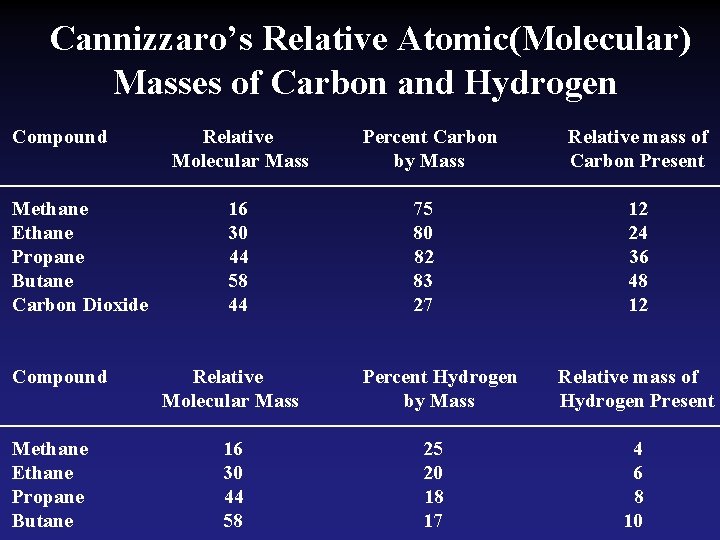
Cannizzaro’s Relative Atomic(Molecular) Masses of Carbon and Hydrogen Compound Methane Ethane Propane Butane Carbon Dioxide Compound Methane Ethane Propane Butane Relative Molecular Mass 16 30 44 58 44 Relative Molecular Mass 16 30 44 58 Percent Carbon by Mass 75 80 82 83 27 Percent Hydrogen by Mass 25 20 18 17 Relative mass of Carbon Present 12 24 36 48 12 Relative mass of Hydrogen Present 4 6 8 10
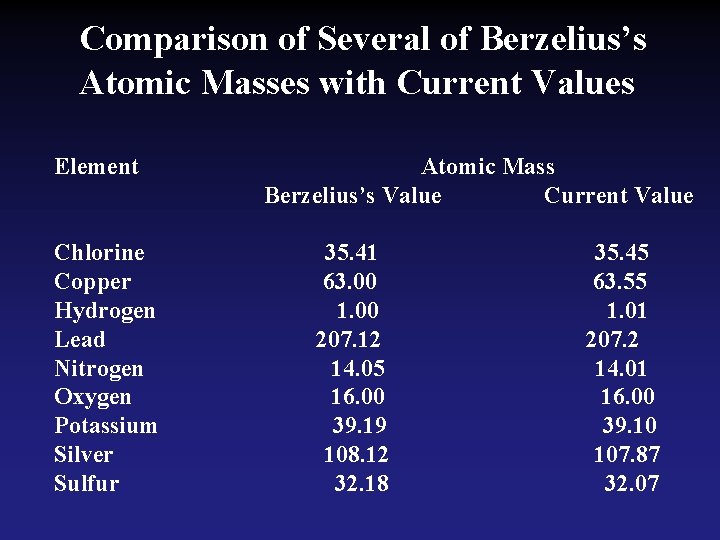
Comparison of Several of Berzelius’s Atomic Masses with Current Values Element Chlorine Copper Hydrogen Lead Nitrogen Oxygen Potassium Silver Sulfur Atomic Mass Berzelius’s Value Current Value 35. 41 63. 00 1. 00 207. 12 14. 05 16. 00 39. 19 108. 12 32. 18 35. 45 63. 55 1. 01 207. 2 14. 01 16. 00 39. 10 107. 87 32. 07
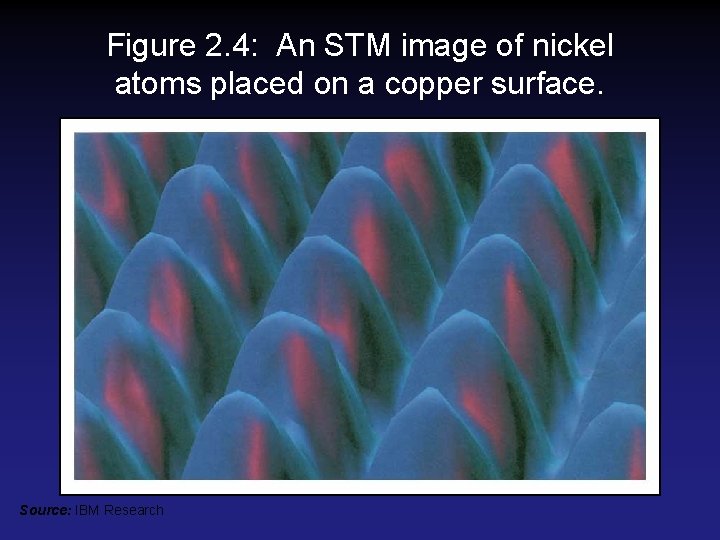
Figure 2. 4: An STM image of nickel atoms placed on a copper surface. Source: IBM Research
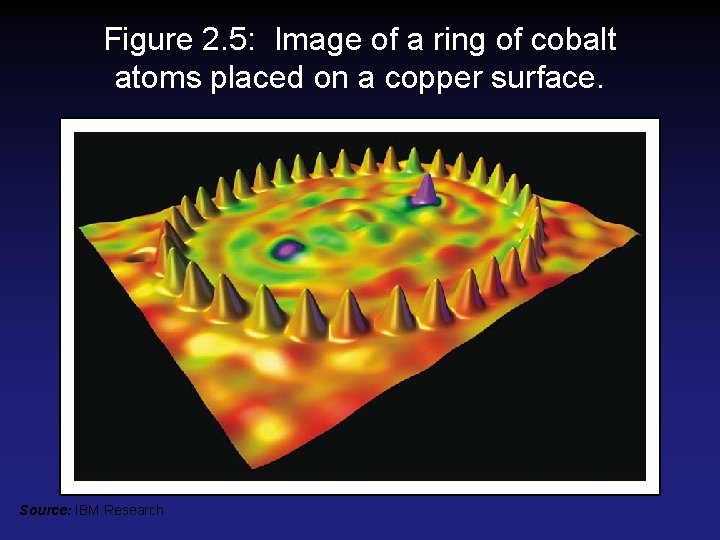
Figure 2. 5: Image of a ring of cobalt atoms placed on a copper surface. Source: IBM Research
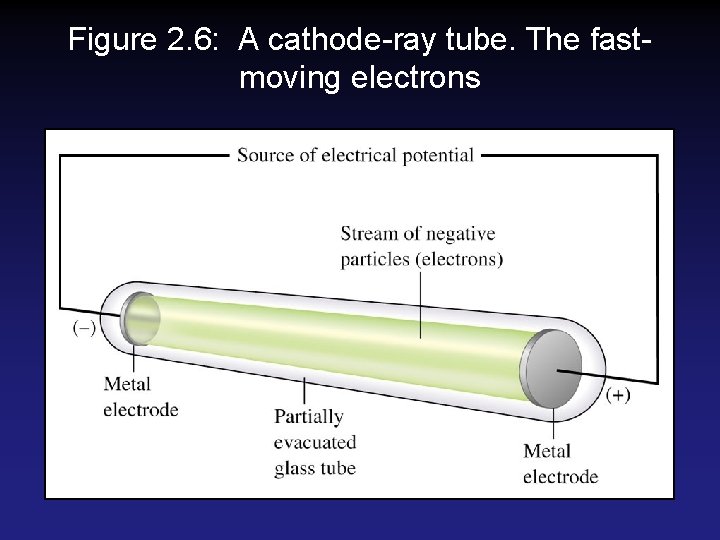
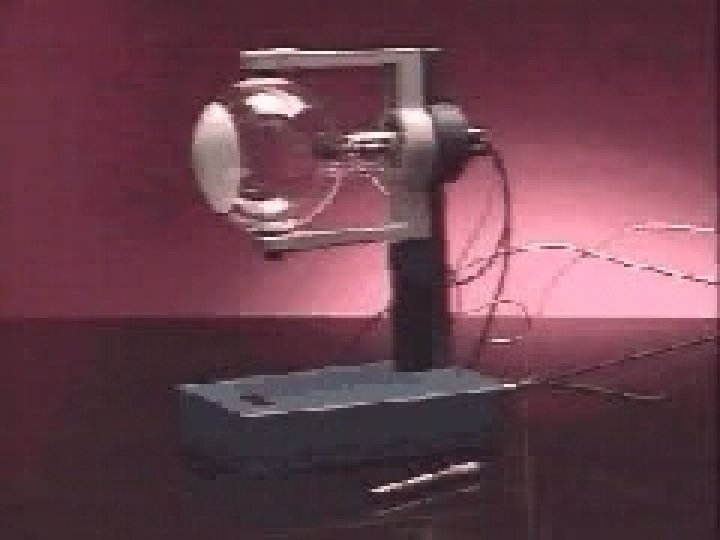
Figure 2. 6: A cathode-ray tube. The fastmoving electrons
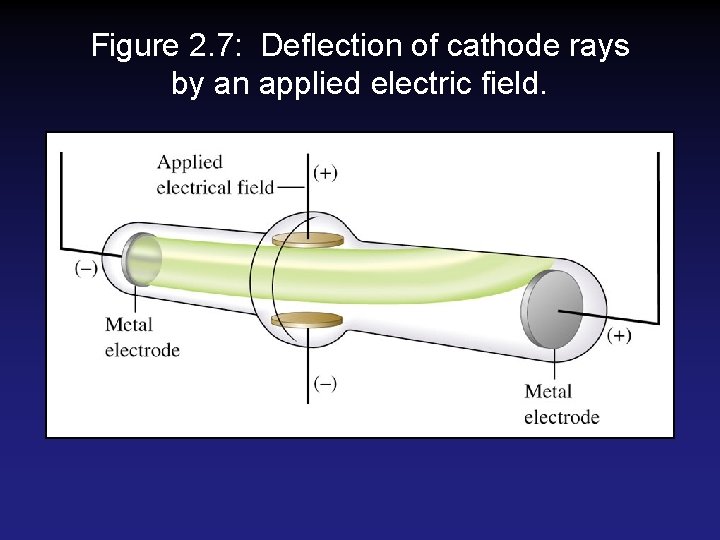
Figure 2. 7: Deflection of cathode rays by an applied electric field.
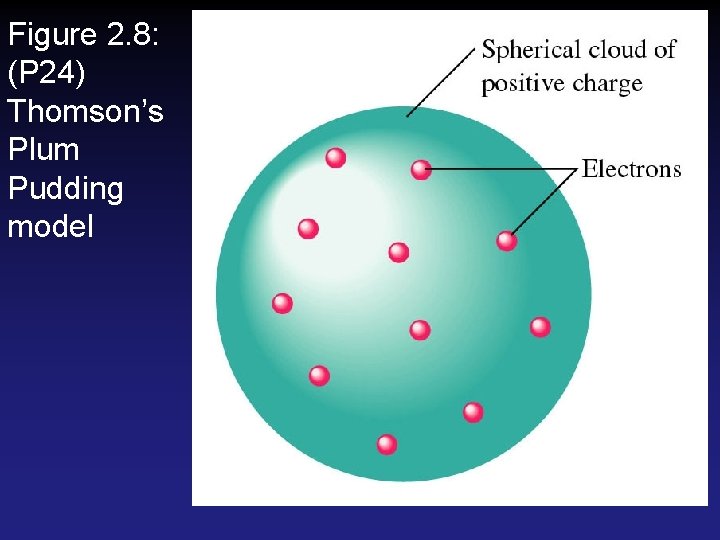
Figure 2. 8: (P 24) Thomson’s Plum Pudding model
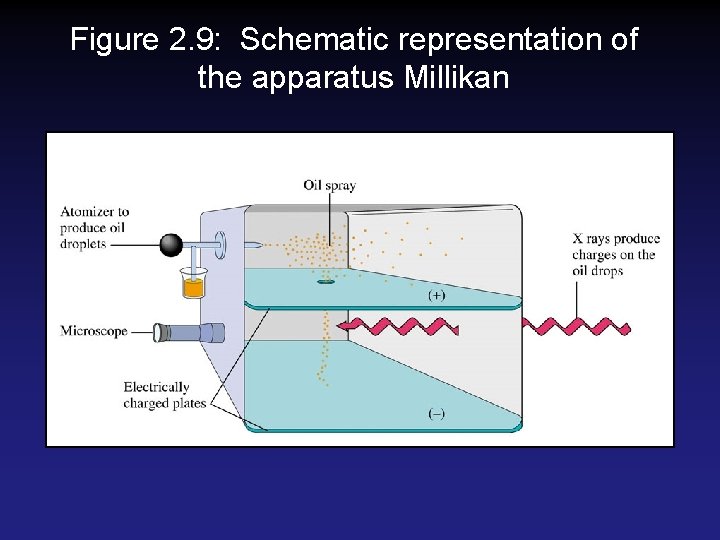
Figure 2. 9: Schematic representation of the apparatus Millikan
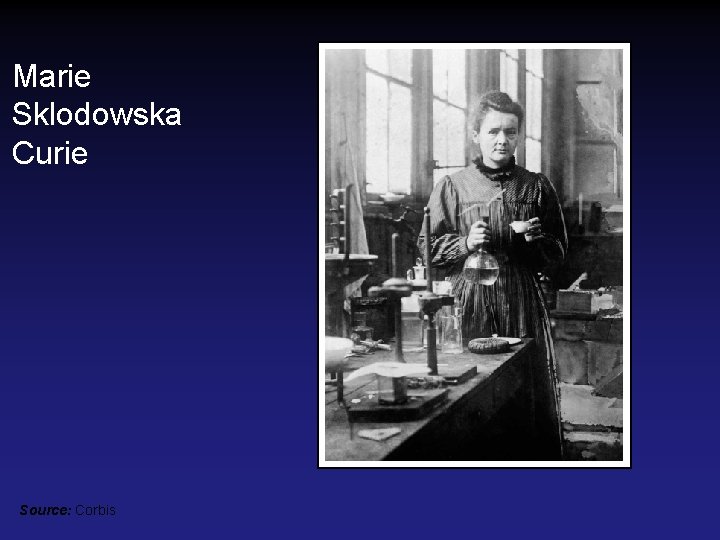
Marie Sklodowska Curie Source: Corbis
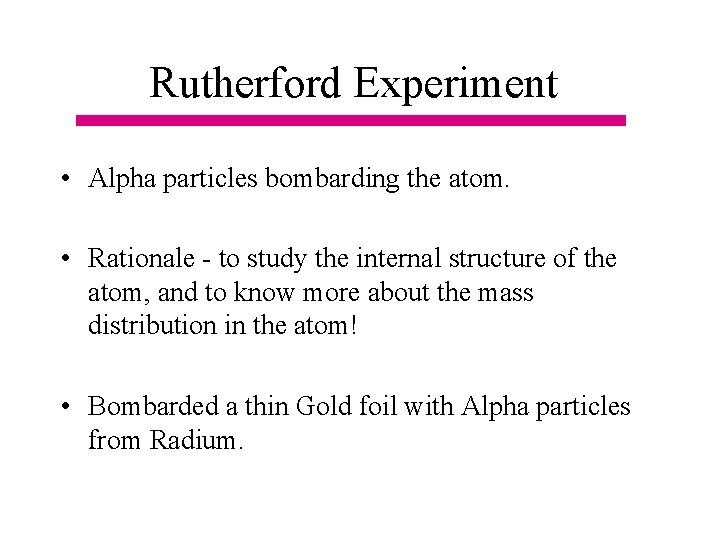
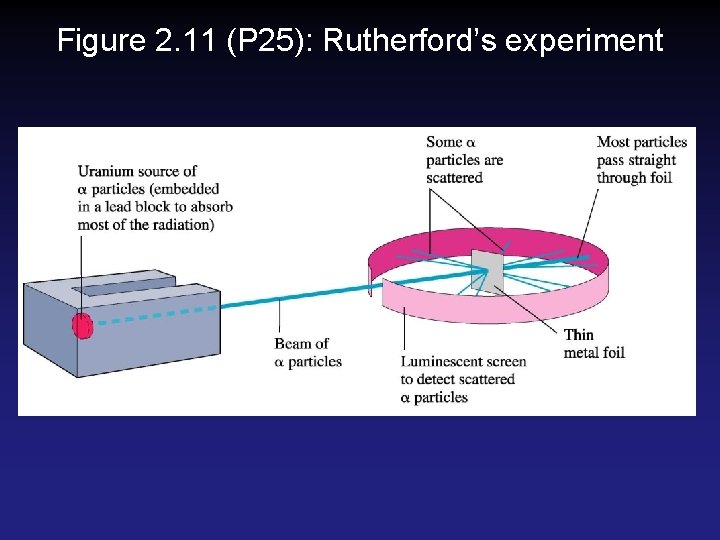
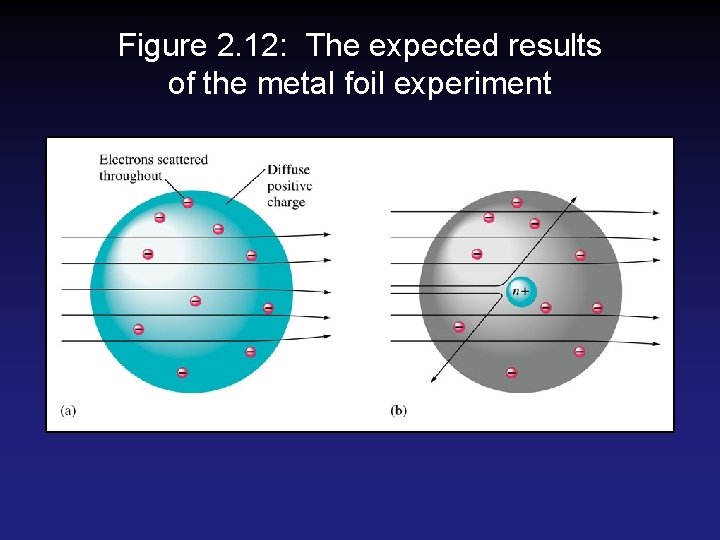
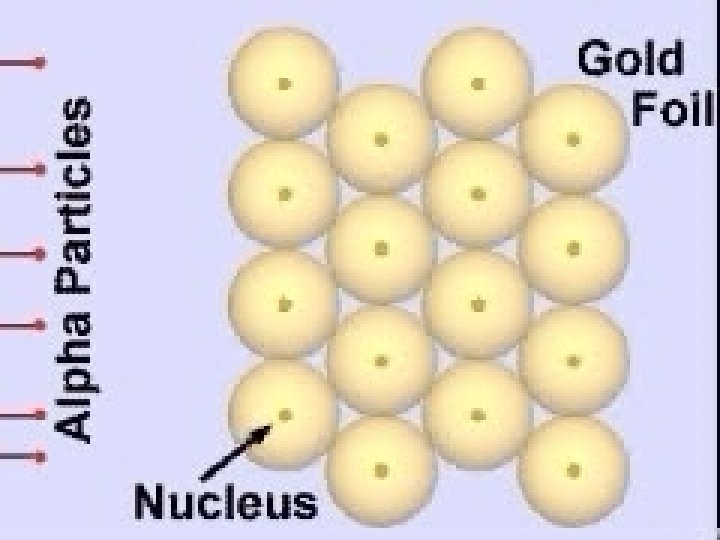
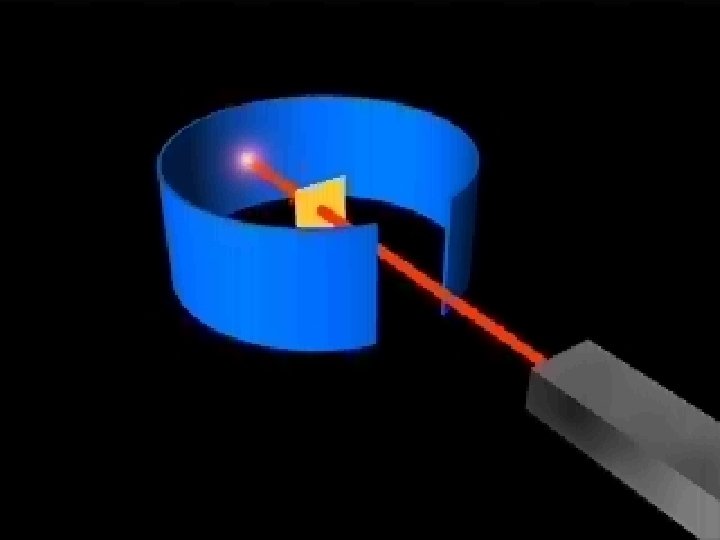
Rutherford Experiment • Alpha particles bombarding the atom. • Rationale - to study the internal structure of the atom, and to know more about the mass distribution in the atom! • Bombarded a thin Gold foil with Alpha particles from Radium.
Figure 2. 11 (P 25): Rutherford’s experiment
Figure 2. 12: The expected results of the metal foil experiment
Ernest Rutherford (1871 -1937) • Won the Nobel Prize in Chemistry in 1908 • “It was quite the most incredible event. . . It was almost as if a gunner were to fire a shell at a piece of tissue and the shell bounced right back!!!!! ”
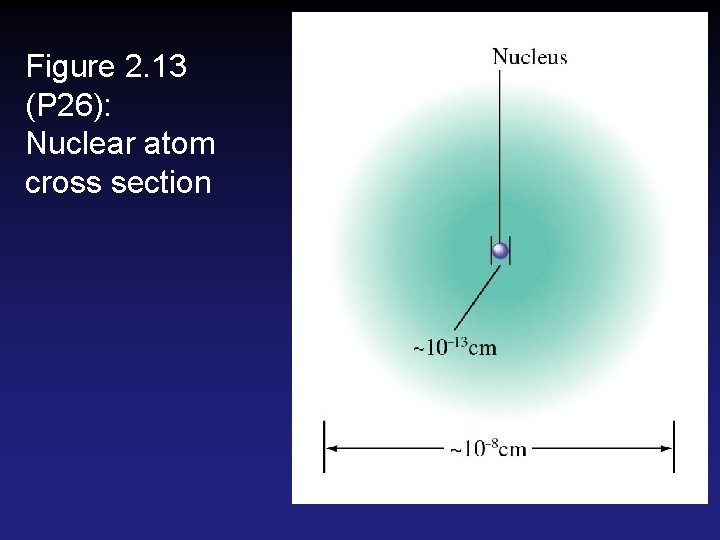
Figure 2. 13 (P 26): Nuclear atom cross section
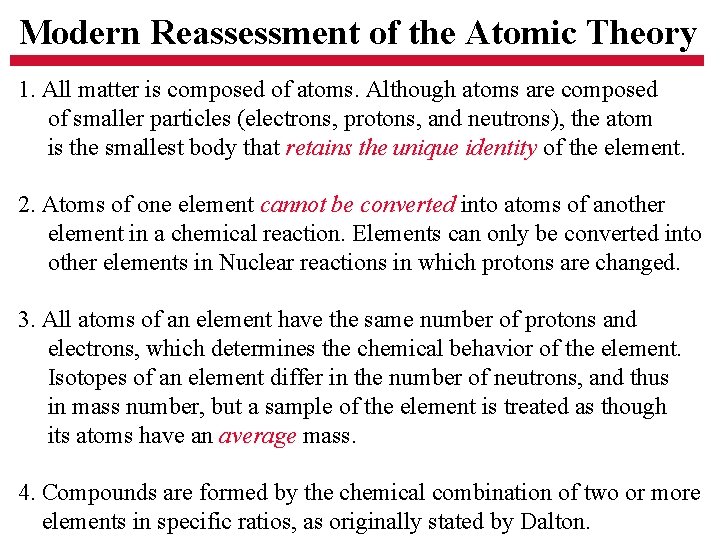
Modern Reassessment of the Atomic Theory 1. All matter is composed of atoms. Although atoms are composed of smaller particles (electrons, protons, and neutrons), the atom is the smallest body that retains the unique identity of the element. 2. Atoms of one element cannot be converted into atoms of another element in a chemical reaction. Elements can only be converted into other elements in Nuclear reactions in which protons are changed. 3. All atoms of an element have the same number of protons and electrons, which determines the chemical behavior of the element. Isotopes of an element differ in the number of neutrons, and thus in mass number, but a sample of the element is treated as though its atoms have an average mass. 4. Compounds are formed by the chemical combination of two or more elements in specific ratios, as originally stated by Dalton.
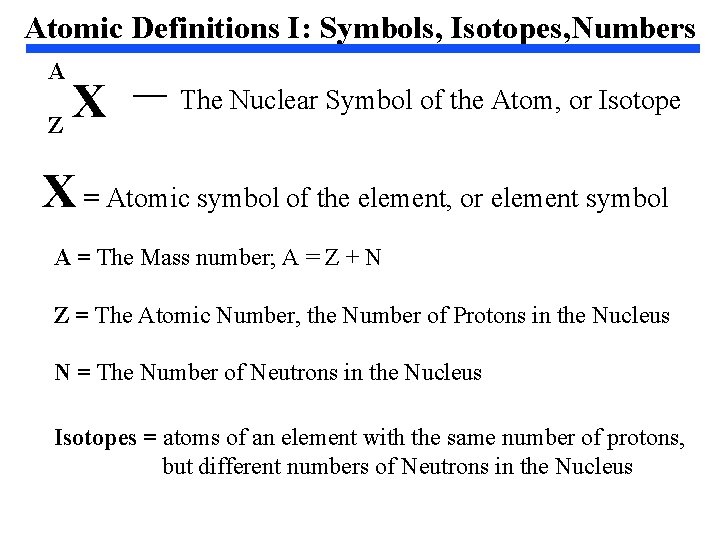
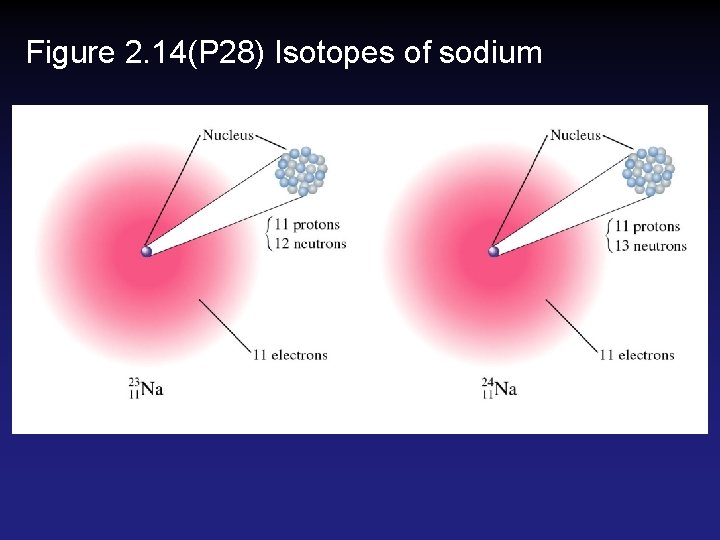
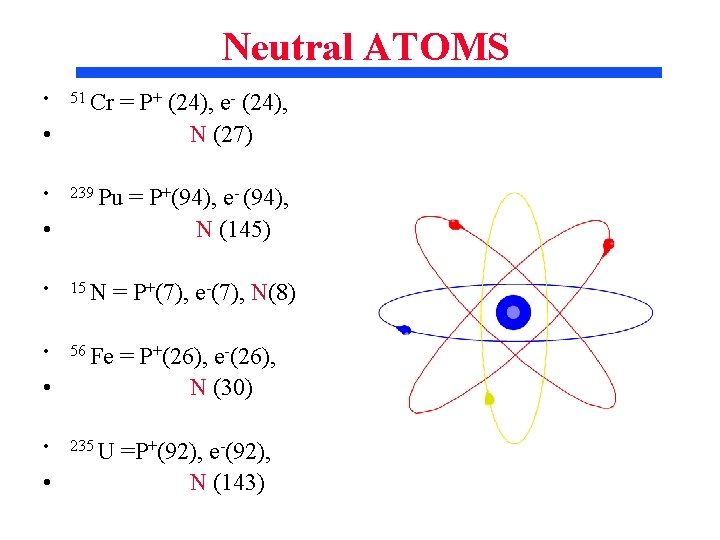
Atomic Definitions I: Symbols, Isotopes, Numbers A X Z The Nuclear Symbol of the Atom, or Isotope X = Atomic symbol of the element, or element symbol A = The Mass number; A = Z + N Z = The Atomic Number, the Number of Protons in the Nucleus N = The Number of Neutrons in the Nucleus Isotopes = atoms of an element with the same number of protons, but different numbers of Neutrons in the Nucleus
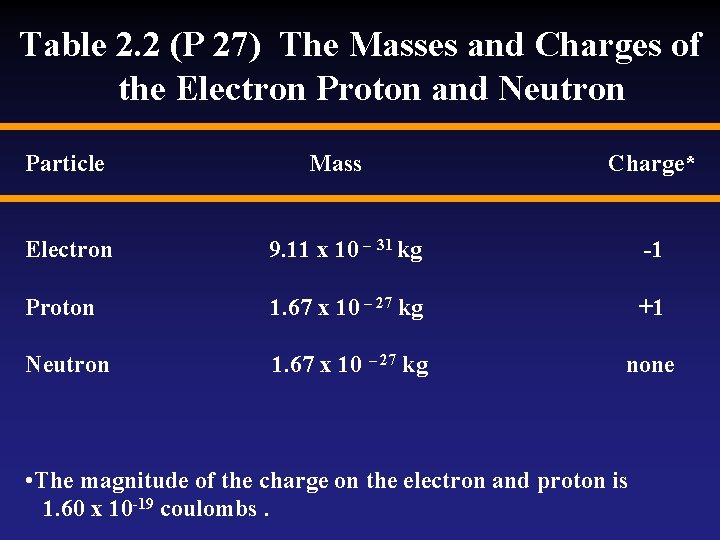
Table 2. 2 (P 27) The Masses and Charges of the Electron Proton and Neutron Particle Mass Charge* Electron 9. 11 x 10 – 31 kg -1 Proton 1. 67 x 10 – 27 kg +1 Neutron 1. 67 x 10 – 27 kg none • The magnitude of the charge on the electron and proton is 1. 60 x 10 -19 coulombs.
Figure 2. 14(P 28) Isotopes of sodium
Neutral ATOMS • 51 Cr • • = P+ (24), e- (24), N (27) 239 Pu • = P+(94), e- (94), N (145) • 15 N • 56 Fe = P+(26), e-(26), N (30) 235 U =P+(92), e-(92), N (143) = P+(7), e-(7), N(8) • • •
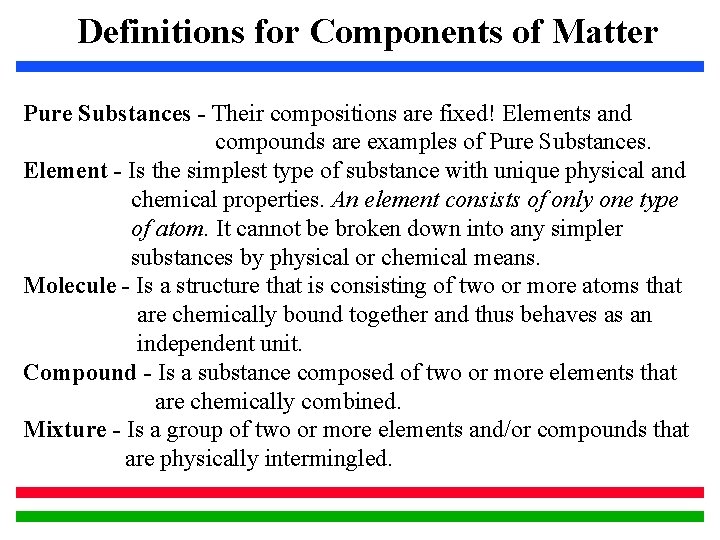
Definitions for Components of Matter Pure Substances - Their compositions are fixed! Elements and compounds are examples of Pure Substances. Element - Is the simplest type of substance with unique physical and chemical properties. An element consists of only one type of atom. It cannot be broken down into any simpler substances by physical or chemical means. Molecule - Is a structure that is consisting of two or more atoms that are chemically bound together and thus behaves as an independent unit. Compound - Is a substance composed of two or more elements that are chemically combined. Mixture - Is a group of two or more elements and/or compounds that are physically intermingled.
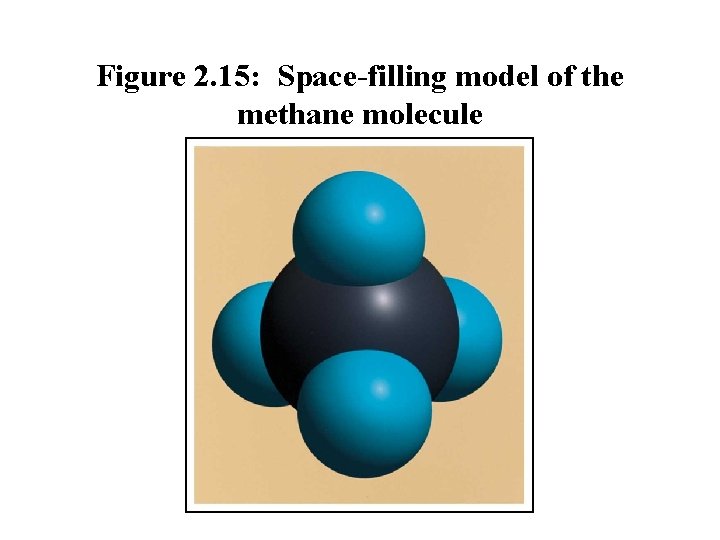
Figure 2. 15: Space-filling model of the methane molecule
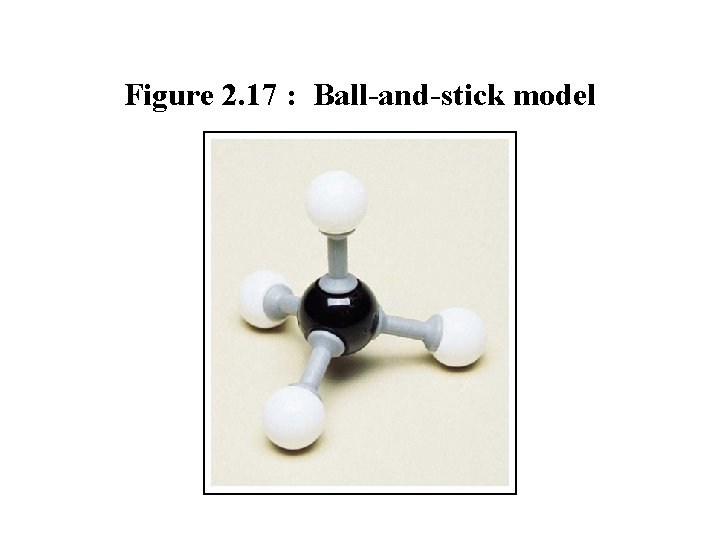
Figure 2. 17 : Ball-and-stick model
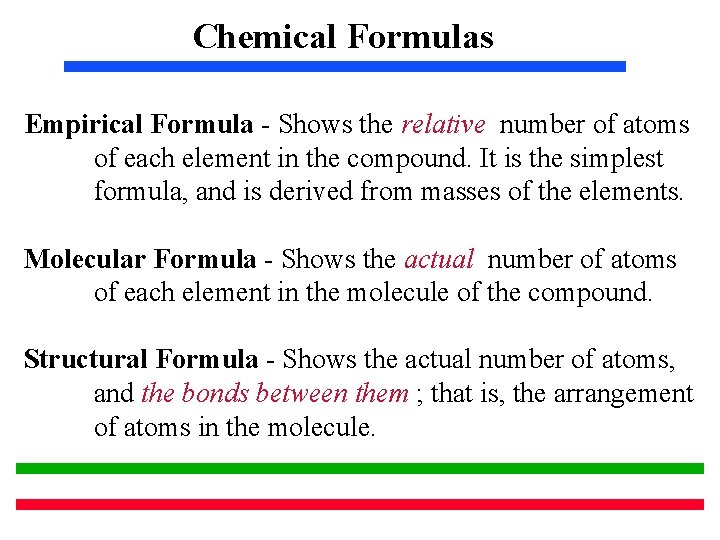
Chemical Formulas Empirical Formula - Shows the relative number of atoms of each element in the compound. It is the simplest formula, and is derived from masses of the elements. Molecular Formula - Shows the actual number of atoms of each element in the molecule of the compound. Structural Formula - Shows the actual number of atoms, and the bonds between them ; that is, the arrangement of atoms in the molecule.
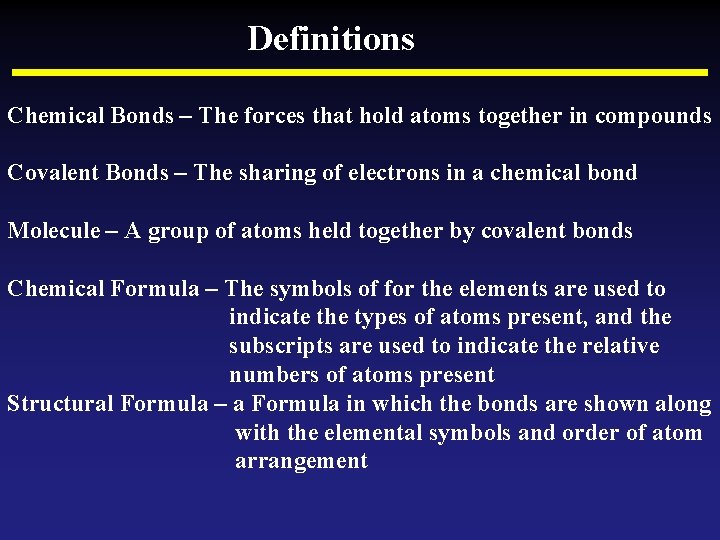
Definitions Chemical Bonds – The forces that hold atoms together in compounds Covalent Bonds – The sharing of electrons in a chemical bond Molecule – A group of atoms held together by covalent bonds Chemical Formula – The symbols of for the elements are used to indicate the types of atoms present, and the subscripts are used to indicate the relative numbers of atoms present Structural Formula – a Formula in which the bonds are shown along with the elemental symbols and order of atom arrangement
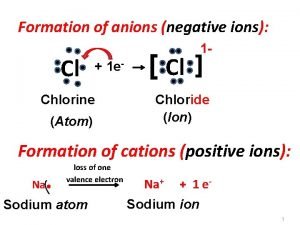
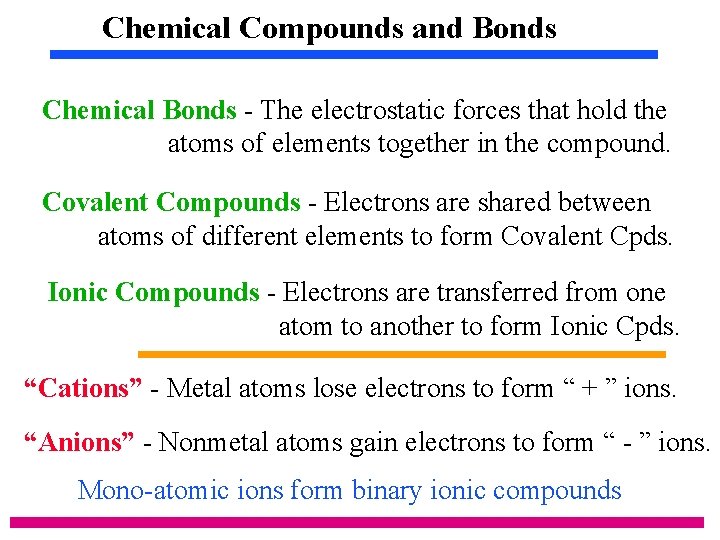
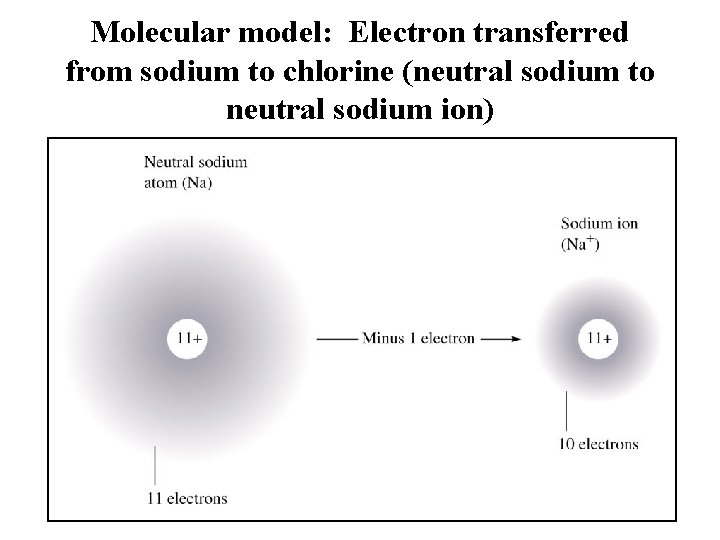
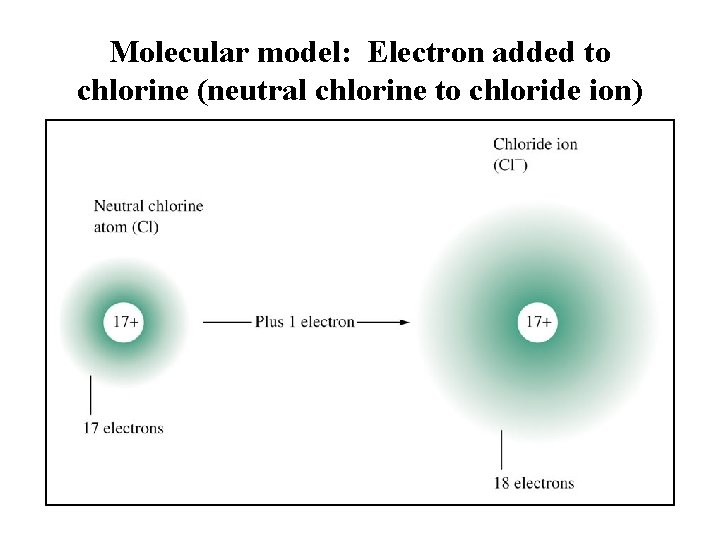
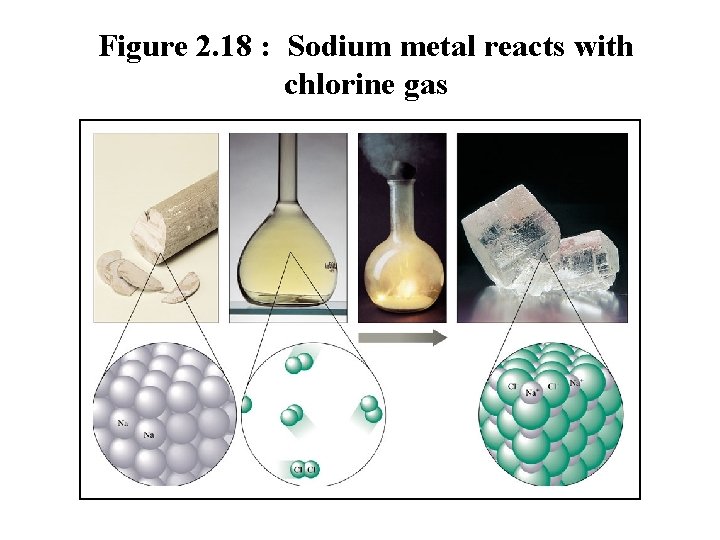
Chemical Compounds and Bonds Chemical Bonds - The electrostatic forces that hold the atoms of elements together in the compound. Covalent Compounds - Electrons are shared between atoms of different elements to form Covalent Cpds. Ionic Compounds - Electrons are transferred from one atom to another to form Ionic Cpds. “Cations” - Metal atoms lose electrons to form “ + ” ions. “Anions” - Nonmetal atoms gain electrons to form “ - ” ions. Mono-atomic ions form binary ionic compounds
Molecular model: Electron transferred from sodium to chlorine (neutral sodium to neutral sodium ion)
Molecular model: Electron added to chlorine (neutral chlorine to chloride ion)
Figure 2. 18 : Sodium metal reacts with chlorine gas
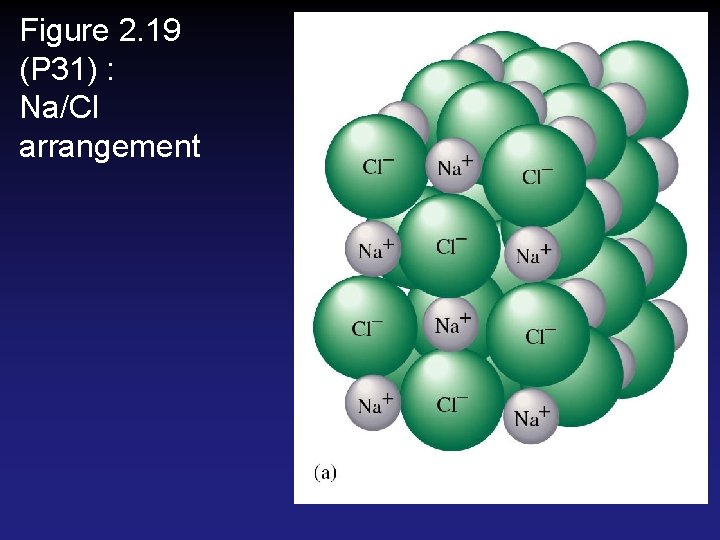
Figure 2. 19 (P 31) : Na/Cl arrangement
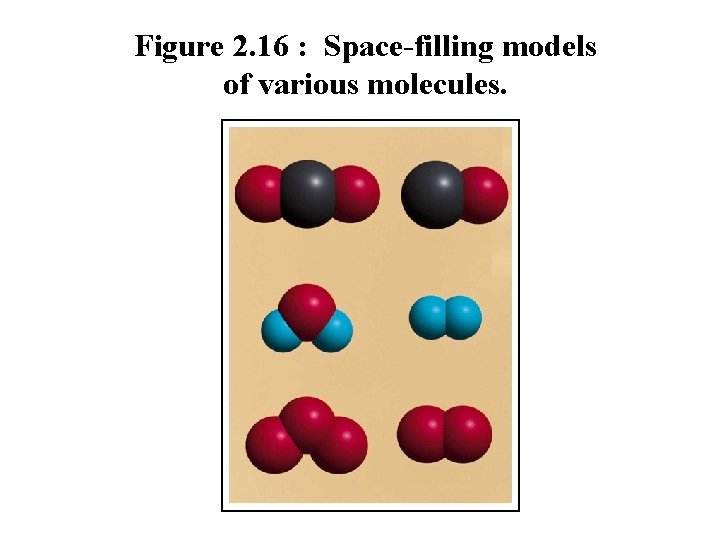
Figure 2. 16 : Space-filling models of various molecules.
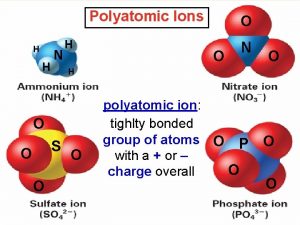
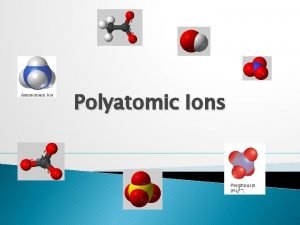
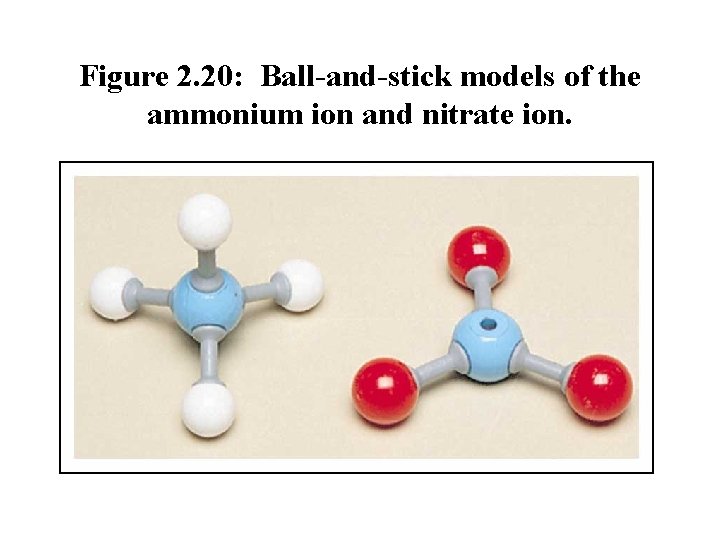
Figure 2. 20: Ball-and-stick models of the ammonium ion and nitrate ion.
Definitions • ELEMENT - A substance that cannot be separated into simpler substances by chemical means • COMPOUND - A substance composed of atoms of two or more elements chemically united in fixed proportions • PERIODIC TABLE - “MENDELEEV TABLE” A tabular arrangement of the elements, vertical groups or families of elements based upon their chemical properties - actually combining ratios with oxygen
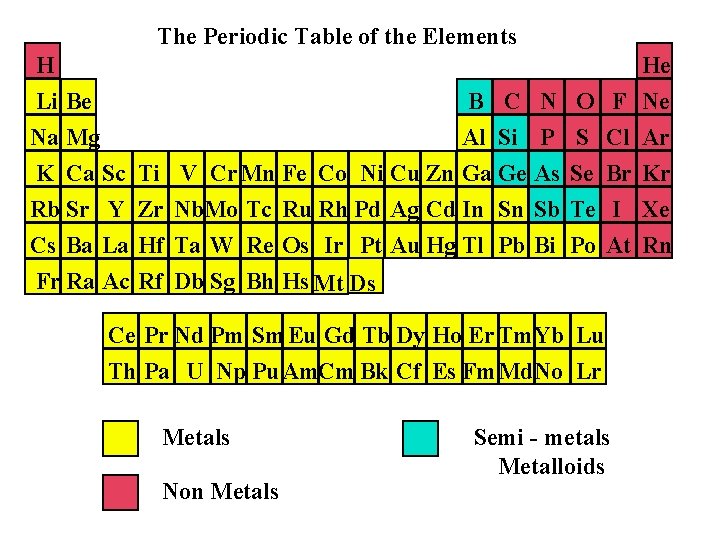
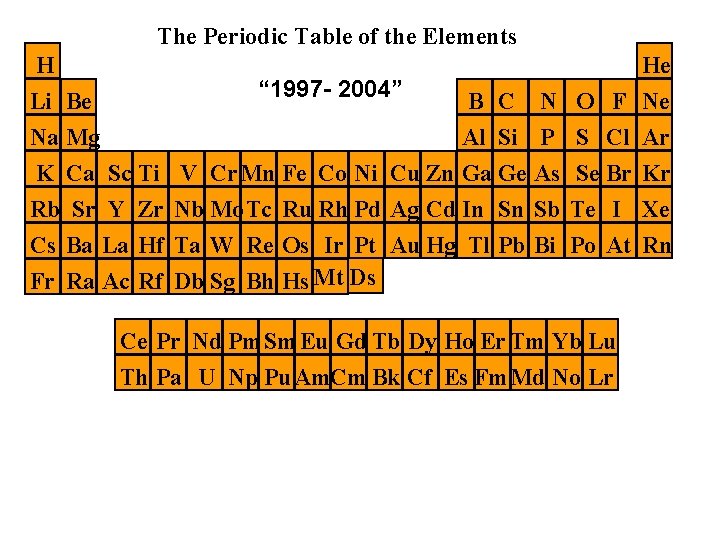
The Periodic Table of the Elements H Li Be Na Mg He B C N O F Ne Al Si P S Cl Ar K Ca Sc Rb Sr Y Cs Ba La Fr Ra Ac Ti Zr Hf Rf V Cr Mn Fe Co Ni Cu Zn Ga Ge As Se Br Kr Nb. Mo Tc Ru Rh Pd Ag Cd In Sn Sb Te I Xe Ta W Re Os Ir Pt Au Hg Tl Pb Bi Po At Rn Db Sg Bh Hs Mt Ds Ce Pr Nd Pm Sm Eu Gd Tb Dy Ho Er Tm. Yb Lu Th Pa U Np Pu. Am. Cm Bk Cf Es Fm. Md. No Lr Metals Non Metals Semi - metals Metalloids
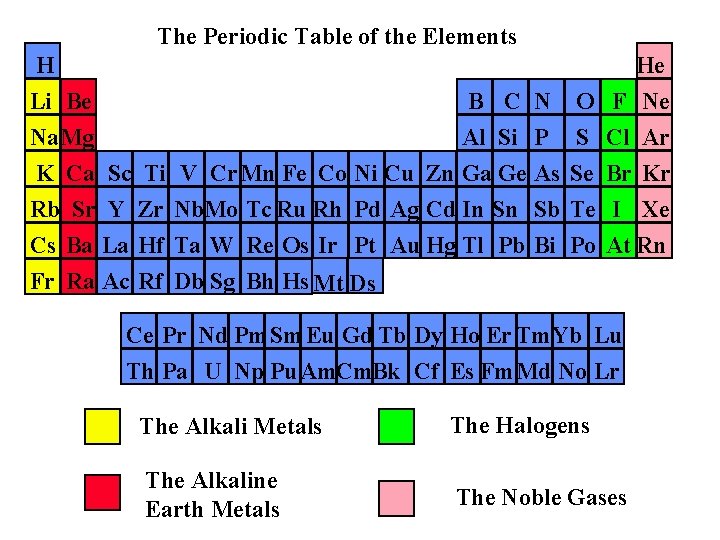
The Periodic Table of the Elements H Li Be Na. Mg B C N Al Si P K Ca Sc Ti Rb Sr Y Zr Cs Ba La Hf Fr Ra Ac Rf He O F Ne S Cl Ar V Cr Mn Fe Co Ni Cu Zn Ga Ge As Se Br Kr Nb. Mo Tc Ru Rh Pd Ag Cd In Sn Sb Te I Xe Ta W Re Os Ir Pt Au Hg Tl Pb Bi Po At Rn Db Sg Bh Hs Mt Ds Ce Pr Nd Pm. Sm Eu Gd Tb Dy Ho Er Tm. Yb Lu Th Pa U Np Pu. Am. Cm. Bk Cf Es Fm. Md No Lr The Alkali Metals The Halogens The Alkaline Earth Metals The Noble Gases
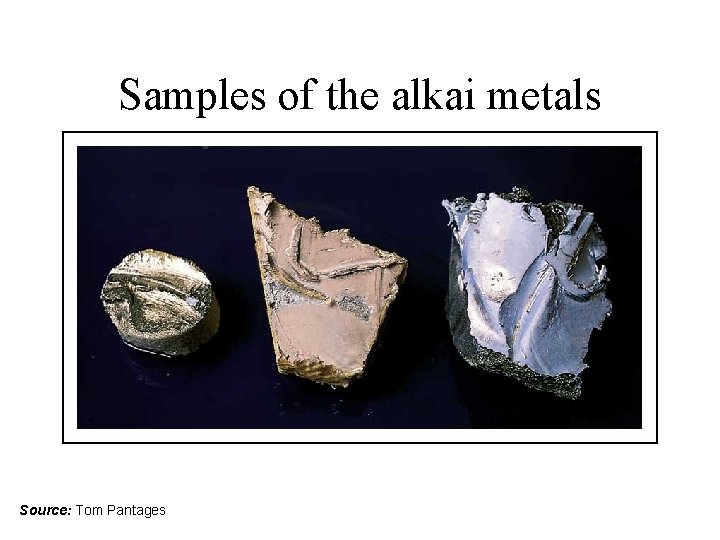
Samples of the alkai metals Source: Tom Pantages
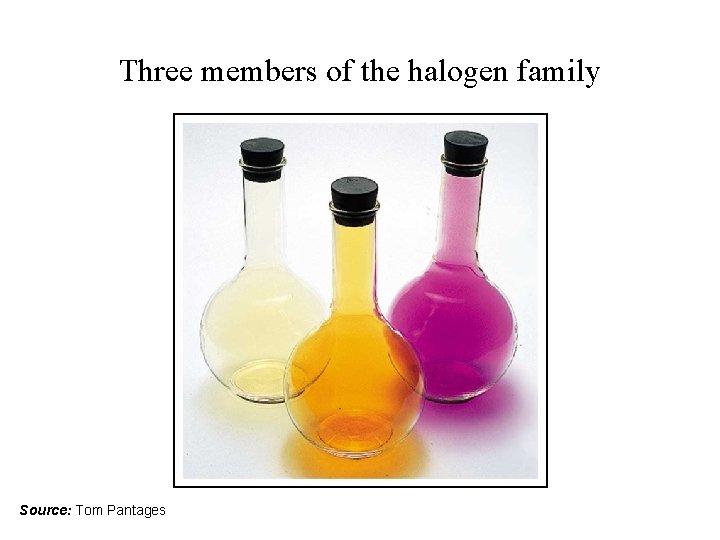
Three members of the halogen family Source: Tom Pantages
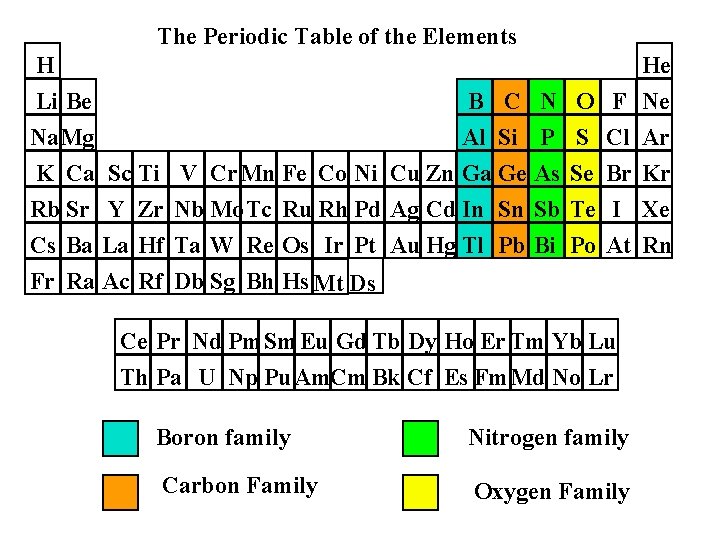
The Periodic Table of the Elements H Li Be Na. Mg He B C N O F Ne Al Si P S Cl Ar K Ca Sc Ti Rb Sr Y Zr Cs Ba La Hf Fr Ra Ac Rf V Cr. Mn Fe Co Ni Cu Zn Ga Ge As Se Br Kr Nb Mo Tc Ru Rh Pd Ag Cd In Sn Sb Te I Xe Ta W Re Os Ir Pt Au Hg Tl Pb Bi Po At Rn Db Sg Bh Hs Mt Ds Ce Pr Nd Pm Sm Eu Gd Tb Dy Ho Er Tm Yb Lu Th Pa U Np Pu. Am. Cm Bk Cf Es Fm. Md No Lr Boron family Nitrogen family Carbon Family Oxygen Family
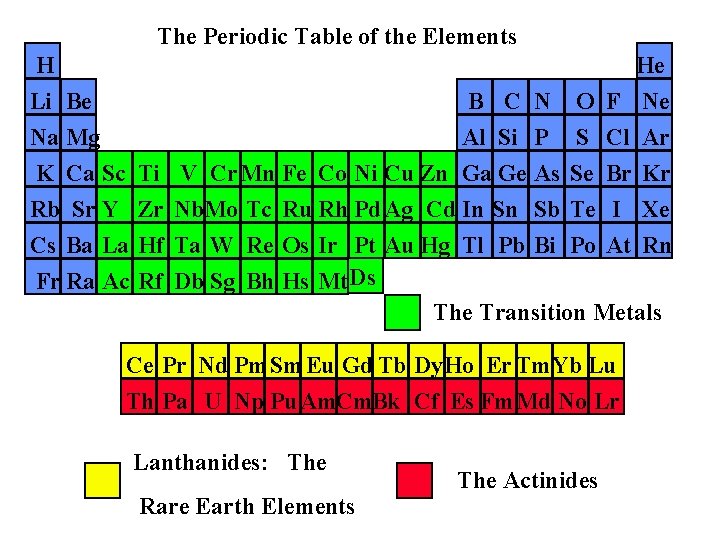
The Periodic Table of the Elements H Li Be Na Mg B C N Al Si P K Ca Sc Rb Sr Y Cs Ba La Fr Ra Ac Ti Zr Hf Rf He O F Ne S Cl Ar V Cr. Mn Fe Co Ni Cu Zn Ga Ge As Se Br Kr Nb. Mo Tc Ru Rh Pd. Ag Cd In Sn Sb Te I Xe Ta W Re Os Ir Pt Au Hg Tl Pb Bi Po At Rn Db Sg Bh Hs Mt Ds The Transition Metals Ce Pr Nd Pm. Sm Eu Gd Tb Dy. Ho Er Tm. Yb Lu Th Pa U Np Pu. Am. Cm. Bk Cf Es Fm. Md No Lr Lanthanides: The Rare Earth Elements The Actinides
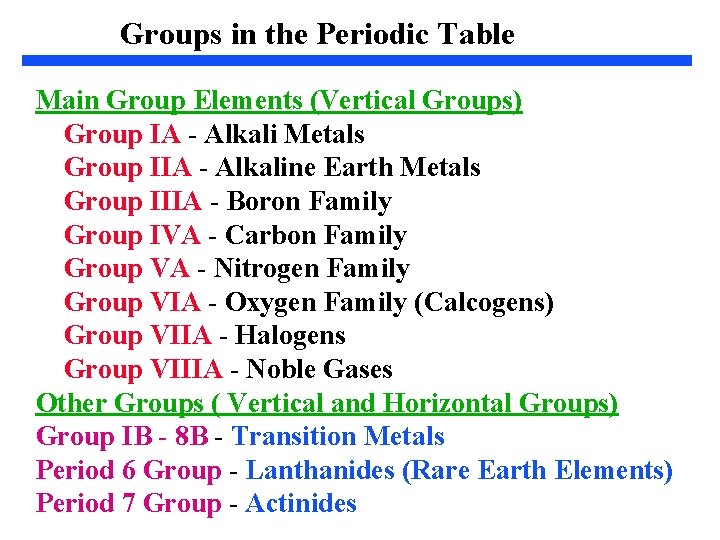
Groups in the Periodic Table Main Group Elements (Vertical Groups) Group IA - Alkali Metals Group IIA - Alkaline Earth Metals Group IIIA - Boron Family Group IVA - Carbon Family Group VA - Nitrogen Family Group VIA - Oxygen Family (Calcogens) Group VIIA - Halogens Group VIIIA - Noble Gases Other Groups ( Vertical and Horizontal Groups) Group IB - 8 B - Transition Metals Period 6 Group - Lanthanides (Rare Earth Elements) Period 7 Group - Actinides
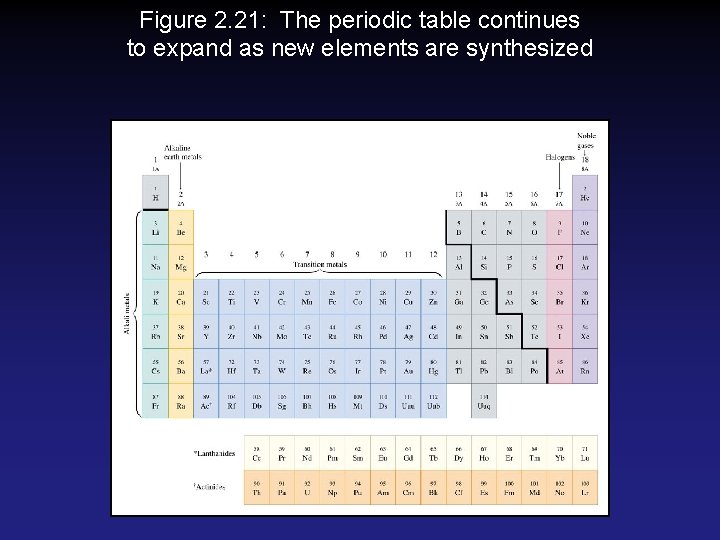
Figure 2. 21: The periodic table continues to expand as new elements are synthesized
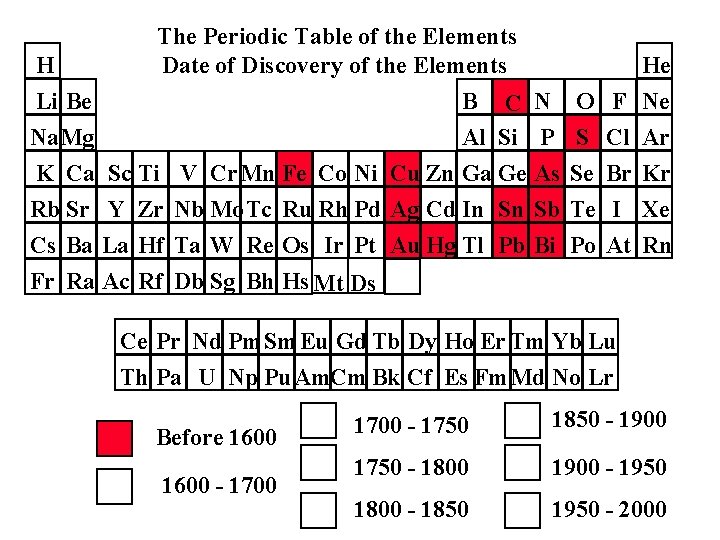
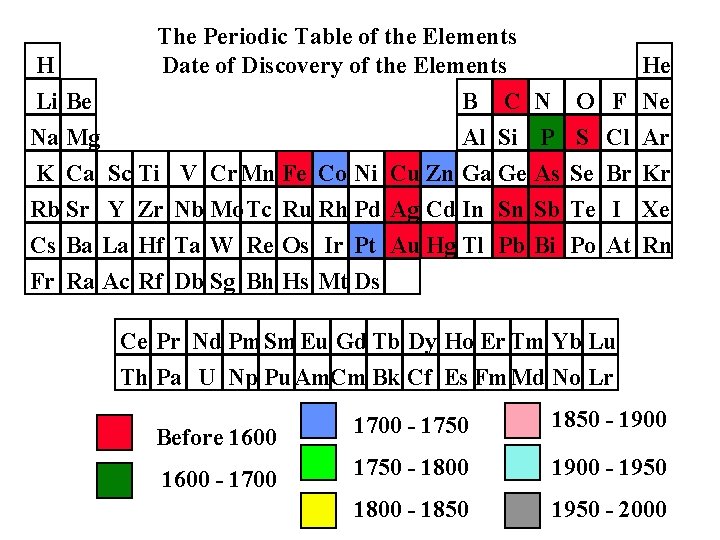
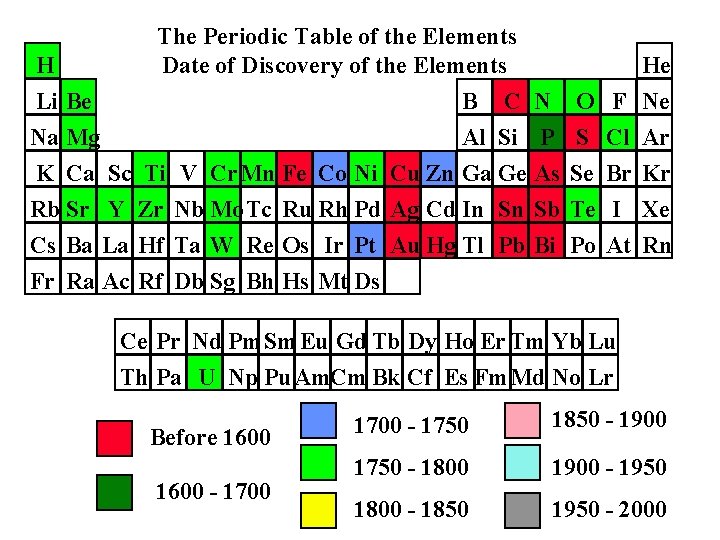
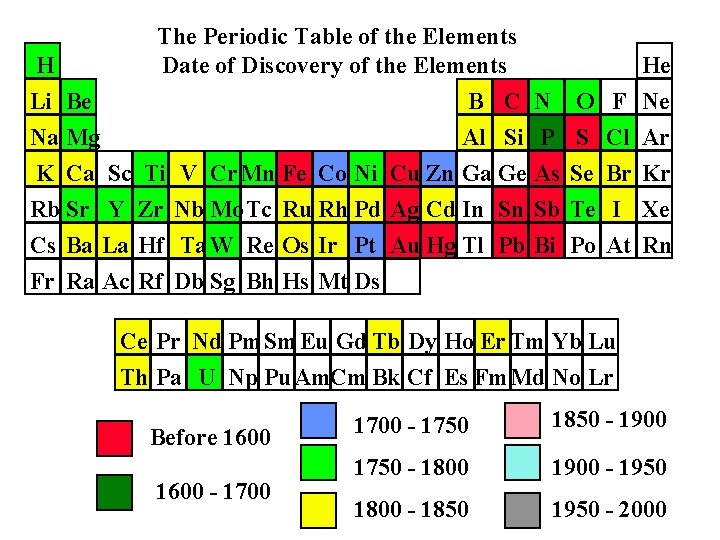
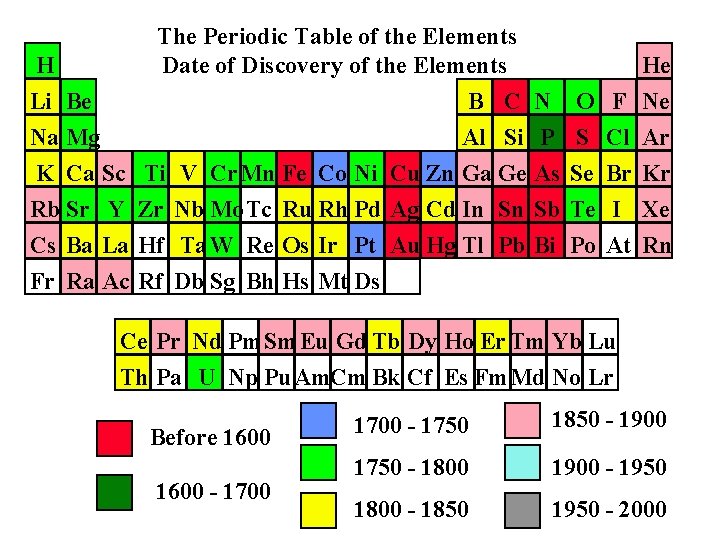
H Li Be Na. Mg The Periodic Table of the Elements Date of Discovery of the Elements He B C N O F Ne Al Si P S Cl Ar K Ca Sc Ti Rb Sr Y Zr Cs Ba La Hf Fr Ra Ac Rf V Cr. Mn Fe Co Ni Cu Zn Ga Ge As Se Br Kr Nb Mo Tc Ru Rh Pd Ag Cd In Sn Sb Te I Xe Ta W Re Os Ir Pt Au Hg Tl Pb Bi Po At Rn Db Sg Bh Hs Mt Ds Ce Pr Nd Pm Sm Eu Gd Tb Dy Ho Er Tm Yb Lu Th Pa U Np Pu. Am. Cm Bk Cf Es Fm. Md No Lr Before 1600 - 1700 - 1750 1850 - 1900 1750 - 1800 1900 - 1950 1800 - 1850 1950 - 2000
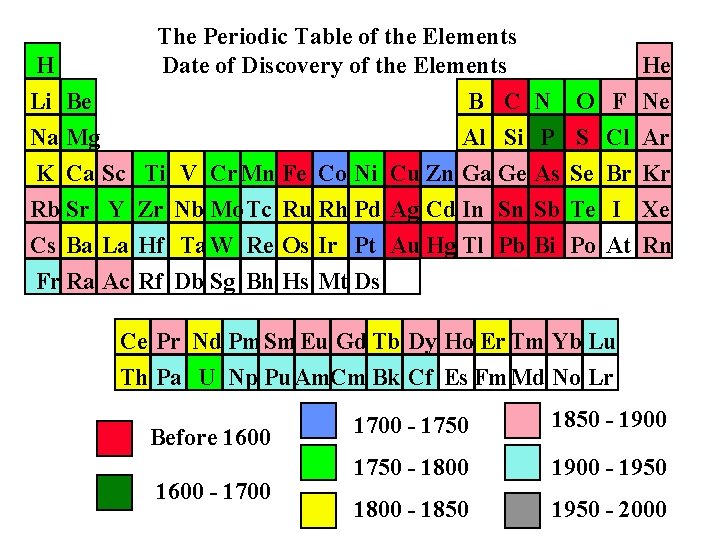
H Li Be Na Mg The Periodic Table of the Elements Date of Discovery of the Elements He B C N O F Ne Al Si P S Cl Ar K Ca Sc Ti Rb Sr Y Zr Cs Ba La Hf Fr Ra Ac Rf V Cr. Mn Fe Co Ni Cu Zn Ga Ge As Se Br Kr Nb Mo Tc Ru Rh Pd Ag Cd In Sn Sb Te I Xe Ta W Re Os Ir Pt Au Hg Tl Pb Bi Po At Rn Db Sg Bh Hs Mt Ds Ce Pr Nd Pm Sm Eu Gd Tb Dy Ho Er Tm Yb Lu Th Pa U Np Pu. Am. Cm Bk Cf Es Fm. Md No Lr Before 1600 1700 - 1750 1850 - 1900 1600 - 1700 1750 - 1800 1900 - 1950 1800 - 1850 1950 - 2000
H Li Be Na Mg The Periodic Table of the Elements Date of Discovery of the Elements He B C N O F Ne Al Si P S Cl Ar K Ca Sc Ti Rb Sr Y Zr Cs Ba La Hf Fr Ra Ac Rf V Cr. Mn Fe Co Ni Cu Zn Ga Ge As Se Br Kr Nb Mo Tc Ru Rh Pd Ag Cd In Sn Sb Te I Xe Ta W Re Os Ir Pt Au Hg Tl Pb Bi Po At Rn Db Sg Bh Hs Mt Ds Ce Pr Nd Pm Sm Eu Gd Tb Dy Ho Er Tm Yb Lu Th Pa U Np Pu. Am. Cm Bk Cf Es Fm. Md No Lr Before 1600 - 1700 - 1750 1850 - 1900 1750 - 1800 1900 - 1950 1800 - 1850 1950 - 2000
H Li Be Na Mg The Periodic Table of the Elements Date of Discovery of the Elements He B C N O F Ne Al Si P S Cl Ar K Ca Sc Ti Rb Sr Y Zr Cs Ba La Hf Fr Ra Ac Rf V Cr. Mn Fe Co Ni Cu Zn Ga Ge As Se Br Kr Nb Mo Tc Ru Rh Pd Ag Cd In Sn Sb Te I Xe Ta W Re Os Ir Pt Au Hg Tl Pb Bi Po At Rn Db Sg Bh Hs Mt Ds Ce Pr Nd Pm. Sm Eu Gd Tb Dy Ho Er Tm Yb Lu Th Pa U Np Pu. Am. Cm Bk Cf Es Fm. Md No Lr Before 1600 - 1700 - 1750 1850 - 1900 1750 - 1800 1900 - 1950 1800 - 1850 1950 - 2000
The Periodic Table of the Elements Date of Discovery of the Elements He B C N O F Ne Al Si P S Cl Ar H Li Be Na Mg K Ca Sc Rb Sr Y Cs Ba La Fr Ra Ac Ti Zr Hf Rf V Cr. Mn Fe Co Ni Cu Zn Ga Ge As Se Br Kr Nb Mo Tc Ru Rh Pd Ag Cd In Sn Sb Te I Xe Ta W Re Os Ir Pt Au Hg Tl Pb Bi Po At Rn Db Sg Bh Hs Mt Ds Ce Pr Nd Pm Sm Eu Gd Tb Dy Ho Er Tm Yb Lu Th Pa U Np Pu. Am. Cm Bk Cf Es Fm. Md No Lr Before 1600 - 1700 - 1750 1850 - 1900 1750 - 1800 1900 - 1950 1800 - 1850 1950 - 2000
The Periodic Table of the Elements Date of Discovery of the Elements He B C N O F Ne Al Si P S Cl Ar H Li Be Na Mg K Ca Sc Rb Sr Y Cs Ba La Fr Ra Ac Ti Zr Hf Rf V Cr. Mn Fe Co Ni Cu Zn Ga Ge As Se Br Kr Nb Mo Tc Ru Rh Pd Ag Cd In Sn Sb Te I Xe Ta W Re Os Ir Pt Au Hg Tl Pb Bi Po At Rn Db Sg Bh Hs Mt Ds Ce Pr Nd Pm Sm Eu Gd Tb Dy Ho Er Tm Yb Lu Th Pa U Np Pu. Am. Cm Bk Cf Es Fm. Md No Lr Before 1600 - 1700 - 1750 1850 - 1900 1750 - 1800 1900 - 1950 1800 - 1850 1950 - 2000
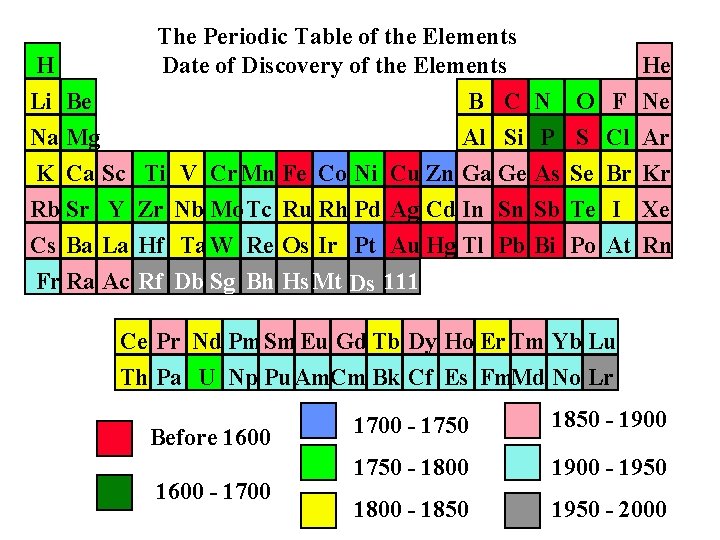
The Periodic Table of the Elements Date of Discovery of the Elements He B C N O F Ne Al Si P S Cl Ar H Li Be Na Mg K Ca Sc Rb Sr Y Cs Ba La Fr Ra Ac Ti Zr Hf Rf V Cr. Mn Fe Co Ni Cu Zn Ga Ge As Se Br Kr Nb Mo Tc Ru Rh Pd Ag Cd In Sn Sb Te I Xe Ta W Re Os Ir Pt Au Hg Tl Pb Bi Po At Rn Db Sg Bh Hs. Mt Ds 111 Ce Pr Nd Pm Sm Eu Gd Tb Dy Ho Er Tm Yb Lu Th Pa U Np Pu. Am. Cm Bk Cf Es Fm. Md No Lr Before 1600 - 1700 - 1750 1850 - 1900 1750 - 1800 1900 - 1950 1800 - 1850 1950 - 2000
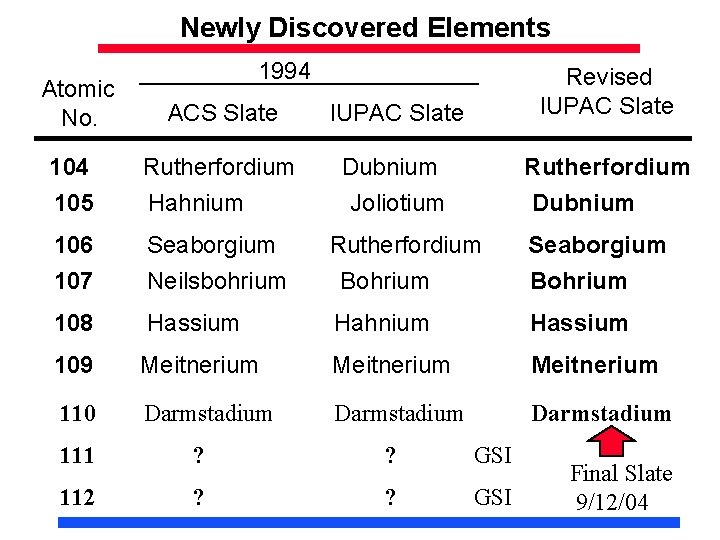
Newly Discovered Elements 1994 Atomic No. ACS Slate IUPAC Slate Revised IUPAC Slate 104 105 Rutherfordium Hahnium Dubnium Joliotium Rutherfordium Dubnium 106 107 Seaborgium Neilsbohrium Rutherfordium Bohrium Seaborgium Bohrium 108 Hassium Hahnium Hassium 109 Meitnerium 110 Darmstadium 111 ? ? GSI 112 ? ? GSI Final Slate 9/12/04
The Periodic Table of the Elements H Li Be Na Mg “ 1997 - 2004” K Ca Sc Ti Rb Sr Y Zr Cs Ba La Hf Fr Ra Ac Rf He B C N O F Ne Al Si P S Cl Ar V Cr. Mn Fe Co Ni Cu Zn Ga Ge As Se Br Kr Nb Mo Tc Ru Rh Pd Ag Cd In Sn Sb Te I Xe Ta W Re Os Ir Pt Au Hg Tl Pb Bi Po At Rn Db Sg Bh Hs Mt Ds Ce Pr Nd Pm Sm Eu Gd Tb Dy Ho Er Tm Yb Lu Th Pa U Np Pu. Am. Cm Bk Cf Es Fm. Md No Lr
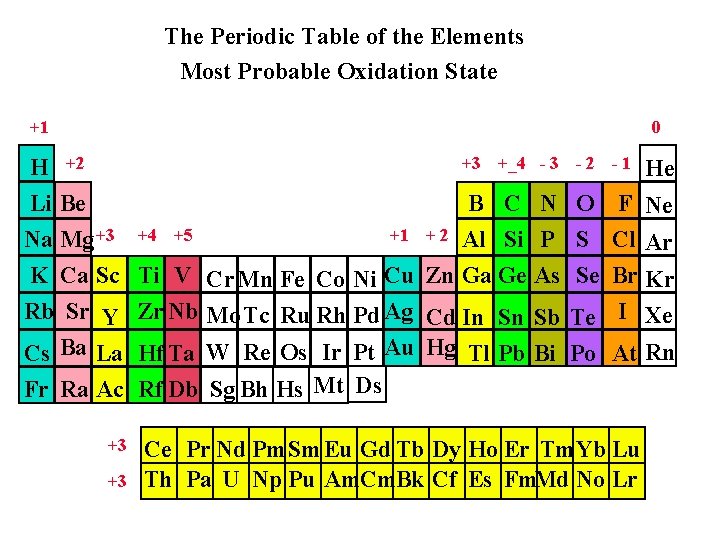
The Periodic Table of the Elements Most Probable Oxidation State +1 0 +3 +_4 - 3 H +2 Li Be B C N +1 + 2 Al Si P Na Mg +3 +4 +5 K Ca Sc Ti V Cr Mn Fe Co Ni Cu Zn Ga Ge As Rb Sr Y Zr Nb Mo Tc Ru Rh Pd Ag Cd In Sn Sb Cs Ba La Hf Ta W Re Os Ir Pt Au Hg Tl Pb Bi Fr Ra Ac Rf Db Sg Bh Hs Mt Ds +3 +3 -2 -1 He O F Ne S Cl Ar Se Br Kr Te I Xe Po At Rn Ce Pr Nd Pm. Sm Eu Gd Tb Dy Ho Er Tm. Yb Lu Th Pa U Np Pu Am. Cm. Bk Cf Es Fm. Md No Lr
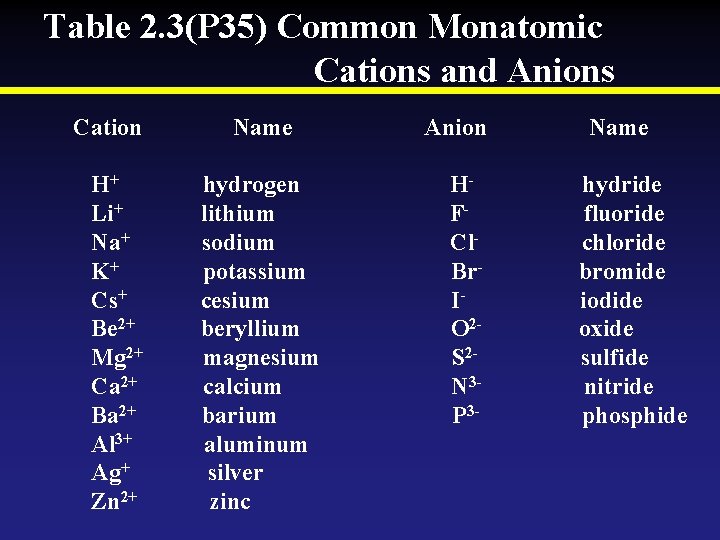
Table 2. 3(P 35) Common Monatomic Cations and Anions Cation H+ Li+ Na+ K+ Cs+ Be 2+ Mg 2+ Ca 2+ Ba 2+ Al 3+ Ag+ Zn 2+ Name hydrogen lithium sodium potassium cesium beryllium magnesium calcium barium aluminum silver zinc Anion HFCl. Br. IO 2 S 2 N 3 P 3 - Name hydride fluoride chloride bromide iodide oxide sulfide nitride phosphide
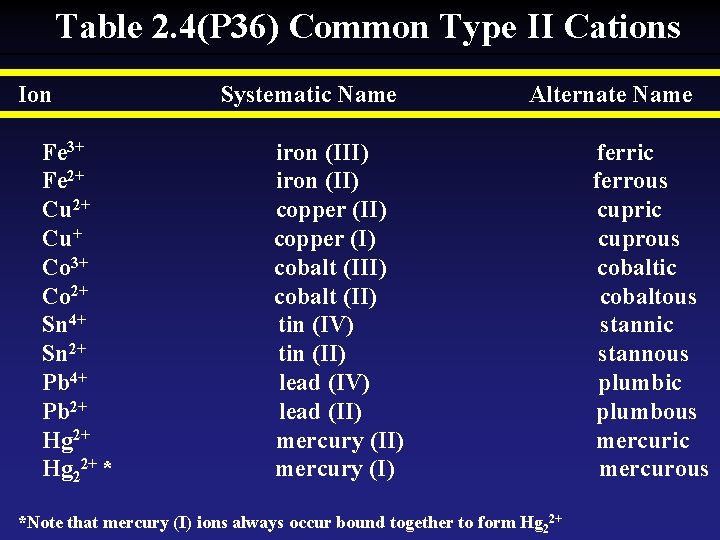
Table 2. 4(P 36) Common Type II Cations Ion Fe 3+ Fe 2+ Cu+ Co 3+ Co 2+ Sn 4+ Sn 2+ Pb 4+ Pb 2+ Hg 22+ * Systematic Name Alternate Name iron (III) iron (II) copper (I) cobalt (II) tin (IV) tin (II) lead (IV) lead (II) mercury (I) *Note that mercury (I) ions always occur bound together to form Hg 22+ ferric ferrous cupric cuprous cobaltic cobaltous stannic stannous plumbic plumbous mercuric mercurous
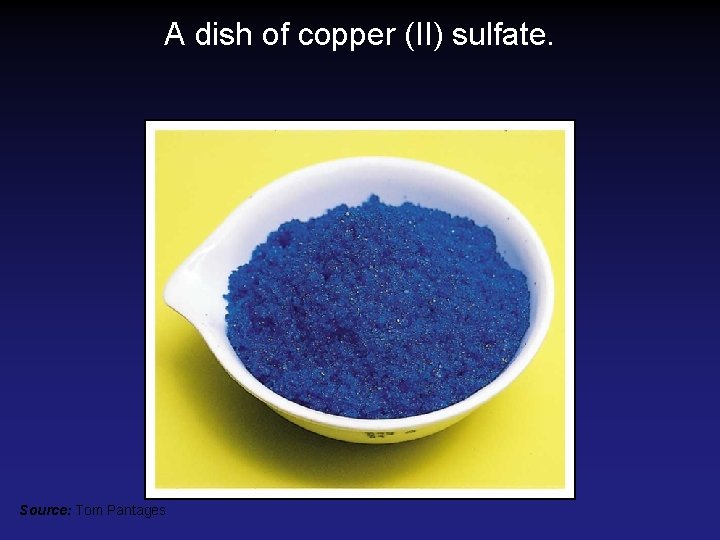
A dish of copper (II) sulfate. Source: Tom Pantages
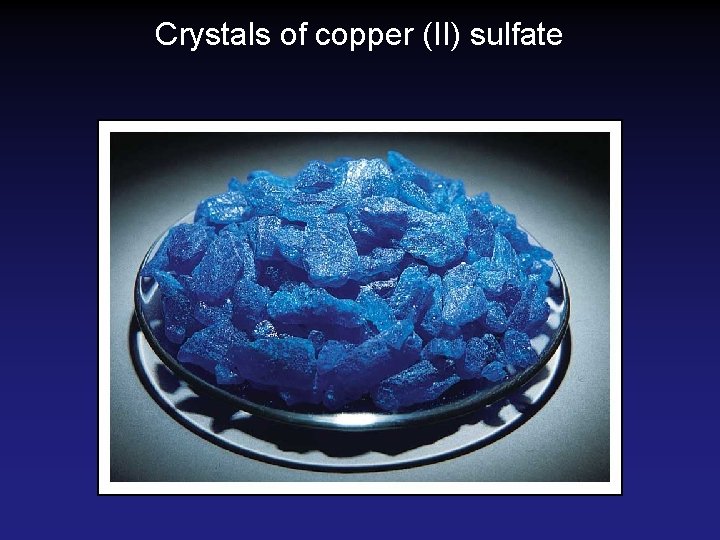
Crystals of copper (II) sulfate
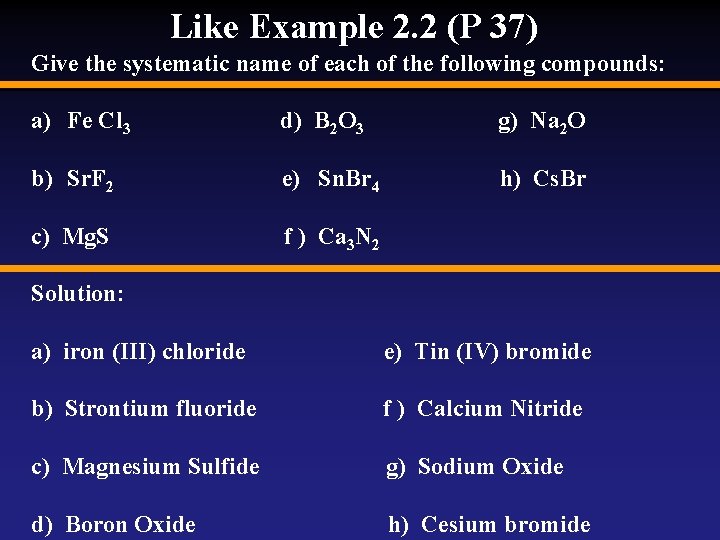
Like Example 2. 2 (P 37) Give the systematic name of each of the following compounds: a) Fe Cl 3 d) B 2 O 3 g) Na 2 O b) Sr. F 2 e) Sn. Br 4 h) Cs. Br c) Mg. S f ) Ca 3 N 2 Solution: a) iron (III) chloride e) Tin (IV) bromide b) Strontium fluoride f ) Calcium Nitride c) Magnesium Sulfide g) Sodium Oxide d) Boron Oxide h) Cesium bromide
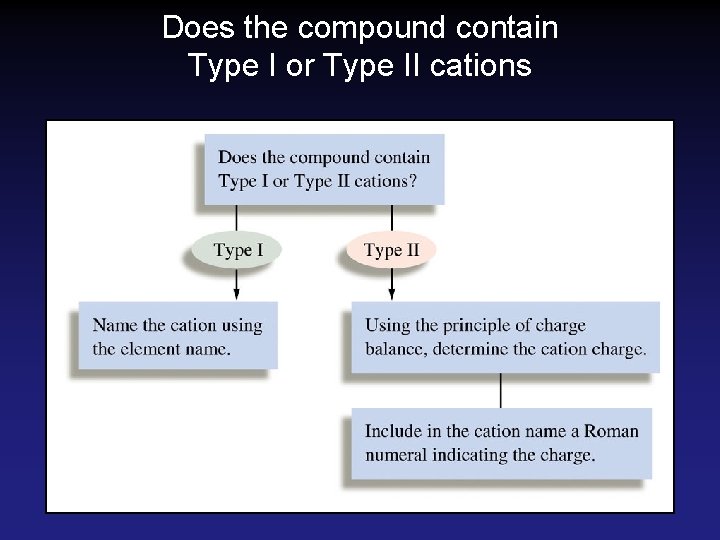
Does the compound contain Type I or Type II cations
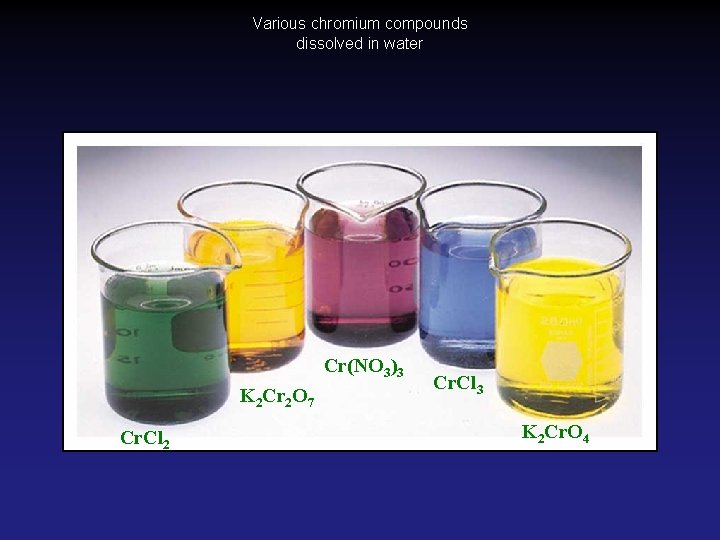
Various chromium compounds dissolved in water Cr(NO 3)3 K 2 Cr 2 O 7 Cr. Cl 2 Cr. Cl 3 K 2 Cr. O 4
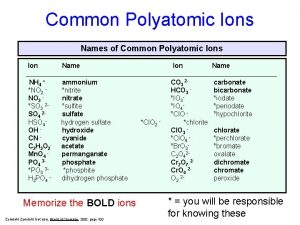
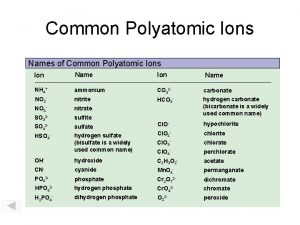
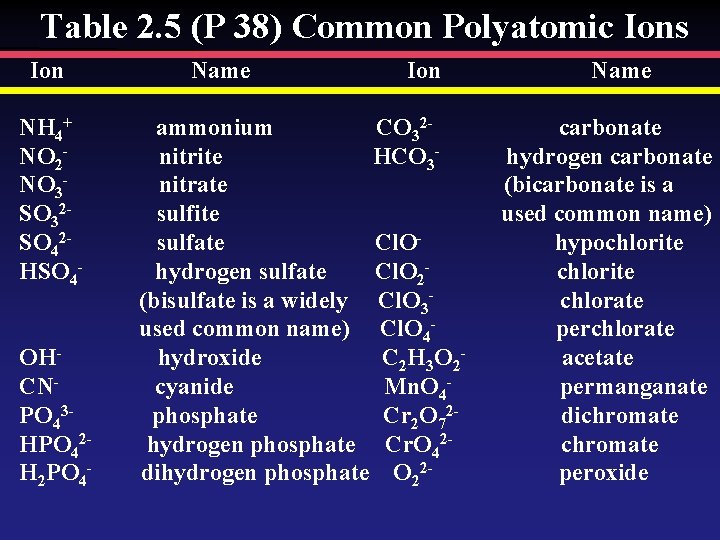
Table 2. 5 (P 38) Common Polyatomic Ions Ion NH 4+ NO 2 NO 3 SO 32 SO 42 HSO 4 OHCNPO 43 HPO 42 H 2 PO 4 - Name Ion ammonium CO 32 nitrite HCO 3 nitrate sulfite sulfate Cl. Ohydrogen sulfate Cl. O 2(bisulfate is a widely Cl. O 3 used common name) Cl. O 4 hydroxide C 2 H 3 O 2 cyanide Mn. O 4 phosphate Cr 2 O 72 hydrogen phosphate Cr. O 42 dihydrogen phosphate O 22 - Name carbonate hydrogen carbonate (bicarbonate is a used common name) hypochlorite chlorate perchlorate acetate permanganate dichromate peroxide
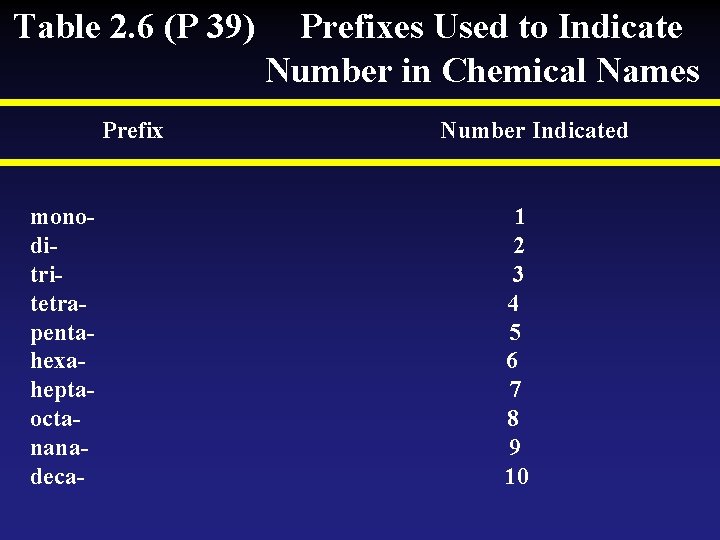
Table 2. 6 (P 39) Prefix monoditritetrapentahexaheptaoctananadeca- Prefixes Used to Indicate Number in Chemical Names Number Indicated 1 2 3 4 5 6 7 8 9 10
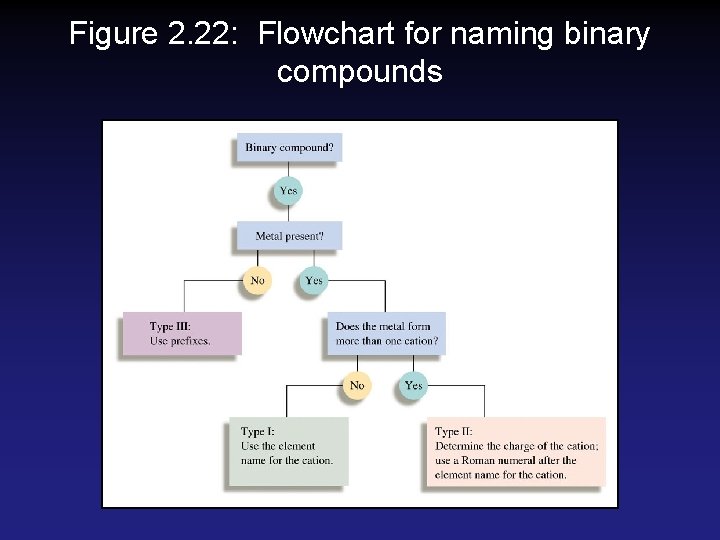
Figure 2. 22: Flowchart for naming binary compounds
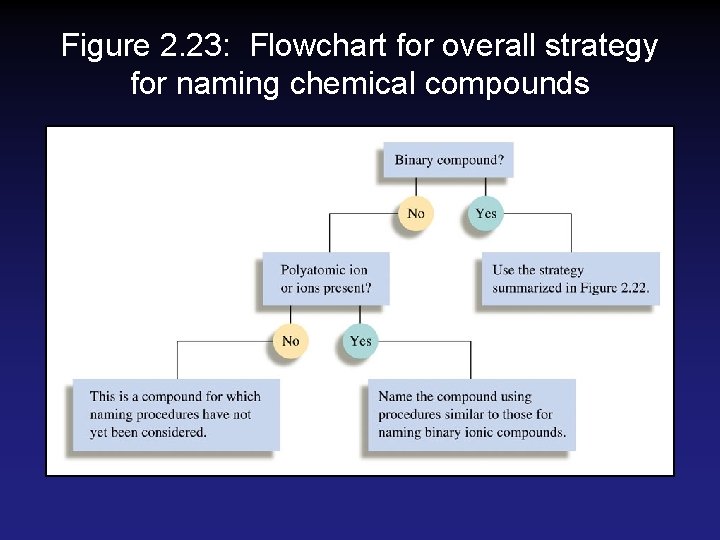
Figure 2. 23: Flowchart for overall strategy for naming chemical compounds
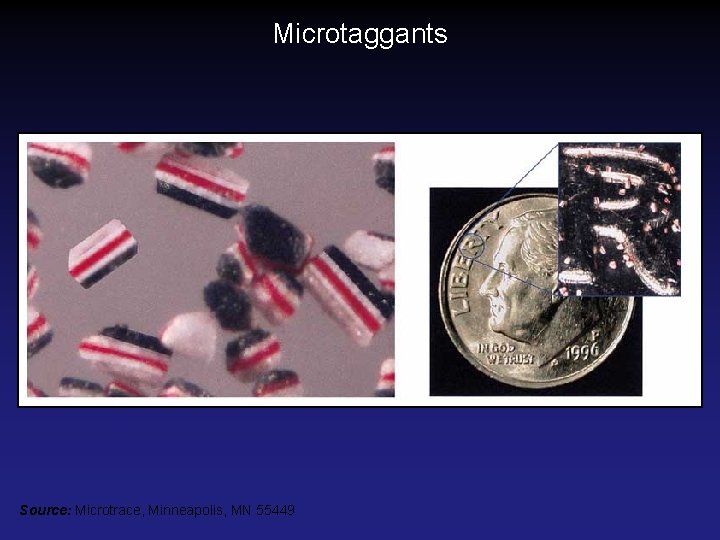
Microtaggants Source: Microtrace, Minneapolis, MN 55449
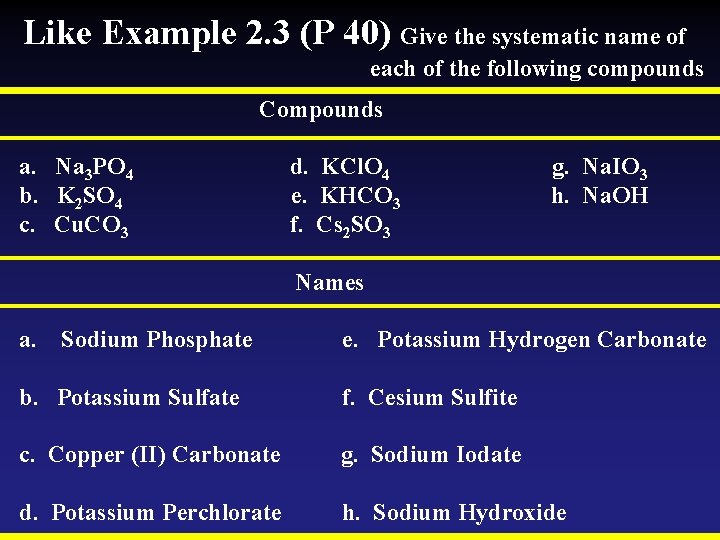
Like Example 2. 3 (P 40) Give the systematic name of each of the following compounds Compounds a. Na 3 PO 4 b. K 2 SO 4 c. Cu. CO 3 d. KCl. O 4 e. KHCO 3 f. Cs 2 SO 3 g. Na. IO 3 h. Na. OH Names a. Sodium Phosphate e. Potassium Hydrogen Carbonate b. Potassium Sulfate f. Cesium Sulfite c. Copper (II) Carbonate g. Sodium Iodate d. Potassium Perchlorate h. Sodium Hydroxide
Like Example 2. 4 (P 42) Give the chemical formula of each of the following compounds Names a. Sodium Peroxide e. Lithium Hydrogen Carbonate b. Chromium (VI) Oxide f. Calcium Carbonate c. Aluminum Oxide g. Copper (II) Chloride d. Ammonium Carbonate h. Magnesium Perchlorate Compounds a. Na 2 O 2 e. Li. HCO 3 b. Cr. O 3 f. Ca. CO 3 c. Al 2 O 3 g. Cu(Cl)2 d. (NH 4)2 CO 3 h. Mg(Cl. O 4)2
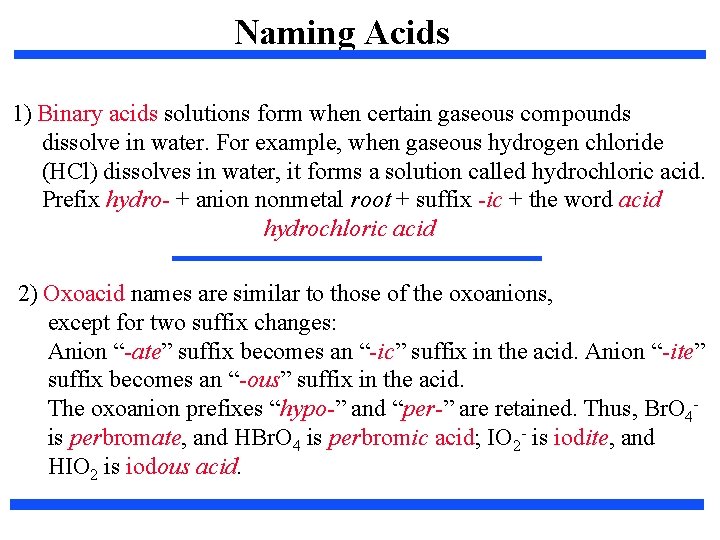
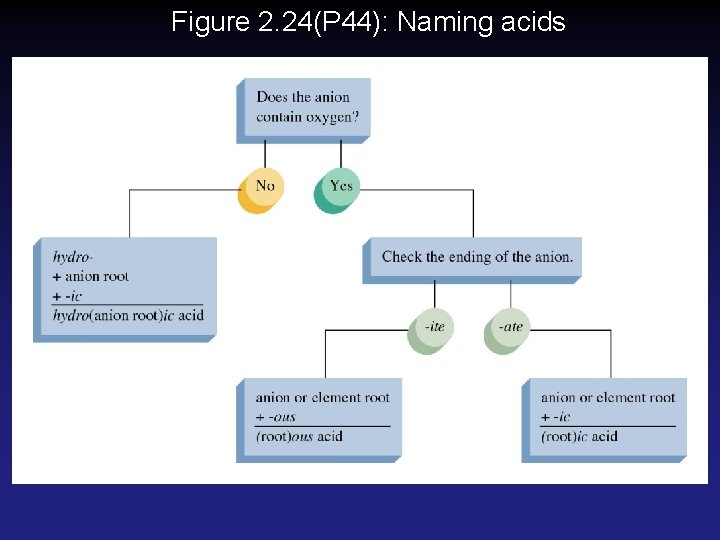
Naming Acids 1) Binary acids solutions form when certain gaseous compounds dissolve in water. For example, when gaseous hydrogen chloride (HCl) dissolves in water, it forms a solution called hydrochloric acid. Prefix hydro- + anion nonmetal root + suffix -ic + the word acid hydrochloric acid 2) Oxoacid names are similar to those of the oxoanions, except for two suffix changes: Anion “-ate” suffix becomes an “-ic” suffix in the acid. Anion “-ite” suffix becomes an “-ous” suffix in the acid. The oxoanion prefixes “hypo-” and “per-” are retained. Thus, Br. O 4 is perbromate, and HBr. O 4 is perbromic acid; IO 2 - is iodite, and HIO 2 is iodous acid.
Figure 2. 24(P 44): Naming acids
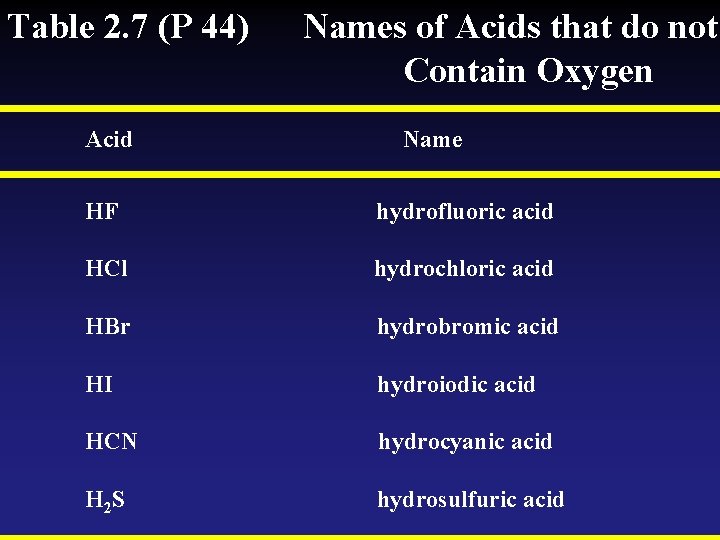
Table 2. 7 (P 44) Acid Names of Acids that do not Contain Oxygen Name HF hydrofluoric acid HCl hydrochloric acid HBr hydrobromic acid HI hydroiodic acid HCN hydrocyanic acid H 2 S hydrosulfuric acid
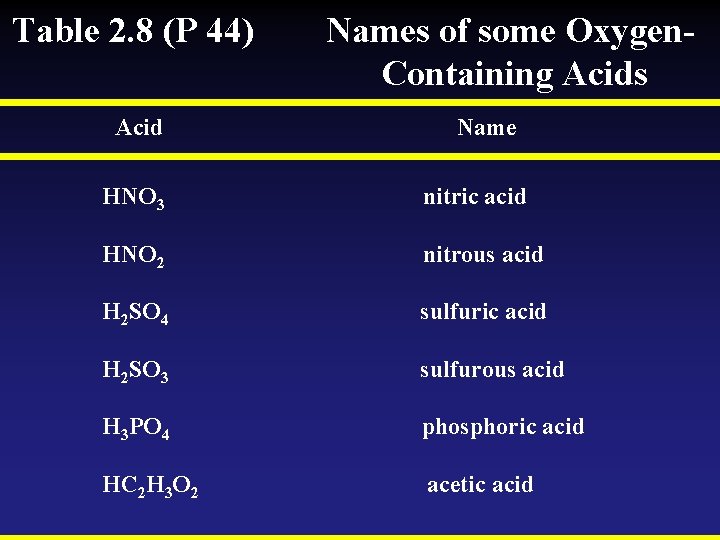
Table 2. 8 (P 44) Acid Names of some Oxygen. Containing Acids Name HNO 3 nitric acid HNO 2 nitrous acid H 2 SO 4 sulfuric acid H 2 SO 3 sulfurous acid H 3 PO 4 phosphoric acid HC 2 H 3 O 2 acetic acid
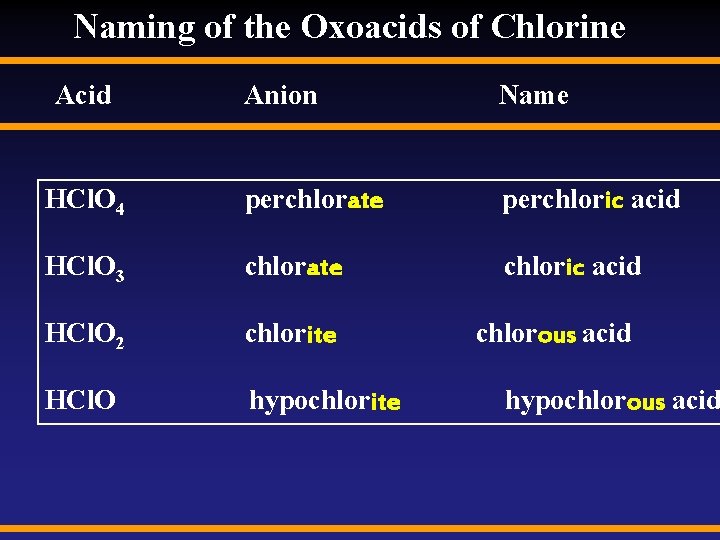
Naming of the Oxoacids of Chlorine Acid Anion Name HCl. O 4 perchlorate perchloric acid HCl. O 3 chlorate chloric acid HCl. O 2 chlorite HCl. O hypochlorite chlorous acid hypochlorous acid
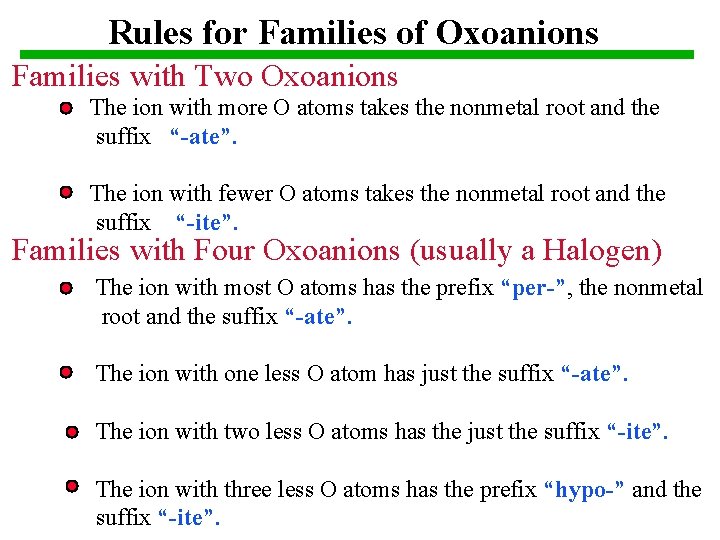
Rules for Families of Oxoanions Families with Two Oxoanions The ion with more O atoms takes the nonmetal root and the suffix “-ate”. The ion with fewer O atoms takes the nonmetal root and the suffix “-ite”. Families with Four Oxoanions (usually a Halogen) The ion with most O atoms has the prefix “per-”, the nonmetal root and the suffix “-ate”. The ion with one less O atom has just the suffix “-ate”. The ion with two less O atoms has the just the suffix “-ite”. The ion with three less O atoms has the prefix “hypo-” and the suffix “-ite”.
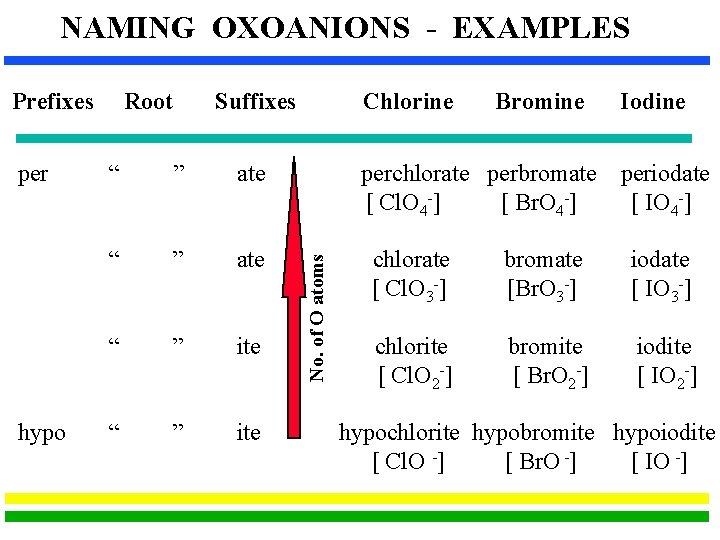
NAMING OXOANIONS - EXAMPLES per hypo Root Suffixes “ ” ate “ ” ite Chlorine Bromine perchlorate perbromate [ Cl. O 4 -] [ Br. O 4 -] No. of O atoms Prefixes Iodine periodate [ IO 4 -] chlorate [ Cl. O 3 -] bromate [Br. O 3 -] iodate [ IO 3 -] chlorite [ Cl. O 2 -] bromite [ Br. O 2 -] iodite [ IO 2 -] hypochlorite hypobromite hypoiodite [ Cl. O -] [ Br. O -] [ IO -]
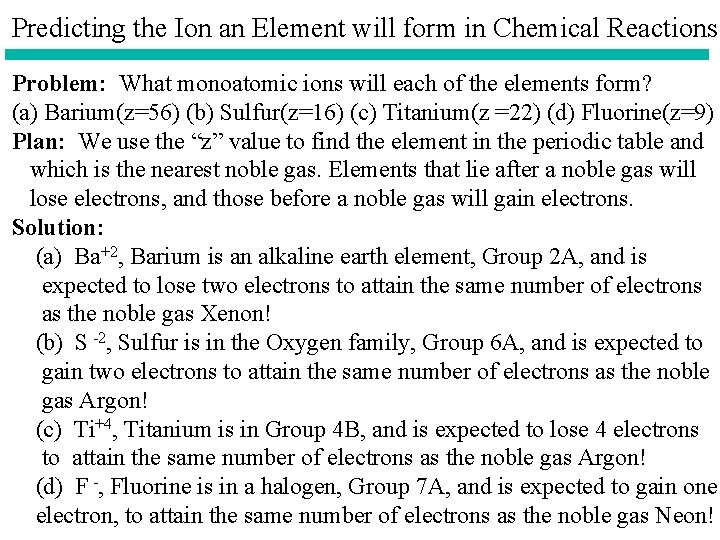
Predicting the Ion an Element will form in Chemical Reactions Problem: What monoatomic ions will each of the elements form? (a) Barium(z=56) (b) Sulfur(z=16) (c) Titanium(z =22) (d) Fluorine(z=9) Plan: We use the “z” value to find the element in the periodic table and which is the nearest noble gas. Elements that lie after a noble gas will lose electrons, and those before a noble gas will gain electrons. Solution: (a) Ba+2, Barium is an alkaline earth element, Group 2 A, and is expected to lose two electrons to attain the same number of electrons as the noble gas Xenon! (b) S -2, Sulfur is in the Oxygen family, Group 6 A, and is expected to gain two electrons to attain the same number of electrons as the noble gas Argon! (c) Ti+4, Titanium is in Group 4 B, and is expected to lose 4 electrons to attain the same number of electrons as the noble gas Argon! (d) F -, Fluorine is in a halogen, Group 7 A, and is expected to gain one electron, to attain the same number of electrons as the noble gas Neon!
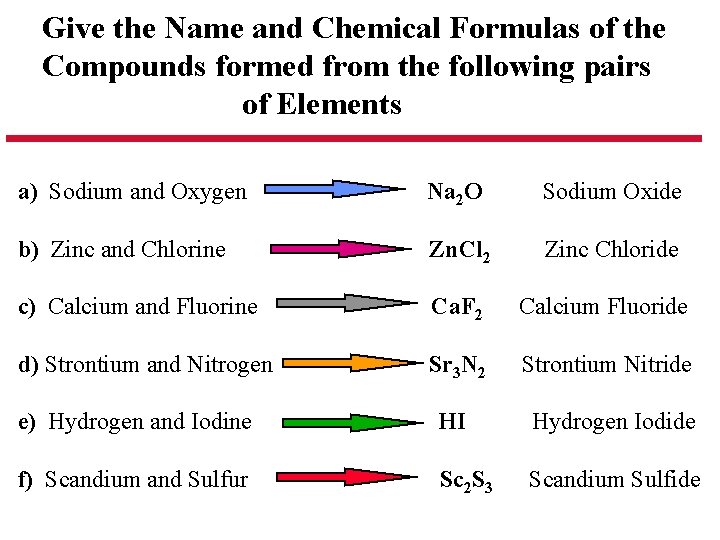
Give the Name and Chemical Formulas of the Compounds formed from the following pairs of Elements a) Sodium and Oxygen Na 2 O Sodium Oxide b) Zinc and Chlorine Zn. Cl 2 Zinc Chloride c) Calcium and Fluorine Ca. F 2 Calcium Fluoride d) Strontium and Nitrogen Sr 3 N 2 Strontium Nitride e) Hydrogen and Iodine HI Hydrogen Iodide f) Scandium and Sulfur Sc 2 S 3 Scandium Sulfide
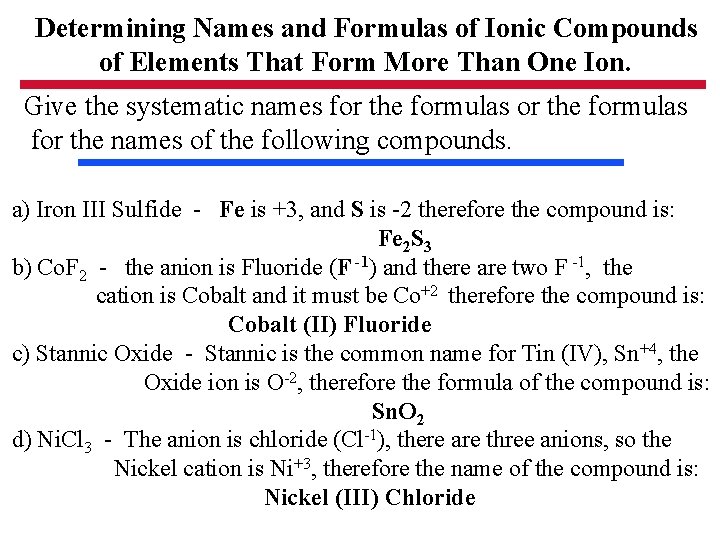
Determining Names and Formulas of Ionic Compounds of Elements That Form More Than One Ion. Give the systematic names for the formulas for the names of the following compounds. a) Iron III Sulfide - Fe is +3, and S is -2 therefore the compound is: Fe 2 S 3 b) Co. F 2 - the anion is Fluoride (F -1) and there are two F -1, the cation is Cobalt and it must be Co+2 therefore the compound is: Cobalt (II) Fluoride c) Stannic Oxide - Stannic is the common name for Tin (IV), Sn+4, the Oxide ion is O-2, therefore the formula of the compound is: Sn. O 2 d) Ni. Cl 3 - The anion is chloride (Cl-1), there are three anions, so the Nickel cation is Ni+3, therefore the name of the compound is: Nickel (III) Chloride
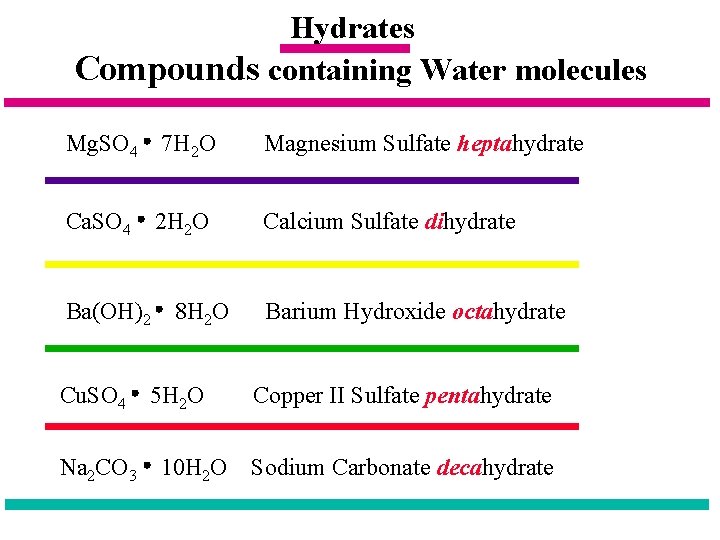
Hydrates Compounds containing Water molecules Mg. SO 4 7 H 2 O Magnesium Sulfate heptahydrate Ca. SO 4 2 H 2 O Calcium Sulfate dihydrate Ba(OH)2 8 H 2 O Barium Hydroxide octahydrate Cu. SO 4 5 H 2 O Copper II Sulfate pentahydrate Na 2 CO 3 10 H 2 O Sodium Carbonate decahydrate
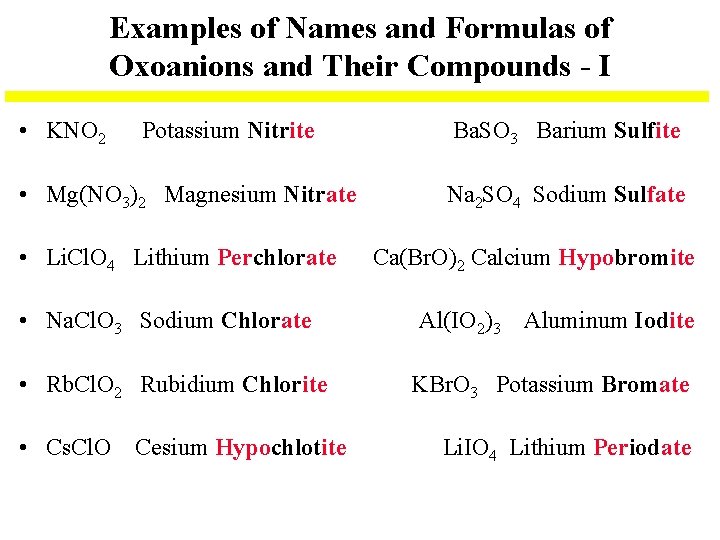
Examples of Names and Formulas of Oxoanions and Their Compounds - I • KNO 2 Potassium Nitrite • Mg(NO 3)2 Magnesium Nitrate • Li. Cl. O 4 Lithium Perchlorate • Na. Cl. O 3 Sodium Chlorate • Rb. Cl. O 2 Rubidium Chlorite • Cs. Cl. O Cesium Hypochlotite Ba. SO 3 Barium Sulfite Na 2 SO 4 Sodium Sulfate Ca(Br. O)2 Calcium Hypobromite Al(IO 2)3 Aluminum Iodite KBr. O 3 Potassium Bromate Li. IO 4 Lithium Periodate
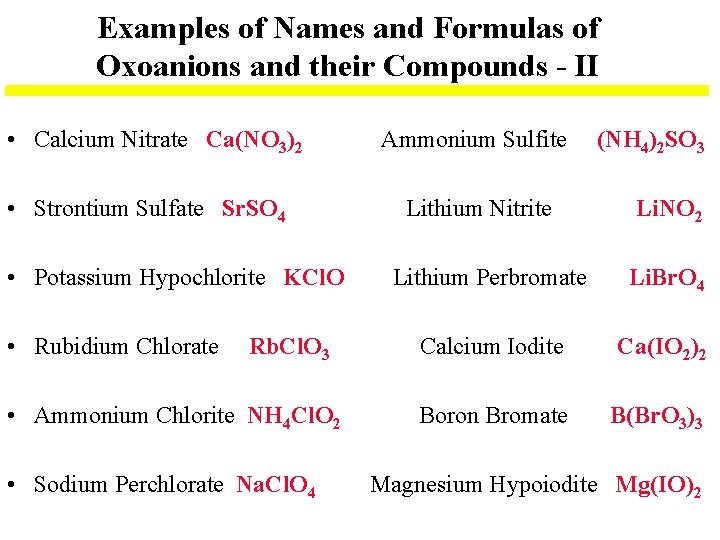
Examples of Names and Formulas of Oxoanions and their Compounds - II • Calcium Nitrate Ca(NO 3)2 • Strontium Sulfate Sr. SO 4 • Potassium Hypochlorite KCl. O • Rubidium Chlorate Rb. Cl. O 3 • Ammonium Chlorite NH 4 Cl. O 2 • Sodium Perchlorate Na. Cl. O 4 Ammonium Sulfite Lithium Nitrite (NH 4)2 SO 3 Li. NO 2 Lithium Perbromate Li. Br. O 4 Calcium Iodite Ca(IO 2)2 Boron Bromate B(Br. O 3)3 Magnesium Hypoiodite Mg(IO)2
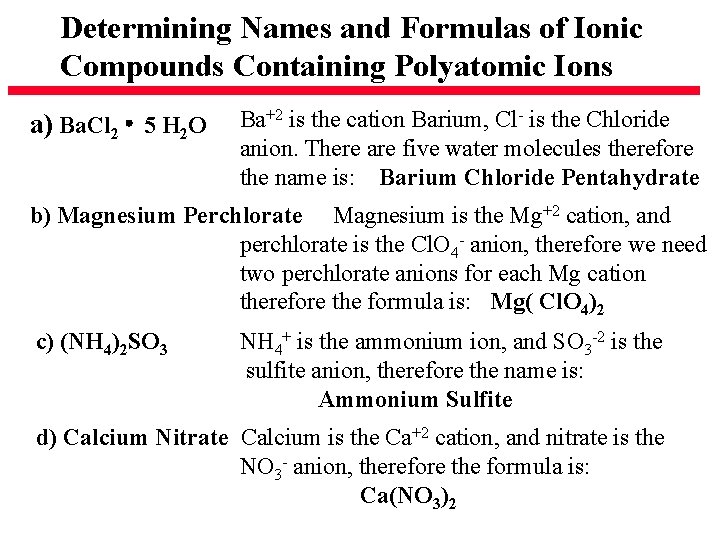
Determining Names and Formulas of Ionic Compounds Containing Polyatomic Ions a) Ba. Cl 2 5 H 2 O Ba+2 is the cation Barium, Cl- is the Chloride anion. There are five water molecules therefore the name is: Barium Chloride Pentahydrate b) Magnesium Perchlorate Magnesium is the Mg+2 cation, and perchlorate is the Cl. O 4 - anion, therefore we need two perchlorate anions for each Mg cation therefore the formula is: Mg( Cl. O 4)2 c) (NH 4)2 SO 3 NH 4+ is the ammonium ion, and SO 3 -2 is the sulfite anion, therefore the name is: Ammonium Sulfite d) Calcium Nitrate Calcium is the Ca+2 cation, and nitrate is the NO 3 - anion, therefore the formula is: Ca(NO 3)2
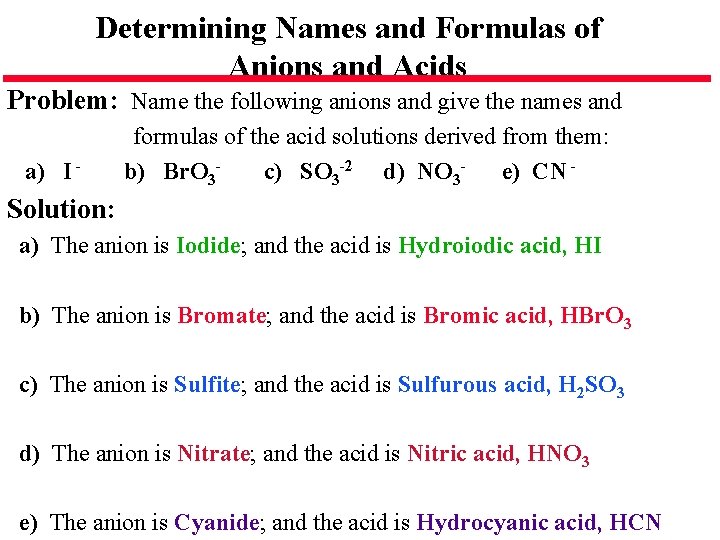
Determining Names and Formulas of Anions and Acids Problem: Name the following anions and give the names and a) I - formulas of the acid solutions derived from them: b) Br. O 3 c) SO 3 -2 d) NO 3 e) CN - Solution: a) The anion is Iodide; and the acid is Hydroiodic acid, HI b) The anion is Bromate; and the acid is Bromic acid, HBr. O 3 c) The anion is Sulfite; and the acid is Sulfurous acid, H 2 SO 3 d) The anion is Nitrate; and the acid is Nitric acid, HNO 3 e) The anion is Cyanide; and the acid is Hydrocyanic acid, HCN
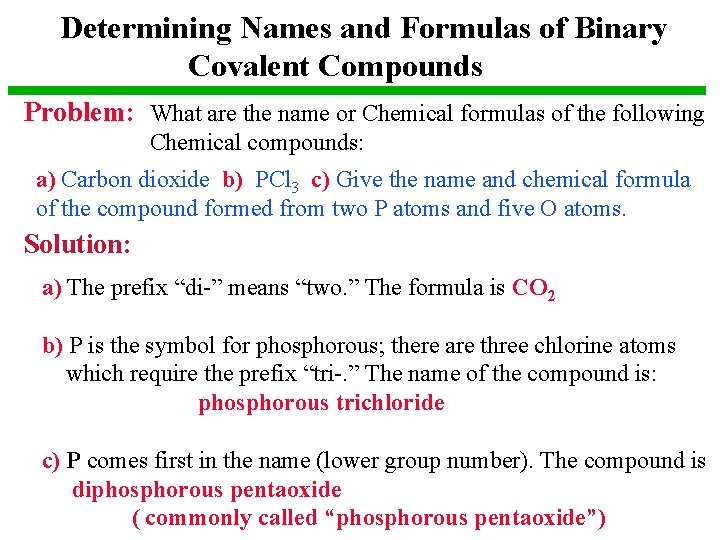
Determining Names and Formulas of Binary Covalent Compounds Problem: What are the name or Chemical formulas of the following Chemical compounds: a) Carbon dioxide b) PCl 3 c) Give the name and chemical formula of the compound formed from two P atoms and five O atoms. Solution: a) The prefix “di-” means “two. ” The formula is CO 2 b) P is the symbol for phosphorous; there are three chlorine atoms which require the prefix “tri-. ” The name of the compound is: phosphorous trichloride c) P comes first in the name (lower group number). The compound is diphosphorous pentaoxide ( commonly called “phosphorous pentaoxide”)
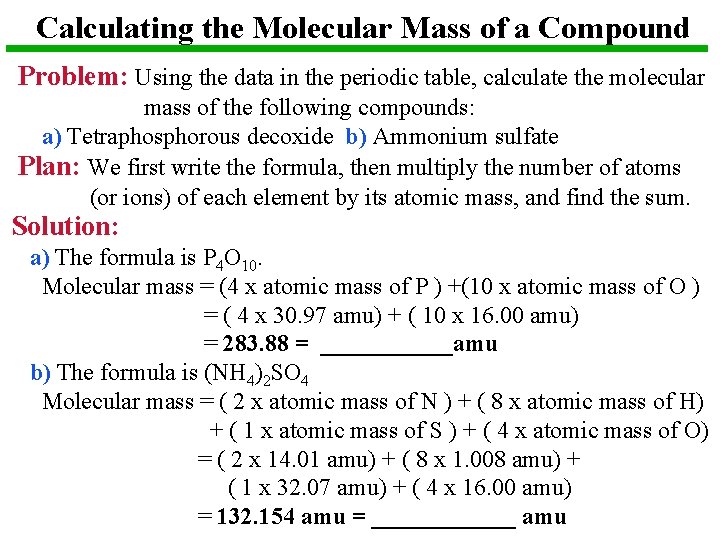
Calculating the Molecular Mass of a Compound Problem: Using the data in the periodic table, calculate the molecular mass of the following compounds: a) Tetraphosphorous decoxide b) Ammonium sulfate Plan: We first write the formula, then multiply the number of atoms (or ions) of each element by its atomic mass, and find the sum. Solution: a) The formula is P 4 O 10. Molecular mass = (4 x atomic mass of P ) +(10 x atomic mass of O ) = ( 4 x 30. 97 amu) + ( 10 x 16. 00 amu) = 283. 88 = ______amu b) The formula is (NH 4)2 SO 4 Molecular mass = ( 2 x atomic mass of N ) + ( 8 x atomic mass of H) + ( 1 x atomic mass of S ) + ( 4 x atomic mass of O) = ( 2 x 14. 01 amu) + ( 8 x 1. 008 amu) + ( 1 x 32. 07 amu) + ( 4 x 16. 00 amu) = 132. 154 amu = ______ amu
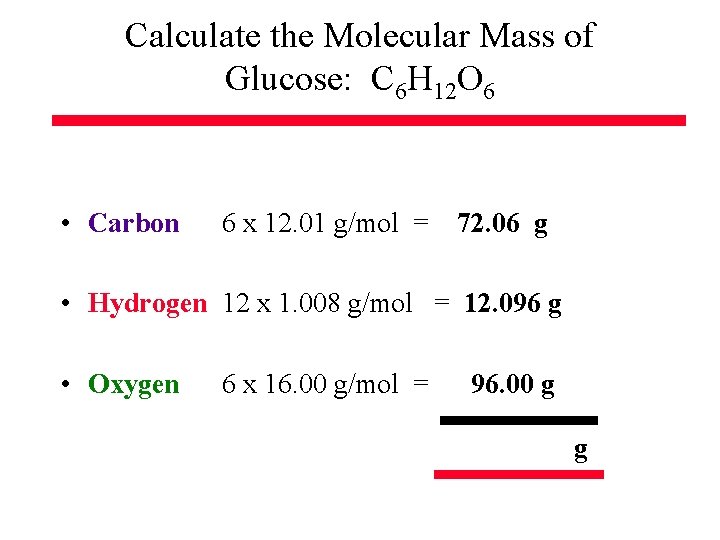
Calculate the Molecular Mass of Glucose: C 6 H 12 O 6 • Carbon 6 x 12. 01 g/mol = 72. 06 g • Hydrogen 12 x 1. 008 g/mol = 12. 096 g • Oxygen 6 x 16. 00 g/mol = 96. 00 g g
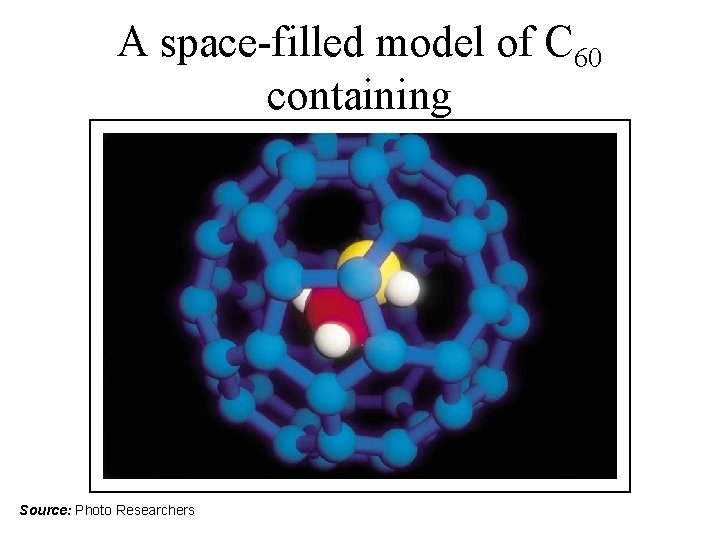
A space-filled model of C 60 containing a "caged" methanol molecule Source: Photo Researchers