
Chapter 19 Properties of Atoms Periodic Table What
Chapter 19 Properties of Atoms Periodic Table
What do you know? • In the 5 th century BCE a Greek philosopher named Leucippus and his student, Democritus, stated, “All matter is made up of particles that cannot be divided called atoms. ” – What do you think atoms are? Unit 1 • Investigation III
Essential Question How have chemists thought about the atom through history? Unit 1 • Investigation III
You will be able to: – Describe some models of an atom and explain how they differ. Unit 1 • Investigation III
Notes – Atoms are extremely small particles, which cannot be seen, even with microscopes. – All matter is made up of atoms. – Scientists have created models to describe atoms. Models are similar to theories, but often include a picture or physical representation. (cont. ) Unit 1 • Investigation III
(cont. ) – When a model is supported by scientific evidence it is often accepted by the scientific community. – Scientific evidence is a collection of observations that many people have made. Everyone agrees on the same collection of observations. – As new evidence is gathered, models are refined and changed. Unit 1 • Investigation III
Activity • Purpose: This lesson will introduce you to various models for the atom that have appeared over the past two hundred years. The descriptions of five models of the atom are on a separate handout. (cont. ) Unit 1 • Investigation III
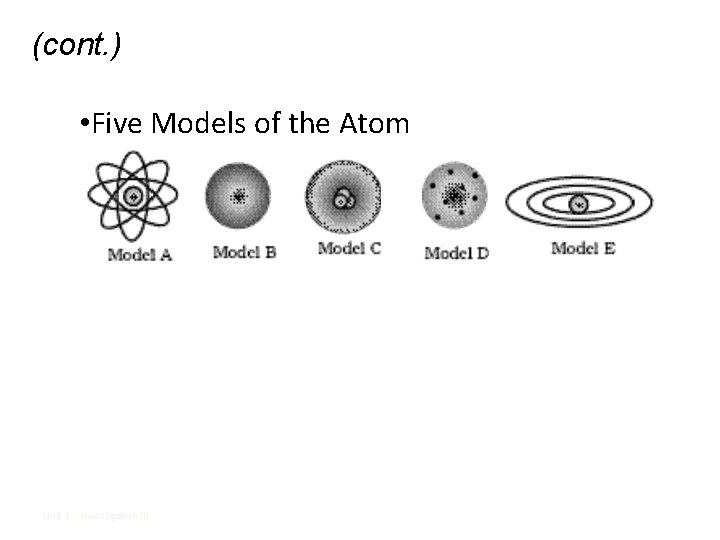
(cont. ) • Five Models of the Atom Unit 1 • Investigation III
Making Sense – Examine the date of the atomic evidence and then put the five models in the correct order of their introduction to the world of science. Unit 1 • Investigation III
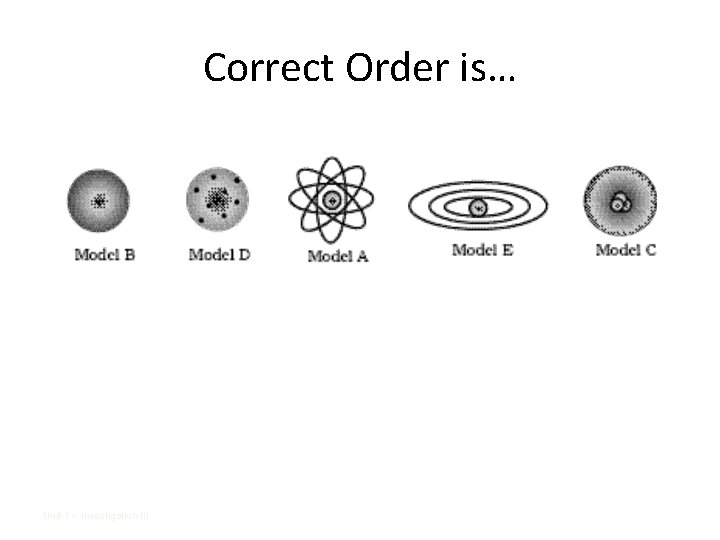
Correct Order is… Unit 1 • Investigation III
Notes – An atom is mostly empty space. – The rest consists of a nucleus, which is located in the very center of the atom, and electrons, which are located around the nucleus. – The nucleus is very small (it would be nothing more than a tiny speck in our drawings, if we were to draw it to scale). (cont. ) Unit 1 • Investigation III
Notes (cont. ) – The nucleus is also very dense and consists of two types of particles— neutrons and protons. – A neutron is a neutral particle with no charge on it. – A proton is a positively charged particle. – Tightly bound together, neutrons and protons make a positively charged nucleus. (cont. ) Unit 1 • Investigation III
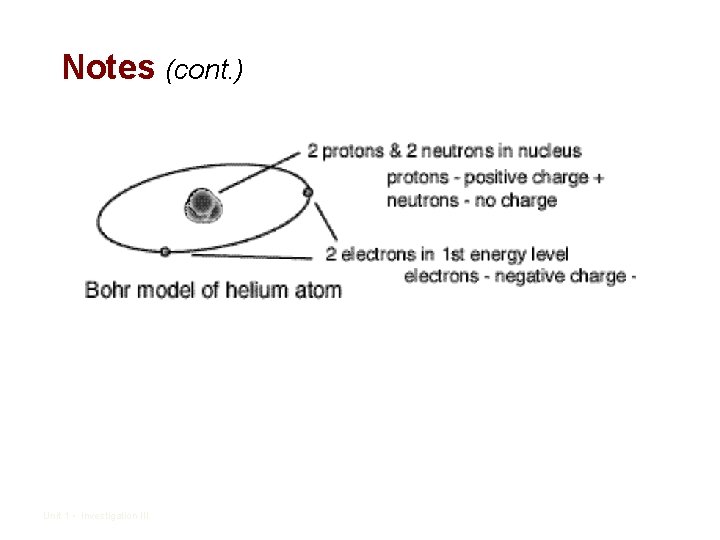
Notes (cont. ) Unit 1 • Investigation III
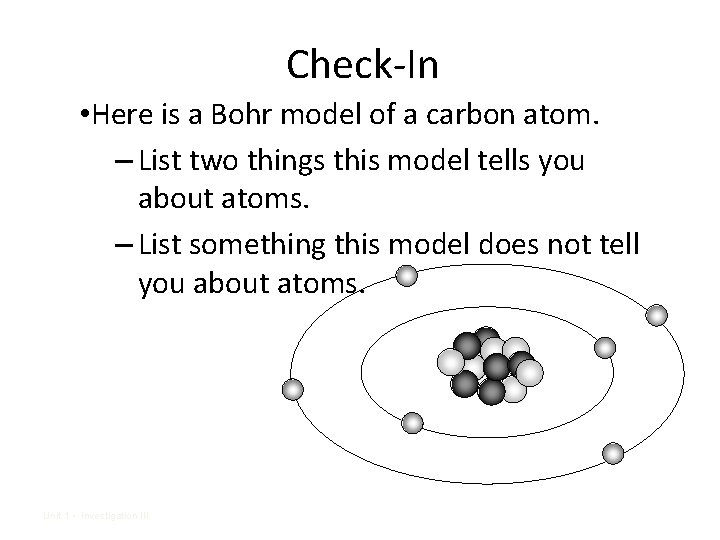
Check-In • Here is a Bohr model of a carbon atom. – List two things this model tells you about atoms. – List something this model does not tell you about atoms. Unit 1 • Investigation III
Wrap-Up – All matter is made up of extremely small particles called atoms. These particles are too small to be seen even with a microscope. – Science is theoretical and dynamic. Models and theories are continually being revised, refined, or replaced with new models and theories. Unit 1 • Investigation III
- Slides: 15