
Chemical Bonding Lesson 1 Ionic Bonds Compounds Remember

Chemical Bonding Lesson 1 – Ionic Bonds & Compounds
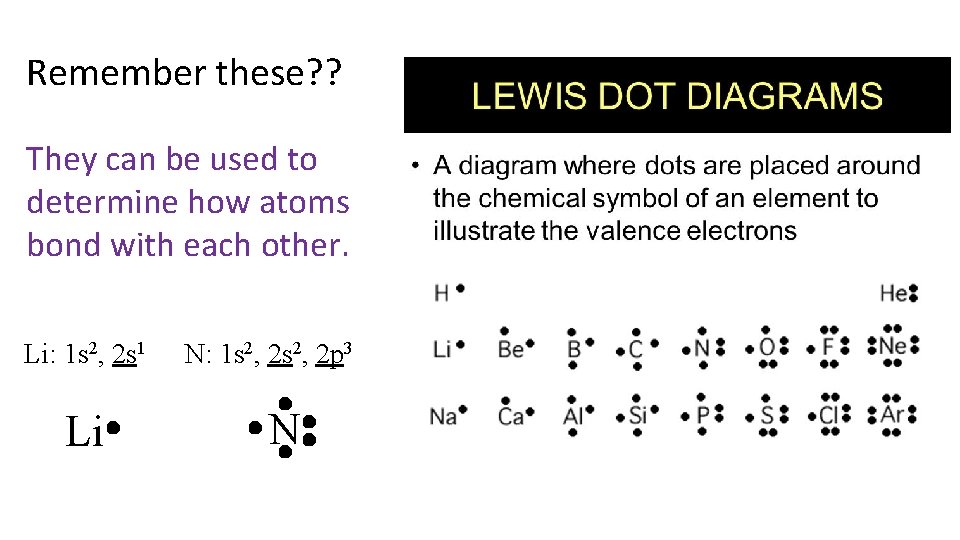
Remember these? ? They can be used to determine how atoms bond with each other. Li: 1 s 2, 2 s 1 Li N: 1 s 2, 2 p 3 N
The Octet Rule • Atoms are most stable when their outermost shell is full • Level 1 = 2 electrons • All other shells = 8 electrons • Noble gases have full outer shell so most do not bond with other atoms • Other atoms lose, gain, or share electrons to get a full outer shell
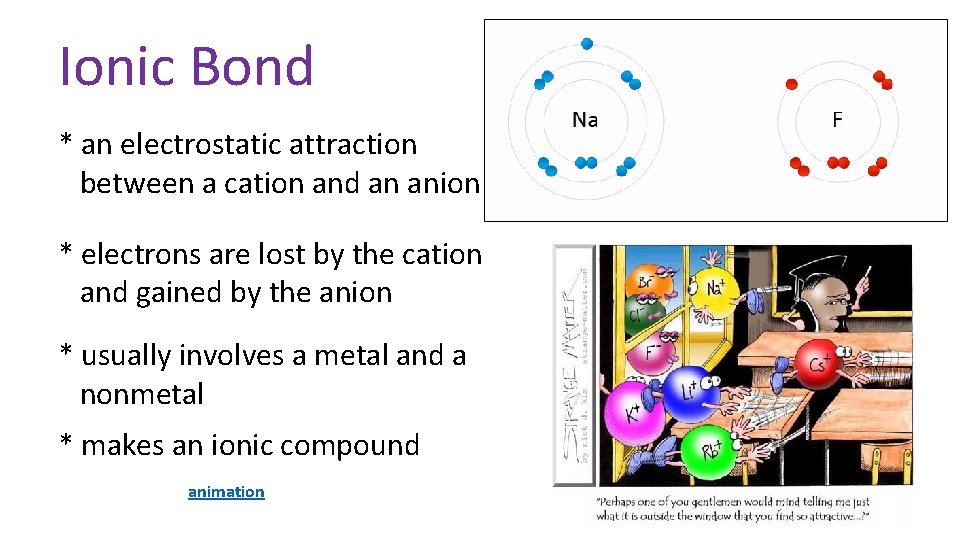
Ionic Bond * an electrostatic attraction between a cation and an anion * electrons are lost by the cation and gained by the anion * usually involves a metal and a nonmetal * makes an ionic compound animation
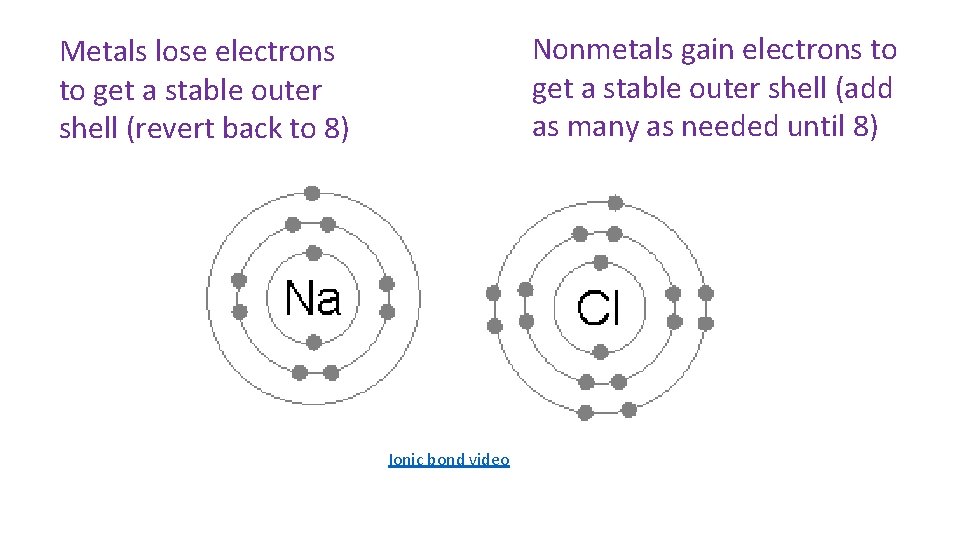
Nonmetals gain electrons to get a stable outer shell (add as many as needed until 8) Metals lose electrons to get a stable outer shell (revert back to 8) Ionic bond video
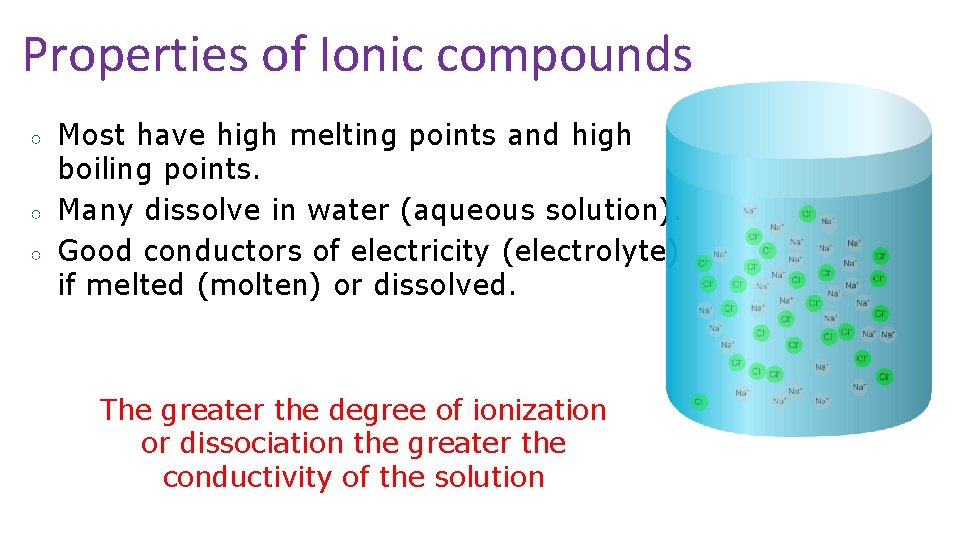
Properties of Ionic compounds ○ ○ ○ Most have high melting points and high boiling points. Many dissolve in water (aqueous solution). Good conductors of electricity (electrolyte) if melted (molten) or dissolved. The greater the degree of ionization or dissociation the greater the conductivity of the solution
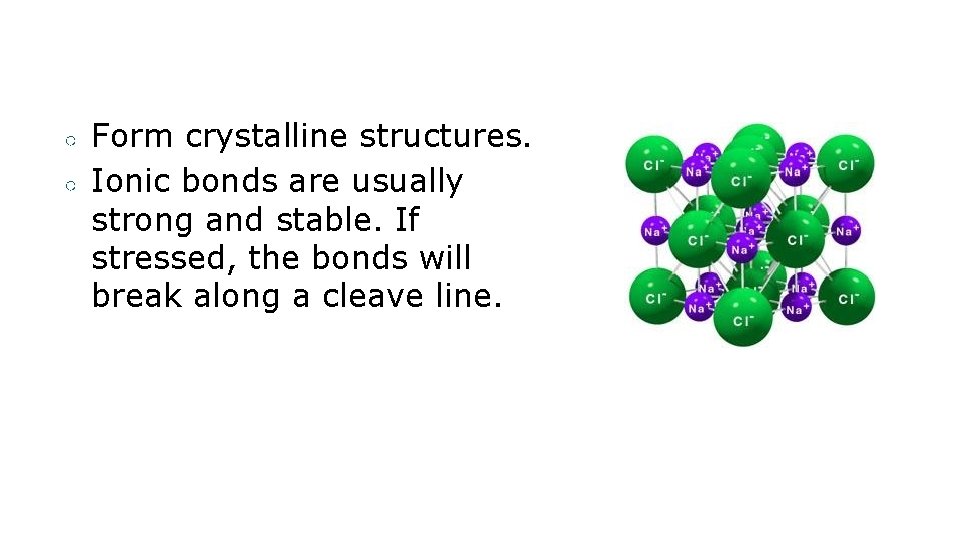
○ ○ Form crystalline structures. Ionic bonds are usually strong and stable. If stressed, the bonds will break along a cleave line.
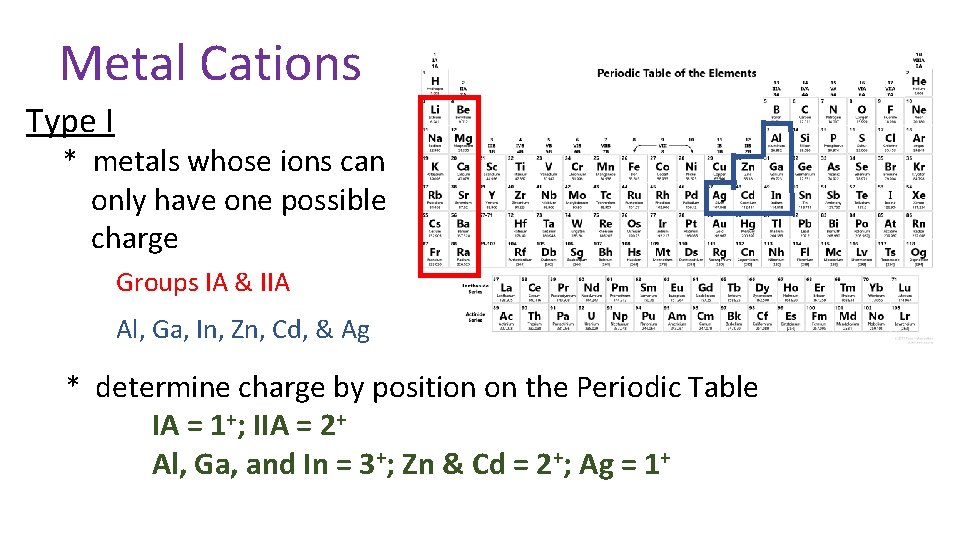
Metal Cations Type I * metals whose ions can only have one possible charge Groups IA & IIA Al, Ga, In, Zn, Cd, & Ag * determine charge by position on the Periodic Table IA = 1+; IIA = 2+ Al, Ga, and In = 3+; Zn & Cd = 2+; Ag = 1+
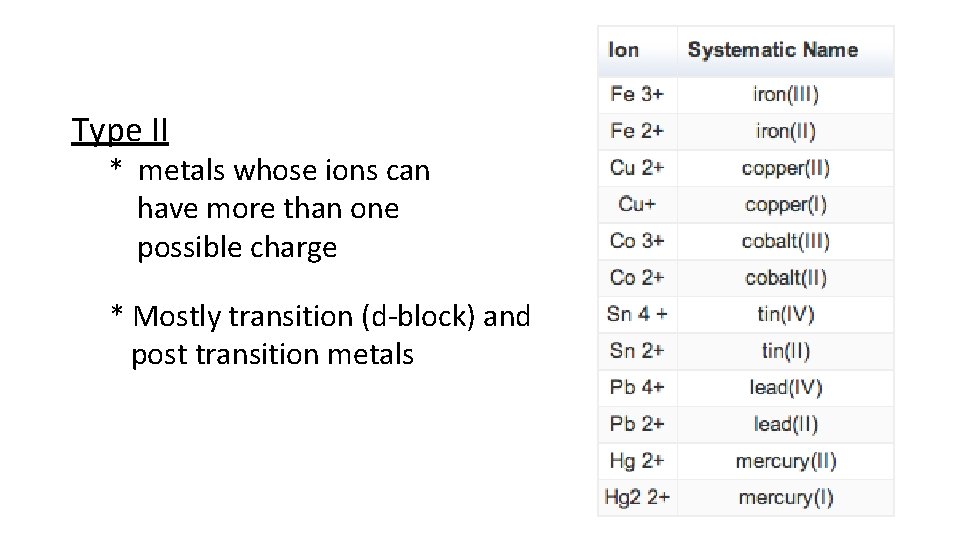
Type II * metals whose ions can have more than one possible charge * Mostly transition (d-block) and post transition metals
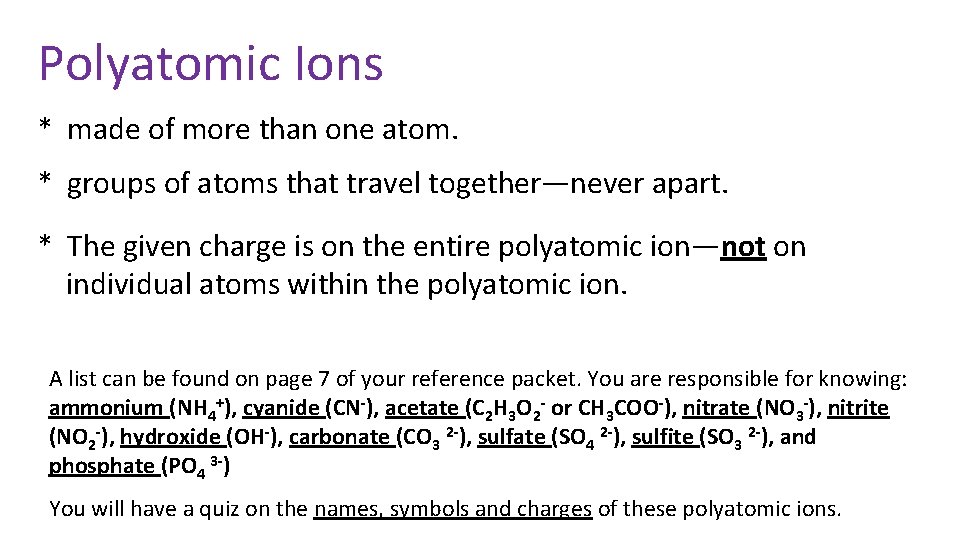
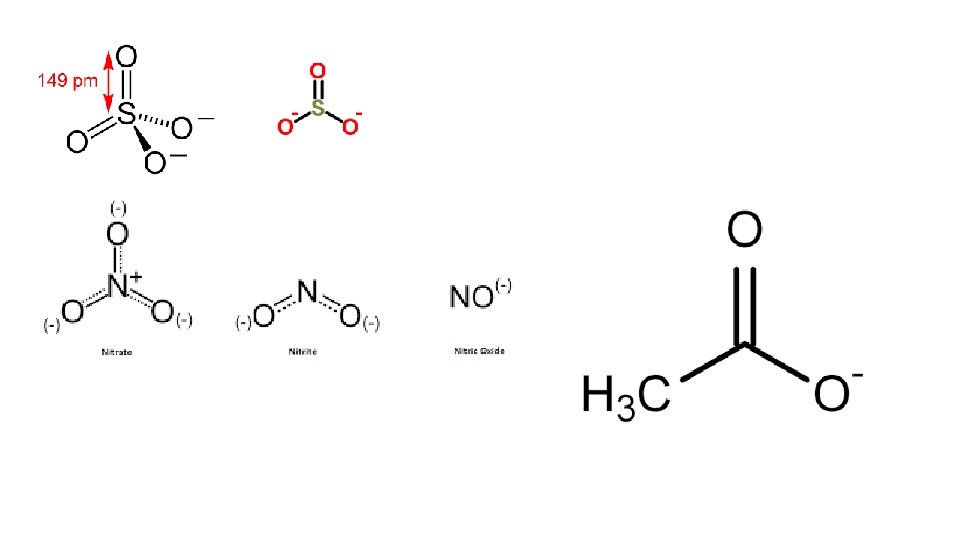
Polyatomic Ions * made of more than one atom. * groups of atoms that travel together—never apart. * The given charge is on the entire polyatomic ion—not on individual atoms within the polyatomic ion. A list can be found on page 7 of your reference packet. You are responsible for knowing: ammonium (NH 4+), cyanide (CN-), acetate (C 2 H 3 O 2 - or CH 3 COO-), nitrate (NO 3 -), nitrite (NO 2 -), hydroxide (OH-), carbonate (CO 3 2 -), sulfate (SO 4 2 -), sulfite (SO 3 2 -), and phosphate (PO 4 3 -) You will have a quiz on the names, symbols and charges of these polyatomic ions.
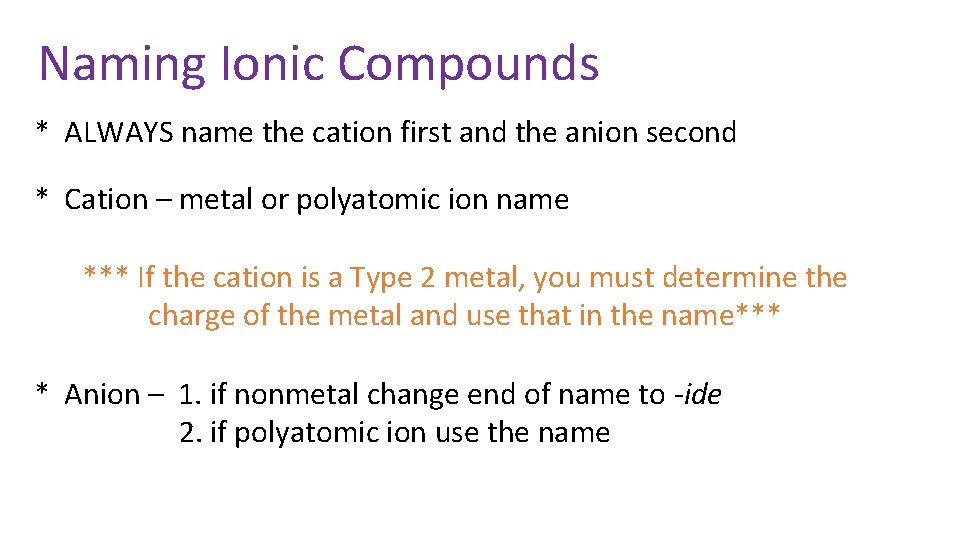
Naming Ionic Compounds * ALWAYS name the cation first and the anion second * Cation – metal or polyatomic ion name *** If the cation is a Type 2 metal, you must determine the charge of the metal and use that in the name*** * Anion – 1. if nonmetal change end of name to -ide 2. if polyatomic ion use the name
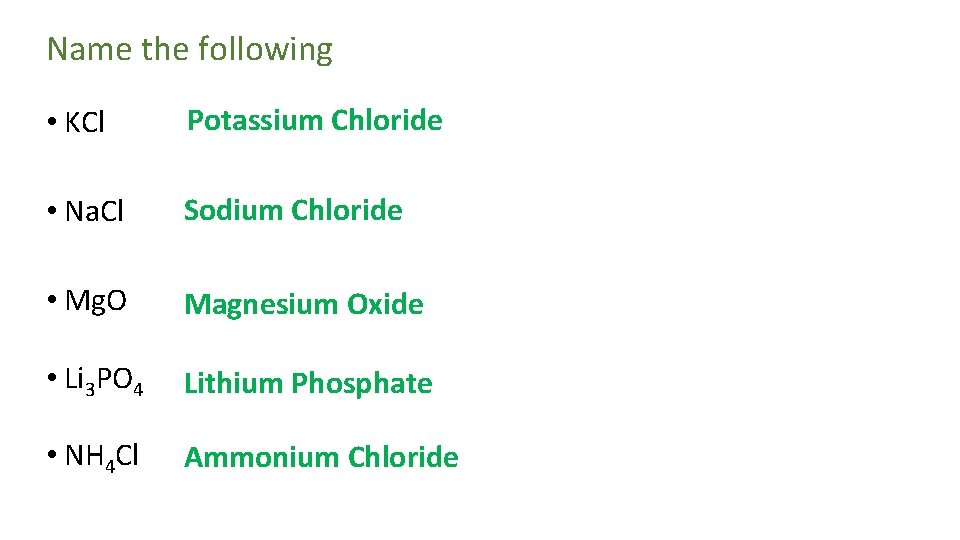
Name the following • KCl Potassium Chloride • Na. Cl Sodium Chloride • Mg. O Magnesium Oxide • Li 3 PO 4 Lithium Phosphate • NH 4 Cl Ammonium Chloride

Writing Formulas ○ ○ ○ Magnesium Fluoride Write the ions that make up the compound Add ions as needed so the compound has a charge of zero Write the number of each ion as a subscript and you have the formula (DO NOT include charges & DO NOT write 1 s) Simplest form = Formula unit Mg+2 F-1 Mg. F 2
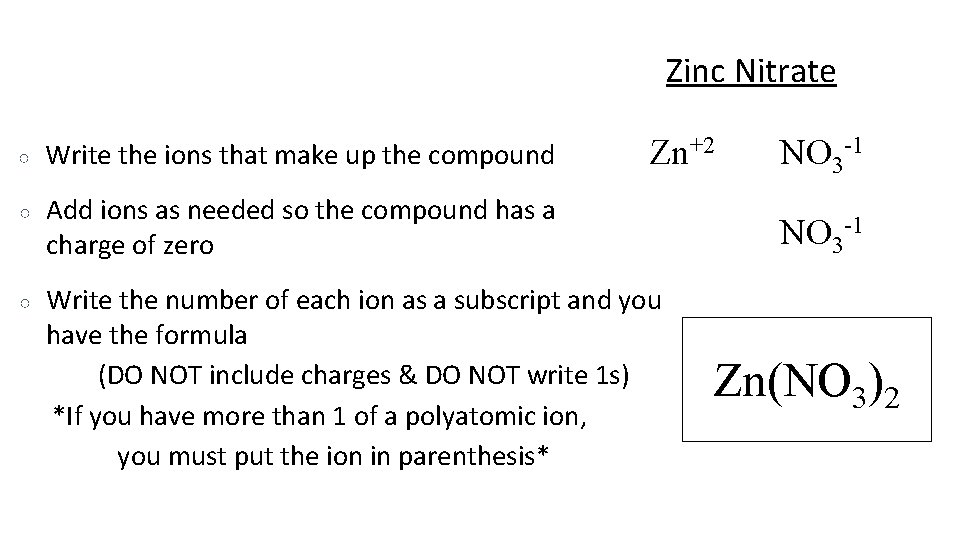
Zinc Nitrate Zn+2 ○ Write the ions that make up the compound ○ Add ions as needed so the compound has a charge of zero ○ Write the number of each ion as a subscript and you have the formula (DO NOT include charges & DO NOT write 1 s) *If you have more than 1 of a polyatomic ion, you must put the ion in parenthesis* NO 3 -1 Zn(NO 3)2
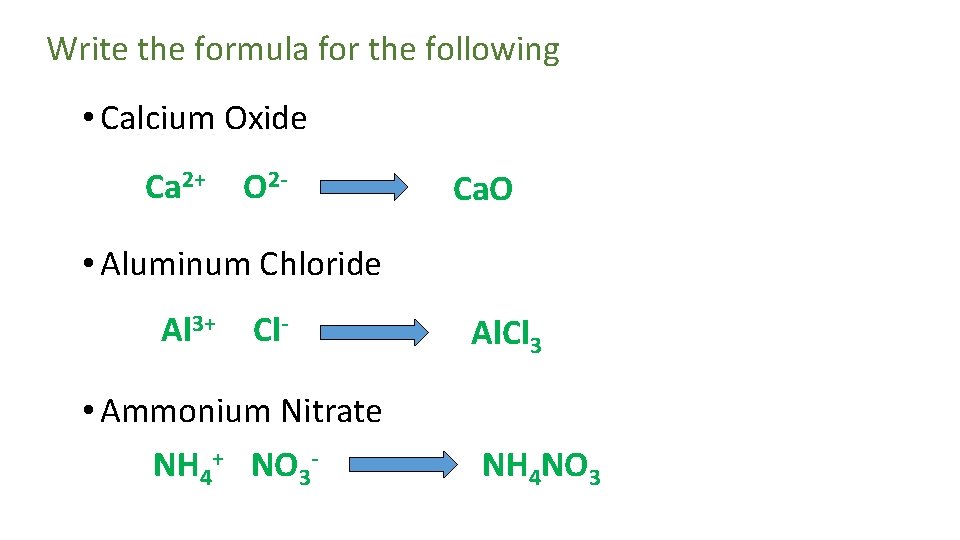
Write the formula for the following • Calcium Oxide Ca 2+ O 2 - Ca. O • Aluminum Chloride Al 3+ Cl- Al. Cl 3 • Ammonium Nitrate NH 4+ NO 3 - NH 4 NO 3
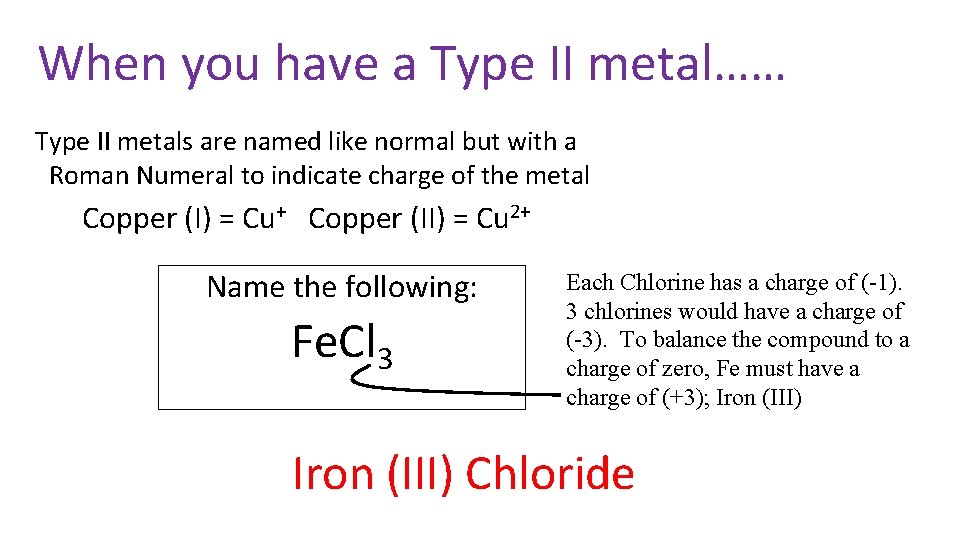
When you have a Type II metal…… Type II metals are named like normal but with a Roman Numeral to indicate charge of the metal Copper (I) = Cu+ Copper (II) = Cu 2+ Name the following: Fe. Cl 3 Each Chlorine has a charge of (-1). 3 chlorines would have a charge of (-3). To balance the compound to a charge of zero, Fe must have a charge of (+3); Iron (III) Chloride
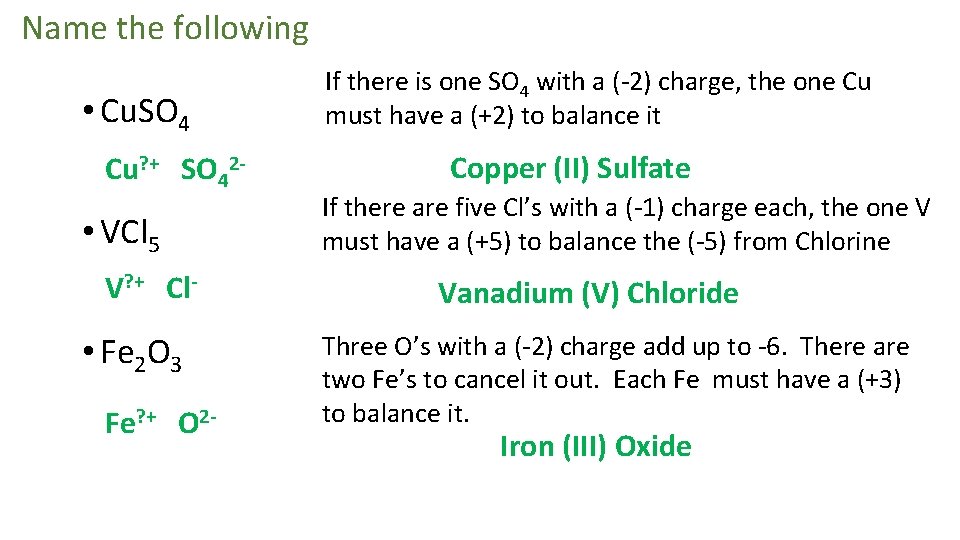
Name the following • Cu. SO 4 Cu? + SO 42 - • VCl 5 V? + Cl- • Fe 2 O 3 Fe? + O 2 - If there is one SO 4 with a (-2) charge, the one Cu must have a (+2) to balance it Copper (II) Sulfate If there are five Cl’s with a (-1) charge each, the one V must have a (+5) to balance the (-5) from Chlorine Vanadium (V) Chloride Three O’s with a (-2) charge add up to -6. There are two Fe’s to cancel it out. Each Fe must have a (+3) to balance it. Iron (III) Oxide
- Slides: 18