
Net Ionic Equations Balance the equation below and
Net Ionic Equations
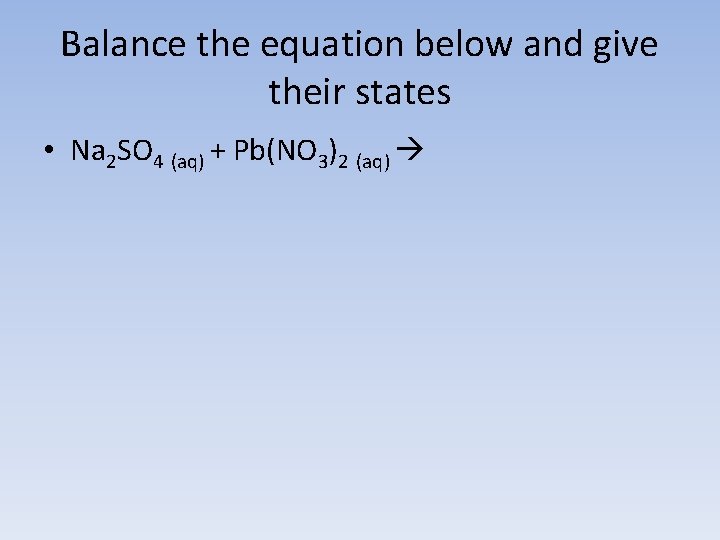
Balance the equation below and give their states • Na 2 SO 4 (aq) + Pb(NO 3)2 (aq)
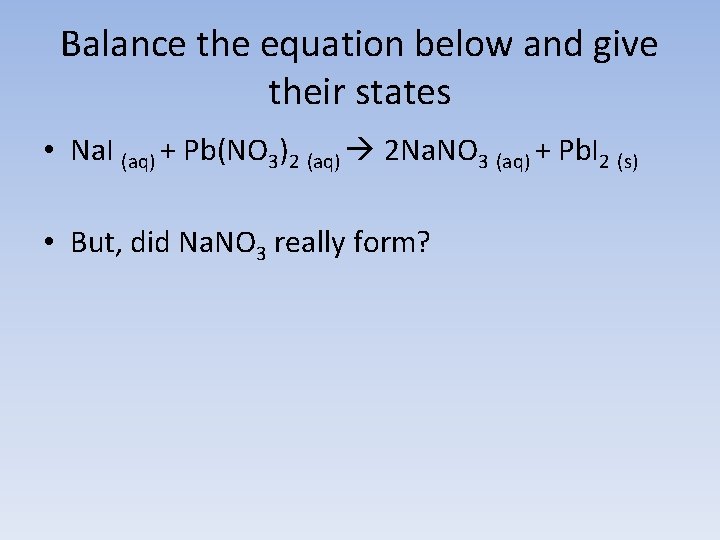
Balance the equation below and give their states • Na. I (aq) + Pb(NO 3)2 (aq) 2 Na. NO 3 (aq) + Pb. I 2 (s) • But, did Na. NO 3 really form?
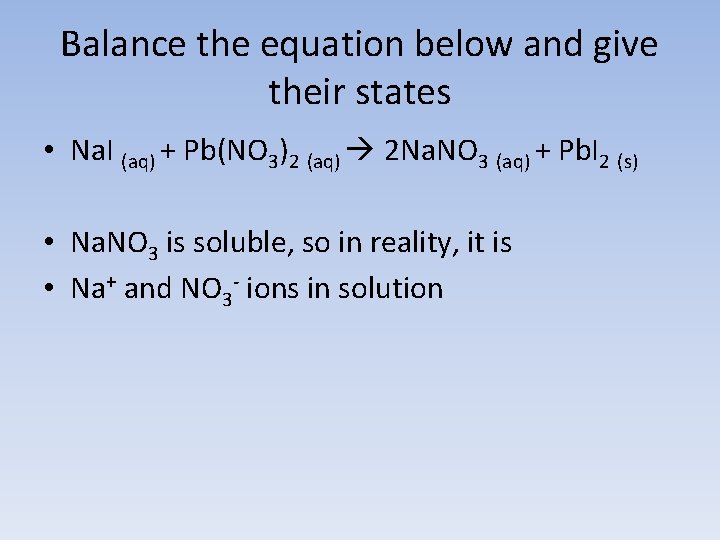
Balance the equation below and give their states • Na. I (aq) + Pb(NO 3)2 (aq) 2 Na. NO 3 (aq) + Pb. I 2 (s) • Na. NO 3 is soluble, so in reality, it is • Na+ and NO 3 - ions in solution
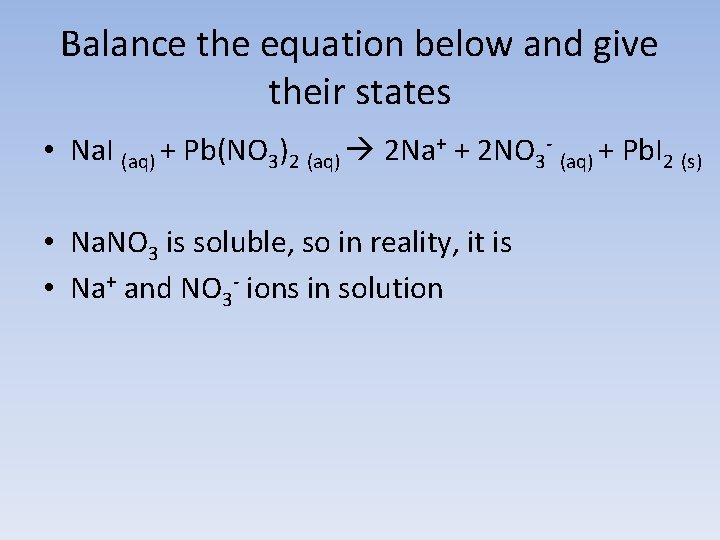
Balance the equation below and give their states • Na. I (aq) + Pb(NO 3)2 (aq) 2 Na+ + 2 NO 3 - (aq) + Pb. I 2 (s) • Na. NO 3 is soluble, so in reality, it is • Na+ and NO 3 - ions in solution
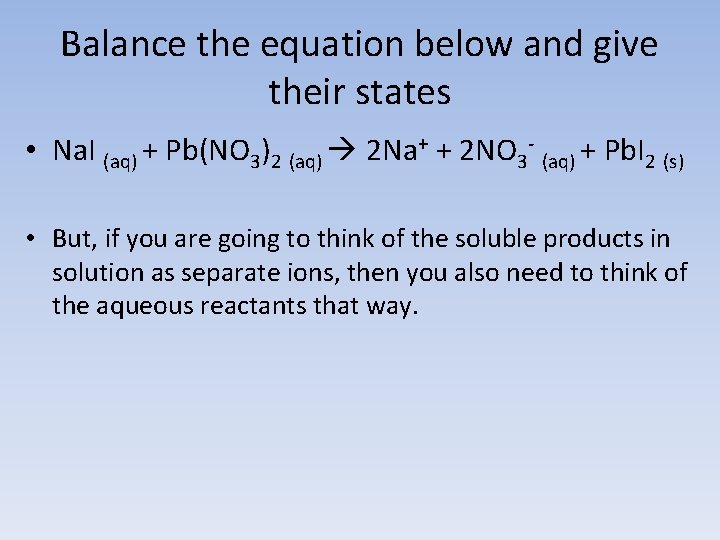
Balance the equation below and give their states • Na. I (aq) + Pb(NO 3)2 (aq) 2 Na+ + 2 NO 3 - (aq) + Pb. I 2 (s) • But, if you are going to think of the soluble products in solution as separate ions, then you also need to think of the aqueous reactants that way.
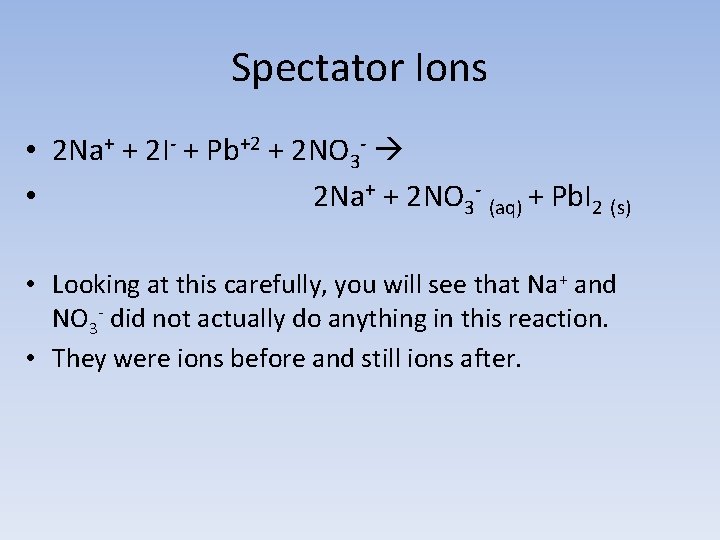
Spectator Ions • 2 Na+ + 2 I- + Pb+2 + 2 NO 3 - • 2 Na+ + 2 NO 3 - (aq) + Pb. I 2 (s) • Looking at this carefully, you will see that Na+ and NO 3 - did not actually do anything in this reaction. • They were ions before and still ions after.
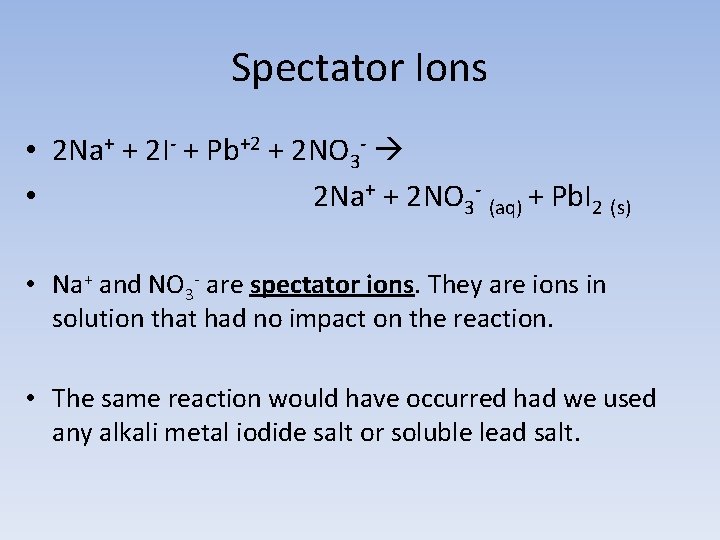
Spectator Ions • 2 Na+ + 2 I- + Pb+2 + 2 NO 3 - • 2 Na+ + 2 NO 3 - (aq) + Pb. I 2 (s) • Na+ and NO 3 - are spectator ions. They are ions in solution that had no impact on the reaction. • The same reaction would have occurred had we used any alkali metal iodide salt or soluble lead salt.
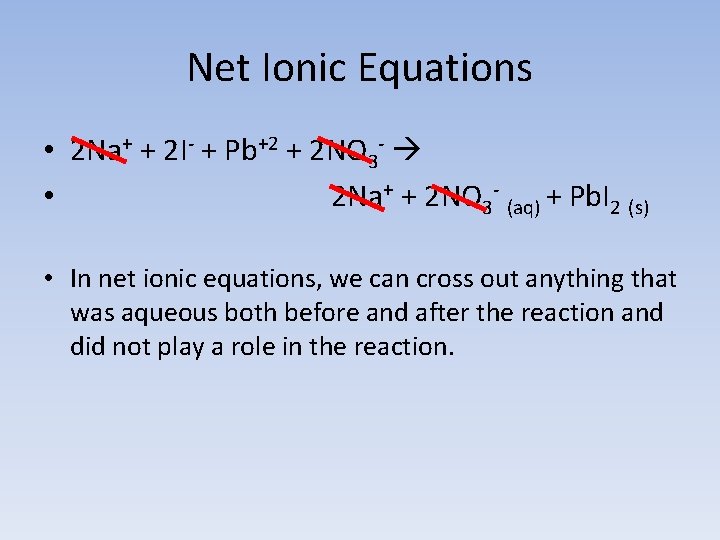
Net Ionic Equations • 2 Na+ + 2 I- + Pb+2 + 2 NO 3 - • 2 Na+ + 2 NO 3 - (aq) + Pb. I 2 (s) • In net ionic equations, we can cross out anything that was aqueous both before and after the reaction and did not play a role in the reaction.
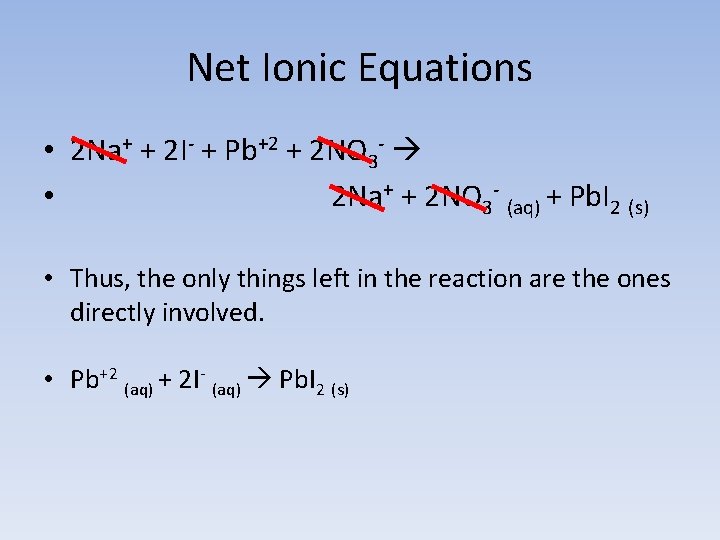
Net Ionic Equations • 2 Na+ + 2 I- + Pb+2 + 2 NO 3 - • 2 Na+ + 2 NO 3 - (aq) + Pb. I 2 (s) • Thus, the only things left in the reaction are the ones directly involved. • Pb+2 (aq) + 2 I- (aq) Pb. I 2 (s)
Rules of Thumb • Always give the full ionic or covalent formulas for anything that is not aqueous, such as solids, liquids, and gases. • Any ions that come together form a solid, liquid, or gases need to be shown on the reactant sides as ions.

Let’s See It Another Way
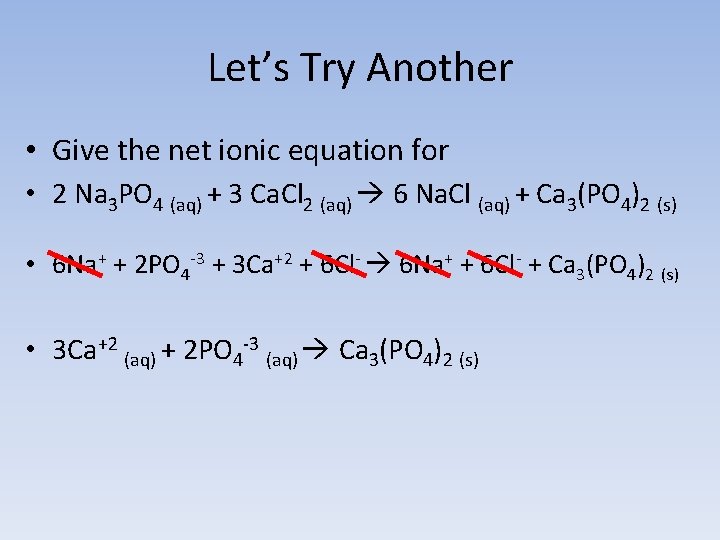
Let’s Try Another • Give the net ionic equation for • 2 Na 3 PO 4 (aq) + 3 Ca. Cl 2 (aq) 6 Na. Cl (aq) + Ca 3(PO 4)2 (s) • 6 Na+ + 2 PO 4 -3 + 3 Ca+2 + 6 Cl- 6 Na+ + 6 Cl- + Ca 3(PO 4)2 (s) • 3 Ca+2 (aq) + 2 PO 4 -3 (aq) Ca 3(PO 4)2 (s)
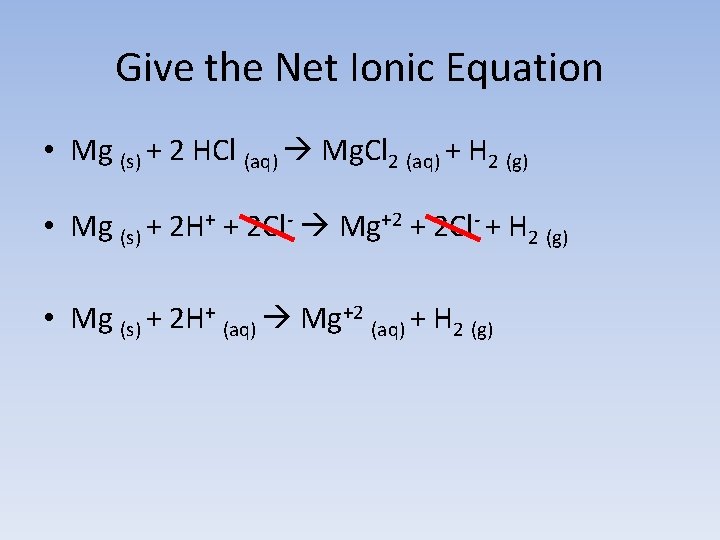
Give the Net Ionic Equation • Mg (s) + 2 HCl (aq) Mg. Cl 2 (aq) + H 2 (g) • Mg (s) + 2 H+ + 2 Cl- Mg+2 + 2 Cl- + H 2 (g) • Mg (s) + 2 H+ (aq) Mg+2 (aq) + H 2 (g)
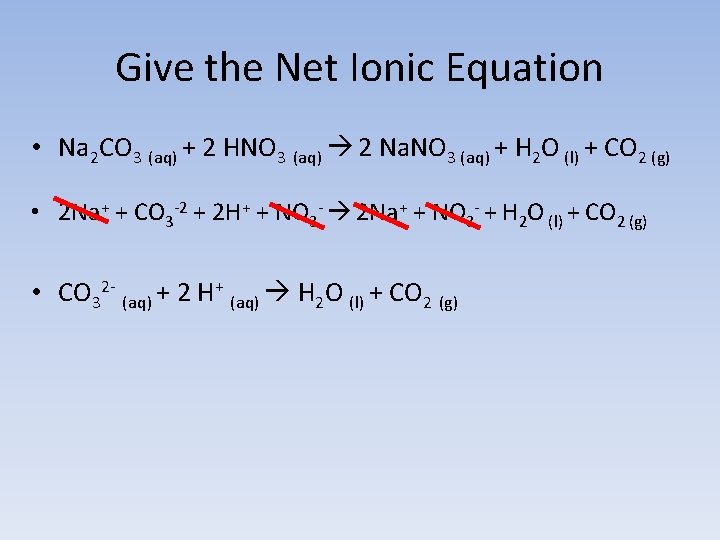
Give the Net Ionic Equation • Na 2 CO 3 (aq) + 2 HNO 3 (aq) 2 Na. NO 3 (aq) + H 2 O (l) + CO 2 (g) • 2 Na+ + CO 3 -2 + 2 H+ + NO 3 - 2 Na+ + NO 3 - + H 2 O (l) + CO 2 (g) • CO 32 - (aq) + 2 H+ (aq) H 2 O (l) + CO 2 (g)
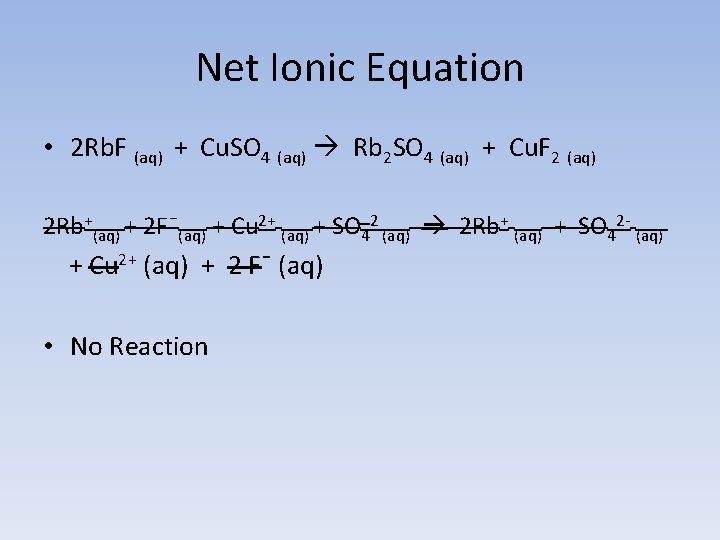
Net Ionic Equation • 2 Rb. F (aq) + Cu. SO 4 (aq) Rb 2 SO 4 (aq) + Cu. F 2 (aq) 2 Rb+(aq) + 2 F¯(aq) + Cu 2+ (aq) + SO 42 (aq) 2 Rb+ (aq) + SO 42 - (aq) + Cu 2+ (aq) + 2 F¯ (aq) • No Reaction
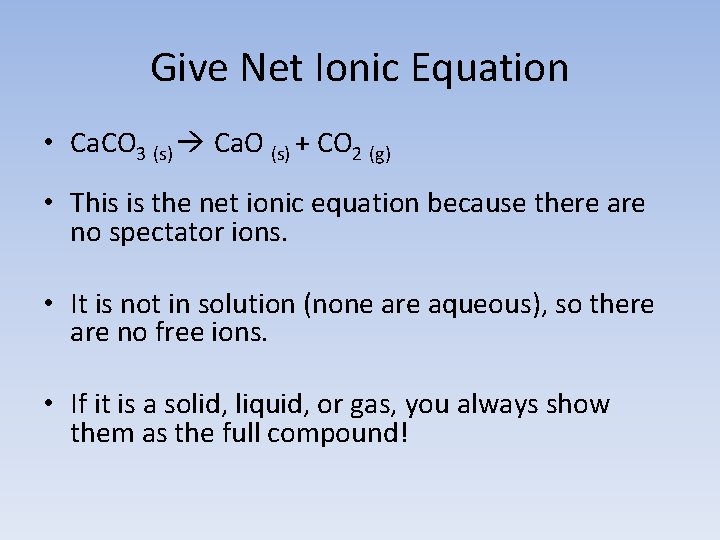
Give Net Ionic Equation • Ca. CO 3 (s) Ca. O (s) + CO 2 (g) • This is the net ionic equation because there are no spectator ions. • It is not in solution (none are aqueous), so there are no free ions. • If it is a solid, liquid, or gas, you always show them as the full compound!
- Slides: 17