ATD2 is a Prosumer of SWIM Data ATD2



















- Slides: 186
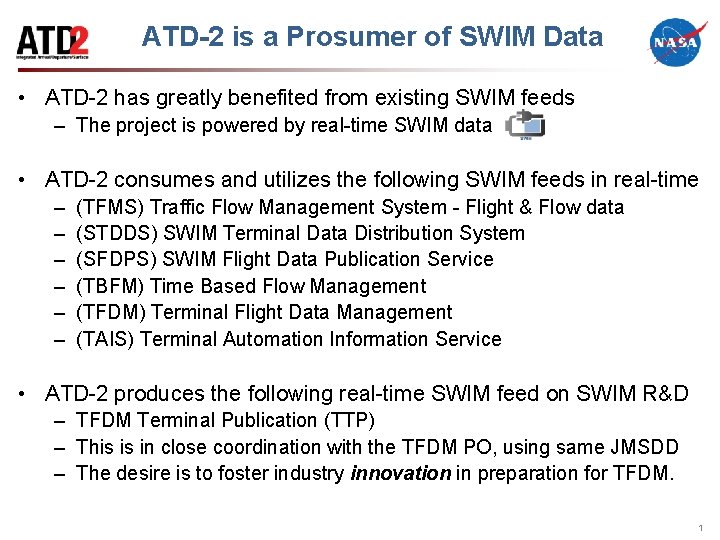
ATD-2 is a Prosumer of SWIM Data • ATD-2 has greatly benefited from existing SWIM feeds – The project is powered by real-time SWIM data • ATD-2 consumes and utilizes the following SWIM feeds in real-time – – – (TFMS) Traffic Flow Management System - Flight & Flow data (STDDS) SWIM Terminal Data Distribution System (SFDPS) SWIM Flight Data Publication Service (TBFM) Time Based Flow Management (TFDM) Terminal Flight Data Management (TAIS) Terminal Automation Information Service • ATD-2 produces the following real-time SWIM feed on SWIM R&D – TFDM Terminal Publication (TTP) – This is in close coordination with the TFDM PO, using same JMSDD – The desire is to foster industry innovation in preparation for TFDM. 1
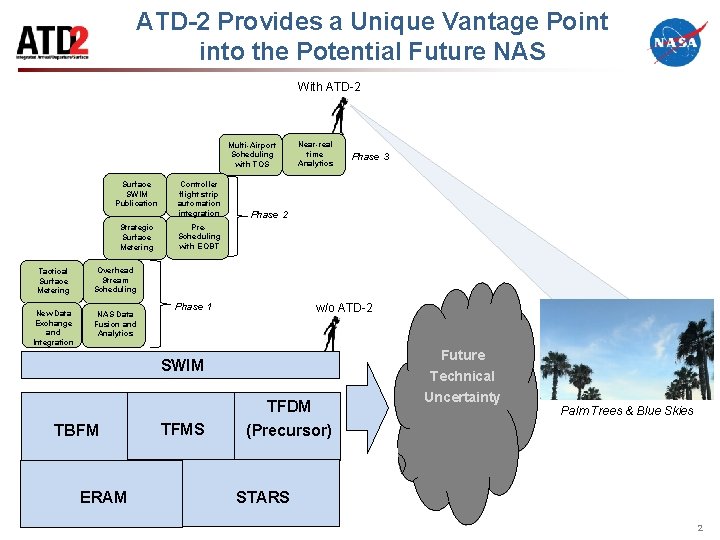
ATD-2 Provides a Unique Vantage Point into the Potential Future NAS With ATD-2 Multi-Airport Scheduling with TOS Surface SWIM Publication Controller flight strip automation integration Strategic Surface Metering Pre. Scheduling with EOBT Tactical Surface Metering Overhead Stream Scheduling New Data Exchange and Integration NAS Data Fusion and Analytics Near-real time Analytics Phase 2 Phase 1 w/o ATD-2 Future SWIM TBFM ERAM TFMS Phase 3 TFDM (Precursor) Technical Uncertainty Palm Trees & Blue Skies STARS 2
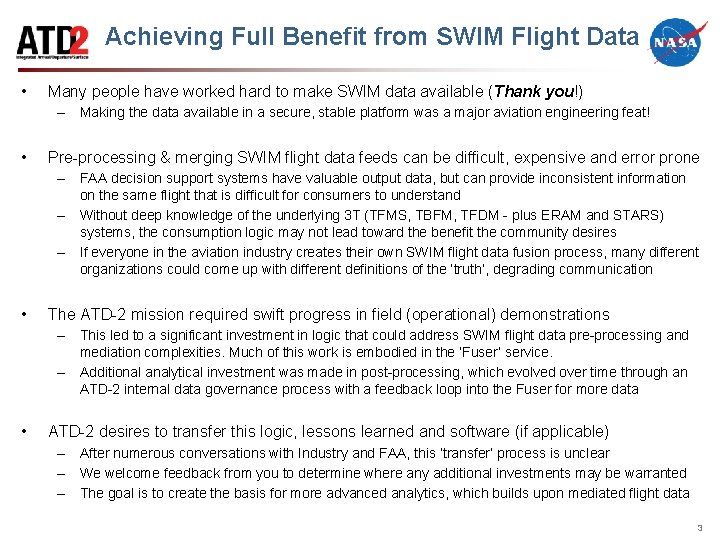
Achieving Full Benefit from SWIM Flight Data • Many people have worked hard to make SWIM data available (Thank you!) – Making the data available in a secure, stable platform was a major aviation engineering feat! • Pre-processing & merging SWIM flight data feeds can be difficult, expensive and error prone – FAA decision support systems have valuable output data, but can provide inconsistent information on the same flight that is difficult for consumers to understand – Without deep knowledge of the underlying 3 T (TFMS, TBFM, TFDM - plus ERAM and STARS) systems, the consumption logic may not lead toward the benefit the community desires – If everyone in the aviation industry creates their own SWIM flight data fusion process, many different organizations could come up with different definitions of the ‘truth’, degrading communication • The ATD-2 mission required swift progress in field (operational) demonstrations – This led to a significant investment in logic that could address SWIM flight data pre-processing and mediation complexities. Much of this work is embodied in the ‘Fuser’ service. – Additional analytical investment was made in post-processing, which evolved over time through an ATD-2 internal data governance process with a feedback loop into the Fuser for more data • ATD-2 desires to transfer this logic, lessons learned and software (if applicable) – After numerous conversations with Industry and FAA, this ‘transfer’ process is unclear – We welcome feedback from you to determine where any additional investments may be warranted – The goal is to create the basis for more advanced analytics, which builds upon mediated flight data 3
National Aeronautics and Space Administration Airspace Technology Demonstration 2 (ATD-2) Learning To SWIM with ATD-2 May 22, 2019
Learning to SWIM with ATD-2 • Why ATD-2 chose to SWIM • ATD-2 Approach to SWIM • Overview of Data Feeds • Data Elements of Interest to ATD-2 in Data Feed • ATD-2 Lessons Learned
Why ATD-2 Chose SWIM • • 6 Real time Single point of access Numerous available products More cost effective than legacy alternatives
Why Use Multiple Sources Of Data? • To cover the entire flight duration and turn-around process – If you want the highest quality data available for the entire flight from gate to gate, this requires the use of multiple sources from SWIM – In general, the best data comes from the FAA system whose operational mission most closely matches your data need (e. g. if you want strategic constraints and planning info, then TFMS, tactical then TBFM or TFDM) • Some information only exist, or is higher quality, in certain feeds – APREQ Release Times from TBFM SWIM – EDCT information from TFM Flight Data SWIM – Surface metering times from TFDM Terminal Publication SWIM • Data redundancy/backup from secondary sources – Loss of any one feed still allows data from other feeds to provide value 7
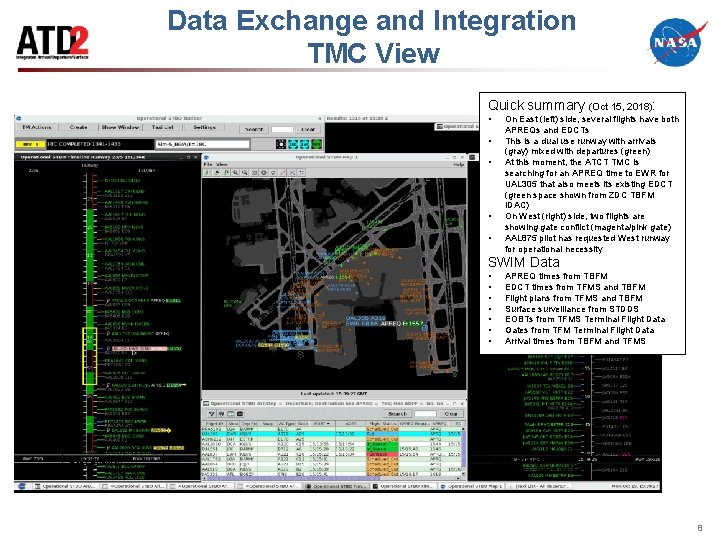
Data Exchange and Integration TMC View Quick summary (Oct 15, 2018): • • • On East (left) side, several flights have both APREQs and EDCTs This is a dual use runway with arrivals (gray) mixed with departures (green) At this moment, the ATCT TMC is searching for an APREQ time to EWR for UAL 305 that also meets its existing EDCT (green space shown from ZDC TBFM IDAC) On West (right) side, two flights are showing gate conflict (magenta/pink gate) AAL 875 pilot has requested West runway for operational necessity SWIM Data • • East Runway APREQ times from TBFM EDCT times from TFMS and TBFM Flight plans from TFMS and TBFM Surface surveillance from STDDS EOBTs from TFMS Terminal Flight Data Gates from TFM Terminal Flight Data Arrival times from TBFM and TFMS West Runway 8
ATD-2 Approach to SWIM • • Get Familiar with Documentation On Ramping Consume Monitor Raw Archives Parse Create Database Match (to be discussed in more detail later in this presentation) • Fuse (to be discussed in more detail in later presentations) • Add value (model / scheduler) 9
References • NAS Service Registry and Repository (NSRR) – https: //nsrr. faa. gov/ • SWIFT Operational Context and Use Cases – https: //connect. lstechllc. com/index. cfm/main/opconfocusgroup • FAA NAS Storyboards – https: //www. faa. gov/about/office_org/headquarters_offices/ang/o ffices/tc/library/Storyboard/nextgen-overview. html#home • SWIM Main Page – https: //www. faa. gov/air_traffic/technology/swim/ • SWIM Users Forum – https: //www. faa. gov/air_traffic/technology/swim/users_forum/ 10
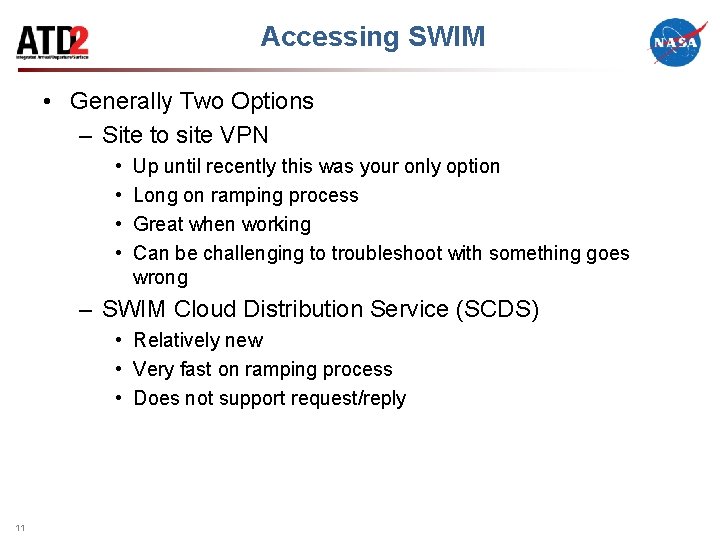
Accessing SWIM • Generally Two Options – Site to site VPN • • Up until recently this was your only option Long on ramping process Great when working Can be challenging to troubleshoot with something goes wrong – SWIM Cloud Distribution Service (SCDS) • Relatively new • Very fast on ramping process • Does not support request/reply 11
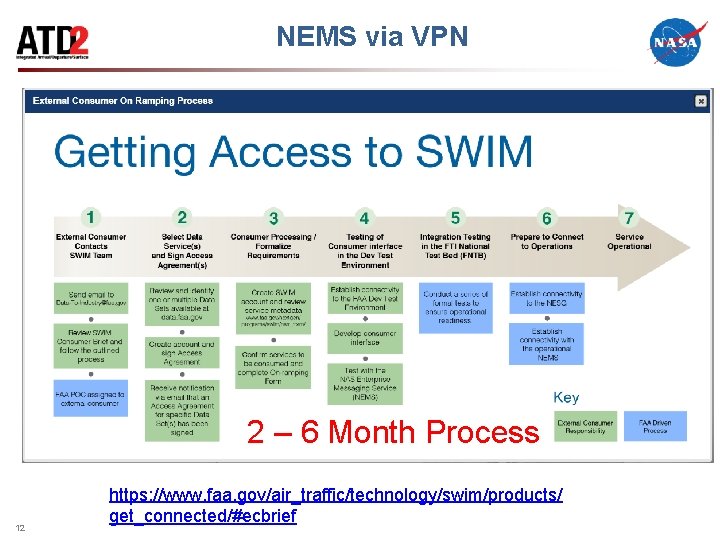
NEMS via VPN 2 – 6 Month Process 12 https: //www. faa. gov/air_traffic/technology/swim/products/ get_connected/#ecbrief
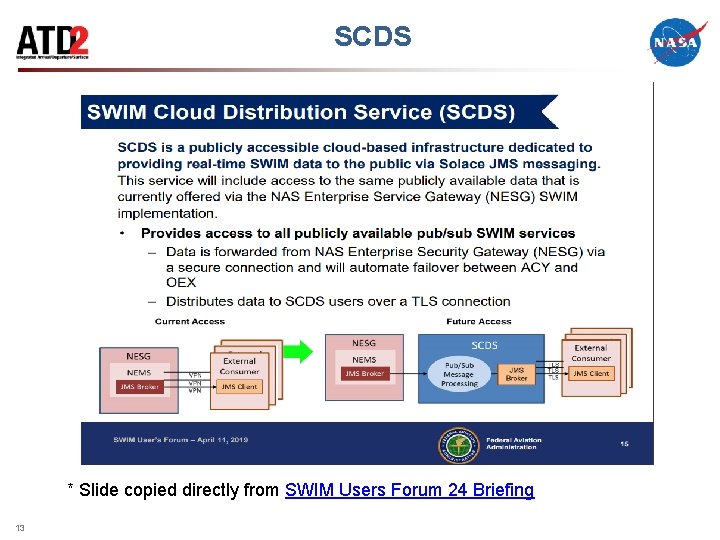
SCDS * Slide copied directly from SWIM Users Forum 24 Briefing 13
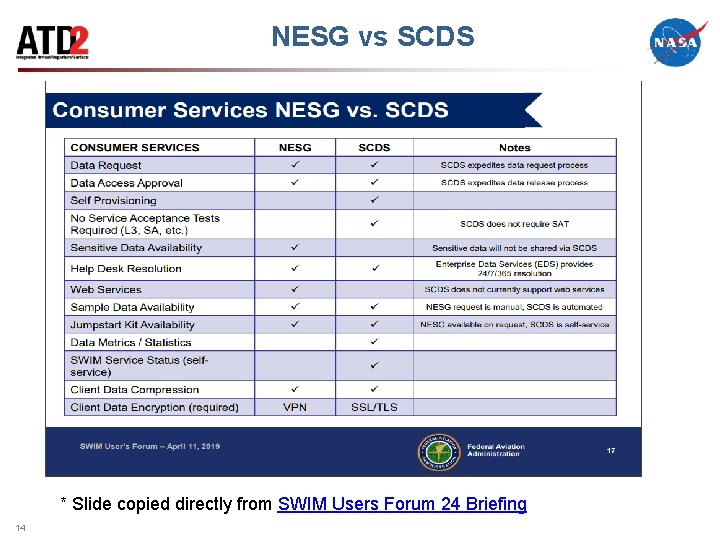
NESG vs SCDS * Slide copied directly from SWIM Users Forum 24 Briefing 14
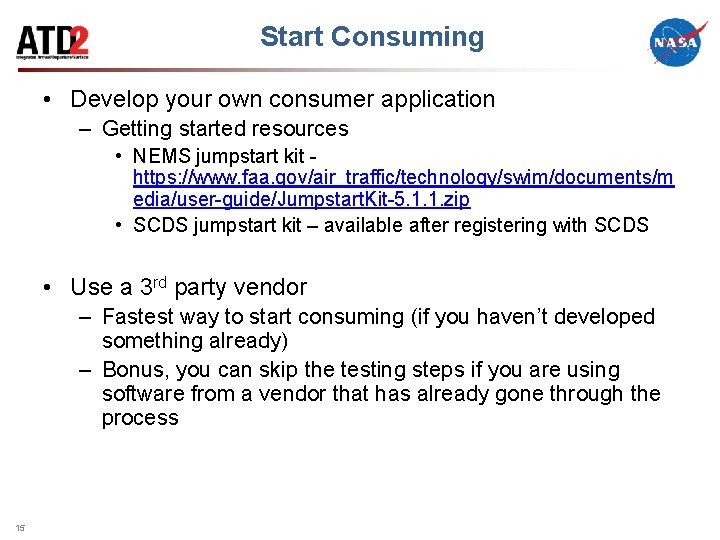
Start Consuming • Develop your own consumer application – Getting started resources • NEMS jumpstart kit https: //www. faa. gov/air_traffic/technology/swim/documents/m edia/user-guide/Jumpstart. Kit-5. 1. 1. zip • SCDS jumpstart kit – available after registering with SCDS • Use a 3 rd party vendor – Fastest way to start consuming (if you haven’t developed something already) – Bonus, you can skip the testing steps if you are using software from a vendor that has already gone through the process 15
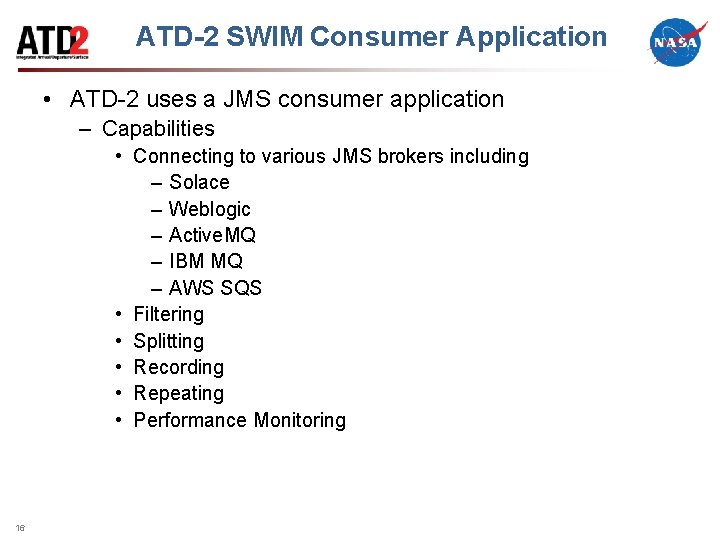
ATD-2 SWIM Consumer Application • ATD-2 uses a JMS consumer application – Capabilities • Connecting to various JMS brokers including – Solace – Weblogic – Active. MQ – IBM MQ – AWS SQS • Filtering • Splitting • Recording • Repeating • Performance Monitoring 16
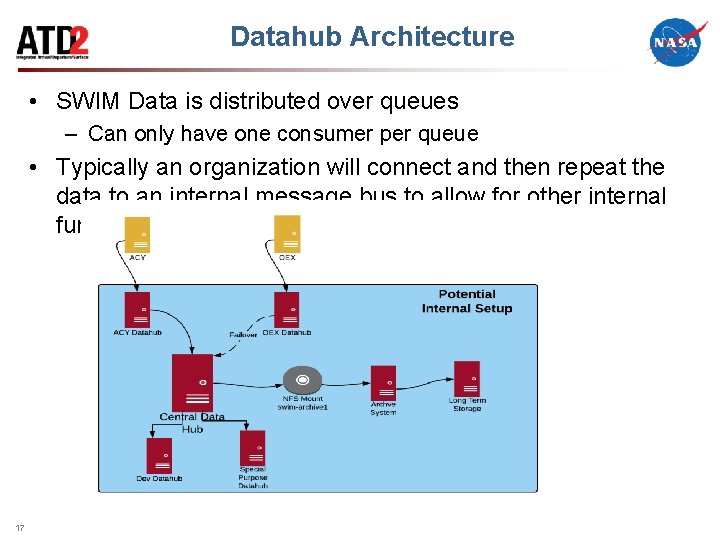
Datahub Architecture • SWIM Data is distributed over queues – Can only have one consumer per queue • Typically an organization will connect and then repeat the data to an internal message bus to allow for other internal functions. 17
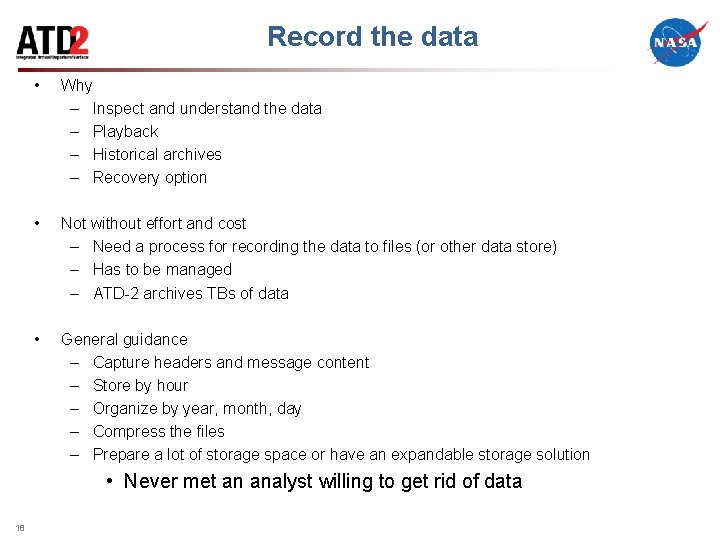
Record the data • Why – Inspect and understand the data – Playback – Historical archives – Recovery option • Not without effort and cost – Need a process for recording the data to files (or other data store) – Has to be managed – ATD-2 archives TBs of data • General guidance – Capture headers and message content – Store by hour – Organize by year, month, day – Compress the files – Prepare a lot of storage space or have an expandable storage solution • Never met an analyst willing to get rid of data 18
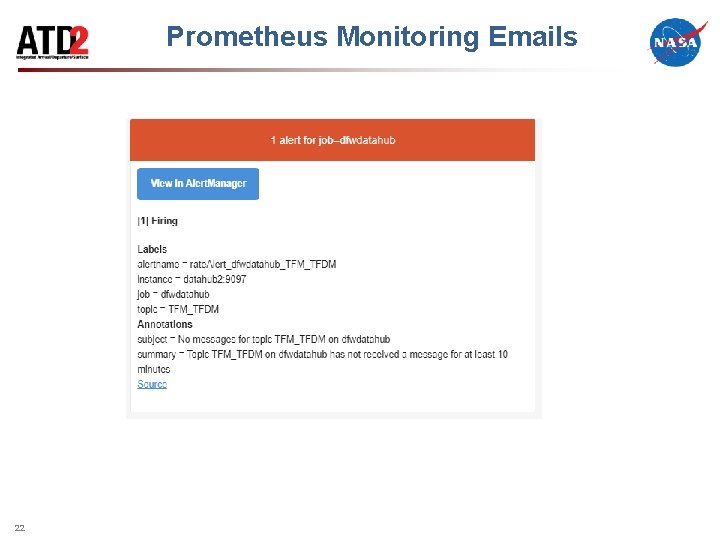
Monitoring • Grafana Reports • System Monitor • Prometheus Alerts/Emails 2/26/2021 19
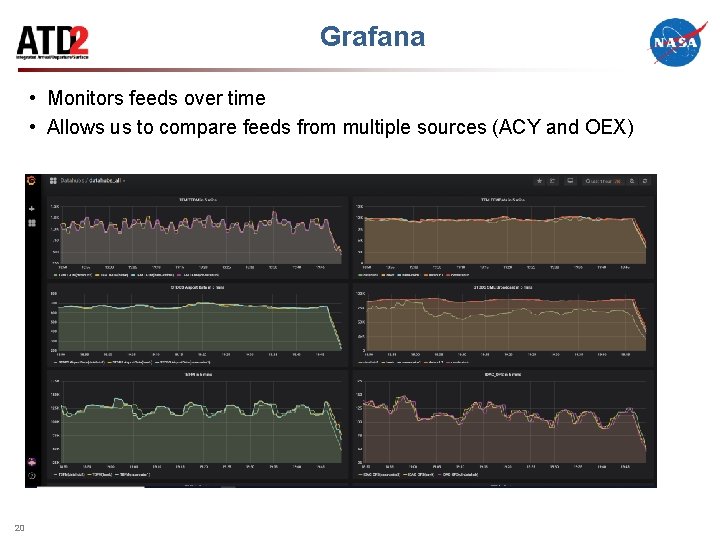
Grafana • Monitors feeds over time • Allows us to compare feeds from multiple sources (ACY and OEX) 20
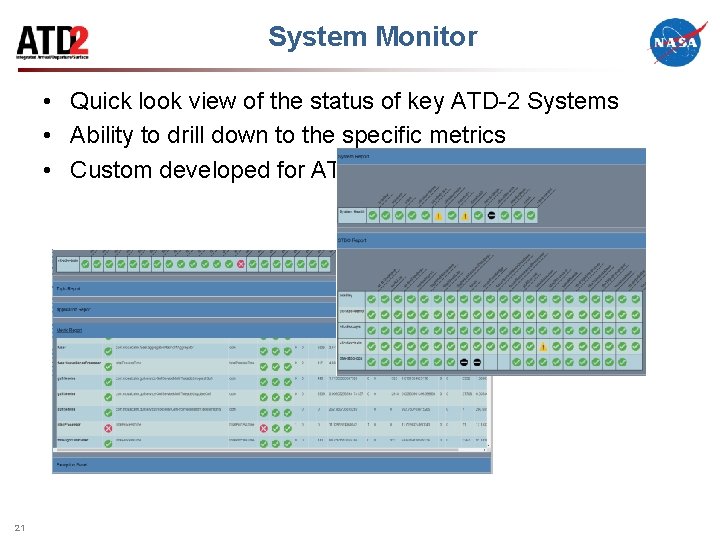
System Monitor • Quick look view of the status of key ATD-2 Systems • Ability to drill down to the specific metrics • Custom developed for ATD-2 21
Prometheus Monitoring Emails 22
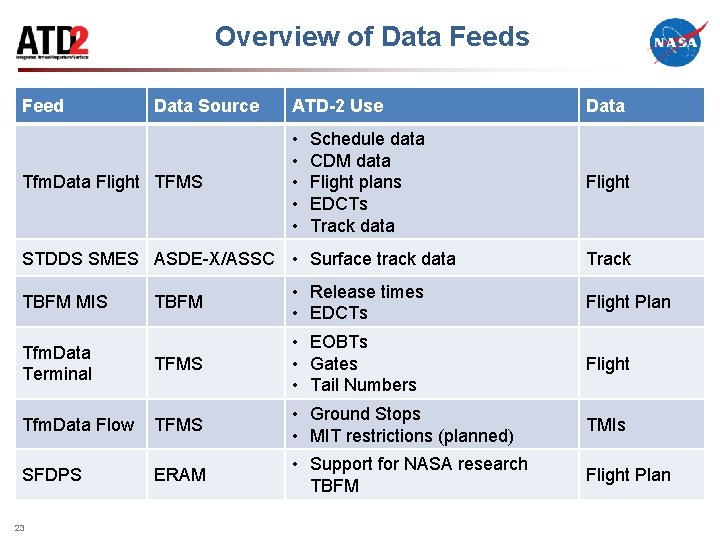
Overview of Data Feeds Feed Data Source Tfm. Data Flight TFMS ATD-2 Use Data • • • Flight Schedule data CDM data Flight plans EDCTs Track data STDDS SMES ASDE-X/ASSC • Surface track data Track TBFM • Release times • EDCTs Flight Plan Tfm. Data Terminal TFMS • EOBTs • Gates • Tail Numbers Flight Tfm. Data Flow TFMS • Ground Stops • MIT restrictions (planned) TMIs SFDPS ERAM • Support for NASA research TBFM Flight Plan TBFM MIS 23
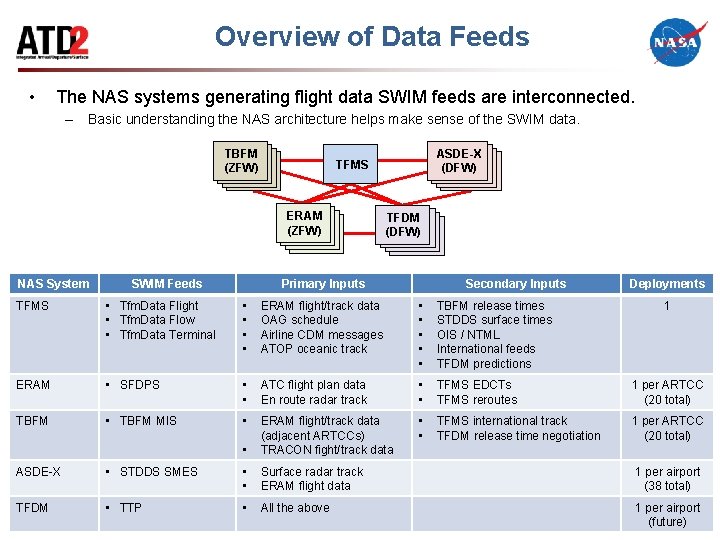
Overview of Data Feeds • The NAS systems generating flight data SWIM feeds are interconnected. – Basic understanding the NAS architecture helps make sense of the SWIM data. TBFM ERAM ERAM (ZFW) (ZAU) (ZAB) NAS System SWIM Feeds ASDE-X ERAM (DFW) (ZAU) (ZAB) TFMS TFDM ERAM (DFW) (ZAU) (ZAB) Primary Inputs Secondary Inputs Deployments TFMS • Tfm. Data Flight • Tfm. Data Flow • Tfm. Data Terminal • • ERAM flight/track data OAG schedule Airline CDM messages ATOP oceanic track • • • TBFM release times STDDS surface times OIS / NTML International feeds TFDM predictions ERAM • SFDPS • • ATC flight plan data En route radar track • • TFMS EDCTs TFMS reroutes 1 per ARTCC (20 total) TBFM • TBFM MIS • • • TFMS international track TFDM release time negotiation 1 per ARTCC (20 total) • ERAM flight/track data (adjacent ARTCCs) TRACON fight/track data 1 ASDE-X • STDDS SMES • • Surface radar track ERAM flight data 1 per airport (38 total) TFDM • TTP • All the above 1 per airport (future) 24
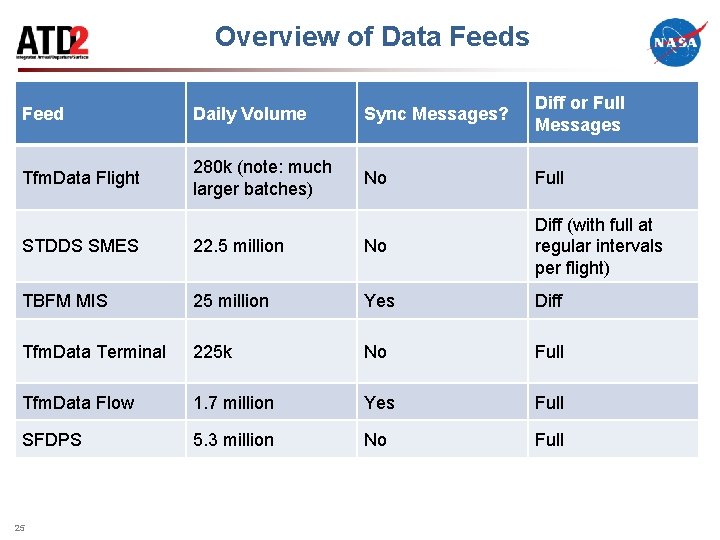
Overview of Data Feeds Feed Daily Volume Sync Messages? Diff or Full Messages Tfm. Data Flight 280 k (note: much larger batches) No Full STDDS SMES 22. 5 million No Diff (with full at regular intervals per flight) TBFM MIS 25 million Yes Diff Tfm. Data Terminal 225 k No Full Tfm. Data Flow 1. 7 million Yes Full SFDPS 5. 3 million No Full 25
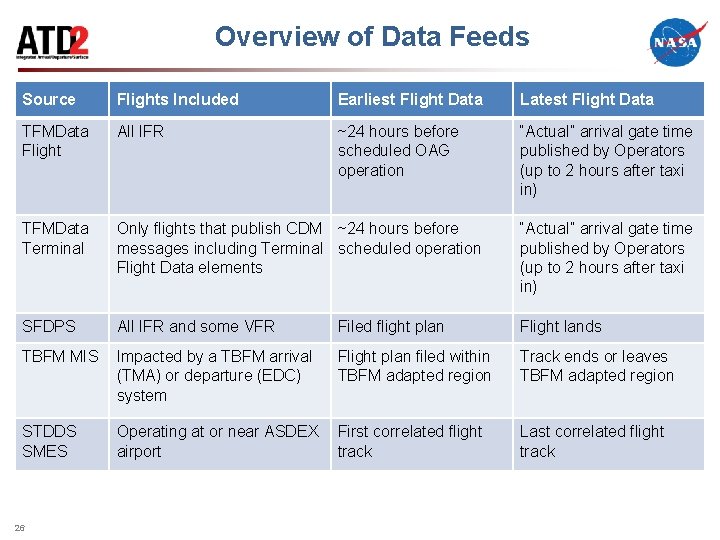
Overview of Data Feeds Source Flights Included Earliest Flight Data Latest Flight Data TFMData Flight All IFR ~24 hours before scheduled OAG operation “Actual” arrival gate time published by Operators (up to 2 hours after taxi in) TFMData Terminal Only flights that publish CDM ~24 hours before messages including Terminal scheduled operation Flight Data elements “Actual” arrival gate time published by Operators (up to 2 hours after taxi in) SFDPS All IFR and some VFR Filed flight plan Flight lands TBFM MIS Impacted by a TBFM arrival (TMA) or departure (EDC) system Flight plan filed within TBFM adapted region Track ends or leaves TBFM adapted region STDDS SMES Operating at or near ASDEX airport First correlated flight track Last correlated flight track 26
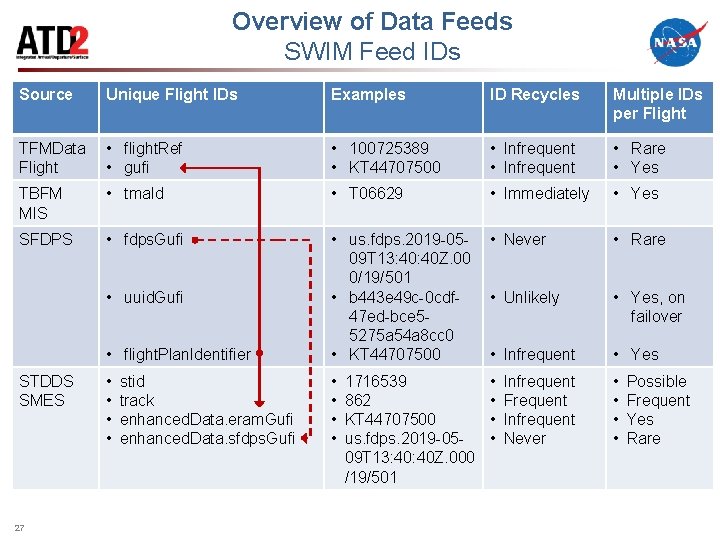
Overview of Data Feeds SWIM Feed IDs Source Unique Flight IDs Examples ID Recycles Multiple IDs per Flight TFMData Flight • flight. Ref • gufi • 100725389 • KT 44707500 • Infrequent • Rare • Yes TBFM MIS • tma. Id • T 06629 • Immediately • Yes SFDPS • fdps. Gufi • Never • Rare • Unlikely • Yes, on failover • flight. Plan. Identifier • us. fdps. 2019 -0509 T 13: 40 Z. 00 0/19/501 • b 443 e 49 c-0 cdf 47 ed-bce 55275 a 54 a 8 cc 0 • KT 44707500 • Infrequent • Yes • • • • • uuid. Gufi STDDS SMES 27 stid track enhanced. Data. eram. Gufi enhanced. Data. sfdps. Gufi 1716539 862 KT 44707500 us. fdps. 2019 -0509 T 13: 40 Z. 000 /19/501 Infrequent Frequent Infrequent Never Possible Frequent Yes Rare
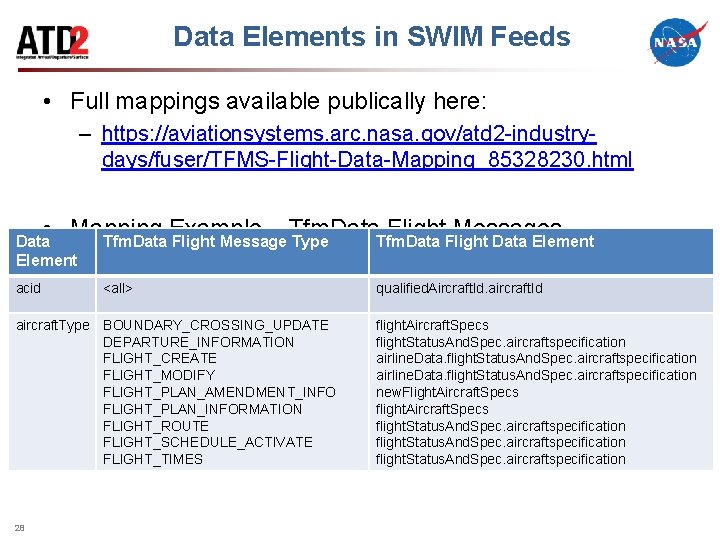
Data Elements in SWIM Feeds • Full mappings available publically here: – https: //aviationsystems. arc. nasa. gov/atd 2 -industrydays/fuser/TFMS-Flight-Data-Mapping_85328230. html • Mapping Example – Tfm. Data Flight Messages Tfm. Data Flight Message Type Data Element acid <all> aircraft. Type BOUNDARY_CROSSING_UPDATE DEPARTURE_INFORMATION FLIGHT_CREATE FLIGHT_MODIFY FLIGHT_PLAN_AMENDMENT_INFO FLIGHT_PLAN_INFORMATION FLIGHT_ROUTE FLIGHT_SCHEDULE_ACTIVATE FLIGHT_TIMES 28 qualified. Aircraft. Id. aircraft. Id flight. Aircraft. Specs flight. Status. And. Spec. aircraftspecification airline. Data. flight. Status. And. Spec. aircraftspecification new. Flight. Aircraft. Specs flight. Status. And. Spec. aircraftspecification
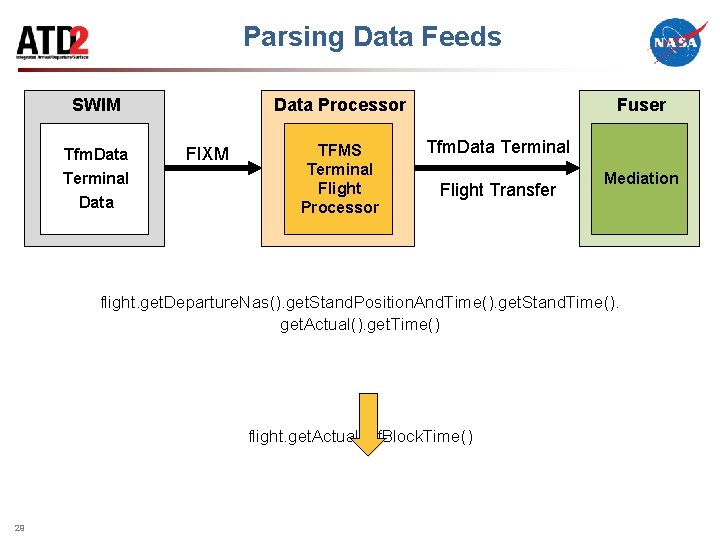
Parsing Data Feeds SWIM Tfm. Data Terminal Data Processor FIXM TFMS Terminal Flight Processor Fuser Tfm. Data Terminal Flight Transfer Mediation flight. get. Departure. Nas(). get. Stand. Position. And. Time(). get. Stand. Time(). get. Actual(). get. Time() flight. get. Actual. Off. Block. Time() 29
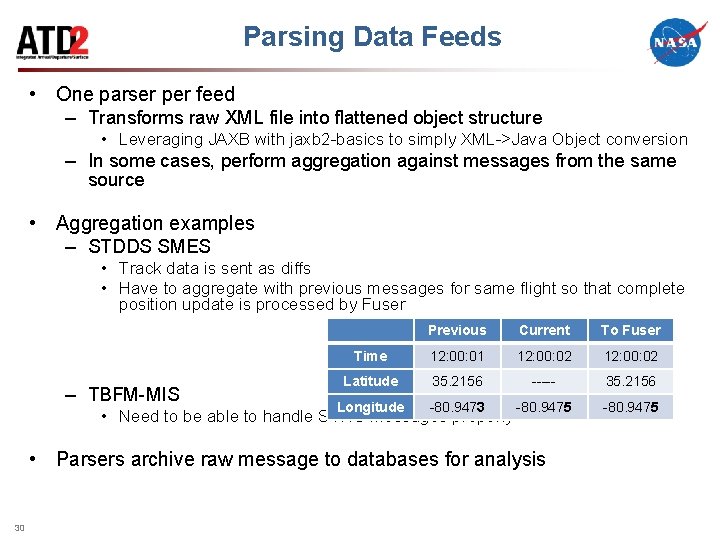
Parsing Data Feeds • One parser per feed – Transforms raw XML file into flattened object structure • Leveraging JAXB with jaxb 2 -basics to simply XML->Java Object conversion – In some cases, perform aggregation against messages from the same source • Aggregation examples – STDDS SMES • Track data is sent as diffs • Have to aggregate with previous messages for same flight so that complete position update is processed by Fuser – TBFM-MIS Previous Current To Fuser Time 12: 00: 01 12: 00: 02 Latitude 35. 2156 ----- 35. 2156 Longitude -80. 9473 -80. 9475 • Need to be able to handle SYNC messages properly • Parsers archive raw message to databases for analysis 30
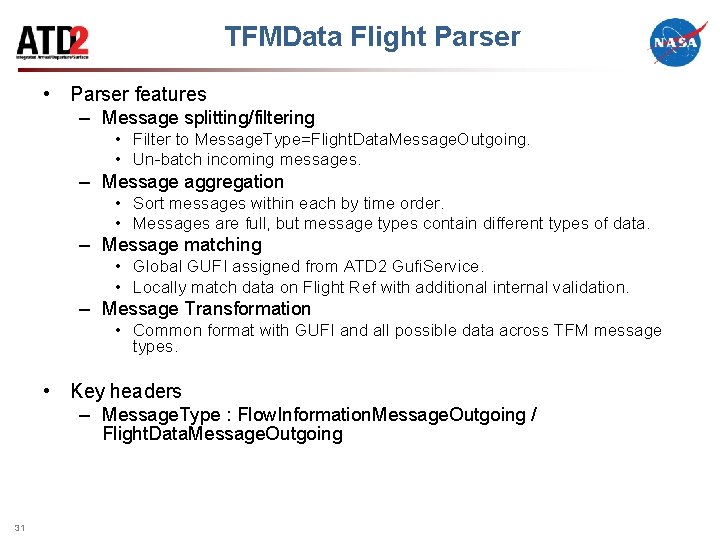
TFMData Flight Parser • Parser features – Message splitting/filtering • Filter to Message. Type=Flight. Data. Message. Outgoing. • Un-batch incoming messages. – Message aggregation • Sort messages within each by time order. • Messages are full, but message types contain different types of data. – Message matching • Global GUFI assigned from ATD 2 Gufi. Service. • Locally match data on Flight Ref with additional internal validation. – Message Transformation • Common format with GUFI and all possible data across TFM message types. • Key headers – Message. Type : Flow. Information. Message. Outgoing / Flight. Data. Message. Outgoing 31
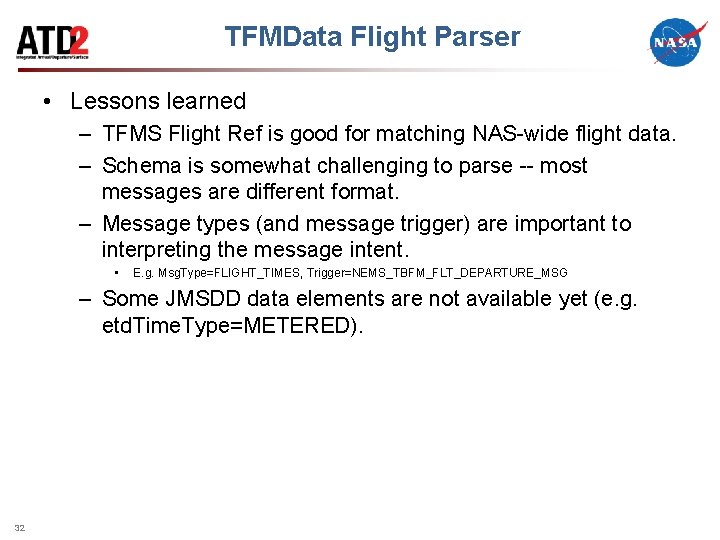
TFMData Flight Parser • Lessons learned – TFMS Flight Ref is good for matching NAS-wide flight data. – Schema is somewhat challenging to parse -- most messages are different format. – Message types (and message trigger) are important to interpreting the message intent. • E. g. Msg. Type=FLIGHT_TIMES, Trigger=NEMS_TBFM_FLT_DEPARTURE_MSG – Some JMSDD data elements are not available yet (e. g. etd. Time. Type=METERED). 32
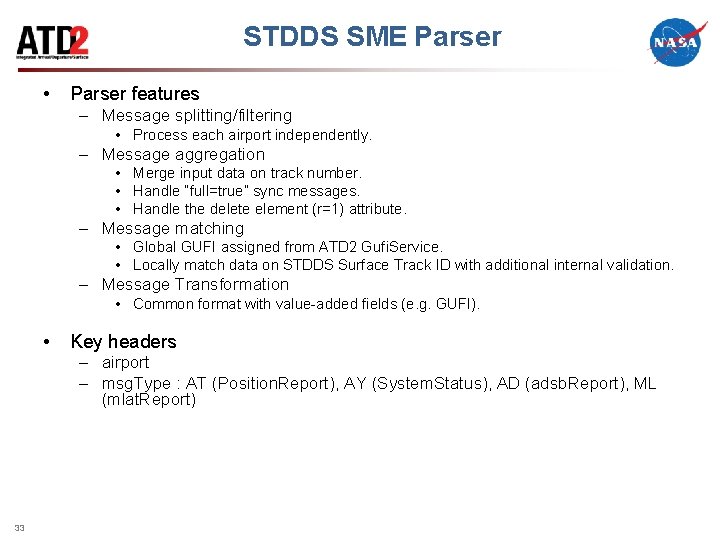
STDDS SME Parser • Parser features – Message splitting/filtering • Process each airport independently. – Message aggregation • Merge input data on track number. • Handle “full=true” sync messages. • Handle the delete element (r=1) attribute. – Message matching • Global GUFI assigned from ATD 2 Gufi. Service. • Locally match data on STDDS Surface Track ID with additional internal validation. – Message Transformation • Common format with value-added fields (e. g. GUFI). • Key headers – airport – msg. Type : AT (Position. Report), AY (System. Status), AD (adsb. Report), ML (mlat. Report) 33
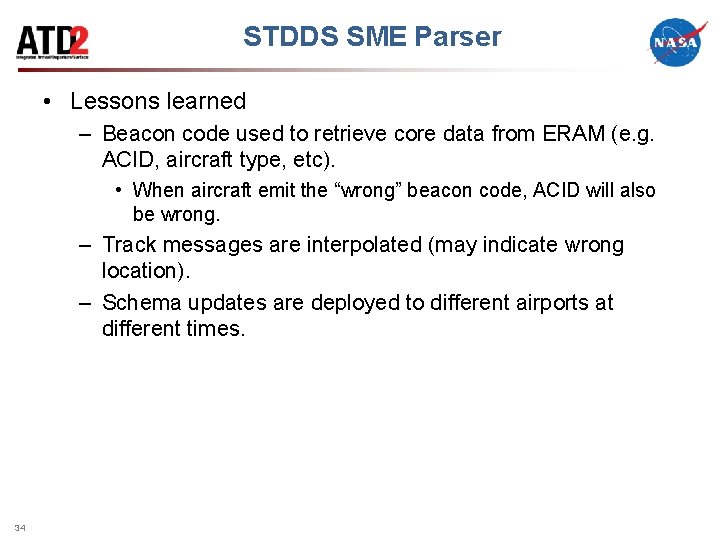
STDDS SME Parser • Lessons learned – Beacon code used to retrieve core data from ERAM (e. g. ACID, aircraft type, etc). • When aircraft emit the “wrong” beacon code, ACID will also be wrong. – Track messages are interpolated (may indicate wrong location). – Schema updates are deployed to different airports at different times. 34
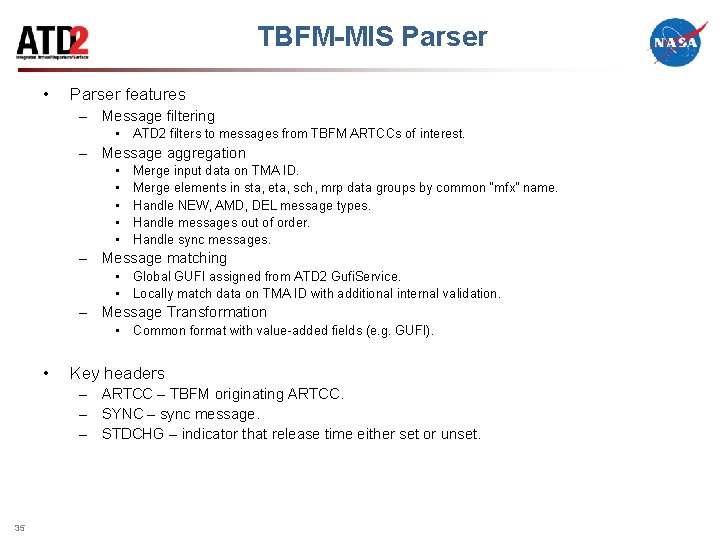
TBFM-MIS Parser • Parser features – Message filtering • ATD 2 filters to messages from TBFM ARTCCs of interest. – Message aggregation • • • Merge input data on TMA ID. Merge elements in sta, eta, sch, mrp data groups by common “mfx” name. Handle NEW, AMD, DEL message types. Handle messages out of order. Handle sync messages. – Message matching • Global GUFI assigned from ATD 2 Gufi. Service. • Locally match data on TMA ID with additional internal validation. – Message Transformation • Common format with value-added fields (e. g. GUFI). • Key headers – ARTCC – TBFM originating ARTCC. – SYNC – sync message. – STDCHG – indicator that release time either set or unset. 35
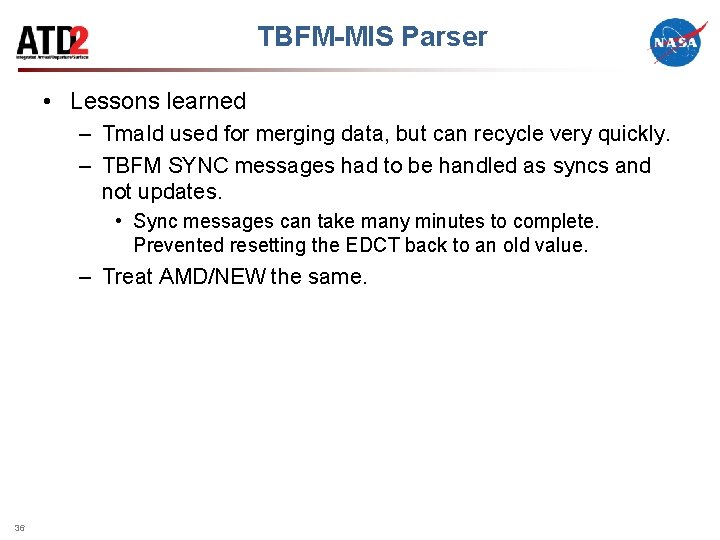
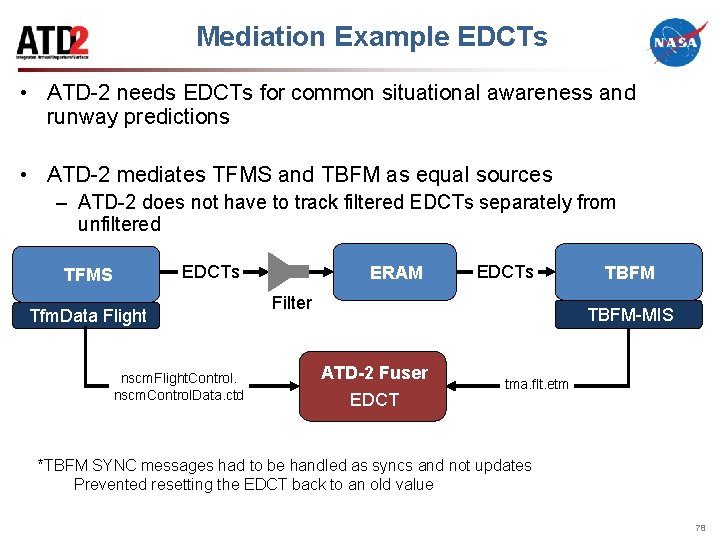
TBFM-MIS Parser • Lessons learned – Tma. Id used for merging data, but can recycle very quickly. – TBFM SYNC messages had to be handled as syncs and not updates. • Sync messages can take many minutes to complete. Prevented resetting the EDCT back to an old value. – Treat AMD/NEW the same. 36
Additional References • Animated storyboards – – About ERAM in general About TBFM in general About TFMS in general About TFDM in general • Operation Context and Use Cases – – 37 About Tfm. Data Flow Operational Context and Use Cases About Tfm. Data Flight Operational Context and Use Cases About TBFM SWIM Operational Context and Use Cases About SFDPS Operational Context and Use Cases
Wrap Up • SWIM contains lots of data • The data has lots of value • But consuming that data is challenging • If only there were some way to fuse the data together… 38
Questions 39
National Aeronautics and Space Administration Airspace Technology Demonstration 2 (ATD-2) Fuser Why Everyone Should Have One May 22, 2019
Why Fuser • One stop shopping for all your flight data needs S STDD TFM S FM TB 5/22/2019 41
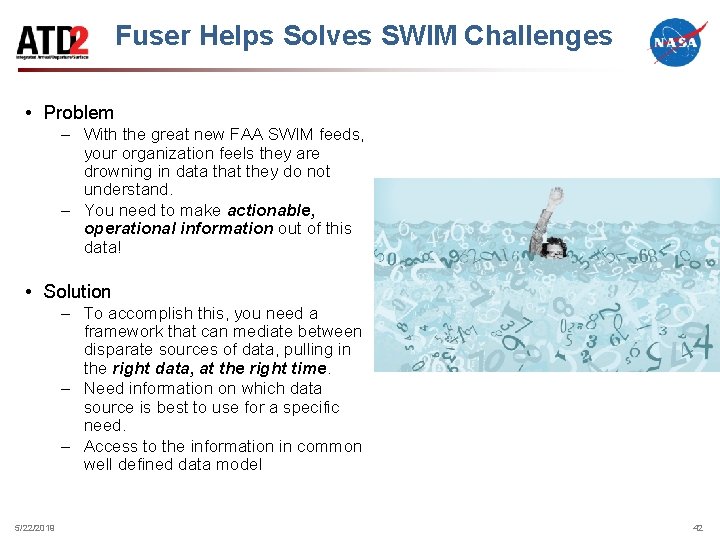
Fuser Helps Solves SWIM Challenges • Problem – With the great new FAA SWIM feeds, your organization feels they are drowning in data that they do not understand. – You need to make actionable, operational information out of this data! • Solution – To accomplish this, you need a framework that can mediate between disparate sources of data, pulling in the right data, at the right time. – Need information on which data source is best to use for a specific need. – Access to the information in common well defined data model 5/22/2019 42
Design Motivations • No desire to spend hours and days troubleshooting an issue – Less time troubleshooting = more time to create new capabilities • More data is not a linear problem. As you get more data feeds the possible issues become exponential • Tired of seeing same issues manifest on various efforts and phases – Redundant effort – Inconsistent behavior – Inconsistent definitions • Needed a system where the data is exposed at all critical phases – – 5/22/2019 What we received What we parsed How we matched/correlated How we fused 43
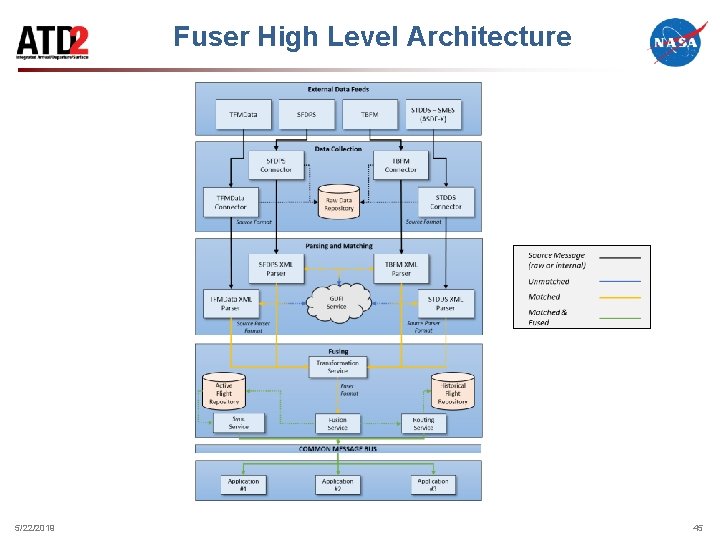
What is the Fuser • Fuser is a system composed of multiple components providing – Parsers for various data sources – Matching Services – Fusion Services • • Transformation Filtering Updating Mediation – Database Loading • Common well defined schema 5/22/2019 44
Fuser High Level Architecture 5/22/2019 45
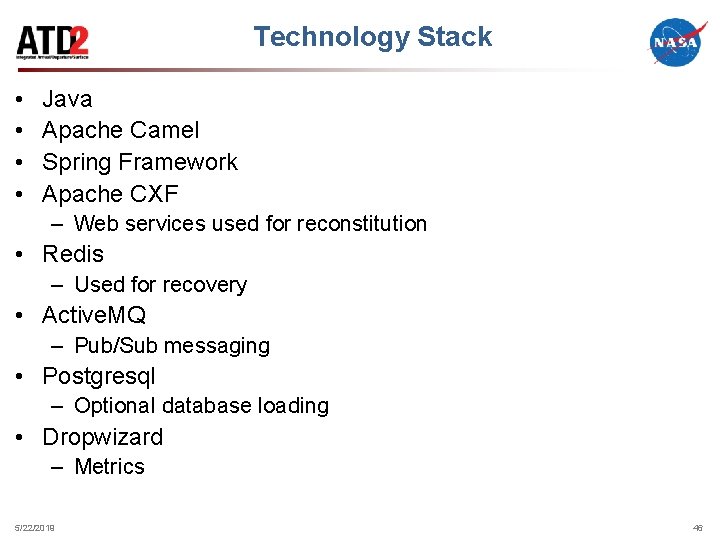
Technology Stack • • Java Apache Camel Spring Framework Apache CXF – Web services used for reconstitution • Redis – Used for recovery • Active. MQ – Pub/Sub messaging • Postgresql – Optional database loading • Dropwizard – Metrics 5/22/2019 46
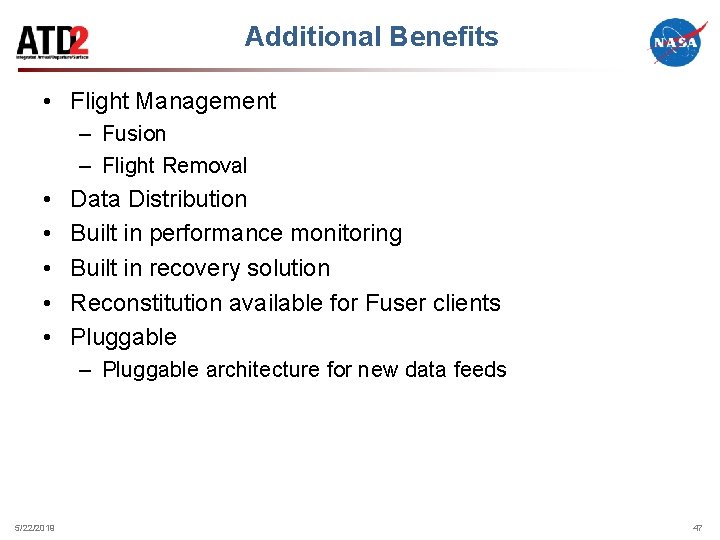
Additional Benefits • Flight Management – Fusion – Flight Removal • • • Data Distribution Built in performance monitoring Built in recovery solution Reconstitution available for Fuser clients Pluggable – Pluggable architecture for new data feeds 5/22/2019 47
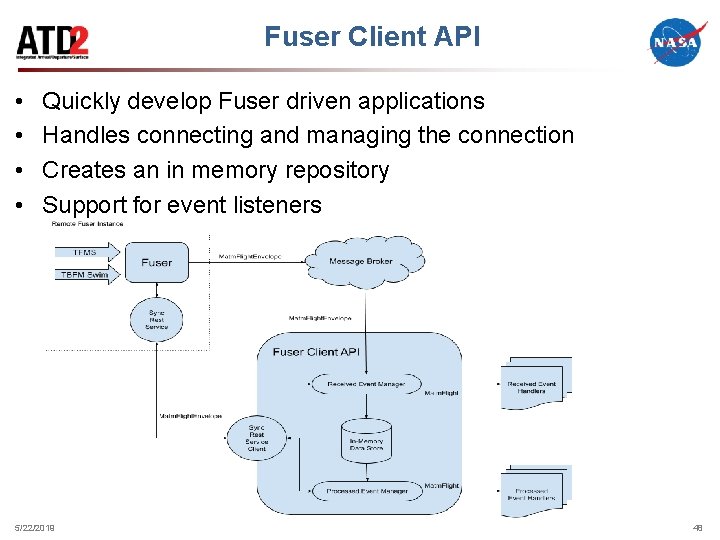
Fuser Client API • • Quickly develop Fuser driven applications Handles connecting and managing the connection Creates an in memory repository Support for event listeners 5/22/2019 48
Fuser Industry Documentation • Fuser Overview • Component Descriptions • Fuser Data Dictionary – Complete list of fields found in the Fuser – Field description • Most fields were meant to be self documenting • SWIM data to Fuser Mappings – Likely more valuable than the data dictionary itself • References to other SWIM related documentation • https: //aviationsystems. arc. nasa. gov/atd 2 -industrydays/fuser/ATD-2 -Industry-Day-Documentation. Outline_81565170. html 5/22/2019 49
Fuser in the Cloud (Pilot) • Fuser currently running in the cloud • Cloud Benefits – Reduce Cost by reducing. . • • Development time Operating cost Maintenance Enhancements • Delta volunteered to be our first pilot user • Willing to engage with others that want to partner 5/22/2019 50
Questions 51
National Aeronautics and Space Administration Airspace Technology Demonstration 2 (ATD-2) Fuser Deeper Dive (Mediation & Use Cases) May 22, 2019
Discussion Topics • • Flight Matching Fuser Processing – Transformation – Filtering – Mediation • Fuser Metadata • Use Cases 53
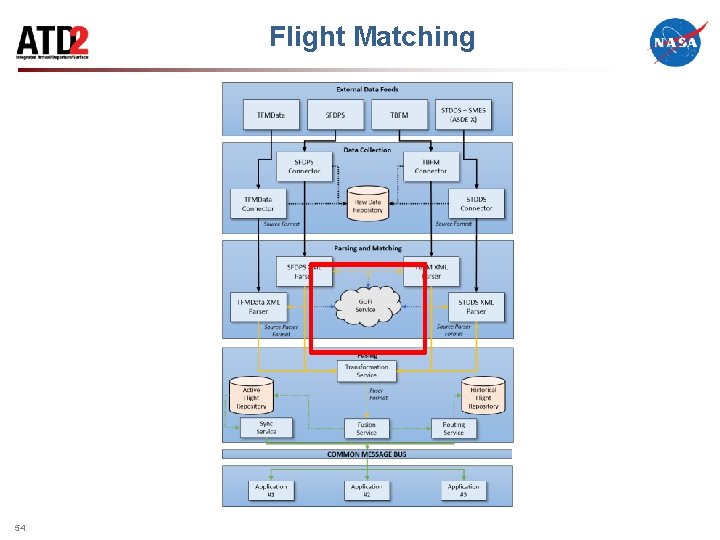
Flight Matching 54
Flight Matching: Overview • Goal – Assign a Global Unique Flight Identifier (GUFI) to every flight message. • Ex: AAL 1428. DFW. MCI. 190507. 1504. 0132. TFM • Why? – GUFI links together flight data across all external data feed sources. – Crucial precursor to data fusion. • What is a flight? – Flight matching is where the “flight” is defined. – ATD 2 defines a “flight” as the full lifecycle : starting with the scheduled or planned operation and ending at the arrival gate. 55
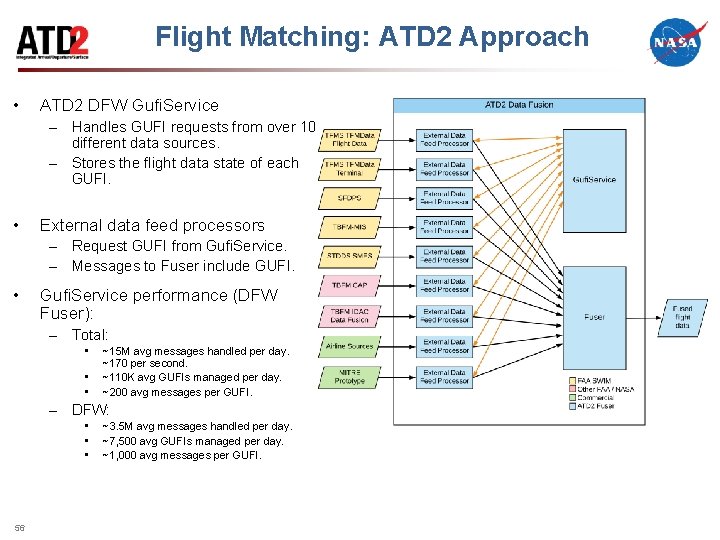
Flight Matching: ATD 2 Approach • ATD 2 DFW Gufi. Service – Handles GUFI requests from over 10 different data sources. – Stores the flight data state of each GUFI. • External data feed processors – Request GUFI from Gufi. Service. – Messages to Fuser include GUFI. • Gufi. Service performance (DFW Fuser): – Total: • • • ~15 M avg messages handled per day. ~170 per second. ~110 K avg GUFIs managed per day. ~200 avg messages per GUFI. – DFW: • • • 56 ~3. 5 M avg messages handled per day. ~7, 500 avg GUFIs managed per day. ~1, 000 avg messages per GUFI.
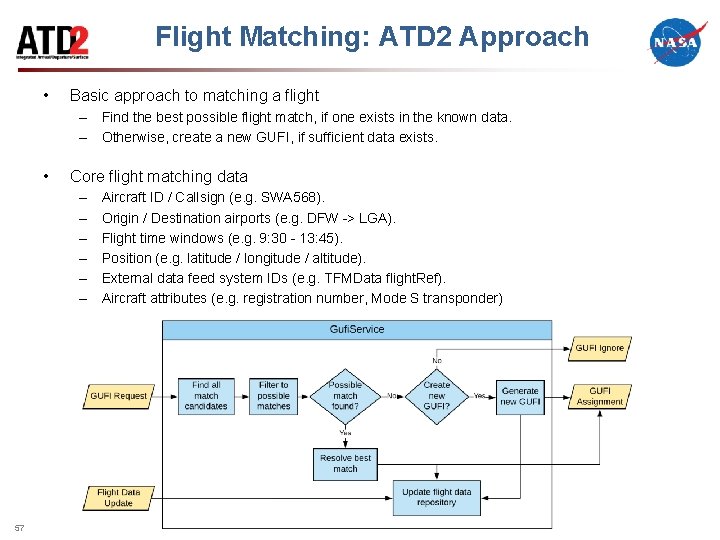
Flight Matching: ATD 2 Approach • Basic approach to matching a flight – Find the best possible flight match, if one exists in the known data. – Otherwise, create a new GUFI, if sufficient data exists. • Core flight matching data – – – 57 Aircraft ID / Callsign (e. g. SWA 568). Origin / Destination airports (e. g. DFW -> LGA). Flight time windows (e. g. 9: 30 - 13: 45). Position (e. g. latitude / longitude / altitude). External data feed system IDs (e. g. TFMData flight. Ref). Aircraft attributes (e. g. registration number, Mode S transponder)
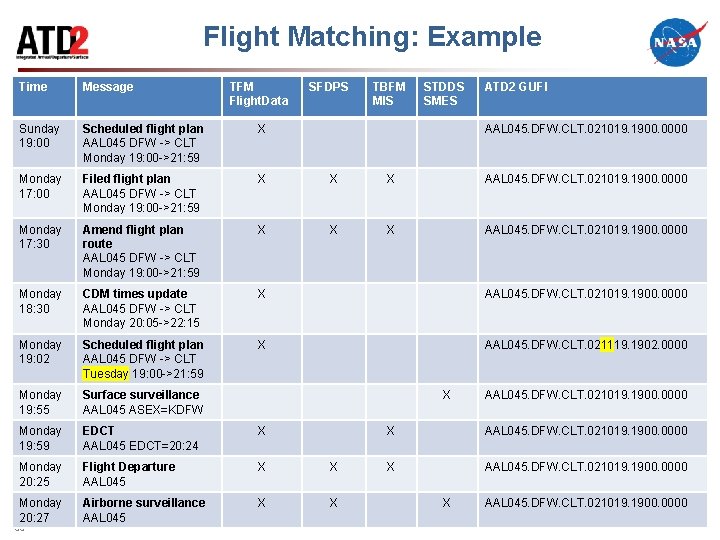
Flight Matching: Example Time Message Sunday 19: 00 Scheduled flight plan AAL 045 DFW -> CLT Monday 19: 00 ->21: 59 X Monday 17: 00 Filed flight plan AAL 045 DFW -> CLT Monday 19: 00 ->21: 59 X X X AAL 045. DFW. CLT. 021019. 1900. 0000 Monday 17: 30 Amend flight plan route AAL 045 DFW -> CLT Monday 19: 00 ->21: 59 X X X AAL 045. DFW. CLT. 021019. 1900. 0000 Monday 18: 30 CDM times update AAL 045 DFW -> CLT Monday 20: 05 ->22: 15 X AAL 045. DFW. CLT. 021019. 1900. 0000 Monday 19: 02 Scheduled flight plan AAL 045 DFW -> CLT Tuesday 19: 00 ->21: 59 X AAL 045. DFW. CLT. 021119. 1902. 0000 Monday 19: 55 Surface surveillance AAL 045 ASEX=KDFW Monday 19: 59 EDCT AAL 045 EDCT=20: 24 X Monday 20: 25 Flight Departure AAL 045 X X Monday 20: 27 Airborne surveillance AAL 045 X X 58 TFM Flight. Data SFDPS TBFM MIS STDDS SMES ATD 2 GUFI AAL 045. DFW. CLT. 021019. 1900. 0000 X AAL 045. DFW. CLT. 021019. 1900. 0000
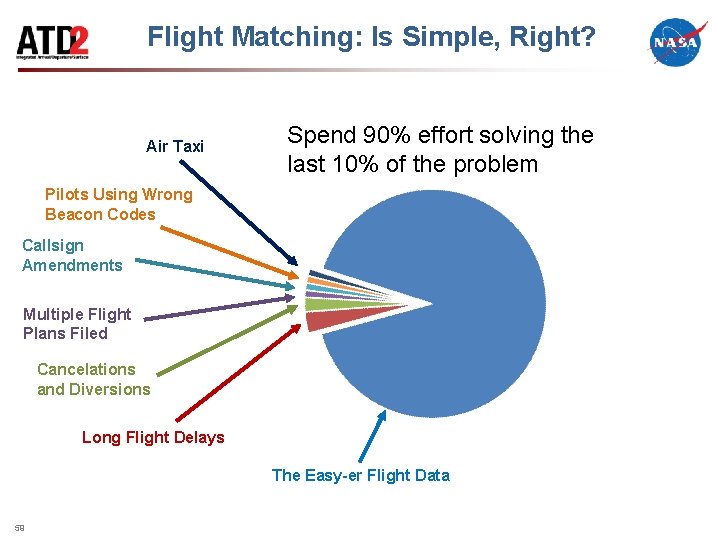
Flight Matching: Is Simple, Right? Air Taxi Spend 90% effort solving the last 10% of the problem Pilots Using Wrong Beacon Codes Callsign Amendments Multiple Flight Plans Filed Cancelations and Diversions Long Flight Delays The Easy-er Flight Data 59
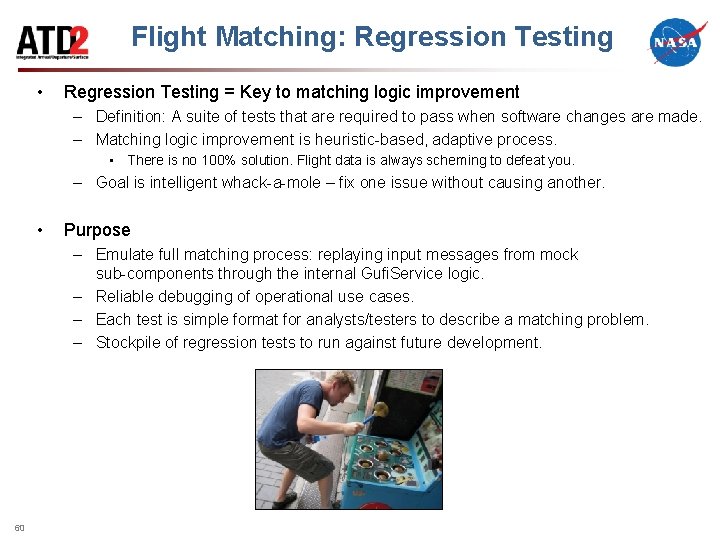
Flight Matching: Regression Testing • Regression Testing = Key to matching logic improvement – Definition: A suite of tests that are required to pass when software changes are made. – Matching logic improvement is heuristic-based, adaptive process. • There is no 100% solution. Flight data is always scheming to defeat you. – Goal is intelligent whack-a-mole – fix one issue without causing another. • Purpose – Emulate full matching process: replaying input messages from mock sub-components through the internal Gufi. Service logic. – Reliable debugging of operational use cases. – Each test is simple format for analysts/testers to describe a matching problem. – Stockpile of regression tests to run against future development. 60
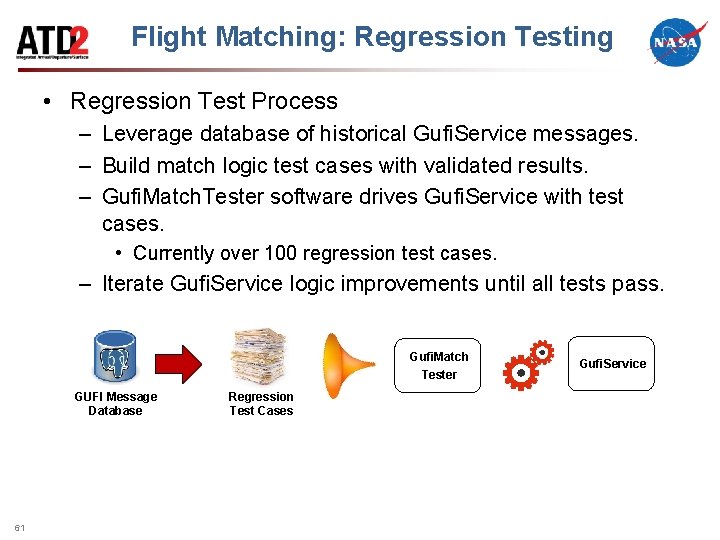
Flight Matching: Regression Testing • Regression Test Process – Leverage database of historical Gufi. Service messages. – Build match logic test cases with validated results. – Gufi. Match. Tester software drives Gufi. Service with test cases. • Currently over 100 regression test cases. – Iterate Gufi. Service logic improvements until all tests pass. Gufi. Match Tester GUFI Message Database 61 Regression Test Cases Gufi. Service
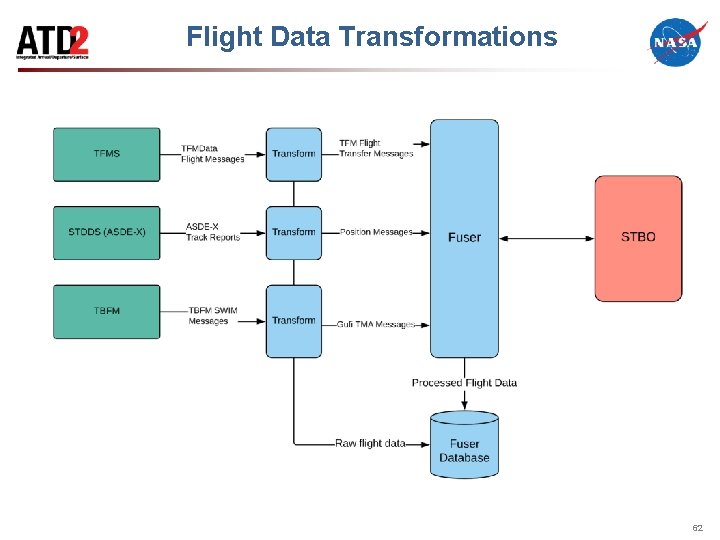
Flight Data Transformations 62
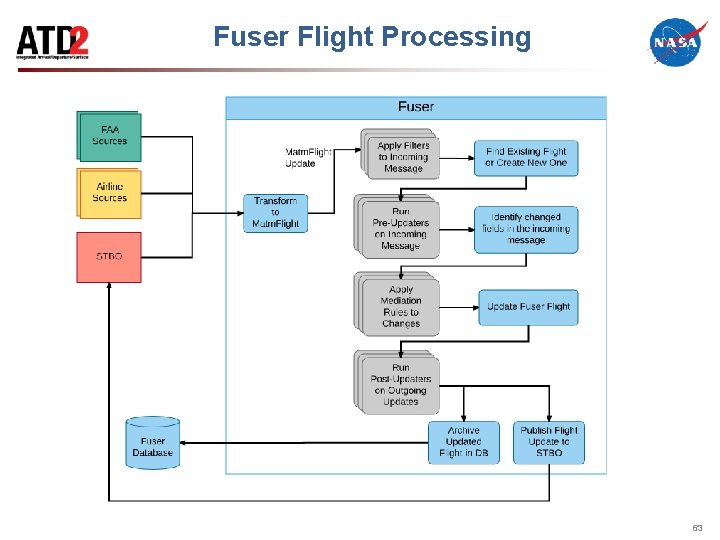
Fuser Flight Processing 63
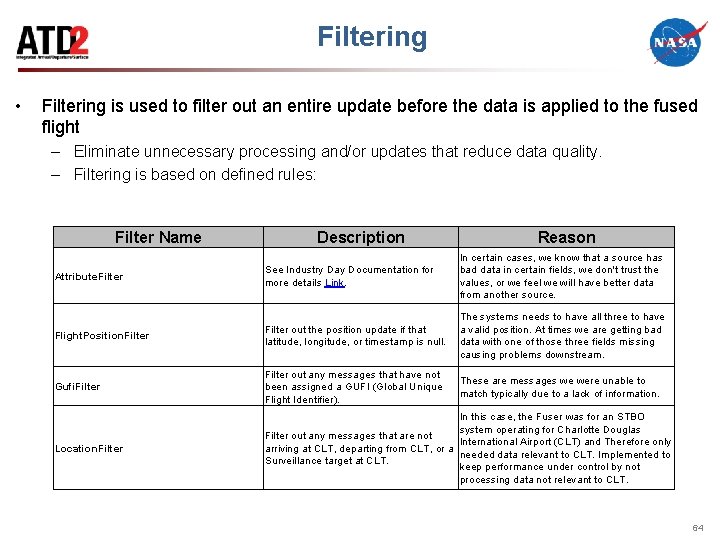
Filtering • Filtering is used to filter out an entire update before the data is applied to the fused flight – Eliminate unnecessary processing and/or updates that reduce data quality. – Filtering is based on defined rules: Filter Name Description Reason Attribute. Filter See Industry Day Documentation for more details Link. In certain cases, we know that a source has bad data in certain fields, we don't trust the values, or we feel we will have better data from another source. Flight. Position. Filter out the position update if that latitude, longitude, or timestamp is null. The systems needs to have all three to have a valid position. At times we are getting bad data with one of those three fields missing causing problems downstream. Gufi. Filter out any messages that have not been assigned a GUFI (Global Unique Flight Identifier). These are messages we were unable to match typically due to a lack of information. Location. Filter In this case, the Fuser was for an STBO system operating for Charlotte Douglas Filter out any messages that are not International Airport (CLT) and Therefore only arriving at CLT, departing from CLT, or a needed data relevant to CLT. Implemented to Surveillance target at CLT. keep performance under control by not processing data not relevant to CLT. 64
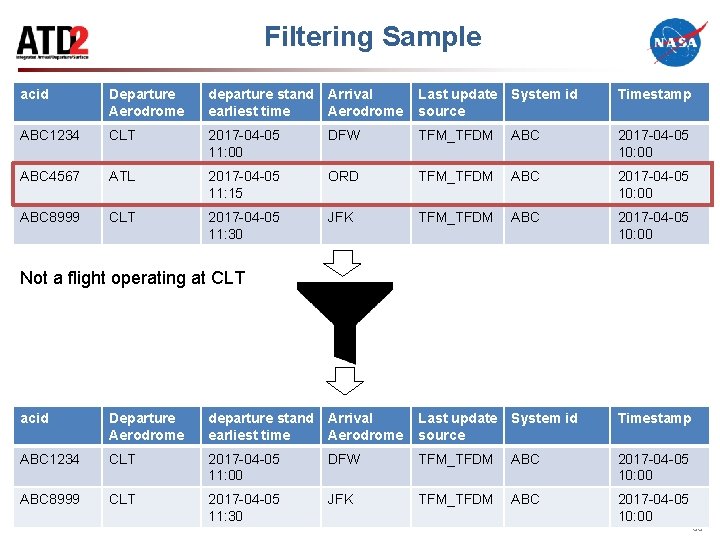
Filtering Sample acid Departure Aerodrome departure stand earliest time Arrival Aerodrome Last update source System id Timestamp ABC 1234 CLT 2017 -04 -05 11: 00 DFW TFM_TFDM ABC 2017 -04 -05 10: 00 ABC 4567 ATL 2017 -04 -05 11: 15 ORD TFM_TFDM ABC 2017 -04 -05 10: 00 ABC 8999 CLT 2017 -04 -05 11: 30 JFK TFM_TFDM ABC 2017 -04 -05 10: 00 Not a flight operating at CLT acid Departure Aerodrome departure stand earliest time Arrival Aerodrome Last update source System id Timestamp ABC 1234 CLT 2017 -04 -05 11: 00 DFW TFM_TFDM ABC 2017 -04 -05 10: 00 ABC 8999 CLT 2017 -04 -05 11: 30 JFK TFM_TFDM ABC 2017 -04 -05 10: 00 65
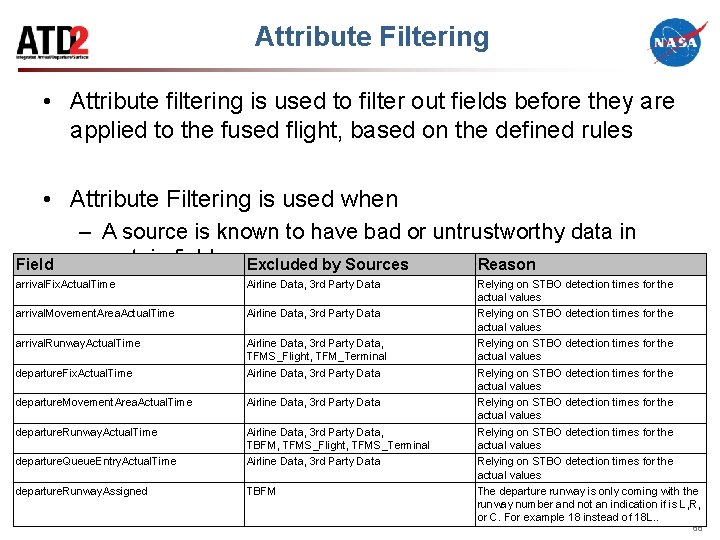
Attribute Filtering • Attribute filtering is used to filter out fields before they are applied to the fused flight, based on the defined rules • Attribute Filtering is used when – A source is known to have bad or untrustworthy data in certain fields Excluded by Sources Field Reason arrival. Fix. Actual. Time Airline Data, 3 rd Party Data Relying on STBO detection times for the – Better data is likely to exist in another source actual values for certain arrival. Movement. Area. Actual. Time Airline Data, 3 rd Party Data Relying on STBO detection times for the fields actual values arrival. Runway. Actual. Time departure. Fix. Actual. Time Airline Data, 3 rd Party Data, TFMS_Flight, TFM_Terminal Airline Data, 3 rd Party Data departure. Movement. Area. Actual. Time Airline Data, 3 rd Party Data departure. Runway. Actual. Time departure. Queue. Entry. Actual. Time Airline Data, 3 rd Party Data, TBFM, TFMS_Flight, TFMS_Terminal Airline Data, 3 rd Party Data departure. Runway. Assigned TBFM Relying on STBO detection times for the actual values Relying on STBO detection times for the actual values The departure runway is only coming with the runway number and not an indication if is L, R, or C. For example 18 instead of 18 L. . 66
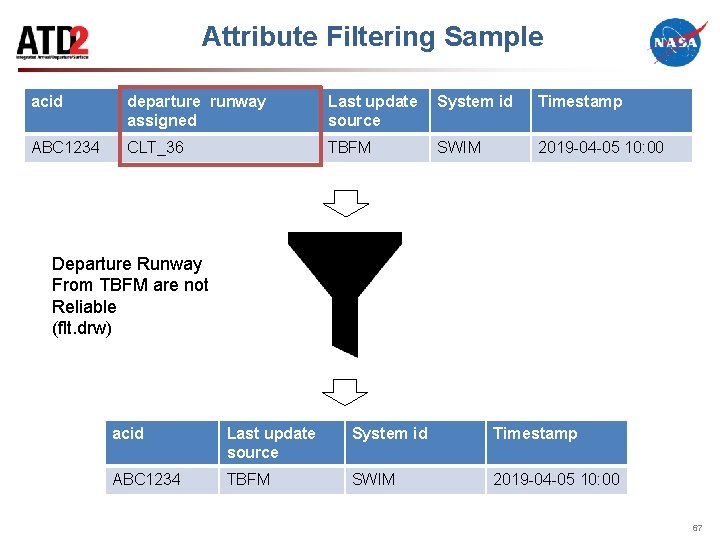
Attribute Filtering Sample acid departure runway assigned Last update source System id Timestamp ABC 1234 CLT_36 TBFM SWIM 2019 -04 -05 10: 00 Departure Runway From TBFM are not Reliable (flt. drw) acid Last update source System id Timestamp ABC 1234 TBFM SWIM 2019 -04 -05 10: 00 67
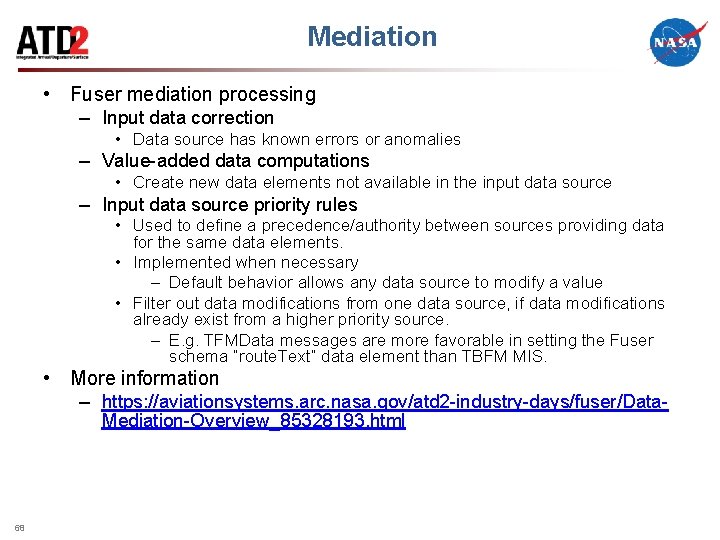
Mediation • Fuser mediation processing – Input data correction • Data source has known errors or anomalies – Value-added data computations • Create new data elements not available in the input data source – Input data source priority rules • Used to define a precedence/authority between sources providing data for the same data elements. • Implemented when necessary – Default behavior allows any data source to modify a value • Filter out data modifications from one data source, if data modifications already exist from a higher priority source. – E. g. TFMData messages are more favorable in setting the Fuser schema “route. Text” data element than TBFM MIS. • More information – https: //aviationsystems. arc. nasa. gov/atd 2 -industry-days/fuser/Data. Mediation-Overview_85328193. html 68
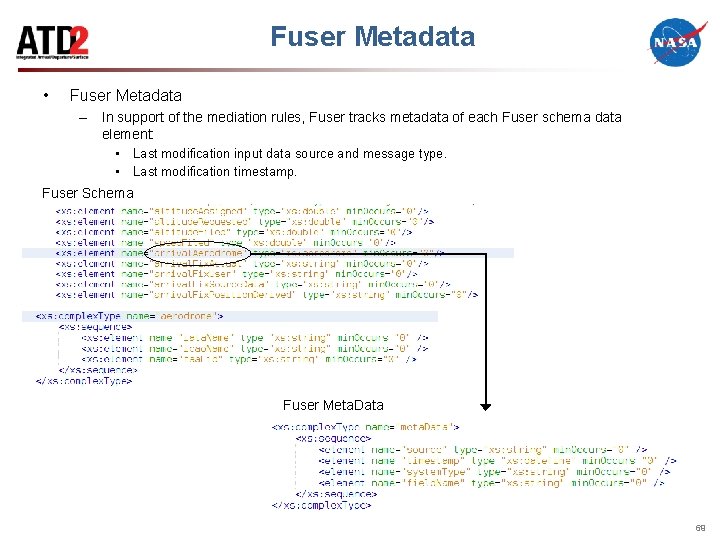
Fuser Metadata • Fuser Metadata – In support of the mediation rules, Fuser tracks metadata of each Fuser schema data element: • Last modification input data source and message type. • Last modification timestamp. Fuser Schema Fuser Meta. Data 69
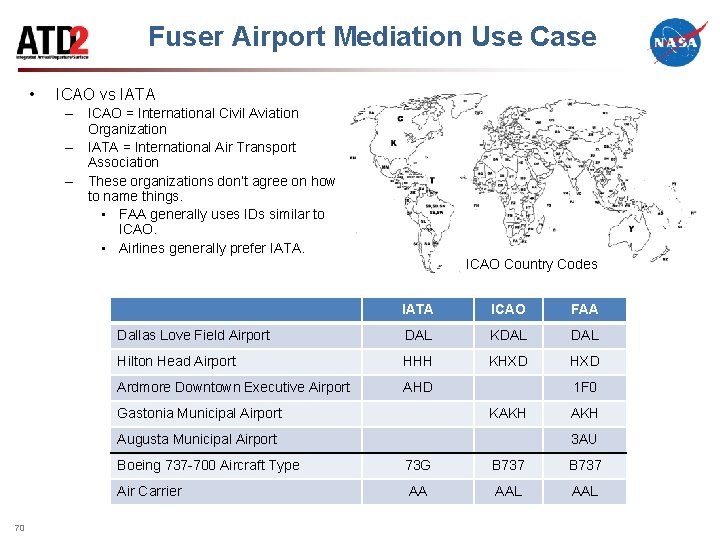
Fuser Airport Mediation Use Case • ICAO vs IATA – ICAO = International Civil Aviation Organization – IATA = International Air Transport Association – These organizations don’t agree on how to name things. • FAA generally uses IDs similar to ICAO. • Airlines generally prefer IATA. ICAO Country Codes IATA ICAO FAA Dallas Love Field Airport DAL KDAL Hilton Head Airport HHH KHXD Ardmore Downtown Executive Airport AHD Gastonia Municipal Airport 1 F 0 KAKH Augusta Municipal Airport 70 AKH 3 AU Boeing 737 -700 Aircraft Type 73 G B 737 Air Carrier AA AAL
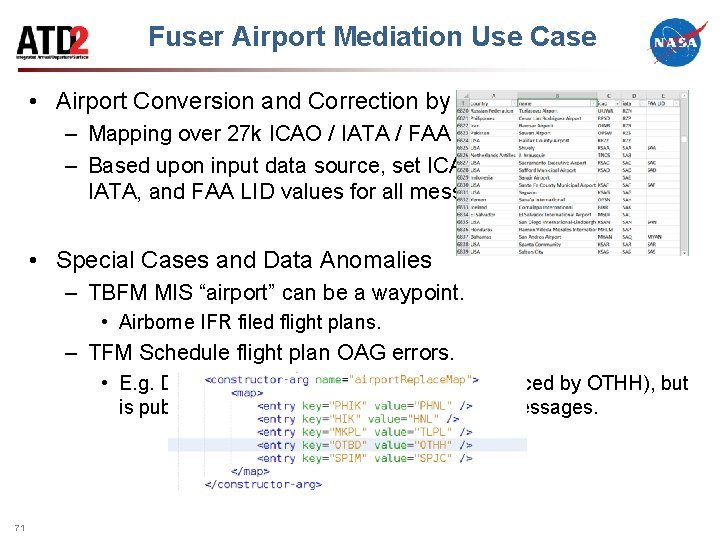
Fuser Airport Mediation Use Case • Airport Conversion and Correction by Source – Mapping over 27 k ICAO / IATA / FAA LID. – Based upon input data source, set ICAO, IATA, and FAA LID values for all messages. • Special Cases and Data Anomalies – TBFM MIS “airport” can be a waypoint. • Airborne IFR filed flight plans. – TFM Schedule flight plan OAG errors. • E. g. Doha OTBD airport closed in 2014 (replaced by OTHH), but is published in TFMS Scheduled flight plan messages. 71
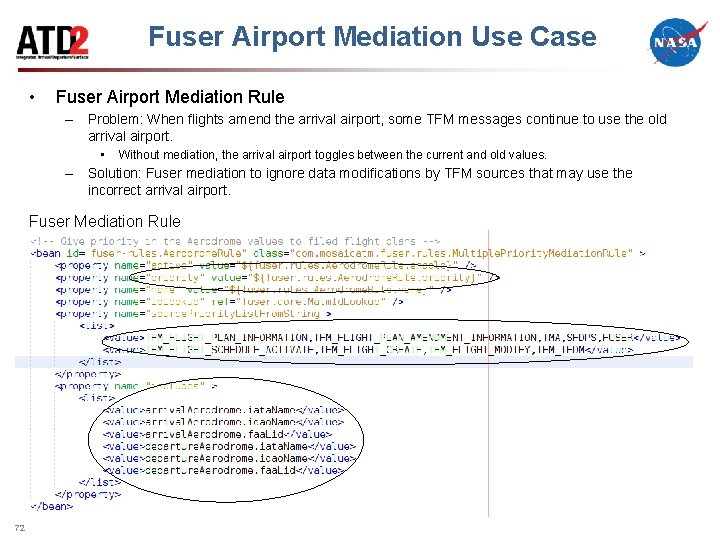
Fuser Airport Mediation Use Case • Fuser Airport Mediation Rule – Problem: When flights amend the arrival airport, some TFM messages continue to use the old arrival airport. • Without mediation, the arrival airport toggles between the current and old values. – Solution: Fuser mediation to ignore data modifications by TFM sources that may use the incorrect arrival airport. Fuser Mediation Rule 72
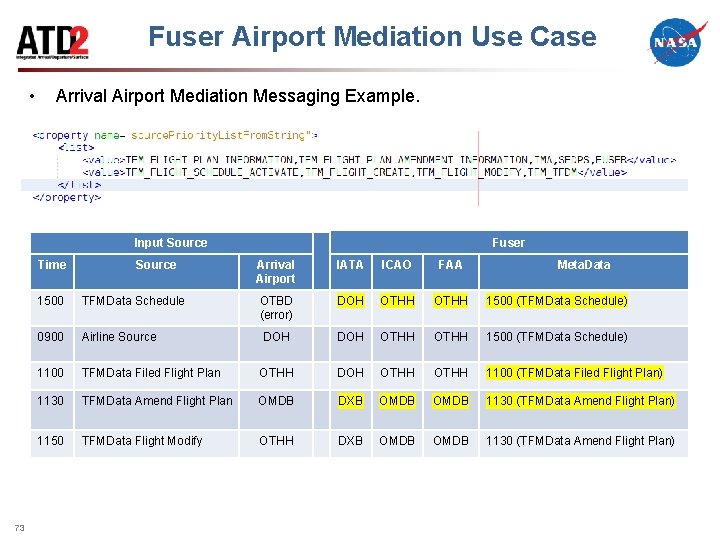
Fuser Airport Mediation Use Case • Arrival Airport Mediation Messaging Example. Input Source Time 73 Source Fuser Arrival Airport IATA ICAO FAA Meta. Data 1500 TFMData Schedule OTBD (error) DOH OTHH 1500 (TFMData Schedule) 0900 Airline Source DOH OTHH 1500 (TFMData Schedule) 1100 TFMData Filed Flight Plan OTHH DOH OTHH 1100 (TFMData Filed Flight Plan) 1130 TFMData Amend Flight Plan OMDB DXB OMDB 1130 (TFMData Amend Flight Plan) 1150 TFMData Flight Modify OTHH DXB OMDB 1130 (TFMData Amend Flight Plan)
Mediation Position Data 74
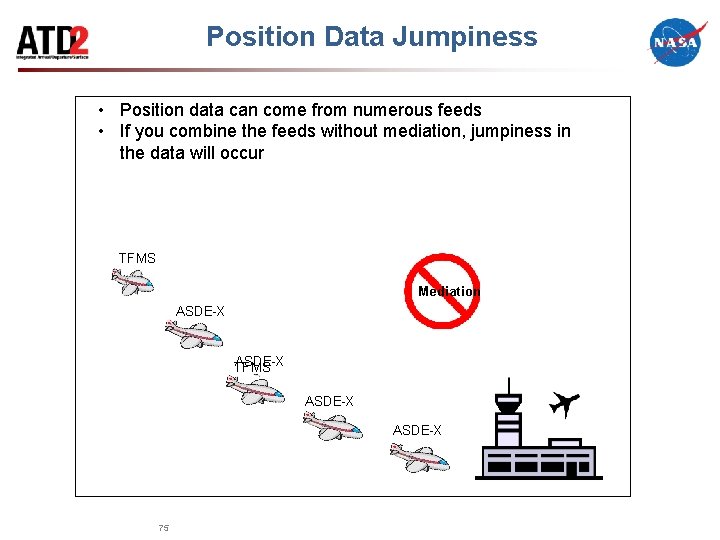
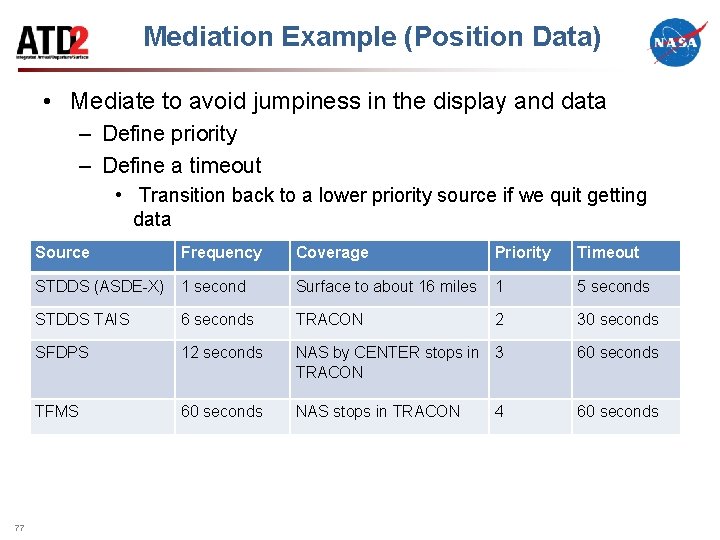
Position Data Jumpiness • Position data can come from numerous feeds • If you combine the feeds without mediation, jumpiness in the data will occur TFMS Mediation ASDE-X TFMS ASDE-X 75
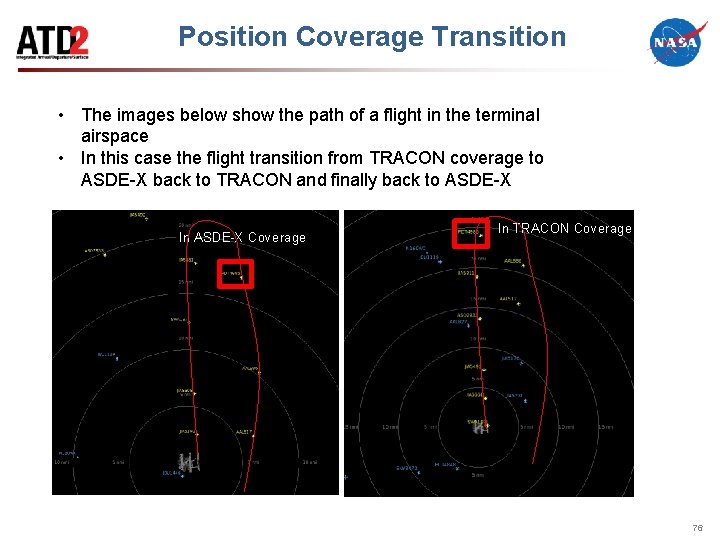
Position Coverage Transition • The images below show the path of a flight in the terminal airspace • In this case the flight transition from TRACON coverage to ASDE-X back to TRACON and finally back to ASDE-X In ASDE-X Coverage In TRACON Coverage 76
Mediation Example (Position Data) • Mediate to avoid jumpiness in the display and data – Define priority – Define a timeout • Transition back to a lower priority source if we quit getting data 77 Source Frequency Coverage Priority Timeout STDDS (ASDE-X) 1 second Surface to about 16 miles 1 5 seconds STDDS TAIS 6 seconds TRACON 2 30 seconds SFDPS 12 seconds NAS by CENTER stops in 3 TRACON 60 seconds TFMS 60 seconds NAS stops in TRACON 60 seconds 4
Mediation Example EDCTs • ATD-2 needs EDCTs for common situational awareness and runway predictions • ATD-2 mediates TFMS and TBFM as equal sources – ATD-2 does not have to track filtered EDCTs separately from unfiltered EDCTs TFMS Tfm. Data Flight nscm. Flight. Control. nscm. Control. Data. ctd ERAM EDCTs Filter TBFM-MIS ATD-2 Fuser EDCT tma. flt. etm *TBFM SYNC messages had to be handled as syncs and not updates Prevented resetting the EDCT back to an old value 78
Multiple Flight Plans 79
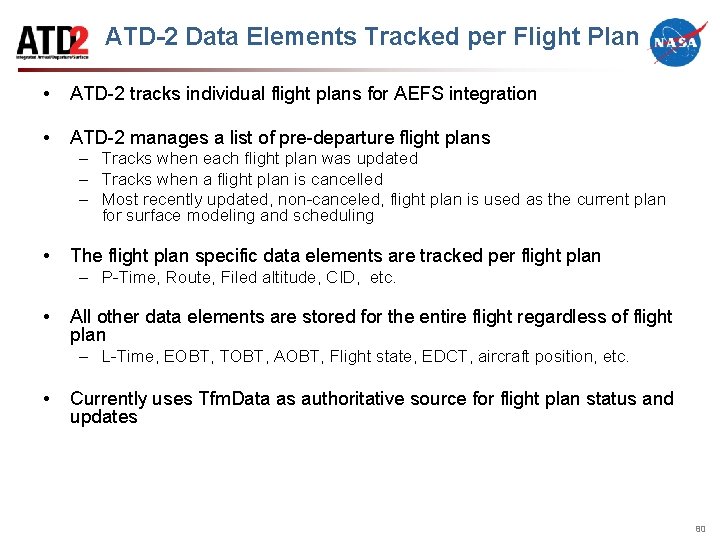
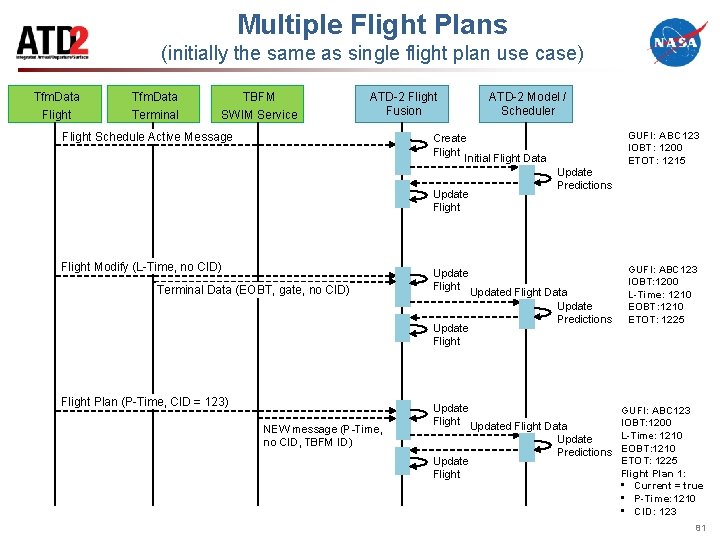
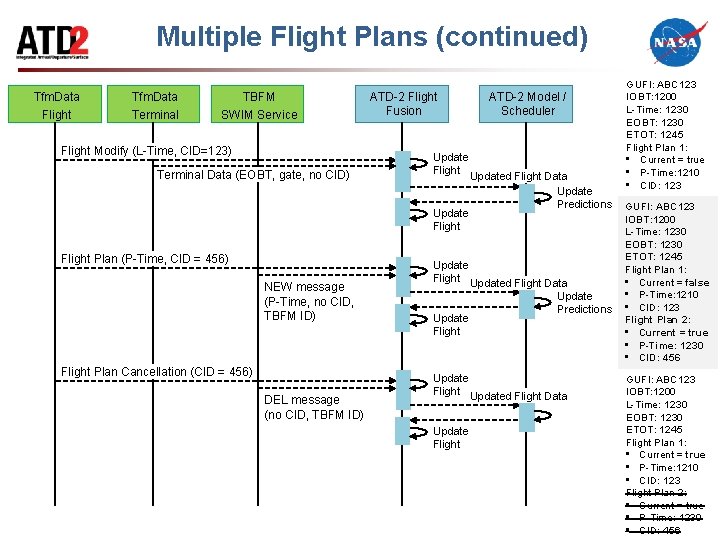
ATD-2 Data Elements Tracked per Flight Plan • ATD-2 tracks individual flight plans for AEFS integration • ATD-2 manages a list of pre-departure flight plans – Tracks when each flight plan was updated – Tracks when a flight plan is cancelled – Most recently updated, non-canceled, flight plan is used as the current plan for surface modeling and scheduling • The flight plan specific data elements are tracked per flight plan – P-Time, Route, Filed altitude, CID, etc. • All other data elements are stored for the entire flight regardless of flight plan – L-Time, EOBT, TOBT, AOBT, Flight state, EDCT, aircraft position, etc. • Currently uses Tfm. Data as authoritative source for flight plan status and updates 80
Multiple Flight Plans (initially the same as single flight plan use case) Tfm. Data Flight Tfm. Data Terminal TBFM SWIM Service ATD-2 Flight Fusion Flight Schedule Active Message ATD-2 Model / Scheduler Create Flight Initial Flight Data Update Flight Modify (L-Time, no CID) Terminal Data (EOBT, gate, no CID) Update Flight Plan (P-Time, CID = 123) NEW message (P-Time, no CID, TBFM ID) Update Predictions Updated Flight Data Update Predictions GUFI: ABC 123 IOBT: 1200 ETOT: 1215 GUFI: ABC 123 IOBT: 1200 L-Time: 1210 EOBT: 1210 ETOT: 1225 Update Flight Updated Flight Data Update Flight GUFI: ABC 123 IOBT: 1200 L-Time: 1210 Update Predictions EOBT: 1210 ETOT: 1225 Flight Plan 1: • Current = true • P-Time: 1210 • CID: 123 81
Multiple Flight Plans (continued) Tfm. Data Flight Tfm. Data Terminal TBFM SWIM Service Flight Modify (L-Time, CID=123) Terminal Data (EOBT, gate, no CID) ATD-2 Flight Fusion Update Flight Plan (P-Time, CID = 456) NEW message (P-Time, no CID, TBFM ID) Flight Plan Cancellation (CID = 456) DEL message (no CID, TBFM ID) ATD-2 Model / Scheduler Updated Flight Data Update Predictions Update Flight Updated Flight Data Update Flight GUFI: ABC 123 IOBT: 1200 L-Time: 1230 EOBT: 1230 ETOT: 1245 Flight Plan 1: • Current = true • P-Time: 1210 • CID: 123 GUFI: ABC 123 IOBT: 1200 L-Time: 1230 EOBT: 1230 ETOT: 1245 Flight Plan 1: • Current = false • P-Time: 1210 • CID: 123 Flight Plan 2: • Current = true • P-Time: 1230 • CID: 456 GUFI: ABC 123 IOBT: 1200 L-Time: 1230 EOBT: 1230 ETOT: 1245 Flight Plan 1: • Current = true • P-Time: 1210 • CID: 123 Flight Plan 2: • Current = true • P-Time: 1230 • CID: 456
Fuser Flight Data
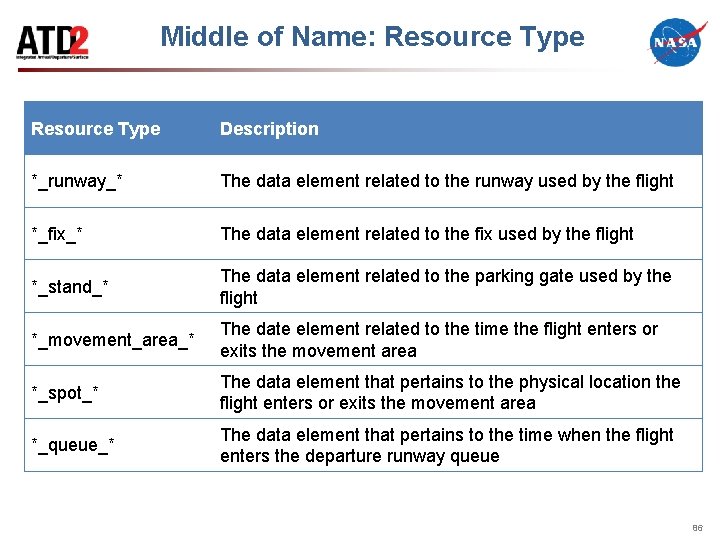
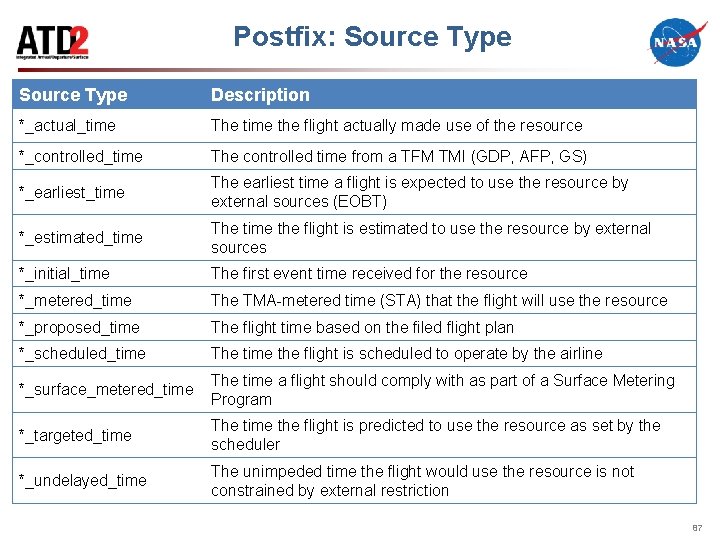
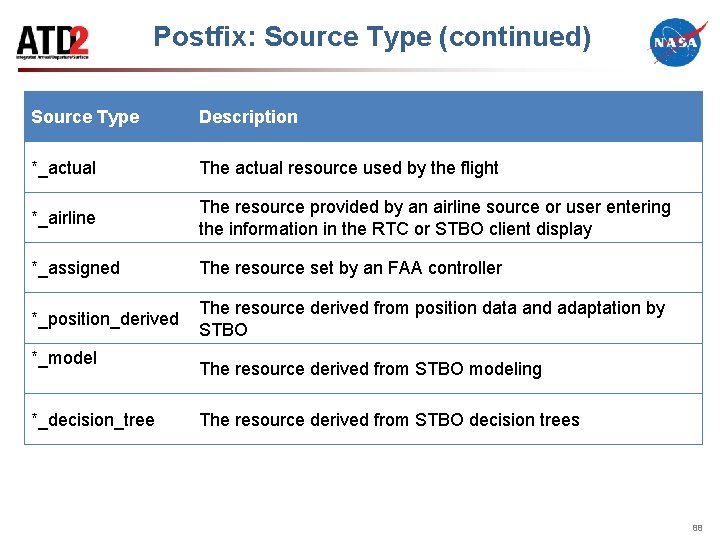
Overview of Fuser Flight Model • Standard naming convention used with most data elements in the Fuser Flight • Naming convention is a based on a flattened version of the Flight Object Data Dictionary (FODD) and FIXM Schema. • Named so that related elements are close together alphabetically • Self documenting for the most part • Each name consists of three parts – Information category – Resource Type – Source Type • Naming convention: category_resource. Type_source. Type • Examples: – arrival_runway_actual_time – departure_spot_predicted 84
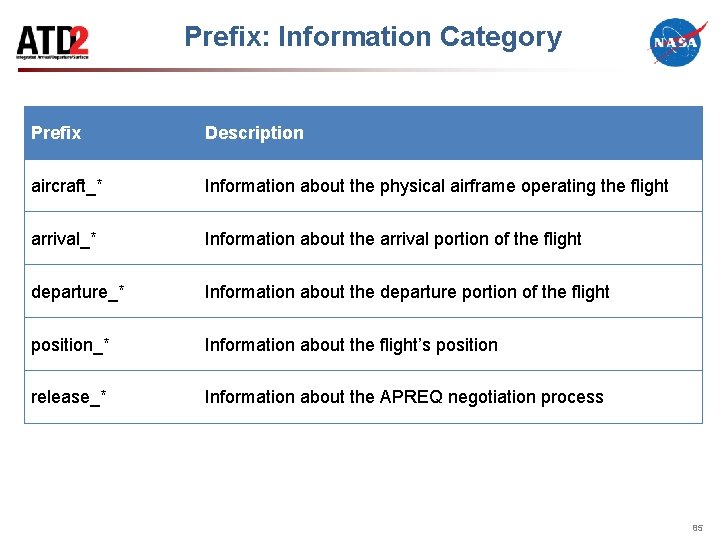
Prefix: Information Category Prefix Description aircraft_* Information about the physical airframe operating the flight arrival_* Information about the arrival portion of the flight departure_* Information about the departure portion of the flight position_* Information about the flight’s position release_* Information about the APREQ negotiation process 85
Middle of Name: Resource Type Description *_runway_* The data element related to the runway used by the flight *_fix_* The data element related to the fix used by the flight *_stand_* The data element related to the parking gate used by the flight *_movement_area_* The date element related to the time the flight enters or exits the movement area *_spot_* The data element that pertains to the physical location the flight enters or exits the movement area *_queue_* The data element that pertains to the time when the flight enters the departure runway queue 86
Postfix: Source Type Description *_actual_time The time the flight actually made use of the resource *_controlled_time The controlled time from a TFM TMI (GDP, AFP, GS) *_earliest_time The earliest time a flight is expected to use the resource by external sources (EOBT) *_estimated_time The time the flight is estimated to use the resource by external sources *_initial_time The first event time received for the resource *_metered_time The TMA-metered time (STA) that the flight will use the resource *_proposed_time The flight time based on the filed flight plan *_scheduled_time The time the flight is scheduled to operate by the airline *_surface_metered_time The time a flight should comply with as part of a Surface Metering Program *_targeted_time The time the flight is predicted to use the resource as set by the scheduler *_undelayed_time The unimpeded time the flight would use the resource is not constrained by external restriction 87
Postfix: Source Type (continued) Source Type Description *_actual The actual resource used by the flight *_airline The resource provided by an airline source or user entering the information in the RTC or STBO client display *_assigned The resource set by an FAA controller *_position_derived The resource derived from position data and adaptation by STBO *_model *_decision_tree The resource derived from STBO modeling The resource derived from STBO decision trees 88
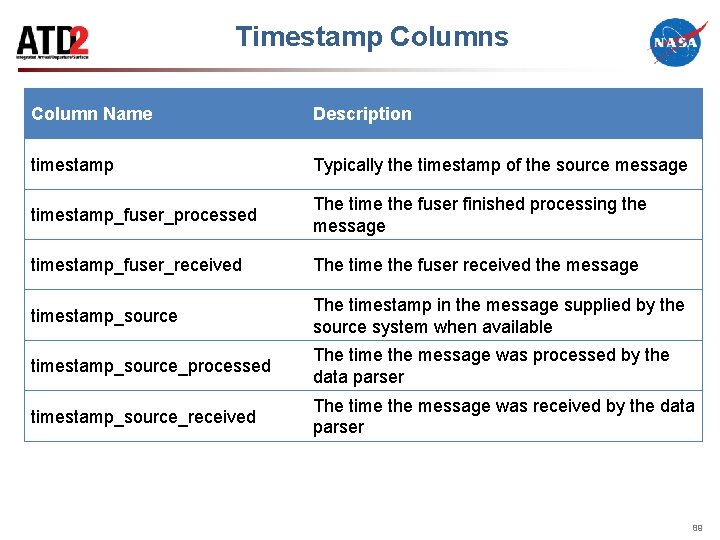
Timestamp Columns Column Name Description timestamp Typically the timestamp of the source message timestamp_fuser_processed The time the fuser finished processing the message timestamp_fuser_received The time the fuser received the message timestamp_source The timestamp in the message supplied by the source system when available timestamp_source_processed The time the message was processed by the data parser timestamp_source_received The time the message was received by the data parser 89
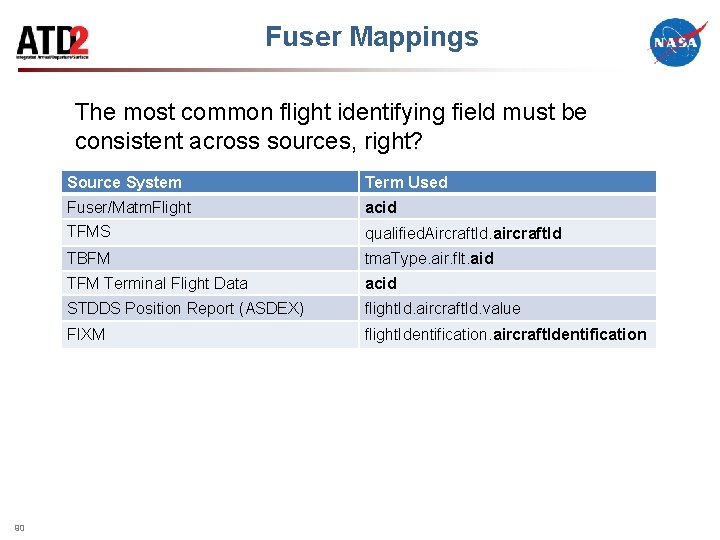
Fuser Mappings The most common flight identifying field must be consistent across sources, right? 90 Source System Term Used Fuser/Matm. Flight acid TFMS qualified. Aircraft. Id. aircraft. Id TBFM tma. Type. air. flt. aid TFM Terminal Flight Data acid STDDS Position Report (ASDEX) flight. Id. aircraft. Id. value FIXM flight. Identification. aircraft. Identification
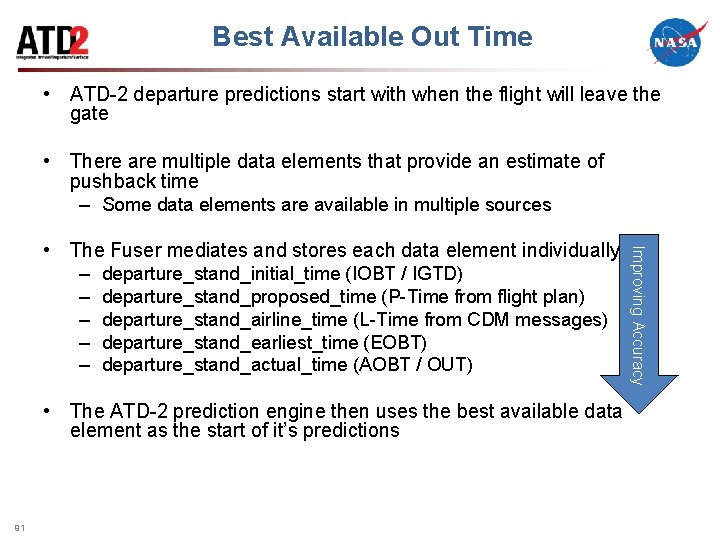
Best Available Out Time • ATD-2 departure predictions start with when the flight will leave the gate • There are multiple data elements that provide an estimate of pushback time – Some data elements are available in multiple sources • The ATD-2 prediction engine then uses the best available data element as the start of it’s predictions 91 Improving Accuracy • The Fuser mediates and stores each data element individually – departure_stand_initial_time (IOBT / IGTD) – departure_stand_proposed_time (P-Time from flight plan) – departure_stand_airline_time (L-Time from CDM messages) – departure_stand_earliest_time (EOBT) – departure_stand_actual_time (AOBT / OUT)
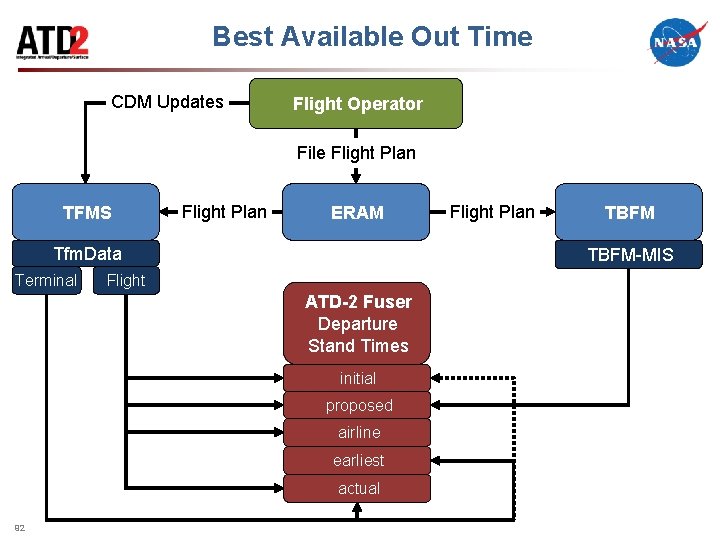
Best Available Out Time CDM Updates Flight Operator File Flight Plan TFMS Flight Plan ERAM Tfm. Data Terminal TBFM-MIS Flight ATD-2 Fuser Departure Stand Times initial proposed airline earliest actual 92 Flight Plan
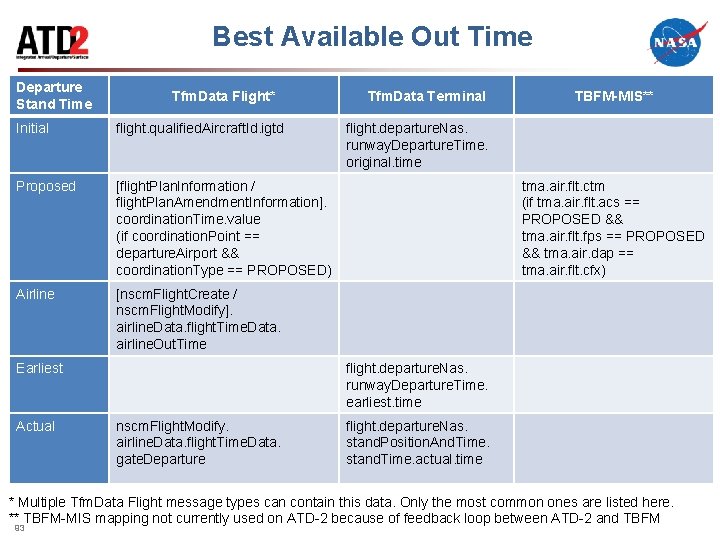
Best Available Out Time Departure Stand Time Tfm. Data Flight* Initial flight. qualified. Aircraft. Id. igtd Proposed [flight. Plan. Information / flight. Plan. Amendment. Information]. coordination. Time. value (if coordination. Point == departure. Airport && coordination. Type == PROPOSED) Airline [nscm. Flight. Create / nscm. Flight. Modify]. airline. Data. flight. Time. Data. airline. Out. Time Earliest Actual Tfm. Data Terminal TBFM-MIS** flight. departure. Nas. runway. Departure. Time. original. time tma. air. flt. ctm (if tma. air. flt. acs == PROPOSED && tma. air. flt. fps == PROPOSED && tma. air. dap == tma. air. flt. cfx) flight. departure. Nas. runway. Departure. Time. earliest. time nscm. Flight. Modify. airline. Data. flight. Time. Data. gate. Departure flight. departure. Nas. stand. Position. And. Time. stand. Time. actual. time * Multiple Tfm. Data Flight message types can contain this data. Only the most common ones are listed here. ** TBFM-MIS mapping not currently used on ATD-2 because of feedback loop between ATD-2 and TBFM 93
ATD-2 Fuser Mapping • Full Fuser Mappings Available – https: //aviationsystems. arc. nasa. gov/atd 2 -industrydays/fuser/Fuser-Database-Input-Mapping. Table_85328219. html 94
Questions 95
National Aeronautics and Space Administration Airspace Technology Demonstration 2 (ATD-2) ATD-2 Fuser Database May 22, 2019
Fuser Database • Purpose • Database Overview • Database Details • Use Cases
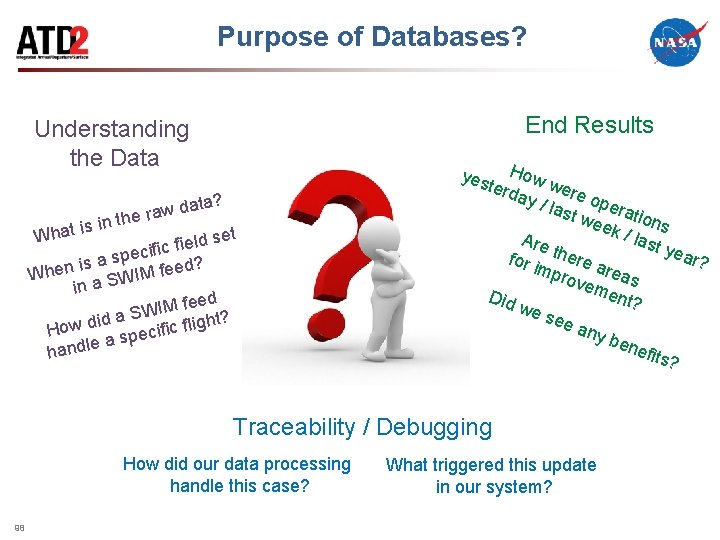
Purpose of Databases? End Results Understanding the Data What is in ta? da w a r e th How w terd ay / ere op erat last wee ions k/l ast Are yea t h ere for i r? area mpr ove s m e Did nt? we see any ben efits ? yes t ld se e i f c i f speci a s i eed? f M When I W in a S feed M I W id a S ic flight? d w o H ecif p s a handle Traceability / Debugging How did our data processing handle this case? 98 What triggered this update in our system?
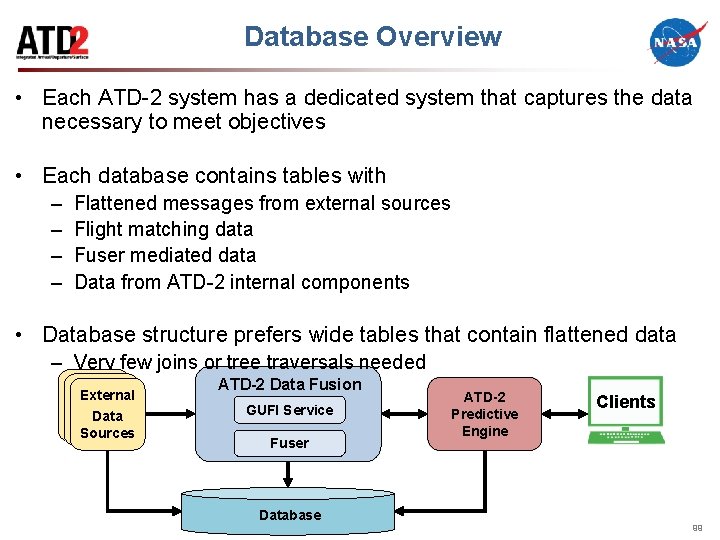
Database Overview • Each ATD-2 system has a dedicated system that captures the data necessary to meet objectives • Each database contains tables with – – Flattened messages from external sources Flight matching data Fuser mediated data Data from ATD-2 internal components • Database structure prefers wide tables that contain flattened data – Very few joins or tree traversals needed External Sources Data Sources ATD-2 Data Fusion GUFI Service Fuser ATD-2 Predictive Engine Clients Database 99
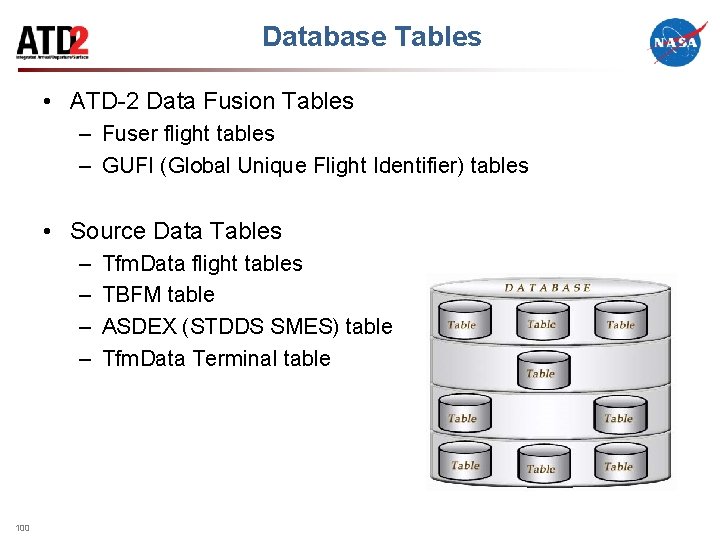
Database Tables • ATD-2 Data Fusion Tables – Fuser flight tables – GUFI (Global Unique Flight Identifier) tables • Source Data Tables – – 100 Tfm. Data flight tables TBFM table ASDEX (STDDS SMES) table Tfm. Data Terminal table
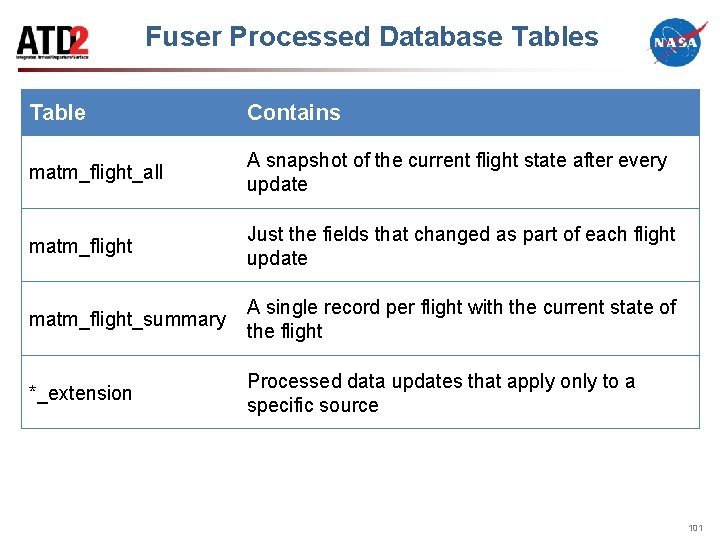
Fuser Processed Database Tables Table Contains matm_flight_all A snapshot of the current flight state after every update matm_flight Just the fields that changed as part of each flight update matm_flight_summary A single record per flight with the current state of the flight *_extension Processed data updates that apply only to a specific source 101
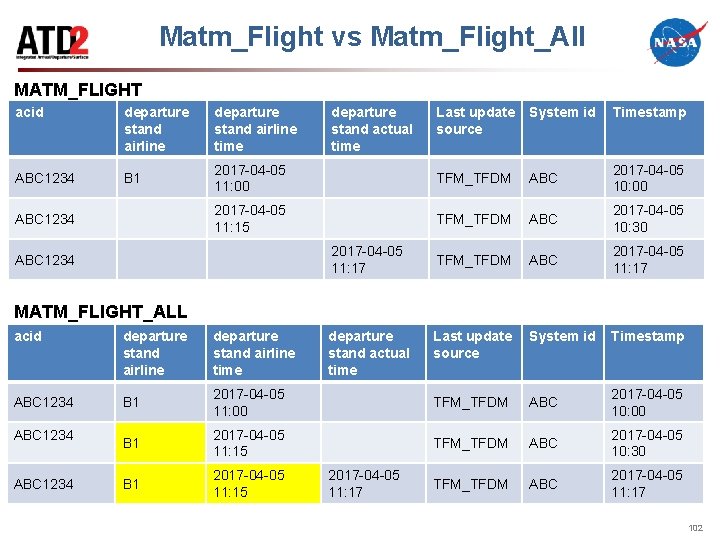
Matm_Flight vs Matm_Flight_All MATM_FLIGHT acid departure stand airline time ABC 1234 B 1 ABC 1234 departure stand actual time Last update source System id Timestamp 2017 -04 -05 11: 00 TFM_TFDM ABC 2017 -04 -05 10: 00 2017 -04 -05 11: 15 TFM_TFDM ABC 2017 -04 -05 10: 30 TFM_TFDM ABC 2017 -04 -05 11: 17 Last update source System id Timestamp 2017 -04 -05 11: 17 ABC 1234 MATM_FLIGHT_ALL acid departure stand airline time ABC 1234 B 1 2017 -04 -05 11: 00 TFM_TFDM ABC 2017 -04 -05 10: 00 B 1 2017 -04 -05 11: 15 TFM_TFDM ABC 2017 -04 -05 10: 30 B 1 2017 -04 -05 11: 15 TFM_TFDM ABC 2017 -04 -05 11: 17 ABC 1234 departure stand actual time 2017 -04 -05 11: 17 102
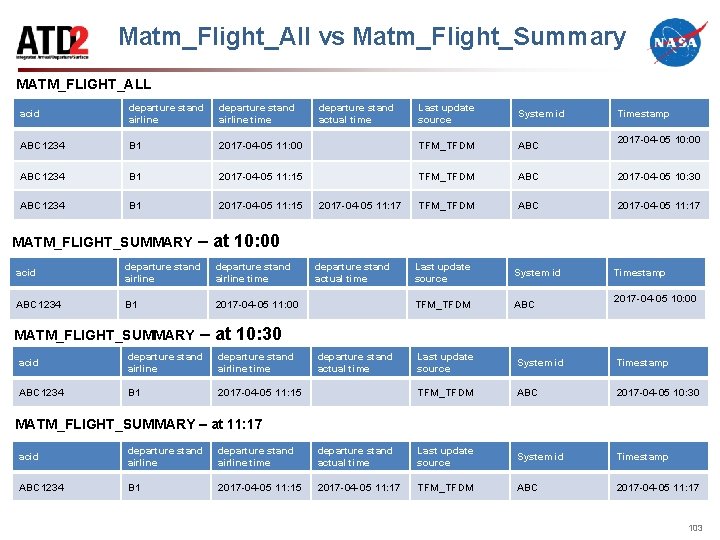
Matm_Flight_All vs Matm_Flight_Summary MATM_FLIGHT_ALL acid departure stand airline time ABC 1234 B 1 ABC 1234 Last update source System id 2017 -04 -05 11: 00 TFM_TFDM ABC B 1 2017 -04 -05 11: 15 TFM_TFDM ABC 2017 -04 -05 10: 30 B 1 2017 -04 -05 11: 15 TFM_TFDM ABC 2017 -04 -05 11: 17 MATM_FLIGHT_SUMMARY 2017 -04 -05 11: 17 Timestamp 2017 -04 -05 10: 00 – at 10: 00 acid departure stand airline time ABC 1234 B 1 2017 -04 -05 11: 00 MATM_FLIGHT_SUMMARY departure stand actual time Last update source System id TFM_TFDM ABC Last update source System id Timestamp TFM_TFDM ABC 2017 -04 -05 10: 30 Timestamp 2017 -04 -05 10: 00 – at 10: 30 acid departure stand airline time ABC 1234 B 1 2017 -04 -05 11: 15 departure stand actual time MATM_FLIGHT_SUMMARY – at 11: 17 acid departure stand airline time departure stand actual time Last update source System id Timestamp ABC 1234 B 1 2017 -04 -05 11: 15 2017 -04 -05 11: 17 TFM_TFDM ABC 2017 -04 -05 11: 17 103
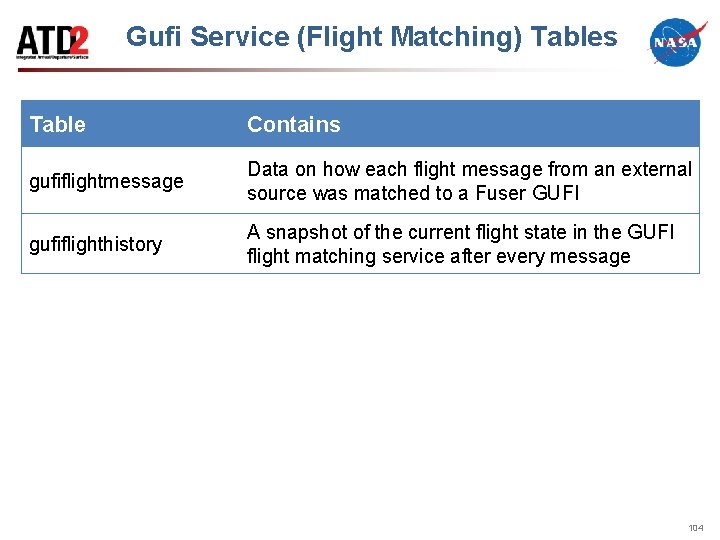
Gufi Service (Flight Matching) Tables Table Contains gufiflightmessage Data on how each flight message from an external source was matched to a Fuser GUFI gufiflighthistory A snapshot of the current flight state in the GUFI flight matching service after every message 104
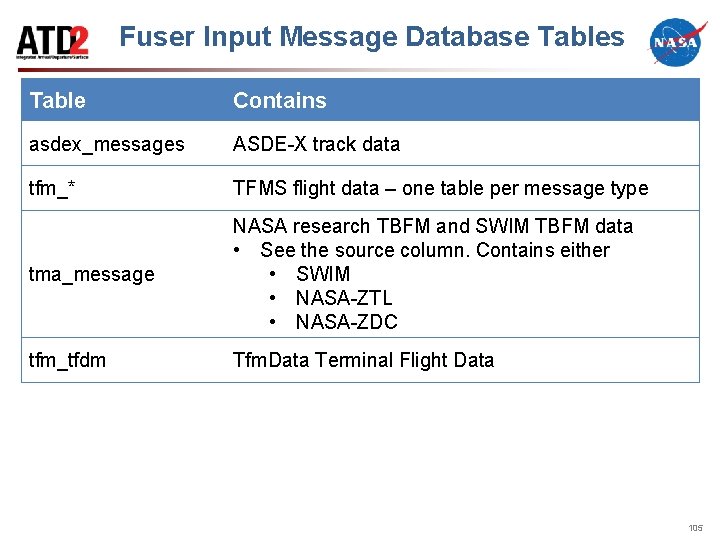
Fuser Input Message Database Tables Table Contains asdex_messages ASDE-X track data tfm_* TFMS flight data – one table per message type tma_message NASA research TBFM and SWIM TBFM data • See the source column. Contains either • SWIM • NASA-ZTL • NASA-ZDC tfm_tfdm Tfm. Data Terminal Flight Data 105
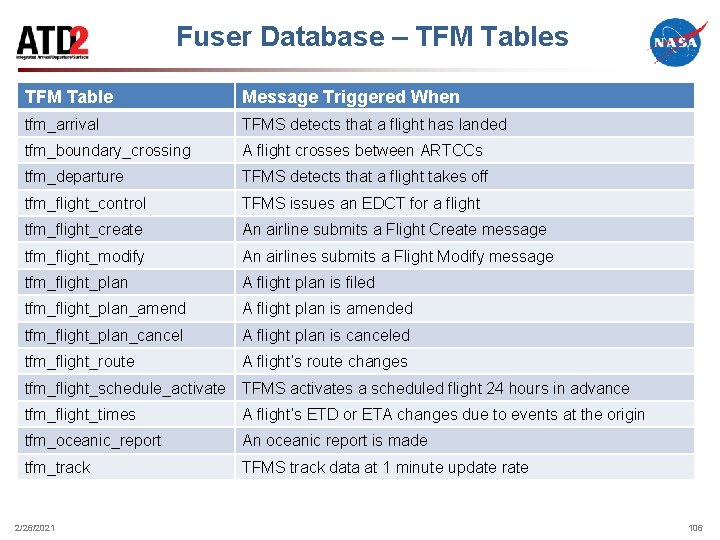
Fuser Database – TFM Tables TFM Table Message Triggered When tfm_arrival TFMS detects that a flight has landed tfm_boundary_crossing A flight crosses between ARTCCs tfm_departure TFMS detects that a flight takes off tfm_flight_control TFMS issues an EDCT for a flight tfm_flight_create An airline submits a Flight Create message tfm_flight_modify An airlines submits a Flight Modify message tfm_flight_plan A flight plan is filed tfm_flight_plan_amend A flight plan is amended tfm_flight_plan_cancel A flight plan is canceled tfm_flight_route A flight’s route changes tfm_flight_schedule_activate TFMS activates a scheduled flight 24 hours in advance tfm_flight_times A flight’s ETD or ETA changes due to events at the origin tfm_oceanic_report An oceanic report is made tfm_track TFMS track data at 1 minute update rate 2/26/2021 106
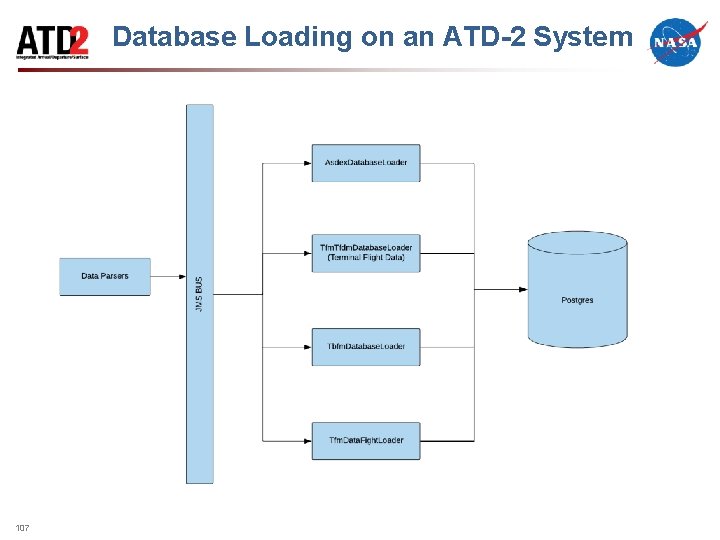
Database Loading on an ATD-2 System 107
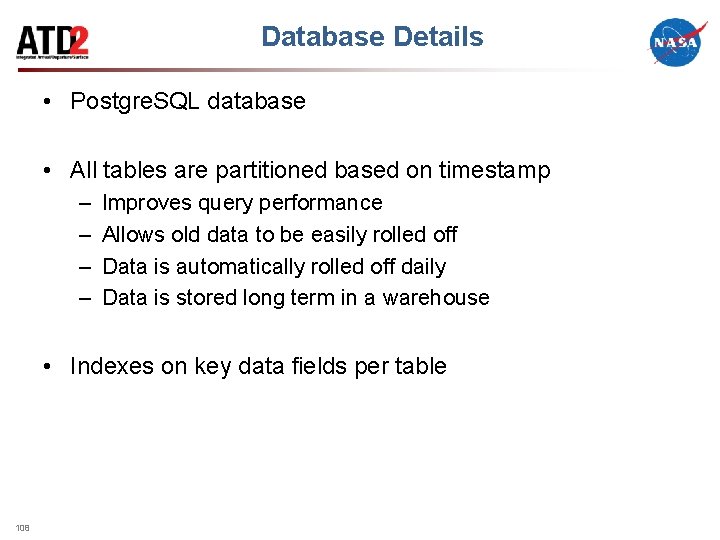
Database Details • Postgre. SQL database • All tables are partitioned based on timestamp – – Improves query performance Allows old data to be easily rolled off Data is automatically rolled off daily Data is stored long term in a warehouse • Indexes on key data fields per table 108
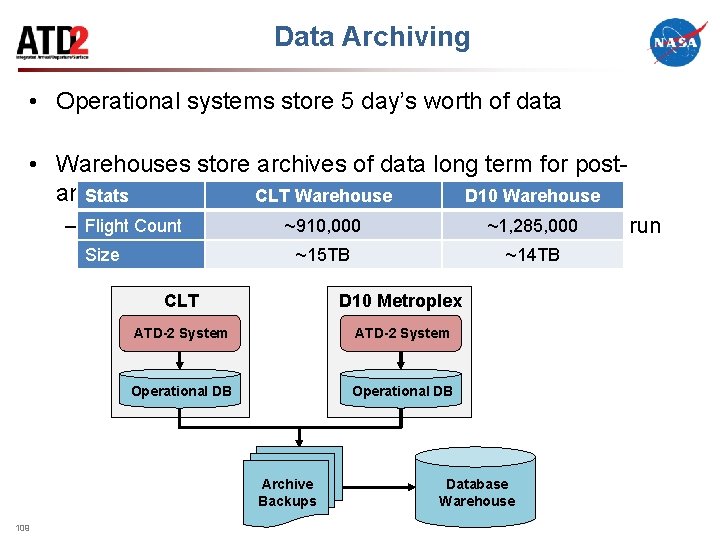
Data Archiving • Operational systems store 5 day’s worth of data • Warehouses store archives of data long term for postanalysis Stats CLT Warehouse D 10 Warehouse ~910, 000 ~1, 285, 000 – Flight Data. Count is archived nightly to allow post-analysis scripts to run overnight Size ~15 TB ~14 TB CLT D 10 Metroplex ATD-2 System Operational DB Archive Backups 109 Database Warehouse
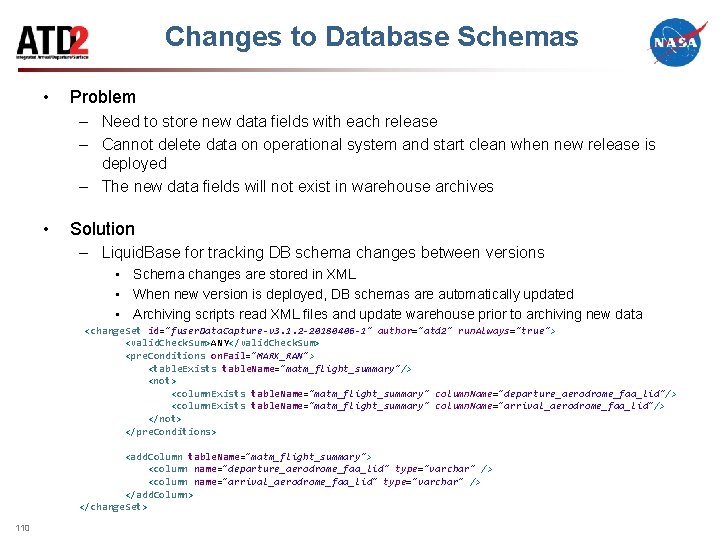
Changes to Database Schemas • Problem – Need to store new data fields with each release – Cannot delete data on operational system and start clean when new release is deployed – The new data fields will not exist in warehouse archives • Solution – Liquid. Base for tracking DB schema changes between versions • Schema changes are stored in XML • When new version is deployed, DB schemas are automatically updated • Archiving scripts read XML files and update warehouse prior to archiving new data <change. Set id="fuser. Data. Capture-v 3. 1. 2 -20180406 -1" author="atd 2" run. Always="true"> <valid. Check. Sum>ANY</valid. Check. Sum> <pre. Conditions on. Fail="MARK_RAN"> <table. Exists table. Name="matm_flight_summary"/> <not> <column. Exists table. Name="matm_flight_summary" column. Name="departure_aerodrome_faa_lid"/> <column. Exists table. Name="matm_flight_summary" column. Name="arrival_aerodrome_faa_lid"/> </not> </pre. Conditions> <add. Column table. Name="matm_flight_summary"> <column name="departure_aerodrome_faa_lid" type="varchar" /> <column name="arrival_aerodrome_faa_lid" type="varchar" /> </add. Column> </change. Set> 110
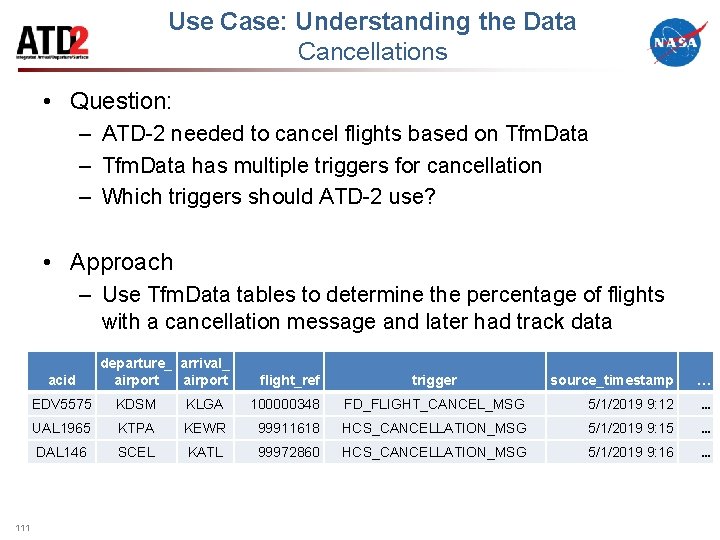
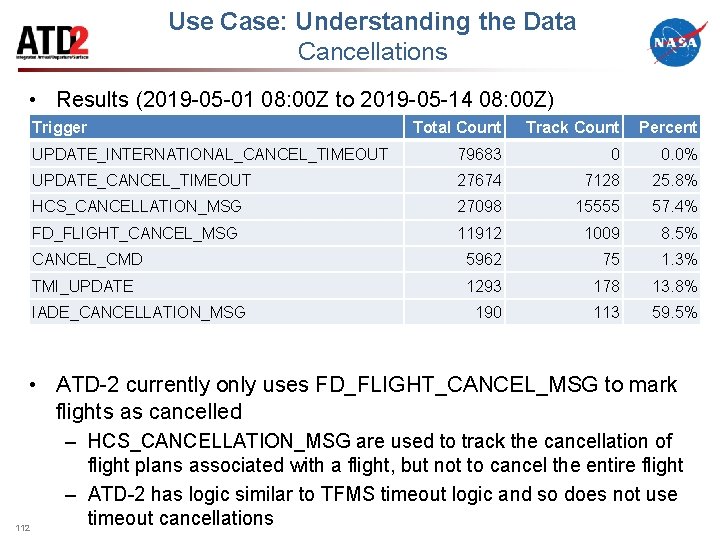
Use Case: Understanding the Data Cancellations • Question: – ATD-2 needed to cancel flights based on Tfm. Data – Tfm. Data has multiple triggers for cancellation – Which triggers should ATD-2 use? • Approach – Use Tfm. Data tables to determine the percentage of flights with a cancellation message and later had track data departure_ arrival_ airport flight_reftable • acidtfm_flight_plan_cancel 111 trigger source_timestamp … EDV 5575 KDSM KLGA 100000348 FD_FLIGHT_CANCEL_MSG 5/1/2019 9: 12 … UAL 1965 KTPA KEWR 99911618 HCS_CANCELLATION_MSG 5/1/2019 9: 15 … DAL 146 SCEL KATL 99972860 HCS_CANCELLATION_MSG 5/1/2019 9: 16 …
Use Case: Understanding the Data Cancellations • Results (2019 -05 -01 08: 00 Z to 2019 -05 -14 08: 00 Z) Trigger Total Count Track Count Percent UPDATE_INTERNATIONAL_CANCEL_TIMEOUT 79683 0 0. 0% UPDATE_CANCEL_TIMEOUT 27674 7128 25. 8% HCS_CANCELLATION_MSG 27098 15555 57. 4% FD_FLIGHT_CANCEL_MSG 11912 1009 8. 5% CANCEL_CMD 5962 75 1. 3% TMI_UPDATE 1293 178 13. 8% 190 113 59. 5% IADE_CANCELLATION_MSG • ATD-2 currently only uses FD_FLIGHT_CANCEL_MSG to mark flights as cancelled 112 – HCS_CANCELLATION_MSG are used to track the cancellation of flight plans associated with a flight, but not to cancel the entire flight – ATD-2 has logic similar to TFMS timeout logic and so does not use timeout cancellations
Use Case: Traceability / Debugging Flight Matching Issues • Question: – Prior to going live at CLT, there was a large push to resolve flight matching issues – Testers reported an issue where two aircraft icons were observed for a single arrival – What happened? • Approach – Pull the data on the flight and all related flights from the GUFI tables – Find when the first mismatch happened – Create a file with the GUFI corrected for every entry – Run file through unit test tool to identify problem 113
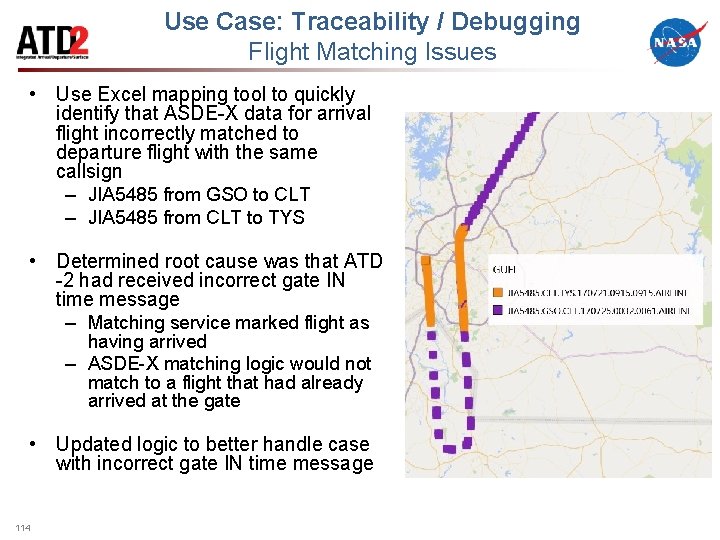
Use Case: Traceability / Debugging Flight Matching Issues • Use Excel mapping tool to quickly identify that ASDE-X data for arrival flight incorrectly matched to departure flight with the same callsign – JIA 5485 from GSO to CLT – JIA 5485 from CLT to TYS • Determined root cause was that ATD -2 had received incorrect gate IN time message – Matching service marked flight as having arrived – ASDE-X matching logic would not match to a flight that had already arrived at the gate • Updated logic to better handle case with incorrect gate IN time message 114
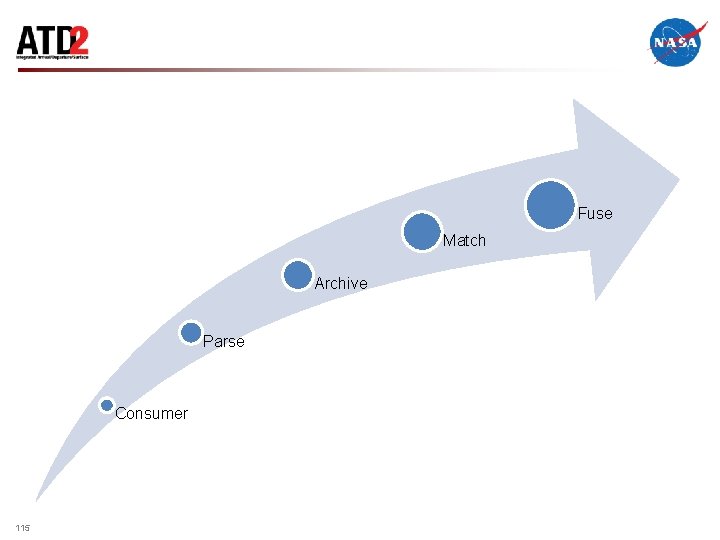
Fuse Match Archive Parse Consumer 115
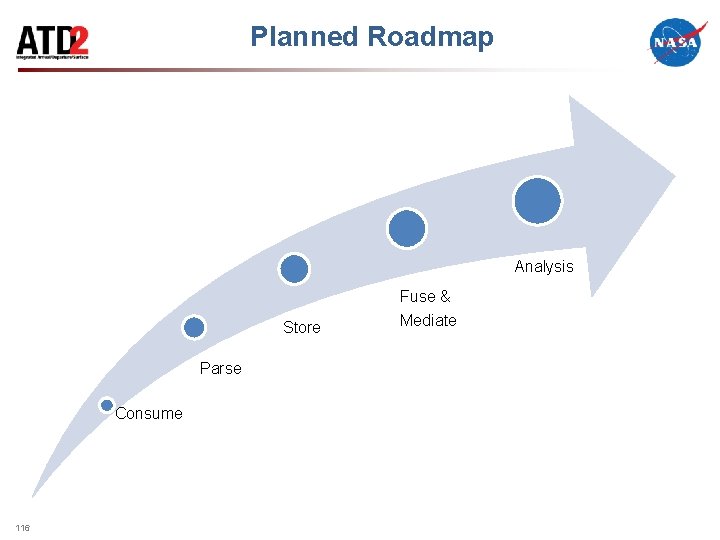
Planned Roadmap Analysis Fuse & Store Parse Consume 116 Mediate
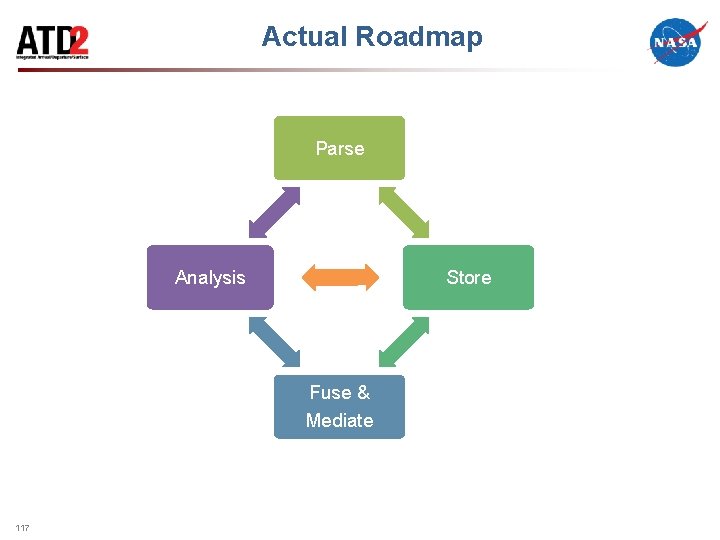
Actual Roadmap Parse Analysis Store Fuse & Mediate 117
Questions 118
National Aeronautics and Space Administration Airspace Technology Demonstration 2 (ATD-2) Turning SWIM Data into Consistent Reports for Analysts and Users May 22, 2019
Background • ATD-2 systems ingest huge amounts of SWIM data • They also output huge amounts of data, recording every aspect of the operation • This output data is very valuable, but is too verbose to be used effectively for some analysis use cases • To address this challenge, we have developed a variety of standardized reports to serve analyst and user needs 120
Analyst challenges in using data This output data presents several problems: 1. Scale: this is big data for most analysts, and Postgres query engine not forgiving for inexpert query design, particularly when trying to conduct longitudinal analysis 2. Complexity: DB design may seem complex to some analysts 3. “Noise”: human inputs, complexities of data mediation, order of processing messages, changes from earlier versions of ATD-2 software, etc. 4. Business rules: so many conventions for measurement Create standardized reports to support analyst and user needs 121
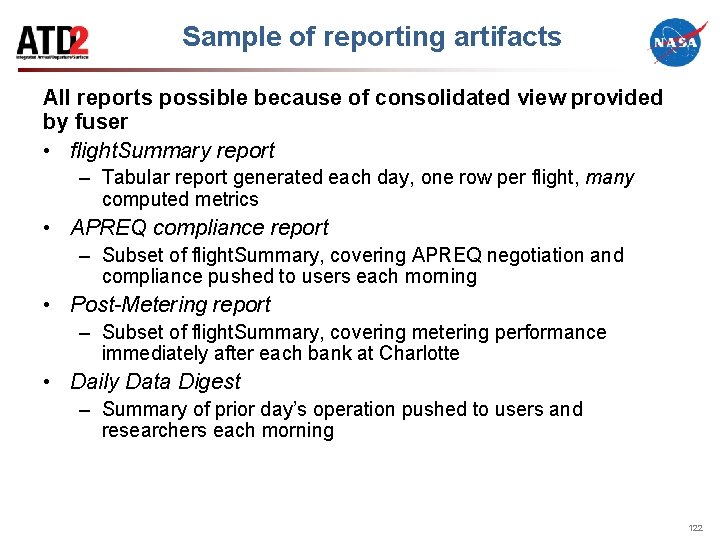
Sample of reporting artifacts All reports possible because of consolidated view provided by fuser • flight. Summary report – Tabular report generated each day, one row per flight, many computed metrics • APREQ compliance report – Subset of flight. Summary, covering APREQ negotiation and compliance pushed to users each morning • Post-Metering report – Subset of flight. Summary, covering metering performance immediately after each bank at Charlotte • Daily Data Digest – Summary of prior day’s operation pushed to users and researchers each morning 122
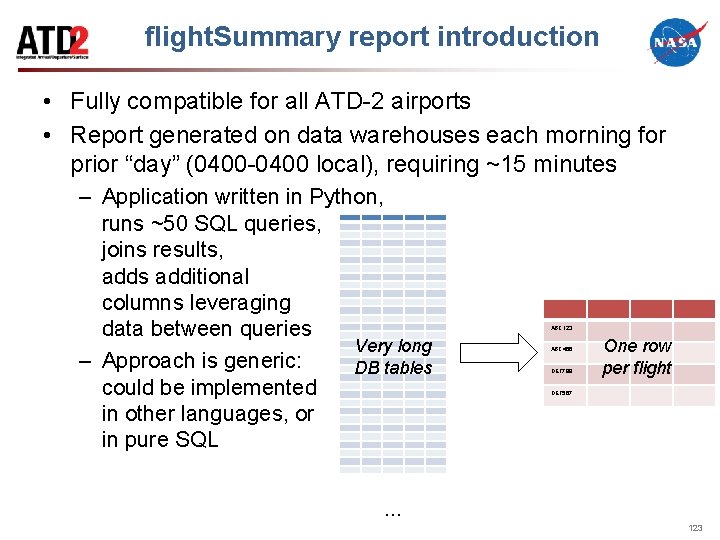
flight. Summary report introduction • Fully compatible for all ATD-2 airports • Report generated on data warehouses each morning for prior “day” (0400 -0400 local), requiring ~15 minutes – Application written in Python, runs ~50 SQL queries, joins results, adds additional columns leveraging data between queries Very long – Approach is generic: DB tables could be implemented in other languages, or in pure SQL ABC 123 ABC 456 DEF 789 One row per flight DEF 567 … 123
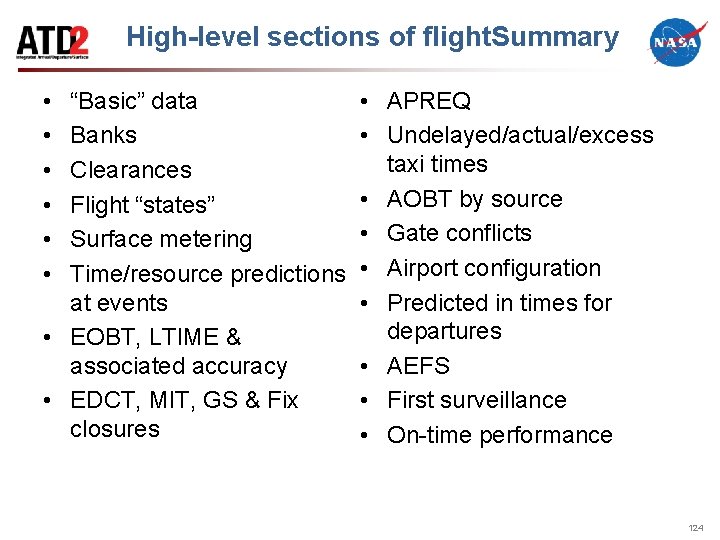
High-level sections of flight. Summary • • • “Basic” data Banks Clearances Flight “states” Surface metering Time/resource predictions at events • EOBT, LTIME & associated accuracy • EDCT, MIT, GS & Fix closures • APREQ • Undelayed/actual/excess taxi times • AOBT by source • Gate conflicts • Airport configuration • Predicted in times for departures • AEFS • First surveillance • On-time performance 124
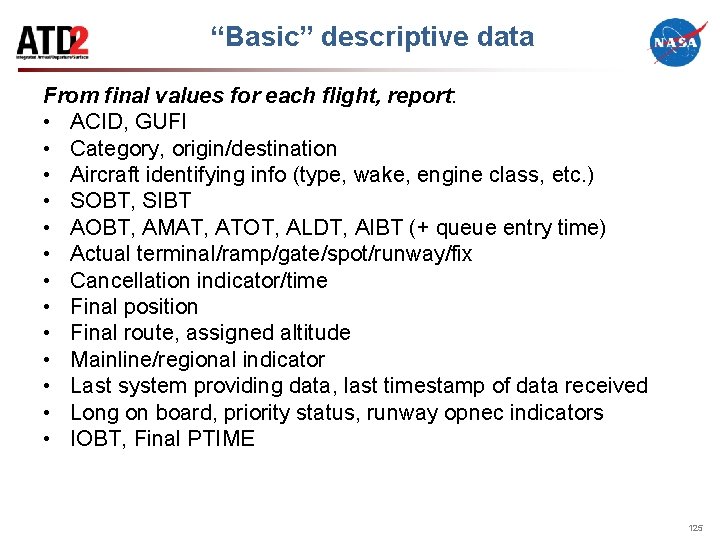
“Basic” descriptive data From final values for each flight, report: • ACID, GUFI • Category, origin/destination • Aircraft identifying info (type, wake, engine class, etc. ) • SOBT, SIBT • AOBT, AMAT, ATOT, ALDT, AIBT (+ queue entry time) • Actual terminal/ramp/gate/spot/runway/fix • Cancellation indicator/time • Final position • Final route, assigned altitude • Mainline/regional indicator • Last system providing data, last timestamp of data received • Long on board, priority status, runway opnec indicators • IOBT, Final PTIME 125
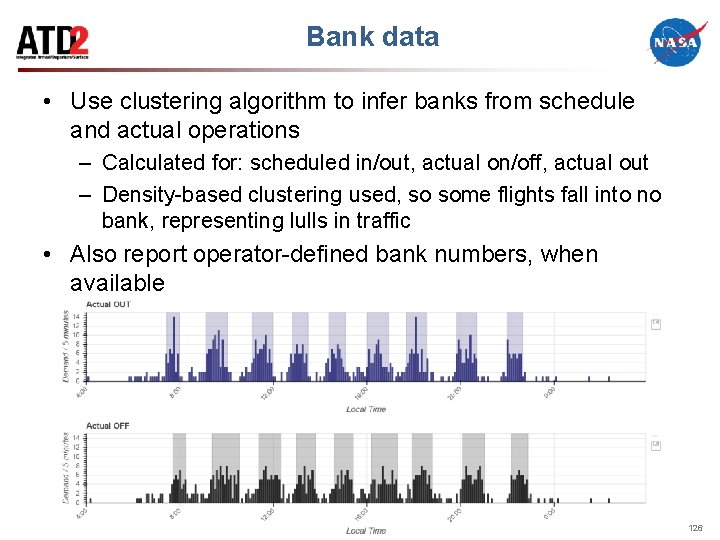
Bank data • Use clustering algorithm to infer banks from schedule and actual operations – Calculated for: scheduled in/out, actual on/off, actual out – Density-based clustering used, so some flights fall into no bank, representing lulls in traffic • Also report operator-defined bank numbers, when available 126
Clearances • RTC records all ramp controller actions, report gets last time each clearance issued – Gate pushback hold, gate pushback approved, proceed to spot, hold, return to gate, “not set”, cleared to gate • Indicator for “true” return to gate status – Often observe controllers quickly undo clearance, pushing flight into unset state – Logic requires >5 minutes between clearance going return to gate or unset, and next good clearance, to count • Indicator for pushback approved clearance being undone • Last clearance type issued • Infer pushback duration by difference between pushback approved and proceed to spot – Only captures flights cleared using RTC, as surveillance does not give reliable pushback duration 127
Flight states • ATD-2 internal model maintains state of flight, based on available data and rules – Scheduled, pushback, ramp taxi out, in queue, off, in terminal airport, en route – On final, taxi in, ramp taxi in, in gate – Return to gate, cancelled, suspended, unknown • Query gets first time flight enters each state • Report final state reached (helps with finding “stuck” flights) 128
Surface metering analysis Developed suite of metrics around surface metering: • Some values computed here apply to all flights, while others are specific to metered flights • Infer flight ready time: capture clearance sequence, observation of surveillance, account for return to gate: – Report predictions at ready: controlled times, UOBT, UTOT, TOBT, TMAT, TTOT • Infer metering “status” • Standardized TOBT/TMAT compliance: using metering status and standard windows (TOBT +/- 2 mins, TMAT +/- 5 mins) • Gate holds: advised and actual • Held beyond SOBT or LTIME • Fuel/emissions savings associated with actual gate hold • Bulk of this data distributed after each bank for common situational awareness as the Post-Metering Report 129
Resource predictions at events • For departures, immediately before: – Pushback, spot crossing, queue entry, off, fix crossing • Predict: – Gate, spot, runway, fix (for all “future” resources) • For arrivals, immediately before: – Fix crossing, landing, spot crossing, in • Predict: – Fix, runway, spot, gate (for all “future” resources) • Include data source for each resource prediction, e. g. , STBO prediction, TBFM data 130
Time values & predictions at events • At same events that resource predictions are sampled, get many times (set tailored to event): • Departures: – At pushback: suite of gate (UOBT, LTIME, etc. ), spot, runway (controlled, undelayed, etc. ), fix times (targeted, undelayed, etc. ) – At spot crossing: suite of spot, runway, fix times – At queue entry: suite of runway, fix times – At takeoff: suite of runway, fix times – At fix crossing: suite of fix times • Arrivals: – Undelayed times for all future resources 131
EOBT / LTIME data For each of EOBT and LTIME, report… • Value at pilot ready time, at pushback clearance • Final value received • Difference versus ready time, pushback clearance, AOBT (using value in effect at that instant) • EOBT at prescheduling • Time first/last value received • Number of times value updated • Accuracy versus ready and AOBT at 0, 5, 10, 15, 20, 30 minutes prior to event 132
TMI impacts EDCT: • Values at pilot ready time, final • When first/last EDCT received • Number of updates • Actual & truncated compliance MIT & Fix closures: • First/last time received • Count of distinct restrictions Ground stop: • Indicator for data received Ø Area of active development to improve metrics 133
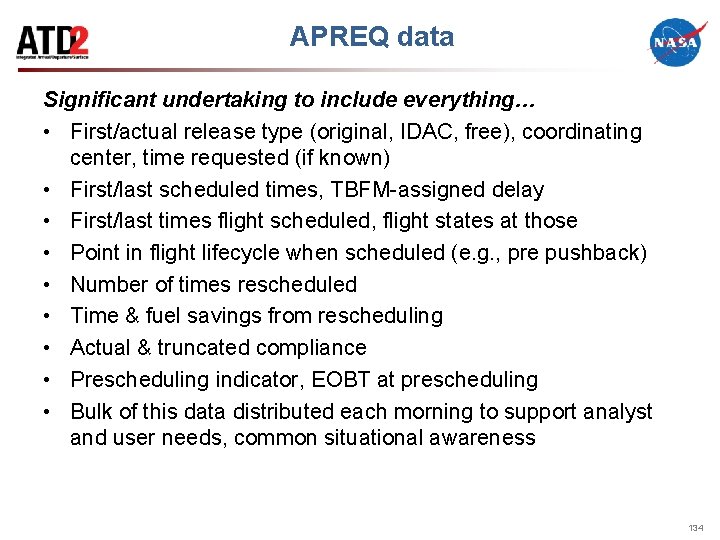
APREQ data Significant undertaking to include everything… • First/actual release type (original, IDAC, free), coordinating center, time requested (if known) • First/last scheduled times, TBFM-assigned delay • First/last times flight scheduled, flight states at those • Point in flight lifecycle when scheduled (e. g. , pre pushback) • Number of times rescheduled • Time & fuel savings from rescheduling • Actual & truncated compliance • Prescheduling indicator, EOBT at prescheduling • Bulk of this data distributed each morning to support analyst and user needs, common situational awareness 134
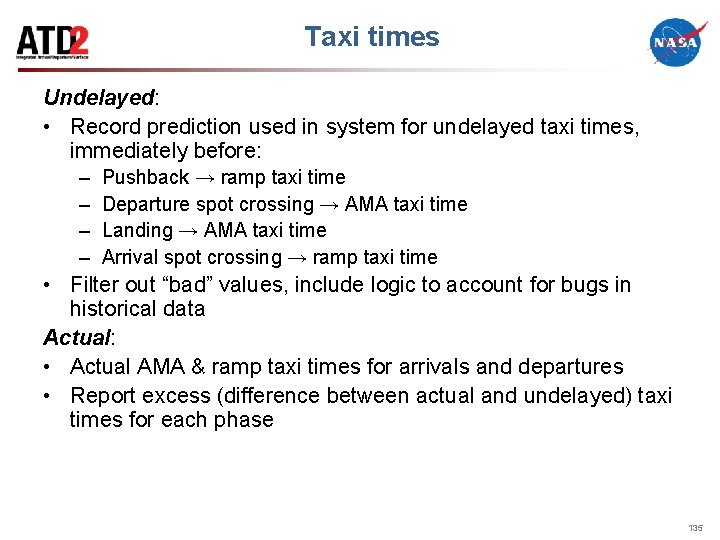
Taxi times Undelayed: • Record prediction used in system for undelayed taxi times, immediately before: – – Pushback → ramp taxi time Departure spot crossing → AMA taxi time Landing → AMA taxi time Arrival spot crossing → ramp taxi time • Filter out “bad” values, include logic to account for bugs in historical data Actual: • Actual AMA & ramp taxi times for arrivals and departures • Report excess (difference between actual and undelayed) taxi times for each phase 135
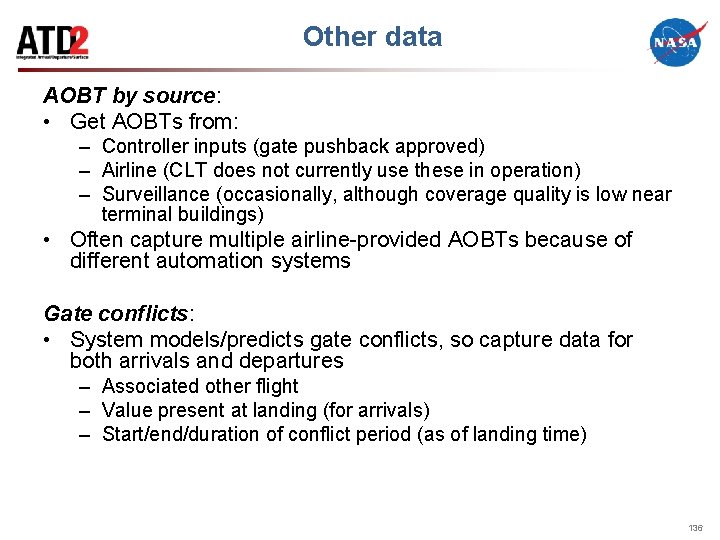
Other data AOBT by source: • Get AOBTs from: – Controller inputs (gate pushback approved) – Airline (CLT does not currently use these in operation) – Surveillance (occasionally, although coverage quality is low near terminal buildings) • Often capture multiple airline-provided AOBTs because of different automation systems Gate conflicts: • System models/predicts gate conflicts, so capture data for both arrivals and departures – Associated other flight – Value present at landing (for arrivals) – Start/end/duration of conflict period (as of landing time) 136
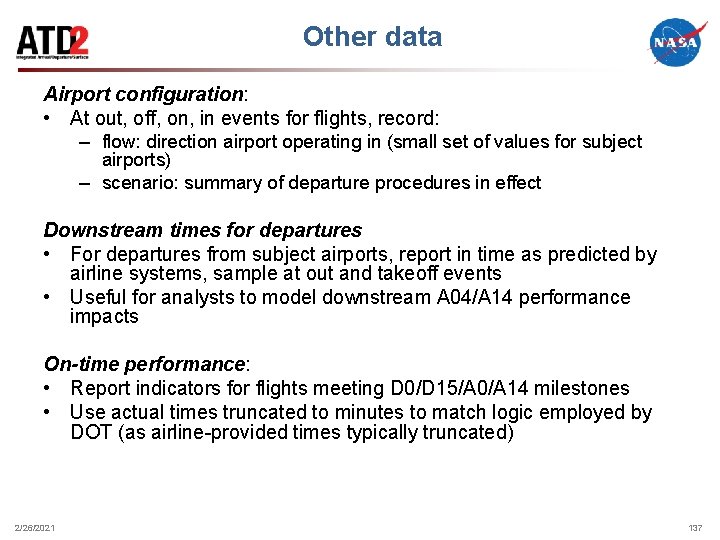
Other data Airport configuration: • At out, off, on, in events for flights, record: – flow: direction airport operating in (small set of values for subject airports) – scenario: summary of departure procedures in effect Downstream times for departures • For departures from subject airports, report in time as predicted by airline systems, sample at out and takeoff events • Useful for analysts to model downstream A 04/A 14 performance impacts On-time performance: • Report indicators for flights meeting D 0/D 15/A 0/A 14 milestones • Use actual times truncated to minutes to match logic employed by DOT (as airline-provided times typically truncated) 2/26/2021 137
Other data AEFS actions: • Cleared for takeoff • Line-up and wait • Enter runway • Taxi clearance First surveillance data: • Time of first surveillance data • System providing first surveillance • Flight state at first surveillance – Useful for understanding if flights pop into system before expected 138
Wrap-up • These reports widely used within project as starting point for analysis, saving considerable redundant work • Versions shared with project partners regularly for their analysis and feedback • Development of these reports highly collaborative, adding new features regularly • Approach is generic, but can be adapted as appropriate • Infinitely simpler by starting with fuser data • This is current ATD-2 approach, but for future work, we believe that maintaining a common 360° view of each flight is extremely valuable. 139
National Aeronautics and Space Administration Airspace Technology Demonstration 2 (ATD-2) Accuracy Comparison of Various Landing Time Prediction Sources May 22, 2019
Objective and background Quantify accuracy of different sources of landing (on) time predictions as actual arrival event approaches • Want to make design decisions for fuser mediation rules informed by data about actual accuracy of various potential prediction sources • Accuracy defined as difference between actual and prediction, particularly interested in how this evolves as actual event approaches • Other sources could easily be included in this framework, e. g. , operator-generated predictions 141
Data and methodology • Two weeks of arrivals to Charlotte from March 2019 • Comparing: – – – TBFM ETA TBFM STA (only when frozen) TBFM STA (before frozen) TFM ETA • Measure error as actual landing time – prediction • Sample every minute for every flight, then average in a variety of ways 142
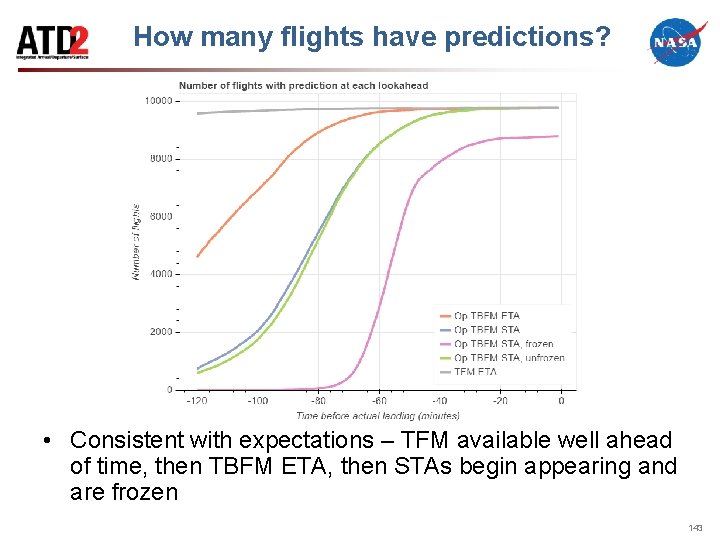
How many flights have predictions? • Consistent with expectations – TFM available well ahead of time, then TBFM ETA, then STAs begin appearing and are frozen 143
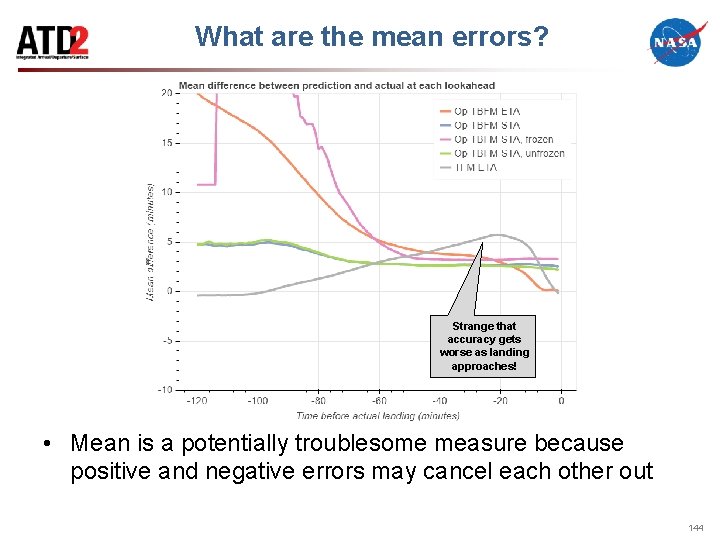
What are the mean errors? Strange that accuracy gets worse as landing approaches! • Mean is a potentially troublesome measure because positive and negative errors may cancel each other out 144
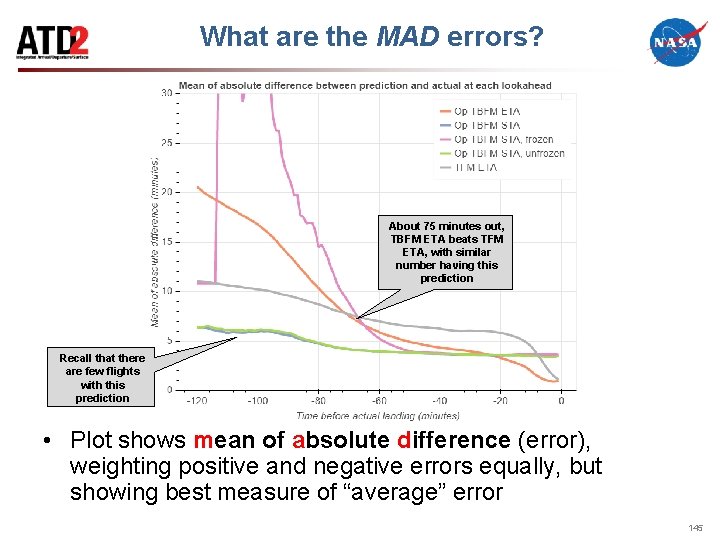
What are the MAD errors? About 75 minutes out, TBFM ETA beats TFM ETA, with similar number having this prediction Recall that there are few flights with this prediction • Plot shows mean of absolute difference (error), weighting positive and negative errors equally, but showing best measure of “average” error 145
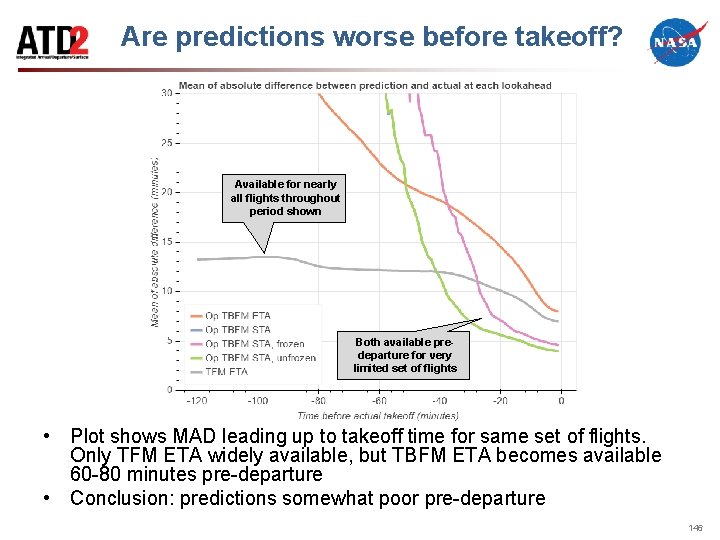
Are predictions worse before takeoff? Available for nearly all flights throughout period shown Both available predeparture for very limited set of flights • Plot shows MAD leading up to takeoff time for same set of flights. Only TFM ETA widely available, but TBFM ETA becomes available 60 -80 minutes pre-departure • Conclusion: predictions somewhat poor pre-departure 146
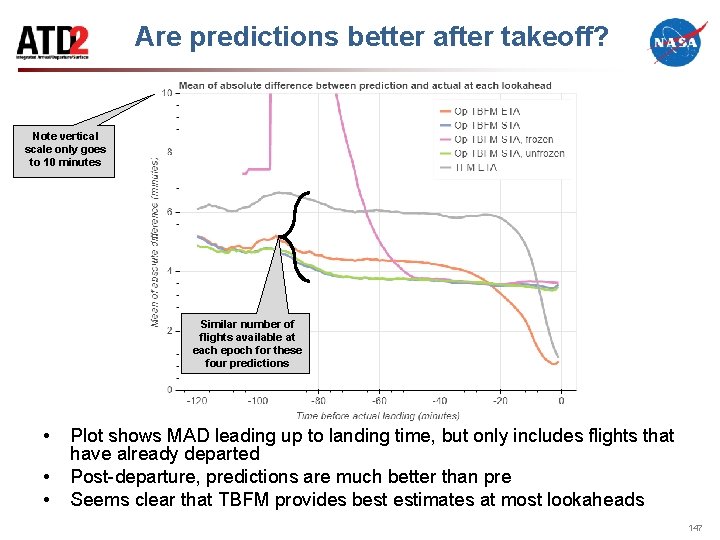
Are predictions better after takeoff? Note vertical scale only goes to 10 minutes Similar number of flights available at each epoch for these four predictions • • • Plot shows MAD leading up to landing time, but only includes flights that have already departed Post-departure, predictions are much better than pre Seems clear that TBFM provides best estimates at most lookaheads 147
Wrap-up • Prediction accuracy generally improves as landing time approaches, as expected • Not all errors converge to zero • Demonstration of feasibility of comparing landing time prediction accuracy of various data sources – This work could be replicated with a big pile of data captured directly from SWIM feeds – But, this work is significantly simpler when using data that has passed through the fuser / ATD-2 system 148
National Aeronautics and Space Administration Airspace Technology Demonstration 2 (ATD-2) Analysis of APREQ Flights at CLT 149 May 22, 2019
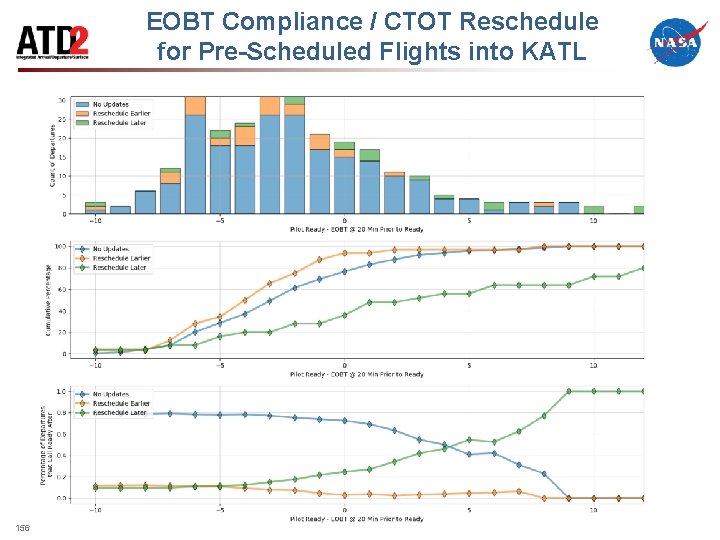
Objective Quantify impact of IADS Phase 1 & 2 capabilities on APREQ flights at CLT with respect to: • Compliance to the Controlled Take Off Time (CTOT) • Benefits for APREQ flights that use IDAC to renegotiate for an earlier CTOT • Benefits of pre-scheduling APREQ flights using the Earliest Off Block Time (EOBT) • Relationship between EOBT compliance and rescheduling CTOT 150
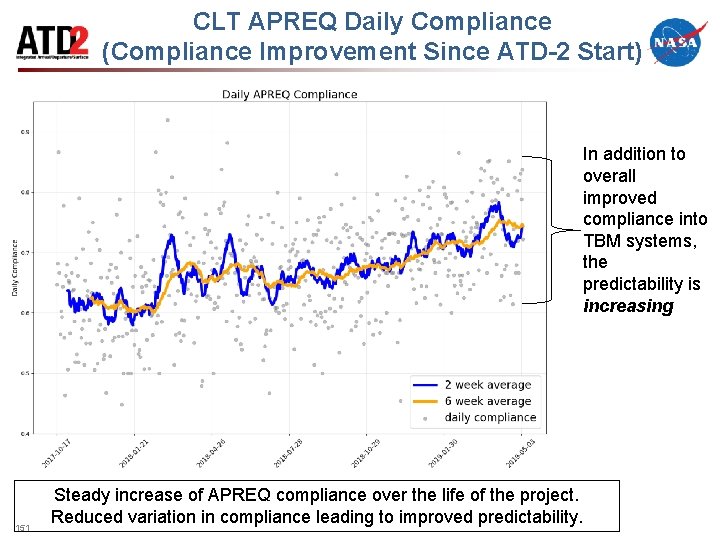
CLT APREQ Daily Compliance (Compliance Improvement Since ATD-2 Start) In addition to overall improved compliance into TBM systems, the predictability is increasing 151 Steady increase of APREQ compliance over the life of the project. Reduced variation in compliance leading to improved predictability.
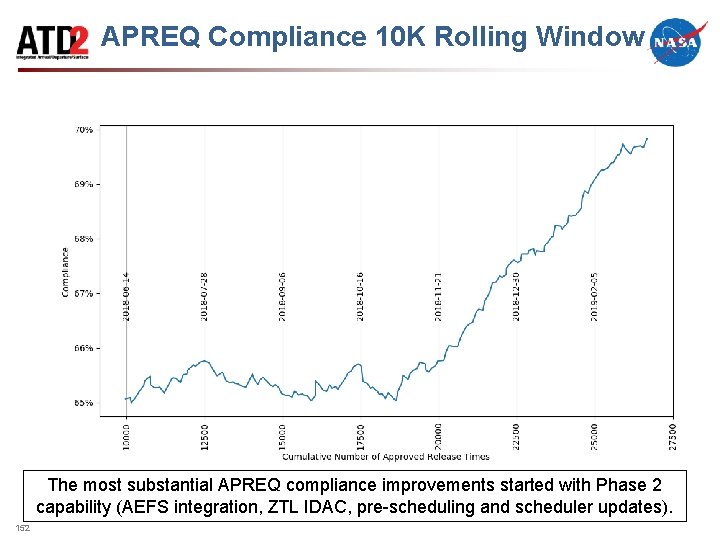
APREQ Compliance 10 K Rolling Window The most substantial APREQ compliance improvements started with Phase 2 capability (AEFS integration, ZTL IDAC, pre-scheduling and scheduler updates). 152
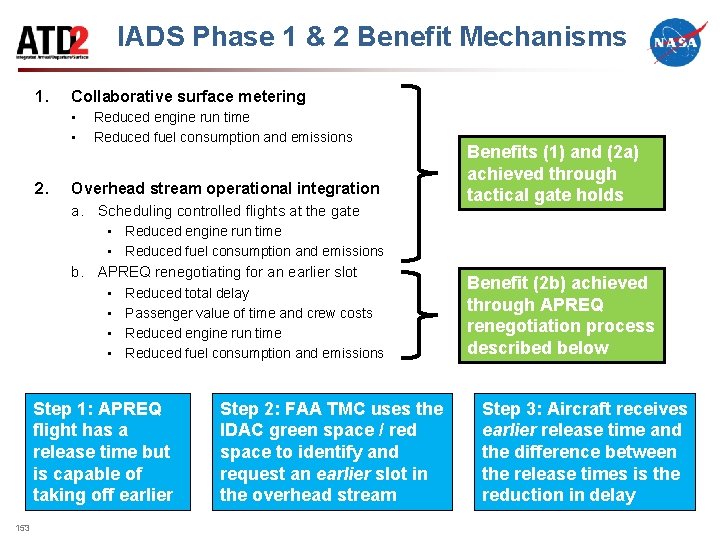
IADS Phase 1 & 2 Benefit Mechanisms 1. Collaborative surface metering • • 2. Reduced engine run time Reduced fuel consumption and emissions Overhead stream operational integration a. Scheduling controlled flights at the gate • Reduced engine run time • Reduced fuel consumption and emissions b. APREQ renegotiating for an earlier slot • Reduced total delay • Passenger value of time and crew costs • Reduced engine run time • Reduced fuel consumption and emissions Step 1: APREQ flight has a release time but is capable of taking off earlier 153 Step 2: FAA TMC uses the IDAC green space / red space to identify and request an earlier slot in the overhead stream Benefits (1) and (2 a) achieved through tactical gate holds Benefit (2 b) achieved through APREQ renegotiation process described below Step 3: Aircraft receives earlier release time and the difference between the release times is the reduction in delay
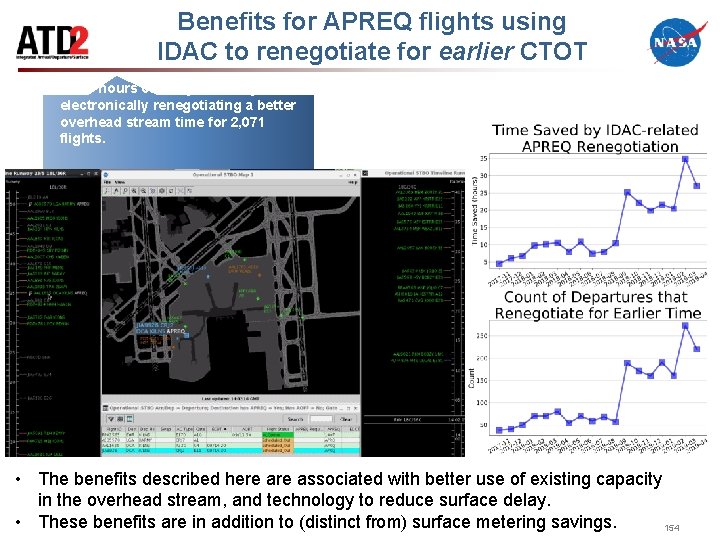
Benefits for APREQ flights using IDAC to renegotiate for earlier CTOT 270. 7 hours of delay saved by electronically renegotiating a better overhead stream time for 2, 071 flights. LBS Fuel • The benefits described here associated with better use of existing capacity in the overhead stream, and technology to reduce surface delay. • These benefits are in addition to (distinct from) surface metering savings. 154
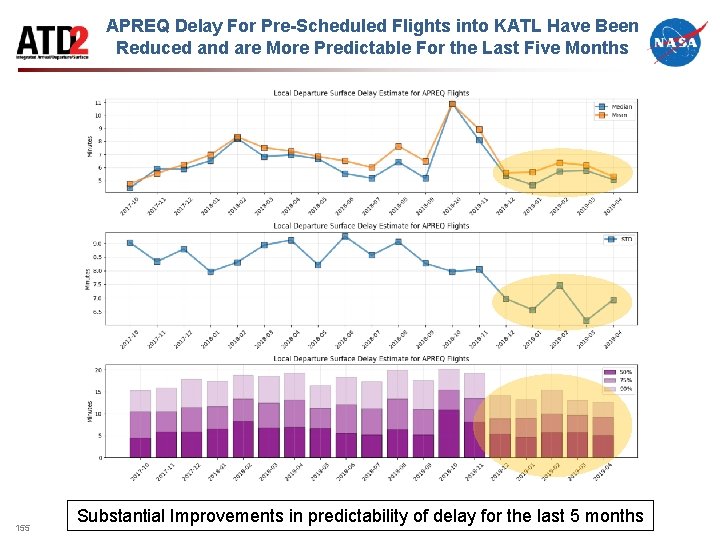
APREQ Delay For Pre-Scheduled Flights into KATL Have Been Reduced and are More Predictable For the Last Five Months 155 Substantial Improvements in predictability of delay for the last 5 months
EOBT Compliance / CTOT Reschedule for Pre-Scheduled Flights into KATL 156
Wrap-up • Compliance to the CTOT has improved throughout the lifecycle of ATD-2 with biggest improvements following the introduction of Phase 2 capabilities • Rescheduling APREQ flights using IDAC has reduced 270. 7 hours of delay at CLT • Predictability of local surface delay for APREQ flights is substantially improved via pre-scheduling with the IADS system • Pre-scheduled flights that reschedule for later times tend to call ready later with respect to EOBT 157
National Aeronautics and Space Administration Airspace Technology Demonstration 2 (ATD-2) Predictive Analytics for ATD-2 May 22, 2019
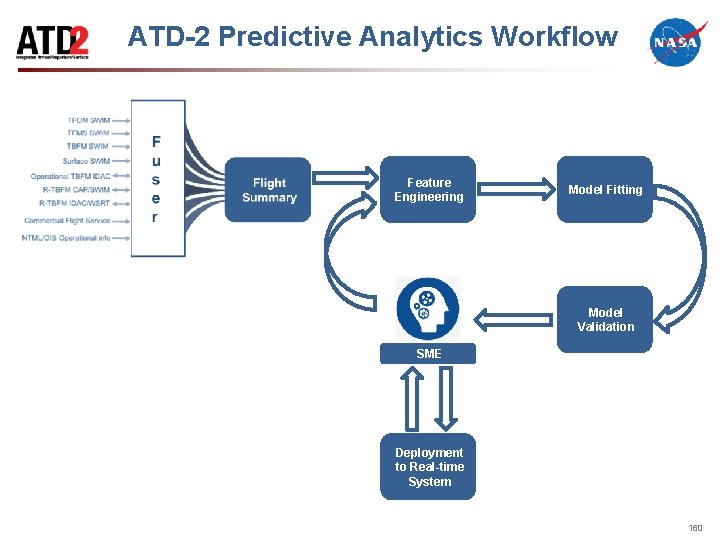
Objective Leverage high quality data and predictive analytics to improve understanding and performance of IADS system • Develop predictive analytics use cases that are relevant to FAA and operators • Iterative process between data scientists and Subject Matter Experts (SME) to gain new insights • Implementation in Python Scikit-learn allows for data scientists to focus on feature engineering and model validation • Interested in data available in real-time system to fit models that have predictive and ultimately prescriptive capabilities 159
ATD-2 Predictive Analytics Workflow Feature Engineering Model Fitting Model Validation SME Deployment to Real-time System 160
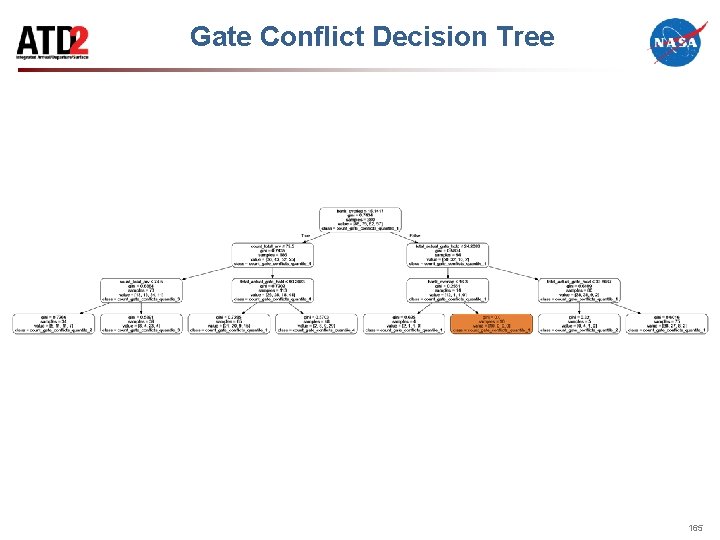
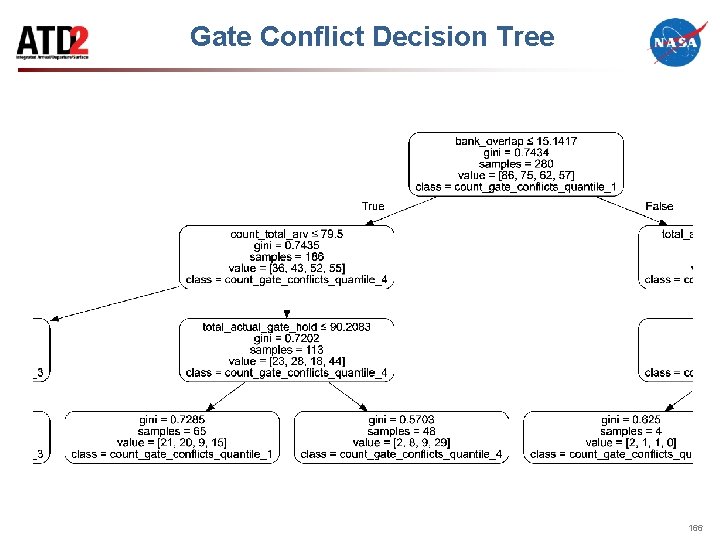
Gate Conflict Use Case Predicting gate conflicts can benefit both FAA and operators • Providing ramp controllers with early notice of gate conflicts allows them to build a plan • Providing FAA with early notice of gate conflicts supports the TMC in the decision whether or not to surface metering • Understanding the different factors that cause gate conflicts could provide strategies to avoid them 161
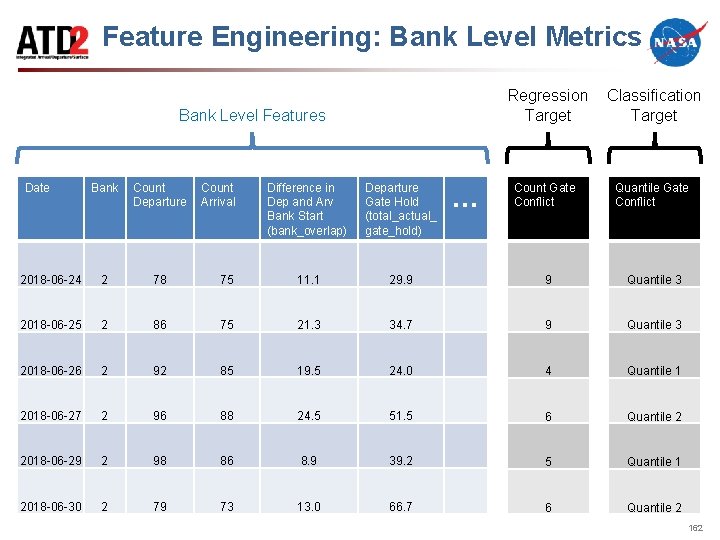
Feature Engineering: Bank Level Metrics Bank Level Features Date Bank Count Departure 2018 -06 -24 2 78 2018 -06 -25 2 2018 -06 -26 Count Arrival Regression Target Classification Target Count Gate Conflict Quantile Gate Conflict Difference in Dep and Arv Bank Start (bank_overlap) Departure Gate Hold (total_actual_ gate_hold) 75 11. 1 29. 9 9 Quantile 3 86 75 21. 3 34. 7 9 Quantile 3 2 92 85 19. 5 24. 0 4 Quantile 1 2018 -06 -27 2 96 88 24. 5 51. 5 6 Quantile 2 2018 -06 -29 2 98 86 8. 9 39. 2 5 Quantile 1 2018 -06 -30 2 79 73 13. 0 66. 7 6 Quantile 2 … 162
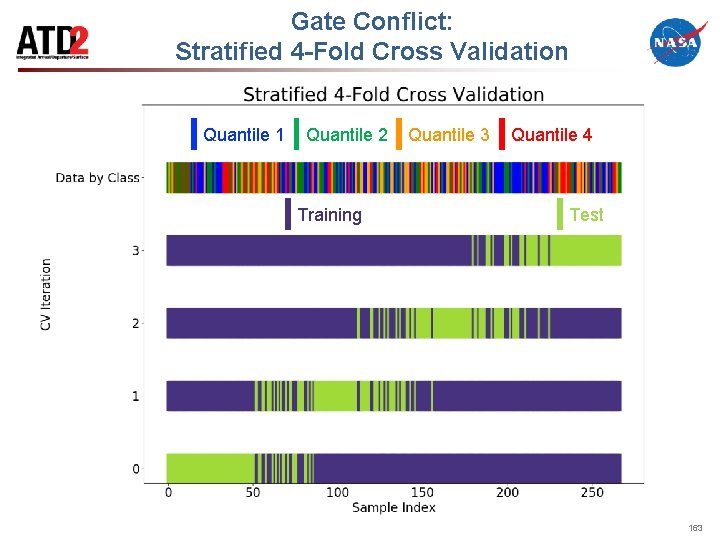
Gate Conflict: Stratified 4 -Fold Cross Validation Quantile 1 Quantile 2 Training Quantile 3 Quantile 4 Test 163
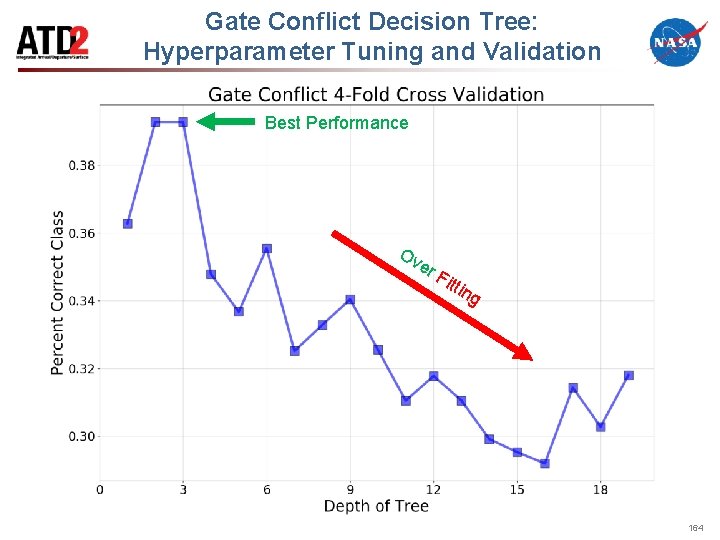
Gate Conflict Decision Tree: Hyperparameter Tuning and Validation Best Performance Ov er Fit tin g 164
Gate Conflict Decision Tree 165
Gate Conflict Decision Tree 166
Wrap-up • High quality data is the foundation of predictive analytics • Selecting and building features that best represent the problem is a critical step in the process • Hyperparameter tuning in combination with cross validation to achieve the best performance • Models are trained by data scientist and then evaluated by SME in iterative process • Deployment to real-time system is necessary to achieve impact across the NAS 167
National Aeronautics and Space Administration Airspace Technology Demonstration 2 (ATD-2) TFDM Terminal Publication Service (TTP) 168 May 22, 2019
TFDM Terminal Publication (TTP) • TFDM data feed publishing Flight and Flow data to consumers • Will provide data exchange between TFDM and NAS Systems and the National Airspace System (NAS) users (airlines, air carriers, air freight, military or general aviation/business aviation operators). • Accessible via the National Airspace (NAS) Enterprise Messaging Service (NEMS). • Uses the publish-subscribe (pub-sub) Message Exchange Pattern (MEP). • XML data format, using FIXM standard for Flight Data • Airport Information and Traffic Management Restrictions use a schema defined by the TFDM team 169
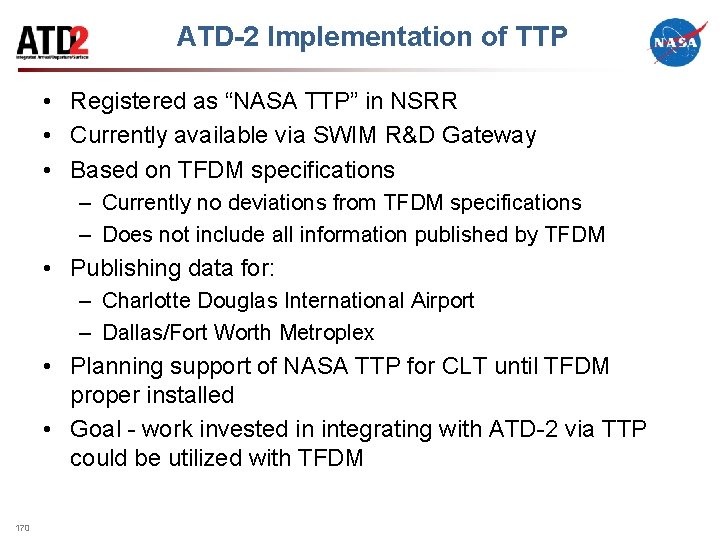
ATD-2 Implementation of TTP • Registered as “NASA TTP” in NSRR • Currently available via SWIM R&D Gateway • Based on TFDM specifications – Currently no deviations from TFDM specifications – Does not include all information published by TFDM • Publishing data for: – Charlotte Douglas International Airport – Dallas/Fort Worth Metroplex • Planning support of NASA TTP for CLT until TFDM proper installed • Goal - work invested in integrating with ATD-2 via TTP could be utilized with TFDM 170
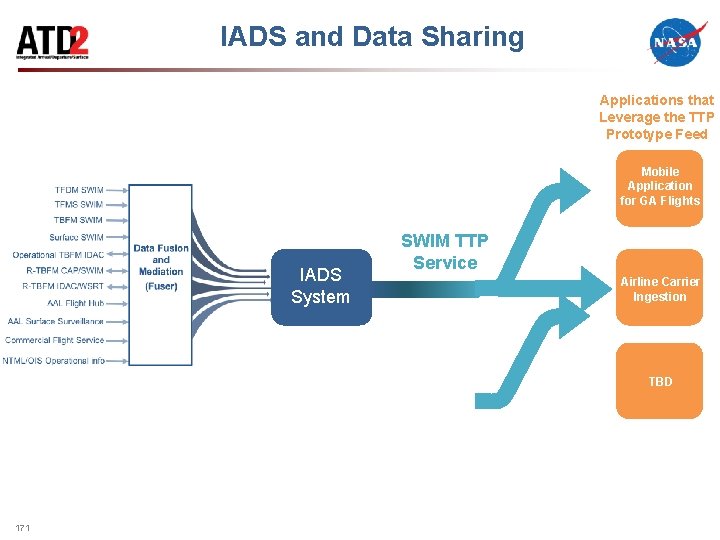
IADS and Data Sharing Applications that Leverage the TTP Prototype Feed Mobile Application for GA Flights IADS System SWIM TTP Service Airline Carrier Ingestion TBD 171
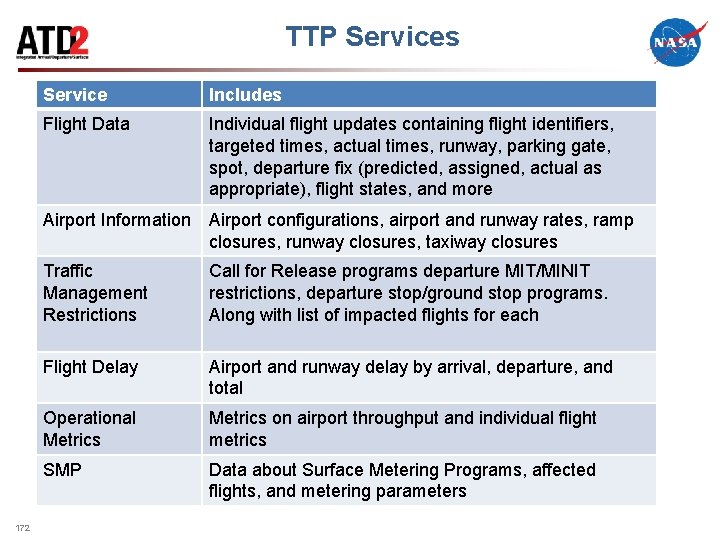
TTP Services Service Includes Flight Data Individual flight updates containing flight identifiers, targeted times, actual times, runway, parking gate, spot, departure fix (predicted, assigned, actual as appropriate), flight states, and more Airport Information Airport configurations, airport and runway rates, ramp closures, runway closures, taxiway closures 172 Traffic Management Restrictions Call for Release programs departure MIT/MINIT restrictions, departure stop/ground stop programs. Along with list of impacted flights for each Flight Delay Airport and runway delay by arrival, departure, and total Operational Metrics on airport throughput and individual flight metrics SMP Data about Surface Metering Programs, affected flights, and metering parameters
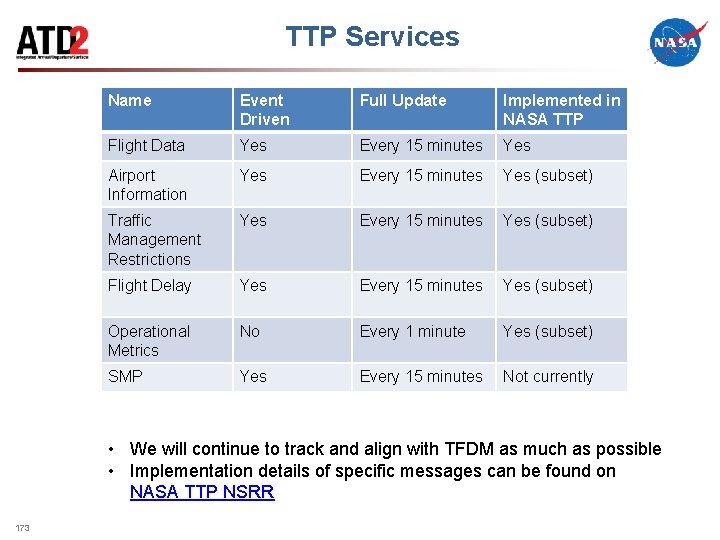
TTP Services Name Event Driven Full Update Implemented in NASA TTP Flight Data Yes Every 15 minutes Yes Airport Information Yes Every 15 minutes Yes (subset) Traffic Management Restrictions Yes Every 15 minutes Yes (subset) Flight Delay Yes Every 15 minutes Yes (subset) Operational Metrics No Every 1 minute Yes (subset) SMP Yes Every 15 minutes Not currently • We will continue to track and align with TFDM as much as possible • Implementation details of specific messages can be found on NASA TTP NSRR 173
Why TTP? • • 174 Share valuable data with other stake holders Automate data sharing avoiding manual inputs Data doesn’t exist in other feeds Doesn’t naturally fit into any existing feeds
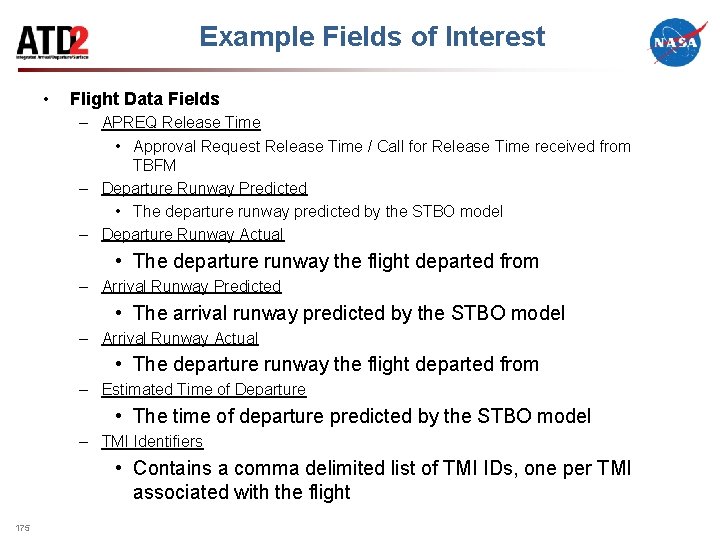
Example Fields of Interest • Flight Data Fields – APREQ Release Time • Approval Request Release Time / Call for Release Time received from TBFM – Departure Runway Predicted • The departure runway predicted by the STBO model – Departure Runway Actual • The departure runway the flight departed from – Arrival Runway Predicted • The arrival runway predicted by the STBO model – Arrival Runway Actual • The departure runway the flight departed from – Estimated Time of Departure • The time of departure predicted by the STBO model – TMI Identifiers • Contains a comma delimited list of TMI IDs, one per TMI associated with the flight 175
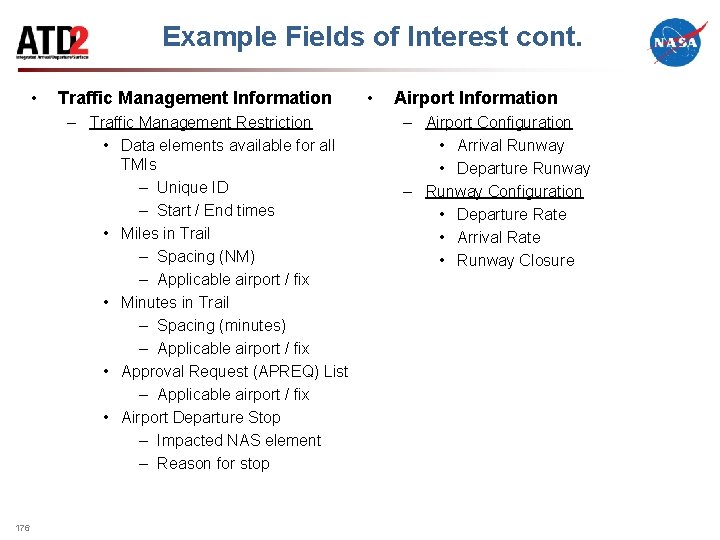
Example Fields of Interest cont. • Traffic Management Information – Traffic Management Restriction • Data elements available for all TMIs – Unique ID – Start / End times • Miles in Trail – Spacing (NM) – Applicable airport / fix • Minutes in Trail – Spacing (minutes) – Applicable airport / fix • Approval Request (APREQ) List – Applicable airport / fix • Airport Departure Stop – Impacted NAS element – Reason for stop 176 • Airport Information – Airport Configuration • Arrival Runway • Departure Runway – Runway Configuration • Departure Rate • Arrival Rate • Runway Closure
Why NASA TTP • Practice – NASA TTP was built against the TFDM TTP design standard – Using the NASA TTP provides users with a period of time to become familiar with the TTP schema and information provided • Integration – Data generated by NASA TTP is accurate and will be similar to the data produced by TFDM – Users are able to begin integration of TFDM TTP data into their internal systems / operations prior to TFDM going operational • Feedback – Using existing forums (CDM WG, SWIFT, etc. ) users are able to ask questions and provide feedback to TFDM prior to its deployment 177
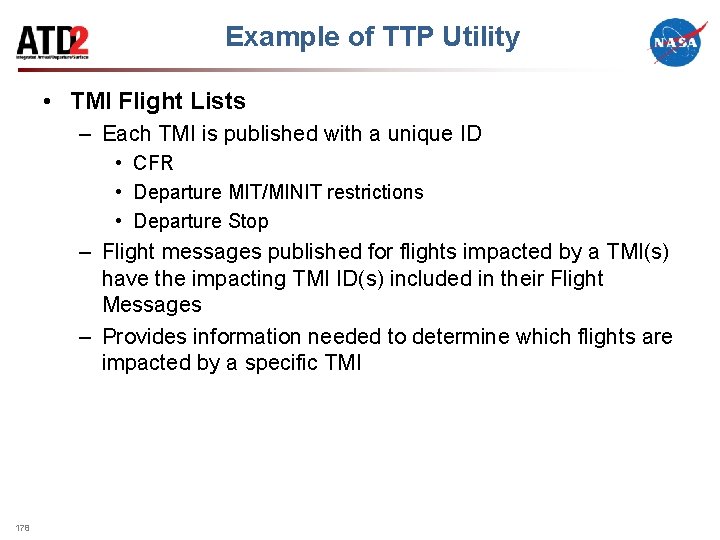
Example of TTP Utility • TMI Flight Lists – Each TMI is published with a unique ID • CFR • Departure MIT/MINIT restrictions • Departure Stop – Flight messages published for flights impacted by a TMI(s) have the impacting TMI ID(s) included in their Flight Messages – Provides information needed to determine which flights are impacted by a specific TMI 178
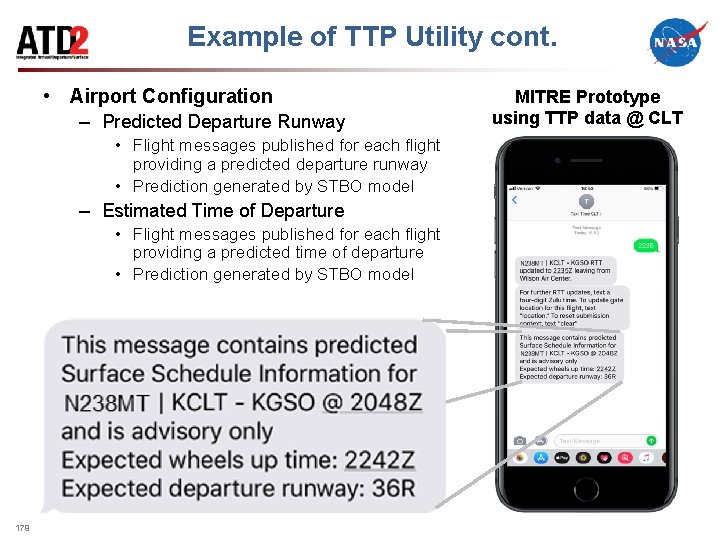
Example of TTP Utility cont. • Airport Configuration – Predicted Departure Runway • Flight messages published for each flight providing a predicted departure runway • Prediction generated by STBO model – Estimated Time of Departure • Flight messages published for each flight providing a predicted time of departure • Prediction generated by STBO model 179 MITRE Prototype using TTP data @ CLT
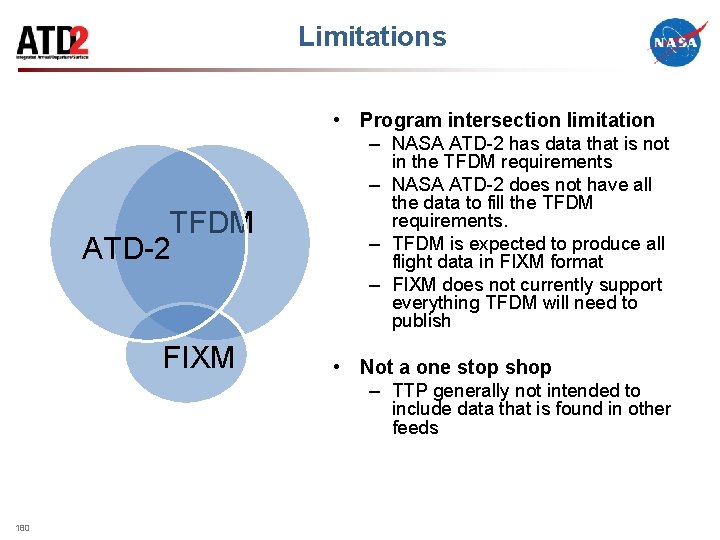
Limitations • Program intersection limitation – NASA ATD-2 has data that is not TFDM ATD-2 FIXM in the TFDM requirements – NASA ATD-2 does not have all the data to fill the TFDM requirements. – TFDM is expected to produce all flight data in FIXM format – FIXM does not currently support everything TFDM will need to publish • Not a one stop shop – TTP generally not intended to include data that is found in other feeds 180
How to access ATD-2 TTP feed • Work with SWIM to establish a connection to SWIM R&D if you don’t already have a connection – If you already have a connection getting access to TTP will be pretty straight forward. • Subscribe to SWIM R&D TTP feed via a new queue that will be established for each stake holder • Work with ATD-2 team on how to utilize the information – See TTP Resources slide for links to documentation 181
TTP Resources • Links to FAA TFDM resources – Concept Overview: • https: //www. faa. gov/air_traffic/technology/tfdm/ – SWIM On-Ramping: • https: //www. faa. gov/air_traffic/technology/swim/products/get_co nnected/ – Implementation Roadmap: • https: //www. faa. gov/air_traffic/technology/tfdm/implementation/ • Links to ATD-2 TFDM / NASA TTP Resources – NSRR: • https: //nsrr. faa. gov/services/nasa-ttp/profile – NASA Website: • https: //www. aviationsystemsdivision. arc. nasa. gov/research/atd 2/ index. shtml 182
Questions 183
Where Are We? Where Are We Going?
Where Are We Now • Initial documentation available – https: //aviationsystems. arc. nasa. gov/atd 2 -industrydays/fuser/ATD-2 -Industry-Day-Documentation. Outline_81565170. html – Will continue to update and enhance – Feedback is welcome • Collaborating – Cloud hosted Fuser pilot program in progress – SWIFT: We are here to share but also to listen – Help us to help you! 185
Where Are We Going • Exploring various options for tech transfer – Knowledge transfer – Documentation – Potential software • Exploring long term hosting options – Could be the answer to software challenges • Looking for industry input to help scope the transfer • Timeframe – 2019 186