
Business Intelligence Data Warehousing Data Acquisition Data Mining

Business Intelligence: Data Warehousing, Data Acquisition, Data Mining, Business Analytics, and Visualization By Dr. S. Sridhar, Ph. D. , RACI(Paris), RZFM(Germany), RMR(USA), RIEEEProc. email : drssridhar@yahoo. com web-site : http: //drsridhar. tripod. com 1
Learning Objectives • Describe the issues in management of data. • Understand the concepts and use of DBMS. • Learn about data warehousing and data marts. • Explain business intelligence/business analytics. • Examine how decision making can be improved through data manipulation and analytics. • Understand the interaction betwixt the Web and database technologies. • Explain how database technologies are used in business analytics. 2 • Understand the impact of the Web on
Information Sharing a Principle Component of the National Strategy for Homeland Security Vignette • Network of systems that provide knowledge integration and distribution • Horizontal and vertical information sharing • Improved communications • Mining of data stored in Webenabled warehouse 3
Data, Information, Knowledge • Data • Items that are the most elementary descriptions of things, events, activities, and transactions • May be internal or external • Information • Organized data that has meaning and value • Knowledge • Processed data or information that conveys understanding or learning 4
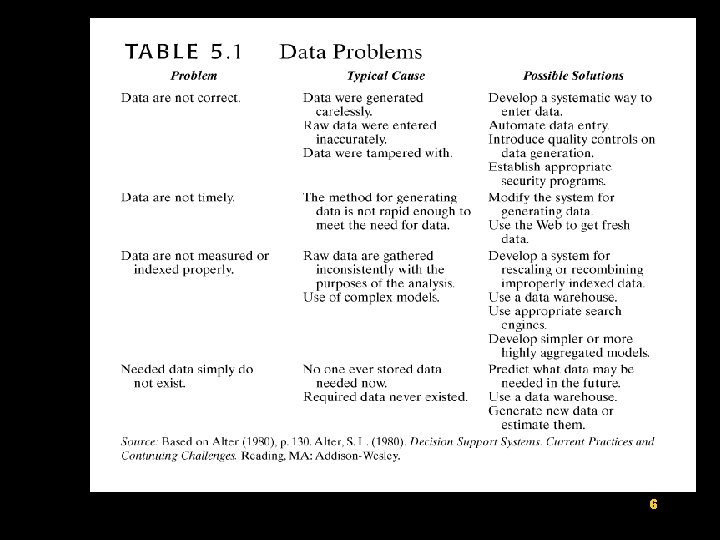
Data • Raw data collected manually or by instruments • Quality is critical • Quality determines usefulness • • Contextual data quality Intrinsic data quality Accessibility data quality Representation data quality • Often neglected or casually handled • Problems exposed when data is summarized 5
6
Data • Cleanse data • • When populating warehouse Data quality action plan Best practices for data quality Measure results • • • Uniformity Version Completeness check Conformity check Genealogy or drill-down • Data integrity issues 7
Data • Data Integration • Access needed to multiple sources • Often enterprise-wide • Disparate and heterogeneous databases • XML becoming language standard 8
External Data Sources • Web • Intelligent agents • Document management systems • Content management systems • Commercial databases • Sell access to specialized databases 9
Database Management Systems • • Software program Supplements operating system Manages data Queries data and generates reports • Data security • Combines with modeling language for construction of DSS 10
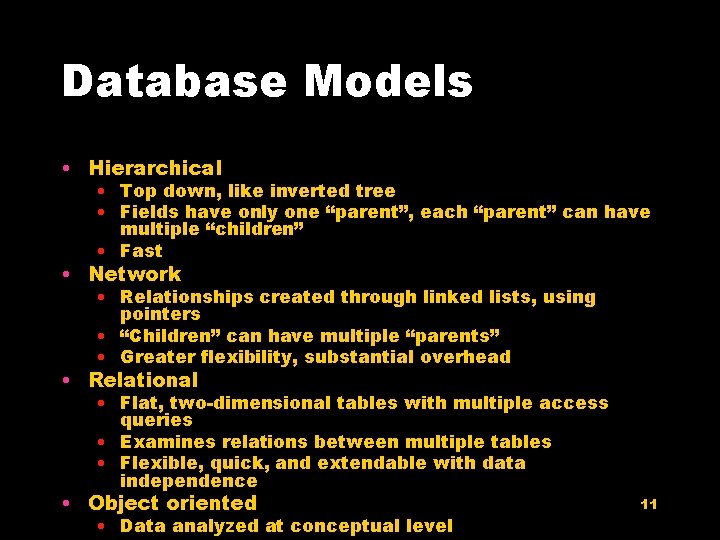
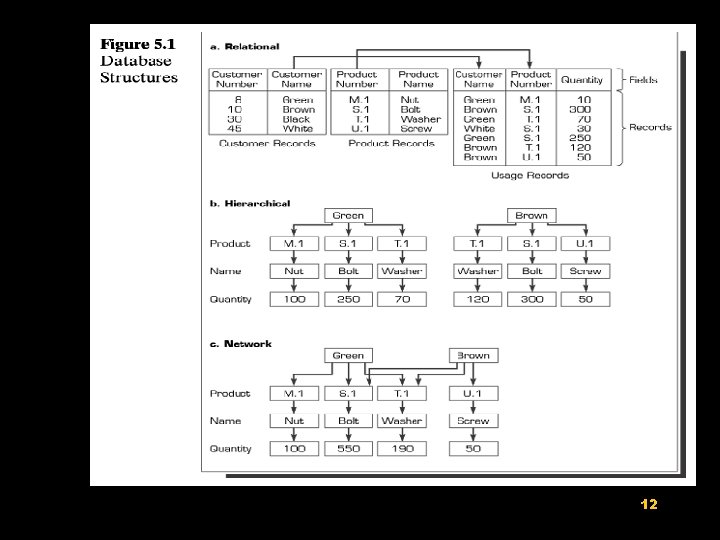
Database Models • Hierarchical • Top down, like inverted tree • Fields have only one “parent”, each “parent” can have multiple “children” • Fast • Network • Relationships created through linked lists, using pointers • “Children” can have multiple “parents” • Greater flexibility, substantial overhead • Relational • Flat, two-dimensional tables with multiple access queries • Examines relations between multiple tables • Flexible, quick, and extendable with data independence • Object oriented • Data analyzed at conceptual level 11
12
Database Models, continued • Multimedia Based • Multiple data formats • JPEG, GIF, bitmap, PNG, sound, video, virtual reality • Requires specific hardware for full feature availability • Document Based • Document storage and management • Intelligent agents and ANN • Inference engines 13
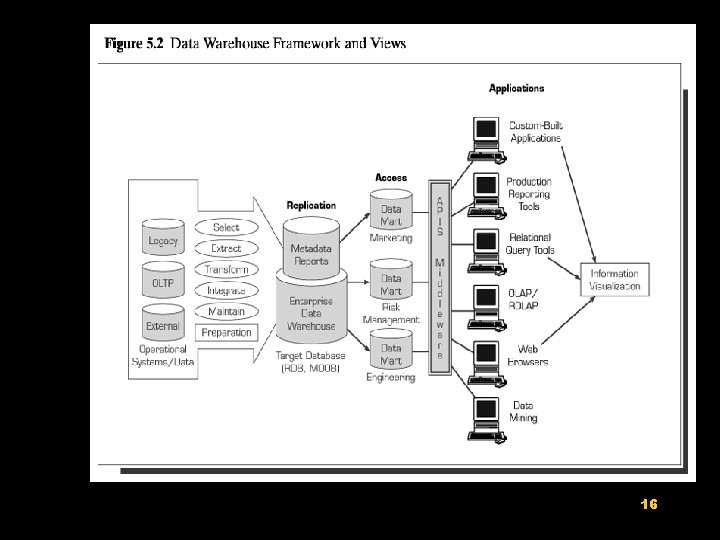
Data Warehouse • Subject oriented • Scrubbed so that data from heterogeneous sources are standardized • Time series; no current status • Nonvolatile • Read only • Summarized • Not normalized; may be redundant • Data from both internal and external sources is present • Metadata included • Data about data • Business metadata • Semantic metadata 14
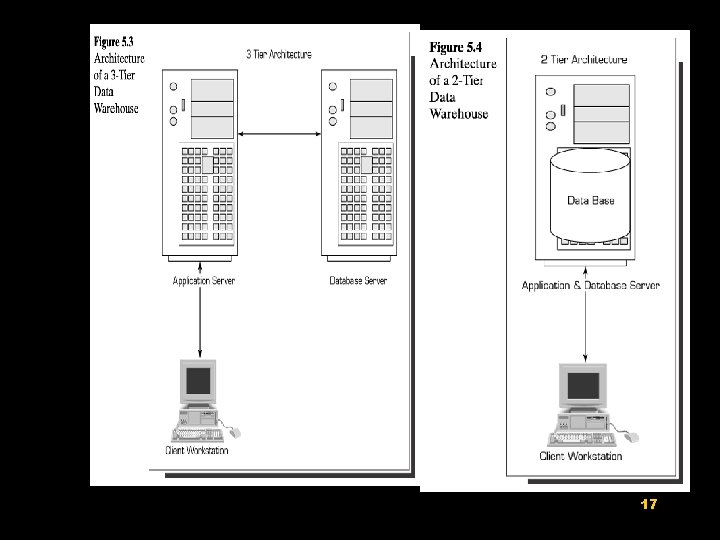
Architecture • May have one or more tiers • Determined by warehouse, data acquisition (back end), and client (front end) • One tier, where all run on same platform, is rare • Two tier usually combines DSS engine (client) with warehouse − More economical • Three tier separates these functional 15 parts
16
17
Migrating Data • Business rules • Stored in metadata repository • Applied to data warehouse centrally • Data extracted from all relevant sources • Loaded through data-transformation tools or programs • Separate operation and decision support environments • Correct problems in quality before data stored • Cleanse and organize in consistent 18
Data Warehouse Design • Dimensional modeling • Retrieval based • Implemented by star schema • Central fact table • Dimension tables • Grain • Highest level of detail • Drill-down analysis 19
Data Warehouse Development • Data warehouse implementation techniques • • Top down Bottom up Hybrid Federated • Projects may be data centric or application centric • Implementation factors • Organizational issues • Project issues • Technical issues • Scalable 20
Data Marts • Dependent • Created from warehouse • Replicated • Functional subset of warehouse • Independent • Scaled down, less expensive version of data warehouse • Designed for a department or SBU • Organization may have multiple data marts • Difficult to integrate 21
Business Intelligence and Analytics • Business intelligence • Acquisition of data and information for use in decision-making activities • Business analytics • Models and solution methods • Data mining • Applying models and methods to data to identify patterns and trends 22
OLAP • Activities performed by end users in online systems • Specific, open-ended query generation • SQL • Ad hoc reports • Statistical analysis • Building DSS applications • Modeling and visualization capabilities • Special class of tools • • DSS/BI/BA front ends Data access front ends Database front ends Visual information access systems 23
Data Mining • Organizes and employs information and knowledge from databases • Statistical, mathematical, artificial intelligence, and machine-learning techniques • Automatic and fast • Tools look for patterns • Simple models • Intermediate models • Complex Models 24
Data Mining • Data mining application classes of problems • • Classification Clustering Association Sequencing Regression Forecasting Others • Hypothesis or discovery driven • Iterative • Scalable 25
Tools and Techniques • Data mining • • • Statistical methods Decision trees Case based reasoning Neural computing Intelligent agents Genetic algorithms • Text Mining • Hidden content • Group by themes • Determine relationships 26
Knowledge Discovery in Databases • Data mining used to find patterns in data • Identification of data • Preprocessing • Transformation to common format • Data mining through algorithms • Evaluation 27
Data Visualization • Technologies supporting visualization and interpretation • Digital imaging, GIS, GUI, tables, multidimensions, graphs, VR, 3 D, animation • Identify relationships and trends • Data manipulation allows real time look at performance data 28
Multidimensionality • Data organized according to business standards, not analysts • Conceptual • Factors • Dimensions • Measures • Time • Significant overhead and storage • Expensive • Complex 29
Analytic systems • Real-time queries and analysis • Real-time decision-making • Real-time data warehouses updated daily or more frequently • Updates may be made while queries are active • Not all data updated continuously • Deployment of business analytic applications 30
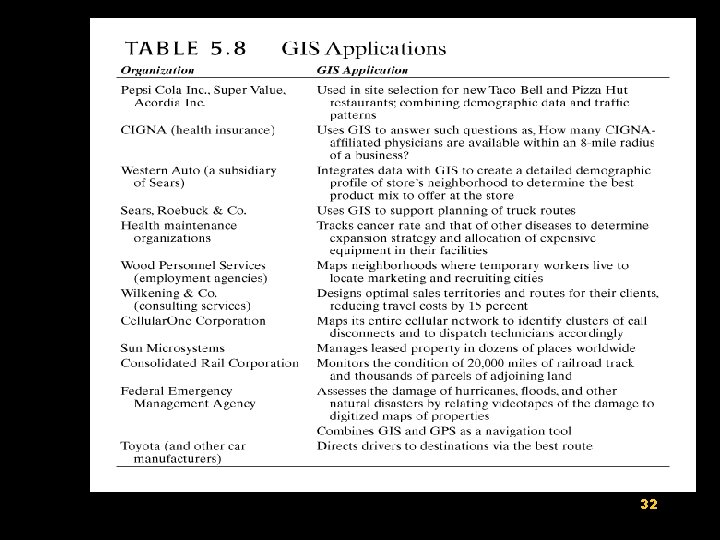
GIS • Computerized system for managing and manipulating data with digitized maps • Geographically oriented • Geographic spreadsheet for models • Software allows web access to maps • Used for modeling and simulations 31
32
Web Analytics/Intelligence • Web analytics • Application of business analytics to Web sites • Web intelligence • Application of business intelligence techniques to Web sites 33
- Slides: 33