Reasoning through Language Arts The Integration of Reading



- Slides: 102
Reasoning through Language Arts: The Integration of Reading and Writing Skills A Workshop by GED Testing Service® GEDtestingservice. com • GED. com
2 GEDtestingservice. com • GED. com
Session Objectives • Review expectations of RLA test • Explore and use close reading strategies • Explore thinking routines to teach the steps in drafting a constructed response • Share resources and ideas 3 GEDtestingservice. com • GED. com
An Overview Stuff to Teach 4 GEDtestingservice. com • GED. com
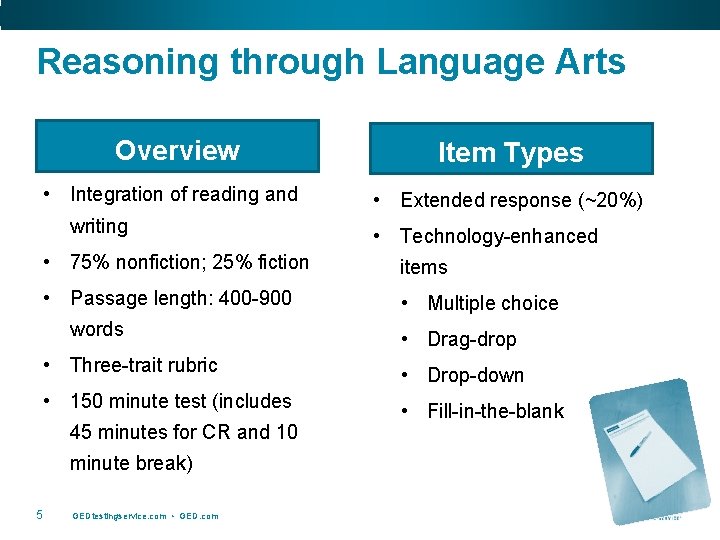
Reasoning through Language Arts Overview Item Types • Integration of reading and • Extended response (~20%) writing • 75% nonfiction; 25% fiction items • Passage length: 400 -900 • Multiple choice words • Three-trait rubric • 150 minute test (includes 45 minutes for CR and 10 minute break) 5 • Technology-enhanced GEDtestingservice. com • GED. com • Drag-drop • Drop-down • Fill-in-the-blank
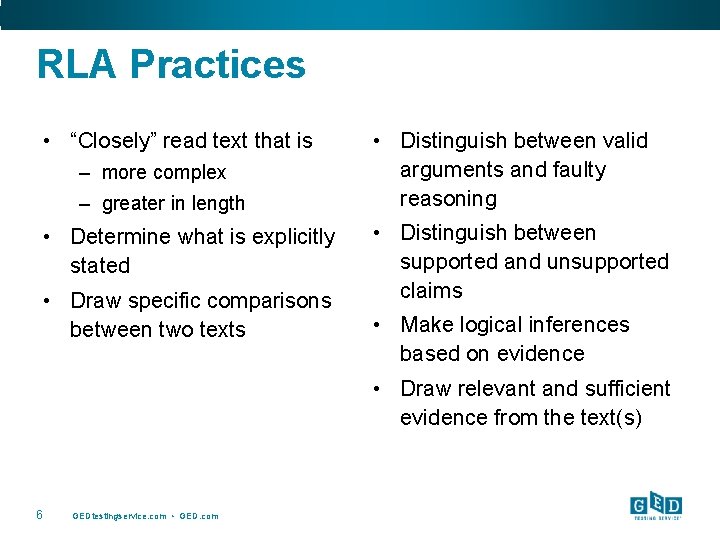
RLA Practices • “Closely” read text that is – more complex – greater in length • Determine what is explicitly stated • Draw specific comparisons between two texts • Distinguish between valid arguments and faulty reasoning • Distinguish between supported and unsupported claims • Make logical inferences based on evidence • Draw relevant and sufficient evidence from the text(s) 6 GEDtestingservice. com • GED. com
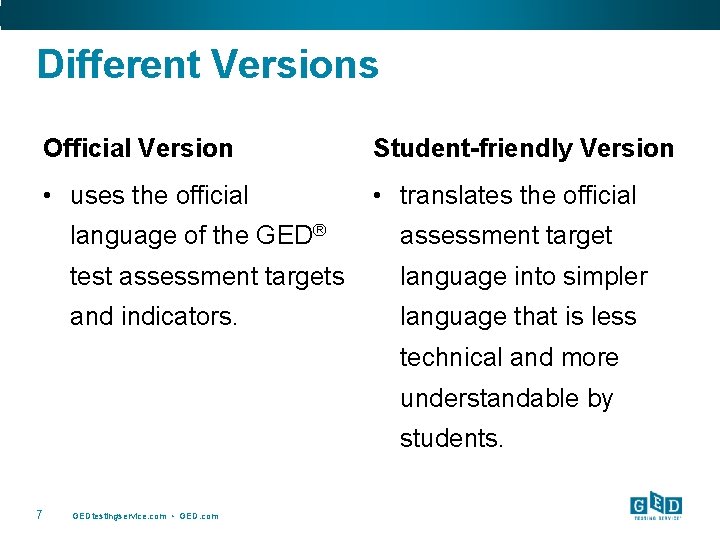
Different Versions Official Version Student-friendly Version • uses the official • translates the official language of the GED® assessment target test assessment targets language into simpler and indicators. language that is less technical and more understandable by students. 7 GEDtestingservice. com • GED. com
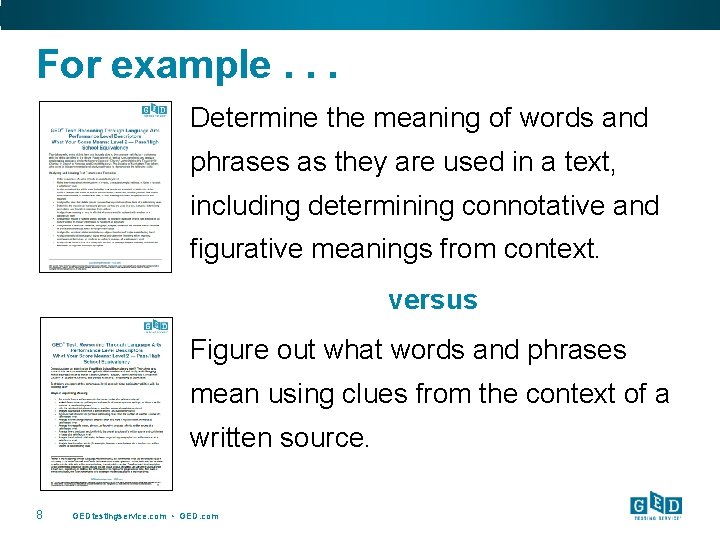
For example. . . Determine the meaning of words and phrases as they are used in a text, including determining connotative and figurative meanings from context. versus Figure out what words and phrases mean using clues from the context of a written source. 8 GEDtestingservice. com • GED. com
Too Much to Teach – Too Little Time? 9 GEDtestingservice. com • GED. com
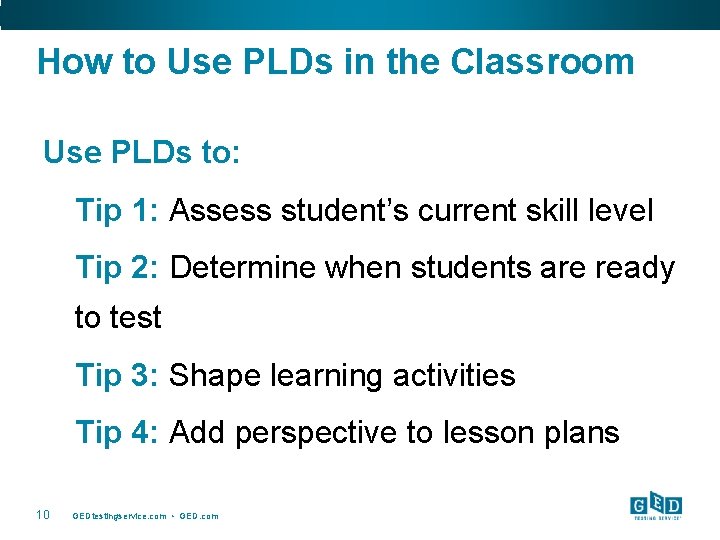
How to Use PLDs in the Classroom Use PLDs to: Tip 1: Assess student’s current skill level Tip 2: Determine when students are ready to test Tip 3: Shape learning activities Tip 4: Add perspective to lesson plans 10 GEDtestingservice. com • GED. com
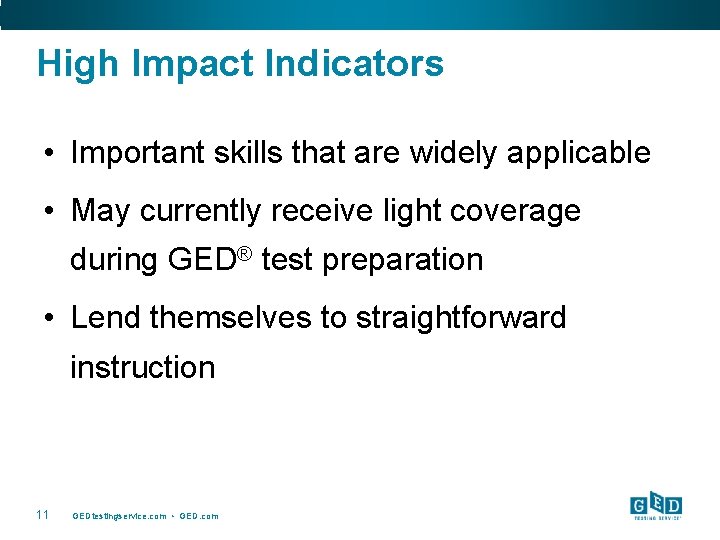
High Impact Indicators • Important skills that are widely applicable • May currently receive light coverage during GED® test preparation • Lend themselves to straightforward instruction 11 GEDtestingservice. com • GED. com
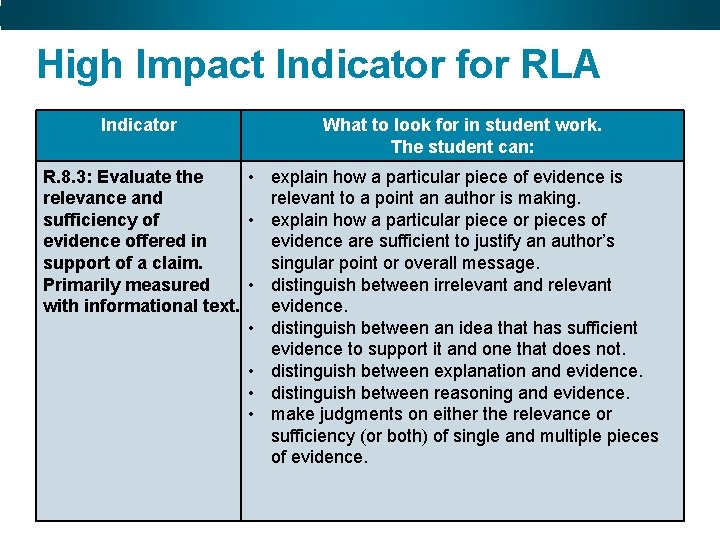
High Impact Indicator for RLA Indicator What to look for in student work. The student can: R. 8. 3: Evaluate the • explain how a particular piece of evidence is relevance and relevant to a point an author is making. sufficiency of • explain how a particular piece or pieces of evidence offered in evidence are sufficient to justify an author’s support of a claim. singular point or overall message. Primarily measured • distinguish between irrelevant and relevant with informational text. evidence. • distinguish between an idea that has sufficient evidence to support it and one that does not. • distinguish between explanation and evidence. • distinguish between reasoning and evidence. • make judgments on either the relevance or sufficiency (or both) of single and multiple pieces of evidence. 12 GEDtestingservice. com • GED. com
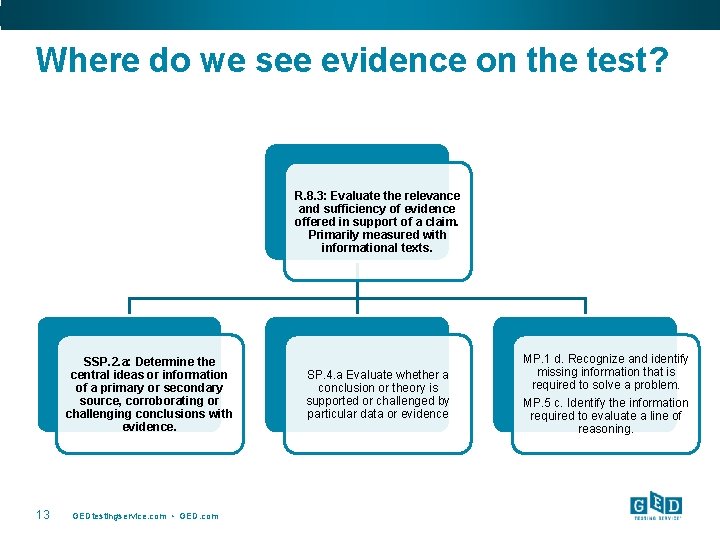
Where do we see evidence on the test? R. 8. 3: Evaluate the relevance and sufficiency of evidence offered in support of a claim. Primarily measured with informational texts. SSP. 2. a: Determine the central ideas or information of a primary or secondary source, corroborating or challenging conclusions with evidence. 13 GEDtestingservice. com • GED. com SP. 4. a Evaluate whether a conclusion or theory is supported or challenged by particular data or evidence MP. 1 d. Recognize and identify missing information that is required to solve a problem. MP. 5 c. Identify the information required to evaluate a line of reasoning.
Planning for Close Reading Implementing the Process into the Classroom 14 GEDtestingservice. com • GED. com
What is close reading? 15 GEDtestingservice. com • GED. com Workbook p. 4
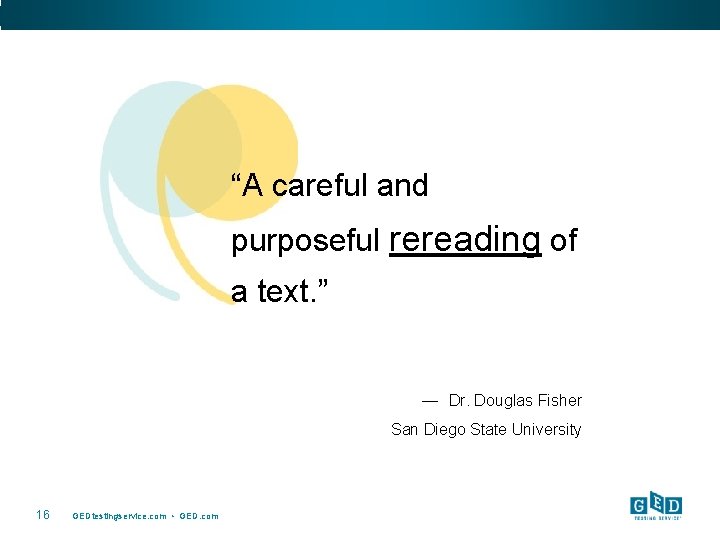
“A careful and purposeful rereading of a text. ” — Dr. Douglas Fisher San Diego State University 16 GEDtestingservice. com • GED. com
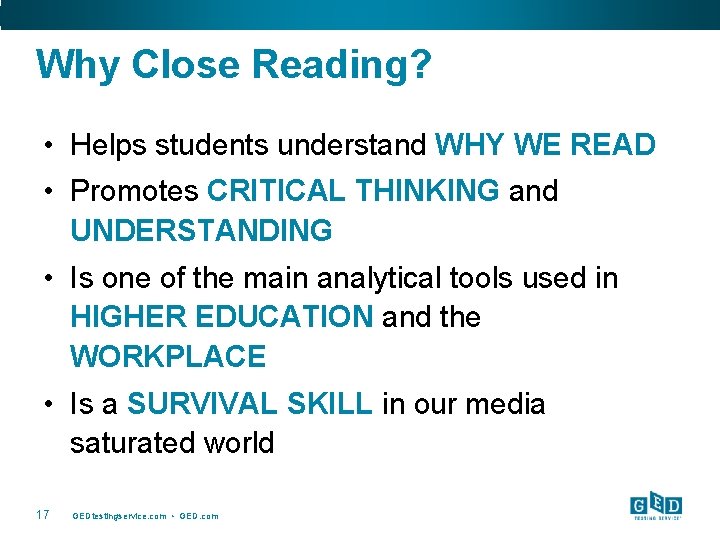
Why Close Reading? • Helps students understand WHY WE READ • Promotes CRITICAL THINKING and UNDERSTANDING • Is one of the main analytical tools used in HIGHER EDUCATION and the WORKPLACE • Is a SURVIVAL SKILL in our media saturated world 17 GEDtestingservice. com • GED. com
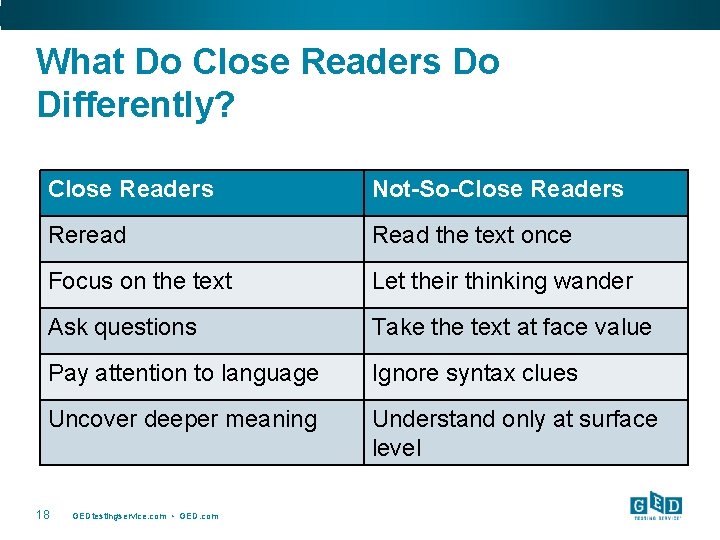
What Do Close Readers Do Differently? Close Readers Not-So-Close Readers Reread Read the text once Focus on the text Let their thinking wander Ask questions Take the text at face value Pay attention to language Ignore syntax clues Uncover deeper meaning Understand only at surface level 18 GEDtestingservice. com • GED. com
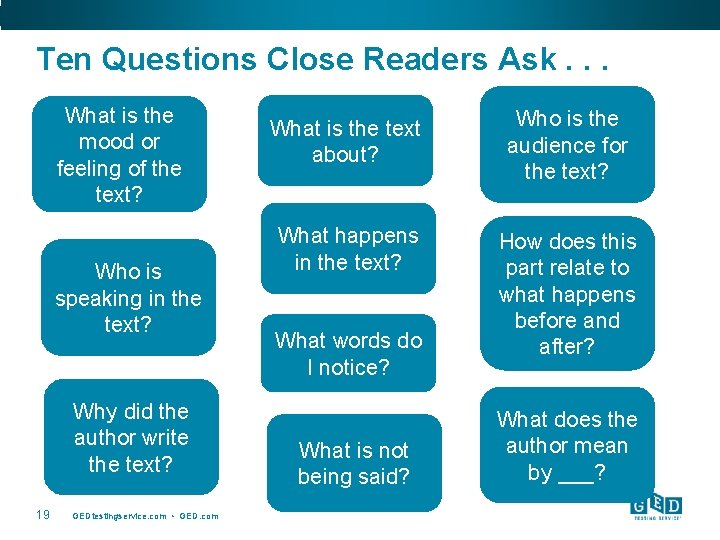
Ten Questions Close Readers Ask. . . What is the mood or feeling of the text? Who is speaking in the text? Why did the author write the text? 19 GEDtestingservice. com • GED. com What is the text about? Who is the audience for the text? What happens in the text? How does this part relate to what happens before and after? What words do I notice? What is not being said? What does the author mean by ___?
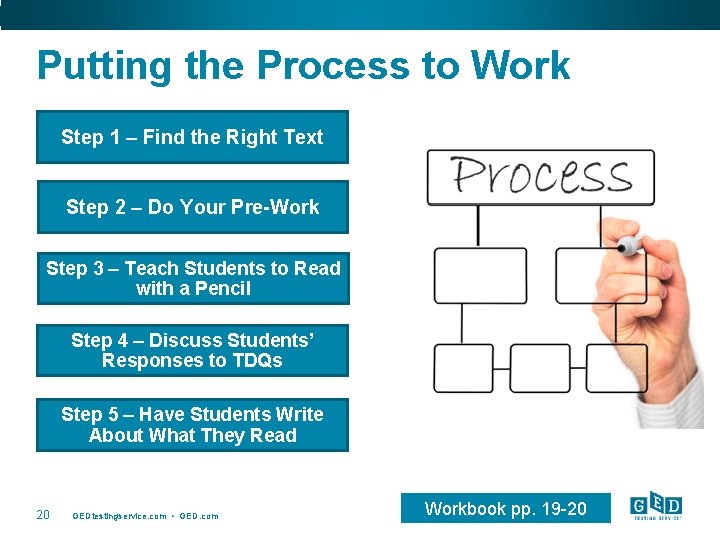
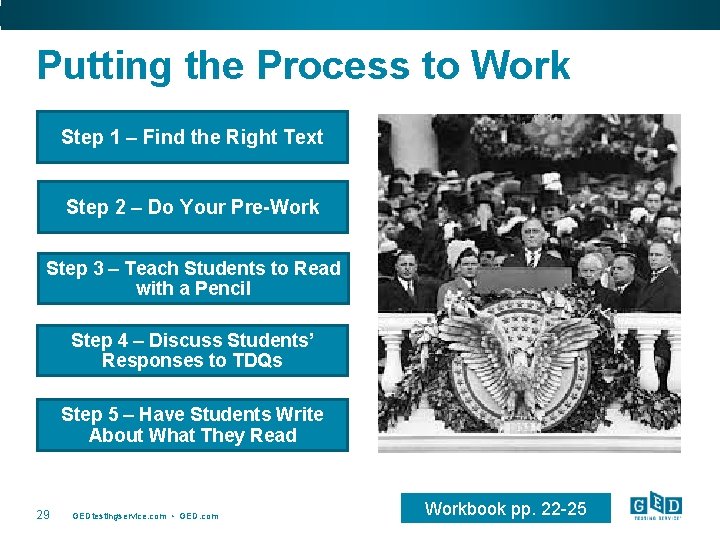
Putting the Process to Work Step 1 – Find the Right Text Step 2 – Do Your Pre-Work Step 3 – Teach Students to Read with a Pencil Step 4 – Discuss Students’ Responses to TDQs Step 5 – Have Students Write About What They Read 20 GEDtestingservice. com • GED. com Workbook pp. 19 -20
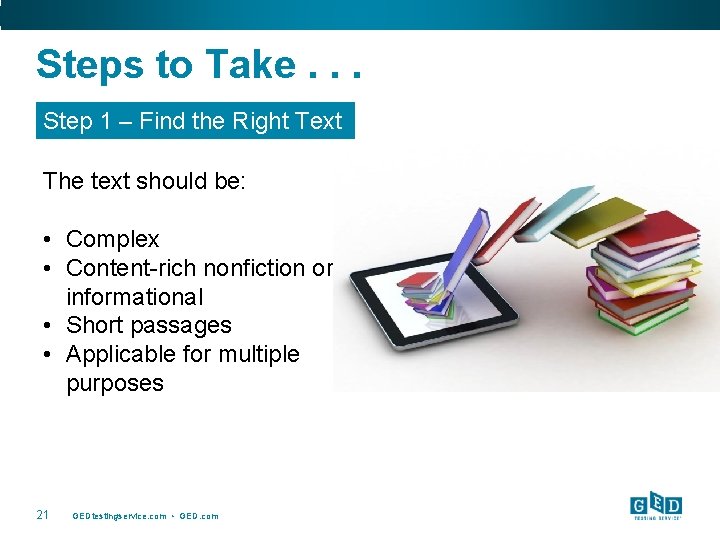
Steps to Take. . . Step 1 – Find the Right Text The text should be: • Complex • Content-rich nonfiction or informational • Short passages • Applicable for multiple purposes 21 GEDtestingservice. com • GED. com
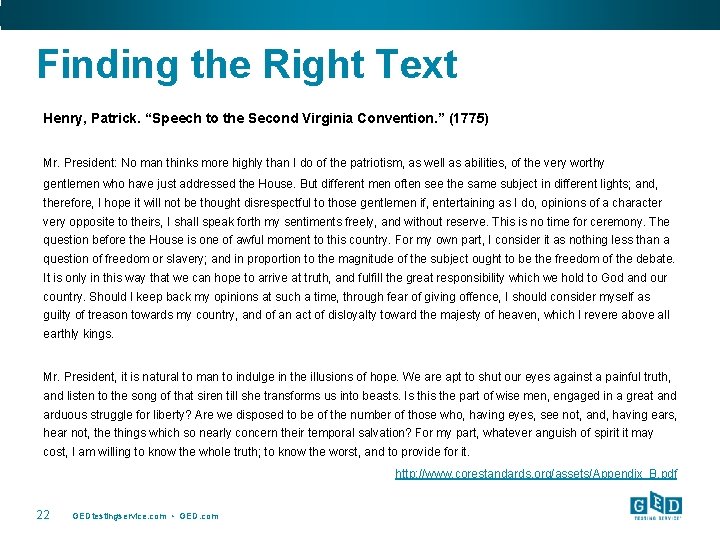
Finding the Right Text Henry, Patrick. “Speech to the Second Virginia Convention. ” (1775) Mr. President: No man thinks more highly than I do of the patriotism, as well as abilities, of the very worthy gentlemen who have just addressed the House. But different men often see the same subject in different lights; and, therefore, I hope it will not be thought disrespectful to those gentlemen if, entertaining as I do, opinions of a character very opposite to theirs, I shall speak forth my sentiments freely, and without reserve. This is no time for ceremony. The question before the House is one of awful moment to this country. For my own part, I consider it as nothing less than a question of freedom or slavery; and in proportion to the magnitude of the subject ought to be the freedom of the debate. It is only in this way that we can hope to arrive at truth, and fulfill the great responsibility which we hold to God and our country. Should I keep back my opinions at such a time, through fear of giving offence, I should consider myself as guilty of treason towards my country, and of an act of disloyalty toward the majesty of heaven, which I revere above all earthly kings. Mr. President, it is natural to man to indulge in the illusions of hope. We are apt to shut our eyes against a painful truth, and listen to the song of that siren till she transforms us into beasts. Is this the part of wise men, engaged in a great and arduous struggle for liberty? Are we disposed to be of the number of those who, having eyes, see not, and, having ears, hear not, the things which so nearly concern their temporal salvation? For my part, whatever anguish of spirit it may cost, I am willing to know the whole truth; to know the worst, and to provide for it. http: //www. corestandards. org/assets/Appendix_B. pdf 22 GEDtestingservice. com • GED. com
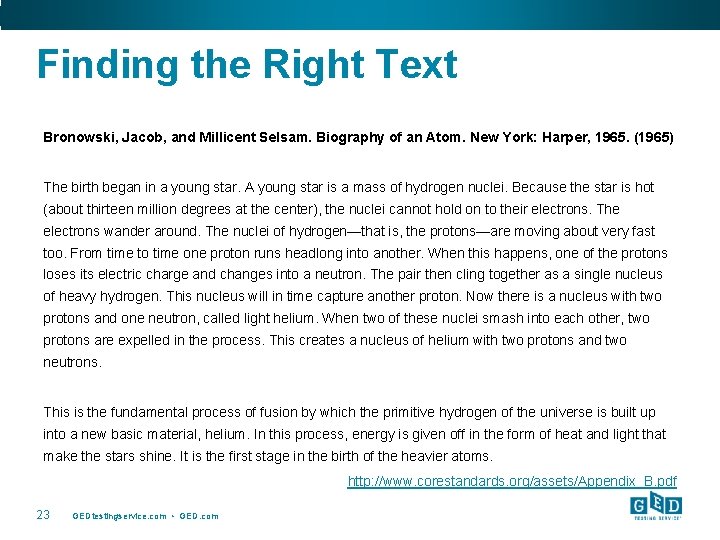
Finding the Right Text Bronowski, Jacob, and Millicent Selsam. Biography of an Atom. New York: Harper, 1965. (1965) The birth began in a young star. A young star is a mass of hydrogen nuclei. Because the star is hot (about thirteen million degrees at the center), the nuclei cannot hold on to their electrons. The electrons wander around. The nuclei of hydrogen—that is, the protons—are moving about very fast too. From time to time one proton runs headlong into another. When this happens, one of the protons loses its electric charge and changes into a neutron. The pair then cling together as a single nucleus of heavy hydrogen. This nucleus will in time capture another proton. Now there is a nucleus with two protons and one neutron, called light helium. When two of these nuclei smash into each other, two protons are expelled in the process. This creates a nucleus of helium with two protons and two neutrons. This is the fundamental process of fusion by which the primitive hydrogen of the universe is built up into a new basic material, helium. In this process, energy is given off in the form of heat and light that make the stars shine. It is the first stage in the birth of the heavier atoms. http: //www. corestandards. org/assets/Appendix_B. pdf 23 GEDtestingservice. com • GED. com
Steps to Take. . . Step 2 – Do Your Pre-Work Identify the most important thing for students to learn, then: • Create a series of TDQs (text -dependent questions) • Identify key words • Determine the annotation symbols • Chunk the text • Develop a reflection activity 24 GEDtestingservice. com • GED. com
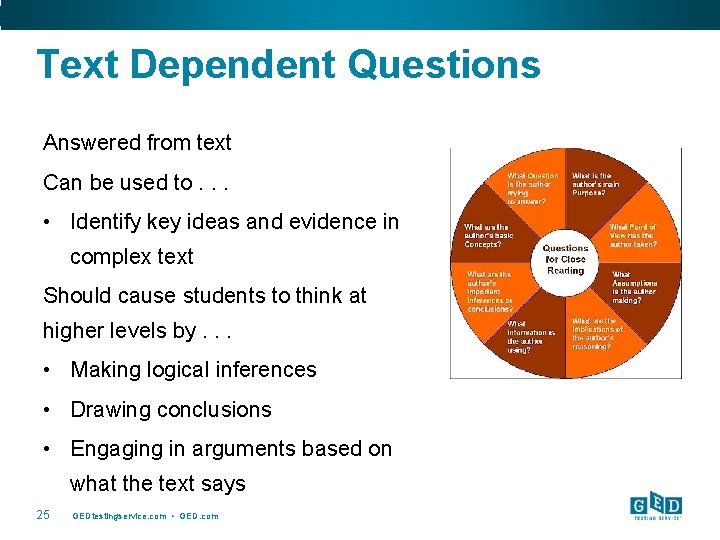
Text Dependent Questions Answered from text Can be used to. . . • Identify key ideas and evidence in complex text Should cause students to think at higher levels by. . . • Making logical inferences • Drawing conclusions • Engaging in arguments based on what the text says 25 GEDtestingservice. com • GED. com
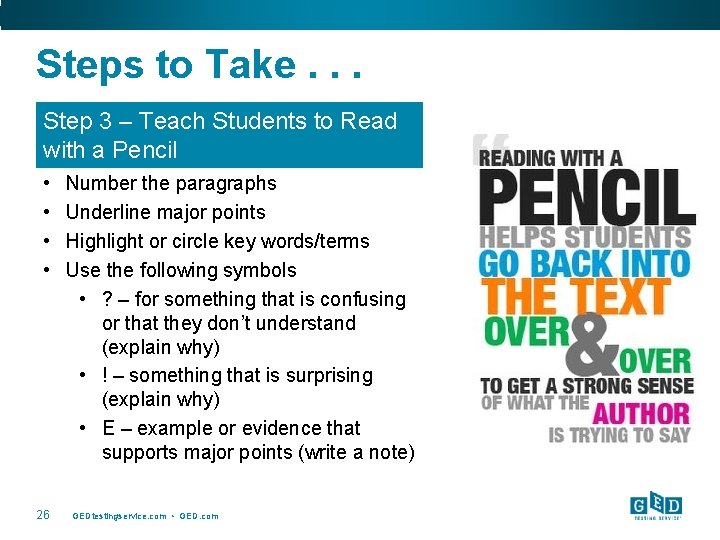
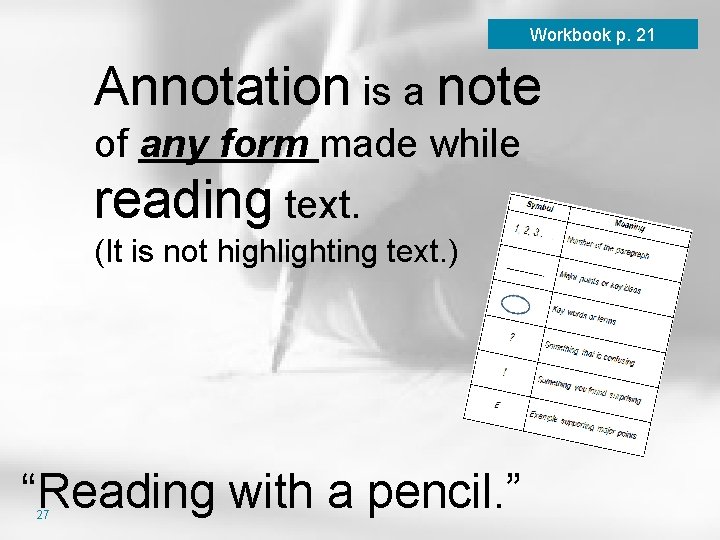
Steps to Take. . . Step 3 – Teach Students to Read with a Pencil • • 26 Number the paragraphs Underline major points Highlight or circle key words/terms Use the following symbols • ? – for something that is confusing or that they don’t understand (explain why) • ! – something that is surprising (explain why) • E – example or evidence that supports major points (write a note) GEDtestingservice. com • GED. com
Workbook p. 21 Annotation is a note of any form made while reading text. (It is not highlighting text. ) “Reading with a pencil. ” 27 GEDtestingservice. com • GED. com
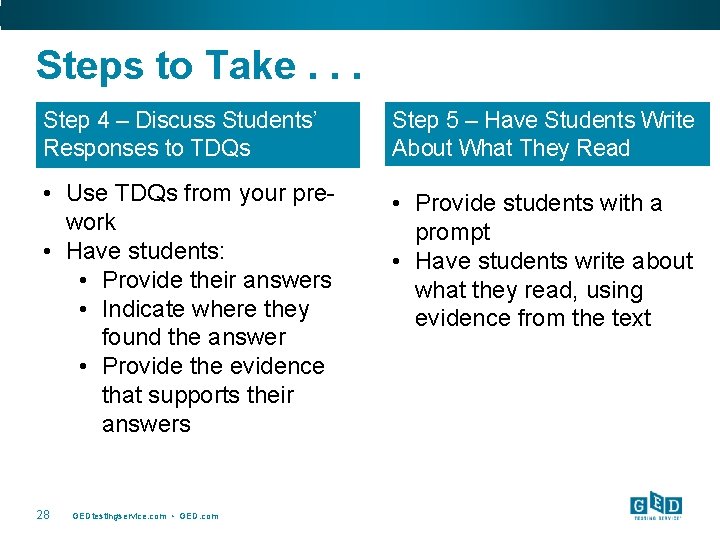
Steps to Take. . . Step 4 – Discuss Students’ Responses to TDQs Step 5 – Have Students Write About What They Read • Use TDQs from your prework • Have students: • Provide their answers • Indicate where they found the answer • Provide the evidence that supports their answers • Provide students with a prompt • Have students write about what they read, using evidence from the text 28 GEDtestingservice. com • GED. com
Putting the Process to Work Step 1 – Find the Right Text Step 2 – Do Your Pre-Work Step 3 – Teach Students to Read with a Pencil Step 4 – Discuss Students’ Responses to TDQs Step 5 – Have Students Write About What They Read 29 GEDtestingservice. com • GED. com Workbook pp. 22 -25
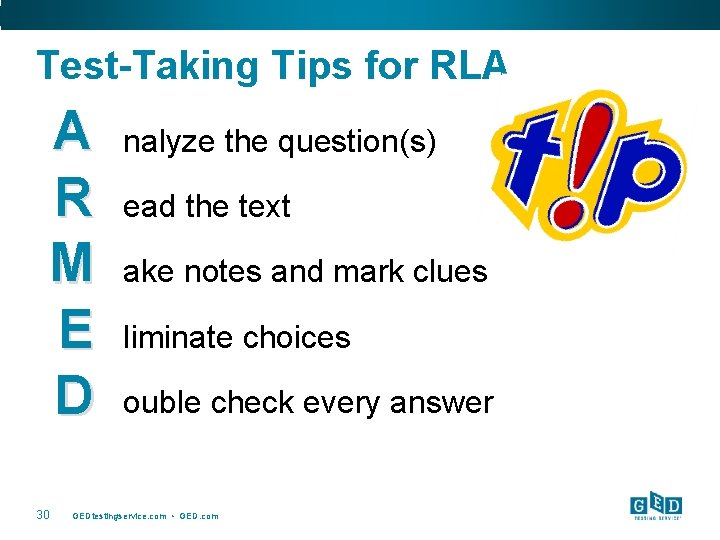
Test-Taking Tips for RLA A R M E D 30 nalyze the question(s) ead the text ake notes and mark clues liminate choices ouble check every answer GEDtestingservice. com • GED. com
Teaching Grammar in Contextualization is Understanding 31 GEDtestingservice. com • GED. com
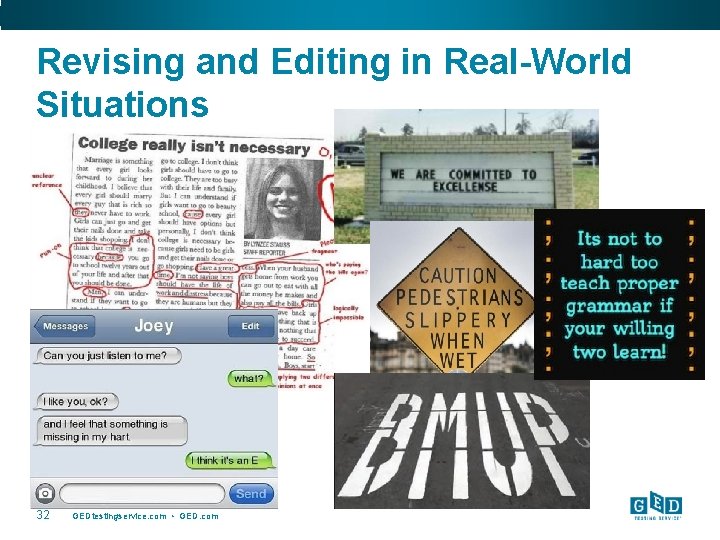
Revising and Editing in Real-World Situations 32 GEDtestingservice. com • GED. com
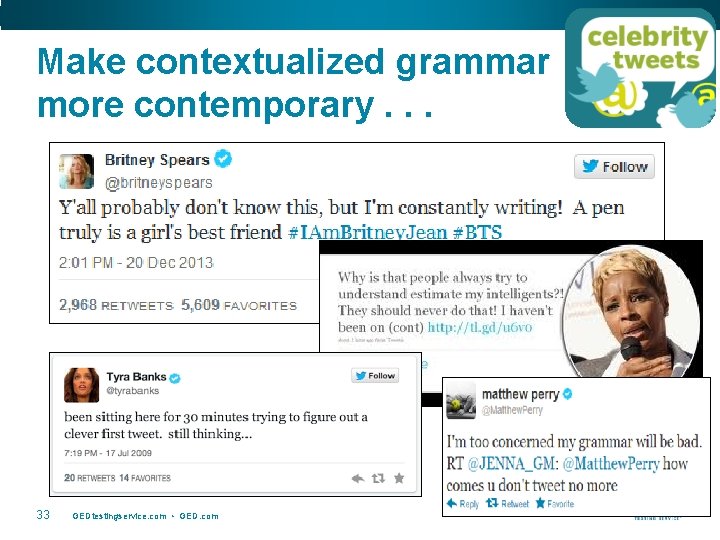
Make contextualized grammar more contemporary. . . 33 GEDtestingservice. com • GED. com
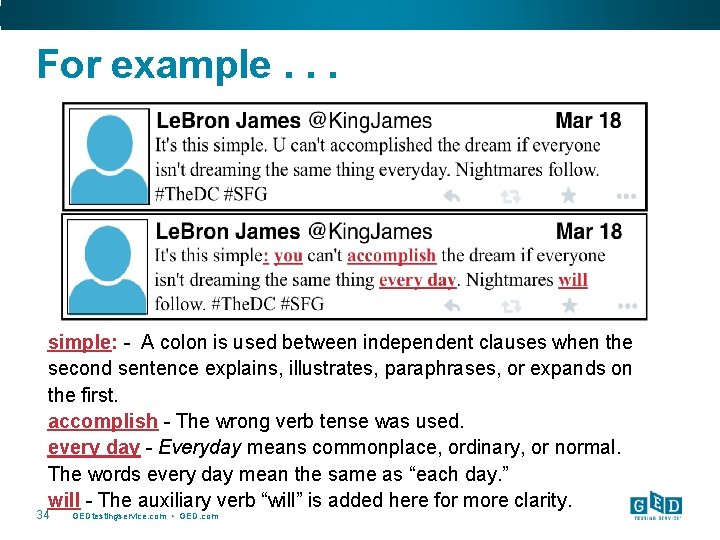
For example. . . simple: - A colon is used between independent clauses when the second sentence explains, illustrates, paraphrases, or expands on the first. accomplish - The wrong verb tense was used. every day - Everyday means commonplace, ordinary, or normal. The words every day mean the same as “each day. ” will - The auxiliary verb “will” is added here for more clarity. 34 GEDtestingservice. com • GED. com
What is close reading? It’s Your Turn! 35 GEDtestingservice. com • GED. com Workbook – p. 5
Constructed Response What are the expectations? 36 GEDtestingservice. com • GED. com
What is evidence -based, argumentative writing? Workbook – p. 7 37 GEDtestingservice. com • GED. com
“The goal of making an argument is to convince an audience of the rightness of the claims being made, using logical reasoning and relevant evidence. . . ” — 38 GEDtestingservice. com • GED. com Source: National Governor’s Association Center for Best Practices and the Council of Chief State School Officers. College & Career Ready Standards for Reading, Writing and Communication
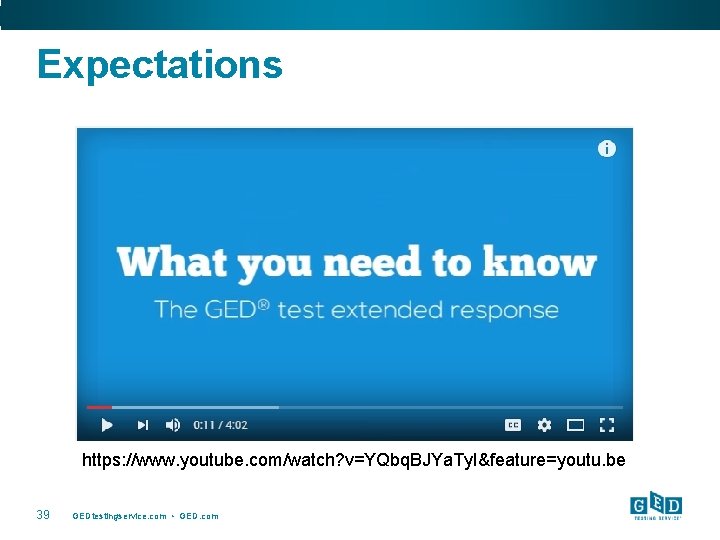
Expectations https: //www. youtube. com/watch? v=YQbq. BJYa. Ty. I&feature=youtu. be 39 GEDtestingservice. com • GED. com
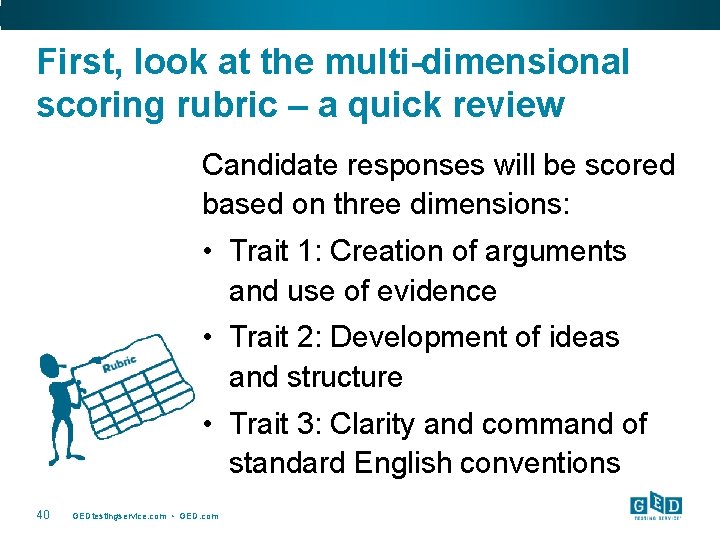
First, look at the multi-dimensional scoring rubric – a quick review Candidate responses will be scored based on three dimensions: • Trait 1: Creation of arguments and use of evidence • Trait 2: Development of ideas and structure • Trait 3: Clarity and command of standard English conventions 40 GEDtestingservice. com • GED. com
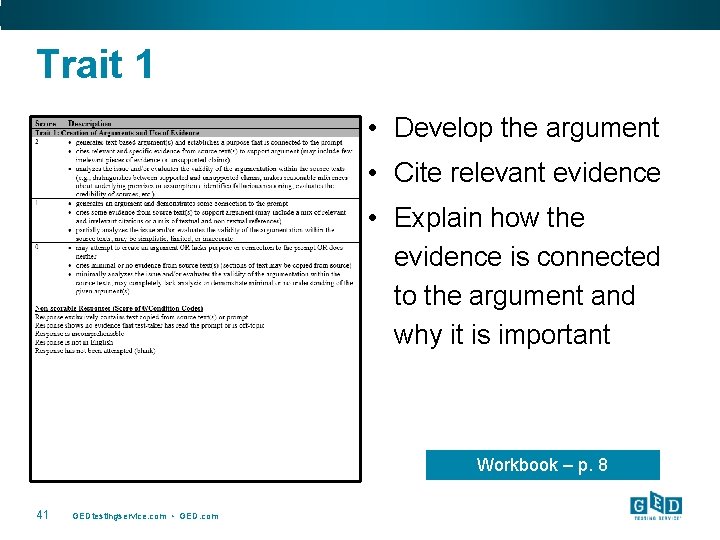
Trait 1 • Develop the argument • Cite relevant evidence • Explain how the evidence is connected to the argument and why it is important Workbook – p. 8 41 GEDtestingservice. com • GED. com
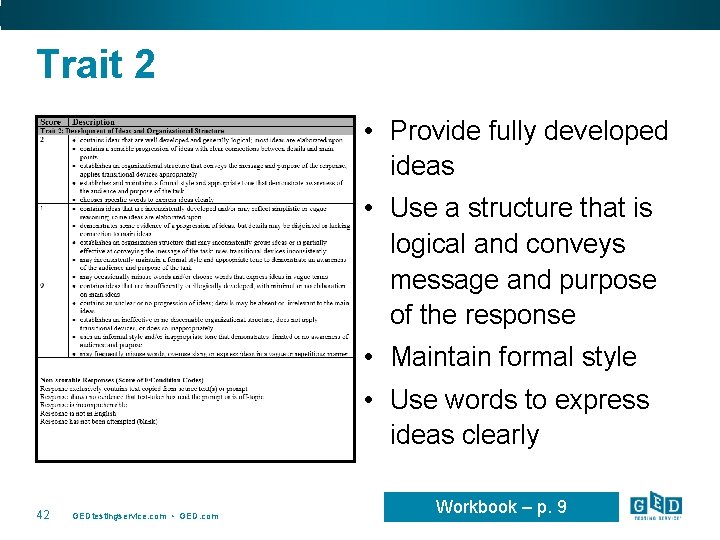
Trait 2 • Provide fully developed ideas • Use a structure that is logical and conveys message and purpose of the response • Maintain formal style • Use words to express ideas clearly 42 GEDtestingservice. com • GED. com Workbook – p. 9
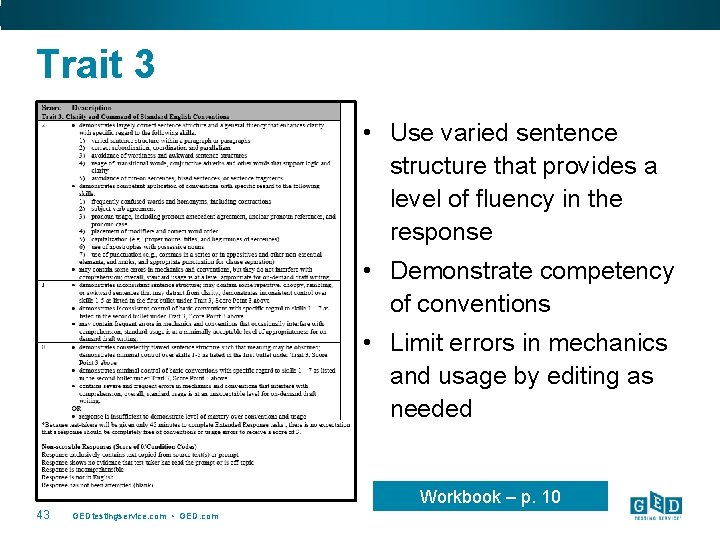
Trait 3 • Use varied sentence structure that provides a level of fluency in the response • Demonstrate competency of conventions • Limit errors in mechanics and usage by editing as needed Workbook – p. 10 43 GEDtestingservice. com • GED. com
MTPV in Action Applying Thinking Routines to Constructed Responses 44 GEDtestingservice. com • GED. com
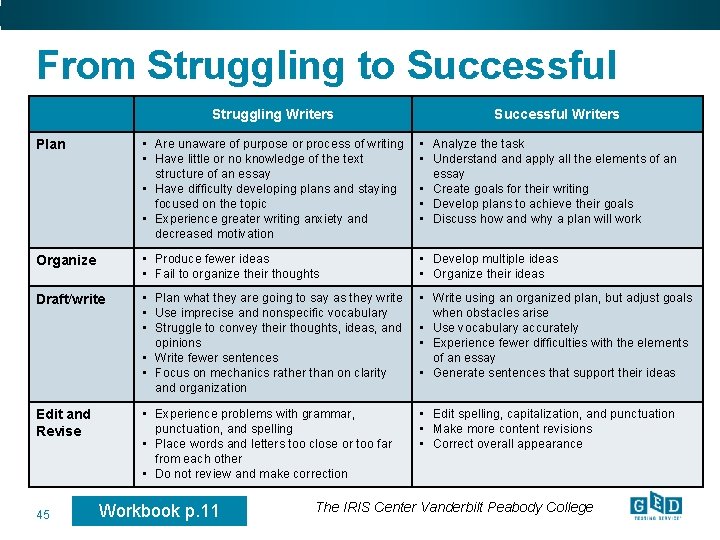
From Struggling to Successful Struggling Writers Successful Writers Plan • Are unaware of purpose or process of writing • Have little or no knowledge of the text structure of an essay • Have difficulty developing plans and staying focused on the topic • Experience greater writing anxiety and decreased motivation • Analyze the task • Understand apply all the elements of an essay • Create goals for their writing • Develop plans to achieve their goals • Discuss how and why a plan will work Organize • Produce fewer ideas • Fail to organize their thoughts • Develop multiple ideas • Organize their ideas Draft/write • Plan what they are going to say as they write • Use imprecise and nonspecific vocabulary • Struggle to convey their thoughts, ideas, and opinions • Write fewer sentences • Focus on mechanics rather than on clarity and organization • Write using an organized plan, but adjust goals when obstacles arise • Use vocabulary accurately • Experience fewer difficulties with the elements of an essay • Generate sentences that support their ideas Edit and Revise • Experience problems with grammar, punctuation, and spelling • Place words and letters too close or too far from each other • Do not review and make correction • Edit spelling, capitalization, and punctuation • Make more content revisions • Correct overall appearance 45 Workbook p. 11 GEDtestingservice. com • GED. com The IRIS Center Vanderbilt Peabody College
“Good writing is clear thinking made visible. ” — Bill Wheeler 46 GEDtestingservice. com • GED. com
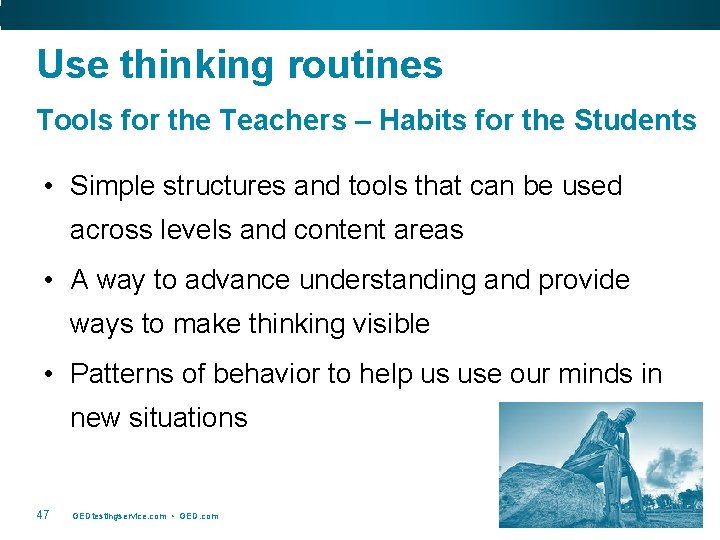
Use thinking routines Tools for the Teachers – Habits for the Students • Simple structures and tools that can be used across levels and content areas • A way to advance understanding and provide ways to make thinking visible • Patterns of behavior to help us use our minds in new situations 47 GEDtestingservice. com • GED. com
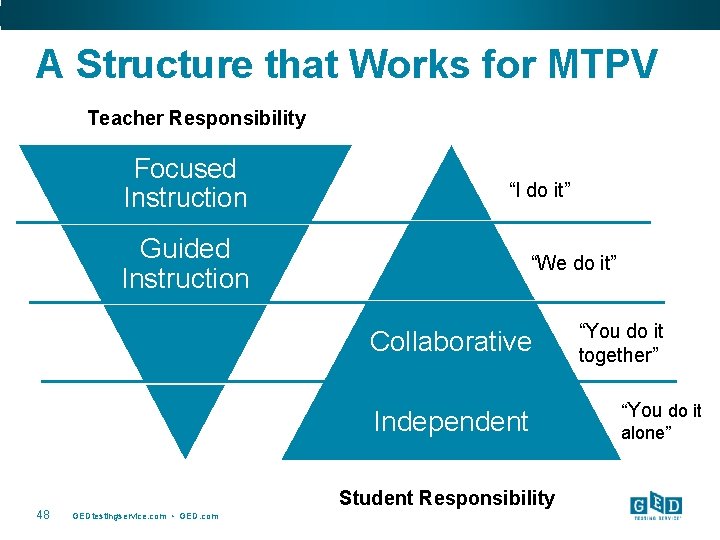
A Structure that Works for MTPV Teacher Responsibility Focused Instruction “I do it” Guided Instruction “We do it” Collaborative Independent 48 Student Responsibility GEDtestingservice. com • GED. com “You do it together” “You do it alone”
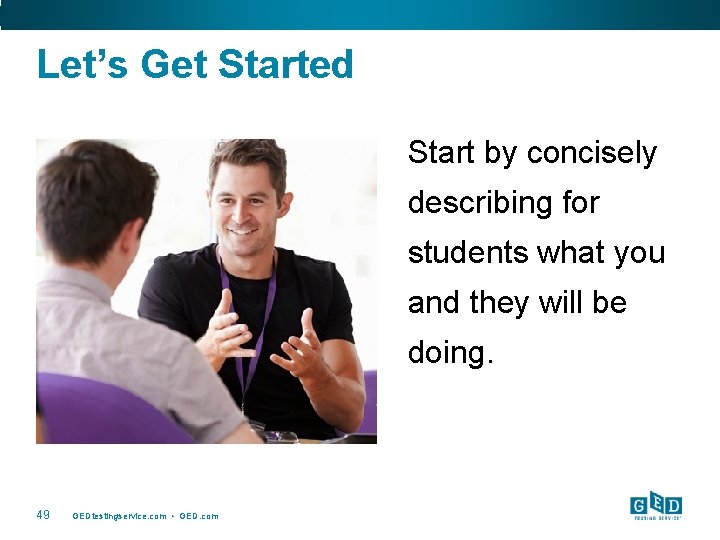
Let’s Get Started Start by concisely describing for students what you and they will be doing. 49 GEDtestingservice. com • GED. com
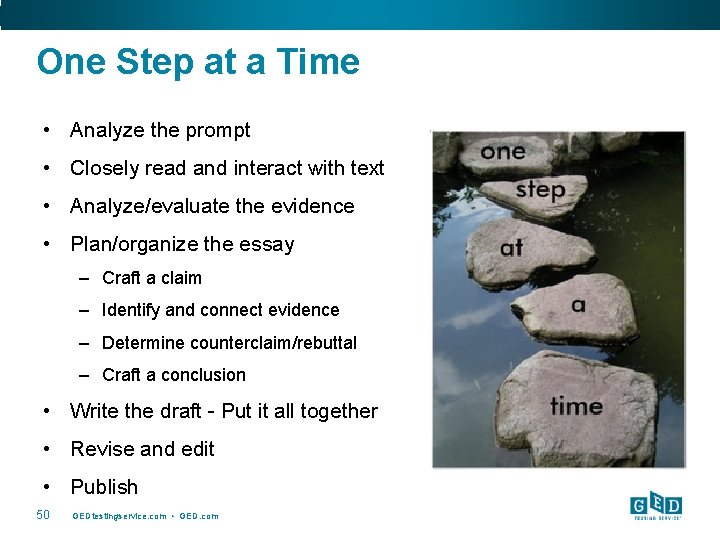
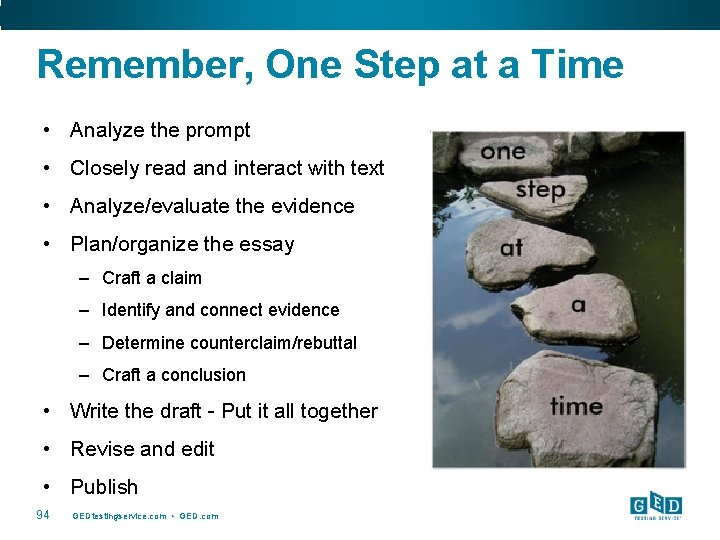
One Step at a Time • Analyze the prompt • Closely read and interact with text • Analyze/evaluate the evidence • Plan/organize the essay – Craft a claim – Identify and connect evidence – Determine counterclaim/rebuttal – Craft a conclusion • Write the draft - Put it all together • Revise and edit • Publish 50 GEDtestingservice. com • GED. com
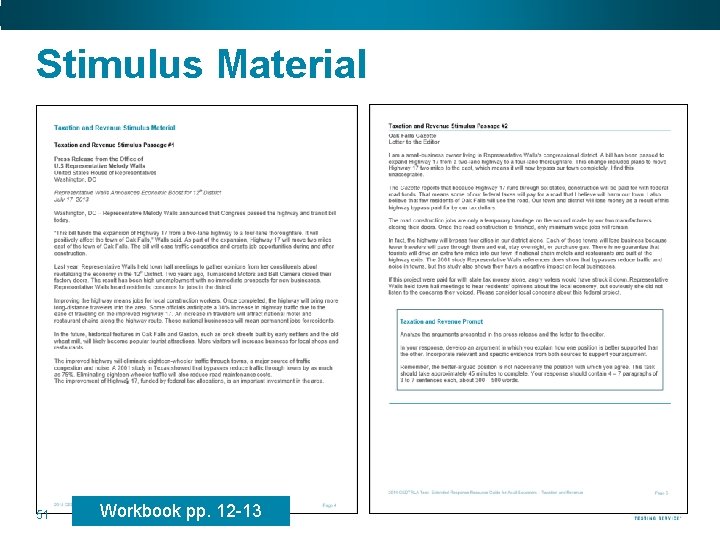
Stimulus Material 51 Workbook pp. 12 -13 GEDtestingservice. com • GED. com
Read and Analyze the Prompt • Question: What does the prompt ask us to do? • As a class, let’s read the prompt • As we read, we identify the verbs in the prompt and what the verbs ask us to do. The goal is for students to be able to unpack the prompt prior to reading the source texts. 52 GEDtestingservice. com • GED. com
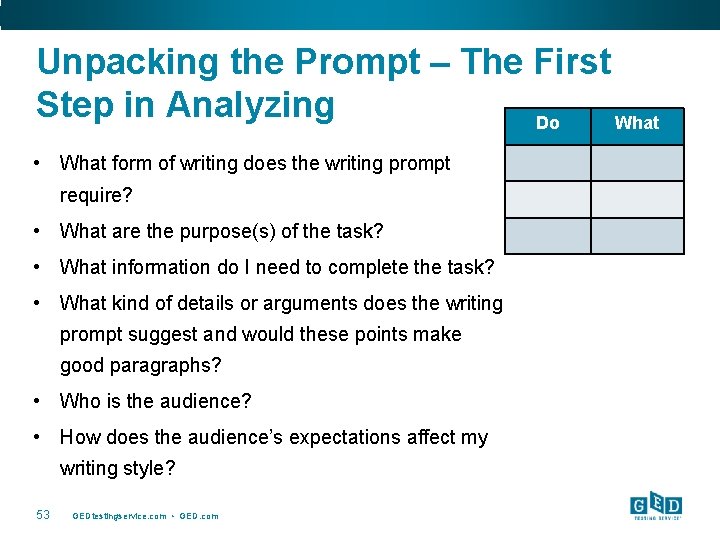
Unpacking the Prompt – The First Step in Analyzing Do What • What form of writing does the writing prompt require? • What are the purpose(s) of the task? • What information do I need to complete the task? • What kind of details or arguments does the writing prompt suggest and would these points make good paragraphs? • Who is the audience? • How does the audience’s expectations affect my writing style? 53 GEDtestingservice. com • GED. com
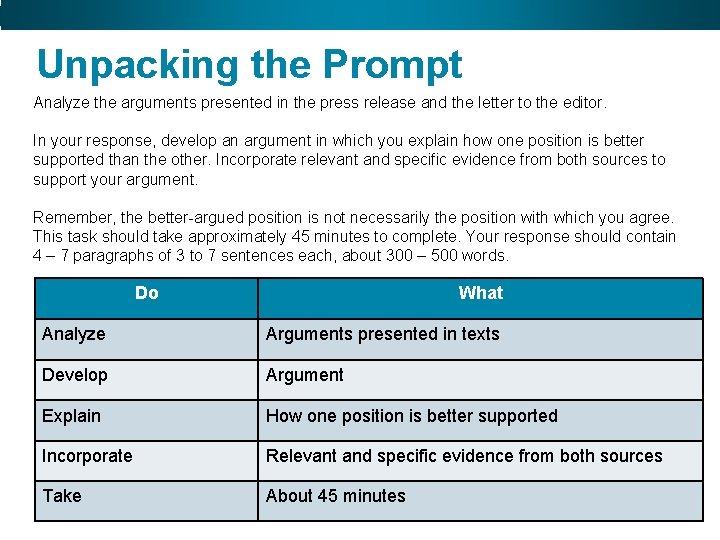
Unpacking the Prompt Analyze the arguments presented in the press release and the letter to the editor. In your response, develop an argument in which you explain how one position is better supported than the other. Incorporate relevant and specific evidence from both sources to support your argument. Remember, the better-argued position is not necessarily the position with which you agree. This task should take approximately 45 minutes to complete. Your response should contain 4 – 7 paragraphs of 3 to 7 sentences each, about 300 – 500 words. Do Do What Analyze Arguments presented in texts Develop Argument Explain How one position is better supported Incorporate Relevant and specific evidence from both sources Take About 45 minutes 54 GEDtestingservice. com • GED. com
Research basis G. Hillocks (2010) points out that “in reality, good argument begins with looking at the data that are likely to become the evidence in an argument and that gives rise to a thesis statement or major claim. ” Hillocks, G. (2010) Teaching argument for critical thinking and writing: An introduction. English Journal 99(6) 24 -32 55 GEDtestingservice. com • GED. com
Modeling – Citing the Evidence • Question: Will the highway and transit bill be beneficial? • As a class, we will read the two stimulus items. • As we read, we will highlight in yellow (or underline) the evidence that supports the benefits of the highway and transit bill. We will highlight in blue (or circle) the evidence supporting that the highway and transit bill will be detrimental. The goal is for students to be able to cite several pieces of textual evidence to support analysis of what the text says explicitly as well as inferences drawn from the text. 56 GEDtestingservice. com • GED. com
But First. . . C N S I T A H W 57 GEDtestingservice. com • GED. com E D I V E ? E
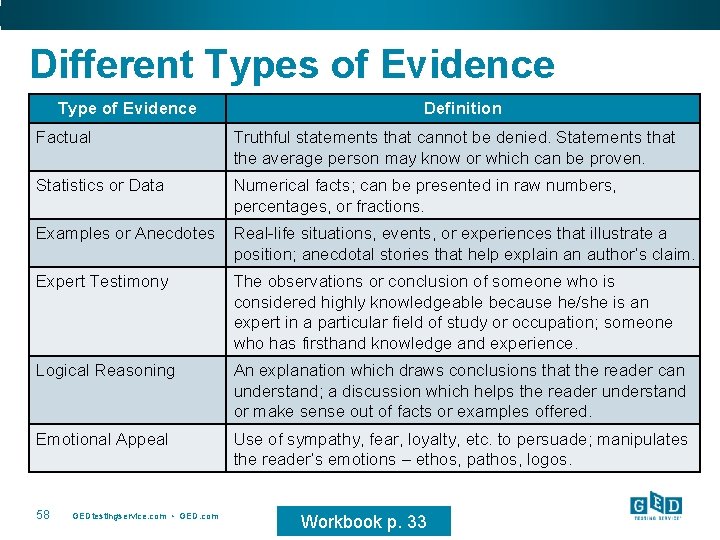
Different Types of Evidence Type of Evidence Definition Factual Truthful statements that cannot be denied. Statements that the average person may know or which can be proven. Statistics or Data Numerical facts; can be presented in raw numbers, percentages, or fractions. Examples or Anecdotes Real-life situations, events, or experiences that illustrate a position; anecdotal stories that help explain an author’s claim. Expert Testimony The observations or conclusion of someone who is considered highly knowledgeable because he/she is an expert in a particular field of study or occupation; someone who has firsthand knowledge and experience. Logical Reasoning An explanation which draws conclusions that the reader can understand; a discussion which helps the reader understand or make sense out of facts or examples offered. Emotional Appeal Use of sympathy, fear, loyalty, etc. to persuade; manipulates the reader’s emotions – ethos, pathos, logos. 58 GEDtestingservice. com • GED. com Workbook p. 33
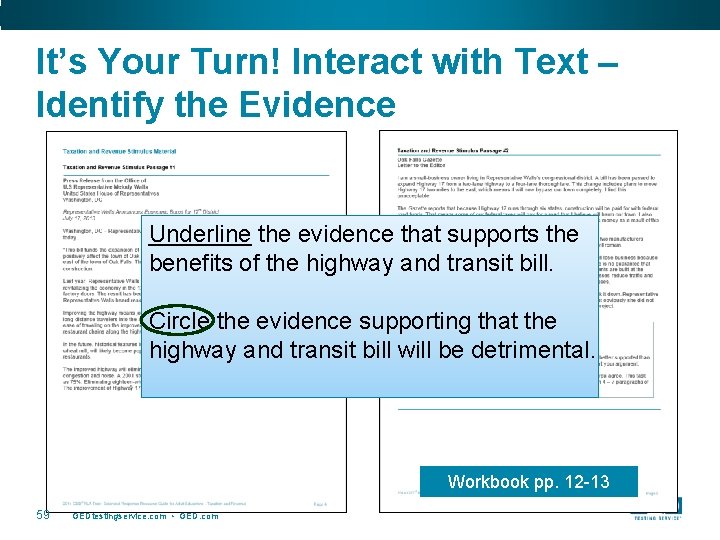
It’s Your Turn! Interact with Text – Identify the Evidence Underline the evidence that supports the benefits of the highway and transit bill. Circle the evidence supporting that the highway and transit bill will be detrimental. Workbook pp. 12 -13 59 GEDtestingservice. com • GED. com
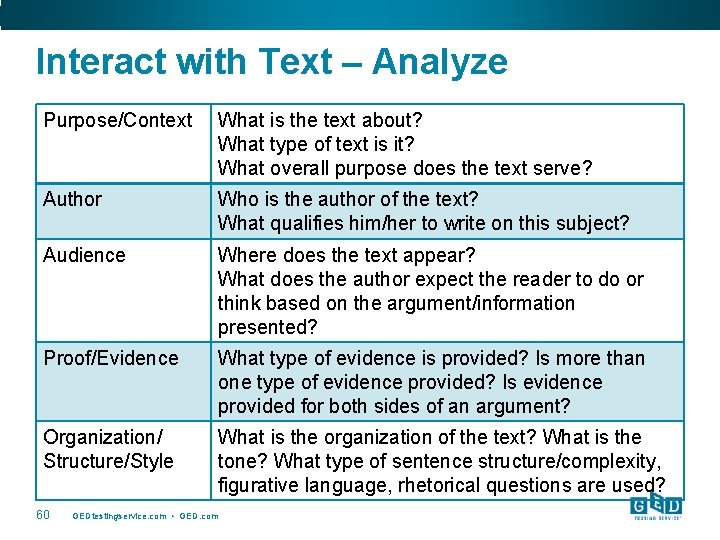
Interact with Text – Analyze Purpose/Context What is the text about? What type of text is it? What overall purpose does the text serve? Author Who is the author of the text? What qualifies him/her to write on this subject? Audience Where does the text appear? What does the author expect the reader to do or think based on the argument/information presented? Proof/Evidence What type of evidence is provided? Is more than one type of evidence provided? Is evidence provided for both sides of an argument? Organization/ Structure/Style What is the organization of the text? What is the tone? What type of sentence structure/complexity, figurative language, rhetorical questions are used? 60 GEDtestingservice. com • GED. com
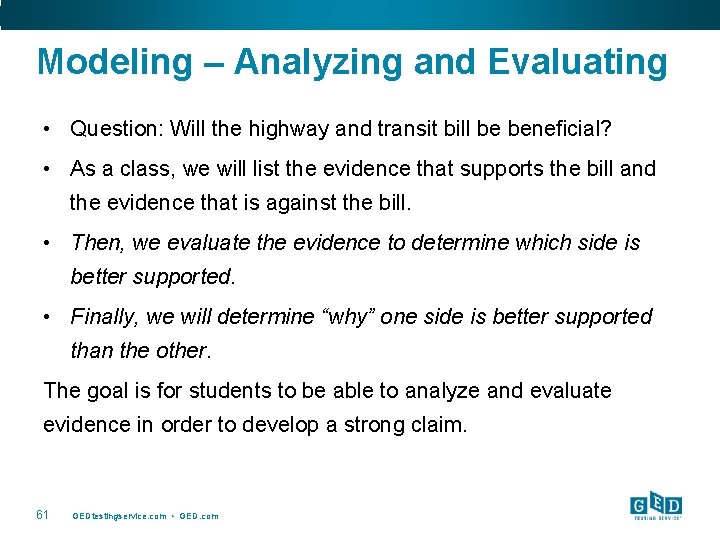
Modeling – Analyzing and Evaluating • Question: Will the highway and transit bill be beneficial? • As a class, we will list the evidence that supports the bill and the evidence that is against the bill. • Then, we evaluate the evidence to determine which side is better supported. • Finally, we will determine “why” one side is better supported than the other. The goal is for students to be able to analyze and evaluate evidence in order to develop a strong claim. 61 GEDtestingservice. com • GED. com
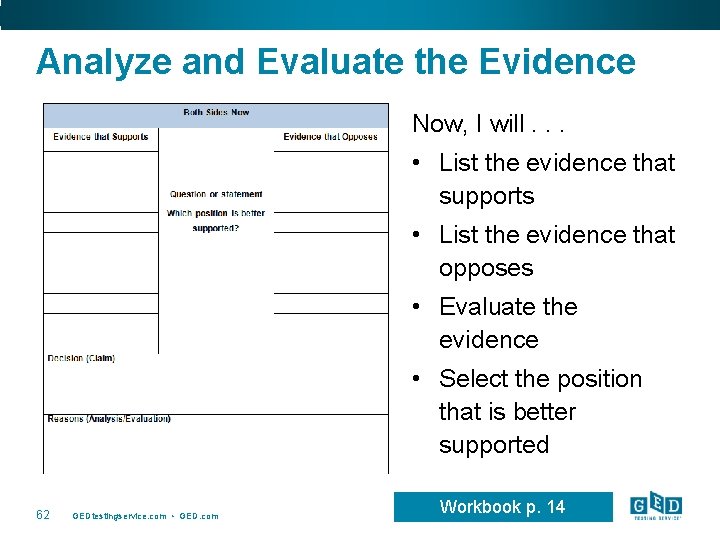
Analyze and Evaluate the Evidence Now, I will. . . • List the evidence that supports • List the evidence that opposes • Evaluate the evidence • Select the position that is better supported 62 GEDtestingservice. com • GED. com Workbook p. 14
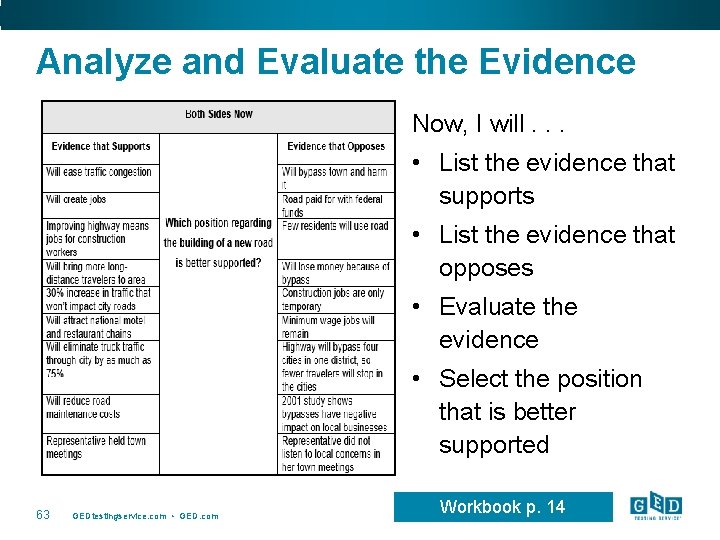
Analyze and Evaluate the Evidence Now, I will. . . • List the evidence that supports • List the evidence that opposes • Evaluate the evidence • Select the position that is better supported 63 GEDtestingservice. com • GED. com Workbook p. 14
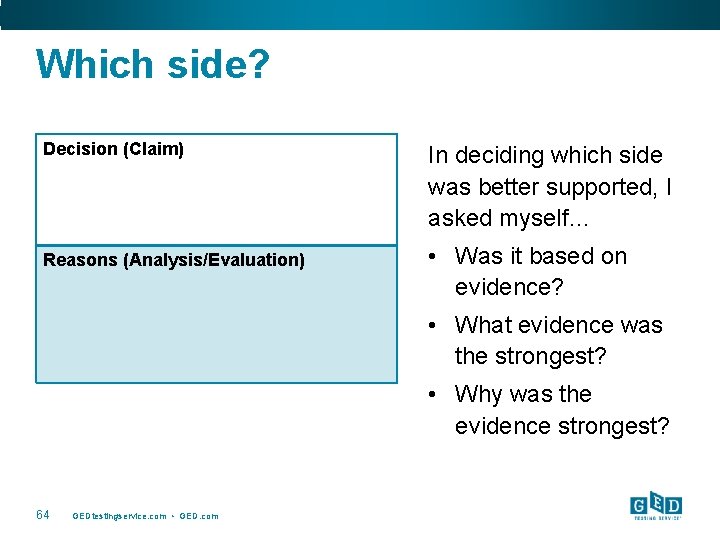
Which side? Decision (Claim) In deciding which side was better supported, I asked myself… Reasons (Analysis/Evaluation) • Was it based on evidence? • What evidence was the strongest? • Why was the evidence strongest? 64 GEDtestingservice. com • GED. com
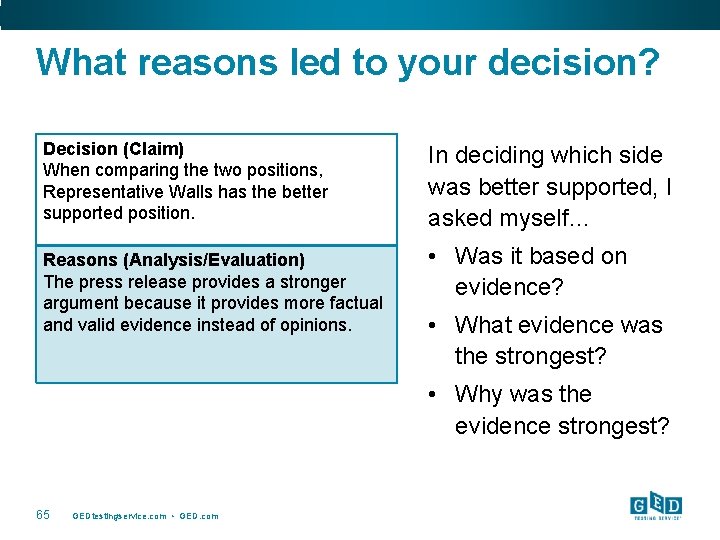
What reasons led to your decision? Decision (Claim) When comparing the two positions, Representative Walls has the better supported position. In deciding which side was better supported, I asked myself… Reasons (Analysis/Evaluation) The press release provides a stronger argument because it provides more factual and valid evidence instead of opinions. • Was it based on evidence? • What evidence was the strongest? • Why was the evidence strongest? 65 GEDtestingservice. com • GED. com
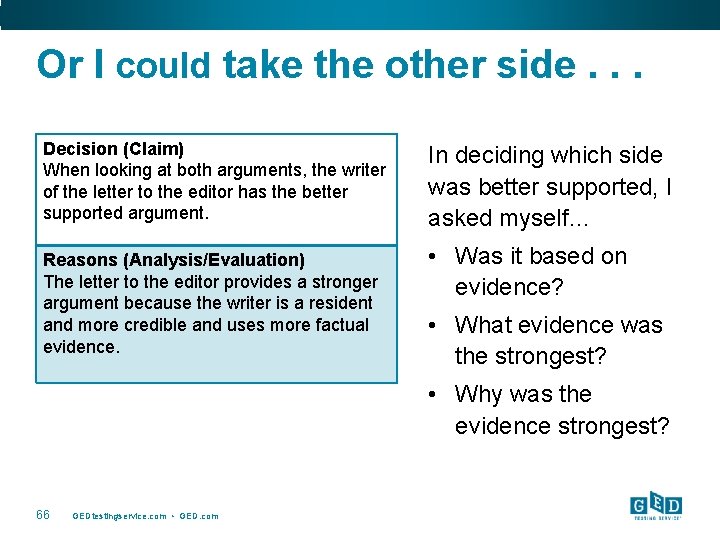
Or I could take the other side. . . Decision (Claim) When looking at both arguments, the writer of the letter to the editor has the better supported argument. In deciding which side was better supported, I asked myself… Reasons (Analysis/Evaluation) The letter to the editor provides a stronger argument because the writer is a resident and more credible and uses more factual evidence. • Was it based on evidence? • What evidence was the strongest? • Why was the evidence strongest? 66 GEDtestingservice. com • GED. com
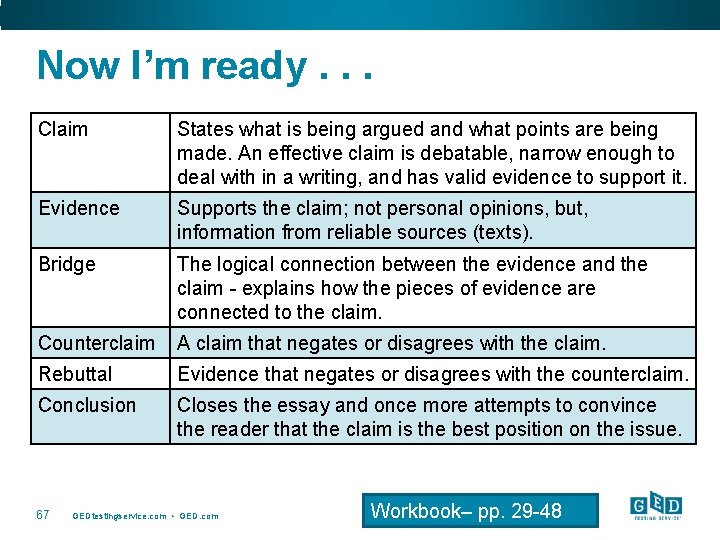
Now I’m ready. . . Claim States what is being argued and what points are being made. An effective claim is debatable, narrow enough to deal with in a writing, and has valid evidence to support it. Evidence Supports the claim; not personal opinions, but, information from reliable sources (texts). Bridge The logical connection between the evidence and the claim - explains how the pieces of evidence are connected to the claim. Counterclaim A claim that negates or disagrees with the claim. Rebuttal Evidence that negates or disagrees with the counterclaim. Conclusion Closes the essay and once more attempts to convince the reader that the claim is the best position on the issue. 67 GEDtestingservice. com • GED. com Workbook– pp. 29 -48
DEVELOP THE CLAIM 68 GEDtestingservice. com • GED. com
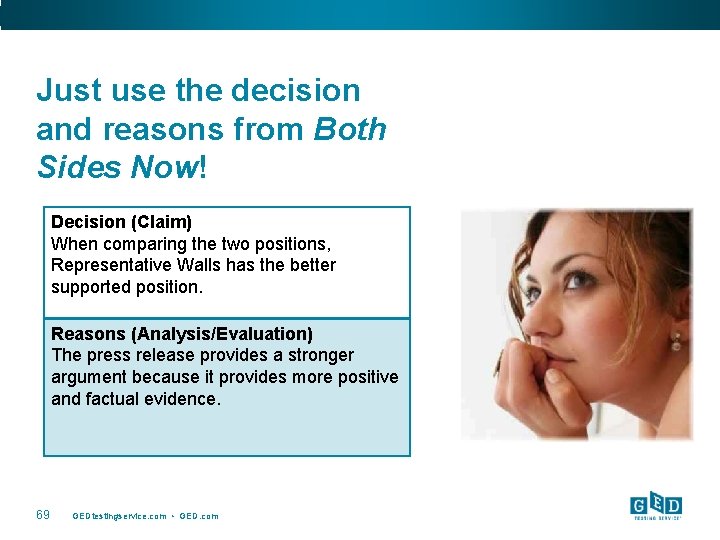
Just use the decision and reasons from Both Sides Now! Decision (Claim) When comparing the two positions, Representative Walls has the better supported position. Reasons (Analysis/Evaluation) The press release provides a stronger argument because it provides more positive and factual evidence. 69 GEDtestingservice. com • GED. com
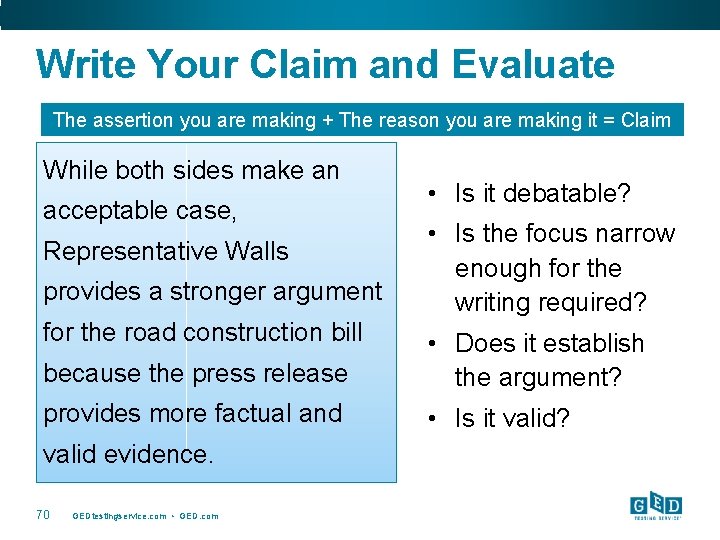
Write Your Claim and Evaluate The assertion you are making + The reason you are making it = Claim While both sides make an acceptable case, Representative Walls provides a stronger argument for the road construction bill • Is it debatable? • Is the focus narrow enough for the writing required? because the press release • Does it establish the argument? provides more factual and • Is it valid? valid evidence. 70 GEDtestingservice. com • GED. com
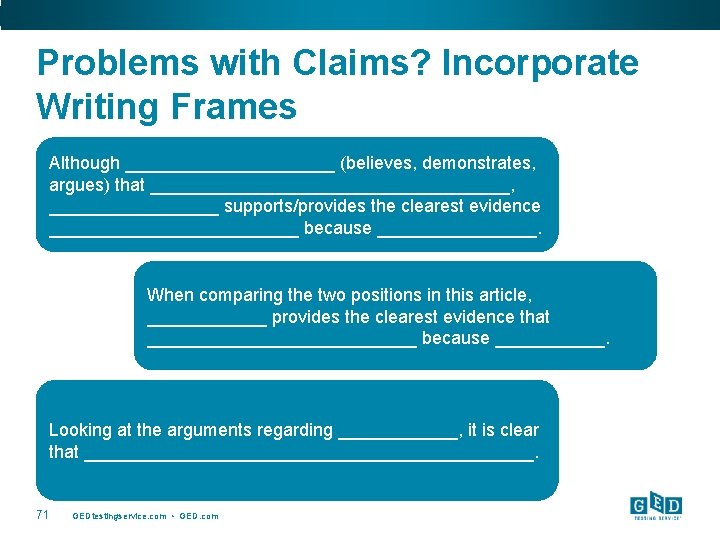
Problems with Claims? Incorporate Writing Frames Although ___________ (believes, demonstrates, argues) that __________________, _________ supports/provides the clearest evidence _____________ because ________. When comparing the two positions in this article, ______ provides the clearest evidence that ______________ because ______. Looking at the arguments regarding ______, it is clear that _______________________. 71 GEDtestingservice. com • GED. com
CITE THE EVIDENCE AND CONNECT IT! 72 GEDtestingservice. com • GED. com
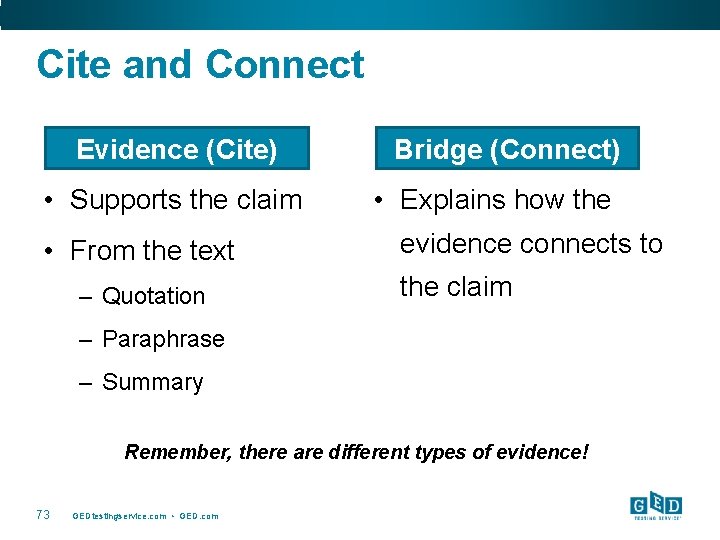
Cite and Connect Evidence (Cite) • Supports the claim • From the text – Quotation Bridge (Connect) • Explains how the evidence connects to the claim – Paraphrase – Summary Remember, there are different types of evidence! 73 GEDtestingservice. com • GED. com
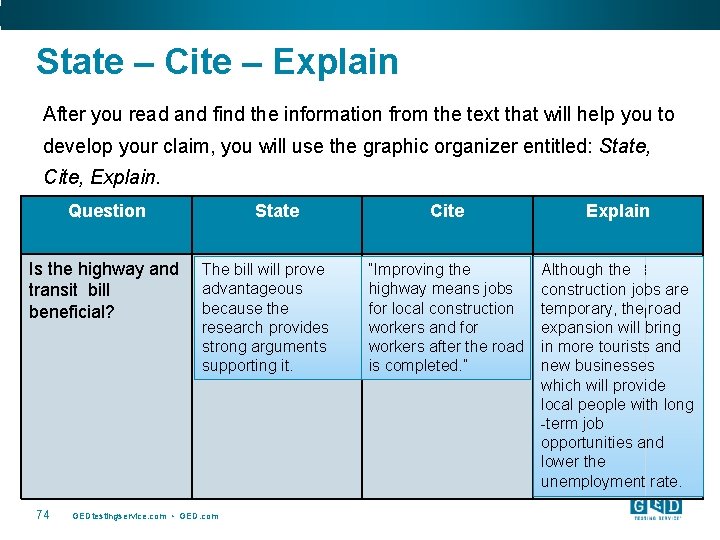
State – Cite – Explain After you read and find the information from the text that will help you to develop your claim, you will use the graphic organizer entitled: State, Cite, Explain. Question State Is the highway and State your claim - The bill will prove advantageous transit bill the idea you had because the beneficial? about the text. research provides strong arguments supporting it. 74 GEDtestingservice. com • GED. com Cite Explain Cite what in the “Improving the highway means jobs text led you to that for local construction statement or claim. workers and for workers after the road is completed. ” Explain how each Although the construction jobs are piece of evidence temporary, the road supports your expansion will bring idea/claim in more tourists and new businesses which will provide local people with long -term job opportunities and lower the unemployment rate.
Cite the Evidence Oak Falls has a high unemployment rate due to the closing of two large employers. 75 GEDtestingservice. com • GED. com
Explaining and Connecting the Evidence Connected Evidence One example of the pro column’s stronger argument is the explanation that new the improved highway can have long term benefits, because the completed highway will lead to new, national businesses coming to the Oak Falls area and that will lessen the unemployment rate that is devastating to the town. 76 GEDtestingservice. com • GED. com
Cite the Evidence. . . federal tax dollars pay for the road, as it will incorporate six different states. . . 77 GEDtestingservice. com • GED. com
Explaining and Connecting the Evidence Connected Evidence. . . federal tax dollars pay for the road, as it will incorporate six different states. . . This means that residents and business owners did not have a say in this bill even though the local small business owner would be more credible than a representative who does not reside in the area 78 GEDtestingservice. com • GED. com
THE COUNTERCLAIM AND REBUTTAL 79 GEDtestingservice. com • GED. com
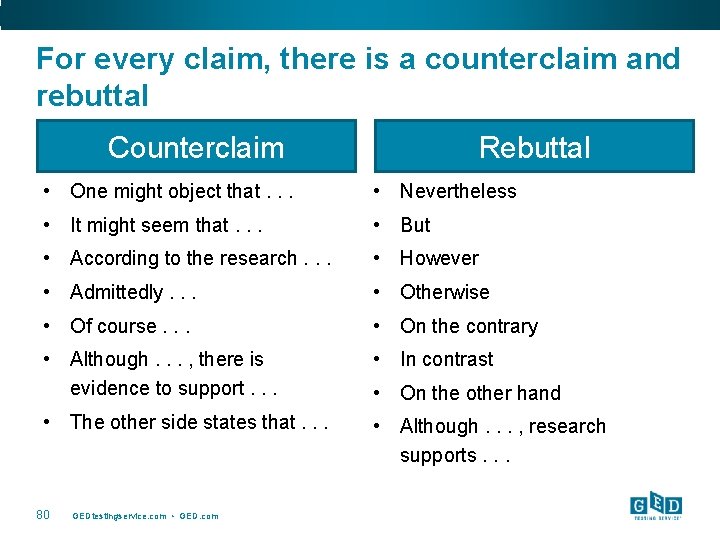
For every claim, there is a counterclaim and rebuttal Counterclaim Rebuttal • One might object that. . . • Nevertheless • It might seem that. . . • But • According to the research. . . • However • Admittedly. . . • Otherwise • Of course. . . • On the contrary • Although. . . , there is evidence to support. . . • In contrast • The other side states that. . . • Although. . . , research supports. . . 80 GEDtestingservice. com • GED. com • On the other hand
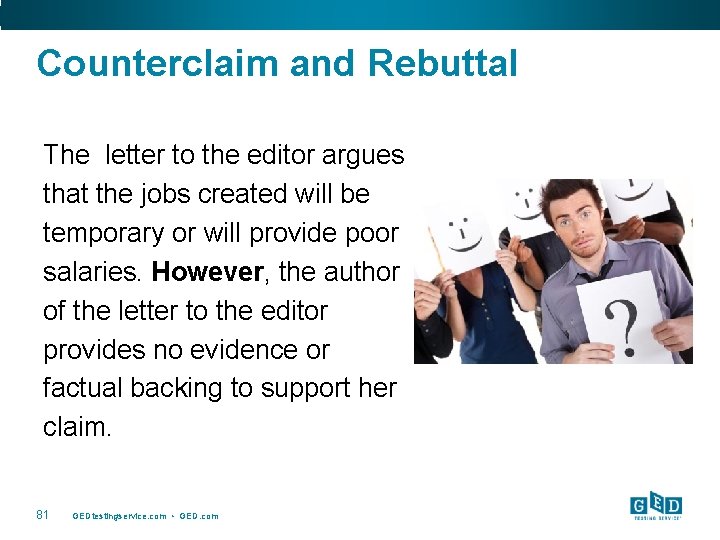
Counterclaim and Rebuttal The letter to the editor argues that the jobs created will be temporary or will provide poor salaries. However, the author of the letter to the editor provides no evidence or factual backing to support her claim. 81 GEDtestingservice. com • GED. com
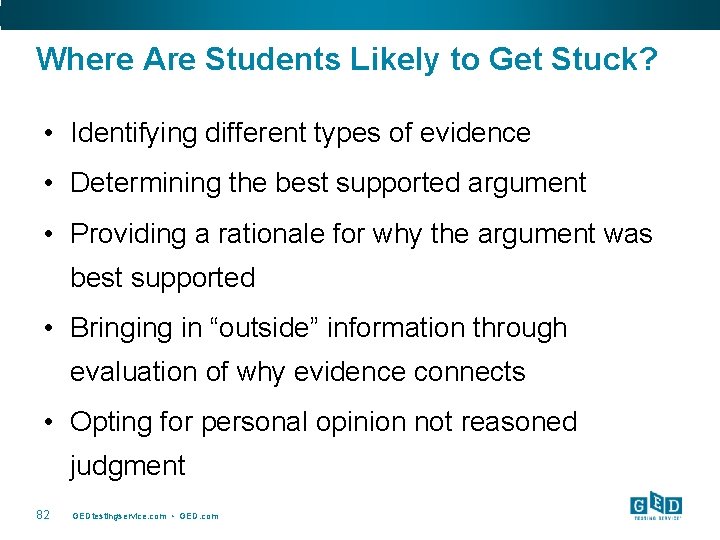
Where Are Students Likely to Get Stuck? • Identifying different types of evidence • Determining the best supported argument • Providing a rationale for why the argument was best supported • Bringing in “outside” information through evaluation of why evidence connects • Opting for personal opinion not reasoned judgment 82 GEDtestingservice. com • GED. com
NOW IT’S TIME TO WRITE! 83 GEDtestingservice. com • GED. com
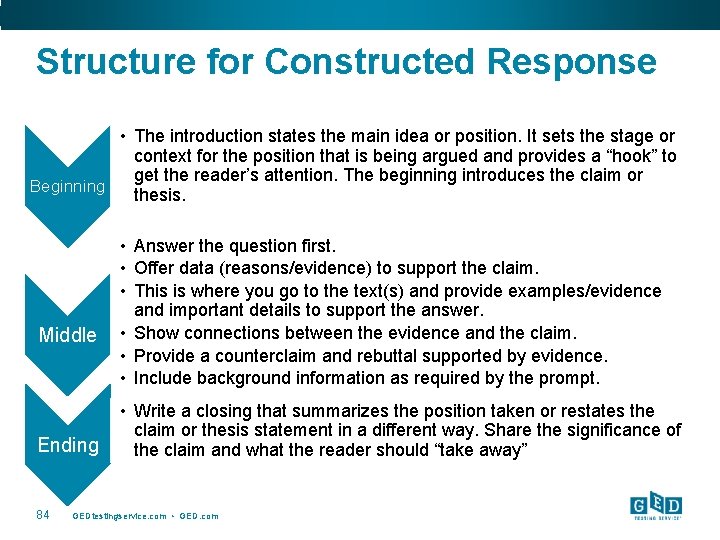
Structure for Constructed Response • The introduction states the main idea or position. It sets the stage or context for the position that is being argued and provides a “hook” to get the reader’s attention. The beginning introduces the claim or Beginning thesis. Middle Ending 84 • Answer the question first. • Offer data (reasons/evidence) to support the claim. • This is where you go to the text(s) and provide examples/evidence and important details to support the answer. • Show connections between the evidence and the claim. • Provide a counterclaim and rebuttal supported by evidence. • Include background information as required by the prompt. • Write a closing that summarizes the position taken or restates the claim or thesis statement in a different way. Share the significance of the claim and what the reader should “take away” GEDtestingservice. com • GED. com
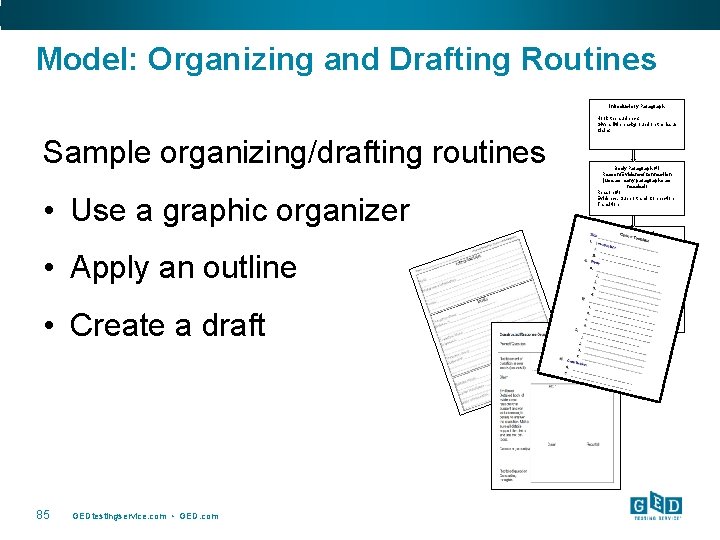
Model: Organizing and Drafting Routines Introductory Paragraph Hook the audience: Give a little background on the issue Claim: Sample organizing/drafting routines • Use a graphic organizer • Apply an outline Body Paragraph #1 Reason/Evidence/Connection (use as many paragraphs as needed) Reason #1 Evidence, Support and Connection Transition Body Paragraph Counterclaim/Rebuttal Counterclaim (Evidence and Support) Rebuttal (Evidence, Support, and Connection) Transition Conclusion Paragraph • Create a draft 85 GEDtestingservice. com • GED. com Provide take-away points Restate your thesis in different way
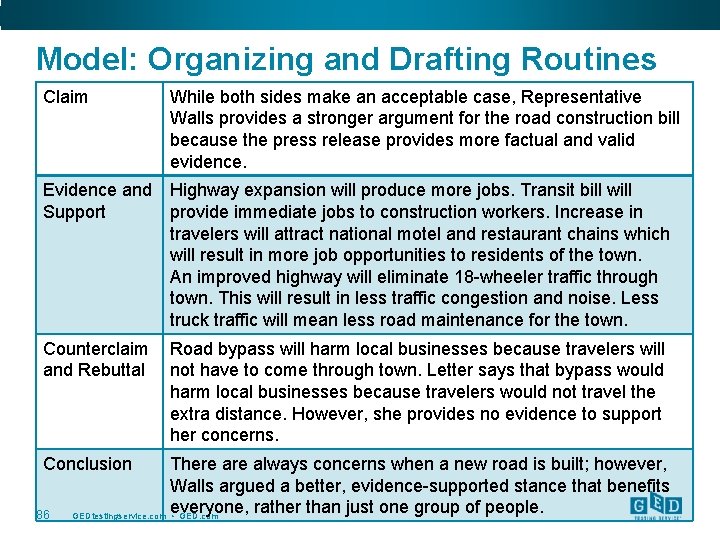
Model: Organizing and Drafting Routines Claim While both sides make an acceptable case, Representative Walls provides a stronger argument for the road construction bill because the press release provides more factual and valid evidence. Evidence and Highway expansion will produce more jobs. Transit bill will Support provide immediate jobs to construction workers. Increase in travelers will attract national motel and restaurant chains which will result in more job opportunities to residents of the town. An improved highway will eliminate 18 -wheeler traffic through town. This will result in less traffic congestion and noise. Less truck traffic will mean less road maintenance for the town. Counterclaim Road bypass will harm local businesses because travelers will and Rebuttal not have to come through town. Letter says that bypass would harm local businesses because travelers would not travel the extra distance. However, she provides no evidence to support her concerns. Conclusion 86 There always concerns when a new road is built; however, Walls argued a better, evidence-supported stance that benefits everyone, rather than just one group of people. GEDtestingservice. com • GED. com
Time to Write! 87 GEDtestingservice. com • GED. com
The Tools of Revision and Editing 88 GEDtestingservice. com • GED. com
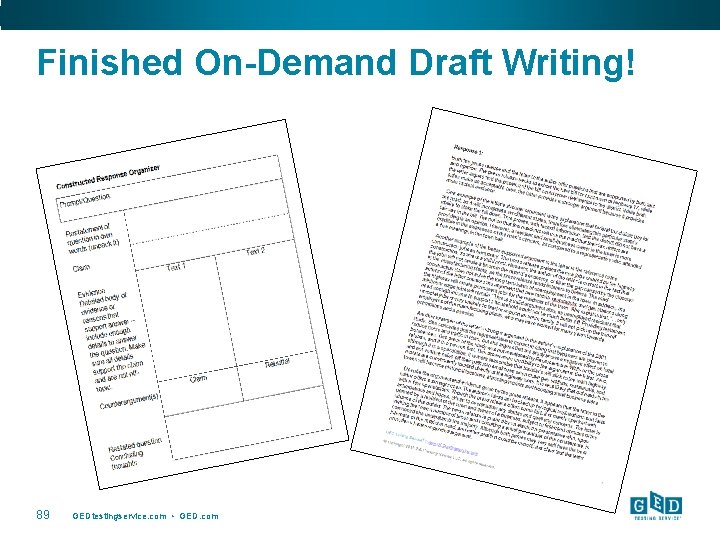
Finished On-Demand Draft Writing! 89 GEDtestingservice. com • GED. com
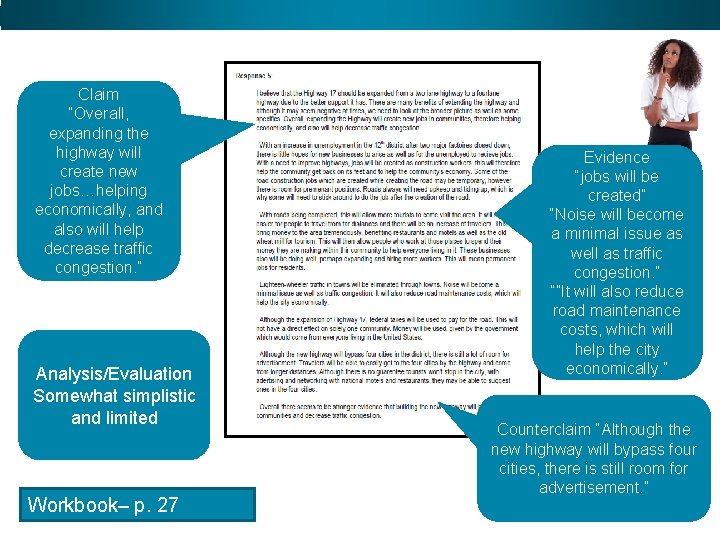
But What If My Students Don’t Write at a “Two” Level? Workbook– p. 15 90 GEDtestingservice. com • GED. com
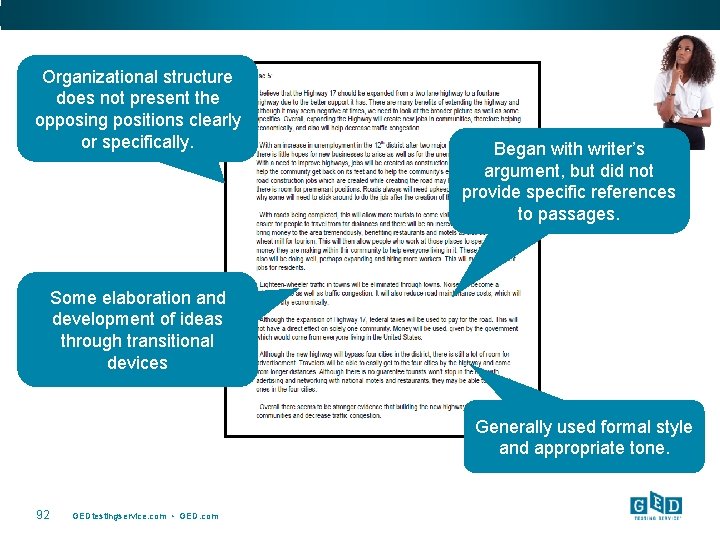
Claim “Overall, expanding the highway will create new jobs…helping economically, and also will help decrease traffic congestion. ” Analysis/Evaluation Somewhat simplistic and limited Workbook– p. 27 91 GEDtestingservice. com • GED. com Evidence “jobs will be created” “Noise will become a minimal issue as well as traffic congestion. ” “”It will also reduce road maintenance costs, which will help the city economically. ” Counterclaim “Although the new highway will bypass four cities, there is still room for advertisement. ”
Organizational structure does not present the opposing positions clearly or specifically. Began with writer’s argument, but did not provide specific references to passages. Some elaboration and development of ideas through transitional devices Generally used formal style and appropriate tone. 92 GEDtestingservice. com • GED. com
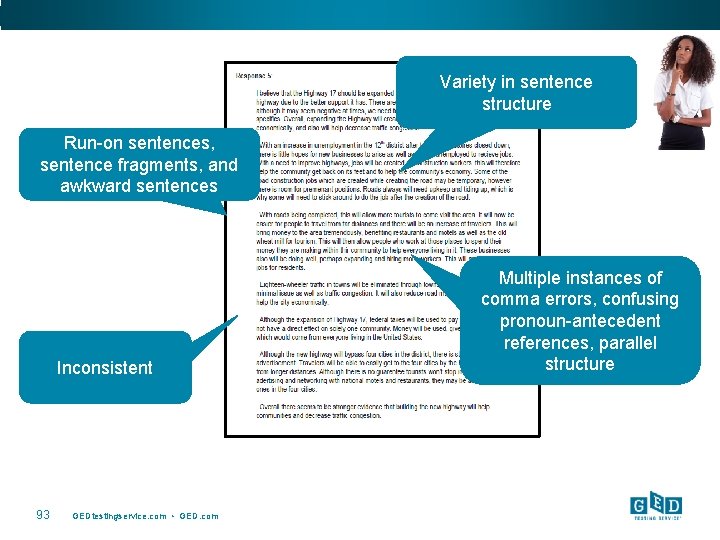
Variety in sentence structure Run-on sentences, sentence fragments, and awkward sentences Inconsistent 93 GEDtestingservice. com • GED. com Multiple instances of comma errors, confusing pronoun-antecedent references, parallel structure
Remember, One Step at a Time • Analyze the prompt • Closely read and interact with text • Analyze/evaluate the evidence • Plan/organize the essay – Craft a claim – Identify and connect evidence – Determine counterclaim/rebuttal – Craft a conclusion • Write the draft - Put it all together • Revise and edit • Publish 94 GEDtestingservice. com • GED. com
Test-Taking Tips for RLA CR • Always complete the constructed response! (You cannot use the 45 minutes provided for any other part of the test. ) • Read analyze the prompt first. • Closely read the source texts, analyzing and evaluating the evidence before determining your claim. • Use the highlighting tool and the erasable note boards for planning. • Plan your time – Use the entire 45 minutes to write your response – Spend 10 -15 minutes for reading and planning – Save 4 -5 minutes to proofread your response 95 GEDtestingservice. com • GED. com
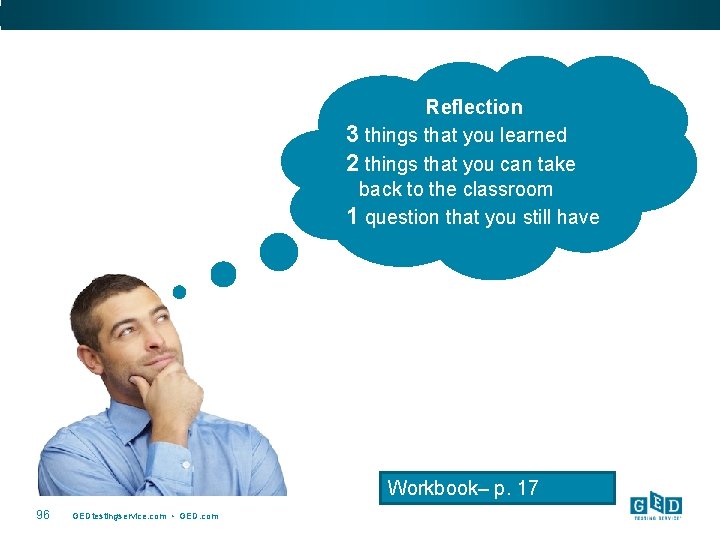
Reflection 3 things that you learned 2 things that you can take back to the classroom 1 question that you still have Workbook– p. 17 96 GEDtestingservice. com • GED. com
Resources 97 GEDtestingservice. com • GED. com
http: //www. gedtestingservice. com/ 98 GEDtestingservice. com • GED. com
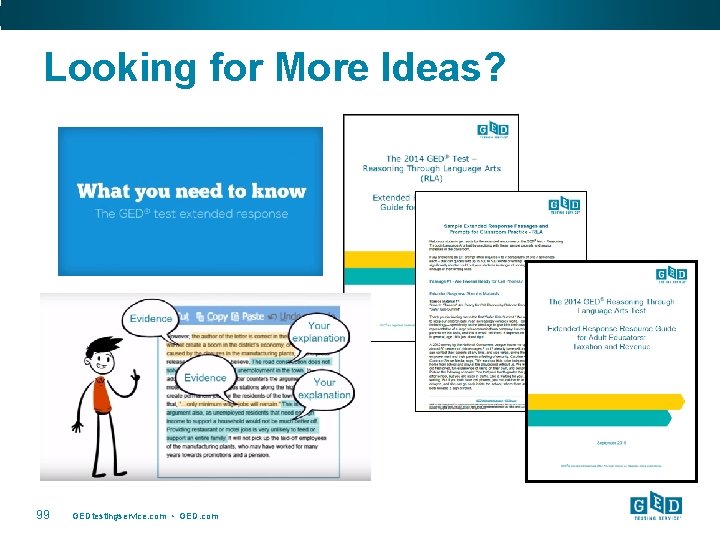
Looking for More Ideas? 99 GEDtestingservice. com • GED. com
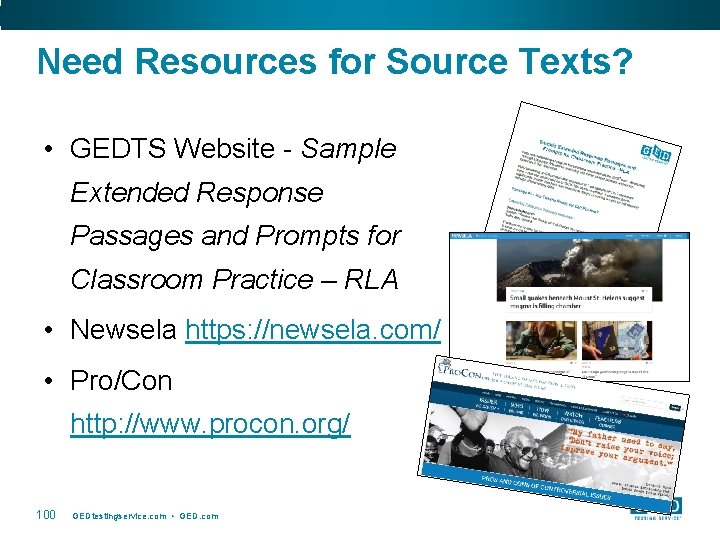
Need Resources for Source Texts? • GEDTS Website - Sample Extended Response Passages and Prompts for Classroom Practice – RLA • Newsela https: //newsela. com/ • Pro/Con http: //www. procon. org/ 100 GEDtestingservice. com • GED. com
Questions 101 GEDtestingservice. com • GED. com
Thank you! communications@GEDTesting. Service. com 102 GEDtestingservice. com • GED. com