Introduction to ELALiteracy Instructional Practice Guide Goals Understand

- Slides: 41
Introduction to ELA/Literacy Instructional Practice Guide
Goals • Understand the key shifts for ELA/literacy and what they look like in practice. • Identify teacher and student actions that may be present in lessons aligned to college- and careerready standards. • Become familiar with and apply the Instructional Practice Guide for ELA/literacy. PAGE 2
Agenda ● The Shifts We Make and the Actions We Take ● Core Action 1 - High-Quality Texts ● Core Action 2 – Text-Dependent Questions ● Core Action 3 – Productive Engagement ● Putting It All Together PAGE 3
Norms • Listen with the intent to understand. Ask questions! • Focus on how this applies to your daily work. Imagine the possibilities! • Create a safe place to air confusion and raise questions. Share your ideas and encourage others to do the same. • Support ideas with evidence. Always. PAGE 4
Materials for Today Master Copies • • Instructional Practice Guides for K– 2 and 3– 12 Beyond the Lesson: Discussion Guide Activities and Materials • College- and Career-Ready Shifts in ELA/Literacy Document • Activity #1: Core Actions Scavenger Hunt • Activity #2: Practice Core Action 1, High-Quality Texts • Activity #3: Practice Core Action 2, Text-Dependent Questions • Activity #4: Practice Core Action 3, Productive Engagement • Activity #5: Practice Putting It All Together PAGE 5
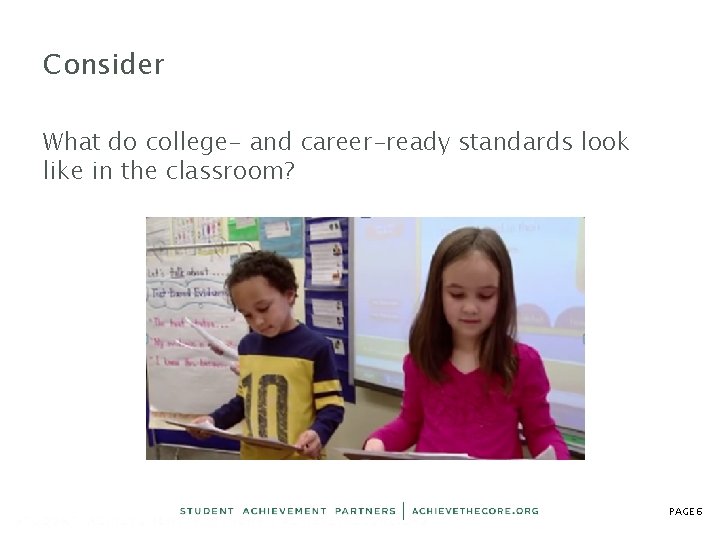
Consider What do college- and career-ready standards look like in the classroom? PAGE 6
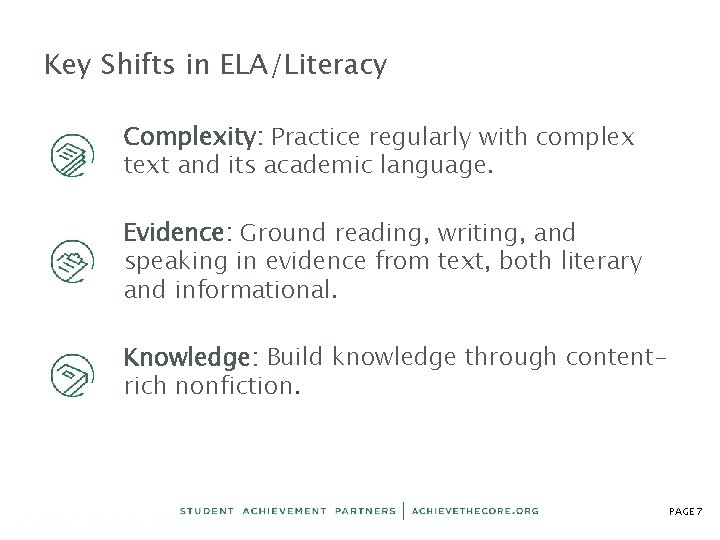
Key Shifts in ELA/Literacy Complexity: Practice regularly with complex text and its academic language. Evidence: Ground reading, writing, and speaking in evidence from text, both literary and informational. Knowledge: Build knowledge through contentrich nonfiction. PAGE 7
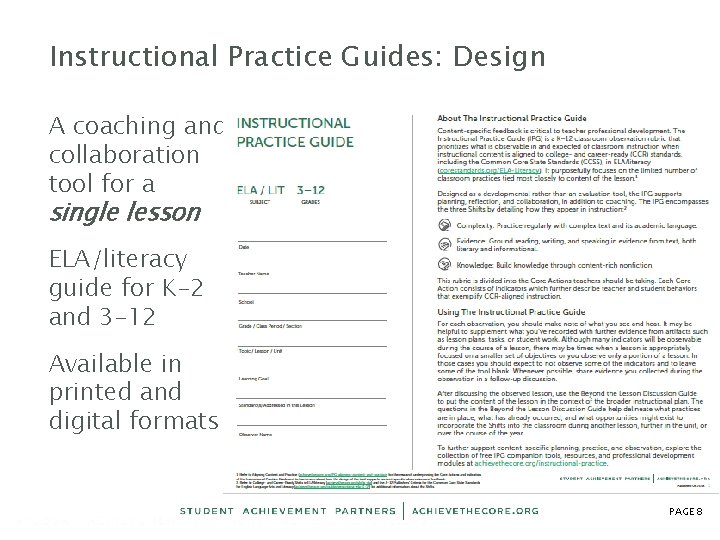
Instructional Practice Guides: Design A coaching and collaboration tool for a single lesson ELA/literacy guide for K– 2 and 3– 12 Available in printed and digital formats PAGE 8
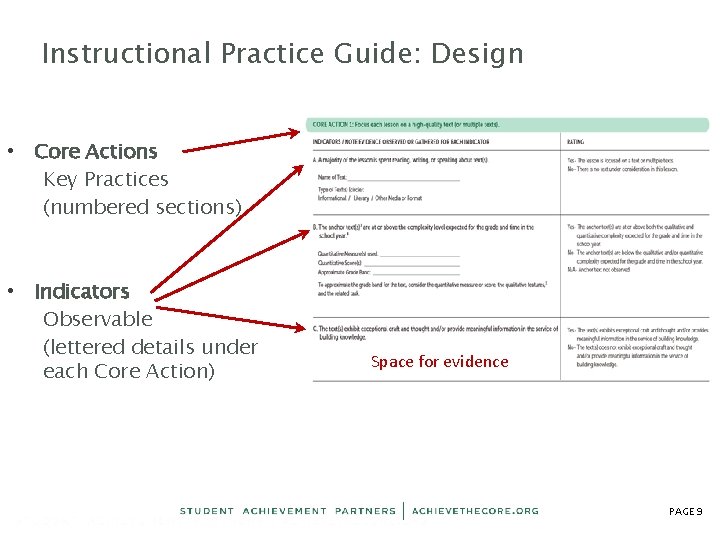
Instructional Practice Guide: Design • Core Actions Key Practices (numbered sections) • Indicators Observable (lettered details under each Core Action) Space for evidence PAGE 9
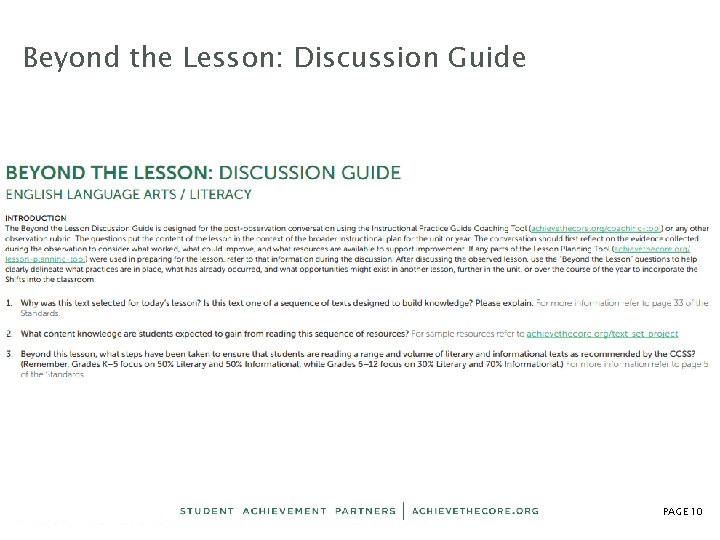
Beyond the Lesson: Discussion Guide PAGE 10
Activity #1: Core Actions Scavenger Hunt 1. Review the Instructional Practice Guide for K– 2 or 3 – 12 and the Beyond the Lesson: Discussion Guide. 2. Complete the Scavenger Hunt questions; support your responses with details from the Instructional Practice Guide and the Beyond the Lesson: Discussion Guide. 3. Highlight or underline where you see evidence of the Shifts throughout the tools. PAGE 11
Core Action 1 Focus each lesson on a high-quality text (or multiple texts). Indicators: A. A majority of the lesson is spent reading, writing, or speaking about text(s). B. The anchor text(s) are at or above the complexity level expected for the grade and time in the school year. C. The text(s) exhibit exceptional craft and thought and/or provide meaningful information in the service of building knowledge. PAGE 12
High-Quality Texts – How Will I Know? • What is the name of the text(s)? • What type of text(s) is/are used: informational, literary, or other media or format? • Is the anchor text at the appropriate complexity level for the grade? ○ • What are the quantitative measure(s) and qualitative features of the text? Is the text of exceptional quality and does it provide meaningful information to build students’ knowledge? PAGE 13
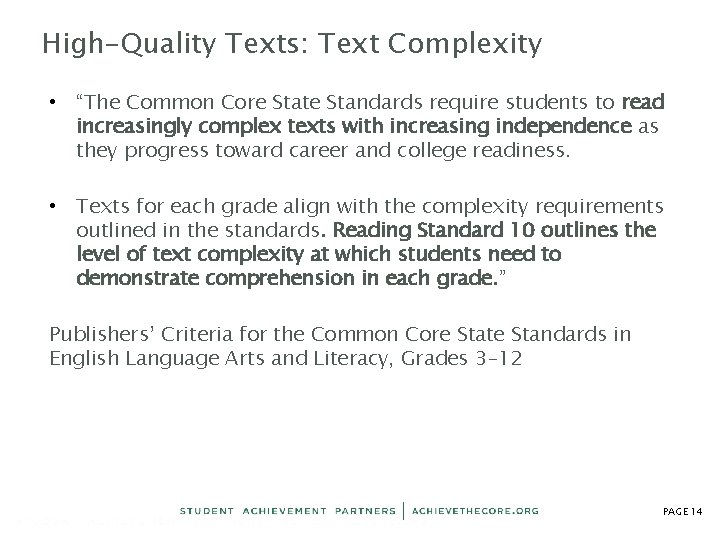
High-Quality Texts: Text Complexity • “The Common Core State Standards require students to read increasingly complex texts with increasing independence as they progress toward career and college readiness. • Texts for each grade align with the complexity requirements outlined in the standards. Reading Standard 10 outlines the level of text complexity at which students need to demonstrate comprehension in each grade. ” Publishers’ Criteria for the Common Core State Standards in English Language Arts and Literacy, Grades 3– 12 PAGE 14
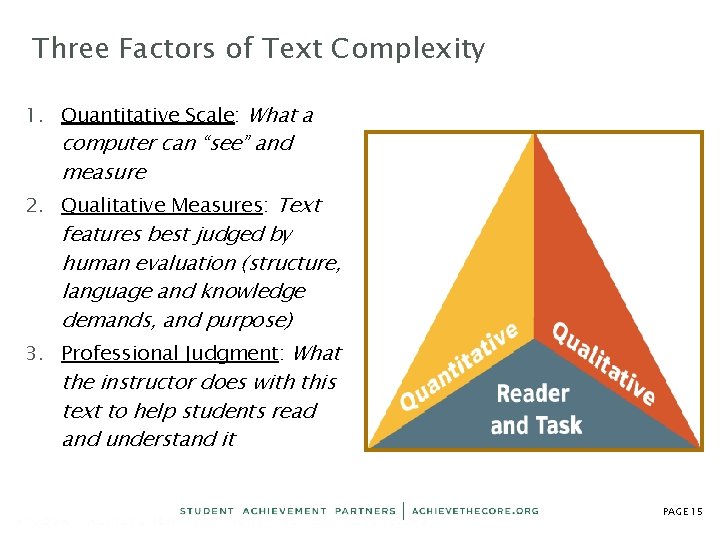
Three Factors of Text Complexity 1. Quantitative Scale: What a computer can “see” and measure 2. Qualitative Measures: Text features best judged by human evaluation (structure, language and knowledge demands, and purpose) 3. Professional Judgment: What the instructor does with this text to help students read and understand it PAGE 15
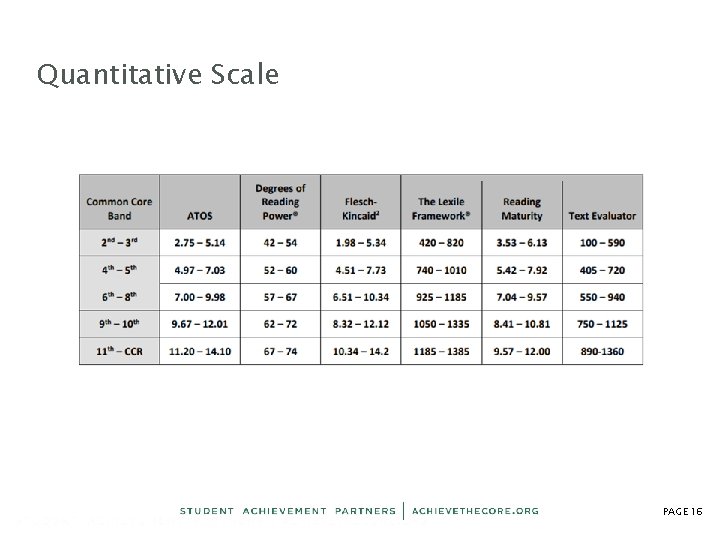
Quantitative Scale PAGE 16
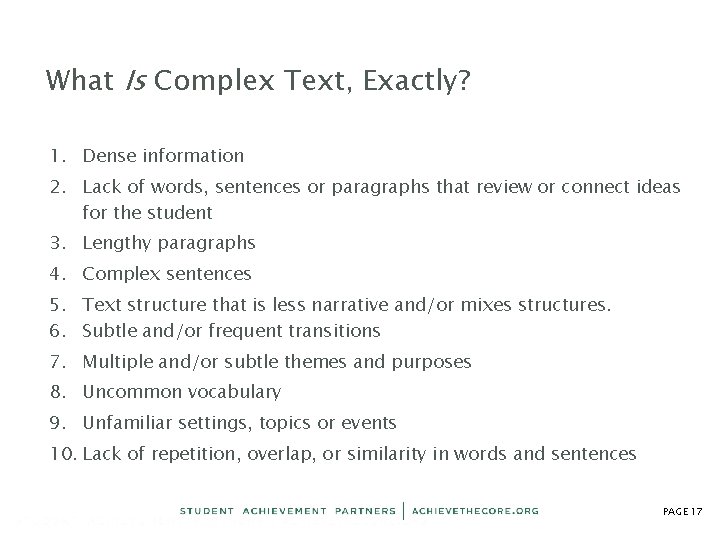
What Is Complex Text, Exactly? 1. Dense information 2. Lack of words, sentences or paragraphs that review or connect ideas for the student 3. Lengthy paragraphs 4. Complex sentences 5. Text structure that is less narrative and/or mixes structures. 6. Subtle and/or frequent transitions 7. Multiple and/or subtle themes and purposes 8. Uncommon vocabulary 9. Unfamiliar settings, topics or events 10. Lack of repetition, overlap, or similarity in words and sentences PAGE 17
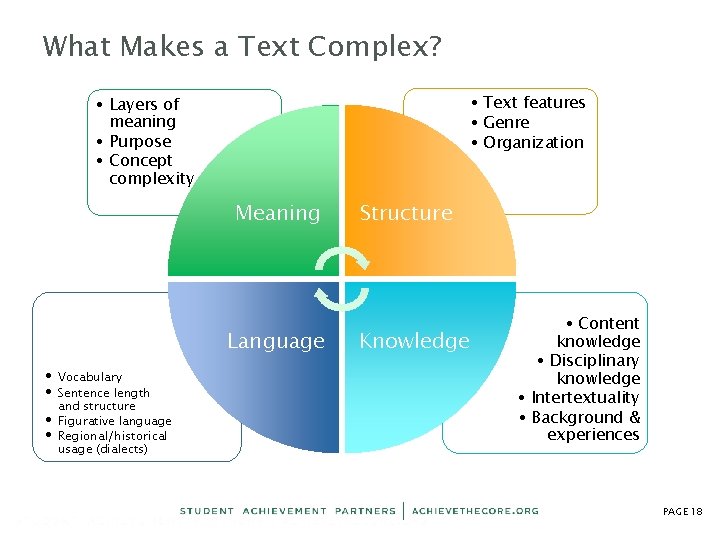
What Makes a Text Complex? • Text features • Genre • Organization • Layers of meaning • Purpose • Concept complexity Meaning Language • • Vocabulary Sentence length and structure Figurative language Regional/historical usage (dialects) Structure Knowledge • Content knowledge • Disciplinary knowledge • Intertextuality • Background & experiences PAGE 18
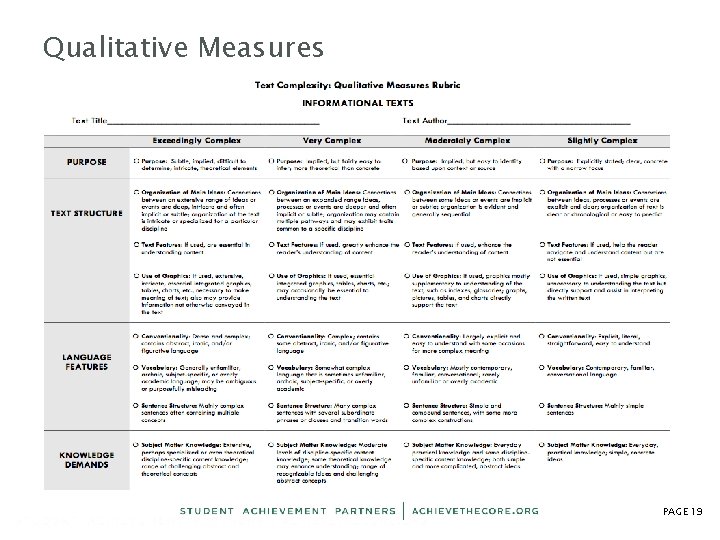
Qualitative Measures PAGE 19
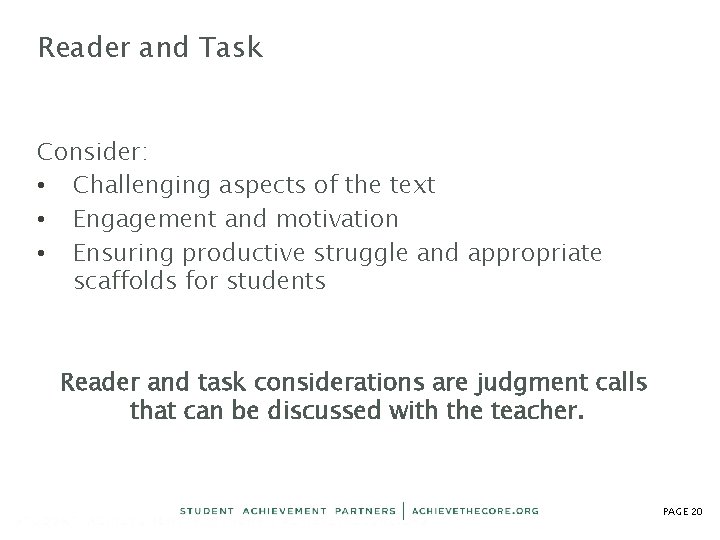
Reader and Task Consider: • Challenging aspects of the text • Engagement and motivation • Ensuring productive struggle and appropriate scaffolds for students Reader and task considerations are judgment calls that can be discussed with the teacher. PAGE 20
Activity #2: Practice Core Action 1, High. Quality Texts • Read the excerpt from The Great Fire. • Complete the “What Makes This Text Complex? ” sheet. • Use the information gathered about the text to provide evidence for indicators 1 B and 1 C from the IPG. PAGE 21
High-Quality Texts: Review and Discuss Based on the results from Activity # 2, is this text a text worth reading? What evidence from the text supports your decision? Based on your role in the learning community, how could a focus on Core Action 1 improve standardsaligned instruction and student learning in the classroom? PAGE 22
Core Action 2 Employ questions and tasks, both oral and written, that are textspecific and accurately address the analytical thinking required by the grade-level standards. Indicators: A. Questions and tasks address the text by attending to its particular qualitative features: its meaning/purpose and/or language, structure(s), or knowledge demands. B. Questions and tasks require students to use evidence from the text to demonstrate understanding and to support their ideas about the text. These ideas are expressed through written and/or oral responses. C. Questions and tasks attend to the words (academic vocabulary), phrases, and sentences within the text. D. Questions and tasks are sequenced to build knowledge by guiding students to delve deeper into the text and graphics. PAGE 23
Text-Dependent Questions and Tasks – How Will I Know? • Are the majority of questions and tasks text-dependent and textspecific? • Can the student answer the questions without prior or outside knowledge? • Does answering the questions require that students read the text? • Are the questions tied to a text (not stand-alone)? • Do the questions require students to cite or use evidence from the text to determine the correct answer? • Do the questions require students to follow the details of, make inferences from, and/or evaluate what is read? PAGE 24
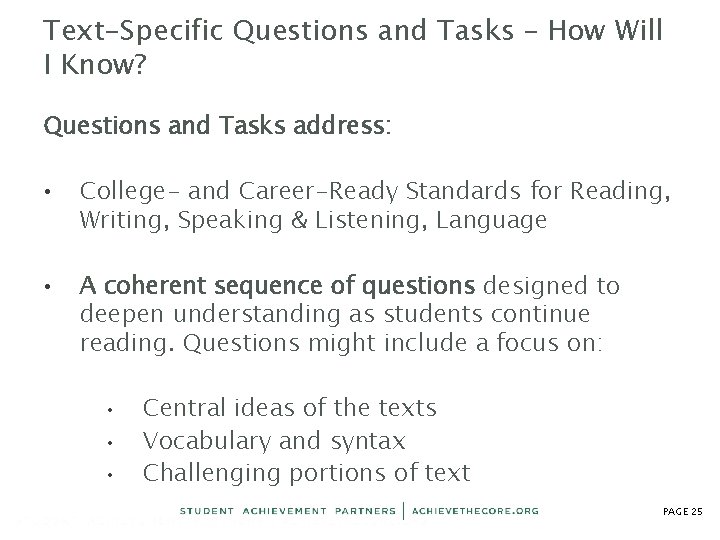
Text-Specific Questions and Tasks – How Will I Know? Questions and Tasks address: • College- and Career-Ready Standards for Reading, Writing, Speaking & Listening, Language • A coherent sequence of questions designed to deepen understanding as students continue reading. Questions might include a focus on: • • • Central ideas of the texts Vocabulary and syntax Challenging portions of text PAGE 25
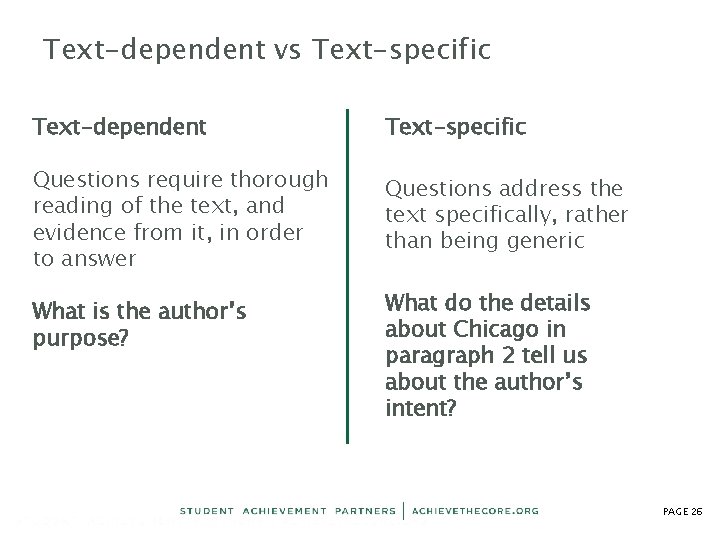
Text-dependent vs Text-specific Text-dependent Text-specific Questions require thorough reading of the text, and evidence from it, in order to answer Questions address the text specifically, rather than being generic What is the author’s purpose? What do the details about Chicago in paragraph 2 tell us about the author’s intent? PAGE 26
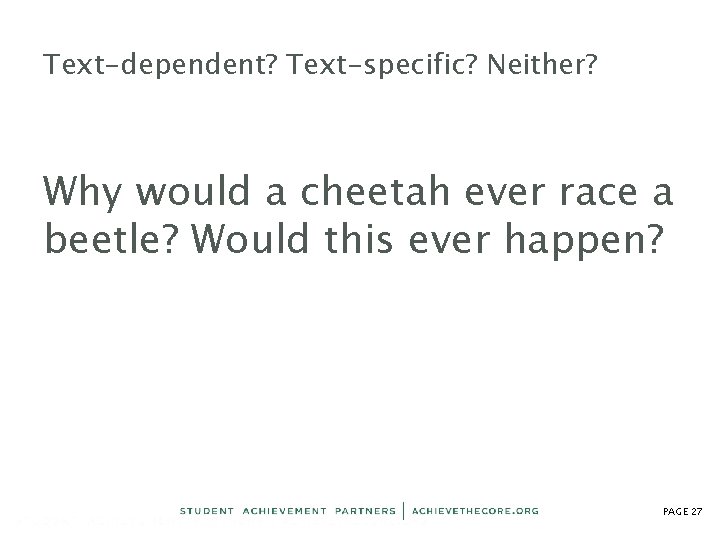
Text-dependent? Text-specific? Neither? Why would a cheetah ever race a beetle? Would this ever happen? PAGE 27
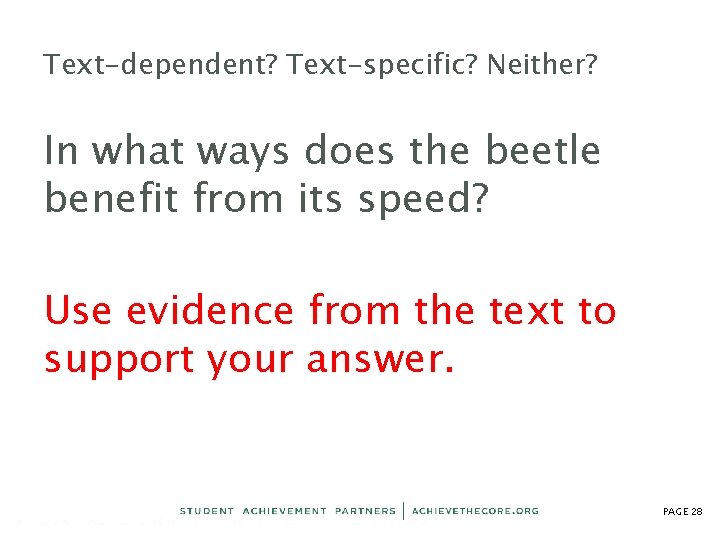
Text-dependent? Text-specific? Neither? In what ways does the beetle benefit from its speed? Use evidence from the text to support your answer. PAGE 28
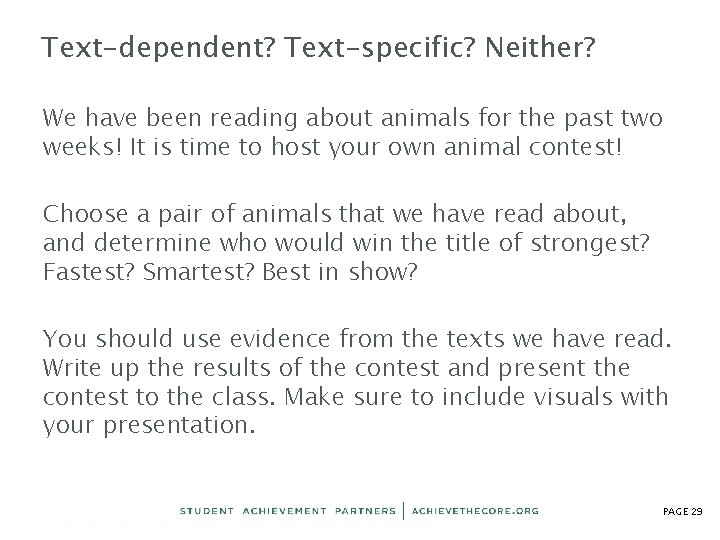
Text-dependent? Text-specific? Neither? We have been reading about animals for the past two weeks! It is time to host your own animal contest! Choose a pair of animals that we have read about, and determine who would win the title of strongest? Fastest? Smartest? Best in show? You should use evidence from the texts we have read. Write up the results of the contest and present the contest to the class. Make sure to include visuals with your presentation. PAGE 29
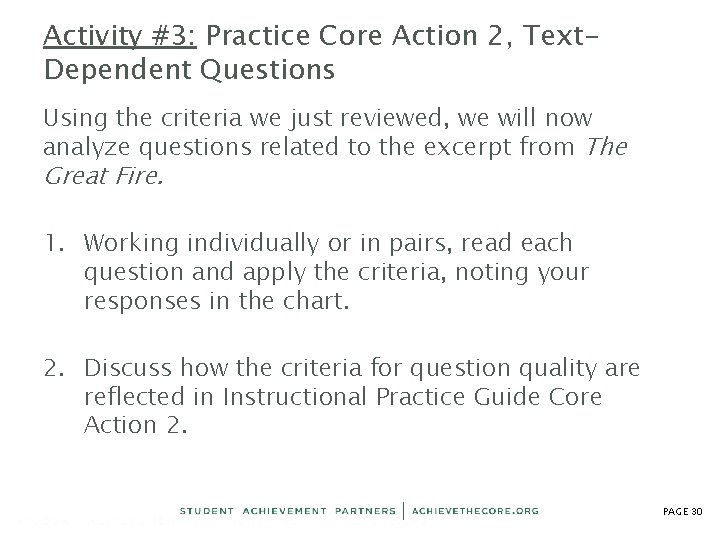
Activity #3: Practice Core Action 2, Text. Dependent Questions Using the criteria we just reviewed, we will now analyze questions related to the excerpt from The Great Fire. 1. Working individually or in pairs, read each question and apply the criteria, noting your responses in the chart. 2. Discuss how the criteria for question quality are reflected in Instructional Practice Guide Core Action 2. PAGE 30
Text-Dependent Questions: Review and Discuss Based on your role in the learning community, how could a focus on Core Action 2 improve standardsaligned instruction and student learning in the classroom? PAGE 31
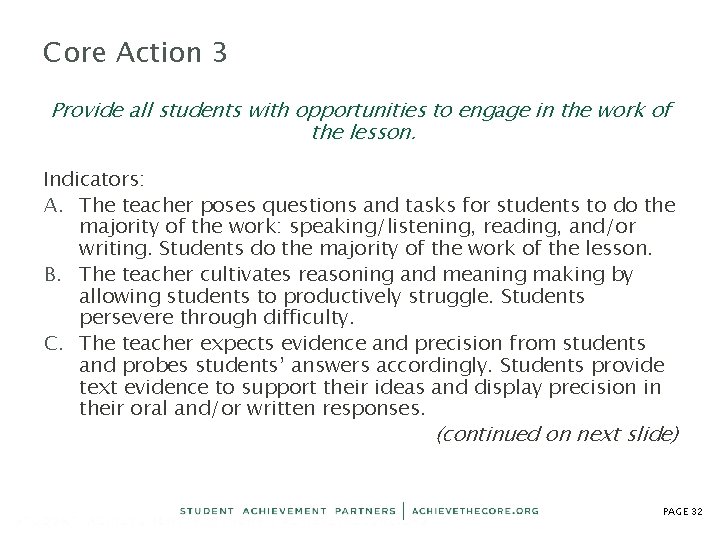
Core Action 3 Provide all students with opportunities to engage in the work of the lesson. Indicators: A. The teacher poses questions and tasks for students to do the majority of the work: speaking/listening, reading, and/or writing. Students do the majority of the work of the lesson. B. The teacher cultivates reasoning and meaning making by allowing students to productively struggle. Students persevere through difficulty. C. The teacher expects evidence and precision from students and probes students’ answers accordingly. Students provide text evidence to support their ideas and display precision in their oral and/or written responses. (continued on next slide) PAGE 32
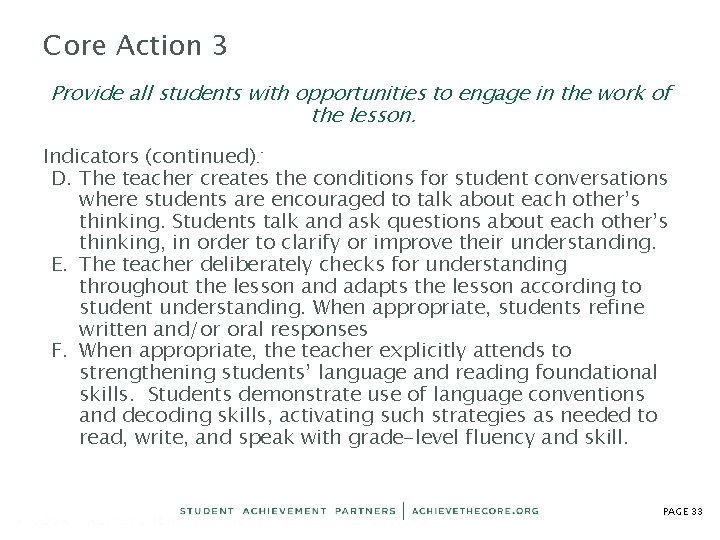
Core Action 3 Provide all students with opportunities to engage in the work of the lesson. Indicators (continued): D. The teacher creates the conditions for student conversations where students are encouraged to talk about each other’s thinking. Students talk and ask questions about each other’s thinking, in order to clarify or improve their understanding. E. The teacher deliberately checks for understanding throughout the lesson and adapts the lesson according to student understanding. When appropriate, students refine written and/or oral responses F. When appropriate, the teacher explicitly attends to strengthening students’ language and reading foundational skills. Students demonstrate use of language conventions and decoding skills, activating such strategies as needed to read, write, and speak with grade-level fluency and skill. PAGE 33
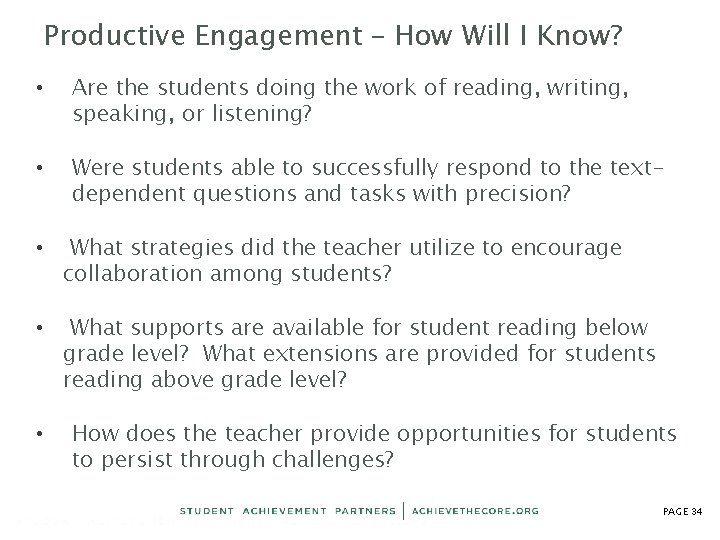
Productive Engagement – How Will I Know? • Are the students doing the work of reading, writing, speaking, or listening? • Were students able to successfully respond to the textdependent questions and tasks with precision? • What strategies did the teacher utilize to encourage collaboration among students? • What supports are available for student reading below grade level? What extensions are provided for students reading above grade level? • How does the teacher provide opportunities for students to persist through challenges? PAGE 34
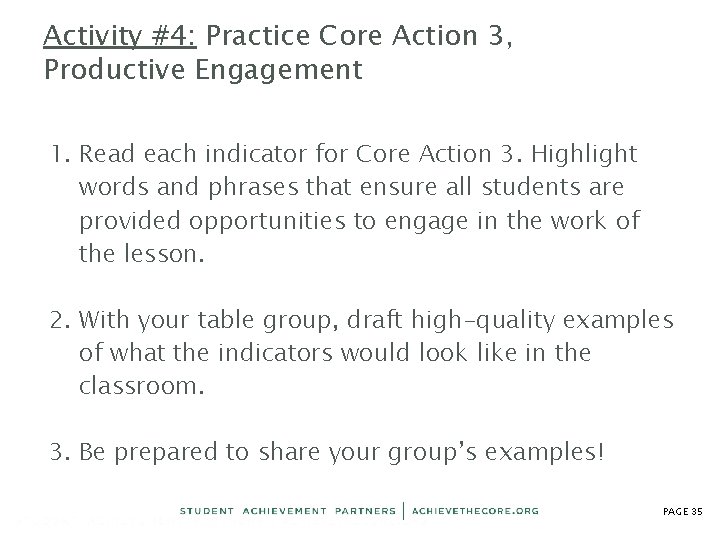
Activity #4: Practice Core Action 3, Productive Engagement 1. Read each indicator for Core Action 3. Highlight words and phrases that ensure all students are provided opportunities to engage in the work of the lesson. 2. With your table group, draft high-quality examples of what the indicators would look like in the classroom. 3. Be prepared to share your group’s examples! PAGE 35
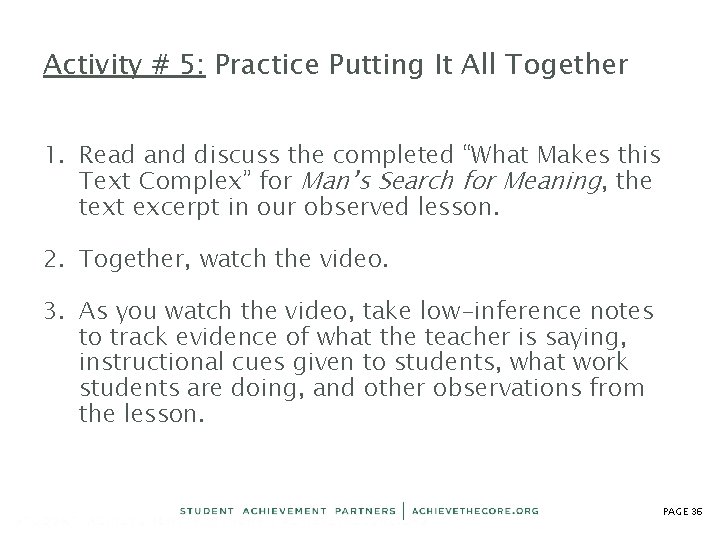
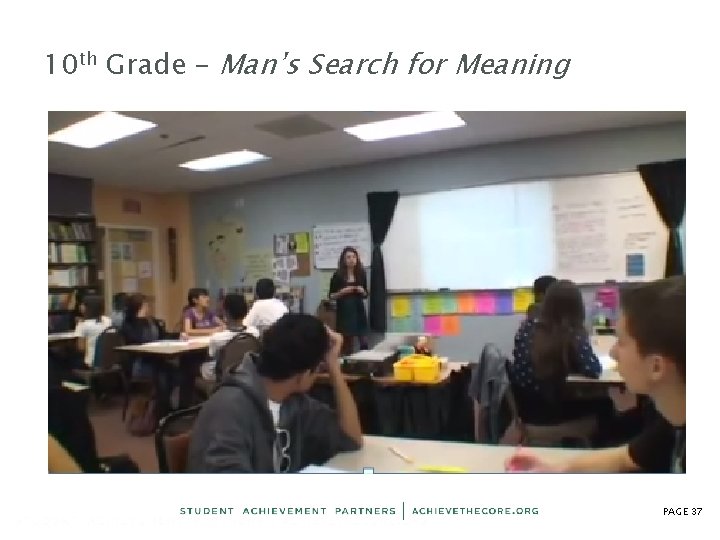
Activity # 5: Practice Putting It All Together 1. Read and discuss the completed “What Makes this Text Complex” for Man’s Search for Meaning, the text excerpt in our observed lesson. 2. Together, watch the video. 3. As you watch the video, take low-inference notes to track evidence of what the teacher is saying, instructional cues given to students, what work students are doing, and other observations from the lesson. PAGE 36
10 th Grade – Man’s Search for Meaning PAGE 37
Reflection • First, use the Instructional Practice Guide to discuss the lesson. • What feedback or discussion points could be targeted from the Core Action evidence collected? • How does using the Instructional Practice Guide support the conversation about instruction aligned to college- and career-ready standards? PAGE 38
Next Steps How could the Instructional Practice Guide be useful in your setting? PAGE 39
The Core Advocate Network Who are the Core Advocates? • Core Advocates are educators who: • Believe in the potential of high-quality standards grounded in evidence to prepare all students for college and career. • Understand embrace the Shifts in instruction and assessment required by college- and career-ready standards. • Are eager to support their colleagues and communities in understanding and translating the Shifts into instructional practice. What do Core Advocates do? • As instructional advocates, Core Advocates lead other educators in their communities in understanding the Shifts, as well as sharing practices aligned to the Shifts and the standards. Among other actions, Core Advocates: • Lead professional development sessions and professional learning communities. • Create, refine, and share standards-aligned resources with the field. • Advocate for high-quality instruction, instructional resources, and professional learning. • Use and provide feedback on high-quality instructional tools and resources. How can I get involved? Join the Core Advocate Network by taking the Core Advocate survey at: www. achievethecore. org/ca-signup Email coreadvocates@studentsachieve. net with any questions. PAGE 40
PAGE 41