
Putting the Core into Practice Instructional Practice Guides
- Slides: 78
Putting the Core into Practice: Instructional Practice Guides Sandra Alberti
Student Achievement Partners – Who We Are • SAP is a nonprofit organization founded by three of the contributing authors of the Common Core State Standards • Currently a team of approximately 30; office in NY and team members located throughout the country • Funded by foundations: GE Foundation, Hewlett Foundation, Bill & Melinda Gates Foundation and The Helmsley Charitable Trust Our mission: • Student Achievement Partners is devoted to accelerating student achievement by supporting effective and innovative implementation of the CCSS. PAGE 2
Our Principles – How we approach the work WE HOLD NO INTELLECTUAL PROPERTY Our goal is to create and disseminate high quality materials as widely as possible. All resources that we create are open source and available at no cost. We encourage states, districts, schools, and teachers to take our resources and make them their own. WE DO NOT COMPETE FOR STATE, DISTRICT OR FEDERAL CONTRACTS Ensuring that states and districts have excellent materials for teachers and students is a top priority. We do not compete for these contracts because we work with our partners to develop high quality RFPs that support the Core Standards. WE DO NOT ACCEPT MONEY FROM PUBLISHERS We work with states and districts to obtain the best materials for teachers and students. We are able to independently advise our partners because we have no financial interests with any publisher of education materials. Our independence is essential to our work. PAGE 3
Our Plan for the Day • Background on the Content • Tour of Achievethe. Core. org • Instructional Practice Guides PAGE 4
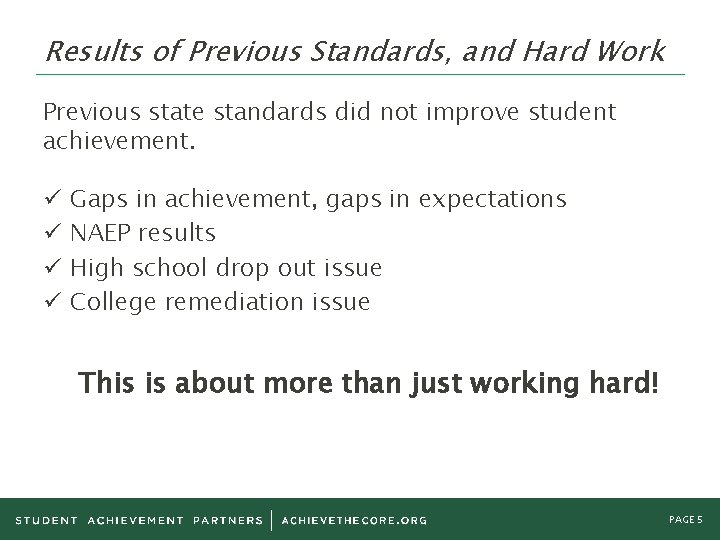
Results of Previous Standards, and Hard Work Previous state standards did not improve student achievement. ü ü Gaps in achievement, gaps in expectations NAEP results High school drop out issue College remediation issue This is about more than just working hard! PAGE 5
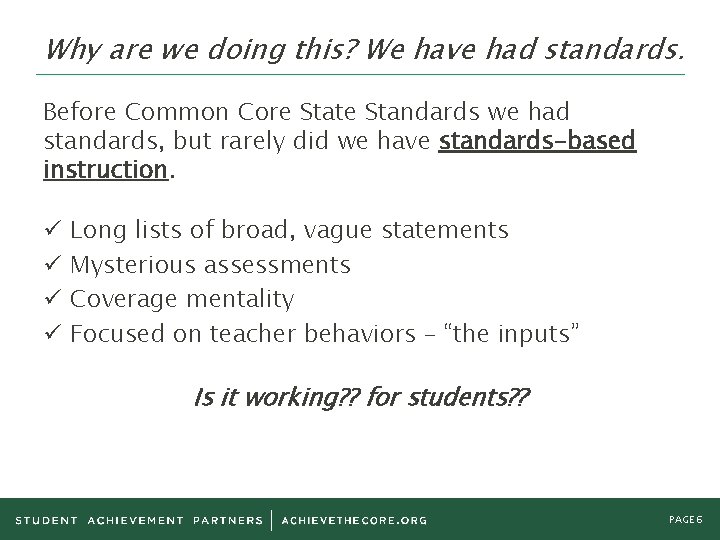
Why are we doing this? We have had standards. Before Common Core State Standards we had standards, but rarely did we have standards-based instruction. ü ü Long lists of broad, vague statements Mysterious assessments Coverage mentality Focused on teacher behaviors – “the inputs” Is it working? ? for students? ? PAGE 6
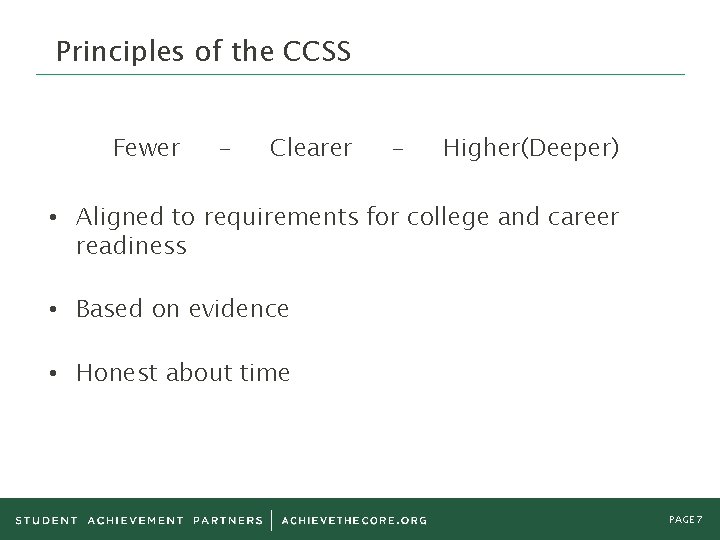
Principles of the CCSS Fewer - Clearer - Higher(Deeper) • Aligned to requirements for college and career readiness • Based on evidence • Honest about time PAGE 7
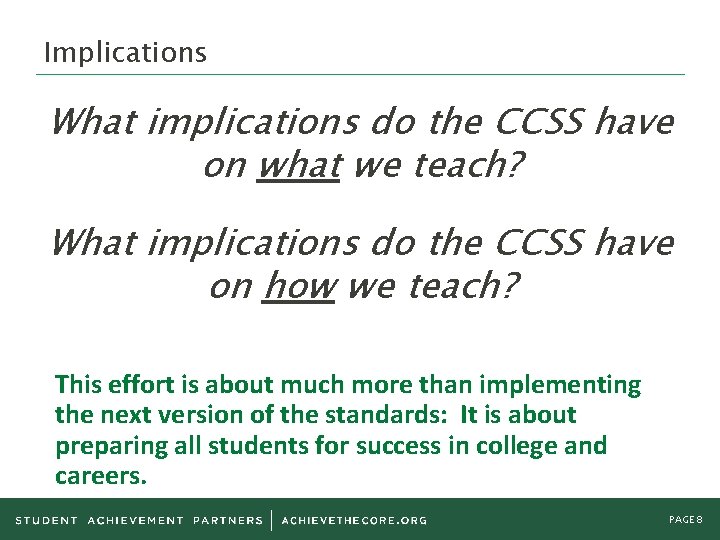
Implications What implications do the CCSS have on what we teach? What implications do the CCSS have on how we teach? This effort is about much more than implementing the next version of the standards: It is about preparing all students for success in college and careers. PAGE 8
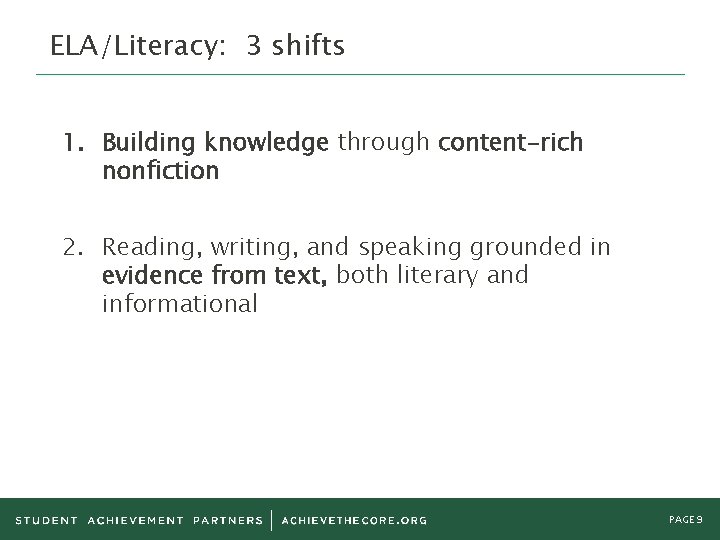
ELA/Literacy: 3 shifts 1. Building knowledge through content-rich nonfiction 2. Reading, writing, and speaking grounded in evidence from text, both literary and informational PAGE 9
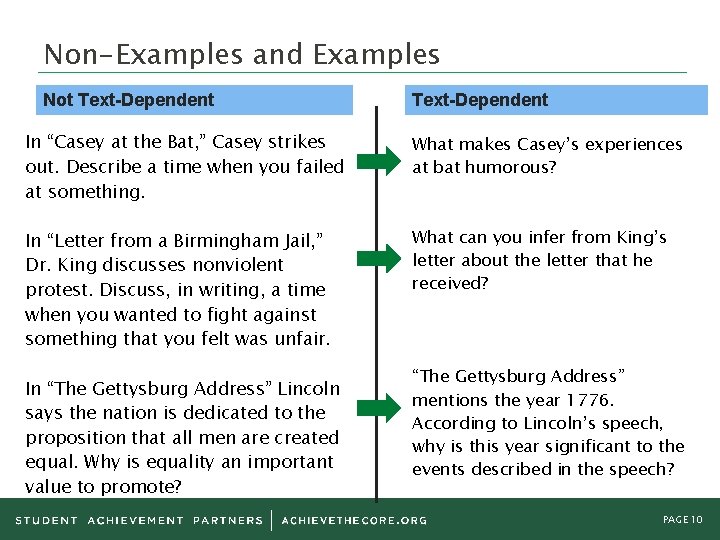
Non-Examples and Examples Not Text-Dependent In “Casey at the Bat, ” Casey strikes out. Describe a time when you failed at something. What makes Casey’s experiences at bat humorous? In “Letter from a Birmingham Jail, ” Dr. King discusses nonviolent protest. Discuss, in writing, a time when you wanted to fight against something that you felt was unfair. What can you infer from King’s letter about the letter that he received? In “The Gettysburg Address” Lincoln says the nation is dedicated to the proposition that all men are created equal. Why is equality an important value to promote? “The Gettysburg Address” mentions the year 1776. According to Lincoln’s speech, why is this year significant to the events described in the speech? PAGE 10
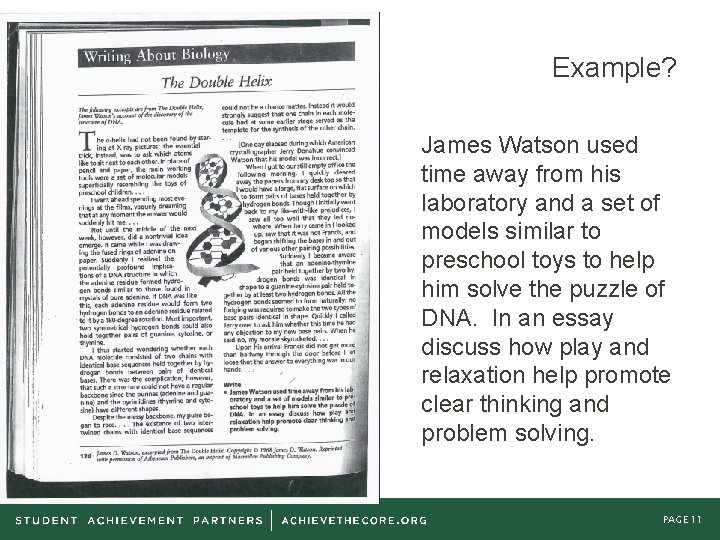
Example? • EXAMPLES James Watson used time away from his laboratory and a set of models similar to preschool toys to help him solve the puzzle of DNA. In an essay discuss how play and relaxation help promote clear thinking and problem solving. PAGE 11
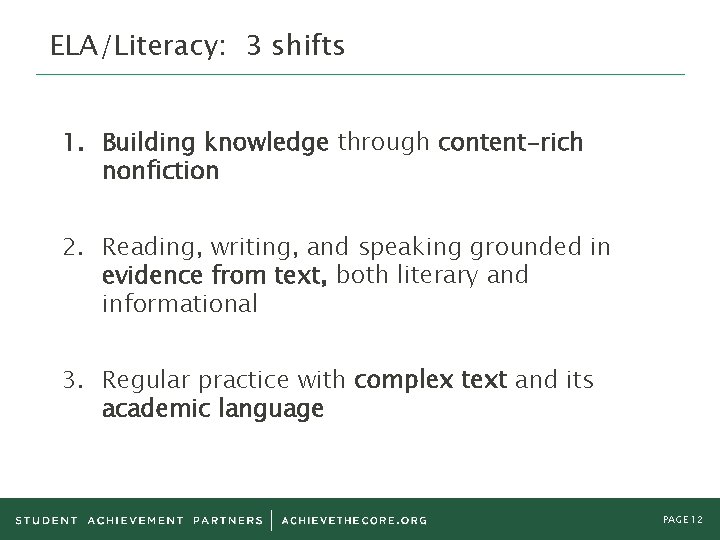
ELA/Literacy: 3 shifts 1. Building knowledge through content-rich nonfiction 2. Reading, writing, and speaking grounded in evidence from text, both literary and informational 3. Regular practice with complex text and its academic language PAGE 12
In order to lead this work… • You need metrics – What will it look like? – How will you know? PAGE 13
Mathematics: 3 shifts 1. Focus: Focus strongly where the standards focus. PAGE 14
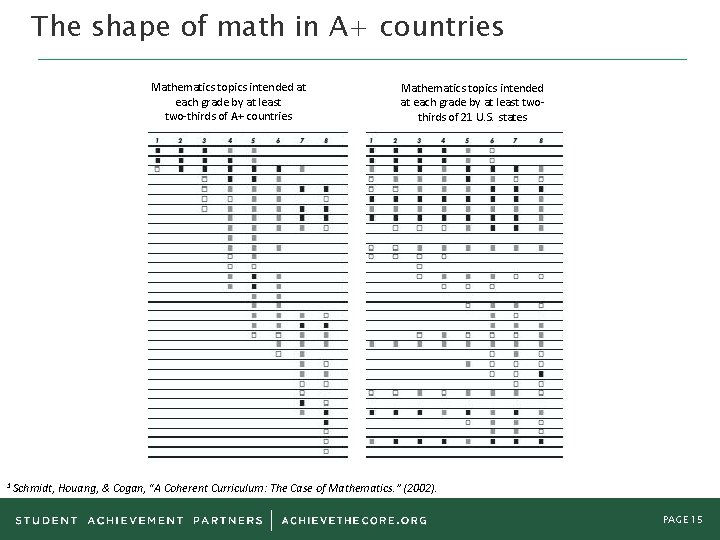
The shape of math in A+ countries Mathematics topics intended at each grade by at least two-thirds of A+ countries 1 Schmidt, Mathematics topics intended at each grade by at least twothirds of 21 U. S. states Houang, & Cogan, “A Coherent Curriculum: The Case of Mathematics. ” (2002). PAGE 15
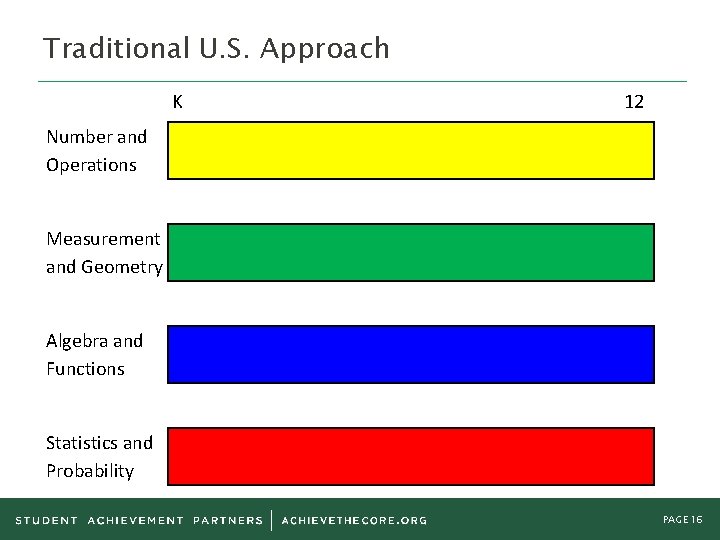
Traditional U. S. Approach K 12 Number and Operations Measurement and Geometry Algebra and Functions Statistics and Probability PAGE 16
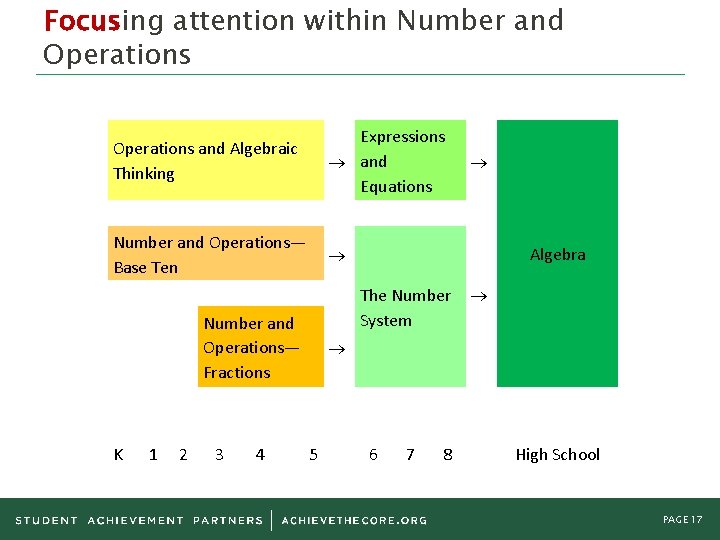
Focusing attention within Number and Operations and Algebraic Thinking Expressions and Equations Number and Operations— Base Ten 1 2 3 4 Algebra The Number System Number and Operations— Fractions K 5 6 7 8 High School PAGE 17
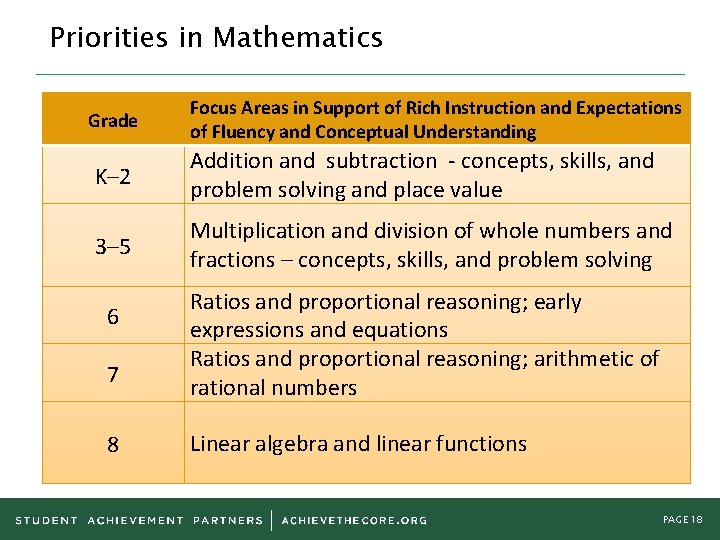
Priorities in Mathematics Grade Focus Areas in Support of Rich Instruction and Expectations of Fluency and Conceptual Understanding K– 2 Addition and subtraction - concepts, skills, and problem solving and place value 3– 5 Multiplication and division of whole numbers and fractions – concepts, skills, and problem solving 6 7 8 Ratios and proportional reasoning; early expressions and equations Ratios and proportional reasoning; arithmetic of rational numbers Linear algebra and linear functions PAGE 18
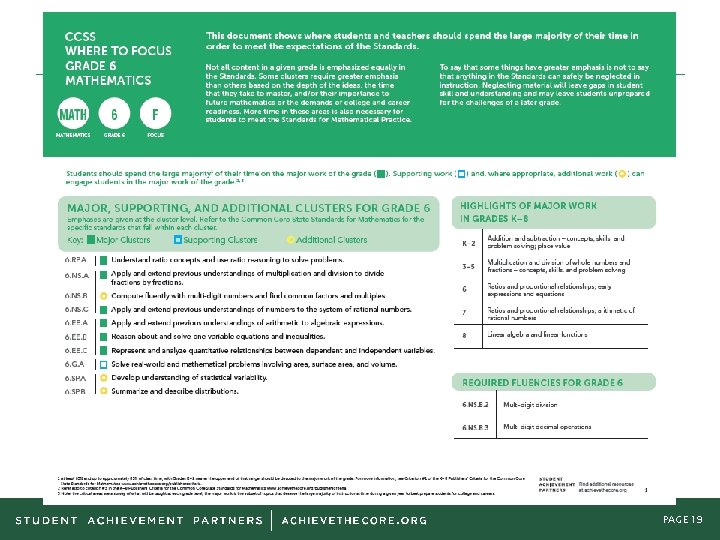
Cluster Emphases Grade 6 Achievethecore. org/focus PAGE 19
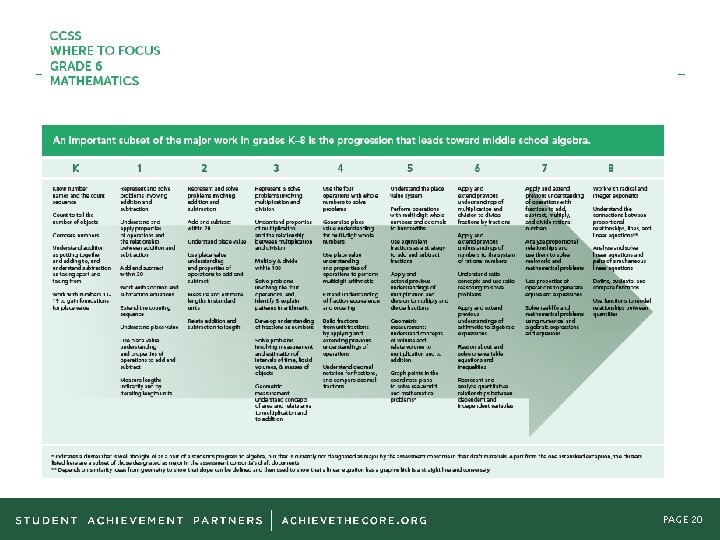
PAGE 20
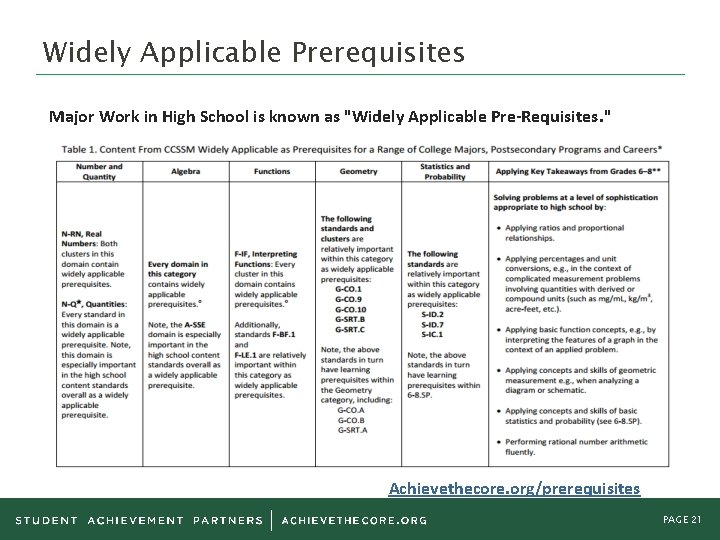
Widely Applicable Prerequisites Major Work in High School is known as "Widely Applicable Pre-Requisites. " Achievethecore. org/prerequisites PAGE 21
Mathematics: 3 shifts 1. Focus: Focus strongly where the standards focus. 2. Coherence: Think across grades, and link to major topics PAGE 22
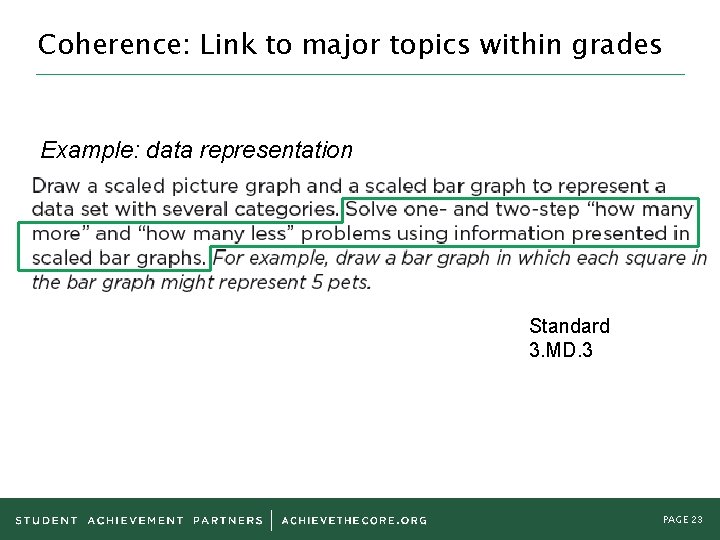
Coherence: Link to major topics within grades Example: data representation Standard 3. MD. 3 PAGE 23
Mathematics: 3 shifts 1. Focus: Focus strongly where the standards focus. 2. Coherence: Think across grades, and link to major topics 3. Rigor: In major topics, pursue conceptual understanding, procedural skill and fluency, and application PAGE 24
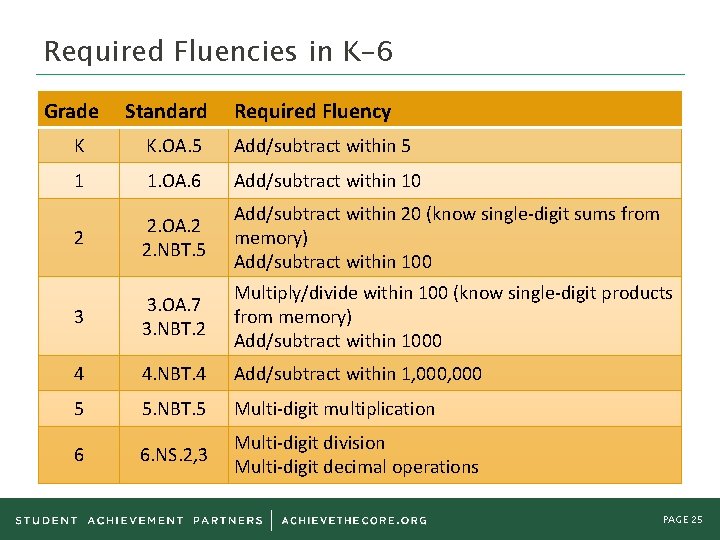
Required Fluencies in K-6 Grade Standard Required Fluency K K. OA. 5 Add/subtract within 5 1 1. OA. 6 Add/subtract within 10 2 2. OA. 2 2. NBT. 5 Add/subtract within 20 (know single-digit sums from memory) Add/subtract within 100 3 3. OA. 7 3. NBT. 2 Multiply/divide within 100 (know single-digit products from memory) Add/subtract within 1000 4 4. NBT. 4 Add/subtract within 1, 000 5 5. NBT. 5 Multi-digit multiplication 6 6. NS. 2, 3 Multi-digit division Multi-digit decimal operations PAGE 25
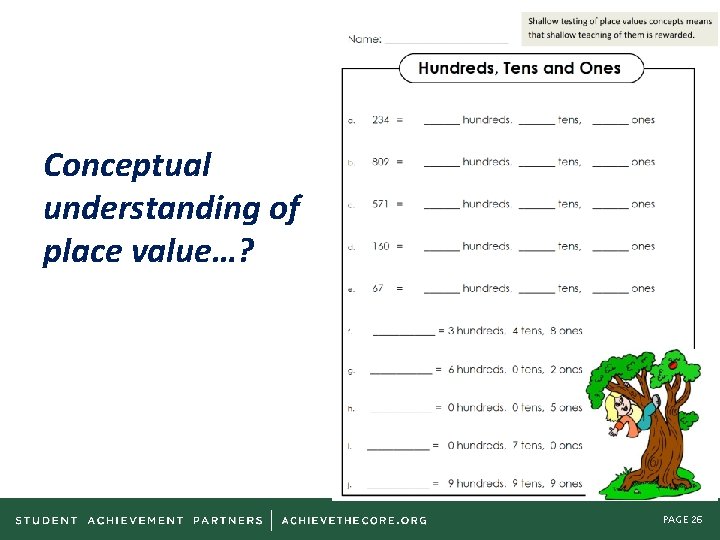
Conceptual understanding of place value…? PAGE 26
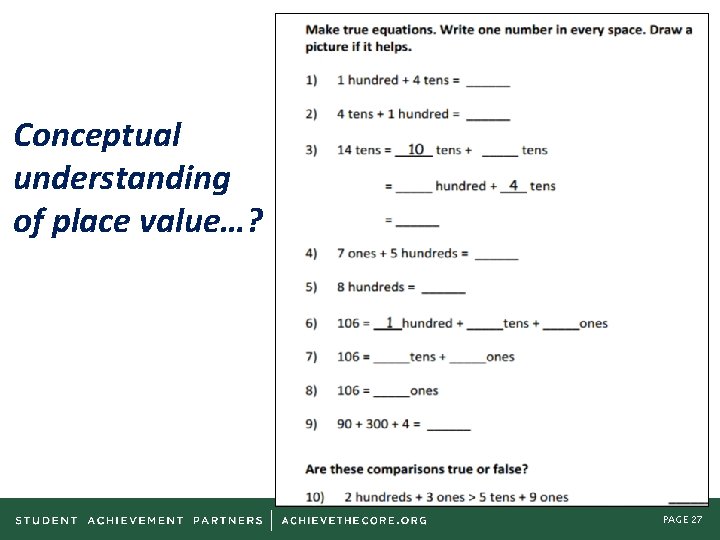
Conceptual understanding of place value…? PAGE 27
In order to lead this work… • You need metrics – What will it look like? – How will you know? PAGE 28
Reflect Please reflect on what you will be able to observe (see, hear) when you have successfully implemented Common Core State Standards in your schools and districts. PAGE 29
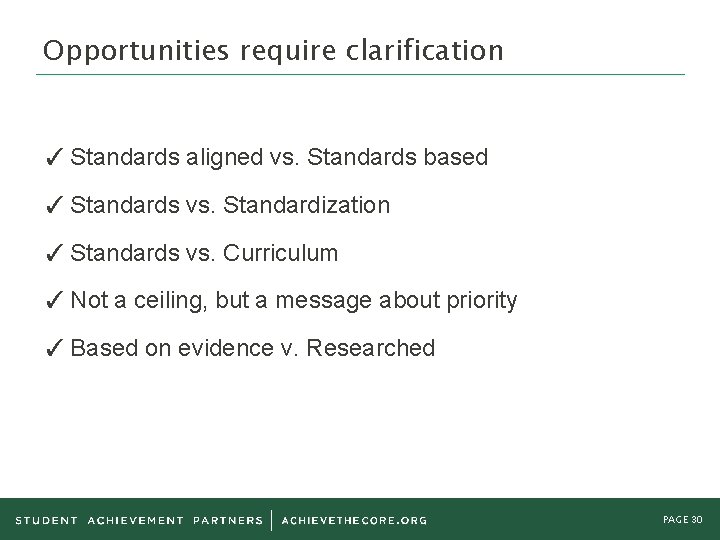
Opportunities require clarification ✓ Standards aligned vs. Standards based ✓ Standards vs. Standardization ✓ Standards vs. Curriculum ✓ Not a ceiling, but a message about priority ✓ Based on evidence v. Researched PAGE 30
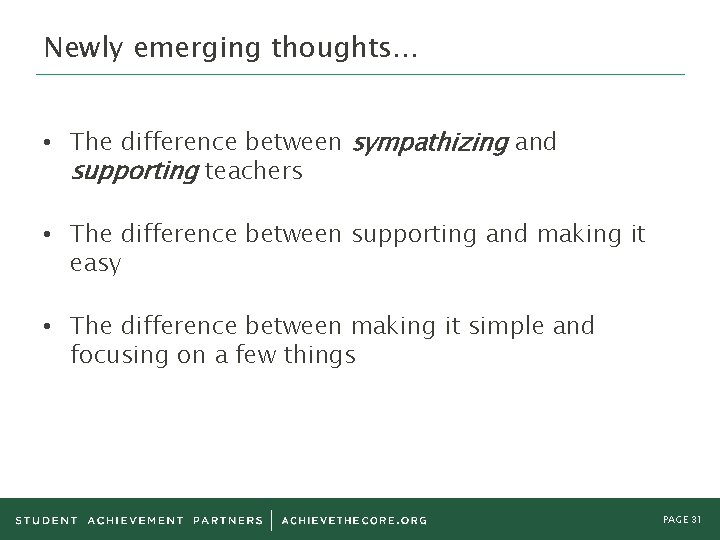
Newly emerging thoughts… • The difference between sympathizing and supporting teachers • The difference between supporting and making it easy • The difference between making it simple and focusing on a few things PAGE 31
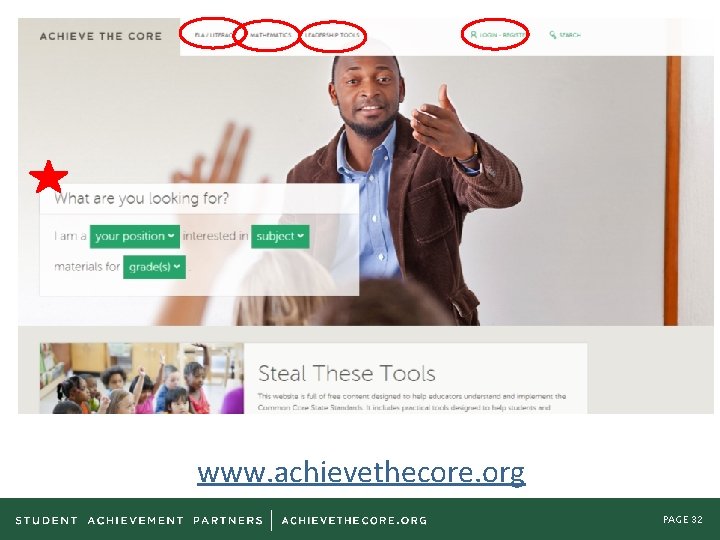
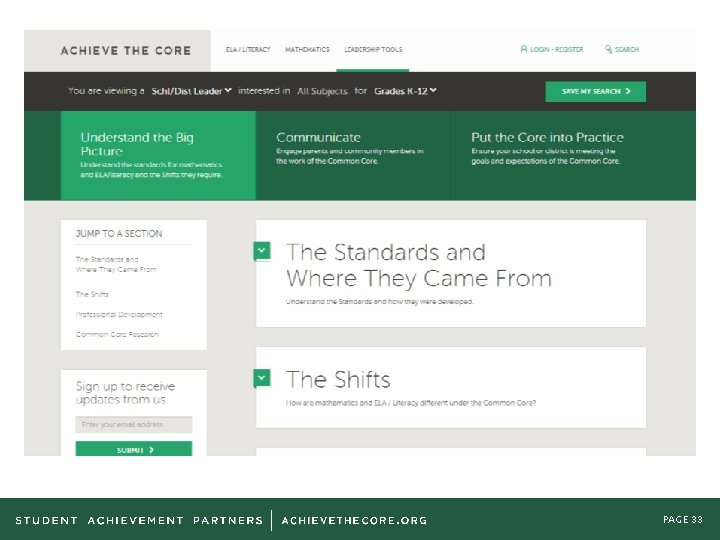
www. achievethecore. org PAGE 32
PAGE 33
Key Characteristics of Leading Organizations ü Systems Thinking ü Learning Organizations ü Know – Really Know – the expectations PAGE 34
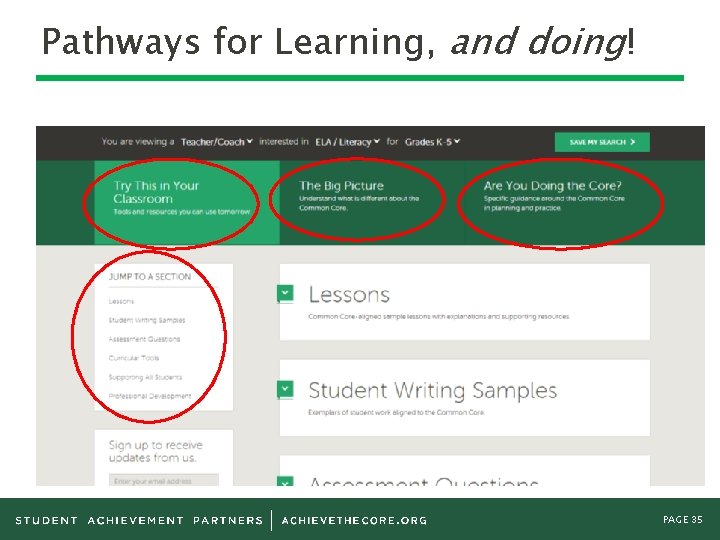
Pathways for Learning, and doing! PAGE 35
Are You Doing the Core? • Instructional Practice • Instructional and Assessment Materials • Professional Development PAGE 36
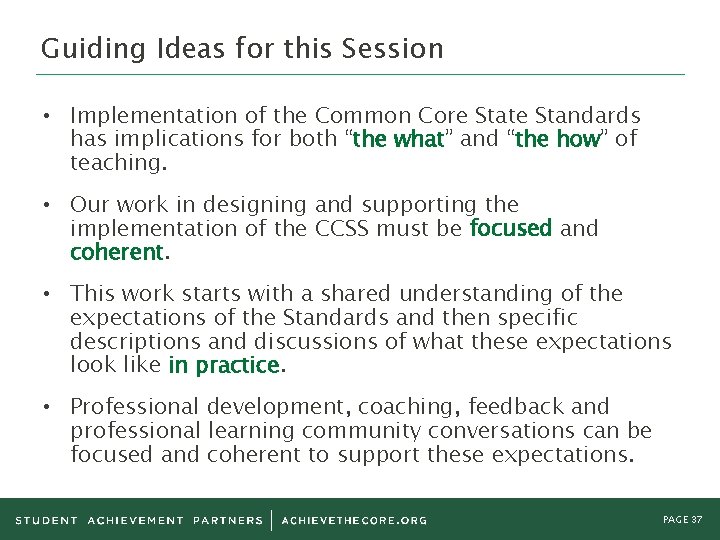
Guiding Ideas for this Session • Implementation of the Common Core State Standards has implications for both “the what” and “the how” of teaching. • Our work in designing and supporting the implementation of the CCSS must be focused and coherent. • This work starts with a shared understanding of the expectations of the Standards and then specific descriptions and discussions of what these expectations look like in practice. • Professional development, coaching, feedback and professional learning community conversations can be focused and coherent to support these expectations. PAGE 37
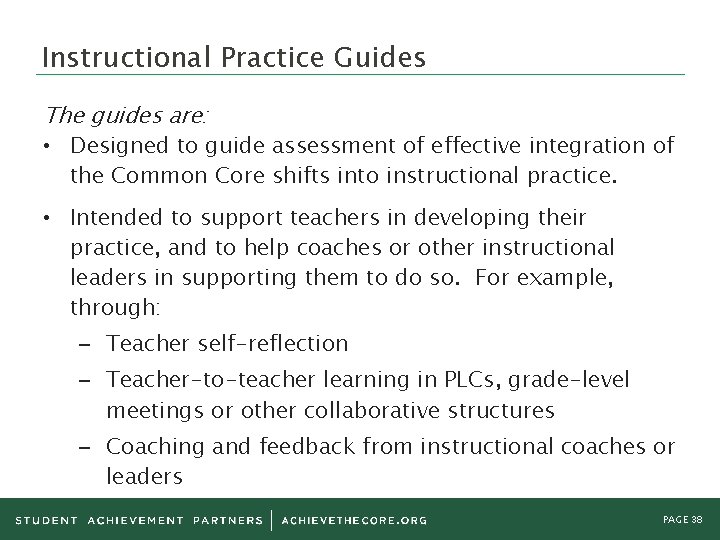
Instructional Practice Guides The guides are: • Designed to guide assessment of effective integration of the Common Core shifts into instructional practice. • Intended to support teachers in developing their practice, and to help coaches or other instructional leaders in supporting them to do so. For example, through: ‒ Teacher self-reflection ‒ Teacher-to-teacher learning in PLCs, grade-level meetings or other collaborative structures ‒ Coaching and feedback from instructional coaches or leaders PAGE 38
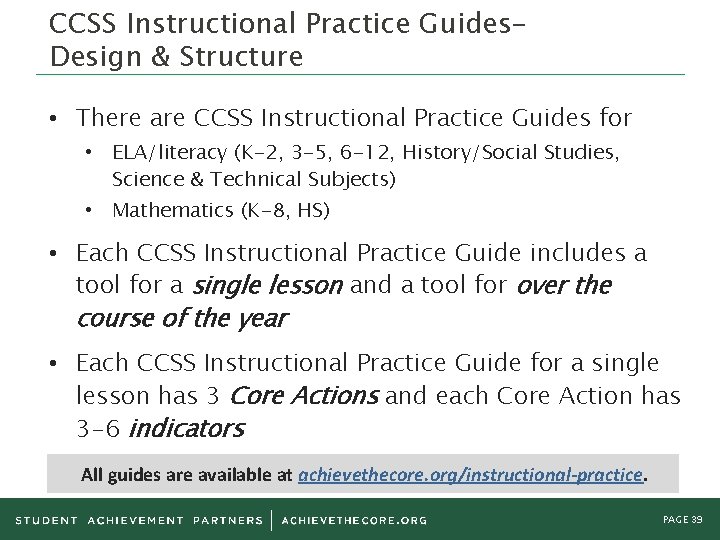
CCSS Instructional Practice Guides– Design & Structure • There are CCSS Instructional Practice Guides for • ELA/literacy (K-2, 3 -5, 6 -12, History/Social Studies, Science & Technical Subjects) • Mathematics (K-8, HS) • Each CCSS Instructional Practice Guide includes a tool for a single lesson and a tool for over the course of the year • Each CCSS Instructional Practice Guide for a single lesson has 3 Core Actions and each Core Action has 3 -6 indicators All guides are available at achievethecore. org/instructional-practice. PAGE 39
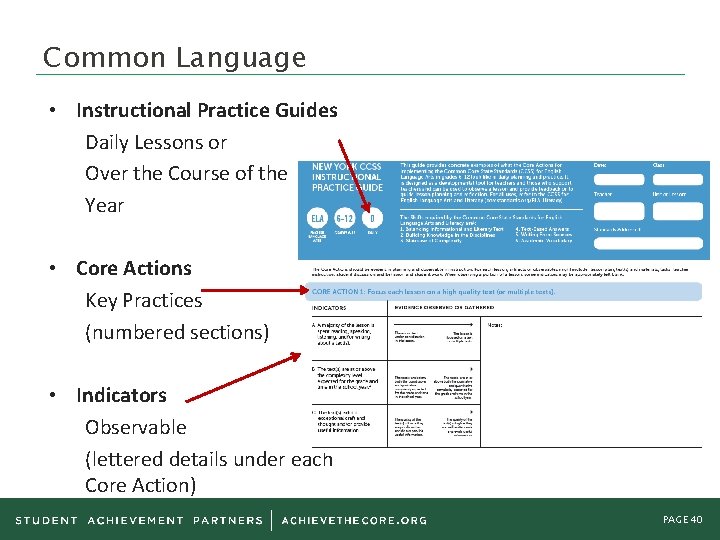
Common Language • Instructional Practice Guides Daily Lessons or Over the Course of the Year • Core Actions Key Practices (numbered sections) • Indicators Observable (lettered details under each Core Action) PAGE 40
INSTRUCTIONAL PRACTICE GUIDE: ELA/Literacy
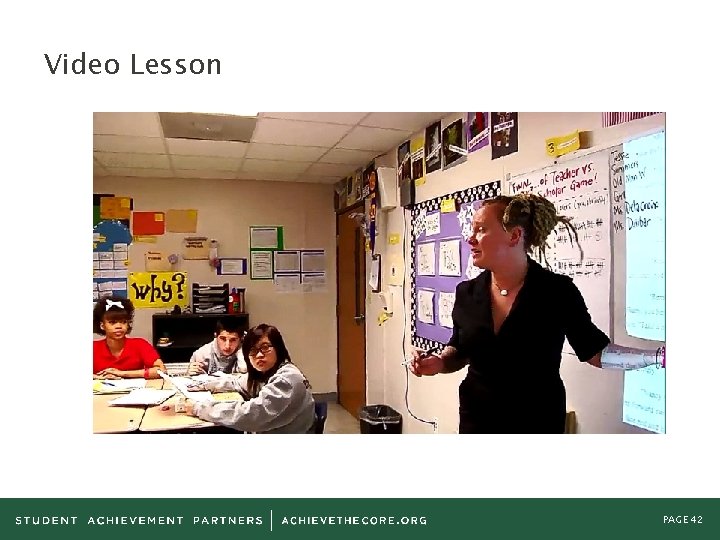
Video Lesson PAGE 42
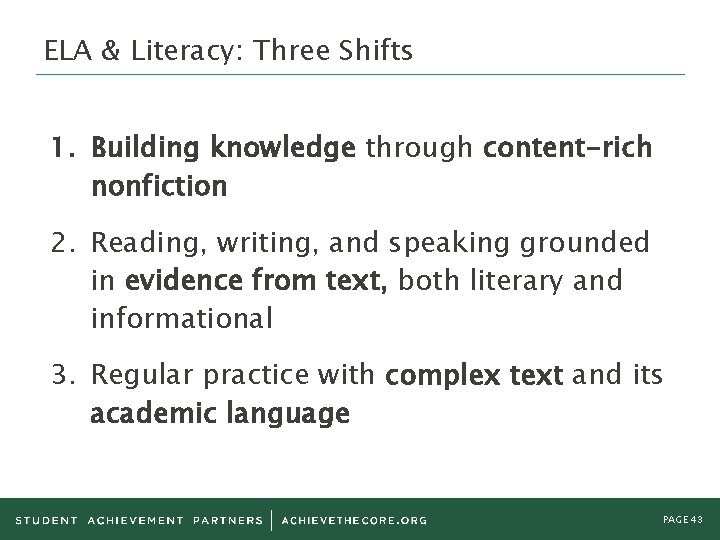
ELA & Literacy: Three Shifts 1. Building knowledge through content-rich nonfiction 2. Reading, writing, and speaking grounded in evidence from text, both literary and informational 3. Regular practice with complex text and its academic language PAGE 43
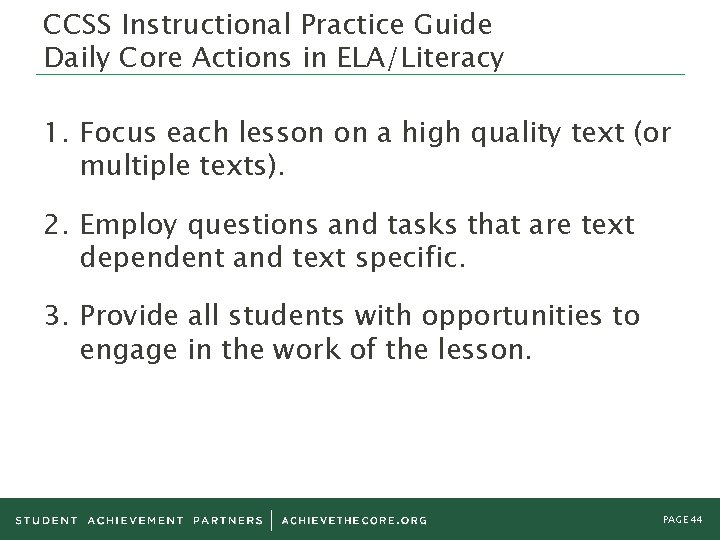
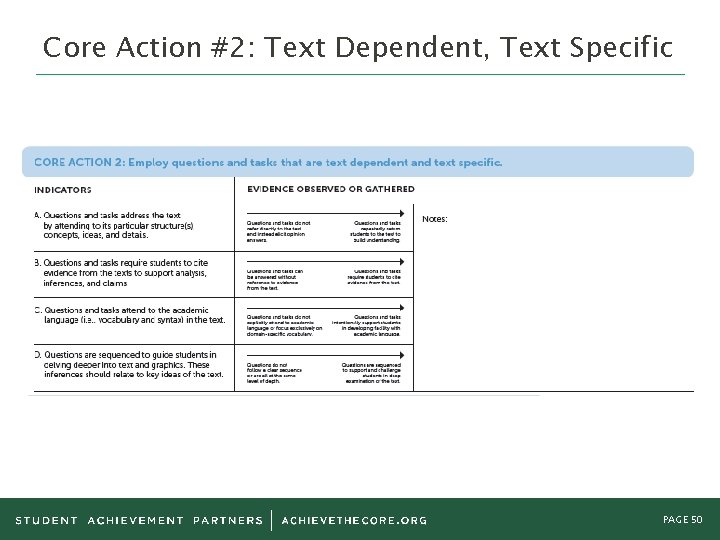
CCSS Instructional Practice Guide Daily Core Actions in ELA/Literacy 1. Focus each lesson on a high quality text (or multiple texts). 2. Employ questions and tasks that are text dependent and text specific. 3. Provide all students with opportunities to engage in the work of the lesson. PAGE 44
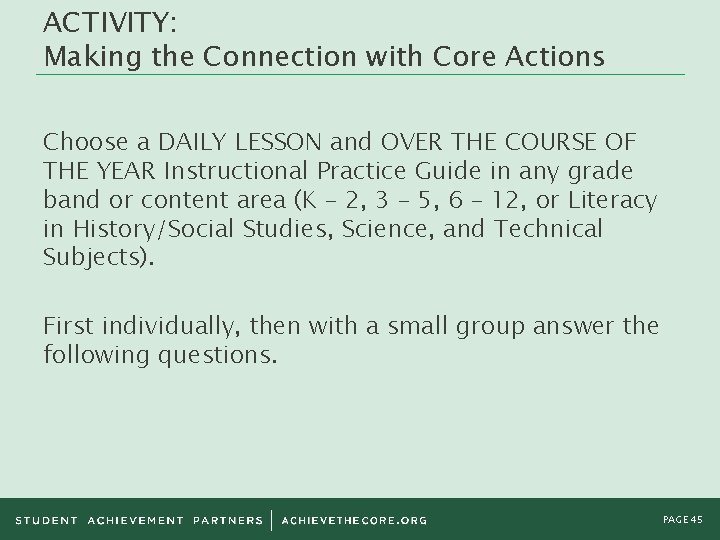
ACTIVITY: Making the Connection with Core Actions Choose a DAILY LESSON and OVER THE COURSE OF THE YEAR Instructional Practice Guide in any grade band or content area (K – 2, 3 – 5, 6 – 12, or Literacy in History/Social Studies, Science, and Technical Subjects). First individually, then with a small group answer the following questions. PAGE 45
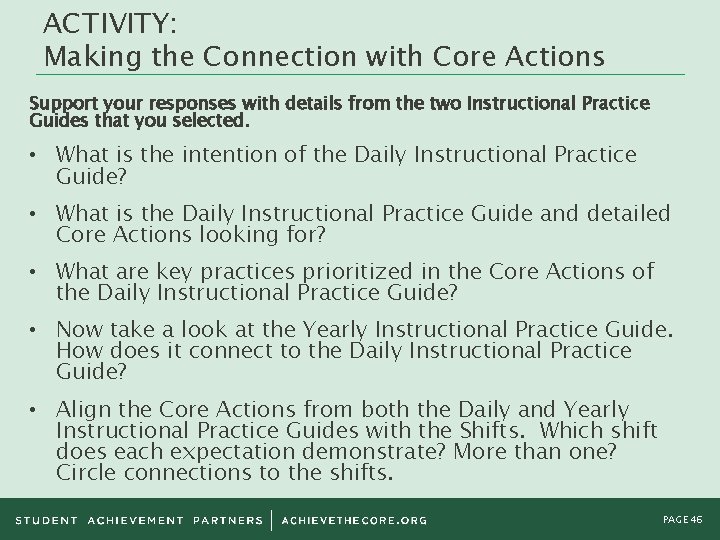
ACTIVITY: Making the Connection with Core Actions Support your responses with details from the two Instructional Practice Guides that you selected. • What is the intention of the Daily Instructional Practice Guide? • What is the Daily Instructional Practice Guide and detailed Core Actions looking for? • What are key practices prioritized in the Core Actions of the Daily Instructional Practice Guide? • Now take a look at the Yearly Instructional Practice Guide. How does it connect to the Daily Instructional Practice Guide? • Align the Core Actions from both the Daily and Yearly Instructional Practice Guides with the Shifts. Which shift does each expectation demonstrate? More than one? Circle connections to the shifts. PAGE 46
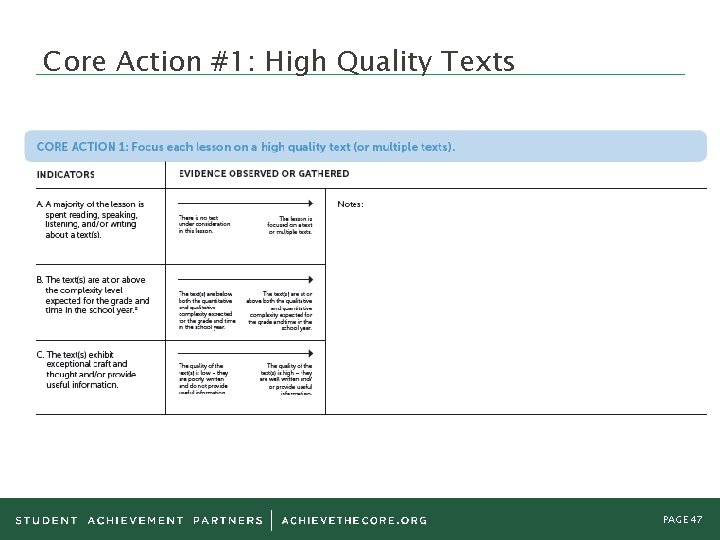
Core Action #1: High Quality Texts PAGE 47
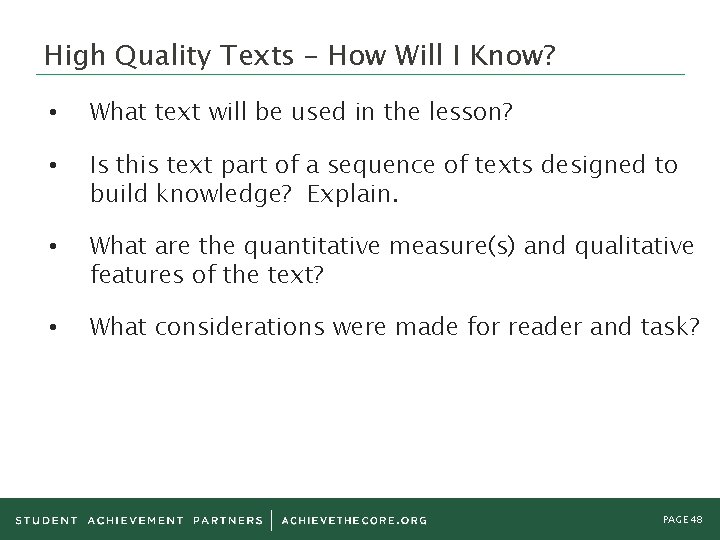
High Quality Texts – How Will I Know? • What text will be used in the lesson? • Is this text part of a sequence of texts designed to build knowledge? Explain. • What are the quantitative measure(s) and qualitative features of the text? • What considerations were made for reader and task? PAGE 48
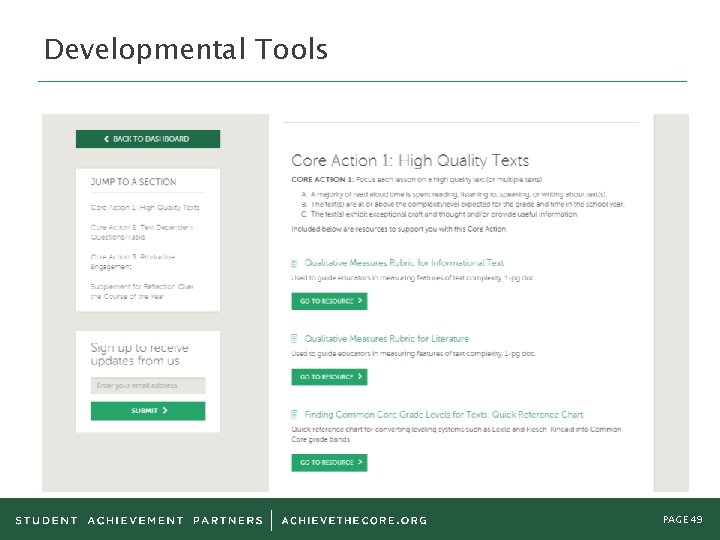
Developmental Tools PAGE 49
Core Action #2: Text Dependent, Text Specific PAGE 50
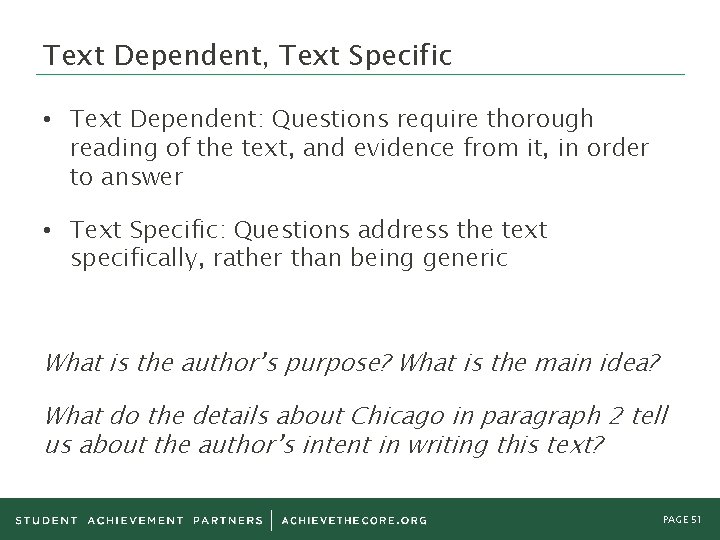
Text Dependent, Text Specific • Text Dependent: Questions require thorough reading of the text, and evidence from it, in order to answer • Text Specific: Questions address the text specifically, rather than being generic What is the author’s purpose? What is the main idea? What do the details about Chicago in paragraph 2 tell us about the author’s intent in writing this text? PAGE 51
Text-Dependency = Questions Worth Answering • Many typical reading questions in the classroom were not text-dependent • The text is used simply as a “springboard” for discussion, without focusing students’ attention on close reading of the text. PAGE 52
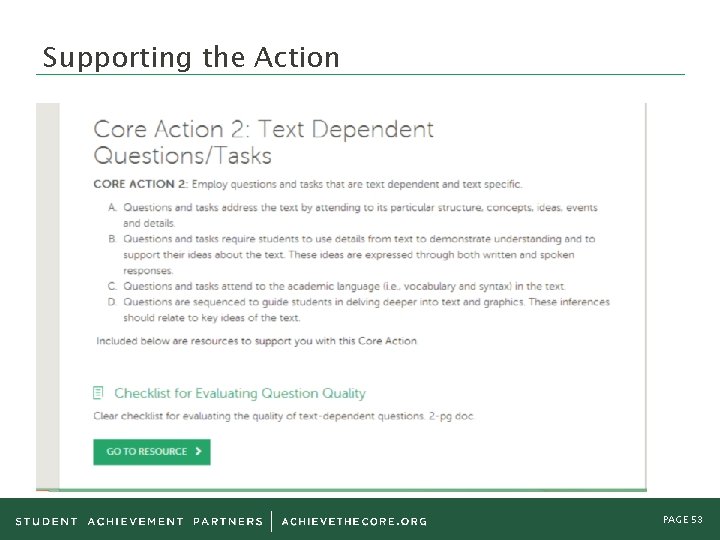
Supporting the Action PAGE 53
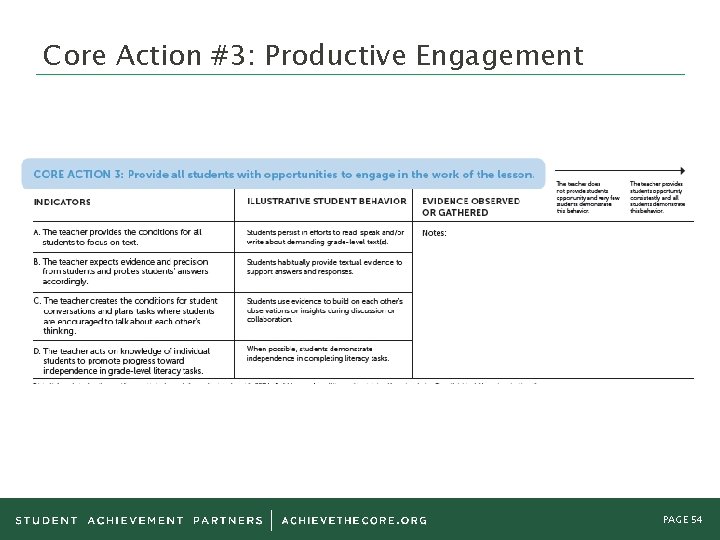
Core Action #3: Productive Engagement PAGE 54
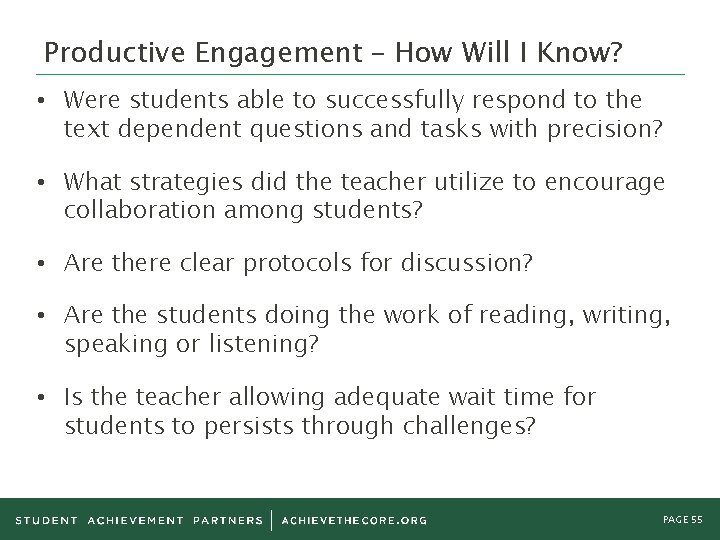
Productive Engagement – How Will I Know? • Were students able to successfully respond to the text dependent questions and tasks with precision? • What strategies did the teacher utilize to encourage collaboration among students? • Are there clear protocols for discussion? • Are the students doing the work of reading, writing, speaking or listening? • Is the teacher allowing adequate wait time for students to persists through challenges? PAGE 55
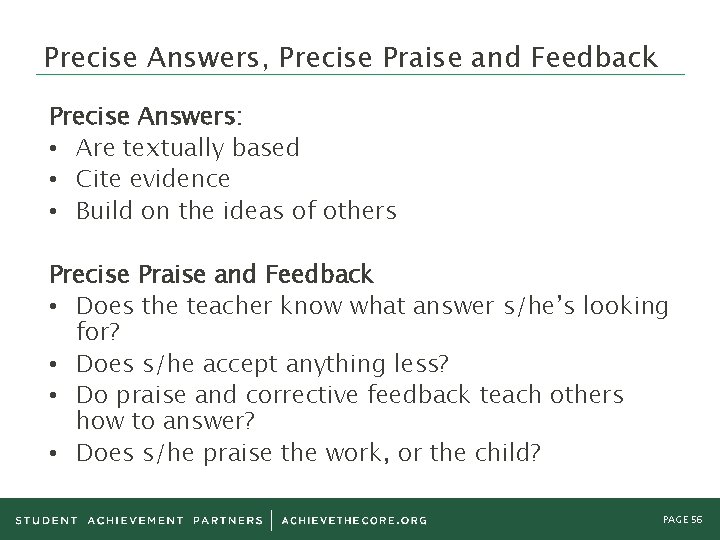
Precise Answers, Precise Praise and Feedback Precise Answers: • Are textually based • Cite evidence • Build on the ideas of others Precise Praise and Feedback • Does the teacher know what answer s/he’s looking for? • Does s/he accept anything less? • Do praise and corrective feedback teach others how to answer? • Does s/he praise the work, or the child? PAGE 56
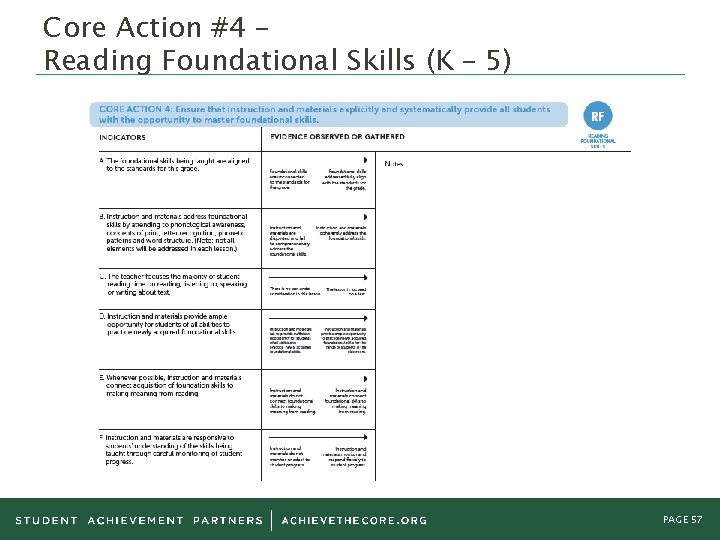
Core Action #4 – Reading Foundational Skills (K – 5) PAGE 57
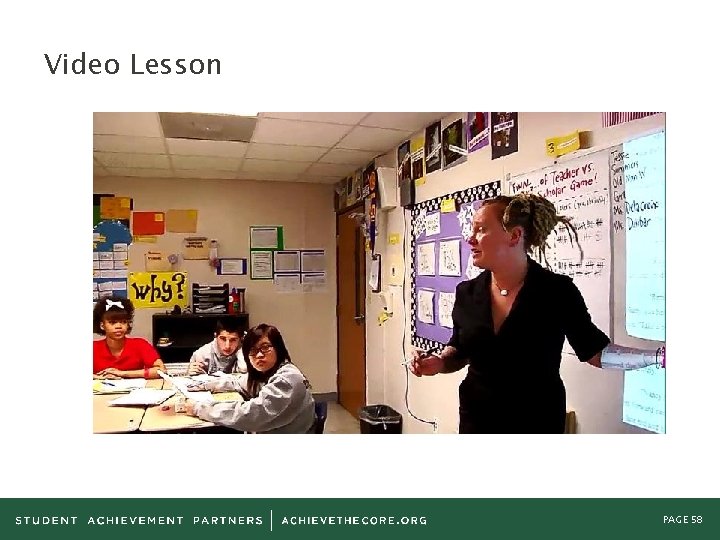
Video Lesson PAGE 58
INSTRUCTIONAL PRACTICE GUIDE: MATHEMATICS
Mathematics: 3 shifts 1. Focus: Focus strongly where the standards focus. 2. Coherence: Think across grades, and link to major topics 3. Rigor: In major topics, pursue conceptual understanding, procedural skill and fluency, and application PAGE 60
CCSS Instructional Practice Guide Core Actions 1. Ensure the work of the lesson reflects the shifts required by the CCSS for Mathematics. 2. Employ instructional practices that allow all students to master the content of the lesson. 3. Provide all students with opportunities to exhibit mathematical practices in connection with the content of the lesson, and therefore, all students are productively engaged in the work of the lesson. PAGE 61
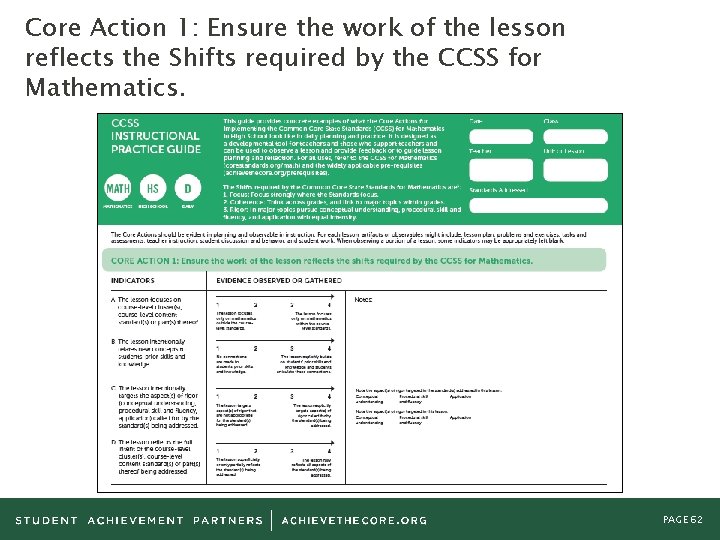
Core Action 1: Ensure the work of the lesson reflects the Shifts required by the CCSS for Mathematics. PAGE 62
ACTIVITY: Core Action 1: Deeper Dive • Highlight 3 -5 key word(s) in each indicator for Core Action 1. • What shift is this related to? • What information is needed in order to meet or rate this indicator? • What are some artifacts that would provide evidence of this indicator? • What are examples of this indicator being met and not being met? PAGE 63
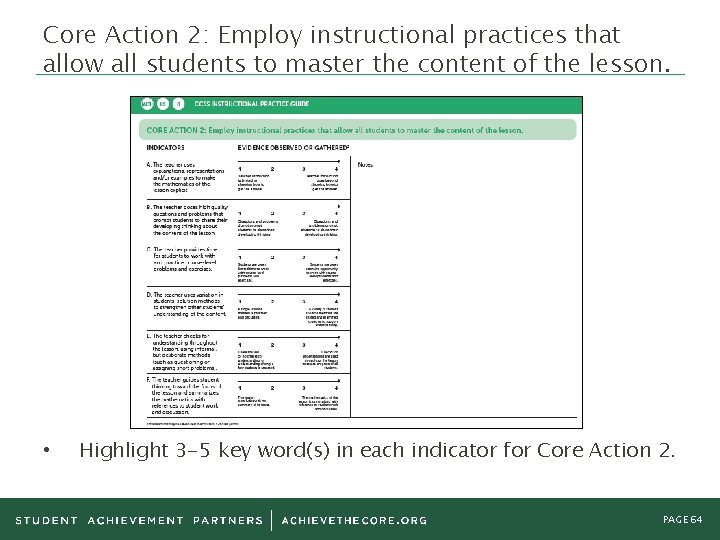
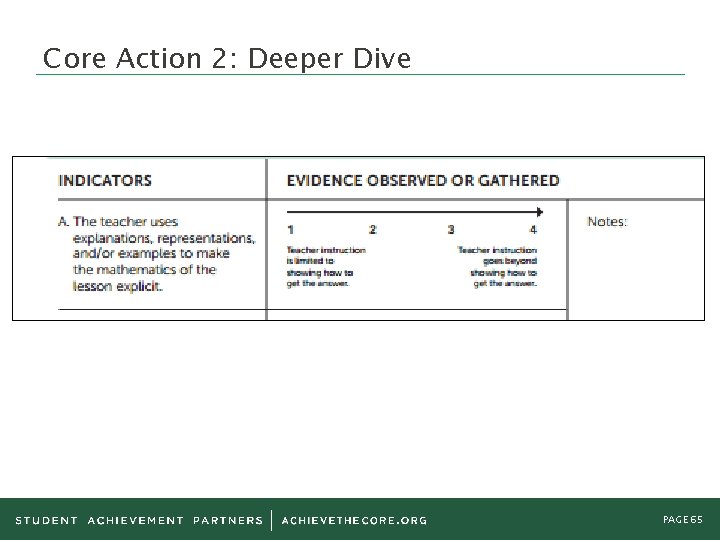
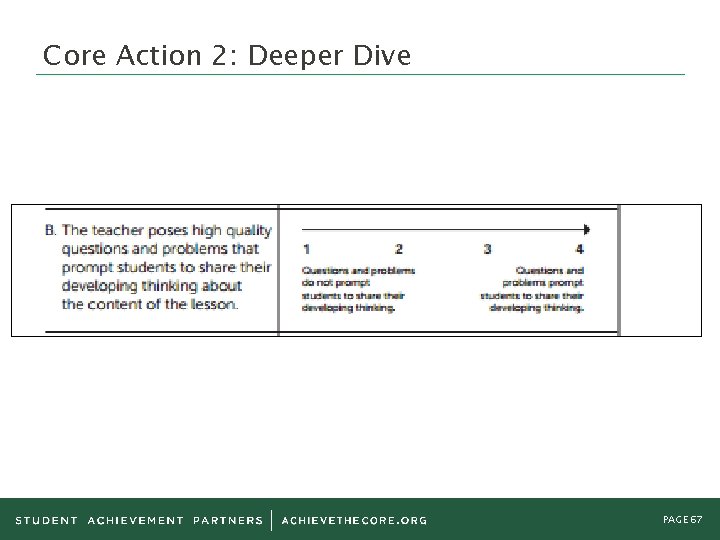
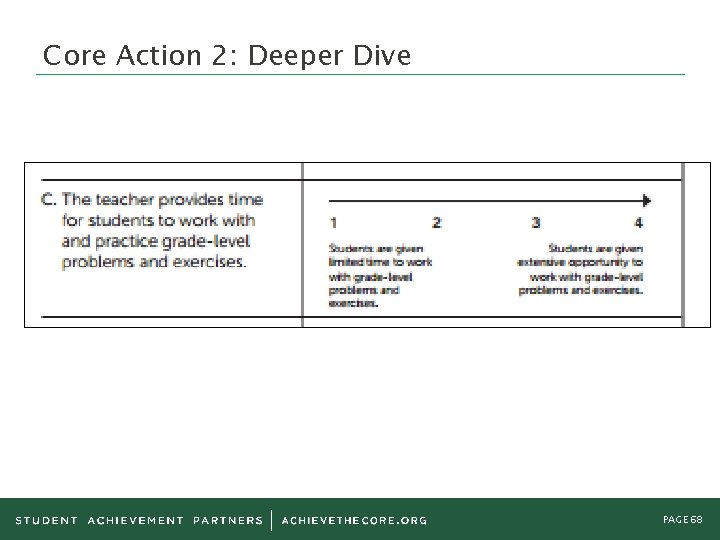
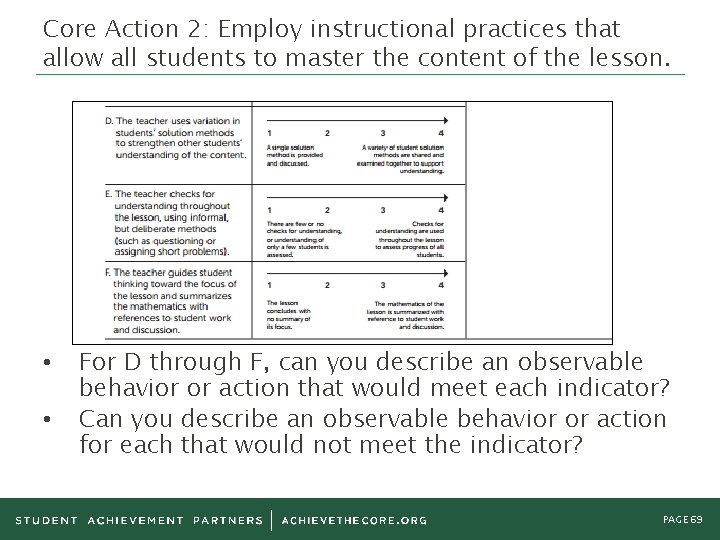
Core Action 2: Employ instructional practices that allow all students to master the content of the lesson. • Highlight 3 -5 key word(s) in each indicator for Core Action 2. PAGE 64
Core Action 2: Deeper Dive PAGE 65
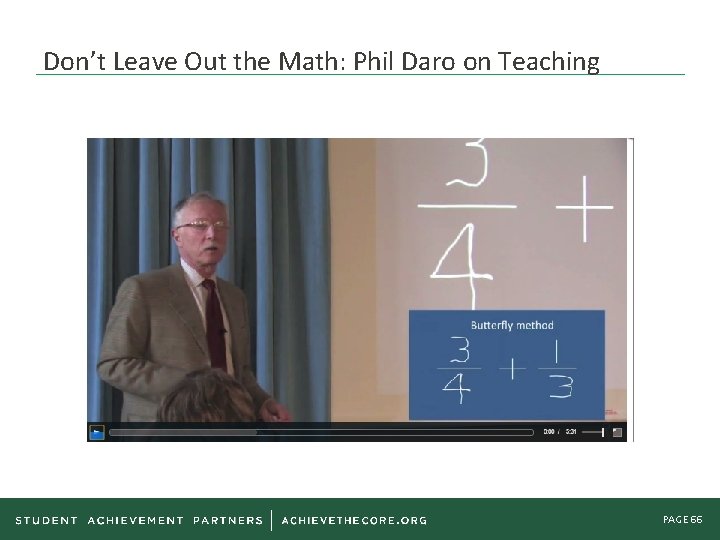
Don’t Leave Out the Math: Phil Daro on Teaching PAGE 66
Core Action 2: Deeper Dive PAGE 67
Core Action 2: Deeper Dive PAGE 68
Core Action 2: Employ instructional practices that allow all students to master the content of the lesson. • • For D through F, can you describe an observable behavior or action that would meet each indicator? Can you describe an observable behavior or action for each that would not meet the indicator? PAGE 69
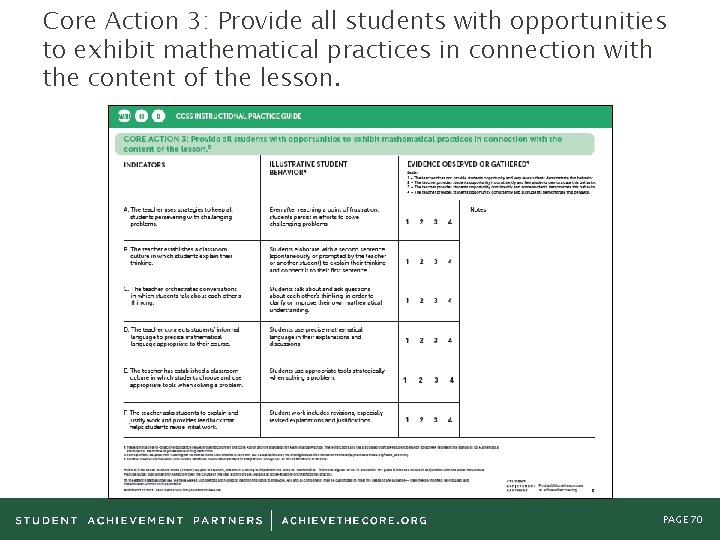
Core Action 3: Provide all students with opportunities to exhibit mathematical practices in connection with the content of the lesson. PAGE 70
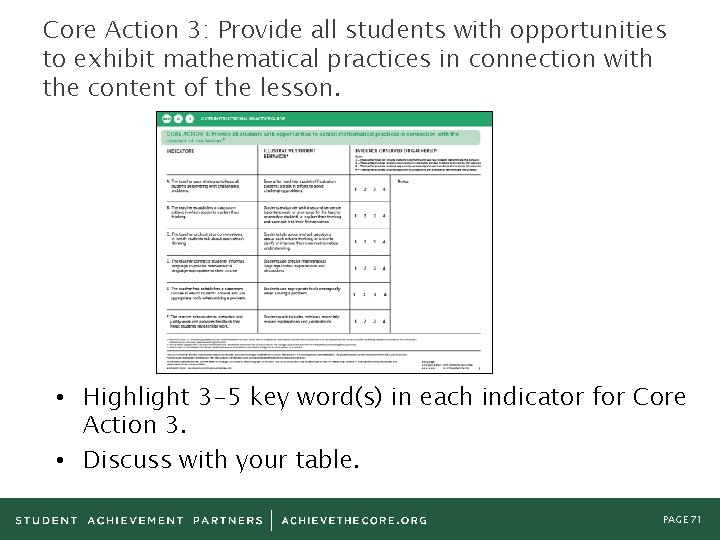
Core Action 3: Provide all students with opportunities to exhibit mathematical practices in connection with the content of the lesson. • Highlight 3 -5 key word(s) in each indicator for Core Action 3. • Discuss with your table. PAGE 71
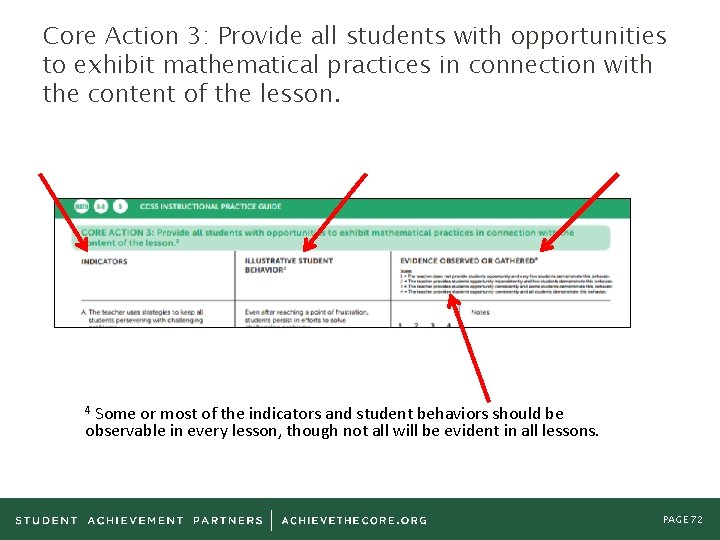
Core Action 3: Provide all students with opportunities to exhibit mathematical practices in connection with the content of the lesson. 4 Some or most of the indicators and student behaviors should be observable in every lesson, though not all will be evident in all lessons. PAGE 72
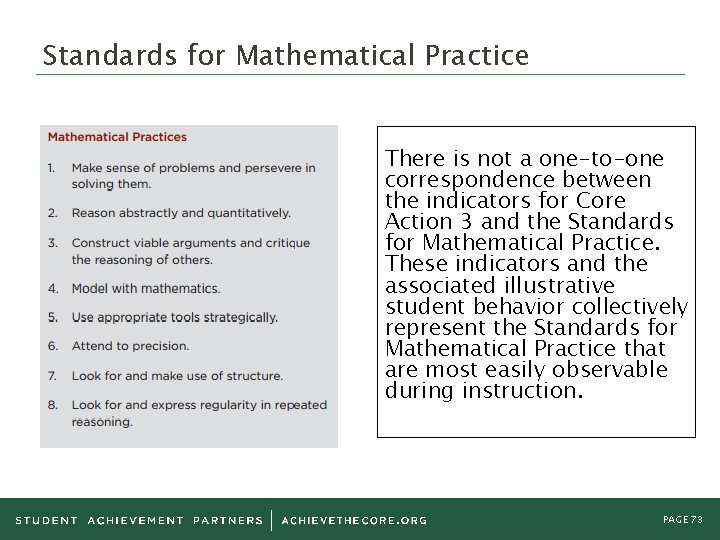
Standards for Mathematical Practice • There is not a one-to-one correspondence between the indicators for Core Action 3 and the Standards for Mathematical Practice. These indicators and the associated illustrative student behavior collectively represent the Standards for Mathematical Practice that are most easily observable during instruction. PAGE 73
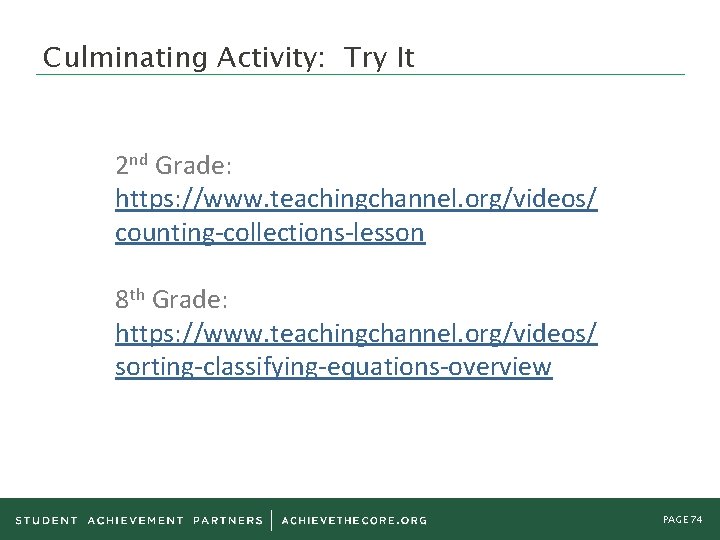
Culminating Activity: Try It 2 nd Grade: https: //www. teachingchannel. org/videos/ counting-collections-lesson 8 th Grade: https: //www. teachingchannel. org/videos/ sorting-classifying-equations-overview PAGE 74
“Silent 5” - Mathematics Take 5 minutes and silently write on a post-it… • An insight from today. . . • I’m still wondering about… PAGE 75
Future Developments • Instructional Practice Guides as Tools – Including Planning Tool http: //achievethecore. org/page/969/instructionalpractice-guide-list-pg – Lesson Planning Tool - BETA • Additional Tool Development • “Survey” = Self-assessment PAGE 76
Group Reflection – Implications for Your Work In teams, discuss implications of our discussion today for your work: 1. How can these tools be used to support teacher and school leader understanding and implementation of the CCSS? 2. Who will you share this information with? 3. What are potential challenges/roadblocks? 4. What is your next step? #CCSSwork PAGE 77
Thank You! Sandra Alberti salberti@studentsachieve. net www. achievethecore. org Twitter: @salberti #CCSSwork