Literacy Critical Reading the Curriculum MEG GORZYCKI ED
- Slides: 15
Literacy, Critical Reading & the Curriculum MEG GORZYCKI, ED. D.
Why Does Literacy Matter? ØLanguage is foundational for learning as words are proxies for mental images, abstract ideas, feelings, and the transmission of knowledge Dahaene, S. (2009). Reading and the brain. New York, Viking Press. ØLearning to read in pre-school and habitually improving one’s literacy skills in grade school gives individuals an advantage throughout formal education Whitehurst, G. J. , & Lonigan, C. J. (2001). Emergent literacy: Development from pre-readers to readers. Handbook of early literacy r research, 1, 11 -29. Ø About 85% of all learning in post-secondary education involves reading and in many courses the textbook is a major source of information. Nist, S. T. & Simpson, M. L. (2000). College studying. In M. L. Kamil, P. B. Mosenthal, P. D. Pearson, & R. Barr (Eds. ) Handbook of reading research (Vol. III). Mahwah, NJ: Lawrence Erlbaum Associates.
What is Literacy? ØAbility to read and write http: //www. merriam-webster. com/dictionary/literacy Ø Literacy concerns verbal reasoning and the ability to read critically Burton, N. W. , Welsh, C. , Kostin, I. , & Van Essen. (2009). Toward a definition of verbal reasoning in higher education. Educational Testing Services. http: //files. eric. ed. gov/fulltext/ED 507807. pdf. ØAbility to understand complex syntax, phonology, semantics, and grammar Graff, H. J. (1982). The legacies of literacy. Journal of Communication, 32(1), 12 -26 ØA means of achieving goals, develop knowledge and fully participate in community life Richmond, M. , Robinson, C. , & Sachs-Israel, M (2008). The global literacy challenge: A profile of youth and adult literacy at the midpoint of the United nations Literacy Decade, 2003 -2013. Paris: United Nation Educational, Scientific and Cultural Organization.
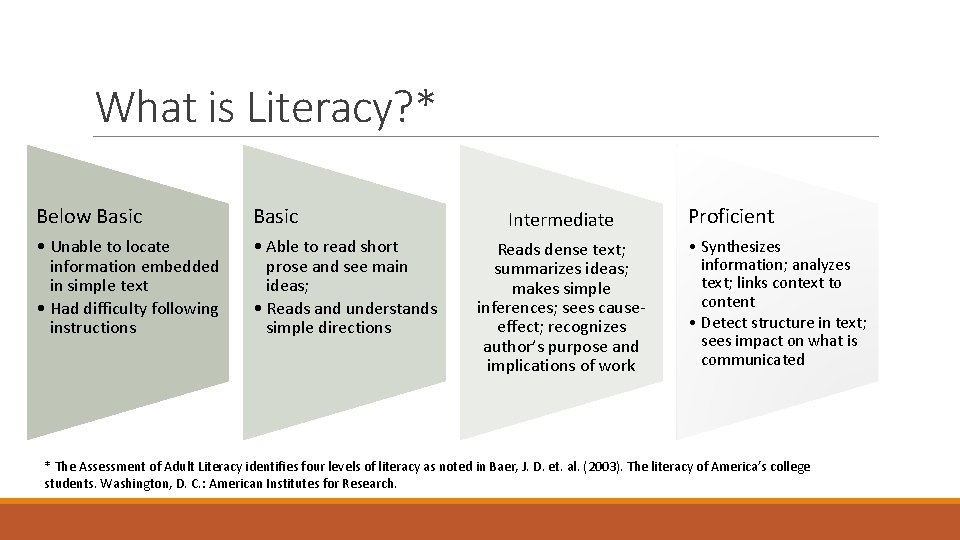
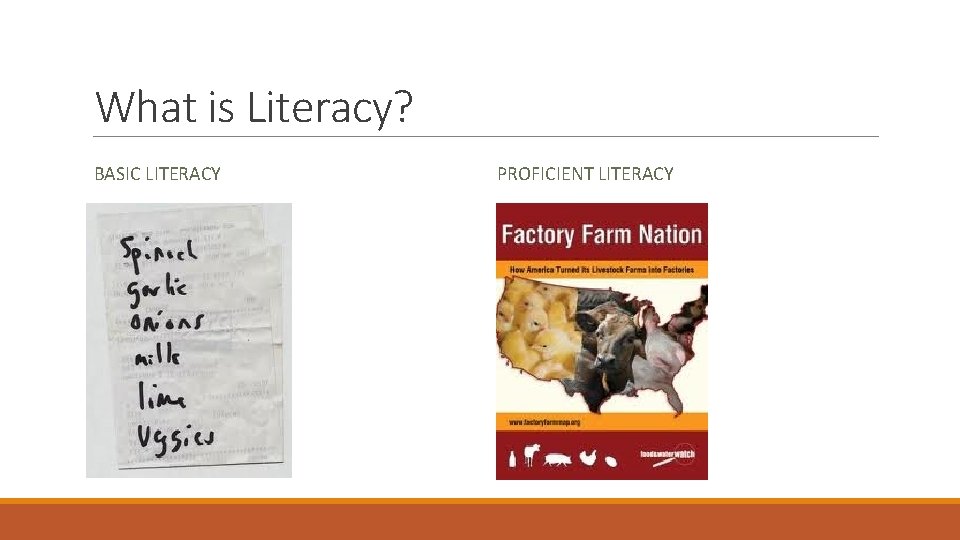
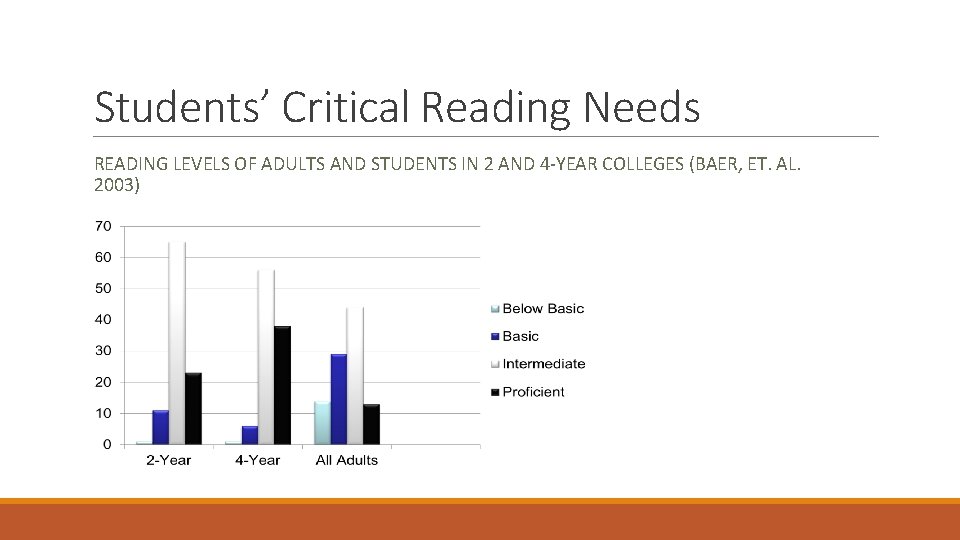
What is Literacy? * Below Basic • Unable to locate information embedded in simple text • Had difficulty following instructions • Able to read short prose and see main ideas; • Reads and understands simple directions Intermediate Reads dense text; summarizes ideas; makes simple inferences; sees causeeffect; recognizes author’s purpose and implications of work Proficient • Synthesizes information; analyzes text; links context to content • Detect structure in text; sees impact on what is communicated * The Assessment of Adult Literacy identifies four levels of literacy as noted in Baer, J. D. et. al. (2003). The literacy of America’s college students. Washington, D. C. : American Institutes for Research.
What is Literacy? BASIC LITERACY PROFICIENT LITERACY
What is Critical Reading? Ø A form of verbal reasoning in which the reader activity constructs meaning from text Burton, N. W. , Welsh, C. , Kostin, I. , & Van Essen. (2009). Toward a definition of verbal reasoning in higher education. Educational Testing Services. http: //files. eric. ed. gov/fulltext/ED 507807. pdf. Ø The conscious engagement of cognitive tasks, (such as thinking about the validity of assertions or making inferences), aimed to improve the reader’s understanding of text Chapman, A. (Ed. ) (1993). Making sense: Teaching critical reading across the curriculum. New York: College Board.
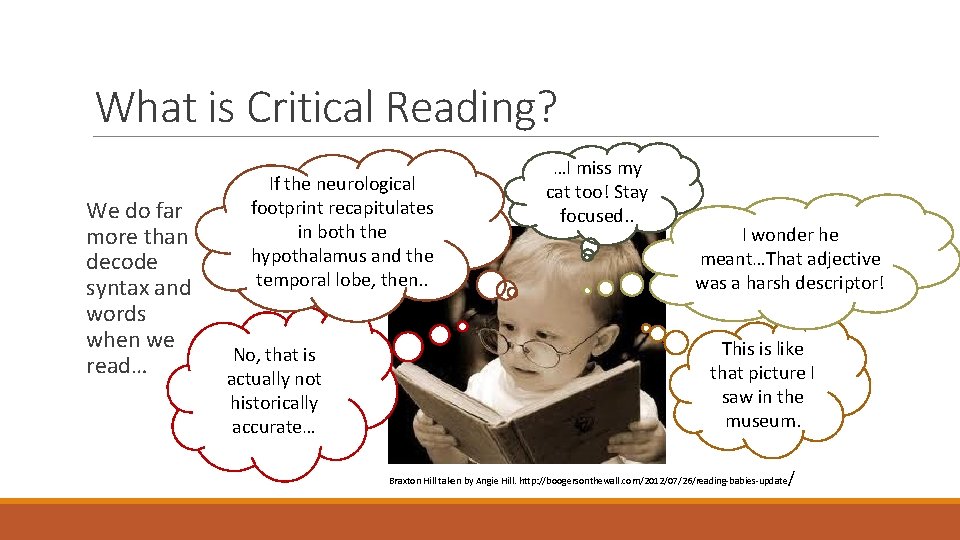
What is Critical Reading? We do far more than decode syntax and words when we read… If the neurological footprint recapitulates in both the hypothalamus and the temporal lobe, then. . No, that is actually not historically accurate… …I miss my cat too! Stay focused. . I wonder he meant…That adjective was a harsh descriptor! This is like that picture I saw in the museum. Braxton Hill taken by Angie Hill. http: //boogersonthewall. com/2012/07/26/reading-babies-update /
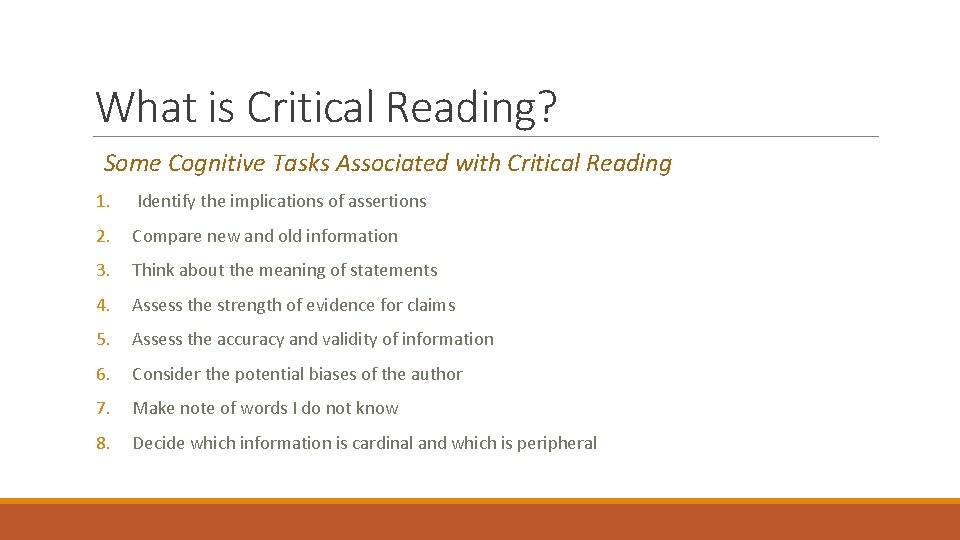
What is Critical Reading? Some Cognitive Tasks Associated with Critical Reading 1. Identify the implications of assertions 2. Compare new and old information 3. Think about the meaning of statements 4. Assess the strength of evidence for claims 5. Assess the accuracy and validity of information 6. Consider the potential biases of the author 7. Make note of words I do not know 8. Decide which information is cardinal and which is peripheral
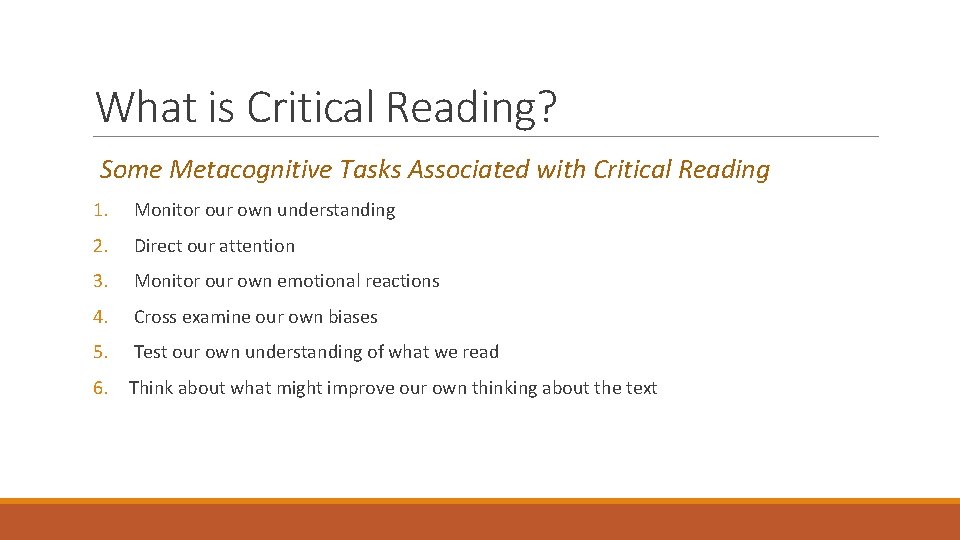
What is Critical Reading? Some Metacognitive Tasks Associated with Critical Reading 1. Monitor our own understanding 2. Direct our attention 3. Monitor our own emotional reactions 4. Cross examine our own biases 5. Test our own understanding of what we read 6. Think about what might improve our own thinking about the text
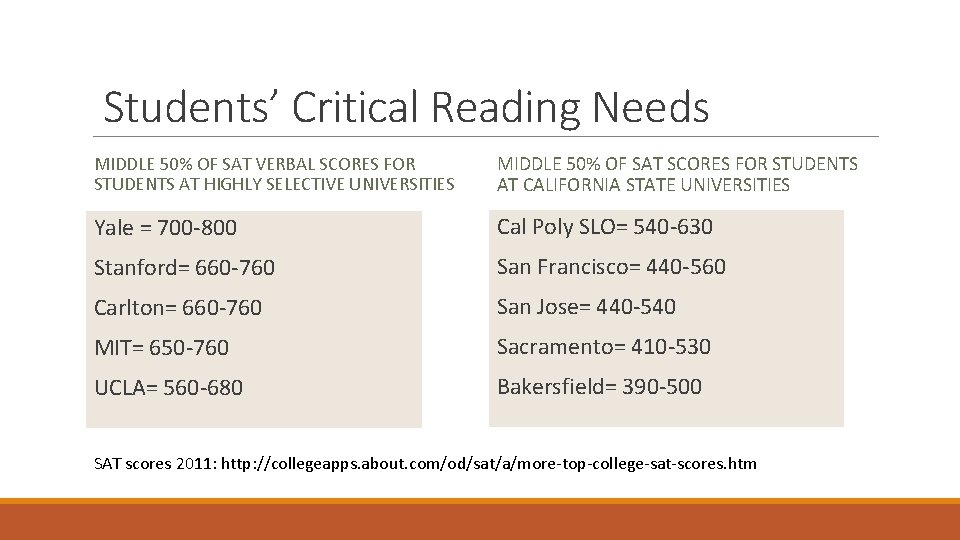
Students’ Critical Reading Needs MIDDLE 50% OF SAT VERBAL SCORES FOR STUDENTS AT HIGHLY SELECTIVE UNIVERSITIES MIDDLE 50% OF SAT SCORES FOR STUDENTS AT CALIFORNIA STATE UNIVERSITIES Yale = 700 -800 Cal Poly SLO= 540 -630 Stanford= 660 -760 San Francisco= 440 -560 Carlton= 660 -760 San Jose= 440 -540 MIT= 650 -760 Sacramento= 410 -530 UCLA= 560 -680 Bakersfield= 390 -500 SAT scores 2011: http: //collegeapps. about. com/od/sat/a/more-top-college-sat-scores. htm
Students’ Critical Reading Needs READING LEVELS OF ADULTS AND STUDENTS IN 2 AND 4 -YEAR COLLEGES (BAER, ET. AL. 2003)
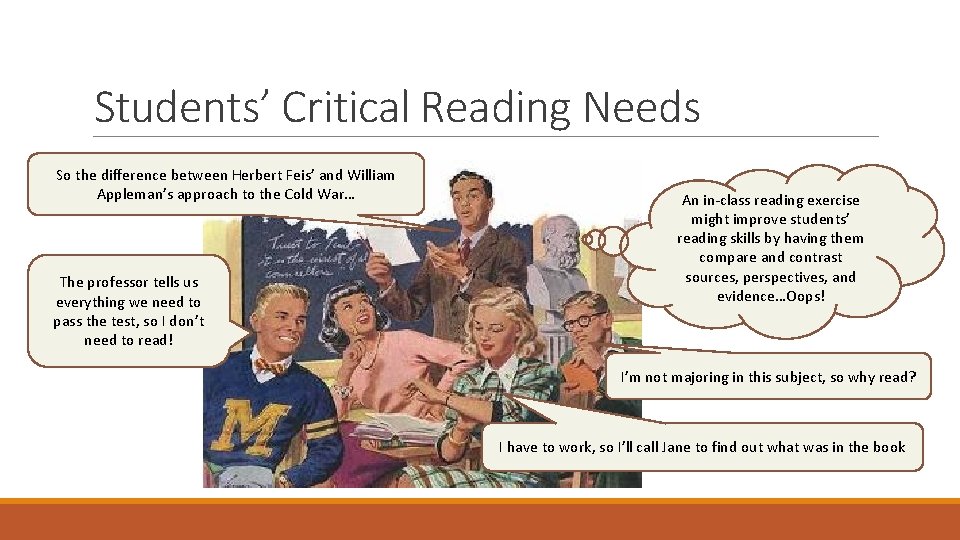
Students’ Critical Reading Needs So the difference between Herbert Feis’ and William Appleman’s approach to the Cold War… The professor tells us everything we need to pass the test, so I don’t need to read! An in-class reading exercise might improve students’ reading skills by having them compare and contrast sources, perspectives, and evidence…Oops! I’m not majoring in this subject, so why read? I have to work, so I’ll call Jane to find out what was in the book
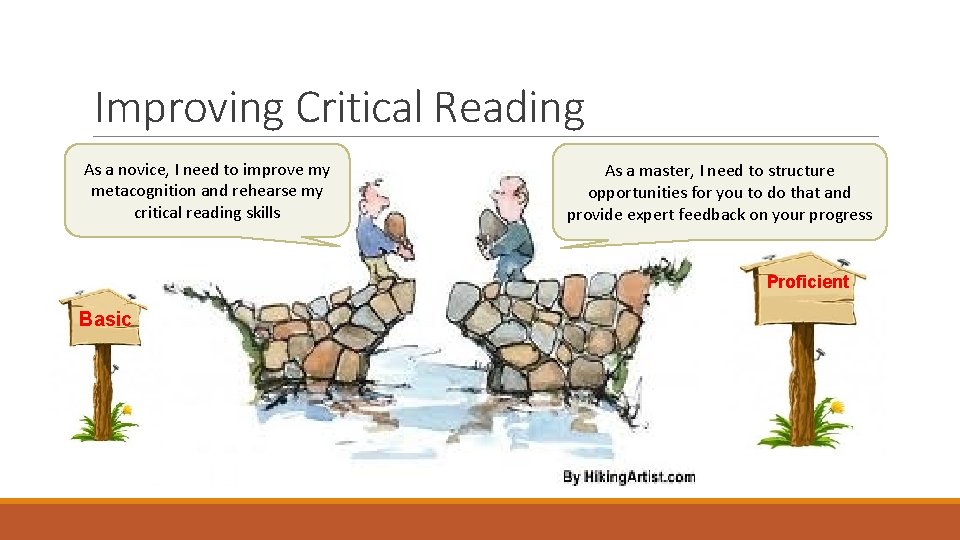
Improving Critical Reading As a novice, I need to improve my metacognition and rehearse my critical reading skills As a master, I need to structure opportunities for you to do that and provide expert feedback on your progress Proficient Basic
Improving Critical Reading Skills WHAT INSTRUCTORS CAN DO Ø Take students’ literacy needs seriously Ø Treat critical reading as course content Ø Integrate critical reading exercises into assignments Ø Offer abundant formative assessments of reading exercises ØExplicitly guide students in their understanding of the cognitive skills associated with reading proficiency ØExplicitly guide students in their use of metacognition while they read Ø incorporate reading exercises into summative assessments and exams
Improving Critical Reading Skills WHAT STUDENTS CAN DO ØTake your reading needs seriously ØMonitor your understanding by stating main ideas in your own words ØLook up words you do not know ØRe-read things to discover details or perspectives you might have previously missed ØThink about what you read, the implications, veracity, and significance of assertions ØDevelop an appreciation for scholarly articulation ØIncrease your awareness of the consequences of a limited capacity to express complex ideas