Introduction to the CMSE Shared Experimental Facilities Anthony
- Slides: 93
Introduction to the CMSE Shared Experimental Facilities Anthony J. Garratt-Reed, SEF Staff Thu Jan 11, 02 -05: 00 pm, 13 -2137, Refreshments provided No enrollment limit, no advance sign up , Single session event The Shared Experimental Facilities in the Center for Materials Science and Engineering provide a wide range of Materials Characterization instrumentation openly available to researchers. This includes electron microscopes, X-ray diffraction systems, surface analysis, spectroscopy techniques, thermal analysis and crystal growth furnaces. Come and find out more details about what we have, what it can do for you, and who runs it! Each staff member will give a short introduction to the instruments in their care. Most staff will be offering a more detailed presentation about their equipment later during IAP. Contact: Anthony J. Garratt-Reed, 13 -1027, x 3 -4622, tonygr@mit. edu Sponsor: Center for Materials Science and Engineering Latest update: 27 -Nov-2006 IAP 2007
Tim Mc. Clure Analysis Shared Experimental Facility Project Technician Office: 13 -4149 Phone: (617) 258 -6470 Email: mtim@mit. edu http: //mit. edu/mtim/www MIT Center for Material Science and Engineering 77 Massachusetts Avenue, Cambridge, Massachusetts 02139 IAP 2007
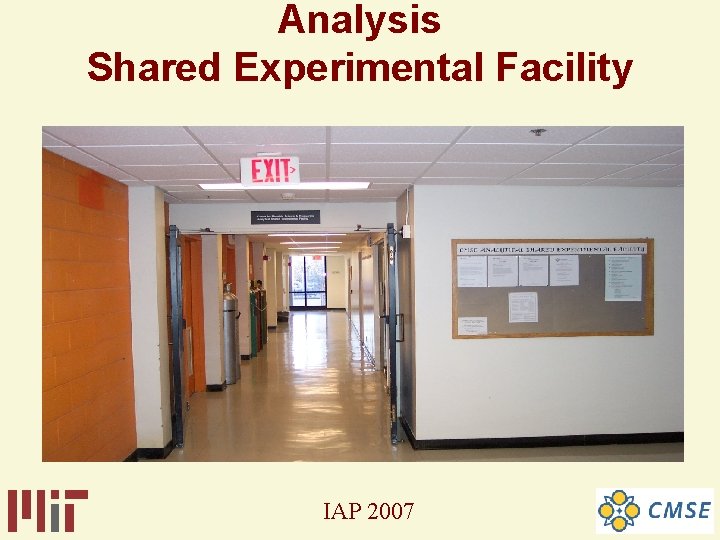
Analysis Shared Experimental Facility IAP 2007
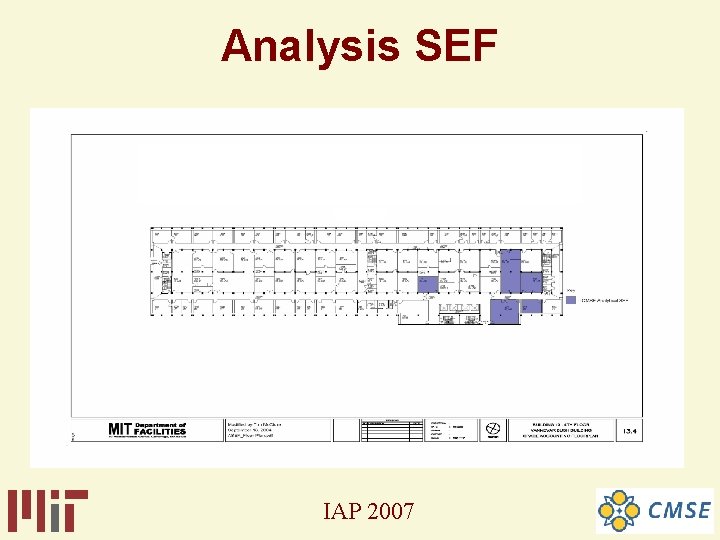
Analysis SEF IAP 2007
Analysis SEF Staff Dr. Shaoyan Chu Tim Mc. Clure Elisabeth Shaw sc 79@mit. edu mtim@mit. edu elshaw@mit. edu IAP 2007 X 3 -0054 X 8 -6470 X 3 -5045
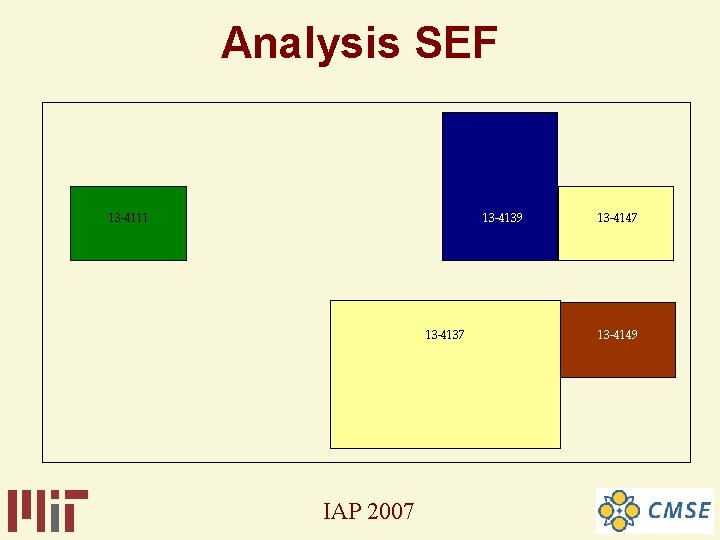
Analysis SEF 13 -4111 13 -4139 13 -4137 IAP 2007 13 -4149
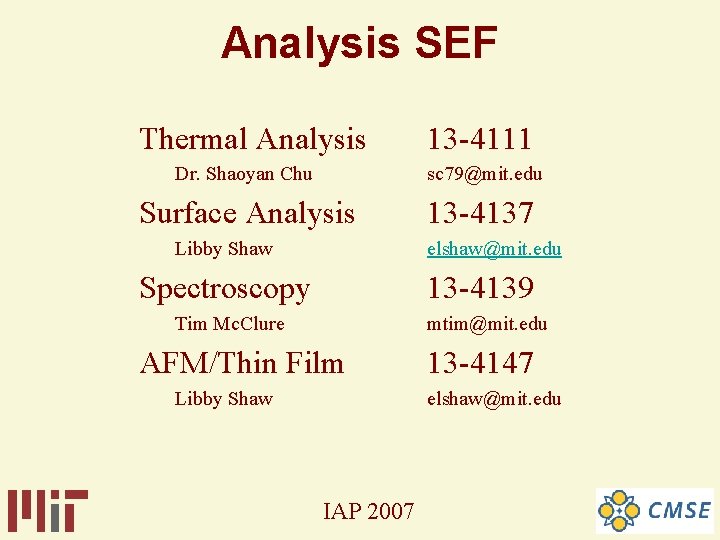
Analysis SEF Thermal Analysis 13 -4111 Dr. Shaoyan Chu sc 79@mit. edu Surface Analysis 13 -4137 Libby Shaw elshaw@mit. edu Spectroscopy 13 -4139 Tim Mc. Clure mtim@mit. edu AFM/Thin Film Libby Shaw 13 -4147 elshaw@mit. edu IAP 2007
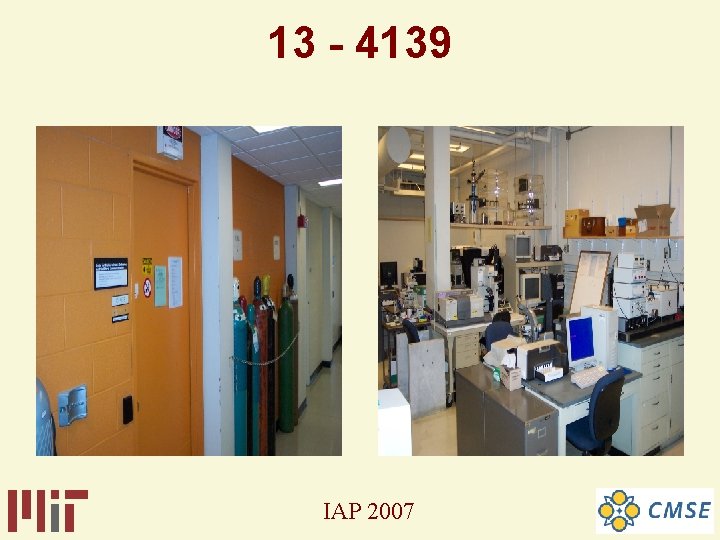
13 - 4139 IAP 2007
Instrumentation in 13 -4139 Spectroscopy Microscopy Thin Film Support IAP 2007
Instrumentation in 13 -4139 Spectroscopy FTIR, Raman, UV/VIS/NIR, Fluorimeter Microscopy Thin Film Support IAP 2007
Instrumentation in 13 -4139 Spectroscopy FTIR, Raman, UV/VIS/NIR, Fluorimeter Microscopy Optical, Thermal, FTIR, Raman Thin Film Support IAP 2007
Instrumentation in 13 -4139 Spectroscopy FTIR, Raman, UV/VIS/NIR, Fluorimeter Microscopy Optical, Thermal, FTIR, Raman Thin Film Profilometer, Flexus, Thermal Co-Evaporator, Plasma Cleaner Support IAP 2007
Instrumentation in 13 -4139 Spectroscopy FTIR, Raman, UV/VIS/NIR, Fluorimeter Microscopy Optical, Thermal, FTIR, Raman Thin Film Profilometer, Flexus, Thermal Co-Evaporator, Plasma Cleaner Support Temperature Controlled Microscope Stages, Cryostat, Lasers, Exhaust Hood, Oven IAP 2007
Spectroscopy IAP 2007
Spectroscopy There are many types of spectroscopic analysis techniques XRAY XPS ICP Etc. IAP 2007
Optical Spectroscopy Methods Absorption Emisson Luminescence Scattering IAP 2007
Absorption Spectroscopy Absorbance or the ratio of transmitted to incident radiant power • Atomic absorption • UV/VIS molecular absorption • IR absorption IAP 2007
Emission Spectroscopy Radiant power of emission • ICP • Spark • Flame • DC Arc IAP 2007
Luminescence Spectroscopy Radiant power of luminescence • Molecular Fluorescence • Phosphorescence • Chemical and Bioluminescence • Atomic Fluorescence IAP 2007
Scattering Spectroscopy Radiant power of scattering • Raman Scattering • Mie scattering • turbidity IAP 2007
Optical Spectroscopy Interaction of optical electromagnetic radiation with matter Vibrational IAP 2007
Spectra Intramolecular Vibrations IAP 2007
Stretching Vibrations • In a simple diatomic molecule A-B the only vibration which can occur is a periodic stretching along the A-B bond. • Stretching vibrations resemble the oscillations of two bodies connected by a spring. IAP 2007
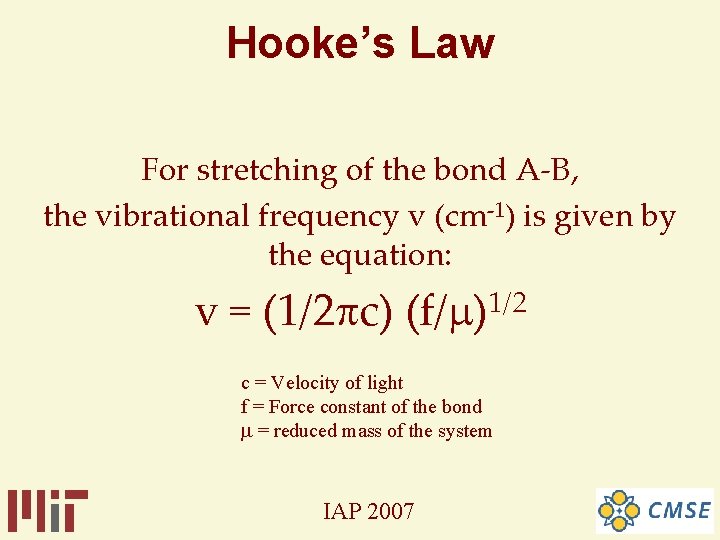
Hooke’s Law For stretching of the bond A-B, the vibrational frequency v (cm-1) is given by the equation: v = (1/2 c) 1/2 (f/ ) c = Velocity of light f = Force constant of the bond = reduced mass of the system IAP 2007
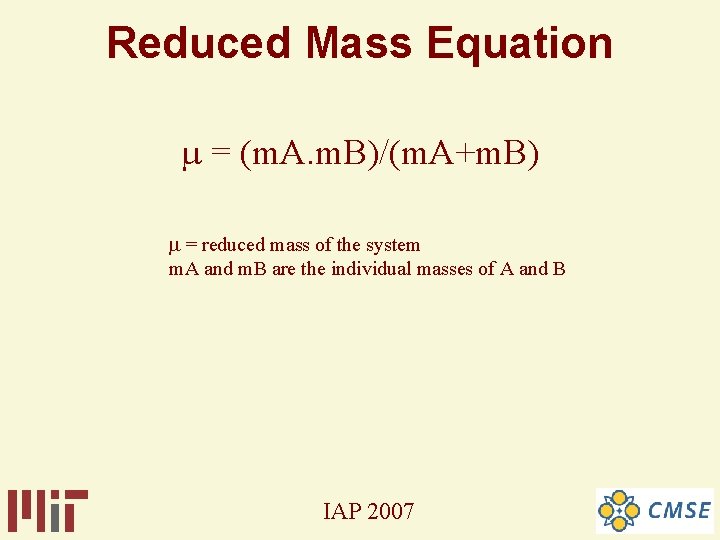
Reduced Mass Equation = (m. A. m. B)/(m. A+m. B) = reduced mass of the system m. A and m. B are the individual masses of A and B IAP 2007
Spectrochemical Analysis Is used to monitor • Water we drink • Food we eat • Status of human health • Quality of the environment IAP 2007
Spectroscopic Intruments • Fourier Transform Infrared (FTIR) -Thermo Nicolet –Magna 860 Bench –Nic Plan Microscope • Raman Microprobe -Kaiser –Hololab 5000 R Modular Research System –Argon Ion (514. 5 nm), Titanium Sapphire (785 nm) CW Lasers, Diode (785 nm) • UV/Vis Spectrometers -Cary • 5 e • 500 i • Fluorimeter -PTI • QM 6/2006 IAP 2007
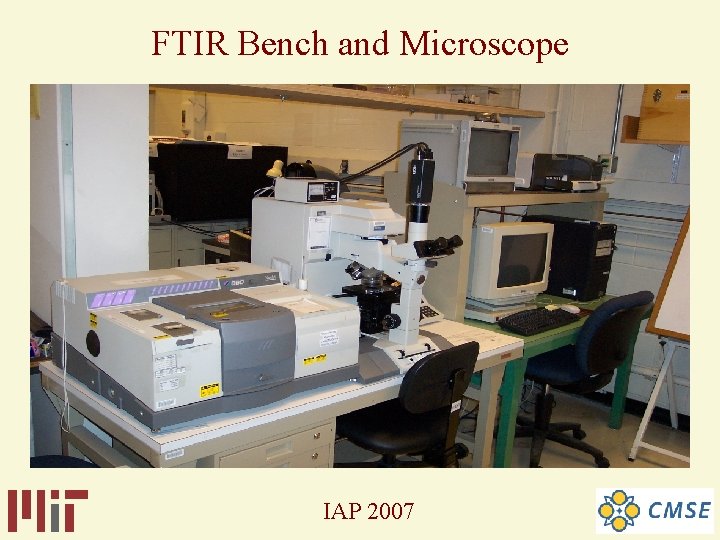
FTIR Bench and Microscope IAP 2007
Infrared Spectra The absorption or emission spectrum arising from the rotational and vibrational motions of a molecule which is not electronically excited is mostly in the infrared region. IAP 2007
IR Active Vibration Selection Rule There must be a net change in permanent dipole moment during the vibration IAP 2007
Vibrational Energies The energy of a vibrational mode depends on molecular structure and environment. Atomic mass bond order molecular substituents molecular geometry hydrogen bonding all effect the vibrational force constant IAP 2007
IR Spectroscopy Studies Identification of a Substance Determination of Molecular structure Determination of Purity Reaction Kinetic Studies Fundamental Studies of Molecules IAP 2007
Spectra • A unique physical property and is characteristic of the molecule • The infrared spectrum can be used as a fingerprint for identification • Compare with previously recorded reference spectra IAP 2007
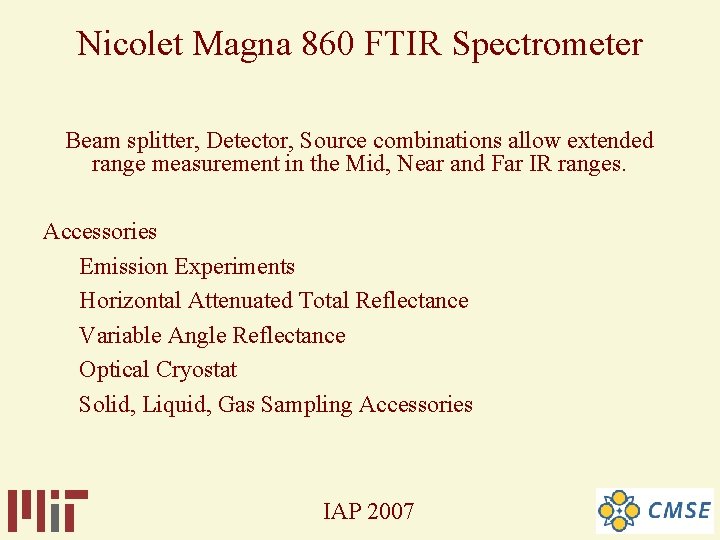
Nicolet Magna 860 FTIR Spectrometer Beam splitter, Detector, Source combinations allow extended range measurement in the Mid, Near and Far IR ranges. Accessories Emission Experiments Horizontal Attenuated Total Reflectance Variable Angle Reflectance Optical Cryostat Solid, Liquid, Gas Sampling Accessories IAP 2007
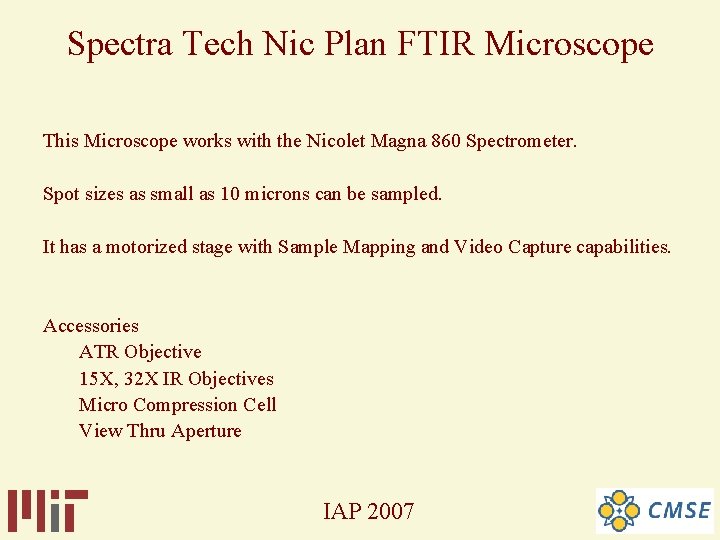
Spectra Tech Nic Plan FTIR Microscope This Microscope works with the Nicolet Magna 860 Spectrometer. Spot sizes as small as 10 microns can be sampled. It has a motorized stage with Sample Mapping and Video Capture capabilities. Accessories ATR Objective 15 X, 32 X IR Objectives Micro Compression Cell View Thru Aperture IAP 2007
FTIR Spectrum of Cyclohexane IAP 2007
FTIR Sensitivity to Carbon Hydrogen Bonds IAP 2007
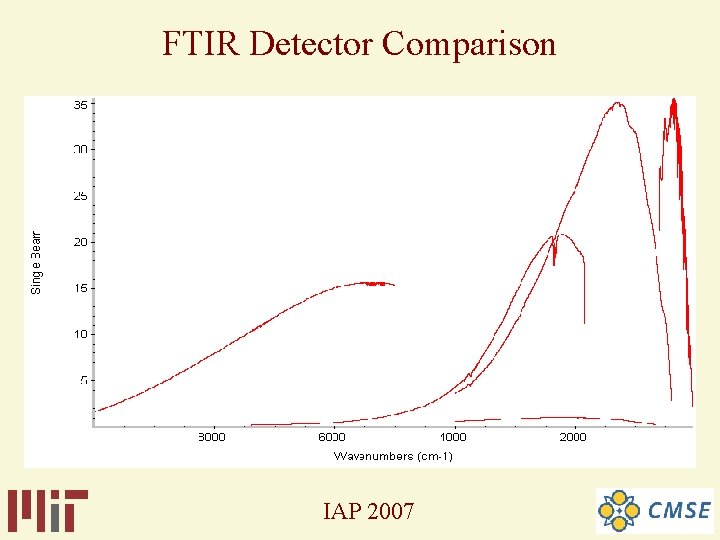
FTIR Detector Comparison IAP 2007
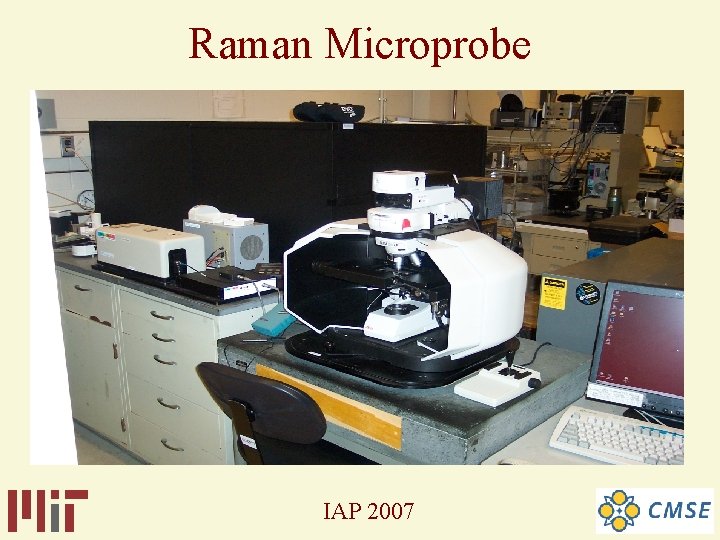
Raman Microprobe IAP 2007
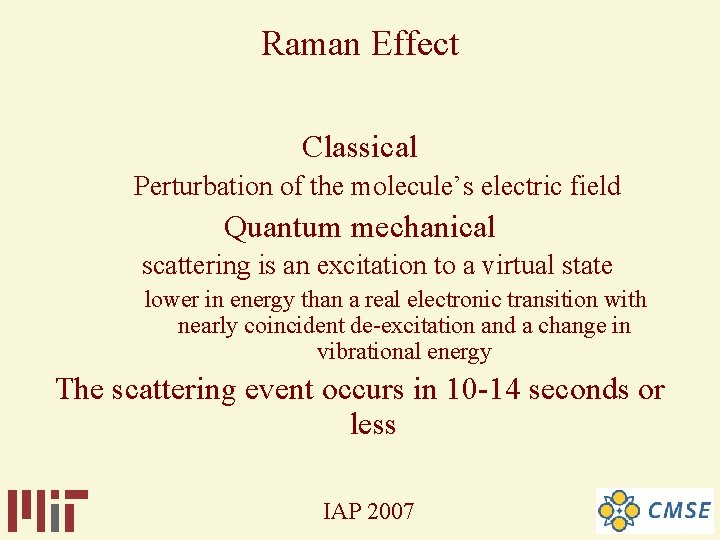
Raman Effect Classical Perturbation of the molecule’s electric field Quantum mechanical scattering is an excitation to a virtual state lower in energy than a real electronic transition with nearly coincident de-excitation and a change in vibrational energy The scattering event occurs in 10 -14 seconds or less IAP 2007
Raman Spectroscopy The Raman effect arises when a photon is incident on a molecule and interacts with the electric dipole of the molecule. It is a form of electronic spectroscopy Vibronic is more accurate IAP 2007
Raman Spectrum The difference in energy between the incident photon and the Raman scattered photon is equal to the energy of a vibration of the scattering molecule. A plot of intensity of scattered light versus energy difference is a Raman spectrum IAP 2007
Weak Raman Scatterers Highly polar moiety vibrations O-H bond An external electric field can not induce a large change in the dipole moment Stretching or bending the bond does not change this IAP 2007
Strong Raman Scatterers Moieties with distributed electron clouds carbon-carbon double bonds The electron cloud of the double bond is easily distorted in an external electric field Bending or stretching the bond changes the distribution of electron density substantially, and causes a large change in induced dipole moment IAP 2007
IR & Raman Molecular Frequencies Infrared absorption frequencies frequently agree with the frequency shifts found in the Raman effect Not always true Depends on the symmetry of the molecule IAP 2007
Raman Uses Vibrational Raman spectroscopy is not limited to intramolecular vibrations Crystal lattice vibrations and other motions of extended solids are Raman-active Polymers Semiconductors IAP 2007
Vibration/Rotation Spectra Gas phase rotational structure is resolvable on vibrational transitions The resulting vibration/rotation spectra are widely used to study combustion and gas phase reactions IAP 2007
Vibrations in Solids Spectra of crystals are almost always sharper than those of melts or solutions. Spectra of solids when compared to those of the solute in solution or their melts are invariably much more complex. The frequencies of the bands in the solid are shifted from those of itself in the liquid phase. Some bands can move considerably (30 cm-1 is not unusual). (IJVS) IAP 2007
Raman Microprobe Kaiser Optical Systems Modular 5000 R Research Grade Raman Leica Microscope Prior Motorized Stage 514. 5 nm or 785 nm Excitation Lasers Holographic Grating Spectrometer Andor Deep Depletion CCD 1024 X 512 Small or Large Fibers IAP 2007
Raman Spectrum of Cyclohexane IAP 2007
Raman & FTIR Spectrum of Cyclohexane IAP 2007
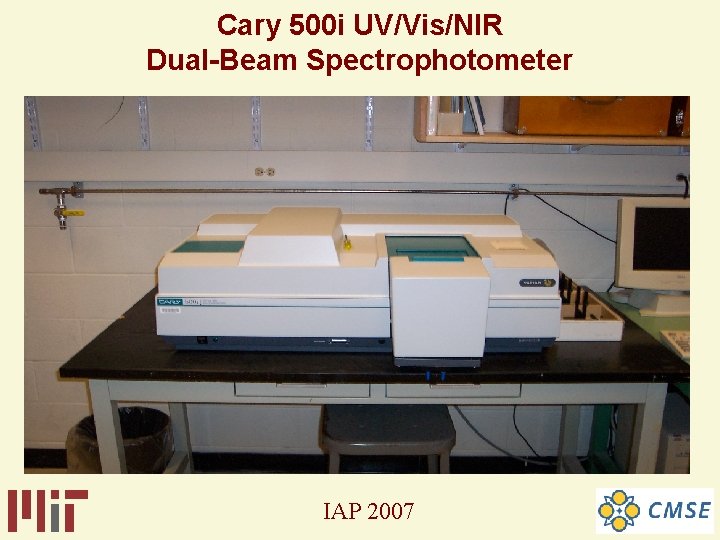
Cary 500 i UV/Vis/NIR Dual-Beam Spectrophotometer IAP 2007
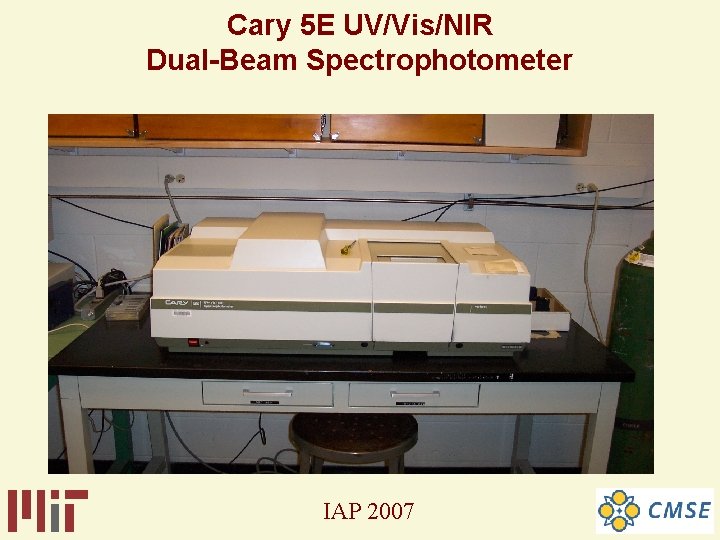
Cary 5 E UV/Vis/NIR Dual-Beam Spectrophotometer IAP 2007
UV/VIS/NIR spectroscopy is the measurement of the wavelength and intensity of absorption of near-ultraviolet and visible light by a sample Ultraviolet and visible light are energetic enough to promote outer electrons to higher energy levels UV/VIS/NIR spectroscopy is usually applied to molecules and inorganic ions or complexes in solution IAP 2007
UV/VIS/NIR Spectra The UV/VIS/NIR spectra have broad features that are of limited use for sample identification but are very useful for quantitative measurements. The concentration of an analyte in solution can be determined by measuring the absorbance at some wavelength and applying the Beer-Lambert Law IAP 2007
Cary 5 E UV/Vis/NIR Dual-Beam Spectrophotometer Wavelength Range: 175 to 3300 nm Sources: UV: Deuterium arc lamp Vis/NIR: Tungsten halogen lamp Detectors: UV/Vis: R 928 Photo Multiplying Tube (PMT) NIR: Thermoelectrically cooled lead sulfide photocell IAP 2007
Cary 500 i UV/Vis/NIR Dual-Beam Spectrophotometer Wavelength Range: 175 to 1750 nm Sources: UV: Deuterium arc lamp Vis/NIR: Tungsten halogen lamp Detectors: UV/Vis: R 928 photomultiplier tube NIR: Thermoelectrically cooled In. Ga. As PIN photodiode IAP 2007
Dual-Beam Spectrophotometer Measures the transmittance of the sample and solvent simultaneously Easier to identify small changes between sample and reference IAP 2007
UV/Vis Spectrophotometer Accessories Solid Sample & Cuvette Holders Multicell Holder Automated measurement of multiple liquid samples Temperature Controlled Optical Cryostats Liquid Nitrogen Liquid Helium IAP 2007
UV/Vis Spectrophotometer Accessories Specular Reflectance (SRA) Fixed 7° Variable Angle Specular Reflectance (VASRA) 20 to 70° IAP 2007
UV/Vis Spectrophotometer Accessories Diffuse Reflectance (DRA) 114 mm Integrating Sphere Internal Detectors (250 nm - 2500 nm) PMT Pbs Praying Mantis Reflectance Accessory Diffuse Reflectance Accessory (220 nm to 3300 nm) Powders Pastes Liquids 3 mm Analysis Area IAP 2007
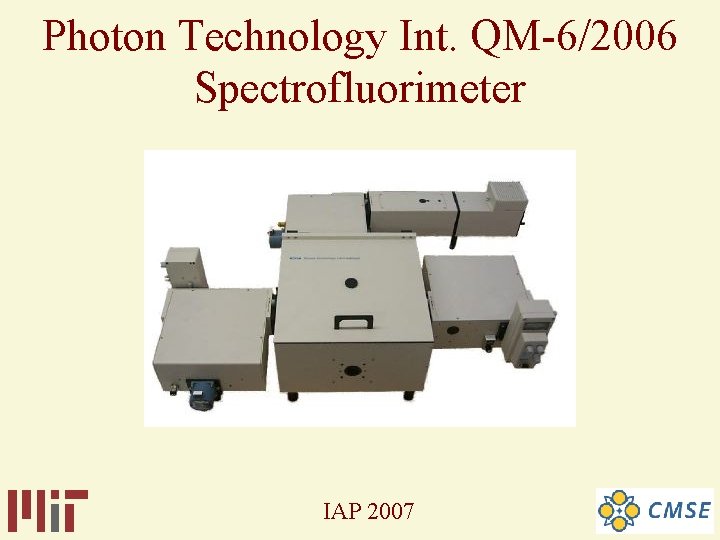
Photon Technology Int. QM-6/2006 Spectrofluorimeter IAP 2007
Photon Technology Int. QM-6/2006 Spectrofluorimeter This is a solid state UV/VIS/NIR Spectrofluorimeter that is on loan from PTI. IAP 2007
Fluorimetry Light emission from atoms or molecules can be used to quantitate the amount of the emitting substance in a sample IAP 2007
Fluorimetry Applications Yields detailed information about complex molecules and their reaction pathways. Binding of biochemical species can be easily studied in situ. Distances within macromolecules may be measured. The dynamics of the folding of proteins can be studied. Concentrations of ions can be measured inside living cells. Membrane structure and function may be studied with fluorescence probes. IAP 2007
Fluorimetry Applications Minute traces of fluorescent materials can be detected and identified in mixtures. Oil samples can be finger-printed and identified by their fluorescence. The electronic structure and dynamics of an excited state of a molecule may be elucidated. Drug interactions with cell receptors can be investigated. Useful for NIR photoluminescence measurement of carbon nanotubes IAP 2007
Fluorimeter Data Show Example Data IAP 2007
Optical Microscopes Zeiss Axioskop Zeiss Ultraphot IAP 2007
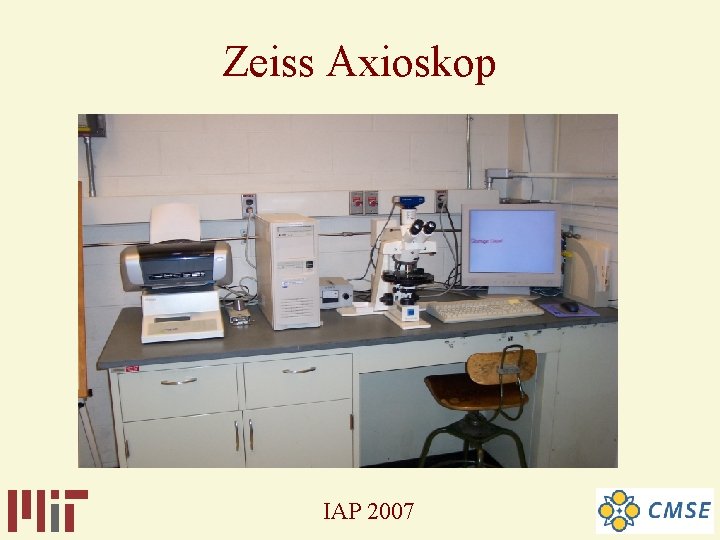
Zeiss Axioskop IAP 2007
Zeiss Axioskop T&R Polarizer's DIC 35 mm Camera Digital Camera Image Analysis Software IAP 2007
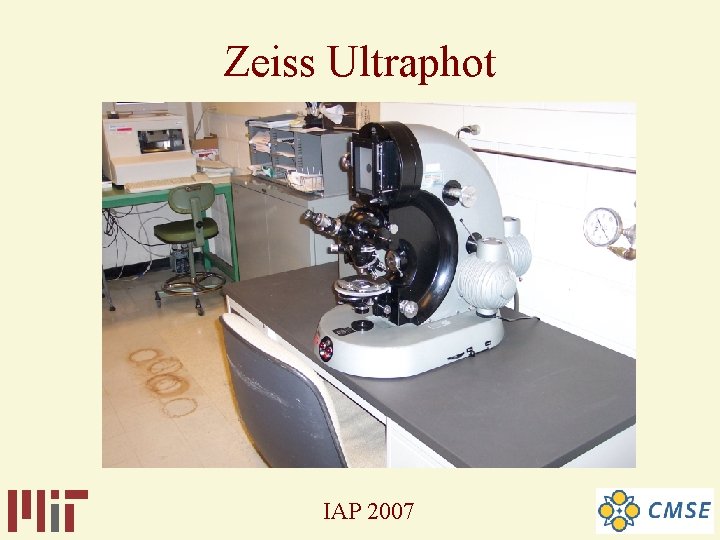
Zeiss Ultraphot IAP 2007
Zeiss Ultraphot 1930 s Analytical Metalographic Microscope Stable Transmission Reflection Depth of Field Flatness of Field IAP 2007
Temperature Controlled Microscope Stages Linkum FTIR 600 (-190 C) to 600 C Mettler R. T. to 350 C IAP 2007
Linkum Freeze Stage For use under any of the laboratories microscopes (Raman, FTIR, Optical) Temperature Range -190°C to 600°C Transmission or Reflection Programable Controlled Sample Atmosphere IAP 2007
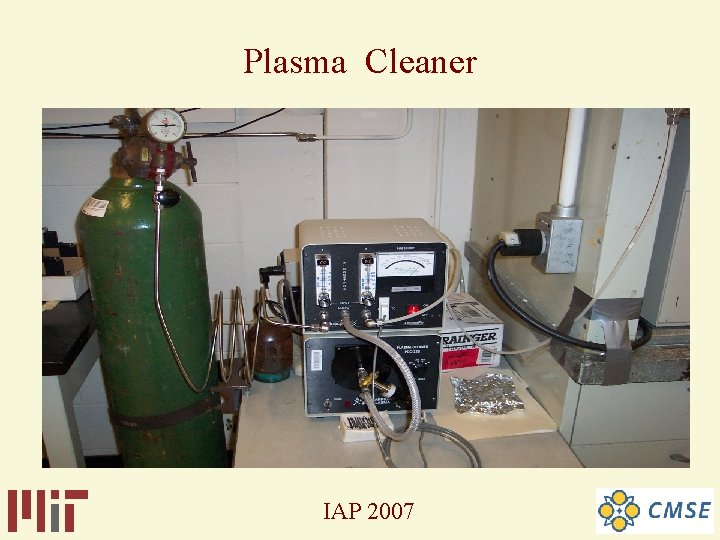
Plasma Cleaner IAP 2007
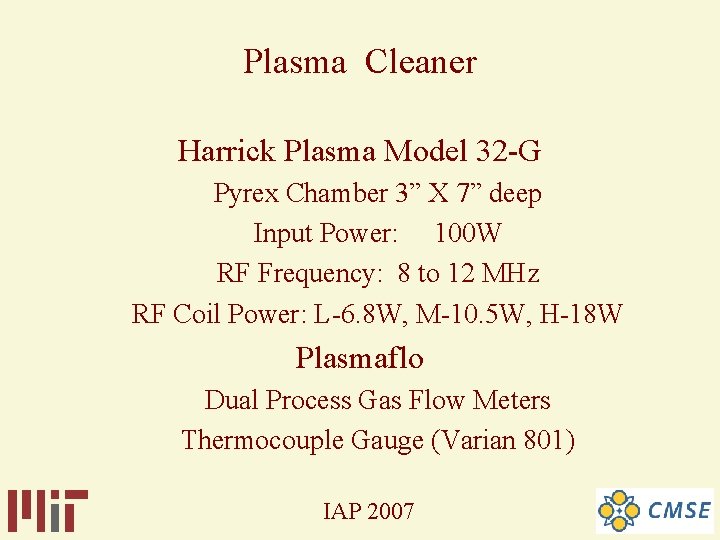
Plasma Cleaner Harrick Plasma Model 32 -G Pyrex Chamber 3” X 7” deep Input Power: 100 W RF Frequency: 8 to 12 MHz RF Coil Power: L-6. 8 W, M-10. 5 W, H-18 W Plasmaflo Dual Process Gas Flow Meters Thermocouple Gauge (Varian 801) IAP 2007
Plasma Cleaner Principle of Operation When a gas under sufficiently low pressure is subjected to a high frequency oscillating electromagnetic field, the accelerated ions in the gas collide with the gas molecules ionizing them and forming plasma. IAP 2007
Plasma Cleaner Principle of Operation (Cont) The ionized gas particles in the plasma interact with solid surfaces placed in the same environment by: Removing organic contamination from surfaces. The high energy plasma particles combine with the contaminant to form carbon dioxide (CO 2) or methane (CH 4) Modifying or enhancing the physical and chemical characteristics of surfaces. A chemical reaction occurs between the plasma gas molecules and the surface undergoing treatment. IAP 2007
Plasma Cleaner The type of interaction between the plasma and the surface depends on: RF Power Frequency Intensity Gas Pressure Flow Rate Time Sample IAP 2007
Thermal Co-evaporator IAP 2007
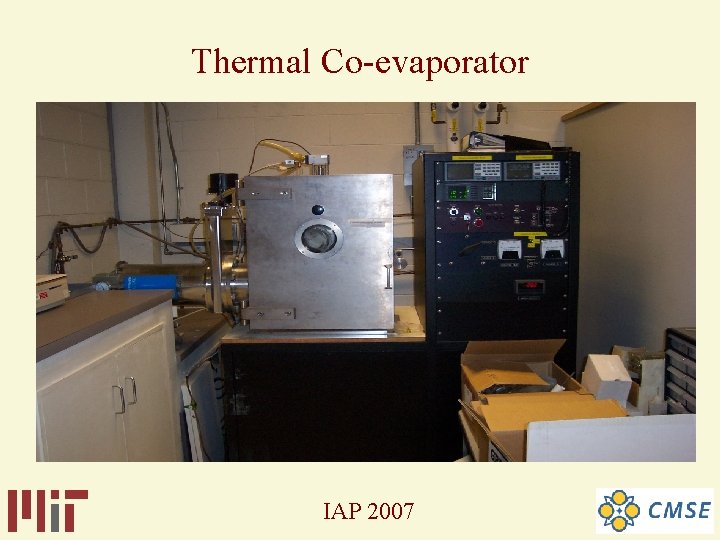
Thermal Co-evaporator This evaporator has three filament positions. The deposition can be controlled from two separate crystal monitor controllers allowing for COEvaporation from two sources (2 KVA and 4 KVA) simultaneously. The substrate stage is water cooled and temperature monitored. It has a cryo-pumped vacuum system with an interlocked Ion gauge controller and automatic valve sequencing controls. IAP 2007
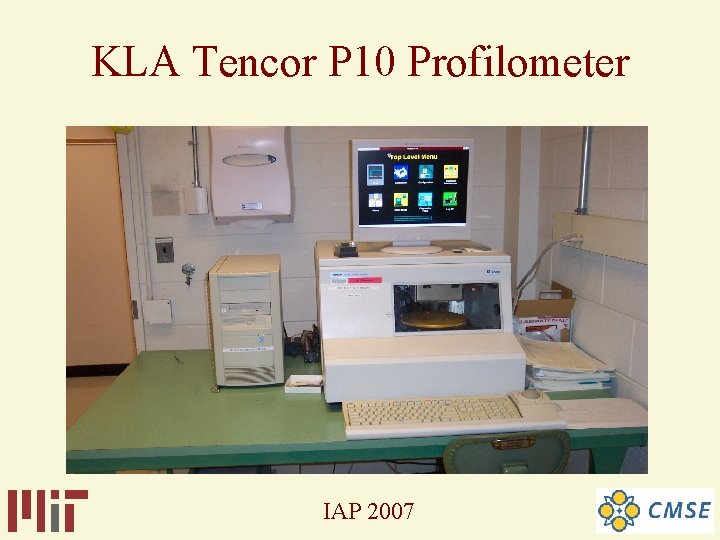
KLA Tencor P 10 Profilometer IAP 2007
KLA Tencor P 10 Profilometer Provides high precision surface topography measurements on a wide variety of substrates using a diamond tipped stylus. This system features a motorized stage. Dual view optics (side view: 95 -410 X, top view: 115 -465 X and 185 -750 X with user interchangeable lenses). The maximum sample size is 355 X 355 mm (14" X 14") and a maximum scan length of 60 mm (2. 3"). 3 d Mapping 2. 5 um Styli Used for Features 100 Angstrom to 327 micorns IAP 2007
KLA Tencor P 10 Profilometer Show Example Data IAP 2007
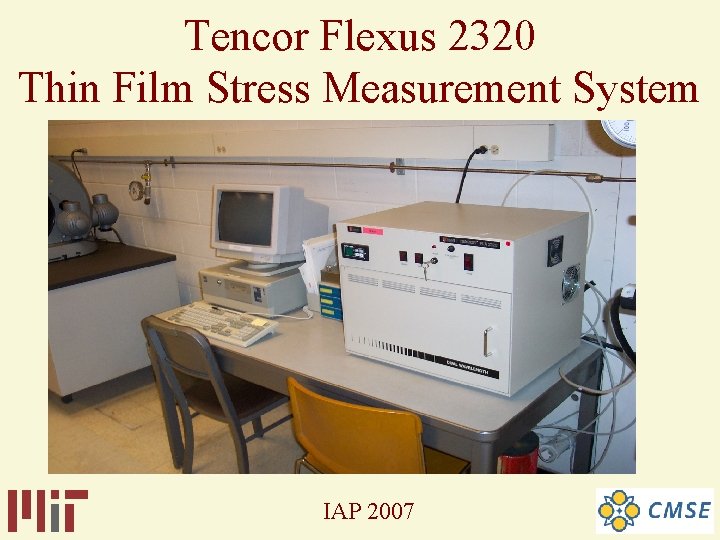
Tencor Flexus 2320 Thin Film Stress Measurement System IAP 2007
Tencor Flexus 2320 Thin Film Stress Measurement System This instrument measures the changes in the radius of curvature of a substrate caused by deposition of a stressed thin film. The change in radius of curvature can be measured over time and as a function of temperature. This system has been modified to extend the normal operating temperature of the hotstage. -150°C to 500°C IAP 2007
MIT Links Center for Materials Science & Engineering web. mit. edu/cmse/ CMSE SEFs prism. mit. edu Materials@MIT materials. mit. edu Tims Web mit. edu/mtim/www/ IAP 2007
Informational Links Internet Journal of Vibrational Spectroscopy www. ijvs. com Optical Microscopy Primer micro. magnet. fsu. edu/primer/ FTIR & Raman Search ftirsearch. com IAP 2007
Instrument Manufacturers Links Kaiser Optical www. kosi. com Photon Technology International www. pti-nj. com Varian www. varianinc. com Thermo Scientific www. thermo. com KLA Tencor www. kla-tencor. com Carl Zeiss www. zeiss. com/micro Harrick Plasma www. harrickplasma. com/ IAP 2007
References • Fourier Transform Infrared Spectrometry Peter R. Griffiths, James A. de Haseth ISBN: 0 -471 -09902 -3 • Molecular Vibrations Theory of Infrared and Raman Vibrational Spectra E. Bright Wilson, Jr. , J. C. Decius and Paul C. Cross ISBN: 0 -486 -63941 -X • Analytical Applications of Raman Spectroscopy Michael J. Pelletier ISBN: 0 -632 -05305 -4 • Handbook of Raman Spectroscopy From the Research Laboratory to the Process Line Ian R. Lewis, Howell G. Edwards ISBN: 0 -8247 -0557 -2 IAP 2007
User Levels Assisted Not interested in becoming a self user (1 X) Training We work together on your sample until we are both comfortable with your operation of the instrument Self 24 Hour access (Undergraduates restricted) Instrument Training Room Safety Orientation IAP 2007
Getting Access to 13 -4139 Contact me Discuss your needs Reserve the instrument together IAP 2007
Spectroscopic Instrumentation at CMSE Wed Jan 31, 10 am-12: 00 pm, 13 -2137 No limit but advance sign up required (see contact below) Signup by: 23 -Jan-2006 Single session event The Center for Materials Science and Engineering's Analysis Shared Experimental Facility has an assortment of Spectroscopic instrumentation available for the use of MIT researchers. These include FTIR, Raman, UV/VIS and Fluorimeter. There will be presentations on the instrumentation and the various measurement techniques available. Preregister via e-mail. Contact: Tim Mc. Clure, 13 -4149, x 8 -6470, mtim@mit. edu IAP 2007