THE ART SCIENCE OF MEDITATION Dr Sudhir Shah





- Slides: 114
THE ART & SCIENCE OF MEDITATION Dr Sudhir Shah MD DM Neurology Professor of Neurology – K. M. School of PGMR Head, Department of Neurology – VSGH, AHD Director of Neurosciences – Sterling Hospital Consultant Neurologist - Ahmedabad, INDIA India 3 rd Jan 2010
Why Meditation ?
• We exist in two forms : body and mind. : exercise. . (essay) • At some stage you realize that peace and happiness are not outside. • The cause of miseries : thoughts, aspirations, past & present and attitude • The quest for the god. • All great people have done meditation.
What is meditation • Exercise of mind to keep it healthy and clean, as we do for body. • A state of altered consciousness. • Fourth stage of consciousness. • Spiritual ecstasy with neurological manifestation. • Not really a Hallucination. • Caution.
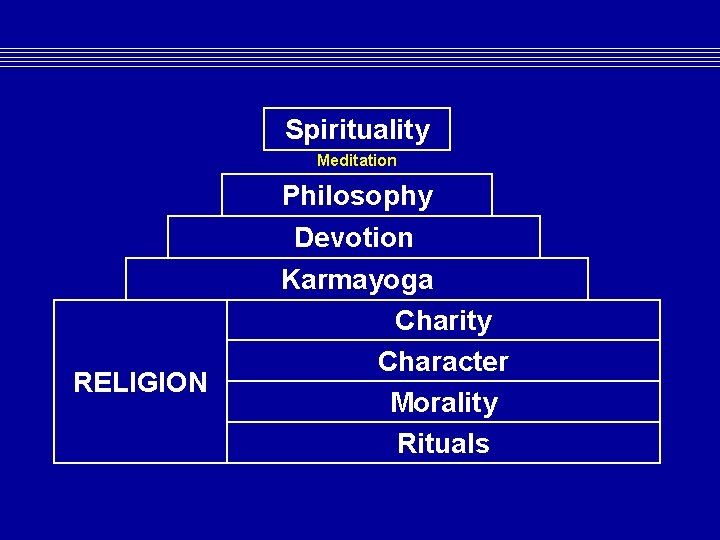
Spirituality Meditation RELIGION Philosophy Devotion Karmayoga Charity Character Morality Rituals
What is meditation? Definitions • Stability of mind • Wavering of mind is stopped • Concentration on one target • Unified thought process • Thoughtlessness • Introspection • Lack of activity • To leave, to give away • Mental aerobics • Intentional self regulation • Patanjali • Dedication • Buddha • Stay connected • Narad
What is meditation? Definitions Definition : Thinking deeply or spiritually about a subject It is a complex cognitive task It is more than relaxation, concentration, It contemplation or posturing Frees the mind from distractions and allows for communication with the “Master Within” The ultimate goal is ILLUMINATION : ENLIGHTENMENT
Meditation : advantages • Physical, mental and emotional health. • Cure / control of psychosomatic disorders including high blood pressure, coronary artery disease, DM, asthma, rheumatism etc. • Stress relief. • Spiritual health. • Better concentration and sharpness. • Produces relaxation and reduces reactivity. • Improves Job performance. • Interpersonal relations.
Meditation : advantages • Brings change of attitude • Inner peace, patience and happiness. • Cultivates and promotes positive emotions and removes negative thoughts. • Helps in controlling anger and conquering fear. • Brings control over thought process. • Improves quality of life. • Intuitive knowledge, healing power, magnetic personality and occult powers.
Meditation is an antidote to stress • The neuro chemistry and neuro physiology of meditation is just the reverse of stress. Stress : Over activity of Sympathetic system. • Meditation: Over activity of Parasympathetic system.
Caution • However, it is not a push button system, you need patience. Hence there is a 90 to 95% -drop out rate. You need to have right guide, right method, correct understanding, appropriate place, constant practice, extreme faith and full conviction. • Please do not sleep. • Meditation industry is at height, because commercialization, so one should be careful. • Not to make comparisons, All systems are great of
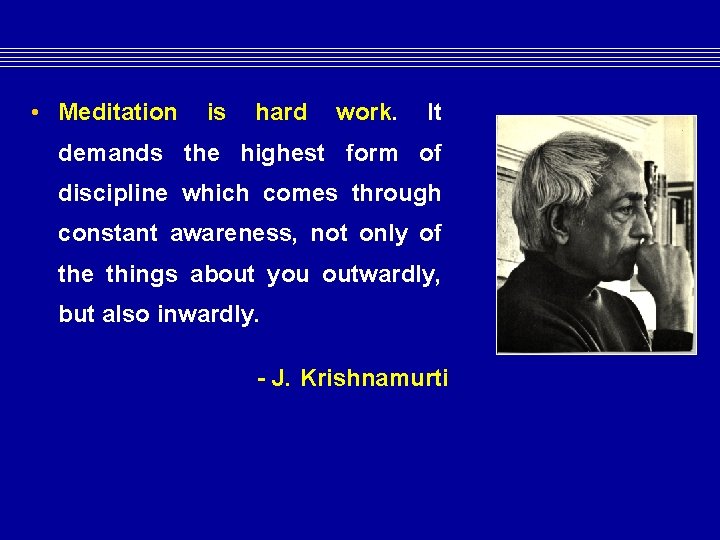
• Meditation is hard work. It demands the highest form of discipline which comes through constant awareness, not only of the things about you outwardly, but also inwardly. - J. Krishnamurti
The Real Purpose Of Meditation • Elimination of Ego • Elimination of Mind
MEDITATION : PHILOSOPHICAL PURPOSE • Philosophical self realization • God realization • Total bliss (total relief of pain) • Total liberation
Meditation techniques • Focus on Breathing • Focus on an object, light • Focus on a sound • Focus on a thought • Focus on sensual object • Focus on sensory perception • Imagery • Soul meditation
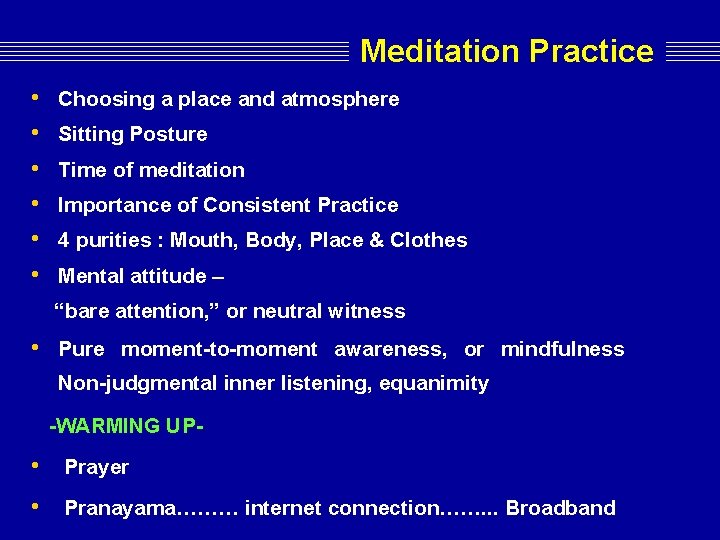
Meditation Practice • • • Choosing a place and atmosphere Sitting Posture Time of meditation Importance of Consistent Practice 4 purities : Mouth, Body, Place & Clothes Mental attitude – “bare attention, ” or neutral witness • Pure moment-to-moment awareness, or mindfulness Non-judgmental inner listening, equanimity -WARMING UP- • Prayer • Pranayama……… internet connection……. . . Broadband
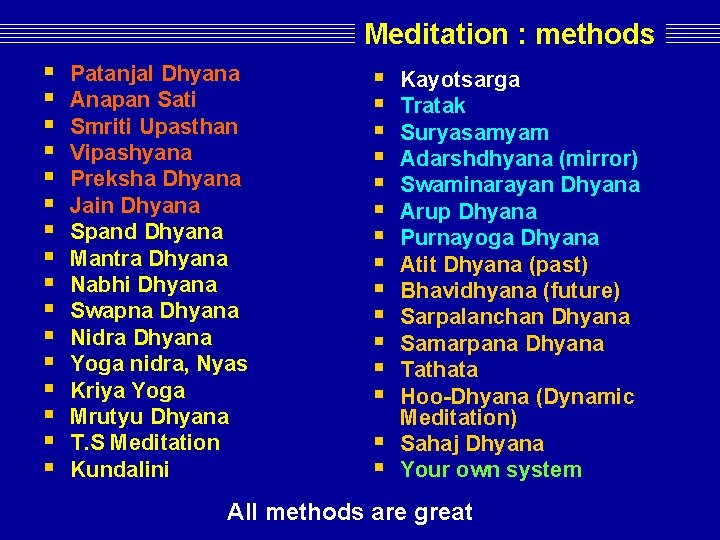
Meditation : methods § § § § Patanjal Dhyana Anapan Sati Smriti Upasthan Vipashyana Preksha Dhyana Jain Dhyana Spand Dhyana Mantra Dhyana Nabhi Dhyana Swapna Dhyana Nidra Dhyana Yoga nidra, Nyas Kriya Yoga Mrutyu Dhyana T. S Meditation Kundalini § § § § Kayotsarga Tratak Suryasamyam Adarshdhyana (mirror) Swaminarayan Dhyana Arup Dhyana Purnayoga Dhyana Atit Dhyana (past) Bhavidhyana (future) Sarpalanchan Dhyana Samarpana Dhyana Tathata Hoo-Dhyana (Dynamic Meditation) Sahaj Dhyana Your own system All methods are great
PATANJAL RAJ YOGA • Yama : Nonviolence, truth, non-stealing celibacy and aparigriha (Non-collectiveness) • Niyama : Purity, Penance (Austerity) Satisfaction Spiritual learning Worship & dedication • Asana : • Pranayama : • Pratyaahar : • Dharna : • Dhyana • Samadhi : :
Meditation over an object, place or thought Chakra, Flame or Photo with eyes open or closed
Basic Instructions for Meditation Anapan Sati • To bring the attention to the breath, but not to control the breathing. It is not pranayama. • Give full attention to the feeling of the breath as it goes in and out. • Dwell in the present, moment by moment, breath by breath. • Observe your mind with moment-to-moment awareness.
Basic Instructions for Meditation • When attention wanders, note it and then gently bring awareness back to the breath. • Why breathing ? Truth, vital, secular, always with you, present tense, carrier of mind – Emotions, thoughts, and perversions • Continue to watch the breath, accepting each moment as it is for 1 hour. Not to loose single breath - The power of ‘NOW’ - The concept of ‘VOID’ • When breathing takes consciousness into each cell, there is a vital dance
Meditation-Techniques • Smriti Upasthan : Observation & awareness of thoughts Budhha, Krishnamurti Avoid conflict with mind The root cause of miseries is thoughts Study beginning, end, structure & content of thoughts. Pl. do not criticize Observe & know your thoughts Study movement of mind and feel separated This will lead to detachment with thoughts Becoming aware of one’s consciousness Observer will realize that himself is being observed • Purnayoga : Maharishi Aurobindo’s method of combination Yoga Empty your thoughts & know your mind
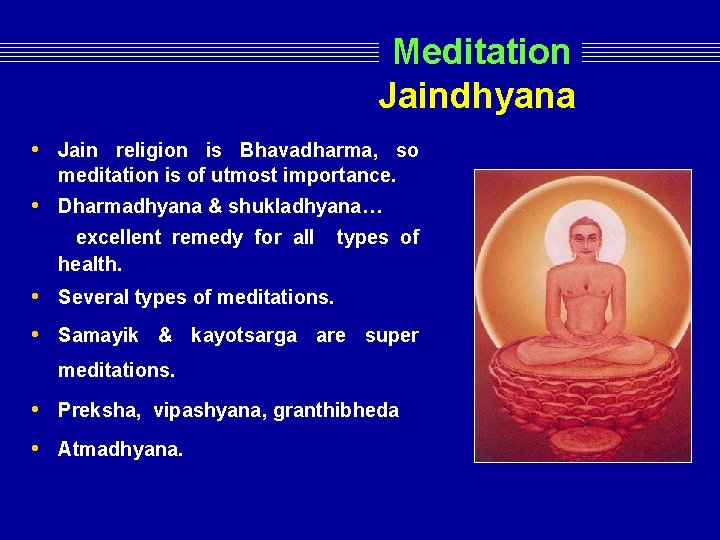
Meditation Jaindhyana • Jain religion is Bhavadharma, so meditation is of utmost importance. • Dharmadhyana & shukladhyana… excellent remedy for all types of health. • Several types of meditations. • Samayik & kayotsarga are super meditations. • Preksha, vipashyana, granthibheda • Atmadhyana.
Atmadhyana • Meditating on the soul is one of the best meditations. • To remain constantly aware of the soul and its characteristics and its functions. To dissociate soul from the body at every moment and the sentinence – the application of knowledge is the ultimate meditation. • Samayam api ma pamayae GOYAMA !
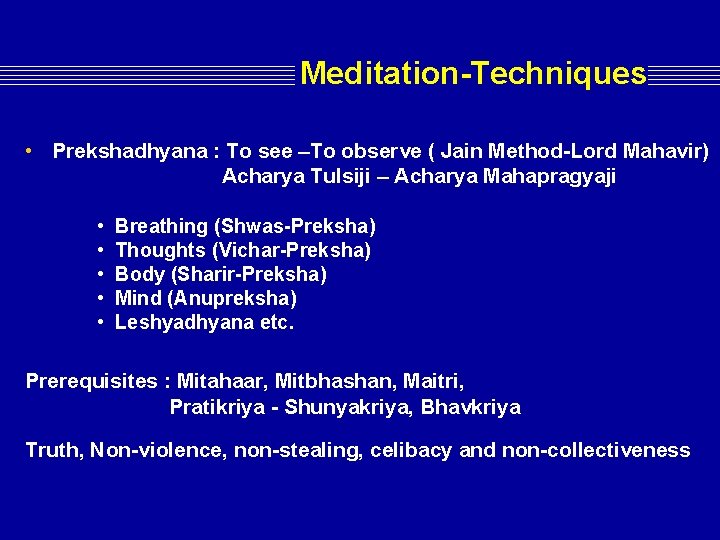
Meditation-Techniques • Prekshadhyana : To see –To observe ( Jain Method-Lord Mahavir) Acharya Tulsiji – Acharya Mahapragyaji • • • Breathing (Shwas-Preksha) Thoughts (Vichar-Preksha) Body (Sharir-Preksha) Mind (Anupreksha) Leshyadhyana etc. Prerequisites : Mitahaar, Mitbhashan, Maitri, Pratikriya - Shunyakriya, Bhavkriya Truth, Non-violence, non-stealing, celibacy and non-collectiveness
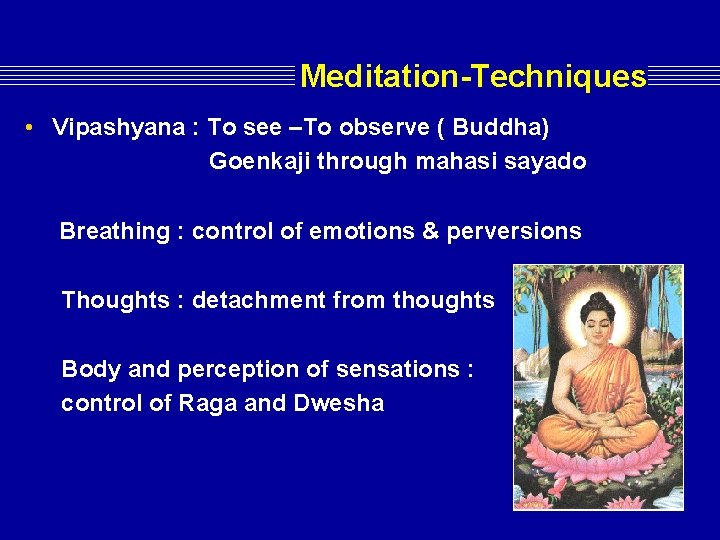
Meditation-Techniques • Vipashyana : To see –To observe ( Buddha) Goenkaji through mahasi sayado Breathing : control of emotions & perversions Thoughts : detachment from thoughts Body and perception of sensations : control of Raga and Dwesha
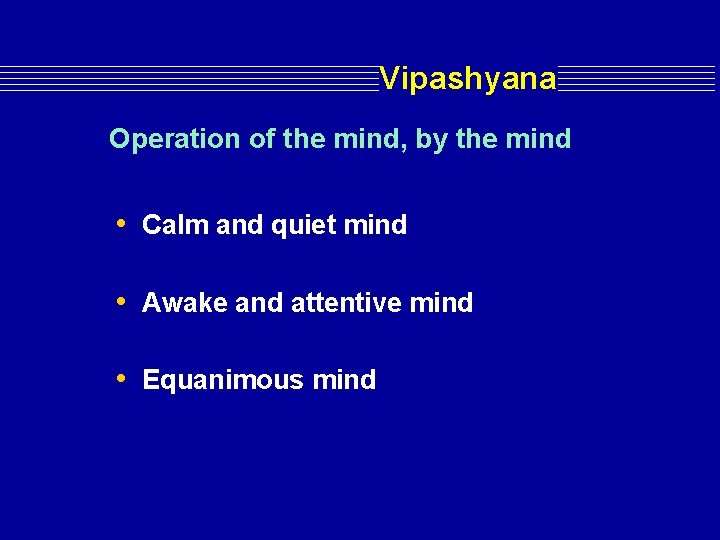
Vipashyana Operation of the mind, by the mind • Calm and quiet mind • Awake and attentive mind • Equanimous mind
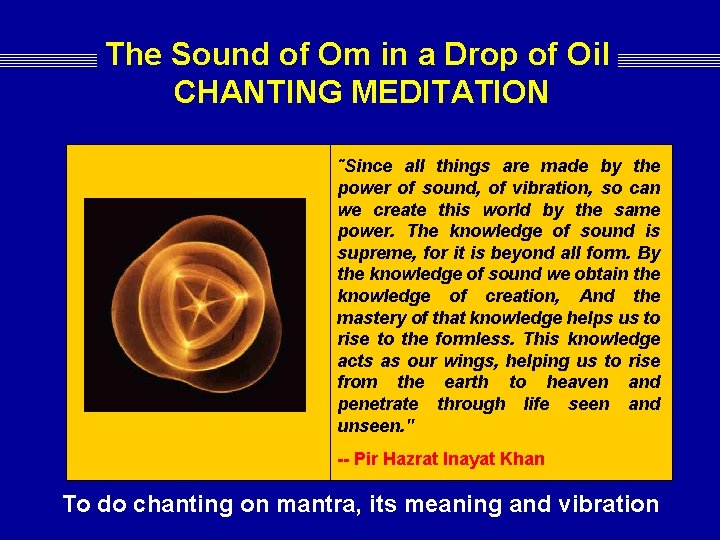
The Sound of Om in a Drop of Oil CHANTING MEDITATION "Since all things are made by the power of sound, of vibration, so can we create this world by the same power. The knowledge of sound is supreme, for it is beyond all form. By the knowledge of sound we obtain the knowledge of creation, And the mastery of that knowledge helps us to rise to the formless. This knowledge acts as our wings, helping us to rise from the earth to heaven and penetrate through life seen and unseen. " -- Pir Hazrat Inayat Khan To do chanting on mantra, its meaning and vibration
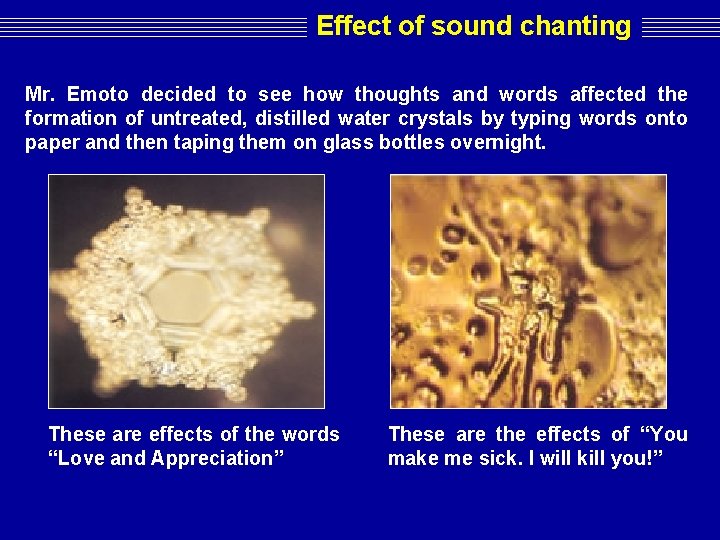
Effect of sound chanting Mr. Emoto decided to see how thoughts and words affected the formation of untreated, distilled water crystals by typing words onto paper and then taping them on glass bottles overnight. These are effects of the words “Love and Appreciation” These are the effects of “You make me sick. I will kill you!”
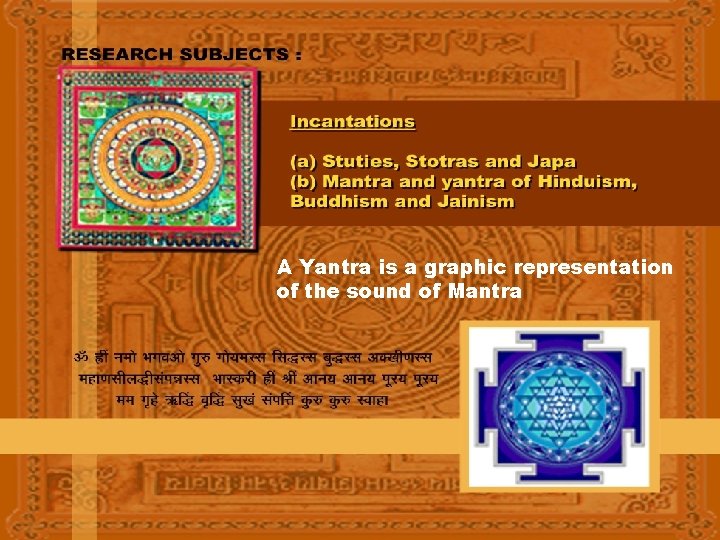
A Yantra is a graphic representation of the sound of Mantra
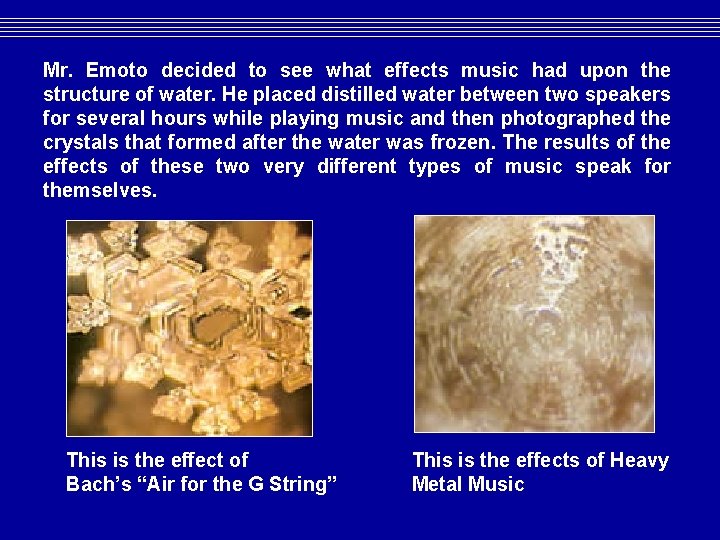
Mr. Emoto decided to see what effects music had upon the structure of water. He placed distilled water between two speakers for several hours while playing music and then photographed the crystals that formed after the water was frozen. The results of the effects of these two very different types of music speak for themselves. This is the effect of Bach’s “Air for the G String” This is the effects of Heavy Metal Music
Mindfulness Practice • Observing the body and mind intentionally Letting experiences unfold from moment to moment and accepting them as they are. • Observing thoughts without getting caught up in them. No effort to control anything except the focus and direction of the attention. Not a passive process, yet does not involve trying to get anywhere. • Eating meditation, sitting meditation, working meditation and meditation during each act is the goal of mindfulness practice.
Rule No. 1 • Wherever there is body, mind should also be there without any exception Rule No. 2 • Develop wakeful plain observorship (Sakshibhav or Drushtabhav) Rule No. 3 • Know your soul with your own soul.
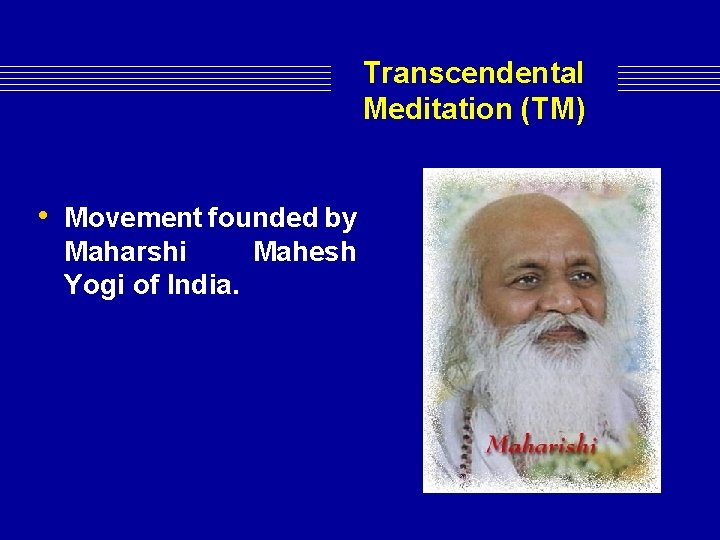
Transcendental Meditation (TM) • Movement founded by Maharshi Mahesh Yogi of India.
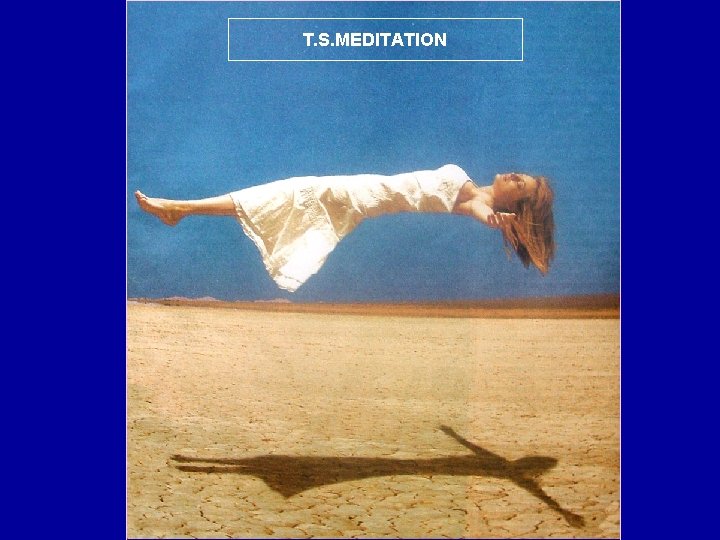
T. S. MEDITATION
Sri Ravishankarji • Sudarshan kriya • Art of living course has changed thousands of lives
SILENCE / CONTEMPLATION In the silence of the heart God speaks Let God fill us, then only we speak. Do small things with great love.
The fruit of silence…. . is Prayer The fruit of Prayer…. . is Faith The fruit of Faith……. . is love The fruit of Love ……. is Service - Mother Teresa
DHYANA YOGA • Perfect relaxation • Observorship • Non Decisiveness Dynamic Meditation
Purnayoga Aspiration Rejection Surrender
Meditation : methods § § § § Patanjal Dhyana Anapan Sati Smriti Upasthan Vipashyana Preksha Dhyana Jain Dhyana Spand Dhyana Mantra Dhyana Nabhi Dhyana Swapna Dhyana Nidra Dhyana Yoga nidra, Nyas Kriya Yoga Mrutyu Dhyana T. S Meditation Kundalini § § § § Kayotsarga Tratak Suryasamyam Adarshdhyana (mirror) Swaminarayan Dhyana Arup Dhyana Purnayoga Dhyana Atit Dhyana (past) Bhavidhyana (future) Sarpalanchan Dhyana Samarpana Dhyana Tathata Hoo-Dhyana (Dynamic Meditation) Sahaj Dhyana Your own system All methods are great
Swapnadhyana Nidradhyana Yognidra Nyasa
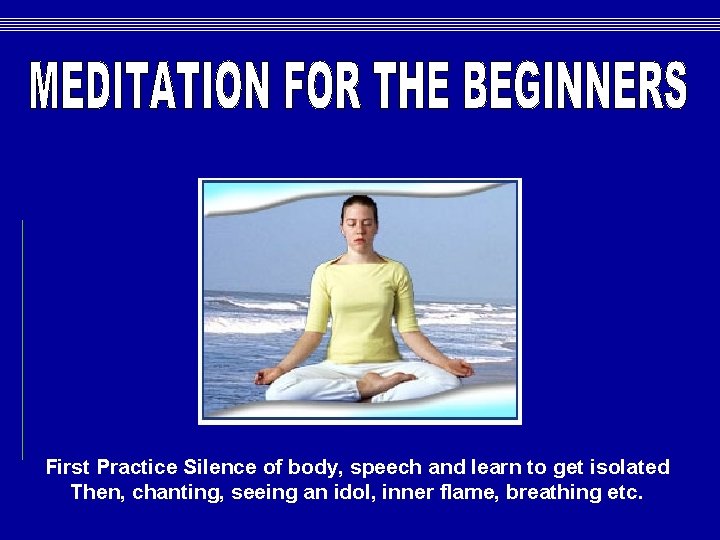
First Practice Silence of body, speech and learn to get isolated Then, chanting, seeing an idol, inner flame, breathing etc.
Benefits of meditation – Oxygen consumption is reduced by 16%, even greater than the reduction of 12% in sleep – Neural structures that are intimately related to the control of the autonomic nervous system are activated – Diurnal, cyclic secretion of stress hormones (adrenocorticotrophic hormone, cortisol and betaendorphin) is absent
STATISTICS • Physicians, Psychotherapists, and other Professionals are increasingly adding Meditative Techniques to their practice. • Over six thousand Physicians have begun the practice of Transcendental Meditation and regularly recommend the TM technique to their patients. • Many Physicians consider Meditation a key element of an Integrated Health Program.
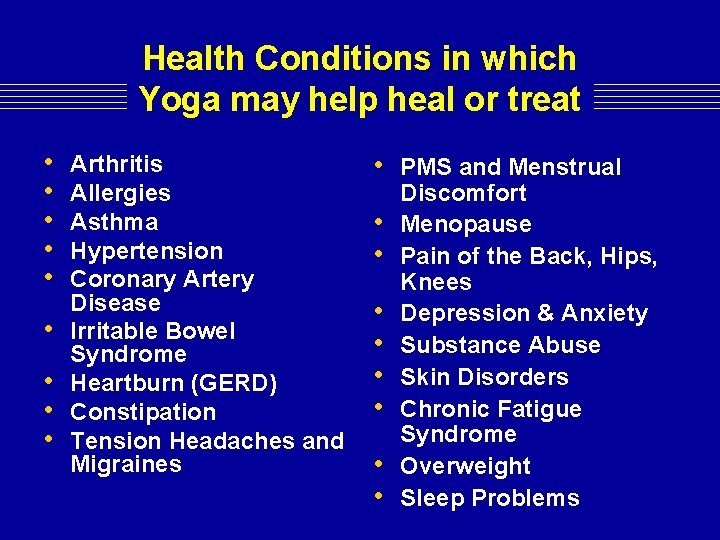
Health Conditions in which Yoga may help heal or treat • • • Arthritis Allergies Asthma Hypertension Coronary Artery Disease Irritable Bowel Syndrome Heartburn (GERD) Constipation Tension Headaches and Migraines • PMS and Menstrual • • Discomfort Menopause Pain of the Back, Hips, Knees Depression & Anxiety Substance Abuse Skin Disorders Chronic Fatigue Syndrome Overweight Sleep Problems
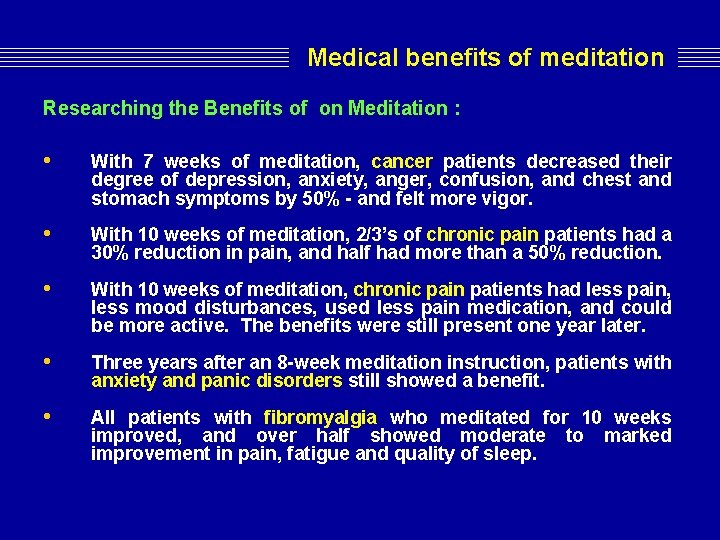
Medical benefits of meditation Researching the Benefits of on Meditation : • With 7 weeks of meditation, cancer patients decreased their degree of depression, anxiety, anger, confusion, and chest and stomach symptoms by 50% - and felt more vigor. • With 10 weeks of meditation, 2/3’s of chronic pain patients had a 30% reduction in pain, and half had more than a 50% reduction. • With 10 weeks of meditation, chronic pain patients had less pain, less mood disturbances, used less pain medication, and could be more active. The benefits were still present one year later. • Three years after an 8 -week meditation instruction, patients with anxiety and panic disorders still showed a benefit. • All patients with fibromyalgia who meditated for 10 weeks improved, and over half showed moderate to marked improvement in pain, fatigue and quality of sleep.
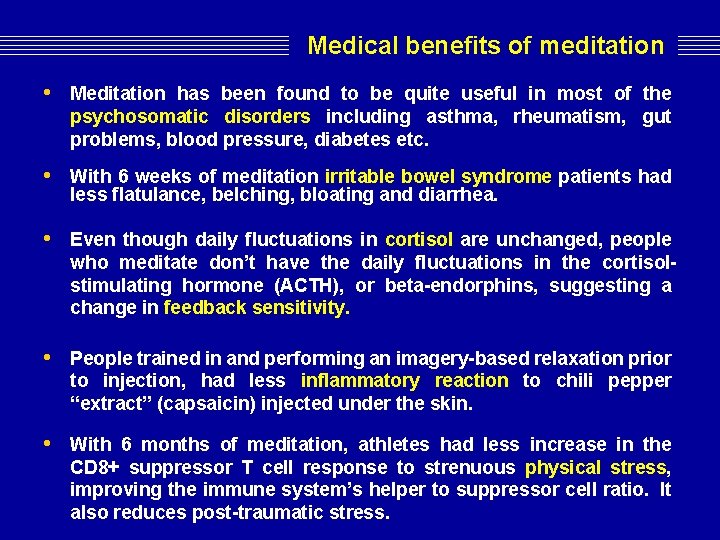
Medical benefits of meditation • Meditation has been found to be quite useful in most of the psychosomatic disorders including asthma, rheumatism, gut problems, blood pressure, diabetes etc. • With 6 weeks of meditation irritable bowel syndrome patients had less flatulance, belching, bloating and diarrhea. • Even though daily fluctuations in cortisol are unchanged, people who meditate don’t have the daily fluctuations in the cortisolstimulating hormone (ACTH), or beta-endorphins, suggesting a change in feedback sensitivity. • People trained in and performing an imagery-based relaxation prior to injection, had less inflammatory reaction to chili pepper “extract” (capsaicin) injected under the skin. • With 6 months of meditation, athletes had less increase in the CD 8+ suppressor T cell response to strenuous physical stress, improving the immune system’s helper to suppressor cell ratio. It also reduces post-traumatic stress.
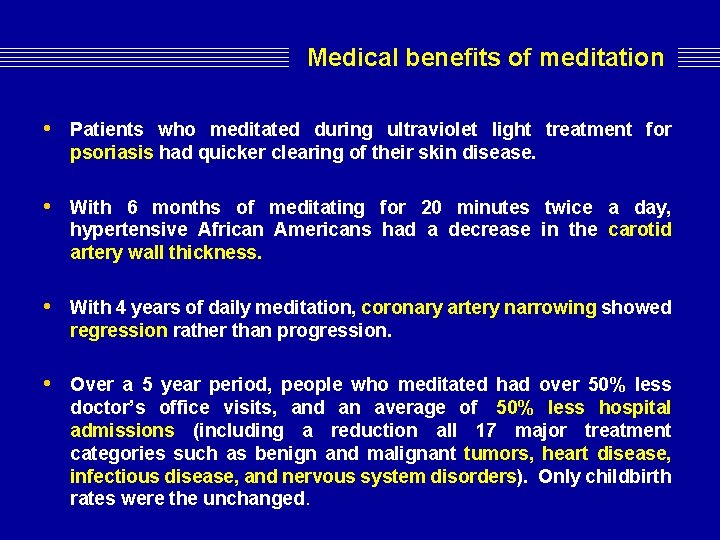
Medical benefits of meditation • Patients who meditated during ultraviolet light treatment for psoriasis had quicker clearing of their skin disease. • With 6 months of meditating for 20 minutes twice a day, hypertensive African Americans had a decrease in the carotid artery wall thickness. • With 4 years of daily meditation, coronary artery narrowing showed regression rather than progression. • Over a 5 year period, people who meditated had over 50% less doctor’s office visits, and an average of 50% less hospital admissions (including a reduction all 17 major treatment categories such as benign and malignant tumors, heart disease, infectious disease, and nervous system disorders). Only childbirth rates were the unchanged.
Relative contraindications of meditation • • Psychosis Severe depression Confusional states Extreme anxiety • Dementias
Physiology of Meditation • Meditation produces a specific physiological response pattern that involves various biological systems. • Mechanisms producing meditative effects include metabolic, autonomic, endocrine, neurological, and psychological manifestation. • Physiological response to meditation occurs on a multidimensional, interactive basis.
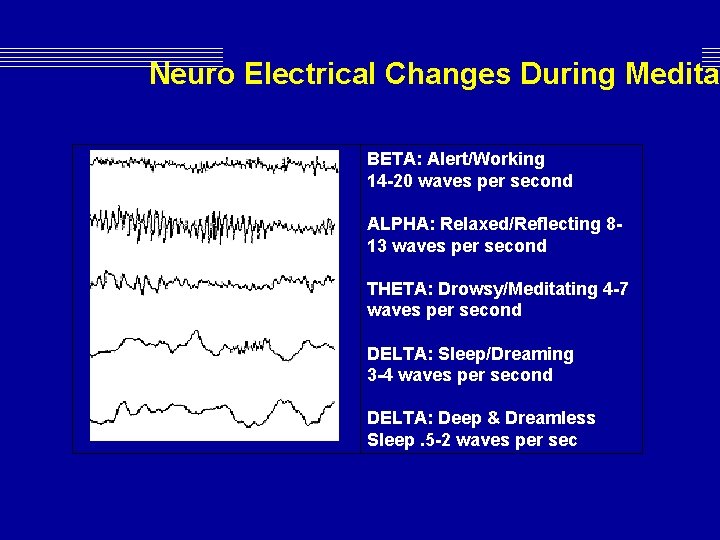
Neuro Electrical Changes During Meditat BETA: Alert/Working 14 -20 waves per second ALPHA: Relaxed/Reflecting 813 waves per second THETA: Drowsy/Meditating 4 -7 waves per second DELTA: Sleep/Dreaming 3 -4 waves per second DELTA: Deep & Dreamless Sleep. 5 -2 waves per sec
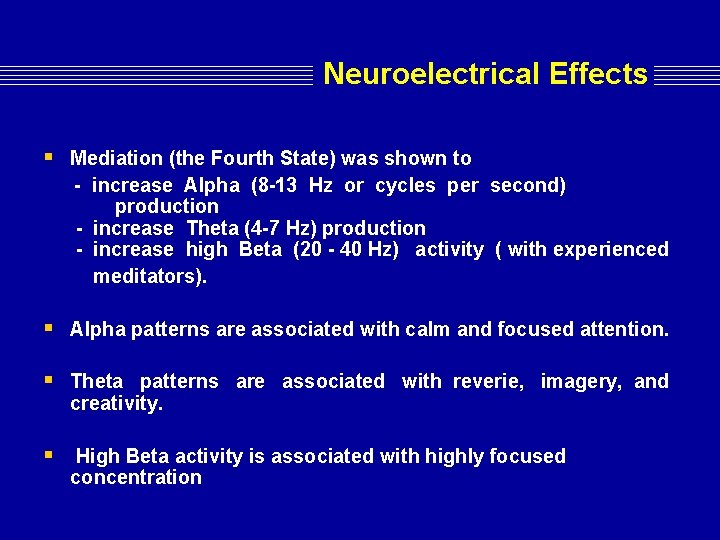
Neuroelectrical Effects § Mediation (the Fourth State) was shown to - increase Alpha (8 -13 Hz or cycles per second) production - increase Theta (4 -7 Hz) production - increase high Beta (20 - 40 Hz) activity ( with experienced meditators). § Alpha patterns are associated with calm and focused attention. § Theta patterns are associated with reverie, imagery, and creativity. § High Beta activity is associated with highly focused concentration
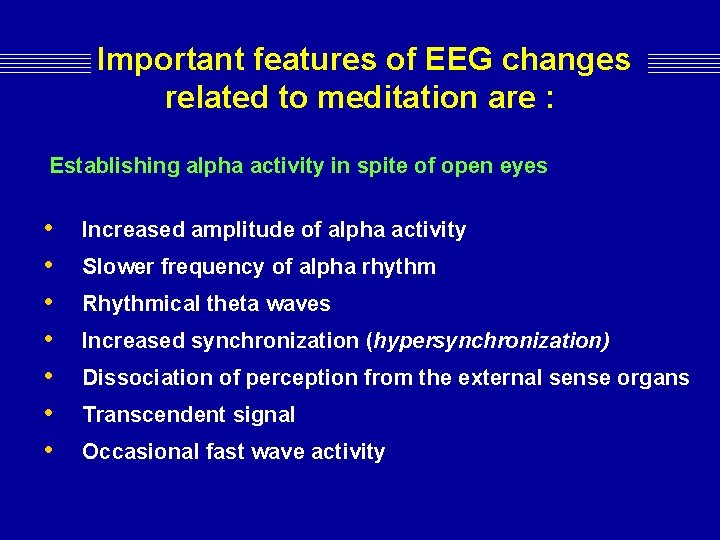
Important features of EEG changes related to meditation are : Establishing alpha activity in spite of open eyes • • Increased amplitude of alpha activity Slower frequency of alpha rhythm Rhythmical theta waves Increased synchronization (hypersynchronization) Dissociation of perception from the external sense organs Transcendent signal Occasional fast wave activity
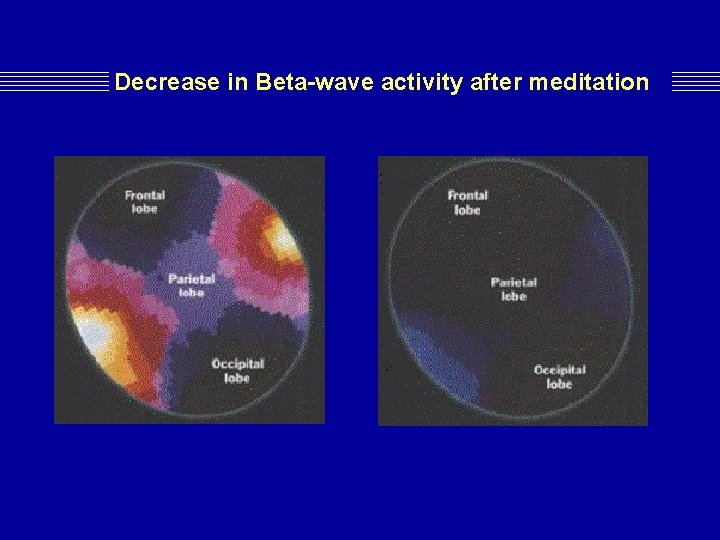
Decrease in Beta-wave activity after meditation
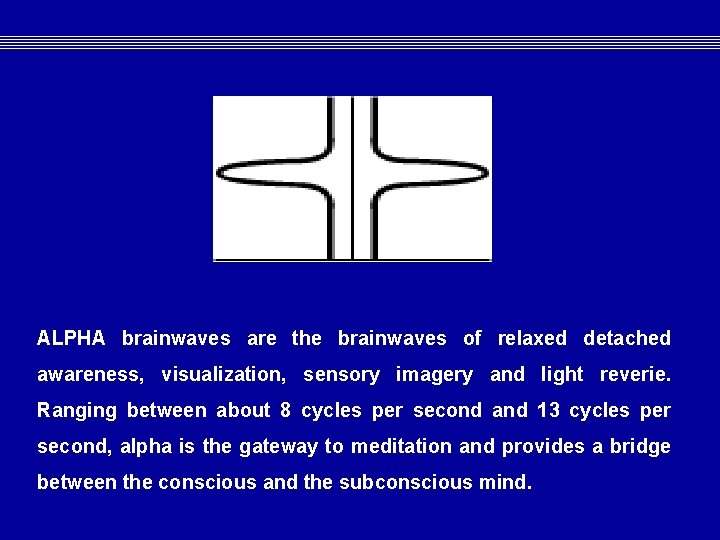
ALPHA brainwaves are the brainwaves of relaxed detached awareness, visualization, sensory imagery and light reverie. Ranging between about 8 cycles per second and 13 cycles per second, alpha is the gateway to meditation and provides a bridge between the conscious and the subconscious mind.
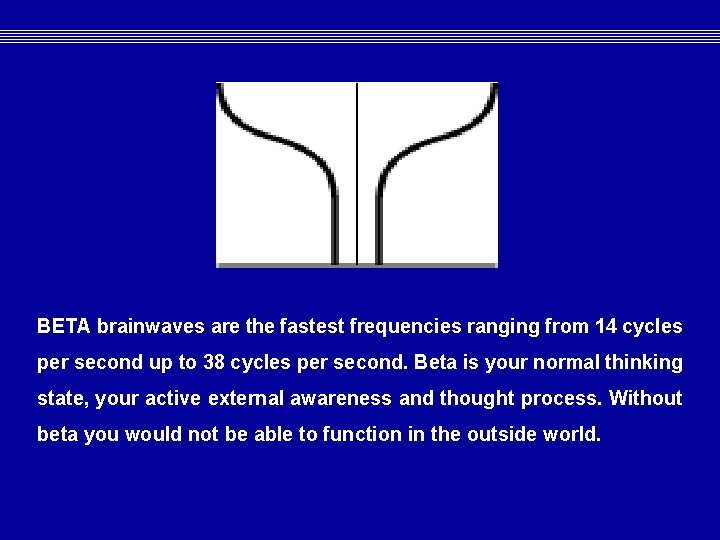
BETA brainwaves are the fastest frequencies ranging from 14 cycles per second up to 38 cycles per second. Beta is your normal thinking state, your active external awareness and thought process. Without beta you would not be able to function in the outside world.
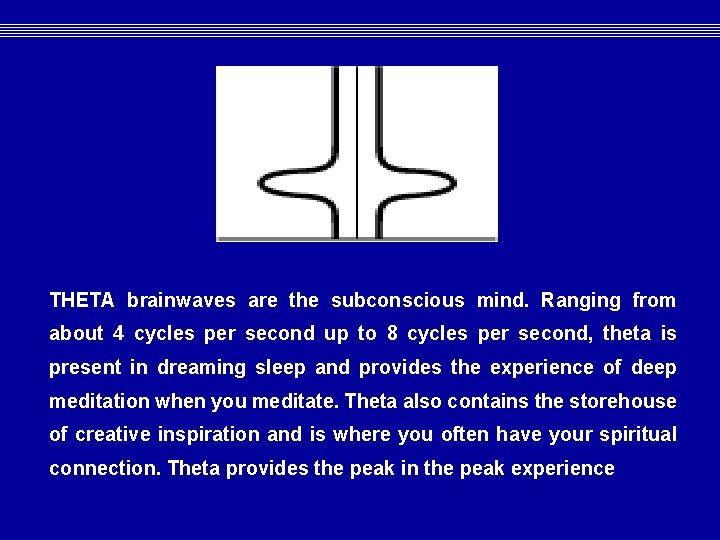
THETA brainwaves are the subconscious mind. Ranging from about 4 cycles per second up to 8 cycles per second, theta is present in dreaming sleep and provides the experience of deep meditation when you meditate. Theta also contains the storehouse of creative inspiration and is where you often have your spiritual connection. Theta provides the peak in the peak experience
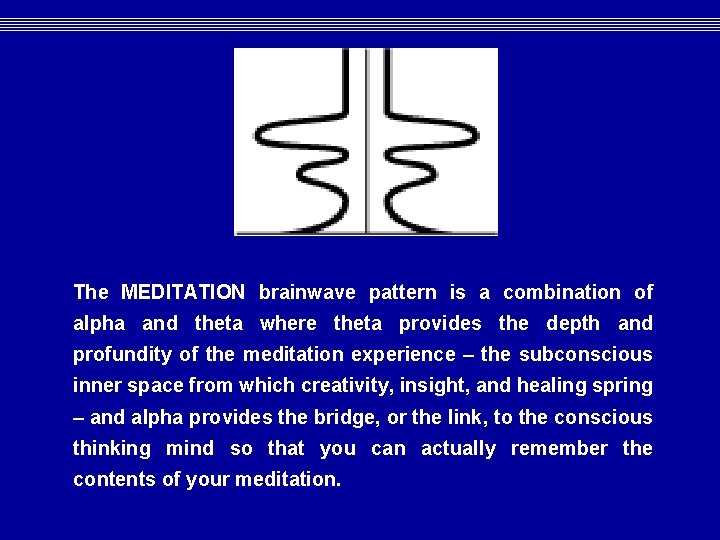
The MEDITATION brainwave pattern is a combination of alpha and theta where theta provides the depth and profundity of the meditation experience – the subconscious inner space from which creativity, insight, and healing spring – and alpha provides the bridge, or the link, to the conscious thinking mind so that you can actually remember the contents of your meditation.
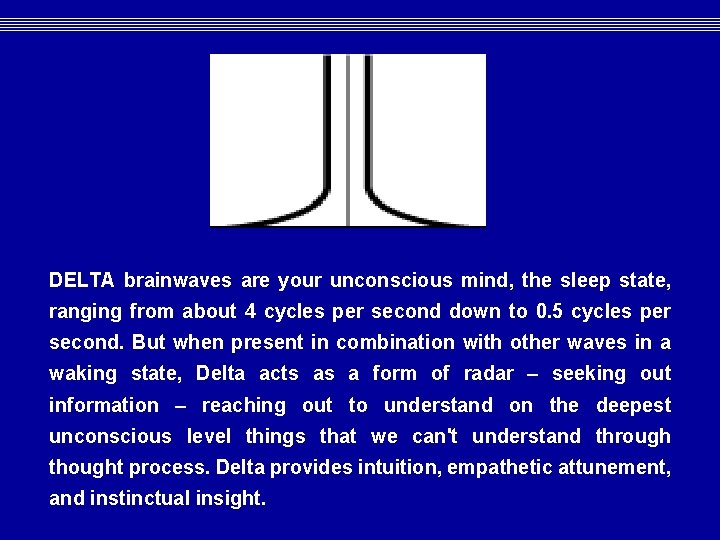
DELTA brainwaves are your unconscious mind, the sleep state, ranging from about 4 cycles per second down to 0. 5 cycles per second. But when present in combination with other waves in a waking state, Delta acts as a form of radar – seeking out information – reaching out to understand on the deepest unconscious level things that we can't understand through thought process. Delta provides intuition, empathetic attunement, and instinctual insight.
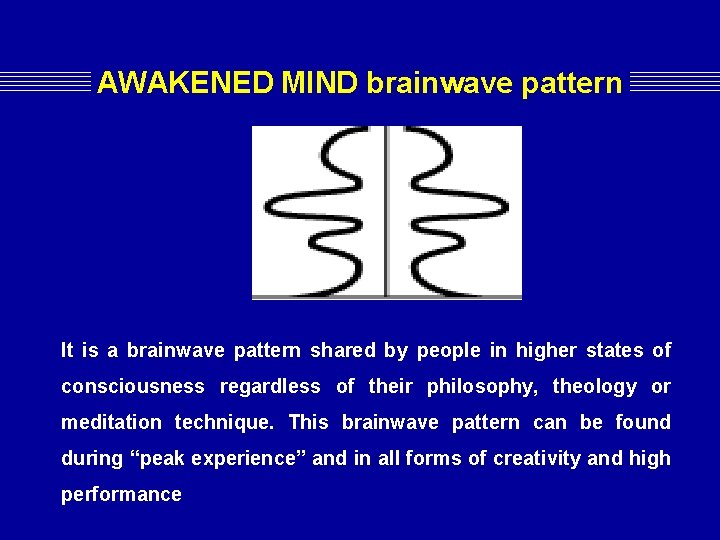
AWAKENED MIND brainwave pattern It is a brainwave pattern shared by people in higher states of consciousness regardless of their philosophy, theology or meditation technique. This brainwave pattern can be found during “peak experience” and in all forms of creativity and high performance
Permanent EEG changes Davidson’s research is consistent with his earlier work that pinpointed the left prefrontal cortex as a brain region associated with happiness and positive thoughts and emotions. Using functional magnetic resonance imagining (f. MRI) on the meditating monks, Davidson found that their brain activity – as measured by the EEG – was especially high in this area With chronic meditation, gamma wave activity(high level information processing) is found in many meditators
Evoked potentials & meditation Meditation sometimes produces altered amplitudes, with practitioners seeming to demonstrate decreased amplitude & latency for sensory EPs & with mindfulness inducing a decrease in habituation
• In meditation the usual frameworks of time, space and other aspects of conscious content are absent, although the mind is not asleep • Compared to quiet or slow-wave sleep, in which brain blood flow is reduced, meditation shows no reduction in total brain blood circulation or perfusion • Regional maps of brain blood flow/perfusion differ among meditation, slow-wave sleep and wakefulness
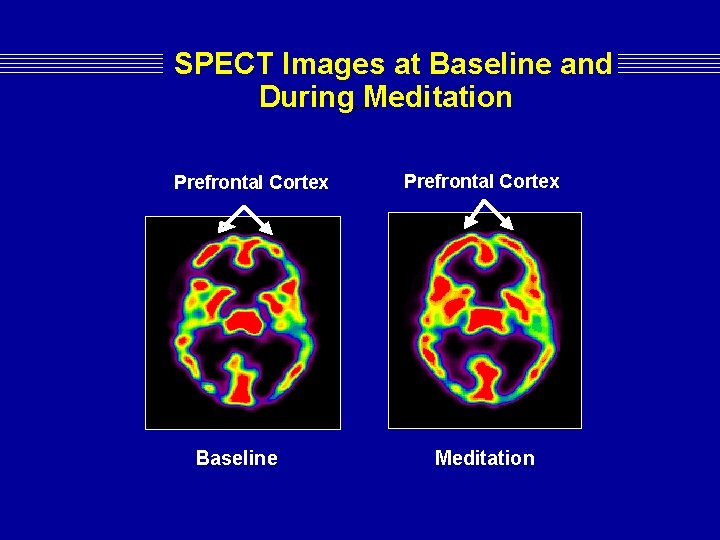
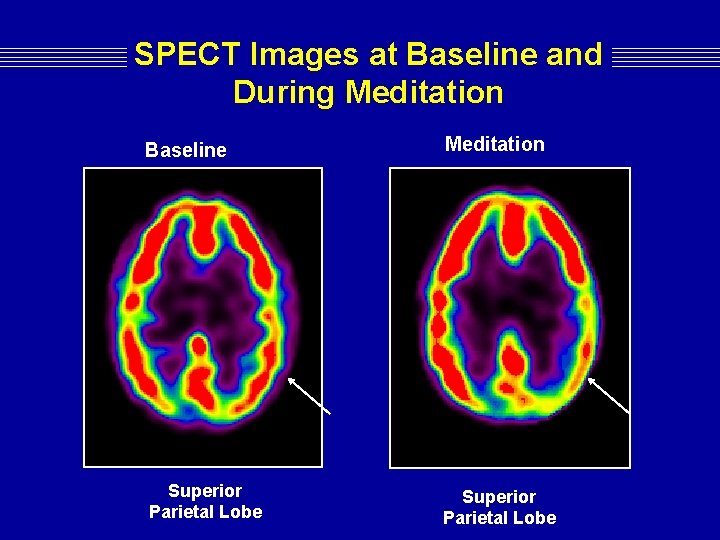
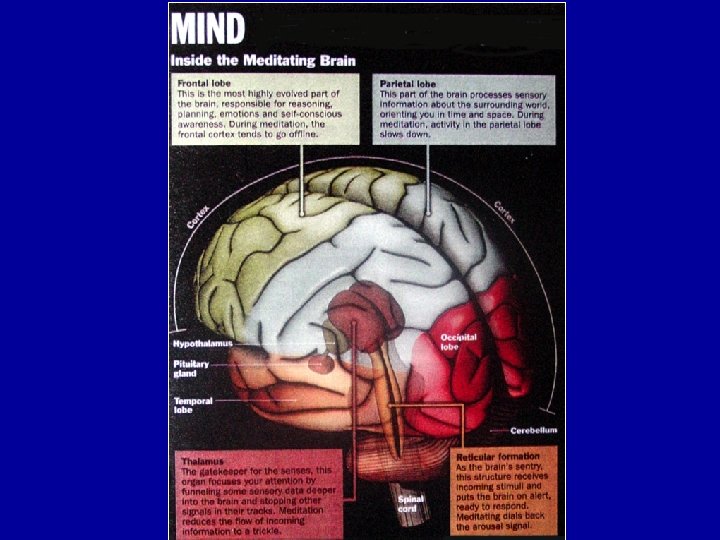
Neurobiology of Meditation § Imaging, such as r. CBF (regional Cerebral Blood Flow), real time MRI (Magnetic Resonance Imaging), MEG (magnetoencephalography), and improved EEG (electoencephalography) allow detailed studies in understanding the effects of meditation on neural behavior. § SPECT study shows- Parietal area of the brain is responsible for giving us a sense of our orientation in space and time. By blocking all sensory and cognitive input into this area, meditation results in the sense of no space and no time.
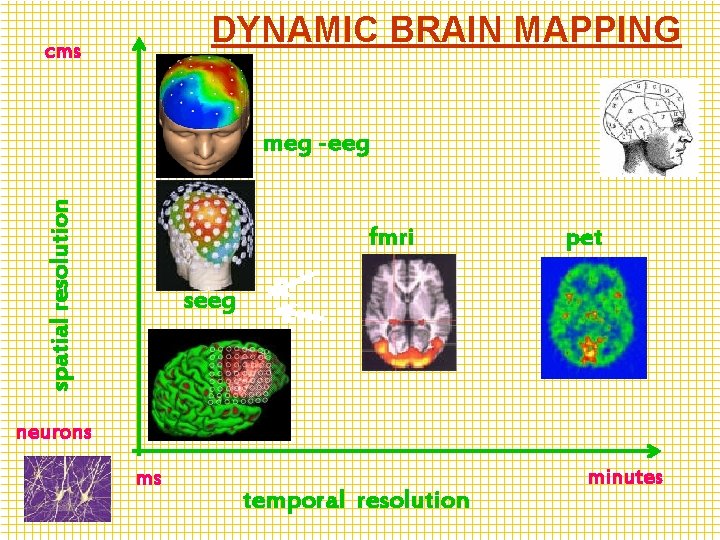
DYNAMIC BRAIN MAPPING cms spatial resolution meg -eeg fmri pet seeg neurons ms temporal resolution minutes
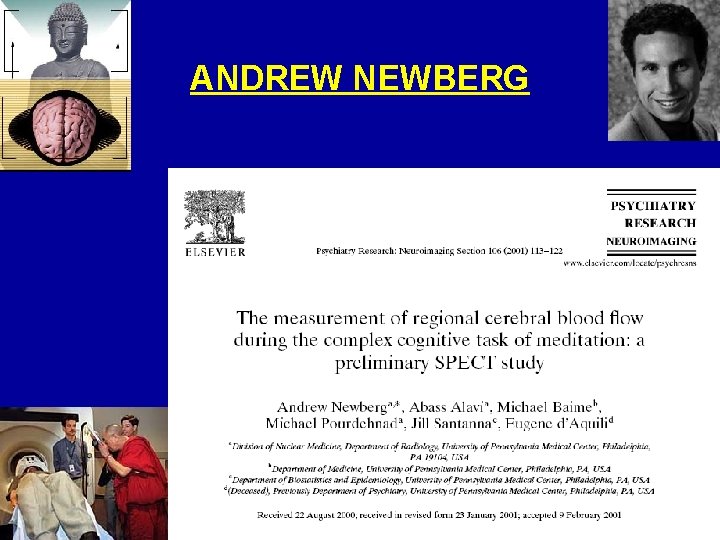
ANDREW NEWBERG
SPECT Images at Baseline and During Meditation Prefrontal Cortex Baseline Prefrontal Cortex Meditation
SPECT Images at Baseline and During Meditation Baseline Meditation Superior Parietal Lobe
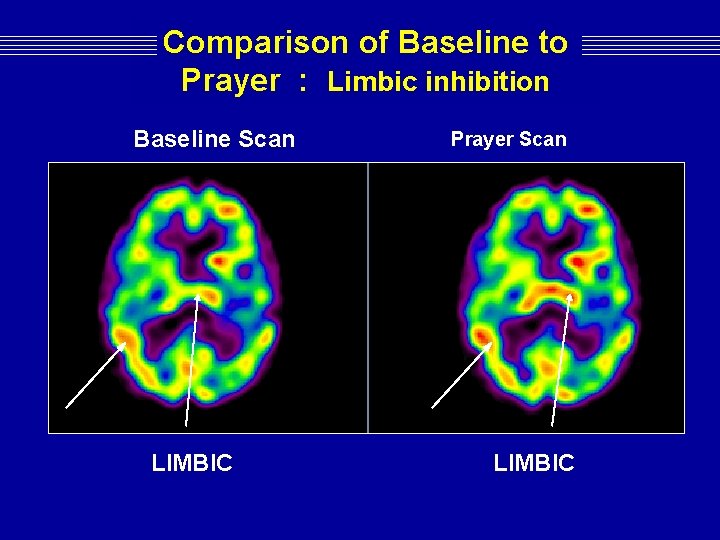
Comparison of Baseline to Prayer : Limbic inhibition Baseline Scan LIMBIC Prayer Scan LIMBIC
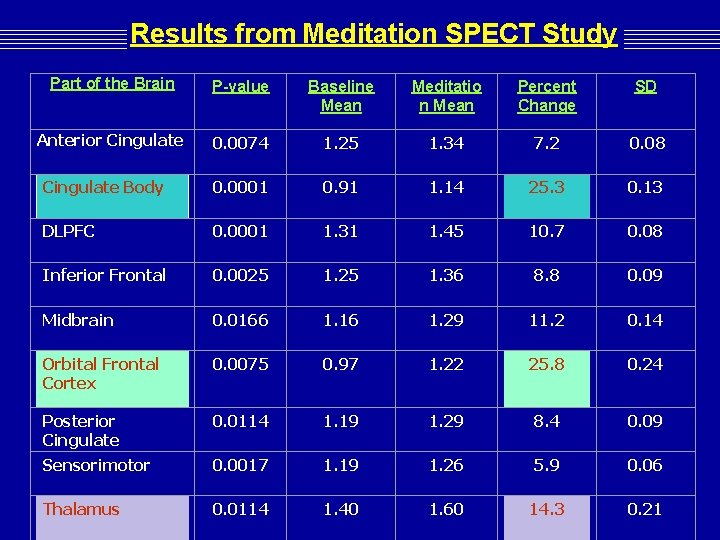
Results from Meditation SPECT Study Part of the Brain P-value Baseline Mean Meditatio n Mean Percent Change SD Anterior Cingulate 0. 0074 1. 25 1. 34 7. 2 0. 08 Cingulate Body 0. 0001 0. 91 1. 14 25. 3 0. 13 DLPFC 0. 0001 1. 31 1. 45 10. 7 0. 08 Inferior Frontal 0. 0025 1. 36 8. 8 0. 09 Midbrain 0. 0166 1. 16 1. 29 11. 2 0. 14 Orbital Frontal Cortex 0. 0075 0. 97 1. 22 25. 8 0. 24 Posterior Cingulate 0. 0114 1. 19 1. 29 8. 4 0. 09 Sensorimotor 0. 0017 1. 19 1. 26 5. 9 0. 06 Thalamus 0. 0114 1. 40 1. 60 14. 3 0. 21
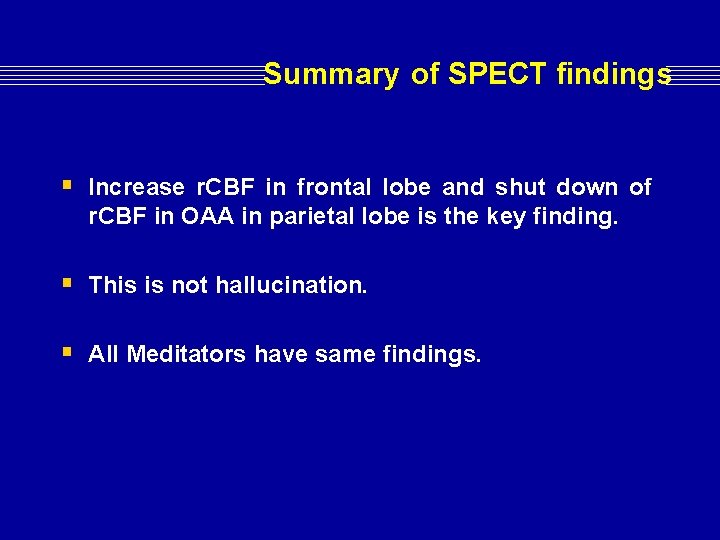
Summary of SPECT findings § Increase r. CBF in frontal lobe and shut down of r. CBF in OAA in parietal lobe is the key finding. § This is not hallucination. § All Meditators have same findings.
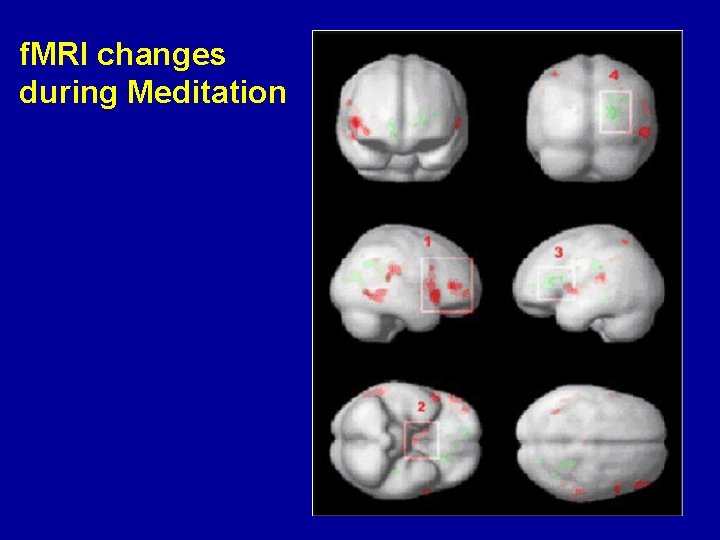
f. MRI changes during Meditation
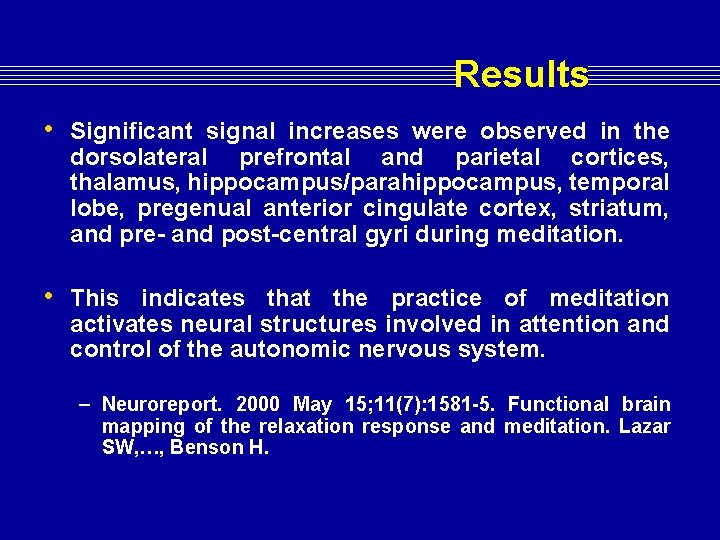
Results • Significant signal increases were observed in the dorsolateral prefrontal and parietal cortices, thalamus, hippocampus/parahippocampus, temporal lobe, pregenual anterior cingulate cortex, striatum, and pre- and post-central gyri during meditation. • This indicates that the practice of meditation activates neural structures involved in attention and control of the autonomic nervous system. – Neuroreport. 2000 May 15; 11(7): 1581 -5. Functional brain mapping of the relaxation response and meditation. Lazar SW, …, Benson H.
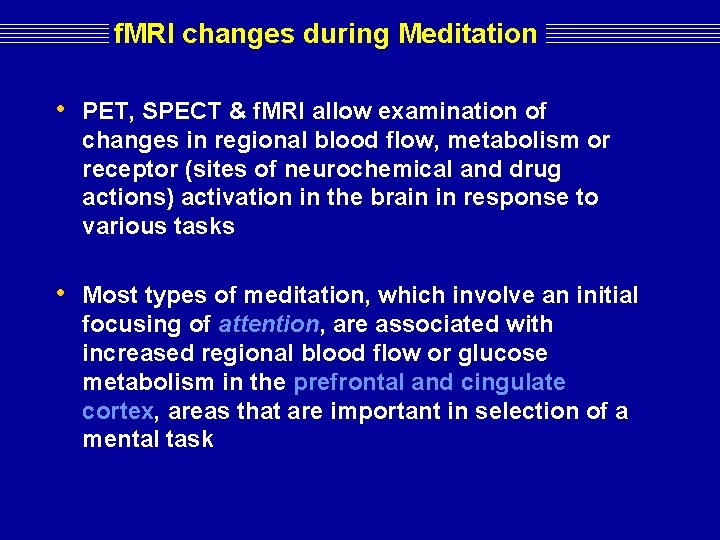
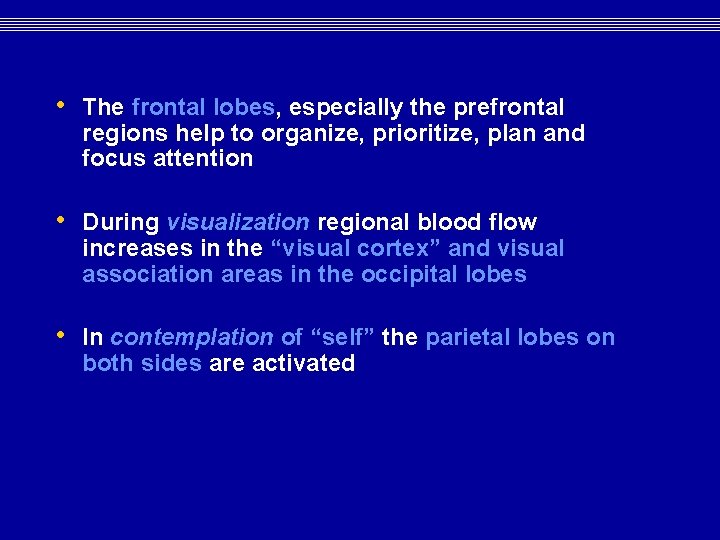
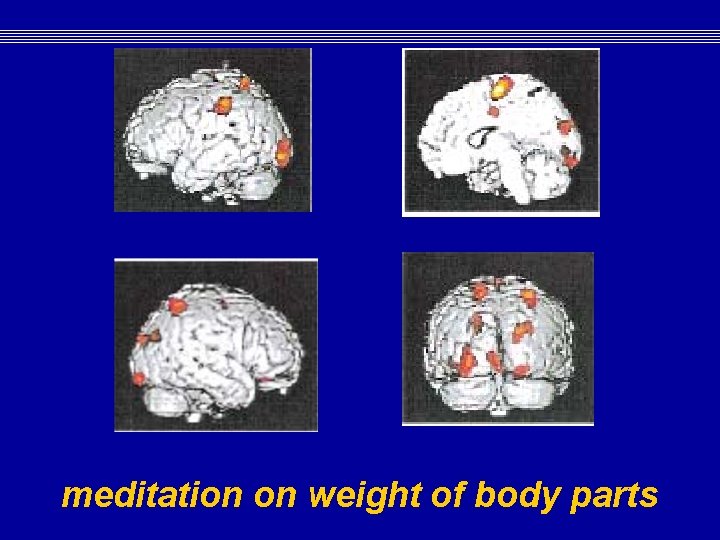
f. MRI changes during Meditation • PET, SPECT & f. MRI allow examination of changes in regional blood flow, metabolism or receptor (sites of neurochemical and drug actions) activation in the brain in response to various tasks • Most types of meditation, which involve an initial focusing of attention, are associated with increased regional blood flow or glucose metabolism in the prefrontal and cingulate cortex, areas that are important in selection of a mental task
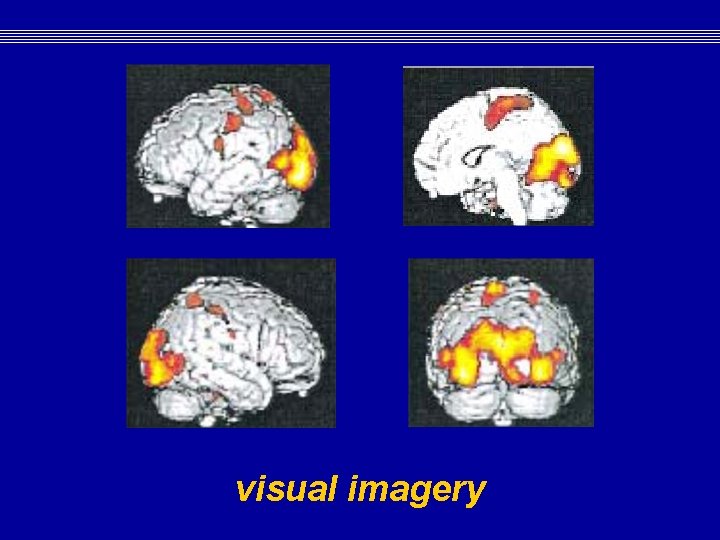
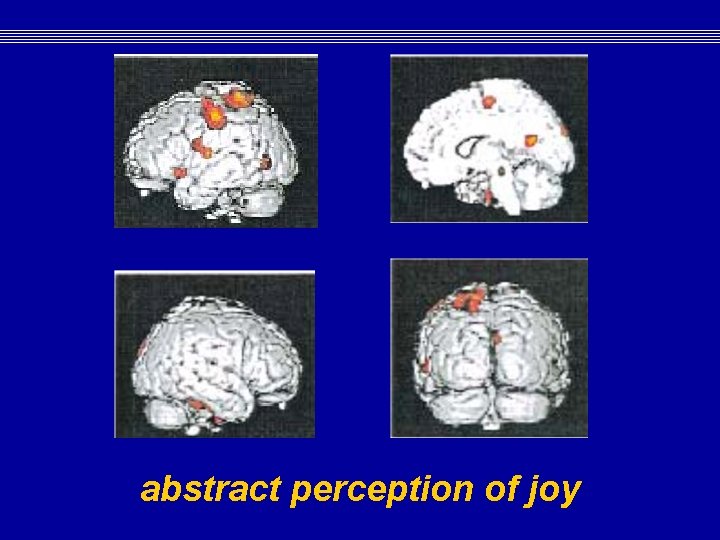
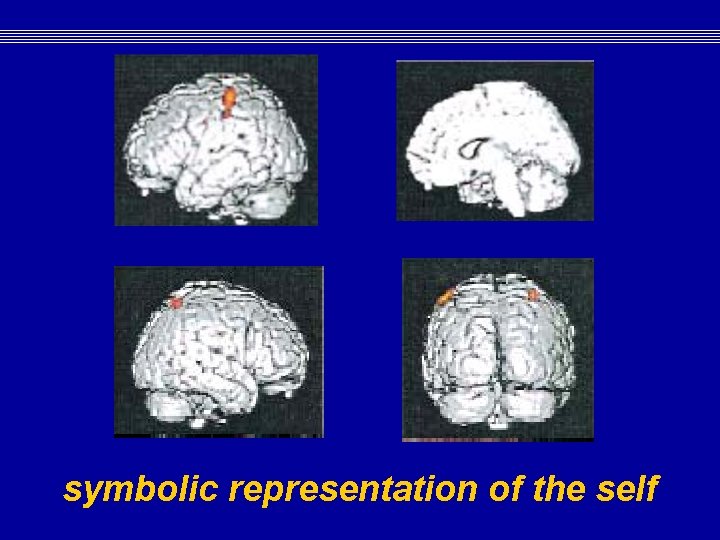
• The frontal lobes, especially the prefrontal regions help to organize, prioritize, plan and focus attention • During visualization regional blood flow increases in the “visual cortex” and visual association areas in the occipital lobes • In contemplation of “self” the parietal lobes on both sides are activated
visual imagery
meditation on weight of body parts
abstract perception of joy
symbolic representation of the self
Thalamus & Hippocampus in meditation
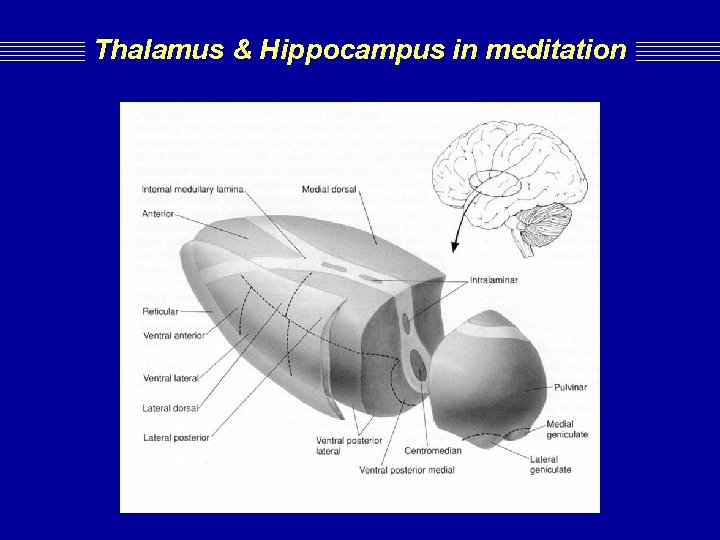
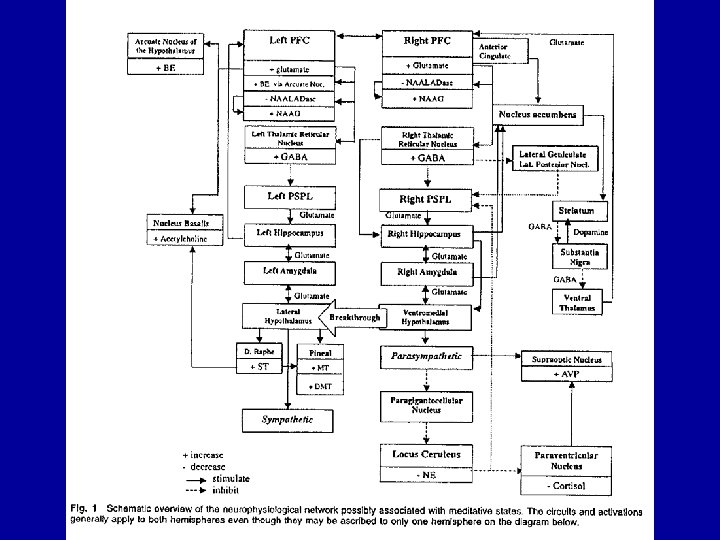
• Thalamus is a relay station and filtering station for is a relay station sensory information. Excitation of RN through PFC, decreases activation of PSPL & thereby decreases body awareness & also decreases input to visual centre (GABA) • The studies point to prefrontal activation (predominantly right), transient hypofrontality, increased frontal lobe & decreased parietal lobe activity & also to a Deafferentation of the PSPL • Functional Deafferentation means a decrease in distracting stimuli to visual cortex & PSPL, hence, increase focus • This results in altered perception of selfexperience
• Activity in Hippocampus is increased in connections with hypothalamus & autonomic nervous system • Stimulation of Right amygdala causes stimulation of ventromedial hypothalamus & peripheral parasympathetic system, thereby causing subjective sensation of relaxation & more profound sense of quiescence
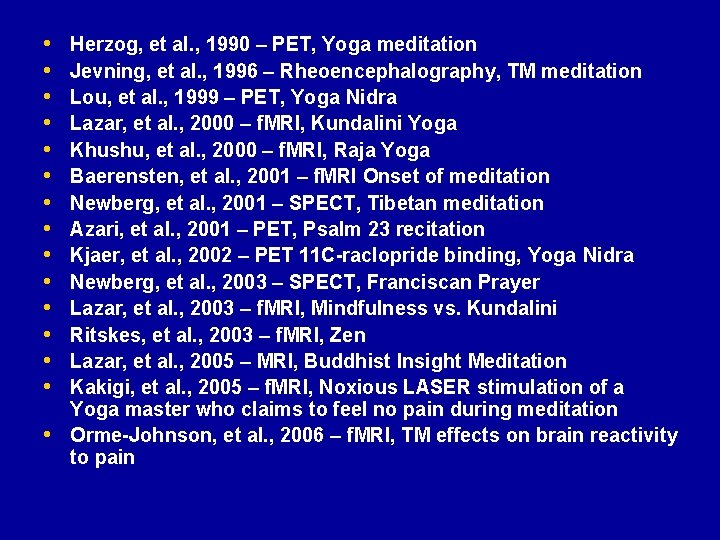
• • • • Herzog, et al. , 1990 – PET, Yoga meditation Jevning, et al. , 1996 – Rheoencephalography, TM meditation Lou, et al. , 1999 – PET, Yoga Nidra Lazar, et al. , 2000 – f. MRI, Kundalini Yoga Khushu, et al. , 2000 – f. MRI, Raja Yoga Baerensten, et al. , 2001 – f. MRI Onset of meditation Newberg, et al. , 2001 – SPECT, Tibetan meditation Azari, et al. , 2001 – PET, Psalm 23 recitation Kjaer, et al. , 2002 – PET 11 C-raclopride binding, Yoga Nidra Newberg, et al. , 2003 – SPECT, Franciscan Prayer Lazar, et al. , 2003 – f. MRI, Mindfulness vs. Kundalini Ritskes, et al. , 2003 – f. MRI, Zen Lazar, et al. , 2005 – MRI, Buddhist Insight Meditation Kakigi, et al. , 2005 – f. MRI, Noxious LASER stimulation of a Yoga master who claims to feel no pain during meditation Orme-Johnson, et al. , 2006 – f. MRI, TM effects on brain reactivity to pain
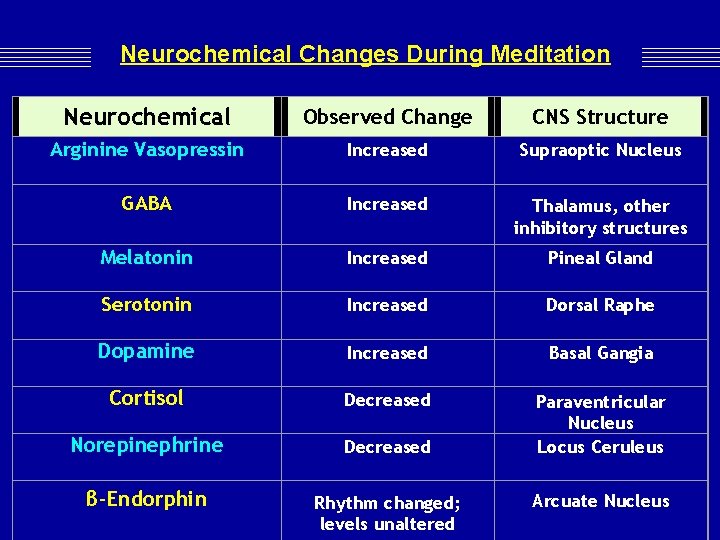
Neurochemical Changes During Meditation § Meditation increases Serotonin production, an important neurotransmitter and neuropeptide that influences mood and behavior in many ways. It can stimulate increased production of Acetylcholine, involved in memory mechanisms & attention § Meditation has also been associated with increased melatonin availability
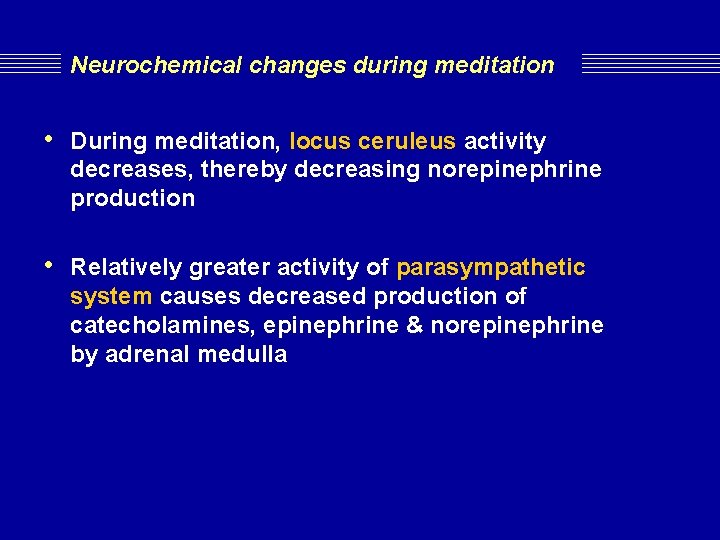
Neurochemical changes during meditation • During meditation, locus ceruleus activity decreases, thereby decreasing norepinephrine production • Relatively greater activity of parasympathetic system causes decreased production of catecholamines, epinephrine & norepinephrine by adrenal medulla
Neurochemical Changes During Meditation Neurochemical Observed Change CNS Structure Arginine Vasopressin Increased Supraoptic Nucleus GABA Increased Thalamus, other inhibitory structures Melatonin Increased Pineal Gland Serotonin Increased Dorsal Raphe Dopamine Increased Basal Gangia Cortisol Decreased Norepinephrine Decreased Paraventricular Nucleus Locus Ceruleus β-Endorphin Rhythm changed; levels unaltered Arcuate Nucleus
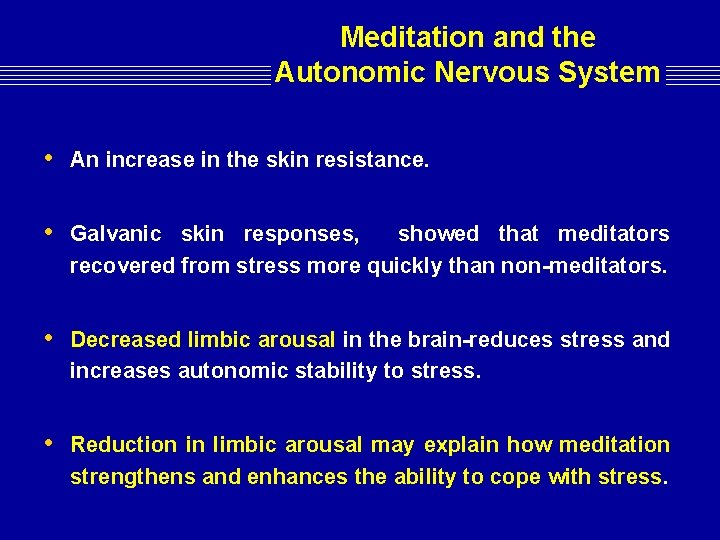
Meditation and the Autonomic Nervous System • An increase in the skin resistance. • Galvanic skin responses, showed that meditators recovered from stress more quickly than non-meditators. • Decreased limbic arousal in the brain-reduces stress and increases autonomic stability to stress. • Reduction in limbic arousal may explain how meditation strengthens and enhances the ability to cope with stress.
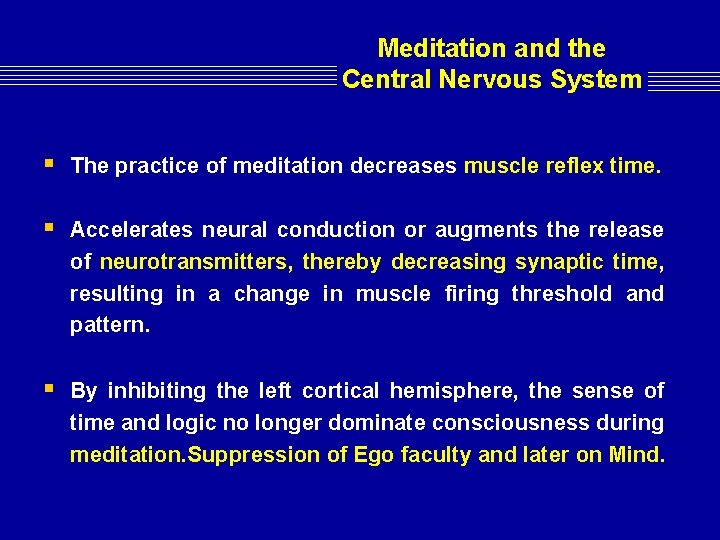
Meditation and the Central Nervous System § The practice of meditation decreases muscle reflex time. § Accelerates neural conduction or augments the release of neurotransmitters, thereby decreasing synaptic time, resulting in a change in muscle firing threshold and pattern. § By inhibiting the left cortical hemisphere, the sense of time and logic no longer dominate consciousness during meditation. Suppression of Ego faculty and later on Mind.
The Plausible Hypothesis • When meditation acts as a constant repetitive stimulus, certain permanent qualitative and quantitative changes develop in nervous system. • Neurotransmitters and neuromodulators may stimulate growth of dormant neurons to develop a centre higher than neocortex- God module. • This higher centre will exert inhibitory control over present neocortex and thereby over mind as a whole- thereby suppressing consciousness and all mental activities. • Spiritual ascent is from the least evolved state of consciousness to near perfect state with which the mind itself will cease to be and there will remain only non-dual experience.
Meditation and the Endocrine System • Reduced blood levels of lactate, cortisol, and epinephrine. • Reduces sympathetic adrenergic receptor sensitivity, producing a decreased response to stressful situations. • Increased levels of gamma aminobutyric acid (GABA), melatonin and dehydroepiandrosterone sulfate. • Meditation produces its anxiolytic effects by promoting GABA action in specific areas of the brain. • Similar effects can be achieved by Reiki, Acupuncture.
Meditation and Metabolism • A wakeful state accompanied by decreased metabolism. • Decreased breathing pattern, decreased heart rate, and decreased blood pressure. • Blood flow to the kidneys and liver declined in the practitioners, with an increase in cardiac output. • Decrease in the level of oxygen utilization and carbon dioxide elimination by muscles. • The metabolic changes arise from a natural reduction in metabolic activity at the cellular level, not from a forced reduction of breathing. • Longevity and delayed aging !
Meditation & Neuroplasticity • A recent MRI study showed that, “brain regions associated with attention, interoception & sensory processing like the PFC & right anterior insula were thicker in meditation practitioners” • Meditation probably offsets age-related cortical thinning & thereby suggesting to promote Neuroplasticity
Meditation and Psychology • Practice of meditation improves cognitive task performance, increases mental concentration, and reduces susceptibility to stress. • Both subjective and objective examinations reveal that meditation enhances perceptual sensitivity.
Meditation and Psychology • It improves the attitude & personality of a person • Improved concentration and attention, allowing for greater productivity, problem-solving, creativity, learning ability and organization of memory. • Enhanced self-image • Less “catastrophic reaction” to stressful situations, e. g. , in survivors of attempted suicide • Better sociability, tolerance and compassion • Improved mood, sleep & scores on selfactualization
Attitude • “ The Longer I live, the more I realize the impact of attitude on life. Attitude to me, is more important than facts. It is more important than the past, than education, successes, than what other people think or say or do. It is more important than appearance, giftedness or skill. It will make or break a company……. . a church…. a home. The remarkable thing is we have a choice every day regarding the attitude we will embrace for that day. We can not change our past. . . we cannot change the fact that people will act in a certain way. We cannot change the inevitable. The only thing we can do is to play on the only string we have, and that is our attitude……. I am convinced that life is 10% what happens to me and 90% how I react to it. And so it is with you…. . We are in charge of our Attitudes ”. - Charles Swindoll
Neural correlates of anxiety • Factors decreasing anxiety during meditation : – Increased parasympathetic acitivity, GABAergic drive, serotonin, endorphins & AVP – Decreased LC firing with decreased noradrenaline & decreased levels of stress hormone cortisol Depression • Factors contributing antidepressant effect : – Increase in serotonin, dopamine, melatonin, endorphin & AVP – Decrease in CRH & cortisol
Psychosis • A variety of schizophrenic effects can be seen • Meditation can induce psychotic states via mechanisms such as : – Increased 5 HT 2 receptor activation, leading to inhibition of LGB – Increased DMT, causing hallucinogenic effects – Increase in NAAG, having dissociative hallucinogenic effects – Increase in dopamine affecting temporal lobe
Implications for Psychiatry • • • Complementary & alternative medicine ? Alternative to Hypnosis Low cost, with continuation for life Group dynamics & group practice Combination e. g. Mindfulness-Based Cognitive Behavior Therapy or Spiritually Augmented CBT • Enhancing one’s psychological resources/holistic living/self actualization • Meditative state changes may develop into traits • Preventive Psychiatry
Unresolved issues – New Frontiers • Although we can understand how the various lobes and neurotransmitters function during meditation, how are these actions directed and by whom? • What accounts for the actual awareness of the experience and of self and where are they perceived? • How do we actually know that something is true and meaningful? What accounts for this conviction? • The link with the Master Within and with Cosmic Consciousness has not been explained and cannot be approached from a neuroscience perspective
Four way Truth • That there is a problem • That there is a cause • That there is a way • If you follow the path, you will get the solution
“Now Monks, I have nothing more to tell you but all that is composed will decay. Strive after your own Salvation. ” -Lord Buddha
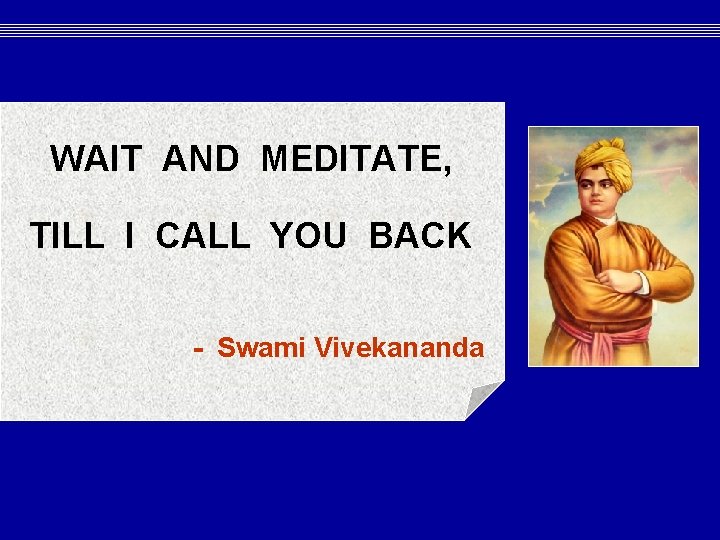
WAIT AND MEDITATE, TILL I CALL YOU BACK - Swami Vivekananda
REFERENCES • • • Jain Agam Dhyana Dipika, Dhyana Shatak Patanjal Yoga Sutra Holy Vedas, Puranas and Upanishadas Tripitak Dhyana Yoga Meditation - Swami Vivekananda - Osho Dhyana Kumbh - Suresh Vakil Meditations - J. Krishnamurti ‘Why God will not go away’ – Andrew Newberg Medical References from several journals
REFERENCES • Aries et al; 2006, Systematic review of efficacy of meditation techniques, Journal of Alternative and Complementary Medicine • Cahn B. R. , Polich J. , (2006), Meditation states and traits: EEG, ERP and neuroimaging studies, Psychol Bull, (2005), Meditation experience is associated with increased cortical thickness, Neuroreport • Mohandas E. , (2008) Neurobiology of spirituality, Mens Sena Monograph. • Newberg A. B. (2003), The neural basis of the complex mental task of meditation: neurotransmitter and neurochemical consideration, Med Hypotheses. • U. S. Department of Health(2007) Meditation Practices for Health: state of the Reasearch