
Emerging Healthcare Associated Pathogens in Texas What are




- Slides: 96
Emerging Healthcare Associated Pathogens in Texas What are our facilities doing to prevent the spread? October 4, 2017
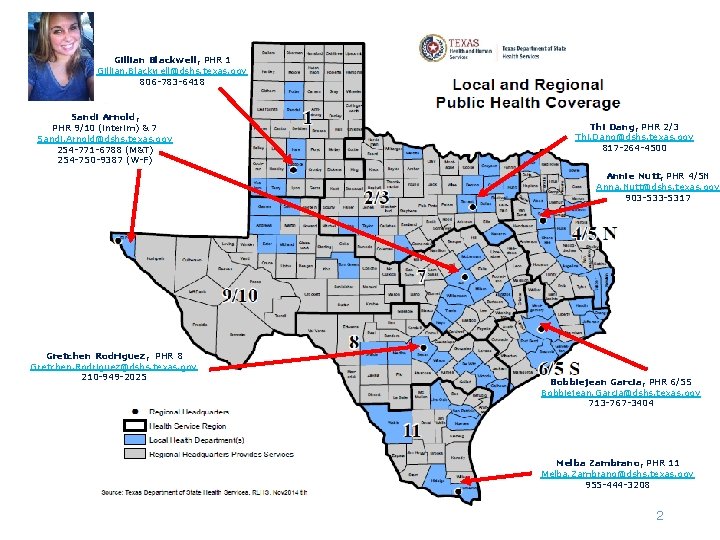
Gillian Blackwell, PHR 1 Gillian. Blackwell@dshs. texas. gov 806 -783 -6418 Sandi Arnold, PHR 9/10 (interim) & 7 Sandi. Arnold@dshs. texas. gov 254 -771 -6788 (M&T) 254 -750 -9387 (W-F) Thi Dang, PHR 2/3 Thi. Dang@dshs. texas. gov 817 -264 -4500 Annie Nutt, PHR 4/5 N Anna. Nutt@dshs. texas. gov 903 -5317 Gretchen Rodriguez, PHR 8 Gretchen. Rodriguez@dshs. texas. gov 210 -949 -2025 Bobbiejean Garcia, PHR 6/5 S Bobbiejean. Garcia@dshs. texas. gov 713 -767 -3404 Melba Zambrano, PHR 11 Melba. Zambrano@dshs. texas. gov 955 -444 -3208 2
Identification of Emerging Resistance
Emerging Pathogens of Concern • Multi-Drug Resistant Organisms: • Currently reportable: • VISA/VRSA, CRE, MDR-A • Bacteria with mobile resistance genes • Candida auris • Clostridium difficile 4
Mobile Resistance Genes 1. Carbapenemase-Producing (CP) genes: • Examples: KPC and NDM 2. Genes conferring resistance to Colistin: • Examples: mcr-1, mcr-2, mcr-3 5
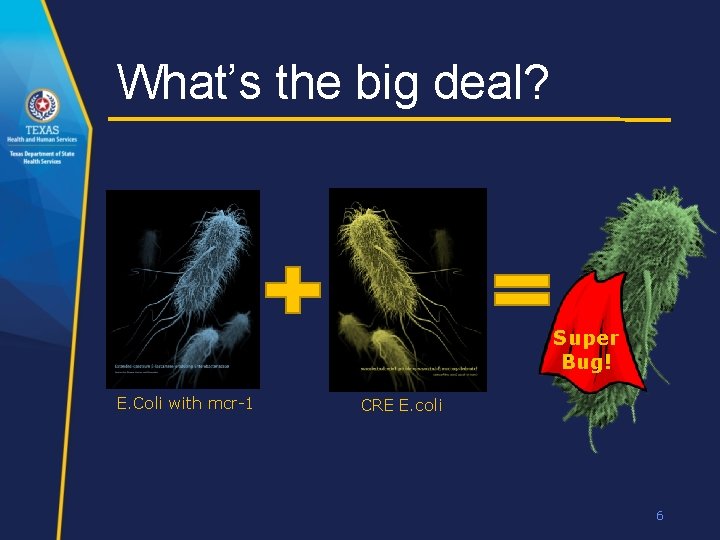
What’s the big deal? Super Bug! E. Coli with mcr-1 CRE E. coli 6
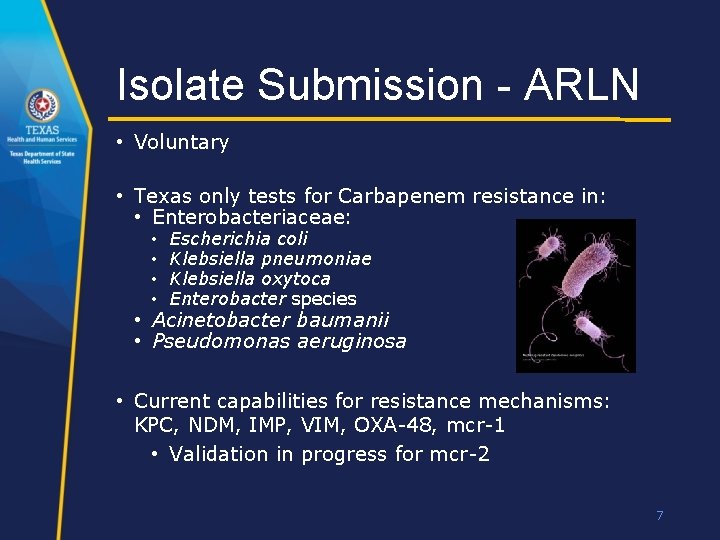
Isolate Submission - ARLN • Voluntary • Texas only tests for Carbapenem resistance in: • Enterobacteriaceae: • • Escherichia coli Klebsiella pneumoniae Klebsiella oxytoca Enterobacter species • Acinetobacter baumanii • Pseudomonas aeruginosa • Current capabilities for resistance mechanisms: KPC, NDM, IMP, VIM, OXA-48, mcr-1 • Validation in progress for mcr-2 7
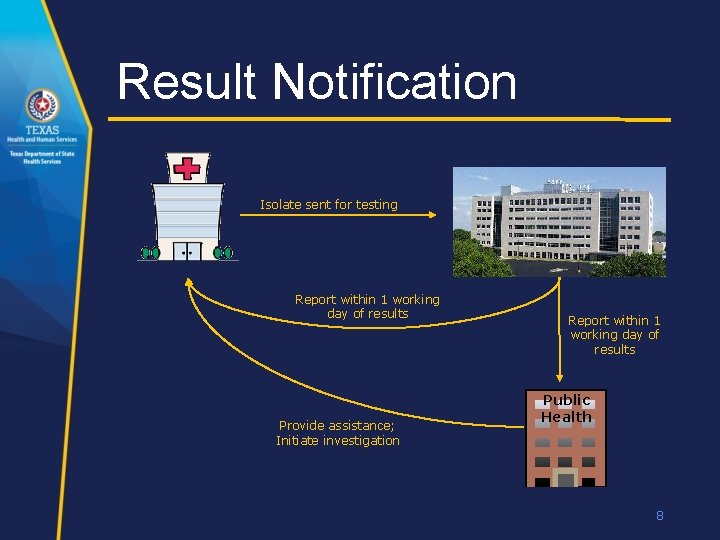
Result Notification Isolate sent for testing Report within 1 working day of results Provide assistance; Initiate investigation Report within 1 working day of results Public Health 8
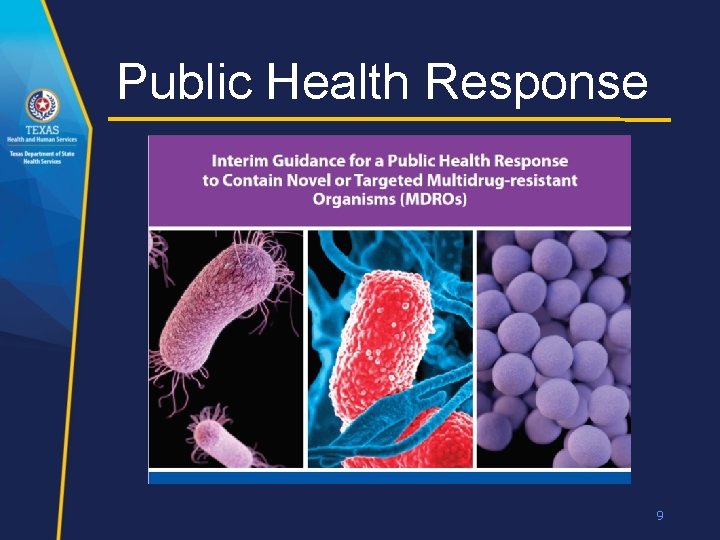
Public Health Response 9
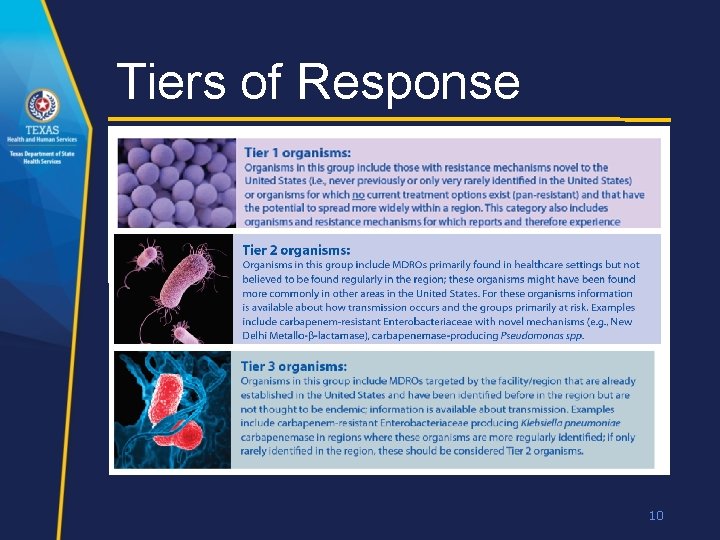
Tiers of Response 10
Public Health Notification and Response
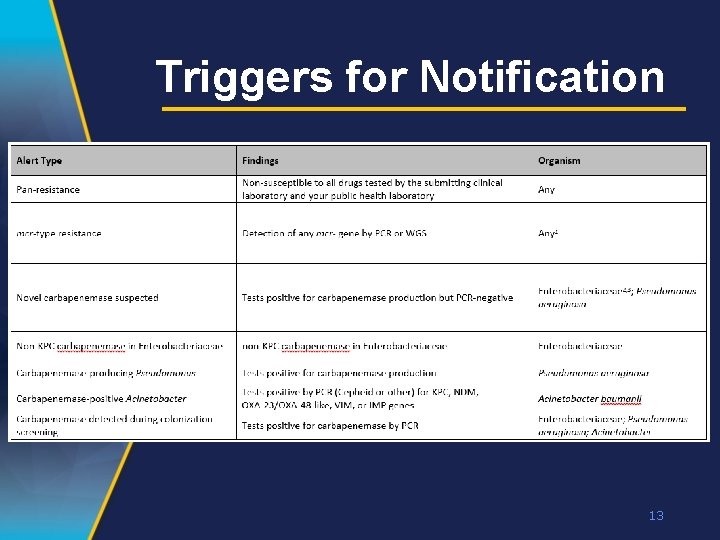
Initial Notification • Once one of the alert triggers is met, an email is sent by the ARLN to notify: • CDC • State HAI Coordinator • Regional HAI Epidemiologist 12
Triggers for Notification 13
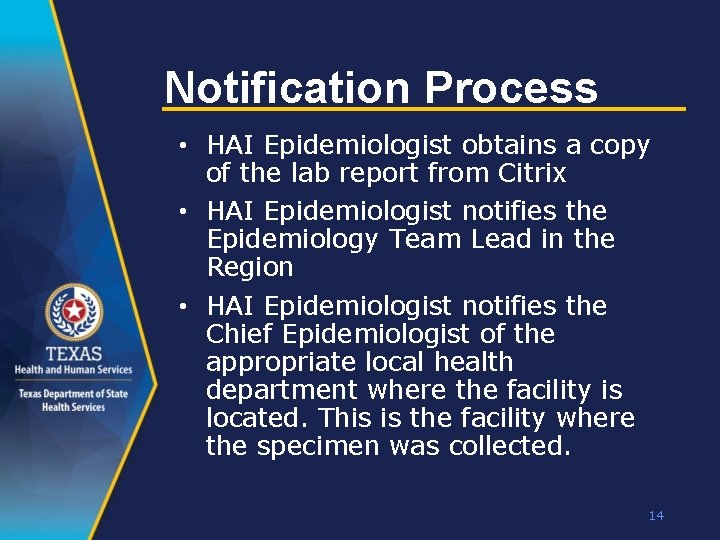
Notification Process • HAI Epidemiologist obtains a copy of the lab report from Citrix • HAI Epidemiologist notifies the Epidemiology Team Lead in the Region • HAI Epidemiologist notifies the Chief Epidemiologist of the appropriate local health department where the facility is located. This is the facility where the specimen was collected. 14
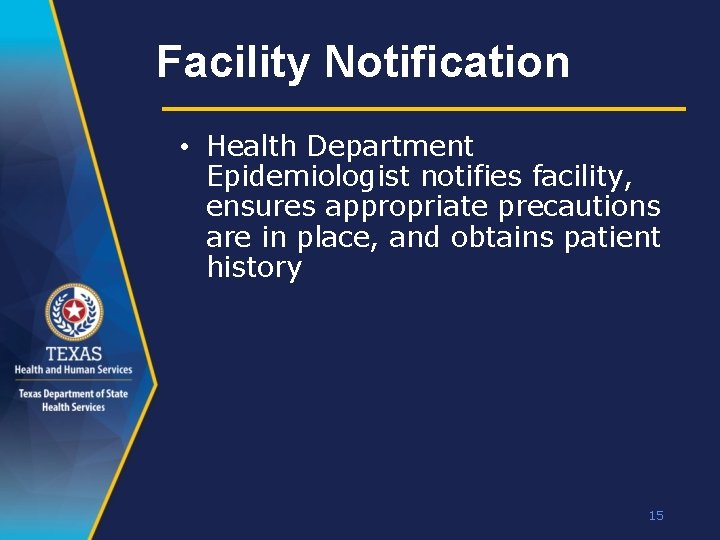
Facility Notification • Health Department Epidemiologist notifies facility, ensures appropriate precautions are in place, and obtains patient history 15
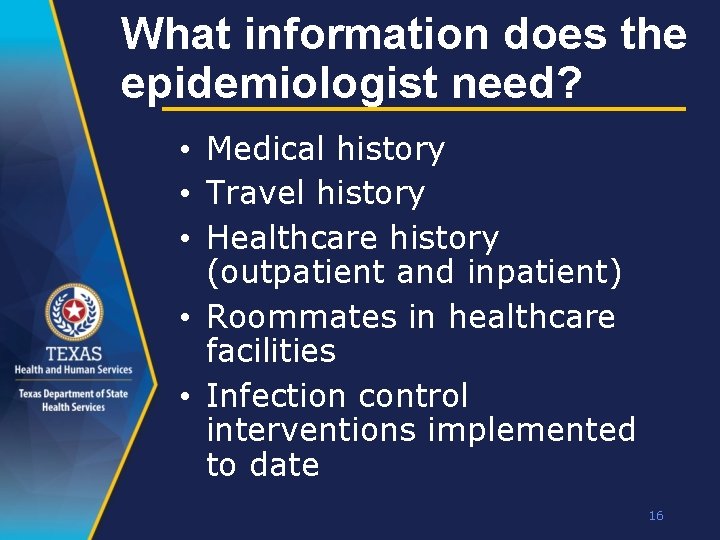
What information does the epidemiologist need? • Medical history • Travel history • Healthcare history (outpatient and inpatient) • Roommates in healthcare facilities • Infection control interventions implemented to date 16
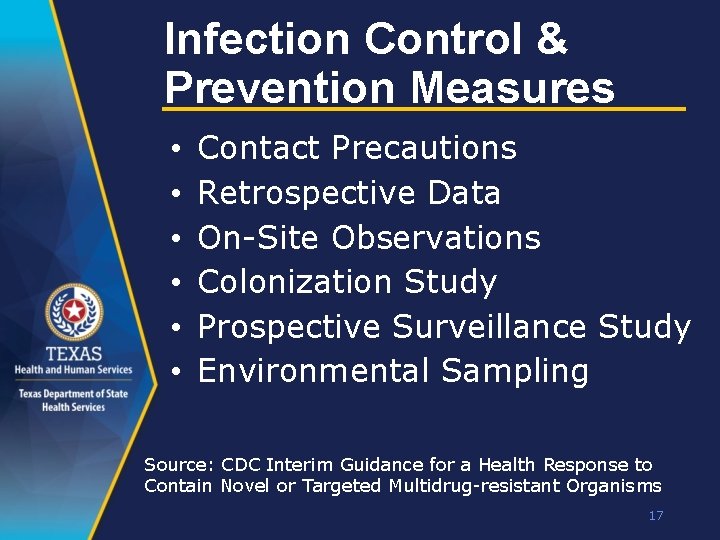
Infection Control & Prevention Measures • • • Contact Precautions Retrospective Data On-Site Observations Colonization Study Prospective Surveillance Study Environmental Sampling Source: CDC Interim Guidance for a Health Response to Contain Novel or Targeted Multidrug-resistant Organisms 17
Public Health Response: Texas’ First mcr-1 Case
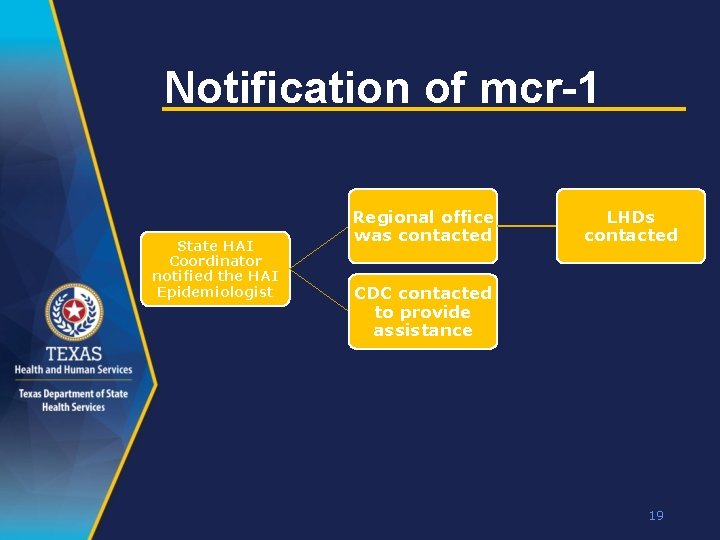
Notification of mcr-1 State HAI Coordinator notified the HAI Epidemiologist Regional office was contacted LHDs contacted CDC contacted to provide assistance 19
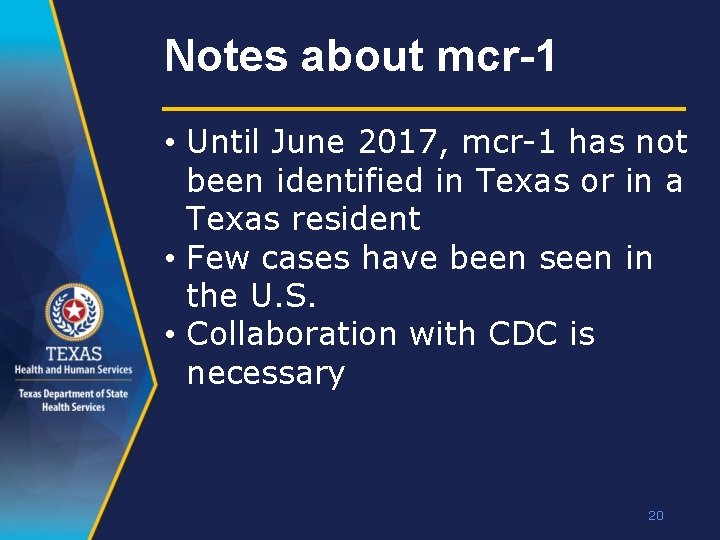
Notes about mcr-1 • Until June 2017, mcr-1 has not been identified in Texas or in a Texas resident • Few cases have been seen in the U. S. • Collaboration with CDC is necessary 20
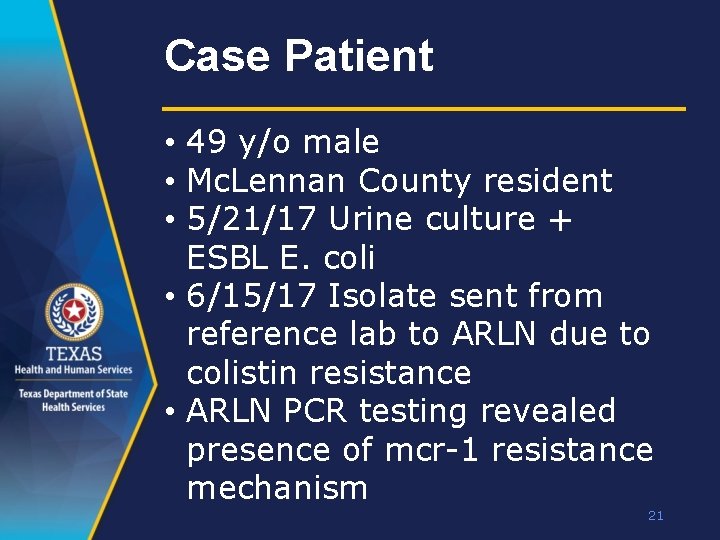
Case Patient • 49 y/o male • Mc. Lennan County resident • 5/21/17 Urine culture + ESBL E. coli • 6/15/17 Isolate sent from reference lab to ARLN due to colistin resistance • ARLN PCR testing revealed presence of mcr-1 resistance mechanism 21
Dallas County Health & Human Services 22
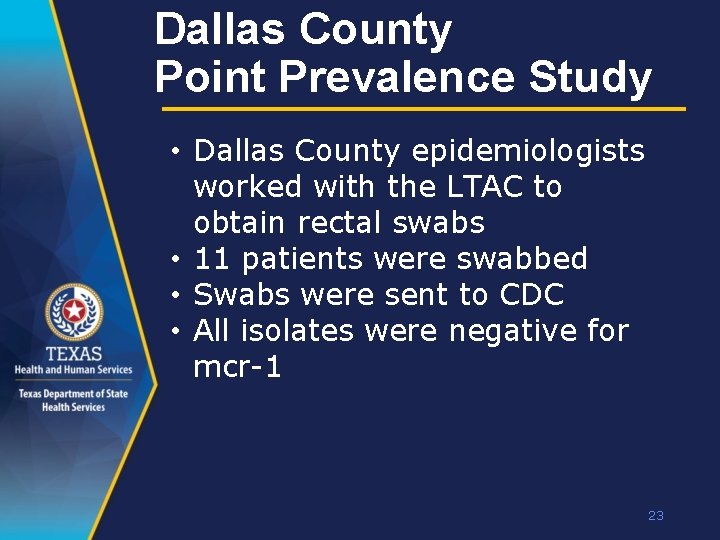
Dallas County Point Prevalence Study • Dallas County epidemiologists worked with the LTAC to obtain rectal swabs • 11 patients were swabbed • Swabs were sent to CDC • All isolates were negative for mcr-1 23
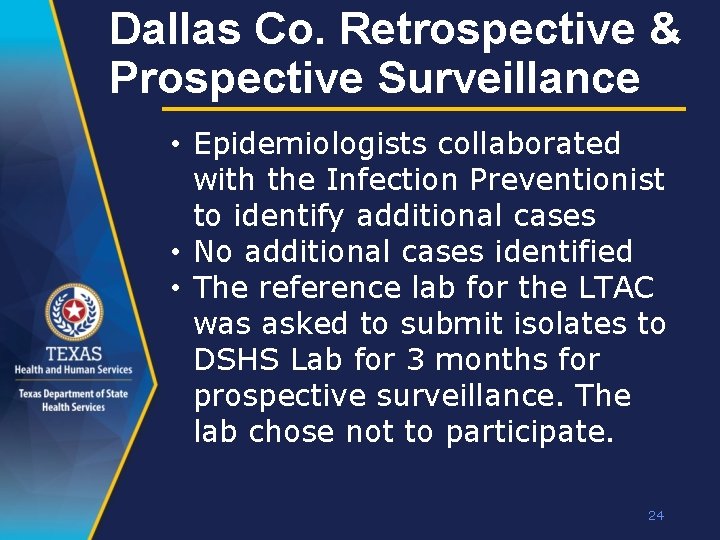
Dallas Co. Retrospective & Prospective Surveillance • Epidemiologists collaborated with the Infection Preventionist to identify additional cases • No additional cases identified • The reference lab for the LTAC was asked to submit isolates to DSHS Lab for 3 months for prospective surveillance. The lab chose not to participate. 24
TARRANT COUNTY PUBLIC HEALTH Accountability. Quality. Innovation. MCR-1 Case Study By: Tijera Bell, MPH, CIC Updated: September 2017 A healthier community through leadership in health strategy.
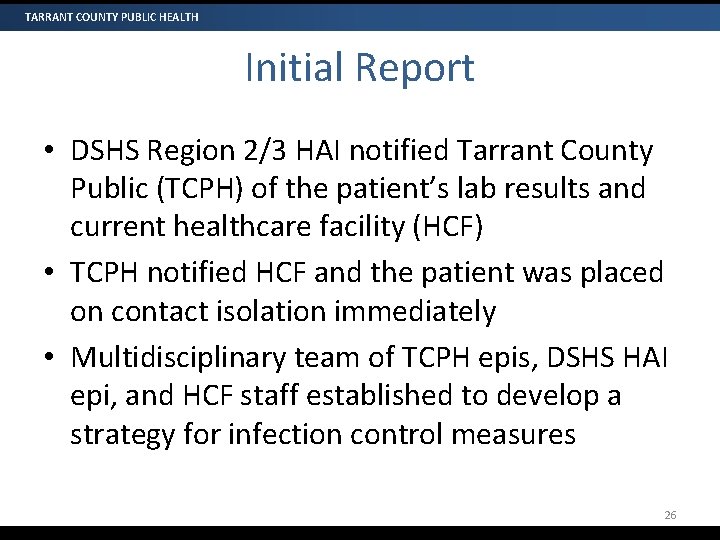
TARRANT COUNTY PUBLIC HEALTH Initial Report • DSHS Region 2/3 HAI notified Tarrant County Public (TCPH) of the patient’s lab results and current healthcare facility (HCF) • TCPH notified HCF and the patient was placed on contact isolation immediately • Multidisciplinary team of TCPH epis, DSHS HAI epi, and HCF staff established to develop a strategy for infection control measures 26
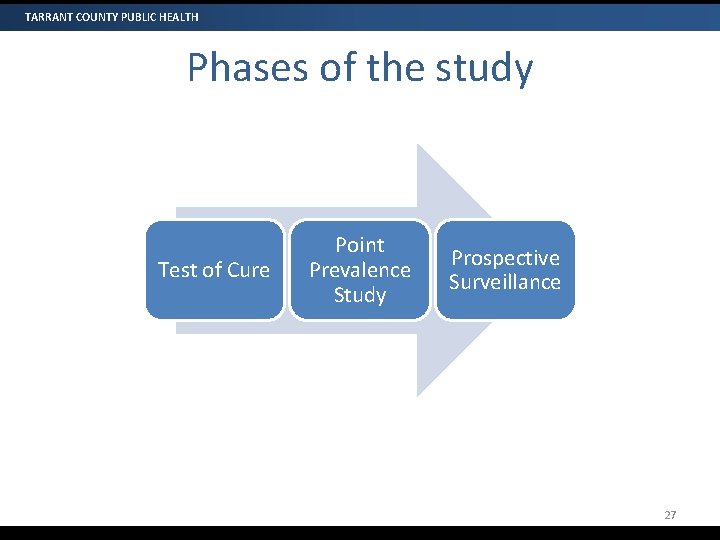
TARRANT COUNTY PUBLIC HEALTH Phases of the study Test of Cure Point Prevalence Study Prospective Surveillance 27
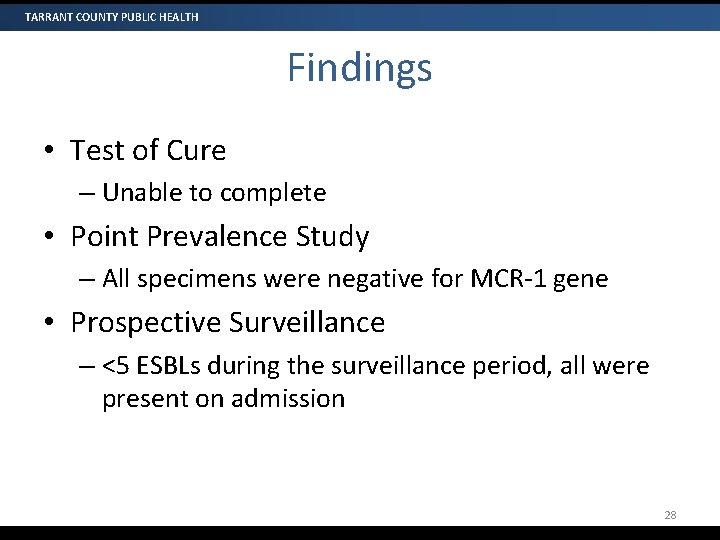
TARRANT COUNTY PUBLIC HEALTH Findings • Test of Cure – Unable to complete • Point Prevalence Study – All specimens were negative for MCR-1 gene • Prospective Surveillance – <5 ESBLs during the surveillance period, all were present on admission 28
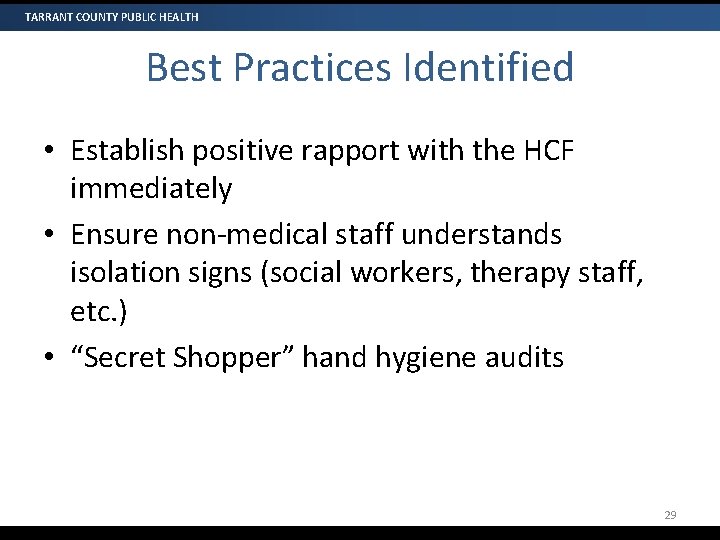
TARRANT COUNTY PUBLIC HEALTH Best Practices Identified • Establish positive rapport with the HCF immediately • Ensure non-medical staff understands isolation signs (social workers, therapy staff, etc. ) • “Secret Shopper” hand hygiene audits 29
TARRANT COUNTY PUBLIC HEALTH Main Address: 1101 S. Main Street Fort Worth, TX 76104 Accountability. Quality. Social Media: Phone: 817 -321 -4700 Website: health. tarrantcounty. com A healthier community through leadership in health strategy. Innovation.
Brazos County Health Department Yao Akpalu, MB. Ch. B, MPH, CPH 31
Waco – Mc. Lennan County Public Health District Vaidehi Shah, BDS, MPH Epidemiologist vaidehis@wacotx. gov 32
Regional Health Department Roles • Participated and provided input in meetings and conference calls • Provided information resources • Assisted with arrangements for specimen submission 33
Takeaways 1) Non-traditional epidemiology investigation steps 2) Extensive collaborative effort between various entities 3) Conducting point prevalence study for emerging HAIs 4) Understand what comprises a prospective surveillance study for emerging HAI pathogens. 34
References • Centers for Disease Control and Prevention (2017). Antibiotic Resistance Lab Network. Retrieved from: https: //www. cdc. gov/drugresistance/solutions-initiative/ar-lab -networks. html. • CDC (2017). CDC Antibiotic/Antimicrobial Resistance. Retrieved from: https: //www. cdc. gov/drugresistance/index. html. • CDC (2017). CDC Interim Guidance for a Health Response to Contain Novel or Targeted Multidrug-resistant Organisms. Retrieved from: https: //www. cdc. gov/hai/outbreaks/mdro/index. html • Texas Department of State Health Services (2017). Texas Notifiable Conditions. Retrieved from: https: //www. dshs. texas. gov/idcu/investigation/conditions/. 35
Carbapenemase Producing Pseudomonas aeruginosa • 36
CRPA • “new” IP • Special population: burn patients • High turn-over at facility Previous P. aeruginosa outbreak December 2016 -January 2017 37
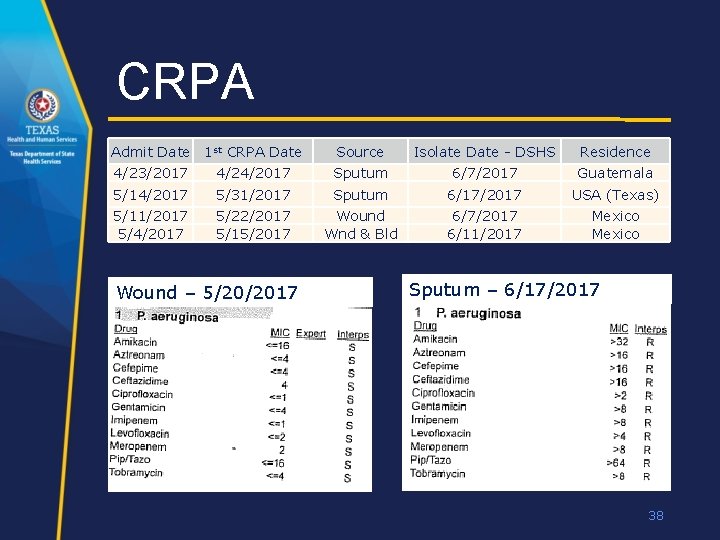
CRPA Admit Date 1 st CRPA Date Source Isolate Date - DSHS Residence 4/23/2017 4/24/2017 Sputum 6/7/2017 Guatemala 5/14/2017 5/31/2017 Sputum 6/17/2017 USA (Texas) 5/11/2017 5/4/2017 5/22/2017 5/15/2017 Wound Wnd & Bld 6/7/2017 6/11/2017 Mexico Wound – 5/20/2017 Sputum – 6/17/2017 38
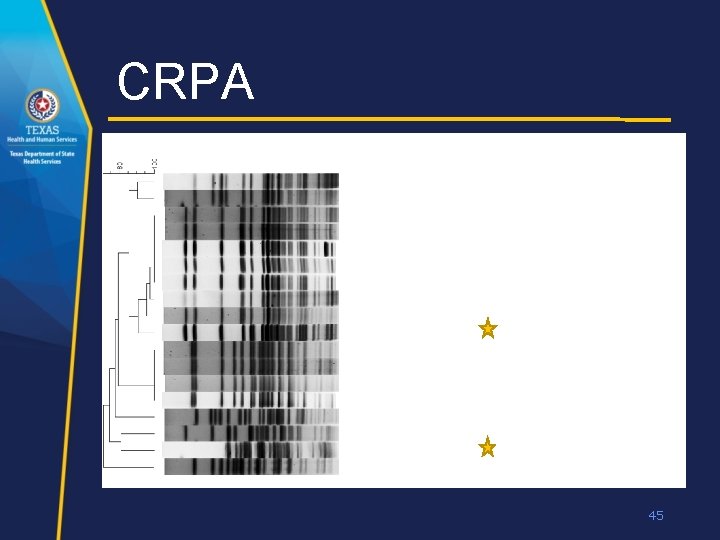
CRPA – PFGE Pattern 310 Pattern 311 39
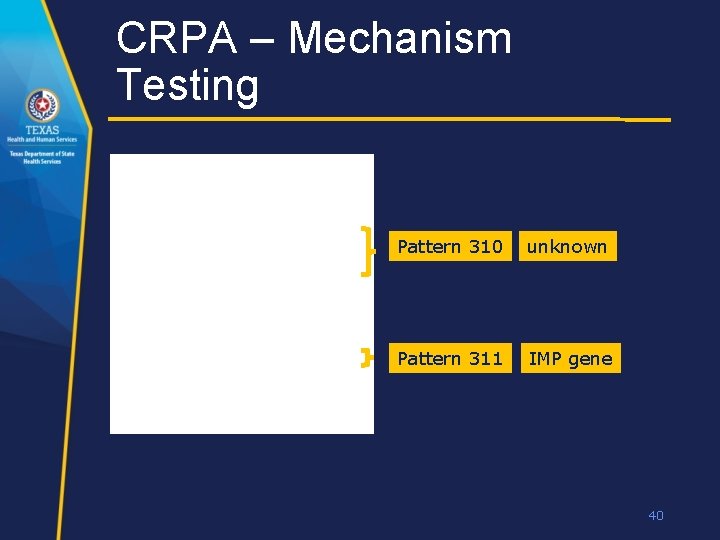
CRPA – Mechanism Testing Pattern 310 unknown Pattern 311 IMP gene 40
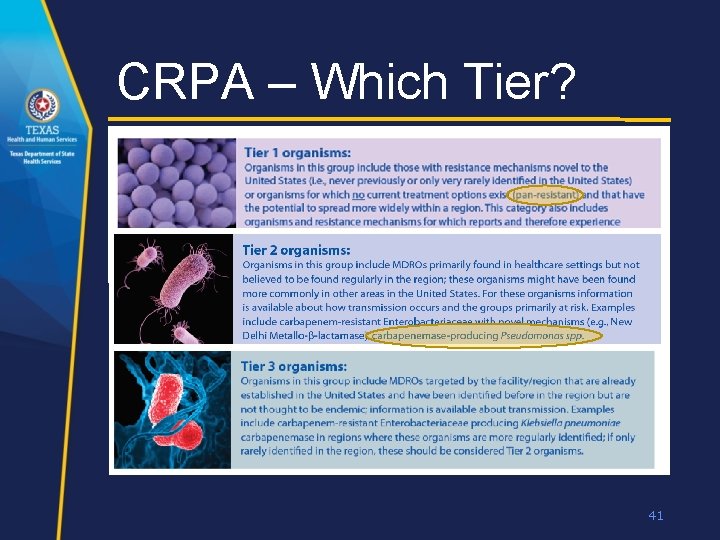
CRPA – Which Tier? 41
CRPA – Site Visit • LHD, LHA, DSHS • Findings • Reusingle-patient device • 60 HH observations (70% compliance) • Inappropriate sink usage • Cracked liners in tub room • Point prevalence study following Monday 42
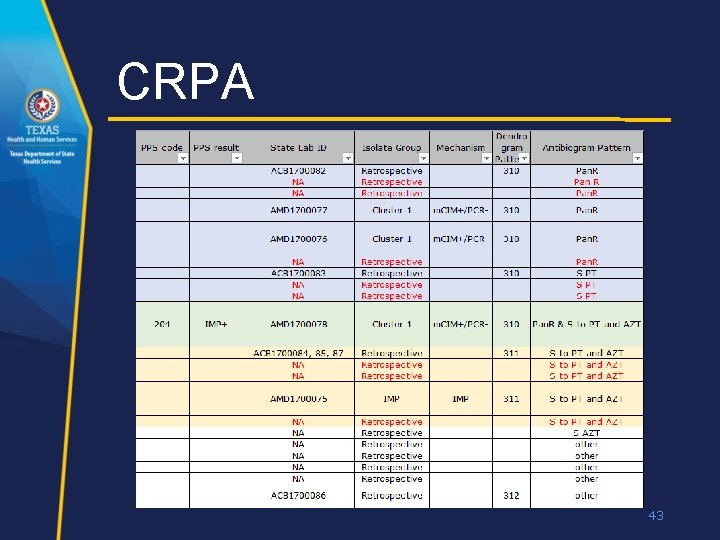
CRPA 43
CRPA • Continued communications with the hospital • Learning as we go • Is it over yet? 44
CRPA 45
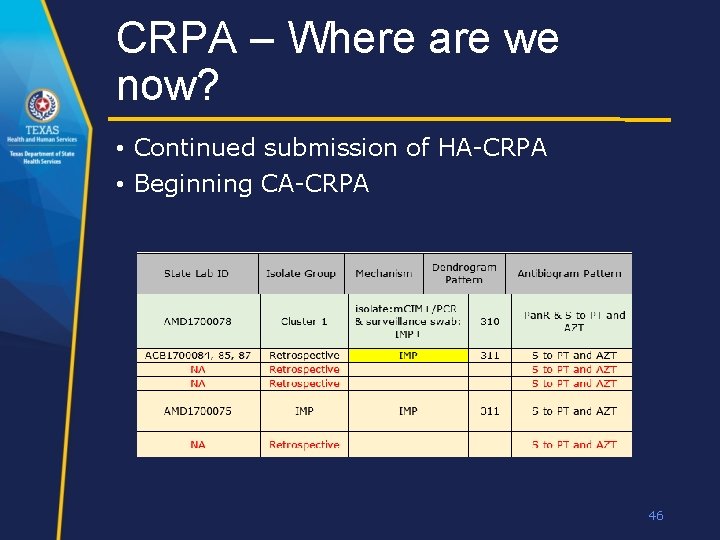
CRPA – Where are we now? • Continued submission of HA-CRPA • Beginning CA-CRPA 46
Infection Control Assessment and Response (ICAR) Visits
Objectives • Explain what are ICAR visits • Understand Texas’ facility selection criteria • Discuss lessons learned from the conducted visits • Strengths • Weaknesses • Challenges 48
ICAR Overview • Tool was developed by the CDC under the Epidemiology and Laboratory Capacity (ELC) Grant. • Began with Ebola preparedness; expanded to all facility types. • Reporting summary data began March 2016, ends March 2018. • Primary goals: Assist health departments in assessing infection prevention practices and guide quality improvement activities. 49
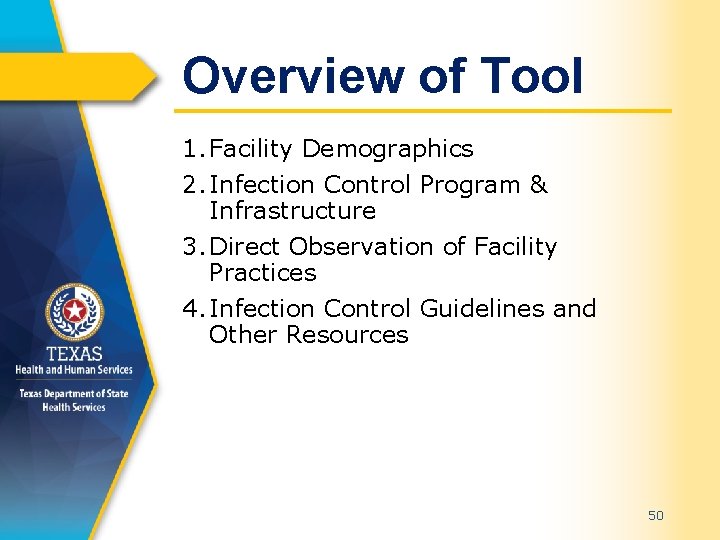
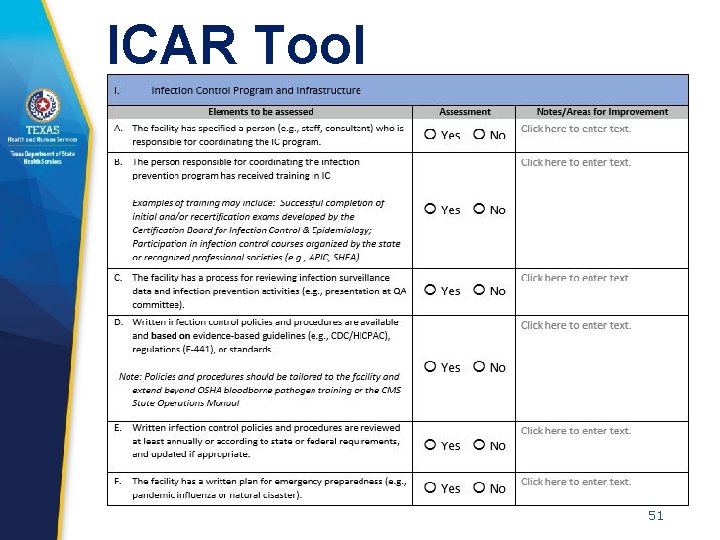
Overview of Tool 1. Facility Demographics 2. Infection Control Program & Infrastructure 3. Direct Observation of Facility Practices 4. Infection Control Guidelines and Other Resources 50
ICAR Tool 51
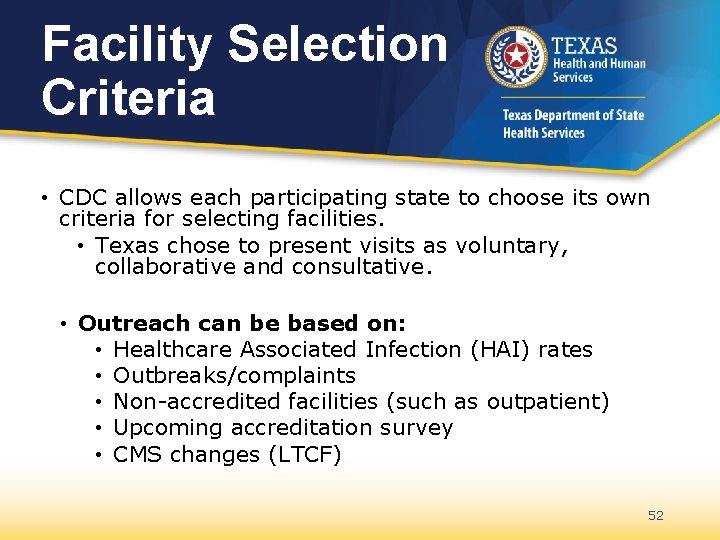
Facility Selection Criteria • CDC allows each participating state to choose its own criteria for selecting facilities. • Texas chose to present visits as voluntary, collaborative and consultative. • Outreach can be based on: • Healthcare Associated Infection (HAI) rates • Outbreaks/complaints • Non-accredited facilities (such as outpatient) • Upcoming accreditation survey • CMS changes (LTCF) 52
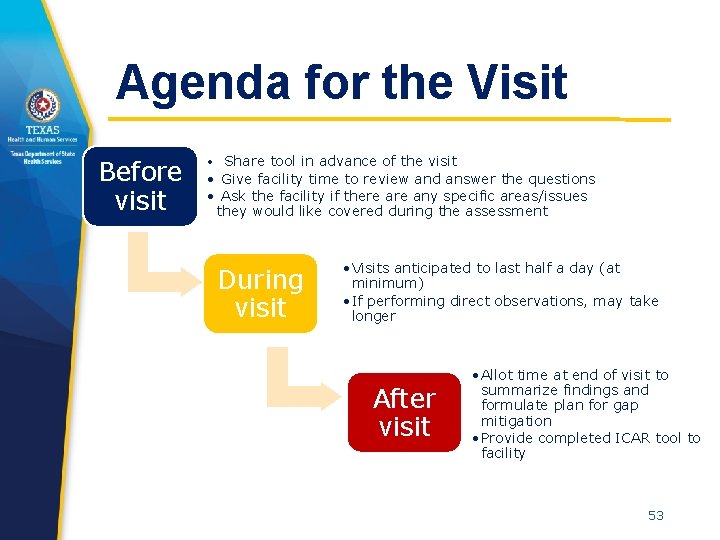
Agenda for the Visit Before visit • Share tool in advance of the visit • Give facility time to review and answer the questions • Ask the facility if there any specific areas/issues they would like covered during the assessment During visit • Visits anticipated to last half a day (at minimum) • If performing direct observations, may take longer After visit • Allot time at end of visit to summarize findings and formulate plan for gap mitigation • Provide completed ICAR tool to facility 53
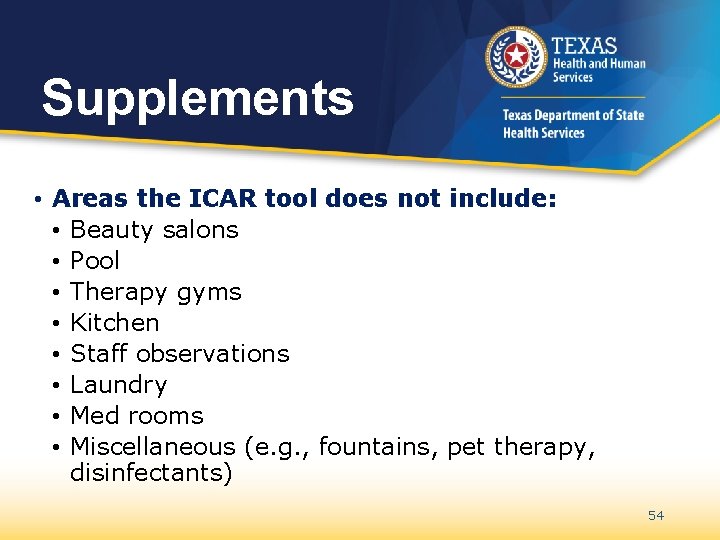
Supplements • Areas the ICAR tool does not include: • Beauty salons • Pool • Therapy gyms • Kitchen • Staff observations • Laundry • Med rooms • Miscellaneous (e. g. , fountains, pet therapy, disinfectants) 54
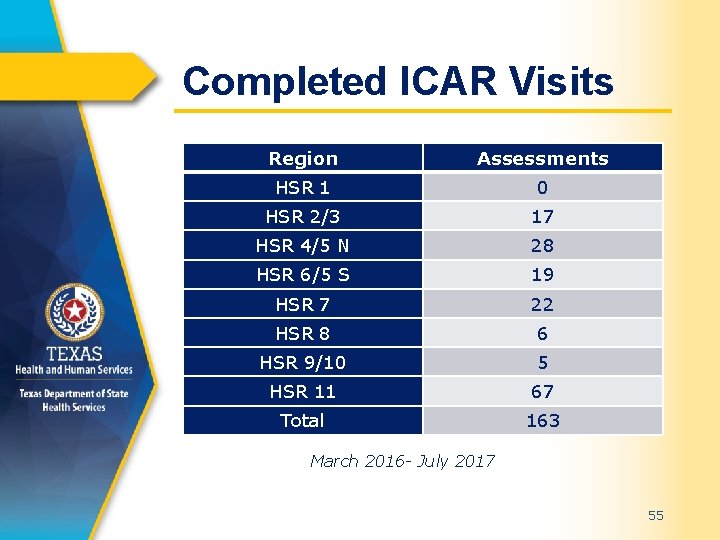
Completed ICAR Visits Region Assessments HSR 1 0 HSR 2/3 17 HSR 4/5 N 28 HSR 6/5 S 19 HSR 7 22 HSR 8 6 HSR 9/10 5 HSR 11 67 Total 163 March 2016 - July 2017 55
Acute Care Facilities 43 visits conducted
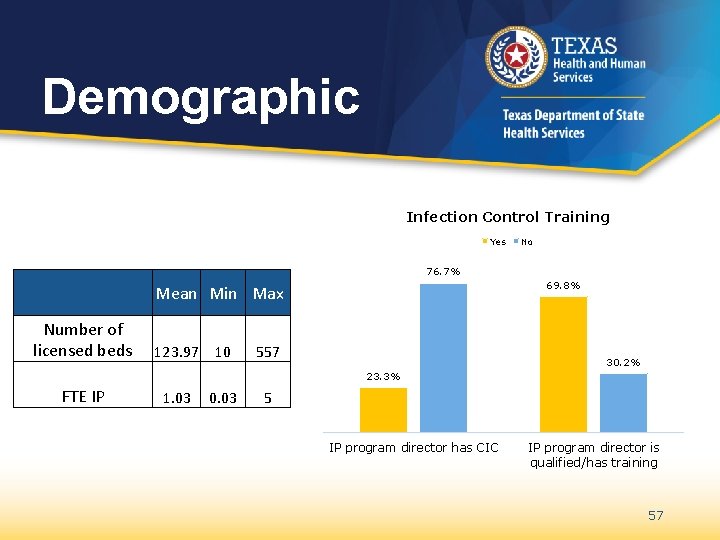
Demographic Infection Control Training Yes No 76. 7% Number of licensed beds 69. 8% Mean Min Max 123. 97 10 557 30. 2% 23. 3% FTE IP 1. 03 0. 03 5 IP program director has CIC IP program director is qualified/has training 57
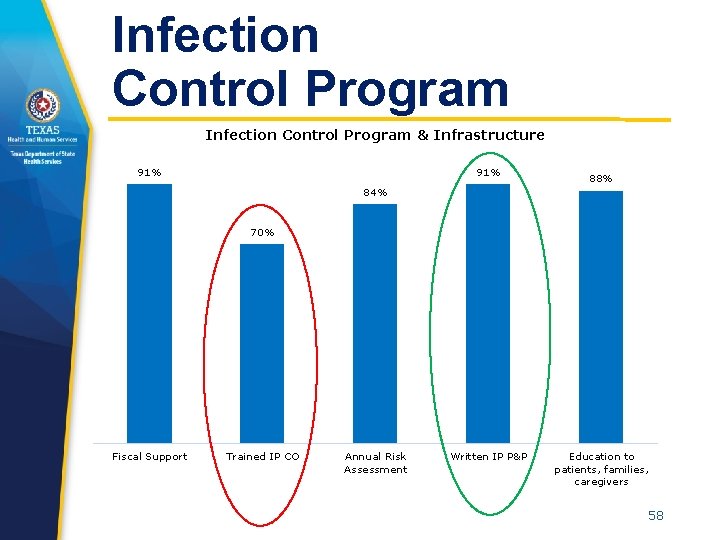
Infection Control Program & Infrastructure 91% 88% 84% 70% Fiscal Support Trained IP CO Annual Risk Assessment Written IP P&P Education to patients, families, caregivers 58
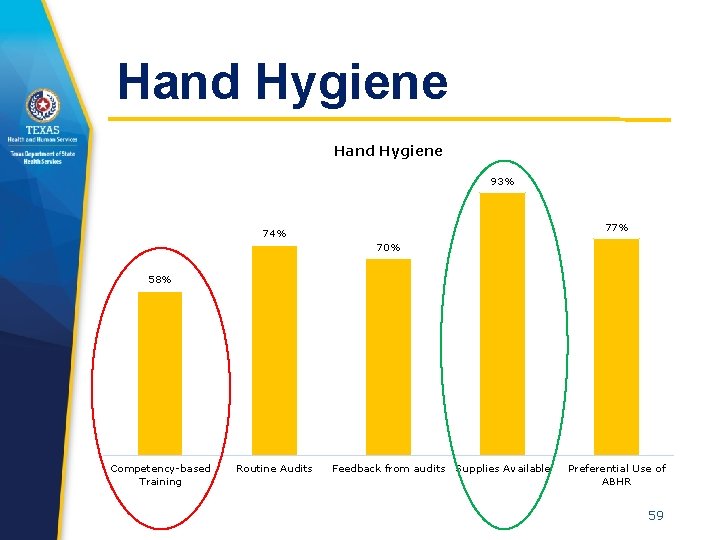
Hand Hygiene 93% 77% 74% 70% 58% Competency-based Training Routine Audits Feedback from audits Supplies Available Preferential Use of ABHR 59
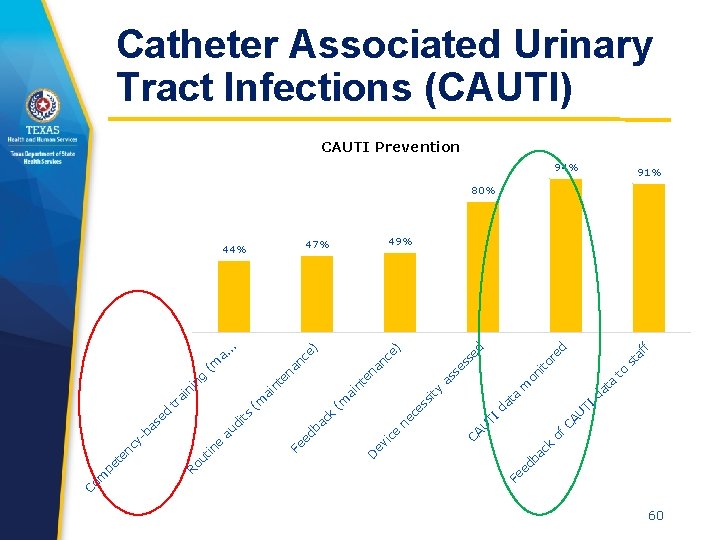
ff ta s d d re ito t o at a d on m at a TI AU C of k ac db Fe e d TI ) ce se es a ss si ty ce s an en 47% CA U ne e ic ev ) ce 44% D nt ai m ( ck an . . a. m ( in g nt en ai m di ts ( ba ed Fe au e in t ra ed as -b cy in ut te n Ro pe m Co Catheter Associated Urinary Tract Infections (CAUTI) CAUTI Prevention 94% 91% 80% 49% 60
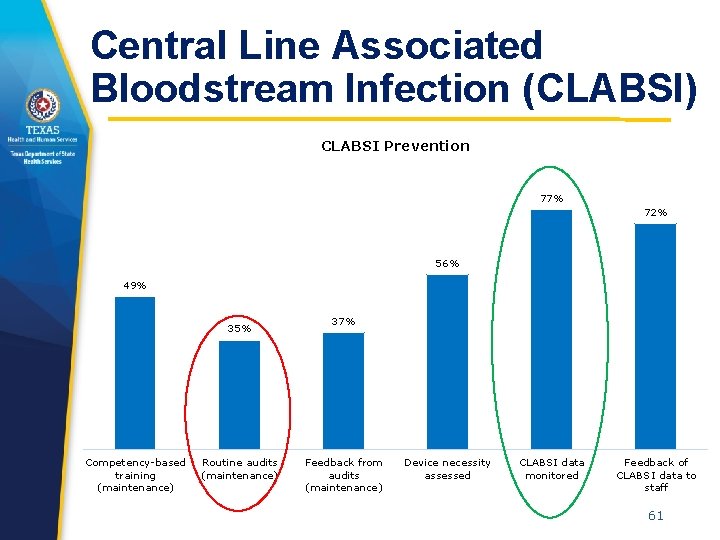
Central Line Associated Bloodstream Infection (CLABSI) CLABSI Prevention 77% 72% 56% 49% 35% Competency-based training (maintenance) Routine audits (maintenance) 37% Feedback from audits (maintenance) Device necessity assessed CLABSI data monitored Feedback of CLABSI data to staff 61
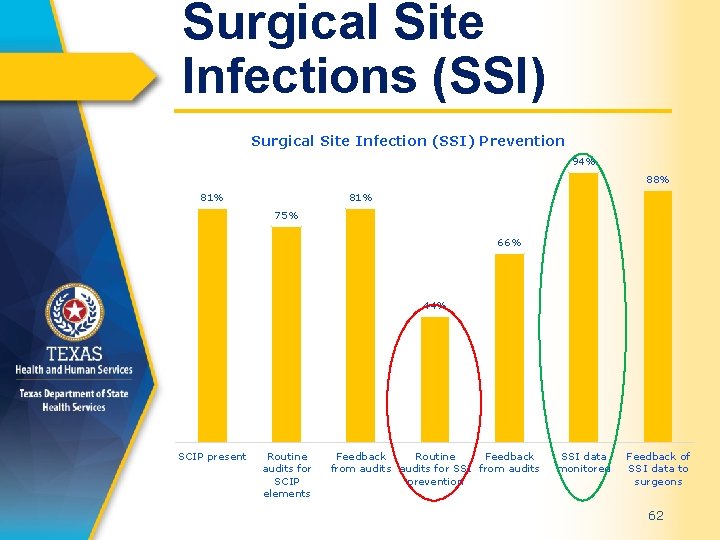
Surgical Site Infections (SSI) Surgical Site Infection (SSI) Prevention 94% 88% 81% 75% 66% 44% SCIP present Routine audits for SCIP elements Feedback Routine Feedback from audits for SSI from audits prevention SSI data monitored Feedback of SSI data to surgeons 62
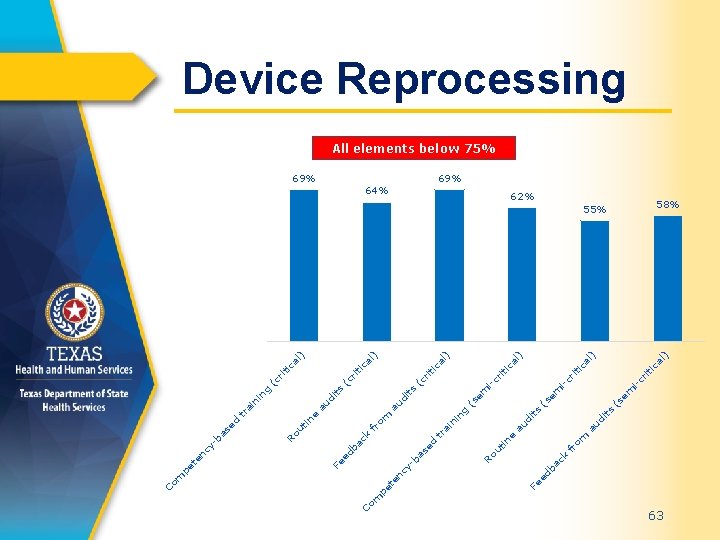
a om fr ck ba ed Fe l) ) al ca iti icr m se ts ( ud i ic ) l) ca ca l iti cr it i- m se ( m icr iti ) al ic rit (c ( cr its se ( ts di au e in ut ng ni ai ud om a ts l) 64% Ro tr d ck fr di ca iti 69% se ba y- nc te pe m Co ba ed Fe ( cr ng ni ai au tr e tin Ro u d se yba nc te m pe Co Device Reprocessing All elements below 75% 69% 62% 55% 58% 63
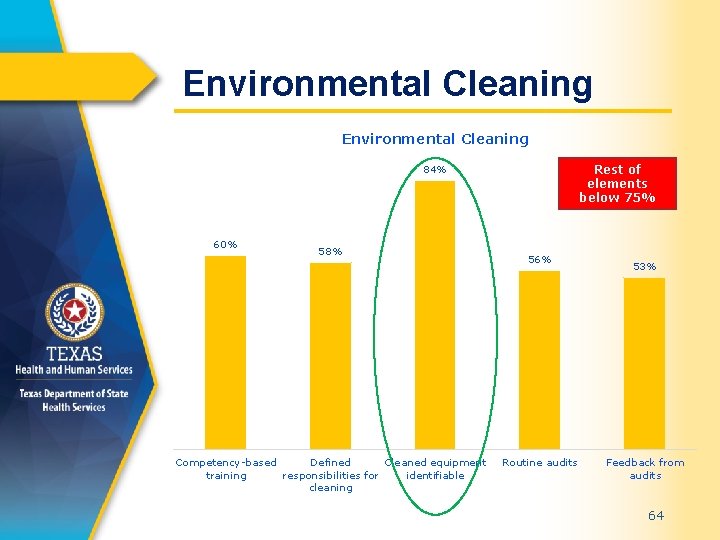
Environmental Cleaning Rest of elements below 75% 84% 60% 58% Competency-based Defined Cleaned equipment training responsibilities for identifiable cleaning 56% Routine audits 53% Feedback from audits 64
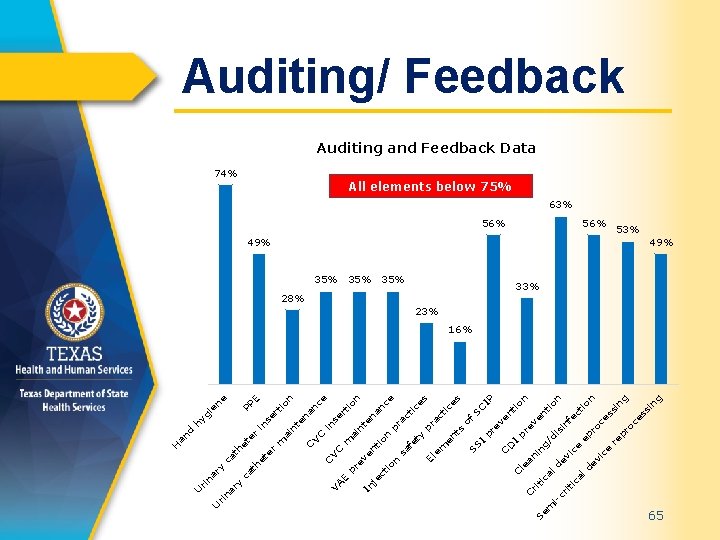
m ai C rt io se in an ce n io rt E 74% In n ev nt en en je an tio ct ce n io pr n ac sa tic fe ty es p El ra em ct ic en es ts o f S SS CI I pr P ev en CD tio I Cl pr n e an ev Cr iti in en Se g/ ca tio m di l d in s cr ev in iti f i ec ce ca tio e l d pr n ev oc ic es e si re ng pr oc es si ng pr E CV se nt en ai m r C CV te PP e en gi hy in d er et th ca y th e ar ca y VA ar rin U U rin an H Auditing/ Feedback Auditing and Feedback Data All elements below 75% 63% 56% 35% 35% 28% 56% 49% 53% 49% 33% 23% 16% 65
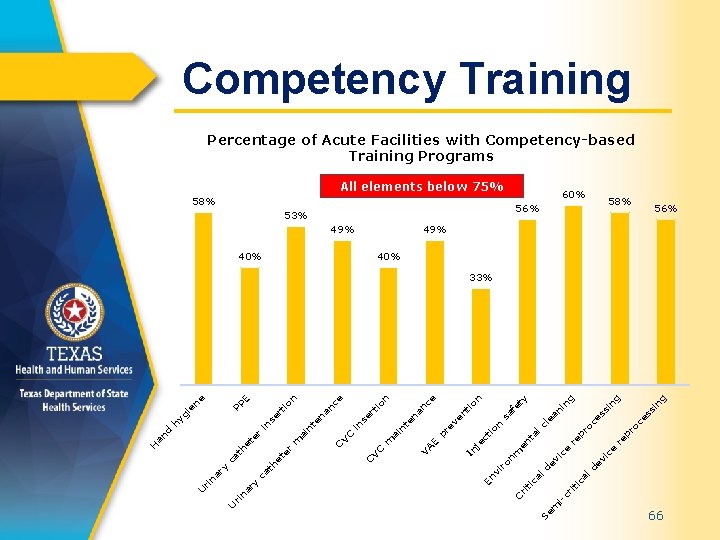
e ic ev ng si 60% es ng 56% oc pr re g in es si oc pr re an le c ty fe All elements below 75% l d ca iti e ev ic l d ta l en sa n 53% icr ca iti n io ct tio en 58% Se m Cr nm vi ro En je In ev ce an 49% pr E VA io n rt se in ce an 40% nt en C m ai CV en nt n io se rt E PP e en gi hy in m ai C CV et er er et th ca y ar rin U d an H Competency Training Percentage of Acute Facilities with Competency-based Training Programs 58% 56% 49% 40% 33% 66
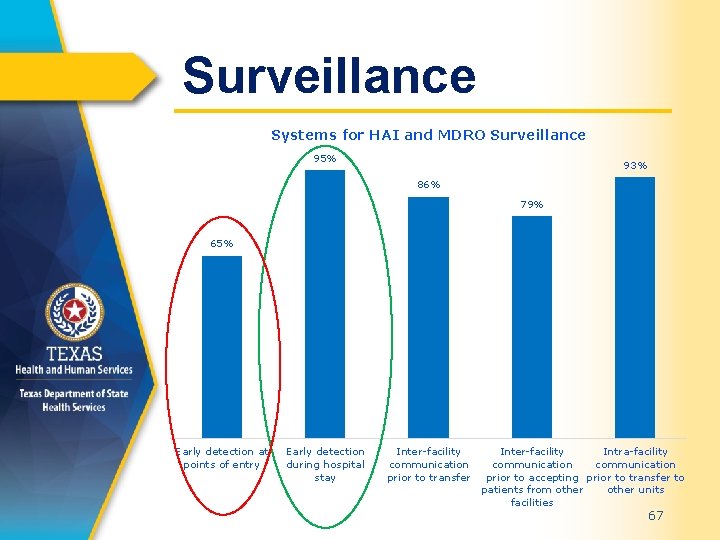
Surveillance Systems for HAI and MDRO Surveillance 95% 93% 86% 79% 65% Early detection at points of entry Early detection during hospital stay Inter-facility communication prior to transfer Inter-facility Intra-facility communication prior to accepting prior to transfer to patients from other units facilities 67
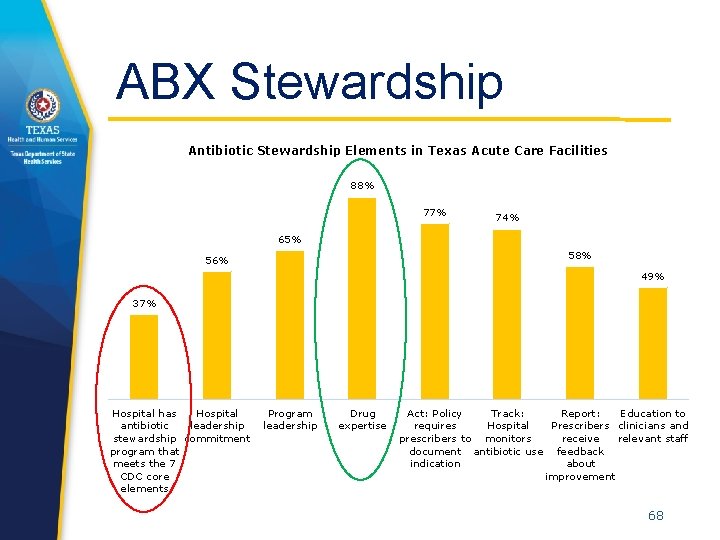
ABX Stewardship Antibiotic Stewardship Elements in Texas Acute Care Facilities 88% 77% 74% 65% 58% 56% 49% 37% Hospital has Hospital antibiotic leadership stewardship commitment program that meets the 7 CDC core elements Program leadership Drug expertise Act: Policy Track: Report: Education to requires Hospital Prescribers clinicians and prescribers to monitors receive relevant staff document antibiotic use feedback indication about improvement 68
69
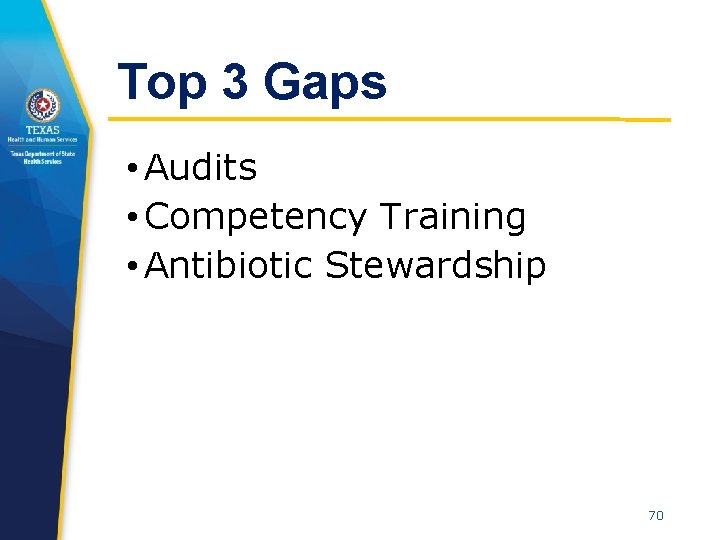
Top 3 Gaps • Audits • Competency Training • Antibiotic Stewardship 70
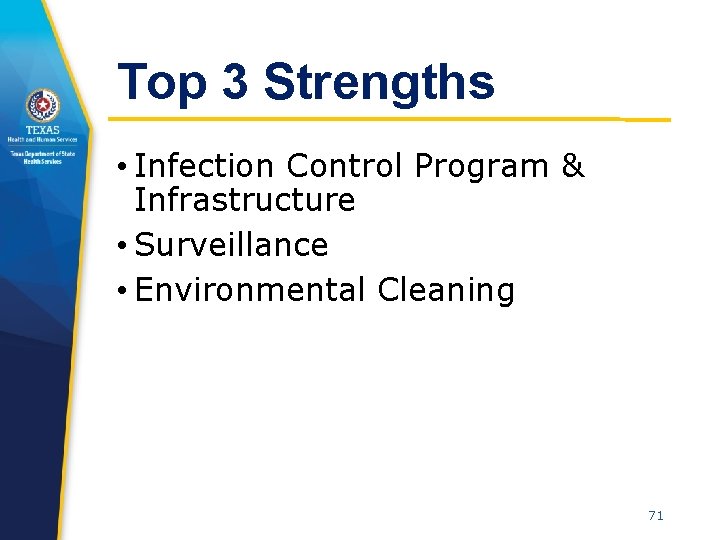
Top 3 Strengths • Infection Control Program & Infrastructure • Surveillance • Environmental Cleaning 71
Long-Term Care Facilities 92 visits conducted
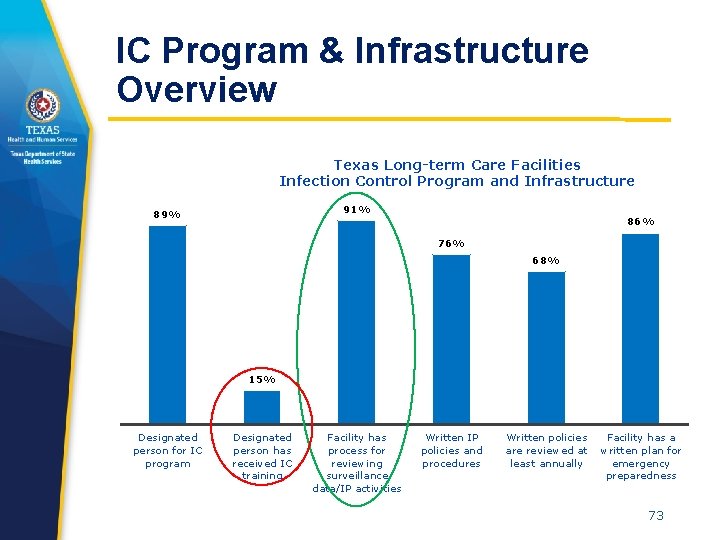
IC Program & Infrastructure Overview Texas Long-term Care Facilities Infection Control Program and Infrastructure 91% 89% 86% 76% 68% 15% Designated person for IC program Designated person has received IC training Facility has process for reviewing surveillance data/IP activities Written IP policies and procedures Written policies Facility has a are reviewed at written plan for least annually emergency preparedness 73
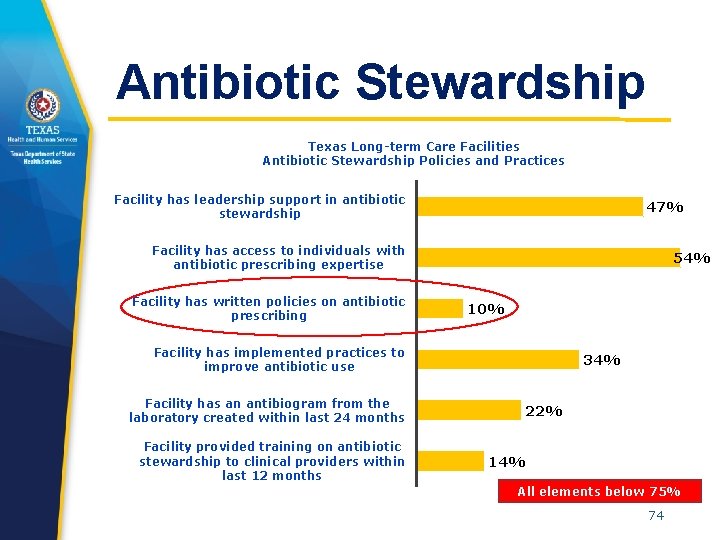
Antibiotic Stewardship Texas Long-term Care Facilities Antibiotic Stewardship Policies and Practices Facility has leadership support in antibiotic stewardship 47% Facility has access to individuals with antibiotic prescribing expertise Facility has written policies on antibiotic prescribing 54% 10% Facility has implemented practices to improve antibiotic use Facility has an antibiogram from the laboratory created within last 24 months Facility provided training on antibiotic stewardship to clinical providers within last 12 months 34% 22% 14% All elements below 75% 74
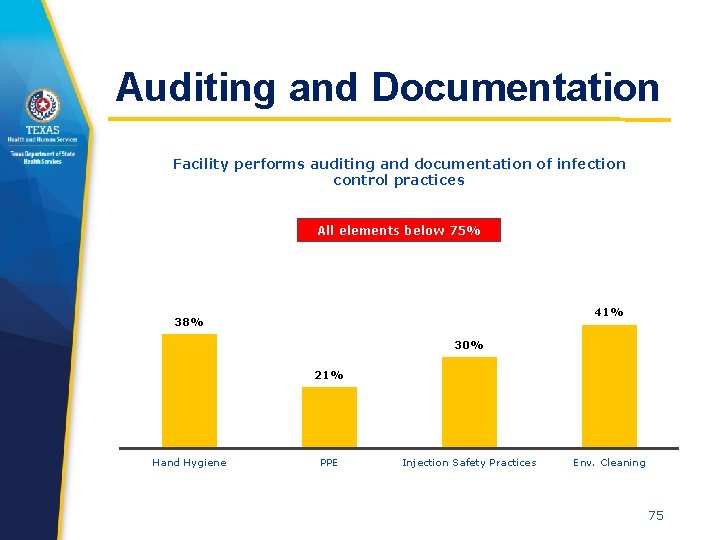
Auditing and Documentation Facility performs auditing and documentation of infection control practices All elements below 75% 41% 38% 30% 21% Hand Hygiene PPE Injection Safety Practices Env. Cleaning 75
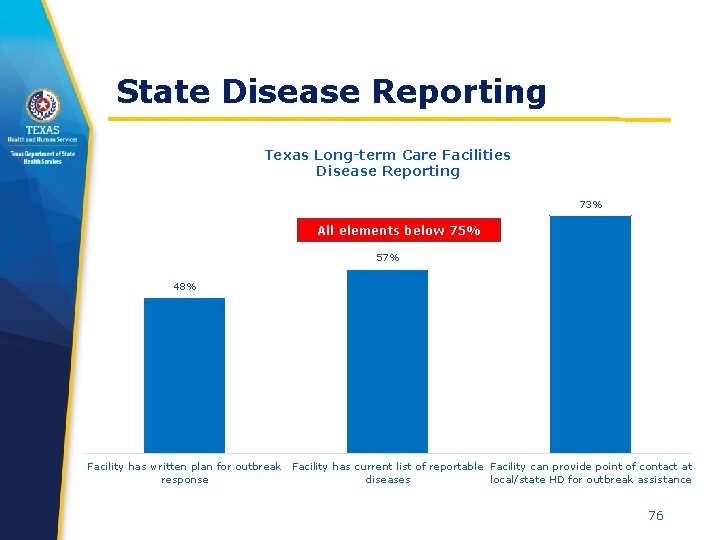
State Disease Reporting Texas Long-term Care Facilities Disease Reporting 73% All elements below 75% 57% 48% Facility has written plan for outbreak Facility has current list of reportable Facility can provide point of contact at response diseases local/state HD for outbreak assistance 76
77
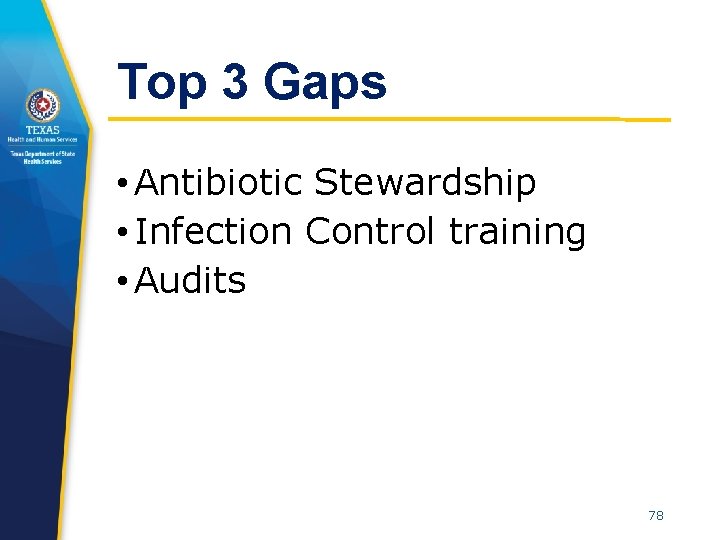
Top 3 Gaps • Antibiotic Stewardship • Infection Control training • Audits 78
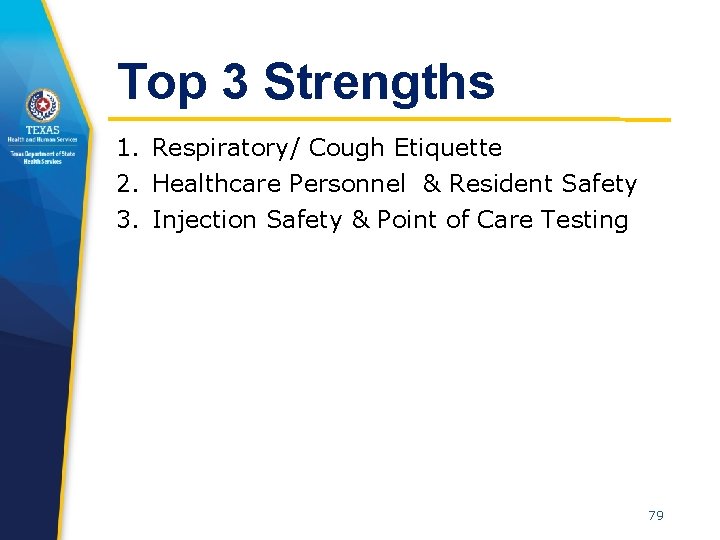
Top 3 Strengths 1. Respiratory/ Cough Etiquette 2. Healthcare Personnel & Resident Safety 3. Injection Safety & Point of Care Testing 79
Dialysis Clinics 23 visits conducted
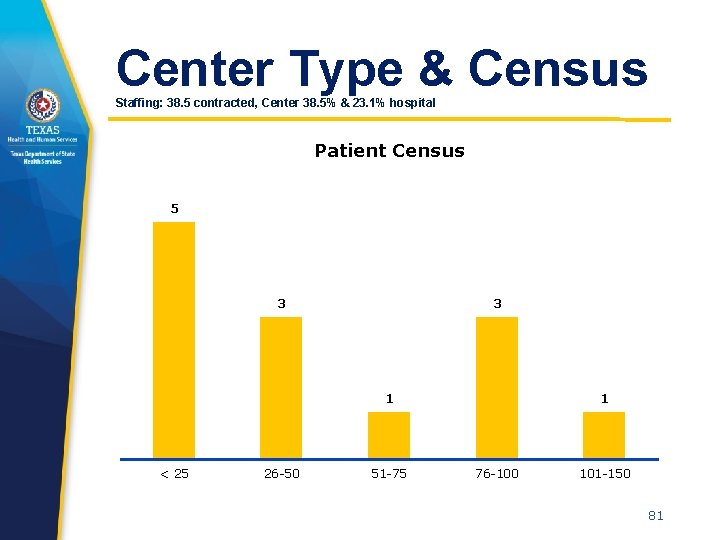
Center Type & Census Staffing: 38. 5 contracted, Center 38. 5% & 23. 1% hospital Patient Census 5 3 3 1 < 25 26 -50 51 -75 1 76 -100 101 -150 81
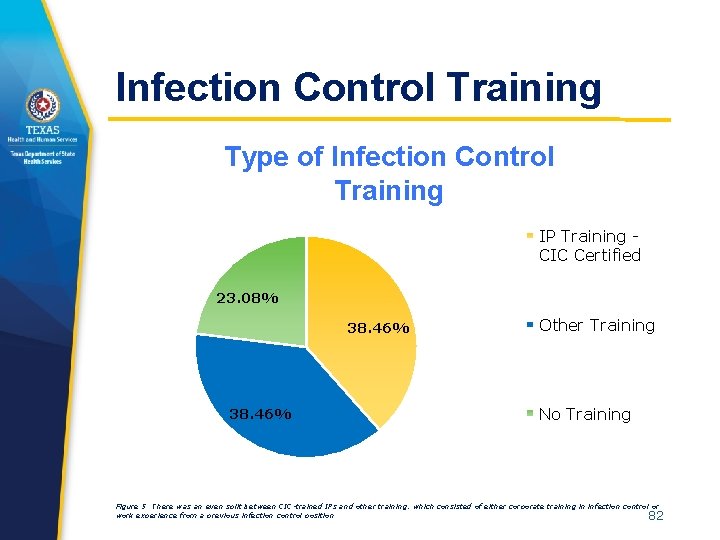
Infection Control Training Type of Infection Control Training IP Training - CIC Certified 23. 08% 38. 46% Other Training No Training Figure 5: There was an even split between CIC-trained IPs and other training, which consisted of either corporate training in infection control or work experience from a previous infection control position. 82
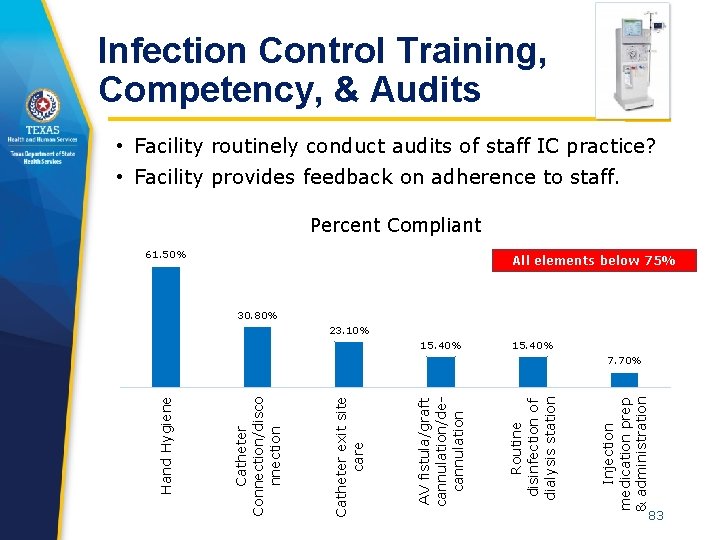
Infection Control Training, Competency, & Audits • Facility routinely conduct audits of staff IC practice? • Facility provides feedback on adherence to staff. Percent Compliant 61. 50% All elements below 75% 30. 80% 23. 10% 15. 40% Injection medication prep & administration Routine disinfection of dialysis station AV fistula/graft cannulation/decannulation Catheter exit site care Catheter Connection/disco nnection Hand Hygiene 7. 70% 83
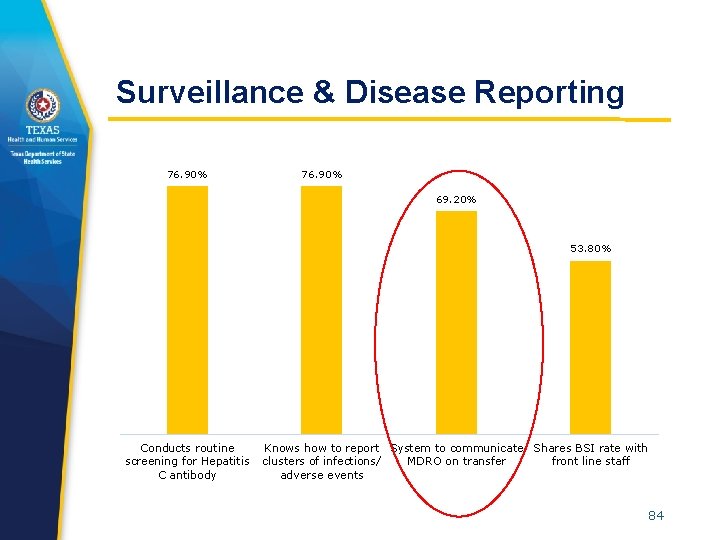
Surveillance & Disease Reporting 76. 90% 69. 20% 53. 80% Conducts routine Knows how to report System to communicate Shares BSI rate with screening for Hepatitis clusters of infections/ MDRO on transfer front line staff C antibody adverse events 84
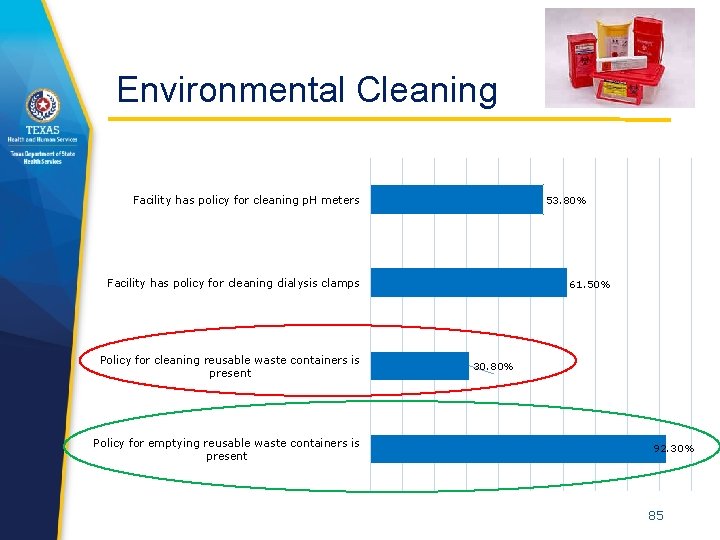
Environmental Cleaning Facility has policy for cleaning p. H meters 53. 80% Facility has policy for cleaning dialysis clamps Policy for cleaning reusable waste containers is present Policy for emptying reusable waste containers is present 61. 50% 30. 80% 92. 30% 85
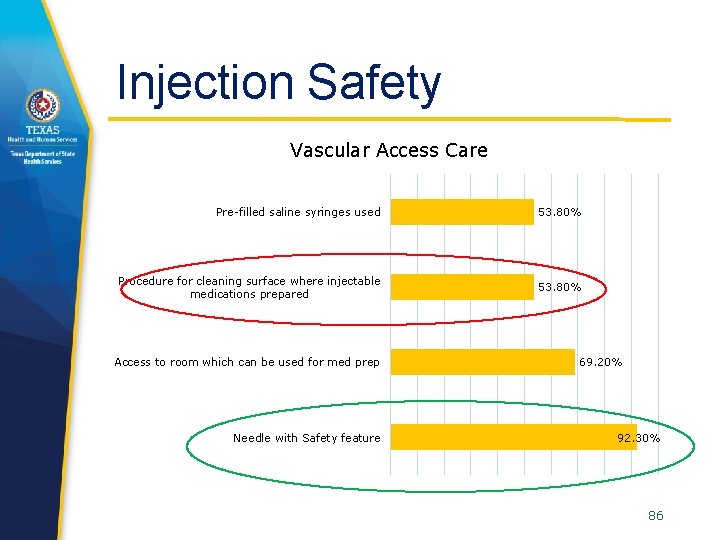
Injection Safety Vascular Access Care Pre-filled saline syringes used Procedure for cleaning surface where injectable medications prepared Access to room which can be used for med prep Needle with Safety feature 53. 80% 69. 20% 92. 30% 86
Best & Poorest Performing 87
Top 3 Gaps • Competency Training & Auditing • Surveillance & Reporting • Respiratory Etiquette 88
Top 3 Strengths • Healthcare Personnel Safety • Personal Protective Equipment (PPE)- Training & Supplies • Environmental Cleaning 89
Conclusion & Next Steps • ABX Stewardship expert • CIC & future training • DADS partnership • TAP CAUTI CLABSI 90
Conclusion Visits allowed us to: • Better understand the most common IC challenges and strengths in the state. • Provide facilities with resources to help mitigate identified gaps. • Improve communication and increase collaboration between the facilities and the health departments. 91
Future Efforts àARLN continues to test for emerging pathogens. àHAI Team continues to assess healthcare facilities for their readiness to respond. Public Health has a vital role to play in leading these investigations while we continue to build a picture of resistance for our state through the ARLN and stop transmission of highly resistant organisms. 92
Questions? 93
Thank you 94
Questions from attendees at the ELC Conference Question: How are they identifying mcr-1 in ESBL? Is it that all samples tested are carb resistant? Or is sample submission based on the facilities wishes? Answer: ESBL is usually seen in E. coli. If resistant to any carbapenems (antibiotics) then the HAI Epidemiologists will ask for isolates to be submitted the DSHS lab (WHICH LAB) for mechanism of resistance testing. In some cases physicians will also ask for these test. Mcr-1 is a type of mechanism of resistance. Facilities in Texas have been asked to participate in ARLN lab submissions but it is not mandated. 95
Questions from attendees at the ELC Conference Question: When will CDC/CMS require LTCF’s (NH’s) to report CRE’s and develop comprehensive antimicrobial stewardship programs? Answer: CRE is a reportable condition, it has been reportable condition for some time and can be found in the notifiable condition list. Flag 441 is the newest CMS regulations, DADS regulatory will be using to survey LTCF facilities. The antibiotic Stewardship portion is effective on 11/28/2017. 96