Introduction to the Orthopaedic 452 course Dr Waleed


- Slides: 91
Introduction to the Orthopaedic 452 course Dr. Waleed Awwad, MBBS. FRCSC Assistant professor of Orthopaedic surgery Spine and scoliosis surgeon
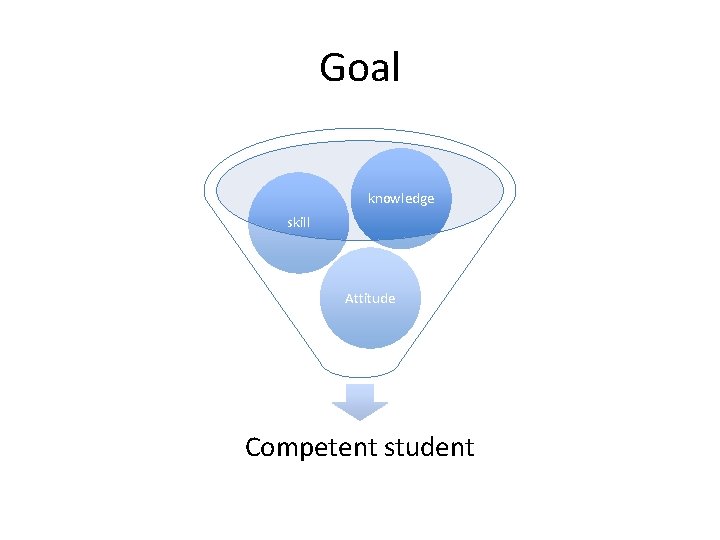
Goal knowledge skill Attitude Competent student
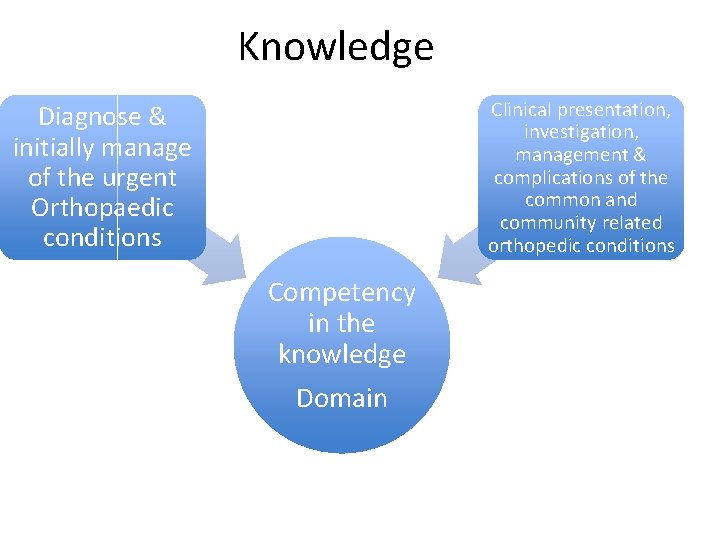
Knowledge Clinical presentation, investigation, management & complications of the common and community related orthopedic conditions Diagnose & initially manage of the urgent Orthopaedic conditions Competency in the knowledge Domain
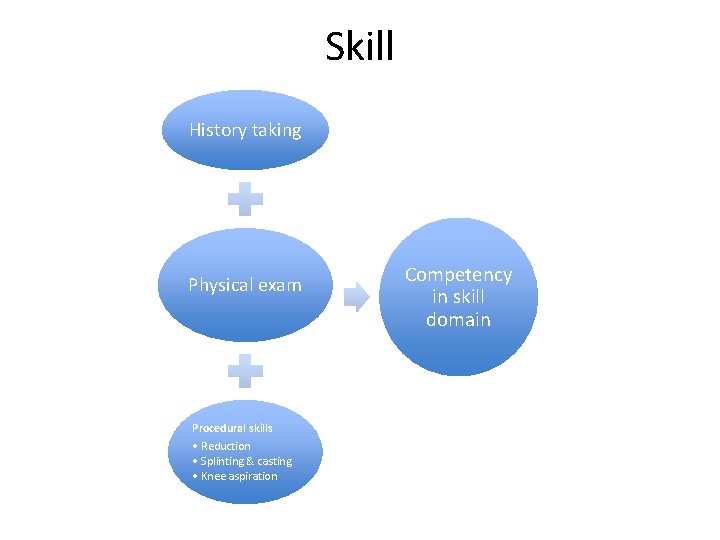
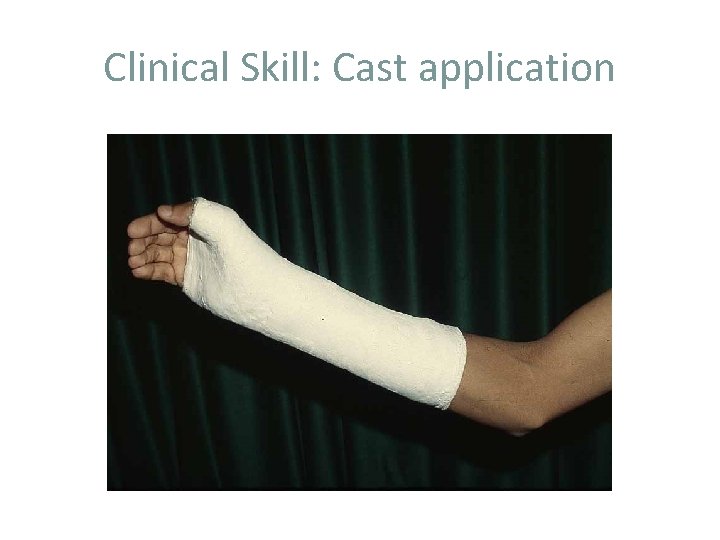
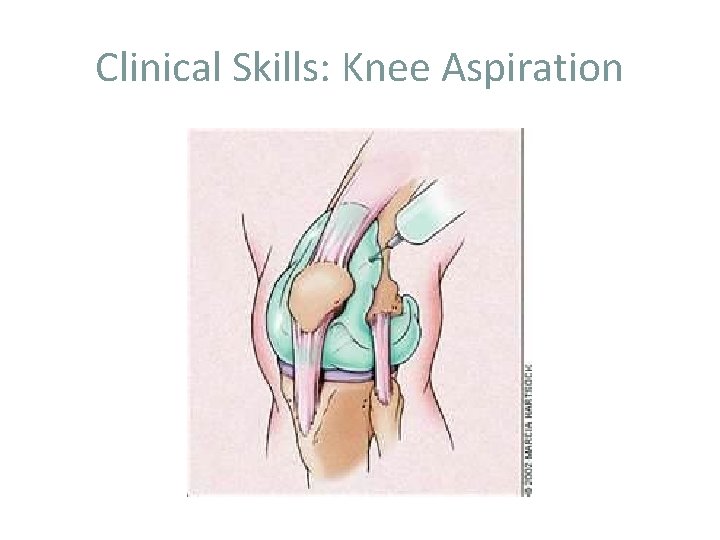
Skill History taking Physical exam Procedural skills • Reduction • Splinting & casting • Knee aspiration Competency in skill domain
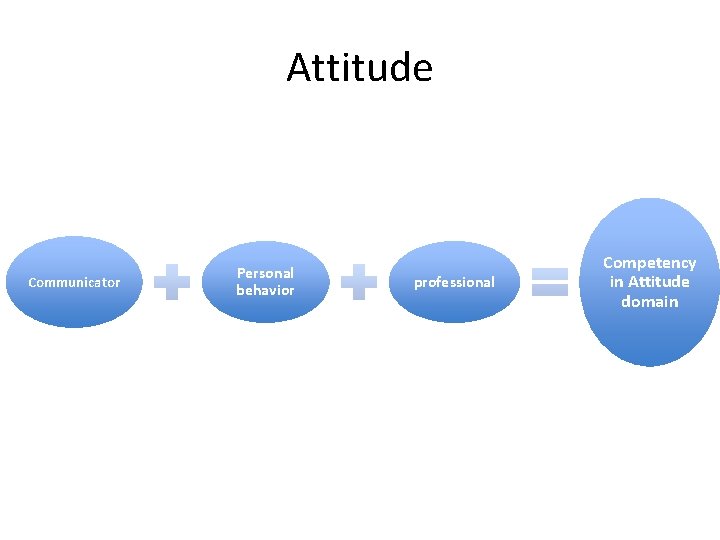
Attitude Communicator Personal behavior professional Competency in Attitude domain
Goals By end of his course, students will have demonstrated the ability to: • Demonstrate essential knowledge required to diagnose, initially manage and to know when to immediately refer a patient with a condition that requires urgent specialist management. • Demonstrate knowledge to specify the symptoms, signs and immediate complications; to outline the assessment and appropriate investigation and; to outline the immediate and long term management of patients with common and community related orthopedic conditions and musculoskeletal trauma. • To take a relevant and a focused MSK history in the knowledge of the characteristics of the major conditions of: bone; joints; connective tissue; nerve tissue and; muscle tissue. • To perform a focused physical examination of major joints (shoulder, hip, knee, foot and ankle, PN and spine) • To order and to demonstrate an appropriate use and interpretation of appropriate investigations including: radiography, CT/MRI/bone scan, MSK U/S, serology, synovial fluid analysis, and EMG/NCS. • The ability to perform a common non surgical orthopaedic procedures like joint aspirations and ability to apply and remove a cast.
Orthopaedic Core Competencies EMERGENCIES / RED FLAGS FRACTURES / TRAUMA PEDIATRIC ORTHOPAEDIC CONDITIONS NON-TRAUMATIC ORTHOPAEDIC CONDITIONS • CLINICAL ASSESSMENT & DIAGNOSIS SKILLS • •
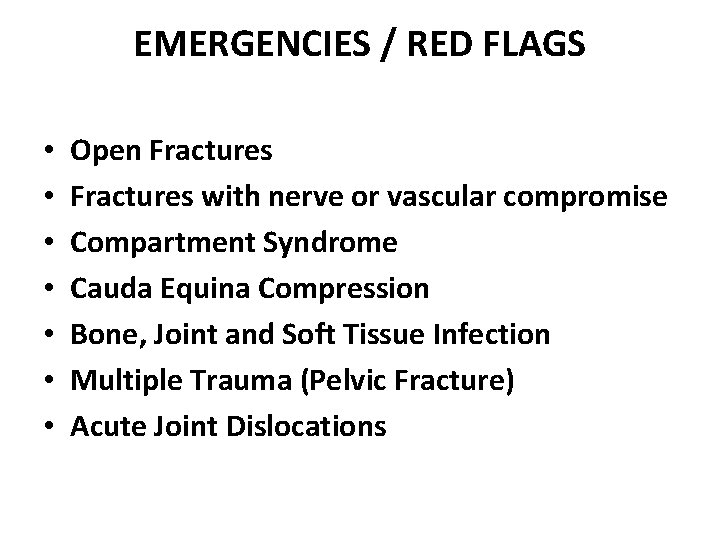
EMERGENCIES / RED FLAGS • • Open Fractures with nerve or vascular compromise Compartment Syndrome Cauda Equina Compression Bone, Joint and Soft Tissue Infection Multiple Trauma (Pelvic Fracture) Acute Joint Dislocations
Fractures & trauma • Common Adult & pediatric Fractures – Upper Limbs – Lower Limbs – Pelvic • • PERIPHERAL NERVE INJURIES Acute Spine Injuries Soft tissue injuries Joint dislocation
Pediatric orthopaedic • Common Hip Conditions • Common Lower Extremities Condition – Alignment / Rotational conditions – Gait Problems – Lower extremities deformities
NON-TRAUMATIC ORTHOPAEDIC CONDITIONS • • Spine Tumors Metabolic Joints condition
Spine • Degenerative/Mechanical neck/back pain • Spinal cord or root entrapment (for example, herniated lumbar disc) • Vertebral fracture of osteoporotic origin • Spinal deformity (scoliosis) • Destructive (infectious and tumor related) back pain (for example, tuberculosis, metastasis, certain cancers)
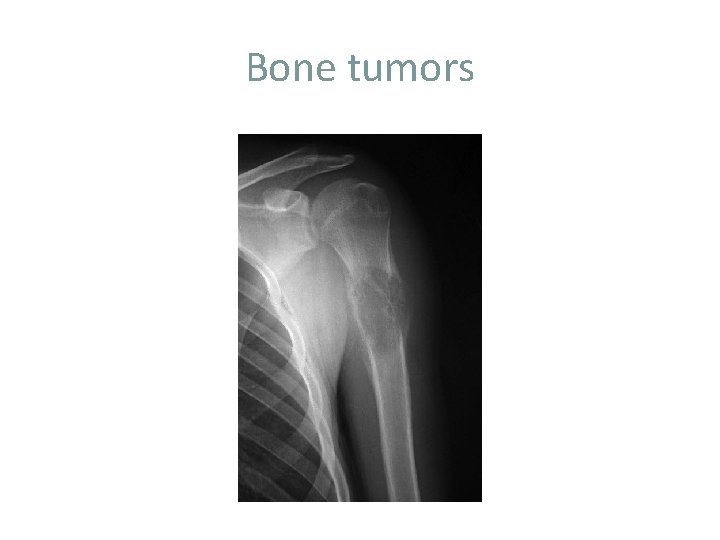
Bone tumors • Metastatic bone disease • Primary bone lesions – Benign bone tumors – Malignant bone tumors
Metabolic bone disorders • Osteoporosis • Osteomalacia and Rickets
Joint conditions • Degenerative OA • Shoulder Chronic Condition
Clinical Assessment & diagnosis skills • • • History taking Physical Examination Investigation interpretation Communication and attitude skills Procedural Skill – Knee joint aspirations. – Apply and remove a cast – Joint/fracture reduction techniques
Teaching and learning methods and places • Lecture (Large group): • Case-based learning –CBL- (Small groups): – Topics will be assigned in a head of time to the students with clear objectives • “Hands-on” small groups sessions: – – Physical examination skills Splinting and casting technique skills Principles of fractures & joints dislocation reduction Joint aspirations. • Ambulatory care teaching – History taking skills – Each student will have a chance of take, present, and discuss patient history with the attending staff tow times during the course • Plaster room – Each student will have chance to observe, apply and remove the cast/splint during the course for at least two times
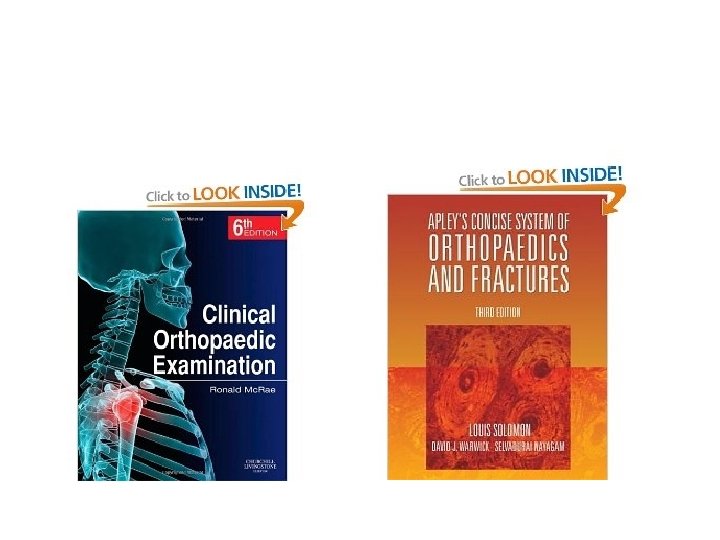
Learning Resources • • Books Tutorials / Lectures CBL Handouts
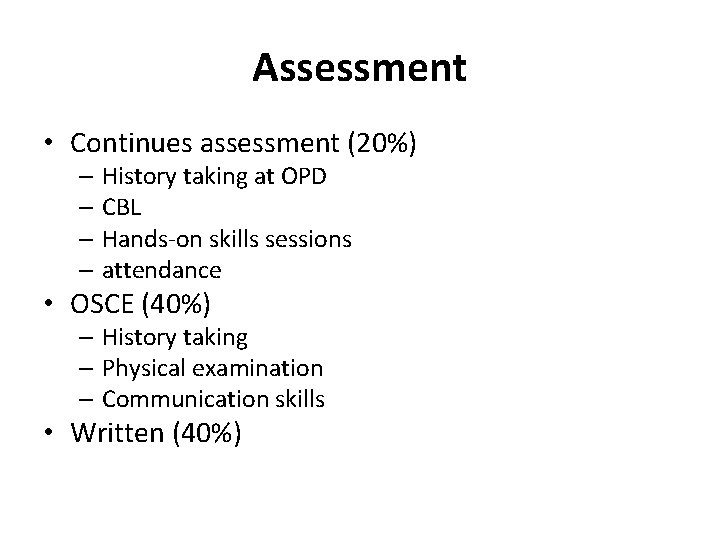
Assessment • Continues assessment (20%) – History taking at OPD – CBL – Hands on skills sessions – attendance • OSCE (40%) – History taking – Physical examination – Communication skills • Written (40%)
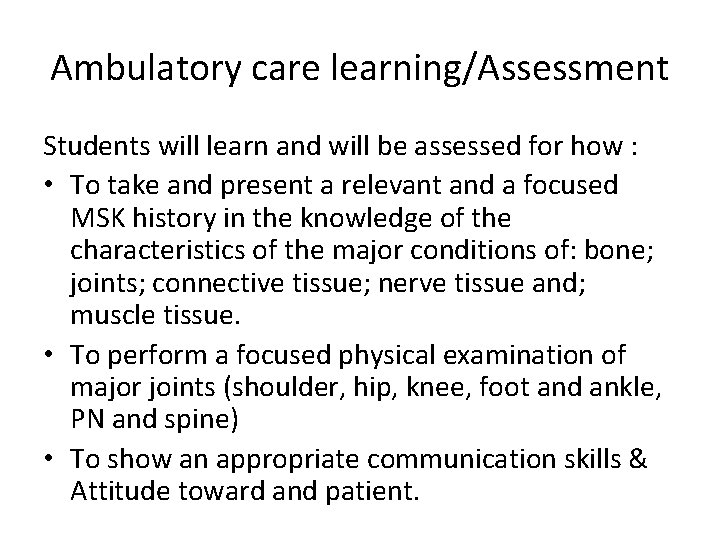
Ambulatory care learning/Assessment Students will learn and will be assessed for how : • To take and present a relevant and a focused MSK history in the knowledge of the characteristics of the major conditions of: bone; joints; connective tissue; nerve tissue and; muscle tissue. • To perform a focused physical examination of major joints (shoulder, hip, knee, foot and ankle, PN and spine) • To show an appropriate communication skills & Attitude toward and patient.
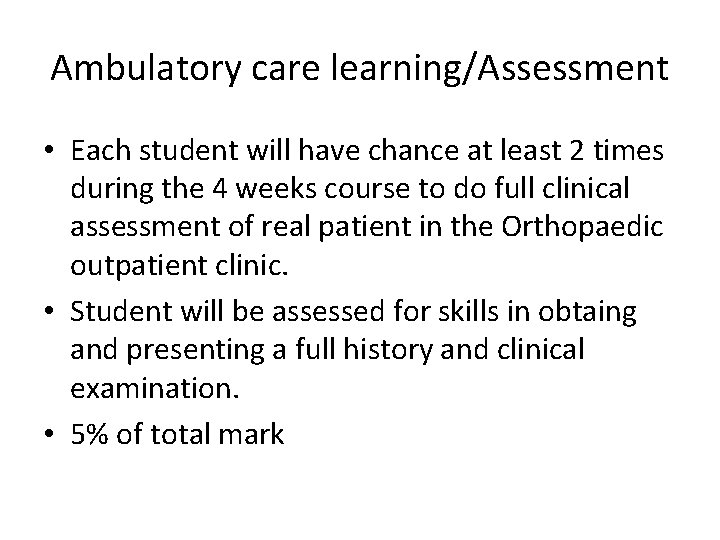
Ambulatory care learning/Assessment • Each student will have chance at least 2 times during the 4 weeks course to do full clinical assessment of real patient in the Orthopaedic outpatient clinic. • Student will be assessed for skills in obtaing and presenting a full history and clinical examination. • 5% of total mark
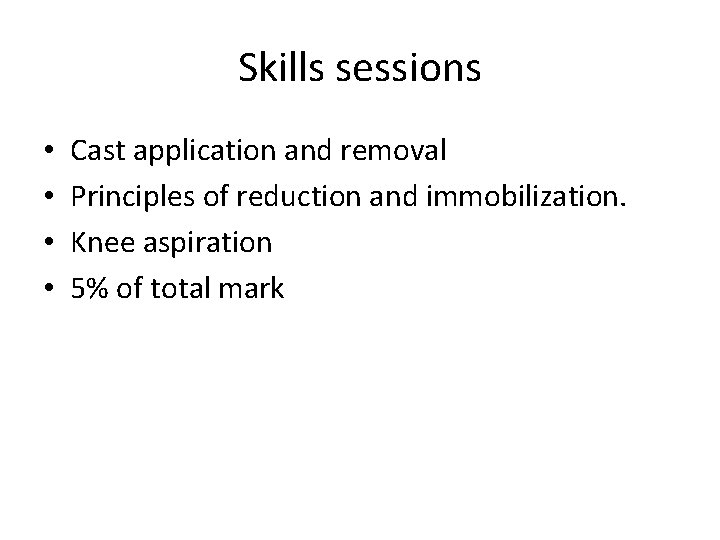
Skills sessions • • Cast application and removal Principles of reduction and immobilization. Knee aspiration 5% of total mark
Case based learning • Six different cases covered the most common MSK problems which can be presented to the ER or orthopaedic/primary clinic • Cases will be assigned ahead of time to the students with clear objectives • 5% of total mark
Attendance • 5% of total mark
Orthopedic Surgery = Not only Bone Surgery • Orthopedic specialty is the branch of medicine which manage trauma and disease of Musculoskeletal system • It includes : bones, muscles, tendons, ligaments, joints, peripheral nerves, vertebral column and spinal cord and its nerves
Orthopedic Specialty • Sub Specialties in orthopedic include : – General – Pediatric Orthopedic – Sport and Reconstructive Orthopedic – Orthopedic Trauma – Arthroplasty – Spinal Surgery – Foot and Ankle surgery – Oncology – Hand Surgery
Red Flags • Red Flags = Warning Symptom or Sign • Red flags should always be looked for and remembered • Presence of a red flag means the necessity for urgent or different action/intervention
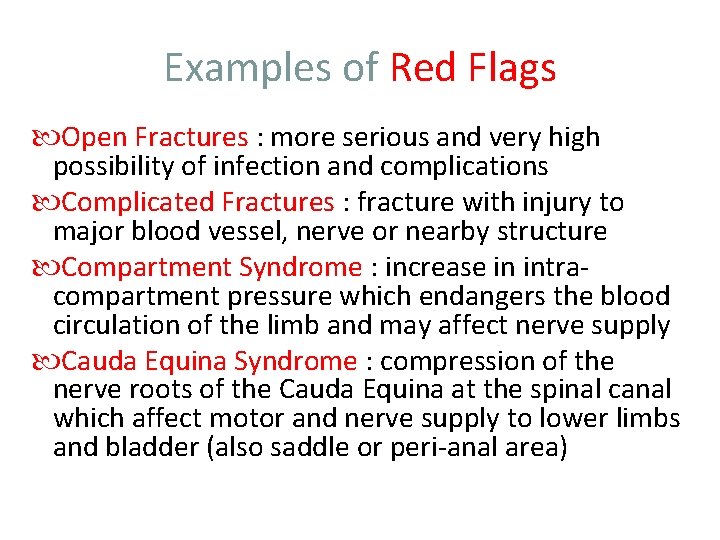
Examples of Red Flags Open Fractures : more serious and very high possibility of infection and complications Complicated Fractures : fracture with injury to major blood vessel, nerve or nearby structure Compartment Syndrome : increase in intra compartment pressure which endangers the blood circulation of the limb and may affect nerve supply Cauda Equina Syndrome : compression of the nerve roots of the Cauda Equina at the spinal canal which affect motor and nerve supply to lower limbs and bladder (also saddle or peri anal area)
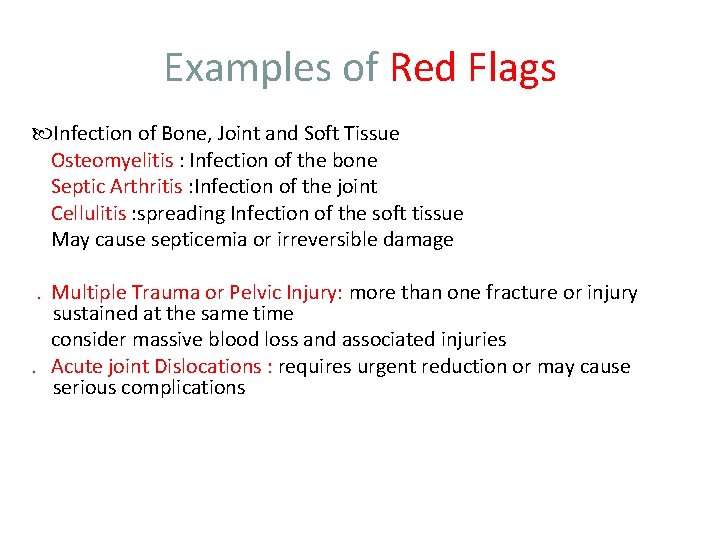
Examples of Red Flags Infection of Bone, Joint and Soft Tissue Osteomyelitis : Infection of the bone Septic Arthritis : Infection of the joint Cellulitis : spreading Infection of the soft tissue May cause septicemia or irreversible damage . Multiple Trauma or Pelvic Injury: more than one fracture or injury sustained at the same time consider massive blood loss and associated injuries. Acute joint Dislocations : requires urgent reduction or may cause serious complications
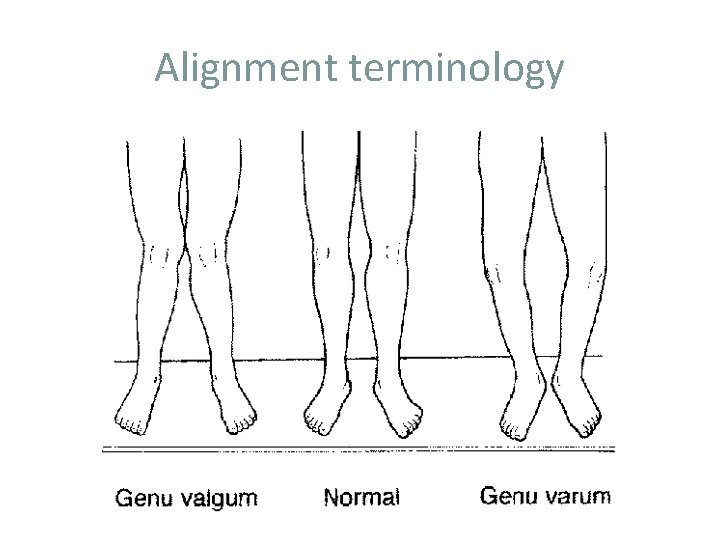
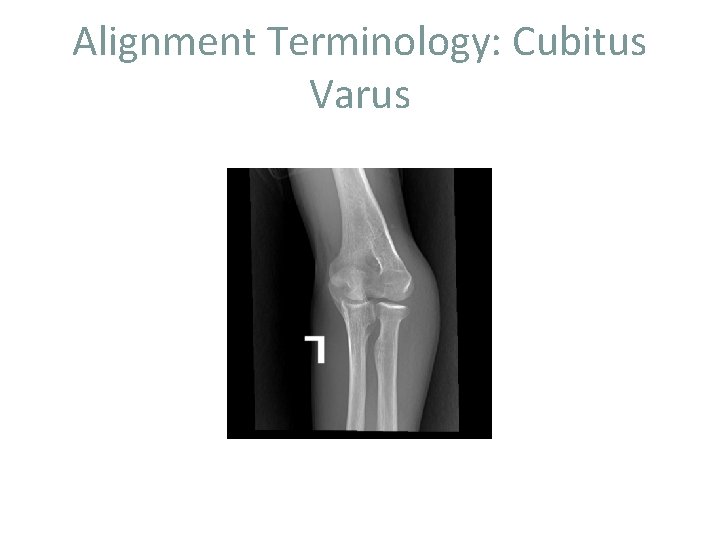
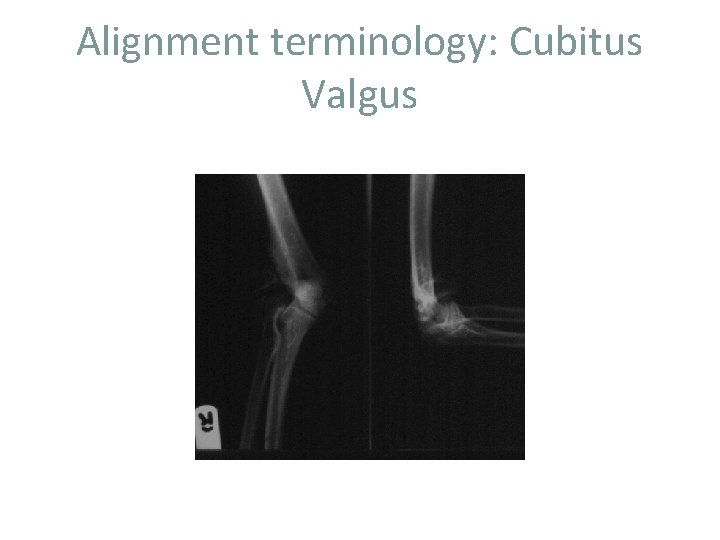
Alignment terminology
Alignment Terminology: Cubitus Varus
Alignment terminology: Cubitus Valgus
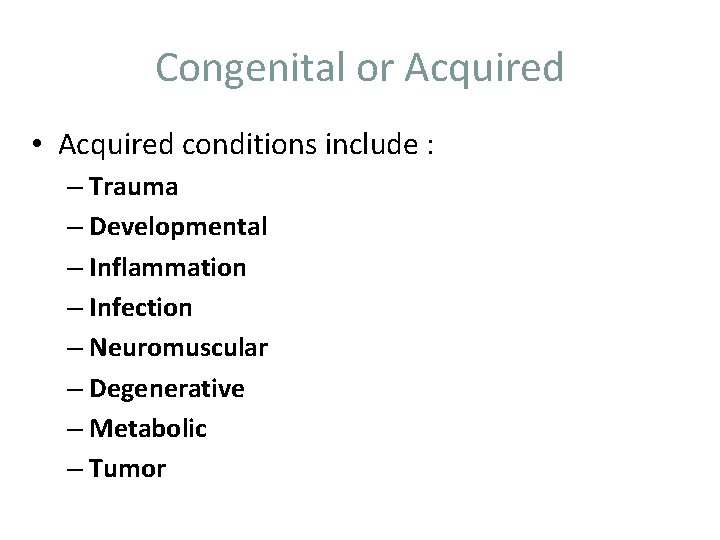
Congenital or Acquired • Acquired conditions include : – Trauma – Developmental – Inflammation – Infection – Neuromuscular – Degenerative – Metabolic – Tumor
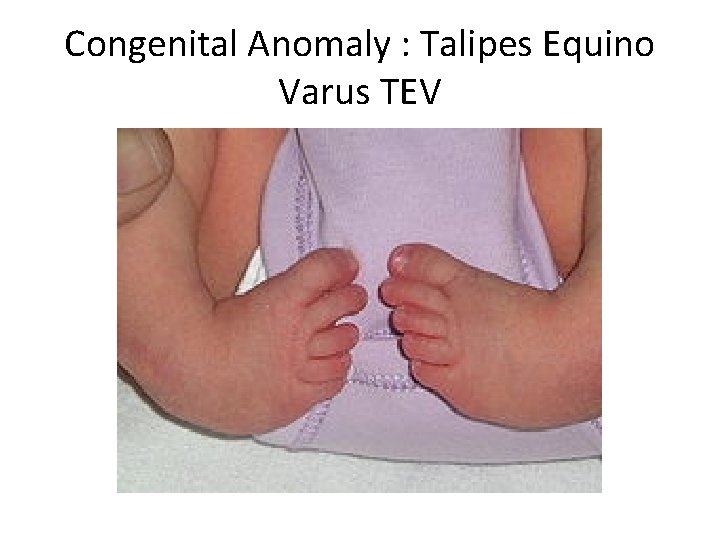
Congenital Anomaly : Talipes Equino Varus TEV
Traumatic Injuries • • • Fractures Dislocations Soft tissues injuries: ligaments, tendons Nerve injuries Epiphyseal injuries
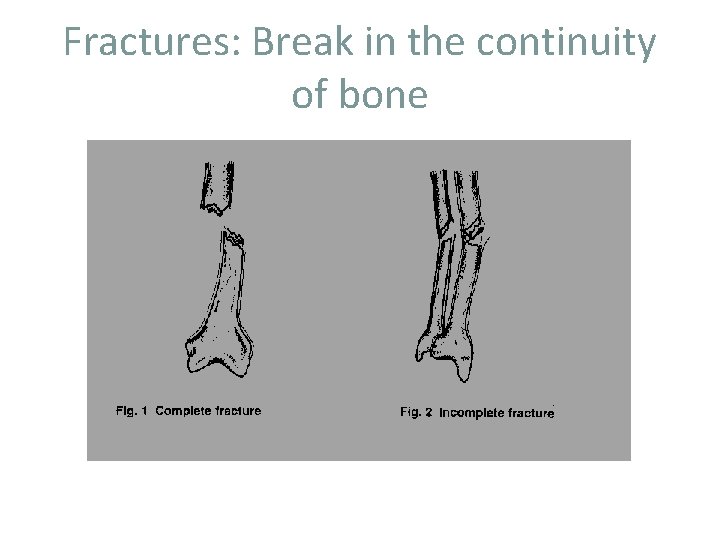
Fractures: Break in the continuity of bone
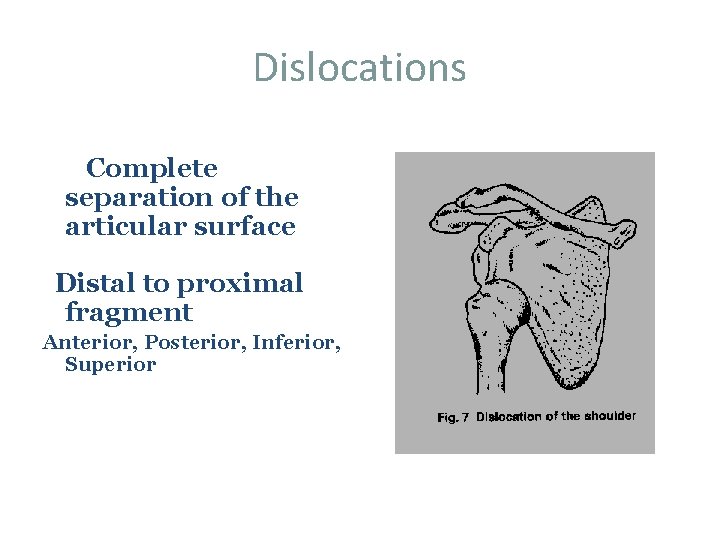
Dislocations Complete separation of the articular surface Distal to proximal fragment Anterior, Posterior, Inferior, Superior
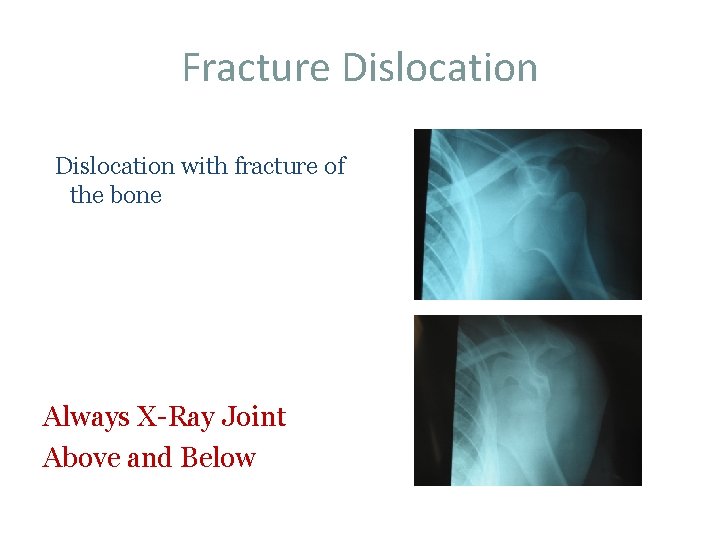
Fracture Dislocation with fracture of the bone Always X-Ray Joint Above and Below
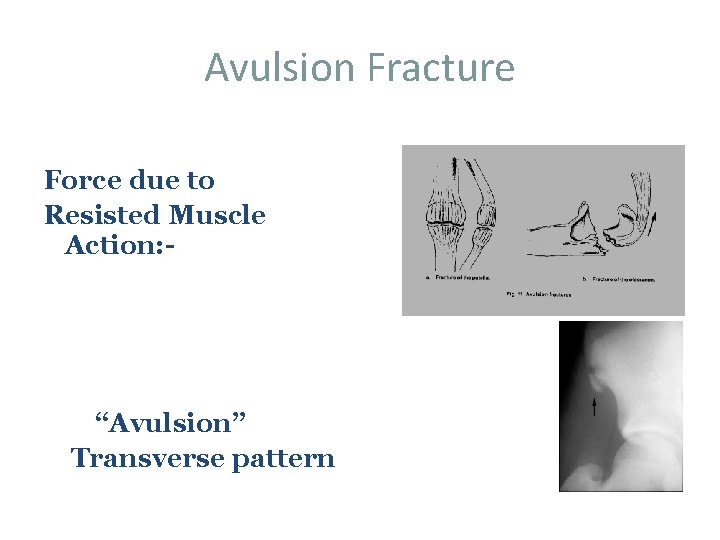
Avulsion Fracture Force due to Resisted Muscle Action: - “Avulsion” Transverse pattern
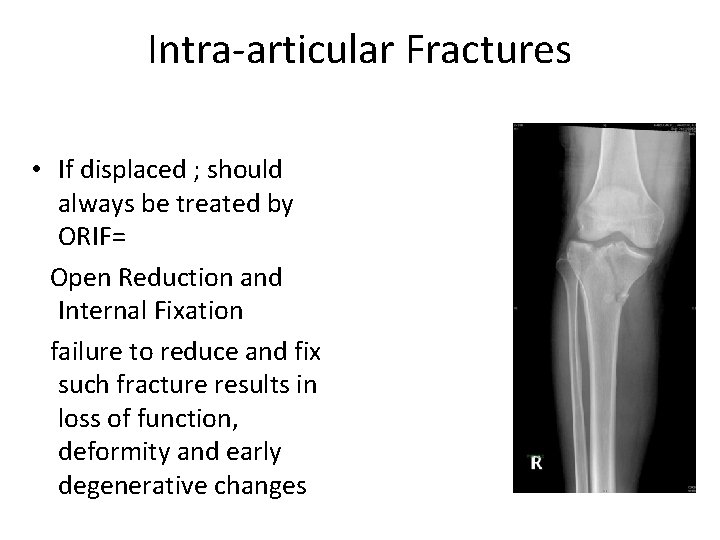
Intra articular Fractures • If displaced ; should always be treated by ORIF= Open Reduction and Internal Fixation failure to reduce and fix such fracture results in loss of function, deformity and early degenerative changes
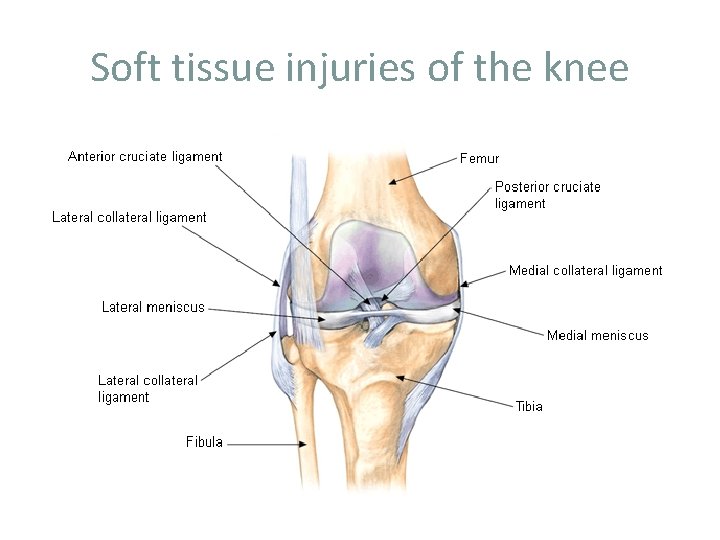
Soft tissue injuries of the knee
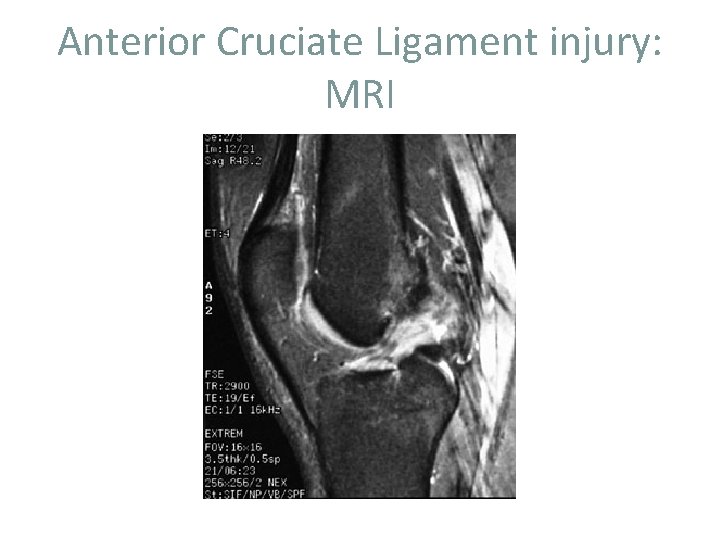
Anterior Cruciate Ligament injury: MRI
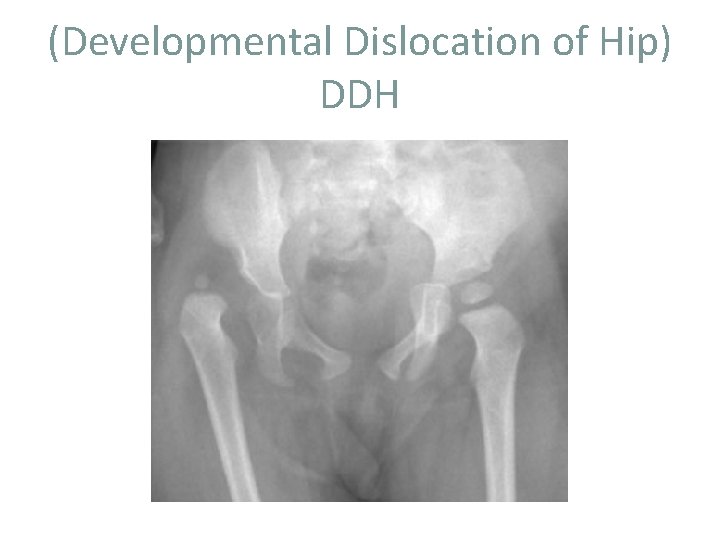
(Developmental Dislocation of Hip) DDH
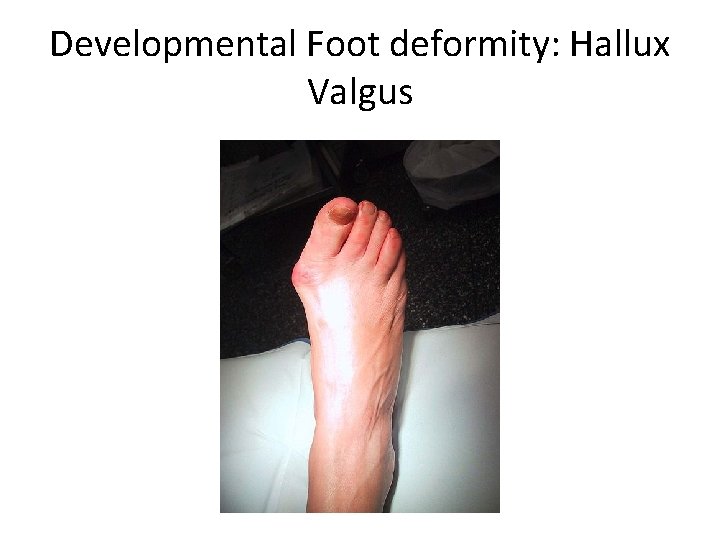
Developmental Foot deformity: Hallux Valgus
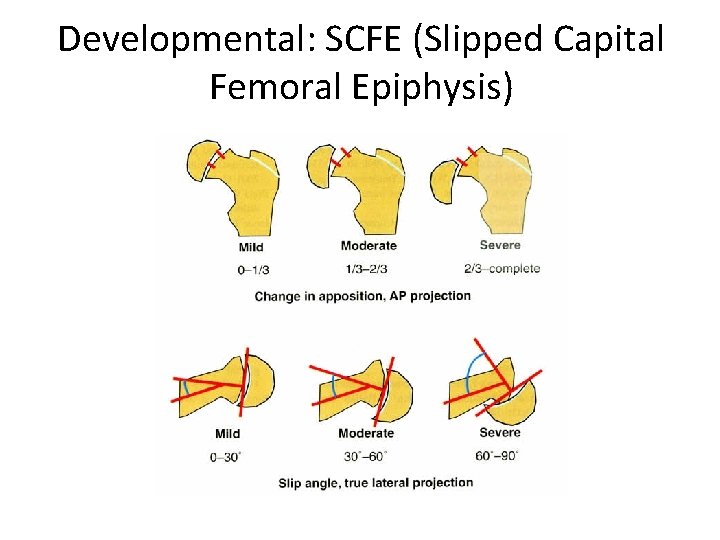
Developmental: SCFE (Slipped Capital Femoral Epiphysis)
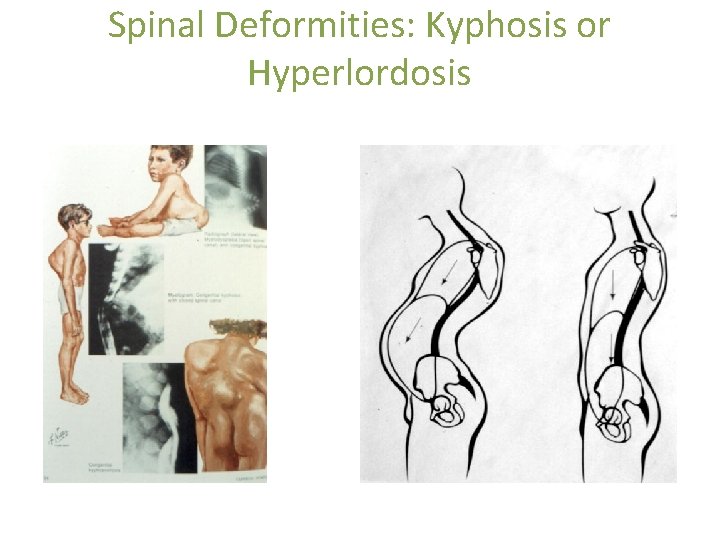
Spinal Deformities: Kyphosis or Hyperlordosis
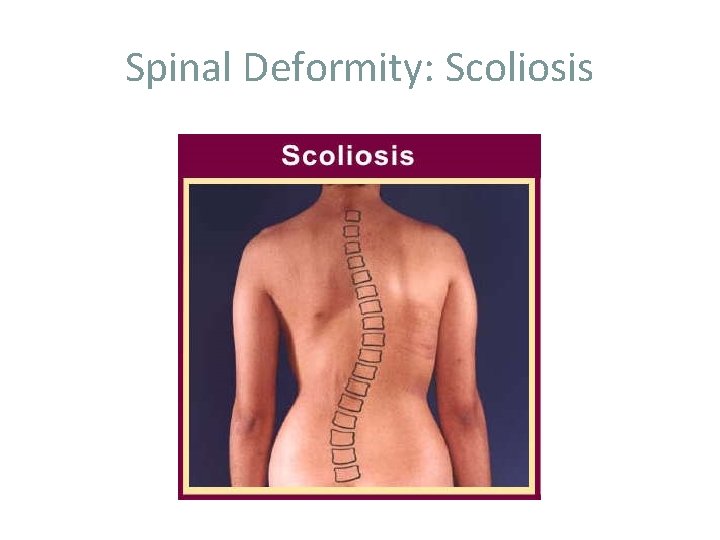
Spinal Deformity: Scoliosis
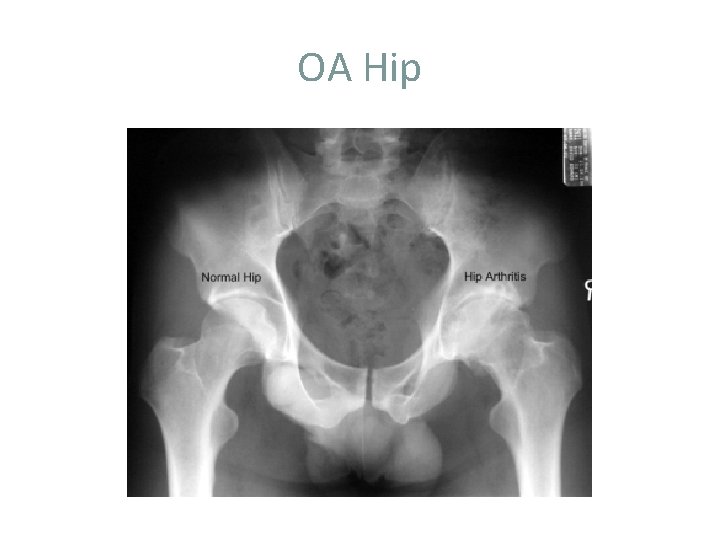
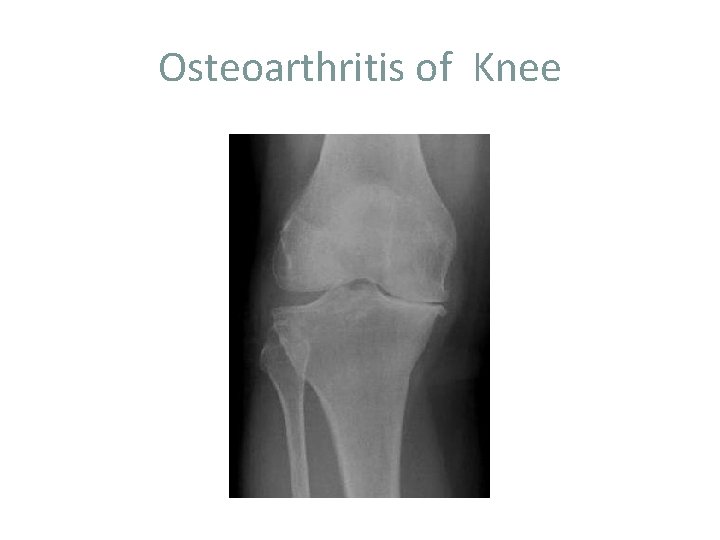
Degenerative Disorders • Occur at any joint • Can be primary or secondary • Can lead to pain and/or deformity and/or loss of function
OA Hip
Osteoarthritis of Knee
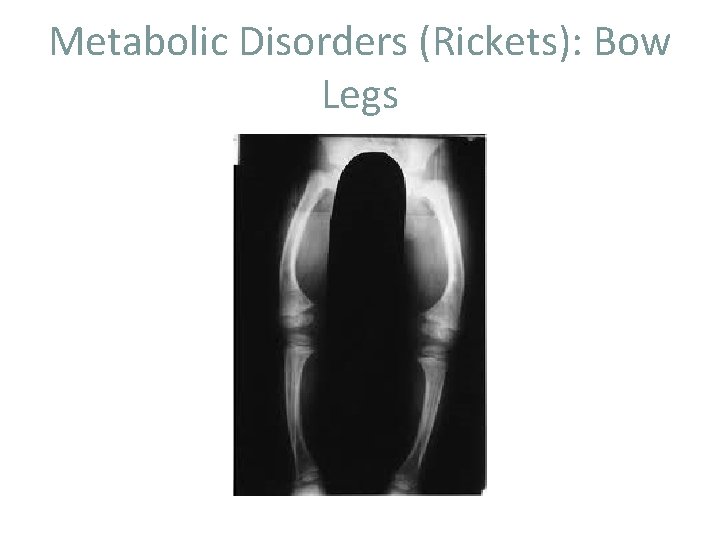
Metabolic Disorders (Rickets): Bow Legs
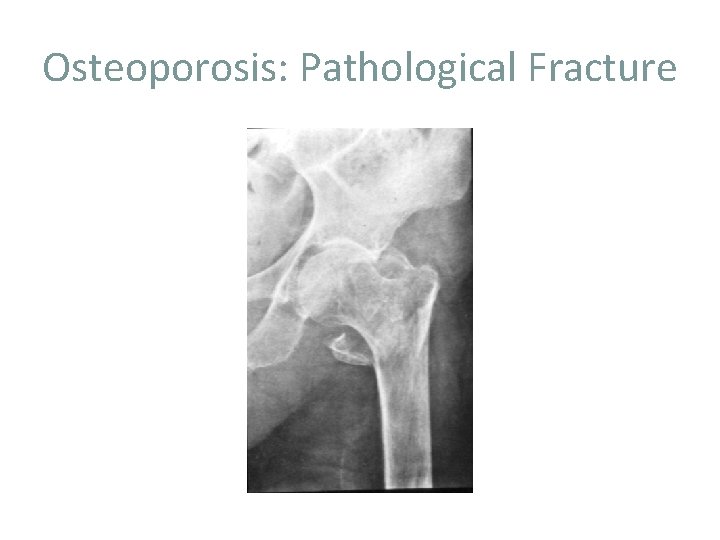
Osteoporosis: Pathological Fracture
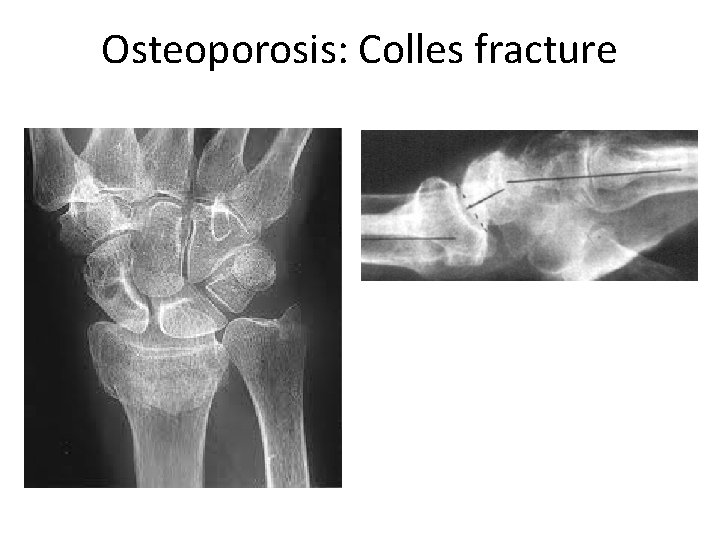
Osteoporosis: Colles fracture
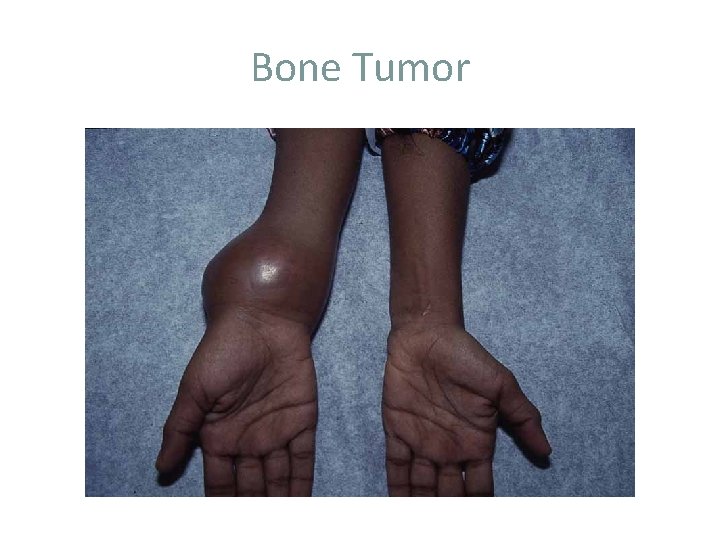
Bone Tumor
Bone tumors
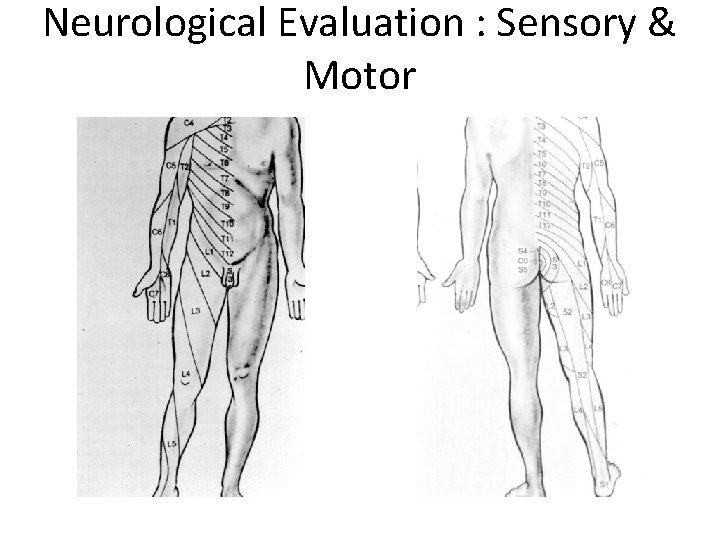
Neurological Evaluation : Sensory & Motor
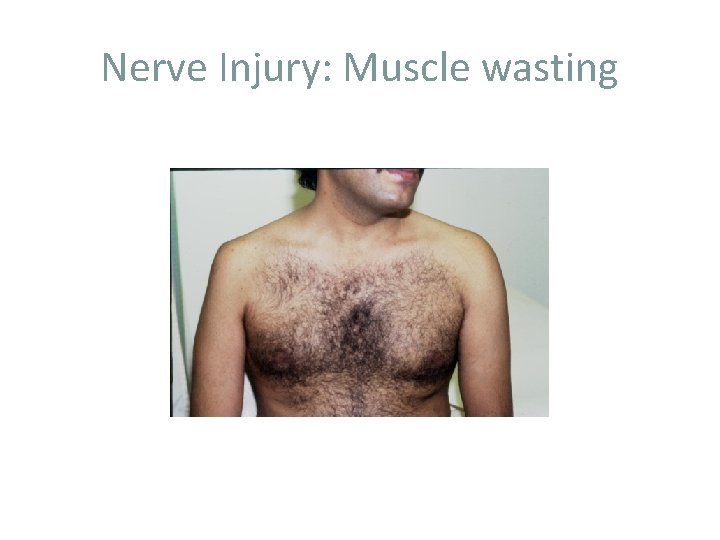
Nerve Injury: Muscle wasting
Spinal Cord Injury • Often results from fracture dislocation of spine • When injury is at cervical spine it may result in Tetraplegia or quad • Injury at dorsal spine may result in Paraplegia
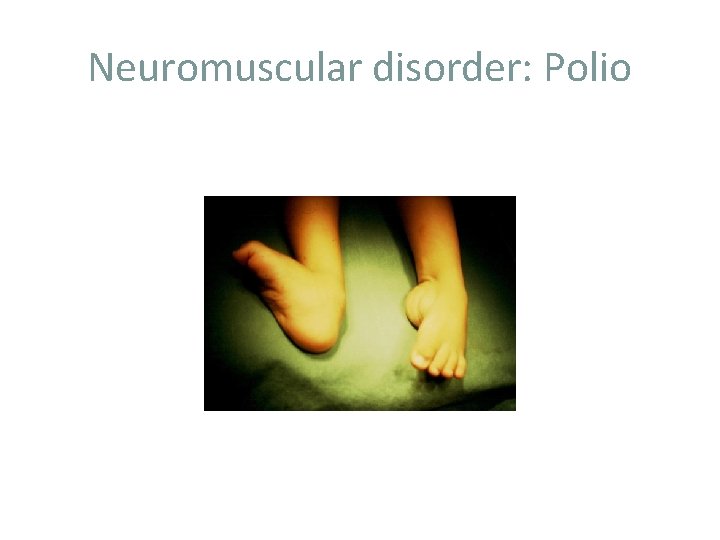
Neuromuscular disorder: Polio
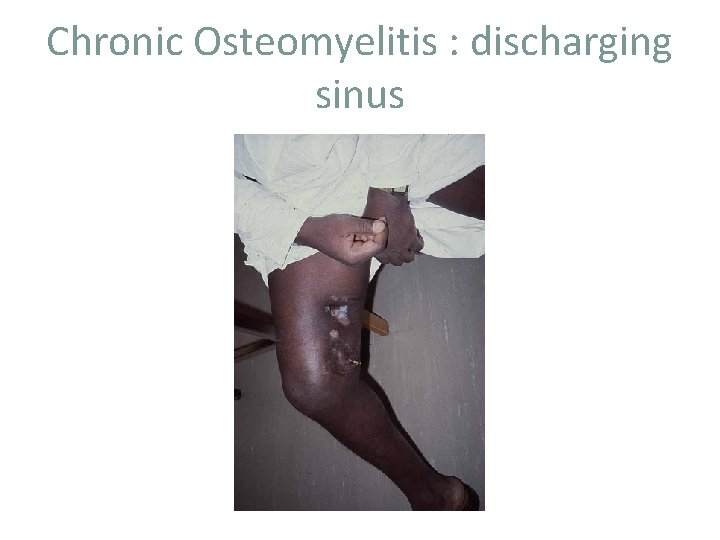
Chronic Osteomyelitis : discharging sinus
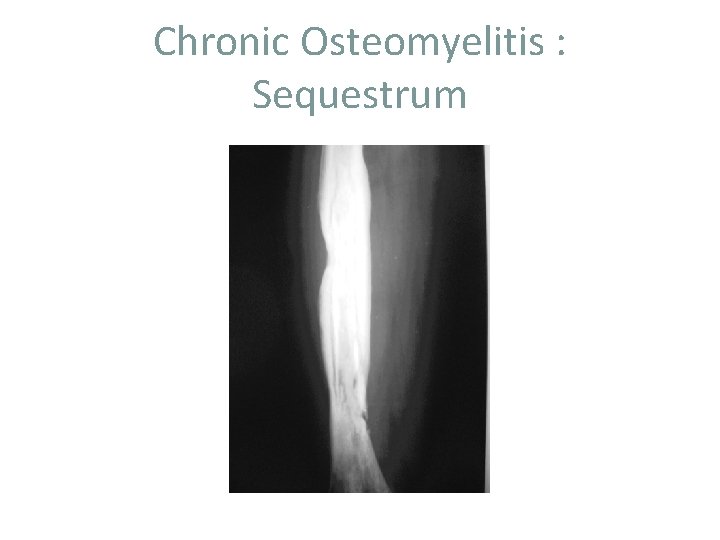
Chronic Osteomyelitis : Sequestrum
Physiotherapy for Orthopedic Patients • Physiotherapy is an important part of orthopedic and trauma management • It is used for : pain relief, prevention of stiffness, muscle strengthening, mobilisation of stiff joint or spine, training non weight bearing or partial weight bearing • Physiotherapy modalities include: heat, cold, exercise, ultrasound, traction, electrical stimulation
Clinical Skill: Cast application
Clinical Skills: Knee Aspiration
ORTHOEADIC HISTORY TAKING
History taking skills • History taking is the most important step in making a diagnosis. • A clinician is 60% closer to making a diagnosis with a thorough history. The remaining 40% is a combination of examination findings and investigations. • History taking can either be of a traumatic or non traumatic injury.
Objective • At the end of this session, students should be able and know how to take a MSK relevant history.
Competency expected from the students • Take a relevant history, with the knowledge of the characteristics of the major musculoskeletal conditions
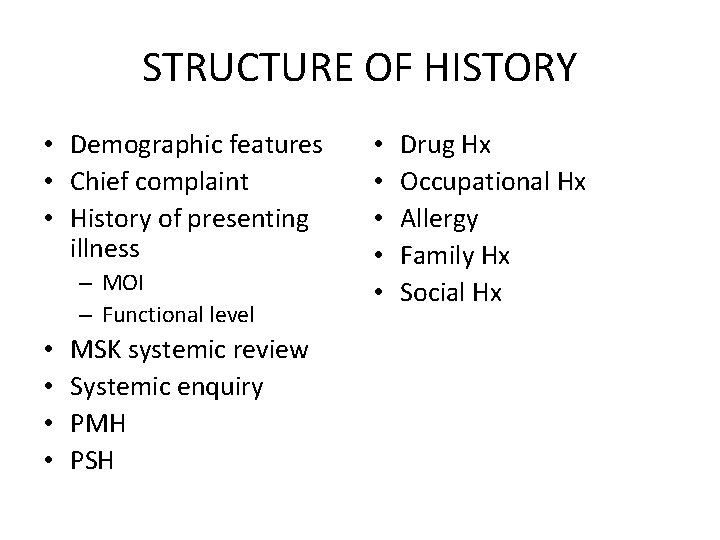
STRUCTURE OF HISTORY • Demographic features • Chief complaint • History of presenting illness – MOI – Functional level • • MSK systemic review Systemic enquiry PMH PSH • • • Drug Hx Occupational Hx Allergy Family Hx Social Hx
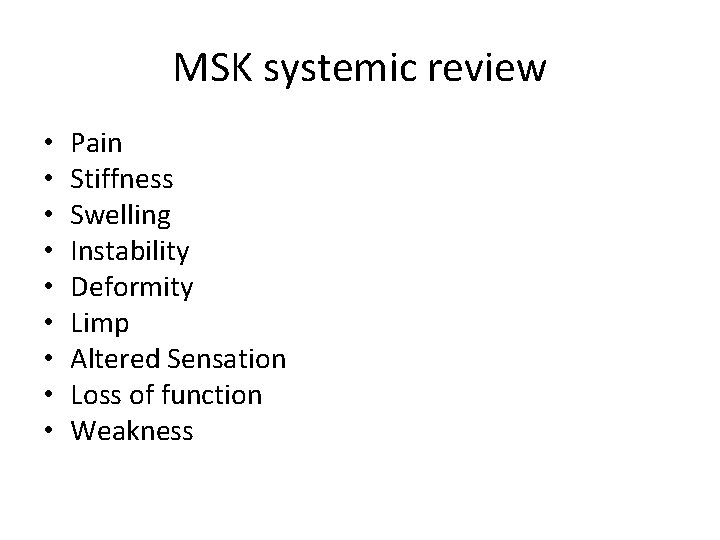
MSK systemic review • • • Pain Stiffness Swelling Instability Deformity Limp Altered Sensation Loss of function Weakness
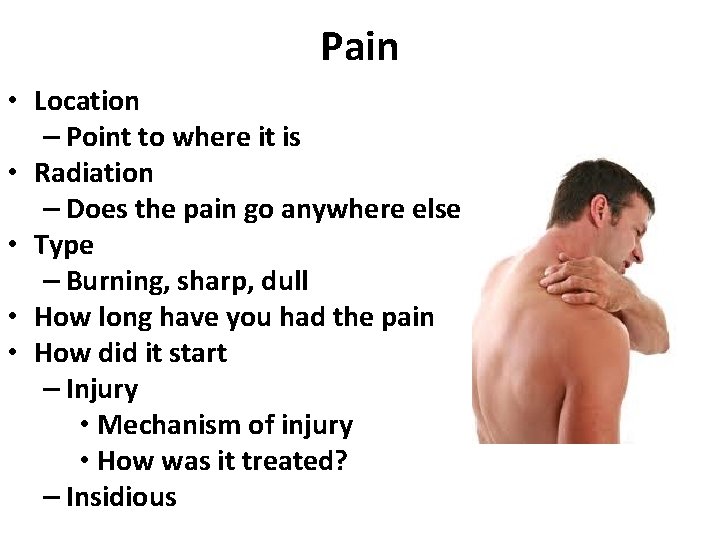
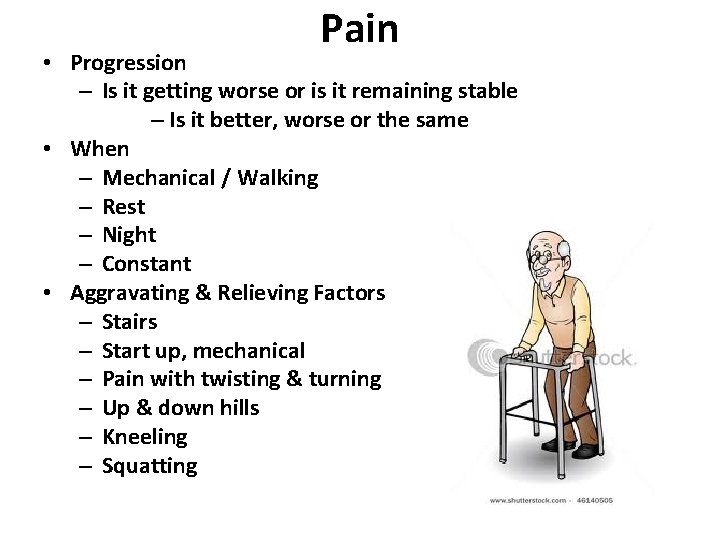
Pain • Location – Point to where it is • Radiation – Does the pain go anywhere else • Type – Burning, sharp, dull • How long have you had the pain • How did it start – Injury • Mechanism of injury • How was it treated? – Insidious
Pain • Progression – Is it getting worse or is it remaining stable – Is it better, worse or the same • When – Mechanical / Walking – Rest – Night – Constant • Aggravating & Relieving Factors – Stairs – Start up, mechanical – Pain with twisting & turning – Up & down hills – Kneeling – Squatting
Pain • • • Where: location/radiation When: onset/duration WWQQAA Quality: what it feels like Quantity: intensity, degree of disability Aggravating and Alleviating factors Associated symptoms
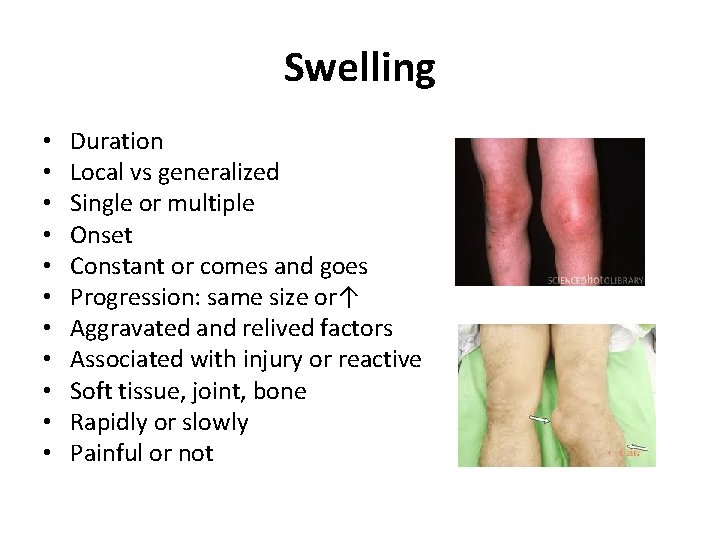
Swelling • • • Duration Local vs generalized Single or multiple Onset Constant or comes and goes Progression: same size or↑ Aggravated and relived factors Associated with injury or reactive Soft tissue, joint, bone Rapidly or slowly Painful or not
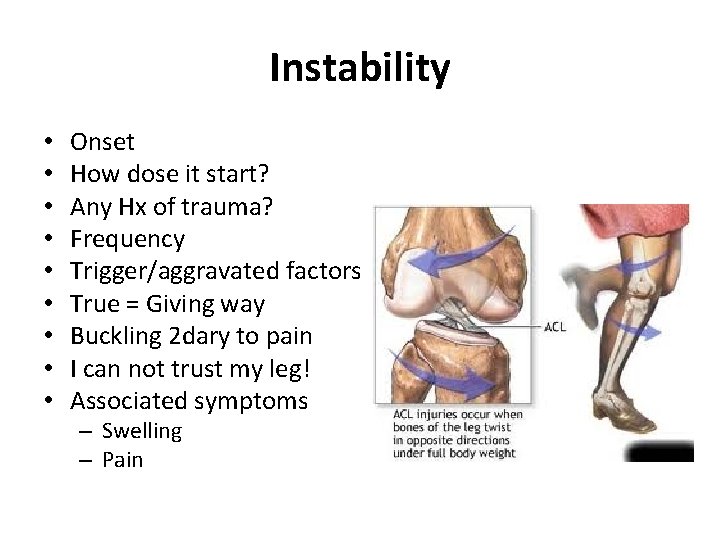
Instability • • • Onset How dose it start? Any Hx of trauma? Frequency Trigger/aggravated factors True = Giving way Buckling 2 dary to pain I can not trust my leg! Associated symptoms – Swelling – Pain
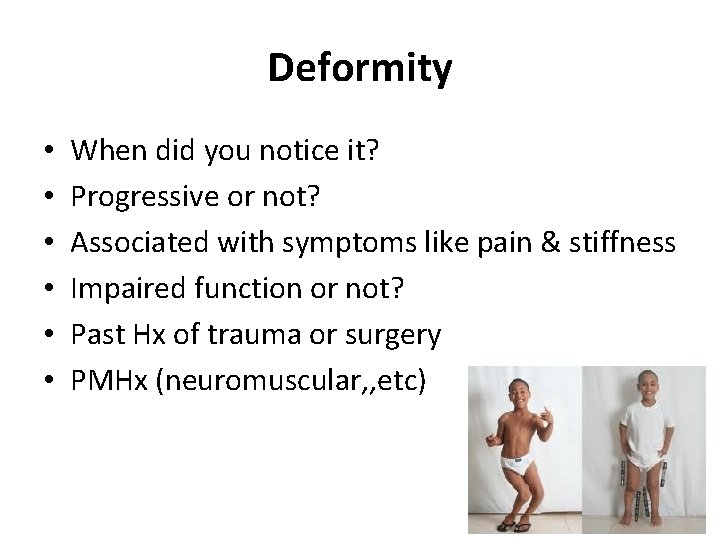
Deformity • • • When did you notice it? Progressive or not? Associated with symptoms like pain & stiffness Impaired function or not? Past Hx of trauma or surgery PMHx (neuromuscular, , etc)
Limping • • Painful vs painless Onset (acute or chronic) Progressive or not? Use walking aid? Functional disability? Traumatic or non traumatic? Associated with swelling, deformity, or fever.
Loss of function • How has this affected your life • Home (daily living activities DLA) – Prayer – Using toilet – getting out of chairs / bed – socks – stairs – squat or kneel for gardening – walking distance – get & out of cars • Work • Sport – Type & intensity – Run, jump
Mechanical symptoms Locking / clicking • Loose body, meniscal tear • Locking vs pseudo locking Giving way • Buckling 2° pain • ACL • Patella
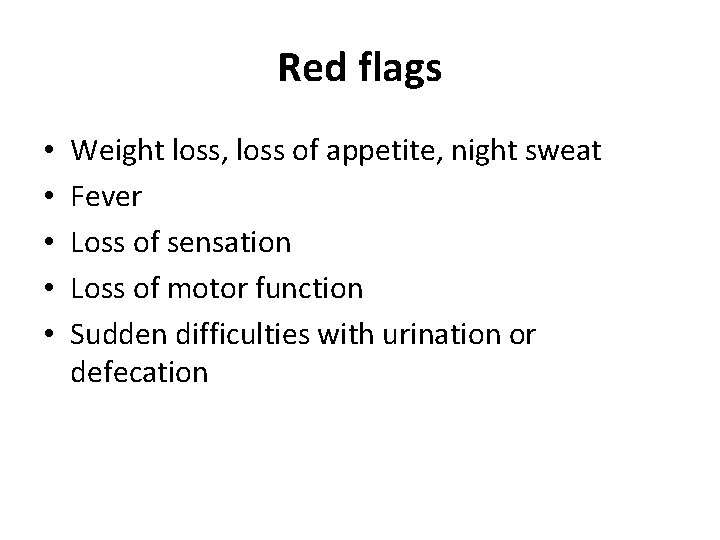
Red flags • • • Weight loss, loss of appetite, night sweat Fever Loss of sensation Loss of motor function Sudden difficulties with urination or defecation
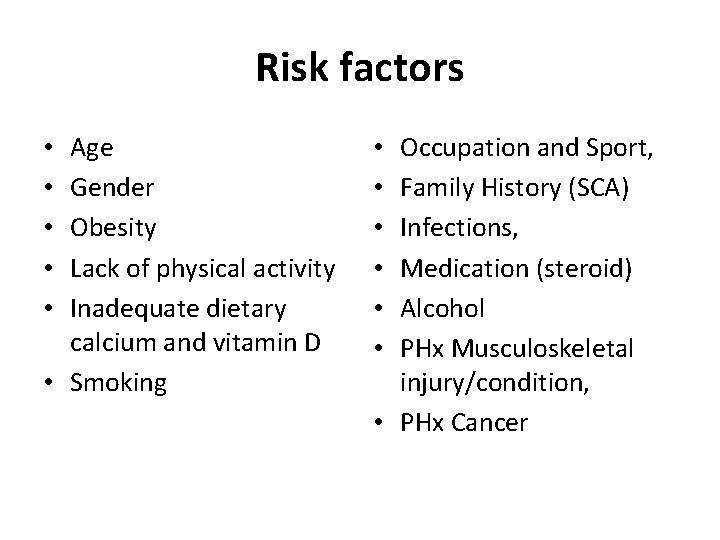
Risk factors Age Gender Obesity Lack of physical activity Inadequate dietary calcium and vitamin D • Smoking • • • Occupation and Sport, Family History (SCA) Infections, Medication (steroid) Alcohol PHx Musculoskeletal injury/condition, • PHx Cancer • • •
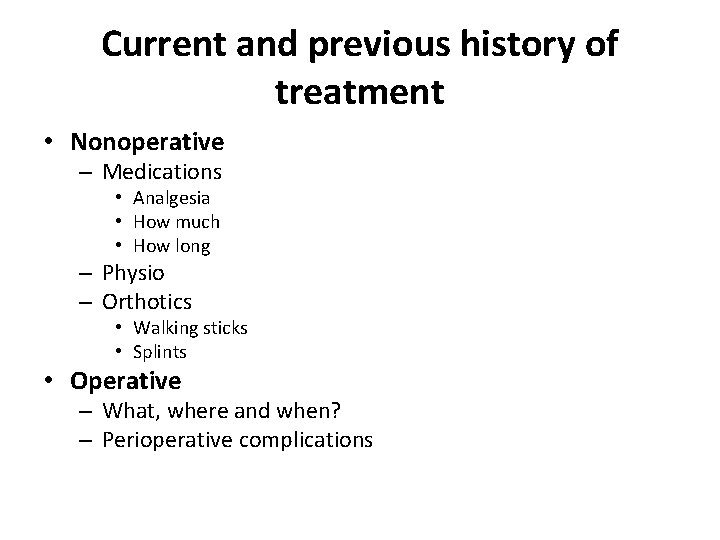
Current and previous history of treatment • Nonoperative – Medications • Analgesia • How much • How long – Physio – Orthotics • Walking sticks • Splints • Operative – What, where and when? – Perioperative complications
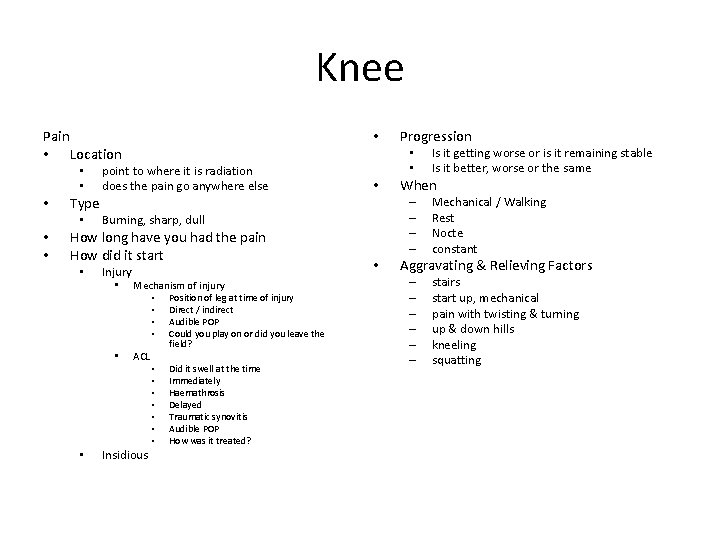
Knee Pain • Location • • • Type • • point to where it is radiation does the pain go anywhere else • Injury • • • Mechanism of injury • Position of leg at time of injury • Direct / indirect • Audible POP • Could you play on or did you leave the ACL Insidious field? • • Did it swell at the time Immediately Haemathrosis Delayed Traumatic synovitis Audible POP How was it treated? • Is it getting worse or is it remaining stable Is it better, worse or the same When – – Burning, sharp, dull How long have you had the pain How did it start Progression Mechanical / Walking Rest Nocte constant Aggravating & Relieving Factors – – – stairs start up, mechanical pain with twisting & turning up & down hills kneeling squatting
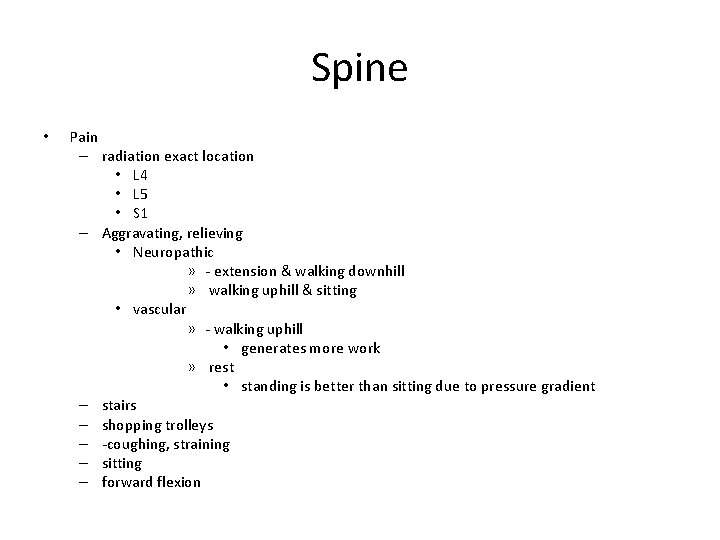
Spine • Pain – radiation exact location • L 4 • L 5 • S 1 – Aggravating, relieving • Neuropathic » extension & walking downhill » walking uphill & sitting • vascular » walking uphill • generates more work » rest • standing is better than sitting due to pressure gradient – stairs – shopping trolleys – coughing, straining – sitting – forward flexion
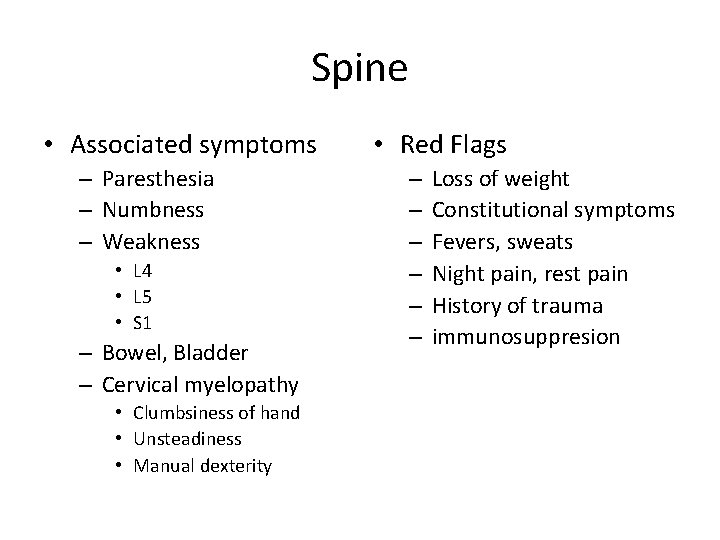
Spine • Associated symptoms – Paresthesia – Numbness – Weakness • L 4 • L 5 • S 1 – Bowel, Bladder – Cervical myelopathy • Clumbsiness of hand • Unsteadiness • Manual dexterity • Red Flags – – – Loss of weight Constitutional symptoms Fevers, sweats Night pain, rest pain History of trauma immunosuppresion
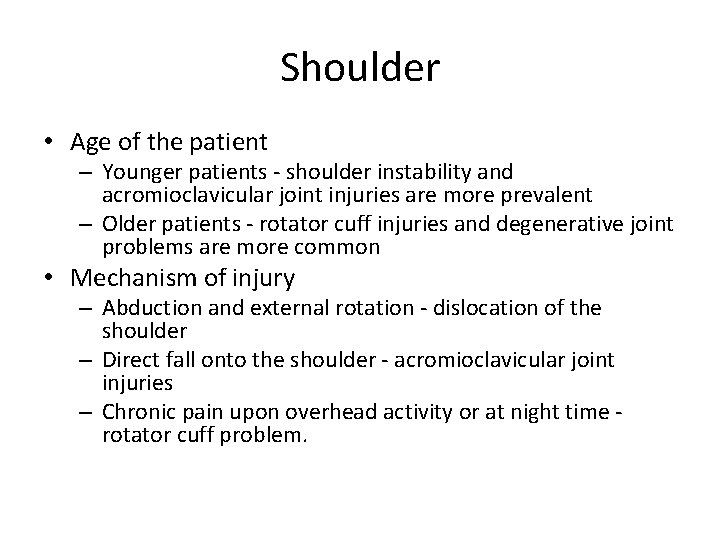
Shoulder • Age of the patient – Younger patients shoulder instability and acromioclavicular joint injuries are more prevalent – Older patients rotator cuff injuries and degenerative joint problems are more common • Mechanism of injury – Abduction and external rotation dislocation of the shoulder – Direct fall onto the shoulder acromioclavicular joint injuries – Chronic pain upon overhead activity or at night time rotator cuff problem.
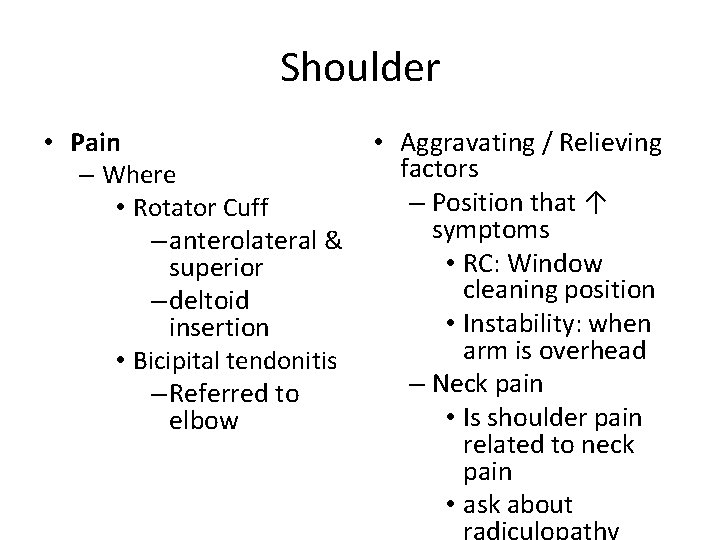
Shoulder • Pain • Aggravating / Relieving factors – Where – Position that ↑ • Rotator Cuff symptoms – anterolateral & • RC: Window superior cleaning position – deltoid • Instability: when insertion arm is overhead • Bicipital tendonitis – Neck pain – Referred to • Is shoulder pain elbow related to neck pain • ask about
Shoulder • Causes – AC joint – Cervical Spine – Glenohumeral joint & rotator cuff • Front & outer aspect of joint • Radiates to middle of arm – Rotator cuff impingement • Positional : appears in the window cleaning position – Instability • Comes on suddenly when the arm is held high overhead – Referred pain • Mediastinal disorders, cardiac ischaemia
Shoulder • Associated – Stiffness – Instability / Gives way • Severe – feeling of joint dislocating • Usually more subtle presenting with clicks/jerks • What position • Initial trauma • How often • Ligamentous laxity – Clicking, Catching / grinding • If so, what position – Weakness • Rotator cuff – especially if large tear – Pins & needles, numbness • Loss of function – Home • Dressing – Coat – Bra • Grooming – Toilet – Brushing hair • Lift objects • Difficulty working with arm above shoulder height – Top shelves – Hanging washing – Work – Sport