Earth Log Day 1 Set Up the Earth
- Slides: 76
Earth Log
Day 1 – Set Up the Earth Log • Write your Name, Class, and Period on the front of EL • There are 100 WHOLE pages in your EL. Number the first 7 WHOLE pages in the top right hand corner of each page. As we progress you will continue to number them in the same location • Page 1 is your Title Page…decorate it as you wish later • Label page 2 as your Table of Contents • Divide the Table of Contents in half by drawing a vertical line down the center of the front and the back of the page (you may want to fold the page first, then draw the line). • Because there are 100 pages, number 1 -100 on the Table of Contents page using the front and back. • Make sure you leave enough space next to each number so that you can write the content next to each number. • Label Page 1 as the Title Page, and page 2 as the Table of Contents • If you would like to go ahead and divide your Table of Contents into sections based on the page numbers…here ya go: • • • Intro: 3 -7 Astronomy: 8 -17 Chemistry: 18 -25 Minerals and Rocks: 26 -39 Weathering and Erosion: 40 -50 Water: 51 -62 Geological Timeline: 63 -77 Plate Tectonics: 78 -89 Weather and Climate: 90 -95 Final Exam: 96 -100
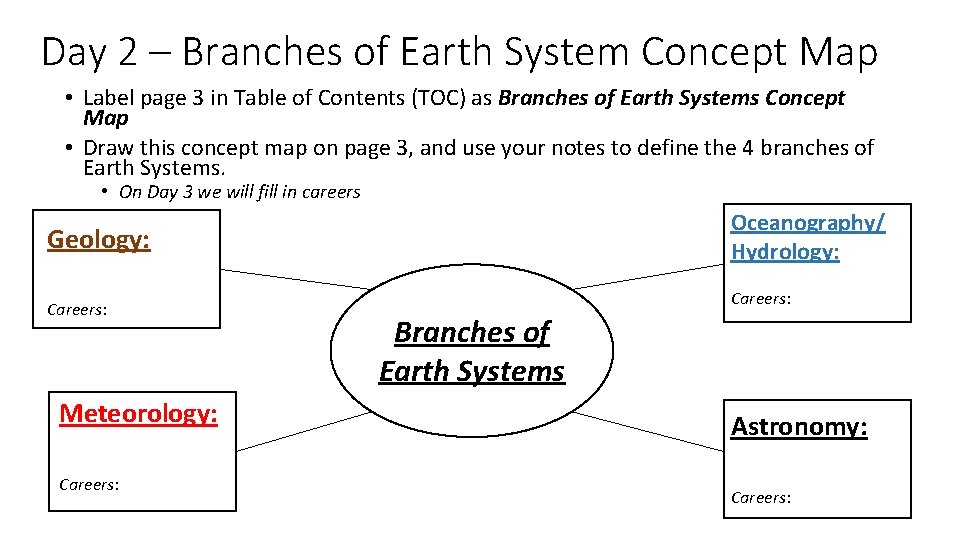
Day 2 – Branches of Earth System Concept Map • Label page 3 in Table of Contents (TOC) as Branches of Earth Systems Concept Map • Draw this concept map on page 3, and use your notes to define the 4 branches of Earth Systems. • On Day 3 we will fill in careers Oceanography/ Hydrology: Geology: Careers: Meteorology: Careers: Branches of Earth Systems Astronomy: Careers:
Day 3 – Careers in Earth Systems • On page 3 of your Earth Log (Branches of Earth Systems Concept Map) fill in 3 -4 different careers (that we have discussed in our presentations) for each of the branches of Earth Systems.
Day 4 – Earth Log: Intro Vocabulary 1 • Label page 4 in your TOC Intro Vocabulary 1. • On page 4 in your Earth Log, use your textbook to define the following vocabulary words: • • • Earth Science Geology Oceanography Meteorology Astronomy
Day 5 – Earth Log: Intro Vocabulary 2 • Label page 5 in your TOC Intro Vocabulary 2. • On page 5 in your Earth Log, use your textbook to define the following vocabulary words: • • • System Atmosphere Hydrosphere Geosphere Biosphere
Day 6 – Laws of Conservation of Matter/Energy • Label p. 6 in your TOC as Laws of Conservation • Define the Law of Conservation of Matter and the Law of Conservation of Energy using your technology. • Finish any Vocabulary from previous pages • Label p. 7 in your TOC as Overflow/Creativity Page • There may be some pages in our Earth Log that can be used for overflow or extra places to put content of your choosing…or you can just doodle on them…or leave them blank.
Day 7 – Astronomy Vocabulary 1 • Label p. 8 in your TOC as Astronomy Vocabulary 1 • Use your textbook to define the following terms: • • • Astronomy Rotation Revolution Solar System Satellite Moons
Day 8 – Astronomy Vocabulary 2 • Label p. 9 in your TOC as Astronomy Vocabulary 2 • Use your textbook to define the following terms and create the list: • Planet • List of Terrestrial Planets (inner planets), in order from closest to the Sun • List of Gas Giants (outer planets), in order from closest to the sun Ø If you would like to sketch each of the planets to show size differences, you can (p. 695 -707). • Kuiper Belt • Solar Nebula • Briefly explain the Nebular Hypothesis and think about some examples we have discussed from the video (p. 685)
Day 9 – Formation of The Moon • Label p. 10 in your TOC as Formation of The Moon • Using your Astronomy Notes Packet: • Write out IN DETAIL the step by step process on how the moon was formed (also, your book may be beneficial as well). • Describe at least 3 benefits that the Moon (or its formation) provides for us. You will have time tomorrow to work on this as well
Day 10 – Formation of The Moon • Label p. 10 in your TOC as Formation of The Moon • Using your Astronomy Notes Packet: • Write out IN DETAIL the step by step process on how the moon was formed (also, your book may be beneficial as well). • Describe at least 3 benefits that the Moon (or its formation) provides for us. • Make sure to finish your Scaled Down Solar System from yesterday…. mark the points/planets on the football field in your packet.
Day 11 – Seasons and Eclipses • Label p. 11 in your TOC as Seasons Notes, and Title p. 11 Seasons Notes • Label p. 12 in your TOC as Eclipses Notes, and Title p. 12 Eclipses Notes • Label p. 13 in your TOC as Eclipses Activity, and Title p. 13 Eclipses Activity • Finish Moon Formation if needed: • Using your Astronomy Notes Packet: • Write out IN DETAIL the step by step process on how the moon was formed (also, your book may be beneficial as well). • Describe at least 3 benefits that the Moon (or its formation) provides for us.
Day 12 – Martian Discussion Questions • Label p. 14 in your TOC as Martian Discussion Questions • Title p. 14 Martian Discussion Questions • Remember to choose at least 2 questions from the list to write a paragraph response (at least 6 sentences) for each on this page in your Earth Log. • Label pages 15 -17 in your TOC as Astronomy Notes, and Title these same pages as Astronomy Notes • These pages will serve as a place for you to write down ANYTHING from your Astronomy Note Packet to be used on the Test (IF your class has earned the privilege to use the Earth Log on the Test).
Day 13 – Astronomy Notes for Test • Label pages 15 -17 in your TOC as Astronomy Notes, and Title these same pages as Astronomy Notes • These pages will serve as a place for you to write down ANYTHING from your Astronomy Note Packet to be used on the Test (IF your class has earned the privilege to use the Earth Log on the Test).
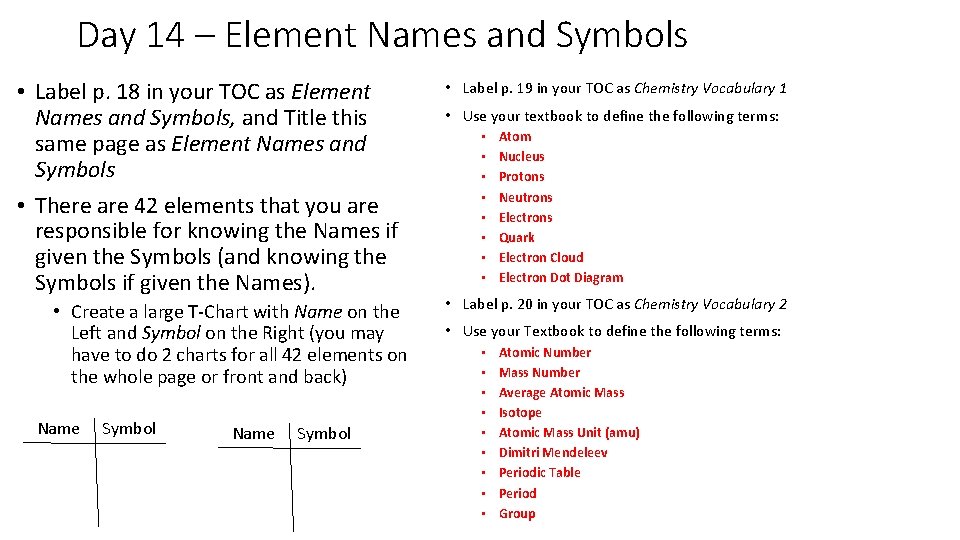
Day 14 – Element Names and Symbols • Label p. 18 in your TOC as Element Names and Symbols, and Title this same page as Element Names and Symbols • There are 42 elements that you are responsible for knowing the Names if given the Symbols (and knowing the Symbols if given the Names). • Create a large T-Chart with Name on the Left and Symbol on the Right (you may have to do 2 charts for all 42 elements on the whole page or front and back) Name Symbol • Label p. 19 in your TOC as Chemistry Vocabulary 1 • Use your textbook to define the following terms: • • Atom Nucleus Protons Neutrons Electrons Quark Electron Cloud Electron Dot Diagram • Label p. 20 in your TOC as Chemistry Vocabulary 2 • Use your Textbook to define the following terms: • • • Atomic Number Mass Number Average Atomic Mass Isotope Atomic Mass Unit (amu) Dimitri Mendeleev Periodic Table Period Group
Day 15 – Chemistry Vocabulary contd. • Label p. 19 in your TOC as Chemistry Vocabulary 1 • Use your textbook to define the following terms: • • Atom Nucleus Protons Neutrons Electrons Quark Electron Cloud Electron Dot Diagram • Label p. 20 in your TOC as Chemistry Vocabulary 2 • Use your Textbook to define the following terms: • • • Atomic Number Mass Number Average Atomic Mass Isotope Atomic Mass Unit (amu) Dimitri Mendeleev Periodic Table Period Group
Day 16 – Reading the Periodic Table • Label p. 21 in TOC as Practice Reading the Periodic Table • For each Element, determine the following: • A#, M#, Avg. AM, #p, #e-, #n • Draw the Bohr Model • Draw the Lewis Structure (electron dot diagram) • K • P • Ne • Label p. 22 in TOC as Reading the Periodic Table Quiz • Glue your little sliver Quiz on this page in your Earth Log • Finish any vocab for Chemistry Vocabulary 1 and 2 on pages 19 -20
Day 17 – Periodic Table…in Color! • Label p. 23 in the TOC as Periodic Table in Color • Cut out your colored Periodic Table and Paste it on p. 23 Finish any vocab for Chemistry Vocabulary 1 and 2 on pages 19 -20 or any other Earth Log entries for Chemistry.
Day 18 – Chemistry Notes • Label pages 24 &25 in your TOC as Chemistry Notes • These pages will serve as a place for you to write down ANYTHING from your Chemistry Note Packet to be used on the Test (IF your class has earned the privilege to use the Earth Log on the Test). • Finish any vocab for Chemistry Vocabulary 1 and 2 on pages 19 -20
Day 19 – Element Names from Symbols • Using page 18, quiz a person next to you over the Element Names and Symbols. Choose any 20 and then switch. • Example: • You: “What is the Name of the Element with the Symbol C? ” • Them: “Carbon. ” • You: “Correct. What is the Name of the Element…. ” • Finish any vocab for Chemistry Vocabulary 1 and 2 on pages 19 -20
Day 20 – Element Symbols from Names • Using page 18, quiz a person next to you over the Element Symbols and Names. Choose any 20 and then switch. • Example: • You: “What is the Symbol of the Element with the Name Carbon? ” • Them: “C. ” • You: “Correct. What is the Symbol of the Element…. ” • Finish any vocab for Chemistry Vocabulary 1 and 2 on pages 19 -20
Turn in your Earth Log to the basket up front
Day 21 – Chemistry Review • Label pages 24 &25 in your TOC as Chemistry Notes • These pages will serve as a place for you to write down ANYTHING from your Chemistry Note Packet to be used on the Test (IF your class has earned the privilege to use the Earth Log on the Test). • Finish anything missing or incomplete from the Chemistry Unit.
Day 22 – Mineral Vocabulary 1. • Label p. 26 in your TOC as Mineral Vocabulary 1 • Use your textbook to define the following terms: • • Mineral Silicate Mineral Non-Silicate Mineral Streak Luster Color (p. 109) Cleavage Fracture • • Label p. 27 in your TOC as Mineral Vocabulary 2 Use your Textbook to define the following terms (p. 113): • • • Density Hardness Silicon-Oxygen Tetrahedron Fluorescence Phosphorescence Magnetism Radioactivity Chatoyancy Asterism
Day 22 – Mineral Vocabulary 1. • Label p. 26 in your TOC as Mineral Vocabulary 1 • Use your textbook to define the following terms: • • Mineral Silicate Non-Silicate Streak Luster Color Cleavage Fracture
Day 23 – Mineral Vocabulary 2. • Label p. 27 in your TOC as Mineral Vocabulary 2 • Use your Textbook to define the following terms: • • Density Hardness Fluorescence Phosphorescence Magnetism Radioactivity Chatoyancy Asterism
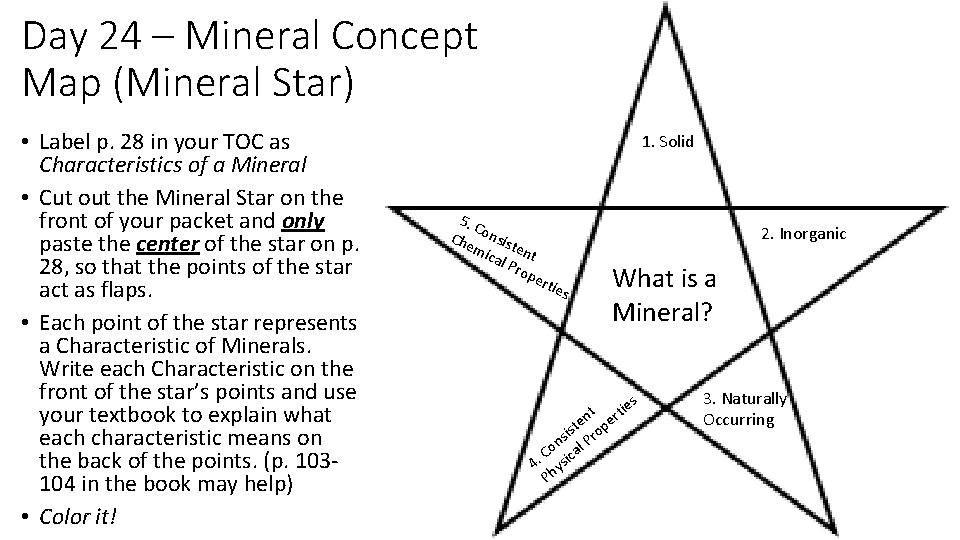
Day 24 – Mineral Concept Map (Mineral Star) • Label p. 28 in your TOC as Characteristics of a Mineral • Cut out the Mineral Star on the front of your packet and only paste the center of the star on p. 28, so that the points of the star act as flaps. • Each point of the star represents a Characteristic of Minerals. Write each Characteristic on the front of the star’s points and use your textbook to explain what each characteristic means on the back of the points. (p. 103104 in the book may help) • Color it! 1. Solid 5. C Che onsis mic tent al P rop ert ies 2. Inorganic What is a Mineral? nt e e t is rop s on cal P C 4. ysi Ph es i t r 3. Naturally Occurring
Day 25 – Minerals important to You • Label p. 29 in your TOC as Minerals Important to Me. • Use the last section from your Mineral Mania Web. Quest: “Minerals in your house. ” Choose 5 items from this list that are the most important items to you, and rank them in order (1 being most important). • Include the minerals that are found in each of these items. • Under your list, identify some of the most common minerals that make up these items and circle them…example: Quartz
Day 26 – Mineral Characteristics Cut Out • Label p. 30 in your TOC as Mineral Characteristics and Magma • Grab a Graphic Organizer sheet from the front desk • Go to my website: cdrakenohs. weebly. com, find the Power. Point entitled “Mineral Characteristics GO” • Use this Power. Point to fill in the boxes of the Graphic Organizer. • Trim up the edges (if needed) and paste this GO on the TOP HALF of p. 30.
Day 27 – Minerals from Magma Cut Out • Grab a Graphic Organizer sheet from the front desk • Go to my website: cdrakenohs. weebly. com, find the Power. Point entitled “Mineral Characteristics GO” • Use this Power. Point to fill in the boxes of the Graphic Organizer. • Trim up the edges (if needed) and paste this GO on the BOTTOM HALF of p. 30.
Day 28 – Mineral Groups Cut Out • Label p. 31 in your TOC as Mineral Groups • Grab a Graphic Organizer sheet from the front desk • Go to my website: cdrakenohs. weebly. com, find the Power. Point entitled “Mineral Characteristics GO” • Use this Power. Point to fill in the boxes of the Graphic Organizer. • Trim up the edges (if needed) and paste this GO on p. 31. This is the only thing on this page, so you can glue it in landscape or portrait.
Day 29 – Mineral Identification • Label p. 32 in your TOC as Mineral Identification Front and Back • Grab both sets of handouts (“ 8” and “ 10”) from the front. • Cut out/fold each handout as instructed by the line diagram on the sheet. • On the outside of each flap you will write the name of each mineral you will need to be able to identify on the Lab Test. Underneath each flap, you will write any descriptions about those specific minerals to help you on the Lab Test. If you would like to print out color pictures from home that you have taken, or pictures of the minerals from my website, you may glue those in with the descriptions as well. • Glue each foldable on p. 32 with the flaps outward, one will be on the front of p. 32, and the other will be on the back. It does not matter which # is on which side.
Day 30 – Rock Vocabulary 1. • Label p. 33 in your TOC as Rock Vocabulary 1 • Use your Textbook to define the following terms: • • • Rock Cycle Bowen’s Reaction Series Igneous Rocks Sedimentary Rocks Metamorphic Rocks
Day 31 – Rock Vocabulary 2 (Igneous). 1 st 5 students to finish get a Starburst • Label p. 34 in your TOC as Rock Vocabulary 2 (Igneous) • Use your Textbook to define the following terms: • • Intrusive Igneous Rock Extrusive Igneous Rock Felsic Mafic • Finish vocab from Day 30 Work on Rock Cycle Cartoon quietly when done with vocab
Day 32 – Rock Vocabulary 3 (Sedimentary). 1 st 5 students to finish get a Starburst • Label p. 35 in your TOC as Rock Vocabulary 3 (Sedimentary) • Use your Textbook to define the following terms: • • • Deposition Compaction Cementation Chemical Sedimentary Rock Organic Sedimentary Rock Clastic Sedimentary Rock • Finish vocab from Day 30 and 31 Work on Rock Cycle Cartoon quietly when done with vocab
Day 33 – Rock Vocabulary 4 (Metamorphic). 1 st 5 students to finish get a Starburst • Label p. 36 in your TOC as Rock Vocabulary 4 (Metamorphic) • Use your Textbook to define the following terms: • • Foliation Non-foliated Contact Metamorphism Regional Metamorphism • Finish vocab from Day 30, 31, 32 Work on Rock Cycle Cartoon quietly when done with vocab
Day 34 – Rock Cycle Cartoon & ID Foldables • Label p. 37 in your TOC as Rock Cycle Cartoon • Paste your FINISHED (meaning your teacher has graded, and passed back) Rock Cycle Cartoon on p. 37 of your Earth Log • Label p. 38 in your TOC as Rock ID – Igneous and Metamorphic • Label p. 39 in your TOC as Rock ID – Sedimentary • Just as we did for our Mineral Identification Foldables on p. 32, create 3 foldables using the handouts upfront for each type of rock. Remember: the outside tabs will have the name of the rocks we need to be able to identify on the test, while the inside will have any information you would like to include from our labs. Make sure to label which foldable is Igneous, Sedimentary, and Metamorphic.
Day 35 – Weathering Vocabulary 1 • Label p. 40 in your TOC as Weathering Vocabulary 1 • Use your Textbook to define the following terms: • • Weathering Mechanical Weathering Chemical Weathering Differential Weathering
Day 36 – Weathering Vocabulary 2 • Label p. 41 in your TOC as Weathering Vocabulary 2 • Use your Textbook to define the following terms: • • • Abrasion Oxidation Hydrolysis Carbonation Acid Precipitation • Work on your Types of Weathering Foldable • Get a foldable template from up front (Bold = cut, dotted = fold, line = divider) • Go to: Cdrakenohs. weebly. com • Weathering Foldable Instructions (also found in packet) • Weathering Foldable Picture
Day 37 – Weathering Foldable and Erosion Vocabulary • Label p. 42 in your TOC as Types of Weathering Foldable • Paste your FINISHED (meaning your teacher has graded, and passed back) Types of Weathering Foldable p. 42 of your Earth Log • Label p. 43 in your TOC as Erosion Vocabulary • Use your Textbook to define the following terms: • • • Erosion Sheet Erosion Mass Movement Solifluction Creep Landform
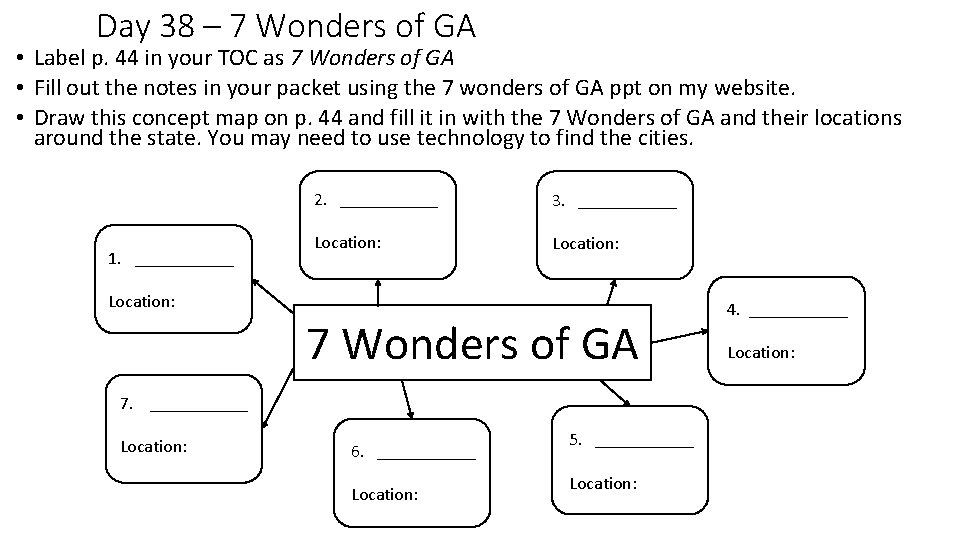
Day 38 – 7 Wonders of GA • Label p. 44 in your TOC as 7 Wonders of GA • Fill out the notes in your packet using the 7 wonders of GA ppt on my website. • Draw this concept map on p. 44 and fill it in with the 7 Wonders of GA and their locations around the state. You may need to use technology to find the cities. 1. ______ 2. ______ 3. ______ Location: 7 Wonders of GA 7. ______ Location: 6. ______ Location: 5. ______ Location: 4. ______ Location:
Day 39 – Caves and Karst Vocabulary • Label p. 45 in your TOC as Caves and Karst Vocabulary • Use your Textbook or Table from the Projects (or technology) to define the following terms: • • • Karst Topography Cavern Sinkhole Stalactite Stalagmite
Day 40 – Type of Weathering, Erosion, and Landforms • Label p. 46 in your TOC as Types of Weathering, Erosion, and Landforms • On page 46, complete the following activity: • Use your tables we created from our Weathering and Erosion Poster Projects and choose the following: • 1 Type of Weathering • 1 Type of Erosion • 1 Landform created from Weathering/Erosion • For each of the above topics: • define/describe the topic • Draw and color a lil picture of the topic (you may look at the posters in the hall for inspiration)
Day 41 – Cave Formation • Label p. 47 in your TOC as Steps of Cave Formation • On page 47, list (write) the steps of cave formation in order and include the full descriptions for each step. • Grab a lab handout from up front…read it • Continue to work on your Cave Formation Cartoon
Day 42 – Review for Weathering and Erosion Test • Label pp. 48 - 50 in your TOC as Weathering and Erosion Notes • On pages 48 – 50 write/draw any notes or pictures that will help you to study for the Weathering and Erosion Test. Depending how well you “handle” yourselves will determine if you will be able to use your Earth Log on your Test. • Finish your Cave Formation Cartoon
Day 43 – Water Cycle Vocabulary • Label p. 51 in your TOC as Water Cycle Vocabulary • Use your Textbook to define the following terms: • • • Water Cycle Evapotranspiration Condensation Precipitation Desalination
Day 44 – Water Cycle Journey • Label p. 52 in your TOC as Water Cycle Journey • Cut out the finished Water Droplet Journey cartoon we did last class period. You will need to trim up the edges all the way to the circles. • Paste the Water Droplet Journey on p. 52 • If you did NOT finish your cartoon…you need to do that first!
Day 45 –Rivers and Watershed Vocabulary • Label p. 53 in your TOC as Rivers and Watershed Vocabulary • Use your Textbook (or technology) to define the following terms: • • • Tributary Watershed Meander Delta Floodplain
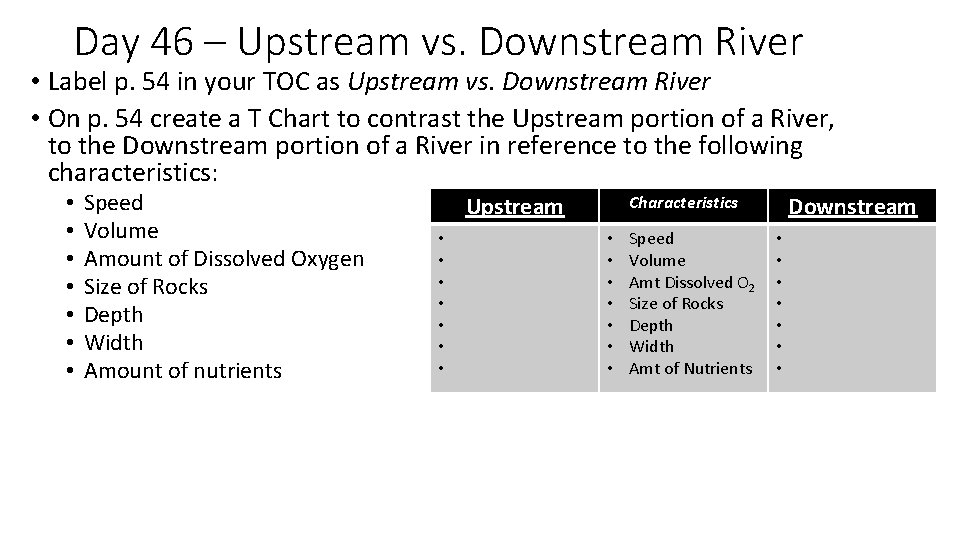
Day 46 – Upstream vs. Downstream River • Label p. 54 in your TOC as Upstream vs. Downstream River • On p. 54 create a T Chart to contrast the Upstream portion of a River, to the Downstream portion of a River in reference to the following characteristics: • • Speed Volume Amount of Dissolved Oxygen Size of Rocks Depth Width Amount of nutrients Upstream • • Downstream Characteristics • • Speed Volume Amt Dissolved O 2 Size of Rocks Depth Width Amt of Nutrients • •
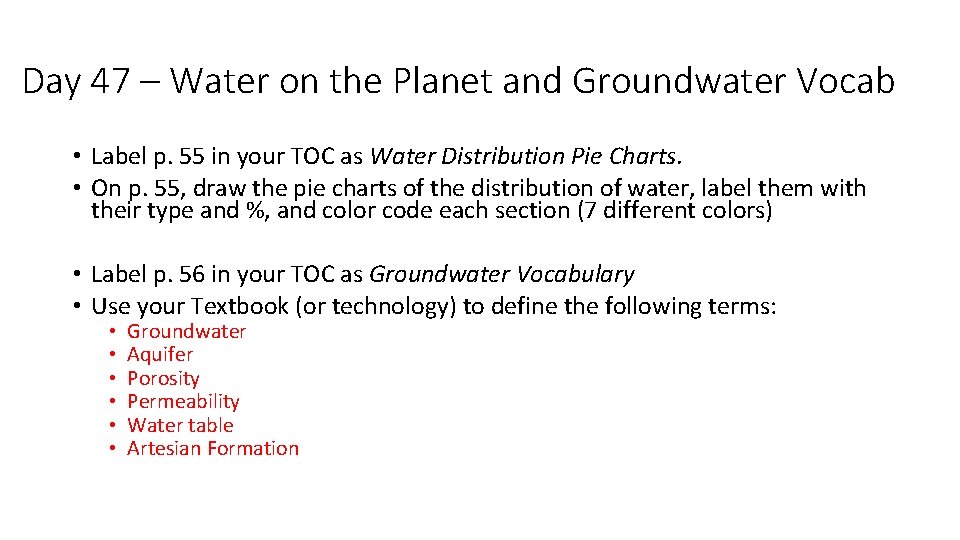
Day 47 – Water on the Planet and Groundwater Vocab • Label p. 55 in your TOC as Water Distribution Pie Charts. • On p. 55, draw the pie charts of the distribution of water, label them with their type and %, and color code each section (7 different colors) • Label p. 56 in your TOC as Groundwater Vocabulary • Use your Textbook (or technology) to define the following terms: • • • Groundwater Aquifer Porosity Permeability Water table Artesian Formation
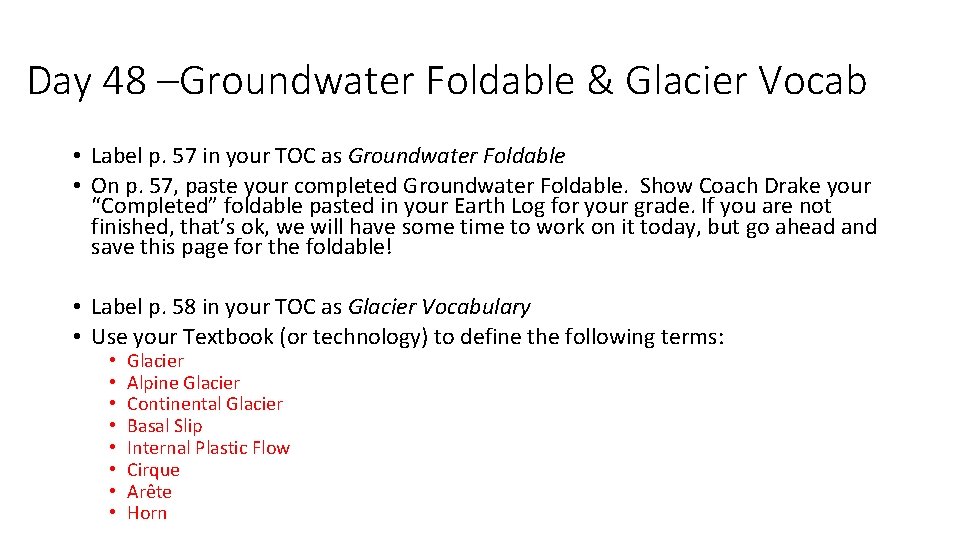
Day 48 –Groundwater Foldable & Glacier Vocab • Label p. 57 in your TOC as Groundwater Foldable • On p. 57, paste your completed Groundwater Foldable. Show Coach Drake your “Completed” foldable pasted in your Earth Log for your grade. If you are not finished, that’s ok, we will have some time to work on it today, but go ahead and save this page for the foldable! • Label p. 58 in your TOC as Glacier Vocabulary • Use your Textbook (or technology) to define the following terms: • • Glacier Alpine Glacier Continental Glacier Basal Slip Internal Plastic Flow Cirque Arête Horn
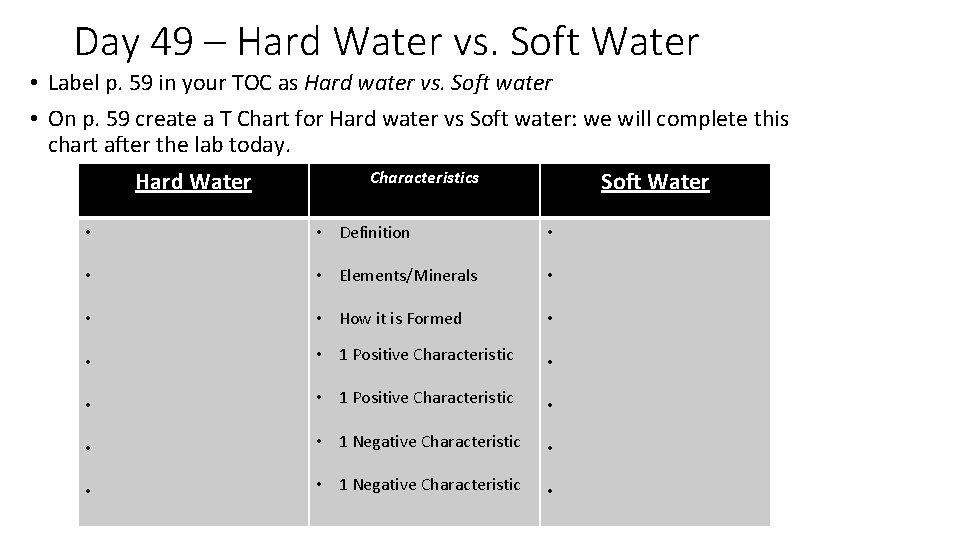
Day 49 – Hard Water vs. Soft Water • Label p. 59 in your TOC as Hard water vs. Soft water • On p. 59 create a T Chart for Hard water vs Soft water: we will complete this chart after the lab today. Hard Water Soft Water Characteristics • • Definition • • • Elements/Minerals • • • How it is Formed • • • 1 Positive Characteristic • • • 1 Negative Characteristic •
Day 50 – Water Notes • Label pages 60 -62 in the TOC as Water Notes • On pages 60 – 62 write/draw any notes or pictures that will help you to study for the Water Test. Depending how well you “handle” yourselves will determine if you will be able to use your Earth Log on your Test.
Day 51 – GTL Section 1 • Finish GW Foldable, Show me it glued in your EL • Label page 63 in the TOC as GTL Section 1. • On page 63 in your Earth Log: 1. “Read” pages 211 -214 o Define the Following Terms: ØGeological Column ØEra ØPeriod ØEpoch o Answer questions 1 -8 on page 214 in the Section #1 Review.
Day 52 – GTL Section 2 • Label page 64 in your TOC as GTL Section 2. • On page 64 in your Earth Log 2. “Read” pages 215 -220 o Define the following Terms: ØEvolution ØPrecambrian time ØPaleozoic Era o Answer questions 1 -9 on page 220 in the Section #2 Review. When you have completed this, grab a note packet from the front. Read the front page…
Day 53 – GTL Section 3 • Label page 65 in your TOC as GTL Section 3. • On page 65 in your Earth Log 2. “Read” pages 221 -226 o Define the following Terms: ØMass Extinction ØMesozoic Era ØCenozoic Era o Answer questions 1 -9 on page 226 in the Section #3 Review. Finish any of the other GTL Sections. Get started on your GTL Project.
Day 54 – What is your favorite EXTINCT organism? • Label p. 66 in your TOC as Fave Extinct Organism • On p. 66, research a specific organism that existed in the past, that is not around today and describe it using the following characteristics. Label each characteristic: 1. General Name (be specific…there are hundreds of “dinosaurs”…) 2. Scientific Name (Genus species) 3. What Era, Period, and Epoch (if applicable) did it thrive in 4. What type of environment did it live in 5. How did it obtain energy? (food? What kind? Is it a plant…do they eat? ) 6. When did it go Extinct 7. Why do scientist think it went Extinct 8. If it were around today, would that be good or bad for our planet, and why. 9. Draw a quick sketch of your organism or the fossils of your organism…or both…
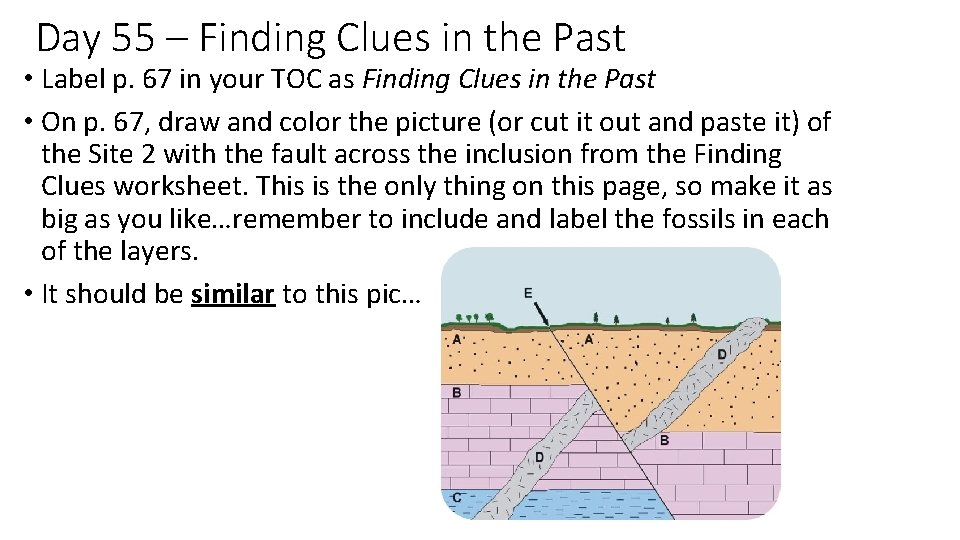
Day 55 – Finding Clues in the Past • Label p. 67 in your TOC as Finding Clues in the Past • On p. 67, draw and color the picture (or cut it out and paste it) of the Site 2 with the fault across the inclusion from the Finding Clues worksheet. This is the only thing on this page, so make it as big as you like…remember to include and label the fossils in each of the layers. • It should be similar to this pic…
Day 56 – Laws and Principles of GTL • Label page 68 in your TOC as Laws and Principles of GTL • Show me your completed worksheet so you can get yo grade. • On p. 68, cut out the colored picture of the geologic column from the Laws and Principles Fact Sheet. Paste it on the top of this page. Make sure to include the rankings of the layers to the right of the picture. Also WRITE the Laws and Principles under the picture…because writing things helps you remember them…it’s true…science fact!
Day 57 – Superposition Practice 1 • Label page 69 in your TOC as Superposition Practice 1 • On p. 69, Number 1 -13. You will be presented with a picture of a geologic column that you will rank Youngest to Oldest. • After we grade the Practice Picture, you will be given this picture to glue in your Earth Log on this same page.
Day 58 – Superposition Practice 2 • Label page 70 in your TOC as Superposition Practice 2 • On p. 70, Number 1 -9. You will be presented with a picture of a geologic column that you will rank Youngest to Oldest. • While you wait for SP 2, trim up and paste SP 1 on p. 69. • After we grade the Practice Picture, you will be given this picture to glue in your Earth Log on this same page.
Day 59 – Unconformities • Label page 71 in your TOC as Unconformities • On p. 71, using the Unconformities handout, cut out each of the colored Geological Columns and glue them in order of occurrence on this page. Be sure to include the descriptions for each image as well. • When you are done, show me and get yo grade!
Day 60 – Superposition Practice 3 • Label page 72 in your TOC as Superposition Practice 3 • On p. 72, Number 1 -15. You will be presented with a picture of a geologic column that you will rank Youngest to Oldest. • While you wait for SP 3, trim up and paste SP 2 on p. 70. • After we grade the Practice Picture, you will be given this picture to glue in your Earth Log on this same page.
Day 61 – Superposition Practice 4 • Label page 73 in your TOC as Superposition Practice 4 • On p. 73, Number 1 -14. You will be presented with a picture of a geologic column that you will rank Youngest to Oldest. • While you wait for SP 4, trim up and paste SP 3 on p. 72. • After we grade the Practice Picture, you will be given this picture to glue in your Earth Log on this same page.
Day 62 – GTL Notes • Label pages 74 -77 in your TOC as GTL Notes • On pages 74 -77 write/draw any notes or pictures that will help you to study for the GTL Test…I PROMISE you, you WILL need to study for this one and utilize opportunities IF you have earned them! You will be given an exact copy of the GTL Table from your notes, just be familiar with how to read that table. Depending how well you “handle” yourselves will determine if you will be able to use your Earth Log on your Test.
Day 63 – Earth’s Basics • Label page 78 in your TOC as Earth’s Basics • On page 78 in your Earth Log • “Read” pages 27 -30 o Define the following Terms: • • • Crust Mantle Core Lithosphere Asthenosphere Mesosphere o Answer questions 1 -9 on page 30 in the Section #2 Review.
Day 64 – Faulting and Folding • Label page 79 in your TOC as Faulting and Folding. • On p. 79 Define the following terms in red and draw sketches for the terms in blue: (the book is helpful p. 276 -278) • Fold • Anticline • Syncline • Monocline • Fault • • Normal Reverse Thrust Strike-Slip
Day 65 – Plate Boundaries • Label page 80 in your TOC as Plate Boundaries • On page 80, define the following plate boundaries, sketch a simple diagram of each type, and give an example of each on the Earth: (p. 249 -251 in your book is super duper helpful…especially the table on 251…jussayin!) • Convergent Boundary • Definition • Pic • Example • Divergent Boundary • Definition • Pic • Example • Transform Boundary • Definition • Pic • Example
Day 66 – Earth’s Layers • • Label page 81 in your TOC as Earth’s Layers. On the top of page 81, glue in the picture of the cross section of the Earth’s Layers At the bottom of page 81, number 1 -11. Using the following words, correctly identify the layers that correspond to the numbers labeled on the picture: • • • Oceanic Crust Continental Crust Lithosphere Asthenosphere Mantle Upper Mantle Lower Mantle Middle Mantle (Convection Currents) Inner Core Outer Core
Day 67 - Pangaea • Label page 82 in your TOC as Pangaea. • Obtain a Pangaea picture from the front of the room. • Color each of the continents/countries listed below that make up Pangaea…your book will be helpful p. 258 -260: • • North America South America Africa Antarctica Australia Eurasia (Europe and Asia) India • If you want to color the non land gaps between some of the continents/countries with Blue to represent the ocean and shallow seas, and Brown for other “land-looking” masses…you can • Trim up the picture and glue it on page 82. • Create a color coded Legend for the picture.
Day 68 – Continental Drift and Plate Tectonics • Label p. 83 in your TOC as Continental Drift and Plate Tectonics Vocabulary (Or…CD and PT Vocabulary) • Use your Textbook/notes to define the following terms: • • • Continental Drift Mid-Ocean Ridge Sea-floor spreading Paleomagnetism Plate tectonics
Day 69 – Study/Ketchup…and Earthquakes • You have 15 minutes before we take the quiz, so make sure your Earth Log is up to date through yesterday. Here is the new entry for today so that you can start now and finish after the quiz before we get started on Earthquakes… • Label page 84 in your TOC as Earthquake Vocabulary. • Use your Textbook to define the following terms: • • Earthquake Elastic rebound Focus (sketch a picture to show this with epicenter…p. 296) Epicenter (sketch a picture to show this with focus…p. 296) Body wave P wave Shadow Zone • Also explain why shadow zones are significant to the study of the Earth’s Layers • Fault Zone
Day 70 - Volcanoes • You have 15 minutes before we take the Earthquake quiz. Here is the new entry for today so that you can start now and finish after the quiz before we get started on Volcanoes… • Label page 85 in your TOC as Volcanoes Vocabulary. • Use your Textbook to define the following terms: • • Volcano Volcanism Magma Lava Hot Spot Pyroclastic Material Caldera • Draw a sick pic of a volcano with some dope lava spewing out of the top…and maybe some “pyroclastic flow” as well…since you know that word now…
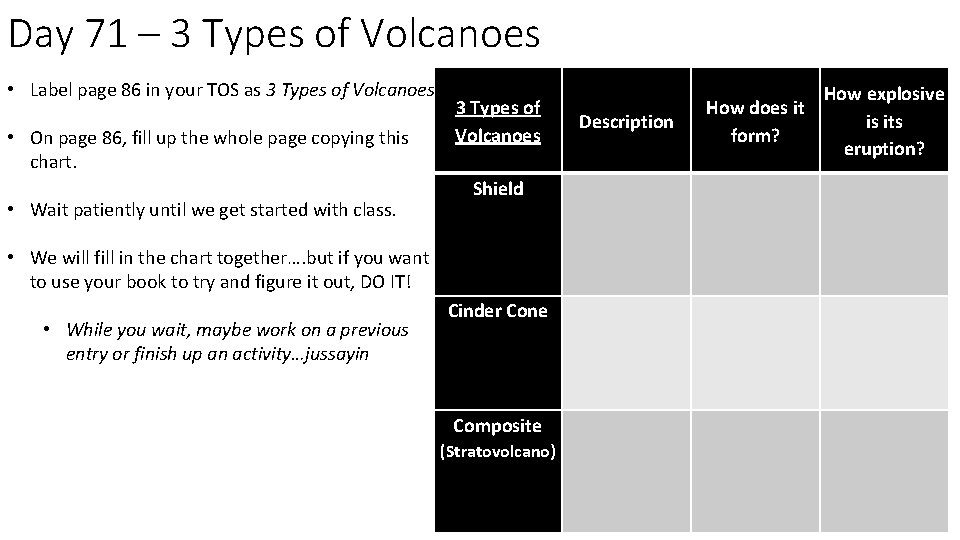
Day 71 – 3 Types of Volcanoes • Label page 86 in your TOS as 3 Types of Volcanoes • On page 86, fill up the whole page copying this chart. • Wait patiently until we get started with class. 3 Types of Volcanoes Shield • We will fill in the chart together…. but if you want to use your book to try and figure it out, DO IT! • While you wait, maybe work on a previous entry or finish up an activity…jussayin Cinder Cone Composite (Stratovolcano) Description How does it form? How explosive is its eruption?
Day 72 – EL, CD, PT, EQ, & V Notes • Label pages 87 -89 in your TOC as EL, CD, PT, EQ, & V Notes • On pages 87 -89 write/draw any notes or pictures that will help you to study for the EL, CD, PT, EQ, & V Test. Your study guide in your packet would be a GREAT place to start and write down information on these pages…This test is pretty tough because of how spread out the content was over many weeks…it’s the hardest one yet so you need to study for this one and utilize opportunities IF you have earned them! • Depending how well you “handle” yourselves will determine if you will be able to use your Earth Log on your Test.
Day 73 – Final Exam Notes • Label pages 96 -100 in your TOC as Final Exam Notes • Using the Final Exam Study Guide, write down anything you want on pages 96 -100. • Any words need to be defined. • Any questions or statements need to be answered or elaborated on.