
5 1 LOGARITHMS AND THEIR PROPERTIES 1 What



- Slides: 12
5. 1 LOGARITHMS AND THEIR PROPERTIES 1
What is a Logarithm? If x is a positive number, log x is the exponent of 10 that gives x. In other words, if y = log x then 10 y = x. log 100 = 2 because log 2500 ≈ 3. 398 because 102 = 100 103. 398 = 2500 2
Logarithms to Exponents Example 1 Rewrite the following statements using exponents instead of logs. (a) log 100 = 2 (b) log 0. 01 = − 2 (c) log 30 = 1. 477 Solution We use the fact that if y = log x then 10 y = x. (a) 2 = log 100 means that 102 = 100. (b) − 2 = log 0. 01 means that 10− 2 = 0. 01. (c) 1. 477 = log 30 means that 101. 477 ≈ 30. 3
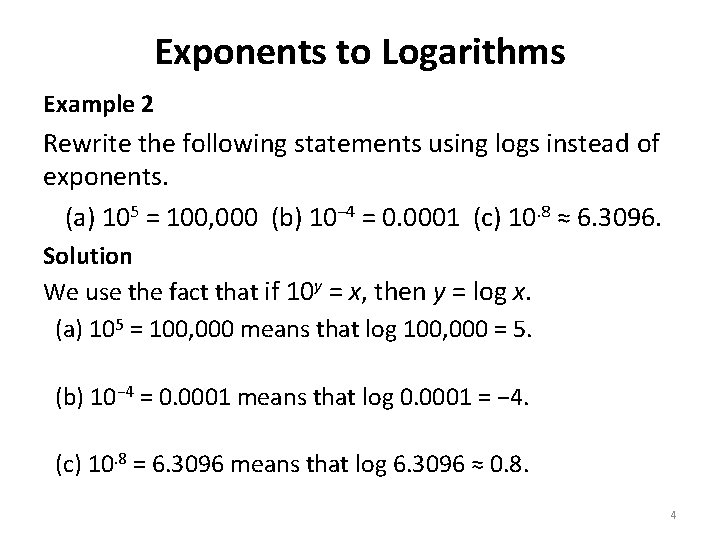
Exponents to Logarithms Example 2 Rewrite the following statements using logs instead of exponents. (a) 105 = 100, 000 (b) 10− 4 = 0. 0001 (c) 10. 8 ≈ 6. 3096. Solution We use the fact that if 10 y = x, then y = log x. (a) 105 = 100, 000 means that log 100, 000 = 5. (b) 10− 4 = 0. 0001 means that log 0. 0001 = − 4. (c) 10. 8 = 6. 3096 means that log 6. 3096 ≈ 0. 8. 4
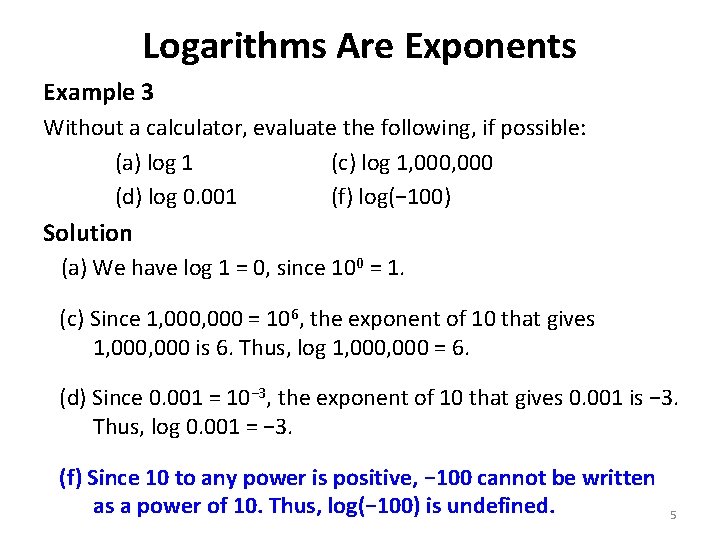
Logarithms Are Exponents Example 3 Without a calculator, evaluate the following, if possible: (a) log 1 (c) log 1, 000 (d) log 0. 001 (f) log(− 100) Solution (a) We have log 1 = 0, since 100 = 1. (c) Since 1, 000 = 106, the exponent of 10 that gives 1, 000 is 6. Thus, log 1, 000 = 6. (d) Since 0. 001 = 10− 3, the exponent of 10 that gives 0. 001 is − 3. Thus, log 0. 001 = − 3. (f) Since 10 to any power is positive, − 100 cannot be written as a power of 10. Thus, log(− 100) is undefined. 5
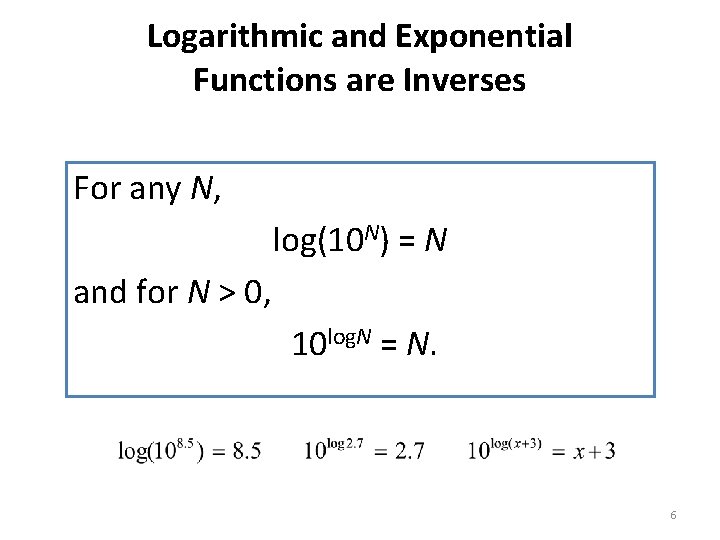
Logarithmic and Exponential Functions are Inverses For any N, log(10 N) = N and for N > 0, 10 log. N = N. 6
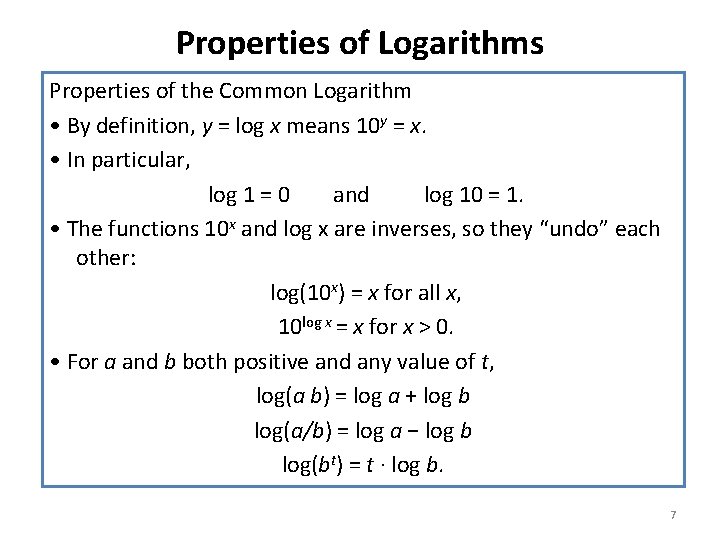
Properties of Logarithms Properties of the Common Logarithm • By definition, y = log x means 10 y = x. • In particular, log 1 = 0 and log 10 = 1. • The functions 10 x and log x are inverses, so they “undo” each other: log(10 x) = x for all x, 10 log x = x for x > 0. • For a and b both positive and any value of t, log(a b) = log a + log b log(a/b) = log a − log b log(bt) = t · log b. 7
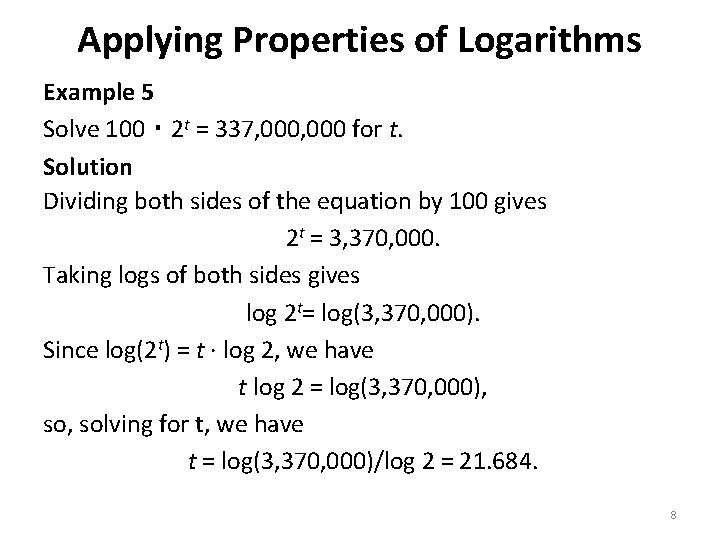
Applying Properties of Logarithms Example 5 Solve 100・ 2 t = 337, 000 for t. Solution Dividing both sides of the equation by 100 gives 2 t = 3, 370, 000. Taking logs of both sides gives log 2 t= log(3, 370, 000). Since log(2 t) = t · log 2, we have t log 2 = log(3, 370, 000), solving for t, we have t = log(3, 370, 000)/log 2 = 21. 684. 8
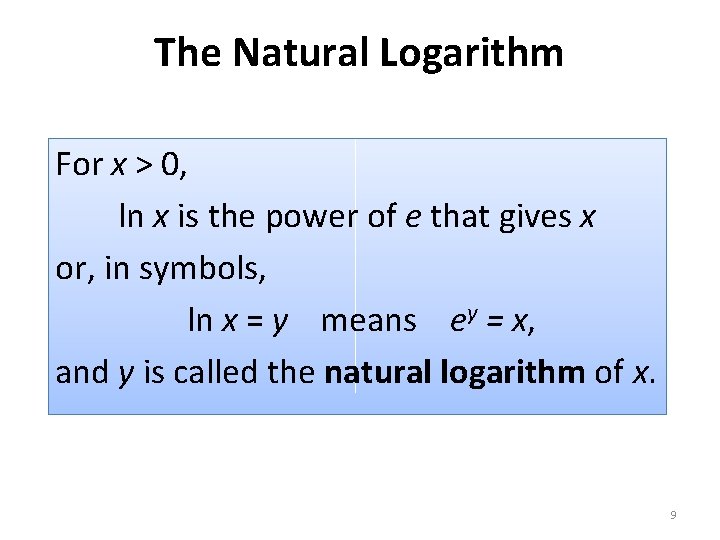
The Natural Logarithm For x > 0, ln x is the power of e that gives x or, in symbols, ln x = y means ey = x, and y is called the natural logarithm of x. 9
Same Properties as for Common Logarithm Properties of the Natural Logarithm • By definition, y = ln x means ey = x. • In particular, ln 1 = 0 and ln e = 1. • The functions ex and ln x are inverses, so they “undo” each other: ln(ex) = x for all x, eln x = x for x > 0. • For a and b both positive and any value of t, ln (a b) = ln a + ln b ln (a/b) = ln a − ln b ln (bt) = t · ln b. 10
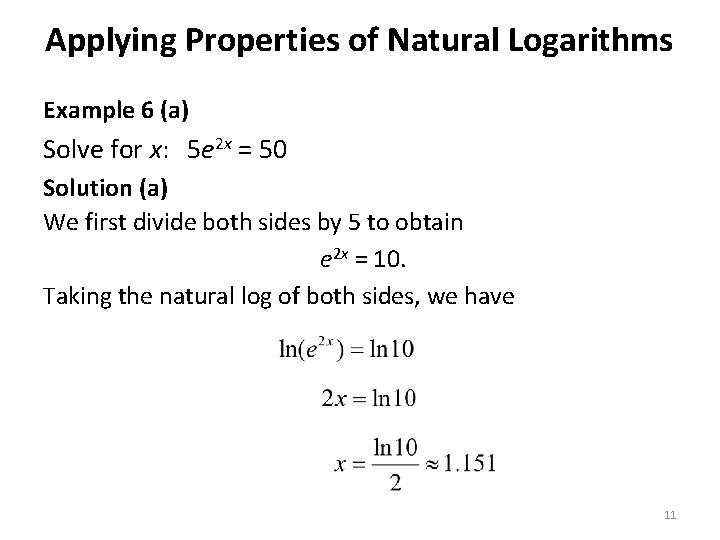
Applying Properties of Natural Logarithms Example 6 (a) Solve for x: 5 e 2 x = 50 Solution (a) We first divide both sides by 5 to obtain e 2 x = 10. Taking the natural log of both sides, we have 11
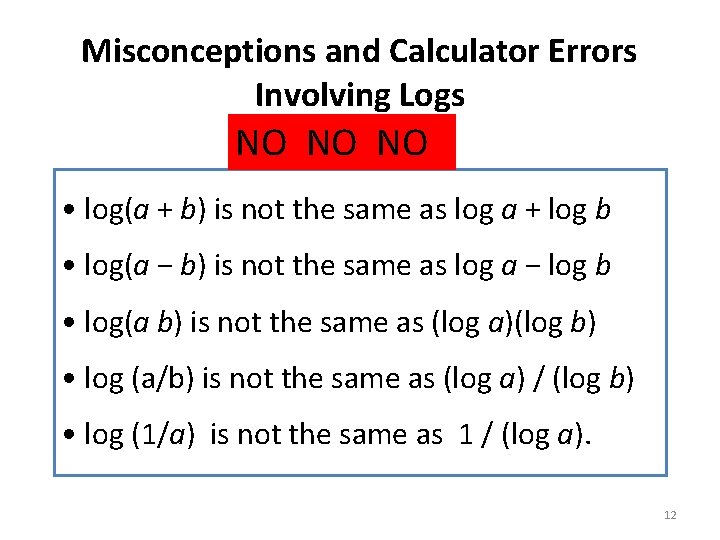
Misconceptions and Calculator Errors Involving Logs NO NO NO • log(a + b) is not the same as log a + log b • log(a − b) is not the same as log a − log b • log(a b) is not the same as (log a)(log b) • log (a/b) is not the same as (log a) / (log b) • log (1/a) is not the same as 1 / (log a). 12