Do Now Look at the picture for 3



- Slides: 102
Do Now Look at the picture for 3 minutes. Then answer the questions 1
AIM: How do we store memories? 2
How does memory relate to learning? 1. Memory is an indication that learning has persisted over time. 2. Learning is acquisition, memory is retention 3. Memory is our ability to store and retrieve information. 4
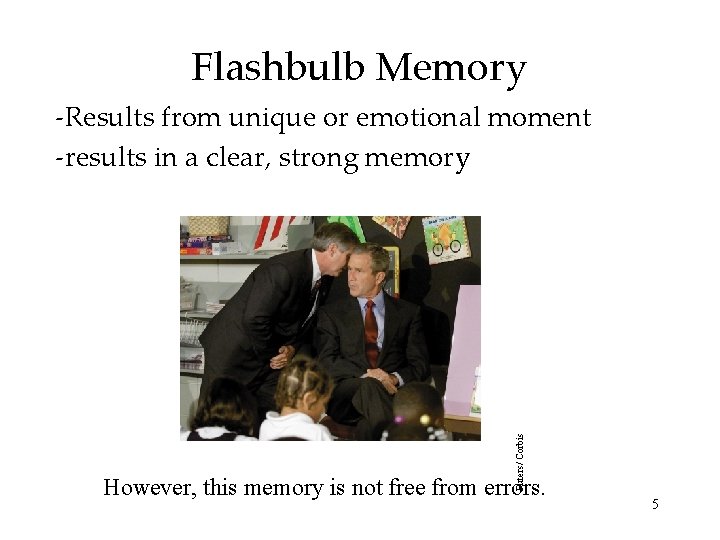
Flashbulb Memory Ruters/ Corbis -Results from unique or emotional moment -results in a clear, strong memory However, this memory is not free from errors. 5
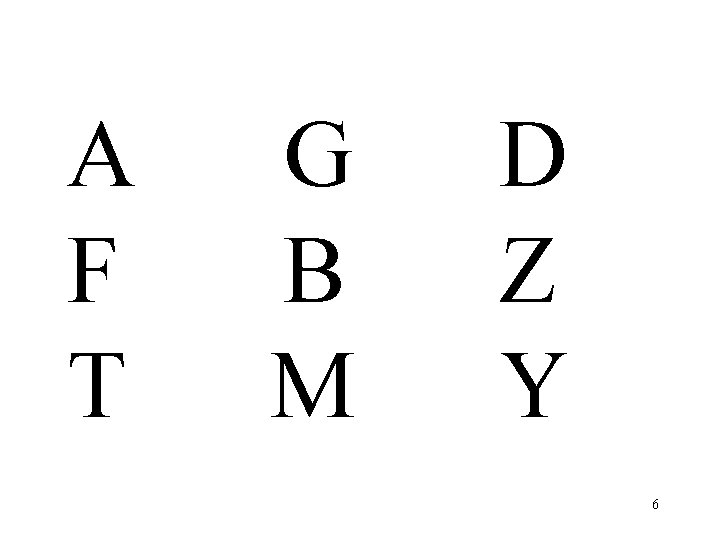
A F T G B M D Z Y 6
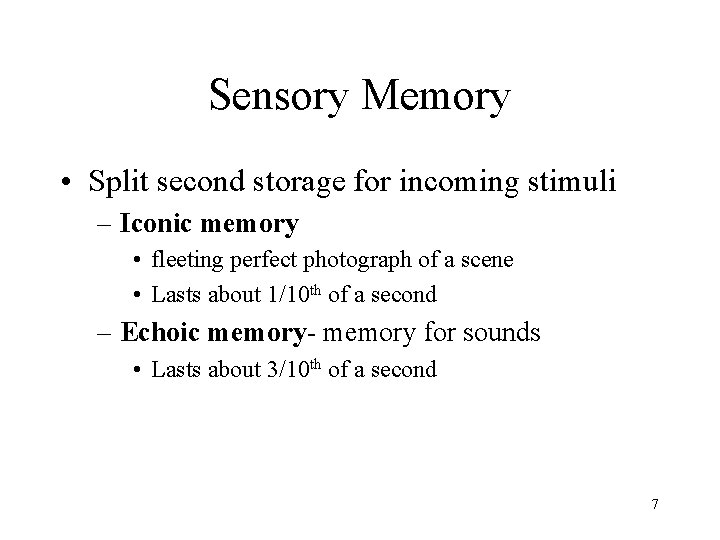
Sensory Memory • Split second storage for incoming stimuli – Iconic memory • fleeting perfect photograph of a scene • Lasts about 1/10 th of a second – Echoic memory- memory for sounds • Lasts about 3/10 th of a second 7
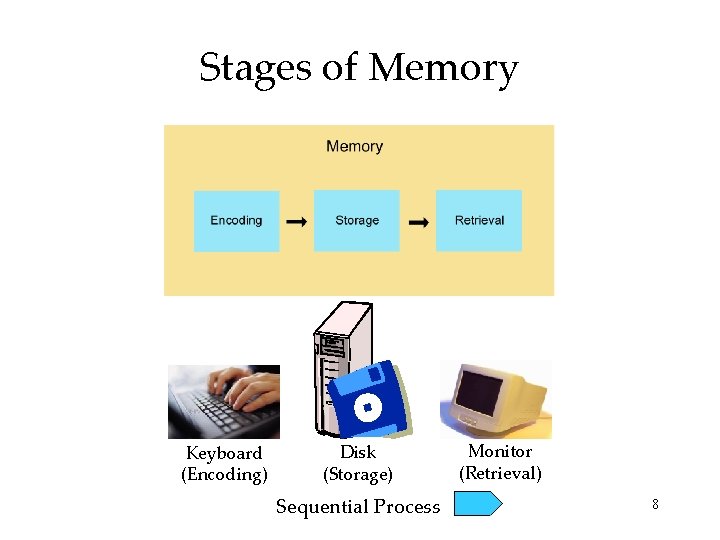
Stages of Memory Keyboard (Encoding) Disk (Storage) Sequential Process Monitor (Retrieval) 8
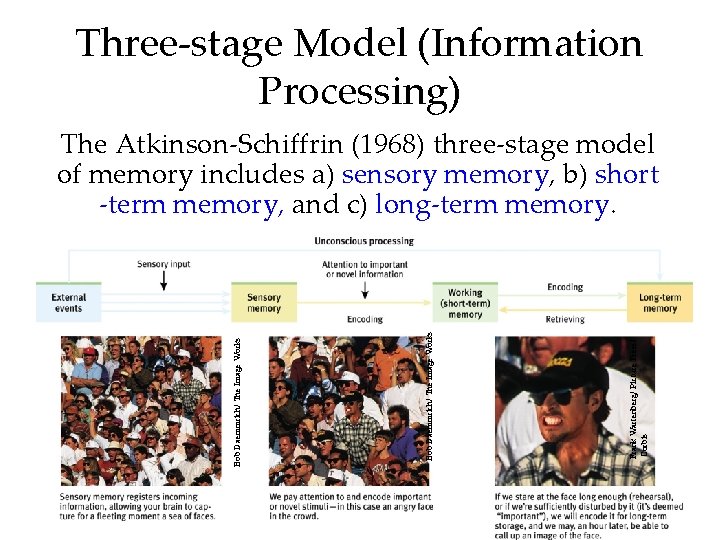
Three-stage Model (Information Processing) Frank Wartenberg/ Picture Press/ Corbis Bob Daemmrich/ The Image Works The Atkinson-Schiffrin (1968) three-stage model of memory includes a) sensory memory, b) short -term memory, and c) long-term memory. 9
Sensory Memory: only some sensory input is encoded into short-term memory, most is lost…. Why do we encode certain sensory info into short-term? 10
Short term memory lasts 10 -30 seconds but can be expanded Long term memory last minutes, days, hours, weeks, years 11
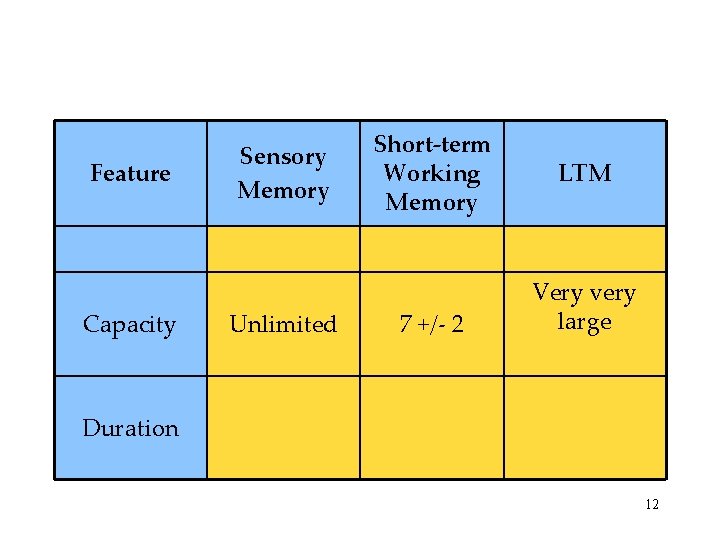
Feature Capacity Sensory Memory Unlimited Short-term Working Memory 7 +/- 2 LTM Very very large Duration 12
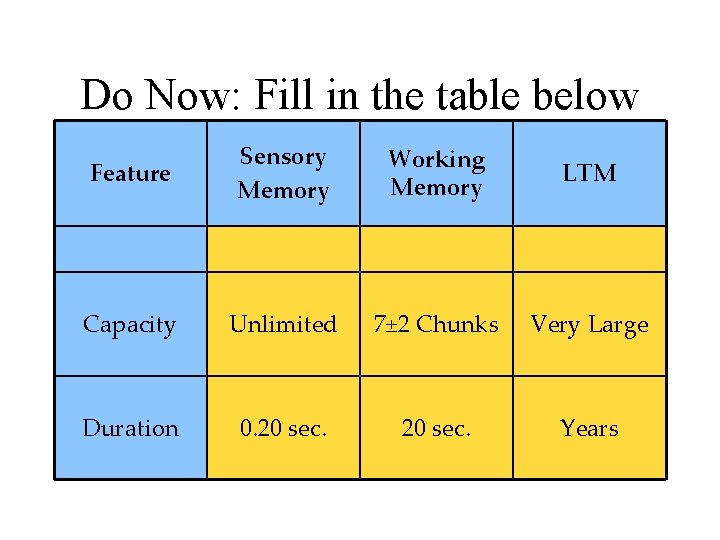
Do Now: Fill in the table below Feature Sensory Memory Working Memory LTM Capacity Unlimited 7± 2 Chunks Very Large Duration 0. 20 sec. Years
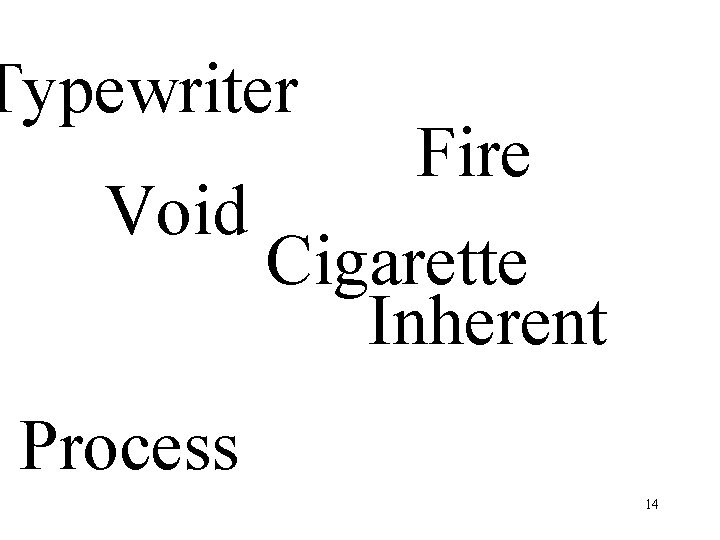
Typewriter Void Fire Cigarette Inherent Process 14
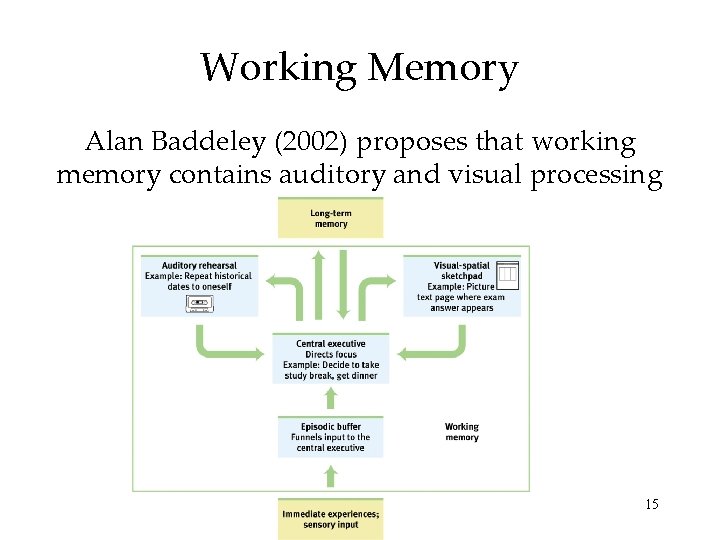
Working Memory Alan Baddeley (2002) proposes that working memory contains auditory and visual processing 15
AIM: How can we encode memories? 16
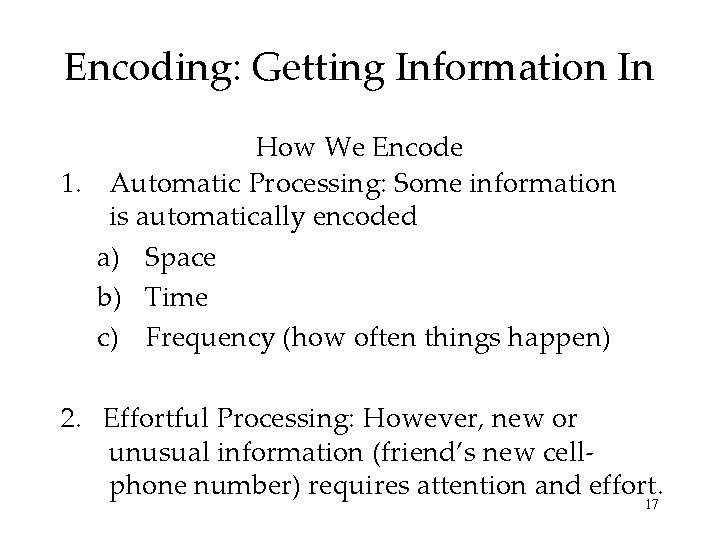
Encoding: Getting Information In How We Encode 1. Automatic Processing: Some information is automatically encoded a) Space b) Time c) Frequency (how often things happen) 2. Effortful Processing: However, new or unusual information (friend’s new cellphone number) requires attention and effort. 17
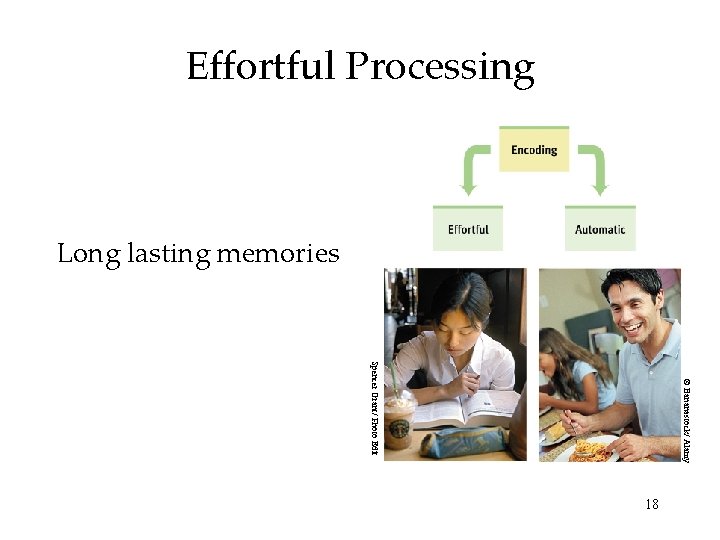
Effortful Processing Long lasting memories © Bananastock/ Alamy Spencer Grant/ Photo Edit 18
How can we effortfully process memories? 19
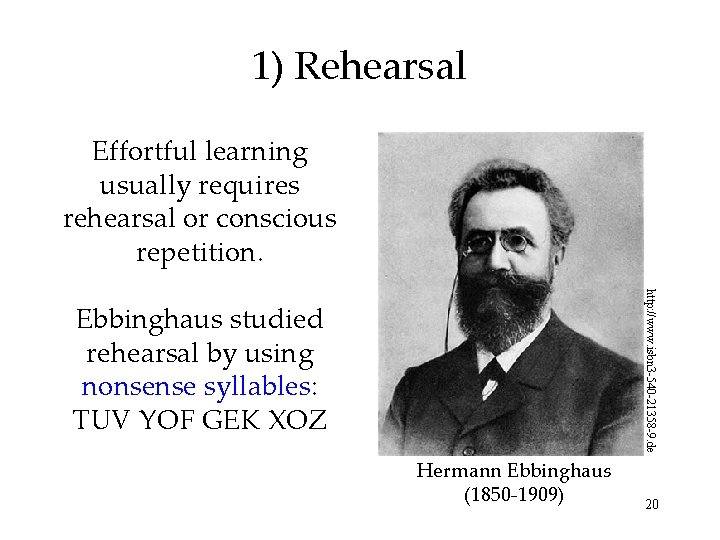
1) Rehearsal Effortful learning usually requires rehearsal or conscious repetition. http: //www. isbn 3 -540 -21358 -9. de Ebbinghaus studied rehearsal by using nonsense syllables: TUV YOF GEK XOZ Hermann Ebbinghaus (1850 -1909) 20
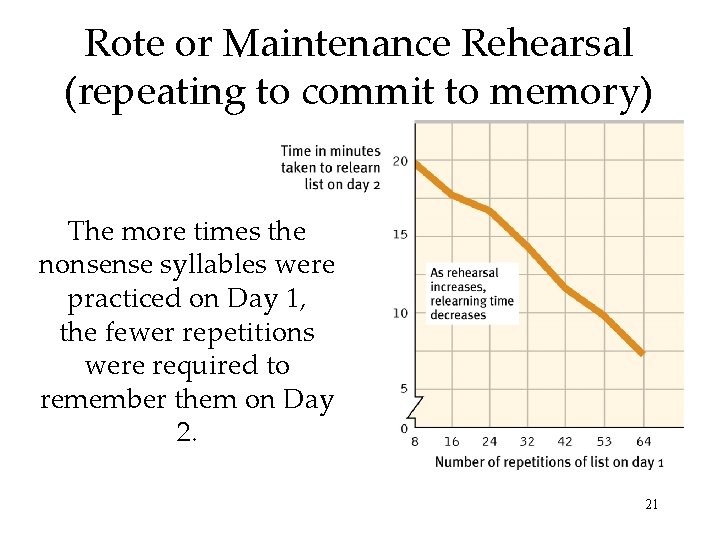
Rote or Maintenance Rehearsal (repeating to commit to memory) The more times the nonsense syllables were practiced on Day 1, the fewer repetitions were required to remember them on Day 2. 21
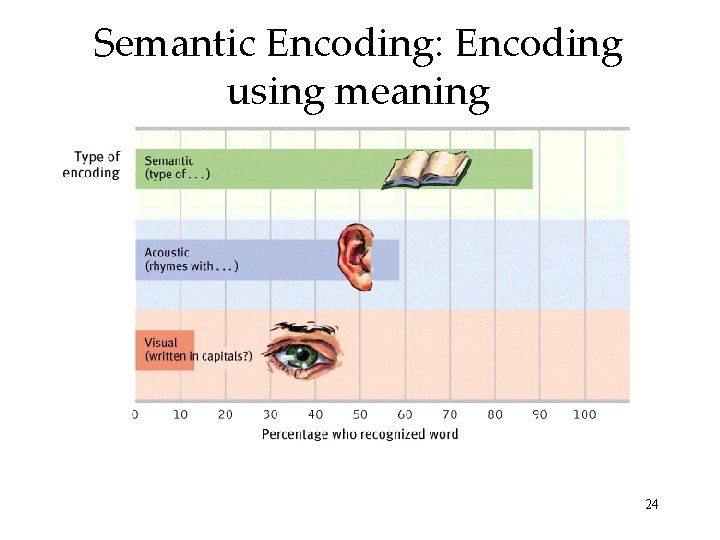
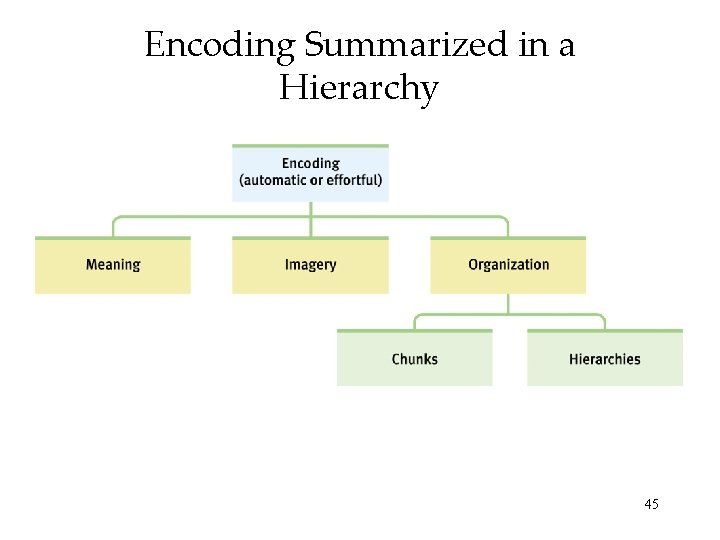
What We Encode 1. Encoding by meaning (semantic coding) 2. Encoding by images 3. Encoding by organization 22
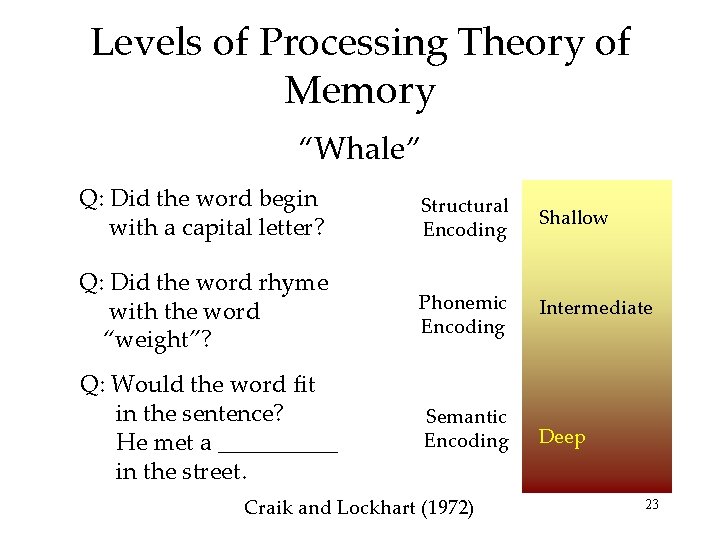
Levels of Processing Theory of Memory “Whale” Q: Did the word begin with a capital letter? Structural Encoding Shallow Q: Did the word rhyme with the word “weight”? Phonemic Encoding Intermediate Q: Would the word fit in the sentence? He met a _____ in the street. Semantic Encoding Deep Craik and Lockhart (1972) 23
Semantic Encoding: Encoding using meaning 24
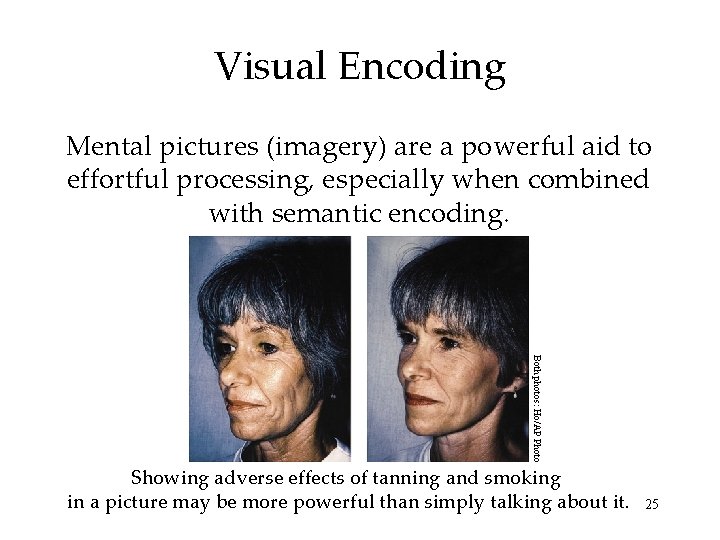
Visual Encoding Mental pictures (imagery) are a powerful aid to effortful processing, especially when combined with semantic encoding. Both photos: Ho/AP Photo Showing adverse effects of tanning and smoking in a picture may be more powerful than simply talking about it. 25
Do Now: Pass forward Psych Sim What is MAINTENANCE REHEARSAL? How does it differ from ELABORATIVE ENCODING?
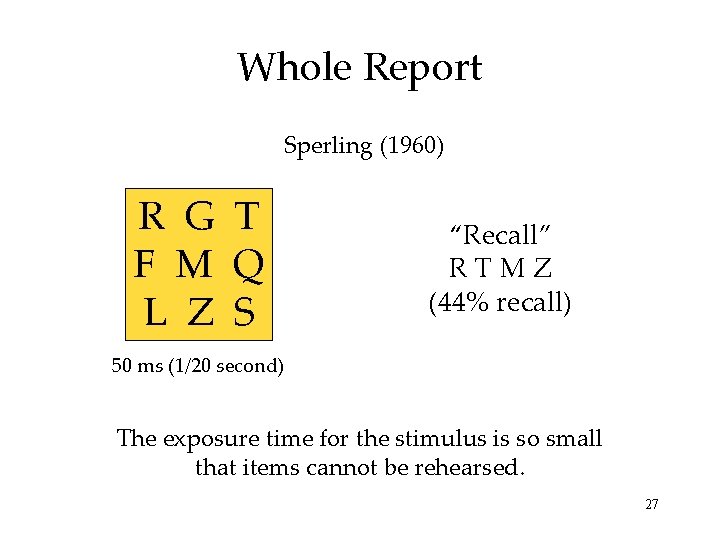
Whole Report Sperling (1960) R G T F M Q L Z S “Recall” RTMZ (44% recall) 50 ms (1/20 second) The exposure time for the stimulus is so small that items cannot be rehearsed. 27
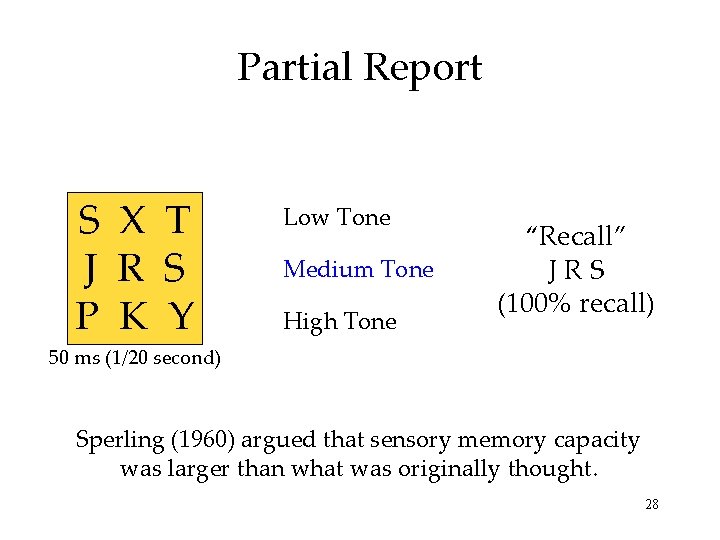
Partial Report S X T J R S P K Y Low Tone Medium Tone High Tone “Recall” JRS (100% recall) 50 ms (1/20 second) Sperling (1960) argued that sensory memory capacity was larger than what was originally thought. 28
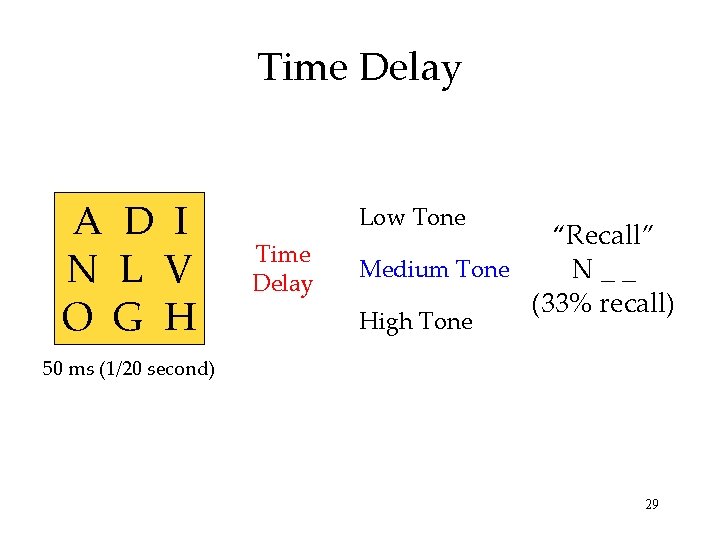
Time Delay A D I N L V O G H Low Tone Time Delay “Recall” Medium Tone N__ (33% recall) High Tone 50 ms (1/20 second) 29
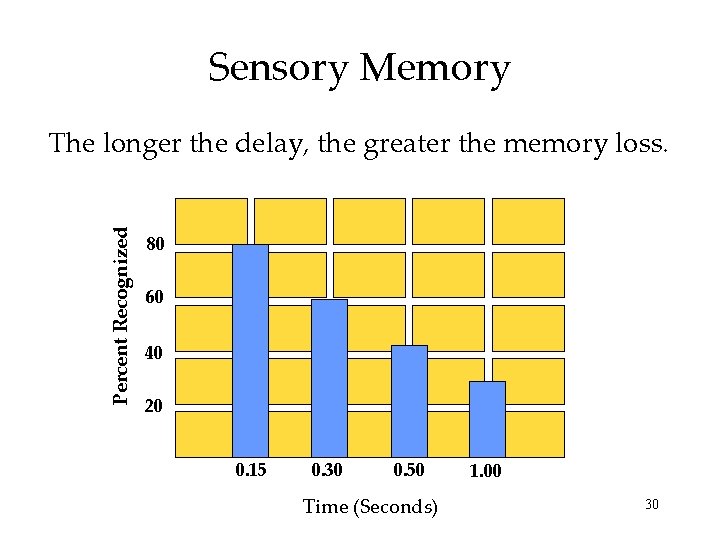
Sensory Memory Percent Recognized The longer the delay, the greater the memory loss. 80 60 40 20 0. 15 0. 30 0. 50 Time (Seconds) 1. 00 30
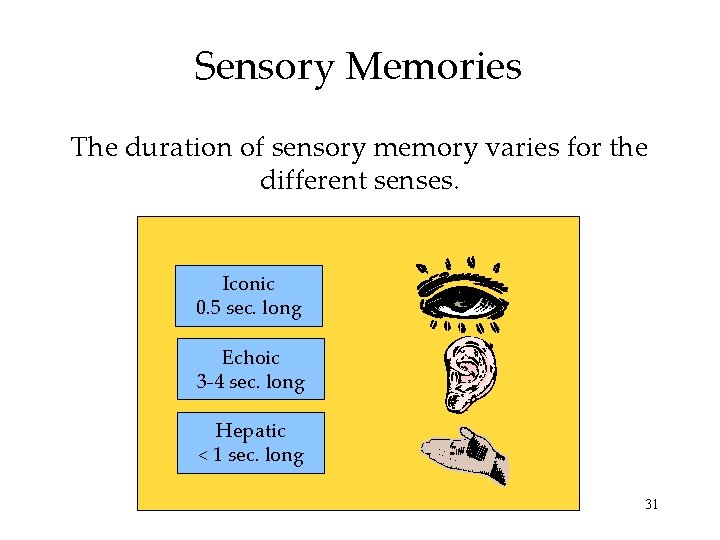
Sensory Memories The duration of sensory memory varies for the different senses. Iconic 0. 5 sec. long Echoic 3 -4 sec. long Hepatic < 1 sec. long 31
AIM: Why do we remember some information…. And forget the rest?
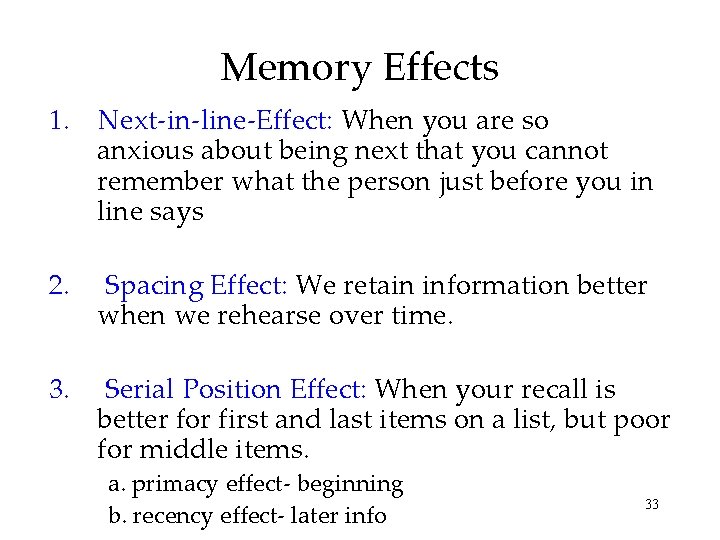
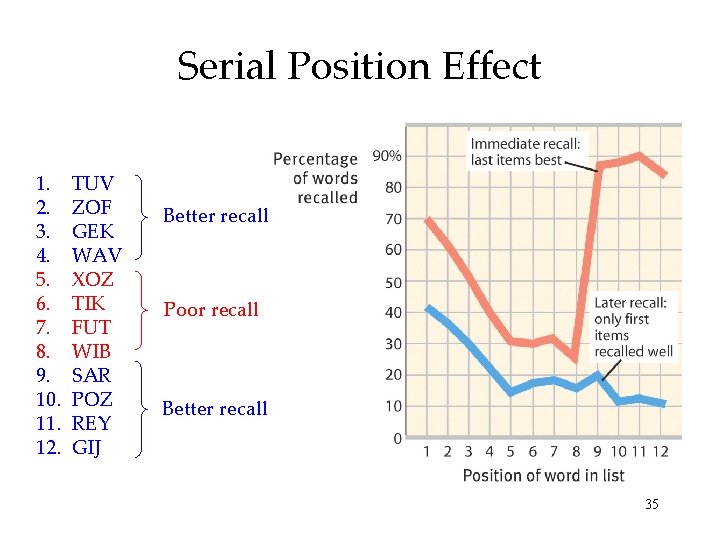
Memory Effects 1. Next-in-line-Effect: When you are so anxious about being next that you cannot remember what the person just before you in line says 2. Spacing Effect: We retain information better when we rehearse over time. 3. Serial Position Effect: When your recall is better for first and last items on a list, but poor for middle items. a. primacy effect- beginning b. recency effect- later info 33
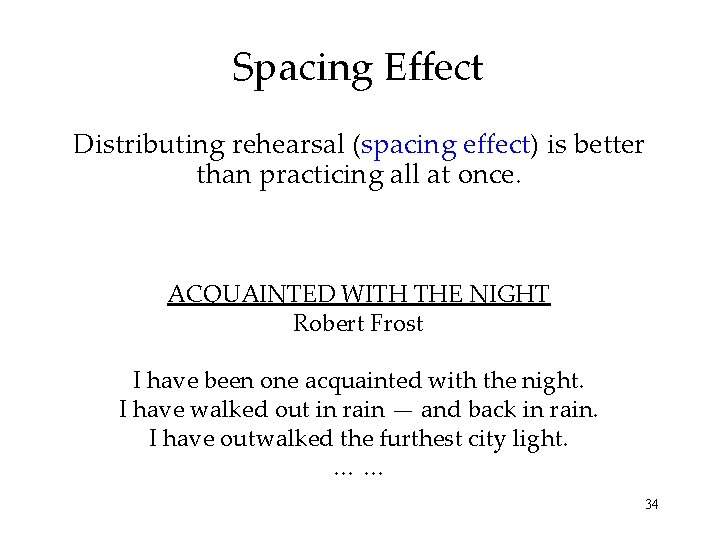
Spacing Effect Distributing rehearsal (spacing effect) is better than practicing all at once. ACQUAINTED WITH THE NIGHT Robert Frost I have been one acquainted with the night. I have walked out in rain — and back in rain. I have outwalked the furthest city light. …… 34
Serial Position Effect 1. 2. 3. 4. 5. 6. 7. 8. 9. 10. 11. 12. TUV ZOF GEK WAV XOZ TIK FUT WIB SAR POZ REY GIJ Better recall Poor recall Better recall 35
Mnemonics Mnemonic techniques are memory devices 1. Method of Loci 2. “Pegword System” 3. Chunking 4. Hierarchy 36
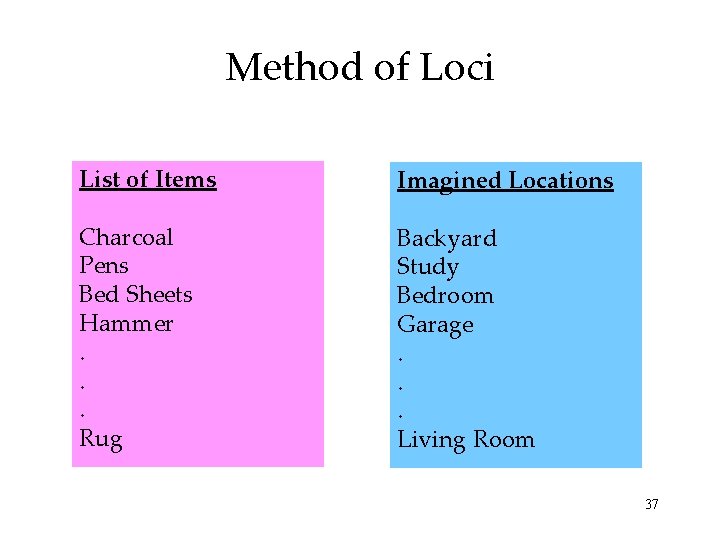
Method of Loci List of Items Imagined Locations Charcoal Pens Bed Sheets Hammer. . . Rug Backyard Study Bedroom Garage. . . Living Room 37
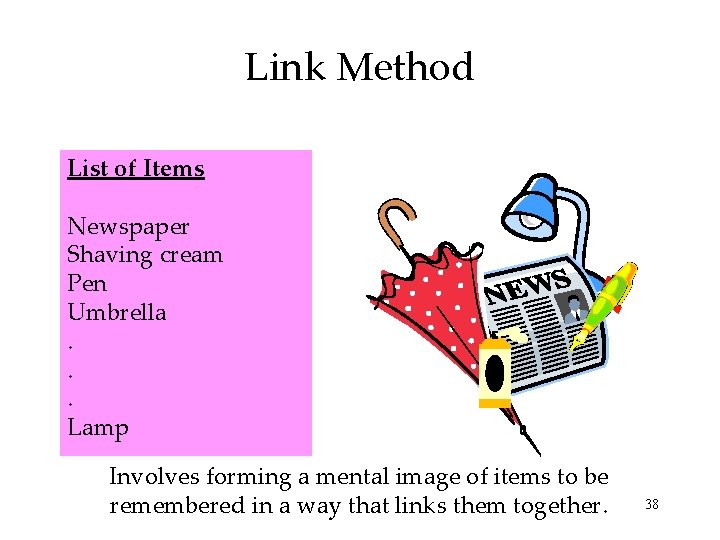
Link Method List of Items Newspaper Shaving cream Pen Umbrella. . . Lamp Involves forming a mental image of items to be remembered in a way that links them together. 38
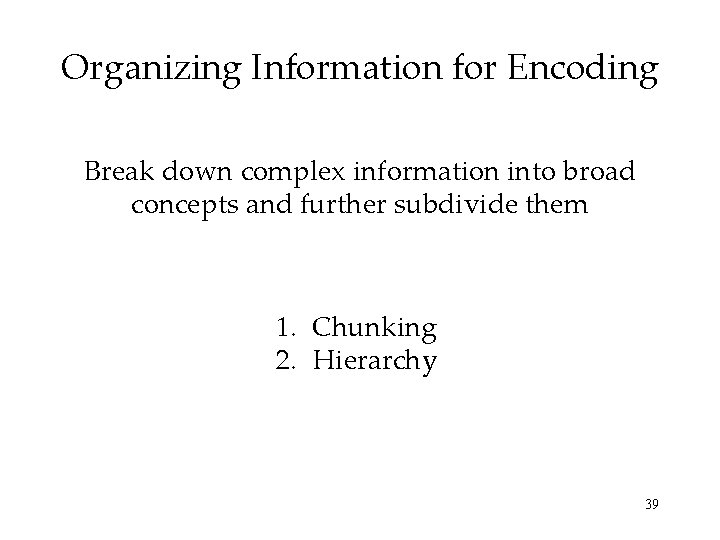
Organizing Information for Encoding Break down complex information into broad concepts and further subdivide them 1. Chunking 2. Hierarchy 39
GHA TUV SOW RRT 40
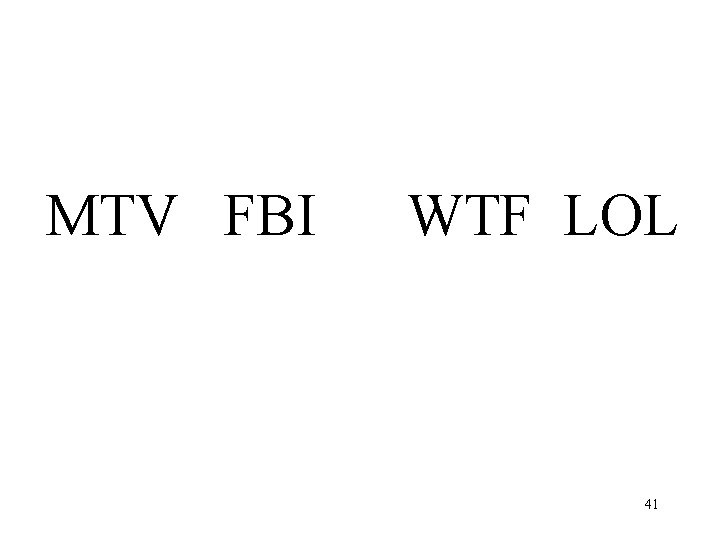
MTV FBI WTF LOL 41
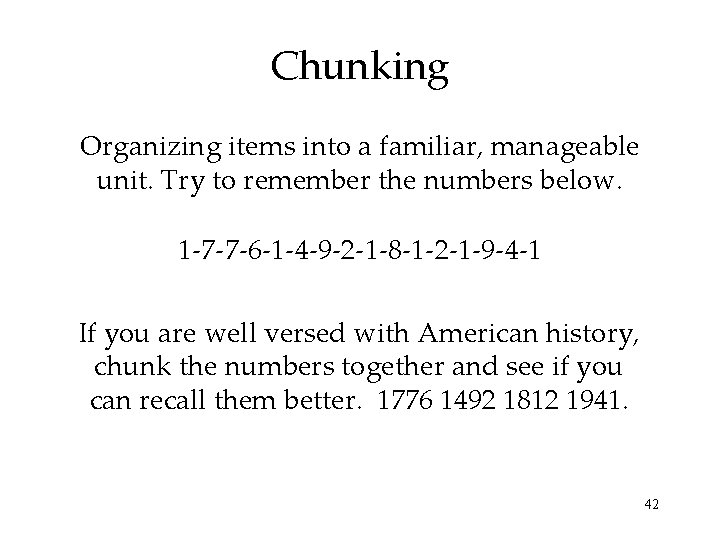
Chunking Organizing items into a familiar, manageable unit. Try to remember the numbers below. 1 -7 -7 -6 -1 -4 -9 -2 -1 -8 -1 -2 -1 -9 -4 -1 If you are well versed with American history, chunk the numbers together and see if you can recall them better. 1776 1492 1812 1941. 42
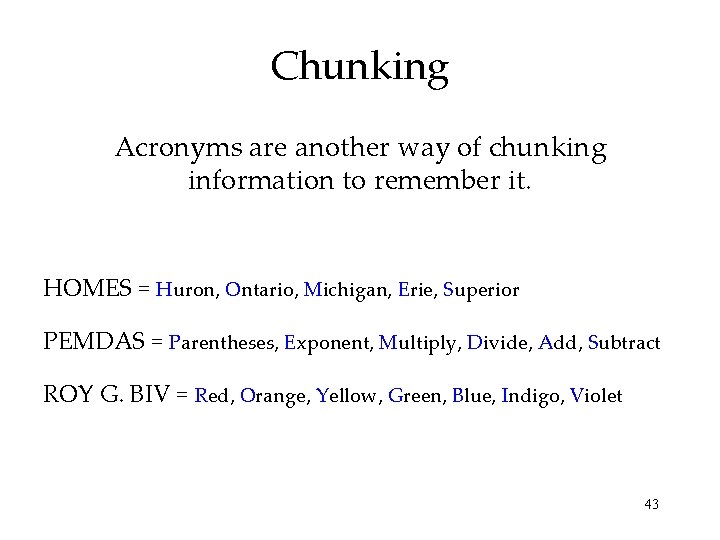
Chunking Acronyms are another way of chunking information to remember it. HOMES = Huron, Ontario, Michigan, Erie, Superior PEMDAS = Parentheses, Exponent, Multiply, Divide, Add, Subtract ROY G. BIV = Red, Orange, Yellow, Green, Blue, Indigo, Violet 43
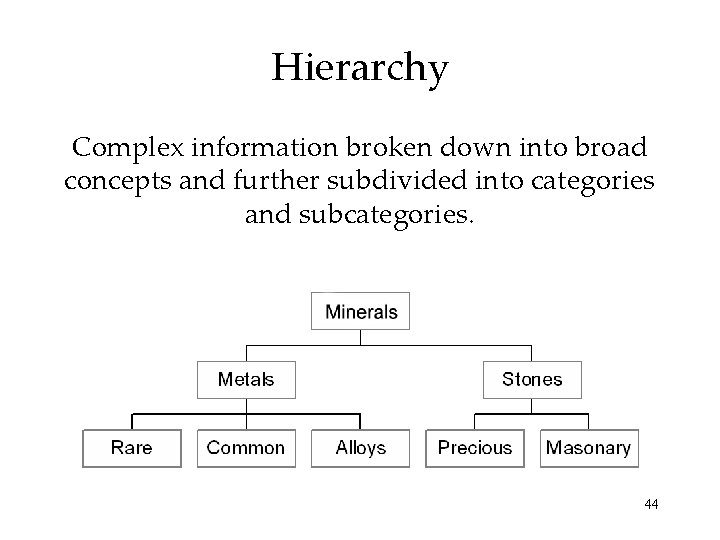
Hierarchy Complex information broken down into broad concepts and further subdivided into categories and subcategories. 44
Encoding Summarized in a Hierarchy 45
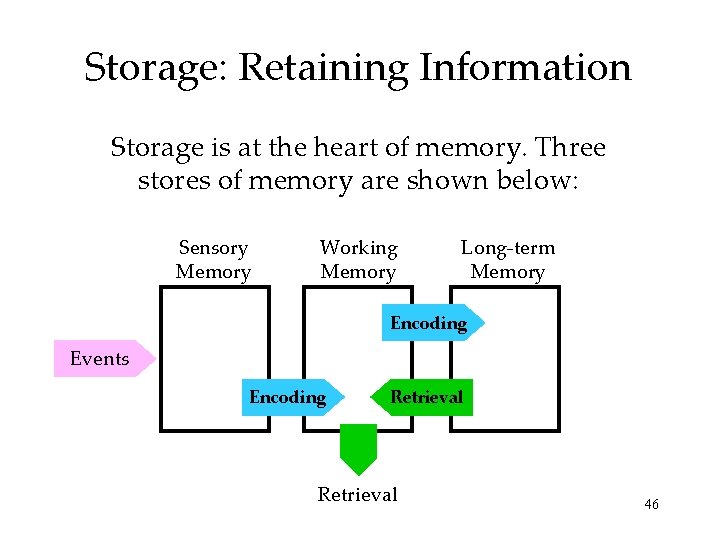
Storage: Retaining Information Storage is at the heart of memory. Three stores of memory are shown below: Sensory Memory Working Memory Long-term Memory Encoding Events Encoding Retrieval 46
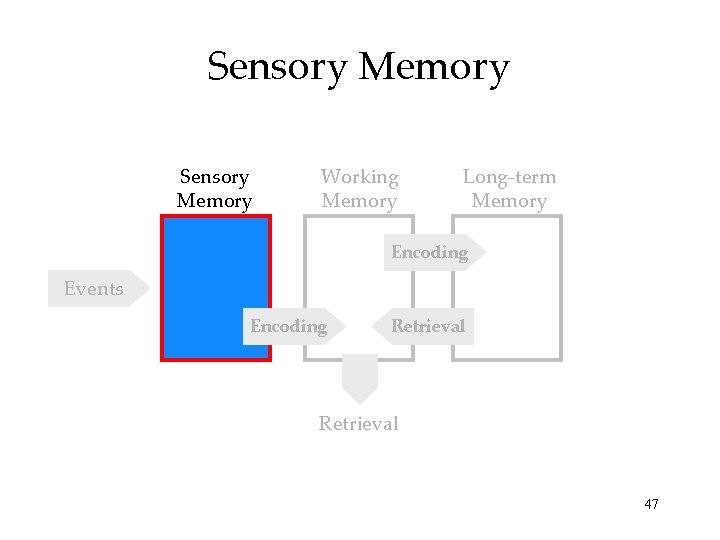
Sensory Memory Working Memory Long-term Memory Encoding Events Encoding Retrieval 47
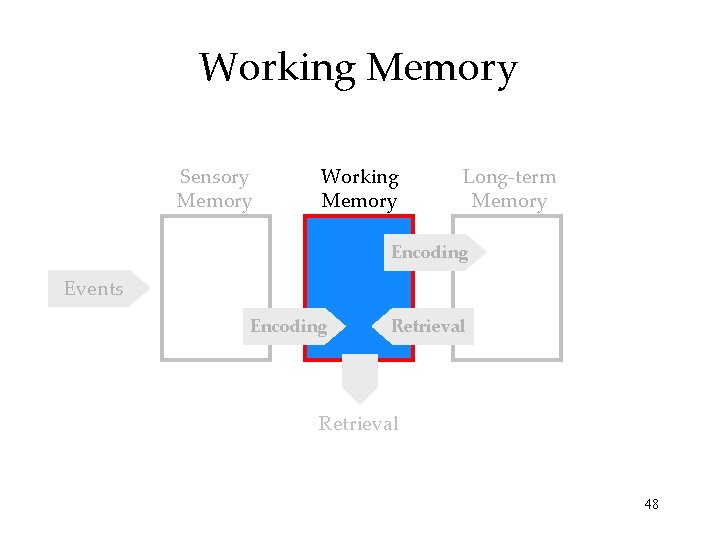
Working Memory Sensory Memory Working Memory Long-term Memory Encoding Events Encoding Retrieval 48
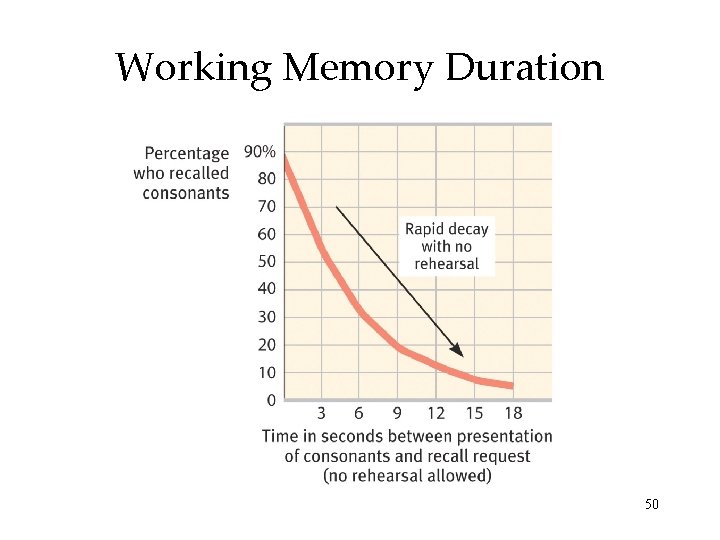
Working Memory Duration 50
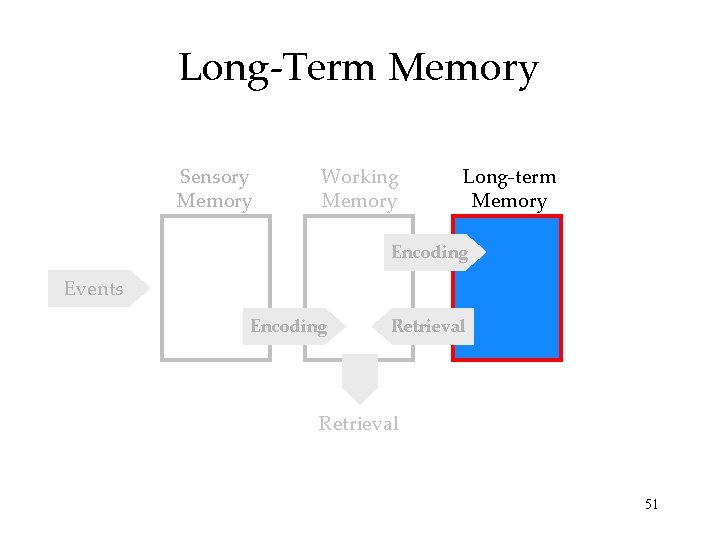
Long-Term Memory Sensory Memory Working Memory Long-term Memory Encoding Events Encoding Retrieval 51
AIM: How do we store memories? 52
http: //www. youtube. com/watch? v= Wmz. U 47 i 2 xgw
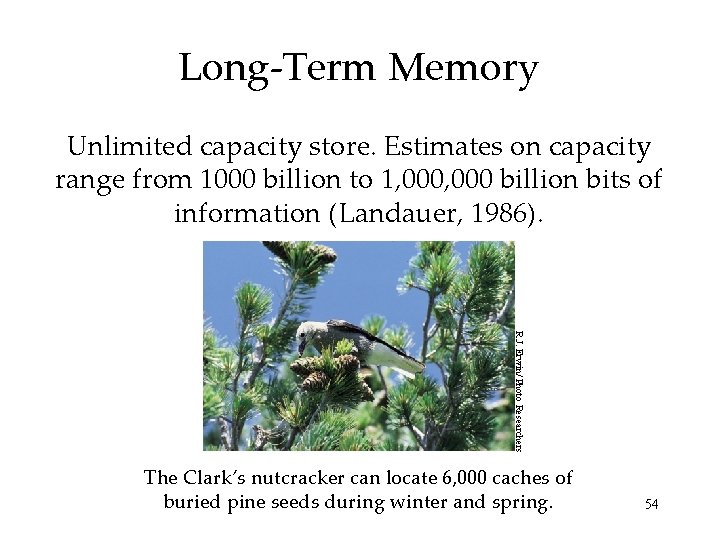
Long-Term Memory Unlimited capacity store. Estimates on capacity range from 1000 billion to 1, 000 billion bits of information (Landauer, 1986). R. J. Erwin/ Photo Researchers The Clark’s nutcracker can locate 6, 000 caches of buried pine seeds during winter and spring. 54
Storing Memories in the Brain 1. Through electrical stimulation of the brain, Wilder Penfield concluded that old memories were etched into the brain. 2. Using rats, Lashley (1950) suggested that even after removing parts of the brain, the animals retain partial memory of the maze. 56
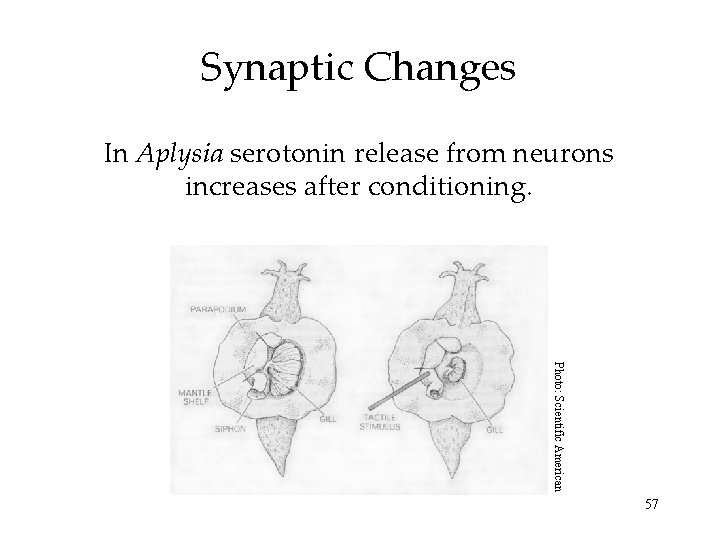
Synaptic Changes In Aplysia serotonin release from neurons increases after conditioning. Photo: Scientific American 57
Do Now: What is meant by the term “Long Term Potentiation? ”
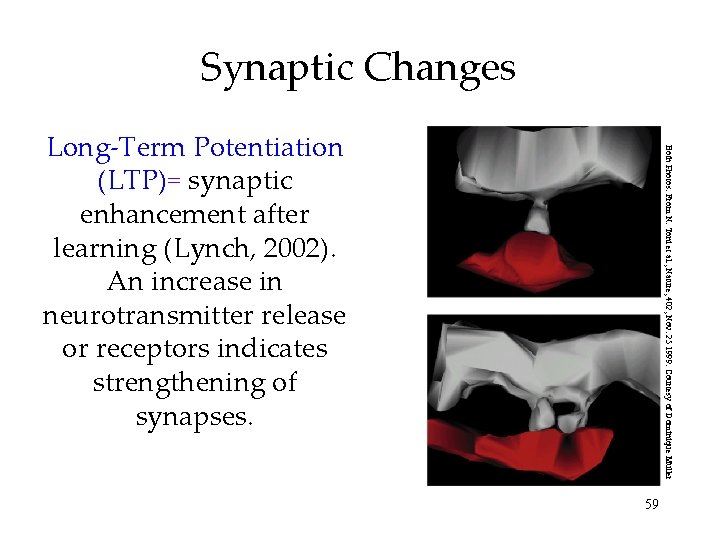
Synaptic Changes Both Photos: From N. Toni et al. , Nature, 402, Nov. 25 1999. Courtesy of Dominique Muller Long-Term Potentiation (LTP)= synaptic enhancement after learning (Lynch, 2002). An increase in neurotransmitter release or receptors indicates strengthening of synapses. 59
AIM: How are memories stored in the brain?
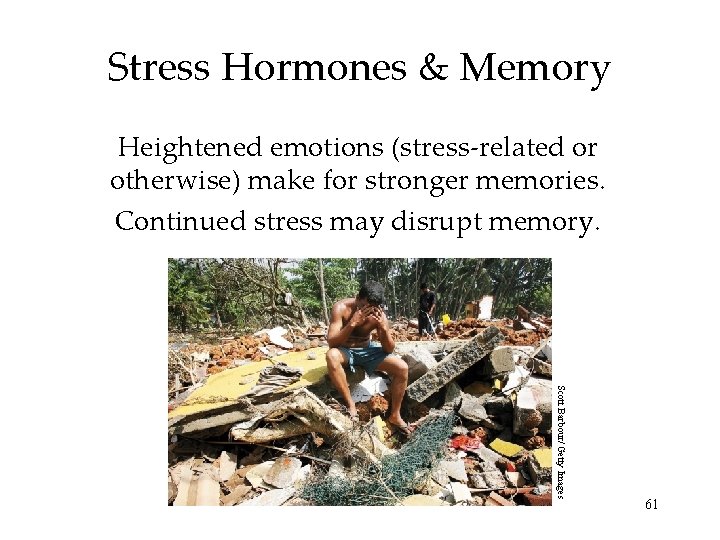
Stress Hormones & Memory Heightened emotions (stress-related or otherwise) make for stronger memories. Continued stress may disrupt memory. Scott Barbour/ Getty Images 61
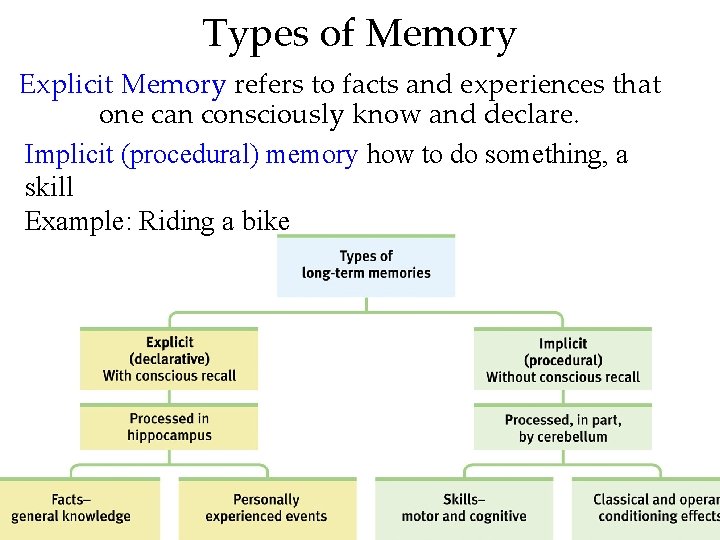
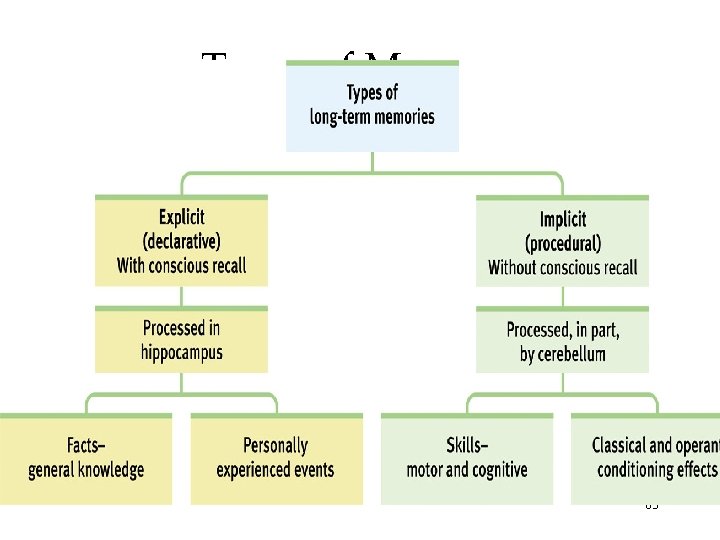
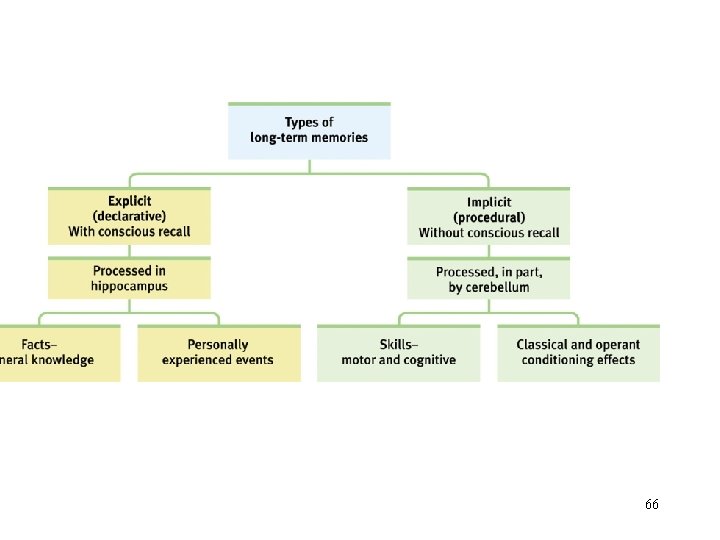
Types of Memory Explicit Memory refers to facts and experiences that one can consciously know and declare. Implicit (procedural) memory how to do something, a skill Example: Riding a bike 62
Types of Memory Implicit (procedural) memory how to do something, a skill Example: Riding a bike 63
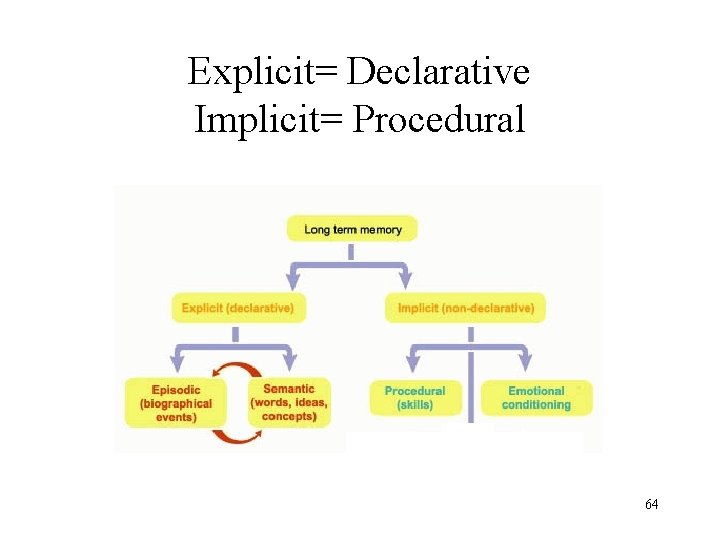
Explicit= Declarative Implicit= Procedural 64
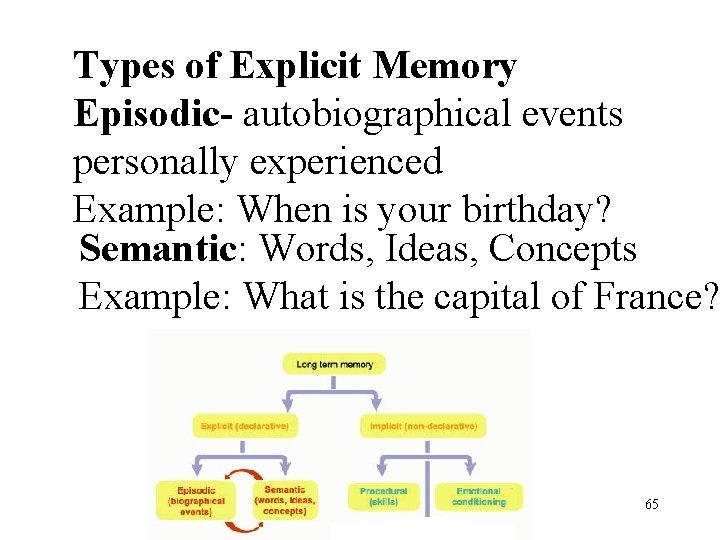
Types of Explicit Memory Episodic- autobiographical events personally experienced Example: When is your birthday? Semantic: Words, Ideas, Concepts Example: What is the capital of France? 65
66
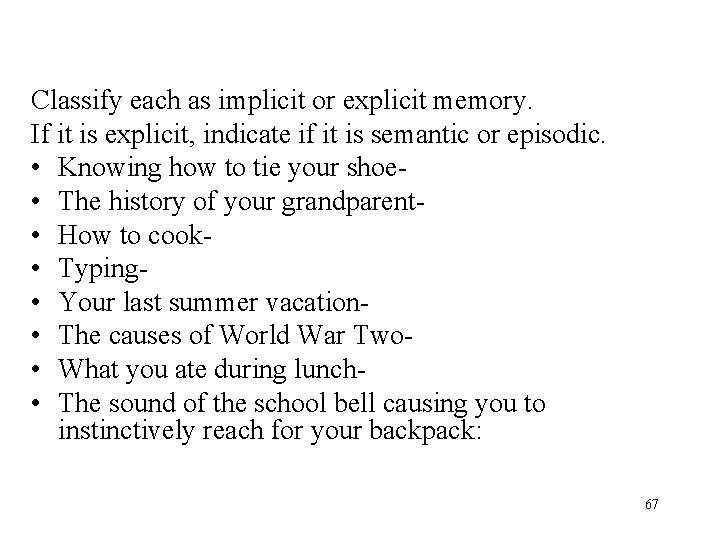
Classify each as implicit or explicit memory. If it is explicit, indicate if it is semantic or episodic. • Knowing how to tie your shoe • The history of your grandparent • How to cook • Typing • Your last summer vacation • The causes of World War Two • What you ate during lunch • The sound of the school bell causing you to instinctively reach for your backpack: 67
Do Now: Quiz 68
AIM: How do we retrieve memories from our long-term storage? 69
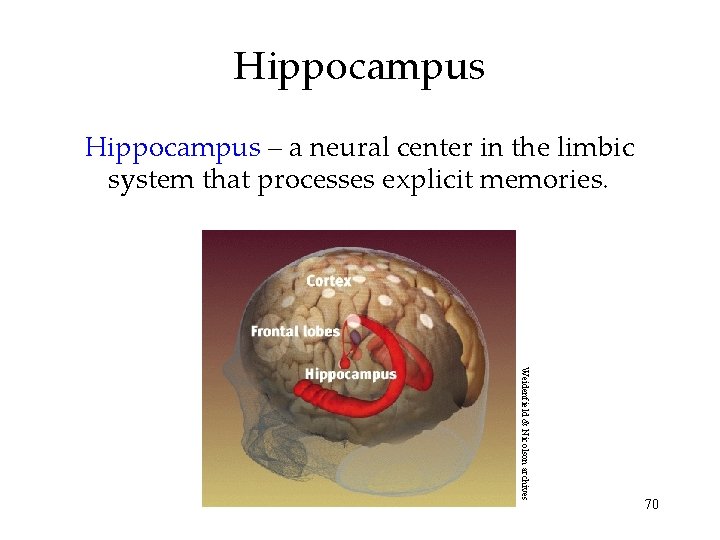
Hippocampus – a neural center in the limbic system that processes explicit memories. Weidenfield & Nicolson archives 70
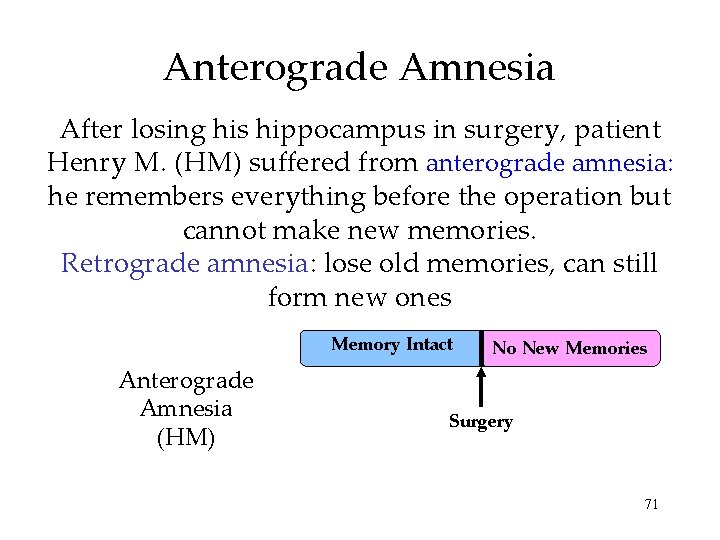
Anterograde Amnesia After losing his hippocampus in surgery, patient Henry M. (HM) suffered from anterograde amnesia: he remembers everything before the operation but cannot make new memories. Retrograde amnesia: lose old memories, can still form new ones Memory Intact Anterograde Amnesia (HM) No New Memories Surgery 71
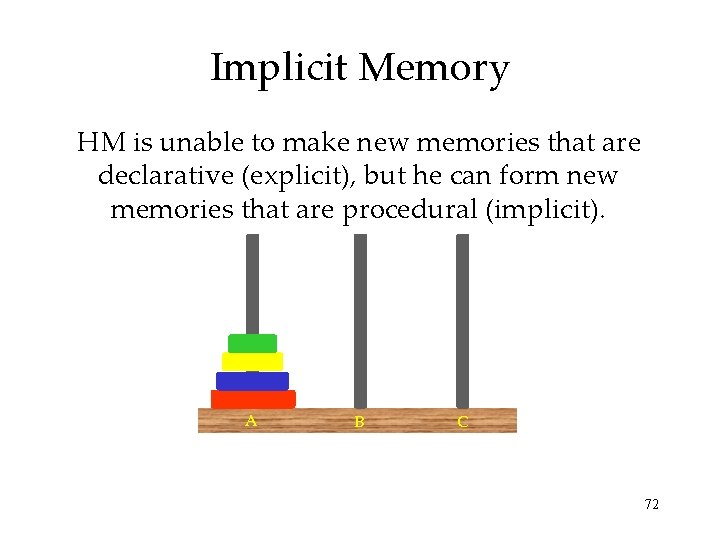
Implicit Memory HM is unable to make new memories that are declarative (explicit), but he can form new memories that are procedural (implicit). A B C 72
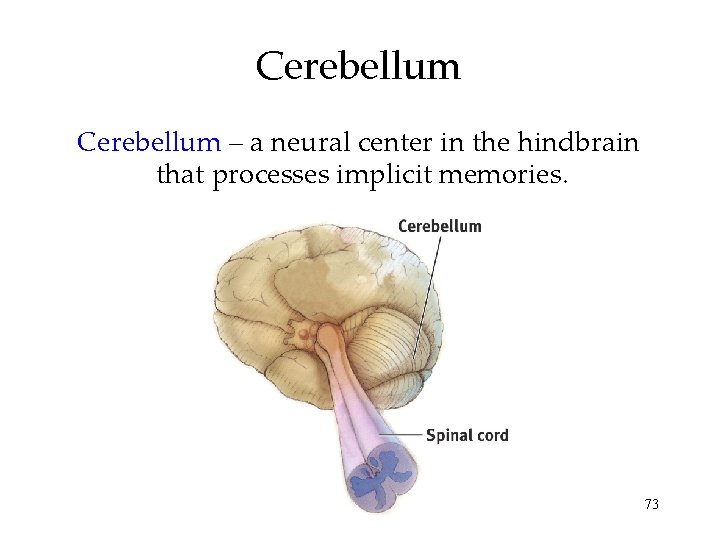
Cerebellum – a neural center in the hindbrain that processes implicit memories. 73
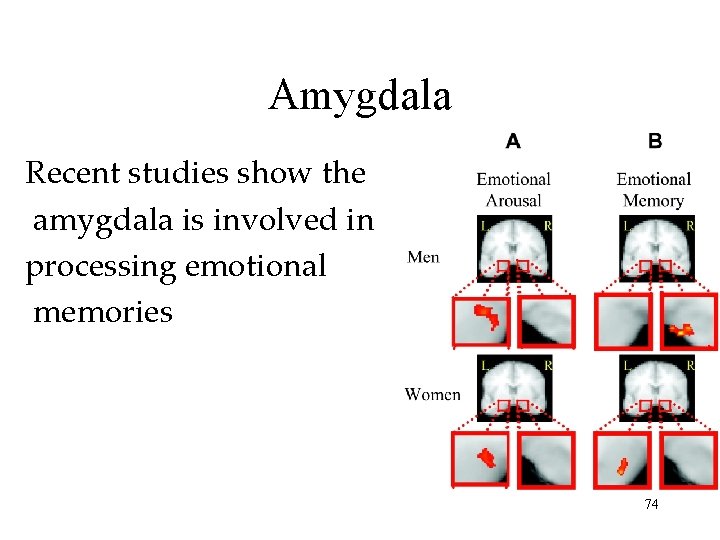
Amygdala Recent studies show the amygdala is involved in processing emotional memories 74
http: //www. youtube. com/watch? v= Wmz. U 47 i 2 xgw
Do Now: 1. What is long-term potentiation? 2. How can stress have two different effects on memory?
AIM: Why do we forget?
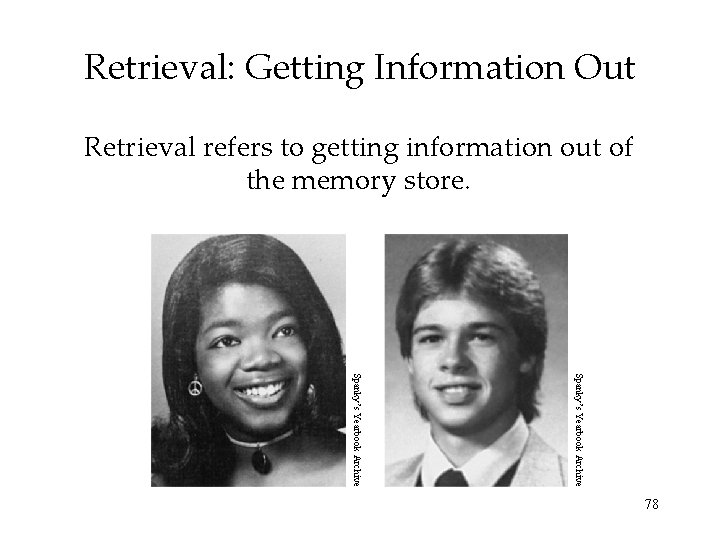
Retrieval: Getting Information Out Retrieval refers to getting information out of the memory store. Spanky’s Yearbook Archive 78
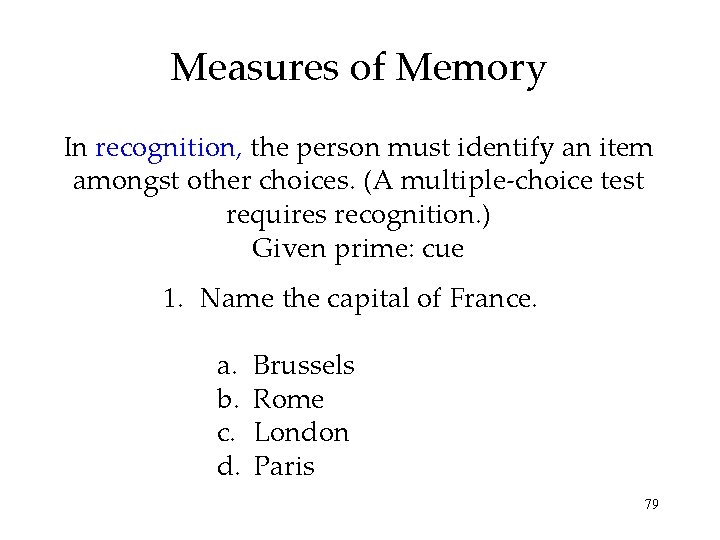
Measures of Memory In recognition, the person must identify an item amongst other choices. (A multiple-choice test requires recognition. ) Given prime: cue 1. Name the capital of France. a. b. c. d. Brussels Rome London Paris 79
Measures of Memory In recall, the person must retrieve information using effort. (A fill-in-the blank test requires recall. ) 1. The capital of France is ______. 80
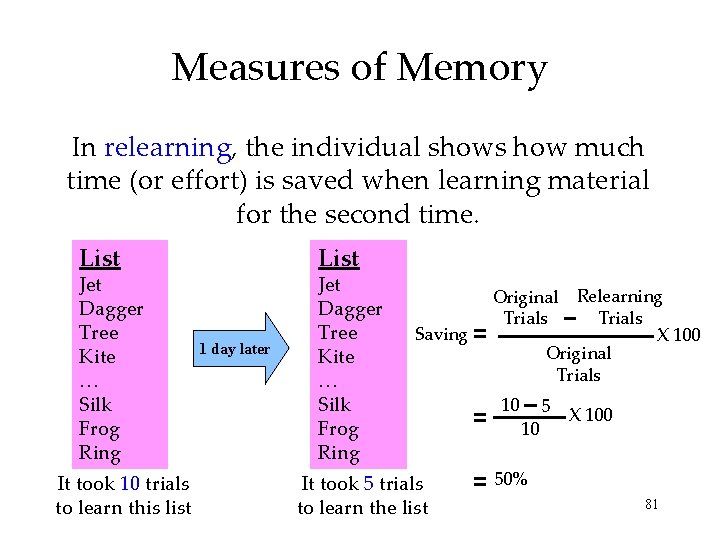
Measures of Memory In relearning, the individual shows how much time (or effort) is saved when learning material for the second time. List Jet Dagger Tree Kite … Silk Frog Ring It took 10 trials to learn this list List 1 day later Jet Dagger Tree Kite … Silk Frog Ring Saving It took 5 trials to learn the list Relearning Trials X 100 Original Trials 10 10 5 X 100 50% 81
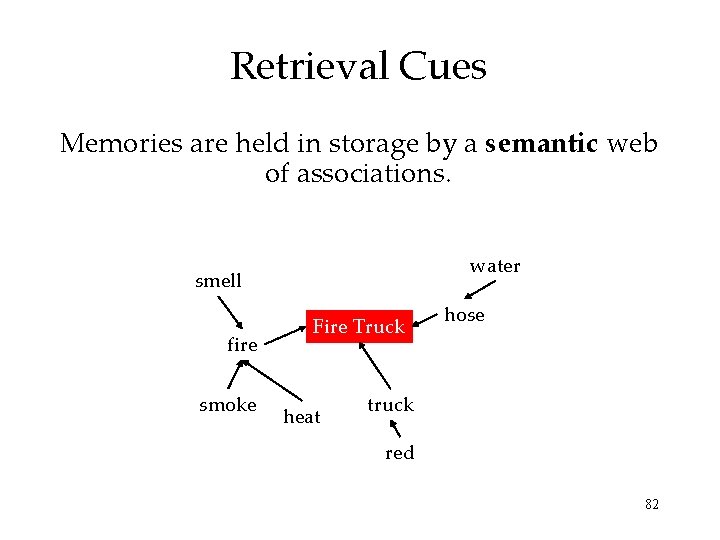
Retrieval Cues Memories are held in storage by a semantic web of associations. water smell fire smoke Fire Truck heat hose truck red 82
Priming To retrieve a specific memory from the web of associations, you must prime it: activate one of the strands that leads to it. Tip of the Tongue Phenomenon: instance of knowing something but being unable to place the word, due to a failure of retrieve 83
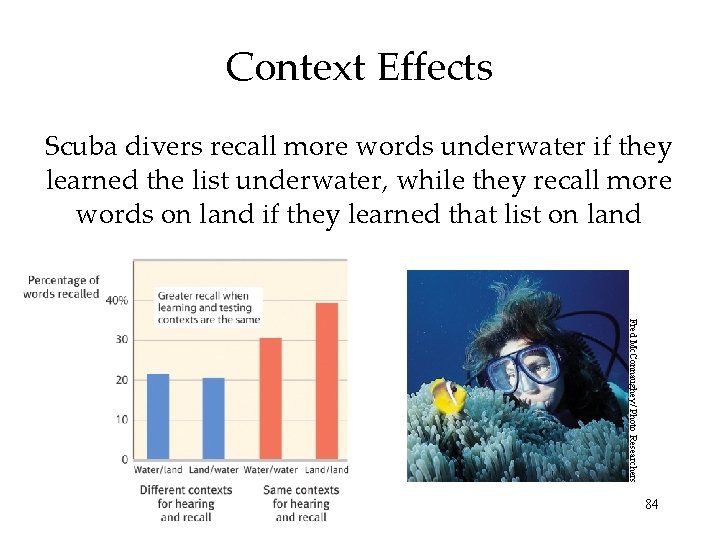
Context Effects Scuba divers recall more words underwater if they learned the list underwater, while they recall more words on land if they learned that list on land Fred Mc. Connaughey/ Photo Researchers 84
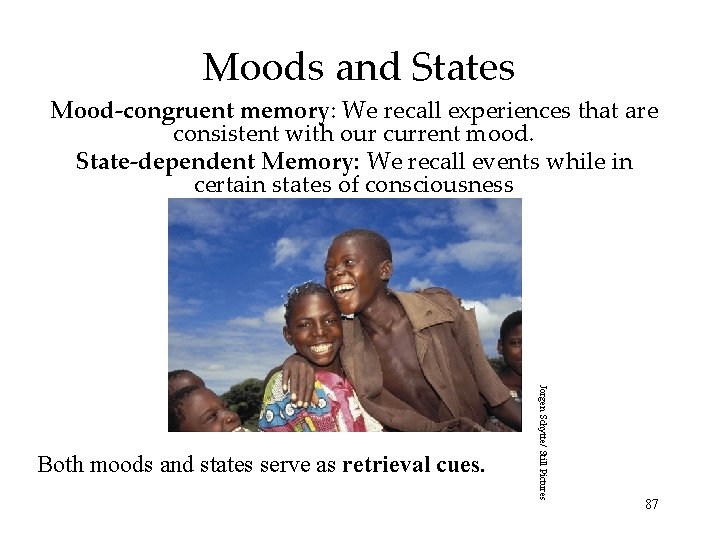
Moods and States Mood-congruent memory: We recall experiences that are consistent with our current mood. State-dependent Memory: We recall events while in certain states of consciousness Jorgen Schytte/ Still Pictures Both moods and states serve as retrieval cues. 87
Why do we forget?
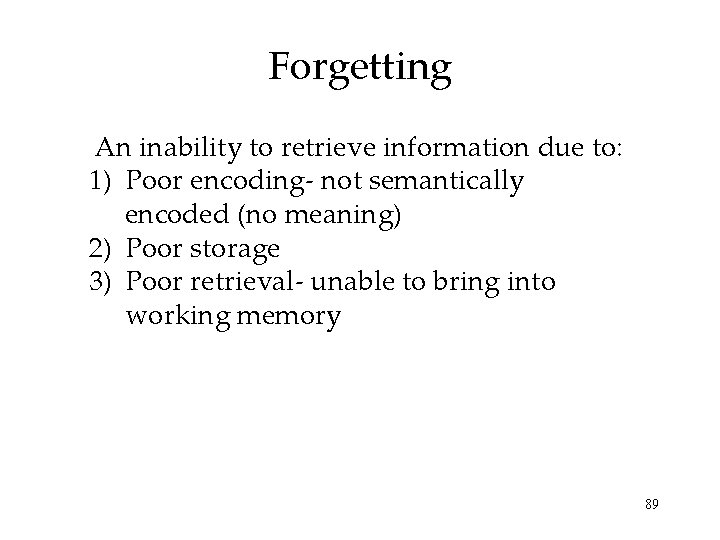
Forgetting An inability to retrieve information due to: 1) Poor encoding- not semantically encoded (no meaning) 2) Poor storage 3) Poor retrieval- unable to bring into working memory 89
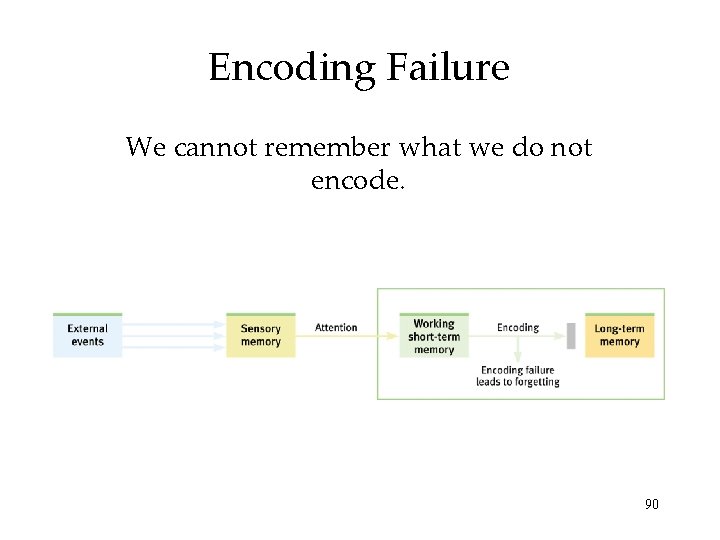
Encoding Failure We cannot remember what we do not encode. 90
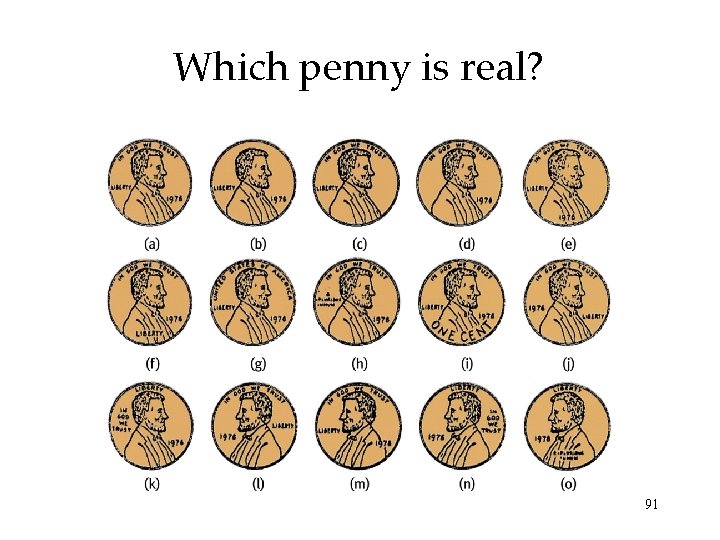
Which penny is real? 91
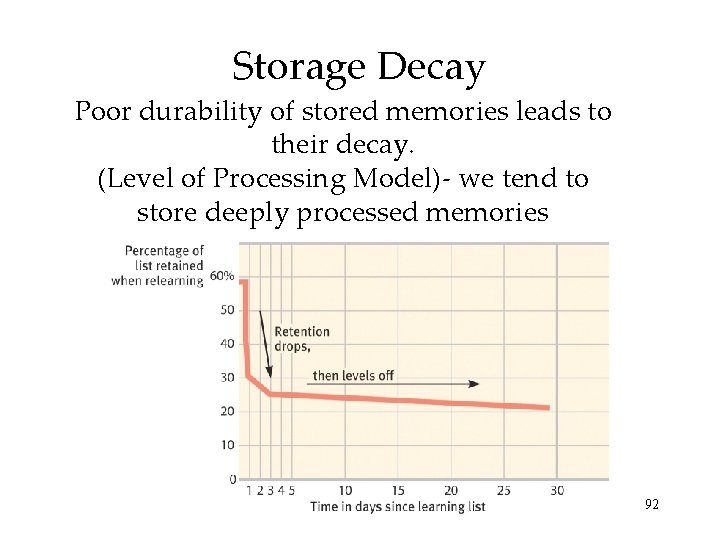
Storage Decay Poor durability of stored memories leads to their decay. (Level of Processing Model)- we tend to store deeply processed memories 92
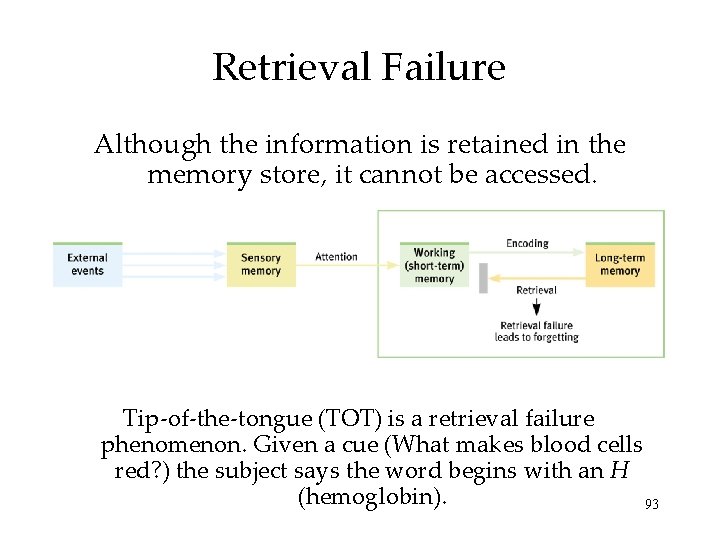
Retrieval Failure Although the information is retained in the memory store, it cannot be accessed. Tip-of-the-tongue (TOT) is a retrieval failure phenomenon. Given a cue (What makes blood cells red? ) the subject says the word begins with an H (hemoglobin). 93
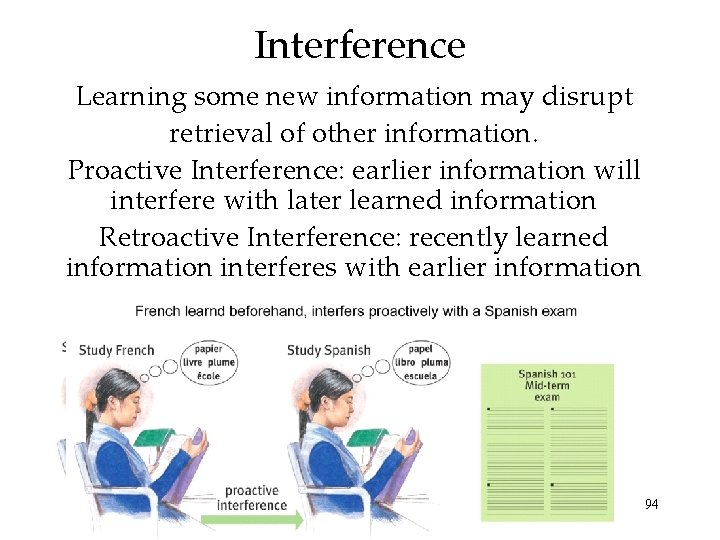
Interference Learning some new information may disrupt retrieval of other information. Proactive Interference: earlier information will interfere with later learned information Retroactive Interference: recently learned information interferes with earlier information 94
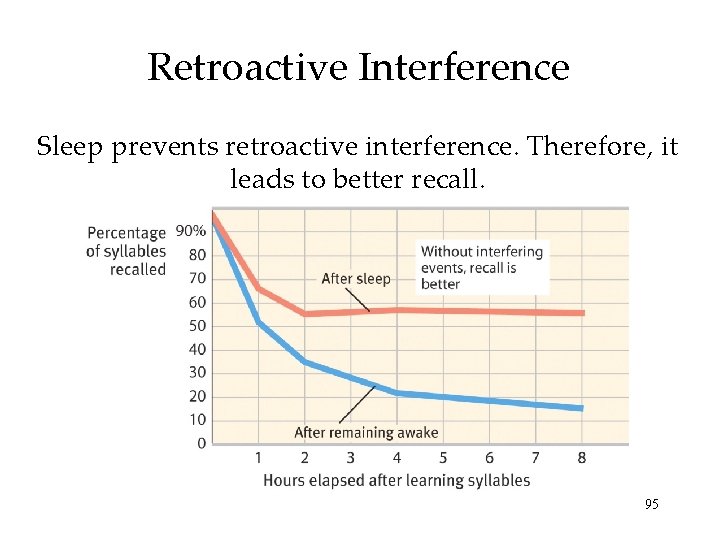
Retroactive Interference Sleep prevents retroactive interference. Therefore, it leads to better recall. 95
Do Now: • Contrast retroactive and proactive interference
AIM: Can we intentionally forget? 97
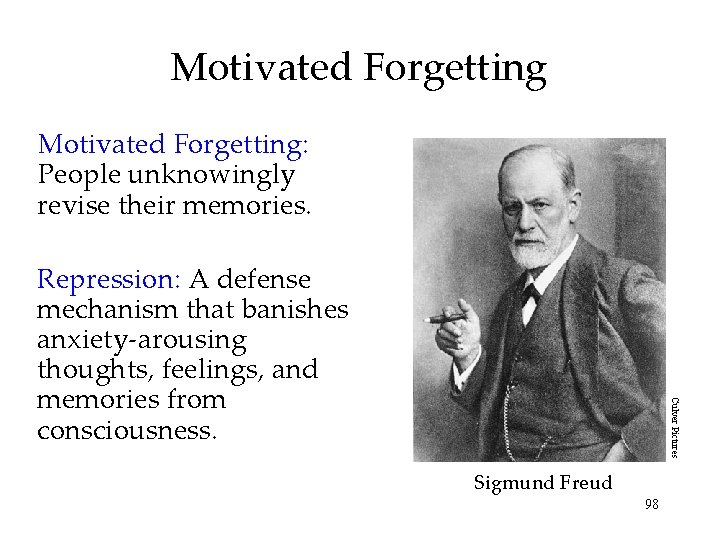
Motivated Forgetting: People unknowingly revise their memories. Culver Pictures Repression: A defense mechanism that banishes anxiety-arousing thoughts, feelings, and memories from consciousness. Sigmund Freud 98
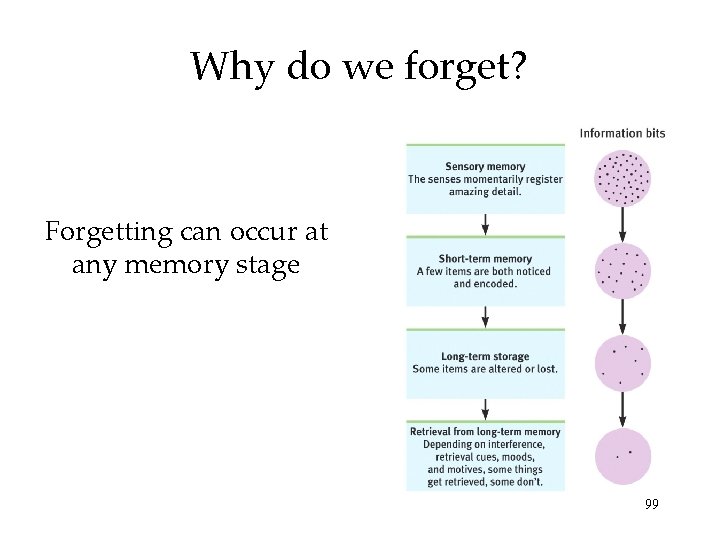
Why do we forget? Forgetting can occur at any memory stage 99
Memory Construction While tapping our memories, we filter or fill in missing pieces of information to make our recall more coherent. Misinformation Effect: Incorporating misleading information into one's memory of an event. 100
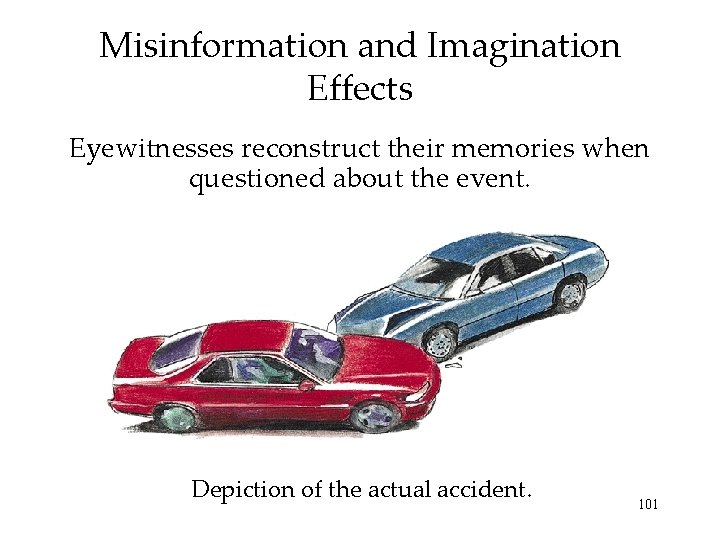
Misinformation and Imagination Effects Eyewitnesses reconstruct their memories when questioned about the event. Depiction of the actual accident. 101
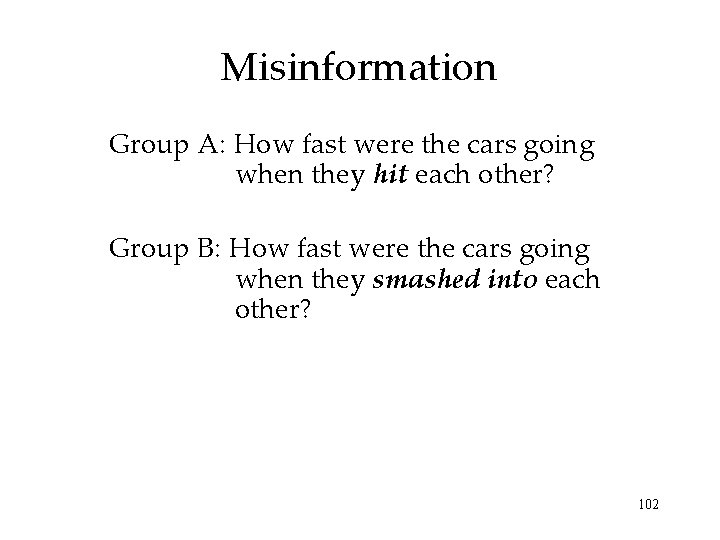
Misinformation Group A: How fast were the cars going when they hit each other? Group B: How fast were the cars going when they smashed into each other? 102
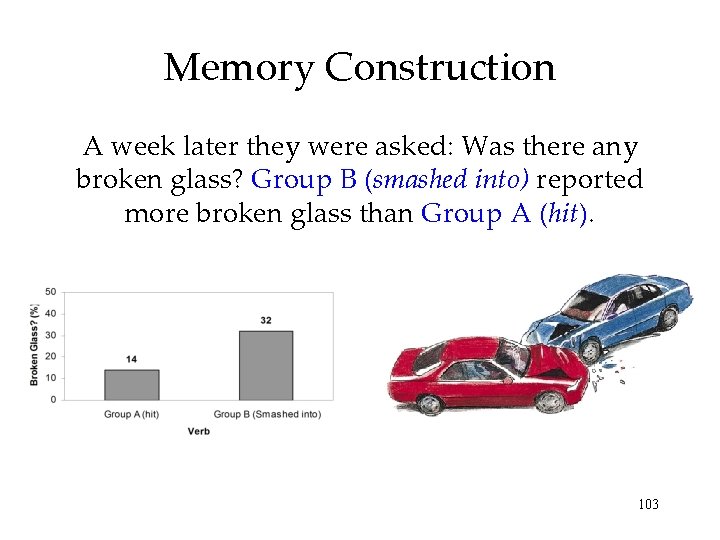
Memory Construction A week later they were asked: Was there any broken glass? Group B (smashed into) reported more broken glass than Group A (hit). 103
Source Amnesia: Attributing an event to the wrong source that we experienced, heard, read, or imagined (misattribution). 104
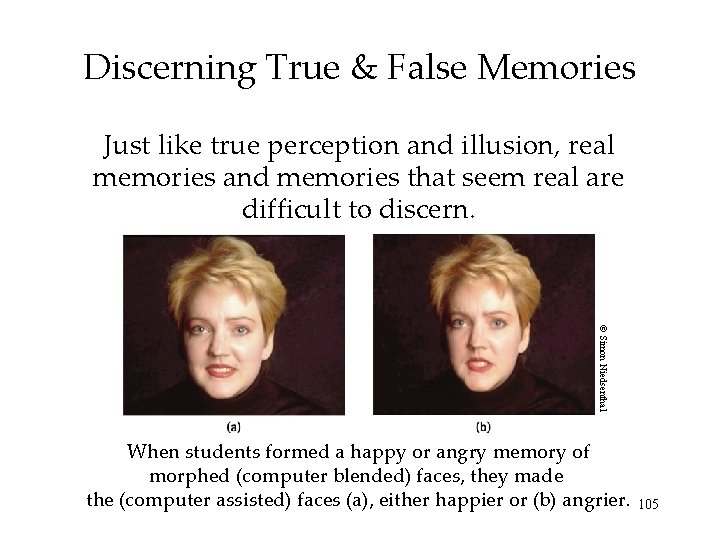
Discerning True & False Memories Just like true perception and illusion, real memories and memories that seem real are difficult to discern. © Simon Niedsenthal When students formed a happy or angry memory of morphed (computer blended) faces, they made the (computer assisted) faces (a), either happier or (b) angrier. 105
False Memories Repressed or Constructed? Some adults actually do forget childhood episodes of abuse. False Memory Syndrome A condition in which a person’s identity and relationships center around a false but strongly believed memory of a traumatic experience, which is sometimes induced by well-meaning therapists. 106
Children’s Eyewitness Recall Children’s eyewitness recall can be unreliable if leading questions are posed. However, if cognitive interviews are neutrally worded, the accuracy of their recall increases. 107