
Although the above picture might look like something
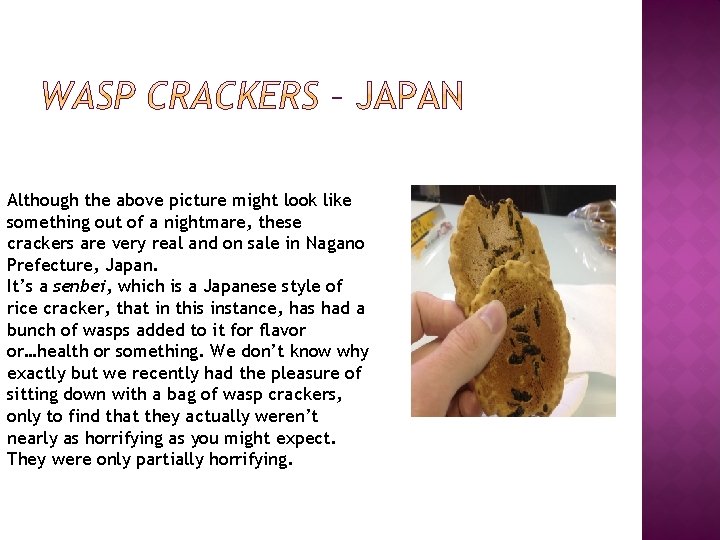
Although the above picture might look like something out of a nightmare, these crackers are very real and on sale in Nagano Prefecture, Japan. It’s a senbei, which is a Japanese style of rice cracker, that in this instance, has had a bunch of wasps added to it for flavor or…health or something. We don’t know why exactly but we recently had the pleasure of sitting down with a bag of wasp crackers, only to find that they actually weren’t nearly as horrifying as you might expect. They were only partially horrifying.
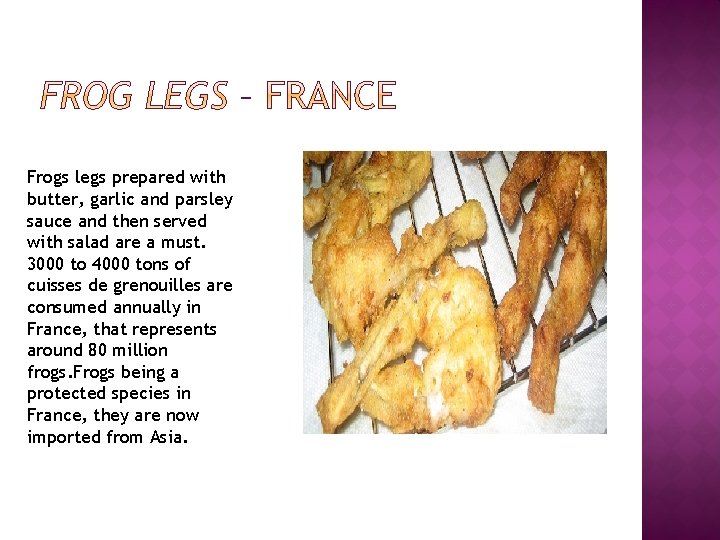
Frogs legs prepared with butter, garlic and parsley sauce and then served with salad are a must. 3000 to 4000 tons of cuisses de grenouilles are consumed annually in France, that represents around 80 million frogs. Frogs being a protected species in France, they are now imported from Asia.
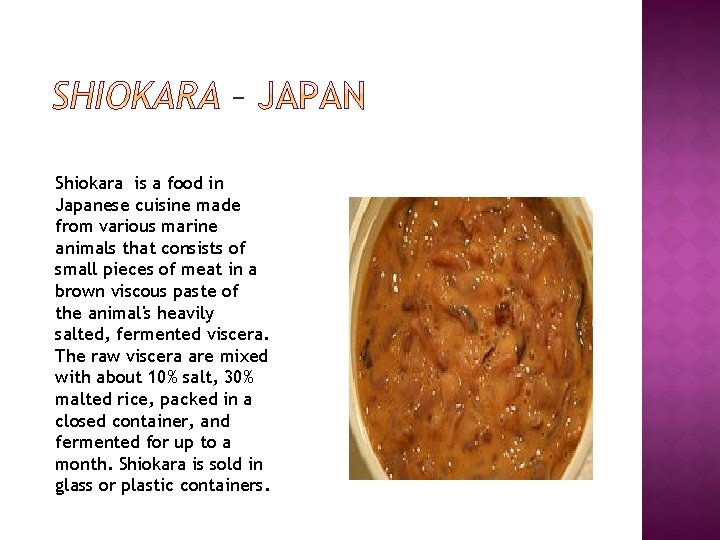
Shiokara is a food in Japanese cuisine made from various marine animals that consists of small pieces of meat in a brown viscous paste of the animal's heavily salted, fermented viscera. The raw viscera are mixed with about 10% salt, 30% malted rice, packed in a closed container, and fermented for up to a month. Shiokara is sold in glass or plastic containers.
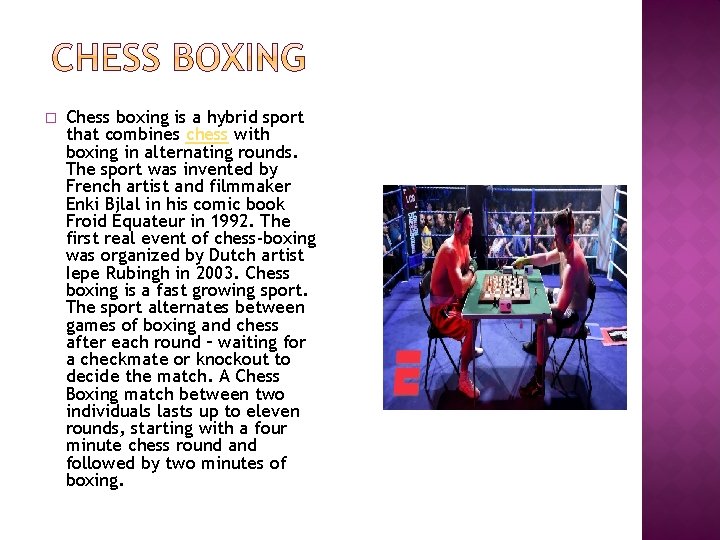
� Chess boxing is a hybrid sport that combines chess with boxing in alternating rounds. The sport was invented by French artist and filmmaker Enki Bilal in his comic book Froid Équateur in 1992. The first real event of chess-boxing was organized by Dutch artist Iepe Rubingh in 2003. Chess boxing is a fast growing sport. The sport alternates between games of boxing and chess after each round – waiting for a checkmate or knockout to decide the match. A Chess Boxing match between two individuals lasts up to eleven rounds, starting with a four minute chess round and followed by two minutes of boxing.
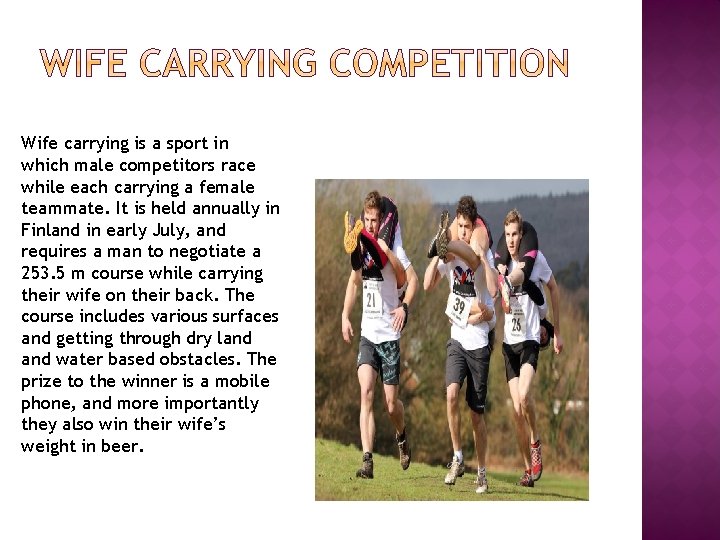
Wife carrying is a sport in which male competitors race while each carrying a female teammate. It is held annually in Finland in early July, and requires a man to negotiate a 253. 5 m course while carrying their wife on their back. The course includes various surfaces and getting through dry land water based obstacles. The prize to the winner is a mobile phone, and more importantly they also win their wife’s weight in beer.
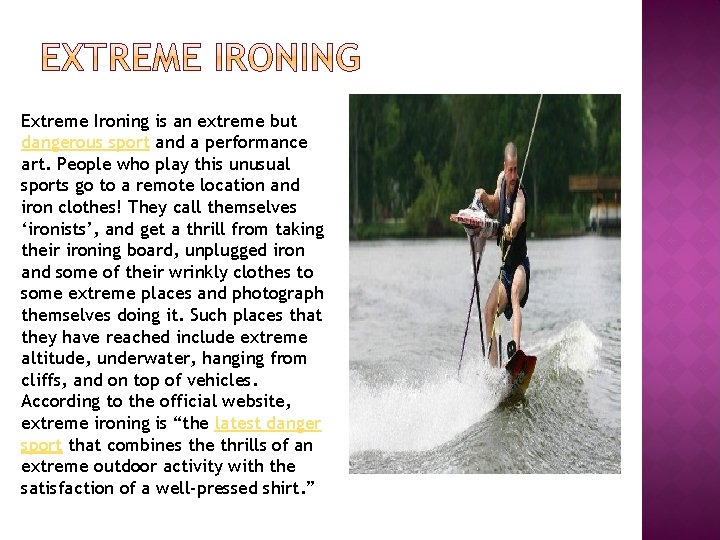
Extreme Ironing is an extreme but dangerous sport and a performance art. People who play this unusual sports go to a remote location and iron clothes! They call themselves ‘ironists’, and get a thrill from taking their ironing board, unplugged iron and some of their wrinkly clothes to some extreme places and photograph themselves doing it. Such places that they have reached include extreme altitude, underwater, hanging from cliffs, and on top of vehicles. According to the official website, extreme ironing is “the latest danger sport that combines the thrills of an extreme outdoor activity with the satisfaction of a well-pressed shirt. ”
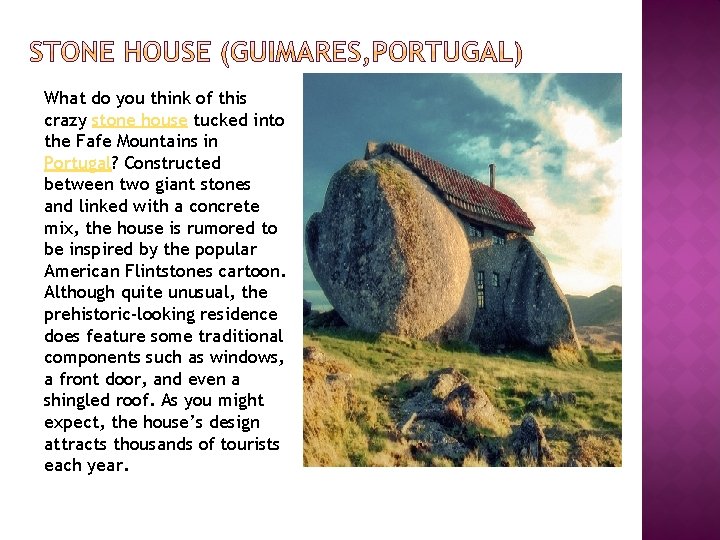
What do you think of this crazy stone house tucked into the Fafe Mountains in Portugal? Constructed between two giant stones and linked with a concrete mix, the house is rumored to be inspired by the popular American Flintstones cartoon. Although quite unusual, the prehistoric-looking residence does feature some traditional components such as windows, a front door, and even a shingled roof. As you might expect, the house’s design attracts thousands of tourists each year.
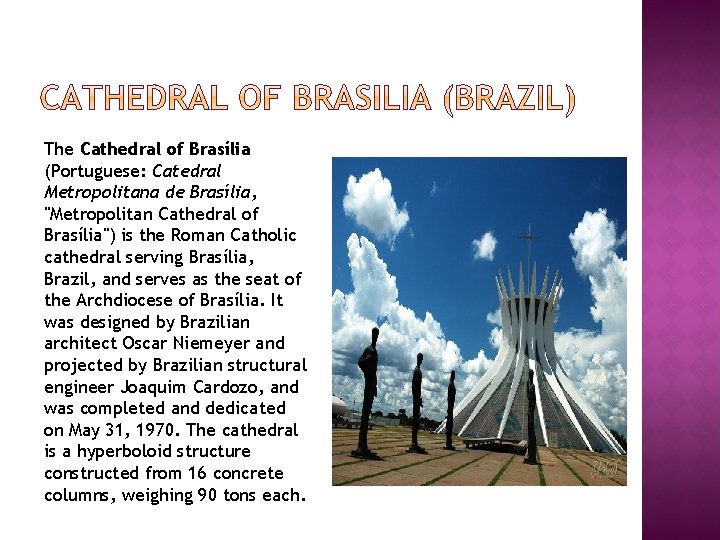
The Cathedral of Brasília (Portuguese: Catedral Metropolitana de Brasília, "Metropolitan Cathedral of Brasília") is the Roman Catholic cathedral serving Brasília, Brazil, and serves as the seat of the Archdiocese of Brasília. It was designed by Brazilian architect Oscar Niemeyer and projected by Brazilian structural engineer Joaquim Cardozo, and was completed and dedicated on May 31, 1970. The cathedral is a hyperboloid structure constructed from 16 concrete columns, weighing 90 tons each.
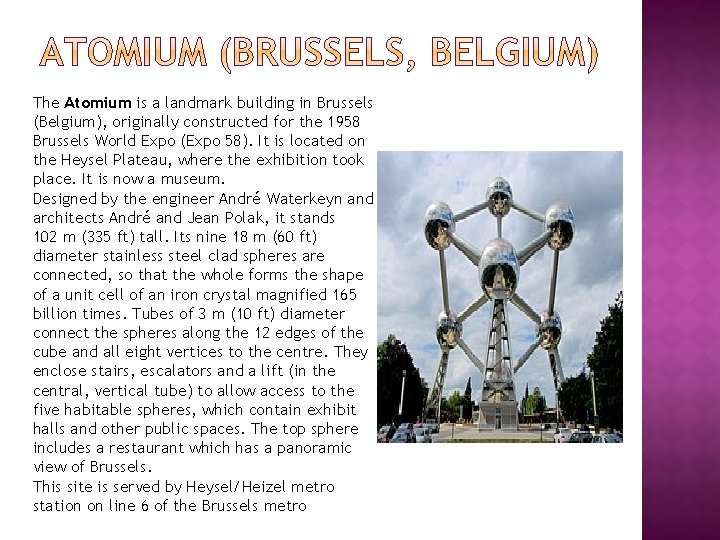
The Atomium is a landmark building in Brussels (Belgium), originally constructed for the 1958 Brussels World Expo (Expo 58). It is located on the Heysel Plateau, where the exhibition took place. It is now a museum. Designed by the engineer André Waterkeyn and architects André and Jean Polak, it stands 102 m (335 ft) tall. Its nine 18 m (60 ft) diameter stainless steel clad spheres are connected, so that the whole forms the shape of a unit cell of an iron crystal magnified 165 billion times. Tubes of 3 m (10 ft) diameter connect the spheres along the 12 edges of the cube and all eight vertices to the centre. They enclose stairs, escalators and a lift (in the central, vertical tube) to allow access to the five habitable spheres, which contain exhibit halls and other public spaces. The top sphere includes a restaurant which has a panoramic view of Brussels. This site is served by Heysel/Heizel metro station on line 6 of the Brussels metro
- Slides: 13