Chpt 21 Fuels Heats of Reactions Organic Chemistry

- Slides: 104
Chpt. 21: Fuels & Heats of Reactions (Organic Chemistry)
Originally Organic Chemistry was the branch of chemistry concerned with substances that derived from living organisms i. e. plants and animals as it was thought that they were different from those extracted from minerals and other non-living sources – inorganic compounds. Examples of organic compounds: sugar, methane, vegetable dyes etc. Examples of inorganic compounds: water, sulphuric acid, calcium hydroxide etc. However, in 1828 Friedrich Wohler discovered that urea could be synthesised in the laboratory. This led to the redefinition of Organic Chemistry.
Definition: Organic Chemistry: is defined as a study of the compounds of carbon. • carbon is unique among the elements in that it can form stable chains and rings of carbon atoms. • This means there are millions of organic compounds with thousands more being synthesised every year. • Don’t Worry!!!!! Even though there are millions of organic compounds the study of organic chemistry is in fact very systematic and INTERESTING!!!!
Let the FUN Begin!!!
Hydrocarbons Definition: Hydrocarbon: is a compound that contains only hydrogen and carbon. • common sources of hydrocarbons – coal, natural gas (methane), petroleum (crude oil) – formed in the earth over millions of years. • preparation of methane (CH 4) – methane can be made readily by using material of plant or animal origin. For example if manure is allowed to decay under anaerobic conditions then bacteria will feed on the manure causing it to decay and producing methane. This gas is an excellent fuel and is used in heating farms while the solid that remains is used as a fertiliser.
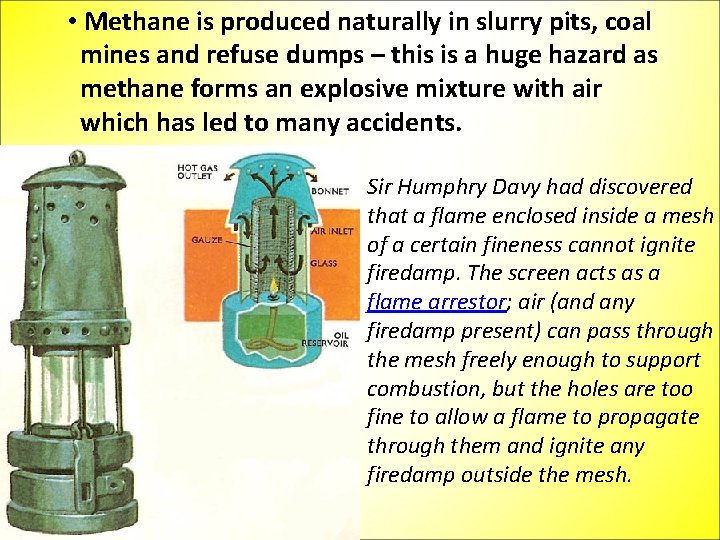
• Methane is produced naturally in slurry pits, coal mines and refuse dumps – this is a huge hazard as methane forms an explosive mixture with air which has led to many accidents. Sir Humphry Davy had discovered that a flame enclosed inside a mesh of a certain fineness cannot ignite firedamp. The screen acts as a flame arrestor; air (and any firedamp present) can pass through the mesh freely enough to support combustion, but the holes are too fine to allow a flame to propagate through them and ignite any firedamp outside the mesh.
• Methane is a gas that is contributing to green house effect (this may be studied at a later date)
Some Important Definitions • A Homologous Series is a family of compounds: - with a uniform chemical type - which show gradations in physical properties - which have the same general formula - which have a similar method of preparation - with successive members differing by a CH 2 unit - which have similar chemical properties • Saturated Compounds: are compounds which contain all single bonds only • Unsaturated Compounds: are compounds which contain carbon-carbon double or triple bonds
• Structural Formula: of a compound shows how the atoms of a compound are arranged relative to each other. • Structural Isomers: compounds which have the same molecular formula but whose atoms are joined together in a different order i. e. different structural formula.
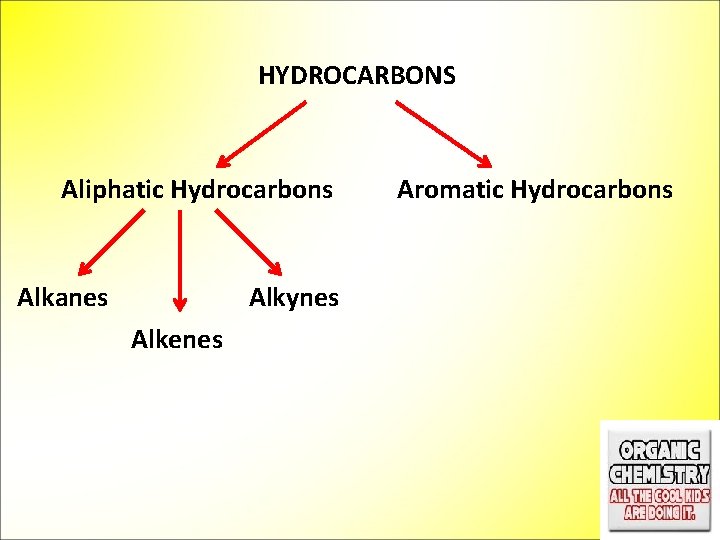
HYDROCARBONS Aliphatic Hydrocarbons Alkanes Alkynes Alkenes Aromatic Hydrocarbons
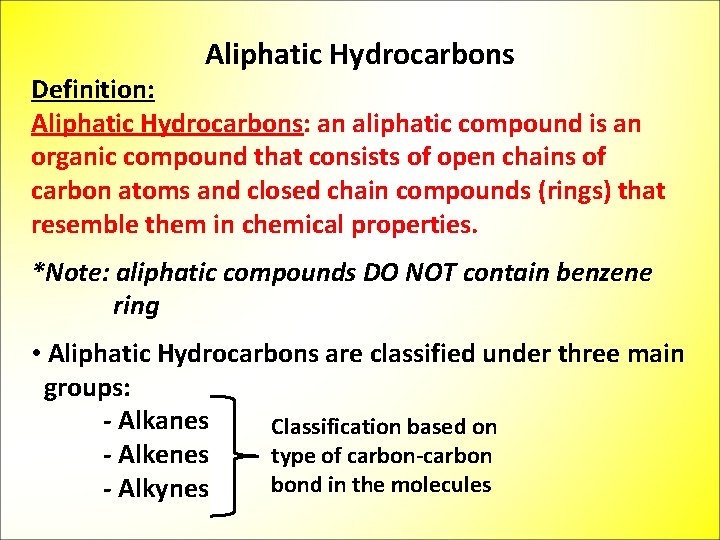
Aliphatic Hydrocarbons Definition: Aliphatic Hydrocarbons: an aliphatic compound is an organic compound that consists of open chains of carbon atoms and closed chain compounds (rings) that resemble them in chemical properties. *Note: aliphatic compounds DO NOT contain benzene ring • Aliphatic Hydrocarbons are classified under three main groups: - Alkanes Classification based on type of carbon-carbon - Alkenes bond in the molecules - Alkynes
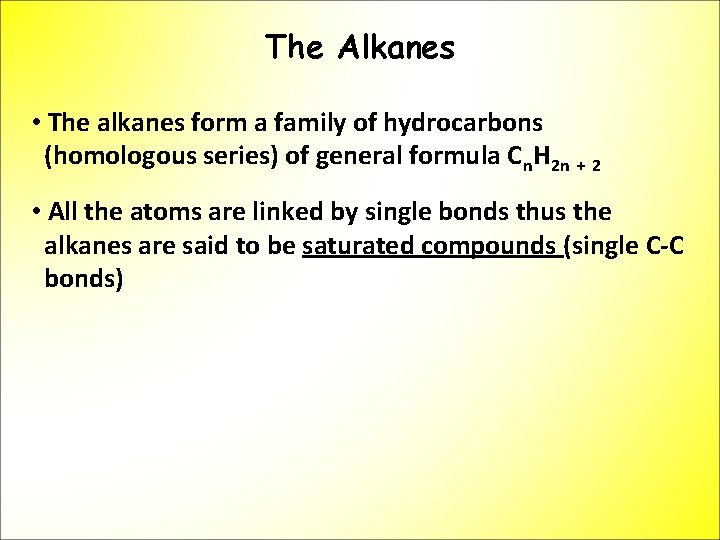
The Alkanes • The alkanes form a family of hydrocarbons (homologous series) of general formula Cn. H 2 n + 2 • All the atoms are linked by single bonds thus the alkanes are said to be saturated compounds (single C-C bonds)
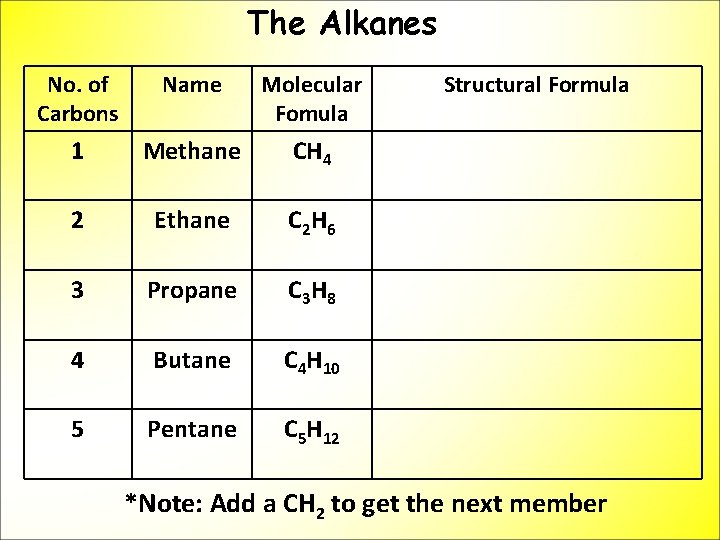
The Alkanes No. of Carbons Name Molecular Fomula 1 Methane CH 4 2 Ethane C 2 H 6 3 Propane C 3 H 8 4 Butane C 4 H 10 5 Pentane C 5 H 12 Structural Formula *Note: Add a CH 2 to get the next member
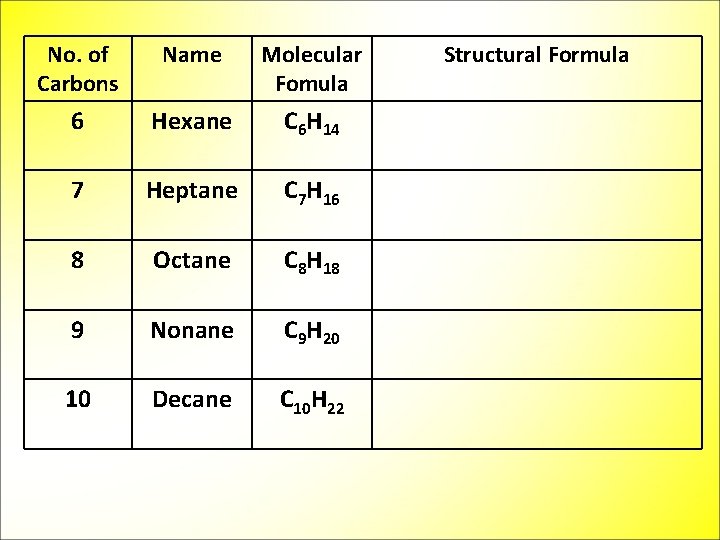
No. of Carbons Name Molecular Fomula 6 Hexane C 6 H 14 7 Heptane C 7 H 16 8 Octane C 8 H 18 9 Nonane C 9 H 20 10 Decane C 10 H 22 Structural Formula
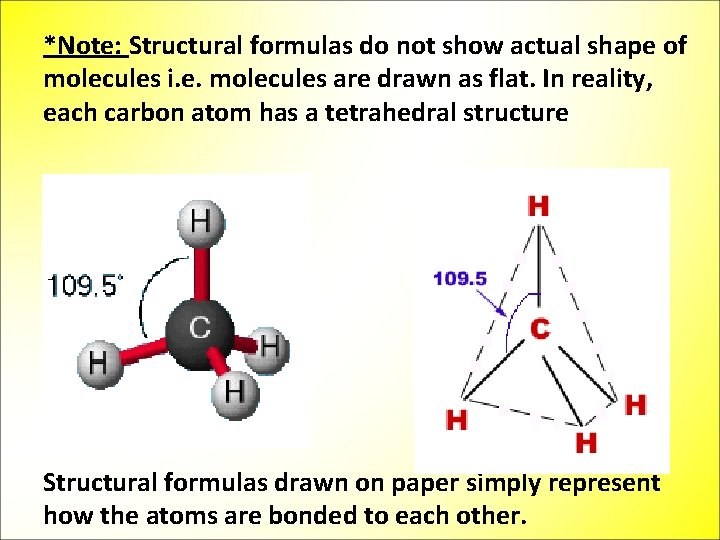
*Note: Structural formulas do not show actual shape of molecules i. e. molecules are drawn as flat. In reality, each carbon atom has a tetrahedral structure Structural formulas drawn on paper simply represent how the atoms are bonded to each other.
Structural Isomers Remember: Structural Isomers: compounds which have the same molecular formula but whose atoms are joined together in a different order i. e. different structural formula. * Note: Only need to know the structures of the isomers of C 4 H 10 (Butane) and C 5 H 12 (Pentane)
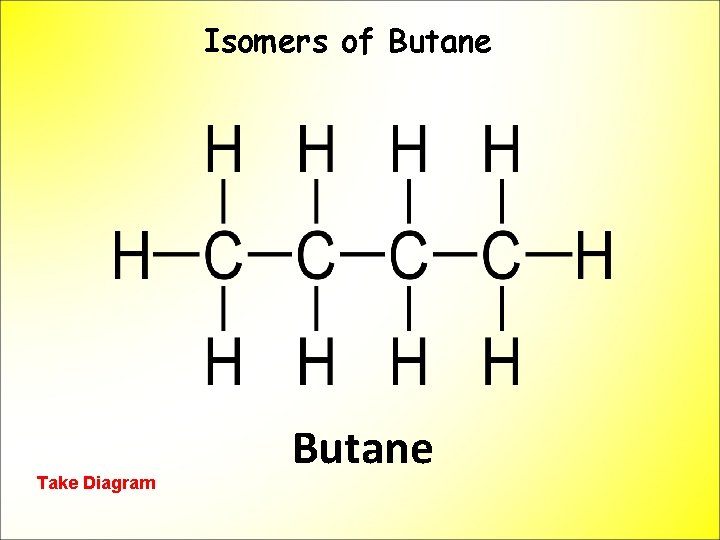
Isomers of Butane Take Diagram Butane
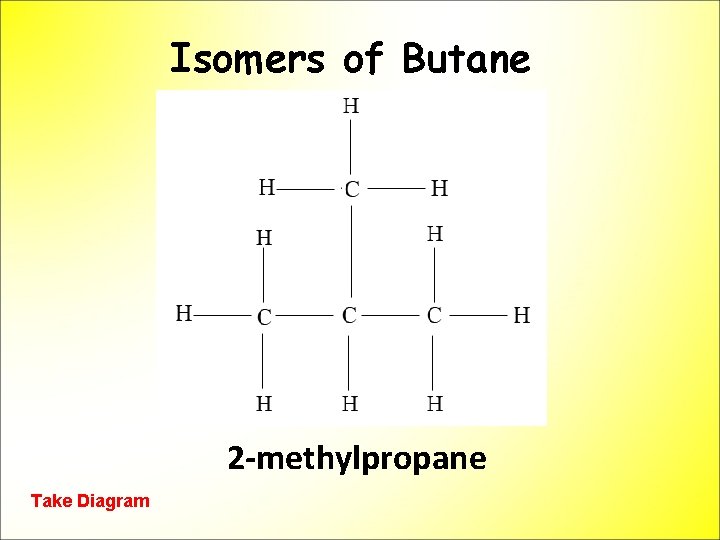
Isomers of Butane 2 -methylpropane Take Diagram
Isomers of Butane and 2 -methylpropane have the same molecular formula C 4 H 10. However, they are two different compounds with different physical properties e. g. different boiling points
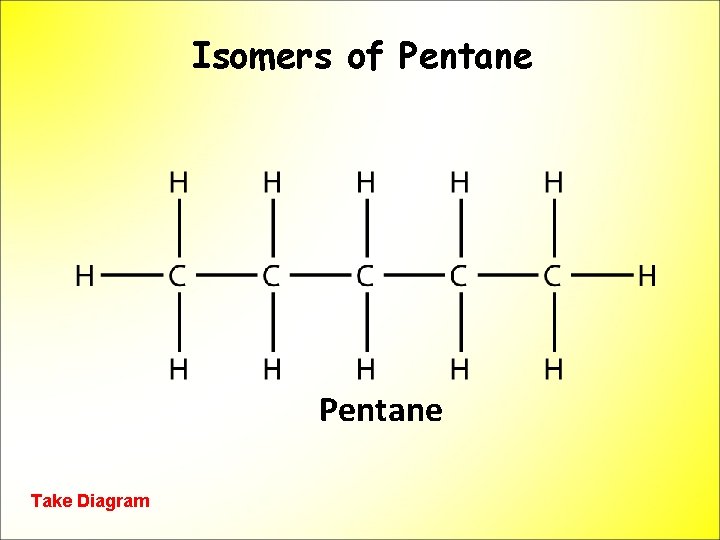
Isomers of Pentane Take Diagram
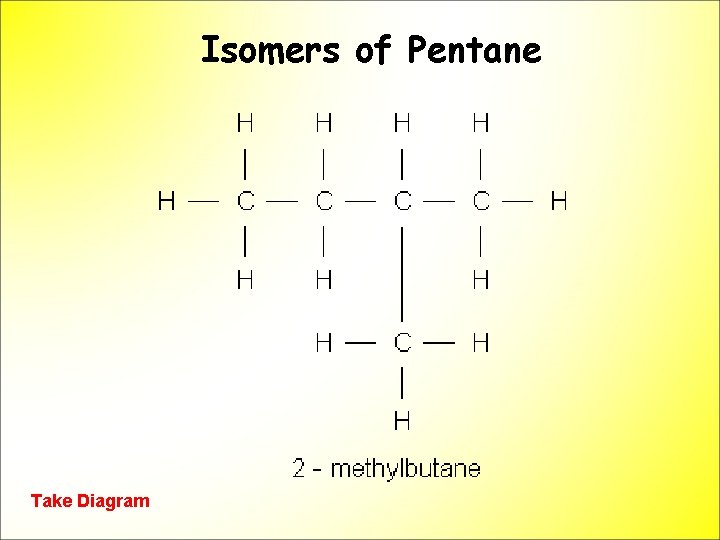
Isomers of Pentane Take Diagram
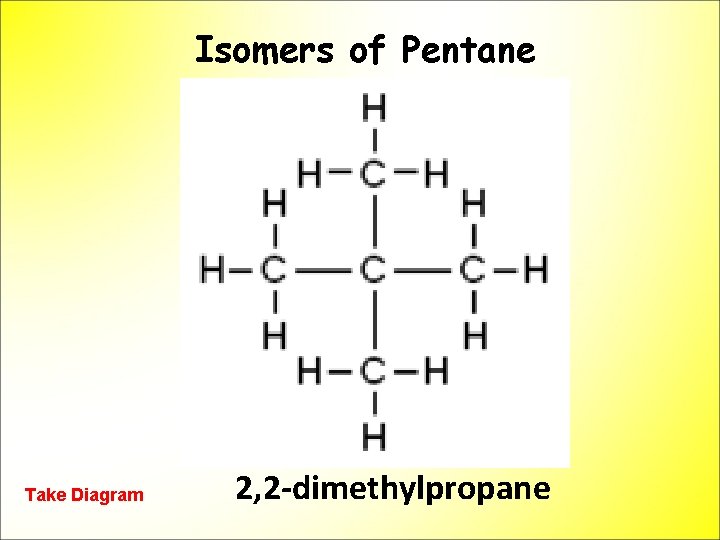
Isomers of Pentane Take Diagram 2, 2 -dimethylpropane
*Note: You must know the formulae and structures of the alkanes up to C 8 and the isomers up to C 5
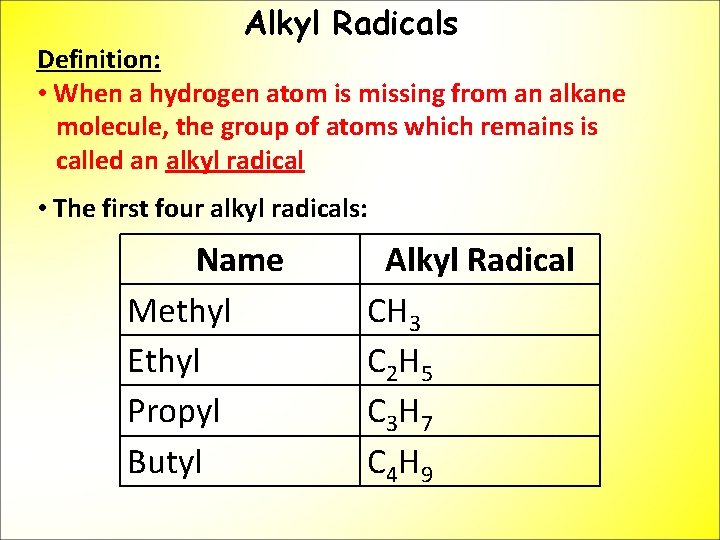
Alkyl Radicals Definition: • When a hydrogen atom is missing from an alkane molecule, the group of atoms which remains is called an alkyl radical • The first four alkyl radicals: Name Methyl Ethyl Propyl Butyl Alkyl Radical CH 3 C 2 H 5 C 3 H 7 C 4 H 9
Alkyl Radicals *Note: If two identical alkyl groups are present in a molecule, this is indicated using the prefix di- e. g. dimethyl = 2 methyl groups diethyl = 2 ethyl groups Side Chains (Substituent Groups/Branches): are groups of atoms attached to the main carbon chain
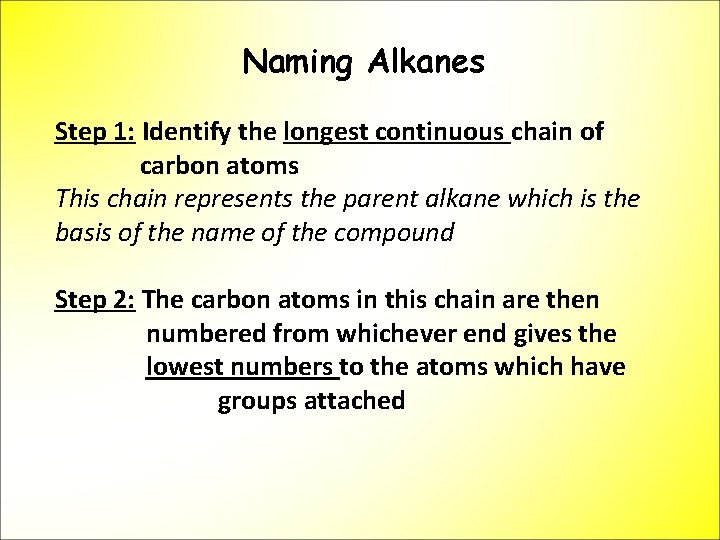
Naming Alkanes Step 1: Identify the longest continuous chain of carbon atoms This chain represents the parent alkane which is the basis of the name of the compound Step 2: The carbon atoms in this chain are then numbered from whichever end gives the lowest numbers to the atoms which have groups attached
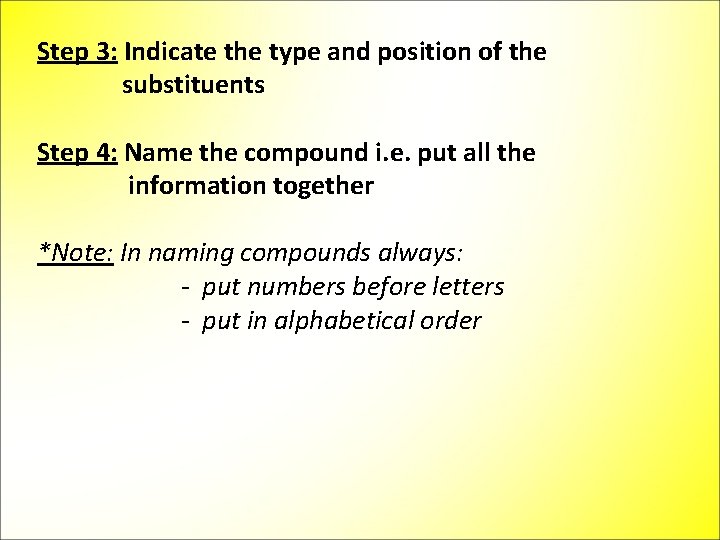
Step 3: Indicate the type and position of the substituents Step 4: Name the compound i. e. put all the information together *Note: In naming compounds always: - put numbers before letters - put in alphabetical order
Examples of how to name alkanes will be completed on board please leave space!!!
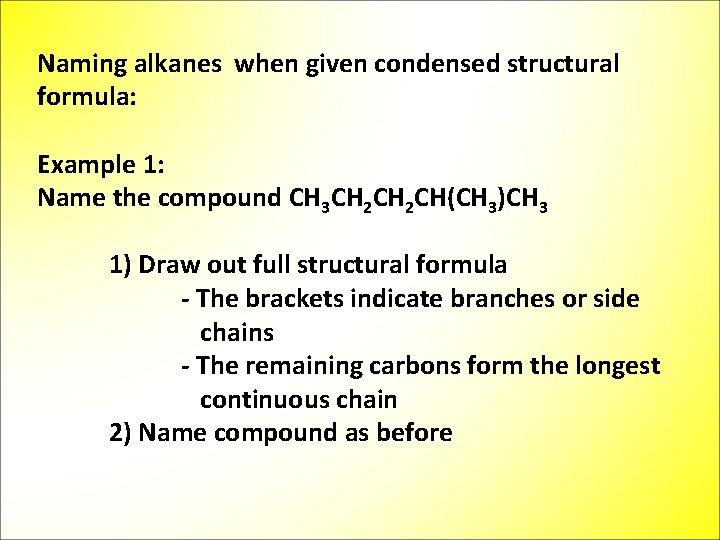
Naming alkanes when given condensed structural formula: Example 1: Name the compound CH 3 CH 2 CH(CH 3)CH 3 1) Draw out full structural formula - The brackets indicate branches or side chains - The remaining carbons form the longest continuous chain 2) Name compound as before
Naming Alkanes: Please complete exercise 21. 1 parts (a), (c) and (d) pg 337
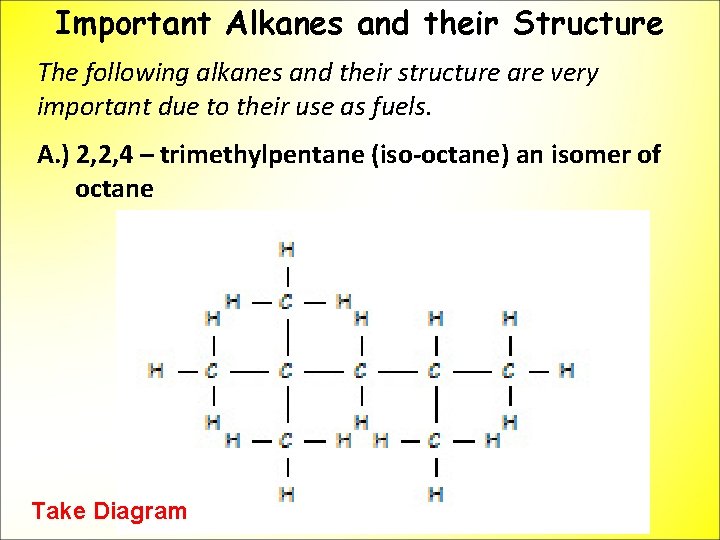
Important Alkanes and their Structure The following alkanes and their structure are very important due to their use as fuels. A. ) 2, 2, 4 – trimethylpentane (iso-octane) an isomer of octane Take Diagram
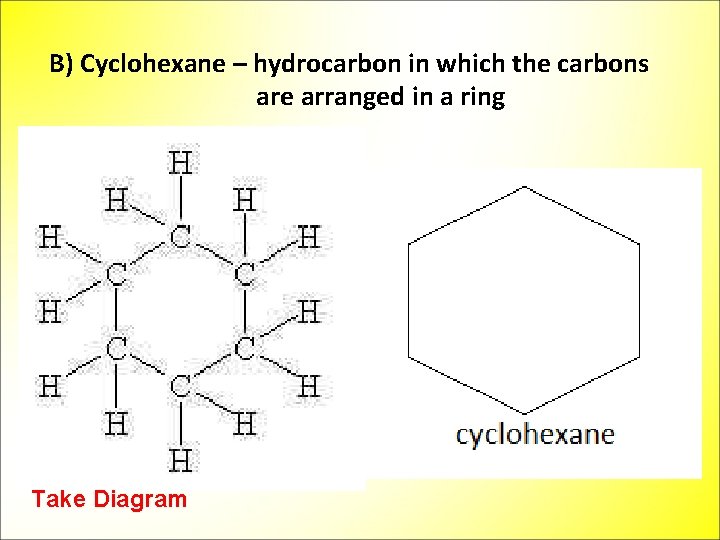
B) Cyclohexane – hydrocarbon in which the carbons are arranged in a ring Take Diagram
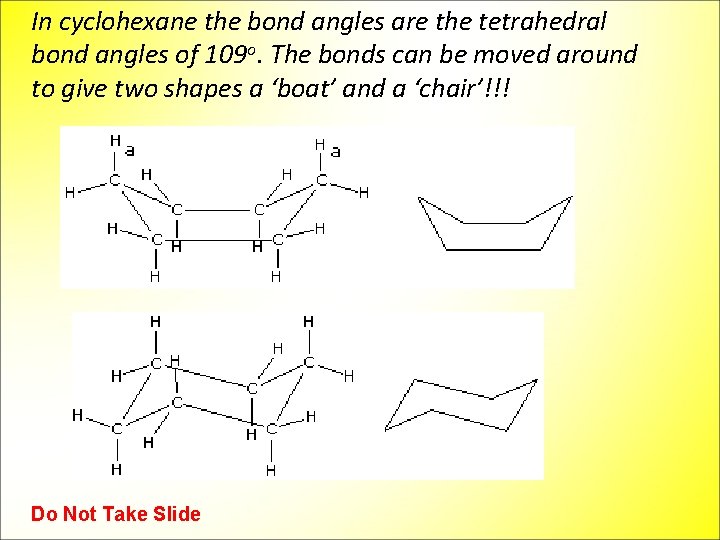
In cyclohexane the bond angles are the tetrahedral bond angles of 109 o. The bonds can be moved around to give two shapes a ‘boat’ and a ‘chair’!!! Do Not Take Slide
Drawing Structural Formulas You may be given the name of a compound asked to draw its structural formula. Step 1: Analyse the name and pick out the parent alkane Step 2: Draw the carbon atoms in the longest chain and number them (order does not matter) Step 3: By analysis of the name you can determine the various side chains present, add these side chains to the carbon chain in the correct positions Step 4: complete the structural formula by filling in the remaining bonds with hydrogen atoms
Examples of how to draw structural formulas will be completed on board please leave space!!!
Drawing Alkanes: Please complete exercise 21. 2 pg 337
Physical Properties of Alkanes • Appearance: C 1 - C 4 alkanes are colourless gases C 5 - C 15 alkanes are colourless liquids C 16 - upwards are colourless or white waxy solids • All alkanes are insoluble in water i. e. they are nonpolar. • All alkanes have no smell • Their main use is as fuels e. g. methane is the main component of natural gas. • All alkanes be represented by the formula: Cn. H 2 n + 2
The Alkenes • The alkenes are the second homologous series of hydrocarbons. They have the general formula Cn. H 2 n • Alkenes contain a carbon-carbon double bond (-C=C-) and for this reason are said to be unsaturated compounds.
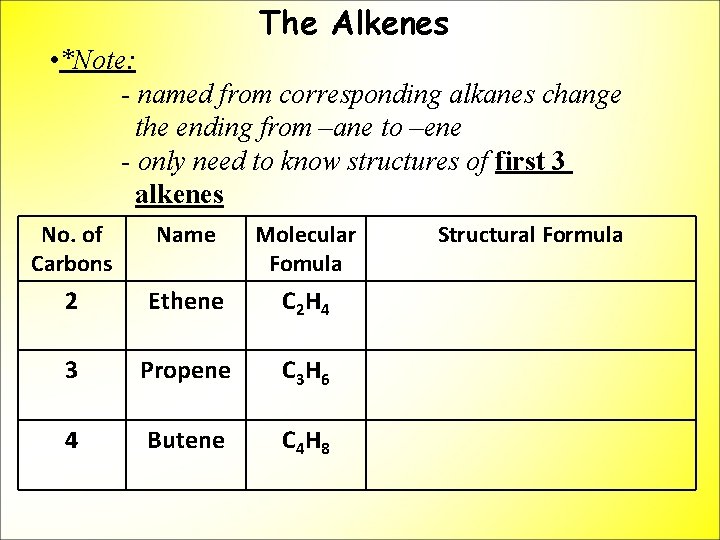
The Alkenes • *Note: - named from corresponding alkanes change the ending from –ane to –ene - only need to know structures of first 3 alkenes No. of Carbons Name Molecular Fomula 2 Ethene C 2 H 4 3 Propene C 3 H 6 4 Butene C 4 H 8 Structural Formula
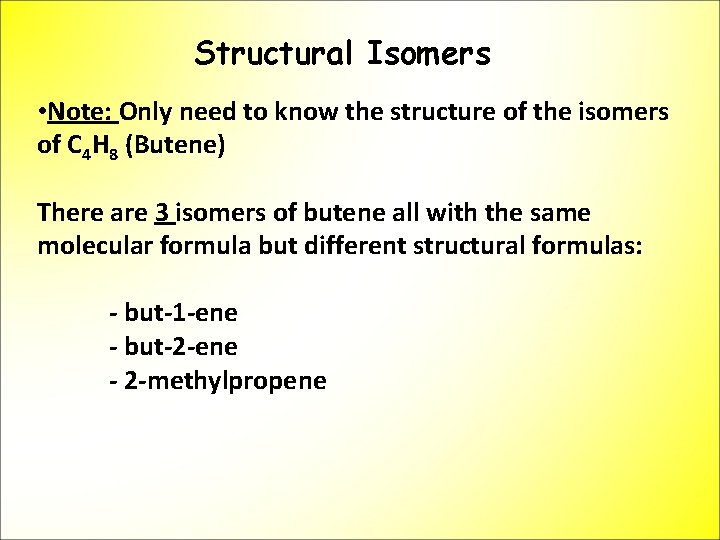
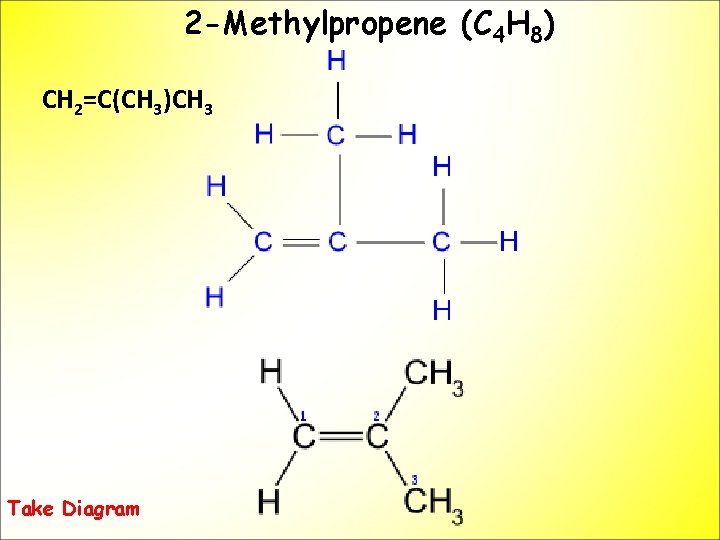
Structural Isomers • Note: Only need to know the structure of the isomers of C 4 H 8 (Butene) There are 3 isomers of butene all with the same molecular formula but different structural formulas: - but-1 -ene - but-2 -ene - 2 -methylpropene
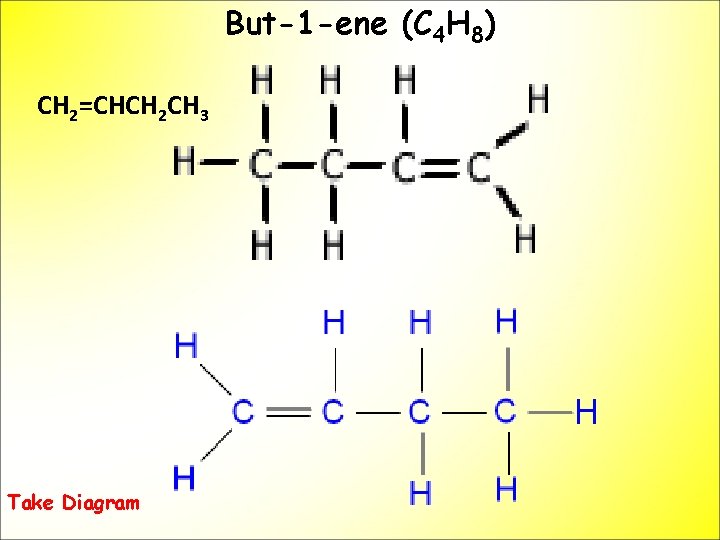
But-1 -ene (C 4 H 8) CH 2=CHCH 2 CH 3 Take Diagram
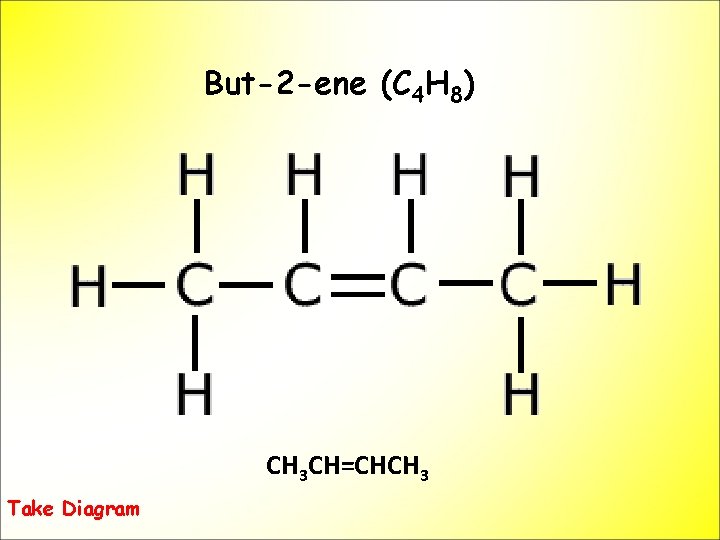
But-2 -ene (C 4 H 8) CH 3 CH=CHCH 3 Take Diagram
2 -Methylpropene (C 4 H 8) CH 2=C(CH 3)CH 3 Take Diagram
*Note: You must know the formulae and structures of the alkenes up to C 4 and the isomers up to C 4
Naming of Alkenes *Rules are very similar to those for naming alkanes Step 1: Identify the longest continuous chain of carbon atoms containing the C=C double bond This chain represents the parent alkane. The compound is named by changing the – ane ending to – ene. Step 2: Number the carbon atoms in this chain by starting at the end nearest the C=C. The double bond is indicated by writing the no. of the carbon atom after which the double bond occurs in the middle of its name.
Step 3: Indicate the type and position of the substituents Step 4: Name the compound i. e. put all the information together Examples of how to name alkenes when given structural formula and condensed structural formula will be completed on board please leave space!!!
Please complete exercise 21. 3 (a), (b), (d) pg. 337
Drawing Structural Formulas of Alkenes You may be given the name of a compound asked to draw its structural formula. Step 1: Analyse the name and: a) decide how many C atoms b) ensure presence of C=C c) evaluate position of C=C Step 2: Draw the carbon atoms in the longest chain and number them w. r. t C=C Step 3: Determine side chains and positions on chain Step 4: complete the structural formula by filling in the remaining bonds with hydrogen atoms
Examples of how to draw structural formulas will be completed on board please leave space!!!
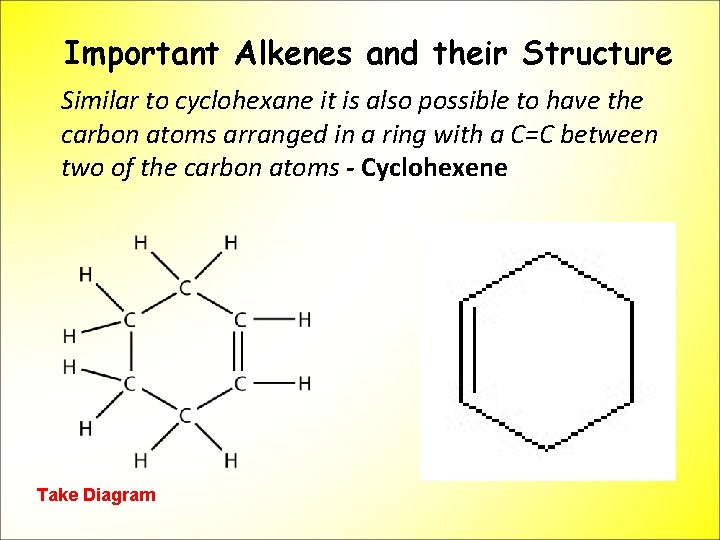
Important Alkenes and their Structure Similar to cyclohexane it is also possible to have the carbon atoms arranged in a ring with a C=C between two of the carbon atoms - Cyclohexene Take Diagram
Please complete exercise 21. 4(a), (b), (c), (d) pg. 337
Physical Properties of Alkenes • Appearance: C 2 - C 4 alkenes are gases C 5 - C 15 are liquids C 16 – upwards are solids • Alkenes are either non-polar or only slightly polar. Thus they have very low solubility in water but are soluble in non-polar solvents e. g. cyclohexane • More reactive than the alkanes • All alkenes can be represented by the formula: Cn H 2 n
Mandatory Experiment: To prepare ethene and examine its properties Please ensure you have an understanding of this experiment and all related reactions!!!
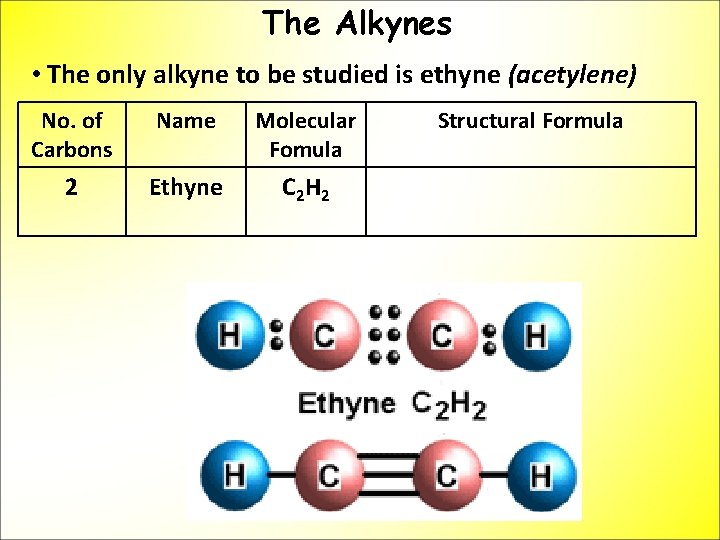
Alkynes • The alkynes are third homologous series of hydrocarbons. They have the general formula Cn. H 2 n - 2 • Alkynes contain a carbon-carbon triple bond (-C = C-) and for this reason are said to be highly unsaturated compounds.
The Alkynes • The only alkyne to be studied is ethyne (acetylene) No. of Carbons Name Molecular Fomula 2 Ethyne C 2 H 2 Structural Formula
Physical Properties of Alkynes • Lower members of alkynes are gases while higher alkynes are liquids or solids • Alkynes are non-polar and are soluble in non-polar solvents e. g. methylbenzene, cyclohexane • Uses: - ethyne (acetylene) is used in oxyacetylene welding and cutting - making monomers for addition ploymerisation • All alkynes can be represented by the general formula: Cn. H 2 n-2
Mandatory Experiment: To prepare ethyne and examine its properties Please ensure you have an understanding of this experiment and all related reactions!!!
Aromatic Hydrocarbons Definition: Aromatic compounds are compounds that contain a benzene ring structure in their molecules
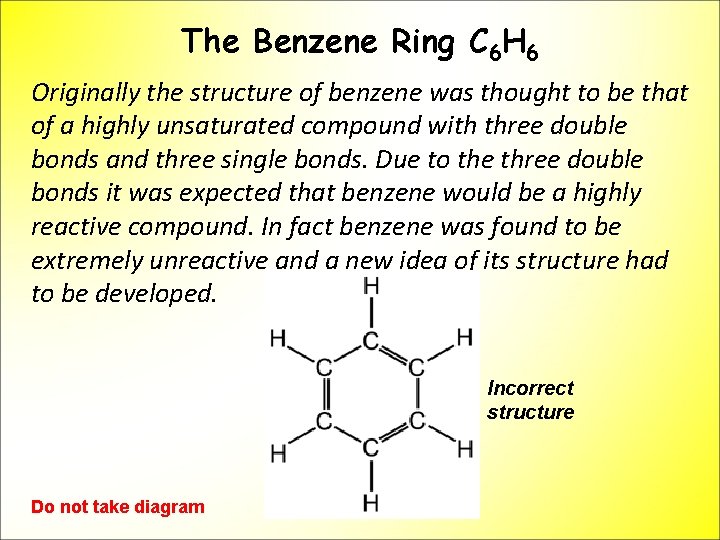
The Benzene Ring C 6 H 6 Originally the structure of benzene was thought to be that of a highly unsaturated compound with three double bonds and three single bonds. Due to the three double bonds it was expected that benzene would be a highly reactive compound. In fact benzene was found to be extremely unreactive and a new idea of its structure had to be developed. Incorrect structure Do not take diagram
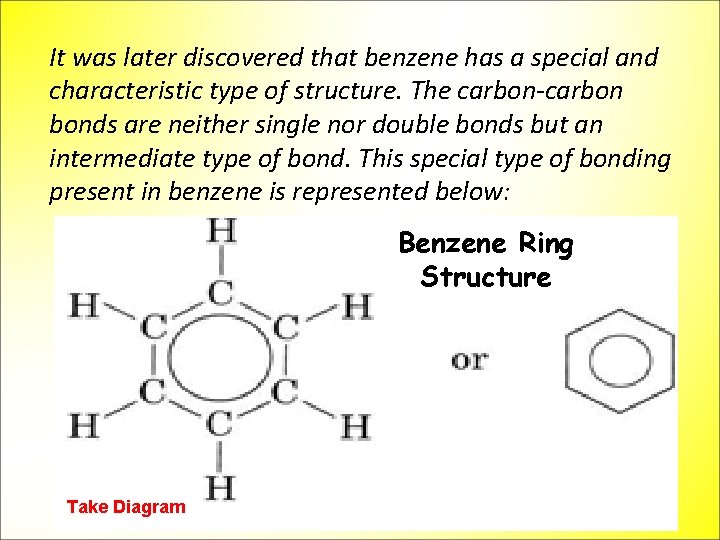
It was later discovered that benzene has a special and characteristic type of structure. The carbon-carbon bonds are neither single nor double bonds but an intermediate type of bond. This special type of bonding present in benzene is represented below: Benzene Ring Structure Take Diagram
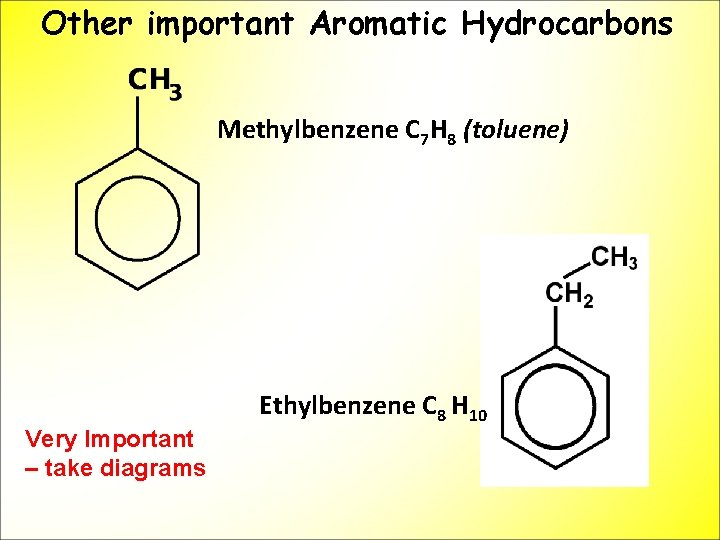
Other important Aromatic Hydrocarbons Methylbenzene C 7 H 8 (toluene) Very Important – take diagrams Ethylbenzene C 8 H 10
Properties of Aromatic Hydrocarbons • Benzene, methylbenzene and ethylbenzene are liquids at room temperature while aromatic compounds of higher molecular mass are solids. • They are non-polar and therefore will only dissolve in non-polar solvents such as cyclohexane • Do not react like a normal unsaturated compound i. e. do not decolourise bromine • Benzene and many of its derivatives are carcinogenic e. g. petrol is carcinogenic while methylbenzene is not and is used as an industrial solvent.
Oil Refining & Its Products (*Note: generally get half a question on oil refining) Crude oil (petroleum) is one of the most valuable and useful materials found in the earth and is commonly referred to as a fossil fuel. Crude oil as it is pumped from under the ground or from under the sea is of little use in itself so in order to separate it into a number of useful mixtures, a process called fractional distillation is used.
Fractional Distillation of Crude Oil (*You must know the process) Definition: Fractional Distillation involves heating crude oil and separating the various mixture (known as fraction) on the basis of their boiling points. Crude oil is a mixture of a variety of saturated hydrocarbons of different chain lengths. The boiling points of these compounds tend to increase as molecular mass increases and their molecular mass increases as the number of carbon atoms increase. Heated crude oil is added continuously near the base of a tall fractionating column and vaporised.
Fractional Distillation - the process: • Crude oil is analysed by refinery chemists to determine its quality. • It is then heated in a furnace and enters a *fractionating column as a partially vaporised mixture. (Fractionating column – tall steel tower up to 60 metres high the inside of which is divided into a number of horizontal trays with holes in them) • The fractionating column is maintained at a high temperature at the bottom but the temperature gradually falls towards the top so that each tray is a little cooler than the one below it.
• Therefore, the larger hydrocarbons that have higher boiling points turn to liquids nearer the bottom of the column and the smaller. hydrocarbons that have lower boiling points stay as gases and rise up along the column. • When each fraction reaches the tray where the temperature is just below the boiling point, it condenses and changes back to a liquid on the tray. • The different fractions are then drawn off by pipes from the various trays and the process continues.
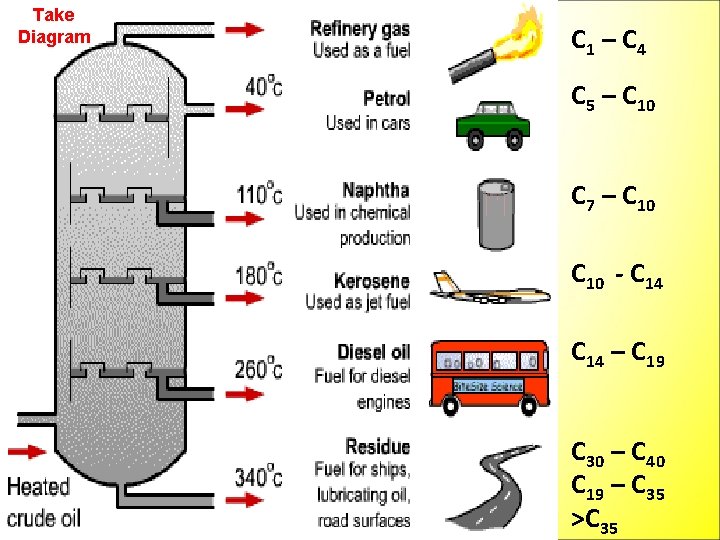
You must be able to draw the following fractionating column and identify the various fractions and the length of their chains of carbon atoms
Take Diagram C 1 – C 4 C 5 – C 10 C 7 – C 10 - C 14 – C 19 C 30 – C 40 C 19 – C 35 >C 35
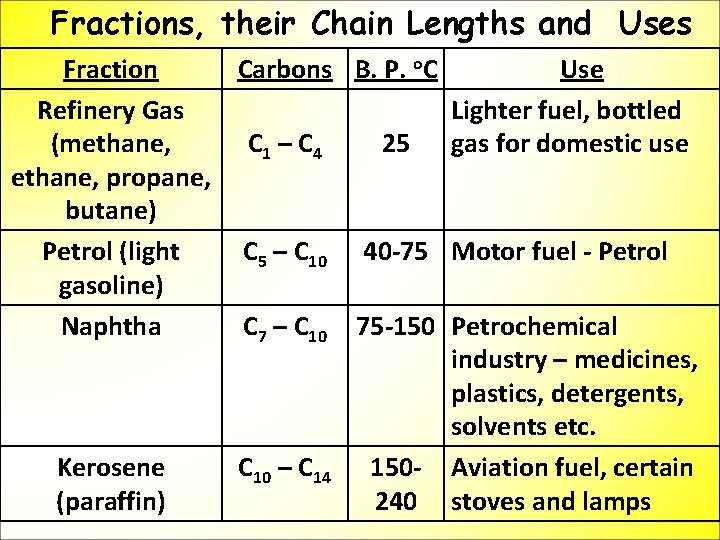
Fractions, their Chain Lengths and Uses Fraction Carbons B. P. o. C Refinery Gas (methane, C 1 – C 4 25 ethane, propane, butane) Petrol (light C 5 – C 10 40 -75 gasoline) Naphtha C 7 – C 10 75 -150 Kerosene (paraffin) C 10 – C 14 150240 Use Lighter fuel, bottled gas for domestic use Motor fuel - Petrol Petrochemical industry – medicines, plastics, detergents, solvents etc. Aviation fuel, certain stoves and lamps
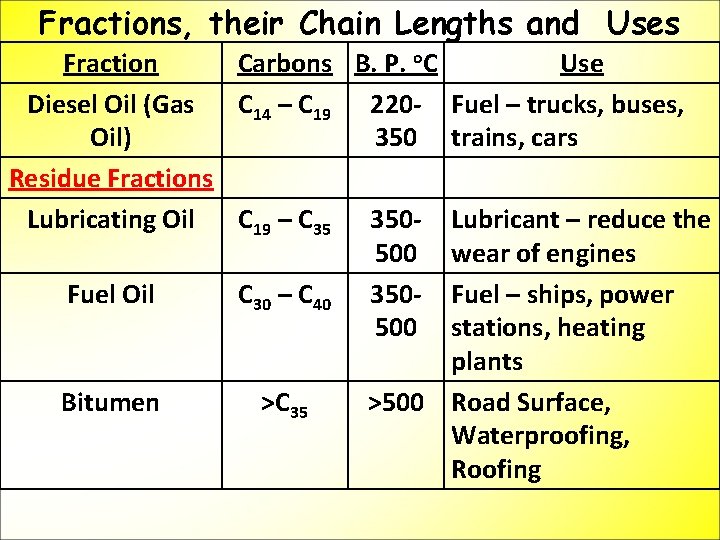
Fractions, their Chain Lengths and Uses Fraction Carbons B. P. o. C Diesel Oil (Gas C 14 – C 19 220 Oil) 350 Residue Fractions Lubricating Oil C 19 – C 35 350500 Fuel Oil C 30 – C 40 350500 Bitumen >C 35 Use Fuel – trucks, buses, trains, cars Lubricant – reduce the wear of engines Fuel – ships, power stations, heating plants >500 Road Surface, Waterproofing, Roofing
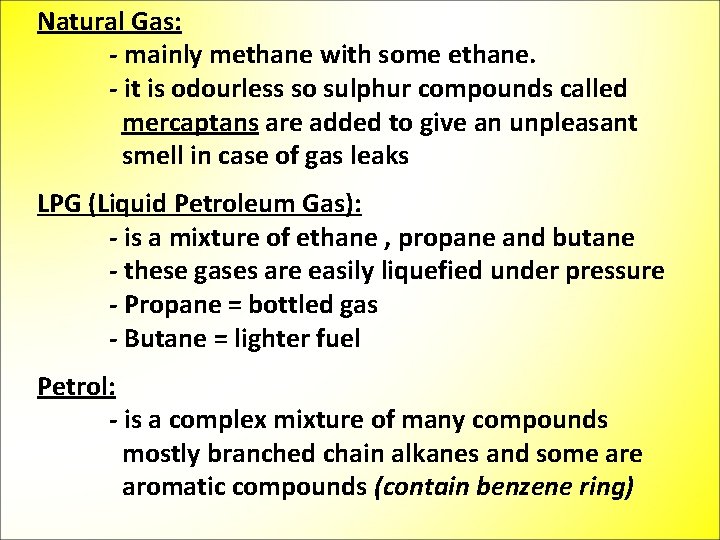
Natural Gas: - mainly methane with some ethane. - it is odourless so sulphur compounds called mercaptans are added to give an unpleasant smell in case of gas leaks LPG (Liquid Petroleum Gas): - is a mixture of ethane , propane and butane - these gases are easily liquefied under pressure - Propane = bottled gas - Butane = lighter fuel Petrol: - is a complex mixture of many compounds mostly branched chain alkanes and some aromatic compounds (contain benzene ring)
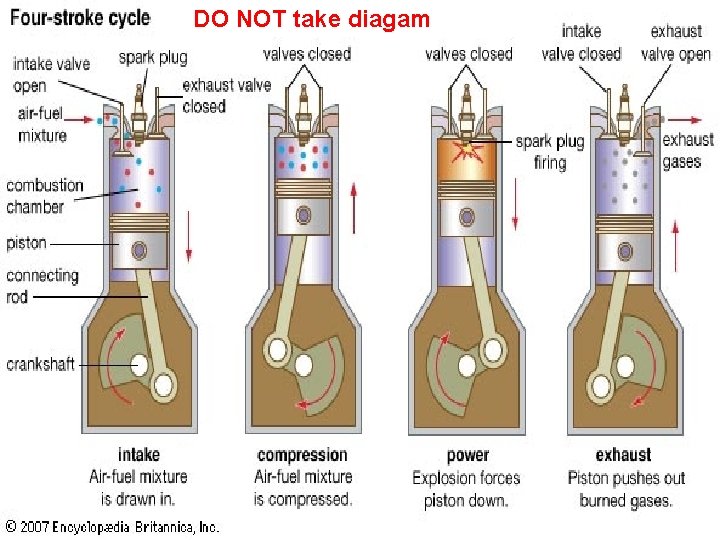
Petrol & The Internal Combustion Engine The petrol obtained directly from the fractionating column in an oil refinery would not be very efficient fuel in a car. It must be vaporised and mixed with air before entering the engine of a vehicle - an internal combustion engine.
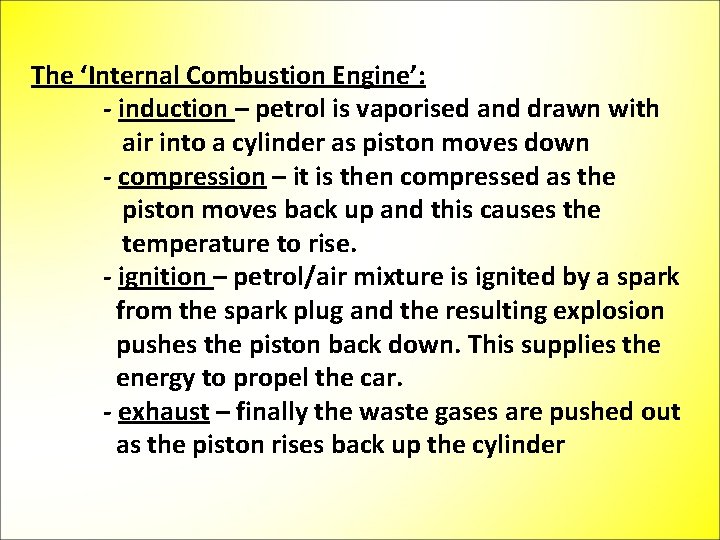
The ‘Internal Combustion Engine’: - induction – petrol is vaporised and drawn with air into a cylinder as piston moves down - compression – it is then compressed as the piston moves back up and this causes the temperature to rise. - ignition – petrol/air mixture is ignited by a spark from the spark plug and the resulting explosion pushes the piston back down. This supplies the energy to propel the car. - exhaust – finally the waste gases are pushed out as the piston rises back up the cylinder
DO NOT take diagam
Auto-ignition (Knocking) The more gases are compressed, the more they tend to heat up and sometimes this causes ignition before the spark is produced*. This occurrence is called auto -ignition or knocking and can cause loss of power and damage to the engine. *Note: this is intended in a diesel engine where there is no spark plug. Definition: Auto-ignition (knocking): is ignition in an internal combustion engine before a spark is produced.
Octane Number Upon investigation it was discovered that: - long straight chain alkanes like heptane, octane and nonane ignited easily and exploded to soon in the cylinder causing knocking. - branched-chain alkanes like 2, 2, 4 trimethylpentane (iso-octane) did not tend to undergo auto-ignition. - therefore, petrol mixtures that contain branched chain alkanes are more efficient than those that contain straight-chain molecules
Definition: The octane number of a fuel is a measure of the tendency of the fuel to resist auto-ignition (knocking) The lower the octane rating the more likely it is that auto-ignition will occur The higher the octane rating the less likely it is that auto-ignition will occur.
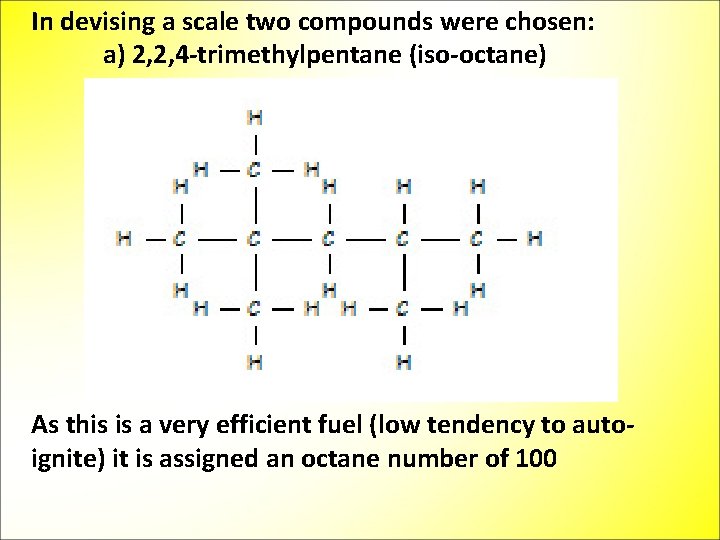
In devising a scale two compounds were chosen: a) 2, 2, 4 -trimethylpentane (iso-octane) As this is a very efficient fuel (low tendency to autoignite) it is assigned an octane number of 100
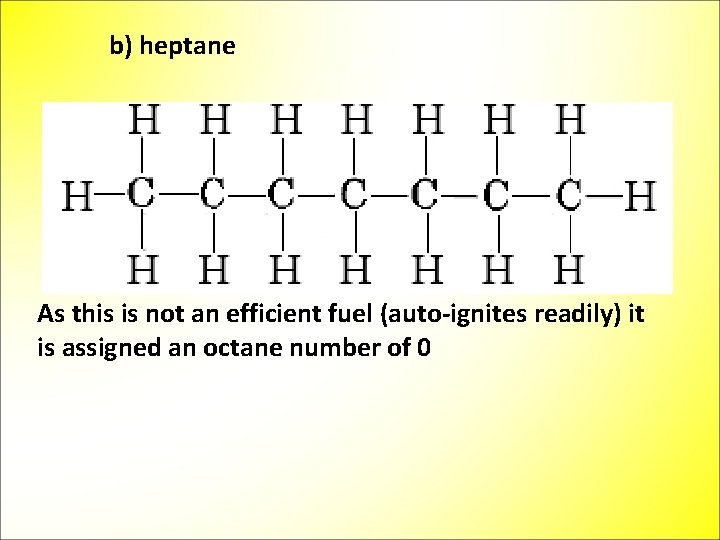
b) heptane As this is not an efficient fuel (auto-ignites readily) it is assigned an octane number of 0
Thus, the octane number of a fuel can be measured by comparing its performance with known mixtures of heptane and 2, 2, 4 -trimethylpentane in a test engine. Good quality petrol with an octane number of 97% means that it is as efficient a fuel as a mixture of 97% 2, 2, 4 -trimethylpentane and 3% heptane.
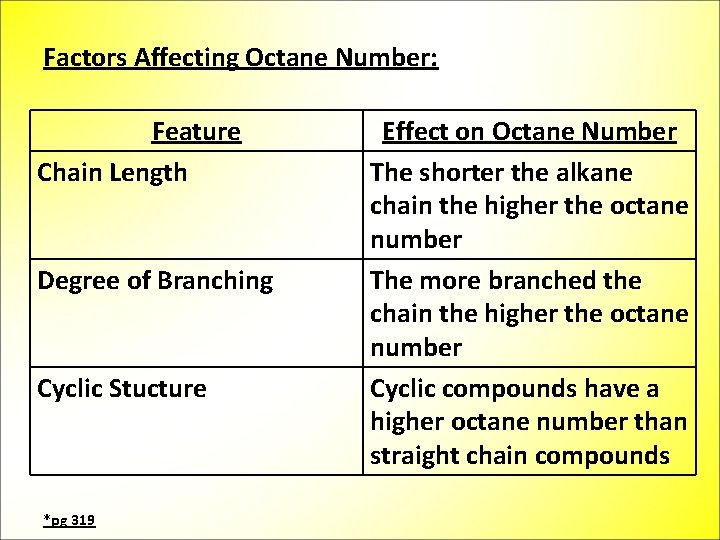
Factors Affecting Octane Number: Feature Chain Length Degree of Branching Cyclic Stucture *pg 319 Effect on Octane Number The shorter the alkane chain the higher the octane number The more branched the chain the higher the octane number Cyclic compounds have a higher octane number than straight chain compounds
Making Petrol: • One method of reducing knocking is the use of antiknock additives in petrol manufacture. • One such additive – tetraethyl lead Pb(C 2 H 5 )4 – helped reduce the amount of knocking. However, lead compounds in exhaust fumes are toxic and this, along with the fact that it damages the catalytic converter in cars so they can no longer reduce the levels of other pollutants in exhaust fumes, has led to the phasing out of leaded petrol in Ireland since 2000.
Adding lead compounds to petrol was an easy solution to the problem of knocking since it meant that petrol did not have to contain compounds with high octane numbers. With the banning on lead as an additive chemists had to come up with alternative ways of increasing the efficiency of petrol – in terms of its octane number. The four ways now used to increase the octane number of petrol are: A - Isomerisation B - Catalytic Cracking C - Reforming (Dehydrocyclisation) D - Adding oxygenates
A. Isomerisation (changing aliphatic chains into isomers): • involves changing straight-chain alkanes into their isomers • When the alkanes are heated in the presence of a suitable catalyst the straight chains break. • When the chain fragments rejoin the final product is more likely to be a branched-chain alkane than a straight chain alkane • Carried out in oil refineries on a large scale with pentane and hexane (both found in petrol fraction of crude oil distillation)
Isomerisation:
B. Catalytic Cracking: Of all the fractions obtained from crude oil petrol is the one in the greatest demand. In order to meet this demand to avoid being left with a large surplus of the heavier fractions a method of making petrol from the heavier fractions was developed – catalytic cracking. Definition: Catalytic cracking is the breaking down of long chain hydrocarbon molecules into short chain molecules for which there is greater demand.
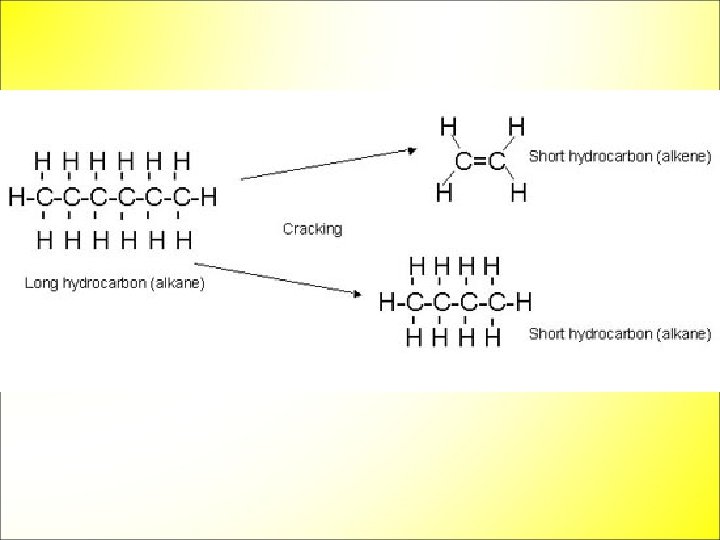
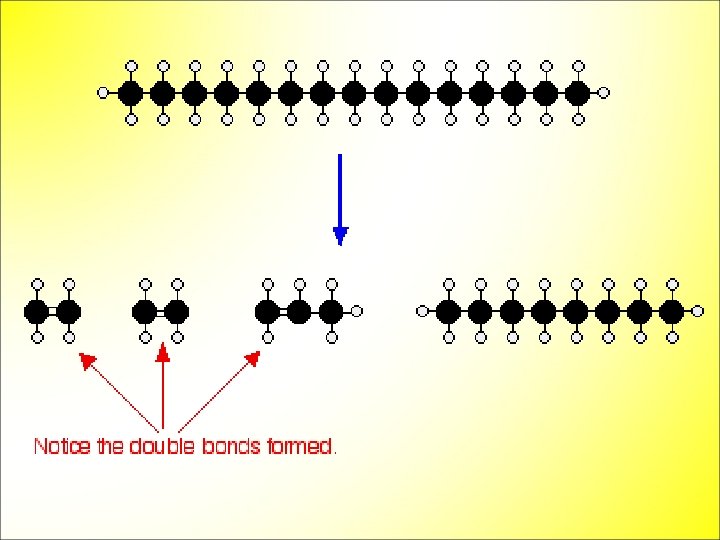
Catalytic Cracking (‘cat cracking’) the process: • involves taking heavy oil such as kerosene or diesel and heating it to a high temperature in the presence of a catalyst • a common reaction is where a large alkane molecule breaks down into smaller ones – a branched alkane (saturated) and an alkene (unsaturated) • unsaturated products – used in polymer industry saturated products – high-octane branched-chain alkanes suitable for making petrol *Note: if you split a saturated alkane at least one of the products must be unsaturated!!!!! **pg 321
Cat crackers have been in existence since the 1940’s. The reaction conditions and catalyst can be varied to give the maximum amount of the desired product e. g. branched alkanes for petrol or ethene for the petrochemicals industry.
Demonstration: To carry out a cracking reaction of a hydrocarbon (pg’s 321 -323)
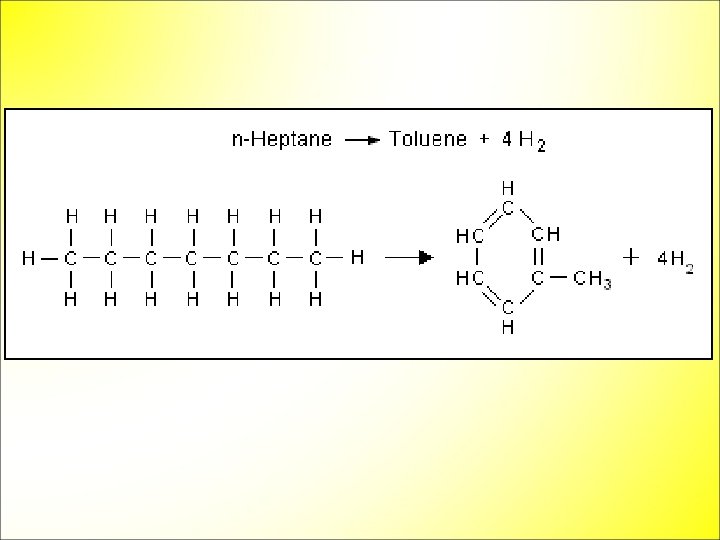
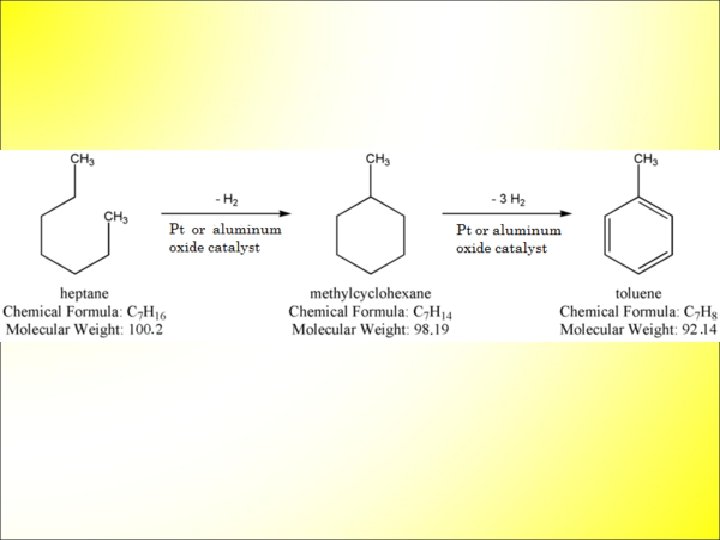
C. Reforming (Dehydrocyclisation): Reforming involves the use of catalysts to form ring compounds
Reforming the process: • A straight chain alkane such as hexane, octane no. = 25, is heated in the presence of a suitable catalyst causing it to change to a cycloalkane e. g. cyclohexane. • The catalyst then causes the cycloalkane to change to an aromatic compound, **benzene, which has an octane number greater than 100. • As well as these high octane compounds being produced hydrogen may also be produced during the reforming reaction – very valuable by product which is piped away for various purposes *Reforming = Dehydrocyclisation – since hydrogen removed and ring compounds formed
D. Adding Oxygenates: • Oxygenate – name given to any fuel which contains oxygen in its molecules. • Oxygenates can also be used as anti-knocking additives. • They can prevent knocking by raising the octane number of the fuel and also cause LESS pollution because they don’t contain lead and they produce lower levels of carbon monoxide when they burn e. g. methanol, ethanol and MTBE (METHYL TERTIARY BUTYL ETHER – octane rating 118) are commonly added to petrol.
Two fuels are to be studied in this course: 1. ) Hydrocarbon Fuels 2. ) Hydrogen Gas (H 2)
Hydrogen • Colourless, odourless gas which is almost insoluble in water • Used in the chemical industry in the following processes: - manufacture of ammonia - *hydrogenation of vegetable oils to make saturated fats (margarine) - manufacture of hydrochloric acid • Hydrogen has great potential as a motor fuel – burns more efficiently than petrol and is non-polluting, water is the only product. *hydrogenation - adding hydrogen to
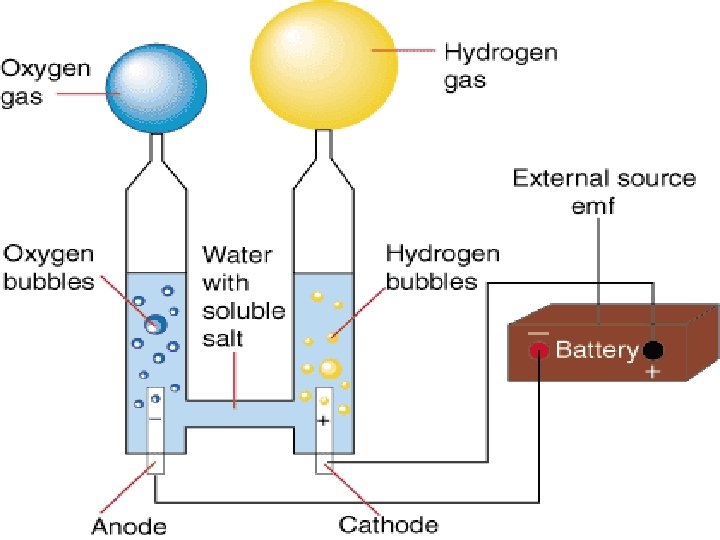
Two methods for producing hydrogen: - Steam reforming of natural gas - Electrolysis of water
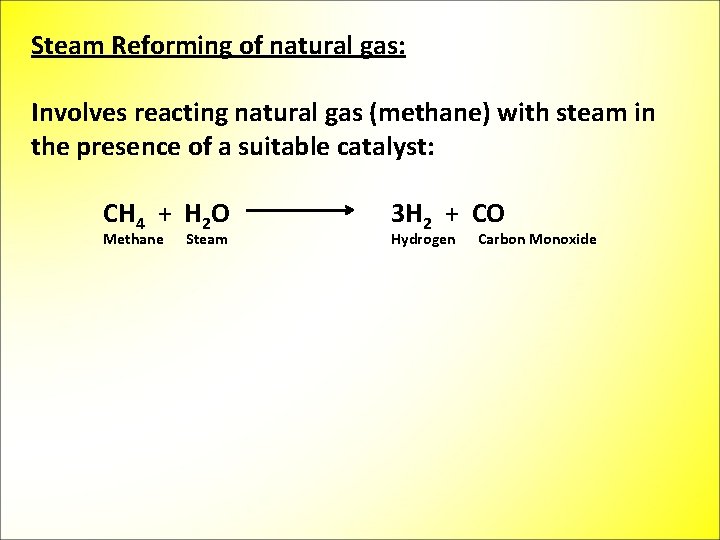
Steam Reforming of natural gas: Involves reacting natural gas (methane) with steam in the presence of a suitable catalyst: CH 4 + H 2 O Methane Steam 3 H 2 + CO Hydrogen Carbon Monoxide
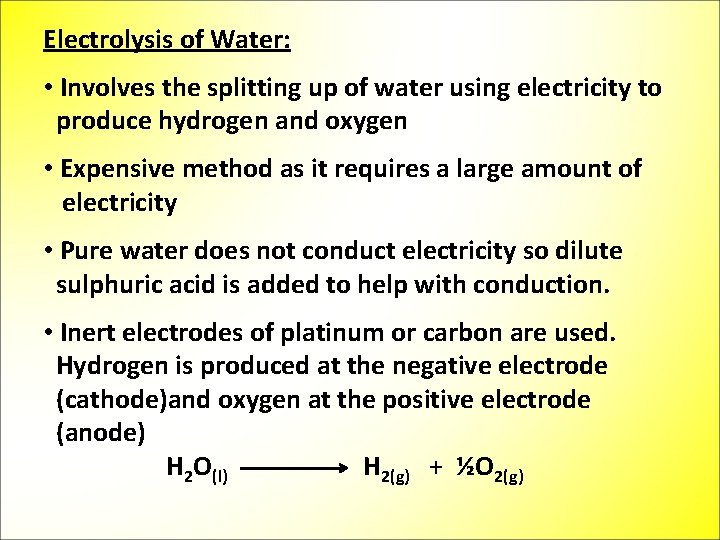
Electrolysis of Water: • Involves the splitting up of water using electricity to produce hydrogen and oxygen • Expensive method as it requires a large amount of electricity • Pure water does not conduct electricity so dilute sulphuric acid is added to help with conduction. • Inert electrodes of platinum or carbon are used. Hydrogen is produced at the negative electrode (cathode)and oxygen at the positive electrode (anode) H 2 O(l) H 2(g) + ½O 2(g)
THERMOCHEMISTRY