LIFE AFTER GRADUATION WELCOME TO THE REAL WORLD



- Slides: 78
LIFE AFTER GRADUATION WELCOME TO THE REAL WORLD!
Congratulations! Your efforts are paid off! You did it!!!
Now What? The Journey to Life After Grad
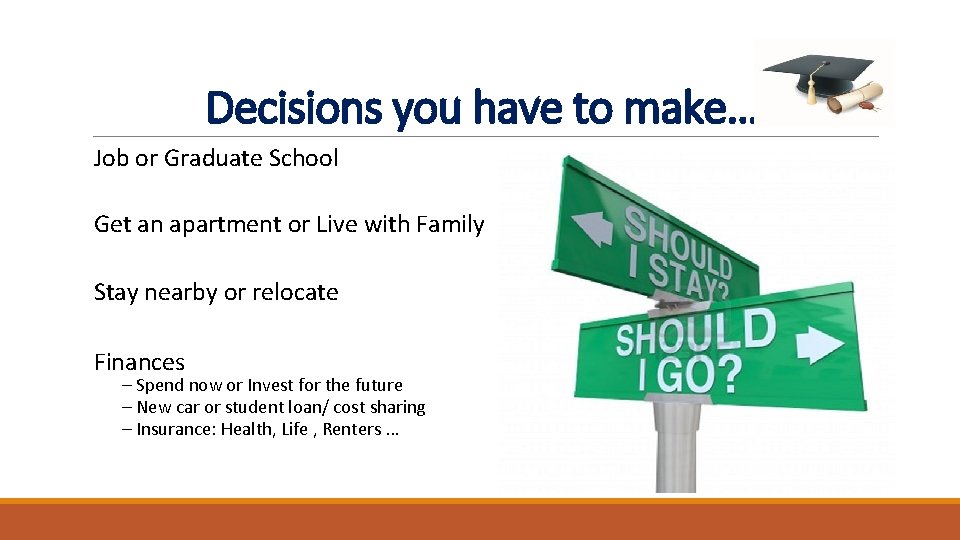
Decisions you have to make… Job or Graduate School Get an apartment or Live with Family Stay nearby or relocate Finances – Spend now or Invest for the future – New car or student loan/ cost sharing – Insurance: Health, Life , Renters …
WHY? ? ? "[The real world] is a big change, more than you can ever imagine when you are sitting in the classroom thinking about the outside world!“ Anonymous business-school grad ◦ ◦ Equip you to face and win the challenges in the new world Unlash your potential and reach your peak in life Change your life and impact the life of others Move to significance ( to our country and rest of the World)
WHY… • This is your real life–not a practice life. • It helps you explore your unique genius • Miracles will happen when we plan our life and live to get the most out of life.
WHAT? • Life: your big picture • Job Creation skills • Job Hunting skills • Personal growth
Life: your big picture §Values and goals will give you an anchor for everything you do—the compass that will help you make big decisions and find your footing when you feel unsatisfied, unfulfilled, or lost. §Before everything you do, figure out: §who you are, §what makes you happy, and §what you want for yourself.
Life: your big picture §It is also about making smart decisions while taking risks; planning for the future without worrying too much about it. §Finally, life is about figuring out where you fit within your broader community and leveraging your unique vision to make the world a better place.
… your big picture Do you want to know how great things happen? “Renew thyself completely each day; do it again, and forever again. ” —Chinese inscription cited by Henry David Thoreau in Walden
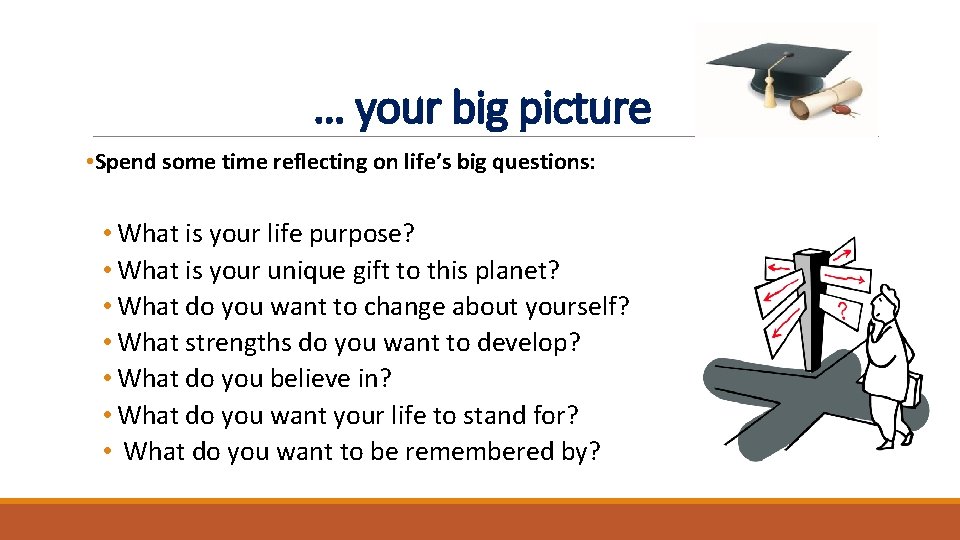
… your big picture • Spend some time reflecting on life’s big questions: • What is your life purpose? • What is your unique gift to this planet? • What do you want to change about yourself? • What strengths do you want to develop? • What do you believe in? • What do you want your life to stand for? • What do you want to be remembered by?
… your big picture Find out what success means to YOU. ( Success: internal and external). • Keep your focus inward and don’t compare yourself to others. “Comparison is a losing game. ” • “Be a first rate version of yourself, not a second rate version of someone else. ” Judy Garland
… your big picture See problems and challenges as opportunities. Without challenges there would be no triumphs; without valleys there would be no peaks.
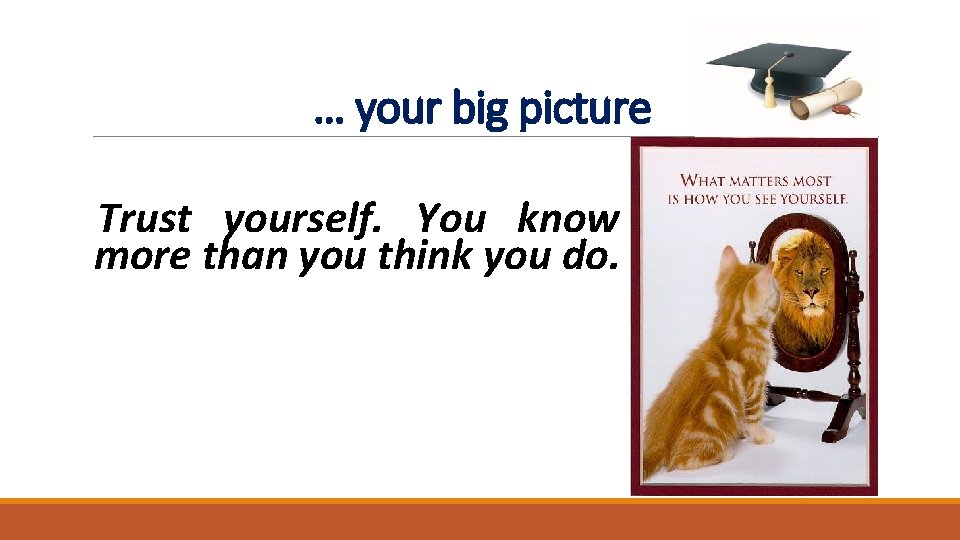
… your big picture Trust yourself. You know more than you think you do.
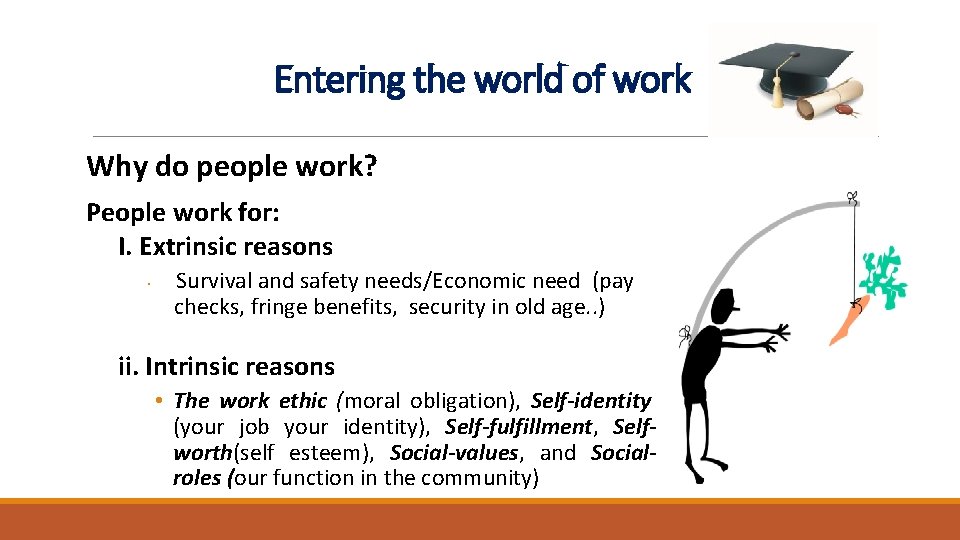
Entering the world of work Why do people work? People work for: I. Extrinsic reasons ◦ Survival and safety needs/Economic need (pay checks, fringe benefits, security in old age. . ) ii. Intrinsic reasons • The work ethic (moral obligation), Self-identity (your job your identity), Self-fulfillment, Selfworth(self esteem), Social-values, and Socialroles (our function in the community)
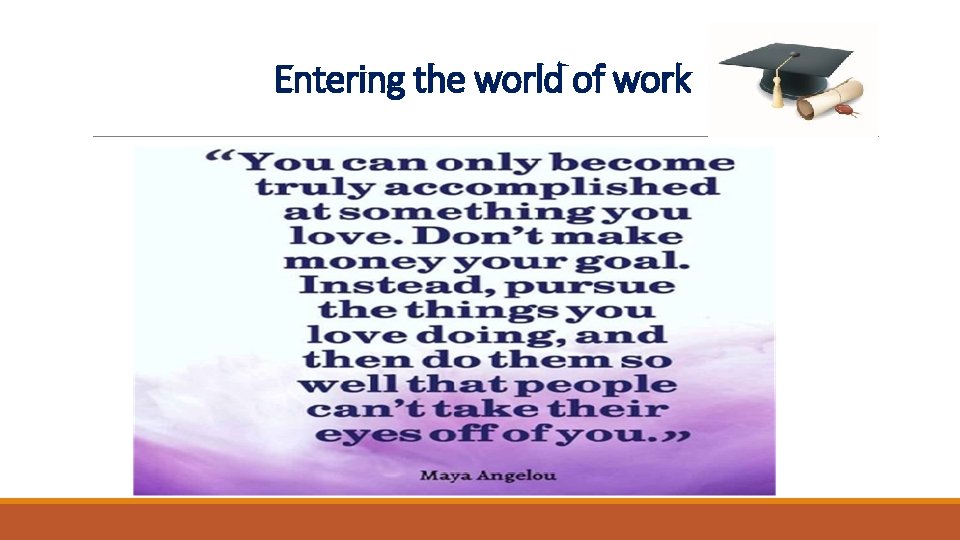
Entering the world of work
Questions?
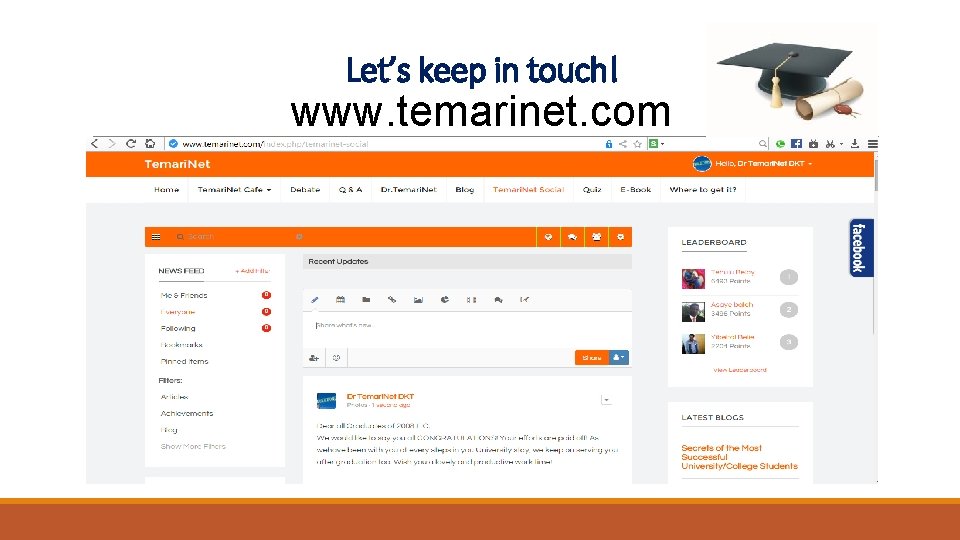
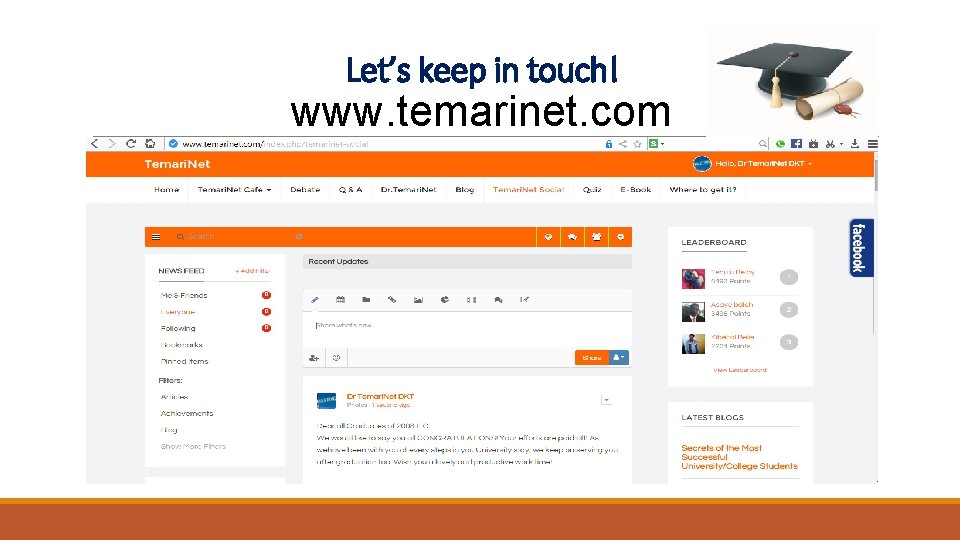
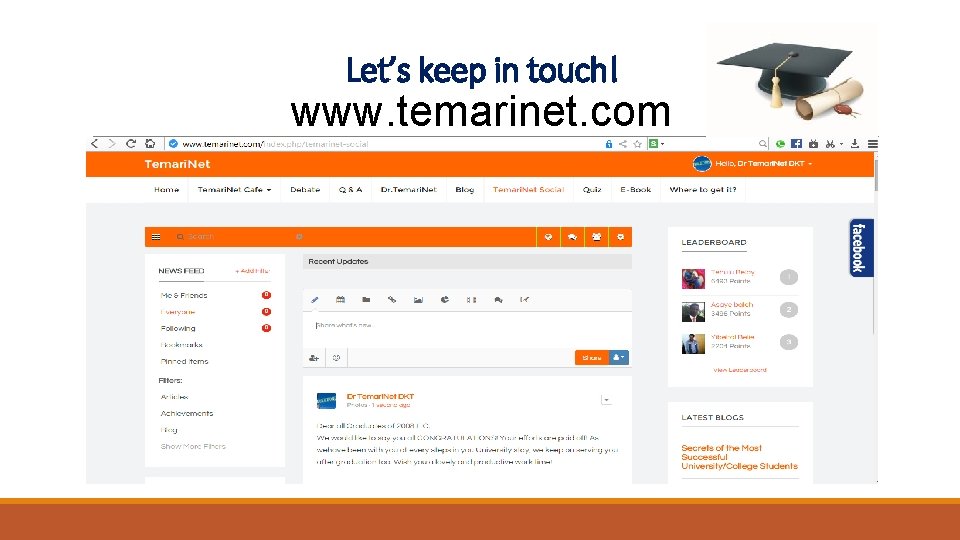
Let’s keep in touch! www. temarinet. com
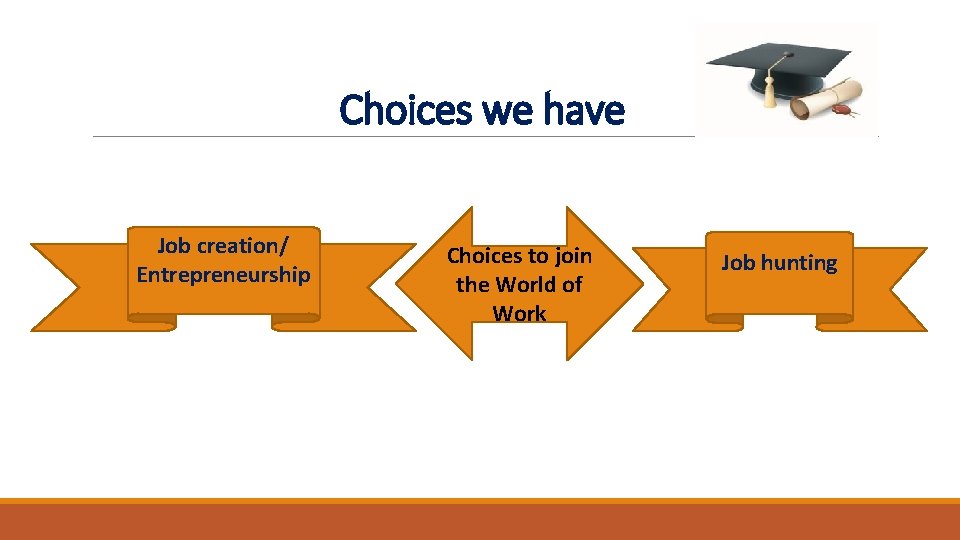
Choices we have Job creation/ Entrepreneurship Choices to join the World of Work Job hunting
Job creation/ Entrepreneurship What is entrepreneurship? ØEntrepreneurship ◦ Strategic thinking and risk-taking behavior that results in the creation of new opportunities for individuals and/or organizations. ØEntrepreneurs ◦ Risk-taking individuals who take actions to pursue opportunities and situations others may fail to recognize or may view as problems or threats.
Job creation/ Entrepreneurship Ø Entrepreneurs are … – Founders of businesses that become large-scale enterprises. – People who: • Buy a local franchise outlet • Open a small retail shop • Operate a self-employed service business – People who introduce a new product or operational change in an existing organization.
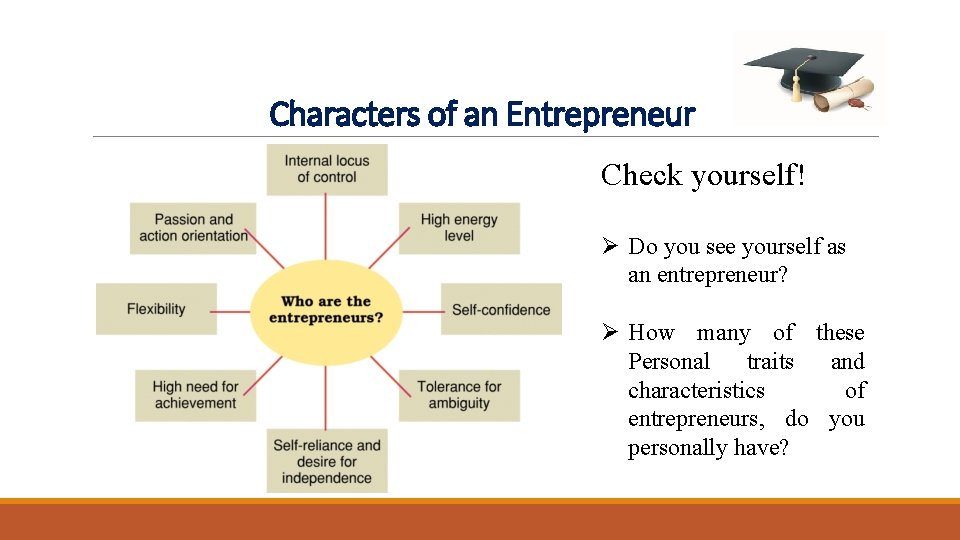
Characters of an Entrepreneur Check yourself! Ø Do you see yourself as an entrepreneur? Ø How many of these Personal traits and characteristics of entrepreneurs, do you personally have?
Why to be an Entrepreneur Ø Reasons for becoming entrepreneurs: – Being motivated by a new idea. – Doing for themselves what they were already doing for other employers. – Seeking a pathway to opportunity.
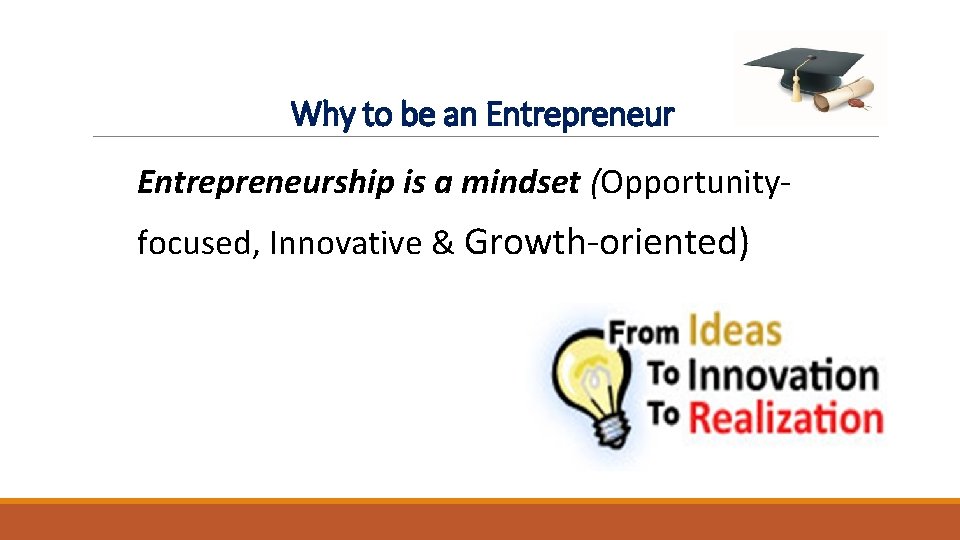
Why to be an Entrepreneurship is a mindset (Opportunityfocused, Innovative & Growth-oriented)
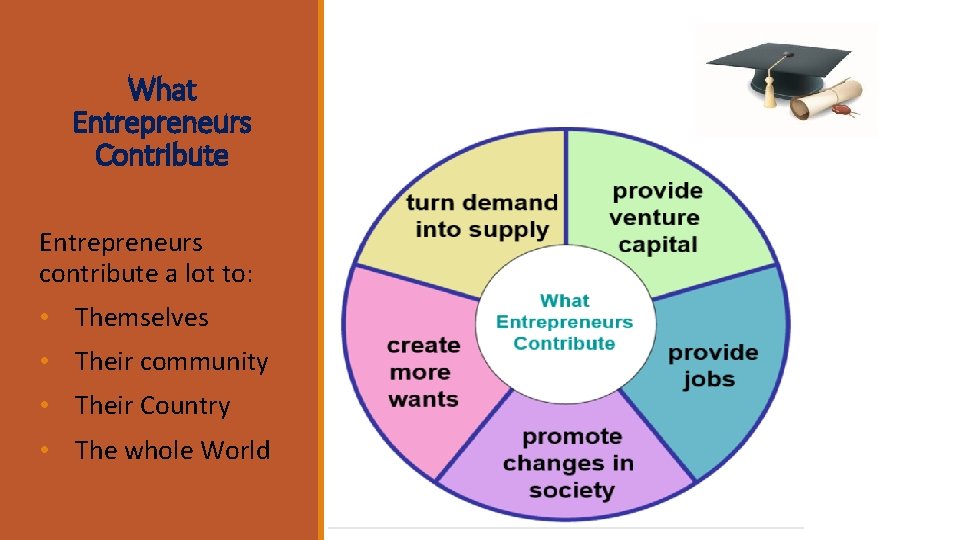
What Entrepreneurs Contribute Entrepreneurs contribute a lot to: • Themselves • Their community • Their Country • The whole World
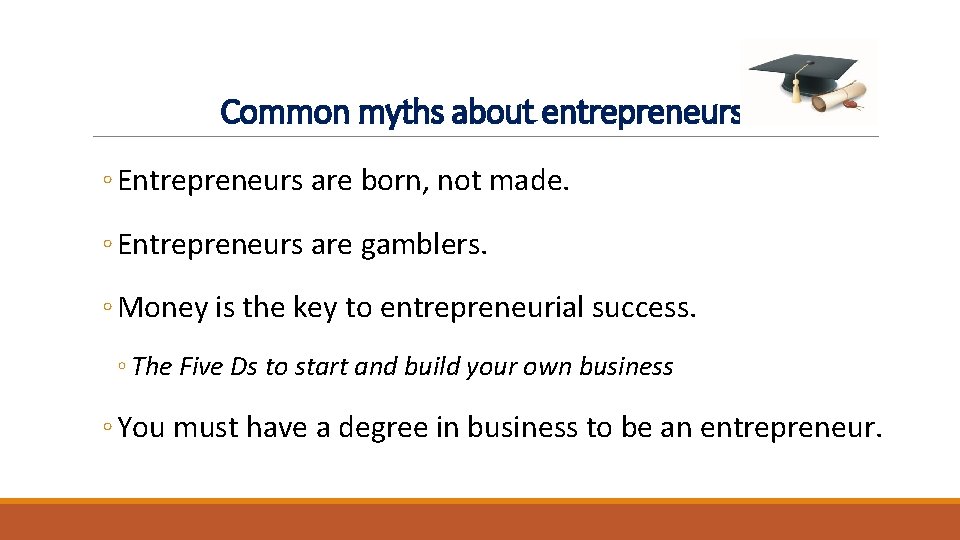
Common myths about entrepreneurs ◦ Entrepreneurs are born, not made. ◦ Entrepreneurs are gamblers. ◦ Money is the key to entrepreneurial success. ◦ The Five Ds to start and build your own business ◦ You must have a degree in business to be an entrepreneur.
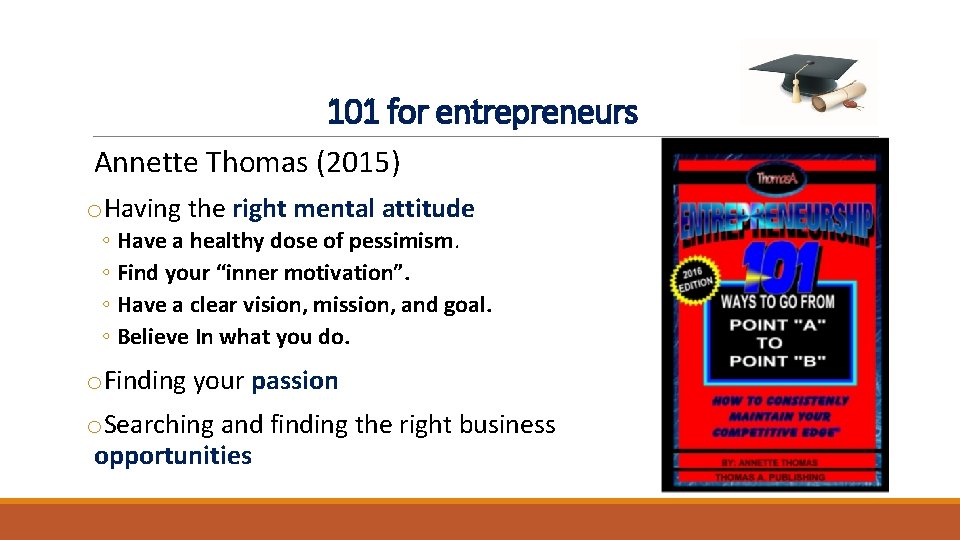
101 for entrepreneurs Annette Thomas (2015) o. Having the right mental attitude ◦ Have a healthy dose of pessimism. ◦ Find your “inner motivation”. ◦ Have a clear vision, mission, and goal. ◦ Believe In what you do. o. Finding your passion o. Searching and finding the right business opportunities
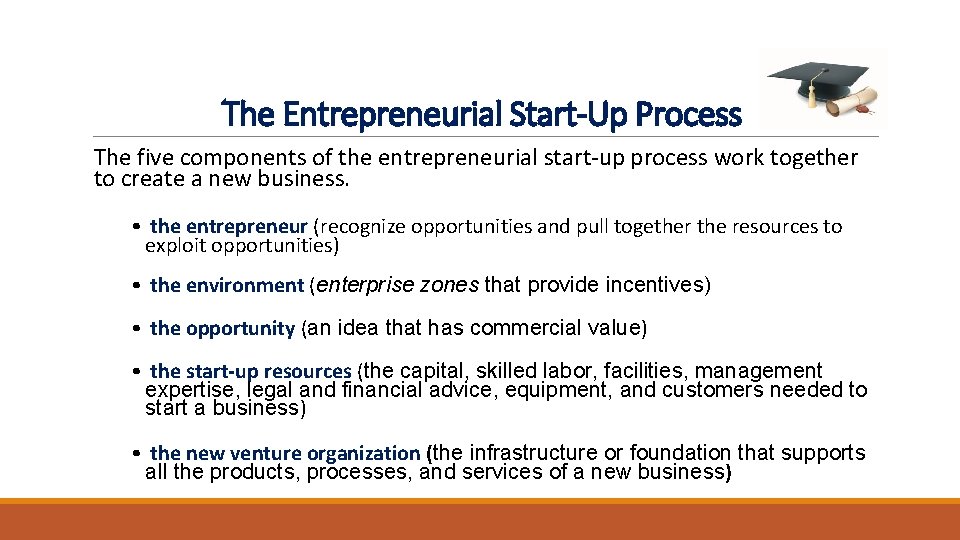
The Entrepreneurial Start-Up Process The five components of the entrepreneurial start-up process work together to create a new business. • the entrepreneur (recognize opportunities and pull together the resources to exploit opportunities) • the environment (enterprise zones that provide incentives) • the opportunity (an idea that has commercial value) • the start-up resources (the capital, skilled labor, facilities, management expertise, legal and financial advice, equipment, and customers needed to start a business) • the new venture organization (the infrastructure or foundation that supports all the products, processes, and services of a new business)
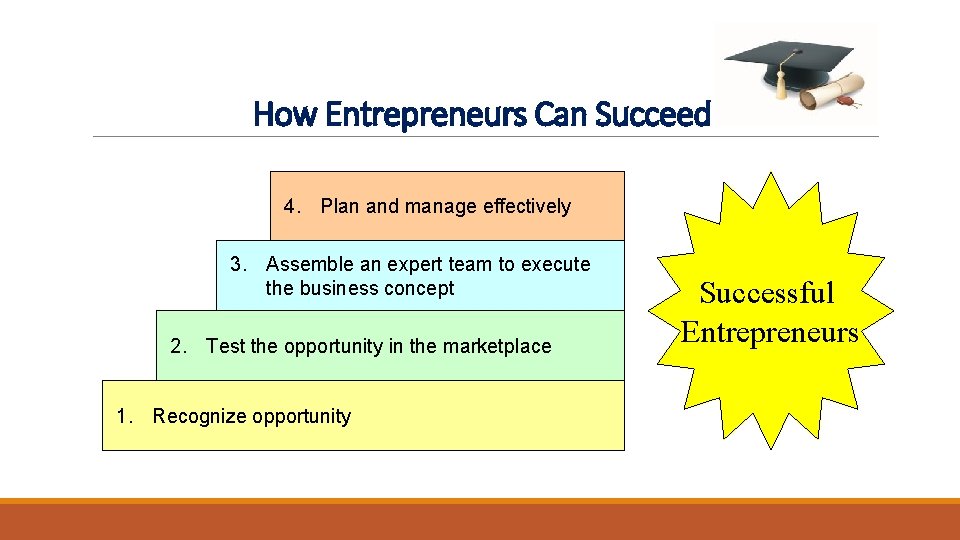
How Entrepreneurs Can Succeed 4. Plan and manage effectively 3. Assemble an expert team to execute the business concept 2. Test the opportunity in the marketplace 1. Recognize opportunity Successful Entrepreneurs
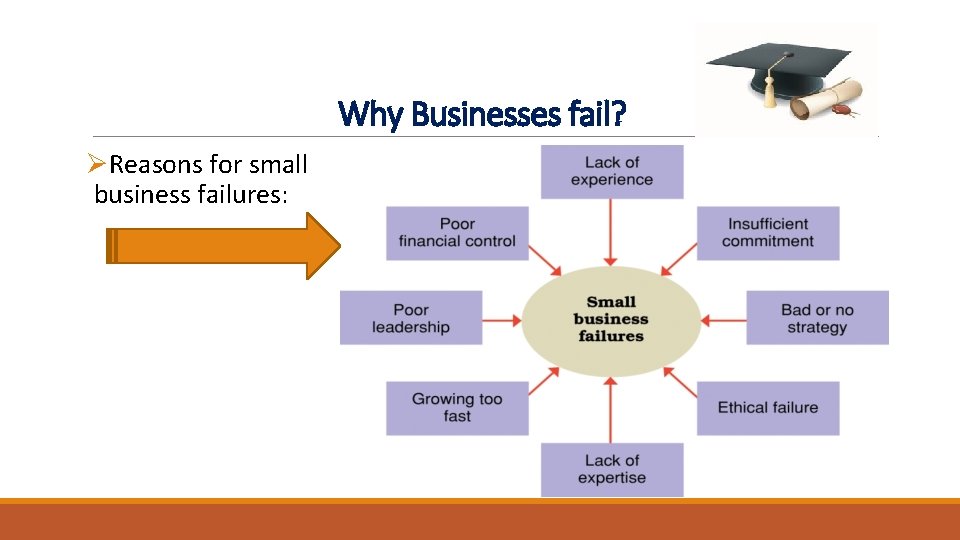
Why Businesses fail? ØReasons for small business failures:
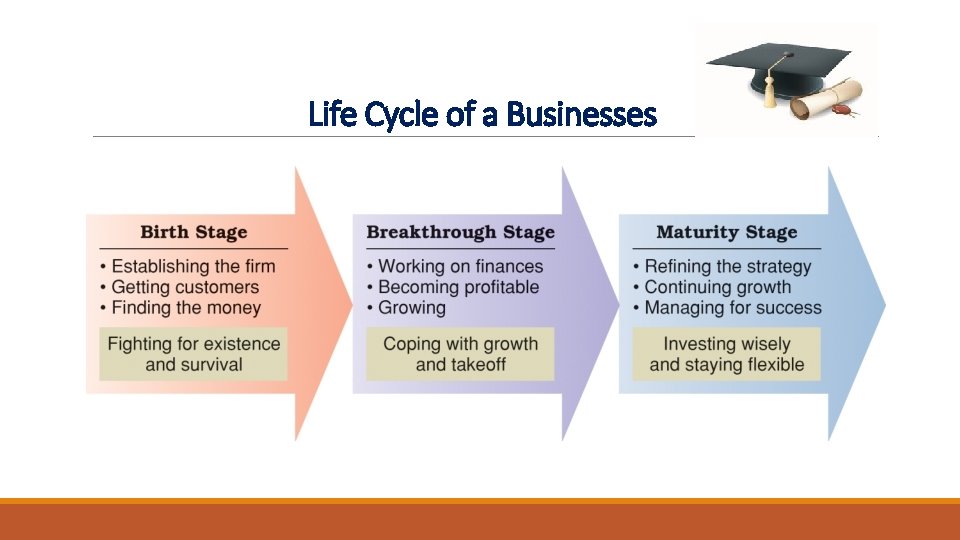
Life Cycle of a Businesses
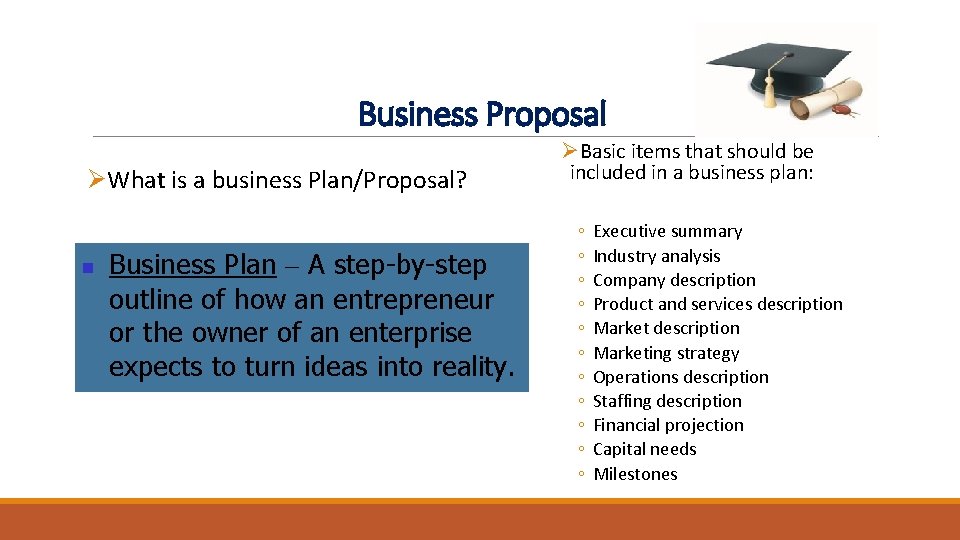
Business Proposal ØWhat is a business Plan/Proposal? n Business Plan – A step-by-step outline of how an entrepreneur or the owner of an enterprise expects to turn ideas into reality. ØBasic items that should be included in a business plan: ◦ ◦ ◦ Executive summary Industry analysis Company description Product and services description Marketing strategy Operations description Staffing description Financial projection Capital needs Milestones
Questions?
Let’s keep in touch! www. temarinet. com
Job Hunting What are the biggest challenges graduate jobseekers are facing today? ØA survey of Guardian Careers readers revealed a lack of jobs, extended unpaid internships and being dubbed too inexperienced for graduate jobs are the biggest challenges in the job market right now. (theguardian, 2012).
. Job Hunting Why does it take some people more time than others to find a job? And what sort of job should you be looking for? Job seeking requires action, and the most effective action is to go out and make contacts with the people who are most likely to need someone with your skills.
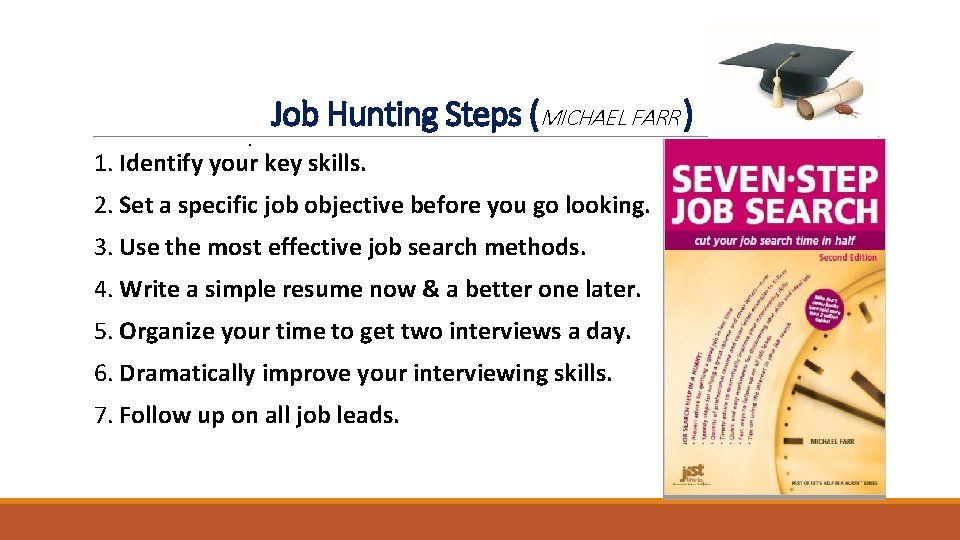
. Job Hunting Steps (MICHAEL FARR ) 1. Identify your key skills. 2. Set a specific job objective before you go looking. 3. Use the most effective job search methods. 4. Write a simple resume now & a better one later. 5. Organize your time to get two interviews a day. 6. Dramatically improve your interviewing skills. 7. Follow up on all job leads.
Job Hunting How to search a job How to write a resume How to ‘wow’ at an interview How to excel on job
Job searching Organize your time while searching a job If you find yourself unemployed/ A gap year? ◦Brush up your skill and learn the language ◦Volunteer or intern ◦Find a temporary work ◦Take related course
TOP TIPS FOR A JOB SEARCH ØThere is more to the job search than just sending out resumes. ØUnderstand that the job search is a full-time job. ØUse multiple job search strategies. ØStart early. ØNetwork and speak with others in your career field. ØRealize that your major oftentimes doesn’t equal a job title.
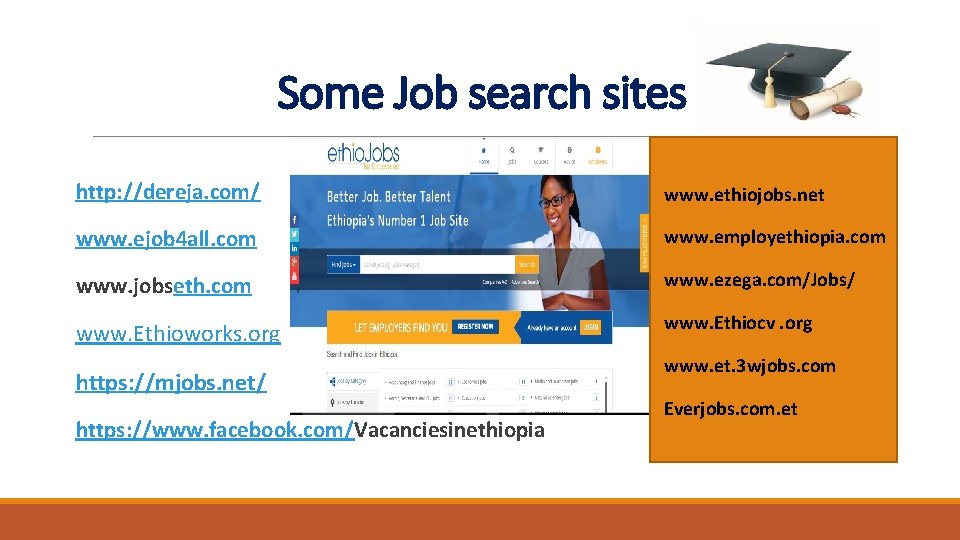
Some Job search Options q. Newspapers ( Reporter, Daily Monitor, Addis Zemen, Ethiopian Herald, Fortune, Capital, etc) q. Notice boards q. Networking q. Job searching websites
Some Job search sites http: //dereja. com/ www. ethiojobs. net www. ejob 4 all. com www. employethiopia. com www. jobseth. com www. ezega. com/Jobs/ www. Ethioworks. org www. Ethiocv. org https: //mjobs. net/ https: //www. facebook. com/Vacanciesinethiopia www. et. 3 wjobs. com Everjobs. com. et
Job searching If you don’t succeed at first “ Many of life’s failures are people who don’t realize how they were close to success when they gave up. ” Thomas Edison
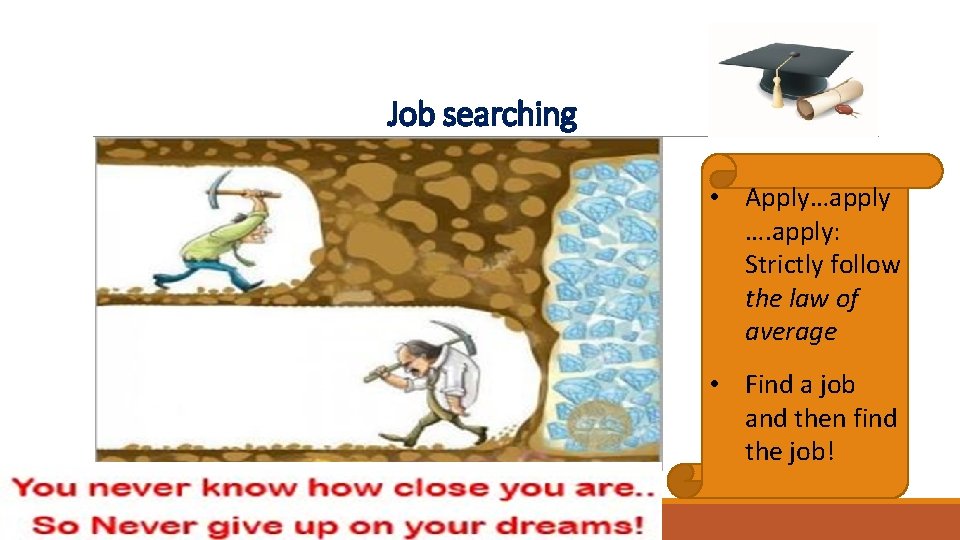
Job searching • Apply…apply …. apply: Strictly follow the law of average • Find a job and then find the job!
Keys to a Successful Job Search • Preparation of Curriculum Vitae • The Job Interview • Career development
Learning to Market Yourself • Creating a self marketing Tool is important for your success.
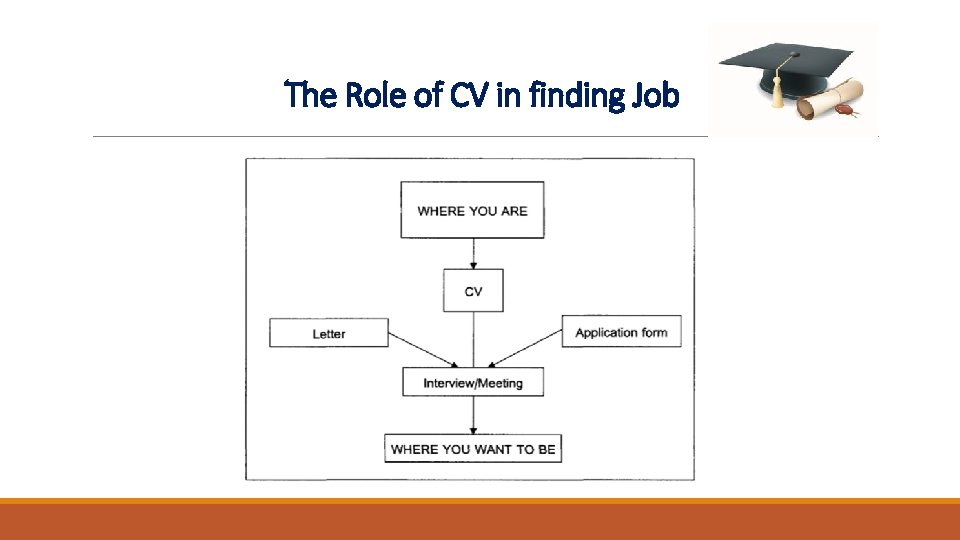
Preparation of Curriculum Vitae • One of the most important marketing tools is a Curriculum Vitae (CV) • Curriculum Vitae (CV) is the Latin for 'the course of your life'. • CVs are mostly used to screen candidates for interview • CVs are the first introducer to the interviewer and explains your complete background
Aim of CV • As the purpose of a CV is to inform briefly the reader of a number of points about yourself, making a CV that works for you is crucial for job success. This usually includes: Øpersonal details Øeducation and training received Øwork history Øskills you possess Øreferences.
Aim of CV • A CV is your sales document that highlights your skills, achievements and experience in such a way that the reader is motivated to meet you. • The objective of a CV is not to get you a job or to win you a contract, but to get you an interview or meeting.
The Role of CV in finding Job
How To Write A Great CV: Basics • We are competing in an overcrowded market, seeking to grab the attention of our reader. So: ◦ How will we make ours stand out? ◦ How can we make an immediate, positive impact on the reader? • Avoid information overload • INVEST SOME TIME IN SHAPING YOUR LIFE
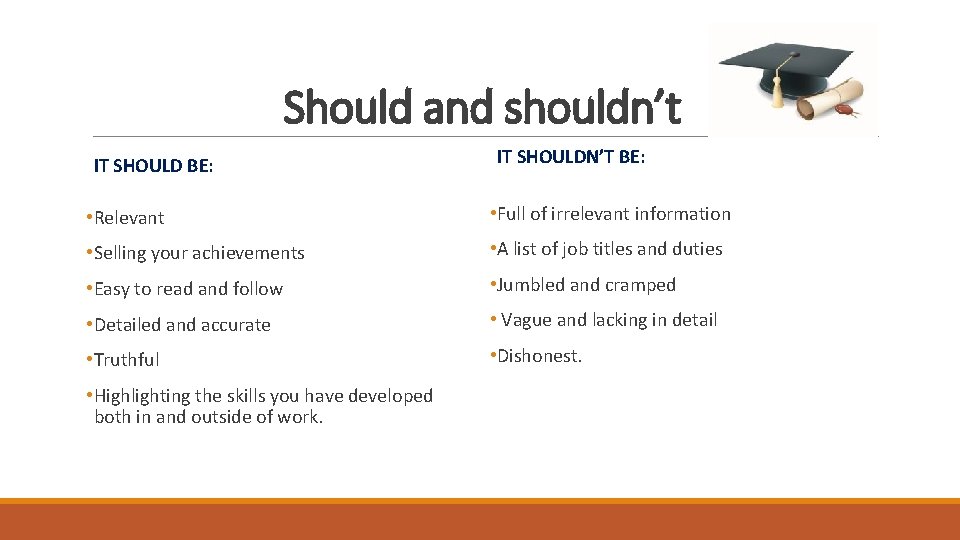
Should and shouldn’t IT SHOULD BE: IT SHOULDN’T BE: • Relevant • Full of irrelevant information • Selling your achievements • A list of job titles and duties • Easy to read and follow • Jumbled and cramped • Detailed and accurate • Vague and lacking in detail • Truthful • Dishonest. • Highlighting the skills you have developed both in and outside of work.
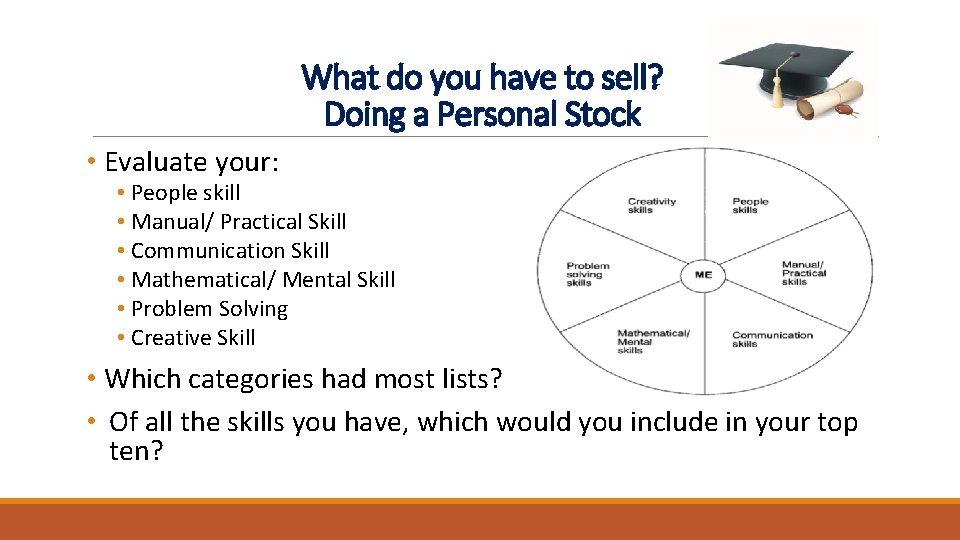
What do you have to sell? Doing a Personal Stock • Evaluate your: • People skill • Manual/ Practical Skill • Communication Skill • Mathematical/ Mental Skill • Problem Solving • Creative Skill • Which categories had most lists? • Of all the skills you have, which would you include in your top ten?
Identifying Your Achievements • Many people do not believe they have ever achieved anything in life! • As usual, people can tend to take for granted successes they have had. • Take time and identify your achievements in three areas: • work related • leisure related • home related
Types of CV 1. Chronological CV – Education and Training is given importance. The latest qualification comes first – reverse order 2. Functional / Skill based CV- CVs are created with concentrate on skills and responsibilities or experiences. Usually meant for experienced persons 3. Speculative CV - sent not based on any advertisement - match your skills, experiences, education with the skills of the job requires Sent to right person if possible by name Emphasis on achievements and results. It should be given in quantifiable terms
Components of A CV 1. A heading : name, age, address, etc. 2. Personal information (age, Marital status, …) 3. Statement of your job/career objective: be specific 4. Summary of your educational background: reverse chronological order ◦ ◦ ◦ Degree awarded( including name of school, year & specialty) Grade point average ( if distinction and above) Honors and awards Professional/ training certificates Extracurricular activities 5. A summary of your work experience 6. Hobbies and Interests 7. List of references
A Good CV ØA good CV is evaluated based on its: Ø Style – the layout, formatting and headings you use Ø Content – All good stuff about you Ø Points of agreement – Point out how and why you meet their requirements. ØSummary of one’s life –details of education, experiences and achievement ØEasy to read language, design, focus on the job ØUse font size 10 -12, Arial/Times New Roman style ØTyped in A 4 size paper
CV mistakes : resume killers 1. Abbreviations 2. Graphics and artworks 3. Negativity 4. No dates 5. Grammar mistakes and typos 6. Long winded: long resumes are boring. 7. Lack of achievements ( relevant) 8. Irrelevant information 9. Trying to sound “ too cleaver” with the words you use
Cover letter It accompanies your resume or CV. It includes: 1. Explanation of the purpose of the letter 2. Explanation of how you learned about the opening 3. Comparison your qualification and the job requirements 4. Request for an interview or other responses to the letter 5. Statements of references will be sent up on request 6. Thanks for prospective employer’s consideration
Cover letter The cover letter reflects your communication skills and to some extent your personality. It includes: 1. Name and address - Left side top Date and Place- Right side top 2. Head the Letter - Subject and Reference 3. The middle paragraph – Brief description of your education and experiences 4. Closing - The closing in which you propose step for further action. Don’t end with hit the mark, use sentence with gentle and polite manner
Sample Cover letter
Cover letter Mistakes Cover letter mistakes you may make when applying via E-mail or in person: 1. Attaching the cover letter to the email or using one fits all cover letter. 2. Writing your whole life story in the body of the e-mail. 3. Providing information not relevant to the position. 4. Excluding information they have asked you to include. 5. Not using a cover letter at all. 6. Forgetting to tell why you are the best fit. 7. Using a boring closing statement.
Questions?
Let’s keep in touch! www. temarinet. com
Job Interview What is Job Interview? A job interview is an interview consisting of a conversation between a job applicant and a representatives of an employer which is conducted to assess whether the applicant should be hired.
Types of Job Interview One-on-one most often used Group you will meet with more than one person at a time
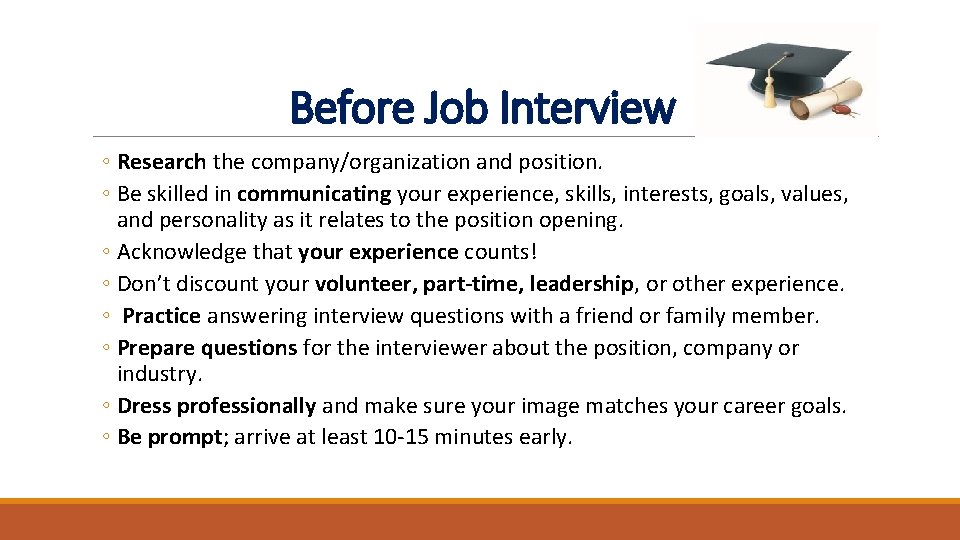
Before Job Interview ◦ Research the company/organization and position. ◦ Be skilled in communicating your experience, skills, interests, goals, values, and personality as it relates to the position opening. ◦ Acknowledge that your experience counts! ◦ Don’t discount your volunteer, part-time, leadership, or other experience. ◦ Practice answering interview questions with a friend or family member. ◦ Prepare questions for the interviewer about the position, company or industry. ◦ Dress professionally and make sure your image matches your career goals. ◦ Be prompt; arrive at least 10 -15 minutes early.
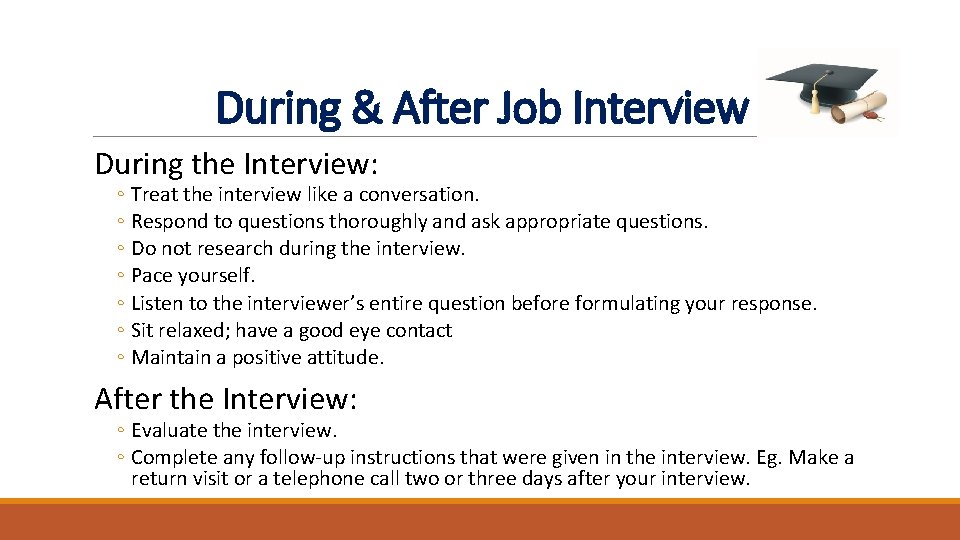
During & After Job Interview During the Interview: ◦ Treat the interview like a conversation. ◦ Respond to questions thoroughly and ask appropriate questions. ◦ Do not research during the interview. ◦ Pace yourself. ◦ Listen to the interviewer’s entire question before formulating your response. ◦ Sit relaxed; have a good eye contact ◦ Maintain a positive attitude. After the Interview: ◦ Evaluate the interview. ◦ Complete any follow-up instructions that were given in the interview. Eg. Make a return visit or a telephone call two or three days after your interview.
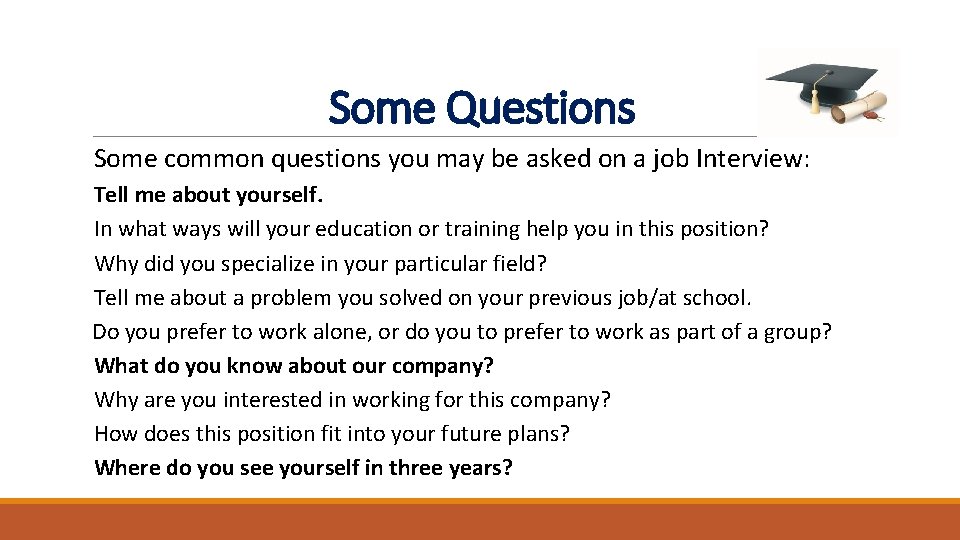
Some Questions Some common questions you may be asked on a job Interview: Tell me about yourself. In what ways will your education or training help you in this position? Why did you specialize in your particular field? Tell me about a problem you solved on your previous job/at school. Do you prefer to work alone, or do you to prefer to work as part of a group? What do you know about our company? Why are you interested in working for this company? How does this position fit into your future plans? Where do you see yourself in three years?
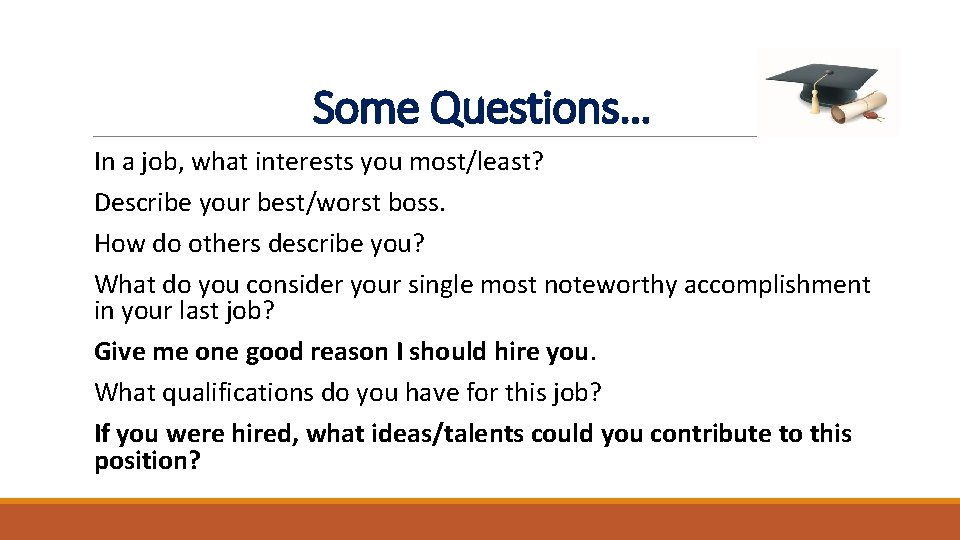
Some Questions… In a job, what interests you most/least? Describe your best/worst boss. How do others describe you? What do you consider your single most noteworthy accomplishment in your last job? Give me one good reason I should hire you. What qualifications do you have for this job? If you were hired, what ideas/talents could you contribute to this position?
Some Questions… What do you consider your most outstanding quality? What evidence can you cite that demonstrates your job effectiveness? Give me two good reasons I should not hire you. What would you most like to improve about yourself? What could you have done better on your last job? What can you tell me that best illustrates your personal drive and motivation.
Examples of wrong answers 1. why do you want to work here ? Wrong Answer : I need a job, I need a shorter commute/Travel, It seems like a greet company. 2. What is your greatest weakness? Wrong Answer : I don’t have one, I’m perfectionist 3. Why are you leaving your current Job? Wrong Answer: I hate my boss or I am not getting paid enough 4. Tell us your 5 or 10 Year plan/goal ? Wrong Answer: I don't have plan, God knows that 5. Do you have any question for us? Wrong Answer: Nope, what is the salary for this position, how many vacation days will I get ?
Caution! You may lose job because: 1. Your resume is bulky (2+ pages for a new grad). 2. You ask too simple of questions in an interview. 3. You fail to look the part of the job. Be clean and neat. 4. You ask about salary before you are formally offered the job. 5. You arrive late to the interview.
Caution!. . . You may lose job because: 6. You fail to apply because it says you need two plus years of experience. 7. You are intimidated by a job title. Do you want to be a big fish in a small pond or a small fish in a big pond? 8. Your social media presence is negative. 9. You bring your phone to an interview. 10. You badmouth past employers.
Questions?
Let’s keep in touch! www. temarinet. com
See you all at the top of the ladder! Good luck!
Congratulations!