
The Cold War Ch 38 39 KEY QUESTIONS


- Slides: 20
The Cold War Ch. 38 -39 KEY QUESTIONS: HOW DID THE UNITED STATES AND THE SOVIET UNION BECOME COLD WAR ENEMIES? WERE THE METHODS USED BY THE U. S. TO CONTAIN COMMUNISM JUSTIFIED? HOW DID THE ANXIETIES RAISED BY THE COLD WAR AFFECT LIFE IN THE UNITED STATES?
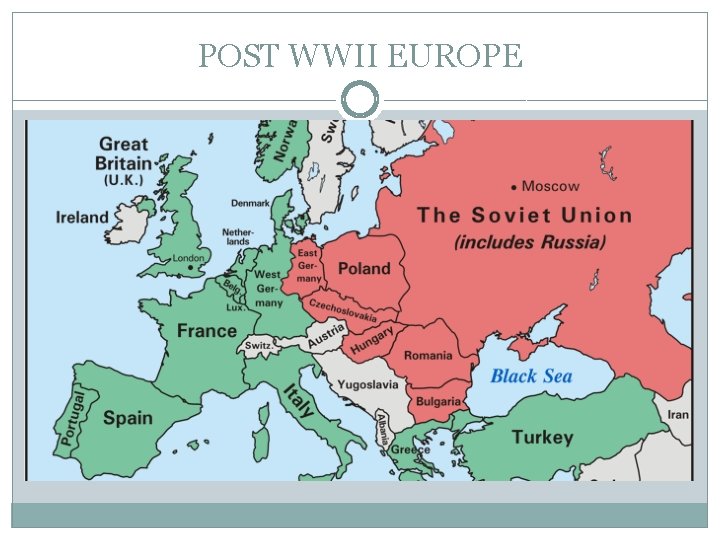
POST WWII EUROPE
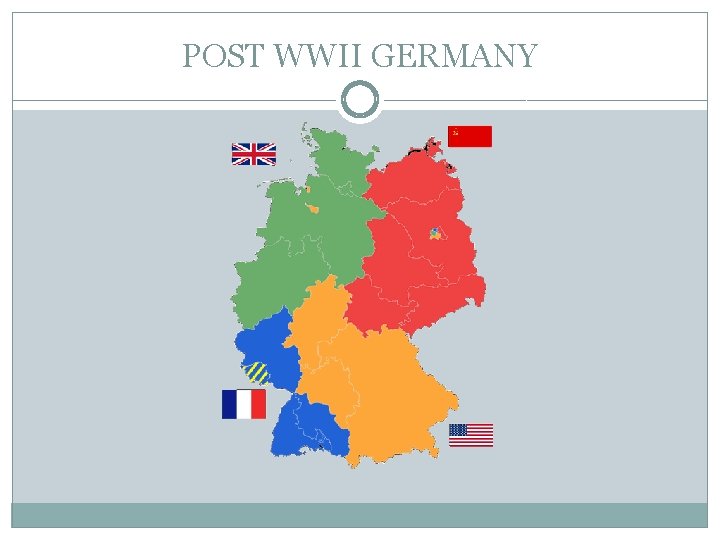
POST WWII GERMANY
38. 2 Forming an Uneasy Peace �After WWII, U. S. and Soviet Union remained as the two major superpowers �Agreed at the Yalta Conference that Eastern Europe should be Democratic �Later at the Potsdam Conference, much changed FDR replaced by Truman Churchill replaced by Attlee Even though Stalin promised elections, most that had occurred had been rigged by the Soviets
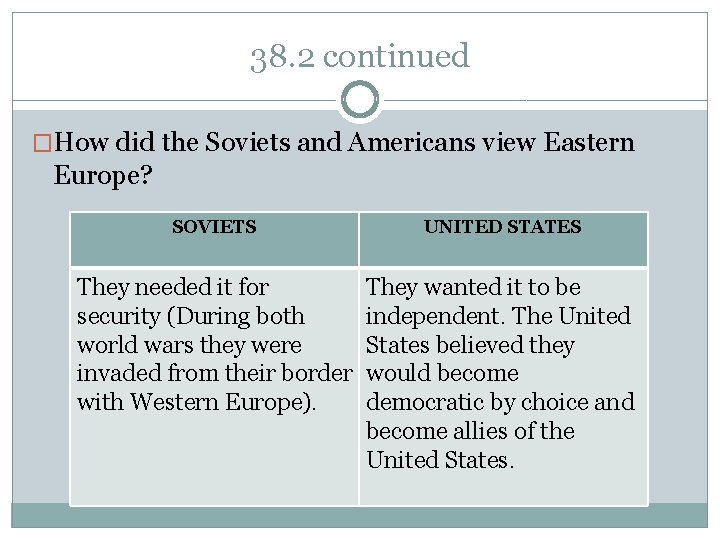
38. 2 continued �How did the Soviets and Americans view Eastern Europe? SOVIETS UNITED STATES They needed it for security (During both world wars they were invaded from their border with Western Europe). They wanted it to be independent. The United States believed they would become democratic by choice and become allies of the United States.
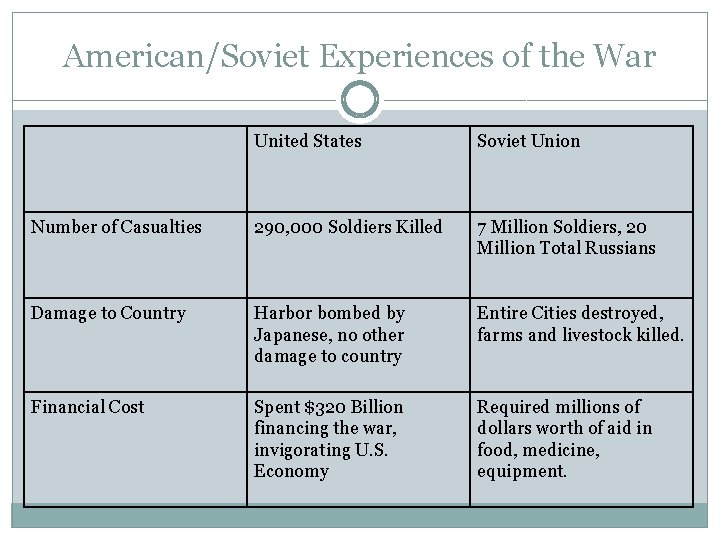
American/Soviet Experiences of the War United States Soviet Union Number of Casualties 290, 000 Soldiers Killed 7 Million Soldiers, 20 Million Total Russians Damage to Country Harbor bombed by Japanese, no other damage to country Entire Cities destroyed, farms and livestock killed. Financial Cost Spent $320 Billion financing the war, invigorating U. S. Economy Required millions of dollars worth of aid in food, medicine, equipment.
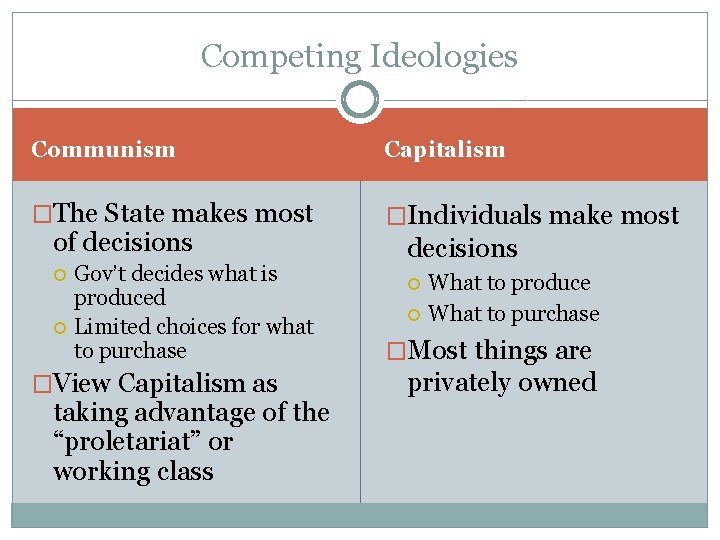
Competing Ideologies Communism Capitalism �The State makes most �Individuals make most of decisions Gov’t decides what is produced Limited choices for what to purchase �View Capitalism as taking advantage of the “proletariat” or working class decisions What to produce What to purchase �Most things are privately owned
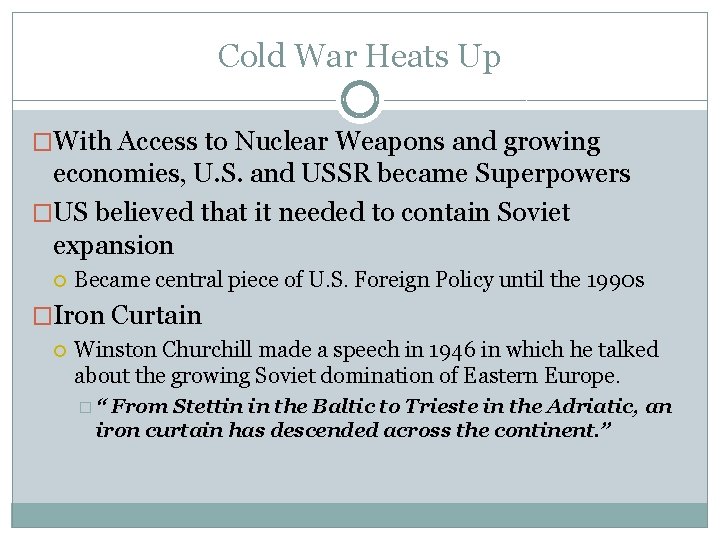
Cold War Heats Up �With Access to Nuclear Weapons and growing economies, U. S. and USSR became Superpowers �US believed that it needed to contain Soviet expansion Became central piece of U. S. Foreign Policy until the 1990 s �Iron Curtain Winston Churchill made a speech in 1946 in which he talked about the growing Soviet domination of Eastern Europe. �“ From Stettin in the Baltic to Trieste in the Adriatic, an iron curtain has descended across the continent. ”
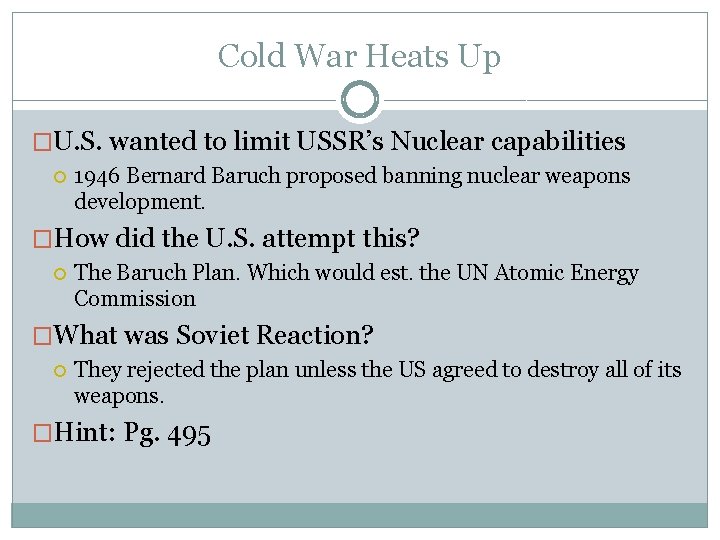
Cold War Heats Up �U. S. wanted to limit USSR’s Nuclear capabilities 1946 Bernard Baruch proposed banning nuclear weapons development. �How did the U. S. attempt this? The Baruch Plan. Which would est. the UN Atomic Energy Commission �What was Soviet Reaction? They rejected the plan unless the US agreed to destroy all of its weapons. �Hint: Pg. 495
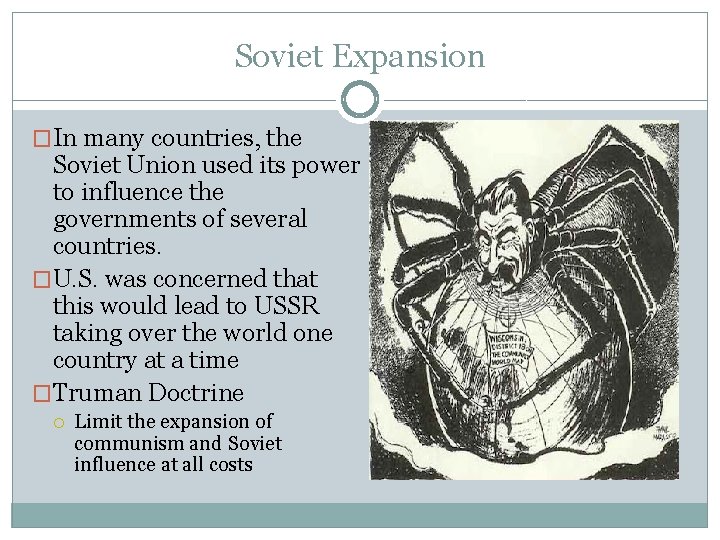
Soviet Expansion �In many countries, the Soviet Union used its power to influence the governments of several countries. �U. S. was concerned that this would lead to USSR taking over the world one country at a time �Truman Doctrine Limit the expansion of communism and Soviet influence at all costs
Rebuilding Europe �Europe was heavily damaged and in economic ruin after WWII �Both the U. S. and USSR saw an opportunity to gain support from European countries �U. S. Marshall plan offered aid to European countries that would support the United States Western European Countries supported this �Soviets responded with the Molotov Plan Eastern European Countries forced to follow this
39. 2 Dealing with Postwar Europe �After WWII, Germany was divided into 4 zones American, British, French, Soviet Americans, British, and French wanted to reunify Germany as a democratic, capitalist country Soviets were angered and blockaded Berlin �Americans dropped millions of pounds of supplies into Berlin in the “Berlin Airlift” �Uprising in Hungary tests U. S. Containment policy U. S. does not intervene, afraid of risking a war with USSR
39. 2 Dealing with Postwar Europe �Two alliances were formed in 1949 to provide for mutual defense and essentially divided Europe in half. NATO: The United States and Western European nations formed the North Atlantic Treaty Organization Warsaw Pact: The Soviet Union responded by forming an alliance with the Communist countries of Eastern Europe.
39. 3 Cold War in Asia � 1949, China falls to communist Mao Zedong US feared communist expansion from China; turned to Japan as an ally in Asia Cut off all trade and communication with China in 1949 �In 1950, Communist North Korea invaded South Korea, sparking the Korean War. U. S. Forces invaded North Korea, almost to the border with China Feeling threatened, China sent 400, 000 troops into North Korea. In 1953, an armistice was signed; countries technically still at war
Fighting the Cold War in the Third World �Both sides used economic and covert or secret means to influence developing countries �US very involved in South America Often would support anticommunist dictators, despite their treatment of their people �Soviets countered US efforts with their own �CIA used its influence to spread capitalism and democracy, even through undemocratic means Overthrew leaders in Iran, Guatemala, and Dominican Republic
Arms Race �Both sides attempted to stockpile as many nuclear weapons as they could, and position them in locations that would give them an advantage �Brinksmanship (promoted by John Dulles) Playing chicken with Nuclear Weapons �Deterrence policy of Mutually Assured Destruction “If you shoot at me, I WILL shoot at you” �Nuclear Stockpiles: US: 10, 000 warheads USSR: 9, 000 warheads China/UK/France: ~100 warheads
CH. 40 Vocab �Communist Sympathizers: A person who believes in communist ideology but is not a member of the Communist Party �House Un-American Activities Committee Formed in 1938, a committee of the U. S House of Representatives that investigated subversive organizations in the United States in 1975. �Alger Hiss Case A court case involving Alger Hiss, a U. S. State Department official accused of passing secrets to the Soviet Union, that contributed to a growing fear of subversion during the early Cold War. In 1950 a grad jury convicted Hiss of perjury but his guilt in regard to espionage was not proven.
CH. 40 Vocab �Rosenberg trial The controversial 1951 trial of two Americans, Ethel and Julius Rosenberg, charged with passing atomic secrets to the Soviets; the two were sentenced to death and executed in 1953, making them the only America civilians to be put to death for spying during the Cold War �Mc. Carthyism The practice of publicly accusing people of subversive activities without evidence to back up the charges; named for Senator Joseph Mc. Carthy who began such a practice in the early 1950’s.
CH. 40 Vocab �Atomic Age The era in which atomic weapons have been used, beginning in 1945 with the first use of the atomic bomb and lasting to the present time. �Federal Civil Defense Administration (FCDA) A federal agency established by Congress in 1951 to plan for civil defense during the arms race by preparing Americans to survive a nuclear attack.
Topics to Review 1. 2. 3. 4. 5. 6. 7. Soviet and American goals at Yalta Baruch Plan Iron Curtain Truman Doctrine Marshall Plan Outcome of the Korean War Berlin Airlift 8. NATO and the Warsaw 9. 10. 11. 12. 13. 14. Pact Brinksmanship Mc. Carthyism Third World Countries Alger Hiss FCDA The Rosenbergs