Invited paper the Thorium Energy Alliance 8 th














- Slides: 83
Invited paper, the Thorium Energy Alliance 8 th Annual Future of Energy Conference, Saint Louis Union Station Hotel, Saint-Louis, Missouri, August 21 -22, 2017. RESTORING RELEVANCE TO NUCLEAR ENERGY, FUTURE INNOVATION STRATEGIES Jason Roemer and Magdi Ragheb Department of Nuclear, Plasma and Radiological Engineering University of Illinois at Urbana-Champaign, 216 Talbot Laboratory, 104 South Wright Street, Urbana, Illinois 61801, USA. jmroeme 2@illinois. edu mragheb@illinois. edu http: //www. mragheb. com
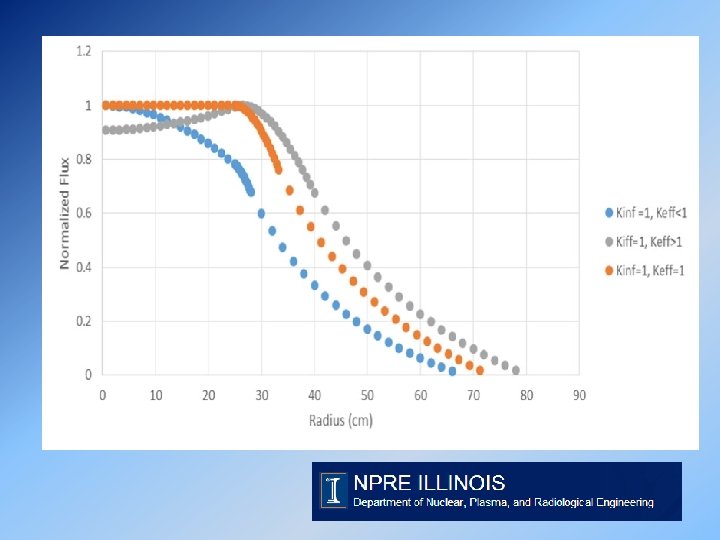
ABSTRACT Whereas thriving globally, nuclear electric generation faces hurdles in the USA. In addition to the shadows from Three Miles Island, Chernobyl and Fukushima, it faces prospects of plants closures and project cancellations caused by cost overruns, plant retirements, and economic competition from renewable and natural-gas sources. It is suggested that innovations are displacing the current technology. , A revival of nuclear generation can be envisioned within the Internet of Things, Io. T paradigm where small capacity units are added incrementally and operated in the load-following as well as base-load, complementing the intermittent nature of the renewable sources. Proposed is the possible adoption of a fail-safe design with a reactor core possessing an infinite multiplication factor of unity. Its underlying analytical and numerical solutions for a liquid molten salt fuel in cylindrical and spherical geometry is presented. The solutions result in a favorable flat neutron flux and power distribution in the core region. The introduction of loadfollowing and the use of dissociating gases are also discussed. Reviewed are other introduced innovations in small size units, the use of liquid fuels as a replacement of solid ones, and operation at low pressure using molten salts. The opportunity they present to isolate and tackle the decay heat issue of solid fuels, as well as the issue of tritium production, are pointed out. A future vision is presented for application to water dissociation into hydrogen as a future transportation system energy carrier, and for agro-industrial complexes and fresh water supplies for arid regions of the globe. 2
IAEA International Atomic Energy Agency report, “International Status and Prospects for Nuclear Power 2017” Global nuclear generating capacity increasing 123% by 2050 compared with its current level. Global nuclear generating capacity increases from 392 GWe at the end of 2016 to 554 GWe by 2030, 717 GWe by 2040 and 874 GWe by 2050. Nuclear's share of global electricity generation would increase from the current level of about 11% to 13. 7% by 2050. 30 -35 new reactors are expected to be grid connected annually starting around 2025. Largest growth is expected in central and eastern Asia, where capacity increases about 3. 5 times by 2050, compared with current levels. Capacity in North American is expected to decrease slightly by 2050. In Europe (excluding capacity initially dips but recovers to reach 120 GWe by 2050. 3
"In some countries, concerns about climate change provide an incentive to support continued operation of nuclear power plants, or are part of the argument for a new build program. " Target for nuclear energy is to provide 25% of electricity in 2050, requiring roughly 1000 GWe of new nuclear capacity to be constructed. "The decline compared to previous projections is mainly on account of early retirement or lack of interest in extending [the] life of nuclear power plants in some countries, due to the reduced competitiveness of nuclear power in the short run and national nuclear policies in several countries following the accident at the Fukushima Daiichi nuclear power plant in 2011. " 4
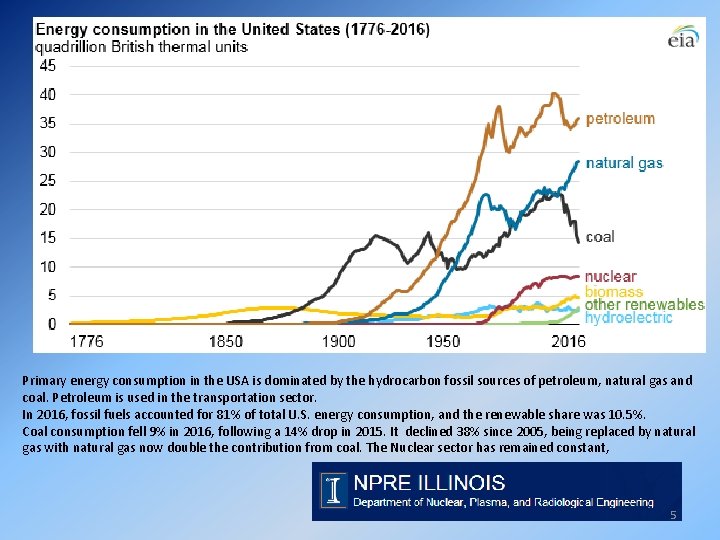
Primary energy consumption in the USA is dominated by the hydrocarbon fossil sources of petroleum, natural gas and coal. Petroleum is used in the transportation sector. In 2016, fossil fuels accounted for 81% of total U. S. energy consumption, and the renewable share was 10. 5%. Coal consumption fell 9% in 2016, following a 14% drop in 2015. It declined 38% since 2005, being replaced by natural gas with natural gas now double the contribution from coal. The Nuclear sector has remained constant, 5
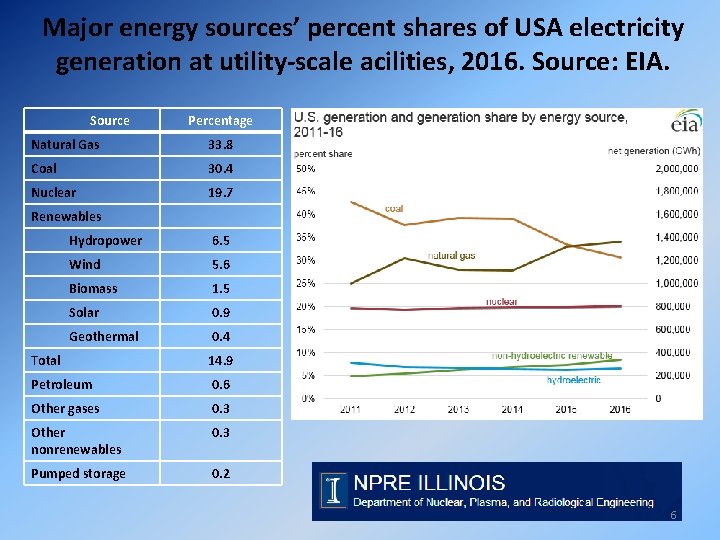
Major energy sources’ percent shares of USA electricity generation at utility-scale acilities, 2016. Source: EIA. Source Percentage Natural Gas 33. 8 Coal 30. 4 Nuclear 19. 7 Renewables Hydropower 6. 5 Wind 5. 6 Biomass 1. 5 Solar 0. 9 Geothermal 0. 4 Total 14. 9 Petroleum 0. 6 Other gases 0. 3 Other nonrenewables 0. 3 Pumped storage 0. 2 6
Competition between nuclear and renewable utility-scale electrical generation sources is occurring. Seasonal rain and snow melt for hydroelectric and installed capacity growth in wind and solar generation, as well as maintenance and refueling schedules for nuclear plans during the spring and fall months, when overall electricity demand is low; affect the overall picture. About 60% of all utility-scale electricity generating capacity that came online in 2016 was from wind and solar sources. Wind and solar follow seasonal patterns reflect the intermittency of their resources, while the monthly fluctuations in nuclear generation reflect maintenance and refueling schedules. Monthly nuclear electricity generation is expected to surpass renewables again during the summer months of 2017 and that nuclear will generate more electricity than renewables for all of 2017. 7
THE TOSHIBA-WESTINGHOUSE CLOUD SHADOW Toshiba's Westinghouse nuclear unit that sought Chapter 11 bankruptcy protection for cost overruns left an uncertain future for the completion of the construction of two nuclear reactors in Georgia. Toshiba promised to provide up to $3. 68 billion into the project to finish it. The payment will be to Georgia Power, a subsidiary of Southern Company, in installments between October 2017 and January 2021. Toshiba has a significant nuclear business in Japan in the decommissioning work at the Fukushima Daiichi plant, the site of the powerful earthquake and tsunami that hit Japan in 2011. Southern Company said the deal will hand over management of the project from Toshiba's unit, Westinghouse, to Southern Company. Toshiba's Westinghouse will still be involved with the project by way of lending engineering, licensing support, and the intellectual property rights needed for the project to Southern Company. Toshiba's nuclear construction efforts are at the heart of its current financial woes. Westinghouse was crippled by massive losses because the costs of its nuclear projects in the U. S. winded up "far surpassing estimates. " 8
Two USA utilities at risk are Southern Company (Vogtle 3 and 4, Georgia) and SCANA Corp (V. C. Summer 2 and 3, South Carolina). Westinghouse is presently constructing two unit, AP 1000 nuclear power stations for each utility. These projects are over-budget and behind schedule. Westinghouse offered both utilities a fixed price contract for these new nuclear plants. The fixed price construction guarantee doomed Westinghouse and prevented other potentially willing buyers from stepping in. No one is willing to take on this open-ended nuclear construction liability As these plants are brought on line in the 2020 -2021 time frame, the matter will go before the state utility commissions of Georgia and South Carolina. Both commissions approved these nuclear projects. The Vogtle units 3 and 4, located near Waynesboro in eastern Georgia near the South Carolina border, is jointly owned by Georgia Power (45. 7%), Oglethorpe Power Corporation (30%), Municipal Electric Authority of Georgia (22. 7%) and Dalton Utilities (1. 6%). 9
In December 2016, Westinghouse faced a heavy one-off loss linked to a deal done by Westinghouse, which had bought a nuclear construction and services business from Chicago Bridge & Iron (CB&I) in 2015. Thinking that it would speed up the construction process and remedy the cost-overuns, Westinghouse discovered that the assets that it took on were worth less than initially thought, and there was also a dispute about payments that are due. In February 2017, it emerged that the loss would be about $6. 3 bn. Toshiba's chairman resigned. To plug the gap, Toshiba sold a majority stake in its NAND flash-memory business to get it through its financial turbulence. V. C. Summer 2 and 3 units under construction, South Carolina 10
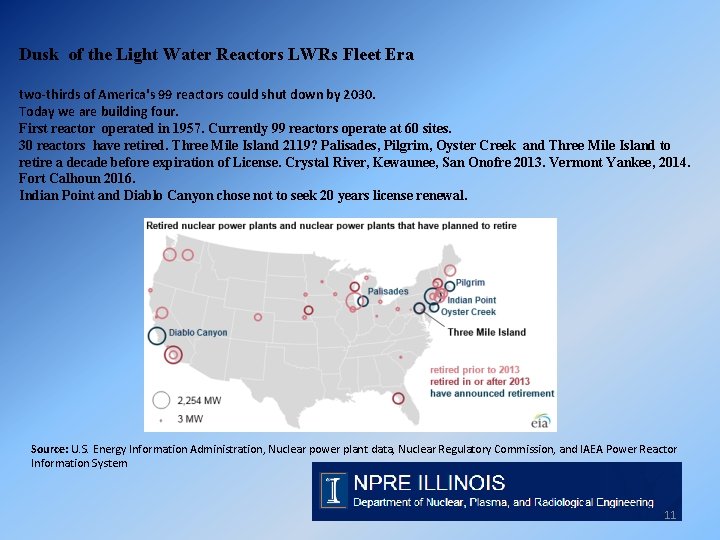
Dusk of the Light Water Reactors LWRs Fleet Era two-thirds of America's 99 reactors could shut down by 2030. Today we are building four. First reactor operated in 1957. Currently 99 reactors operate at 60 sites. 30 reactors have retired. Three Mile Island 2119? Palisades, Pilgrim, Oyster Creek and Three Mile Island to retire a decade before expiration of License. Crystal River, Kewaunee, San Onofre 2013. Vermont Yankee, 2014. Fort Calhoun 2016. Indian Point and Diablo Canyon chose not to seek 20 years license renewal. Source: U. S. Energy Information Administration, Nuclear power plant data, Nuclear Regulatory Commission, and IAEA Power Reactor Information System 11
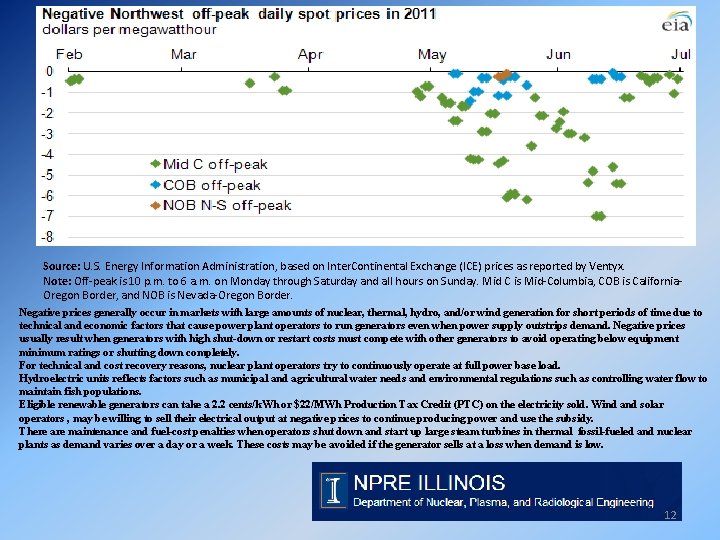
Source: U. S. Energy Information Administration, based on Inter. Continental Exchange (ICE) prices as reported by Ventyx. Note: Off-peak is 10 p. m. to 6 a. m. on Monday through Saturday and all hours on Sunday. Mid C is Mid-Columbia, COB is California. Oregon Border, and NOB is Nevada-Oregon Border. Negative prices generally occur in markets with large amounts of nuclear, thermal, hydro, and/or wind generation for short periods of time due to technical and economic factors that cause power plant operators to run generators even when power supply outstrips demand. Negative prices usually result when generators with high shut-down or restart costs must compete with other generators to avoid operating below equipment minimum ratings or shutting down completely. For technical and cost recovery reasons, nuclear plant operators try to continuously operate at full power base load. Hydroelectric units reflects factors such as municipal and agricultural water needs and environmental regulations such as controlling water flow to maintain fish populations. Eligible renewable generators can take a 2. 2 cents/k. Wh or $22/MWh Production Tax Credit (PTC) on the electricity sold. Wind and solar operators , may be willing to sell their electrical output at negative prices to continue producing power and use the subsidy. There are maintenance and fuel-cost penalties when operators shut down and start up large steam turbines in thermal fossil-fueled and nuclear plants as demand varies over a day or a week. These costs may be avoided if the generator sells at a loss when demand is low. 12
MARKET FAILURE The current situation for new nuclear build in the U. S. is bleak This is reflected in the status of NRC Combined Operating License (COL) applications: 2 plants with 2 Westinghouse AP 1000 reactors each are under construction – the Vogtle and Summer dual-reactor sites received approval of COL applications, were approved by state utility economic regulators in about 2007, and are now under construction 4 plants approved, but stalled – four new nuclear projects (Fermi 3, Levy County, South Texas Project, and W. S. Lee) have approved COL applications, but are on hold or cancelled 2 plants under review, but stalled – two projects (North Anna 3 and Turkey Point) have COL applications under review, but the sponsoring utilities have not committed to build 2 plants suspended – two COL applications (Comanche Peak and Harris) were suspended 8 plants withdrawn – eight COL applications (Bell Bend, Bellefonte, Callaway, Calvert Cliffs, Grand Gulf, Nine Mile Point, River Bend, and Victoria Country) were withdrawn Few planned applications – the Nu. Scale project in Idaho started the NRC Design Certification review process in early 2017, has plans to file a COL application in 2018.
14
FAIL-SAFE REACTOR CONCEPT Systems engineers have a maxim that: “If a system is not designed to be fail-safe, tested under all combinations of extreme conditions, and operated perfectly, it will fail. ” Hence it is mandatory that nuclear reactors designs must follow this maxim both at the design and the operational stages. Murphy’s Law: “If anything can go wrong, it will, ” or: “Anything that can go wrong, will go wrong, ” forces us to infer that our engineering systems will eventually fail if they were not developed so as to not fail in the first place. We thus attempt the consideration of a definitely fail-safe reactor design. 15
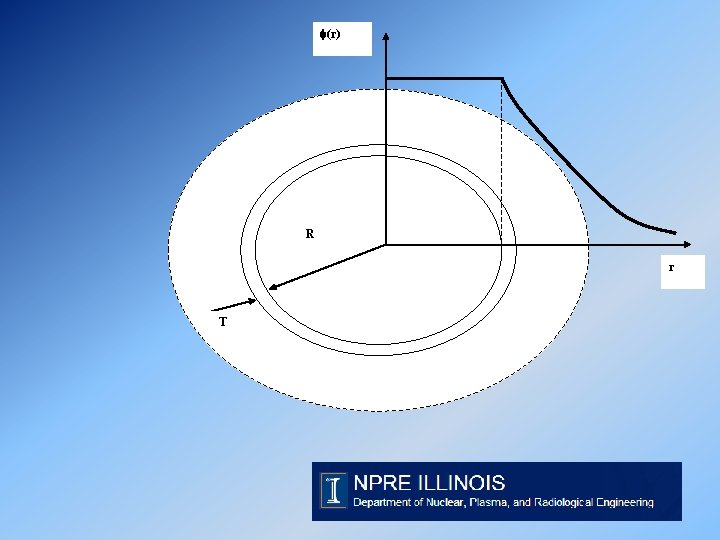
(r) R r T
21
Fail Safe Design-Flux Flattening • Uniform steam quality – Consistent void fraction in BWR – Even fuel burnup • Reduced Operations – Eliminates need for core coolant nozzles in PWR • Reduced fuel management – No need for rearrangement to compensate for radial differences in flux 24
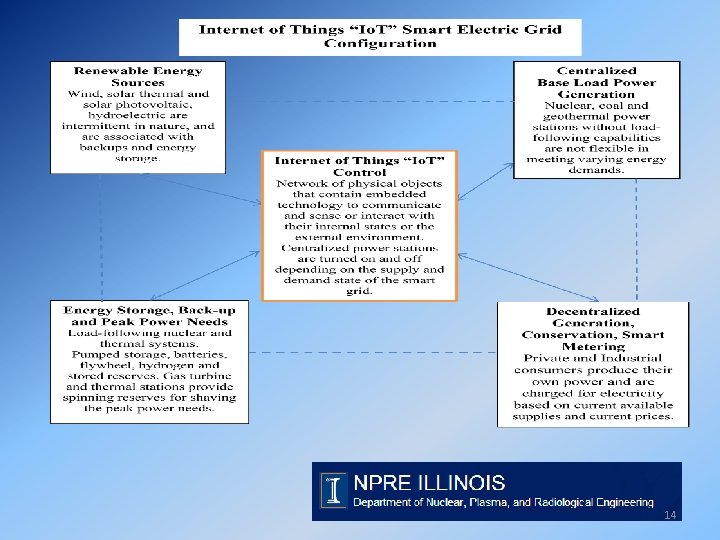
Load Following Vs. Baseload Generation • Baseload generation creates a consistent energy source while the plant is operating – Most “newer” nuclear plants are baseload • Create more electricity=more income • Load following generation creates a varying source of energy that matches energy demand • Complements intermittent energy sources 25
Why Load Following? • Energy usage throughout the day is not constant, it fluctuates • New intermittent sources of generation cause instability the grid • When demand is low, baseload utilities have to pay distributors to use their electricity without recoursing to shut down their thermal or nuclear plants 26
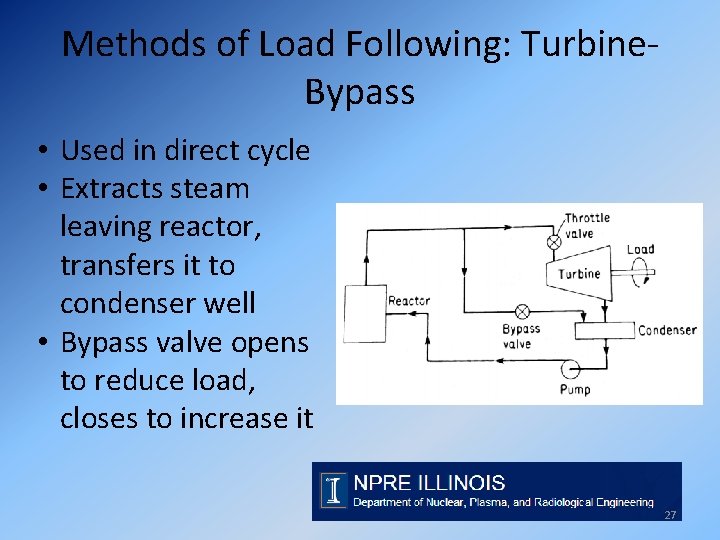
Methods of Load Following: Turbine. Bypass • Used in direct cycle • Extracts steam leaving reactor, transfers it to condenser well • Bypass valve opens to reduce load, closes to increase it 27
Methods of Load Following-Subcooling • Used in Dual Cycle with heat exchanger • Creates an increase in power by raising the amount of subcooling • More heat transfer between core and secondary system raises non-boiling height • Higher non-boiling height leads to less voids and thus more heat generation 28
Methods of Load Following. Recirculation • Used in direct cycle plant – Bypass valve has lower efficiency at lesser loads • Increase in mass flow rate at the inlet of core will increase the amount of heat generated – Rise in load • Recirculation controlled by pumps 29
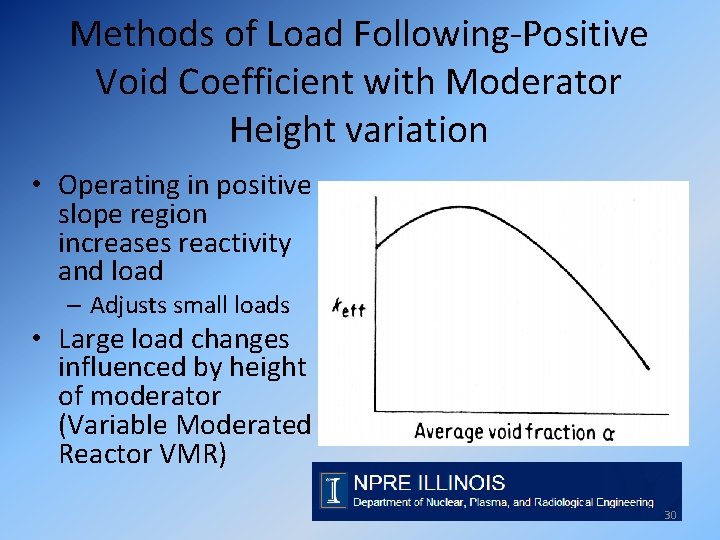
Methods of Load Following-Positive Void Coefficient with Moderator Height variation • Operating in positive slope region increases reactivity and load – Adjusts small loads • Large load changes influenced by height of moderator (Variable Moderated Reactor VMR) 30
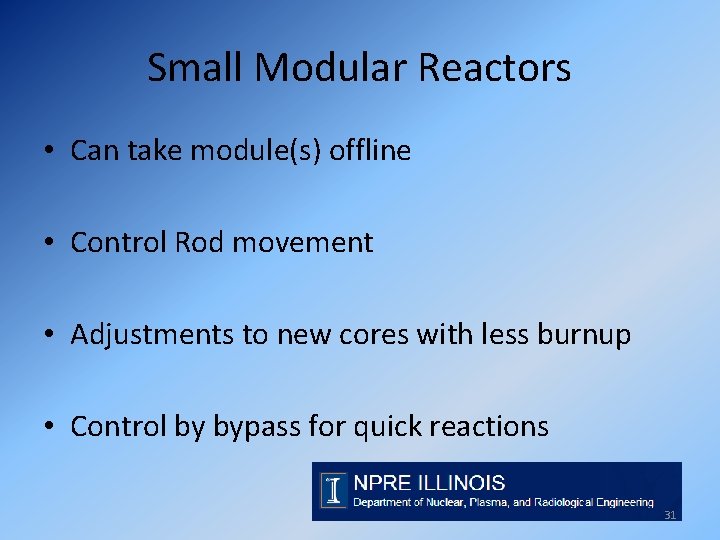
Small Modular Reactors • Can take module(s) offline • Control Rod movement • Adjustments to new cores with less burnup • Control by bypass for quick reactions 31
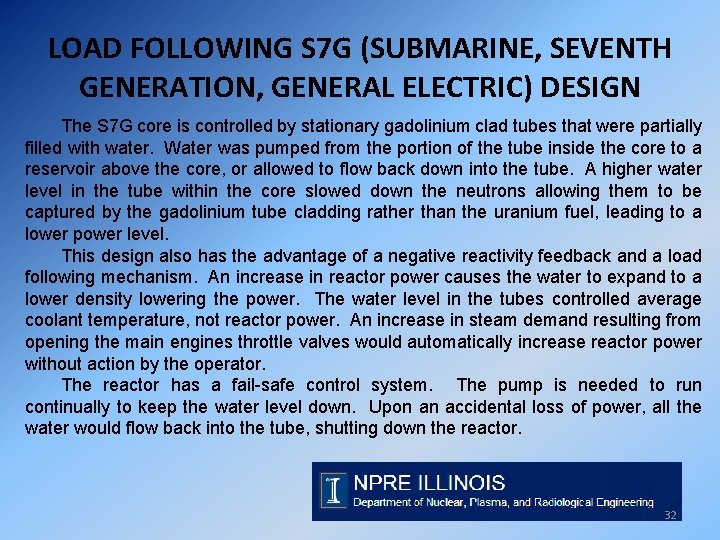
LOAD FOLLOWING S 7 G (SUBMARINE, SEVENTH GENERATION, GENERAL ELECTRIC) DESIGN The S 7 G core is controlled by stationary gadolinium clad tubes that were partially filled with water. Water was pumped from the portion of the tube inside the core to a reservoir above the core, or allowed to flow back down into the tube. A higher water level in the tube within the core slowed down the neutrons allowing them to be captured by the gadolinium tube cladding rather than the uranium fuel, leading to a lower power level. This design also has the advantage of a negative reactivity feedback and a load following mechanism. An increase in reactor power causes the water to expand to a lower density lowering the power. The water level in the tubes controlled average coolant temperature, not reactor power. An increase in steam demand resulting from opening the main engines throttle valves would automatically increase reactor power without action by the operator. The reactor has a fail-safe control system. The pump is needed to run continually to keep the water level down. Upon an accidental loss of power, all the water would flow back into the tube, shutting down the reactor. 32
33
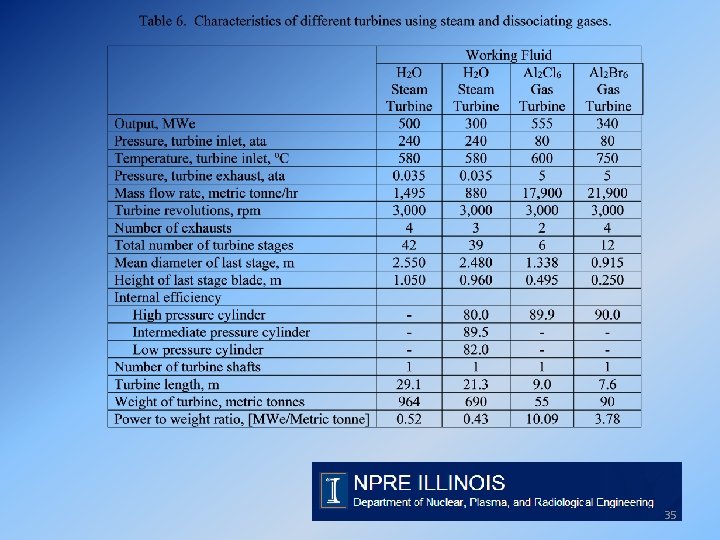
35
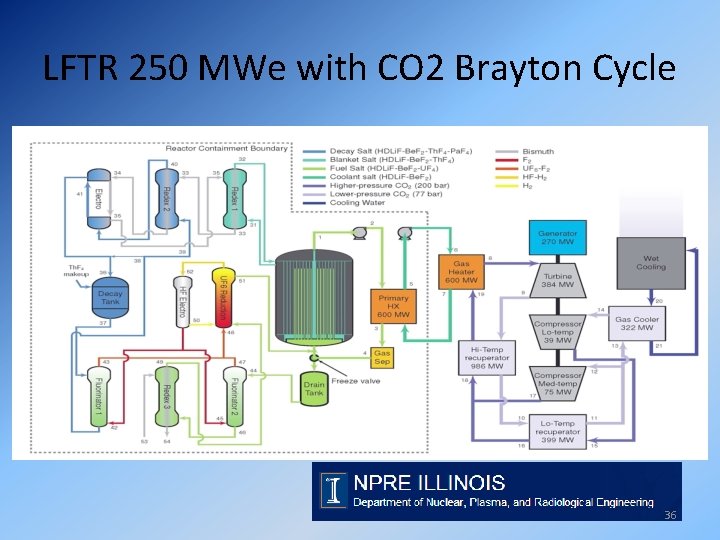
LFTR 250 MWe with CO 2 Brayton Cycle 36
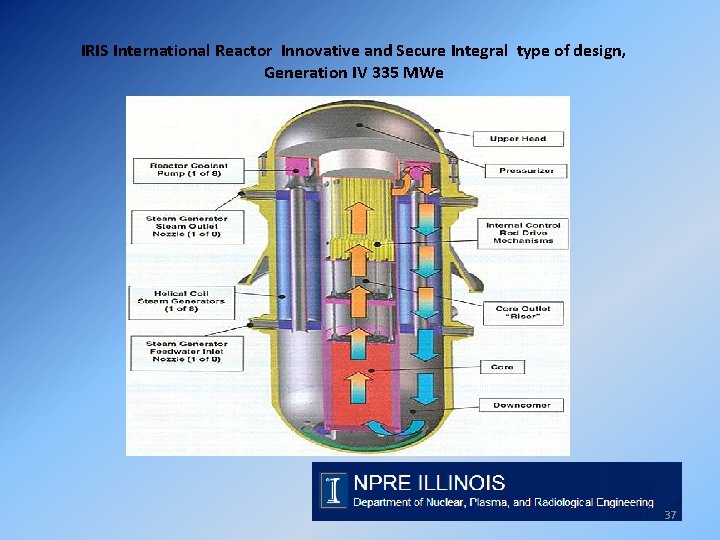
IRIS International Reactor Innovative and Secure Integral type of design, Generation IV 335 MWe 37
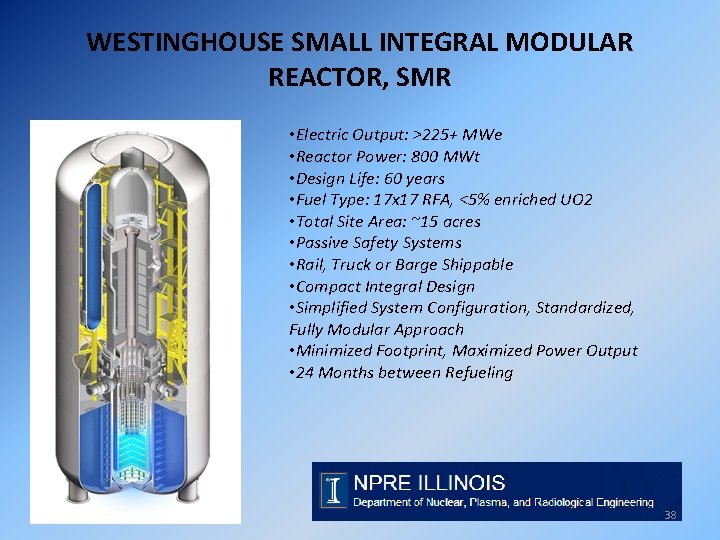
WESTINGHOUSE SMALL INTEGRAL MODULAR REACTOR, SMR • Electric Output: >225+ MWe • Reactor Power: 800 MWt • Design Life: 60 years • Fuel Type: 17 x 17 RFA, <5% enriched UO 2 • Total Site Area: ~15 acres • Passive Safety Systems • Rail, Truck or Barge Shippable • Compact Integral Design • Simplified System Configuration, Standardized, Fully Modular Approach • Minimized Footprint, Maximized Power Output • 24 Months between Refueling 38
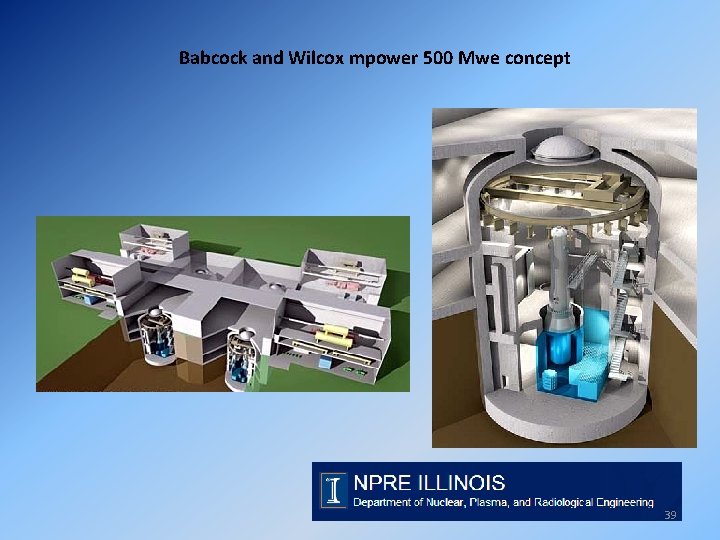
Babcock and Wilcox mpower 500 Mwe concept 39
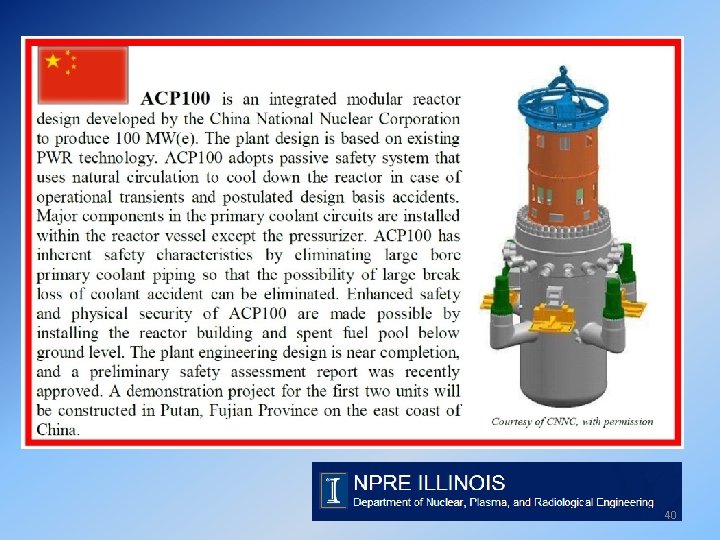
40
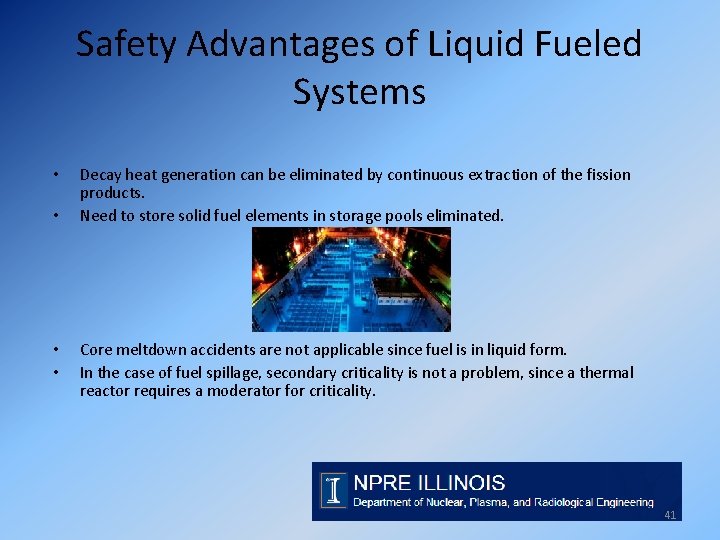
Safety Advantages of Liquid Fueled Systems • • Decay heat generation can be eliminated by continuous extraction of the fission products. Need to store solid fuel elements in storage pools eliminated. Core meltdown accidents are not applicable since fuel is in liquid form. In the case of fuel spillage, secondary criticality is not a problem, since a thermal reactor requires a moderator for criticality. 41
Thorium and Liquid Fuels Startups • • Flibe Energy Transatomic Power Terrestrial Energy INC. , TEI Thorcon Moltex Energy Seaborg Technology Copenhagen Atomics Terrapower 42
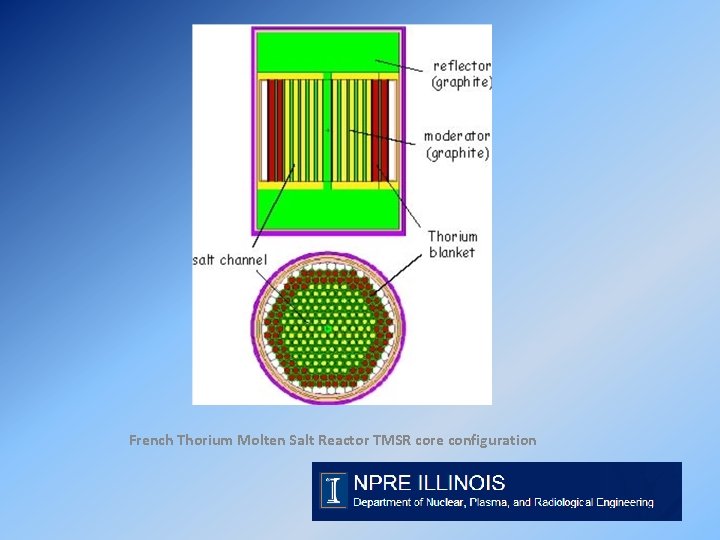
French Thorium Molten Salt Reactor TMSR core configuration
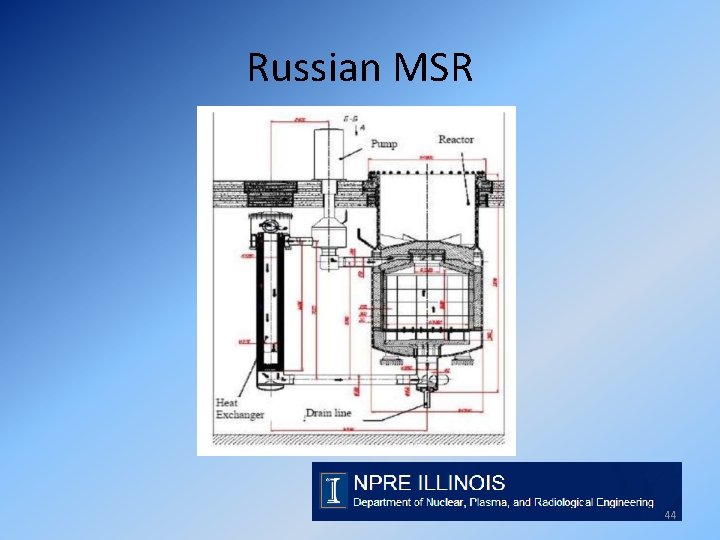
Russian MSR 44
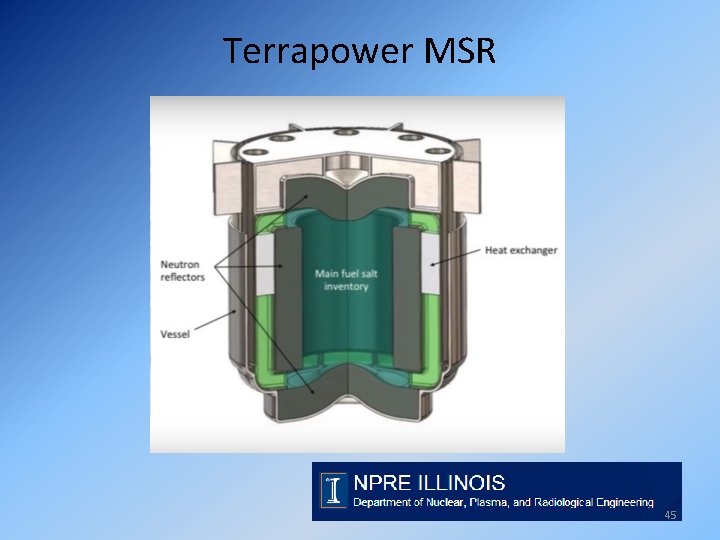
Terrapower MSR 45
Thorcon MSR SEALED POT IN A CAN 250 Mwe design 46
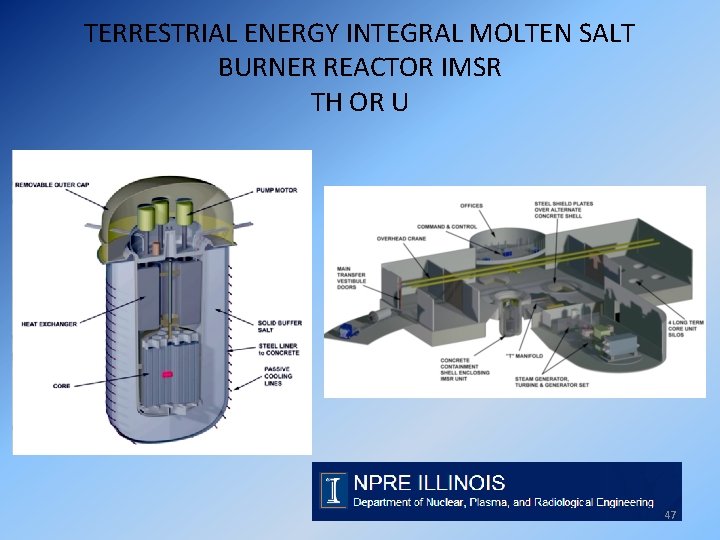
TERRESTRIAL ENERGY INTEGRAL MOLTEN SALT BURNER REACTOR IMSR TH OR U 47
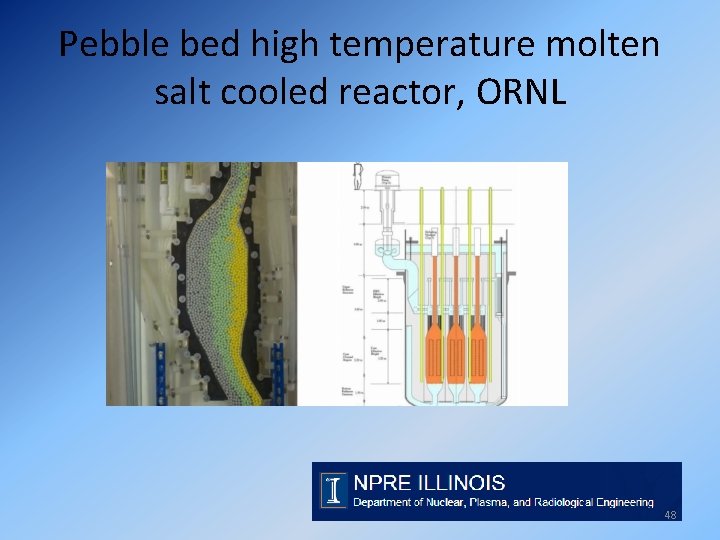
Pebble bed high temperature molten salt cooled reactor, ORNL 48
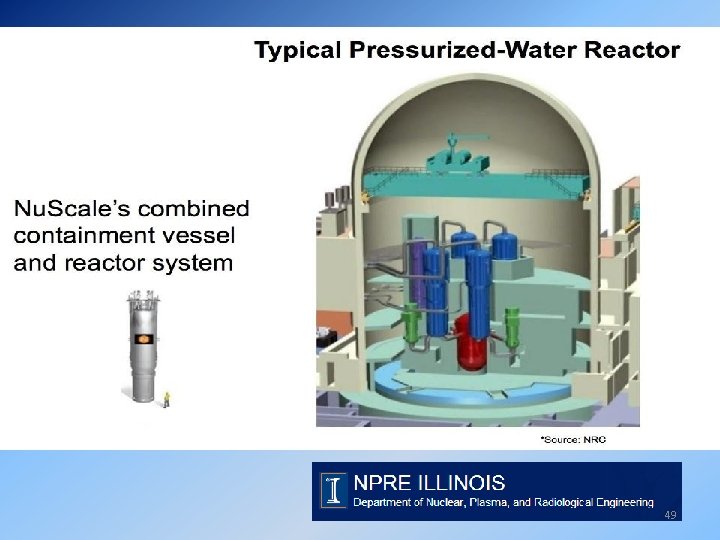
49
INTEGRAL REACTOR CONCEPTS 50
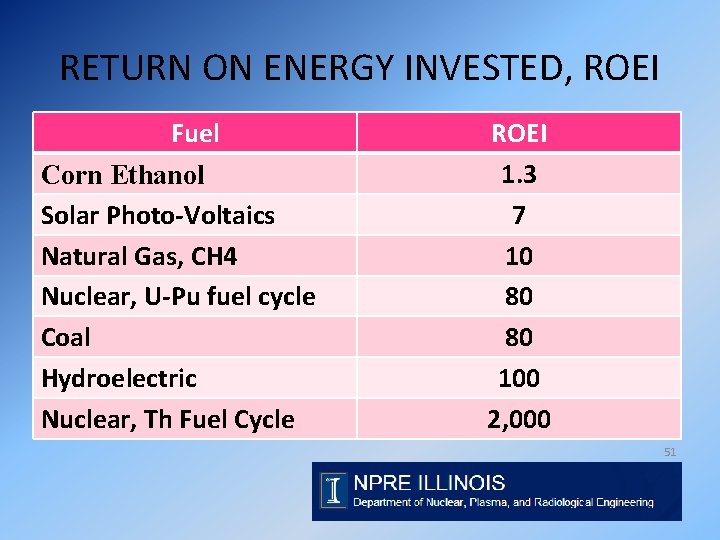
RETURN ON ENERGY INVESTED, ROEI Fuel Corn Ethanol Solar Photo-Voltaics Natural Gas, CH 4 Nuclear, U-Pu fuel cycle Coal Hydroelectric Nuclear, Th Fuel Cycle ROEI 1. 3 7 10 80 80 100 2, 000 51
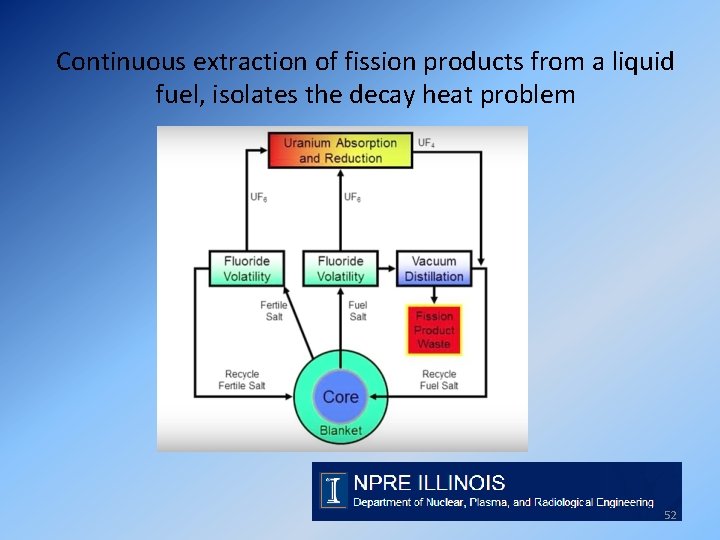
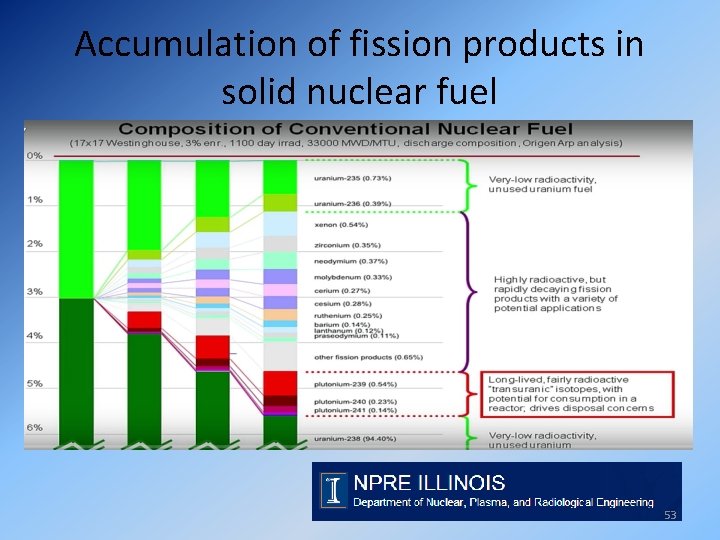
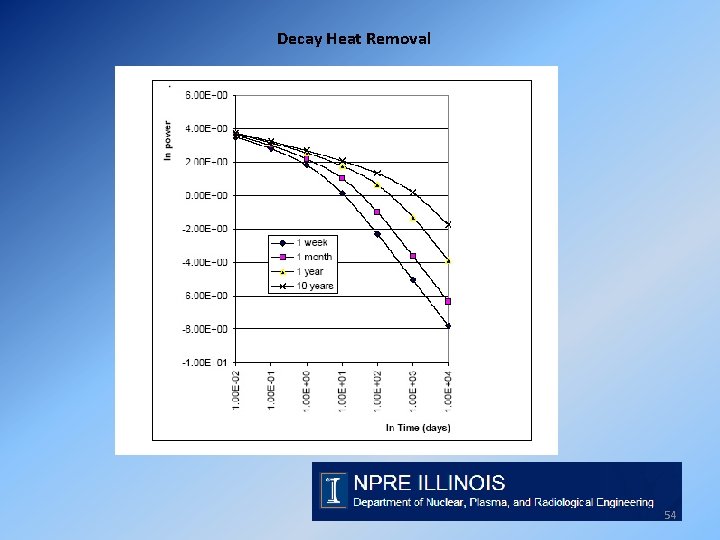
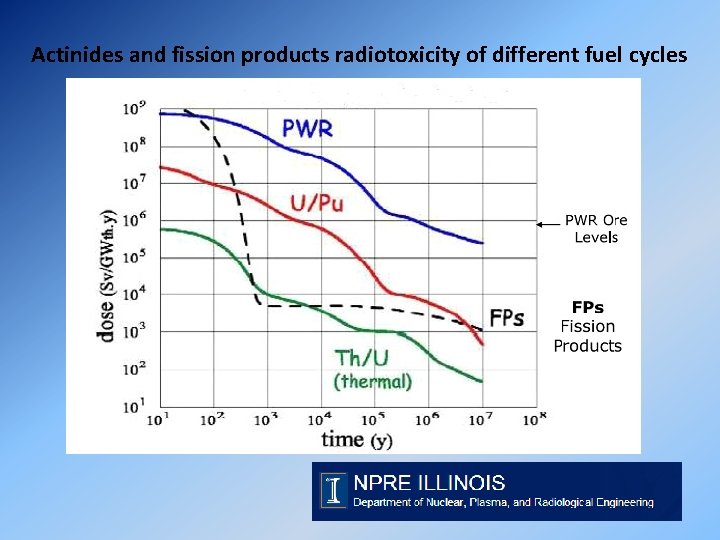
Continuous extraction of fission products from a liquid fuel, isolates the decay heat problem 52
Accumulation of fission products in solid nuclear fuel 53
Decay Heat Removal 54
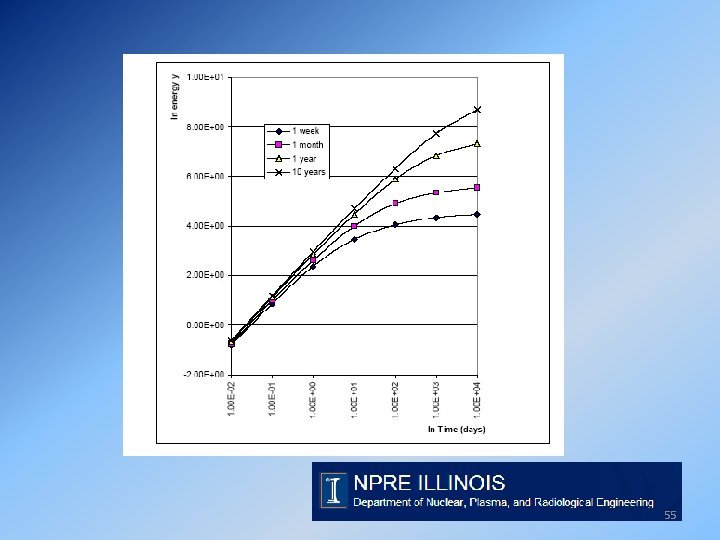
55
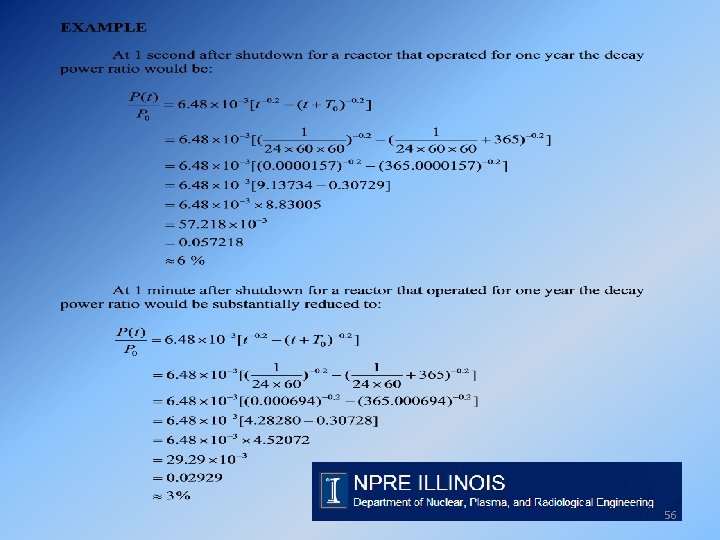
56
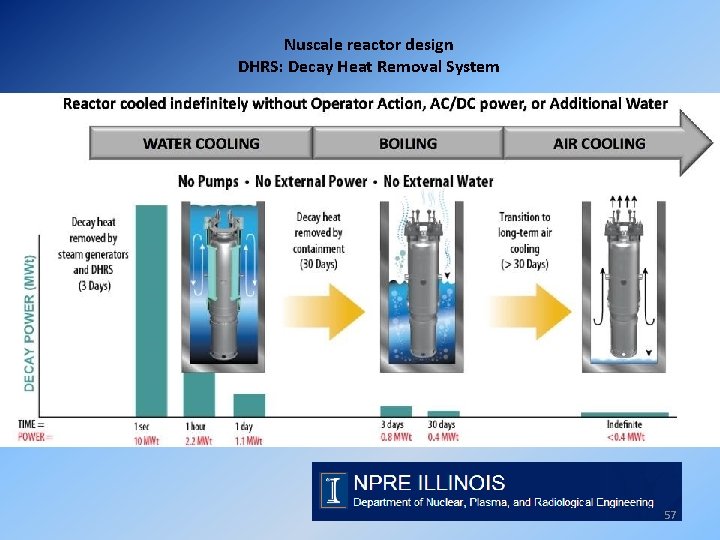
Nuscale reactor design DHRS: Decay Heat Removal System 57
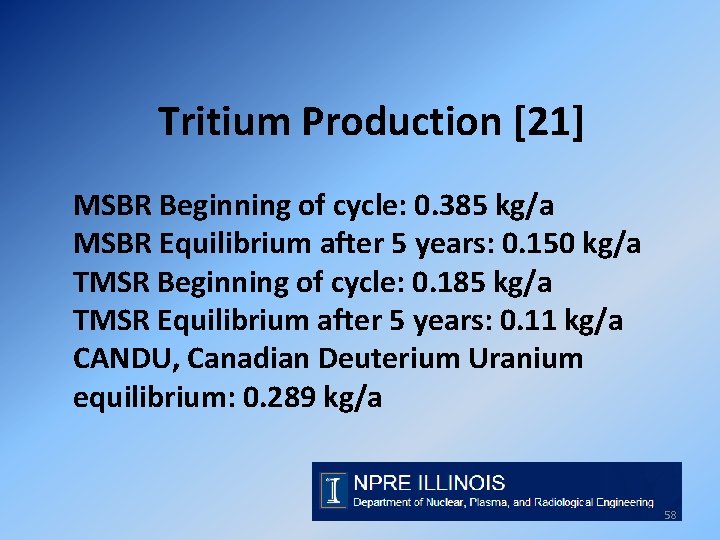
Tritium Production [21] MSBR Beginning of cycle: 0. 385 kg/a MSBR Equilibrium after 5 years: 0. 150 kg/a TMSR Beginning of cycle: 0. 185 kg/a TMSR Equilibrium after 5 years: 0. 11 kg/a CANDU, Canadian Deuterium Uranium equilibrium: 0. 289 kg/a 58
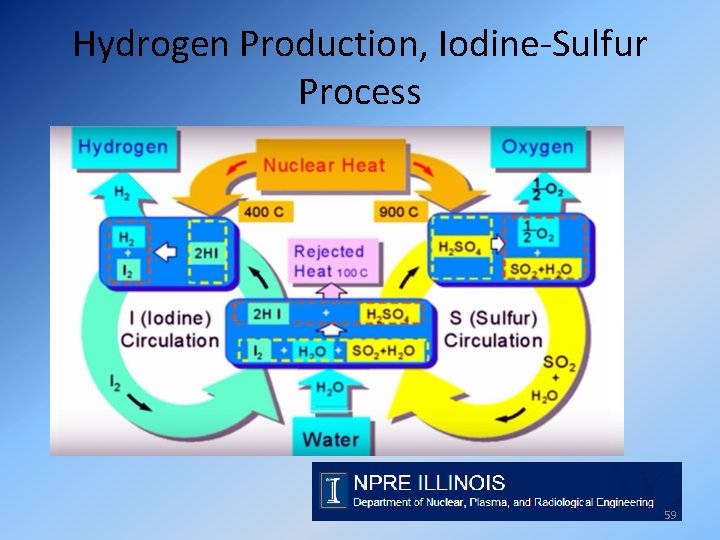
Hydrogen Production, Iodine-Sulfur Process 59
Arid areas agro industrial complexes The Dream Lives On. 60
IDENTIFIED INNOVATIONS • • • • Adoption of Fail-safe concepts Load-following designs Small reactor units Integral type configurations Liquid fuels replacing solid fuels Isolating the decay heat generation issue Use CO 2 gas turbine, Brayton cycle for higher efficiencies Explore new cycles such as Dissociating gases Maintain the breeding option Tritium production: Isotopic tailoring of Li 7 in a thermal spectrum. Na-based salts. Corrosion issues: Use ceramics components. Fission-Fusion hybrids Low Energy Nuclear Reactions, LENRs 61
ABSTRACT Whereas thriving globally, nuclear electric generation faces hurdles in the USA. In addition to the shadows from Three Miles Island, Chernobyl and Fukushima, it faces prospects of plants closures and project cancellations caused by cost overruns, plant retirements, and economic competition from renewable and natural-gas sources. It is argued that innovations are displacing the status quo technology. , A revival of nuclear generation can be envisioned within the Internet of Things, Io. T paradigm where small capacity units are added incrementally and operated for load-following as base-load mode, complementing the intermittent nature of the renewable sources. Proposed is the possible adoption of a fail-safe design with a reactor core possessing an infinite multiplication factor of unity. Its underlying analytical and numerical solutions for a molten salt fuel in cylindrical geometry is presented. The solutions result in a favorable flat neutron flux and power distribution in the core region. The introduction of load-following and the use of dissociating gases are also discussed. Reviewed are other introduced innovations in small size units, the use of liquid fuels as a replacement of solid ones, and operation at low pressure using molten salts. The opportunity they present to isolate and tackle the decay heat issue of solid fuels, as well as the issue of tritium production, are pointed out. A future vision is presented for application to water dissociation into hydrogen as a future transportation system energy carrier, and for agro-industrial complexes and fresh water supplies for arid regions of the globe. 2
“You never change anything by fighting the existing reality. To change something, build a new model and make the existing model obsolete. ” Bucky Fuller, inventor of the geodesic dome concept.
REFERENCES 1. Jeremy Carl and David Fedor, “Keeping the Lights on at America’s Nuclear Power Plants, ” Shultz-Stephenson Task Force on Energy Policy, Reinventing Nuclear Power Essay Series, Hoover Institution Press Publication No. 683, Stanford, California, 2017. 2. Michael Rubin, “Should the U. S. Revive Nuclear Power? , Commentary, July 18, 2017. 3. Ramanan Krishnamoorti and S. Radhakrishnan, “U. S. Nuclear Energy: Transform or Become Irrelevant, Forbes, March 14, 2017. 4. “DOE Fundamentals Handbook, Nuclear Physics And Reactor Theory. ” U. S Department of Energy, Washington D. C. Vol 1. 1993. https: //energy. gov/sites/prod/files/2013/06/f 2/h 1019 v 1. pdf 5. D. T. Ingersoll, C. Colbert, Z. Houghton, R. Snuggerud, J W. Gaston, and M. Empey, “Can Nuclear Power and Renewables be Friends? ” Proceedings of ICAPP, Nice, France, 2015. http: //www. nuscalepower. com/images/our_technology/nuscale-integration-with-renewables_icapp 15. pdf 6. “Negative Prices in wholesale electricity markets indicate supply inflexibilities”, U. S Energy Information Administration. 2012. https: //www. eia. gov/todayinenergy/detail. php? id=5110 7. “What is U. S. electricity generation by energy source? ”, U. S. Energy Information Administration. 2017. https: //www. eia. gov/tools/faq. php? id=427&t=3 8. “Electricity Explained, ” U. S Energy Information Administration. 2017. https: //www. eia. gov/energyexplained/index. cfm? page=electricity_in_the_united_states#tab 2 9. “Electricity sector of the United States” U. S Energy Information Administration. 2017. https: //en. wikipedia. org/wiki/Electricity_sector_of_the_United_States#/media/File: Electricity_Generation_Sources_for_the_United_States. svg 10. M. M. El-Wakil, “Nuclear Energy Conversion, ” The American Nuclear Society, La Grange Park, Illinois, 1978. 11. M. M. H. Ragheb, R. T. Santoro, J. M. Barnes, and M. J. Saltmarsh, “Nuclear Performance of Molten Salt” Fusion-Fission Symbiotic Systems for Catalyzed Deuterium and Deuterium-Tritium Reactors, ” Nuclear Technology, Vol. 48, pp. 216 -232, May 1980. 12. M. Ragheb, “Optimized Fissile and Fusile Breeding in a Laser-Fusion Fissile-Enrichment Flux Trap Blanket, ” Journal of Fusion Energy, Vol. 1, No. 1, pp. 285 -298, 1981. 13. M. M. H. Ragheb, G. A Moses, and C. W. Maynard, “Pellet and Pellet-Blanket neutronics and Photonics for Electron Beam Fusion, ” Nucl. Technol. , Vol. 48: 16, April 1980. 14. M. Ragheb and S. Behtash, “Symbiosis of Coupled Systems of Fusion D-3 He Satellites and Tritium and He 3 Generators, ” Nuclear Science and Engineering, Vol. 88, pp. 16 -36, 1984. 15. M. Ragheb and C. W. Maynard, “On a Nonproliferation Aspect of the Presence of U 232 in the U 233 fuel cycle, ” Atomkernenergie, 1979. 16. H. A. Bethe, “The Fusion Hybrid, ” Nucl. News, Vol. 21, 7, 41, May 1978. 17. S. S. Rozhkov and G. E. Shatalov, “Thorium in the Blanket of a Hybrid Thermonuclear Reactor, ” Proc. U. S. -USSR Symp. Fusion-Fission Reactors, July 13 -16, 1976, CONF-760733, p. 143, 1976. 18. V. L. Blinkin and V. M. Novikov, “Symbiotic System of a Fusion and Fission Reactor with Very Simple Fuel Reprocessing, ” Nucl. Fusion, Vol. 18, 7, 1978. 19. J. D. Lee, “The Beryllium/molten salt blanket-a new concept, ” UCRL-80585, Lawrence Livermore Laboratory, 1979. 20. M. M. H. Ragheb and C. W. Maynard, “Three-dimensional cell calculations for a fusion reactor gas-cooled solid blanket, ” Atomkernenergie (ATKE) Bd. 32, Lfg. 3, 159, 1978. 21. Cristian Le Brun, Ludovic Mathieu, Daniel Heuer and Alexis Nuttin, “Impact of the MSBR Concept technology on Long-lived Radio-Toxicity and Proliferation Resistance, ” Laboratoire dr Physique Subatomique et de Cosmologie, CNRS/IN 2 P 3, Universite Joseph Fourier et INPG, Grenoble, France, Note LPSC 05 -81 64 64
APPENDICES 65
2009 Washington D. C. Thorium Energy Alliance 66
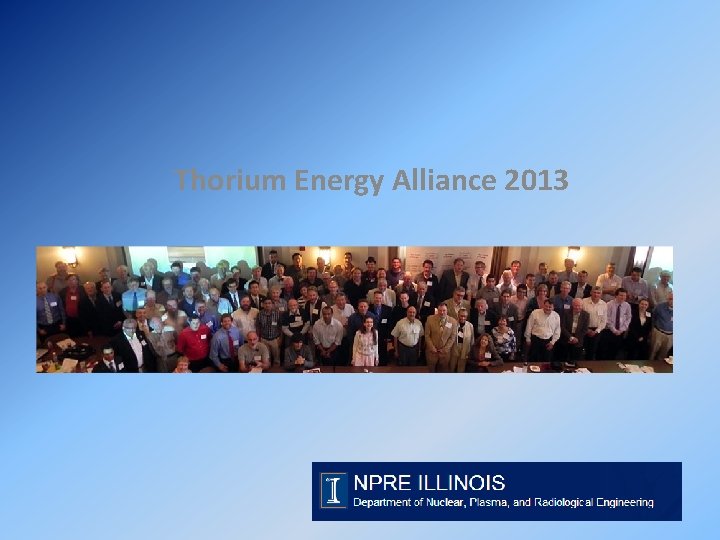
Thorium Energy Alliance 2013
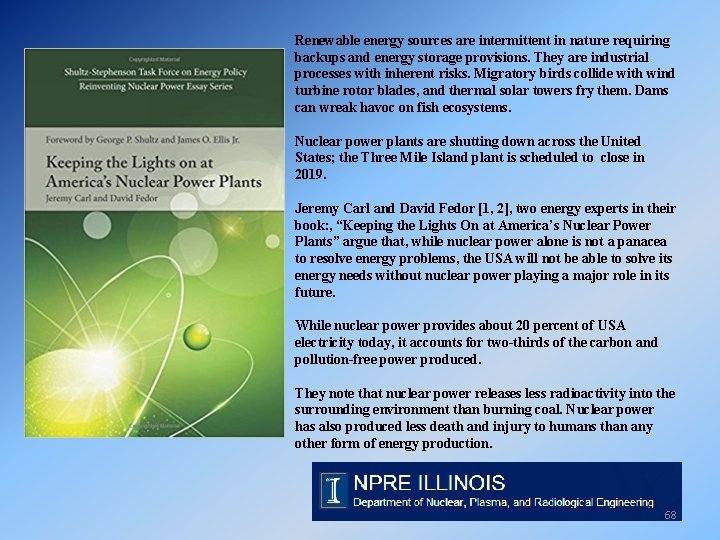
Renewable energy sources are intermittent in nature requiring backups and energy storage provisions. They are industrial processes with inherent risks. Migratory birds collide with wind turbine rotor blades, and thermal solar towers fry them. Dams can wreak havoc on fish ecosystems. Nuclear power plants are shutting down across the United States; the Three Mile Island plant is scheduled to close in 2019. Jeremy Carl and David Fedor [1, 2], two energy experts in their book: , “Keeping the Lights On at America’s Nuclear Power Plants” argue that, while nuclear power alone is not a panacea to resolve energy problems, the USA will not be able to solve its energy needs without nuclear power playing a major role in its future. While nuclear power provides about 20 percent of USA electricity today, it accounts for two-thirds of the carbon and pollution-free power produced. They note that nuclear power releases less radioactivity into the surrounding environment than burning coal. Nuclear power has also produced less death and injury to humans than any other form of energy production. 68
Ramanan Krishnamoorti and S. Radhakrishnan, “U. S. Nuclear Energy: Transform or Become Irrelevant, Forbes, March 14, 2017. The increased cost of building traditional high pressure light water reactors comes at a time when natural gas prices have plummeted and grid-scale solar and wind are becoming price competitive. Nuclear has the ability to provide highly reliable base load power, a critical factor as we go towards more intermittent sources, including wind and solar. “Energy sources not based on hydrocarbons have become the de facto option to decrease anthropogenic carbon dioxide. Thus, along with solar and wind, nuclear represents a significant technological solution to address the human-caused CO 2 issue. “Nuclear power technology continues to evolve away from the concrete-intensive light water high pressure process and toward a modular and molten salt-based process, especially outside the U. S. With the broad availability of nuclear fuel, especially in a world where thorium and other trans-uranium elements are increasingly becoming the fuel of choice, this technology is scalable and ready for global consumption. If done right the use of thorium and some of the trans-uranium elements might quite substantially scale-down the issue of spent fuel disposal. ” 69
Actinides and fission products radiotoxicity of different fuel cycles
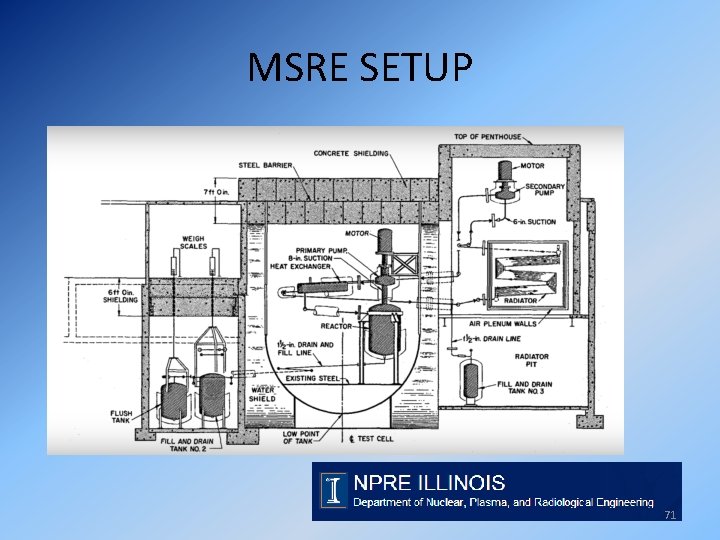
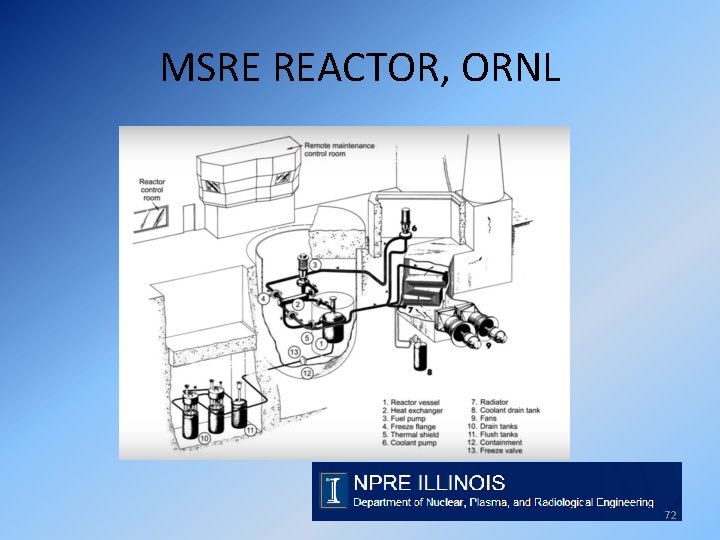
MSRE SETUP 71
MSRE REACTOR, ORNL 72
Fission Products removal in MSR 73
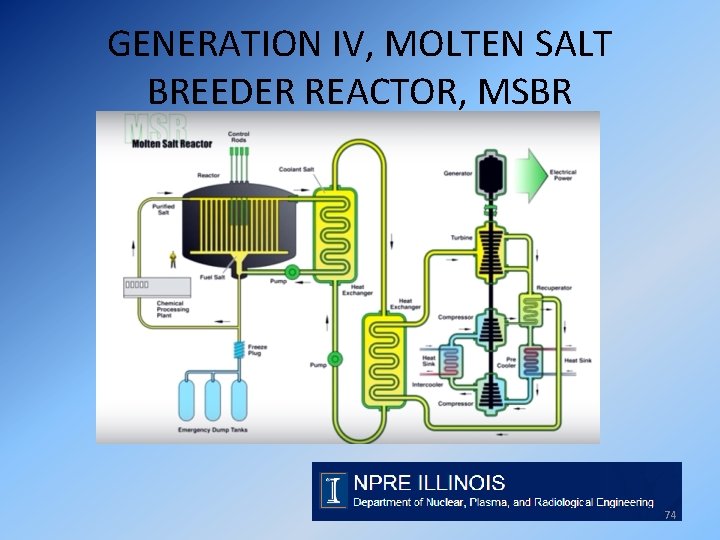
GENERATION IV, MOLTEN SALT BREEDER REACTOR, MSBR 74
DISCUSSION 1. Molten Salt Reactors (MSRs) offer a great deal of stability compared to their solid fuel counterparts. MSR’s are designed with a salt plug drain below the reactor vessel. The plug must be actively cooled and in the case of a loss of power accident or if the fluid becomes too hot, the salt plug will melt and the molten salt will drain into a passively cooled containment vessel capable of removing the decay heat from the system. Furthermore, molten salts have a very strong negative temperature and void coefficients.
2. Another advantage of molten salt systems is the ability to process the fuel during plant operation to remove fission products hence eliminating the decay heat problem. To remove the uranium from the salt, the fluoride volatility process can be utilized. Hydrogen fluoride and then F 2 gas is bubbled through the salt. The uranium is converted from UF 4 to UF 6 and is released from the salt as a gas. The UF 6 is then converted back to UF 4 as needed. This method is also applicable to higher actinides such as plutonium. Fission products can also be removed by several methods such as vacuum distillation or liquid bismuth reductive extraction. Gaseous fission products, such as xenon and krypton are continuously removed by sparging the salt with helium gas. This ability to remove fission products and adjust the fissile concentrations in the salt during operation allows one to maintain stable reactivity and removes the need for burnable poisons. A single control rod can be included for start-up and shutdown but is not necessary due to the ability to drain fuel out the core and into criticality safe storage tanks.
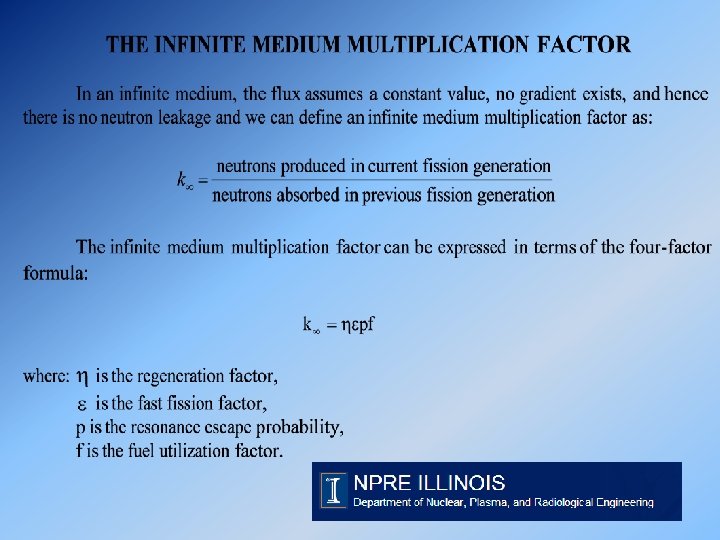
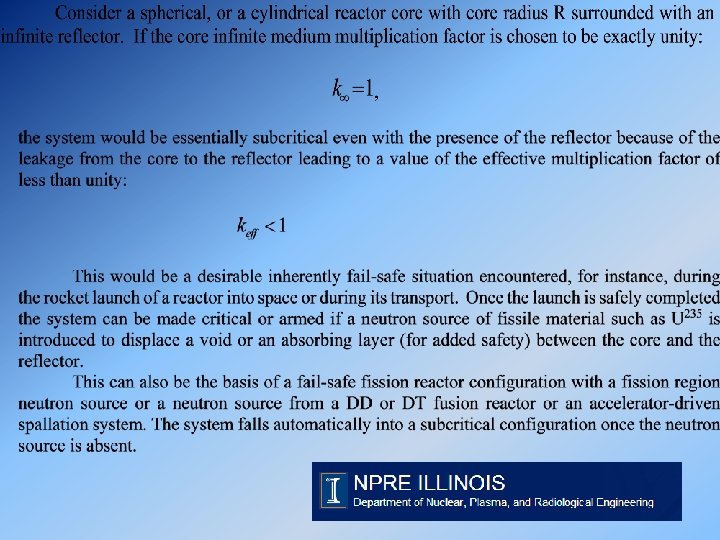
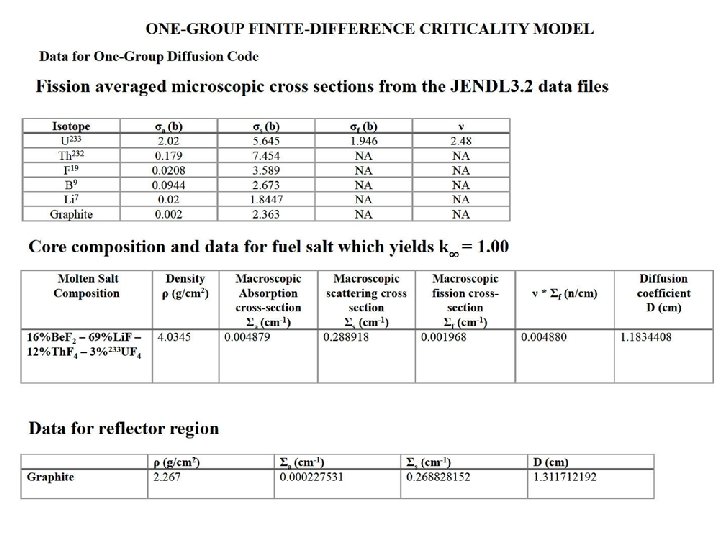
3. The reactor configurations detailed in this work offer even greater fail-safety features than traditional MSRs. In the source-driven fail-safe reactor, the extra fissile material surrounding the core offers greater flexibility in reactivity control, as the core and source salt fissile concentrations can be varied during operations to maintain optimal conditions. 4. Furthermore, the core cannot achieve criticality without the source region material present. This is because the core is at k∞ =1 and therefore keff < 1 due to neutron losses. Without the source region, the fail-safe reactor modeled earlier would have a keff = 0. 61365 ± 0. 00045. 5. The fusion source driven systems are subcritical. This makes criticality accidents not possible, since the effective multiplication factor keff is not near 1. Additionally, reactivity can be easily controlled by varying the source strength. Without the source present, the system cannot maintain criticality, making the system stable and fail-safe.
NUCLEAR LOAD FOLLOWING History Initially when nuclear plants were designed they were built as exclusively baseload generators. Nuclear was designed to operate with high upfront costs but low varying costs. A PWR/BWR plant would be put on the grid at a steady state power level and remain there until shutting down to refuel, approximately 18 months. For the most part, this pattern of operation remains in the U. S. Some other countries like France with a high proportion of nuclear energy production had to adapt to load following. Currently the European Utility Requirements (EURs) have mandated that nuclear plants must be capable of a daily load cycling operation between 50 percent and 100 percent of rated power with a rate of change of electricity output of 3 -5 percent of rated power per minute.
. Reactor Kinetics In addition to the economics of load following the other main challenge is reactor kinetics. Large power changes cause changes in xenon concentration (specifically Xe-135) which is a significant poison and has a half-life of approximately 9 hours. Xe-135 is a fission product but its primary production is is from I-135 (beta minus decay, about 6. 6 hour half-life). I-135 is a fission product and its concentration is directly proportional to reactor power. A large down-power transient (will cause a decreased neutron population) to burn out Xe-135 but its concentration will continue to build for several hours from iodine decay. This cause a large negative reactivity insertion in the core hours later which must be compensated for with a reduction in the boron concentration or by moving control rods out. An opposite effect happens on an up-power transient.
. Pressurized Water Reactors, PWRs While not economically as efficient as operating at rated power it is possible for PWRs to load follow a small amount. Some reactors use grey rods (borated steel) to better control neutron flux and adjust for power level changes. The AP 1000 is designed with grey rods. This limits the amount of soluble boron used to more quickly change power distribution in the core. PWRs often operate with the control rods fully withdrawn but compensate for small changes in core reactivity with boron concentration and/or grey rods. At the beginning of the core loading cycle there is plenty of excess reactivity. Near the end of the operating cycle just prior to shut-down for refueling the margins are much smaller. Fuel has burned up, fission product poisons have accumulated in the core and may restrict maneuverability of power changes. 80
Boiling Water Reactors, BWRs Newer BWR cores have an improved inherent load-following ability over PWRs and older natural circulation BWR cores. By varying the amount of recirculation flow with the reactor recirculation pumps, reactor power can be fine-tuned. By increasing the flow, bubbles are better swept from high neutron flux areas in the core which increases moderator effectiveness. This in turn raises reactor power to a new steady state level. Decreasing flow has the opposite effect. Older BWRs can still load follow to a certain extent with control rod movement (like PWRs). BWRs do not use soluble boron for reactivity control. 81
Energy Storage If energy storage was a more efficient technology, there would be less need to load-follow with nuclear. Nuclear plants could run at rated power and when demand spikes, pull power from the reserve. As energy production shifts to non-baseload sources such as wind and solar, the need for reserves is even higher. With a solar/wind only grid, without days of reserve capacity the lights would go dark on cloudy and windless days and long winter nights. Current best reserve capacity is using heat storage (molten salts with solar and pumped storage or hydro but is only on the order of hours. New technologies are being developed every day. There is a large push to build massive batteries (such as Elon Musk and PNNL) while others are coming up with other unique ideas such a train full of heavy rocks. Other ideas considered are pumped storage, flywheel, chemical storage as hydrogen or other fuel production, and compressed gases. Until energy storage becomes mature, the recent solar and wind boom exacerbates the need for load following and peak demand plants. 82
Thank you 83