Criminological Theory Social Power and the Construction of


- Slides: 76
Criminological Theory Social Power and the Construction of Crime: Conflict Theory Lilly, Cullen, Ball, Criminological Theory Sixth Edition. © 2015 SAGE Publications
Conflict Criminologists l l Marx and Engels: the dialectic Dahrendorf, Coser, and Simmel: conflict and compromise l l l Bonger: Capitalism and crime Sutherland Sellin: Differential Social Organization Vold: Conflict and crime Turk: Criminalization process Chambliss: Crime, Power, and Legal Process Quinney: Societal reaction and social reality of crime Lilly, Cullen, Ball, Criminological Theory Sixth Edition. © 2015 SAGE Publications
Introduction l Theories that focus attention on struggles between individuals and/or groups in terms of power differentials fall into the general category of conflict theory l Some conflict theories search for the sources of the conflicts, others seek to elucidate the basic principles by which conflict evolves, and still others try to develop a foundation for eliminating the conflict Lilly, Cullen, Ball, Criminological Theory Sixth Edition. © 2015 SAGE Publications
Forerunners of Conflict Theory: Marx and Engels: Capitalism and Crime l For Marx and Engels, crime was to some extent a symptom of a decline of social solidarity and would be diminished if social solidarity could be regained l Marx and Engels saw the problem in economic terms and denounced the division of labor as the unjust exploitation of one social class by another l They proposed revolution followed by a period of socialism l Conflict was inherent in the nature of social arrangements under capitalism because of the vast differences in interests and power created under it Lilly, Cullen, Ball, Criminological Theory Sixth Edition. © 2015 SAGE Publications
Forerunners of Conflict Theory: Marx and Engels: Capitalism and Crime l Conflict of interests between different groups will be increased by inequality in the distribution of scarce resources l Those receiving less of the needed resources would question the legitimacy of the arrangement l These groups would then be more likely to organize and to bring the conflict out into the open, trying to redistribute scarce resources Lilly, Cullen, Ball, Criminological Theory Sixth Edition. © 2015 SAGE Publications
Forerunners of Conflict Theory: Marx and Engels: Capitalism and Crime l Capitalism was considered to be at the root of the conflict because it was a source of unjust inequality l According to Marx and Engels, the resolution to conflict was to destroy capitalism and build toward the one just form of social solidaritycommunism Lilly, Cullen, Ball, Criminological Theory Sixth Edition. © 2015 SAGE Publications
Forerunners of Conflict Theory: Simmel: Forms of Conflict l l Simmel was a contemporary of Durkheim concerning himself with a search for precise intellectual understanding of abstract laws governing human interaction rather than with changing the world l Was an exponent of sociological formalism l Concerned not so much with the changing content of social life as with its recurring forms or patterns Simmel’s interest was in conflict in general Lilly, Cullen, Ball, Criminological Theory Sixth Edition. © 2015 SAGE Publications
Forerunners of Conflict Theory: Simmel: Forms of Conflict l Conflict is a normal part of life and one form of interaction among others l Conflict was regarded not as a problem, but rather a typical aspect of social order that often contributed to order l Focused on the consequences of conflict Lilly, Cullen, Ball, Criminological Theory Sixth Edition. © 2015 SAGE Publications
Forerunners of Conflict Theory: Bonger: Capitalism and Crime l Believed that humans are innately social l Crime would have to be traced to an unfavorable environment that distorted human nature l Such an unfavorable environment had been generated by the rise of capitalism l Created a sharp division between the rulers and the ruled that originated in the economic system Lilly, Cullen, Ball, Criminological Theory Sixth Edition. © 2015 SAGE Publications
Forerunners of Conflict Theory: Bonger: Capitalism and Crime l In such an unfavorable environment, human nature was distorted into an intense “egoism” that made people more capable of committing crimes against one another l l Seek pleasure by any means possible without regard for others Traced much crime to the poverty generated by capitalism both directly (sometimes crime necessary for survival) and indirectly (by demoralizing the individual) Lilly, Cullen, Ball, Criminological Theory Sixth Edition. © 2015 SAGE Publications
Forerunners of Conflict Theory: Bonger: Capitalism and Crime l The more powerful bourgeoisie also committed crimes l Traced this crime to the opportunities that came with power and the decline of morality that came with capitalism l Made the richer and the poorer Lilly, Cullen, Ball, Criminological Theory Sixth Edition. © 2015 SAGE Publications
Forerunners of Conflict Theory: Bonger: Capitalism and Crime l l Definitions of morality varied l The source of the prevailing definitions and of their variations could be found in the interests of the powerful l The legal system tends to legalize the egoistic actions of the powerful and to penalize those of the powerless The abolition of capitalism and the redistribution of wealth and power would restore a favorable environment and eliminate crime Lilly, Cullen, Ball, Criminological Theory Sixth Edition. © 2015 SAGE Publications
Forerunners of Conflict Theory: Sutherland Sellin: Culture Conflict and Crime l Differential social organization represented one type of conflict perspective l Inherent in the notion was the assumption that society did not rest on complete consensus, but rather was made up of different segments with conflicting cultural patterns l A person whose associations were dominated by relationships with those in a less law-abiding segment of society would tend to learn criminal techniques and develop criminal orientations Lilly, Cullen, Ball, Criminological Theory Sixth Edition. © 2015 SAGE Publications
Forerunners of Conflict Theory: Sutherland Sellin: Culture Conflict and Crime l Powerful economic interests such as huge corporations had an organization that made them habitual criminals although their wealth and power protected them from prosecution l Sellin stressed the problem of culture conflict as a source of crime, maintaining that different groups learn different conduct norms and that the conduct norms of one group might clash with those of another Lilly, Cullen, Ball, Criminological Theory Sixth Edition. © 2015 SAGE Publications
Forerunners of Conflict Theory: Vold: Conflict and Crime l Conflict should be regarded as a fundamental social form characteristic of social life in general l Social order did not rest entirely on consensus, rather it rested in part on the stability resulting from the balance of power among conflicting forces that compose society l The conflict between groups was analyzed as potentially making a positive contribution to the strengthening of the different groups Lilly, Cullen, Ball, Criminological Theory Sixth Edition. © 2015 SAGE Publications
Forerunners of Conflict Theory: Vold: Conflict and Crime l Those who produce legislative majorities win control over the police power and dominate the polices that decide who is likely to be involved in violation of the law l The principle of compromise from positions of strength operates in every stage of the l Politics was the art of compromise Lilly, Cullen, Ball, Criminological Theory Sixth Edition. © 2015 SAGE Publications
Forerunners of Conflict Theory: Vold: Conflict and Crime l Much crime is political in nature l Included crimes resulting from protest movements aimed at political reform l Regardless who is right and who is wrong, those who lose the conflict are the criminals l Numerous kinds of crimes result from the clashes incidental to attempts to change or to upset the caste system of racial segregation in various parts of the world Lilly, Cullen, Ball, Criminological Theory Sixth Edition. © 2015 SAGE Publications
Theory in Context: The Turmoil of the 1960 s l Although the various forerunners of conflict theory discussed previously had anticipated much of what was to follow, it was not until the social upheavals of the 1960 s that criminological conflict theory came into its own l Conflict theory highlighted the newly revealed patterns of social division and questioned the legitimacy of the motives, strategies, and tactics of those in power Lilly, Cullen, Ball, Criminological Theory Sixth Edition. © 2015 SAGE Publications
Theory in Context: The Turmoil of the 1960 s l Three factors explain the rise of conflict theory: 1. The impact of the war in Vietnam on American society 2. The growth of the counterculture 3. The rising political protest over discrimination and the use of the police power of the state to suppress political dissent Lilly, Cullen, Ball, Criminological Theory Sixth Edition. © 2015 SAGE Publications
Theory in Context: The Turmoil of the 1960 s l The impression of society of composed of groups in conflict became more and more prevalent, providing fertile ground for the development of the conflict theory Lilly, Cullen, Ball, Criminological Theory Sixth Edition. © 2015 SAGE Publications
Varieties of Conflict Theory l The new criminological conflict theory went much further than criminologists had taken it before, appealing to Marx and Bonger as well as to Simmel l During the 1960 s, several criminologists, influenced by a blending of labeling theory with political theory, began to develop their own brand of criminological conflict theory Lilly, Cullen, Ball, Criminological Theory Sixth Edition. © 2015 SAGE Publications
Varieties of Conflict Theory l Four factors behind the shift to new conflict theory: 1. There was a profound skepticism toward any theory that traced crime to something about the individual 2. There was a marked shift from the assumption that the inadequacies of the CJS were traced to be incompetent or corrupt individuals to the conclusion that these problems were inherent in the system Lilly, Cullen, Ball, Criminological Theory Sixth Edition. © 2015 SAGE Publications
Varieties of Conflict Theory l Four factors behind the shift to new conflict theory: 3. Older assumptions that criminal law represented the collective will of the people was rejected 4. It had become clear that the official crime rate figures did not reflect the amount of criminal behavior actually present in society but also that what they did reflect more often was the labeling behavior of the authorities Lilly, Cullen, Ball, Criminological Theory Sixth Edition. © 2015 SAGE Publications
Turk: The Criminalization Process l Presented a complete statement of his own brand of conflict theory in Criminality and the Legal Order (1969), which built on Dahrendorf’s perspective l For Turk, the recognition of social conflict as a basic fact of life represented simple realism Lilly, Cullen, Ball, Criminological Theory Sixth Edition. © 2015 SAGE Publications
Turk: The Criminalization Process l Dahrendorf located the source of conflict in power differences, more specifically in differences in authority or power that had been accepted as legitimate l l Because cultural norms always exist and have to depend on sanctions for their enforcement, some people must have more power than others to make the sanctions stick Inequality was inescapable fact because the basic units of society necessarily involved dominancesubjection relationships Lilly, Cullen, Ball, Criminological Theory Sixth Edition. © 2015 SAGE Publications
Turk: The Criminalization Process l For Turk, theoretical problem of explaining crime lay in explaining criminalization, the process of assignment of criminal status to individuals l Stressed that assignment of criminal status to an individual may have less connection with the behavior of that person than with his or her relationship to authorities l What they are rather than what they do Lilly, Cullen, Ball, Criminological Theory Sixth Edition. © 2015 SAGE Publications
Turk: The Criminalization Process l l Central to the concept of authority is its accepted legitimacy Any theorist concerned with the relationship between subjects and authorities must investigate the basis for such acceptance Turk was concerned with the logical consequences of the fact that some people had authority over others, not with the sources of this authority Criminal status represented a real or imagined violation of legal norms Lilly, Cullen, Ball, Criminological Theory Sixth Edition. © 2015 SAGE Publications
Turk: The Criminalization Process l Distinguished between two types of norms: 1. 2. l Cultural Norms: Norms dealing with what is expected Social Norms: What is being done rather than what is being said Given that cultural and social norms might not agree, the existence of a difference between authorities and subjects in their evaluation of a particular attribute logically implies four situational possibilities Lilly, Cullen, Ball, Criminological Theory Sixth Edition. © 2015 SAGE Publications
Turk: The Criminalization Process l Four situational possibilities that carry a different conflict potential: 1. 2. 3. 4. High congruence between what is said and what is done No agreement between what is being stated and what is being done The authorities’ talk and behavior were congruent, but little agreement with the words and actions of the subjects The subjects talk and behavior were congruent, but little agreement with the words and actions of the authorities Lilly, Cullen, Ball, Criminological Theory Sixth Edition. © 2015 SAGE Publications
Turk: The Criminalization Process l The conflict with authorities grows with the extent to which those having the illegal attributes or engaging in the illegal activities are organized l The probability of conflict increases as the authorities confront norm resisters who are less sophisticated Lilly, Cullen, Ball, Criminological Theory Sixth Edition. © 2015 SAGE Publications
Turk: The Criminalization Process l The logical possibilities resulting from the combination of organization and sophistication were set forth as follows: 1. Organized and unsophisticated 2. Unorganized and unsophisticated 3. Organized and sophisticated 4. Unorganized and sophisticated Lilly, Cullen, Ball, Criminological Theory Sixth Edition. © 2015 SAGE Publications
Turk: The Criminalization Process l Conflict between authorities and subjects is more probable where the latter are highly organized and relatively unsophisticated l The odds of such conflict declined to the extent that the subjects involved are unorganized and unsophisticated and still further to the extend that they are organized and sophisticated l Lowest probability of conflict is associated with a situation in which subjects are unorganized and sophisticated Lilly, Cullen, Ball, Criminological Theory Sixth Edition. © 2015 SAGE Publications
Turk: The Criminalization Process l As for the authorities themselves, they must be organized or, by definition, they would not be authorities l Conflict between these authorities and subjects resisting their norms would be greatest where the authorities were least sophisticated in the use of power l Where subjects are strongly identified with the authorities and generally agree in moral evaluations, an announced norm may be accepted in a “father knows best” spirit Lilly, Cullen, Ball, Criminological Theory Sixth Edition. © 2015 SAGE Publications
Turk: The Criminalization Process l Key question was once conflict has begun, what are the conditions affecting the probability that members of the opposition will become criminals l The major factor in the probability criminalization was likely to be the extent to which the official legal norms agreed with both the cultural norms and the social norms of those specifically charged with enforcing the legal norms l The greater the power difference in favor of norm enforcers over resisters, the greater would be the probability of criminalization Lilly, Cullen, Ball, Criminological Theory Sixth Edition. © 2015 SAGE Publications
Turk: The Criminalization Process l The odds of criminalization had to do with the realism of conflict moves, or whether or not any moves by the resisters or authorities was considered to be realistic l Any move by resisters was considered to be unrealistic if it: 1. 2. 3. 4. Increased the visibility of the offensive attribute or behavior, thereby increasing the risk that the authorities would be forced to act Increased the offensiveness of the attribute or behavior Increased consensus among the various levels of enforcers Increased the power difference in favor of the enforcers Lilly, Cullen, Ball, Criminological Theory Sixth Edition. © 2015 SAGE Publications
Turk: The Criminalization Process l Any move by the authorities was likely to be unrealistic if it: 1. Shifted the basis of their legitimacy away from consensus toward the “norm of deference” or obligation to obey despite disagreement 2. Represented a departure from standard legal procedures, especially if the shifts were unofficial, sudden, or sharp 3. Generalized from a particular offensive attribute so that additional attributes of the opposition also became grounds for criminalization 4. Increased the size and power of the opposition 5. Decreased consensus among various levels of enforcers Lilly, Cullen, Ball, Criminological Theory Sixth Edition. © 2015 SAGE Publications
Chambliss: Crime, Power, and Legal Process l Chambliss was first inspired by the American tradition of legal realism, the pioneering work of the American legal scholar Jerome Hall, and the results of his own empirical research l The school of legal realism insisted that the study of abstract legal theory must be complimented by the study of the law as it works itself out in actual practice l Hoped to develop a theory of the law in action— a theory based on empirical research Lilly, Cullen, Ball, Criminological Theory Sixth Edition. © 2015 SAGE Publications
Chambliss: Crime, Power, and Legal Process l Published Crime and the Legal Process l l Included empirical research studies of the legal system Published Law, Order, and Power with Seidman l Simply identified his position as representing an “interest group” perspective rather than a “value expression” perspective Lilly, Cullen, Ball, Criminological Theory Sixth Edition. © 2015 SAGE Publications
Chambliss: Crime, Power, and Legal Process l With Seidman, he discussed: l The relative complexity of society l The complexity, which comes with technological development and necessitates more complicated actually operates to put people at odds with one another, thereby requiring formal institutions designed to sanction what some consider to be norm violations Lilly, Cullen, Ball, Criminological Theory Sixth Edition. © 2015 SAGE Publications
Chambliss: Crime, Power, and Legal Process l The lower the level of complexity of a society, the more emphasis will be placed in the dispute-settling process upon reconciliation; the more complex the society, the more emphasis will be placed on rule enforcement Lilly, Cullen, Ball, Criminological Theory Sixth Edition. © 2015 SAGE Publications
Chambliss: Crime, Power, and Legal Process l Increasing social complexity itself tended to call for sanction institutions designed to keep order among conflicting interests l This sanctioning process would become even more pronounced to the degree that the social complexity became a matter of social stratification l The more economically stratified a society becomes, the more it becomes necessary for the dominant groups in the society to enforce through coercion the norms of conduct which guarantee their supremacy Lilly, Cullen, Ball, Criminological Theory Sixth Edition. © 2015 SAGE Publications
Chambliss: Crime, Power, and Legal Process l Developing sanctions tended to be enforced through bureaucratic organizations l The basis of the sanctioning would be organized in the interests of the dominant groups, but the actual application of the sanctions tended to come through bureaucracies that had their own interests Lilly, Cullen, Ball, Criminological Theory Sixth Edition. © 2015 SAGE Publications
Chambliss: Crime, Power, and Legal Process l In Law, Order, and Power, five fundamental propositions concerning the relationship between social stratification and the law: 1. The conditions of one’s life affect one’s values and norms 2. Complex societies are composed of groups with widely different life conditions 3. Complex societies, therefore, are composed of highly disparate and conflicting sets of norms Lilly, Cullen, Ball, Criminological Theory Sixth Edition. © 2015 SAGE Publications
Chambliss: Crime, Power, and Legal Process l In Law, Order, and Power, five fundamental propositions concerning the relationship between social stratification and the law: 4. The probability of a given group’s having its particular normative system embodied in law is not distributed equally, but rather is closely related to the political and economic position of that group 5. The higher a group’s political or economic position, the greater is the probability that its views will be reflected in the laws Lilly, Cullen, Ball, Criminological Theory Sixth Edition. © 2015 SAGE Publications
Chambliss: Crime, Power, and Legal Process l The criminal justice bureaucracies tended to treat those of lower social class position more harshly for the same offense committed by the middle-class and upper-class people because lower social class people had little to offer in return for lenience and were in no position to fight the system l The process by which the goals of bureaucratic efficiency and avoidance of trouble displace the official goal of impartial law enforcement has been termed goal displacement Lilly, Cullen, Ball, Criminological Theory Sixth Edition. © 2015 SAGE Publications
Chambliss: Crime, Power, and Legal Process l A bureaucratic organization might be expected to take the easy way out, especially in contexts where: 1. The members have little motivation to resist the easy way out 2. They have a great deal of discretion in how they actually will be have 3. Adherence to the official goals is not enforced Lilly, Cullen, Ball, Criminological Theory Sixth Edition. © 2015 SAGE Publications
Chambliss: Crime, Power, and Legal Process l By the 1970 s, Chambliss theoretical position shifted towards a Marxist direction with nine propositions: Summarizing His Position 1. Criminal and noncriminal behavior stem from people acting rationally in ways that are compatible with their class position 2. Crime varies from society to society depending on the political and economic structures of society 3. Socialist countries should have much lower rates of crime because the less intense class struggle should reduce the forces leading to and the functions of crime Lilly, Cullen, Ball, Criminological Theory Sixth Edition. © 2015 SAGE Publications
Chambliss: Crime, Power, and Legal Process l Chambliss argued that because law enforcement agencies depend on professional criminals for inside information that makes their job easier, they tend to cooperate with these offenders rather than enforcing the law against them l From the standpoint of the sociology of legal systems, the most important aspect of the widespread presence of organized crime is that such organizations are impossible without the cooperation of the legal system Lilly, Cullen, Ball, Criminological Theory Sixth Edition. © 2015 SAGE Publications
Chambliss: Crime, Power, and Legal Process l According to Chambliss, most of the criminallegal effort is devoted to processing and sanctioning those persons least likely to be deterred by legal sanctions l The creation and enforcement of law grew out of social conflict and then tended to add and reinforce that conflict l Harsh treatment of the powerless while avoiding the organizational strains that would follow from taking on the powerful Lilly, Cullen, Ball, Criminological Theory Sixth Edition. © 2015 SAGE Publications
Chambliss: Crime, Power, and Legal Process l By the 1970 s, Chambliss theoretical position shifted towards a Marxist direction with nine propositions: Content and Operation of Criminal Law 1. Acts are defined as criminal because it is in the interests of the ruling class to so define them 2. Members of the ruling class will be able to violate the laws with impunity while members of the subject class will be punished 3. As capitalist societies industrialize and the gap between the bourgeoisie and the proletariat widens, penal law will expand in an effort to coerce the proletariat into submission Lilly, Cullen, Ball, Criminological Theory Sixth Edition. © 2015 SAGE Publications
Chambliss: Crime, Power, and Legal Process l By the 1970 s, Chambliss theoretical position shifted towards a Marxist direction with nine propositions: Consequences of Crime for Society 4. Crime reduces surplus labor by creating employment not only for the criminals but for law enforcers, welfare workers, professors of criminology 5. Crime diverts the lower classes’ attention from the exploitation they experience and directs it toward other members of their own class rather than toward the capitalist class or the economic system 6. Crime is a reality which exists only as it is created by those in the society whose interests are served by its presence Lilly, Cullen, Ball, Criminological Theory Sixth Edition. © 2015 SAGE Publications
Quinney: Social Reality, Capitalism and Crime l Set forth his theory in Crime and Justice in Society l Focused on the sociology of conflicting interests l Began with social jurisprudence l Defined law as the creation and interpretation of specialized rules in a politically organized society l Politically organized society is based on an interest structure l This structure is characterized by unequal distribution of power and by conflict Lilly, Cullen, Ball, Criminological Theory Sixth Edition. © 2015 SAGE Publications
Quinney: Social Reality, Capitalism and Crime l Law is formulated and administered within the interest structure l Whenever a law is created or interpreted, the values of some are necessarily assured and the values of others are either ignored or negated Lilly, Cullen, Ball, Criminological Theory Sixth Edition. © 2015 SAGE Publications
Quinney: Social Reality, Capitalism and Crime l Published The Problem of Crime and The Social Reality of Crime l Crime must be considered in relative terms as a legal status that is assigned to behaviors and persons by authorized others in society l Social differentiation and social change tended to produce complex societies with different and often conflicting conduct norms prevailing in different segments Lilly, Cullen, Ball, Criminological Theory Sixth Edition. © 2015 SAGE Publications
Quinney: Social Reality, Capitalism and Crime l Social differentiation and social change tended to produce complex societies with different and often conflicting conduct norms prevailing in different segments l The crucial question is why societies and their agencies report, manufacture, or produce the volume of crime they do l The politicality of crime Lilly, Cullen, Ball, Criminological Theory Sixth Edition. © 2015 SAGE Publications
Quinney: Social Reality, Capitalism and Crime l Drew on philosophical idealism l There is no reality beyond man’s conception of it: reality is a state of mind l There is no reason to believe in the objective existence of anything l Social reality in general, as well as deviance or crime in particular, is a manner of changing perceptions and interpretations Lilly, Cullen, Ball, Criminological Theory Sixth Edition. © 2015 SAGE Publications
Quinney: Social Reality, Capitalism and Crime l The theoretical problem lay in the exploration and explanation of the phenomenological process by which collective meaning is developed and sustained Lilly, Cullen, Ball, Criminological Theory Sixth Edition. © 2015 SAGE Publications
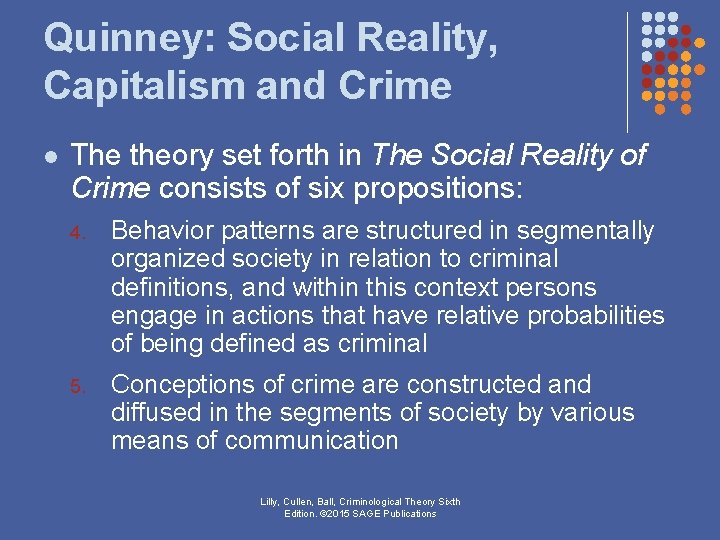
Quinney: Social Reality, Capitalism and Crime l The theory set forth in The Social Reality of Crime consists of six propositions: 1. Crime: A definition of human conduct that is created by authorized agents in a politically organized society 2. Criminal definitions describe behaviors that conflict with the interests of segments of society that have the power to shape public policy 3. Criminal definitions are applied by the segments of society that have the power to shape the enforcement and administration of criminal law Lilly, Cullen, Ball, Criminological Theory Sixth Edition. © 2015 SAGE Publications
Quinney: Social Reality, Capitalism and Crime l The theory set forth in The Social Reality of Crime consists of six propositions: 4. Behavior patterns are structured in segmentally organized society in relation to criminal definitions, and within this context persons engage in actions that have relative probabilities of being defined as criminal 5. Conceptions of crime are constructed and diffused in the segments of society by various means of communication Lilly, Cullen, Ball, Criminological Theory Sixth Edition. © 2015 SAGE Publications
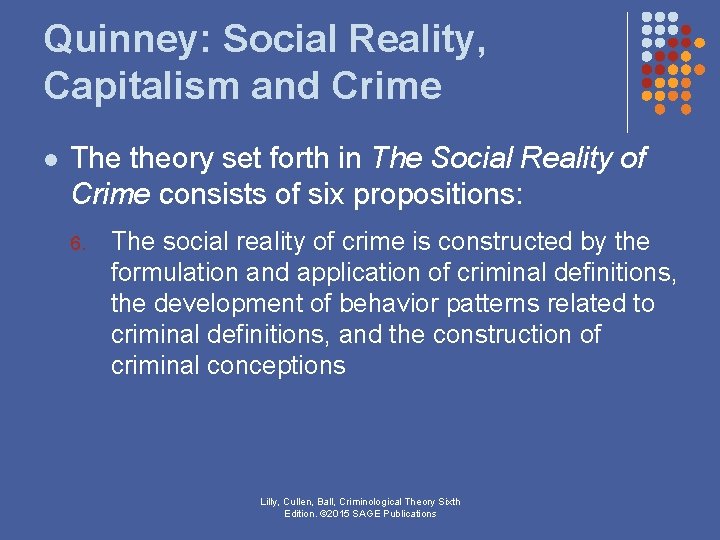
Quinney: Social Reality, Capitalism and Crime l The theory set forth in The Social Reality of Crime consists of six propositions: 6. The social reality of crime is constructed by the formulation and application of criminal definitions, the development of behavior patterns related to criminal definitions, and the construction of criminal conceptions Lilly, Cullen, Ball, Criminological Theory Sixth Edition. © 2015 SAGE Publications
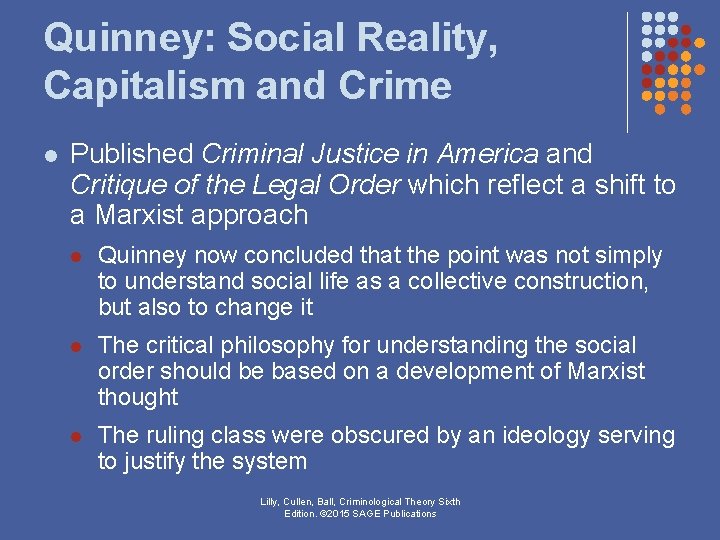
Quinney: Social Reality, Capitalism and Crime l Published Criminal Justice in America and Critique of the Legal Order which reflect a shift to a Marxist approach l Quinney now concluded that the point was not simply to understand social life as a collective construction, but also to change it l The critical philosophy for understanding the social order should be based on a development of Marxist thought l The ruling class were obscured by an ideology serving to justify the system Lilly, Cullen, Ball, Criminological Theory Sixth Edition. © 2015 SAGE Publications
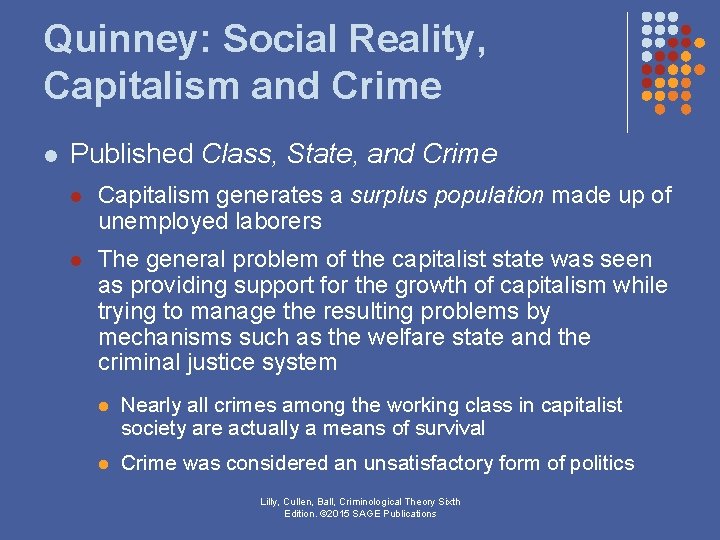
Quinney: Social Reality, Capitalism and Crime l Published Class, State, and Crime l Capitalism generates a surplus population made up of unemployed laborers l The general problem of the capitalist state was seen as providing support for the growth of capitalism while trying to manage the resulting problems by mechanisms such as the welfare state and the criminal justice system l Nearly all crimes among the working class in capitalist society are actually a means of survival l Crime was considered an unsatisfactory form of politics Lilly, Cullen, Ball, Criminological Theory Sixth Edition. © 2015 SAGE Publications
Quinney: Social Reality, Capitalism and Crime l l Crimes of Dominance 1. Crimes of control 2. Crimes of the government 3. Crimes of economic domination Crimes of Accommodation and Resistance 4. Predatory crimes 5. Personal crimes 6. Crimes of resistance Lilly, Cullen, Ball, Criminological Theory Sixth Edition. © 2015 SAGE Publications
Quinney: Social Reality, Capitalism and Crime l The answer to the human predicament is a salvation achieved through the overcoming and healing of the disparity between existence and essence l l Increasingly emphasized the religious nature of the goal Justice is more than a normative idea; it is charged with the transcendent power of the infinite and the eternal, with the essence of divine revelation l What was necessary was a “prophetic understanding” of reality l The socialist struggle in our age is a search for God at the same time that it is a struggle for justice in human society l Believed that it becomes possible to transform oneself and the social order in the pursuit of greater justice Lilly, Cullen, Ball, Criminological Theory Sixth Edition. © 2015 SAGE Publications
Conflict Theory and the Causes of Crime l l l Earlier conflict theorists had concentrated on the way in which the traditional search for causes of criminal and delinquent behavior had deflected attention away from the fact that crime was the result of the criminalization of certain behavior by the powerful, then turned their attention to the sources of the behavior that was criminalized Gordon: Offered a Marxist economic analysis that traced a great deal of crime to the underlying economic structure of American society Spitzer: Capitalism generated both a surplus population that consisted essentially of economic outcasts and a series of internal contradictions in the institutions developed to maintain capitalist domination Lilly, Cullen, Ball, Criminological Theory Sixth Edition. © 2015 SAGE Publications
Conflict Theory and the Causes of Crime l Greenberg: Circumstances (lack of employment opportunities) tend to produce a deep resentment and a fear of failure that precipitated violent behavior l Colvin and Pauly: Capitalist society tended to exert a pattern of coercive control over the lower class, threatening those at or near the bottom with loss of jobs or of any economic assistance unless they conform to the expectations of the powerful and lead to alienative involvement and break bonds to society Lilly, Cullen, Ball, Criminological Theory Sixth Edition. © 2015 SAGE Publications
Conflict Theory and the Causes of Crime l Central theoretical problem still is to understand the nature of social conflict l l Crime is an outcome of definitions imposed as part of the consequences of conflict among various segments of society Criminological conflict theory has had notable consequences in terms of subsequent theorizing and rethinking within mainstream criminology, but has had relatively little direct impact on social policy Lilly, Cullen, Ball, Criminological Theory Sixth Edition. © 2015 SAGE Publications
Consequences of Conflict Theory l Turk’s policy implications l The concept of criminal as a status assigned by the authorities as a result of a process working itself out through conflict probabilities was especially appealing to those with a formal sociological orientation who were interested in the conflict perspective but were put off by the ideological fervor of many Marxists Lilly, Cullen, Ball, Criminological Theory Sixth Edition. © 2015 SAGE Publications
Consequences of Conflict Theory l Chambliss’s policy implications l Inherent in the approach addressed by the U. S. Supreme Court under Chief Justice Earl Warren l The Warren Court had shown considerable appreciation for the legal realists’ distinction between the law in the books and the law in action l Extended the legal rights of convicted offenders as well as suspects and private citizens Lilly, Cullen, Ball, Criminological Theory Sixth Edition. © 2015 SAGE Publications
Consequences of Conflict Theory l Quinney’s policy implications l His approach had more impact on both criminological thought and deviant behavior l The concept of crime as a result of the “social construction of reality” is broader than labeling theory, and the general perspective has become extremely influential in the larger field of “social problems” as well as in the newer “postmodern criminologies” Lilly, Cullen, Ball, Criminological Theory Sixth Edition. © 2015 SAGE Publications
Consequences of Conflict Theory l The conflict theorists recognized the inequalities stressed by the opportunity theories and the stigmatizing processes emphasized by the labeling theories had a great deal to do with the perceived interests of the powerful, and they suggested how the powerful and the bureaucracies representing them might be held accountable Lilly, Cullen, Ball, Criminological Theory Sixth Edition. © 2015 SAGE Publications
Consequences of Conflict Theory l Marxist approach l More recent criminological conflict theorists working in the Marxist tradition have moved toward structural Marxism and away from the instrumental Marxism l Instrumental Marxism has tended to portray the capitalist elite as an omniscient few who knew everything and always pulled the strings to ensure that their interests were served l Structuralism locates the basis of social control factors such as law in class relations in general rather than asserting that it was entirely within the total conscious control of the capitalists at all times Lilly, Cullen, Ball, Criminological Theory Sixth Edition. © 2015 SAGE Publications
Consequences of Conflict Theory l Marxist approach l The Marxist conflict theories were attacking capitalism and criticizing conventional criminology l Charged that conventional criminology was itself a part of the capitalist system and tended to support it, thereby contributing to the crime problem rather than to its understanding or its solution l The radical theorists insisted that even the reforms urged by conventional criminologists were simply minor tinkering that tended to support the further survival of a corrupt social system Lilly, Cullen, Ball, Criminological Theory Sixth Edition. © 2015 SAGE Publications
Consequences of Conflict Theory l Peacemaking criminology accepts the notion that conflict is at the root of crime, but it advocates a policy response that refuses to escalate this conflict in favor of policies of conciliation and mediation l Peacemaking aims to build trust and a sense of community l Conflict can be best resolved by building social bonds among people Lilly, Cullen, Ball, Criminological Theory Sixth Edition. © 2015 SAGE Publications
Consequences of Conflict Theory l Peacemaking criminology l l Peacemaking criminology reflects the position of many marginalized people who realize that they cannot obtain their goals by overpowering their opposition Reflects an assumption that “two wrongs do not make a right” l It leads to social policies such as restorative justice l Peacemaking criminology has been highly criticized for utopian thinking and for the suggestion that power can be countered by something other than power Lilly, Cullen, Ball, Criminological Theory Sixth Edition. © 2015 SAGE Publications
Conclusion l Criminological conflict theory and peacemaking criminology certainly have succeeded in providing for a broadened reorientation and an increased sensitivity to issues previously overlooked or treated only in passing Lilly, Cullen, Ball, Criminological Theory Sixth Edition. © 2015 SAGE Publications