
The Social Distance Theory of Power Implications for
- Slides: 15
The Social Distance Theory of Power: Implications for Close Relationships Joe Magee New York University Pam Smith University of California-San Diego
Social Distance Theory of Power Key Principles • Principle #1: Asymmetric dependence (i. e. , power) produces asymmetric social distance – Social distance = Felt closeness to another person (Aron et al. , 1992) • Principle #2: Power increases construal level (via social distance) Magee & Smith, 2013, PSPR
Dependence and Social Distance • Closeness in relationships is achieved through repeated interactions of symmetrically dependent individuals Kelley et al. , 1983 – Symmetrically dependent partners want to minimize distance and thus need each other’s affiliation (motivation) – They expect the same of each other (expectations) • Asymmetric dependence (i. e. , power) can emerge for at least two reasons: – Differential investment – Relative attractiveness of each partner’s alternatives Rusbult & Buunk, 1993
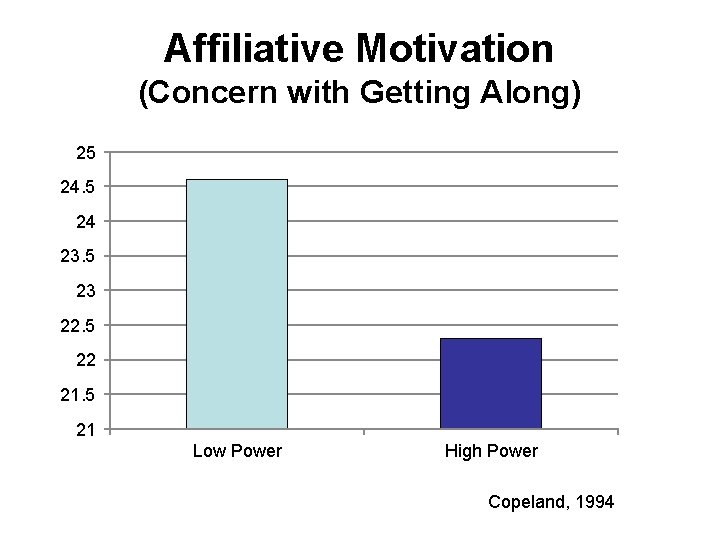
Asymmetric Dependence Asymmetric Social Distance • High-power individual has lower need to affiliate with partner Copeland, 1994; van Kleef et al. , 2008
Affiliative Motivation (Concern with Getting Along) 25 24 23. 5 23 22. 5 22 21. 5 21 Low Power High Power Copeland, 1994
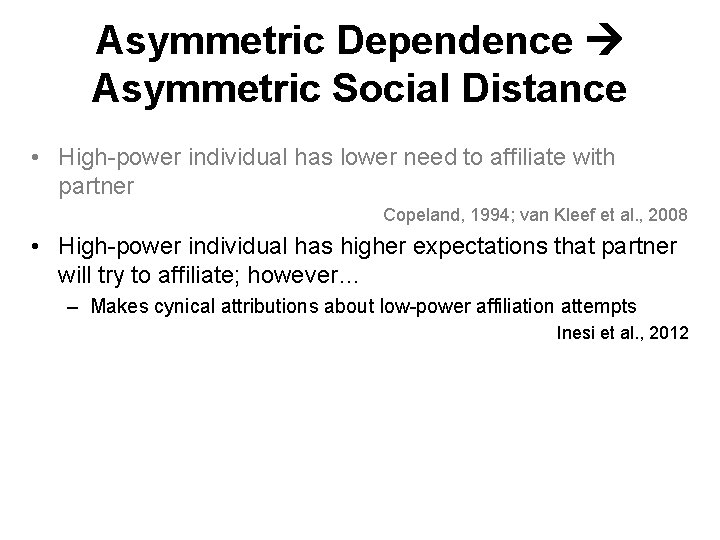
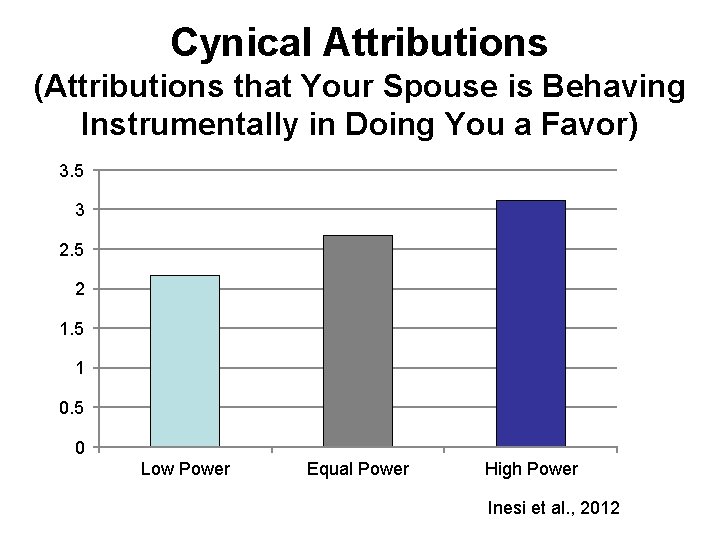
Asymmetric Dependence Asymmetric Social Distance • High-power individual has lower need to affiliate with partner Copeland, 1994; van Kleef et al. , 2008 • High-power individual has higher expectations that partner will try to affiliate; however… – Makes cynical attributions about low-power affiliation attempts Inesi et al. , 2012
Cynical Attributions (Attributions that Your Spouse is Behaving Instrumentally in Doing You a Favor) 3. 5 3 2. 5 2 1. 5 1 0. 5 0 Low Power Equal Power High Power Inesi et al. , 2012
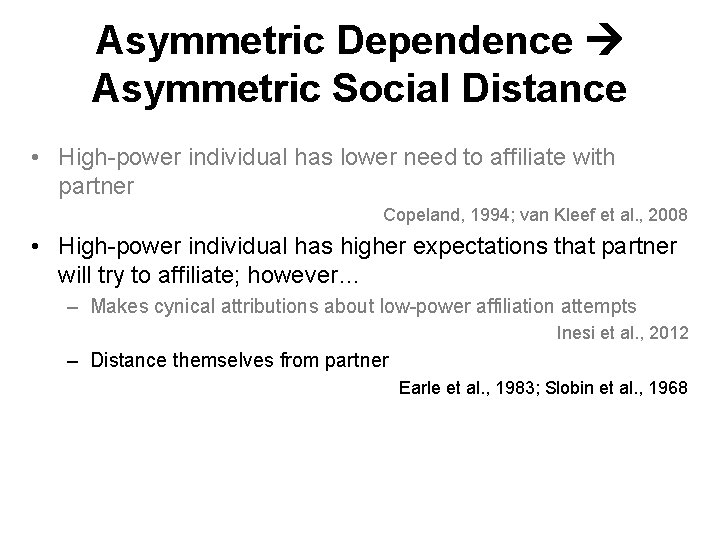
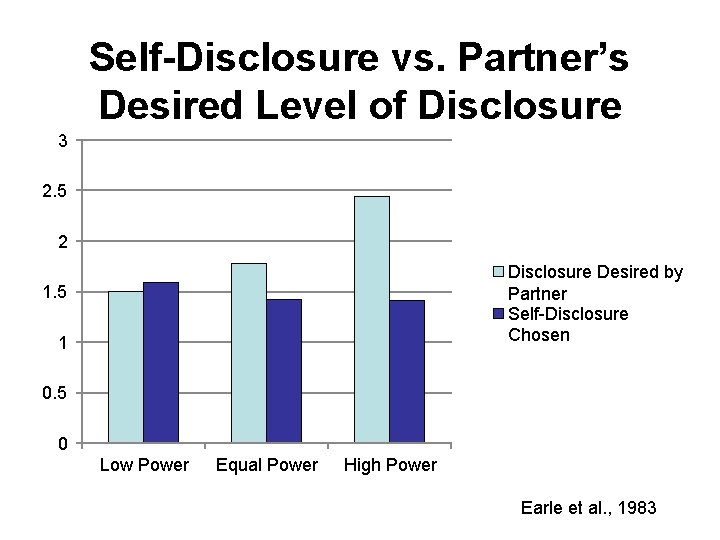
Asymmetric Dependence Asymmetric Social Distance • High-power individual has lower need to affiliate with partner Copeland, 1994; van Kleef et al. , 2008 • High-power individual has higher expectations that partner will try to affiliate; however… – Makes cynical attributions about low-power affiliation attempts Inesi et al. , 2012 – Distance themselves from partner Earle et al. , 1983; Slobin et al. , 1968
Self-Disclosure vs. Partner’s Desired Level of Disclosure 3 2. 5 2 Disclosure Desired by Partner Self-Disclosure Chosen 1. 5 1 0. 5 0 Low Power Equal Power High Power Earle et al. , 1983
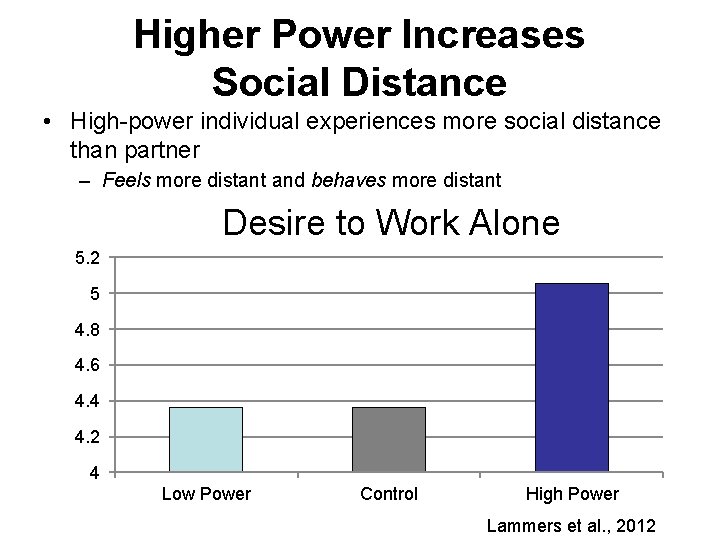
Higher Power Increases Social Distance • High-power individual experiences more social distance than partner – Feels more distant and behaves more distant Desire to Work Alone 5. 2 5 4. 8 4. 6 4. 4 4. 2 4 Low Power Control High Power Lammers et al. , 2012
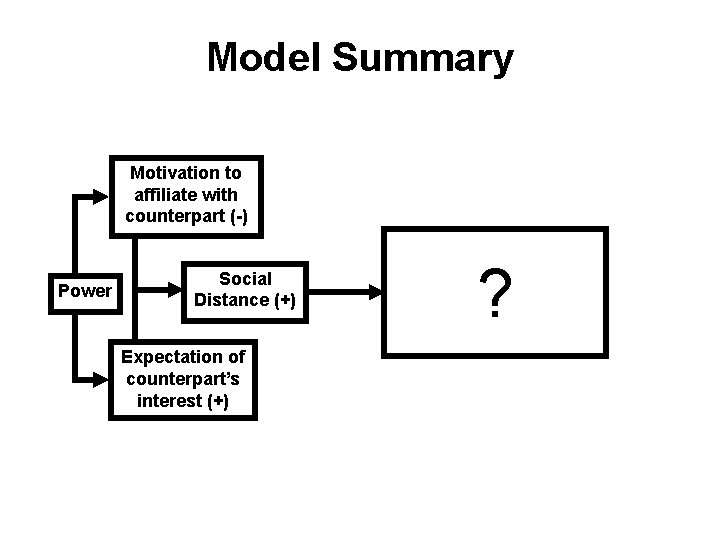
Model Summary Motivation to affiliate with counterpart (-) Power Social Distance (+) Expectation of counterpart’s interest (+) ?
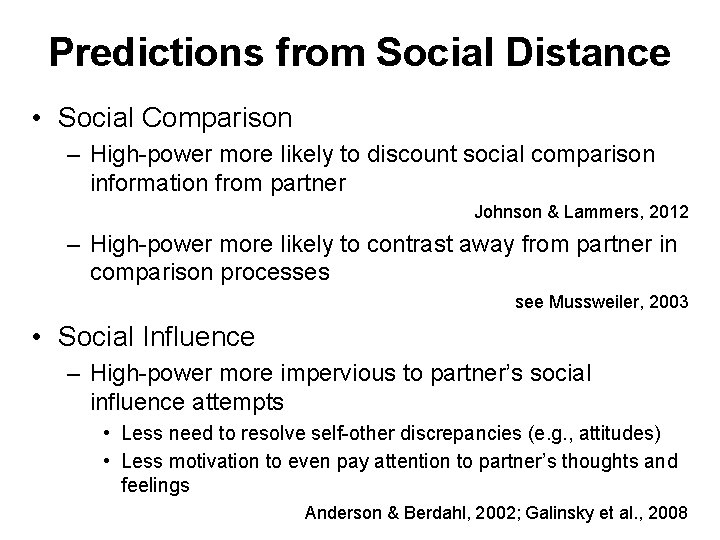
Predictions from Social Distance • Social Comparison – High-power more likely to discount social comparison information from partner Johnson & Lammers, 2012 – High-power more likely to contrast away from partner in comparison processes see Mussweiler, 2003 • Social Influence – High-power more impervious to partner’s social influence attempts • Less need to resolve self-other discrepancies (e. g. , attitudes) • Less motivation to even pay attention to partner’s thoughts and feelings Anderson & Berdahl, 2002; Galinsky et al. , 2008
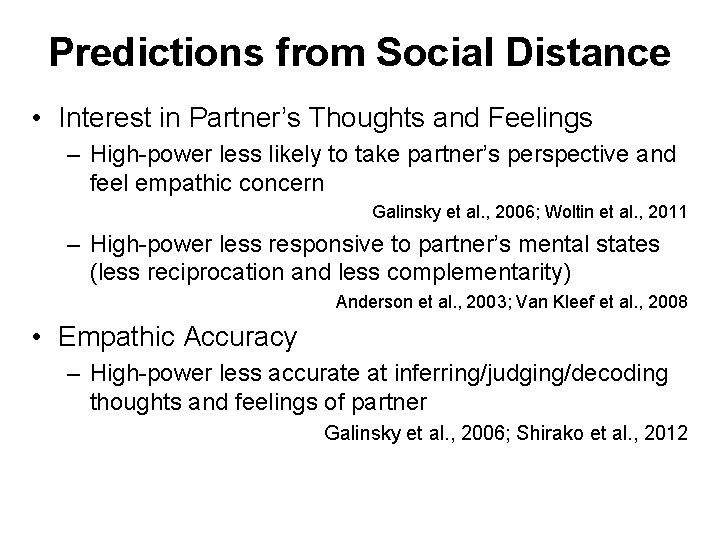
Predictions from Social Distance • Interest in Partner’s Thoughts and Feelings – High-power less likely to take partner’s perspective and feel empathic concern Galinsky et al. , 2006; Woltin et al. , 2011 – High-power less responsive to partner’s mental states (less reciprocation and less complementarity) Anderson et al. , 2003; Van Kleef et al. , 2008 • Empathic Accuracy – High-power less accurate at inferring/judging/decoding thoughts and feelings of partner Galinsky et al. , 2006; Shirako et al. , 2012
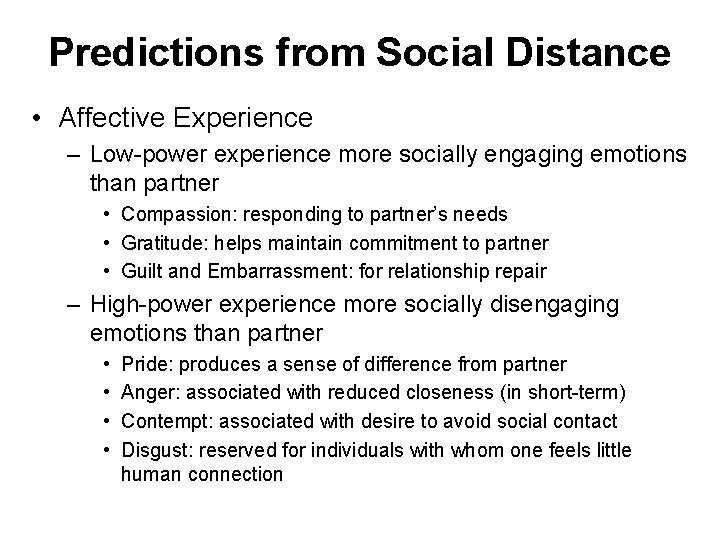
Predictions from Social Distance • Affective Experience – Low-power experience more socially engaging emotions than partner • Compassion: responding to partner’s needs • Gratitude: helps maintain commitment to partner • Guilt and Embarrassment: for relationship repair – High-power experience more socially disengaging emotions than partner • • Pride: produces a sense of difference from partner Anger: associated with reduced closeness (in short-term) Contempt: associated with desire to avoid social contact Disgust: reserved for individuals with whom one feels little human connection
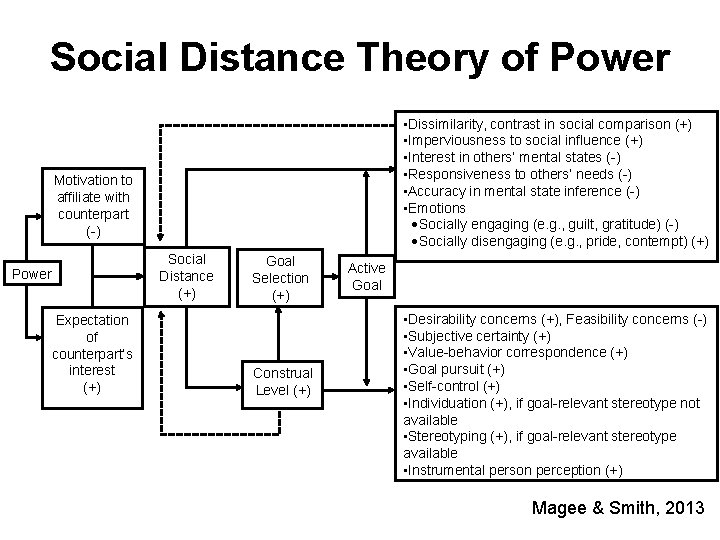
Social Distance Theory of Power • Dissimilarity, contrast in social comparison (+) • Imperviousness to social influence (+) • Interest in others’ mental states (-) • Responsiveness to others’ needs (-) • Accuracy in mental state inference (-) • Emotions Socially engaging (e. g. , guilt, gratitude) (-) Socially disengaging (e. g. , pride, contempt) (+) Motivation to affiliate with counterpart (-) Power Expectation of counterpart’s interest (+) Social Distance (+) Goal Selection (+) Construal Level (+) Active Goal • Desirability concerns (+), Feasibility concerns (-) • Subjective certainty (+) • Value-behavior correspondence (+) • Goal pursuit (+) • Self-control (+) • Individuation (+), if goal-relevant stereotype not available • Stereotyping (+), if goal-relevant stereotype available • Instrumental person perception (+) Magee & Smith, 2013