
POWER Power refers to the potential or actual
- Slides: 23
POWER • Power refers to the potential or actual ability to influence others in a desired direction. It is the ability of a person (group) to induce another person (group) to behave in a way that the former desires. • Power can be categorized in two types: 1. Formal Power 2. Informal Power
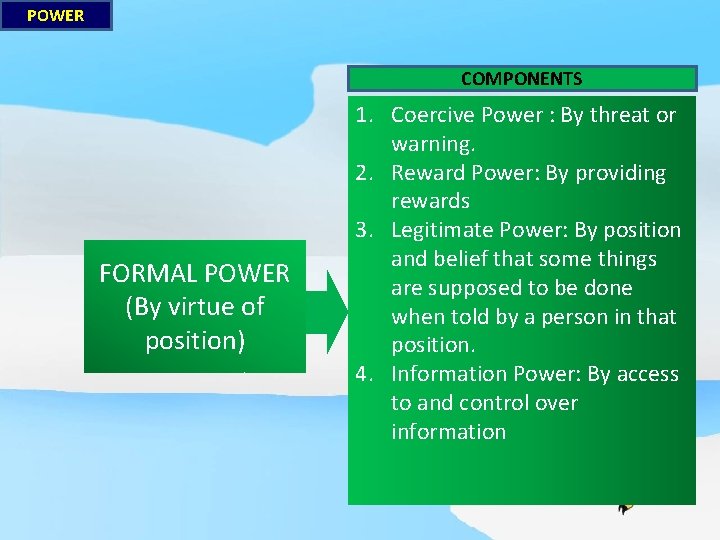
POWER COMPONENTS FORMAL POWER (By virtue of position) 1. Coercive Power : By threat or warning. 2. Reward Power: By providing rewards 3. Legitimate Power: By position and belief that some things are supposed to be done when told by a person in that position. 4. Information Power: By access to and control over information
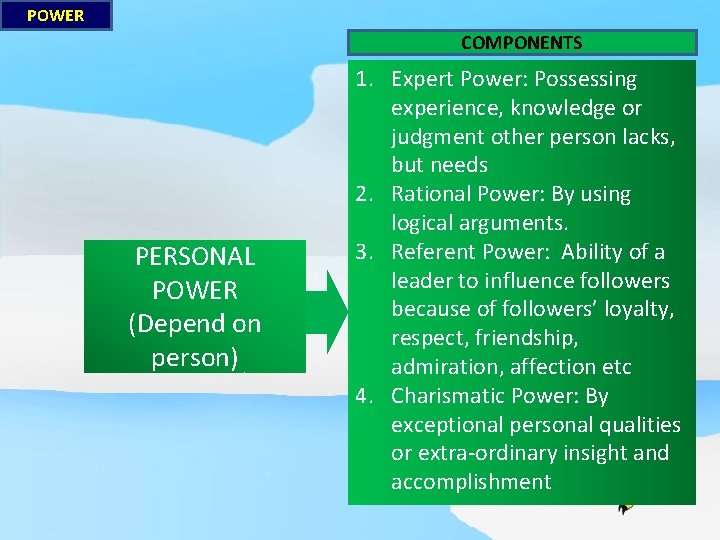
POWER COMPONENTS PERSONAL POWER (Depend on person) 1. Expert Power: Possessing experience, knowledge or judgment other person lacks, but needs 2. Rational Power: By using logical arguments. 3. Referent Power: Ability of a leader to influence followers because of followers’ loyalty, respect, friendship, admiration, affection etc 4. Charismatic Power: By exceptional personal qualities or extra-ordinary insight and accomplishment
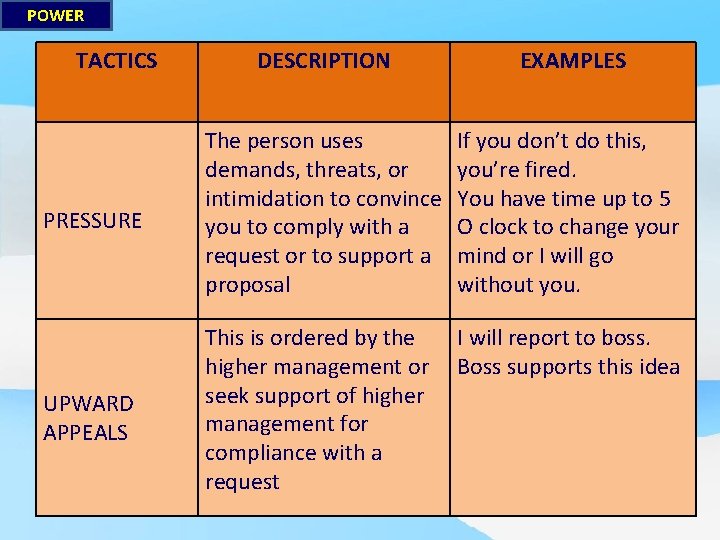
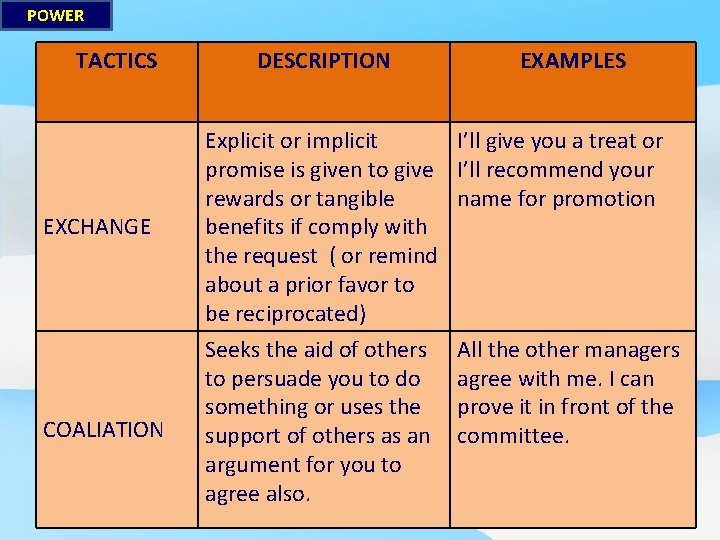
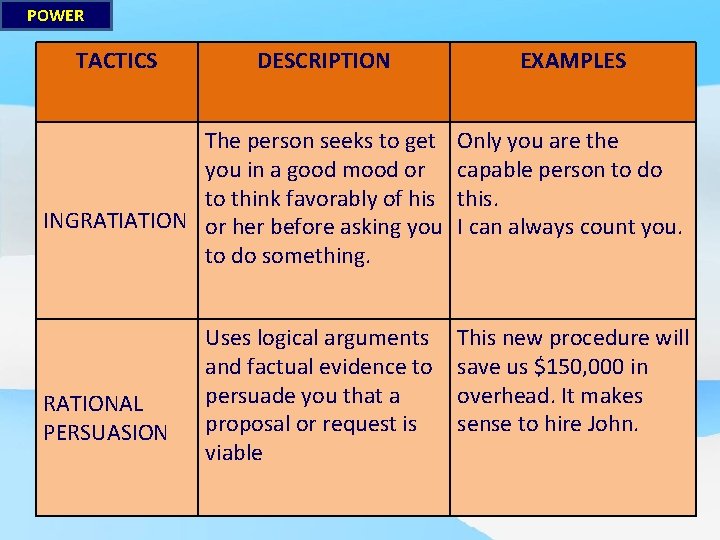
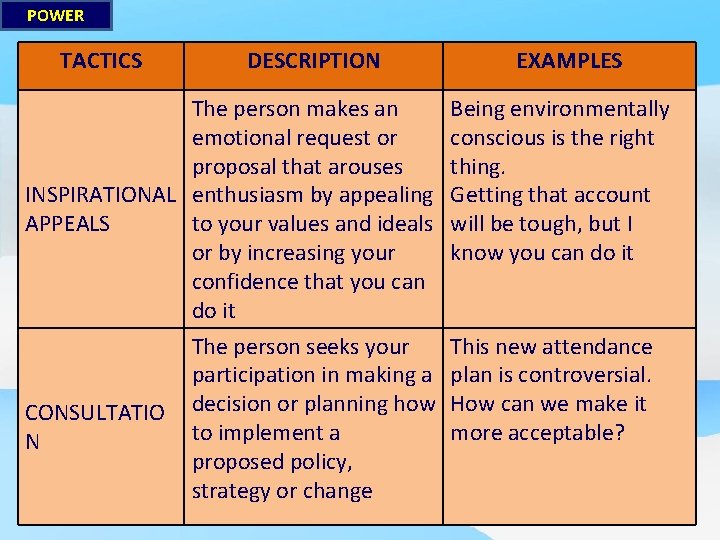
POWER Influence • The purpose of power is to influence people. • There are eight basic types of influence tactics used in organizations.
POWER TACTICS DESCRIPTION EXAMPLES PRESSURE The person uses demands, threats, or intimidation to convince you to comply with a request or to support a proposal If you don’t do this, you’re fired. You have time up to 5 O clock to change your mind or I will go without you. I will report to boss. Boss supports this idea UPWARD APPEALS This is ordered by the higher management or seek support of higher management for compliance with a request
POWER TACTICS EXCHANGE COALIATION DESCRIPTION Explicit or implicit promise is given to give rewards or tangible benefits if comply with the request ( or remind about a prior favor to be reciprocated) Seeks the aid of others to persuade you to do something or uses the support of others as an argument for you to agree also. EXAMPLES I’ll give you a treat or I’ll recommend your name for promotion All the other managers agree with me. I can prove it in front of the committee.
POWER TACTICS DESCRIPTION The person seeks to get you in a good mood or to think favorably of his INGRATIATION or her before asking you to do something. RATIONAL PERSUASION Uses logical arguments and factual evidence to persuade you that a proposal or request is viable EXAMPLES Only you are the capable person to do this. I can always count you. This new procedure will save us $150, 000 in overhead. It makes sense to hire John.
POWER TACTICS DESCRIPTION The person makes an emotional request or proposal that arouses INSPIRATIONAL enthusiasm by appealing APPEALS to your values and ideals or by increasing your confidence that you can do it CONSULTATIO N The person seeks your participation in making a decision or planning how to implement a proposed policy, strategy or change EXAMPLES Being environmentally conscious is the right thing. Getting that account will be tough, but I know you can do it This new attendance plan is controversial. How can we make it more acceptable?
POWER EMPOWERMENT • Generally organizations use less than 20% of the capabilities of their employee’s potential (Gallup Research) • Employee potential can be increased by creating an environment in which the employee can learn, grow and give their best. • Employee should go to extra mile expending their discretionary energy for the sake of the organization. • Identifying the untapped potential and developing it are the key competitive strengths of many organizations now.
POWER Indicators of organization without empowerment Blaming & victim mentality Fear of making decisions Lack of participation in decision making New ideas not taken seriously Leaders Vs Employees mindset Distrust and cynicism Apathy and burnout Thoughts or feelings not freely expressed for fear of repercussion Learning and growth opportunities not actively pursued Gossip and back biting People feel unappreciated Lack of recognition for contributions Top talent leaving for better opportunities or work environment
POLITICS
• Organizational politics refers to the use and manipulation of situations, power and people to secure position and gain from situation. • It may done by letting others down and by increasing their own power, image and status in the organization. • Politics can be a well played game inside the organization by a single player or a group (team) together.
• Usually cliques are involved in this. • It can foster the benefit of the organization or may go against it. • It can also benefit those who play it or may throw them out of organization. • It can also benefit those who don’t play it or may send them out of the organization • Thus it is a double edged sword that can either benefit the organization or
• It is practically impossible to make a workplace free from politics, but the organization and employees should follow certain ethics to make the workplace more healthier.
1. LIVING AT PEACE WITH OTHERS • The easiest way to avoid problems with politics is to get along with people. • You can be pleasant and professional and at the same time assertive If there is a concern, then focus only on the issue and not on the person. If you refuse a request, tell why and try to come up with alternative solutions
2. KEEP THE TALK INSIDE • Keeps the issues and discussion inside the organization • Bad mouthing harms you as much as it harms the organization
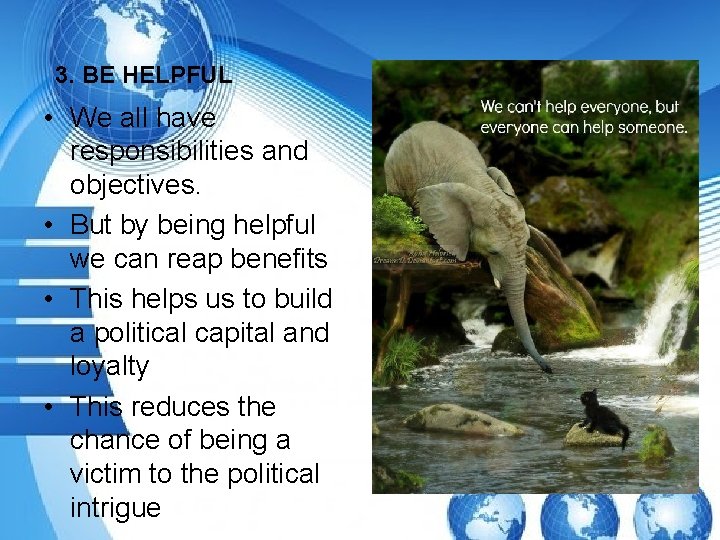
3. BE HELPFUL • We all have responsibilities and objectives. • But by being helpful we can reap benefits • This helps us to build a political capital and loyalty • This reduces the chance of being a victim to the political intrigue
4. STAY AWAY FROM GOSSIP • Gossip destroys the happy atmosphere in an office and hence try to stay away from it. • Don’t lecture on it to colleagues or subordinates but subtly change the subject
5. Avoid the talking-ill-of-the-boss sessions • If you join such group, it makes you look disloyal to the boss and if you don’t, it looks awkward in the group • Try to change the topic
6. BE STRAIGHT FORWARD • Be straight forward • Do what you say you’re going to do, alert people to problems, and admit your mistakes • Open stand get resistance as well as support
7. Address issue of politics openly when appropriate 8. Document things • Always a keep of record of the matter in written format • Documents are proofs and also serve as a record of accomplishments
9. Self Incentive to Foster Teamwork • Incentives should be given on the basis of justice in the organization • If we reward employees in a department based only on how well that department does, we may inadvertently cause destructive competition among departments.
10. Set an Example • People in organization look to leadership to see how to act. • In order to avoid negative politics, the manager should set himself as an example to follow.