Chapter 2 Differentiation 2 1 The Derivative and

- Slides: 60
Chapter 2 Differentiation • 2 -1 The Derivative and the Tangent Line Problem • 2 -2 Basic Differentiation Rules and Rates of Change • 2 -3 Product/Quotient Rule and Higher-Order Derivatives • 2 -4 Chain Rule • 2 -5 Implicit Differentiation • 2 -6 Related Rates (SKIP for now)
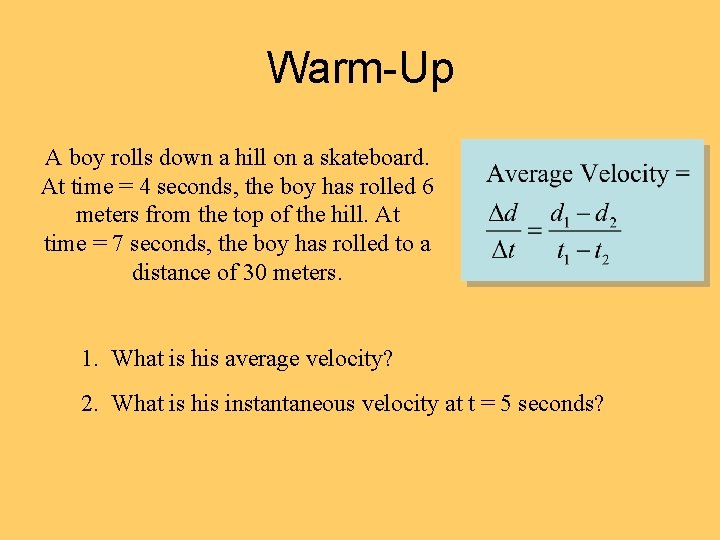
Warm-Up A boy rolls down a hill on a skateboard. At time = 4 seconds, the boy has rolled 6 meters from the top of the hill. At time = 7 seconds, the boy has rolled to a distance of 30 meters. 1. What is his average velocity? 2. What is his instantaneous velocity at t = 5 seconds?
2. 1 The Derivative and Tangent Line Problem http: //www. youtube. com/watch? v=w 8 e. E 5 o 5 Na. VU
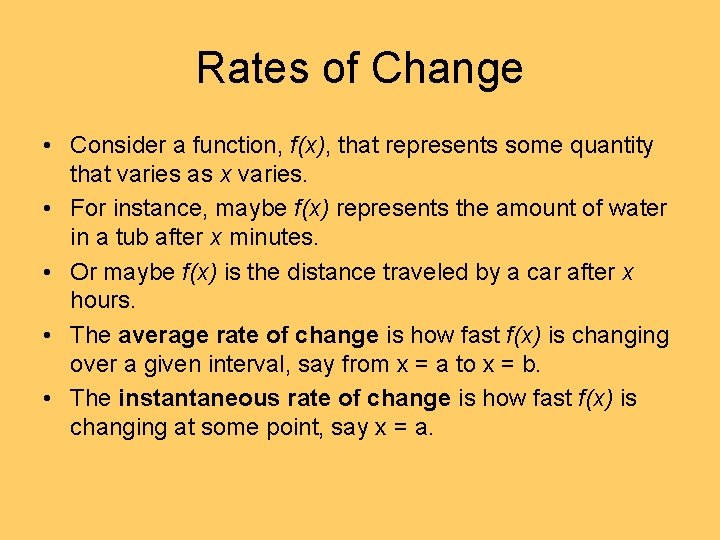
Rates of Change • Consider a function, f(x), that represents some quantity that varies as x varies. • For instance, maybe f(x) represents the amount of water in a tub after x minutes. • Or maybe f(x) is the distance traveled by a car after x hours. • The average rate of change is how fast f(x) is changing over a given interval, say from x = a to x = b. • The instantaneous rate of change is how fast f(x) is changing at some point, say x = a.
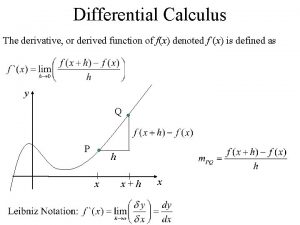
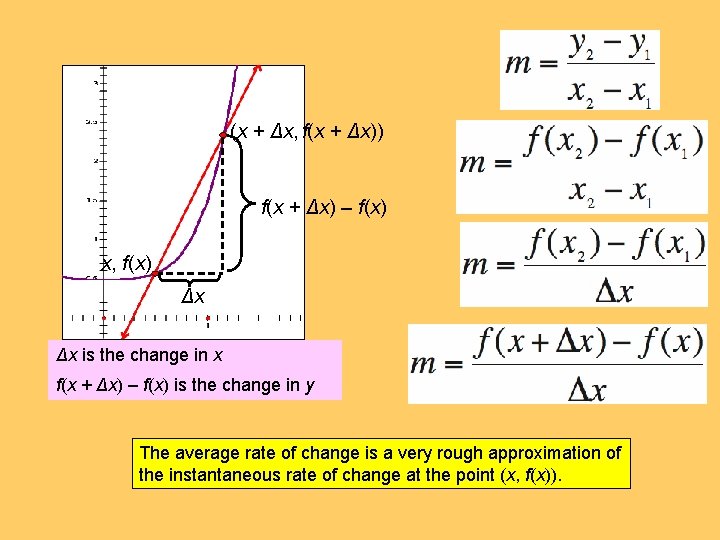
(x + Δx, f(x + Δx)) f(x + Δx) – f(x) x, f(x) Δx Δx is the change in x f(x + Δx) – f(x) is the change in y The average rate of change is a very rough approximation of the instantaneous rate of change at the point (x, f(x)).
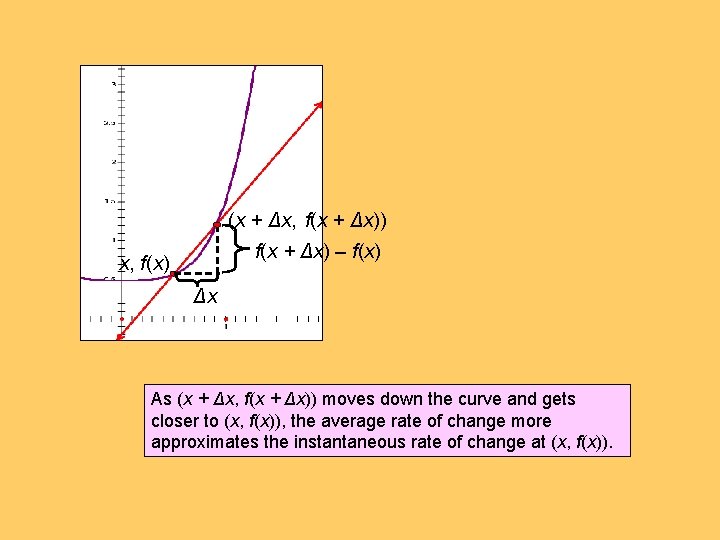
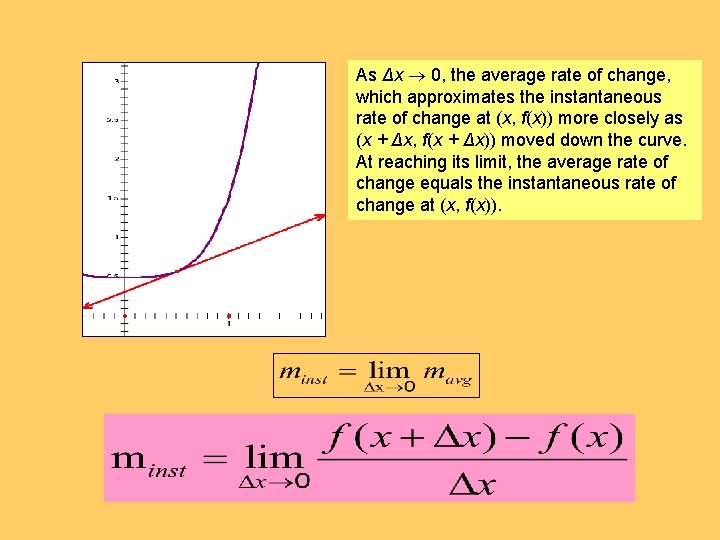
(x + Δx, f(x + Δx)) f(x + Δx) – f(x) x, f(x) Δx As (x + Δx, f(x + Δx)) moves down the curve and gets closer to (x, f(x)), the average rate of change more approximates the instantaneous rate of change at (x, f(x)).
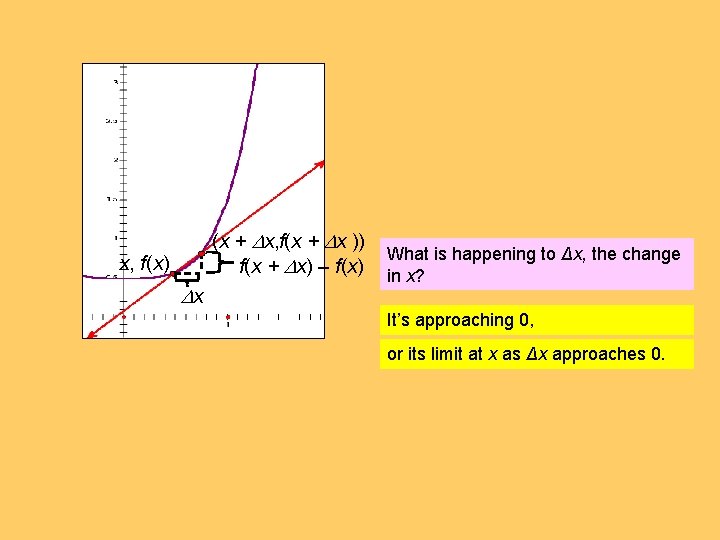
(x + x, f(x + x )) f(x + x) – f(x) x, f(x) x What is happening to Δx, the change in x? It’s approaching 0, or its limit at x as Δx approaches 0.
As Δx 0, the average rate of change, which approximates the instantaneous rate of change at (x, f(x)) more closely as (x + Δx, f(x + Δx)) moved down the curve. At reaching its limit, the average rate of change equals the instantaneous rate of change at (x, f(x)).
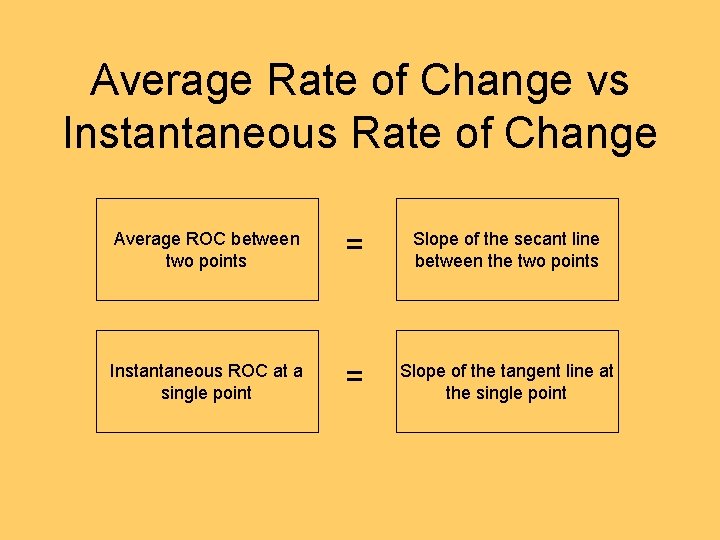
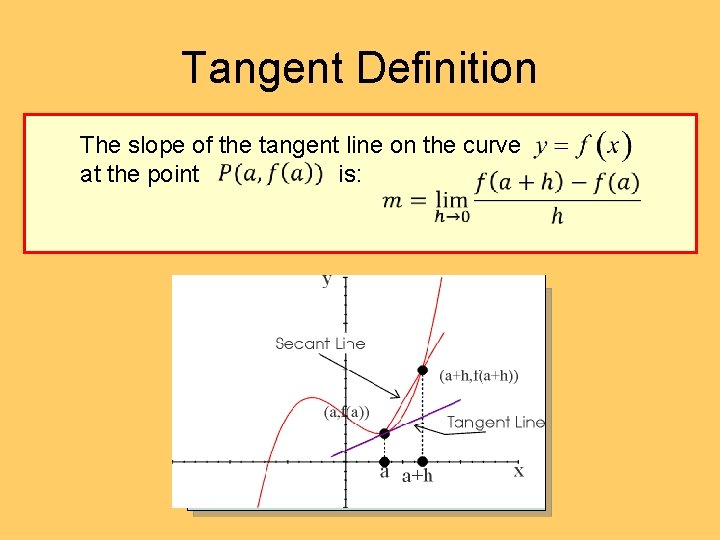
Average Rate of Change vs Instantaneous Rate of Change Average ROC between two points = Slope of the secant line between the two points Instantaneous ROC at a single point = Slope of the tangent line at the single point
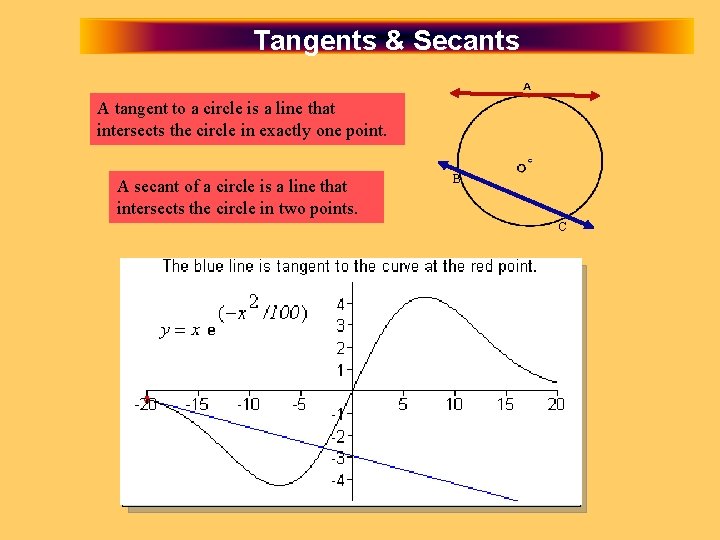
Tangents & Secants A tangent to a circle is a line that intersects the circle in exactly one point. A secant of a circle is a line that intersects the circle in two points. B C
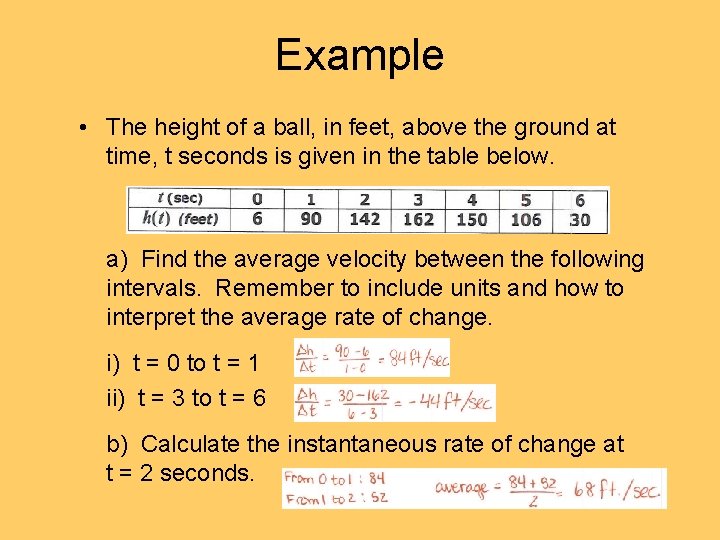
Example • The height of a ball, in feet, above the ground at time, t seconds is given in the table below. a) Find the average velocity between the following intervals. Remember to include units and how to interpret the average rate of change. i) t = 0 to t = 1 ii) t = 3 to t = 6 b) Calculate the instantaneous rate of change at t = 2 seconds.
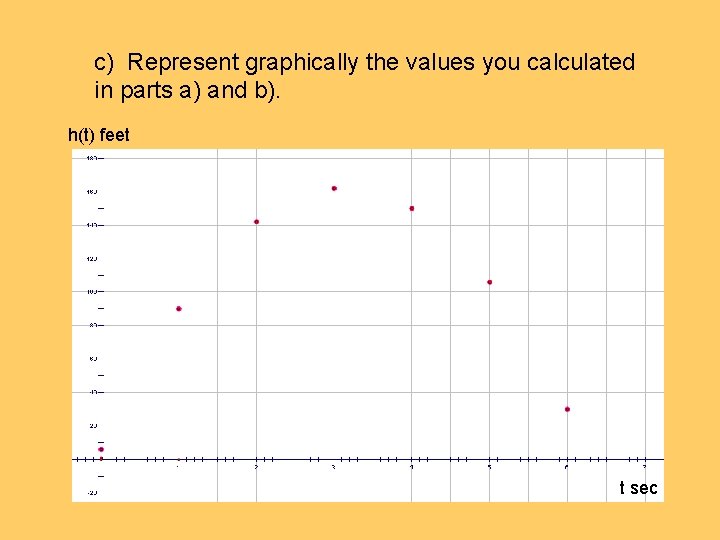
c) Represent graphically the values you calculated in parts a) and b). h(t) feet t sec
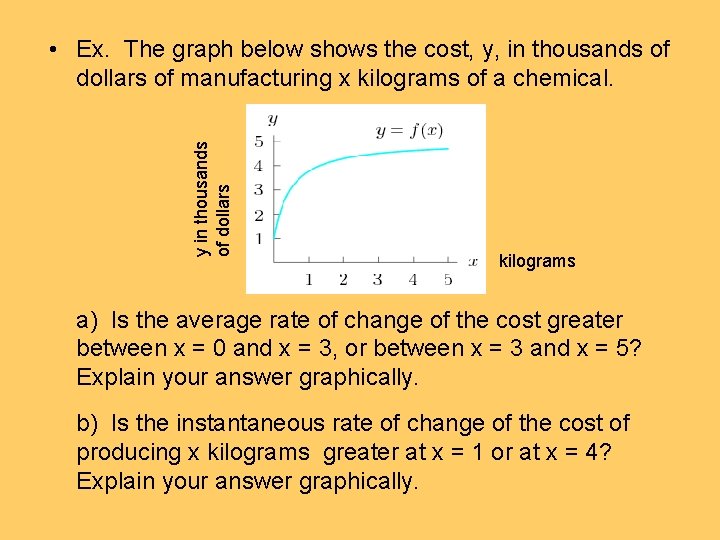
y in thousands of dollars • Ex. The graph below shows the cost, y, in thousands of dollars of manufacturing x kilograms of a chemical. kilograms a) Is the average rate of change of the cost greater between x = 0 and x = 3, or between x = 3 and x = 5? Explain your answer graphically. b) Is the instantaneous rate of change of the cost of producing x kilograms greater at x = 1 or at x = 4? Explain your answer graphically.
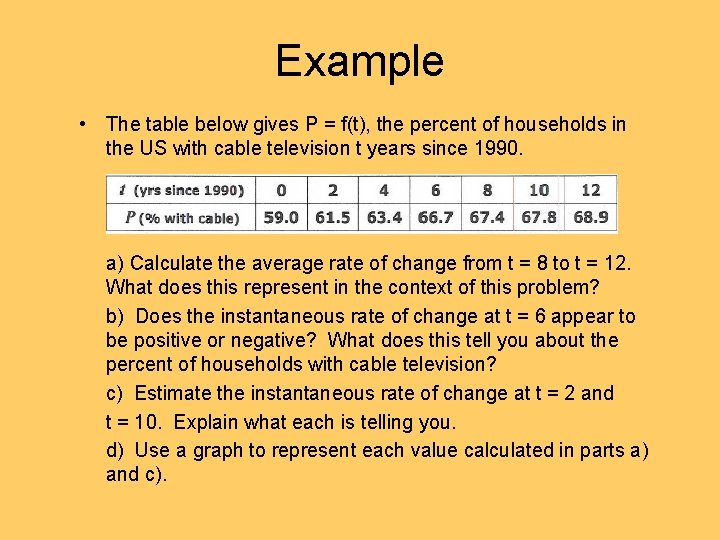
Example • The table below gives P = f(t), the percent of households in the US with cable television t years since 1990. a) Calculate the average rate of change from t = 8 to t = 12. What does this represent in the context of this problem? b) Does the instantaneous rate of change at t = 6 appear to be positive or negative? What does this tell you about the percent of households with cable television? c) Estimate the instantaneous rate of change at t = 2 and t = 10. Explain what each is telling you. d) Use a graph to represent each value calculated in parts a) and c).
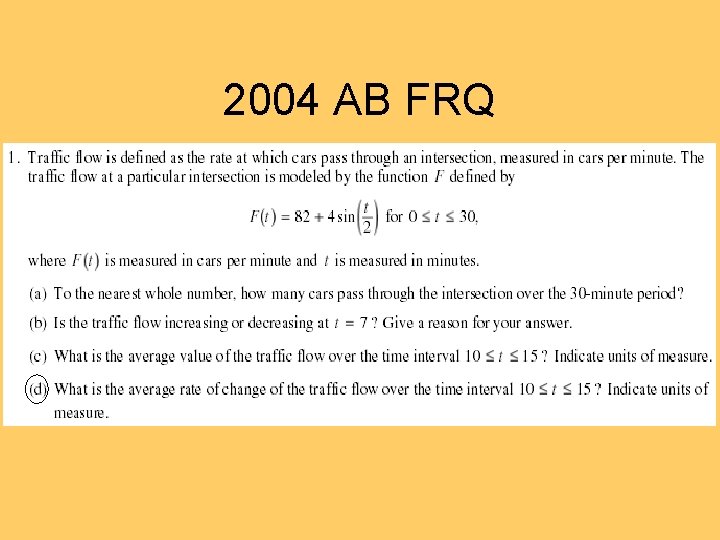
2004 AB FRQ
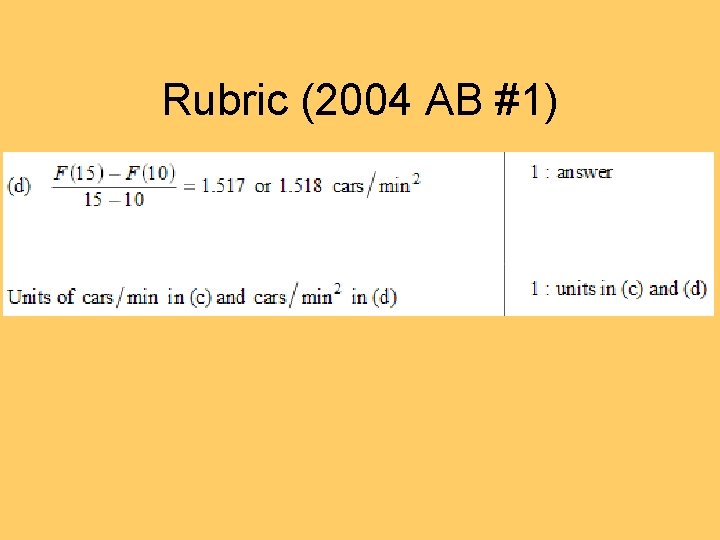
Rubric (2004 AB #1)
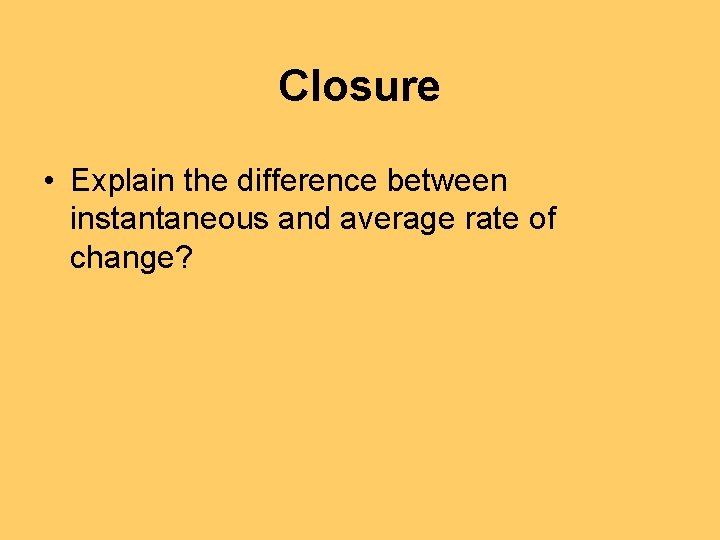
Closure • Explain the difference between instantaneous and average rate of change?
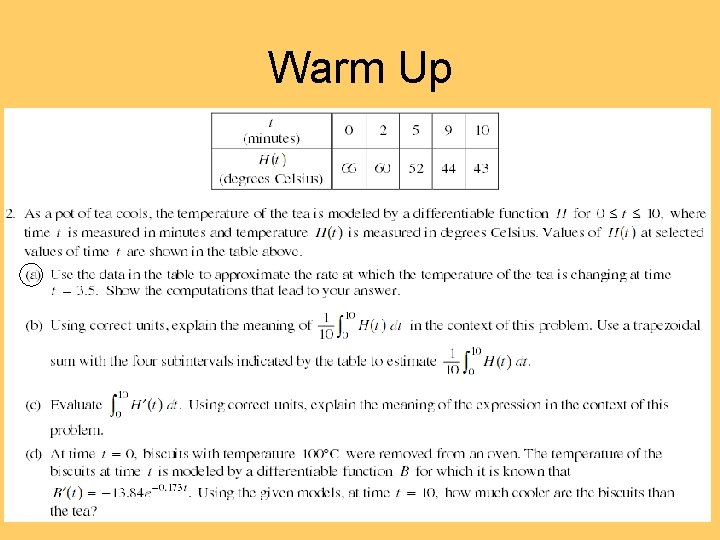
Warm Up
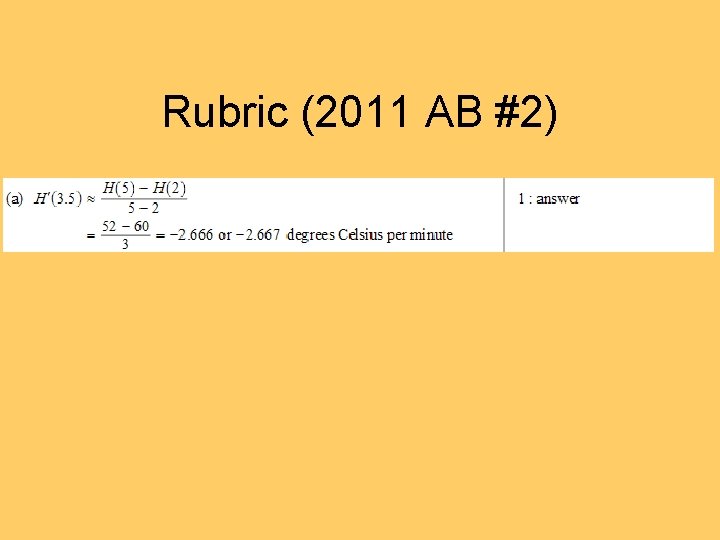
Rubric (2011 AB #2)
Tangent Definition The slope of the tangent line on the curve at the point is:
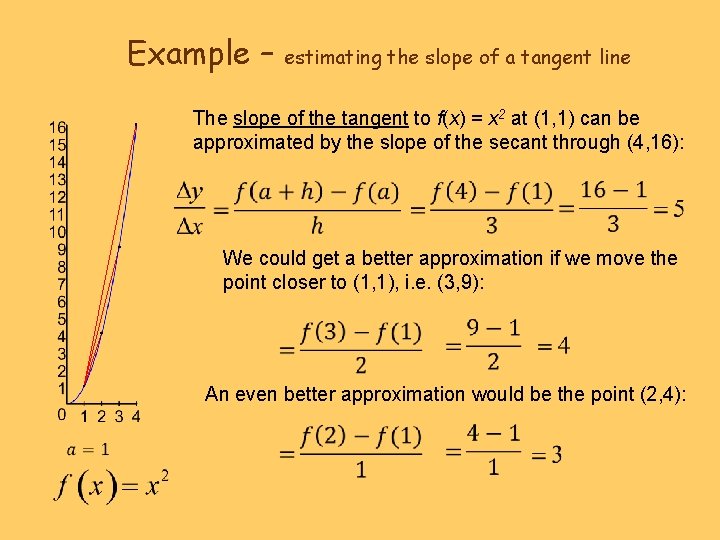
Example – estimating the slope of a tangent line The slope of the tangent to f(x) = x 2 at (1, 1) can be approximated by the slope of the secant through (4, 16): We could get a better approximation if we move the point closer to (1, 1), i. e. (3, 9): An even better approximation would be the point (2, 4):
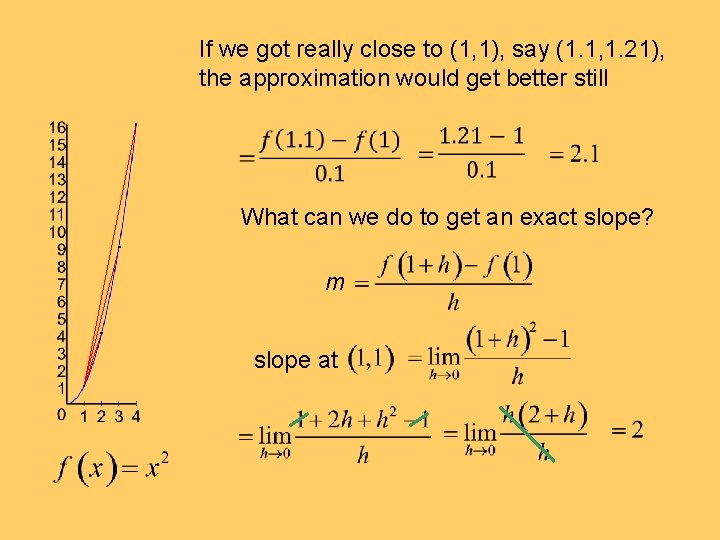
If we got really close to (1, 1), say (1. 1, 1. 21), the approximation would get better still What can we do to get an exact slope? m slope at
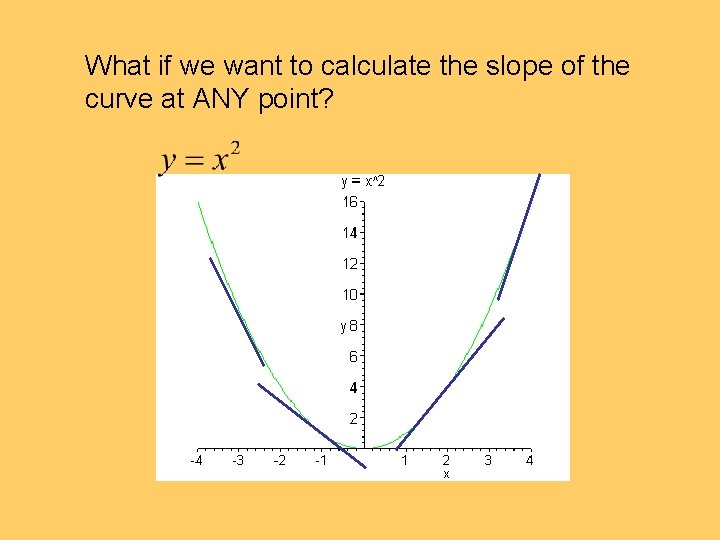
What if we want to calculate the slope of the curve at ANY point?
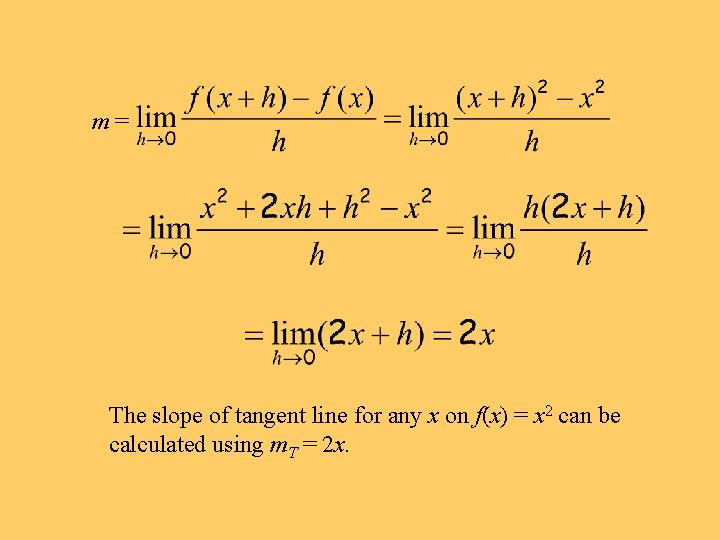
m= The slope of tangent line for any x on f(x) = x 2 can be calculated using m. T = 2 x.
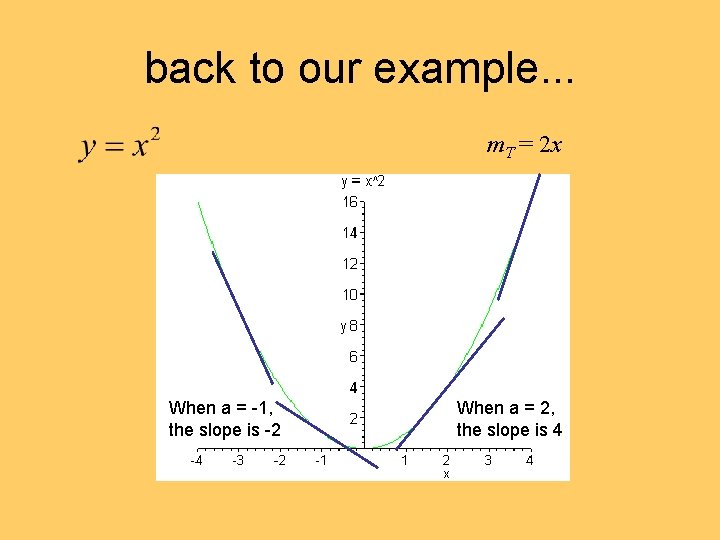
back to our example. . . m. T = 2 x When a = -1, the slope is -2 When a = 2, the slope is 4
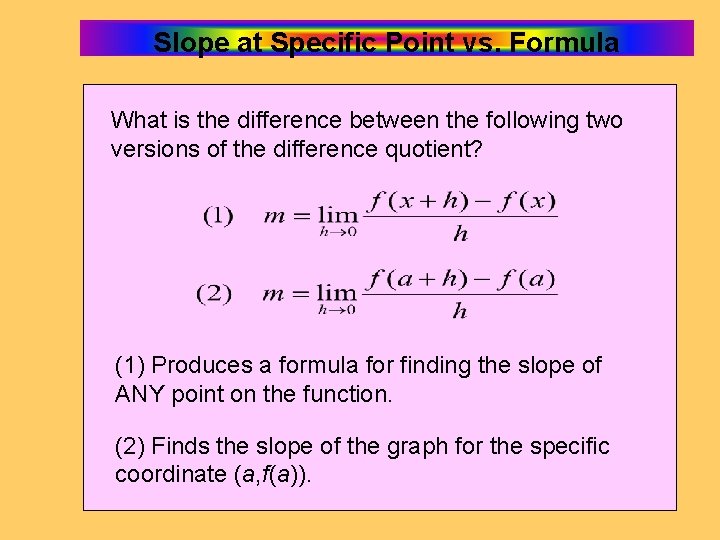
Slope at Specific Point vs. Formula What is the difference between the following two versions of the difference quotient? (1) Produces a formula for finding the slope of ANY point on the function. (2) Finds the slope of the graph for the specific coordinate (a, f(a)).
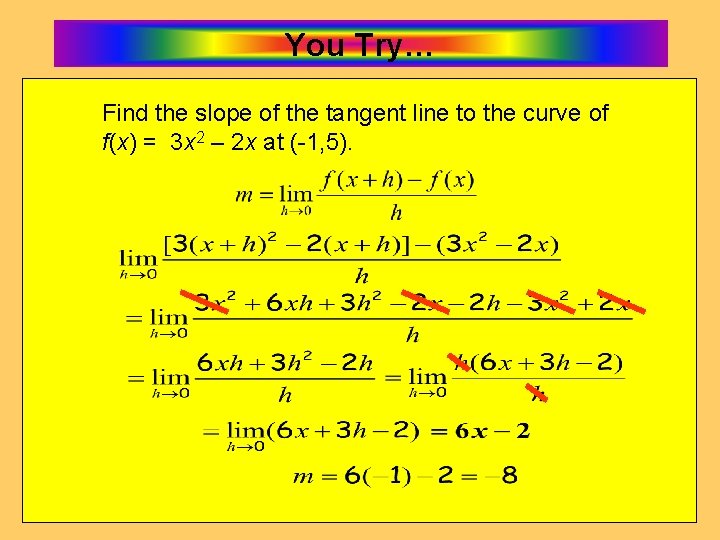
You Try… Find the slope of the tangent line to the curve of f(x) = 3 x 2 – 2 x at (-1, 5).
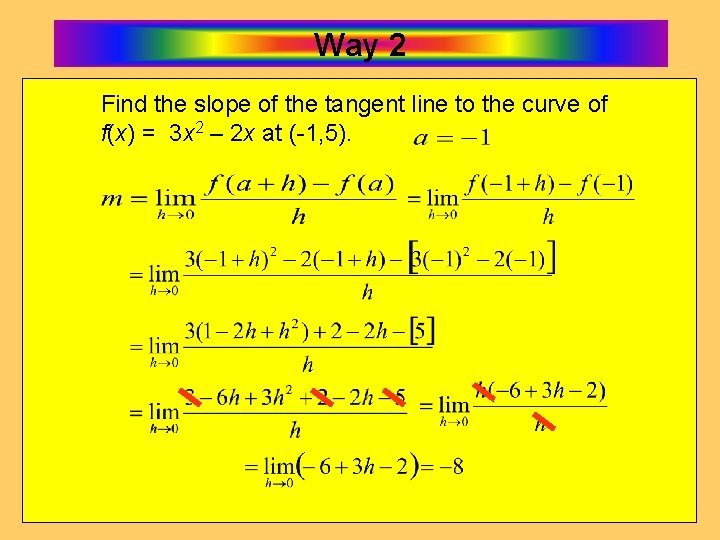
Way 2 Find the slope of the tangent line to the curve of f(x) = 3 x 2 – 2 x at (-1, 5).
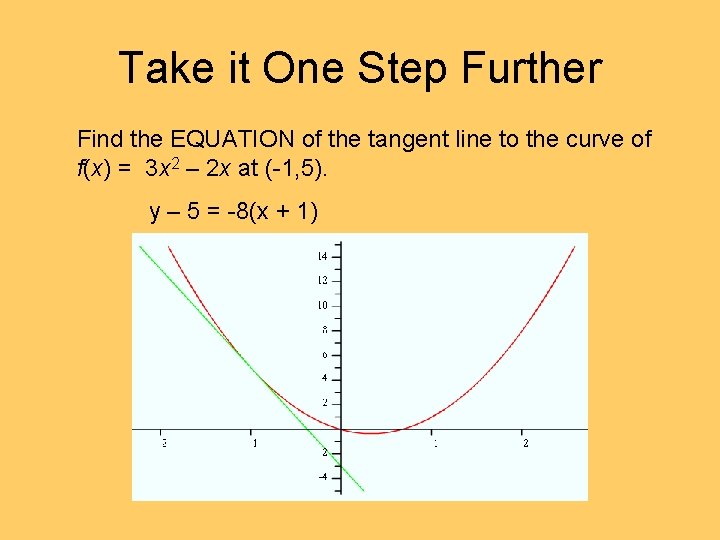
Take it One Step Further Find the EQUATION of the tangent line to the curve of f(x) = 3 x 2 – 2 x at (-1, 5). y – 5 = -8(x + 1)
• You have now come to a crucial point in the study of Calculus! • The limit used to define instantaneous rate of change (the slope of a tangent line) is also used to define of the two fundamental topics in Calculus… DIFFERENTIATION.
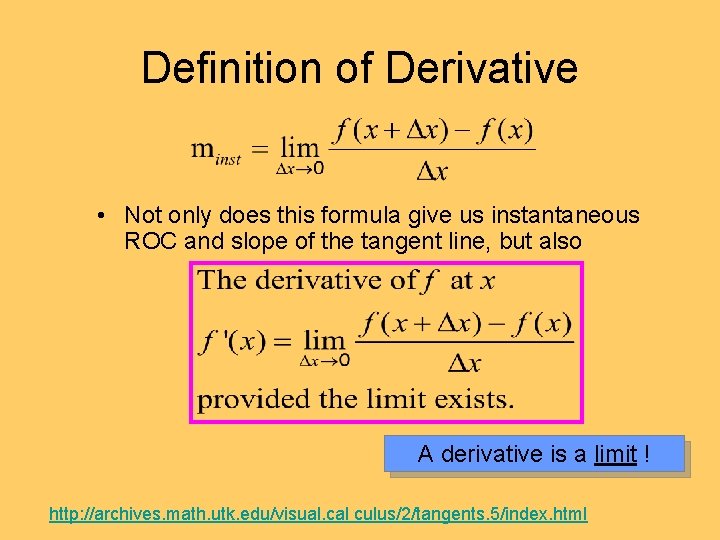
Definition of Derivative • Not only does this formula give us instantaneous ROC and slope of the tangent line, but also A derivative is a limit ! http: //archives. math. utk. edu/visual. cal culus/2/tangents. 5/index. html
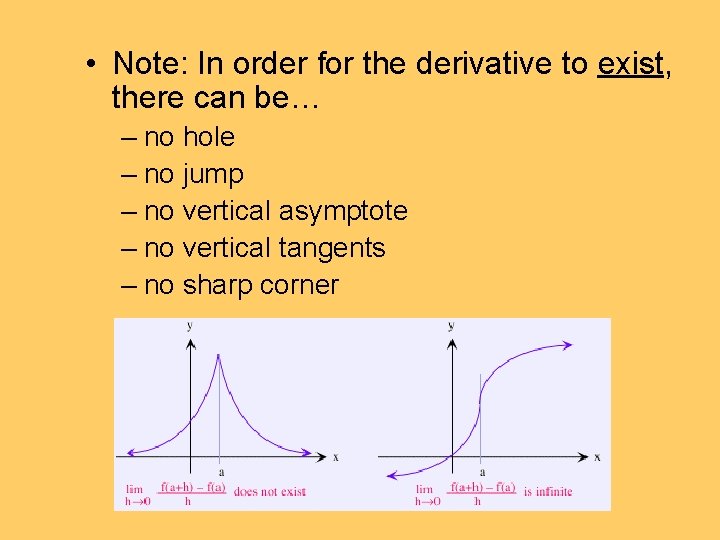
• Note: In order for the derivative to exist, there can be… – no hole – no jump – no vertical asymptote – no vertical tangents – no sharp corner
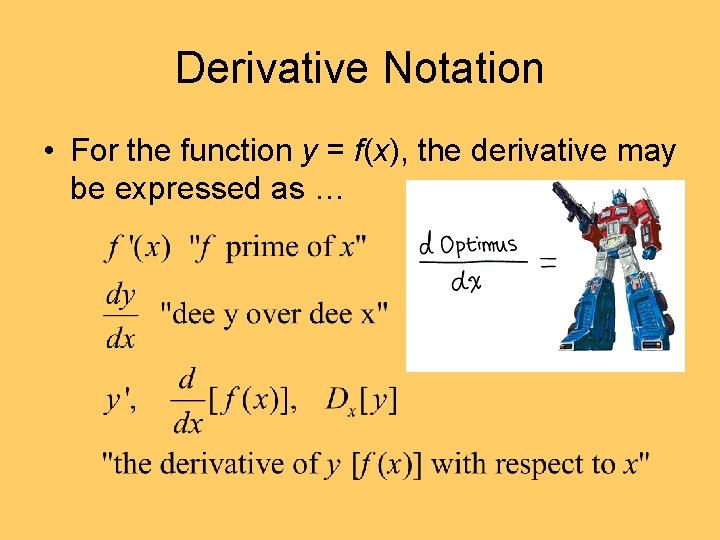
Derivative Notation • For the function y = f(x), the derivative may be expressed as …
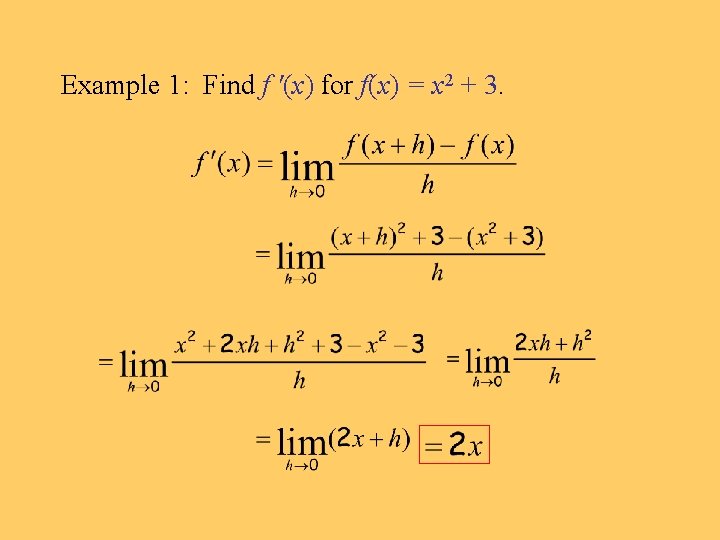
Example 1: Find f ′(x) for f(x) = x 2 + 3.
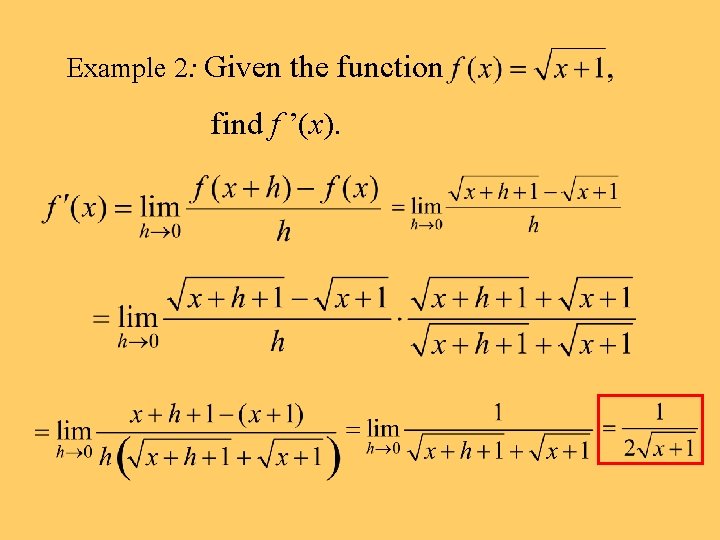
Example 2: Given the function find f ’(x).
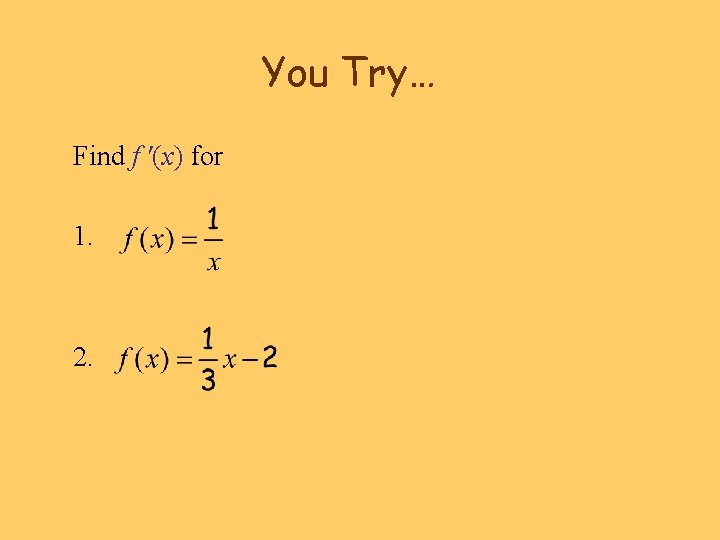
You Try… Find f ′(x) for 1. 2.
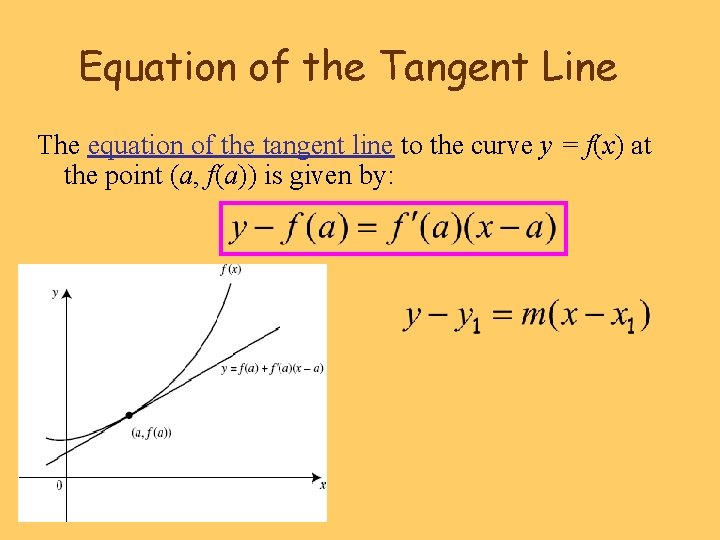
Equation of the Tangent Line The equation of the tangent line to the curve y = f(x) at the point (a, f(a)) is given by:
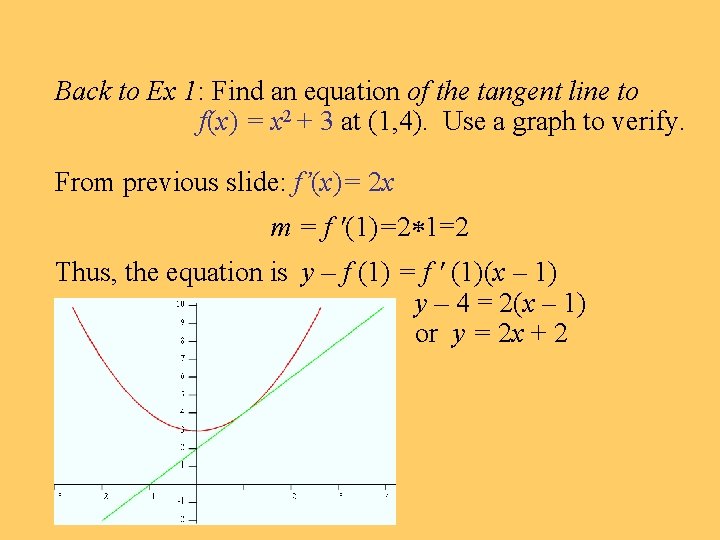
Back to Ex 1: Find an equation of the tangent line to f(x) = x 2 + 3 at (1, 4). Use a graph to verify. From previous slide: f’(x)= 2 x m = f ′(1)=2 1=2 Thus, the equation is y – f (1) = f ′ (1)(x – 1) y – 4 = 2(x – 1) or y = 2 x + 2
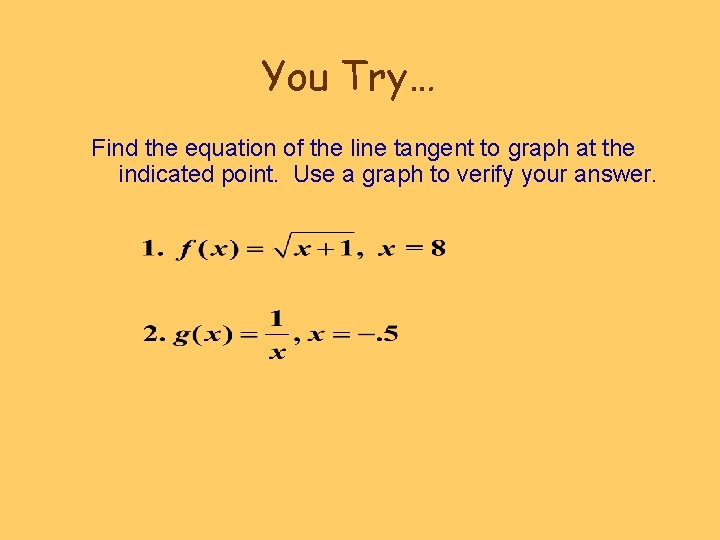
You Try… Find the equation of the line tangent to graph at the indicated point. Use a graph to verify your answer.
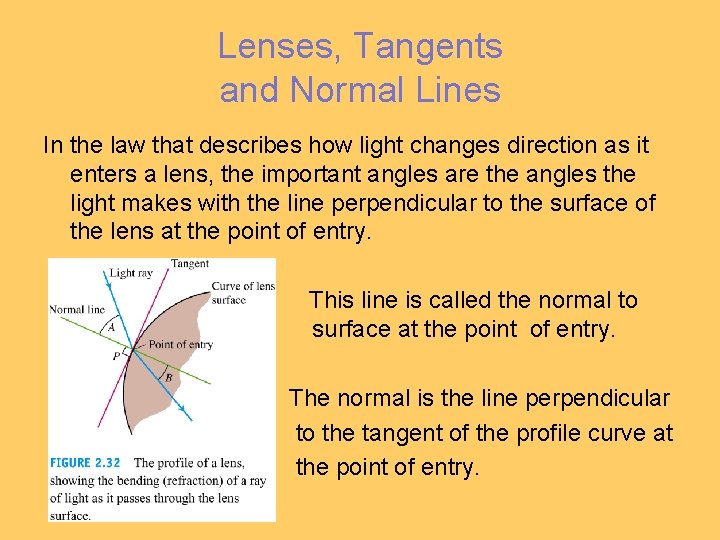
Lenses, Tangents and Normal Lines In the law that describes how light changes direction as it enters a lens, the important angles are the angles the light makes with the line perpendicular to the surface of the lens at the point of entry. This line is called the normal to surface at the point of entry. The normal is the line perpendicular to the tangent of the profile curve at the point of entry.
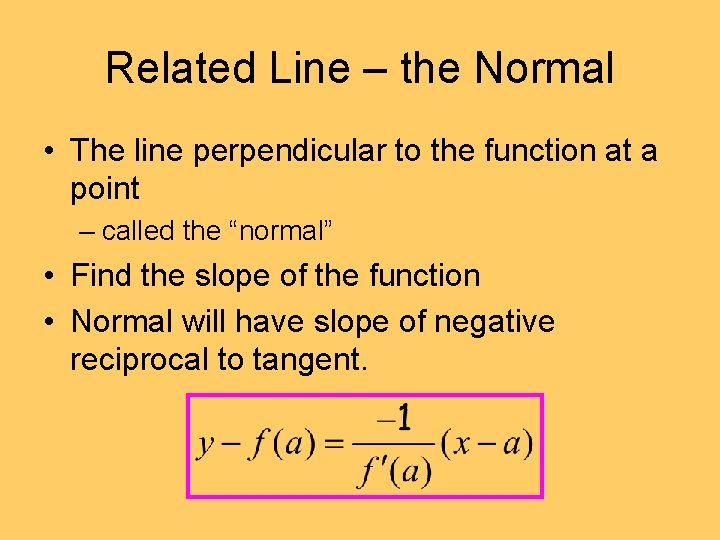
Related Line – the Normal • The line perpendicular to the function at a point – called the “normal” • Find the slope of the function • Normal will have slope of negative reciprocal to tangent.
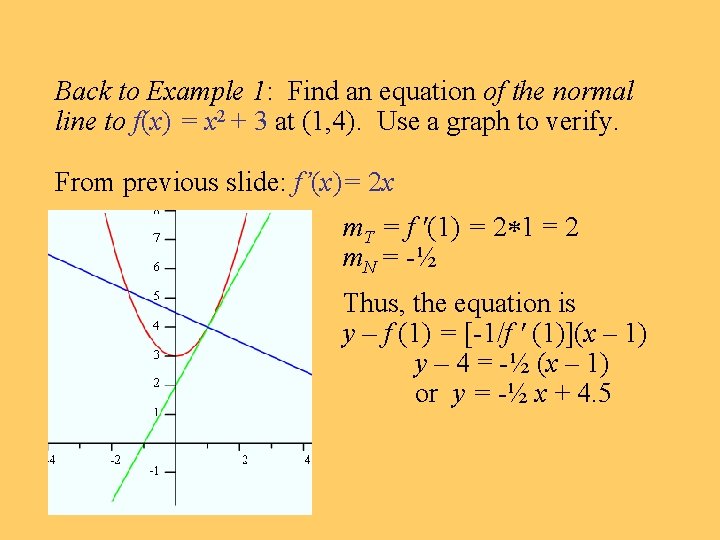
Back to Example 1: Find an equation of the normal line to f(x) = x 2 + 3 at (1, 4). Use a graph to verify. From previous slide: f’(x)= 2 x m. T = f ′(1) = 2 1 = 2 m. N = -½ Thus, the equation is y – f (1) = [-1/f ′ (1)](x – 1) y – 4 = -½ (x – 1) or y = -½ x + 4. 5
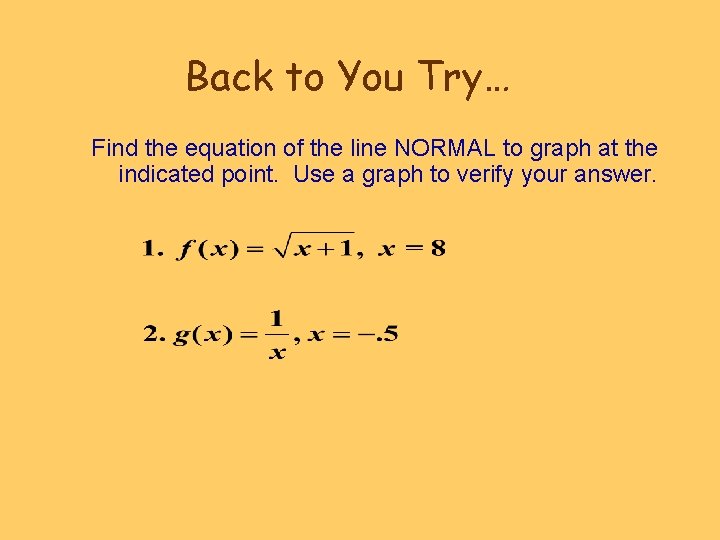
Back to You Try… Find the equation of the line NORMAL to graph at the indicated point. Use a graph to verify your answer.
in conclusion. . . • The derivative is the slope of the line tangent to the curve (evaluated at a point) • it is a limit (2 ways to define it) • once you learn the rules of derivatives, you WILL forget these limit definitions • cool site to go to for additional explanations: http: //archives. math. utk. edu/visual. calculus/2/
Closure • Explain how to find the equation of a tangent line to a curve f(x) using derivatives?
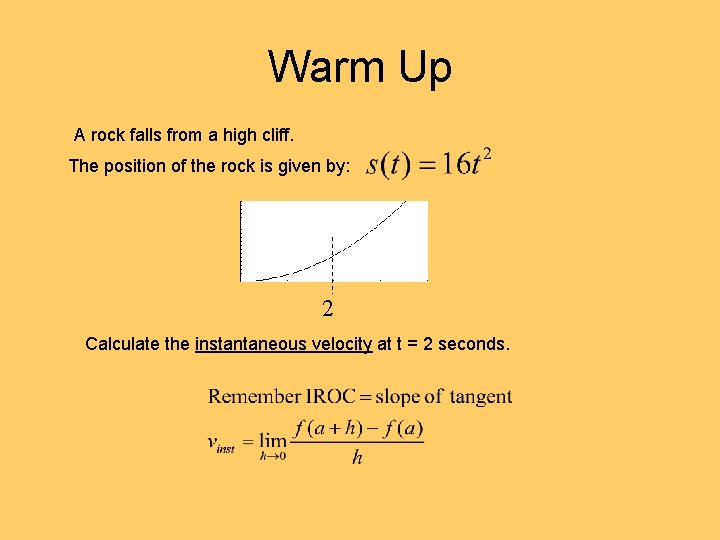
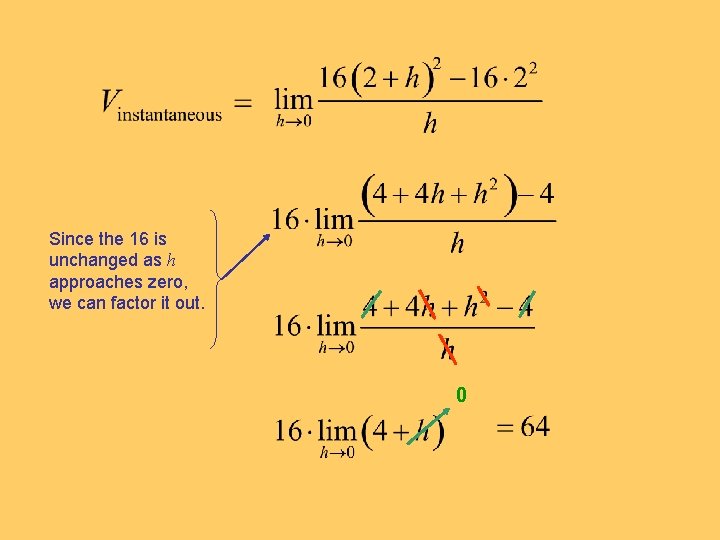
Warm Up A rock falls from a high cliff. The position of the rock is given by: 2 Calculate the instantaneous velocity at t = 2 seconds.
Since the 16 is unchanged as h approaches zero, we can factor it out. 0
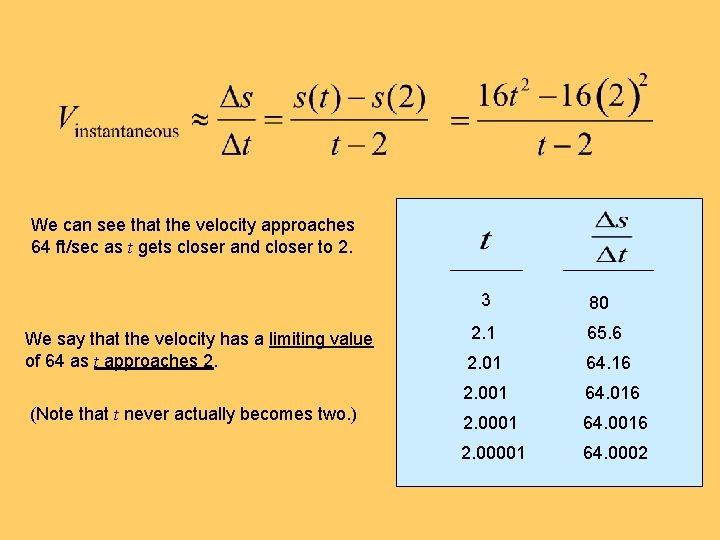
We can see that the velocity approaches 64 ft/sec as t gets closer and closer to 2. 3 We say that the velocity has a limiting value of 64 as t approaches 2. (Note that t never actually becomes two. ) 80 2. 1 65. 6 2. 01 64. 16 2. 001 64. 016 2. 0001 64. 0016 2. 00001 64. 0002
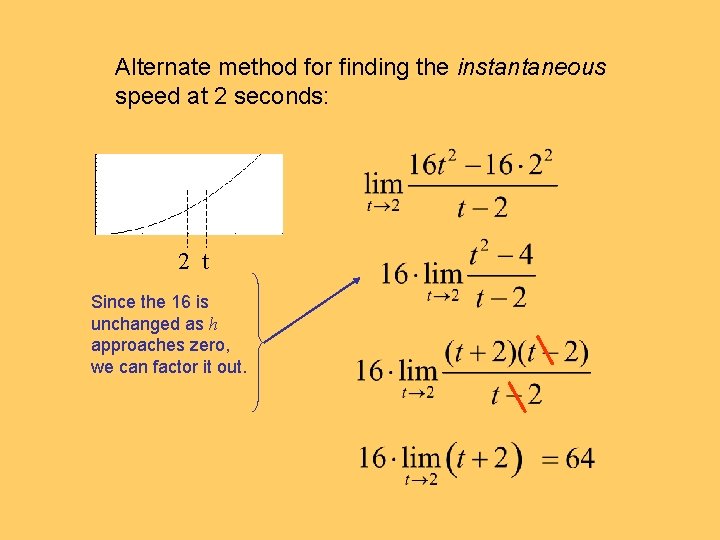
Alternate method for finding the instantaneous speed at 2 seconds: 2 t Since the 16 is unchanged as h approaches zero, we can factor it out.
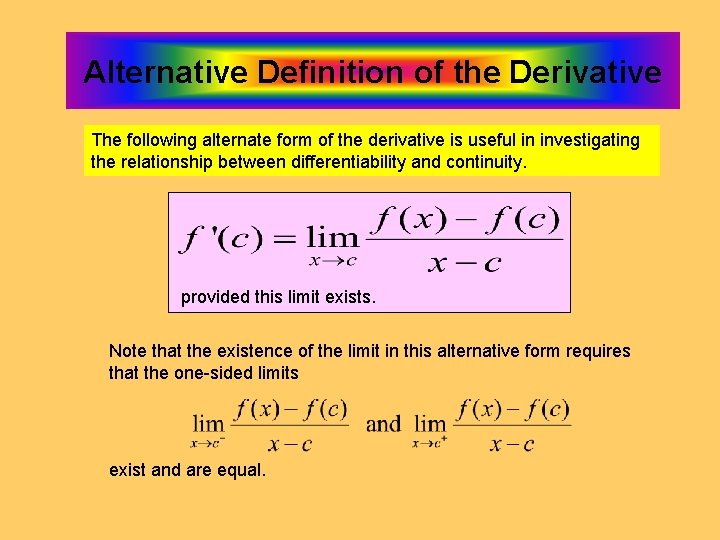
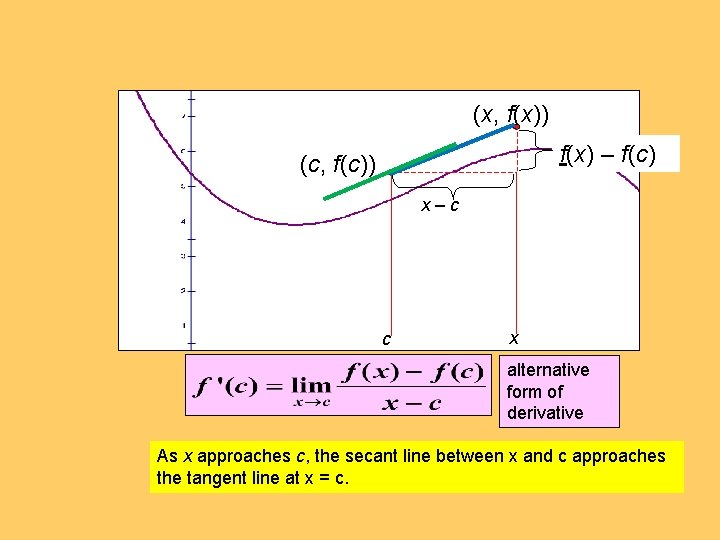
Alternative Definition of the Derivative The following alternate form of the derivative is useful in investigating the relationship between differentiability and continuity. provided this limit exists. Note that the existence of the limit in this alternative form requires that the one-sided limits exist and are equal.
(x, f(x)) f(x) – f(c) (c, f(c)) x – c c x alternative form of derivative As x approaches c, the secant line between x and c approaches the tangent line at x = c.
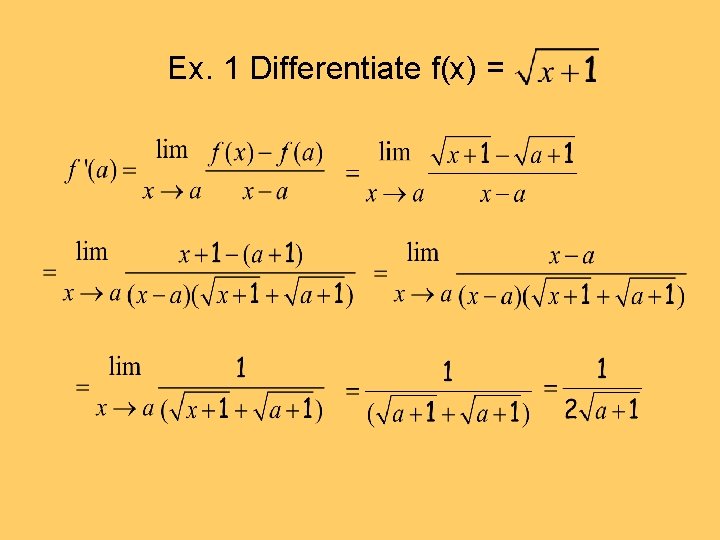
Ex. 1 Differentiate f(x) =
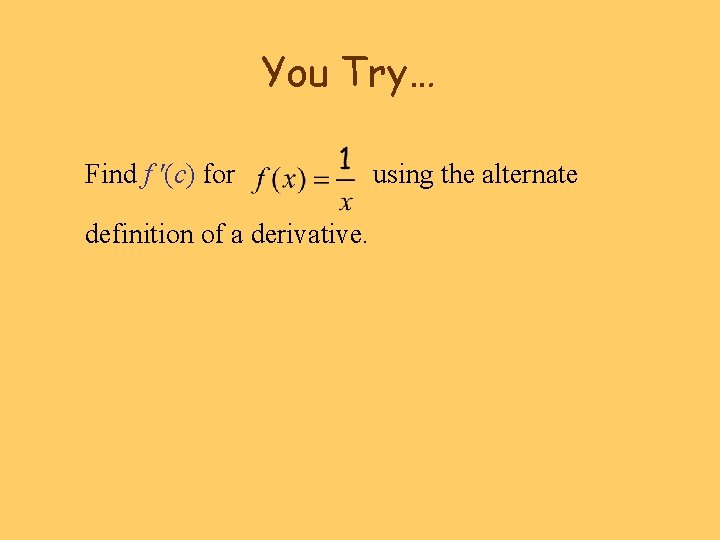
You Try… Find f ′(c) for definition of a derivative. using the alternate
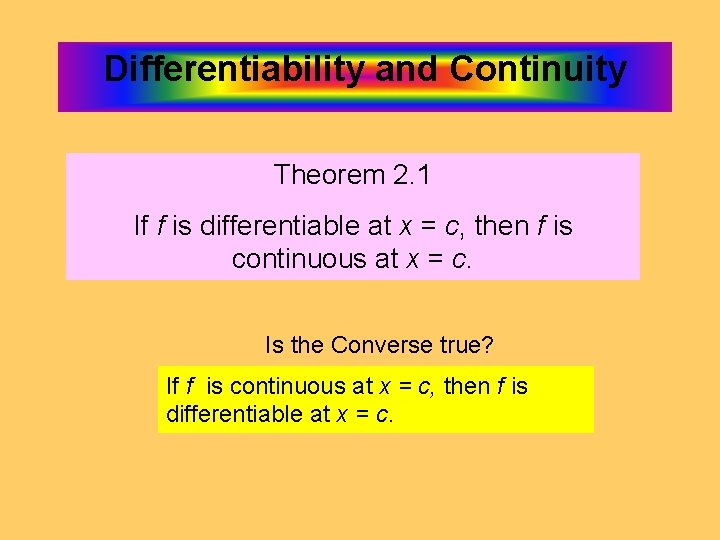
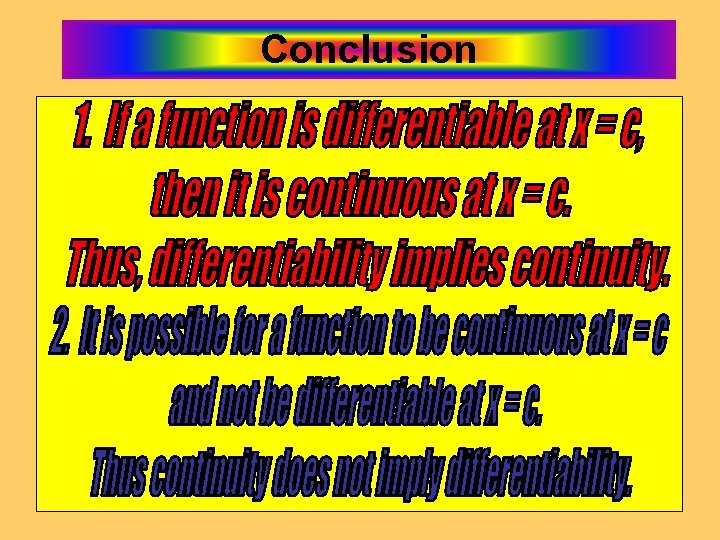
Differentiability and Continuity Theorem 2. 1 If f is differentiable at x = c, then f is continuous at x = c. Is the Converse true? If f is continuous at x = c, then f is differentiable at x = c.
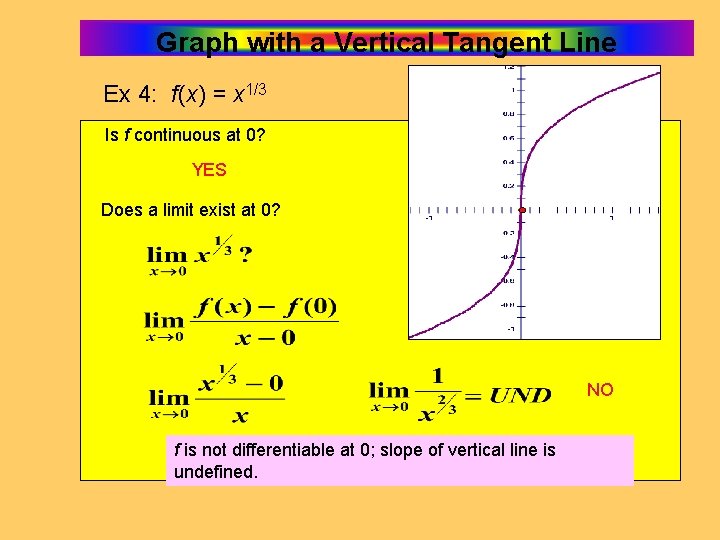
Graph with a Vertical Tangent Line Ex 4: f(x) = x 1/3 Is f continuous at 0? YES Does a limit exist at 0? NO f is not differentiable at 0; slope of vertical line is undefined.
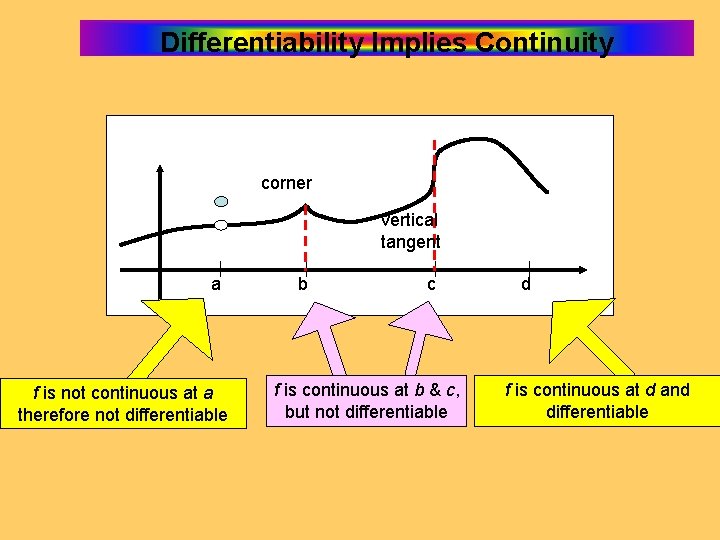
Differentiability Implies Continuity corner vertical tangent a f is not continuous at a therefore not differentiable b c f is continuous at b & c, but not differentiable d f is continuous at d and differentiable
Conclusion
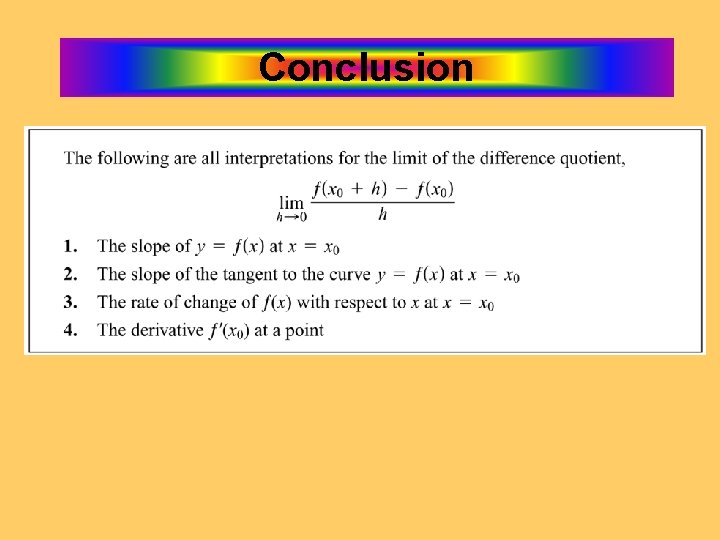
Conclusion
Closure • Give all three formulas for the definition of a derivative you have learned so far. Explain the difference between each.