UN Economic Commission for Europe 16 th UNCEFACT
- Slides: 71
UN Economic Commission for Europe 16 th UN/CEFACT PLENARY 8 – 9 July 2011 UN/CEFACT Sixteenth session Palais des Nations, Geneva, Switzerland
UN Economic Commission for Europe 17 th UN/CEFACT Plenary Geneva, 7 -8 July 2011 UN/CEFACT FMG Report Forum Management Group Chair: Mike Doran Vice-Chairs: Anders Grangard Garret Minakawa
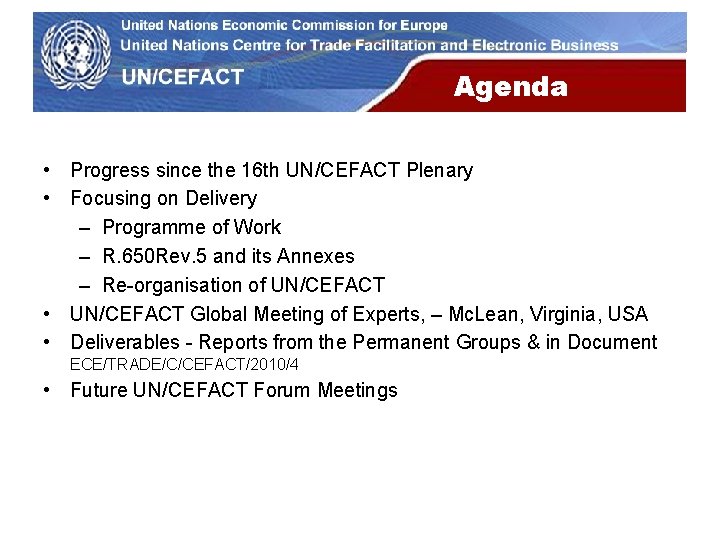
UN Economic Commission for Europe Agenda • Progress since the 16 th UN/CEFACT Plenary • Focusing on Delivery – Programme of Work – R. 650 Rev. 5 and its Annexes – Re-organisation of UN/CEFACT • UN/CEFACT Global Meeting of Experts, – Mc. Lean, Virginia, USA • Deliverables - Reports from the Permanent Groups & in Document ECE/TRADE/C/CEFACT/2010/4 • Future UN/CEFACT Forum Meetings
UN Economic Commission for Europe Progress since the 16 th Plenary Programme of Work 2010/2011 • Focus on delivering UN/CEFACT products & services • Confluence Website to track UN/CEFACT Project Portfolio now well populated • Alignment & prioritisation of Forum projects with the UN/CEFACT Integrated Strategy • Details of POW progress in PG Reports
UN Economic Commission for Europe Mandates & TORs Mandates & Terms of Reference • Intersessional approval of R. 650 Rev. 5 and its Annexes (March 2011) gave rise to the interpretation that the UN/CEFACT Forum and FMG had been abolished • Plenary intervention required to correct the situation
UN Economic Commission for Europe Global Meeting of Experts It was agreed at the 16 th UN/CEFACT Plenary in December 2010 that a Forum meeting would need to be held in the first quarter of 2011 to further develop the proposals for the reorganization of UN/CEFACT. It was also agreed that the Forum’s project work, under the approved programme of work, should continue unhindered during the discussions about the reorganization. The delegation of the United States offered to host the meeting at the Logistics Management Institute in Mc. Lean, Va, from 28 March to 1 April 2011.
UN Economic Commission for Europe Global Meeting of Experts Mc. Lean, Virginia, USA, 28 March – 1 April 2011 As no Host Country Agreement (HCA) was signed, UNECE would not agree to the 18 TH UN/CEFACT Forum being held in Mc. Lean. Replaced by an unofficial “Global Meeting of Experts”. HCA taking precedence over UN/CEFACT’s meeting requirements – what are the benefits for UN/CEFACT?
UN Economic Commission for Europe Global Meeting of Experts • The Global Meeting of Experts (GME) was hosted by the Delegation of United States of America. • The GME was organised by the Logistics Management Institute (LMI) and the FMG and held at the premises of the LMI. • Some 115 participants from all regions attended the GME. • In addition to progressing UN/CEFACT projects under the POW, extensive discussions and consultations took place concerning the reorganisation of UN/CEFACT • Very sincere thanks to the US delegation and LMI for a very well organised meeting and commitment beyond what is normally required when hosting such meetings
UN Economic Commission for Europe Liaison Activities • OASIS – UBL Collaboration agreement nearing conclusion • ISO TC 68 – Cross Industry Invoice (CII) semantic alignment • ISO TC 8 – Alignment with standard on Electronic Port Clearance to be clarified • ISO/TC 154 – New publication of UNTDED/ISO 7372 proposed • CEN/EU – Collaboration on implementation support
UN Economic Commission for Europe Future Forum Meetings • 18 th Forum meeting – 19 -23 September 2011, Geneva, Switzerland • 19 th Forum meeting – Spring 2012, India • 20 th Forum meeting – September 2012 Vienna, Austria
UN Economic Commission for Europe PG Reports Permanent Group Reports
UN Economic Commission for Europe ATG Plenary Report Mark Crawford, ATG Chair Gait Boxman, ATG Vice Chair Jostein Frømyr, ATG Vice Chair UN/CEFACT Seventeeth session Palais des Nations, Geneva, Switzerland
UN Economic Commission for Europe ATG Mandate • Create and maintain the trade, business and administration document structures based on a specific technology or standard • Design, assembly and production of syntax specific solutions based on identified business and/or technical requirements from the empowered groups of UN/CEFACT
UN Economic Commission for Europe ATG Deliverables • Technical assessment and maintenance of syntax specific solutions through the application of Data Maintenance Requests • A series of coherent, consistent and normalized syntax solutions that are aligned with domain reference models for publication in a designated UN/CEFACT information Registry: – UN/EDIFACT messages and their support directories – XML Schemas 14
UN Economic Commission for Europe ATG Deliverables • Procedures and Mechanisms for the maintenance and quality of the syntax solutions • Appropriate technical specifications detailing the design and production rules, guidelines and checklists • Maintenance of Recommendations/Technical Specifications in coordination with TC 154 – UNECE Recommendation 1 (UN Layout Key) technical aspects – ISO IS 9735 - EDIFACT Syntax
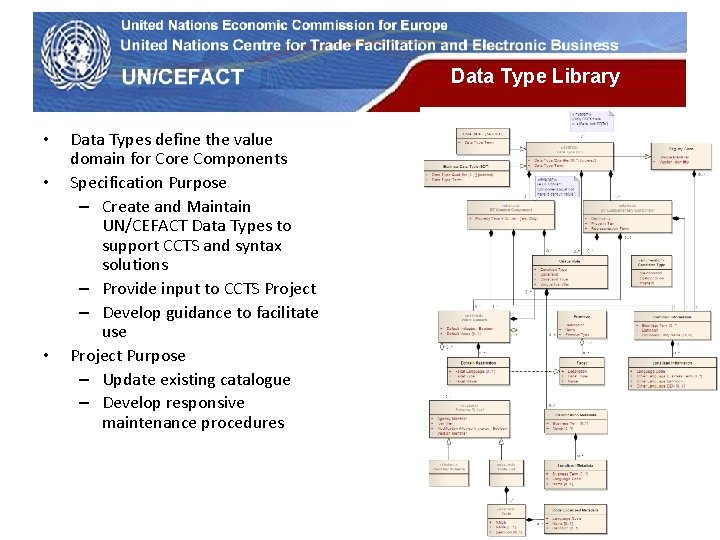
UN Economic Commission for Europe • • • Data Types define the value domain for Core Components Specification Purpose – Create and Maintain UN/CEFACT Data Types to support CCTS and syntax solutions – Provide input to CCTS Project – Develop guidance to facilitate use Project Purpose – Update existing catalogue – Develop responsive maintenance procedures Data Type Library
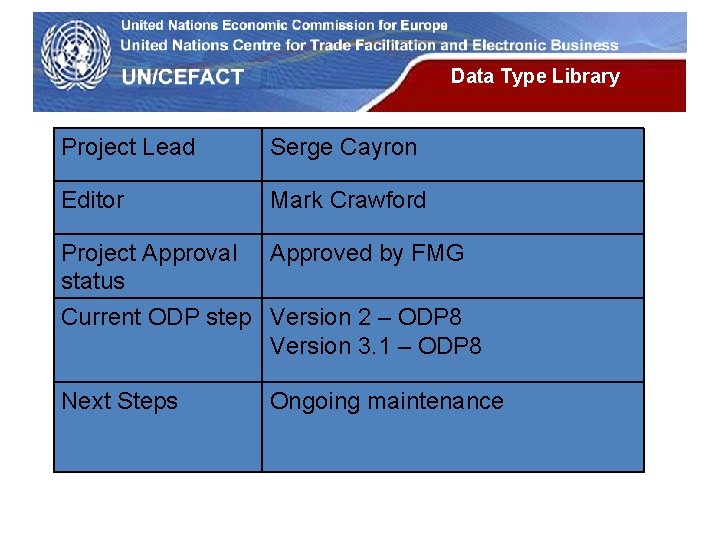
UN Economic Commission for Europe Project Lead Serge Cayron Editor Mark Crawford Data Type Library Project Approval Approved by FMG status Current ODP step Version 2 – ODP 8 Version 3. 1 – ODP 8 Next Steps Ongoing maintenance
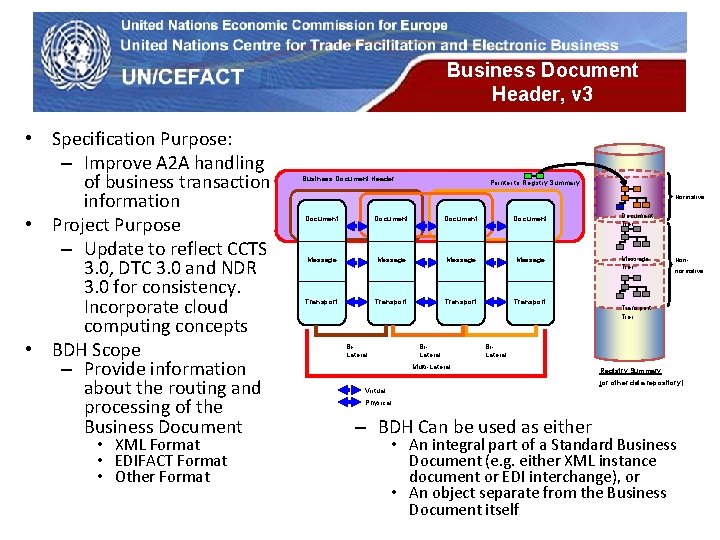
Business Document Header, v 3 UN Economic Commission for Europe • Specification Purpose: – Improve A 2 A handling of business transaction information • Project Purpose – Update to reflect CCTS 3. 0, DTC 3. 0 and NDR 3. 0 for consistency. Incorporate cloud computing concepts • BDH Scope – Provide information about the routing and processing of the Business Document • XML Format • EDIFACT Format • Other Format Business Document Header Pointer to Registry Summary Normative Document Document Tier Message Message Tier Transport Bi. Lateral Transport Nonnormative Transport Tier Bi. Lateral Multi-Lateral Registry Summary (or other data repository) Virtual Physical – BDH Can be used as either • An integral part of a Standard Business Document (e. g. either XML instance document or EDI interchange), or • An object separate from the Business Document itself
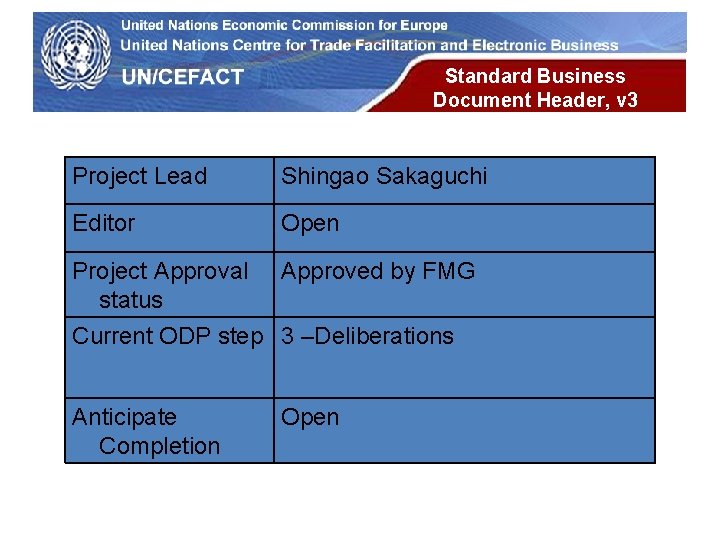
UN Economic Commission for Europe Standard Business Document Header, v 3 Project Lead Shingao Sakaguchi Editor Open Project Approval status Approved by FMG Current ODP step 3 –Deliberations Anticipate Completion Open
UN Economic Commission for Europe ATG 1 EDIFACT Syntax • Purpose – Development and Maintenance of EDIFACT syntax solutions to support UN/CEFACT work program • Officers – Chair: Gait Boxman • http: //www. uncefactforum. org/ATG 1. htm
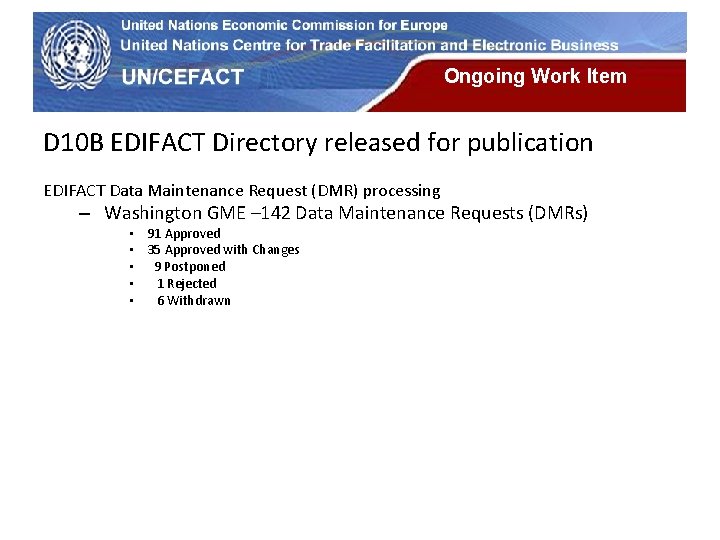
UN Economic Commission for Europe Ongoing Work Item D 10 B EDIFACT Directory released for publication EDIFACT Data Maintenance Request (DMR) processing – Washington GME – 142 Data Maintenance Requests (DMRs) • • • 91 Approved 35 Approved with Changes 9 Postponed 1 Rejected 6 Withdrawn
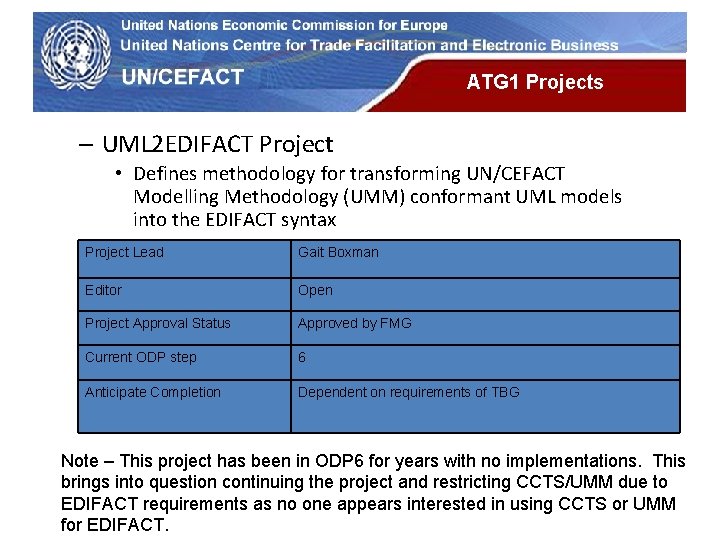
UN Economic Commission for Europe ATG 1 Projects – UML 2 EDIFACT Project • Defines methodology for transforming UN/CEFACT Modelling Methodology (UMM) conformant UML models into the EDIFACT syntax Project Lead Gait Boxman Editor Open Project Approval Status Approved by FMG Current ODP step 6 Anticipate Completion Dependent on requirements of TBG Note – This project has been in ODP 6 for years with no implementations. This brings into question continuing the project and restricting CCTS/UMM due to EDIFACT requirements as no one appears interested in using CCTS or UMM for EDIFACT.
UN Economic Commission for Europe ATG 2 – XML Syntax • Group Purpose – Development and maintenance of XML syntax solutions to support UN/CEFACT work program • Officers – Chair: Jostein Frømyr • http: //www. uncefactforum. org/ATG 2. htm
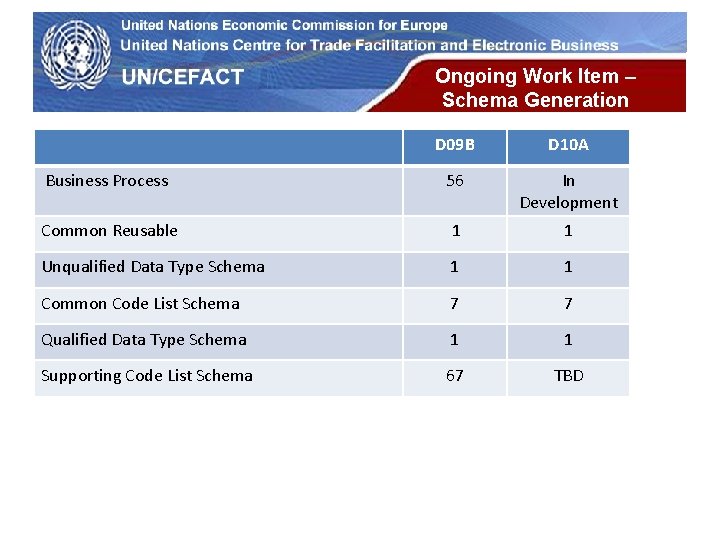
UN Economic Commission for Europe Ongoing Work Item – Schema Generation D 09 B D 10 A Business Process 56 In Development Common Reusable 1 1 Unqualified Data Type Schema 1 1 Common Code List Schema 7 7 Qualified Data Type Schema 1 1 Supporting Code List Schema 67 TBD
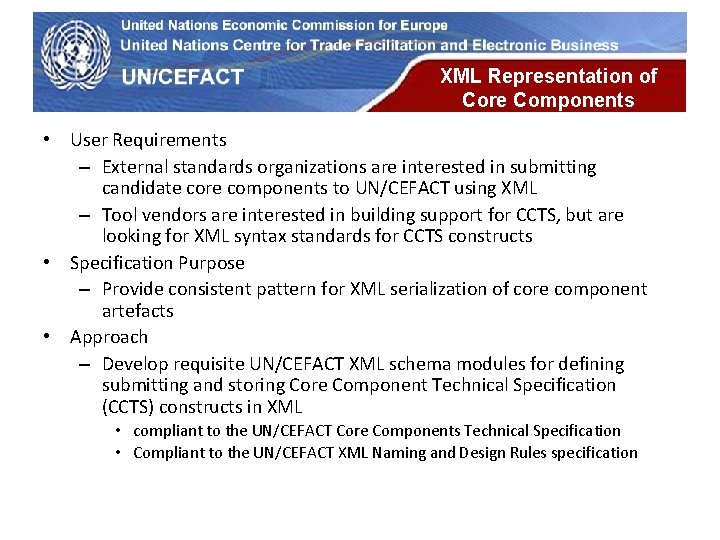
UN Economic Commission for Europe XML Representation of Core Components • User Requirements – External standards organizations are interested in submitting candidate core components to UN/CEFACT using XML – Tool vendors are interested in building support for CCTS, but are looking for XML syntax standards for CCTS constructs • Specification Purpose – Provide consistent pattern for XML serialization of core component artefacts • Approach – Develop requisite UN/CEFACT XML schema modules for defining submitting and storing Core Component Technical Specification (CCTS) constructs in XML • compliant to the UN/CEFACT Core Components Technical Specification • Compliant to the UN/CEFACT XML Naming and Design Rules specification
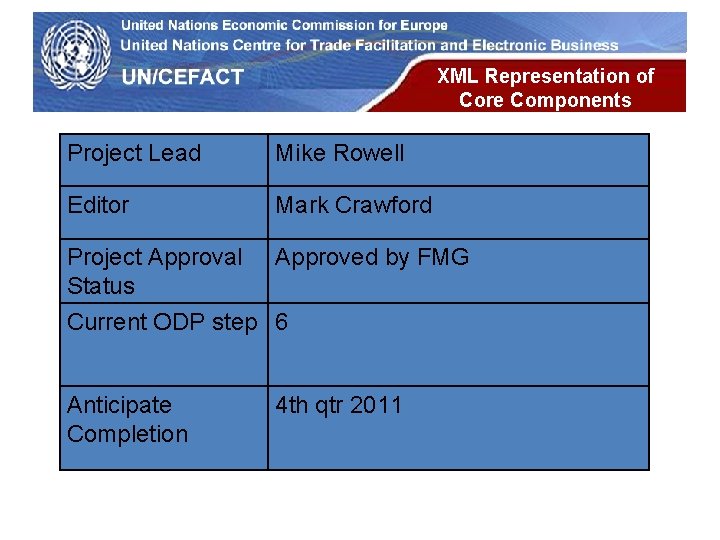
UN Economic Commission for Europe Project Lead Mike Rowell Editor Mark Crawford XML Representation of Core Components Project Approval Approved by FMG Status Current ODP step 6 Anticipate Completion 4 th qtr 2011
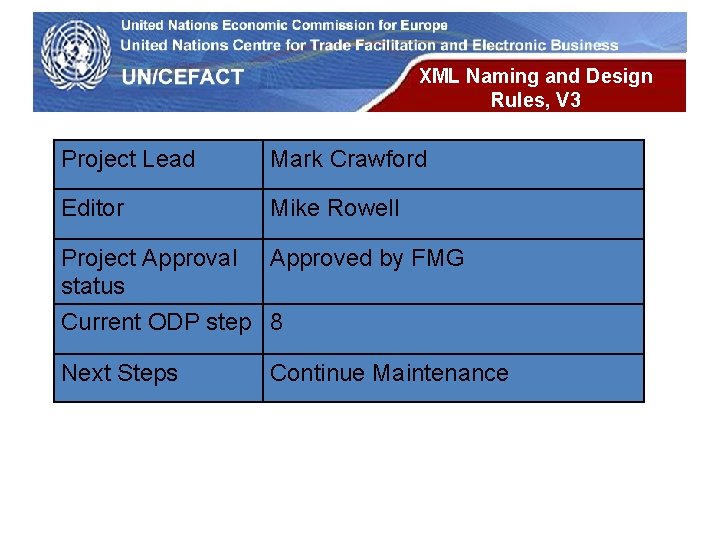
UN Economic Commission for Europe XML Naming and Design Rules, V 3 Project Lead Mark Crawford Editor Mike Rowell Project Approval status Approved by FMG Current ODP step 8 Next Steps Continue Maintenance
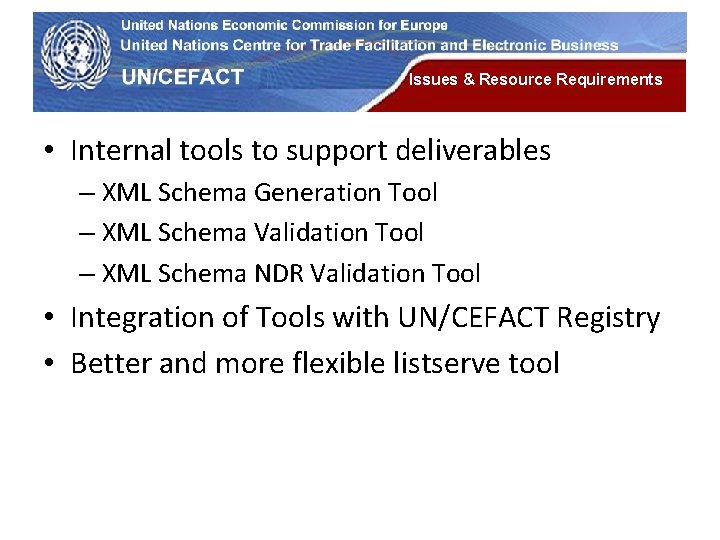
UN Economic Commission for Europe Issues & Resource Requirements • Internal tools to support deliverables – XML Schema Generation Tool – XML Schema Validation Tool – XML Schema NDR Validation Tool • Integration of Tools with UN/CEFACT Registry • Better and more flexible listserve tool
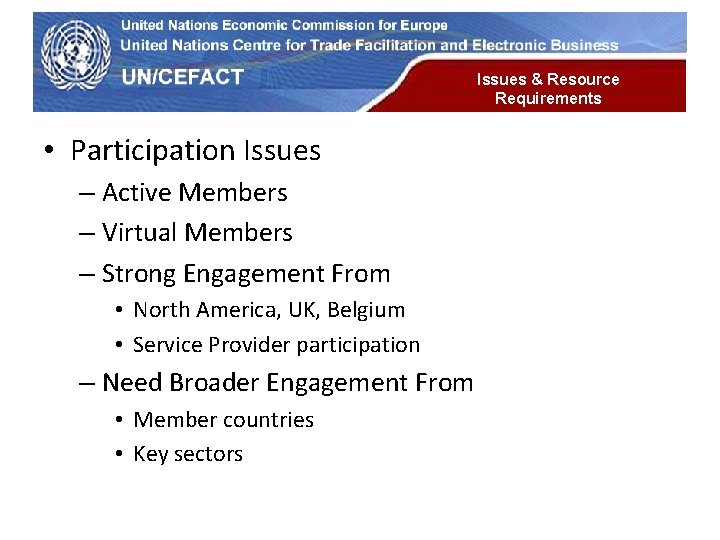
UN Economic Commission for Europe • Participation Issues – Active Members – Virtual Members – Strong Engagement From • North America, UK, Belgium • Service Provider participation – Need Broader Engagement From • Member countries • Key sectors Issues & Resource Requirements
UN Economic Commission for Europe ICG INFORMATION CONTENT MANAGEMENT GROUP Mike CONROY, Chair Hidekazu Enjo, Vice Chair 7 - 8 July 2011 UN/CEFACT Seventeenth session Palais des Nations, Geneva, Switzerland
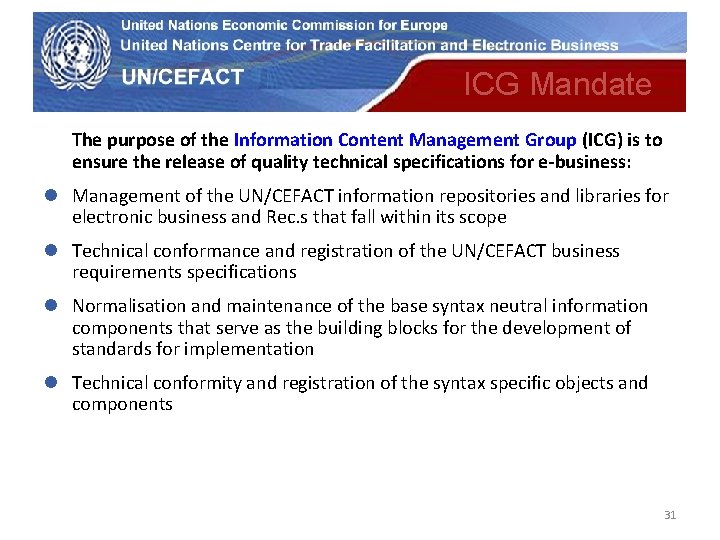
UN Economic Commission for Europe ICG Mandate The purpose of the Information Content Management Group (ICG) is to ensure the release of quality technical specifications for e-business: l Management of the UN/CEFACT information repositories and libraries for electronic business and Rec. s that fall within its scope l Technical conformance and registration of the UN/CEFACT business requirements specifications l Normalisation and maintenance of the base syntax neutral information components that serve as the building blocks for the development of standards for implementation l Technical conformity and registration of the syntax specific objects and components 31
UN Economic Commission for Europe ICG Deliverables • A series of coherent, consistent and normalized reference libraries comprising the business requirements, information objects and code lists that are aligned with the domain reference models and serve as the building blocks for the development of standards for implementation • Validating the conformance of technical specifications with the corresponding publication guidelines and for the release of approved syntax specific information objects and components • Processes and procedures for the maintenance of the libraries • Mechanisms for ensuring the quality of the library contents • Proposals, including draft Recommendations for review and approval by the UN/CEFACT Plenary and • Maintenance of UN Recommendations related to codes 32
UN Economic Commission for Europe § § § § UNECE Recommendations UNECE Rec. No. 3 - ISO Country Code for Representation of Names of Countries UNECE Rec. No. 5 - Abbreviations of INCOTERMS UNECE Rec. No. 7 - Numerical Representation of Dates, Time, and Periods of Time UNECE Rec. No. 8 - Unique Identification Code Methodology - UNIC UNECE Rec. No. 9 - Alphabetical Code for the Representation of Currencies UNECE Rec. No. 10 - Codes for Ship's Names UNECE Rec. No. 15 - Simpler Shipping Marks UNECE Rec. No. 16 - Trade and Transport Locations (UN/LOCODE) UNECE Rec. No. 17 - Payterms UNECE Rec. No. 19 - Codes for Modes of Transport UNECE Rec. No. 20 - Codes for units of measure used in international trade UNECE Rec. No. 21 - Codes for Types of Cargo, Packages and Packaging Materials UNECE Rec. No. 23 - Freight Cost Code UNECE Rec. No. 24 - Trade and Transport Status Codes UNECE Rec. No. 28 - Codes for Types of Means of Transport 33
UN Economic Commission for Europe • Items for Plenary Noting UNECE Recommendations § UNECE Rec. 23 (Freight cost Codes) - Rev. 7 • UN/EDIFACT DIRECTORY Releases § D 10 B § D 11 A • Core Component Library (CCL) Releases § D 10 A • XML Schema Release D 10 A: § § § § Cross Industry Remittance Advice Cross Industry Delivery Process Cross Industry Scheduling Process Cross_Industry Invoice Cross_Industry Order Cross_Industry Quotation Cross_Industry_Catalogue Accounting_Message Financial_Reporting Accounting_Entry Accounting_Journal Accounting_Ledger Chart_of_Accounts Cattle Registration Information Exchange Electronic_Data_Exchange_Proxy 34
UN Economic Commission for Europe Work in progress The following work items need to be integrated into the new structure: • UN/CEFACT Code List management finalisation • Ongoing Audit of UN/CEFACT deliverables – Core Component Library – XML Schemas – UN/EDIFACT Library set – Validation of the Requirements Specification Mapping (RSM) • Ongoing maintenance of UNECE Recommendations related to codes – UN/ECE Recommendations 3, 5, 7, 8, 9, 10, 15, 16, 17, 19, 20, 21, 23, 24 and 28 • Review of the UN/LOCODE process in order to improve quality and to bring the Recommendation up to date. 35
UN Economic Commission for Europe LEGAL GROUP (LG) Chair: Bart Schermer (Acting) Vice Chair: Bart Schermer 7 -8 July 2011 UN/CEFACT Seventeenth Session Palais des Nations, Geneva, Switzerland
UN Economic Commission for Europe Legal Group Mission: Mission • To provide legal guidance and counsel for the programmes of the United Nations Centre for Trade Facilitation and Electronic Business (UN/CEFACT) in a variety of areas related to the intersections of law and technology. • Work with the Bureau and other CEFACT groups on the legal aspects of electronic business and international trade facilitation 37
UN Economic Commission for Europe Legal Group 2011 LG Activities: 2011 LG Activities • LG participated in the UNCITRAL International Colloquium in February 2011 at UN Headquarters in New York – Legal Topics for Colloquium included: – Electronic International Single Window – Electronic Transferability of Rights in Goods • E. g. , Electronic Bills of Lading – Identity Management – Mobile (or m-) Commerce including e-Payment Systems • Participation in bi-weekly FMG meetings including advising on various legal issues relevant to the operations of UN/CEFACT 38
UN Economic Commission for Europe Legal Group LG Activities Going Forward: LG Activities Going Forward • LG will continue its participation in the WCOUNCITRAL Joint Legal Task Force • Continue collaboration efforts with UNCITRAL, the WCO, and other UN and Intergovernmental Organizations • Possible involvement with other CEFACT groups on new Recommendations and/or those under revision 39
UN Economic Commission for Europe International Trade and Business Group Report to the 17 th UN/CEFACT Plenary Session Acting Chair: Chris Hassler Vice Chair: Michael Dill 7 - 8 July 2011 UN/CEFACT Plenary Geneva
UN Economic Commission for Europe TBG Mandate • The purpose of the TBG is to be responsible for the simplification of international trade procedures, business and governmental process analysis, and best practices, using the UN/CEFACT Modeling Methodology, where appropriate, to support the development of trade facilitation & e-Business standards. 41
UN Economic Commission for Europe TBG Summary • Typical Forum attendance - 150 experts within 16 Working Groups • Many participants are sponsored by companies, trade associations and national governments but in all cases are expected to contribute as individual subject matter experts • Since the last UN/CEFACT Plenary, International Trade and Business Processes Groups met unofficially during the Global Meeting of Experts in Mc. Lean, Virginia, United States. • Also to progress work forward, TBG Work Groups conducted numerous face to face interim meetings and more than 100 internet conferences and conference calls 42
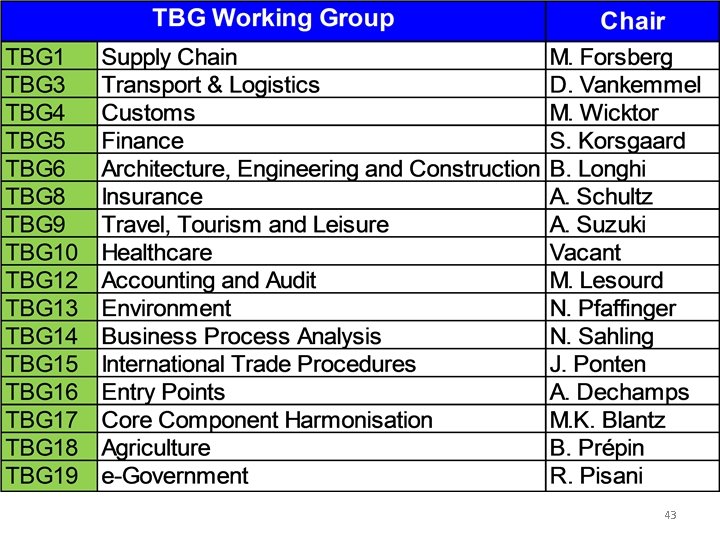
UN Economic Commission for Europe TBG Summary 43
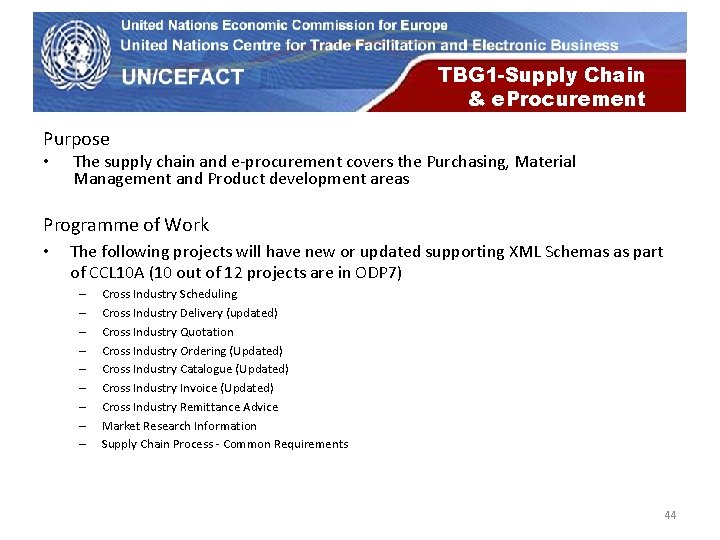
UN Economic Commission for Europe TBG 1 -Supply Chain & e. Procurement Purpose • The supply chain and e-procurement covers the Purchasing, Material Management and Product development areas Programme of Work • The following projects will have new or updated supporting XML Schemas as part of CCL 10 A (10 out of 12 projects are in ODP 7) – – – – – Cross Industry Scheduling Cross Industry Delivery (updated) Cross Industry Quotation Cross Industry Ordering (Updated) Cross Industry Catalogue (Updated) Cross Industry Invoice (Updated) Cross Industry Remittance Advice Market Research Information Supply Chain Process - Common Requirements 44
UN Economic Commission for Europe TBG 1 -Supply Chain & e. Procurement • REACH project in ODP 1 (Registration, Evaluation, Authorisation and Restriction of Chemicals) • Continued collaboration with TBG 6 on the use of CCTS 3 and NDR 3 for the supply chain messages. • TBG 1 has improved the routines for automation of RSM production 45
UN Economic Commission for Europe TBG 3 -Transportation and Logistics Purpose • Develop the e. Business standards for Logistics planning and Transport. This covers operational movements of goods, administrative and governmental requirements and safety / security of freight movements. Programme of Work and achievements • • “Advance Cargo Declaration” (Security of freight): productive joint session with TBG 4/WCO and TBG 15. 57 DMRs processed by ATG during the week (among total 100) for Urban Logistics (sustainable development ) and Maritime Next TBG 3 interim meetings: Berlin 20 -24 June and Valencia 14 -18 November 2011 Follow-up on projects, especially Cargo Tracing Tracking with TBG 4 46
UN Economic Commission for Europe TBG 4 -Customs • Processed 65 DMR’s together with ATG 1 where all 65 DMR’s were approved. • Presented the Single Window Compendium developed by WCO to TBG 15 and invited the group to leave comments and proposals. • Resolved in meeting with TBG 3 and TBG 15 the issue of Advance Cargo Declaration in connection with the joint TBG 3 / TBG 15 draft resolution and presented a time-plan for development of messages requested in the resolution draft. • Participated in a TBG 3 presentation and project proposal concerning Cargo Tracing and Tracking which is identified as an area for future cooperation. • Presented to TBG 18 the efforts to include e. Cert in the WCO Data Model and agreements for future cooperation in this area were made. • Participated actively in the various brainstorming sessions related to the restructuring of UN/CEFACT. 47
UN Economic Commission for Europe TBG 5 -Finance Purpose • Be responsible within the financial services area for the simplification of international trade procedures, business and governmental process analysis, and optimization of all information exchange standards. Programme of Work • Maintain core financial services requirements in the UN/CEFACT Core Component Library. • Assist other UN/CEFACT developments in the programme of work with financial services requirements, including inputs from stakeholders and standards organizations to reduce duplication of work. ) 48
UN Economic Commission for Europe TBG 6 -Architecture, Engineering & Construction Purpose • Responsible for coordination and proposal of new developments and maintenance in the area of Architecture, Engineering and Construction Industry (AEC) and Public Procurement (in link with TBG 1 and TBG 19) Programme of Work • TBG 1 -TBG 6 (e. Tendering and CFEM) – to create joint library for supporting all their XML transactions: work in progress. – CII in syntax v 3: done ! Draft version for national pilots…, already used (ex: French Government) • Security Project – SDEIR Recommendation 37: Plenary approval period extended; – CALI (Certificate Authority Listing Initiative) to be discussed • TBG 19 -TBG 6 – e. Notification/e. Tendering: subproject has begun since Geneva 49
UN Economic Commission for Europe TBG 8 -Insurance Goal: To set up a common, harmonized insurance data dictionary, which will be used as input for the TBG 17 harmonization process and by the insurance industry as a reference dictionary for developing data models, object class models or message structures and to facilitate interoperability within the global Insurance sector. TBG 8 Project: • • Uses the existing data standards of the e. EG 7 -member organizations as well as the ACORD Global Insurance Standard to harmonize its respective dictionaries and to discover generic and/or insurance specific core components. TBG 8 Project Status: • Several submissions to the CCL were already made • The CCL contains now insurance related information for insurance specific contract administration and claims handling, private and commercial motor insurance, private homeowner insurance and health insurance. • The actual harmonisation project between ACORD and e. EG 7 covers the requirements of commercial property and casualty insurance. 50
UN Economic Commission for Europe TBG 9 -Travel, Tourism & Leisure Purpose To support and promote international business activities related to the exchange of travel industry data. Programme of Work Covered • Small scaled Lodging House (SLH) Reservation Information Process project A draft BRS was proposed to TBG 9 at the GME and amended to some extent since then. The group will prepare the document for public review. • Travel Destination Information Process project This was discussed within the group and will be proposed as a new project around this fall under the leadership of Korea. Since the GME, the subject was discussed in the TT&L working group meeting with AFACT members. The information entities proposed at this meeting will be checked by applying actual cases of destination information by each country attended • TBG 9 Meetings TBG 9 held meetings in Tokyo on 28 April with Korean members. 51
UN Economic Commission for Europe TBG 12 -Accounting & Audit Purpose Develop e-Business standards for Accounting and Audit domains. It covers specific accounting matters as well as regulatory obligations requiring business to file multiple questionnaires, returns, declaration forms and reporting towards private and governmental collectors. It aims to insert accounting related data into business documents. With respect to audit requirements TBG 12 is intended to take care of, or to deal with archiving matters. Programme of Work • Achieved: Accounting Token (for Invoice), Entry Message v. 1, Accounting Message, Entry v. 4, Chart Of Accounts, Ledger, Journal, Reporting; • BRS in progress for 2 Messages: Trial Balance, Bundle Collection; continued maintenance on Entry v. 4, Ledger v. 2. • BRS in progress for 1 Message: Lexical Nomenclature. 52
UN Economic Commission for Europe TBG 13 Environmental Purpose To support and promote both international and regional cooperation activities related to environmental data exchange. Programme of Work • Basel Convention on Control of Transboundary Movements of Waste (TMW): 172 Parties, G 2 G, B 2 G; • TMW Business Information Entity/Core Component submission approved, and published within CCL 09 A; • Plans to work on TMW-related waste-assessment data. • Work with TBG 1 on REACH (Registration, Evaluation, Authorisation and Restriction of Chemical substances) • TBG 13 has been reorganized under the auspices of Franz Mochty of the Austrian Federal Ministry of Agriculture, Forestry, Environment and Water Management 53
UN Economic Commission for Europe TBG 14 -Business Process Analysis Purpose • Responsible for defining the International Supply Chain model to present the various processes and parties involved within the international supply chain in a consistent and simplified way. Programme of Work • Project P 059 “International Supply Chain Reference Model” delivered ver. 2010 A of the Buy. Ship-Pay Process Model aka ISCRM plus add. Model documentation – Documentation and model available at Confluence http: //www 1. unece. org/cefact/platform/display/TBG/International+Supply+Chain+Reference+Model • • • Contribute to BRS/RSM update project – Structure of BRS/RSM according to UMM Interim meeting in Paris with TBG 3/4/15 – Potential future co-operations and projects with TBG 15 and 4 Contributions to Future Organization – Future Role of TBG 14 Proposal (see next Slide) – Discussion Paper: Business Processes Analysis and UN/CEFACT – Raise awareness of BPA and its potential in Trade Facilitation 54
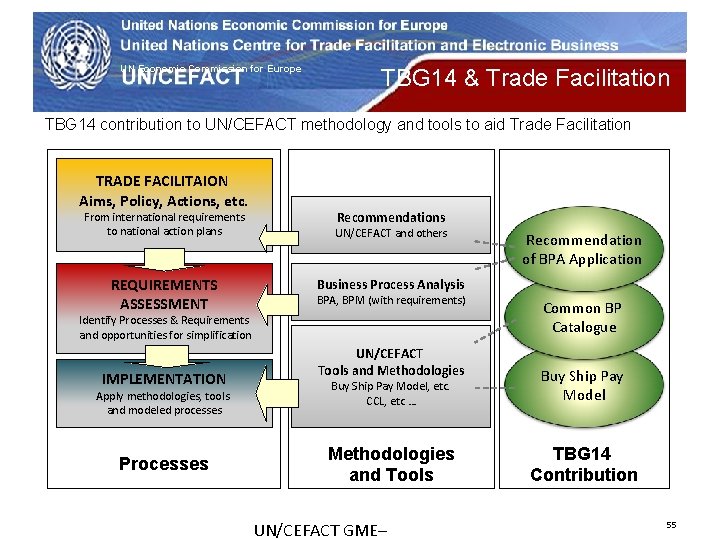
UN Economic Commission for Europe TBG 14 & Trade Facilitation TBG 14 contribution to UN/CEFACT methodology and tools to aid Trade Facilitation TRADE FACILITAION Aims, Policy, Actions, etc. From international requirements to national action plans REQUIREMENTS ASSESSMENT Recommendations UN/CEFACT and others Business Process Analysis BPA, BPM (with requirements) Identify Processes & Requirements and opportunities for simplification IMPLEMENTATION Apply methodologies, tools and modeled processes Processes Recommendation of BPA Application UN/CEFACT Tools and Methodologies Common BP Catalogue Buy Ship Pay Model, etc. CCL, etc … Buy Ship Pay Model Methodologies and Tools TBG 14 Contribution UN/CEFACT GME– 55
UN Economic Commission for Europe TBG 15 -International Trade Procedures Purpose • Analyze, simplify, harmonize and align public and private sector practices, procedures and information flows relating to international trade transactions both in goods and related services Work Completed since last Plenary • Revision of Recommendation 12 Measures to Facilitate Maritime Transport Documents Procedures • Information material on m. Business Programme of Work – Current Projects • Project on Consultation Models, based on Recommendation 4 • Project on Single Window Interoperability 56
UN Economic Commission for Europe TBG 16 -Entry Point • The Entry Point still maintains the official website for the International Trade and Business Group (note: this website will be closed as soon the reorganization will be effective). • TBG 16 has developed a Change Request (CR) procedure for updates to the UN/CEFACT XML deliverables. The procedure is now fully implemented. • TBG 16 has also participated in the discussions for the reorganization and is part of the ”Transition Team” which evaluates how to implement the reorganization. 57
UN Economic Commission for Europe TBG 17 -Core Component Harmonisation Purpose • Responsible for consistency and harmonisation of core components across business domains and sectors, contributing to a concise and well-defined glossary of business terms, business data semantic definitions, and structuring of data exchanges. Programme of Work – – – Developed Core Component Libraries 10 A and 11 A, including: • Quotation, Scheduling, Remittance Advice, WCO data model 3. 0, several Accounting messages, Cattle Registration, and an update to Cross Industry Invoice Working with ISO on TDED update, and alignment with CCL and UN/EDIFACT Members • Other TBGs and PGs • UNCTAD, UNEP, e. AC (AFACT), EDIFICE, GS 1, JAI, IATA, OAGi, Rosetta. Net, SBR, SWIFT, UBL, USG, WCO, X 12 58
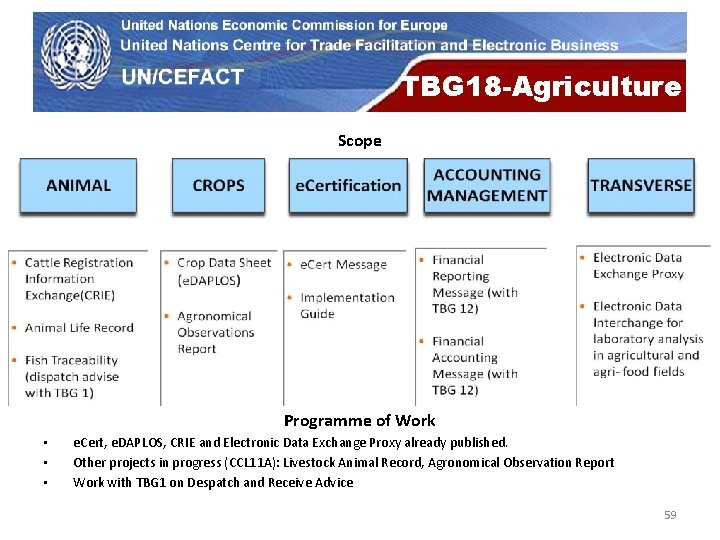
UN Economic Commission for Europe TBG 18 -Agriculture Scope Programme of Work • • • e. Cert, e. DAPLOS, CRIE and Electronic Data Exchange Proxy already published. Other projects in progress (CCL 11 A): Livestock Animal Record, Agronomical Observation Report Work with TBG 1 on Despatch and Receive Advice 59
UN Economic Commission for Europe TBG 19 -e. Government Purpose • Develop and maintain business scenarios and business transactions to facilitate the electronic delivery of services to citizens, businesses and governmental organizations. Programme of Work and achievements • Legal Notice Publication (LNP) project: launched – The purpose of the project is to create Business Process Models and Business Class Diagrams for documenting the business scenarios and business transactions involved in legal notice publication (LNP). The output will be used to obtain and validate the XML messages to support the business transactions. The project will be divided into sub-projects dependent upon requirements. Each subproject may deal with a specific area of LNP. The first sub-project is to cover LNP in the Public Procurement domain. • Version 3 Release 1 of the e. Tendering BRS is being discussed with TBG 6 and discussions are under way for the future incorporation of e. Notification outputs and change requests in the e. Tendering BRS 60
UN Economic Commission for Europe Techiques and Methodologies Group (TMG) Christian Huemer, Chair Scott Hinkelman, Vice Chair 7 - 8 July 2011 UN/CEFACT Seventeenth session Palais des Nations, Geneva, Switzerland
UN Economic Commission for Europe Mandate • The purpose of the Techniques & Methodologies Group (TMG) is to provide all UN/CEFACT Groups with Meta (base) Business Process, Information and Communications Technology specifications, methodologies, recommendations and education. 62
UN Economic Commission for Europe Mandate (2) • The TMG shall also function as a research group evaluating new information and communication technologies (ICT), as well as, techniques and methodologies that may assist UN/CEFACT and its groups to fulfill their mandate and vision in Trade Facilitation and e. Business. 63
UN Economic Commission for Europe Working Groups • Core Components Working Group (CCWG) – Core Components Technical Specification 3. 0 - finished – UML Profile for Core Components (UPCC 3. 0) – UN/CEFACT Context Methodology (UCM 1. 0) – Core Component Business Document Assembly (CCBDA 1. 0) • Business Process Working Group (BPWG) – UN/CEFACT Modeling Methodology (UMM 2. 0) – Resource-Event-Agent specialization (REA 1. 0) 64
UN Economic Commission for Europe Members &Meetings • Members – ~ 20 active members – 10+ participants at face-to-face (F 2 F) meetings • Meeting – Global Meeting of Experts on Trade Facilitation Recommendations and Electronic Business Standards (GME); Mc. Lean, Virginia, USA; March 28 – April 1 65
UN Economic Commission for Europe UPCC 3. 0 • UML Profile for Core Components 3. 0 – UPCC 3. 0 will be the successor of UPCC 1. 0 – Finished 3 rd Review Cycle of Public Review, ODP Step 5 – Ready to move to Implementation Verification, ODP Step 6 66
UN Economic Commission for Europe UCM 1. 0 • UN/CEFACT Context Methodology 1. 0 – Focus on a robust and complete context methodology – Consists of 3 parts: • Context Value Organization • Expression Grammar • “Contextualized” Classifier – Finished 3 rd Review Cycle of Public Review, ODP Step 5 – Currently in 2 nd Review Cycle of Public Review, ODP Step 5 67
UN Economic Commission for Europe CCBDA 1. 0 • Core Component Business Document Assembly 1. 0 – Methodology for design time assembly of business documents in a semantic and reusable order – Call for Participation has been sent to Ho. Ds – Project Kick-Off Call scheduled for the week of 11 th July 2011 68
UN Economic Commission for Europe UMM 2. 0 • UN/CEFACT Modeling Methodology 2. 0 – Finished two Cycles in Implementation Verification, ODP Step 6 – Has received informal indications of 4 Implementation Verifications • 2 Tool Implementation Verifications • 2 Project Implementation Verification – Awaiting formal confirmation letters of the implementation verifications 69
UN Economic Commission for Europe REA 1. 0 • Ressources – Events – Agents 1. 0 – REA is an accounting model – REA may be used for the business justification of inter-organizational systems – The project transforms REA concepts to UML for the purpose of extending UMM – REA will enhance the business requirements elicitation of UMM – Internal Draft Development, ODP 3. 0 70
UN Economic Commission for Europe http: //www. UNCEFACT. org 71