Deep Learning for Audio YUCHEN FAN MATT POTOK




- Slides: 101
Deep Learning for Audio YUCHEN FAN, MATT POTOK, CHRISTOPHER SHROBA
Motivation Text-to-Speech ◦ Accessibility features for people with little to no vision, or people in situations where they cannot look at a screen or other textual source ◦ Natural language interfaces for a more fluid and natural way to interact with computers ◦ Voice Assistants (Siri, etc. ), GPS, Screen Readers, Automated telephony systems Automatic Speech Recognition ◦ Again, natural language interfaces ◦ Alternative input medium for accessibility purposes ◦ Voice Assistants (Siri, etc. ), Automated telephony systems, Hands-free phone control in the car Music Generation ◦ Mostly for fun ◦ Possible applications in music production software
Outline Automatic Speech Recognition (ASR) ◦ Deep models with HMMs ◦ Connectionist Temporal Classification (CTC) ◦ Attention based models Text to Speech (TTS) ◦ Wave. Net ◦ Deep. Voice ◦ Tacotron Bonus: Music Generation
Automatic Speech Recognition (ASR)
Outline History of Automatic Speech Recognition Hidden Markov Model (HMM) based Automatic Speech Recognition ◦ Gaussian mixture models with HMMs ◦ Deep models with HMMs End-to-End Deep Models based Automatic Speech Recognition ◦ Connectionist Temporal Classification (CTC) ◦ Attention based models
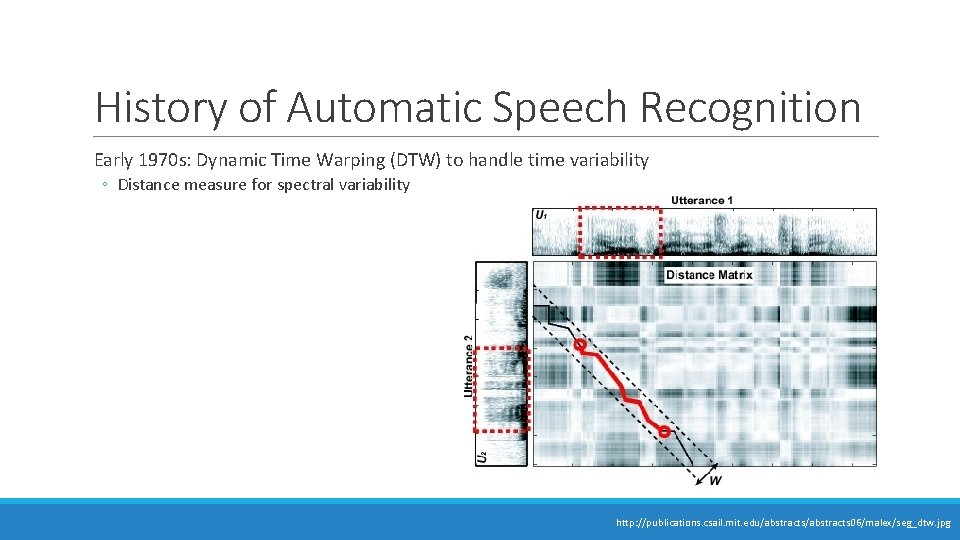
History of Automatic Speech Recognition Early 1970 s: Dynamic Time Warping (DTW) to handle time variability ◦ Distance measure for spectral variability http: //publications. csail. mit. edu/abstracts 06/malex/seg_dtw. jpg
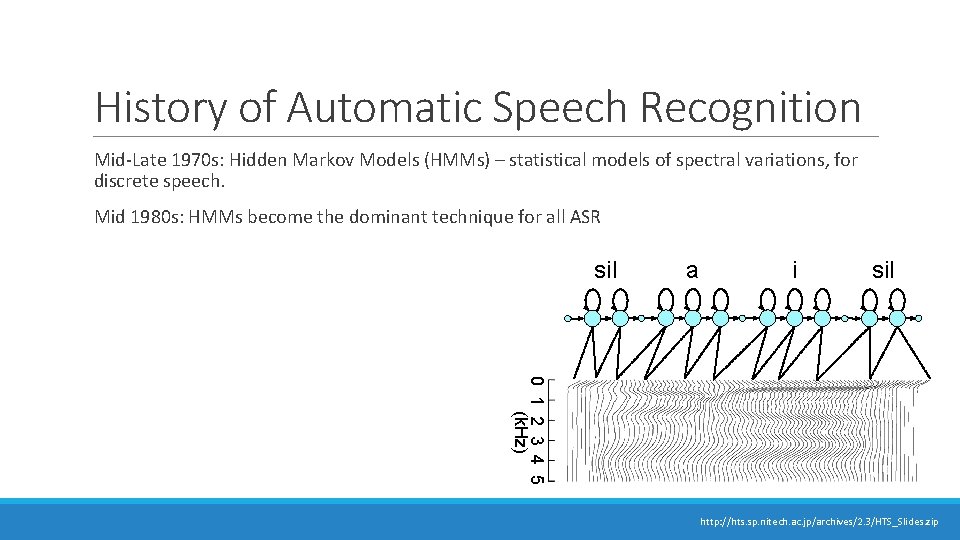
History of Automatic Speech Recognition Mid-Late 1970 s: Hidden Markov Models (HMMs) – statistical models of spectral variations, for discrete speech. Mid 1980 s: HMMs become the dominant technique for all ASR sil a i sil 0 1 2 3 4 5 (k. Hz) http: //hts. sp. nitech. ac. jp/archives/2. 3/HTS_Slides. zip
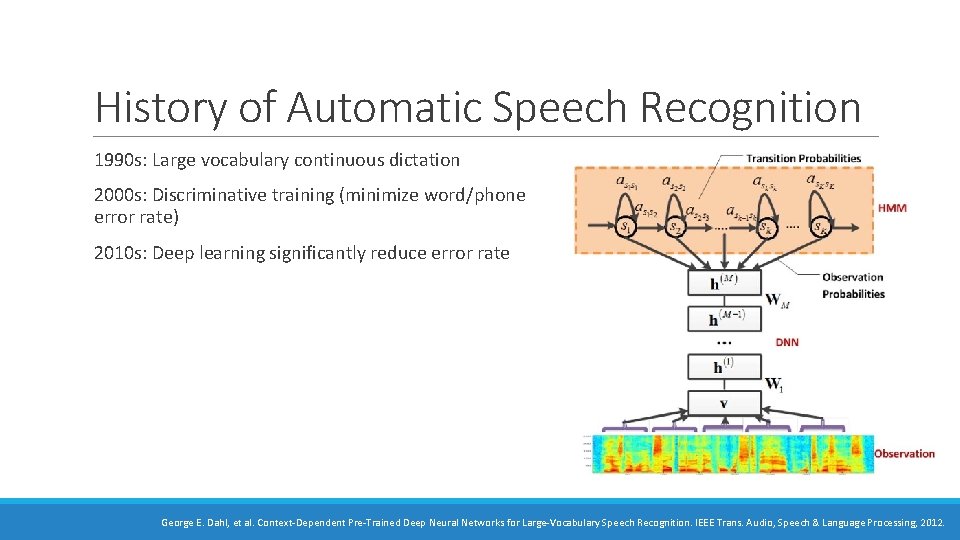
History of Automatic Speech Recognition 1990 s: Large vocabulary continuous dictation 2000 s: Discriminative training (minimize word/phone error rate) 2010 s: Deep learning significantly reduce error rate George E. Dahl, et al. Context-Dependent Pre-Trained Deep Neural Networks for Large-Vocabulary Speech Recognition. IEEE Trans. Audio, Speech & Language Processing, 2012.
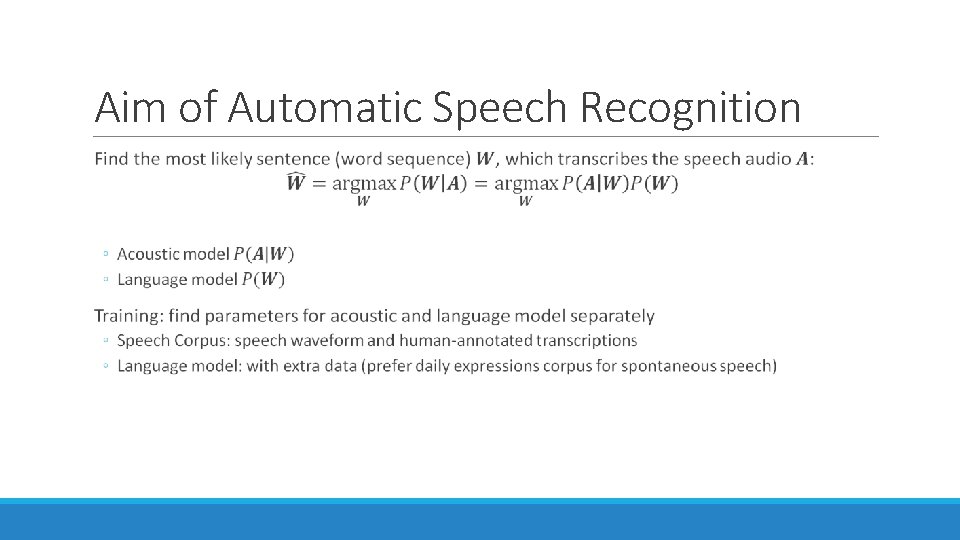
Aim of Automatic Speech Recognition
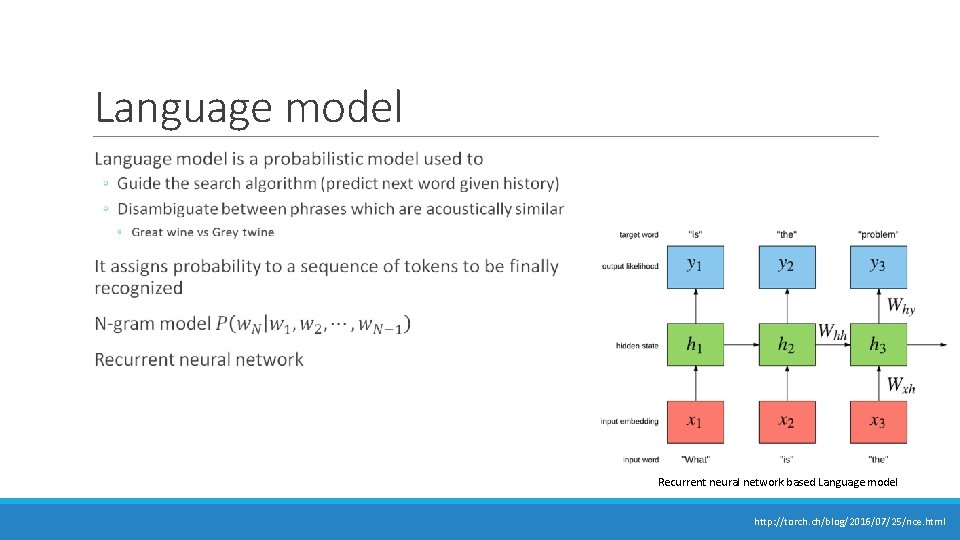
Language model Recurrent neural network based Language model http: //torch. ch/blog/2016/07/25/nce. html
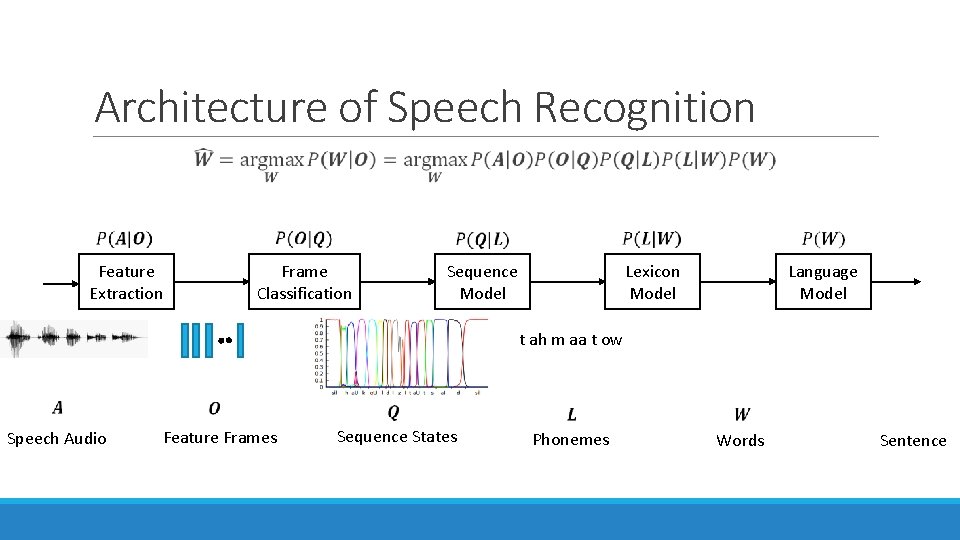
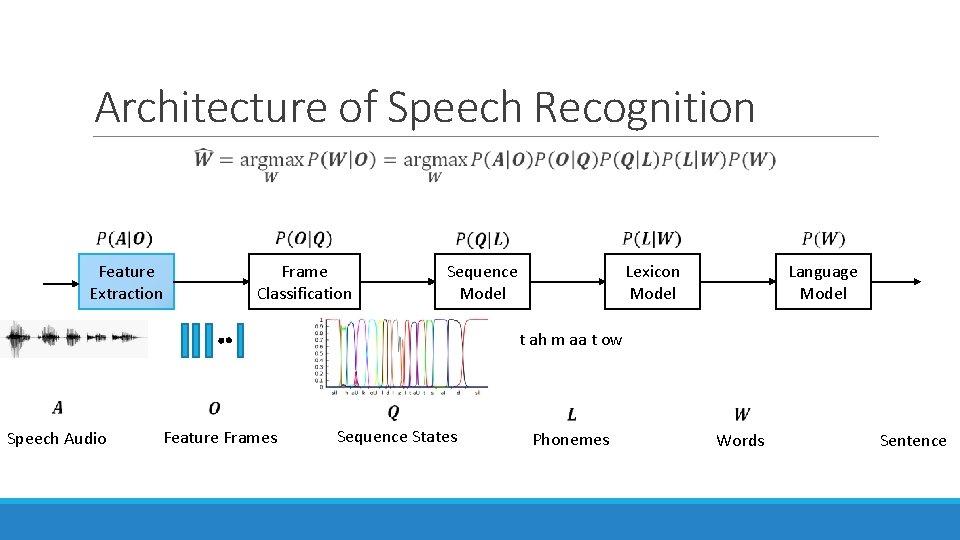
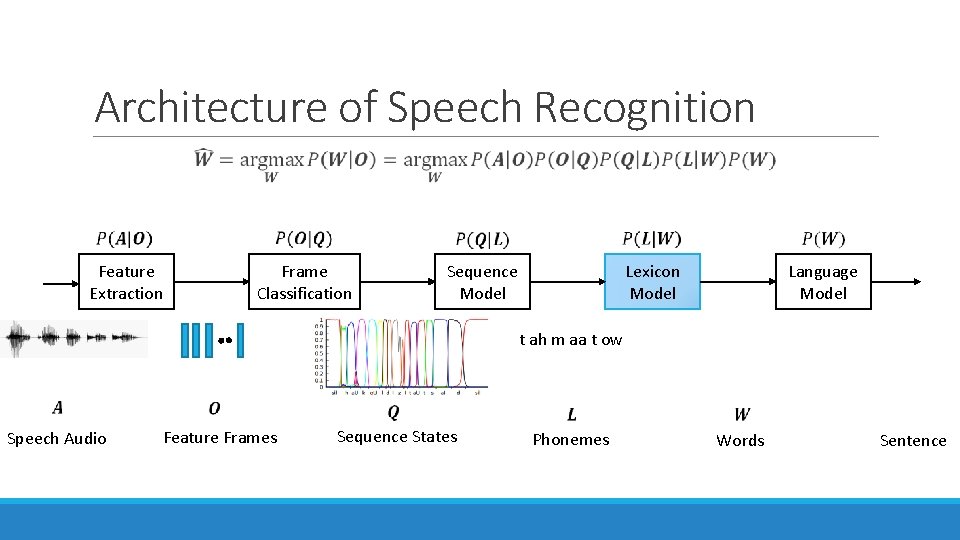
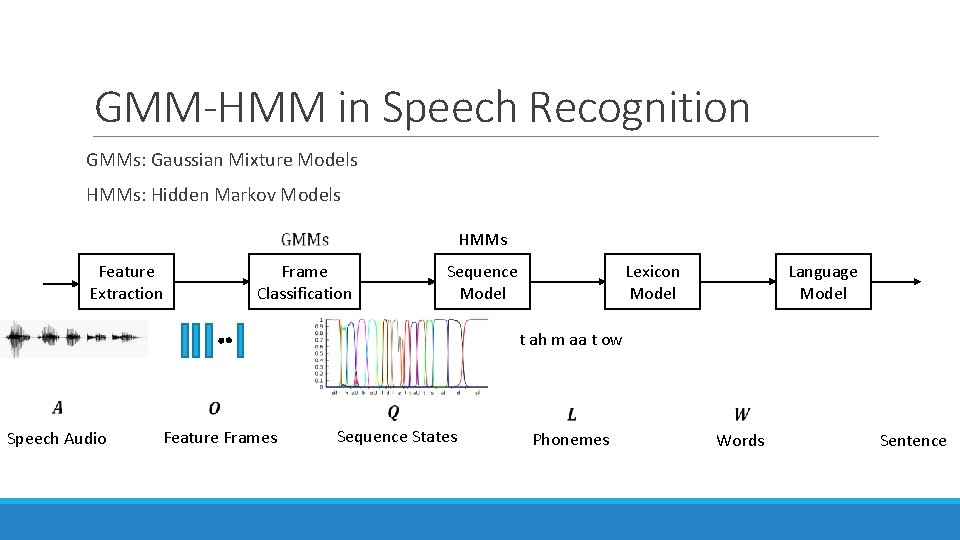
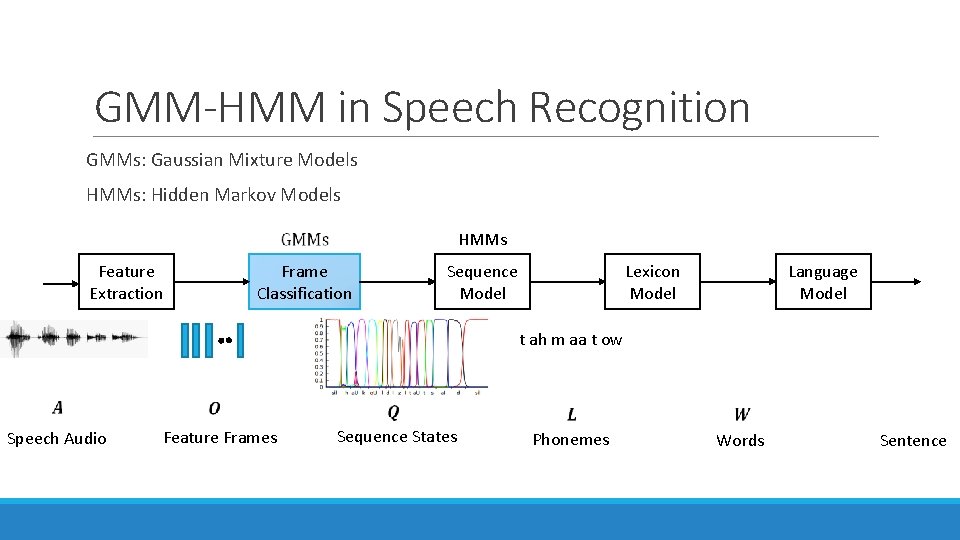
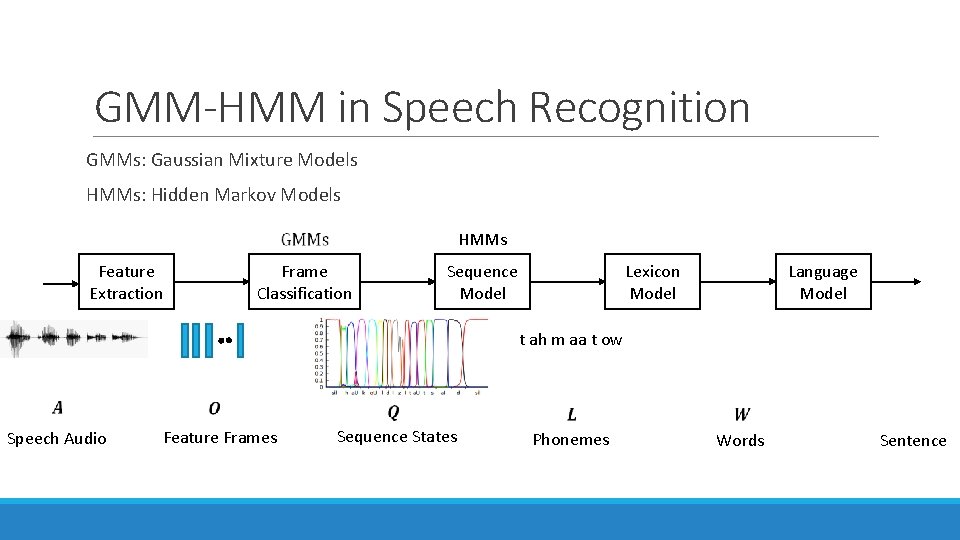
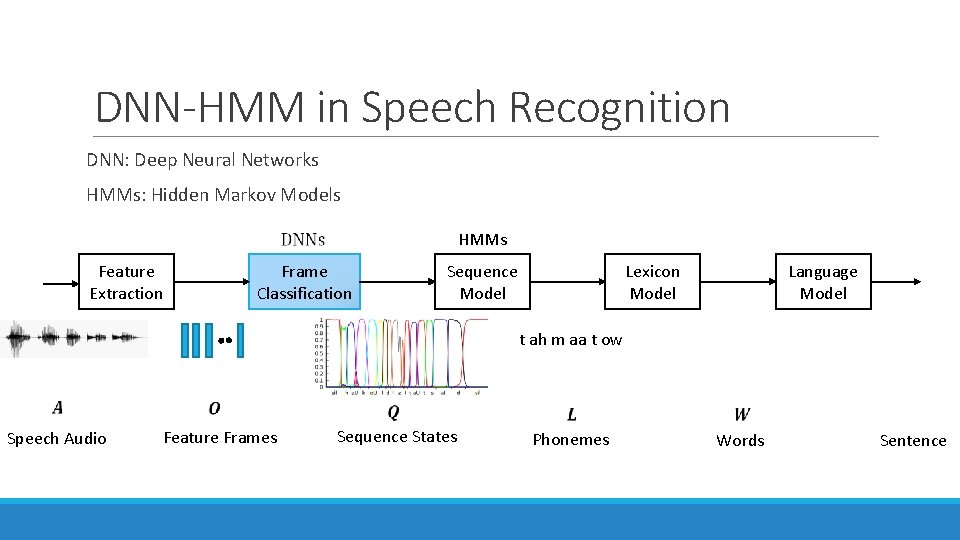
Architecture of Speech Recognition Feature Extraction Frame Classification Lexicon Model Sequence Model Language Model t ah m aa t ow Speech Audio Feature Frames Sequence States Phonemes Words Sentence
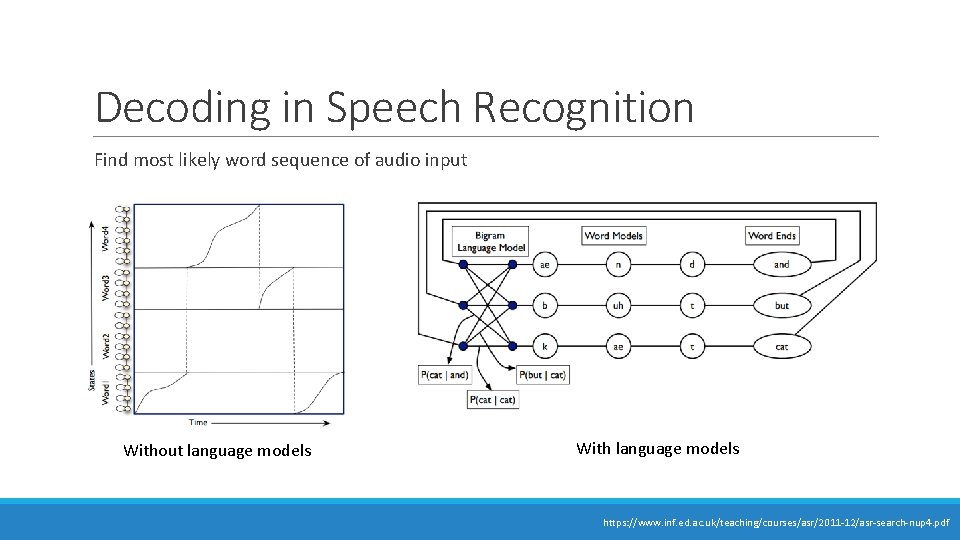
Decoding in Speech Recognition Find most likely word sequence of audio input Without language models With language models https: //www. inf. ed. ac. uk/teaching/courses/asr/2011 -12/asr-search-nup 4. pdf
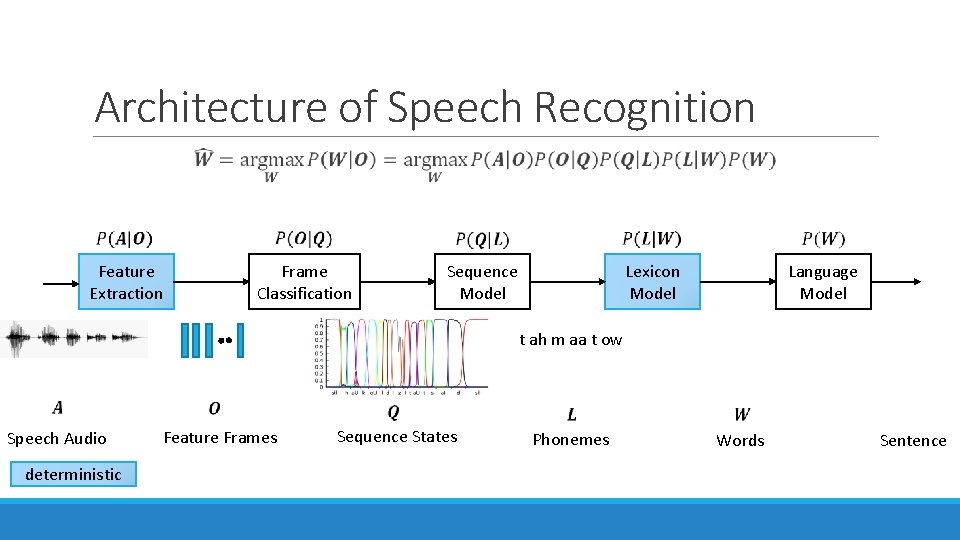
Architecture of Speech Recognition Feature Extraction Frame Classification Lexicon Model Sequence Model Language Model t ah m aa t ow Speech Audio deterministic Feature Frames Sequence States Phonemes Words Sentence
Architecture of Speech Recognition Feature Extraction Frame Classification Lexicon Model Sequence Model Language Model t ah m aa t ow Speech Audio Feature Frames Sequence States Phonemes Words Sentence
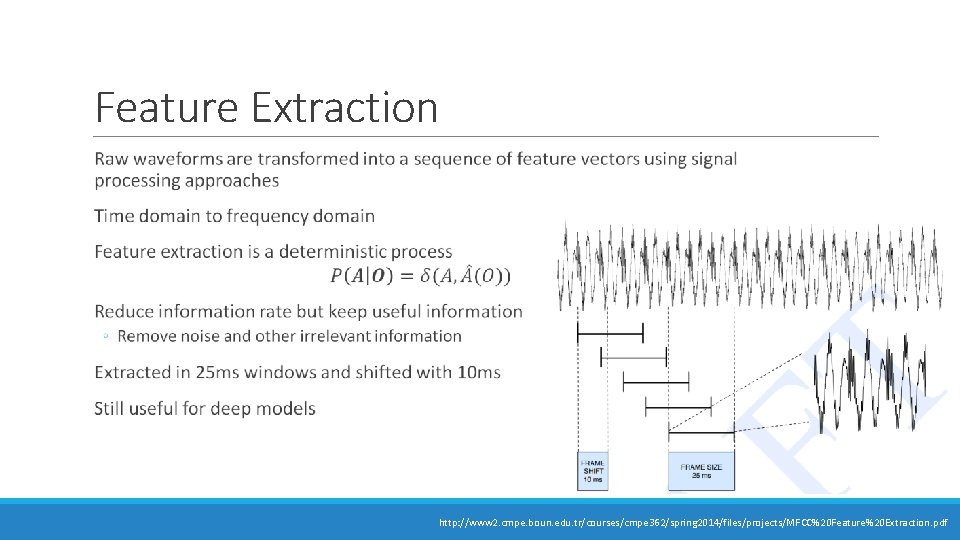
Feature Extraction http: //www 2. cmpe. boun. edu. tr/courses/cmpe 362/spring 2014/files/projects/MFCC%20 Feature%20 Extraction. pdf
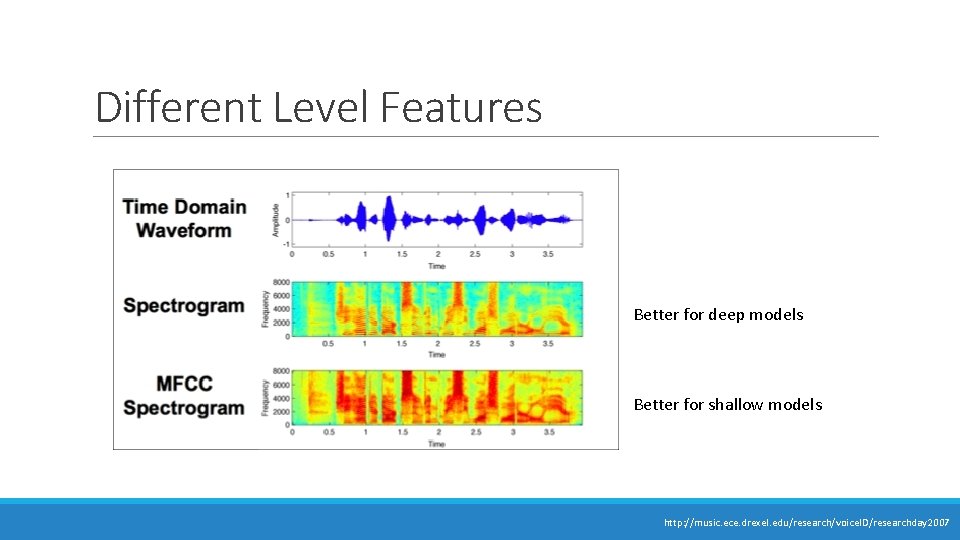
Different Level Features Better for deep models Better for shallow models http: //music. ece. drexel. edu/research/voice. ID/researchday 2007
Architecture of Speech Recognition Feature Extraction Frame Classification Lexicon Model Sequence Model Language Model t ah m aa t ow Speech Audio Feature Frames Sequence States Phonemes Words Sentence
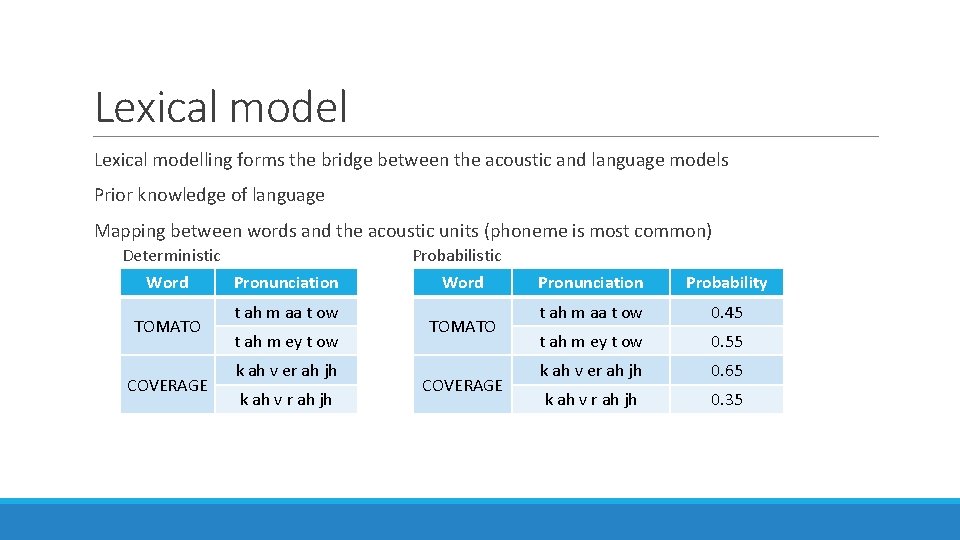
Lexical model Lexical modelling forms the bridge between the acoustic and language models Prior knowledge of language Mapping between words and the acoustic units (phoneme is most common) Deterministic Probabilistic Word TOMATO COVERAGE Pronunciation t ah m aa t ow t ah m ey t ow k ah v er ah jh k ah v r ah jh Word TOMATO COVERAGE Pronunciation Probability t ah m aa t ow 0. 45 t ah m ey t ow 0. 55 k ah v er ah jh 0. 65 k ah v r ah jh 0. 35
GMM-HMM in Speech Recognition GMMs: Gaussian Mixture Models HMMs: Hidden Markov Models Feature Extraction HMMs Frame Classification Lexicon Model Sequence Model Language Model t ah m aa t ow Speech Audio Feature Frames Sequence States Phonemes Words Sentence
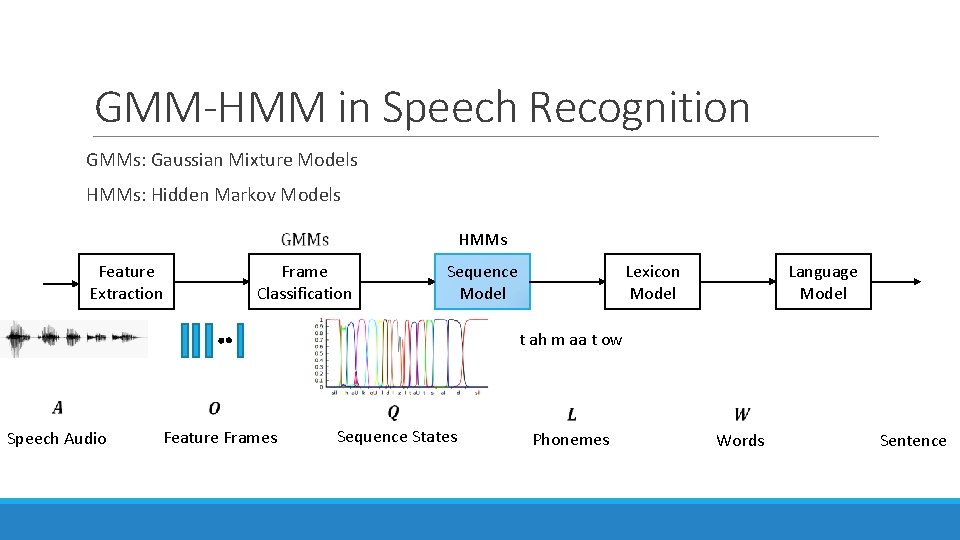
GMM-HMM in Speech Recognition GMMs: Gaussian Mixture Models HMMs: Hidden Markov Models Feature Extraction HMMs Frame Classification Lexicon Model Sequence Model Language Model t ah m aa t ow Speech Audio Feature Frames Sequence States Phonemes Words Sentence
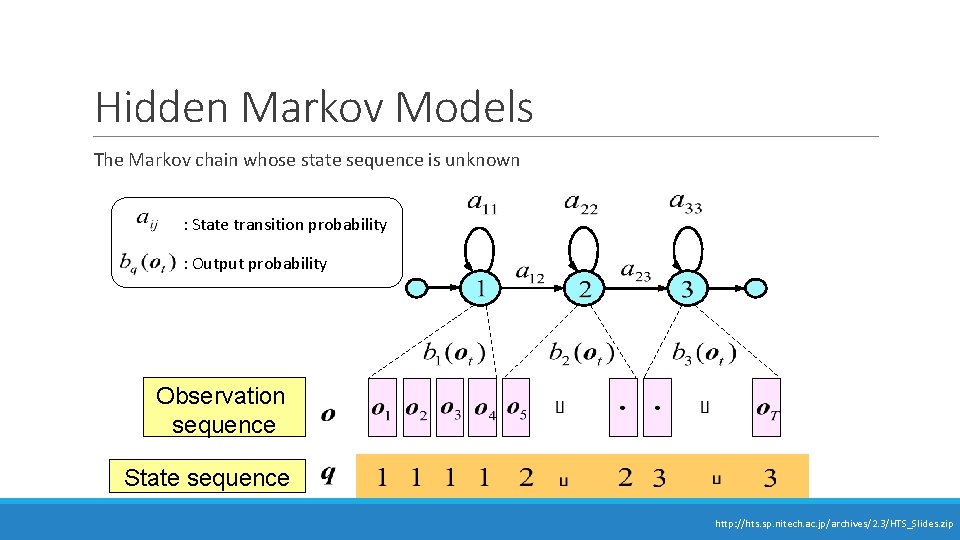
Hidden Markov Models The Markov chain whose state sequence is unknown : State transition probability : Output probability Observation sequence State sequence http: //hts. sp. nitech. ac. jp/archives/2. 3/HTS_Slides. zip
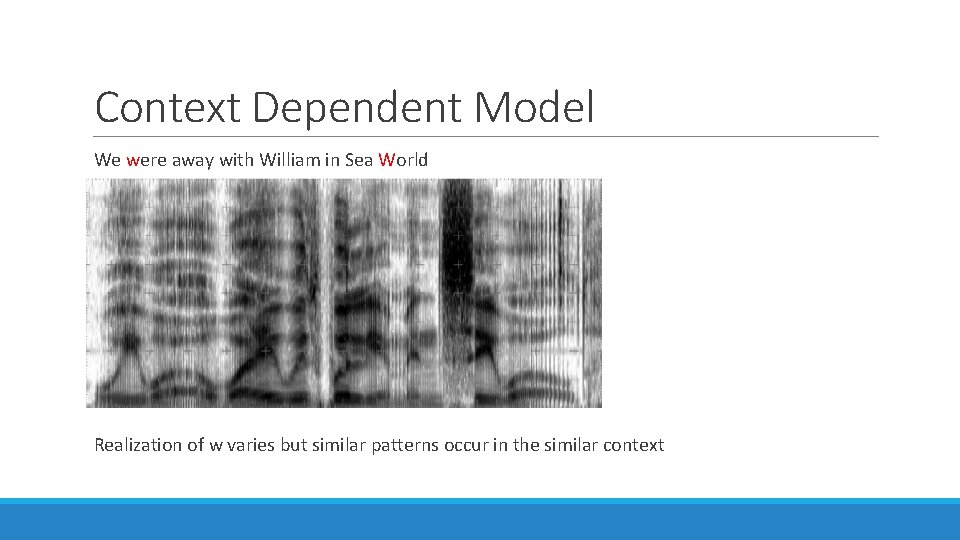
Context Dependent Model We were away with William in Sea World Realization of w varies but similar patterns occur in the similar context
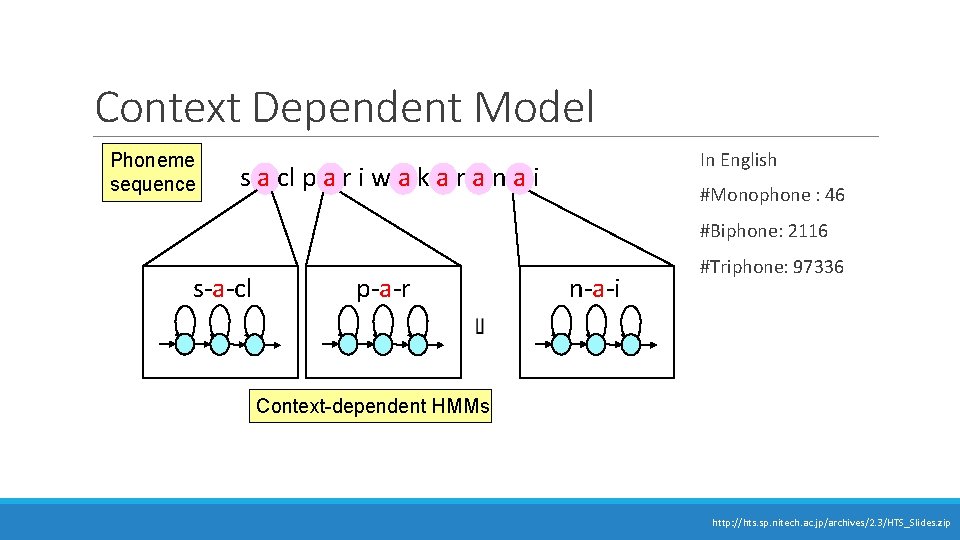
Context Dependent Model Phoneme sequence In English s a cl p a r i w a k a r a n a i #Monophone : 46 #Biphone: 2116 s-a-cl p-a-r n-a-i #Triphone: 97336 Context-dependent HMMs http: //hts. sp. nitech. ac. jp/archives/2. 3/HTS_Slides. zip
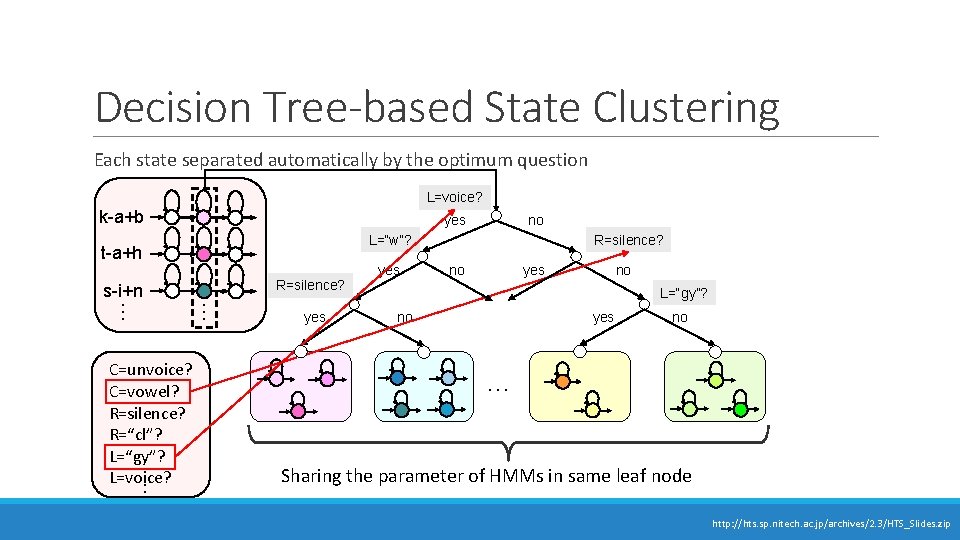
Decision Tree-based State Clustering Each state separated automatically by the optimum question L=voice? k-a+b yes no L=“w”? t-a+h R=silence? … … s-i+n … C=unvoice? C=vowel? R=silence? R=“cl”? L=“gy”? L=voice? yes R=silence? no yes no L=“gy”? no yes no … Sharing the parameter of HMMs in same leaf node http: //hts. sp. nitech. ac. jp/archives/2. 3/HTS_Slides. zip
GMM-HMM in Speech Recognition GMMs: Gaussian Mixture Models HMMs: Hidden Markov Models Feature Extraction HMMs Frame Classification Lexicon Model Sequence Model Language Model t ah m aa t ow Speech Audio Feature Frames Sequence States Phonemes Words Sentence
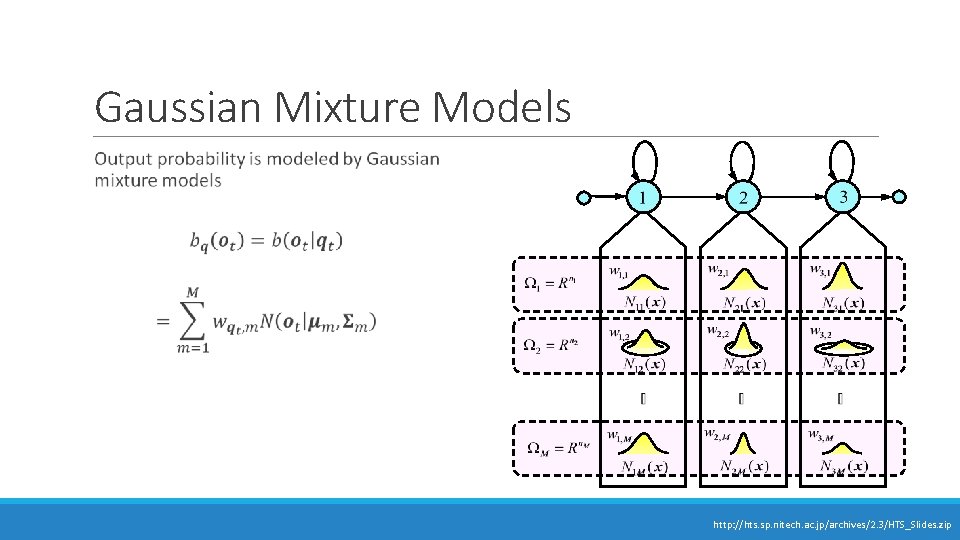
Gaussian Mixture Models http: //hts. sp. nitech. ac. jp/archives/2. 3/HTS_Slides. zip
GMM-HMM in Speech Recognition GMMs: Gaussian Mixture Models HMMs: Hidden Markov Models Feature Extraction HMMs Frame Classification Lexicon Model Sequence Model Language Model t ah m aa t ow Speech Audio Feature Frames Sequence States Phonemes Words Sentence
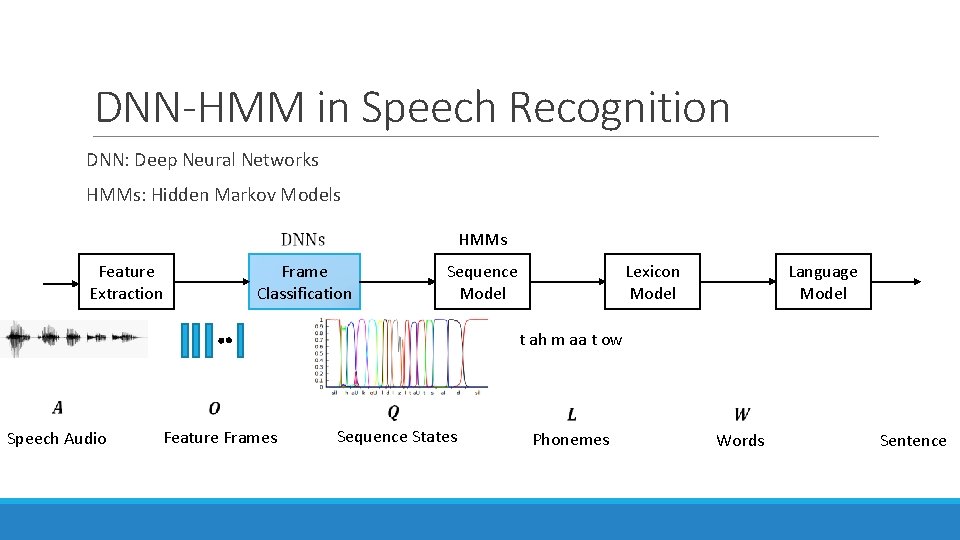
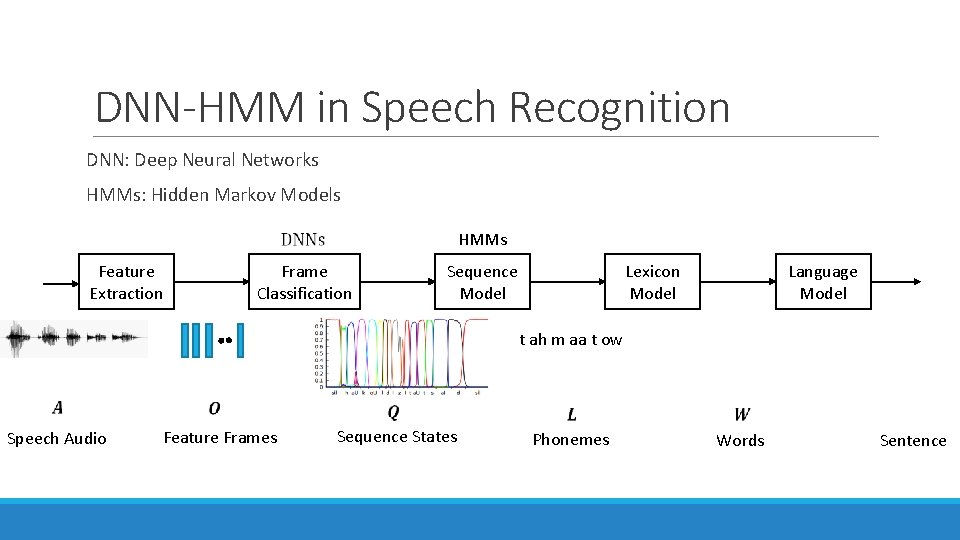
DNN-HMM in Speech Recognition DNN: Deep Neural Networks HMMs: Hidden Markov Models Feature Extraction HMMs Frame Classification Lexicon Model Sequence Model Language Model t ah m aa t ow Speech Audio Feature Frames Sequence States Phonemes Words Sentence
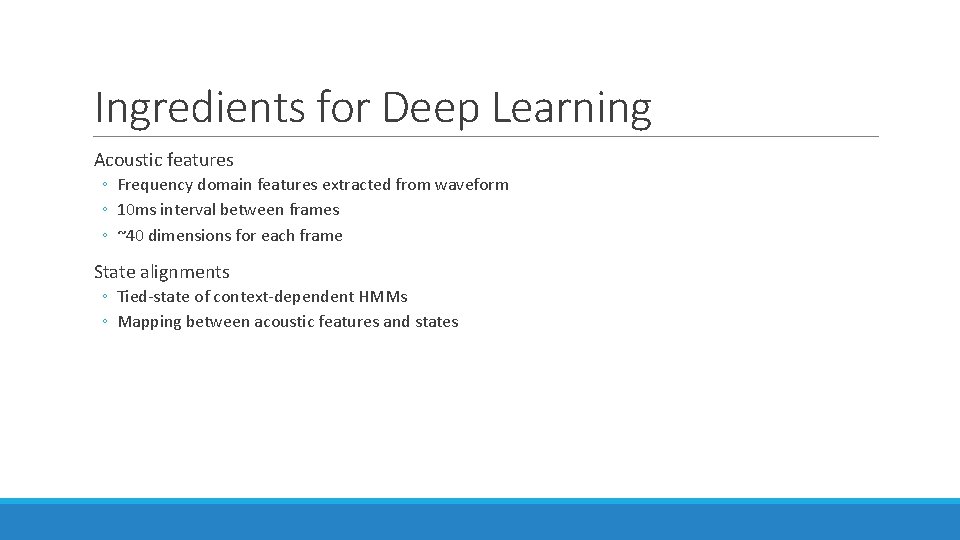
Ingredients for Deep Learning Acoustic features ◦ Frequency domain features extracted from waveform ◦ 10 ms interval between frames ◦ ~40 dimensions for each frame State alignments ◦ Tied-state of context-dependent HMMs ◦ Mapping between acoustic features and states
DNN-HMM in Speech Recognition DNN: Deep Neural Networks HMMs: Hidden Markov Models Feature Extraction HMMs Frame Classification Lexicon Model Sequence Model Language Model t ah m aa t ow Speech Audio Feature Frames Sequence States Phonemes Words Sentence
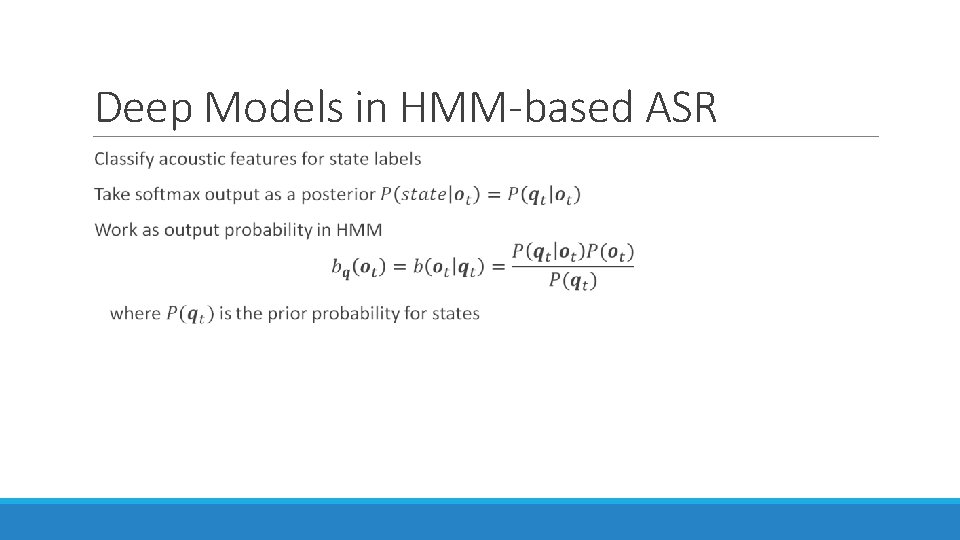
Deep Models in HMM-based ASR
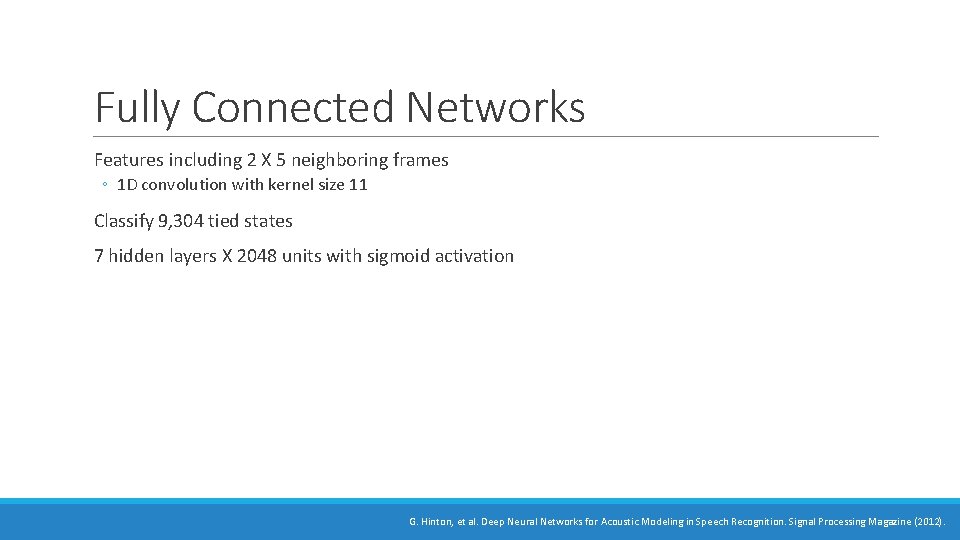
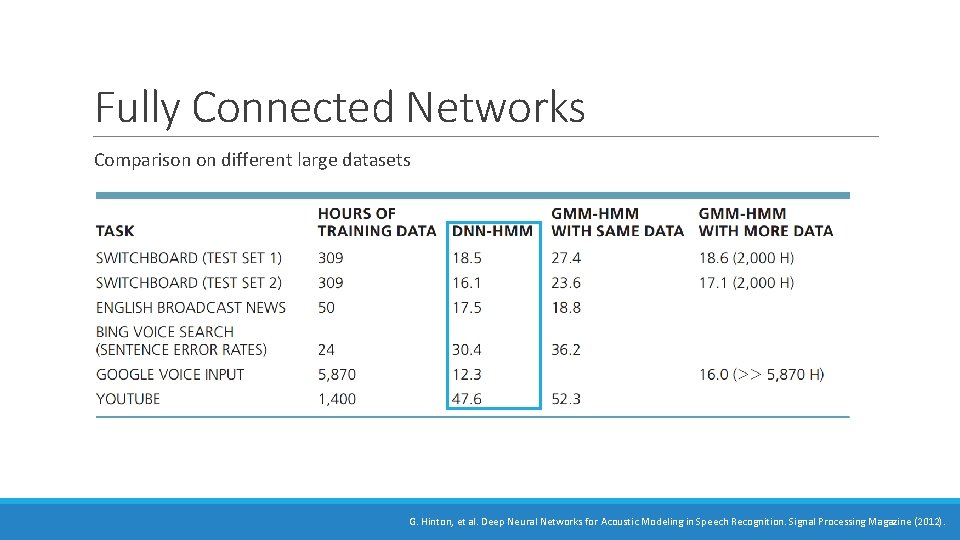
Fully Connected Networks Features including 2 X 5 neighboring frames ◦ 1 D convolution with kernel size 11 Classify 9, 304 tied states 7 hidden layers X 2048 units with sigmoid activation G. Hinton, et al. Deep Neural Networks for Acoustic Modeling in Speech Recognition. Signal Processing Magazine (2012).
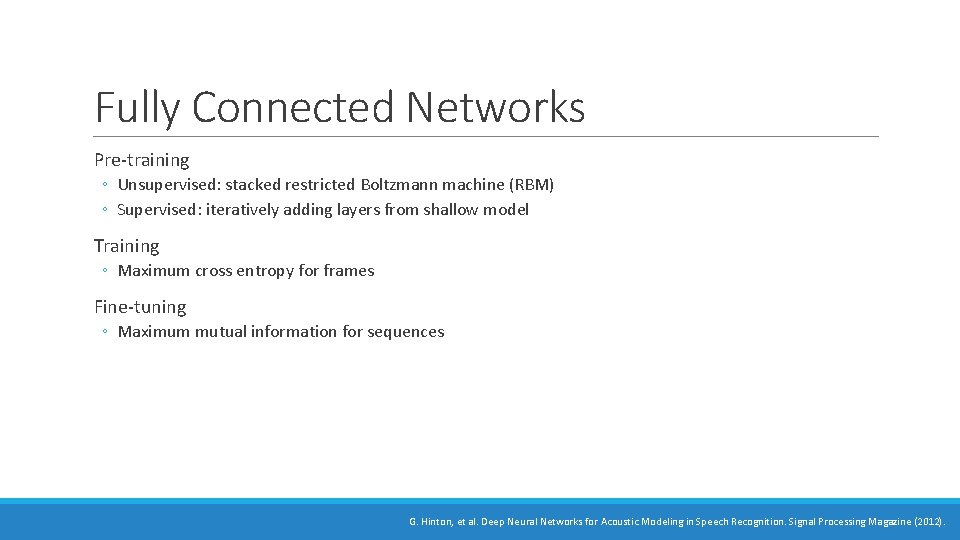
Fully Connected Networks Pre-training ◦ Unsupervised: stacked restricted Boltzmann machine (RBM) ◦ Supervised: iteratively adding layers from shallow model Training ◦ Maximum cross entropy for frames Fine-tuning ◦ Maximum mutual information for sequences G. Hinton, et al. Deep Neural Networks for Acoustic Modeling in Speech Recognition. Signal Processing Magazine (2012).
Fully Connected Networks Comparison on different large datasets G. Hinton, et al. Deep Neural Networks for Acoustic Modeling in Speech Recognition. Signal Processing Magazine (2012).
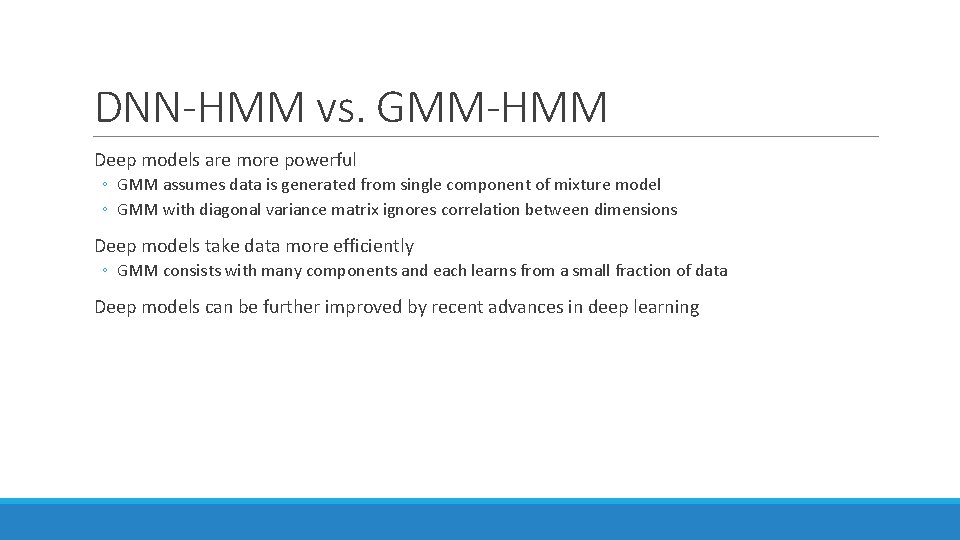
DNN-HMM vs. GMM-HMM Deep models are more powerful ◦ GMM assumes data is generated from single component of mixture model ◦ GMM with diagonal variance matrix ignores correlation between dimensions Deep models take data more efficiently ◦ GMM consists with many components and each learns from a small fraction of data Deep models can be further improved by recent advances in deep learning
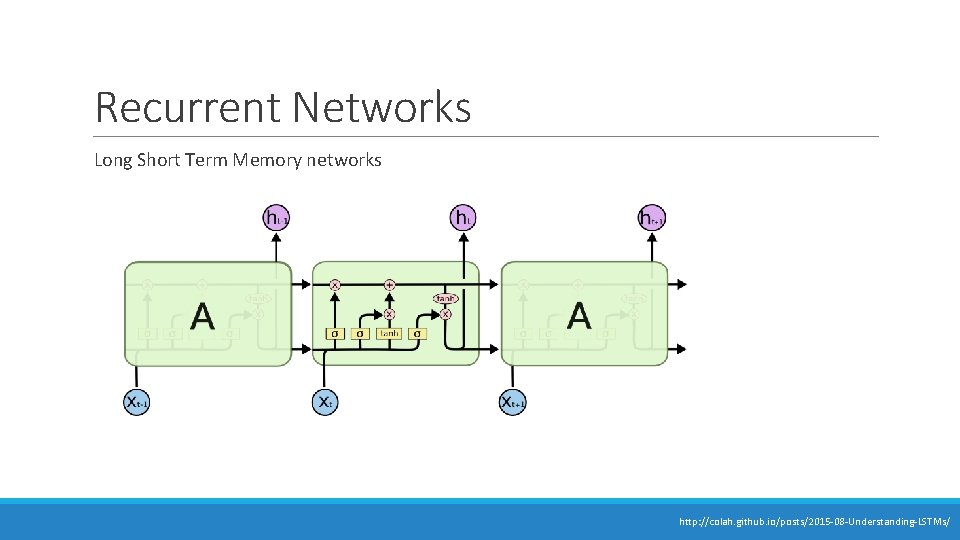
Recurrent Networks Long Short Term Memory networks http: //colah. github. io/posts/2015 -08 -Understanding-LSTMs/
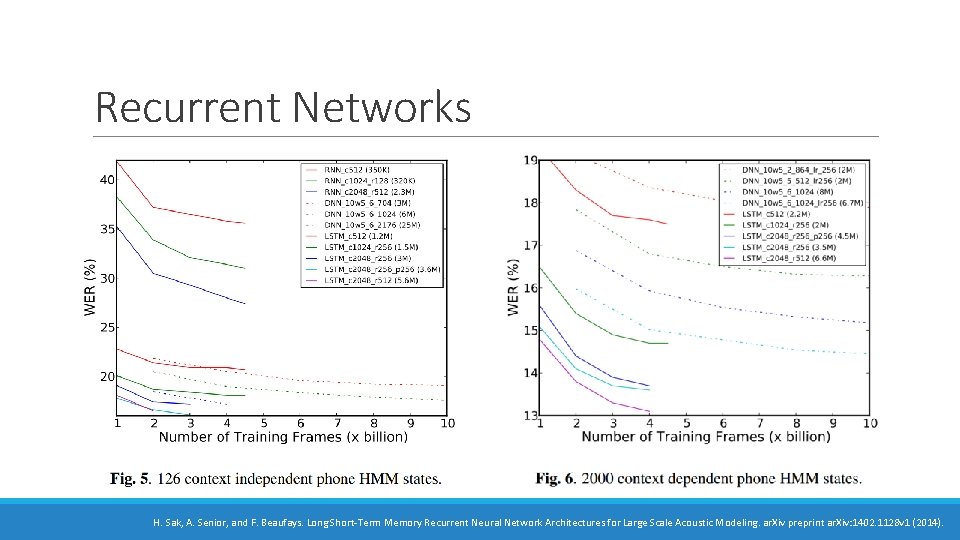
Recurrent Networks H. Sak, A. Senior, and F. Beaufays. Long Short-Term Memory Recurrent Neural Network Architectures for Large Scale Acoustic Modeling. ar. Xiv preprint ar. Xiv: 1402. 1128 v 1 (2014).
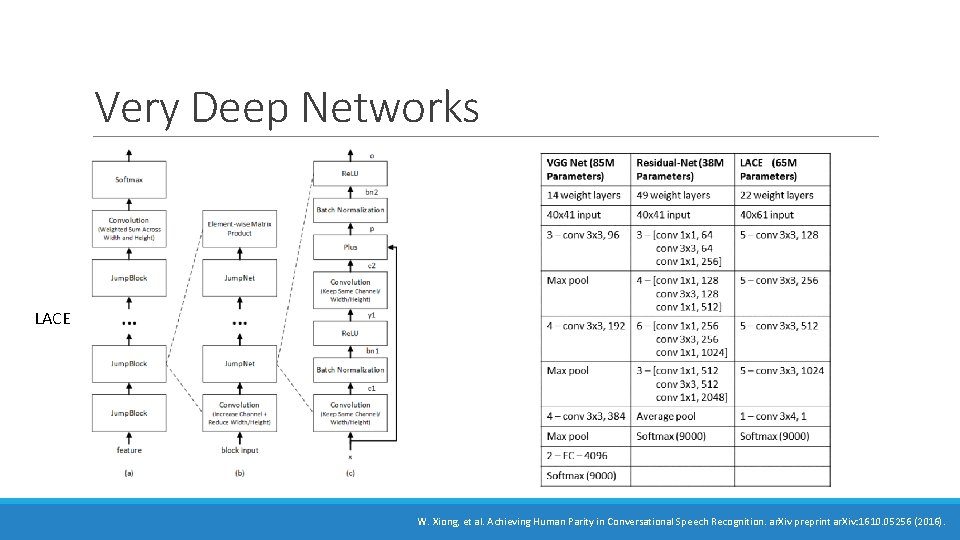
Very Deep Networks LACE W. Xiong, et al. Achieving Human Parity in Conversational Speech Recognition. ar. Xiv preprint ar. Xiv: 1610. 05256 (2016).
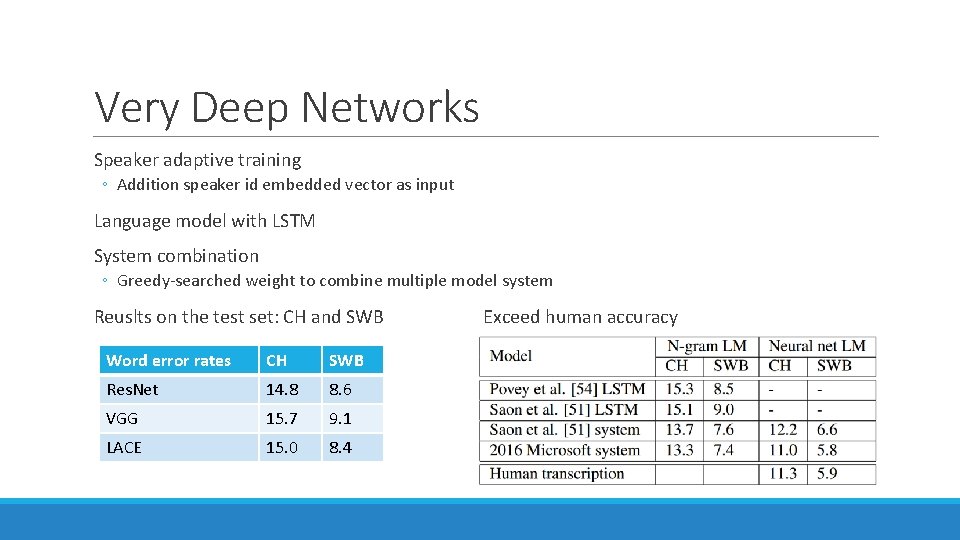
Very Deep Networks Speaker adaptive training ◦ Addition speaker id embedded vector as input Language model with LSTM System combination ◦ Greedy-searched weight to combine multiple model system Reuslts on the test set: CH and SWB Exceed human accuracy Word error rates CH SWB Res. Net 14. 8 8. 6 VGG 15. 7 9. 1 LACE 15. 0 8. 4
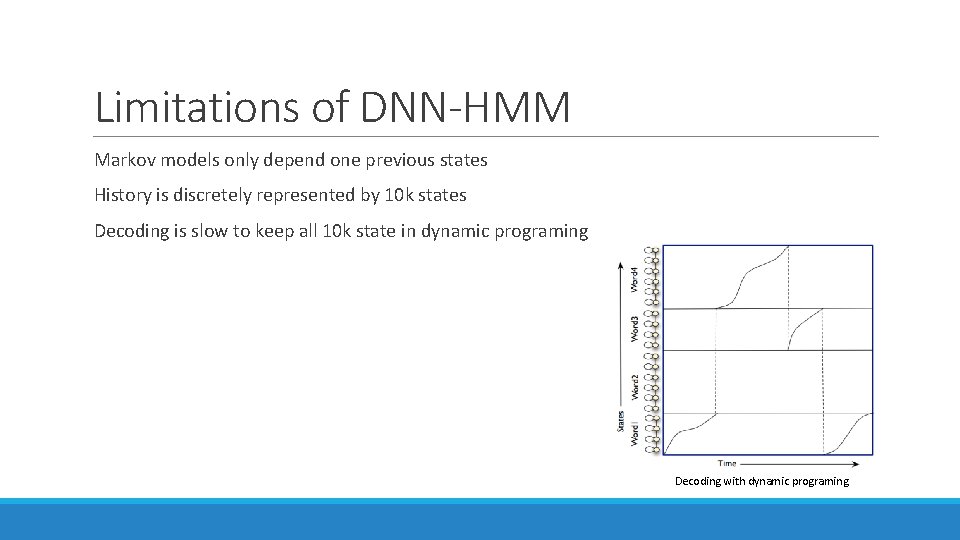
Limitations of DNN-HMM Markov models only depend one previous states History is discretely represented by 10 k states Decoding is slow to keep all 10 k state in dynamic programing Decoding with dynamic programing
DNN-HMM in Speech Recognition DNN: Deep Neural Networks HMMs: Hidden Markov Models Feature Extraction HMMs Frame Classification Lexicon Model Sequence Model Language Model t ah m aa t ow Speech Audio Feature Frames Sequence States Phonemes Words Sentence
End-to-End Deep Models based Automatic Speech Recognition Connectionist Temporal Classification (CTC) based models ◦ LSTM CTC models ◦ Deep speech 2 Attention based models
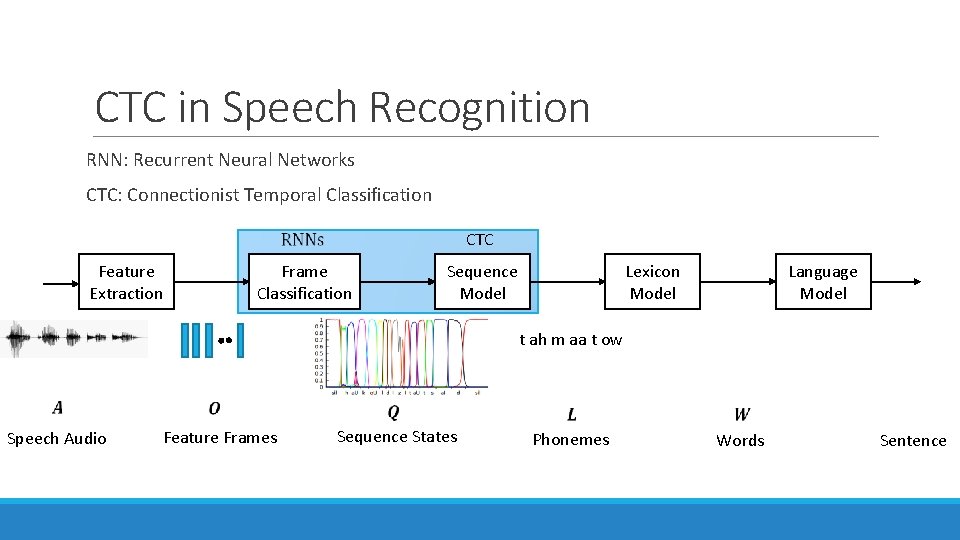
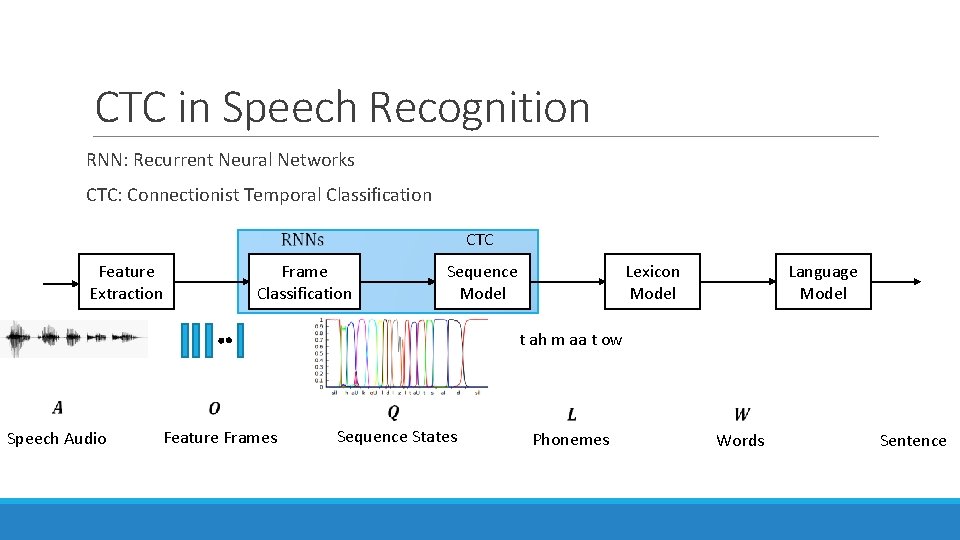
CTC in Speech Recognition RNN: Recurrent Neural Networks CTC: Connectionist Temporal Classification CTC Feature Extraction Frame Classification Lexicon Model Sequence Model Language Model t ah m aa t ow Speech Audio Feature Frames Sequence States Phonemes Words Sentence
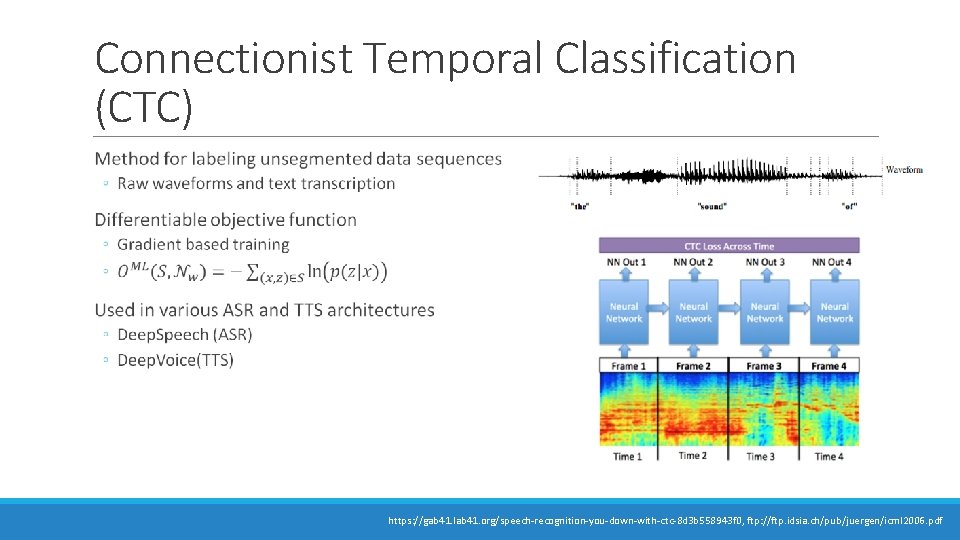
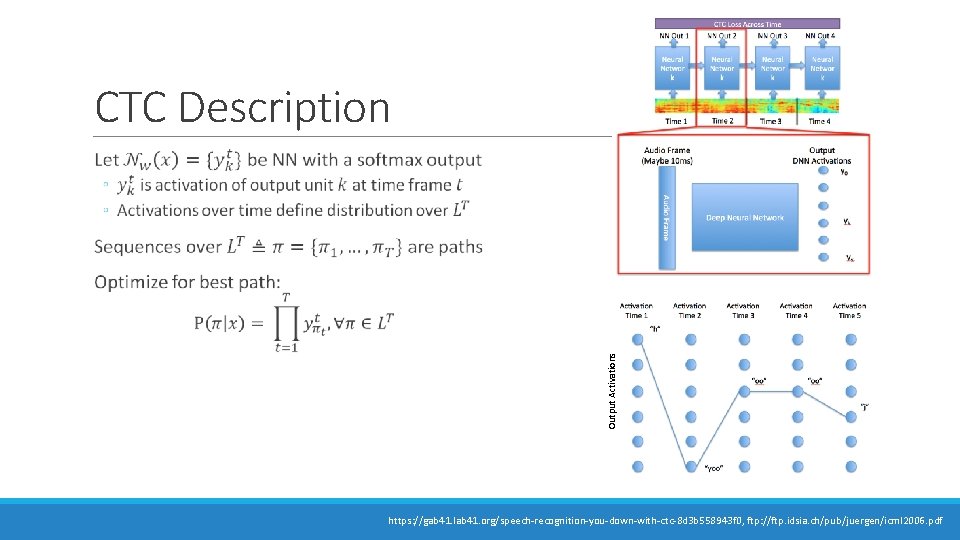
Connectionist Temporal Classification (CTC) https: //gab 41. lab 41. org/speech-recognition-you-down-with-ctc-8 d 3 b 558943 f 0, ftp: //ftp. idsia. ch/pub/juergen/icml 2006. pdf
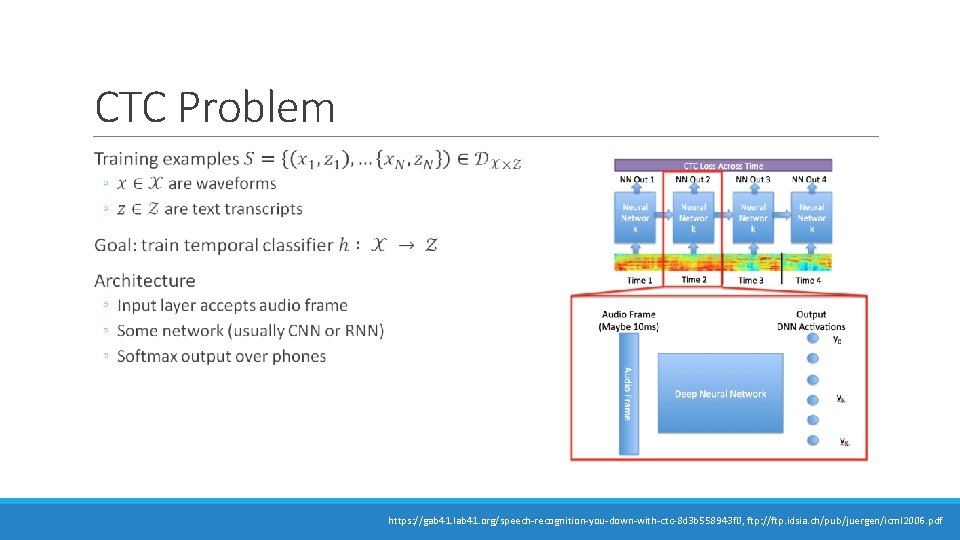
CTC Problem https: //gab 41. lab 41. org/speech-recognition-you-down-with-ctc-8 d 3 b 558943 f 0, ftp: //ftp. idsia. ch/pub/juergen/icml 2006. pdf
CTC Description Output Activations https: //gab 41. lab 41. org/speech-recognition-you-down-with-ctc-8 d 3 b 558943 f 0, ftp: //ftp. idsia. ch/pub/juergen/icml 2006. pdf
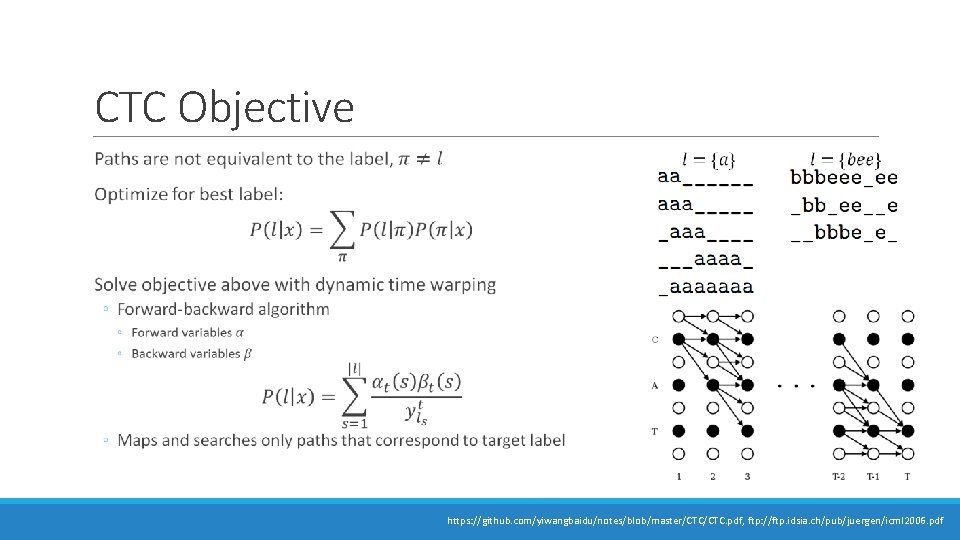
CTC Objective https: //github. com/yiwangbaidu/notes/blob/master/CTC. pdf, ftp: //ftp. idsia. ch/pub/juergen/icml 2006. pdf
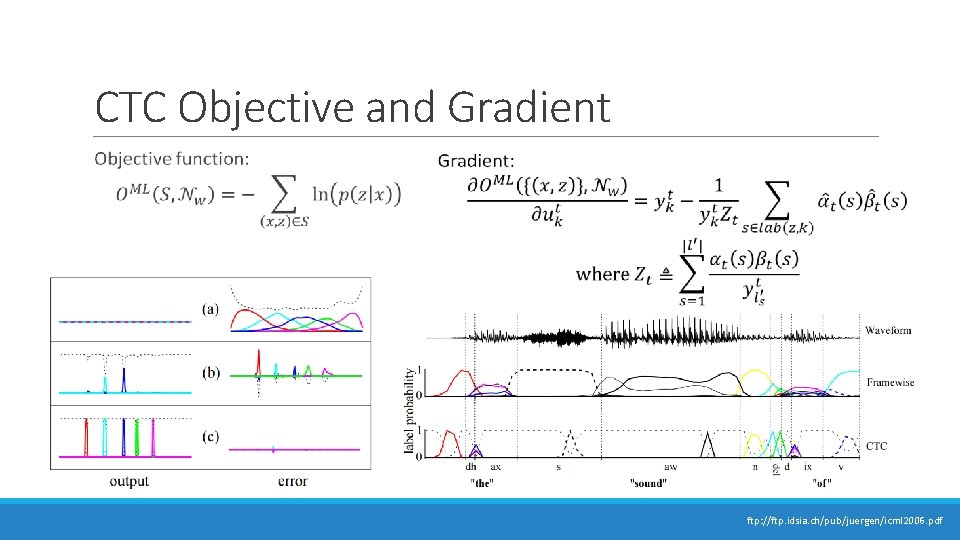
CTC Objective and Gradient ftp: //ftp. idsia. ch/pub/juergen/icml 2006. pdf
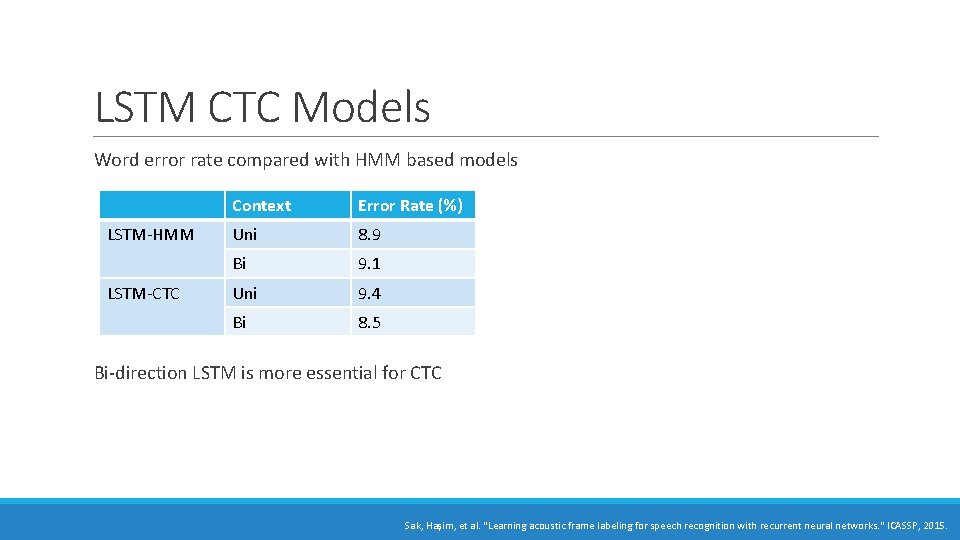
LSTM CTC Models Word error rate compared with HMM based models LSTM-HMM LSTM-CTC Context Error Rate (%) Uni 8. 9 Bi 9. 1 Uni 9. 4 Bi 8. 5 Bi-direction LSTM is more essential for CTC Sak, Haşim, et al. "Learning acoustic frame labeling for speech recognition with recurrent neural networks. " ICASSP, 2015.
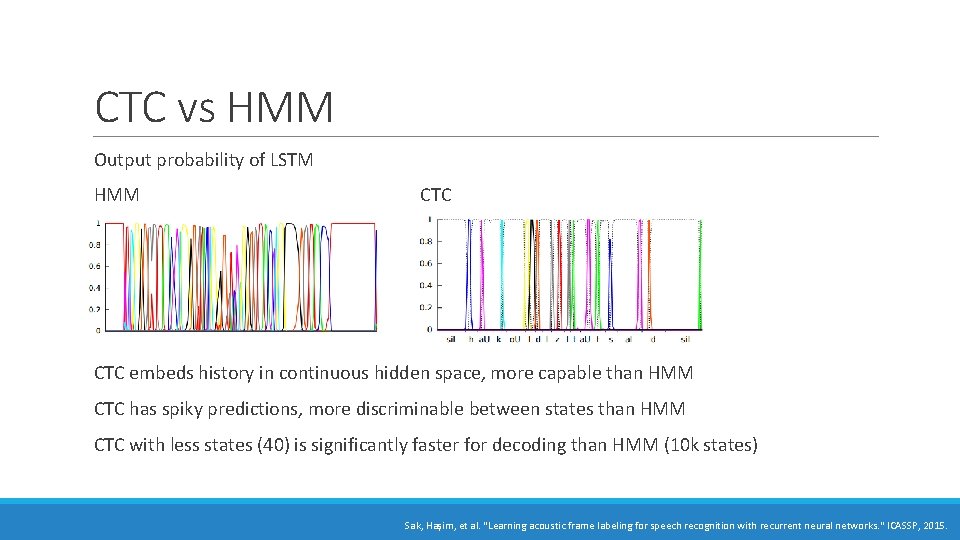
CTC vs HMM Output probability of LSTM HMM CTC embeds history in continuous hidden space, more capable than HMM CTC has spiky predictions, more discriminable between states than HMM CTC with less states (40) is significantly faster for decoding than HMM (10 k states) Sak, Haşim, et al. "Learning acoustic frame labeling for speech recognition with recurrent neural networks. " ICASSP, 2015.
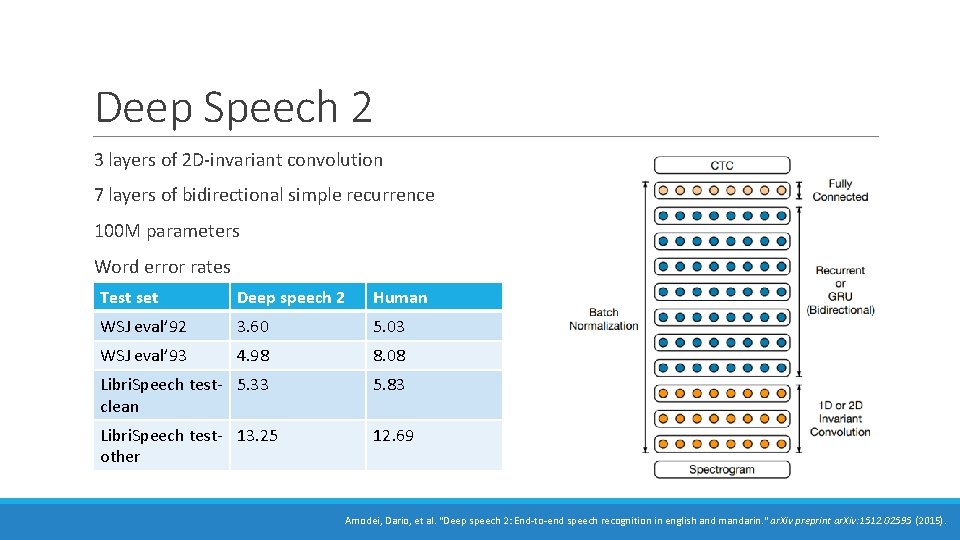
Deep Speech 2 3 layers of 2 D-invariant convolution 7 layers of bidirectional simple recurrence 100 M parameters Word error rates Test set Deep speech 2 Human WSJ eval’ 92 3. 60 5. 03 WSJ eval’ 93 4. 98 8. 08 Libri. Speech test- 5. 33 clean 5. 83 Libri. Speech test- 13. 25 other 12. 69 Amodei, Dario, et al. "Deep speech 2: End-to-end speech recognition in english and mandarin. " ar. Xiv preprint ar. Xiv: 1512. 02595 (2015).
CTC in Speech Recognition RNN: Recurrent Neural Networks CTC: Connectionist Temporal Classification CTC Feature Extraction Frame Classification Lexicon Model Sequence Model Language Model t ah m aa t ow Speech Audio Feature Frames Sequence States Phonemes Words Sentence
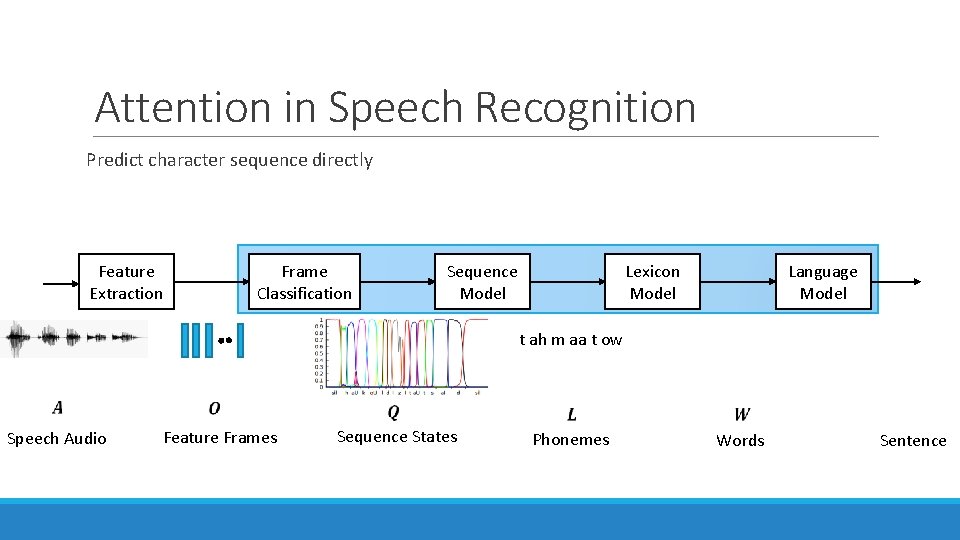
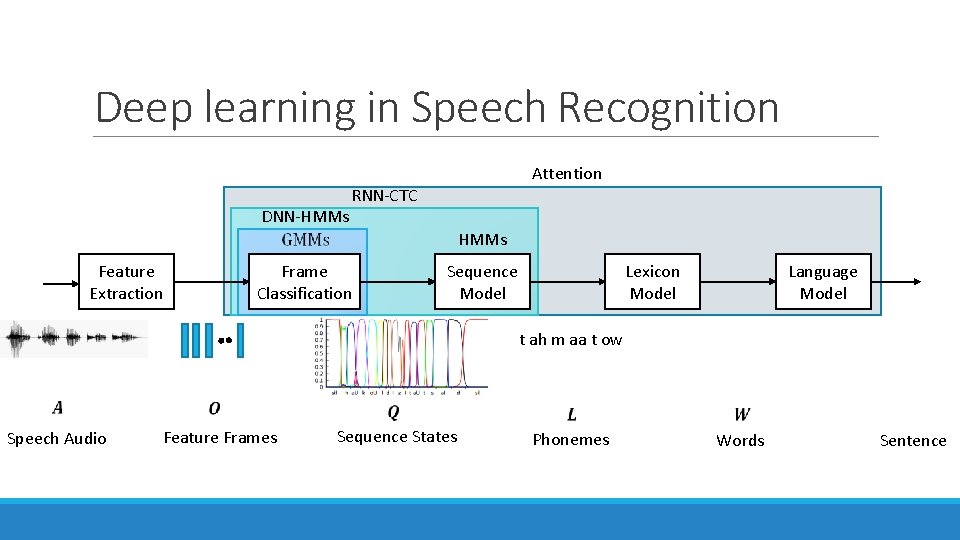
Attention in Speech Recognition Predict character sequence directly Feature Extraction Frame Classification Lexicon Model Sequence Model Language Model t ah m aa t ow Speech Audio Feature Frames Sequence States Phonemes Words Sentence
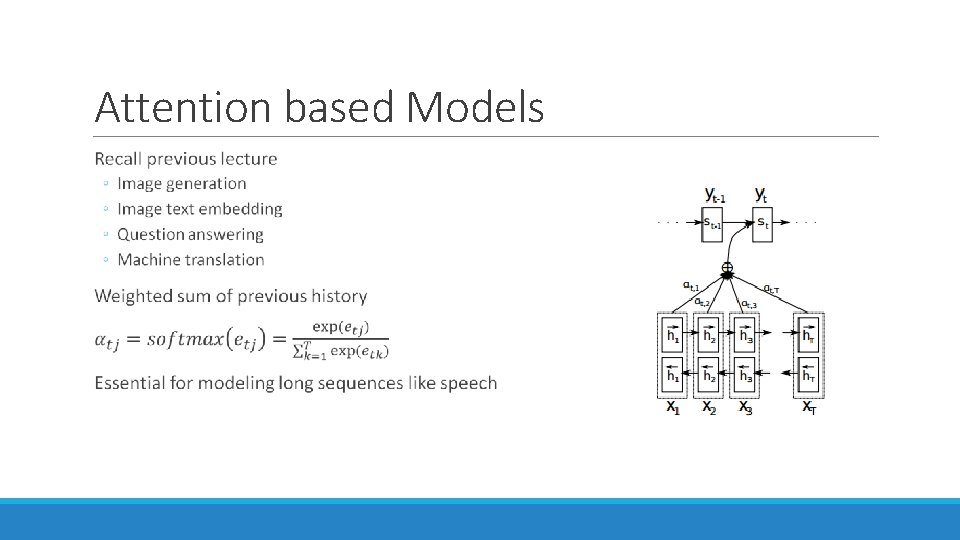
Attention based Models
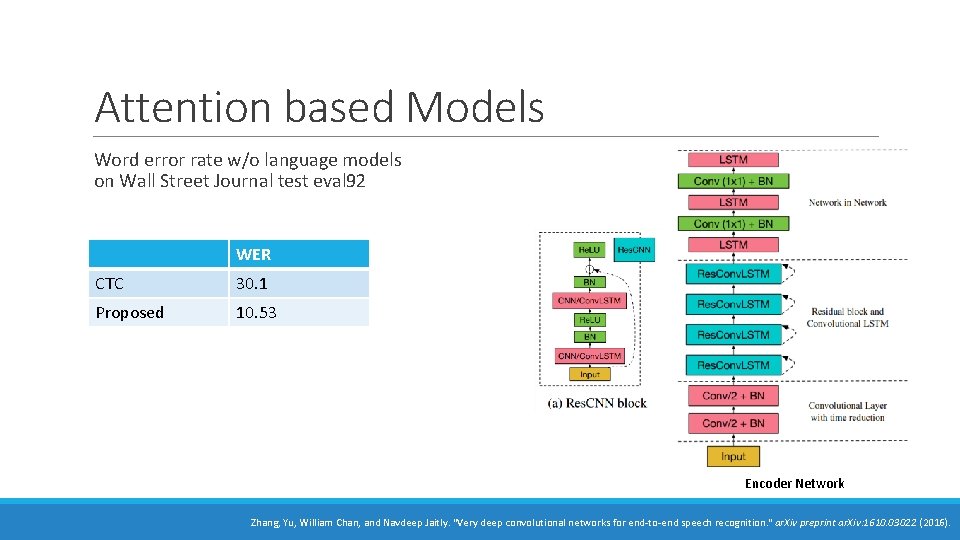
Attention based Models Word error rate w/o language models on Wall Street Journal test eval 92 WER CTC 30. 1 Proposed 10. 53 Encoder Network Zhang, Yu, William Chan, and Navdeep Jaitly. "Very deep convolutional networks for end-to-end speech recognition. " ar. Xiv preprint ar. Xiv: 1610. 03022 (2016).
Deep learning in Speech Recognition Attention DNN-HMMs Feature Extraction RNN-CTC Frame Classification HMMs Lexicon Model Sequence Model Language Model t ah m aa t ow Speech Audio Feature Frames Sequence States Phonemes Words Sentence
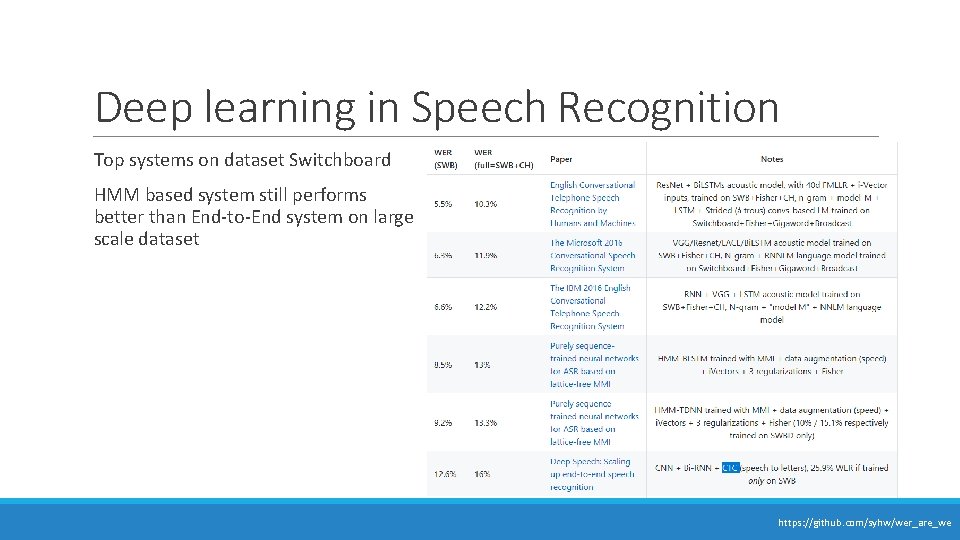
Deep learning in Speech Recognition Top systems on dataset Switchboard HMM based system still performs better than End-to-End system on large scale dataset https: //github. com/syhw/wer_are_we
Text to Speech (TTS)
Outline Automatic Speech Recognition (ASR) ◦ Deep models with HMMs ◦ Connectionist Temporal Classification (CTC) ◦ Attention based models Text to Speech (TTS) ◦ Wave. Net ◦ Deep. Voice ◦ Tacotron Bonus: Music Generation
Traditional Methods Concatenative approaches vs. Statistical Parametric approach ◦ Concatenative: More natural sounding, Less flexible, Take up more space ◦ Statistical Parametric: Muffled, more flexible, Smaller models Traditionally, two stages: frontend and backend ◦ Frontend analyzes text and determines phonemes, stresses, pitch, etc. ◦ Backend generates the audio Moving towards models which can convert directly from text to audio, with the model itself learning any intermediate representations necessary
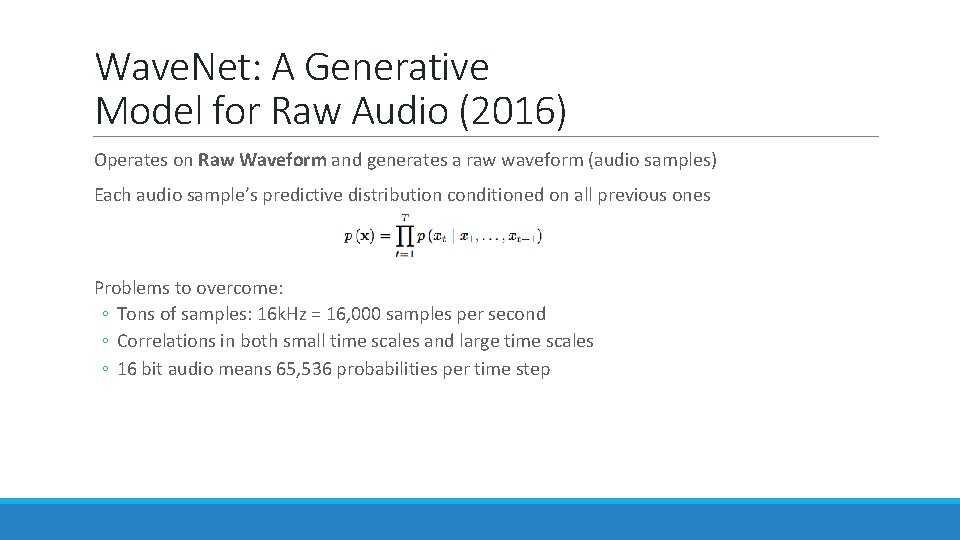
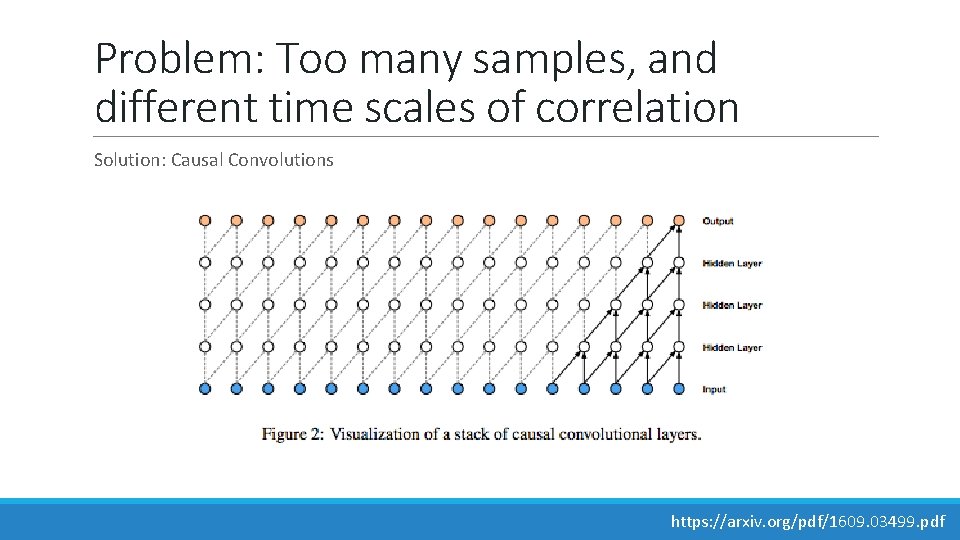
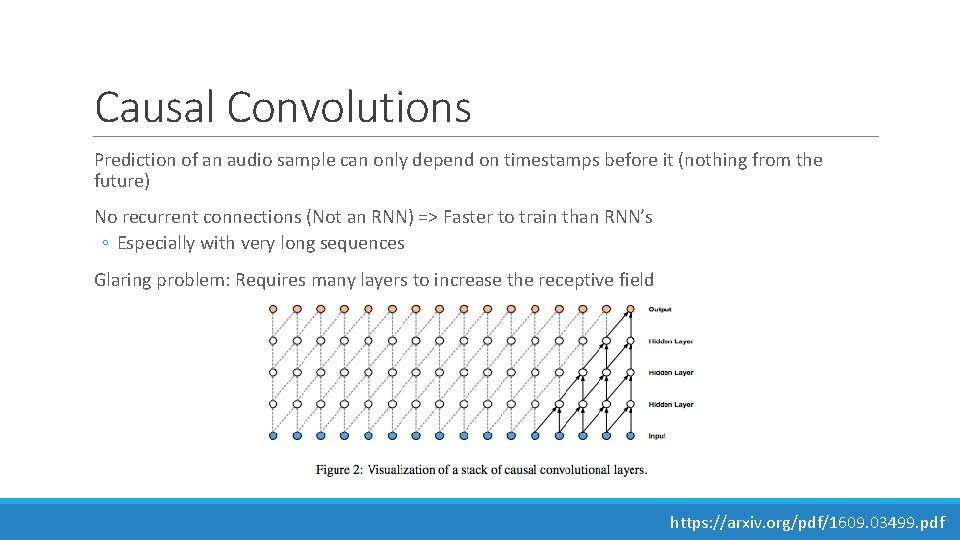
Wave. Net: A Generative Model for Raw Audio (2016) Operates on Raw Waveform and generates a raw waveform (audio samples) Each audio sample’s predictive distribution conditioned on all previous ones Problems to overcome: ◦ Tons of samples: 16 k. Hz = 16, 000 samples per second ◦ Correlations in both small time scales and large time scales ◦ 16 bit audio means 65, 536 probabilities per time step
Problem: Too many samples, and different time scales of correlation Solution: Causal Convolutions https: //arxiv. org/pdf/1609. 03499. pdf
Causal Convolutions Prediction of an audio sample can only depend on timestamps before it (nothing from the future) No recurrent connections (Not an RNN) => Faster to train than RNN’s ◦ Especially with very long sequences Glaring problem: Requires many layers to increase the receptive field https: //arxiv. org/pdf/1609. 03499. pdf
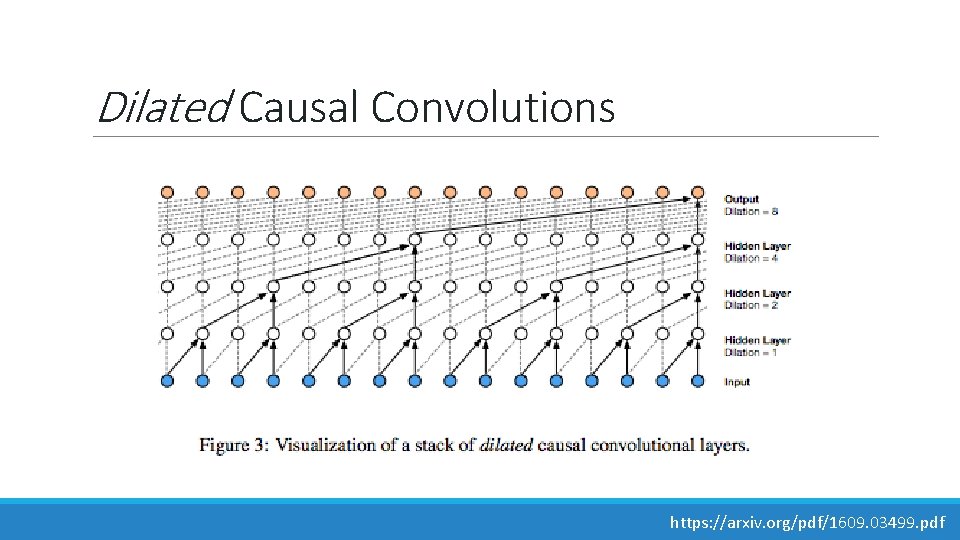
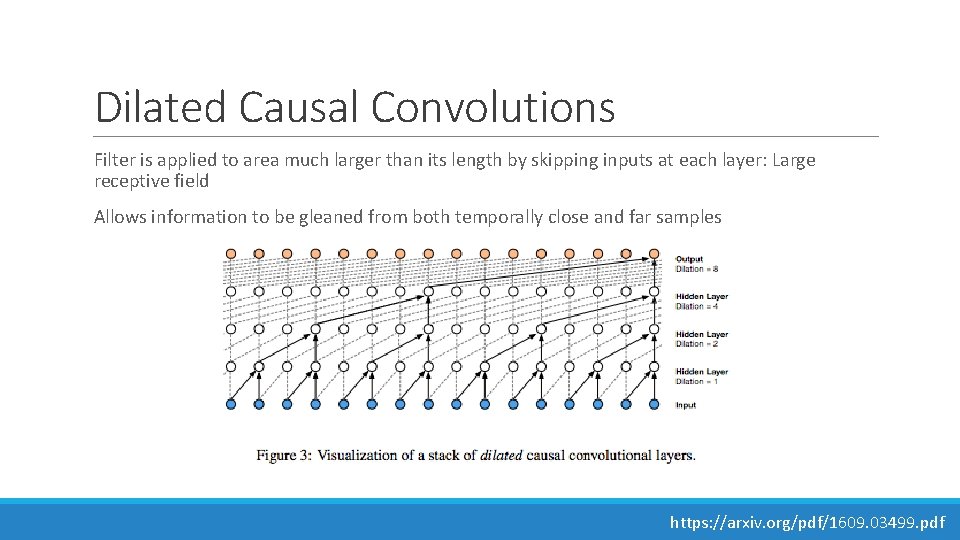
Dilated Causal Convolutions https: //arxiv. org/pdf/1609. 03499. pdf
Dilated Causal Convolutions Filter is applied to area much larger than its length by skipping inputs at each layer: Large receptive field Allows information to be gleaned from both temporally close and far samples https: //arxiv. org/pdf/1609. 03499. pdf
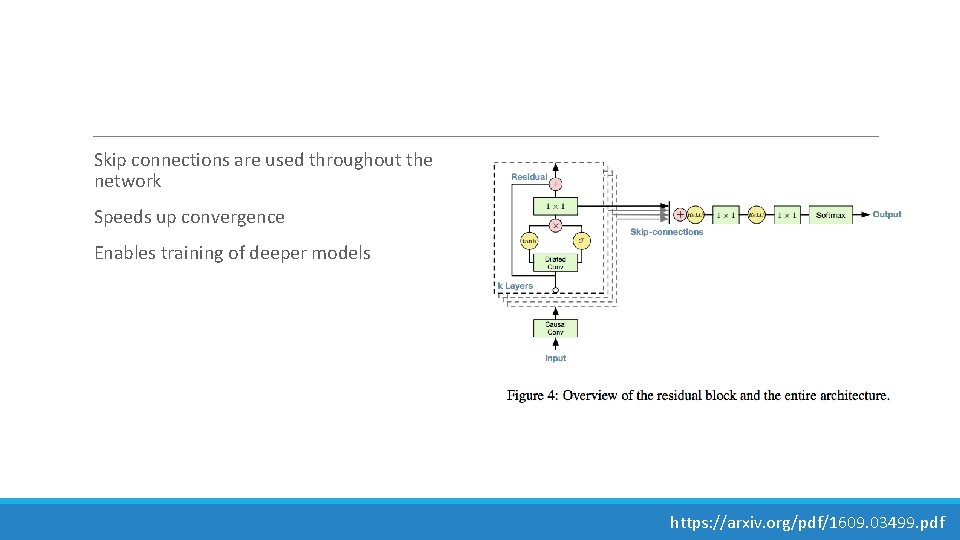
Skip connections are used throughout the network Speeds up convergence Enables training of deeper models https: //arxiv. org/pdf/1609. 03499. pdf
Where are we now? No input => Generic framework https: //deepmind. com/blog/wavenet-generative-model-raw-audio/
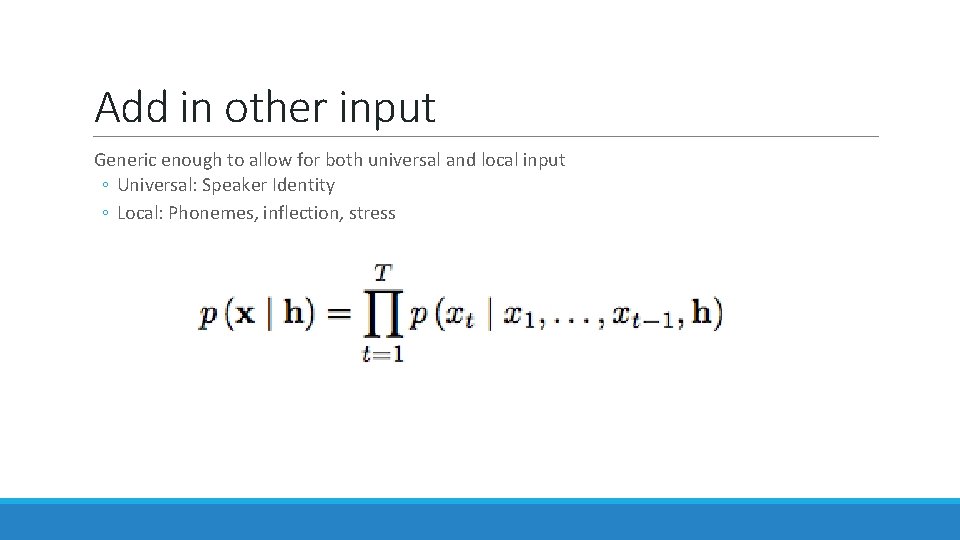
Add in other input Generic enough to allow for both universal and local input ◦ Universal: Speaker Identity ◦ Local: Phonemes, inflection, stress
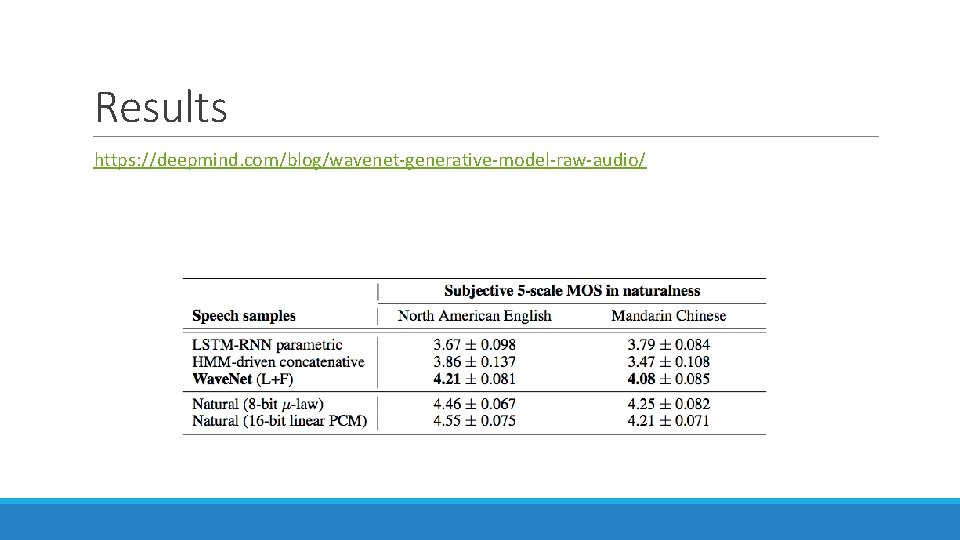
Results https: //deepmind. com/blog/wavenet-generative-model-raw-audio/
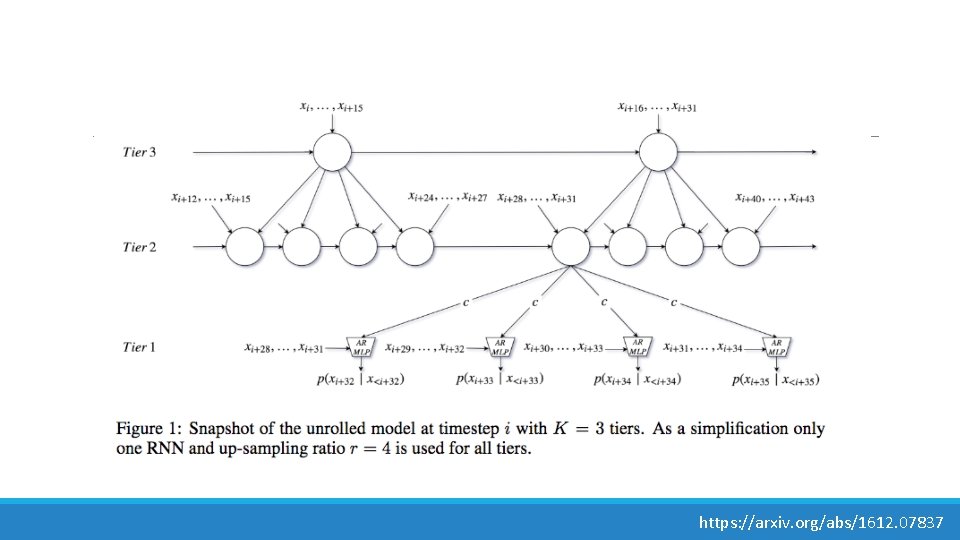
Sample. RNN How to deal with different time scales? Modularize. Use different modules operating at different clock rates to deal with varying levels of abstraction Sample-Level Modules and Frame-Level Modules
https: //arxiv. org/abs/1612. 07837
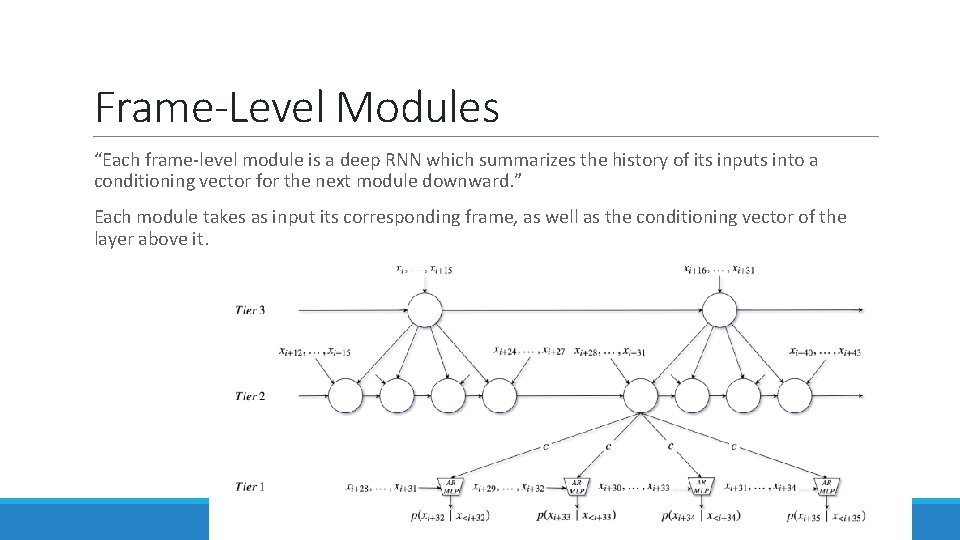
Frame-Level Modules “Each frame-level module is a deep RNN which summarizes the history of its inputs into a conditioning vector for the next module downward. ” Each module takes as input its corresponding frame, as well as the conditioning vector of the layer above it.
Sample Level Modules Conditioned on the conditioning vector from the frame above it, and on some number of preceding samples. Since this number is generally small, they use a multilayer perceptron here instead of an RNN, to speed up training “When processing an audio sequence, the MLP is convolved over the sequence, processing each window of samples and predicting the next sample. ” “At generation time, the MLP is run repeatedly to generate one sample at a time. ”
Other aspects of Sample. RNN Linear Quantization with q=256 RNN’s (not used in Wave. Net) are powerful if they can be trained efficiently Truncated Back Propagation Through Time (BPTT) ◦ Split sequence into subsequences and only propagate gradient to beginning of subsequence ◦ Interestingly, able to train well on subsequences of only 32 ms
Results https: //soundcloud. com/samplernn
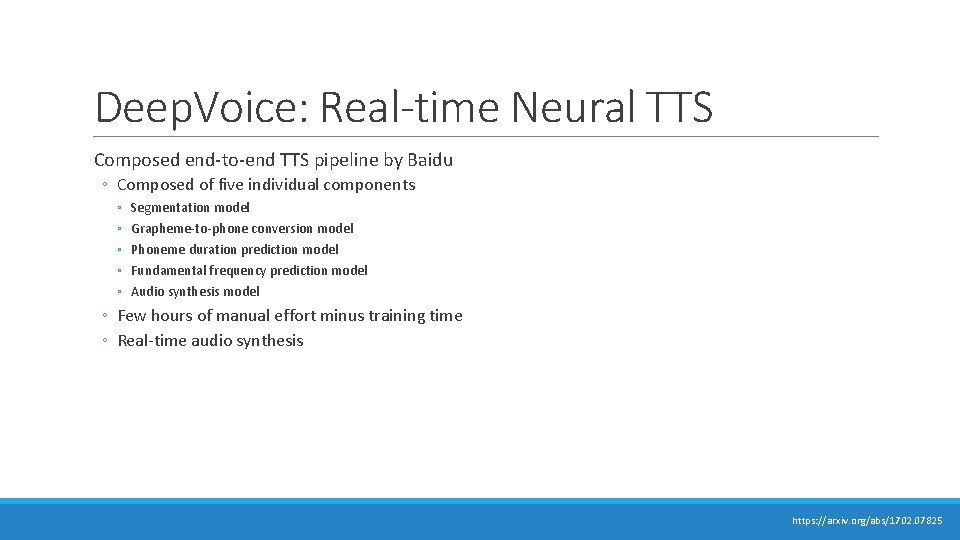
Deep. Voice: Real-time Neural TTS Composed end-to-end TTS pipeline by Baidu ◦ Composed of five individual components ◦ ◦ ◦ Segmentation model Grapheme-to-phone conversion model Phoneme duration prediction model Fundamental frequency prediction model Audio synthesis model ◦ Few hours of manual effort minus training time ◦ Real-time audio synthesis https: //arxiv. org/abs/1702. 07825
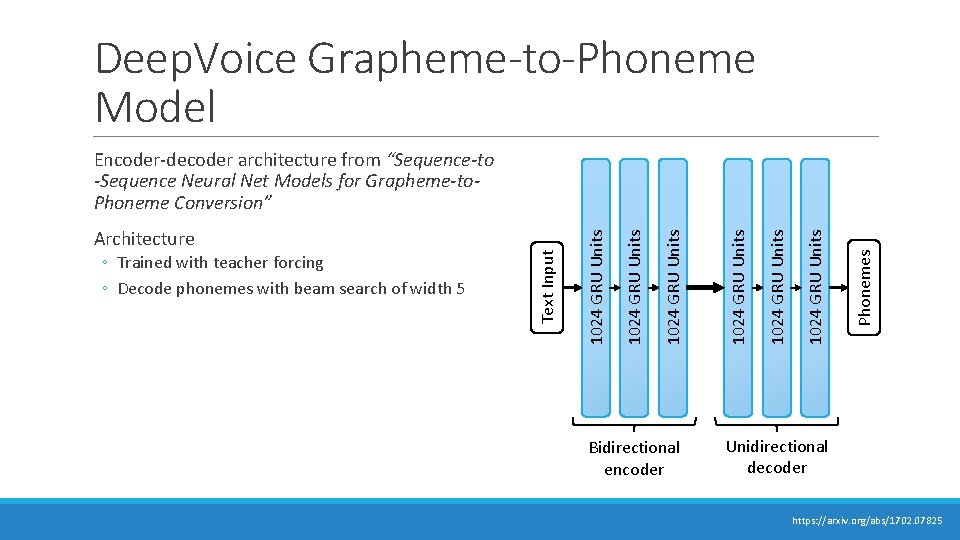
Deep. Voice Grapheme-to-Phoneme Model Bidirectional encoder Phonemes 1024 GRU Units 1024 GRU Units ◦ Trained with teacher forcing ◦ Decode phonemes with beam search of width 5 1024 GRU Units Architecture Text Input Encoder-decoder architecture from “Sequence-to -Sequence Neural Net Models for Grapheme-to. Phoneme Conversion” Unidirectional decoder https: //arxiv. org/abs/1702. 07825
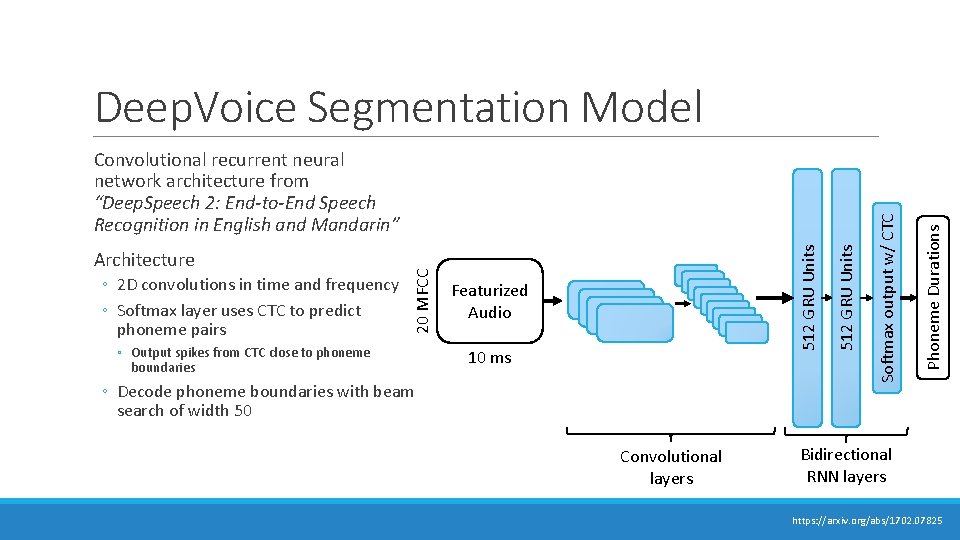
10 ms ◦ Decode phoneme boundaries with beam search of width 50 Convolutional layers Phoneme Durations ◦ Output spikes from CTC close to phoneme boundaries Featurized Audio 512 GRU Units ◦ 2 D convolutions in time and frequency ◦ Softmax layer uses CTC to predict phoneme pairs 512 GRU Units Architecture 20 MFCC Convolutional recurrent neural network architecture from “Deep. Speech 2: End-to-End Speech Recognition in English and Mandarin” Softmax output w/ CTC Deep. Voice Segmentation Model Bidirectional RNN layers https: //arxiv. org/abs/1702. 07825
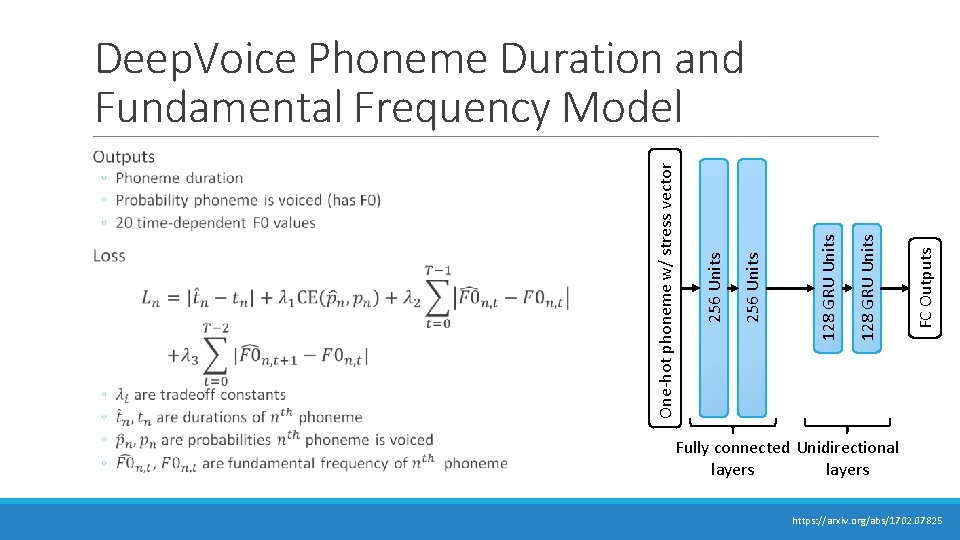
FC Outputs 128 GRU Units 256 Units One-hot phoneme w/ stress vector Deep. Voice Phoneme Duration and Fundamental Frequency Model Fully connected Unidirectional layers https: //arxiv. org/abs/1702. 07825
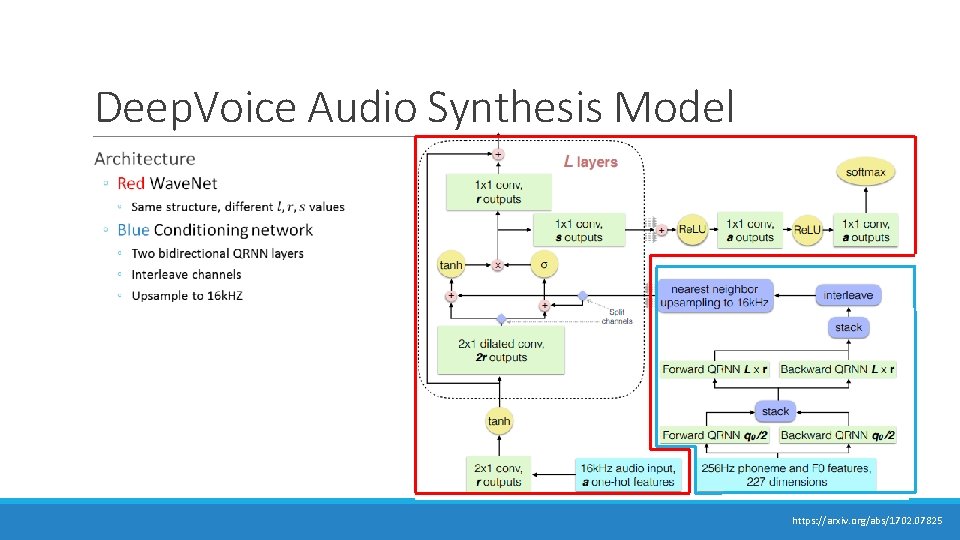
Deep. Voice Audio Synthesis Model https: //arxiv. org/abs/1702. 07825
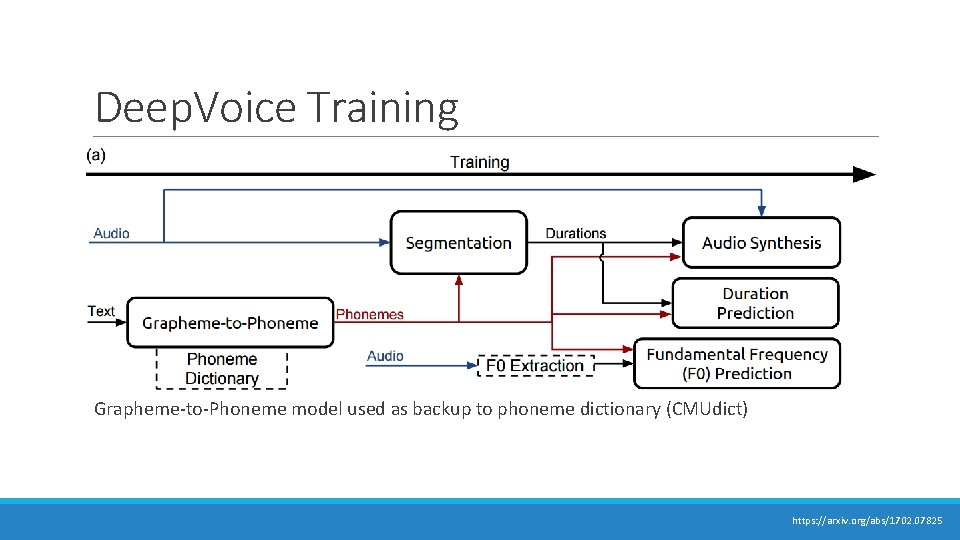
Deep. Voice Training Grapheme-to-Phoneme model used as backup to phoneme dictionary (CMUdict) https: //arxiv. org/abs/1702. 07825
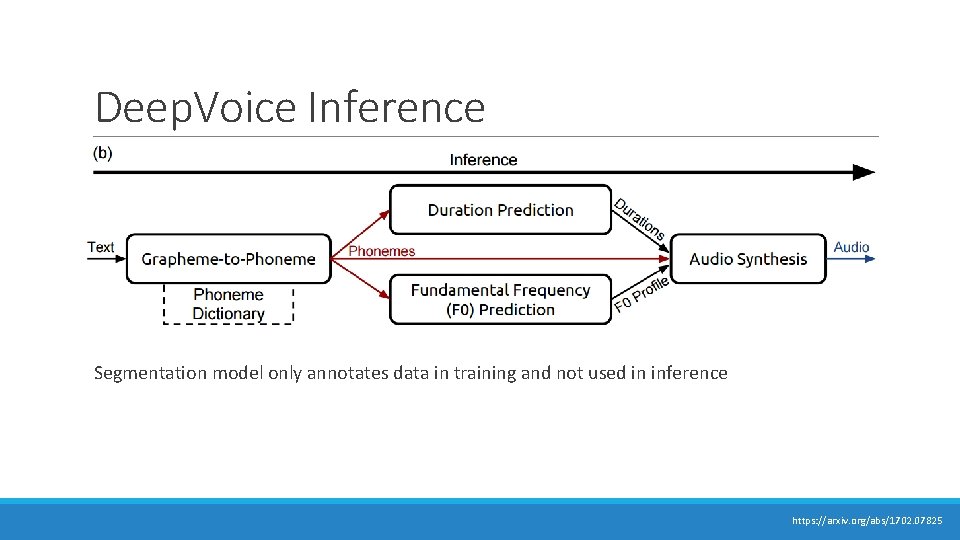
Deep. Voice Inference Segmentation model only annotates data in training and not used in inference https: //arxiv. org/abs/1702. 07825
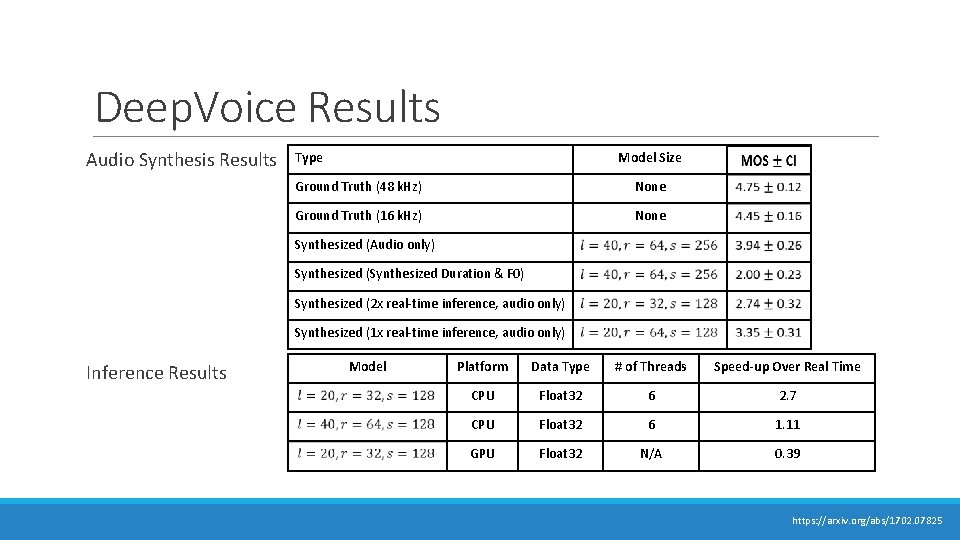
Deep. Voice Results Audio Synthesis Results Type Model Size Ground Truth (48 k. Hz) None Ground Truth (16 k. Hz) None Synthesized (Audio only) Synthesized (Synthesized Duration & F 0) Synthesized (2 x real-time inference, audio only) Synthesized (1 x real-time inference, audio only) Inference Results Model Platform Data Type # of Threads Speed-up Over Real Time CPU Float 32 6 2. 7 CPU Float 32 6 1. 11 GPU Float 32 N/A 0. 39 https: //arxiv. org/abs/1702. 07825
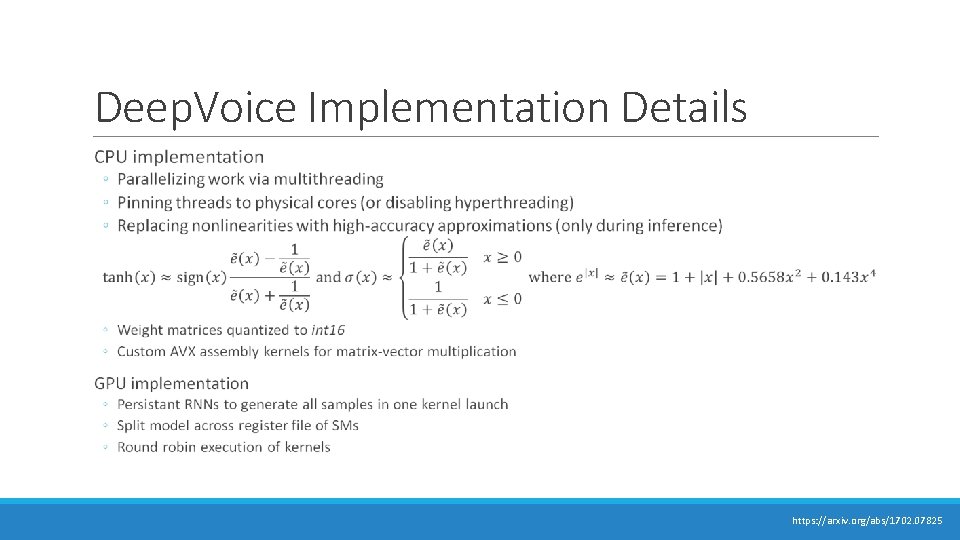
Deep. Voice Implementation Details https: //arxiv. org/abs/1702. 07825
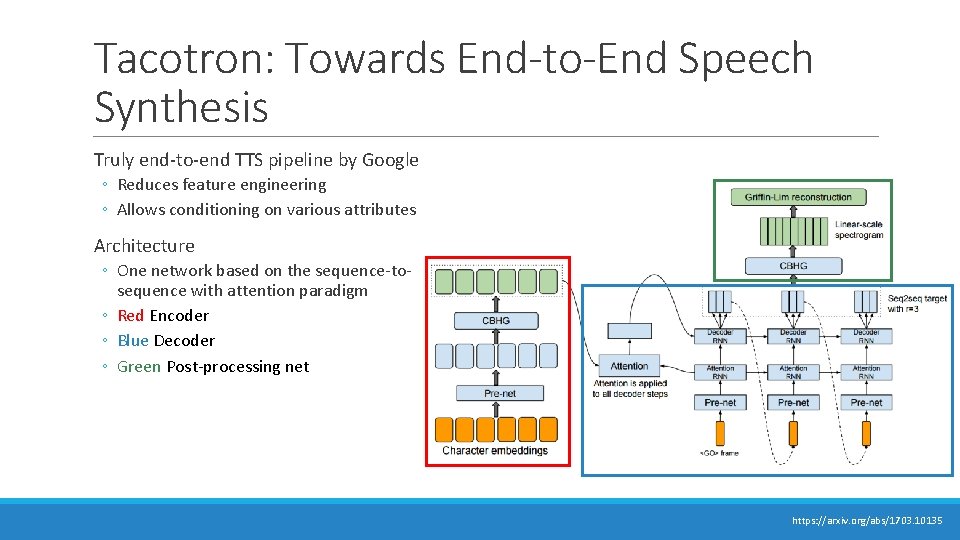
Tacotron: Towards End-to-End Speech Synthesis Truly end-to-end TTS pipeline by Google ◦ Reduces feature engineering ◦ Allows conditioning on various attributes Architecture ◦ One network based on the sequence-tosequence with attention paradigm ◦ Red Encoder ◦ Blue Decoder ◦ Green Post-processing net https: //arxiv. org/abs/1703. 10135
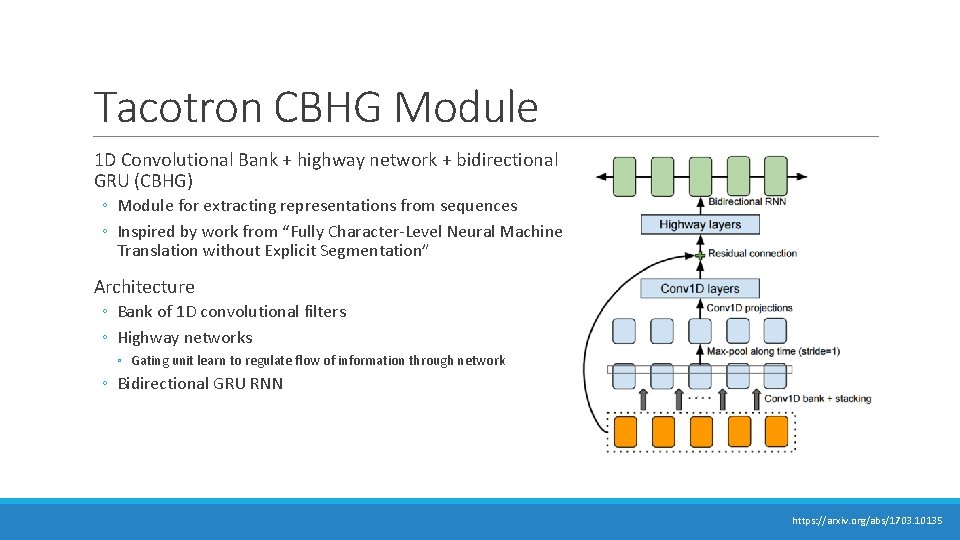
Tacotron CBHG Module 1 D Convolutional Bank + highway network + bidirectional GRU (CBHG) ◦ Module for extracting representations from sequences ◦ Inspired by work from “Fully Character-Level Neural Machine Translation without Explicit Segmentation” Architecture ◦ Bank of 1 D convolutional filters ◦ Highway networks ◦ Gating unit learn to regulate flow of information through network ◦ Bidirectional GRU RNN https: //arxiv. org/abs/1703. 10135
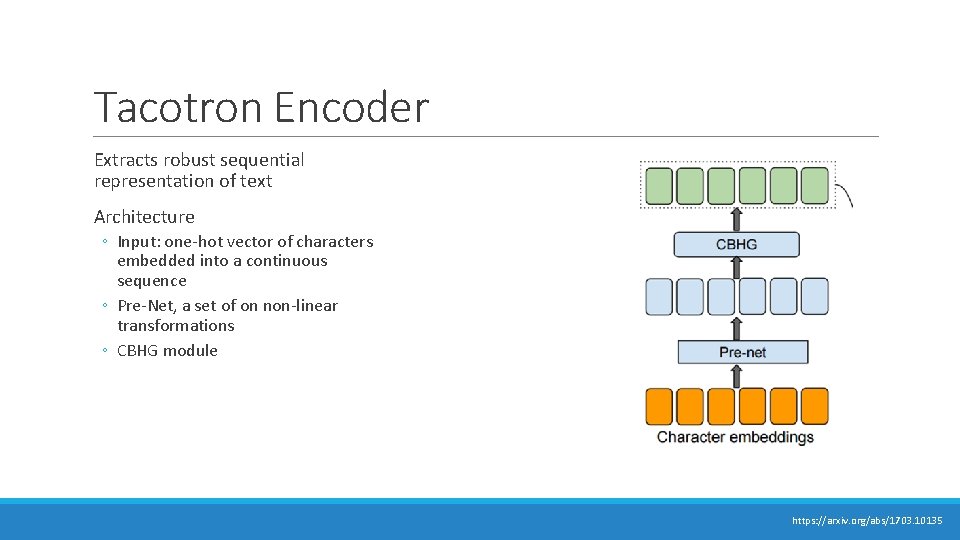
Tacotron Encoder Extracts robust sequential representation of text Architecture ◦ Input: one-hot vector of characters embedded into a continuous sequence ◦ Pre-Net, a set of on non-linear transformations ◦ CBHG module https: //arxiv. org/abs/1703. 10135
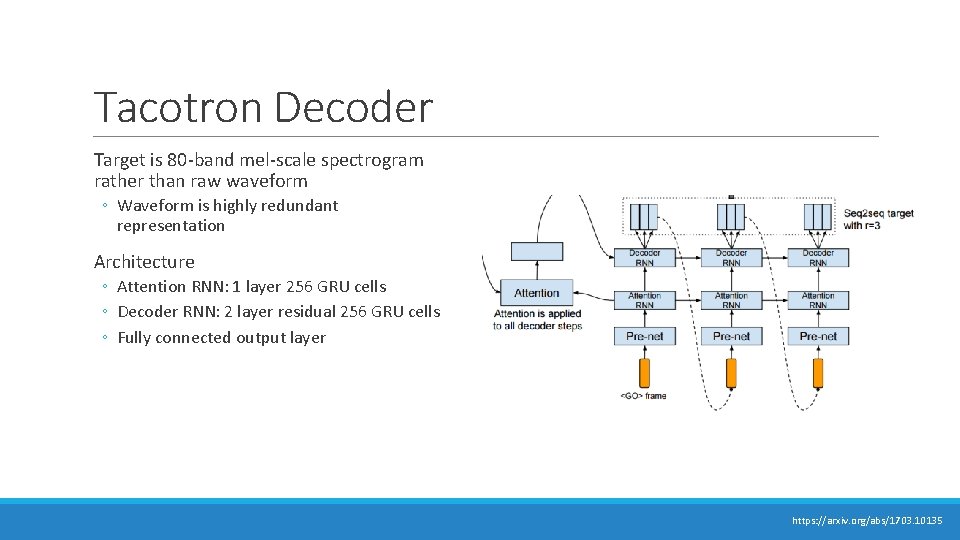
Tacotron Decoder Target is 80 -band mel-scale spectrogram rather than raw waveform ◦ Waveform is highly redundant representation Architecture ◦ Attention RNN: 1 layer 256 GRU cells ◦ Decoder RNN: 2 layer residual 256 GRU cells ◦ Fully connected output layer https: //arxiv. org/abs/1703. 10135
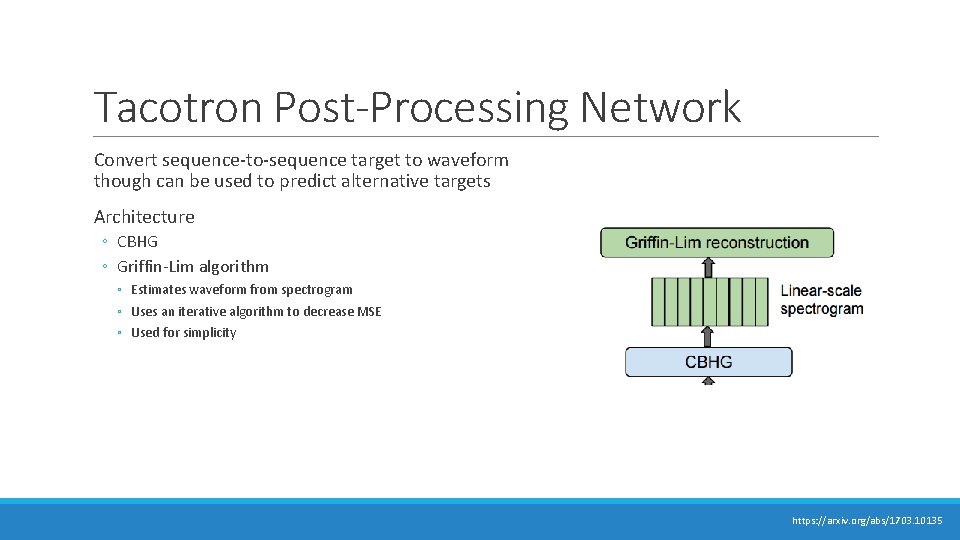
Tacotron Post-Processing Network Convert sequence-to-sequence target to waveform though can be used to predict alternative targets Architecture ◦ CBHG ◦ Griffin-Lim algorithm ◦ Estimates waveform from spectrogram ◦ Uses an iterative algorithm to decrease MSE ◦ Used for simplicity https: //arxiv. org/abs/1703. 10135
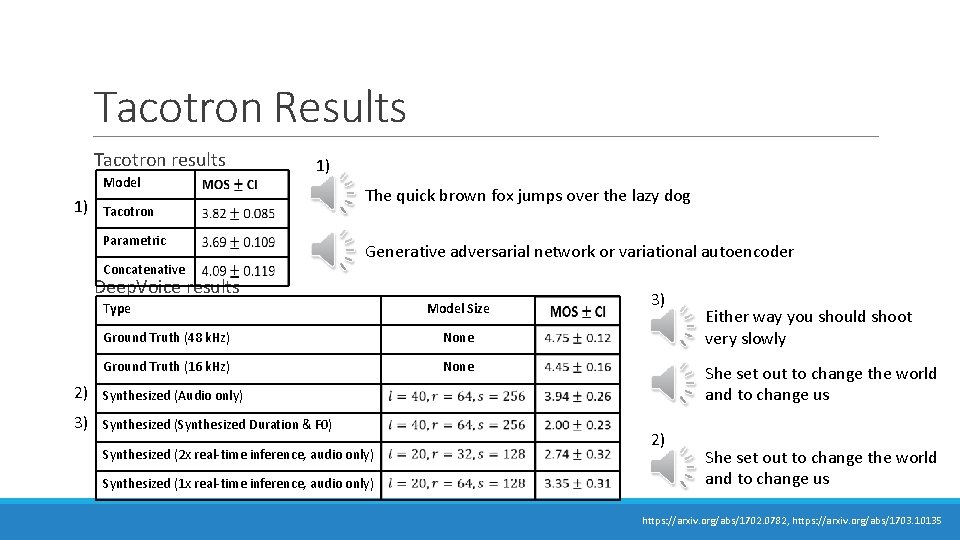
Tacotron Results Tacotron results Model 1) 1) Tacotron Parametric Concatenative The quick brown fox jumps over the lazy dog Generative adversarial network or variational autoencoder Deep. Voice results Type Model Size Ground Truth (48 k. Hz) None Ground Truth (16 k. Hz) None 2) Synthesized (Audio only) 3) Synthesized (Synthesized Duration & F 0) Synthesized (2 x real-time inference, audio only) Synthesized (1 x real-time inference, audio only) 3) Either way you should shoot very slowly She set out to change the world and to change us 2) She set out to change the world and to change us https: //arxiv. org/abs/1702. 0782, https: //arxiv. org/abs/1703. 10135
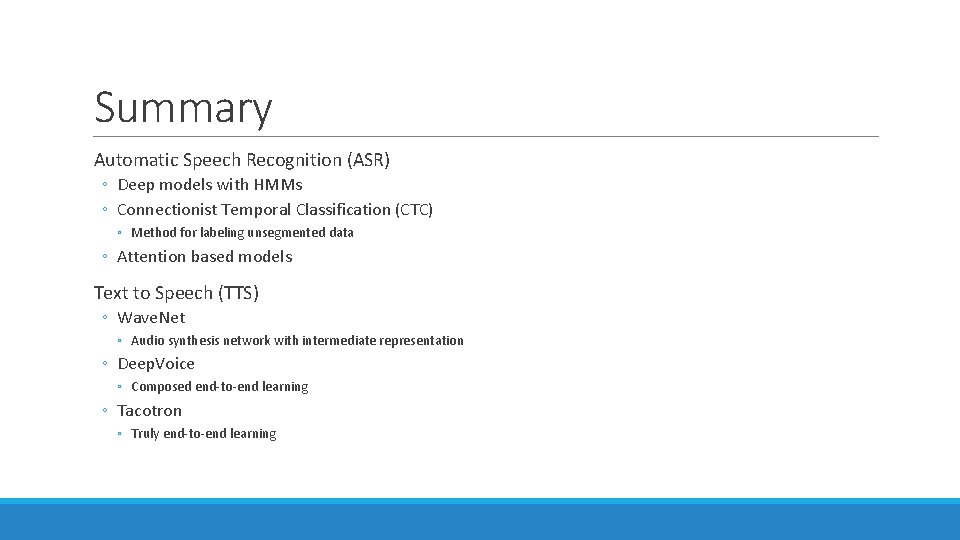
Summary Automatic Speech Recognition (ASR) ◦ Deep models with HMMs ◦ Connectionist Temporal Classification (CTC) ◦ Method for labeling unsegmented data ◦ Attention based models Text to Speech (TTS) ◦ Wave. Net ◦ Audio synthesis network with intermediate representation ◦ Deep. Voice ◦ Composed end-to-end learning ◦ Tacotron ◦ Truly end-to-end learning
Thank you! Questions?
Bonus: Music Generation
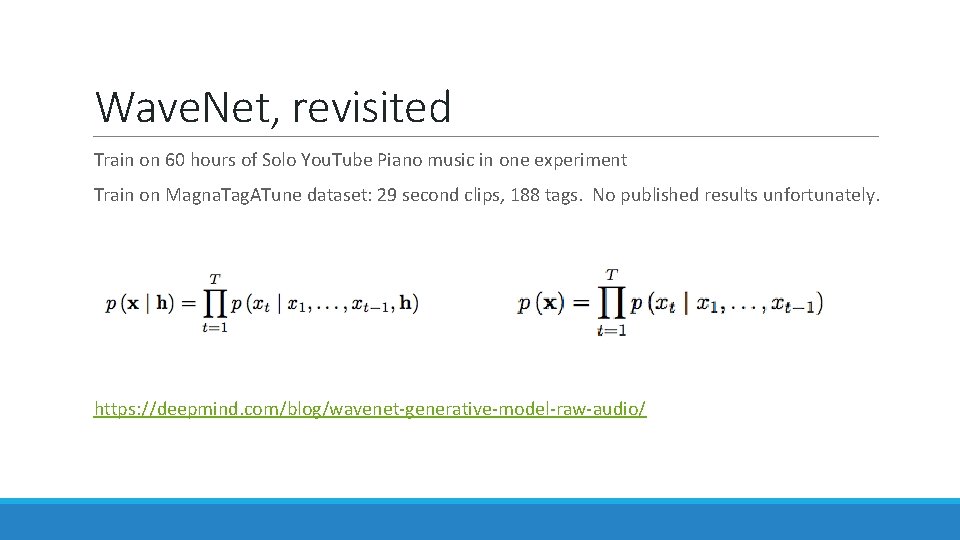
Wave. Net, revisited Train on 60 hours of Solo You. Tube Piano music in one experiment Train on Magna. Tag. ATune dataset: 29 second clips, 188 tags. No published results unfortunately. https: //deepmind. com/blog/wavenet-generative-model-raw-audio/
“Deep Learning for Music" Aims to create pleasant music with deep neural nets alone Questions: ◦ “Is there a meaningful way to represent notes in music as a vector? ” (like word 2 vec) ◦ “Can we build interesting generative neural network architectures that effectively express the ◦ notions of harmony and melody? ” Input ◦ Midi Data ◦ Piano Roll data (which notes are on? )
The Network 2 Layer LSTM Map tokens (either MIDI messages or note combinations) to a learned vector respresentation Feed output into softmax layer Allows user to adjust hyperparamters including number of layers, hidden unit size, sequence length, batch size, and learning rate. Input a “seed” sequence Two approaches to generation: ◦ Choose maximum from softmax ◦ Choose anything from the softmax distribution
Results Music trained solely on Bach was better than a mix of classical pianists Music trained using the Piano Roll format was better than that of the MIDI messages No published audio, unfortunately
References Text to Speech (TTS) ◦ A. van den Oord, S. Dieleman, H. Zen, K. Simonyan, O. Vinyals, A. Graves, N. Kalchbrenner, A. Senior, and K. Kavukcuoglu. Wave. Net: A Generative Model for Raw Audio. ar. Xiv preprint ar. Xiv: 1609. 03499 (2016). ◦ S. Mehri, K. Kumar, I. Gulrajani, R. Kumar, S. Jain, J. Sotelo, A. Courville, and Y. Bengio. Sample. RNN: An Unconditional End-to-End Neural Audio Generation Model. ar. Xiv preprint ar. Xiv: 1612. 07837 v 2 (2017). ◦ J. Sotelo, S. Mehri, K. Kumar, J. Santos, K. Kastner, A. Courville, and Y. Bengio. Char 2 Wav: End-to-End Speech Synthesis. ICLR (2017). ◦ S. Arik, M. Chrzanowski, A. Coates, G. Diamos, A. Gibiansky, Y. Kang, X. Li, J. Miller, A. Ng, J. Raiman, S. Sengupta, and M. Shoeybi. Deep Voice: Real-time Neural Text-to-Speech. ar. Xiv preprint ar. Xiv: 1702. 07825 v 2 (2017). ◦ Y. Wang, and et al. Tacotron: A Fully End-to-End Text-to-Speech Synthesis Model. ar. Xiv preprint ar. Xiv: 1703. 10135 v 1 (2017).
References Automatic Speech Recognition (ASR) ◦ A. Graves, S. Fernandez, F. Gomez, and J. Schmidhuber. Connectionist Temporal Classification: Labelling Unsegmented Sequence Data with Recurrent Neural Networks. ICML (2006). ◦ G. Hinton, et al. Deep Neural Networks for Acoustic Modeling in Speech Recognition. Signal Processing Magazine (2012). ◦ A. Graves, A. Mohamed, and G. Hinton. Speech Recognition with Deep Recurrent Neural Networks. ar. Xiv preprint ar. Xiv: 1303. 5778 v 1 (2013). ◦ H. Sak, A. Senior, and F. Beaufays. Long Short-Term Memory Recurrent Neural Network Architectures for Large Scale Acoustic Modeling. . r. Xiv preprint ar. Xiv: 1402. 1128 v 1 (2014). ◦ O. Abdel-Hamid, et al. Convolutional Neural Networks for Speech Recognition. IEEE/ACM Transactions on Audio, Speech, and Language Processing (2014). ◦ A. Hannun, C. Case, J. Casper, B. Catanzaro, G. Diamos, E. Elsen, R. Prenger, S. Satheesh, S. Sengupta, A. Coates, and A. Ng. Deep Speech: Scaling up end-to-end speech recognition. ar. Xiv preprint ar. Xiv: 1412. 5567 v 2 (2014). ◦ D. Amodei, et al. Deep Speech 2: End-to-End Speech Recognition in English and Mandarin. ar. Xiv preprint ar. Xiv: 1512. 02595 v 1 (2015). ◦ Y. Wang. Connectionist Temporal Classification: A Tutorial with Gritty Details. Github (2015). ◦ D. Bahdanau, et al. End-to-End Attention-based Large Vocabulary Speech Recognition. ar. Xiv preprint ar. Xiv: 1508. 04395 (2015). ◦ W. Xiong, et al. Achieving Human Parity in Conversational Speech Recognition. ar. Xiv preprint ar. Xiv: 1610. 05256 (2016).
References Music Generation ◦ A. Huang, and R. Wu. Deep Learning for Music. ar. Xiv preprint ar. Xiv: 1606. 04930 v 1 (2016). ◦ V. Kaligeri, and S. Grandhe. Music Generation Using Deep Learning. ar. Xiv: 1612. 04928 v 1 (2016).