
Machine Learning A Birds Eye View By Swagatam
Machine Learning: A Bird’s Eye View By Swagatam Das E-mail: swagatam. das@isical. ac. in Electronics and Communication Sciences Unit, Indian Statistical Institute, Kolkata – 700 108, India.
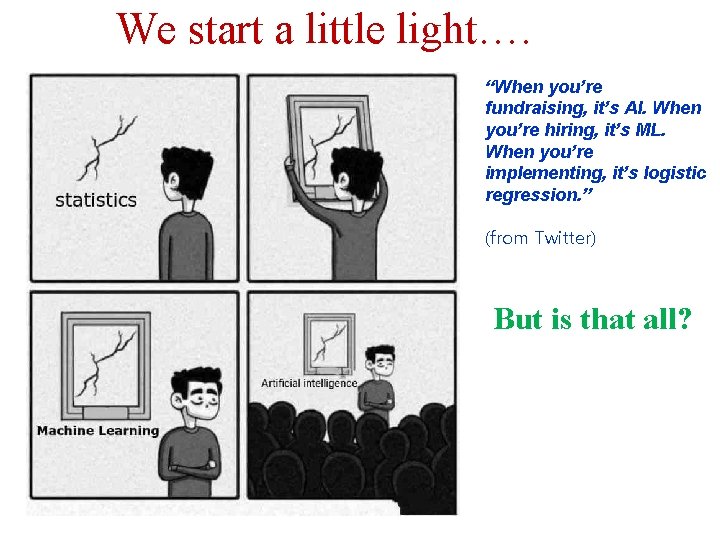
We start a little light…. “When you’re fundraising, it’s AI. When you’re hiring, it’s ML. When you’re implementing, it’s logistic regression. ” (from Twitter) But is that all? 2
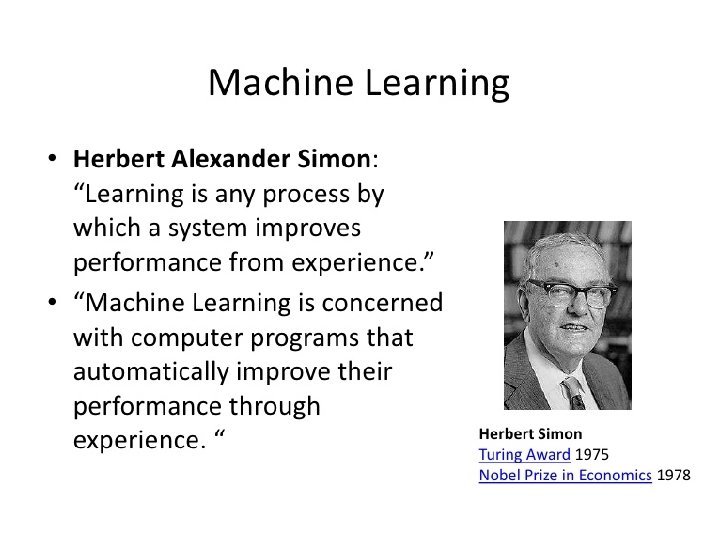
Why “Learn”? n Machine learning is programming computers to optimize a performance criterion using example data which can act like past experience. n There is no need to “learn” to calculate payroll n Learning is used when: Human expertise does not exist (navigating on Mars), ¨ Humans are unable to explain their expertise (speech recognition) ¨ Solution changes in time (routing on a computer network) ¨ Solution needs to be adapted to particular cases (user biometrics) ¨ n 4
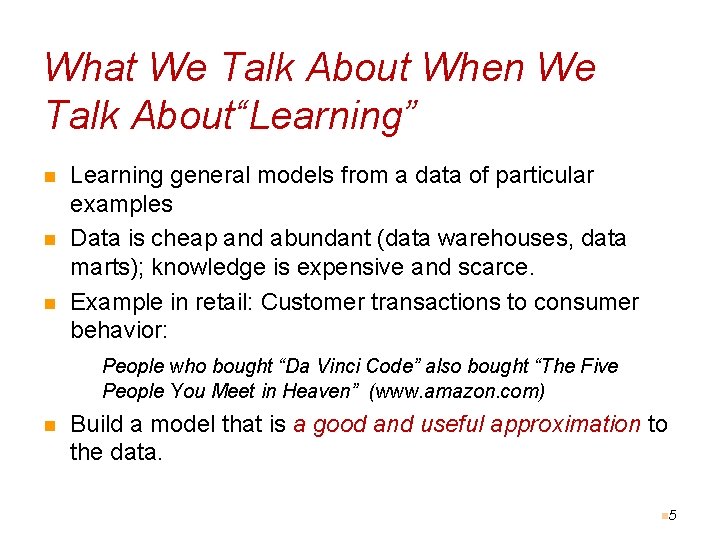
What We Talk About When We Talk About“Learning” n n n Learning general models from a data of particular examples Data is cheap and abundant (data warehouses, data marts); knowledge is expensive and scarce. Example in retail: Customer transactions to consumer behavior: People who bought “Da Vinci Code” also bought “The Five People You Meet in Heaven” (www. amazon. com) n Build a model that is a good and useful approximation to the data. n 5
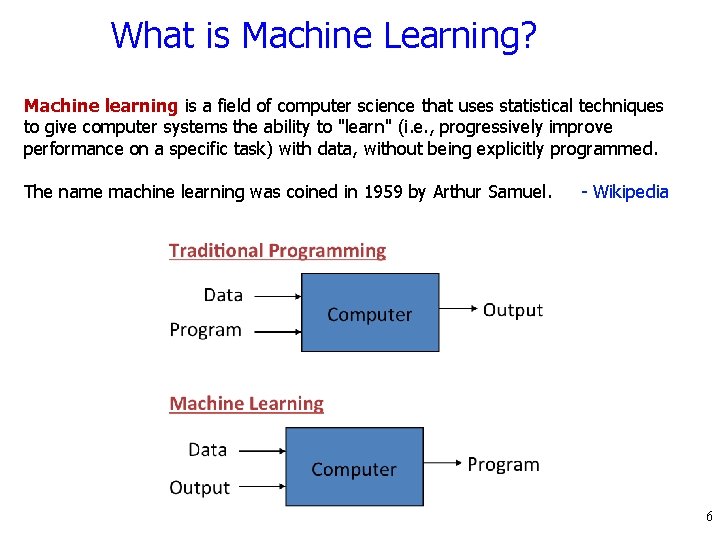
What is Machine Learning? Machine learning is a field of computer science that uses statistical techniques to give computer systems the ability to "learn" (i. e. , progressively improve performance on a specific task) with data, without being explicitly programmed. The name machine learning was coined in 1959 by Arthur Samuel. - Wikipedia 6
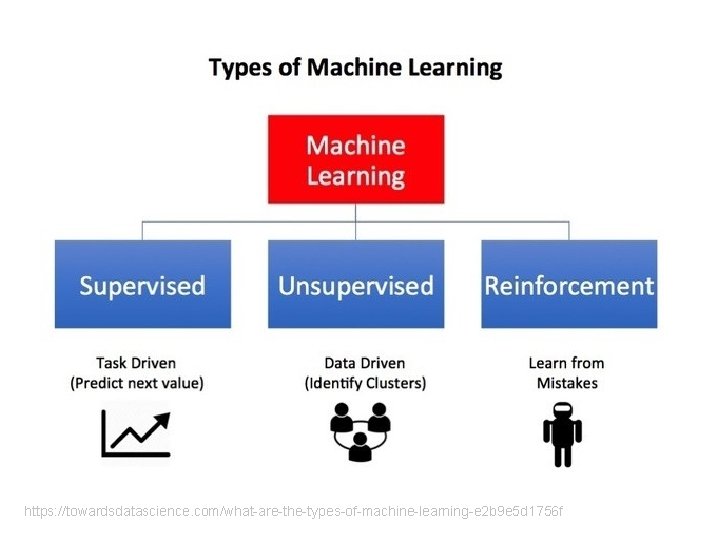
https: //towardsdatascience. com/what-are-the-types-of-machine-learning-e 2 b 9 e 5 d 1756 f
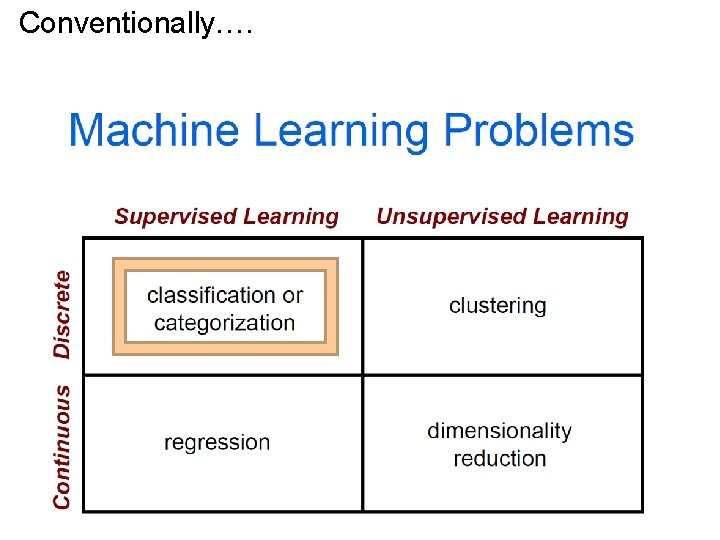
Conventionally….
The data and the goal n Data: A set of data records (also called examples, instances or cases) described by q q n k attributes/variables/features: A 1, A 2, … Ak. a class: Each example is labelled with a predefined class. Goal: To learn a classification model f from the data that can be used to predict the classes of new (future, or test) cases/instances. 9
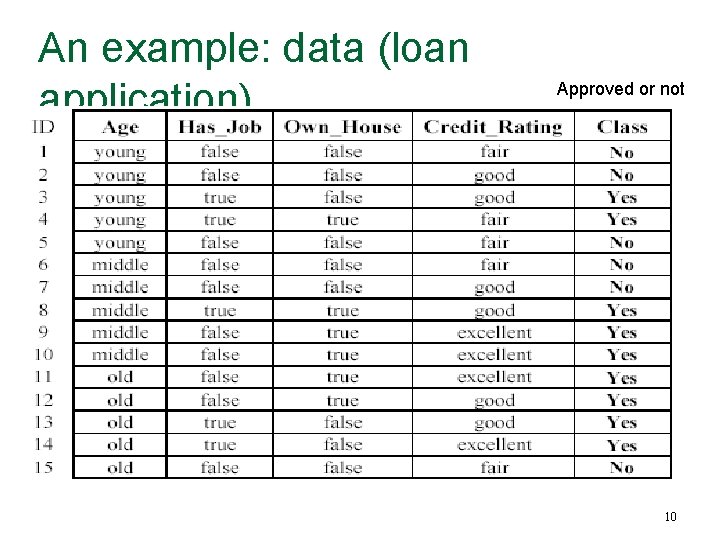
An example: data (loan application) Approved or not 10
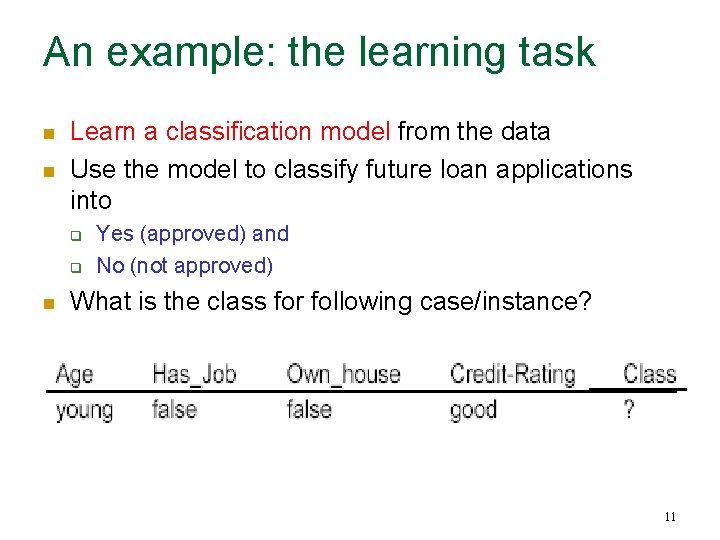
An example: the learning task n n Learn a classification model from the data Use the model to classify future loan applications into q q n Yes (approved) and No (not approved) What is the class for following case/instance? 11
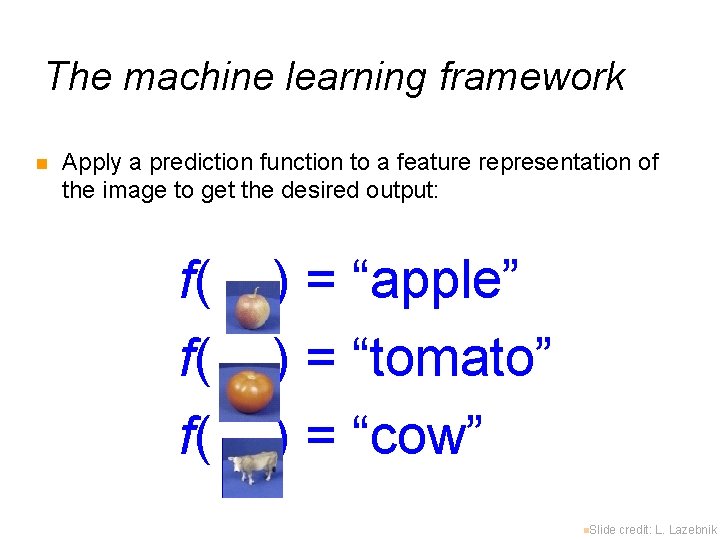
The machine learning framework n Apply a prediction function to a feature representation of the image to get the desired output: f( f( f( ) = “apple” ) = “tomato” ) = “cow” n. Slide credit: L. Lazebnik
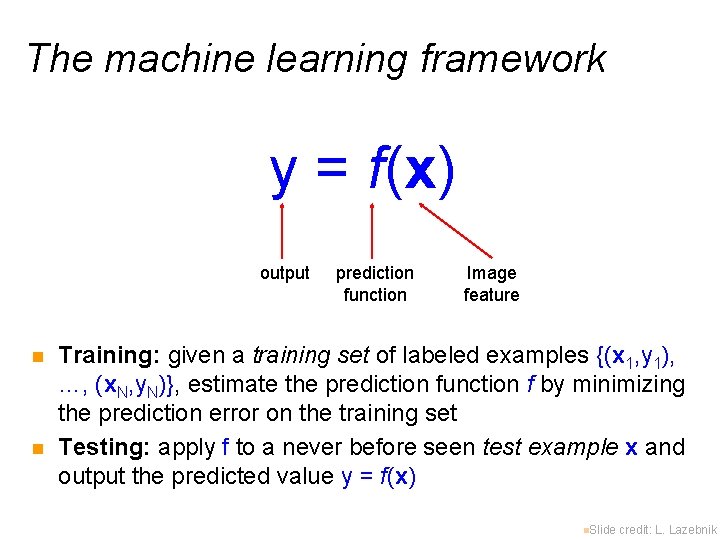
The machine learning framework y = f(x) output n n prediction function Image feature Training: given a training set of labeled examples {(x 1, y 1), …, (x. N, y. N)}, estimate the prediction function f by minimizing the prediction error on the training set Testing: apply f to a never before seen test example x and output the predicted value y = f(x) n. Slide credit: L. Lazebnik
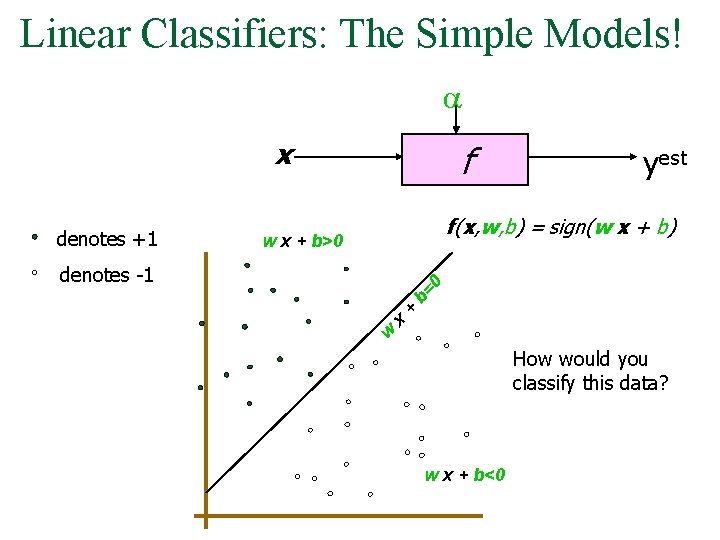
Linear Classifiers: The Simple Models! x denotes +1 f yest f(x, w, b) = sign(w x + b) w x + b>0 w x + b= 0 denotes -1 How would you classify this data? w x + b<0
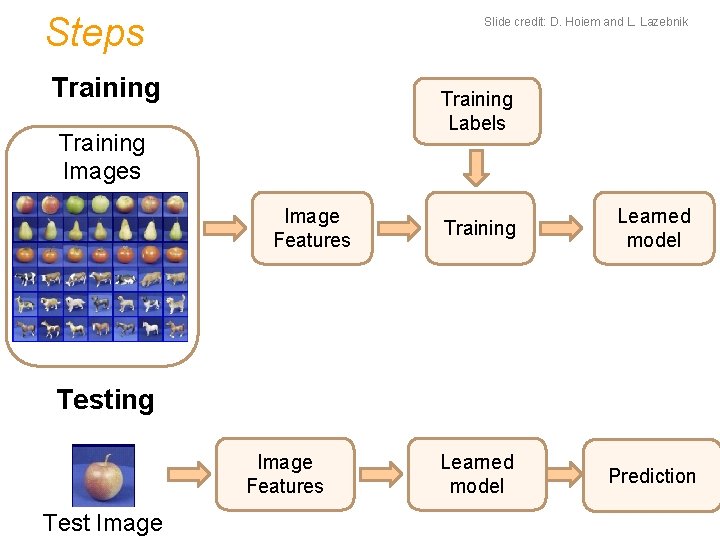
Steps Slide credit: D. Hoiem and L. Lazebnik Training Labels Training Images Image Features Training Learned model Prediction Testing Image Features Test Image
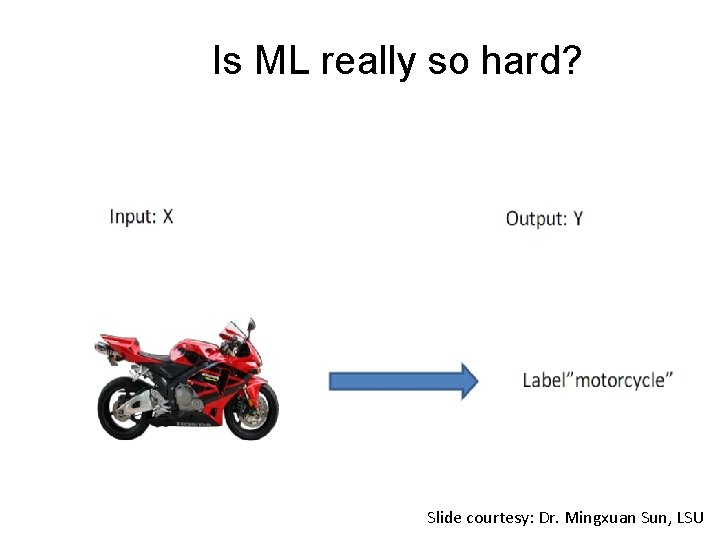
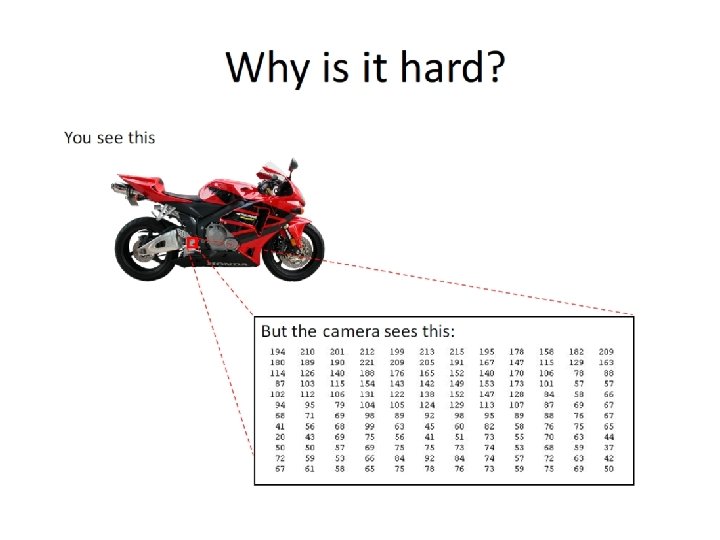
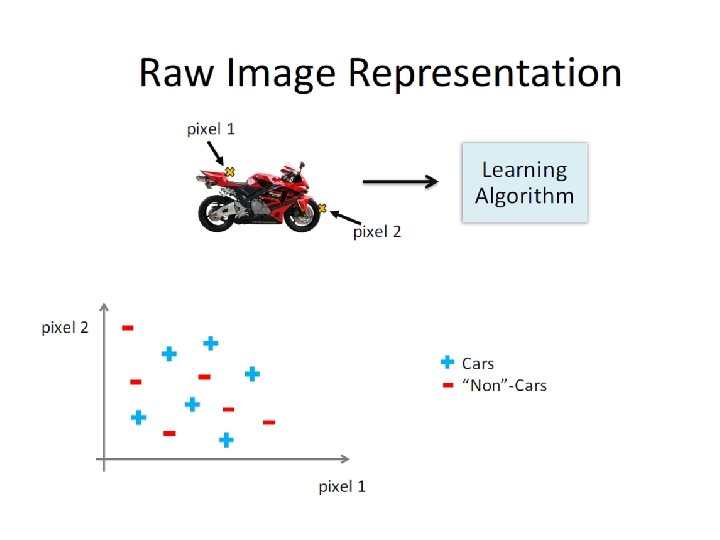
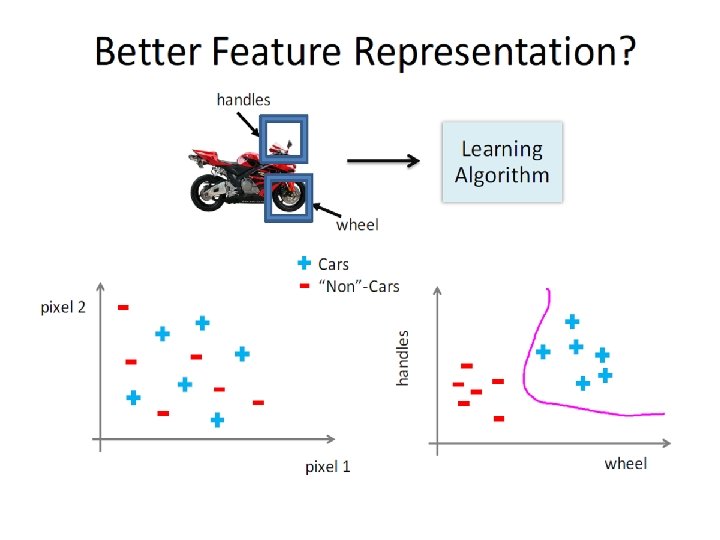
Is ML really so hard? Slide courtesy: Dr. Mingxuan Sun, LSU
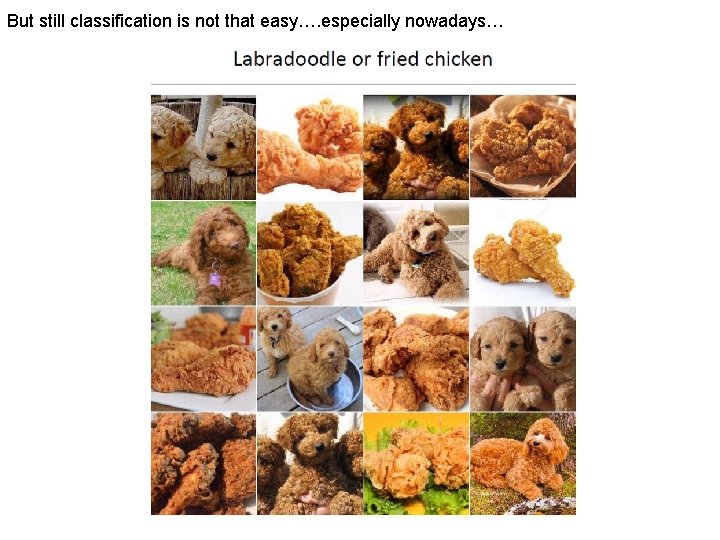
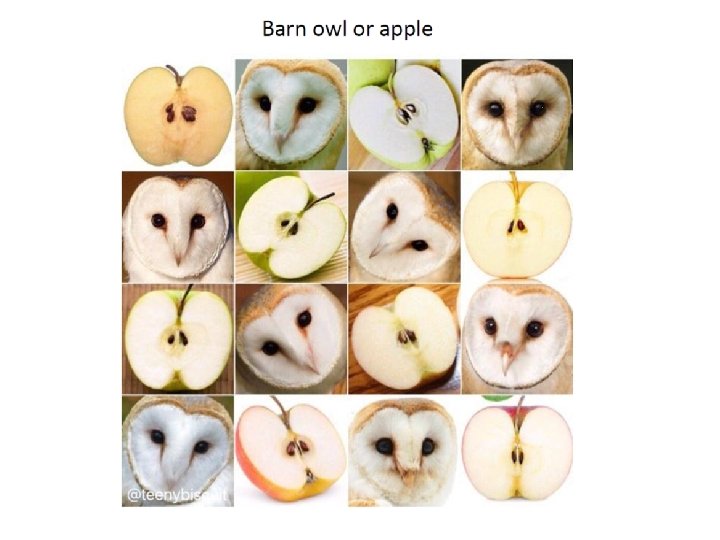
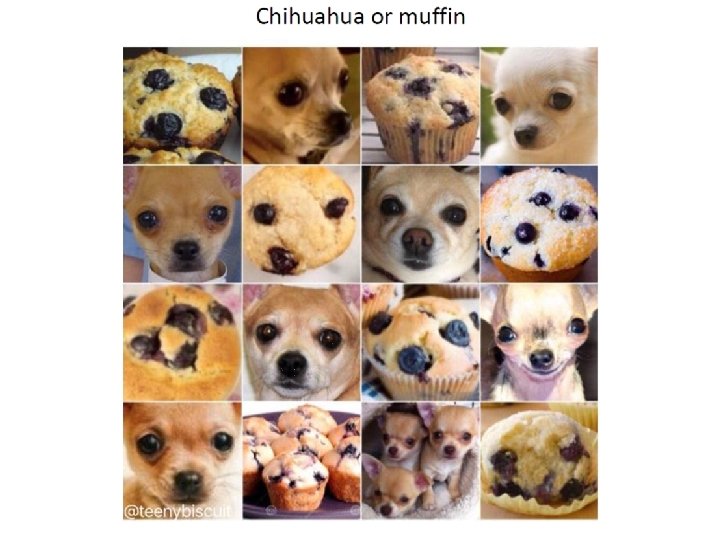
But still classification is not that easy…. especially nowadays…
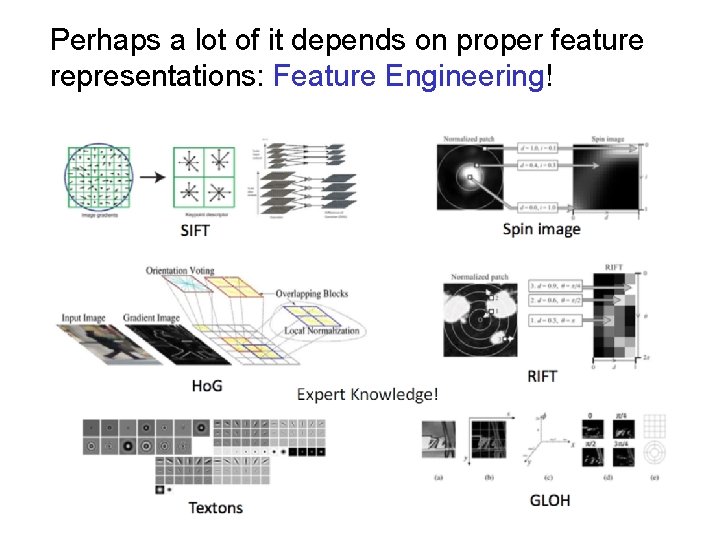
Perhaps a lot of it depends on proper feature representations: Feature Engineering!
So many classifiers over the years…. k-nearest neighbor n n n n n SVM Decision Trees Neural networks Naïve Bayesian network Logistic regression Randomized Forests The Deep Learning Systems And so on…. . And then comes the No Free Lunch Theorem of ML……. .
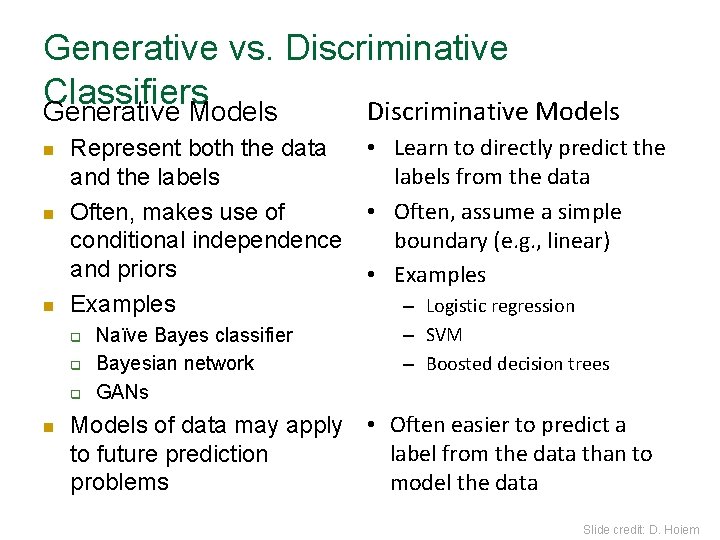
Generative vs. Discriminative Classifiers Discriminative Models Generative Models n n n Represent both the data and the labels Often, makes use of conditional independence and priors Examples q q q n Naïve Bayes classifier Bayesian network GANs • Learn to directly predict the labels from the data • Often, assume a simple boundary (e. g. , linear) • Examples – Logistic regression – SVM – Boosted decision trees Models of data may apply • Often easier to predict a label from the data than to to future prediction model the data problems Slide credit: D. Hoiem
A very brief look into a few traditional classifiers 26
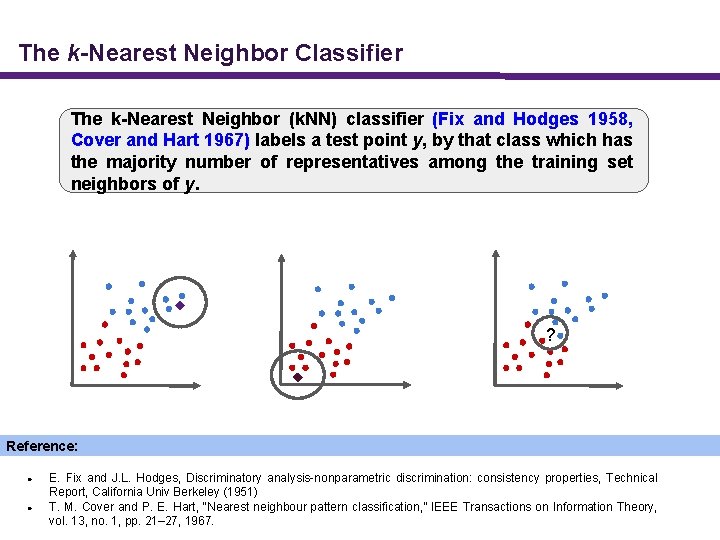
The k-Nearest Neighbor Classifier The k-Nearest Neighbor (k. NN) classifier (Fix and Hodges 1958, Cover and Hart 1967) labels a test point y, by that class which has the majority number of representatives among the training set neighbors of y. ? Reference: ● ● E. Fix and J. L. Hodges, Discriminatory analysis-nonparametric discrimination: consistency properties, Technical Report, California Univ Berkeley (1951) T. M. Cover and P. E. Hart, “Nearest neighbour pattern classification, ” IEEE Transactions on Information Theory, vol. 13, no. 1, pp. 21– 27, 1967.
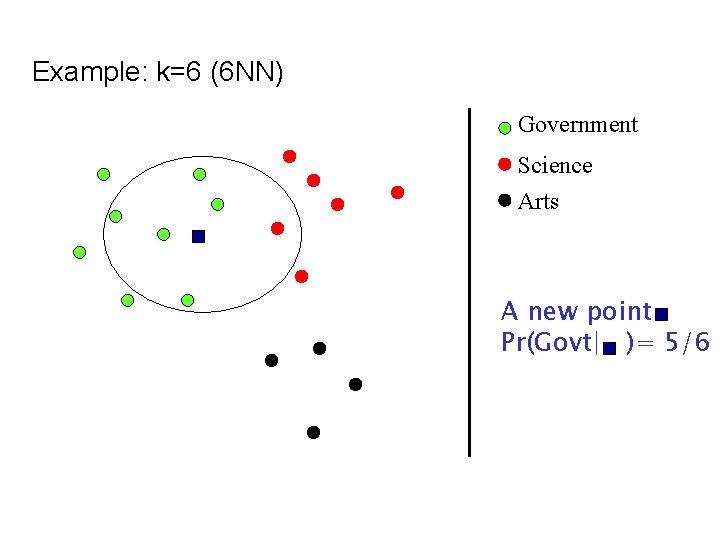
Example: k=6 (6 NN) Government Science Arts A new point Pr(Govt| )= 5/6
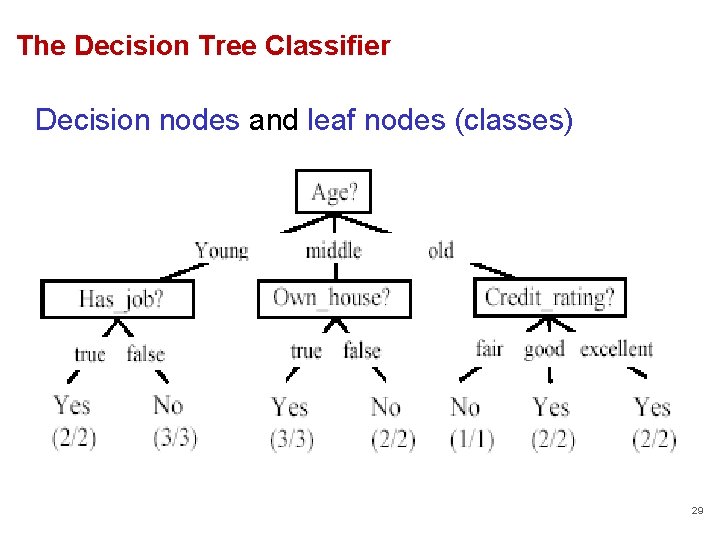
The Decision Tree Classifier Decision nodes and leaf nodes (classes) 29
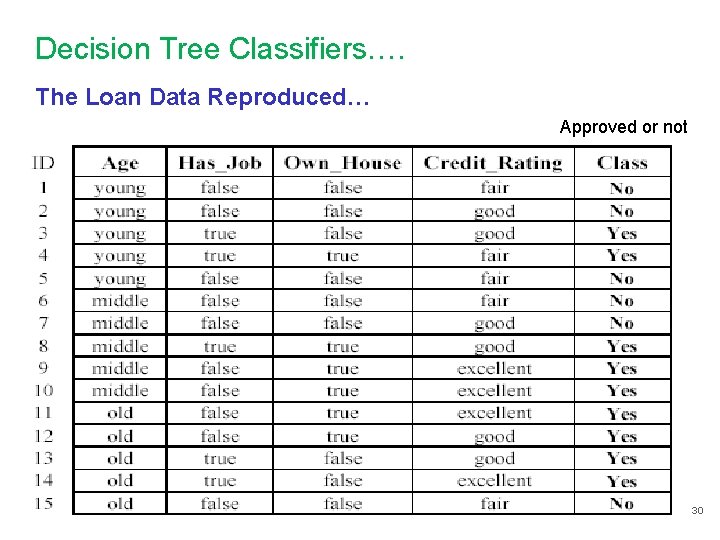
Decision Tree Classifiers…. The Loan Data Reproduced… Approved or not 30
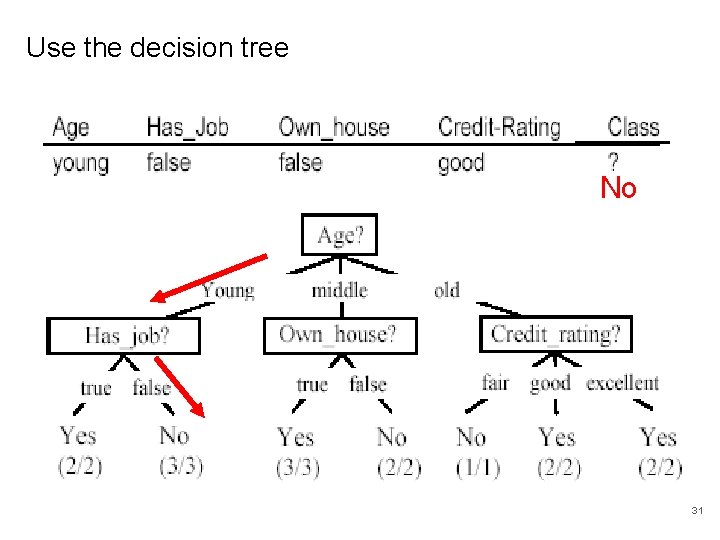
Use the decision tree No 31
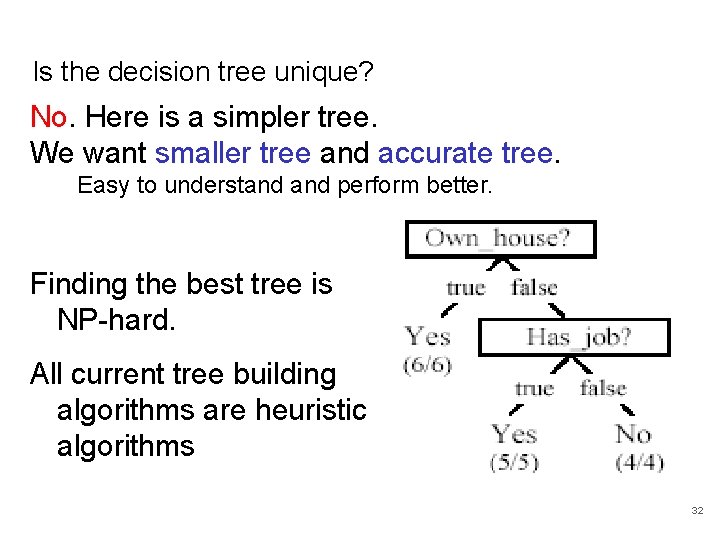
Is the decision tree unique? No. Here is a simpler tree. We want smaller tree and accurate tree. Easy to understand perform better. Finding the best tree is NP-hard. All current tree building algorithms are heuristic algorithms 32
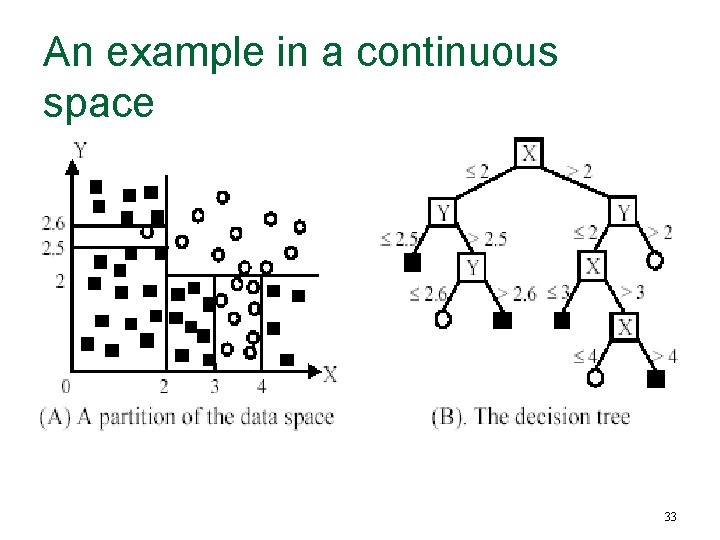
An example in a continuous space 33
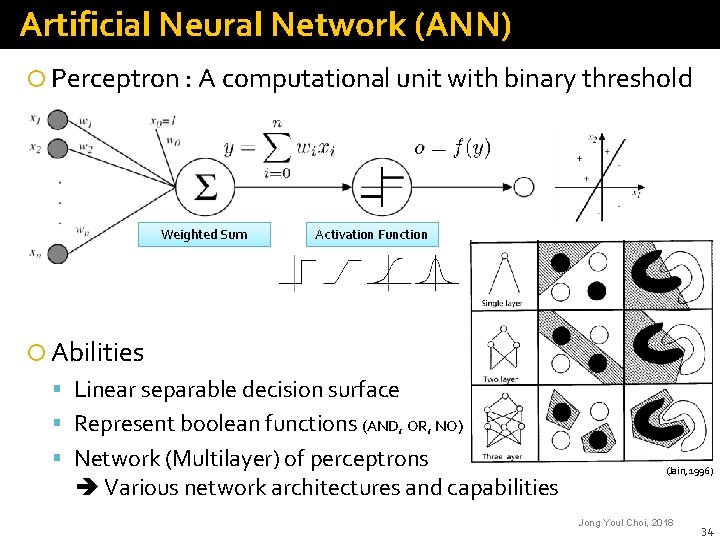
Artificial Neural Network (ANN) Perceptron : A computational unit with binary threshold Weighted Sum Activation Function Abilities Linear separable decision surface Represent boolean functions (AND, OR, NO) Network (Multilayer) of perceptrons Various network architectures and capabilities (Jain, 1996) Jong Youl Choi, 2018 34
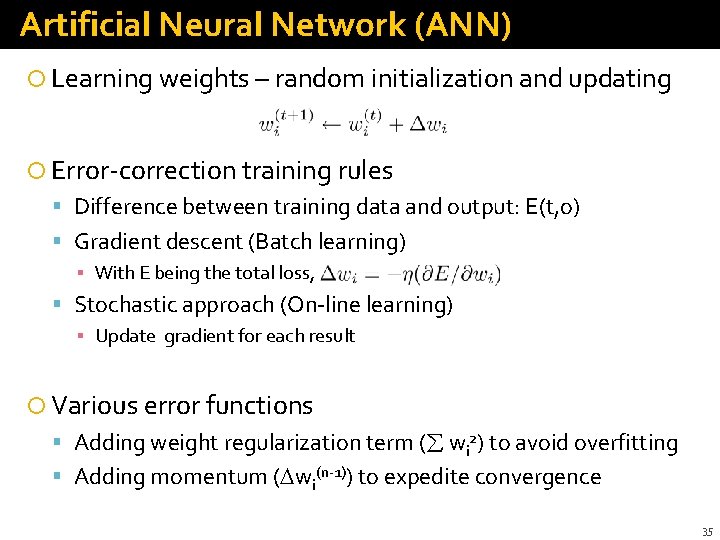
Artificial Neural Network (ANN) Learning weights – random initialization and updating Error-correction training rules Difference between training data and output: E(t, o) Gradient descent (Batch learning) ▪ With E being the total loss, Stochastic approach (On-line learning) ▪ Update gradient for each result Various error functions Adding weight regularization term ( wi 2) to avoid overfitting Adding momentum ( wi(n-1)) to expedite convergence 35
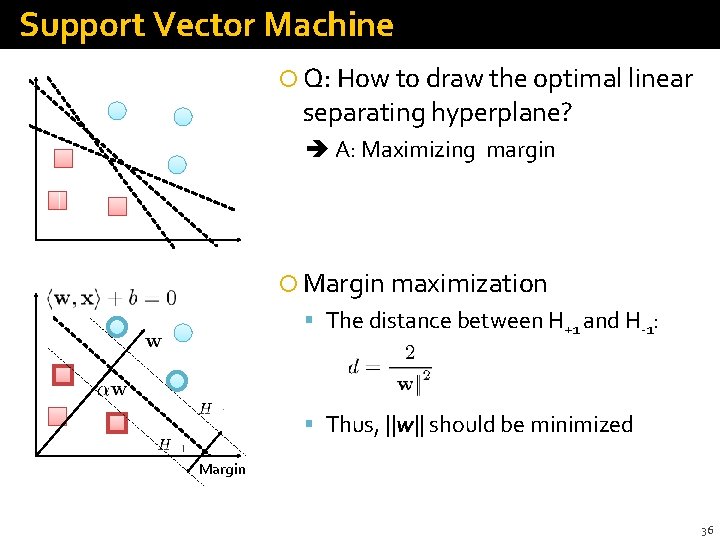
Support Vector Machine Q: How to draw the optimal linear separating hyperplane? A: Maximizing margin Margin maximization The distance between H+1 and H-1: Thus, ||w|| should be minimized Margin 36
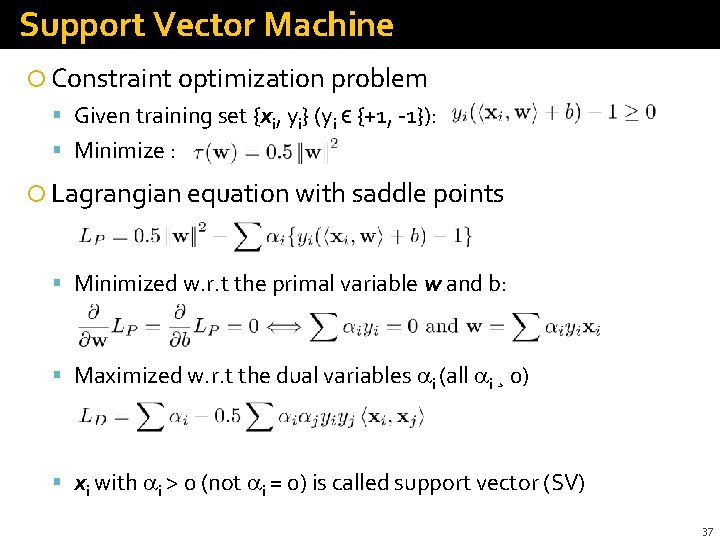
Support Vector Machine Constraint optimization problem Given training set {xi, yi} (yi ϵ {+1, -1}): Minimize : Lagrangian equation with saddle points Minimized w. r. t the primal variable w and b: Maximized w. r. t the dual variables i (all i ¸ 0) xi with i > 0 (not i = 0) is called support vector (SV) 37
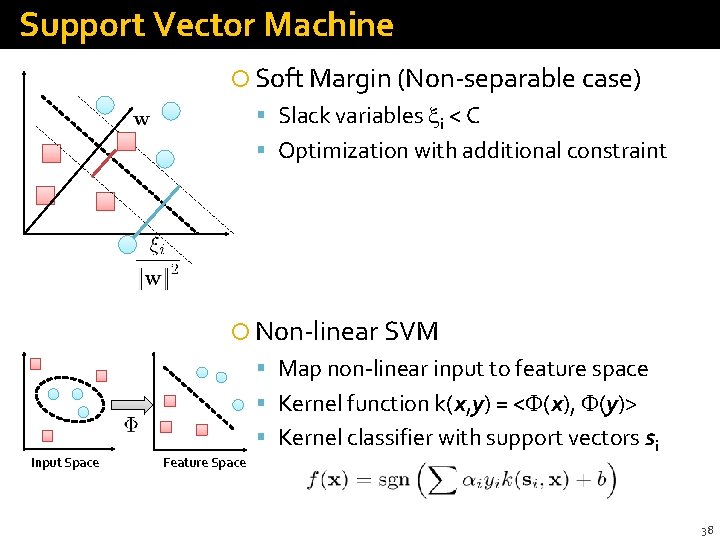
Support Vector Machine Soft Margin (Non-separable case) Slack variables i < C Optimization with additional constraint Non-linear SVM Map non-linear input to feature space Kernel function k(x, y) = < (x), (y)> Input Space Feature Space Kernel classifier with support vectors si 38
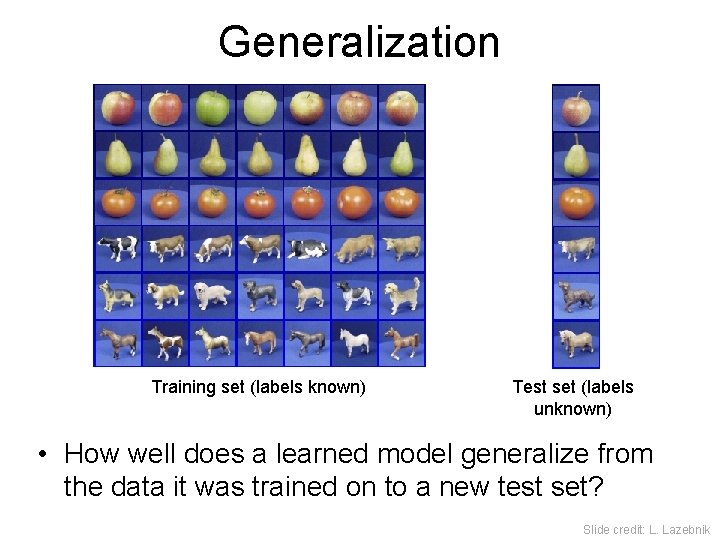
Generalization Training set (labels known) Test set (labels unknown) • How well does a learned model generalize from the data it was trained on to a new test set? Slide credit: L. Lazebnik
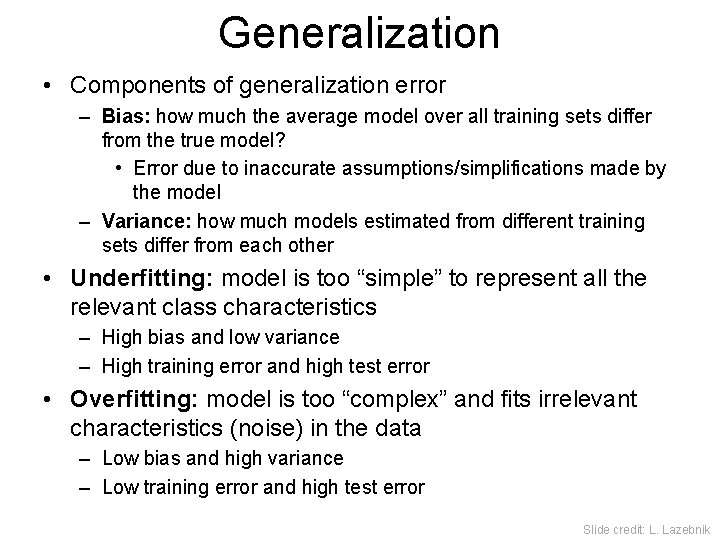
Generalization • Components of generalization error – Bias: how much the average model over all training sets differ from the true model? • Error due to inaccurate assumptions/simplifications made by the model – Variance: how much models estimated from different training sets differ from each other • Underfitting: model is too “simple” to represent all the relevant class characteristics – High bias and low variance – High training error and high test error • Overfitting: model is too “complex” and fits irrelevant characteristics (noise) in the data – Low bias and high variance – Low training error and high test error Slide credit: L. Lazebnik
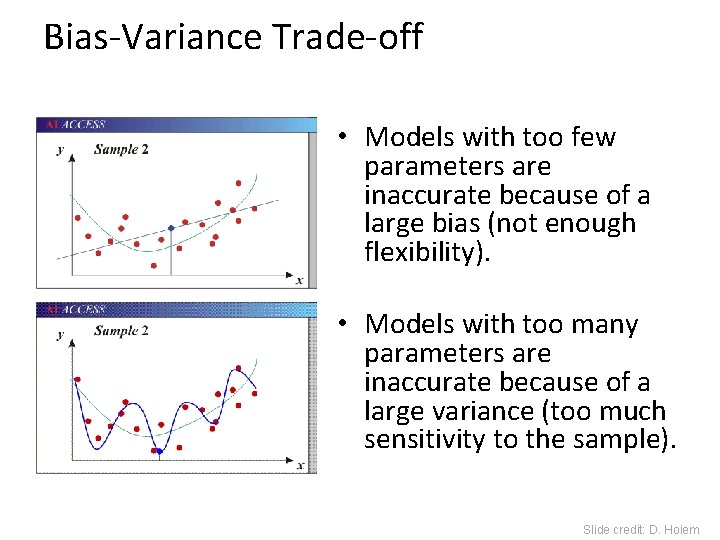
Bias-Variance Trade-off • Models with too few parameters are inaccurate because of a large bias (not enough flexibility). • Models with too many parameters are inaccurate because of a large variance (too much sensitivity to the sample). Slide credit: D. Hoiem
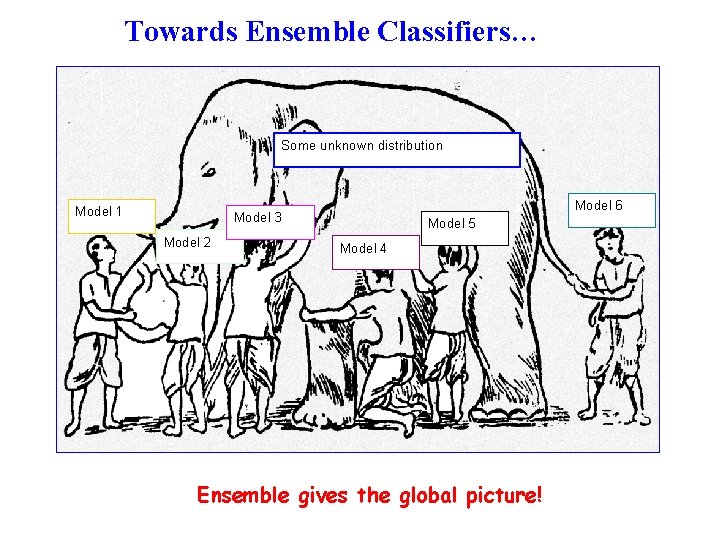
Towards Ensemble Classifiers… Some unknown distribution Model 1 Model 6 Model 3 Model 2 Model 5 Model 4 Ensemble gives the global picture!
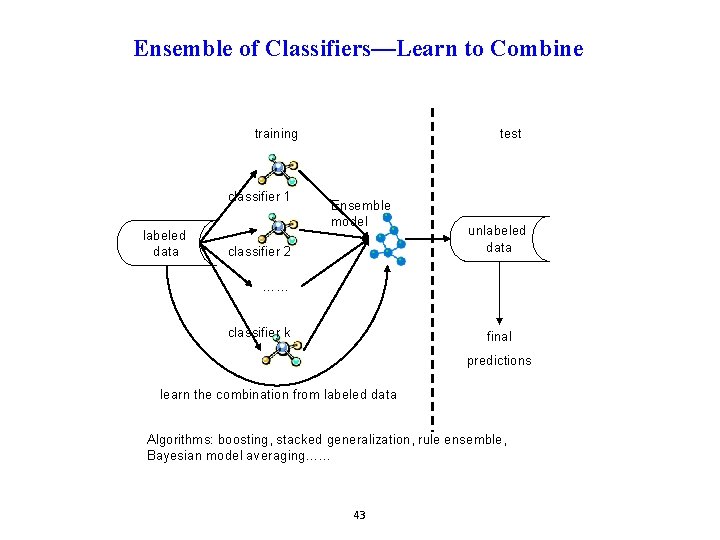
Ensemble of Classifiers—Learn to Combine training classifier 1 labeled data test Ensemble model classifier 2 unlabeled data …… classifier k final predictions learn the combination from labeled data Algorithms: boosting, stacked generalization, rule ensemble, Bayesian model averaging…… 43
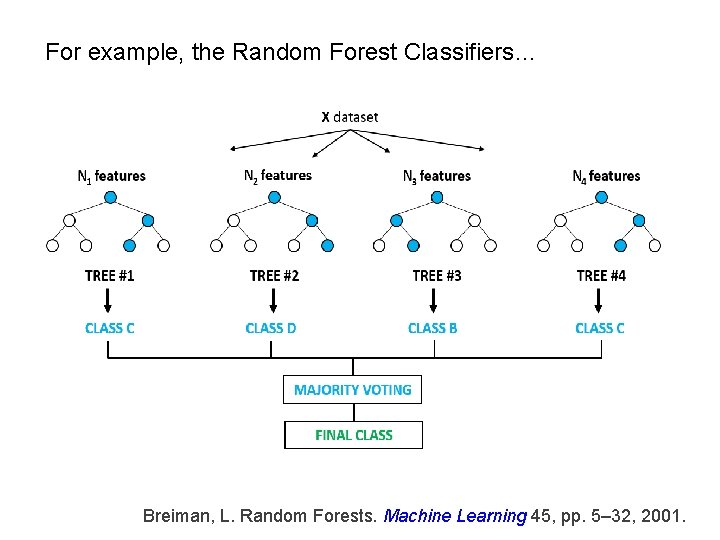
For example, the Random Forest Classifiers… Breiman, L. Random Forests. Machine Learning 45, pp. 5– 32, 2001.
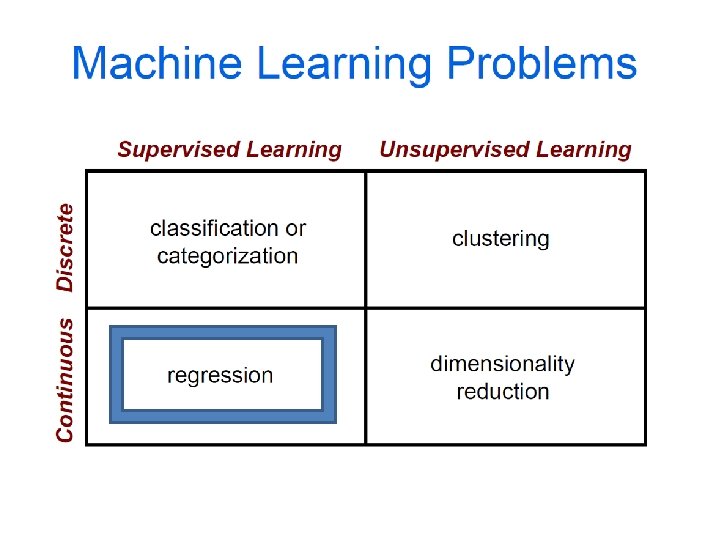
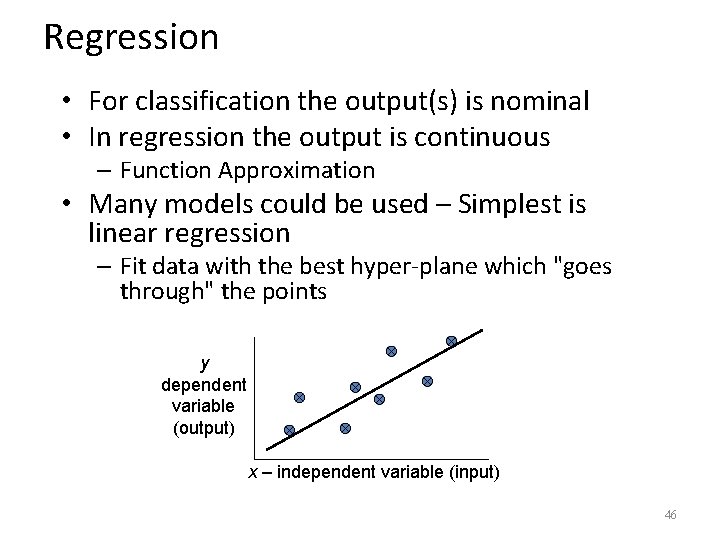
Regression • For classification the output(s) is nominal • In regression the output is continuous – Function Approximation • Many models could be used – Simplest is linear regression – Fit data with the best hyper-plane which "goes through" the points y dependent variable (output) x – independent variable (input) 46
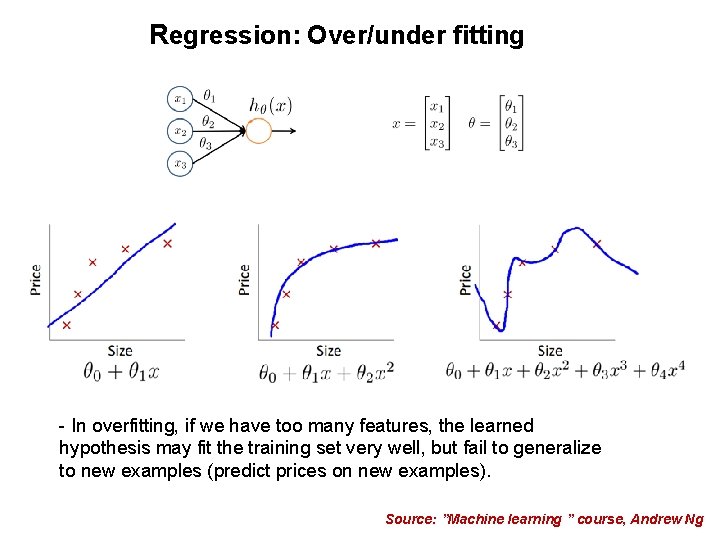
Regression: Over/under fitting - In overfitting, if we have too many features, the learned hypothesis may fit the training set very well, but fail to generalize to new examples (predict prices on new examples). 47 Source: ”Machine learning ” course, Andrew Ng
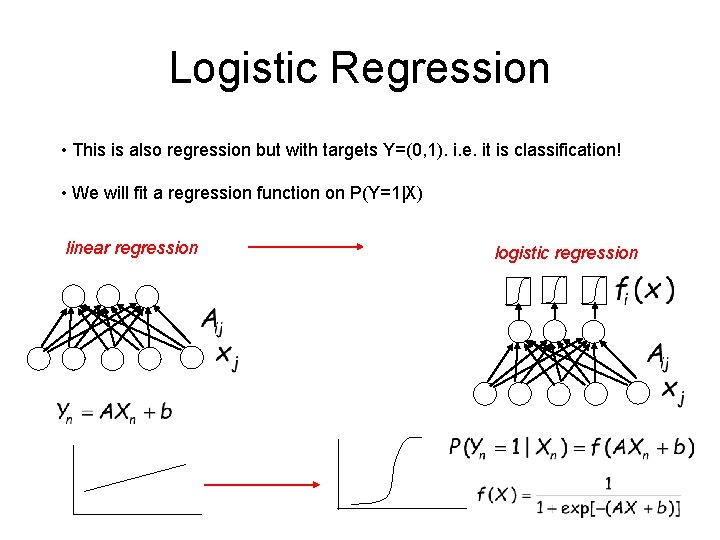
Logistic Regression • This is also regression but with targets Y=(0, 1). i. e. it is classification! • We will fit a regression function on P(Y=1|X) linear regression logistic regression
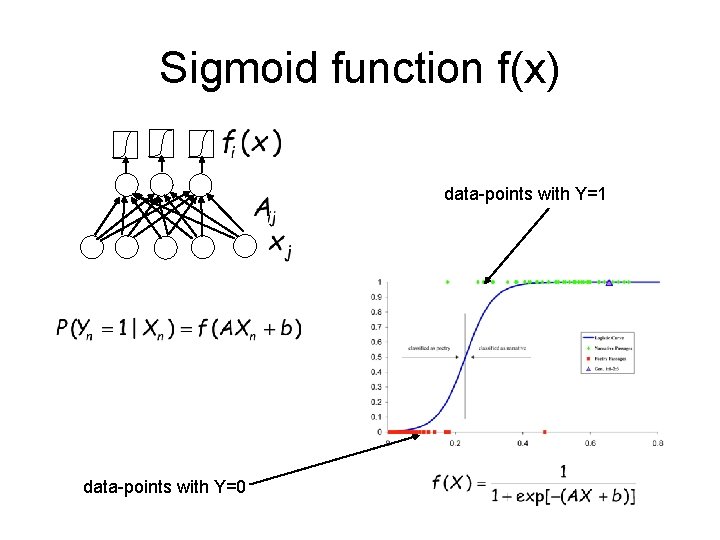
Sigmoid function f(x) data-points with Y=1 data-points with Y=0
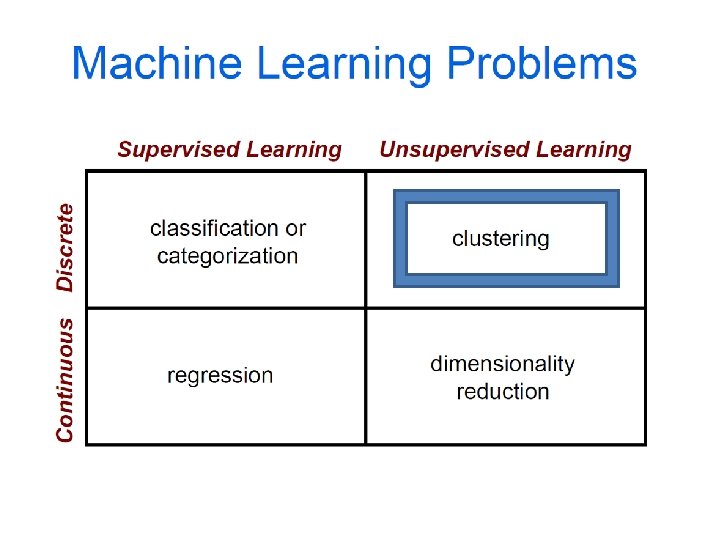
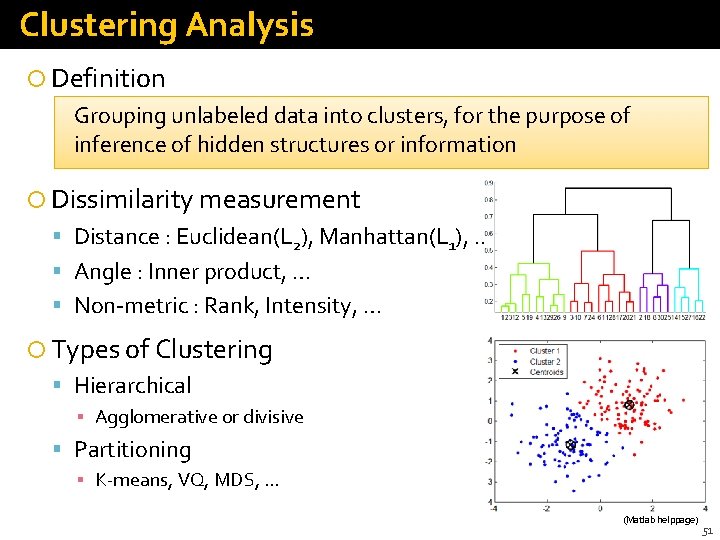
Clustering Analysis Definition Grouping unlabeled data into clusters, for the purpose of inference of hidden structures or information Dissimilarity measurement Distance : Euclidean(L 2), Manhattan(L 1), … Angle : Inner product, … Non-metric : Rank, Intensity, … Types of Clustering Hierarchical ▪ Agglomerative or divisive Partitioning ▪ K-means, VQ, MDS, … (Matlab helppage) 51
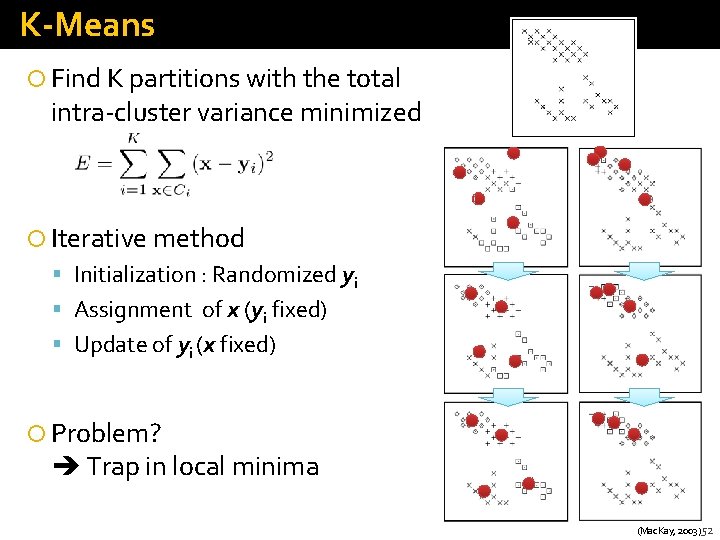
K-Means Find K partitions with the total intra-cluster variance minimized Iterative method Initialization : Randomized yi Assignment of x (yi fixed) Update of yi (x fixed) Problem? Trap in local minima (Mac. Kay, 2003)52
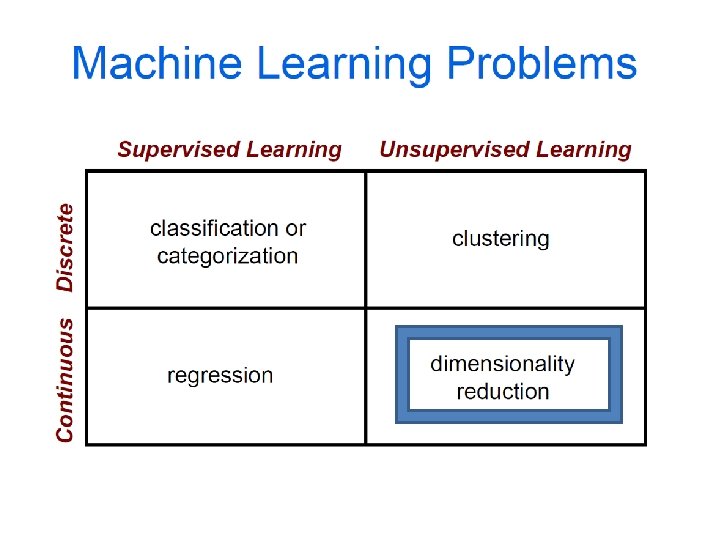
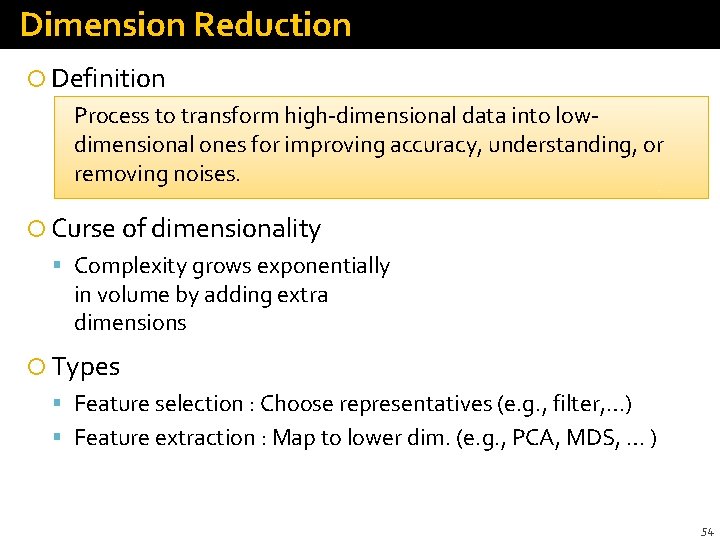
Dimension Reduction Definition Process to transform high-dimensional data into lowdimensional ones for improving accuracy, understanding, or removing noises. Curse of dimensionality Complexity grows exponentially in volume by adding extra dimensions Types Feature selection : Choose representatives (e. g. , filter, …) Feature extraction : Map to lower dim. (e. g. , PCA, MDS, … ) 54
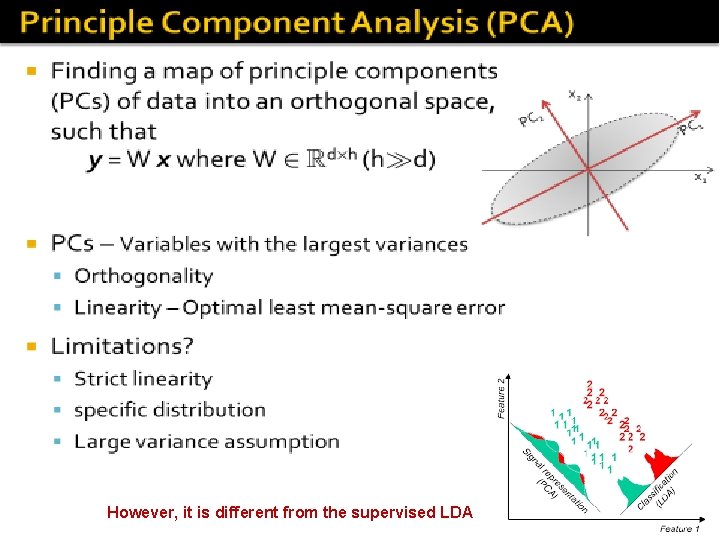
However, it is different from the supervised LDA
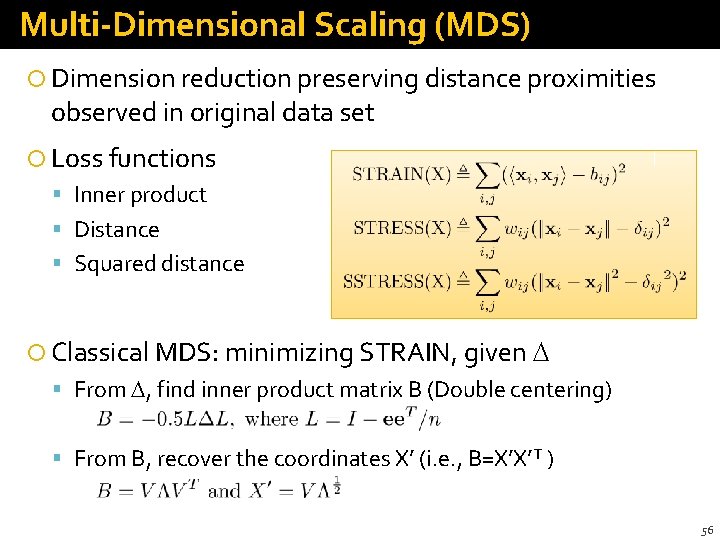
Multi-Dimensional Scaling (MDS) Dimension reduction preserving distance proximities observed in original data set Loss functions Inner product Distance Squared distance Classical MDS: minimizing STRAIN, given From , find inner product matrix B (Double centering) From B, recover the coordinates X’ (i. e. , B=X’X’T ) 56
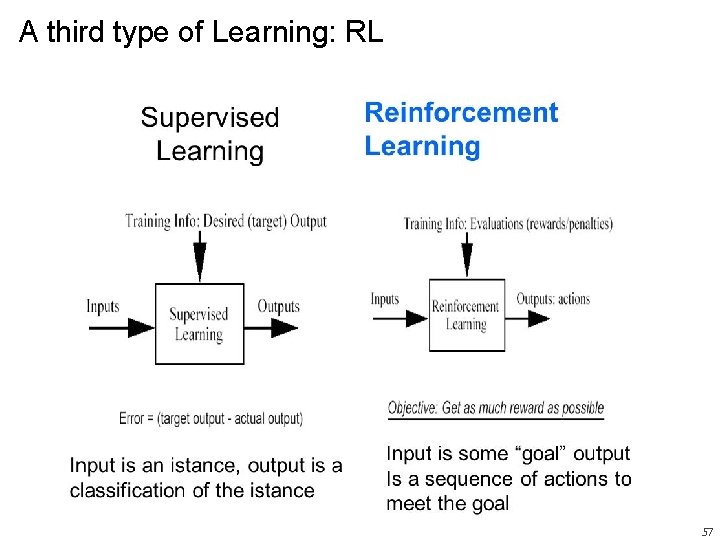
A third type of Learning: RL 57
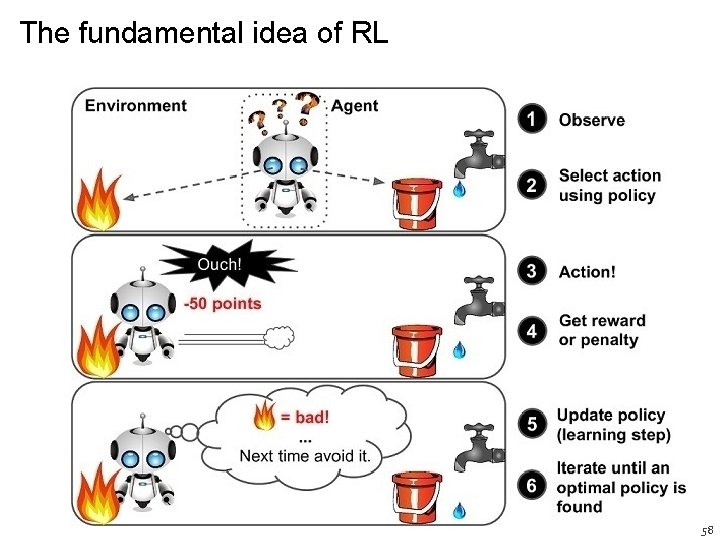
The fundamental idea of RL 58
Machine Learning : Some Recent Advances
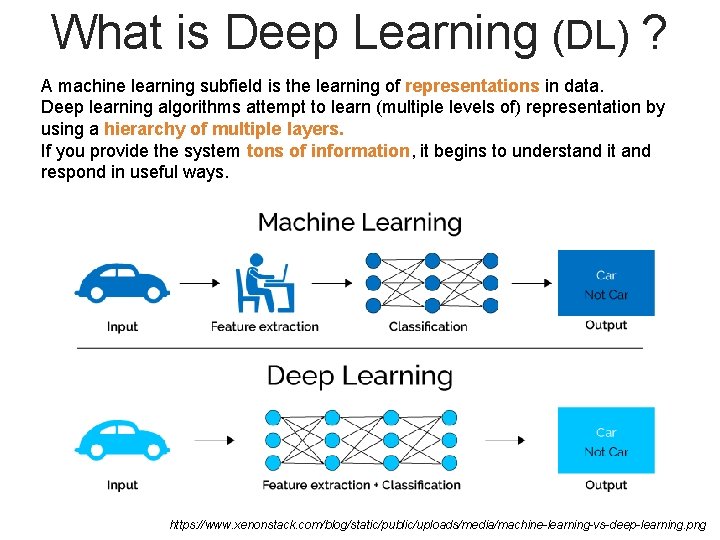
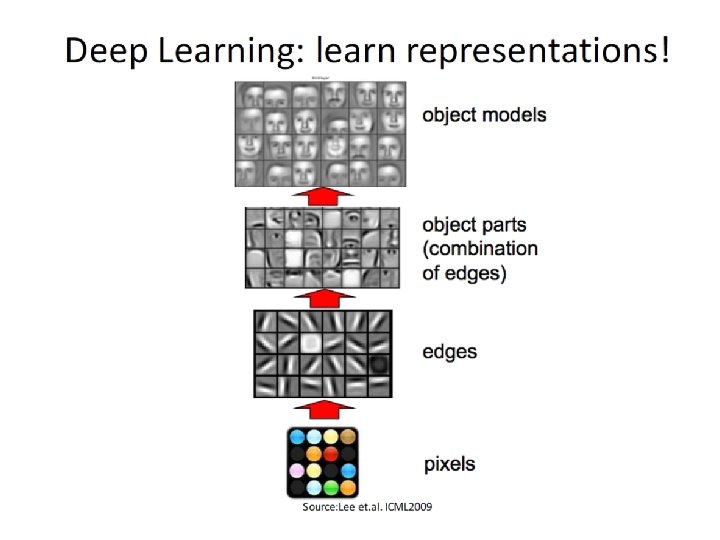
What is Deep Learning (DL) ? A machine learning subfield is the learning of representations in data. Deep learning algorithms attempt to learn (multiple levels of) representation by using a hierarchy of multiple layers. If you provide the system tons of information, it begins to understand it and respond in useful ways. https: //www. xenonstack. com/blog/static/public/uploads/media/machine-learning-vs-deep-learning. png
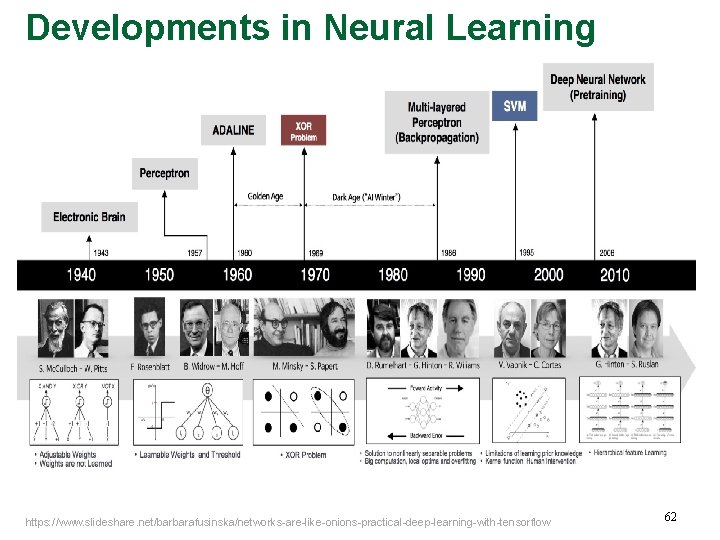
Developments in Neural Learning Systems https: //www. slideshare. net/barbarafusinska/networks-are-like-onions-practical-deep-learning-with-tensorflow 62
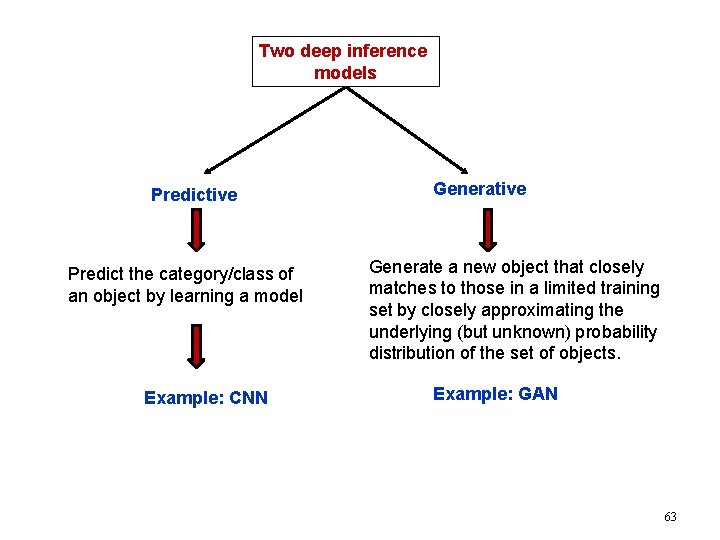
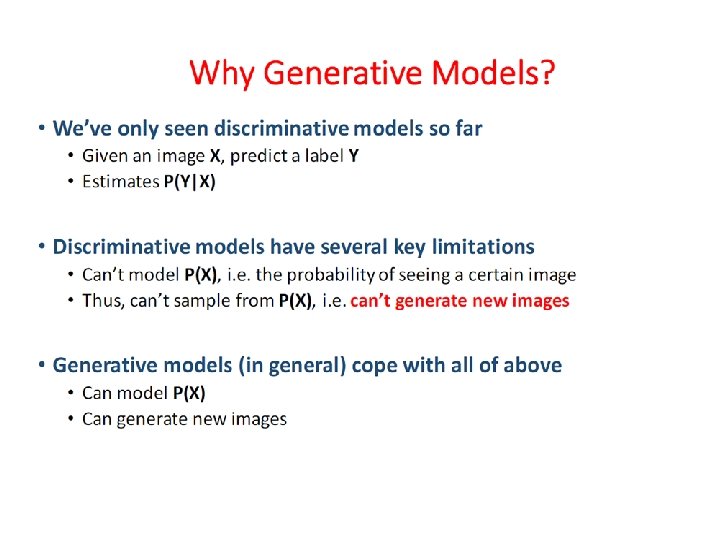
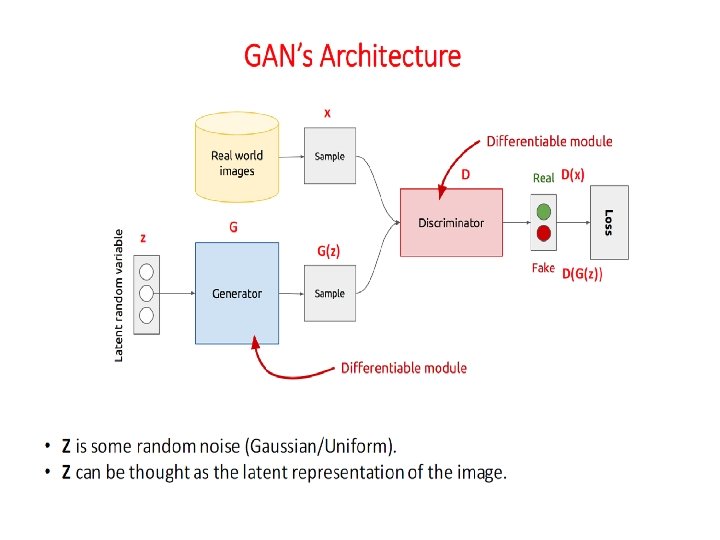
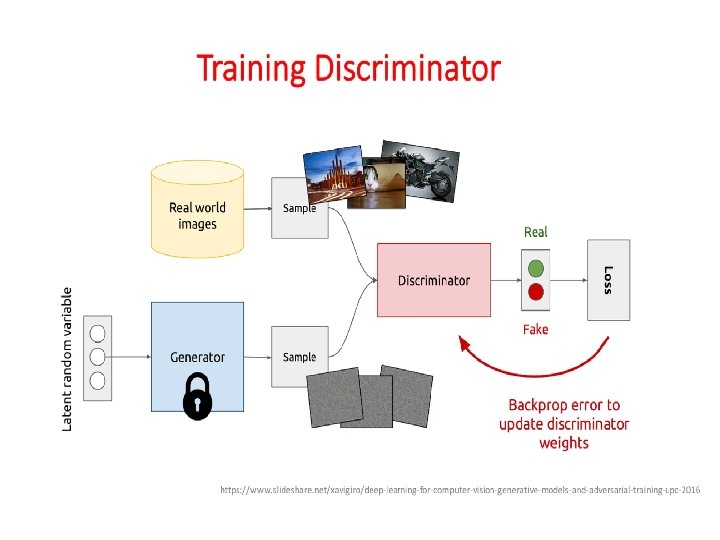
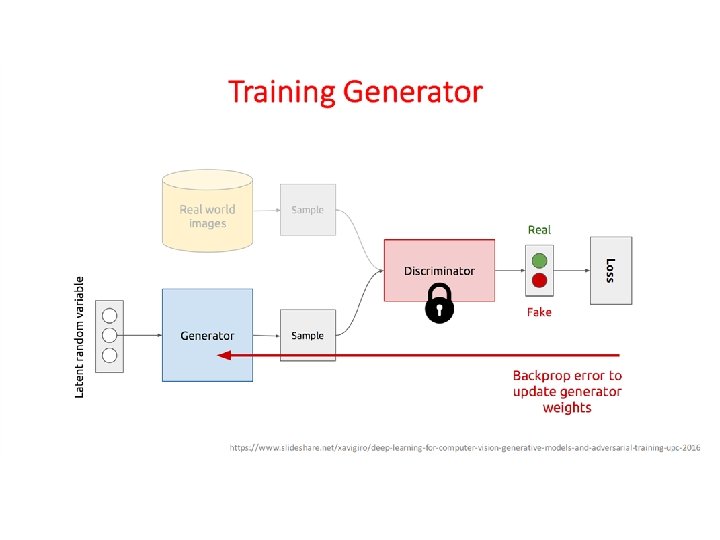
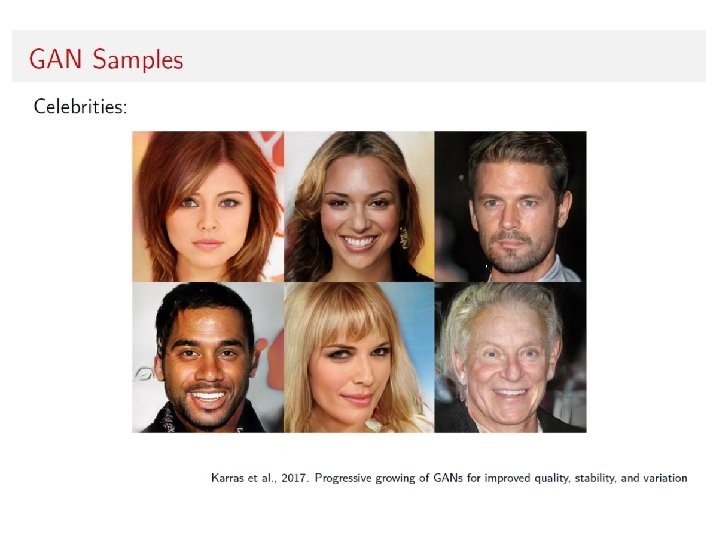
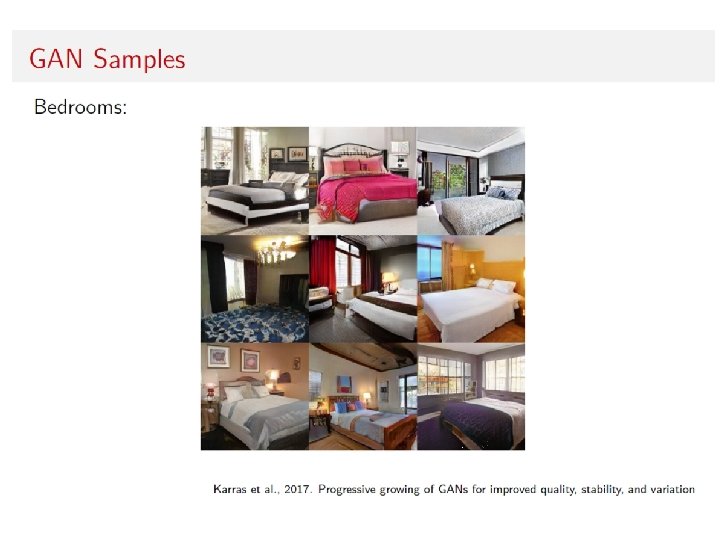
Two deep inference models Predictive Predict the category/class of an object by learning a model Example: CNN Generative Generate a new object that closely matches to those in a limited training set by closely approximating the underlying (but unknown) probability distribution of the set of objects. Example: GAN 63
The 2012 Breakthrough in Predictive Learning…. n A Krizhevsky, I Sutskever, and GE Hinton, “Imagenet classification with deep convolutional neural networks”, Advances in neural information processing systems (NIPS 2012), 1097 -1105 Has 32, 000+ citations by now!! Reduced the error rate on imagenet under LSVRC to 16% Later evolved into Alexnet. 64
Deep Learning: Acknowledging Some Resources used here… n n “Neural Networks and Deep Learning” q written by Michael Nielsen q http: //neuralnetworksanddeeplearning. com/ “Deep Learning” q Written by Ian J. Goodfellow, Yoshua Bengio, and Aaron Courville q http: //www. iro. umontreal. ca/~bengioy/dlbook/ Deep Learning Tutorial. Hung-yi Lee, NTU. Brandon Rohrer on Linked. In Roger Grosse, Cycle. GAN
Deep Learning What people already knew in 1980 s
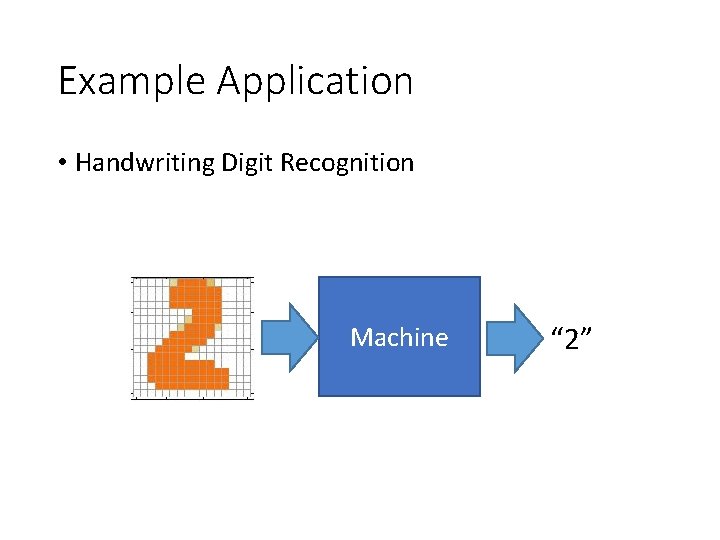
Example Application • Handwriting Digit Recognition Machine “ 2”
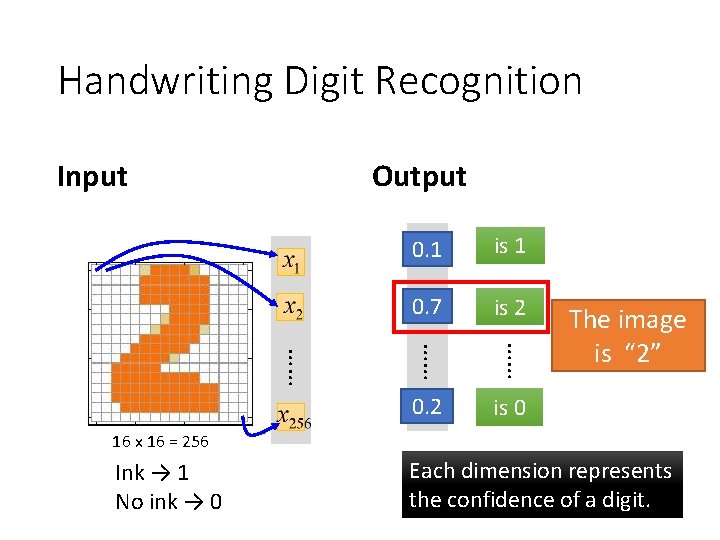
Handwriting Digit Recognition Input Output y 1 0. 1 is 1 0. 7 y 2 is 2 …… …… …… 0. 2 y 10 The image is “ 2” is 0 16 x 16 = 256 Ink → 1 No ink → 0 Each dimension represents the confidence of a digit.
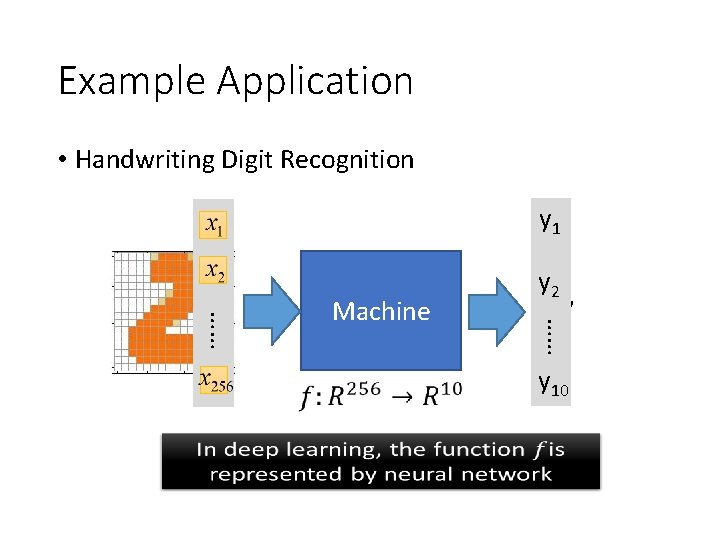
Example Application • Handwriting Digit Recognition y 1 “ 2” …… …… Machine y 2 y 10
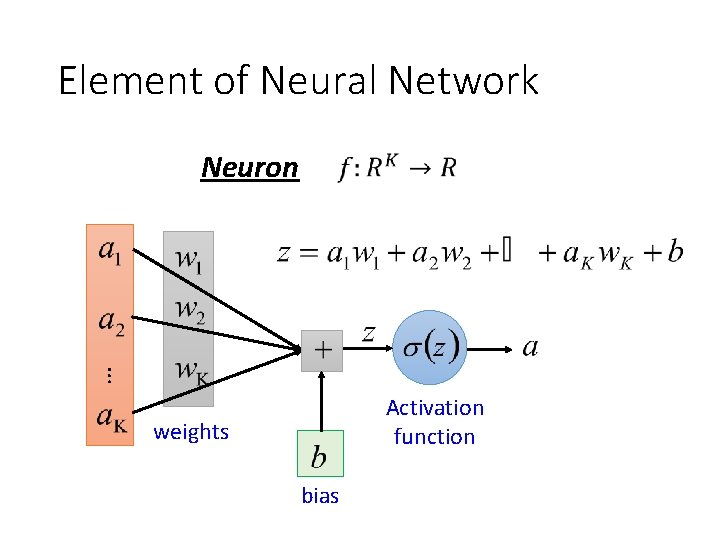
Element of Neural Network Neuron … Activation function weights bias
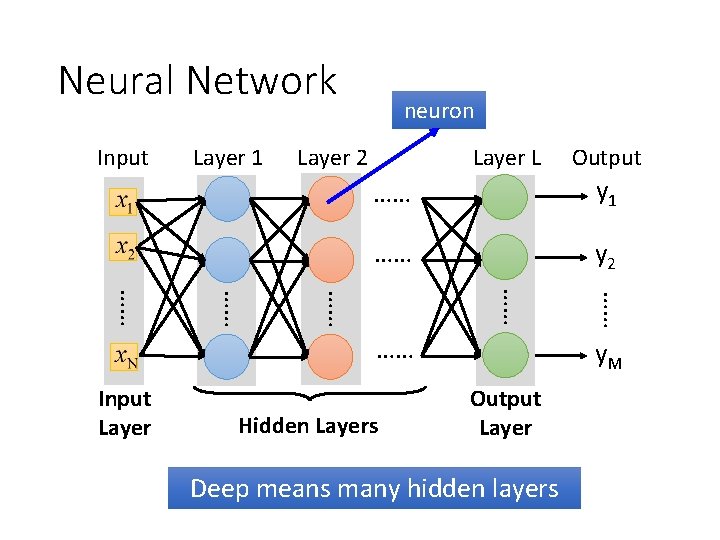
Neural Network Input Layer 1 neuron Layer 2 Layer L …… y 1 …… y 2 Hidden Layers …… …… …… Input Layer Output y. M Output Layer Deep means many hidden layers
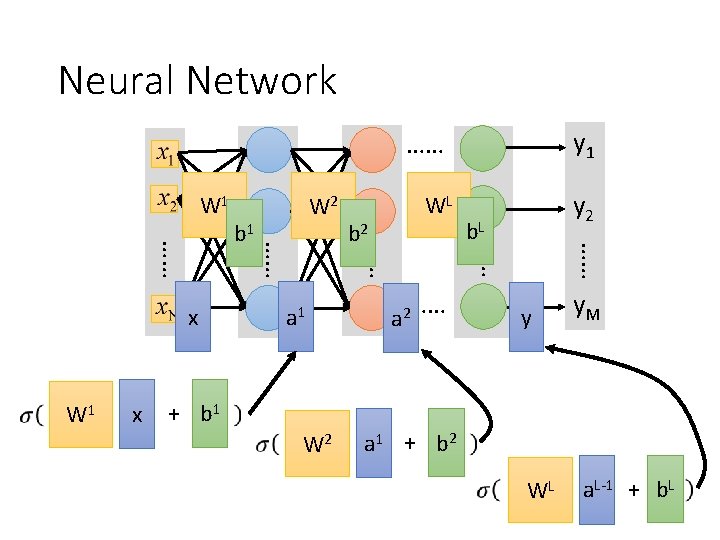
Neural Network W 1 WL …… y 2 + b 1 W 2 …… a 1 b. L …… x b 2 y 1 …… W 1 …… …… x b 1 W 2 …… y y. M a 1 + b 2 WL a. L-1 + b. L
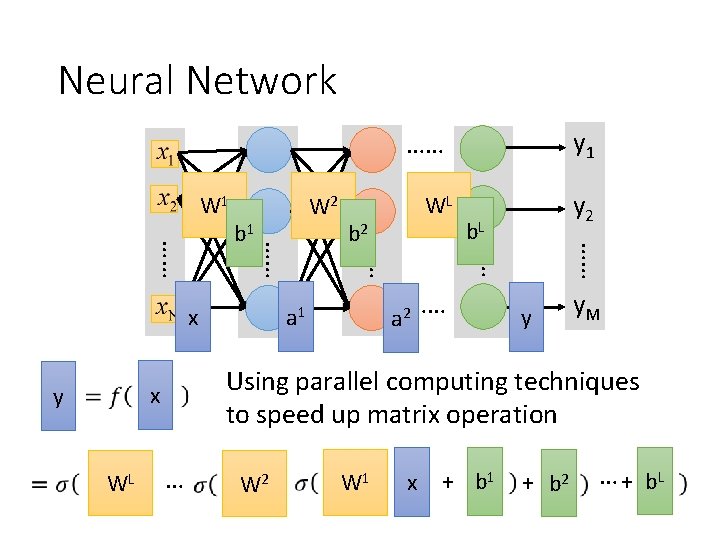
Neural Network W 1 b. L …… a 1 a 2 …… WL y 2 y y. M Using parallel computing techniques to speed up matrix operation x y WL …… …… x b 2 y 1 …… …… …… b 1 W 2 …… … W 2 W 1 x + b 1 + b 2 … + b. L
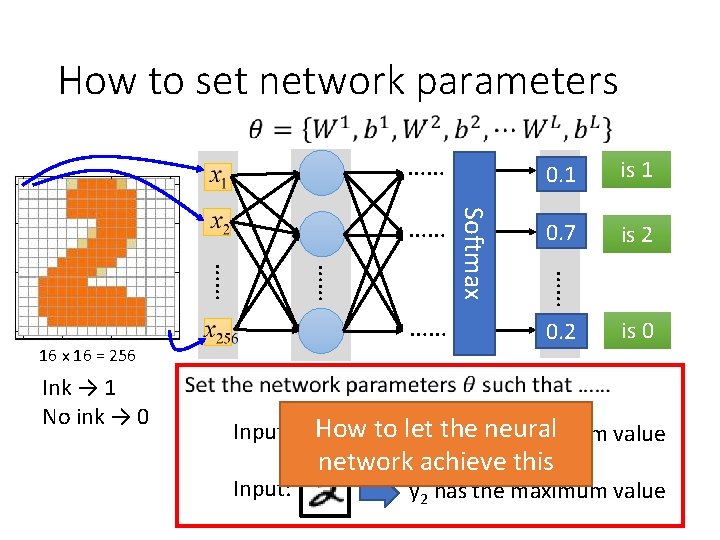
How to set network parameters …… 16 x 16 = 256 Ink → 1 No ink → 0 is 1 0. 7 y 2 is 2 …… …… Softmax …… y 1 0. 2 y 10 is 0 thethe neural Input: How to let y 1 has maximum value Input: network achieve this y 2 has the maximum value
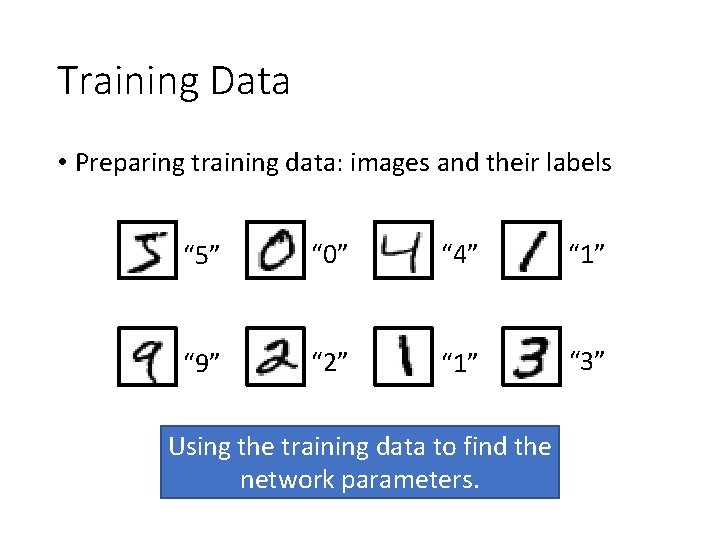
Training Data • Preparing training data: images and their labels “ 5” “ 0” “ 4” “ 1” “ 9” “ 2” “ 1” “ 3” Using the training data to find the network parameters.
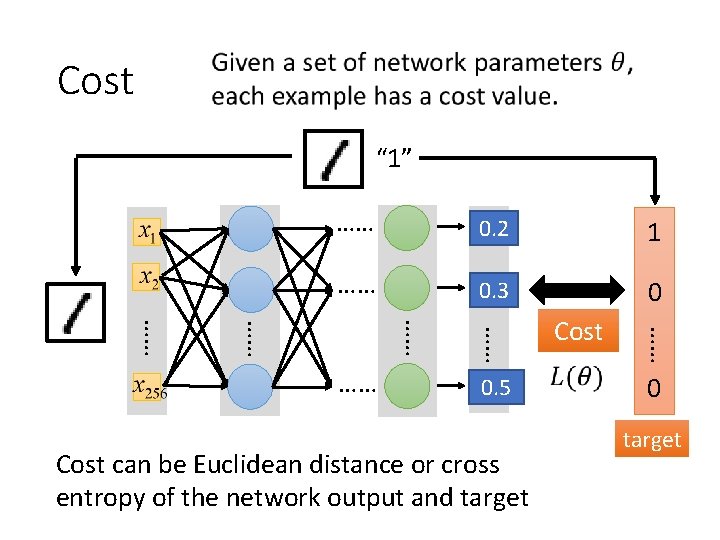
Cost “ 1” …… y 0. 2 1 1 …… 0. 3 y 2 0 y 0. 5 10 Cost can be Euclidean distance or cross entropy of the network output and target …… …… …… Cost 0 target
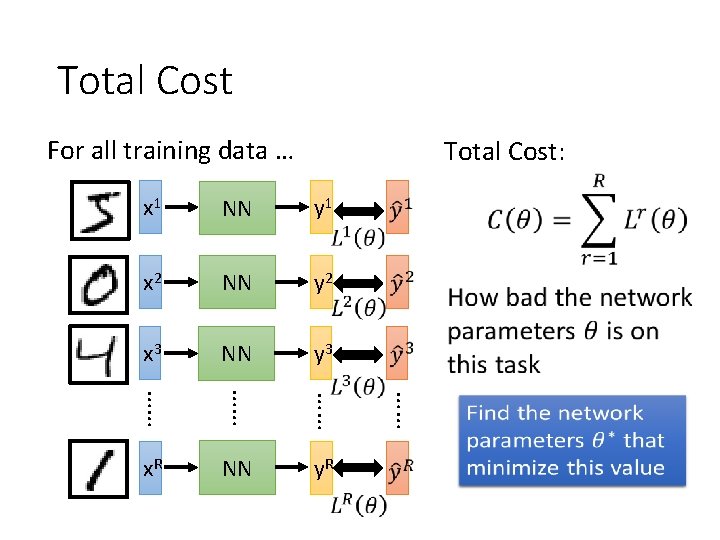
Total Cost For all training data … Total Cost: NN y 1 x 2 NN y 2 x 3 NN y 3 …… …… …… x. R NN y. R …… x 1
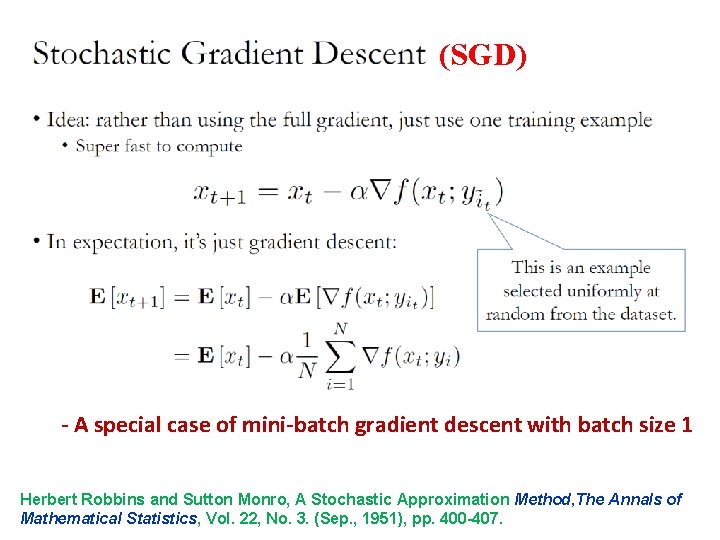
(SGD) - A special case of mini-batch gradient descent with batch size 1 Herbert Robbins and Sutton Monro, A Stochastic Approximation Method, The Annals of Mathematical Statistics, Vol. 22, No. 3. (Sep. , 1951), pp. 400 -407.
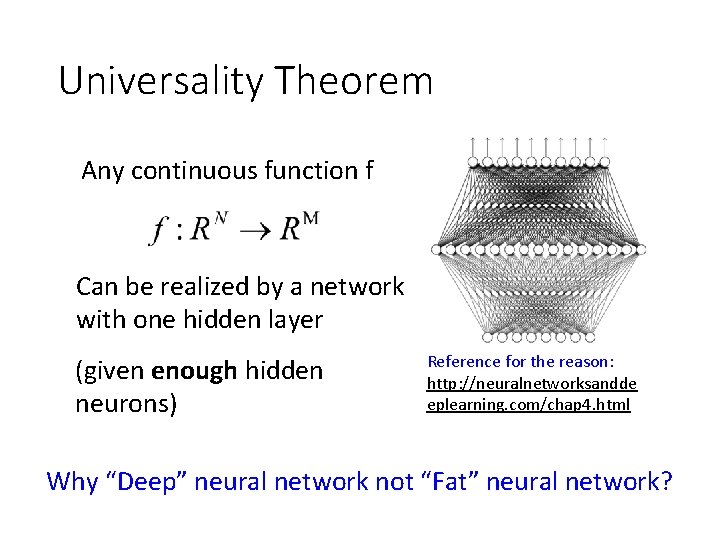
Universality Theorem Any continuous function f Can be realized by a network with one hidden layer (given enough hidden neurons) Reference for the reason: http: //neuralnetworksandde eplearning. com/chap 4. html Why “Deep” neural network not “Fat” neural network?
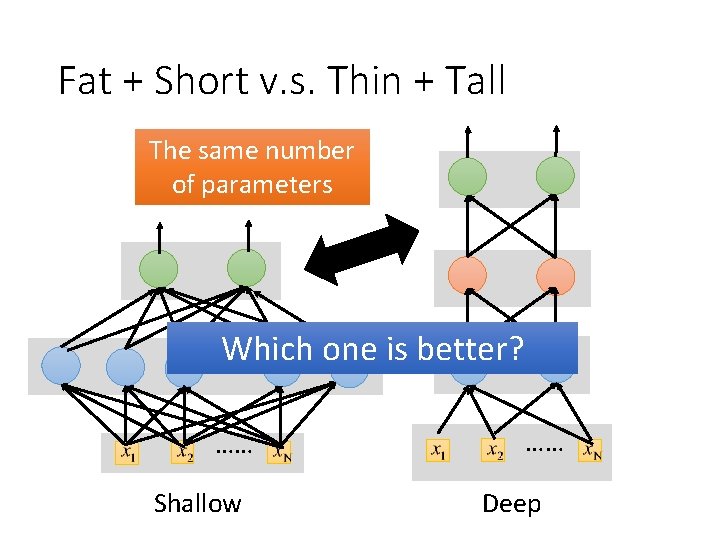
Fat + Short v. s. Thin + Tall The same number of parameters Which one is better? …… …… Shallow …… Deep
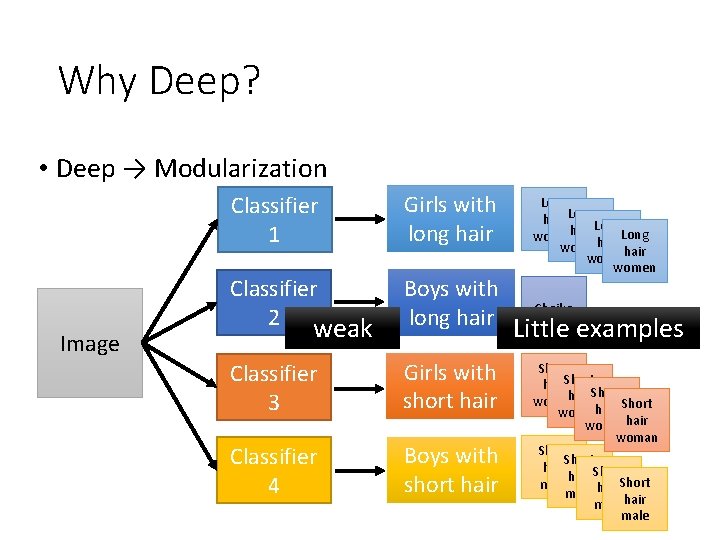
Why Deep? • Deep → Modularization Image Classifier 1 Girls with long hair Classifier 2 weak Boys with long hair Classifier 3 Girls with short hair Classifier 4 Boys with short hair Long womenhair Long women hair women Cheiko Little examples Short hair Short womanhair woman Short hair Short male hair male
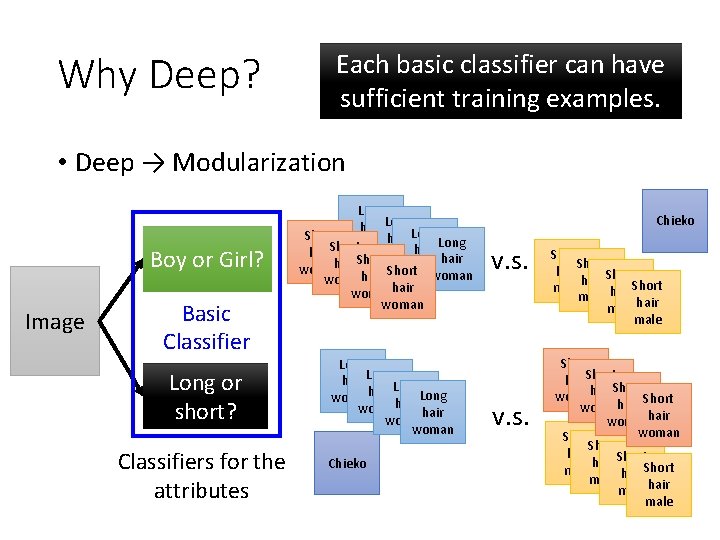
Why Deep? Each basic classifier can have sufficient training examples. • Deep → Modularization Boy or Girl? Image Basic Classifier Long or short? Classifiers for the attributes Long hair Long Short womanhair Long Short hair woman hair Short hair woman Short womanhair woman Long hair Long womanhair Long woman hair woman Chieko v. s. Short hair Short male hair male Short hair Short womanhair woman Short hair Short male hair male
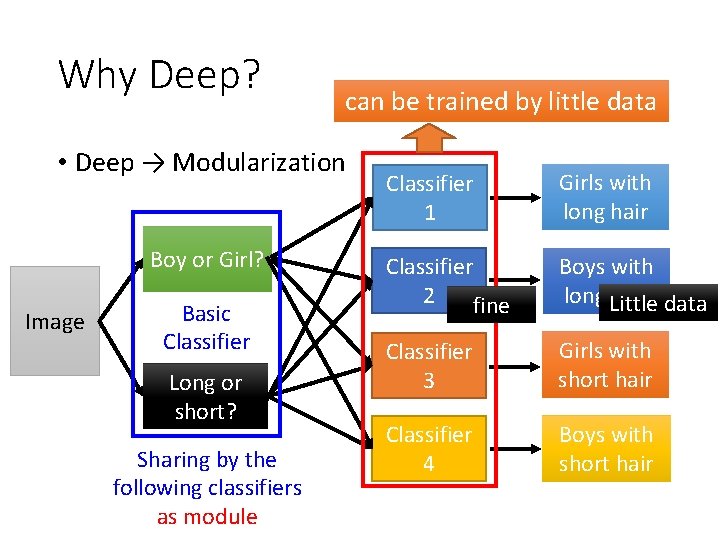
Why Deep? can be trained by little data • Deep → Modularization Boy or Girl? Image Basic Classifier Long or short? Sharing by the following classifiers as module Classifier 1 Girls with long hair Classifier 2 fine Boys with long Little hair data Classifier 3 Girls with short hair Classifier 4 Boys with short hair
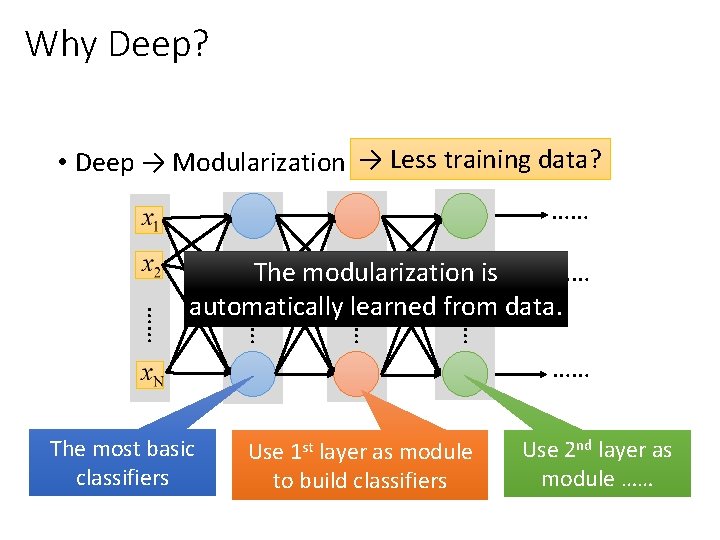
Why Deep? • Deep → Modularization → Less training data? …… …… …… The modularization is automatically learned from data. …… The most basic classifiers Use 1 st layer as module to build classifiers Use 2 nd layer as module ……
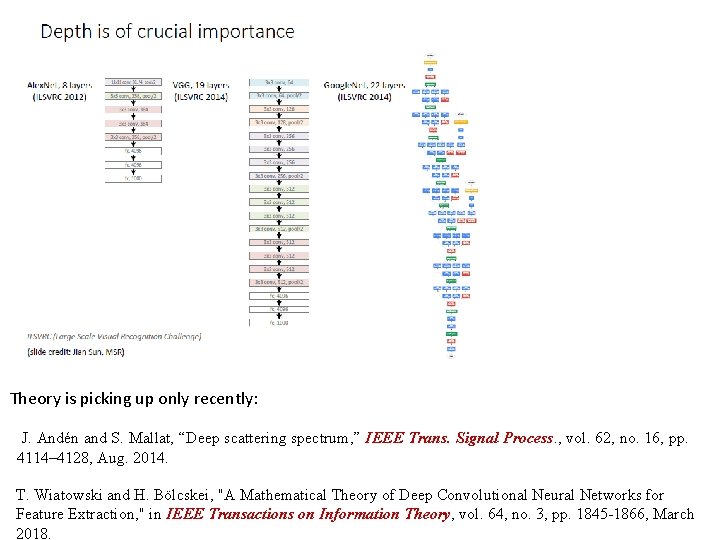
Theory is picking up only recently: J. Andén and S. Mallat, “Deep scattering spectrum, ” IEEE Trans. Signal Process. , vol. 62, no. 16, pp. 4114– 4128, Aug. 2014. T. Wiatowski and H. Bölcskei, "A Mathematical Theory of Deep Convolutional Neural Networks for Feature Extraction, " in IEEE Transactions on Information Theory, vol. 64, no. 3, pp. 1845 -1866, March 2018.
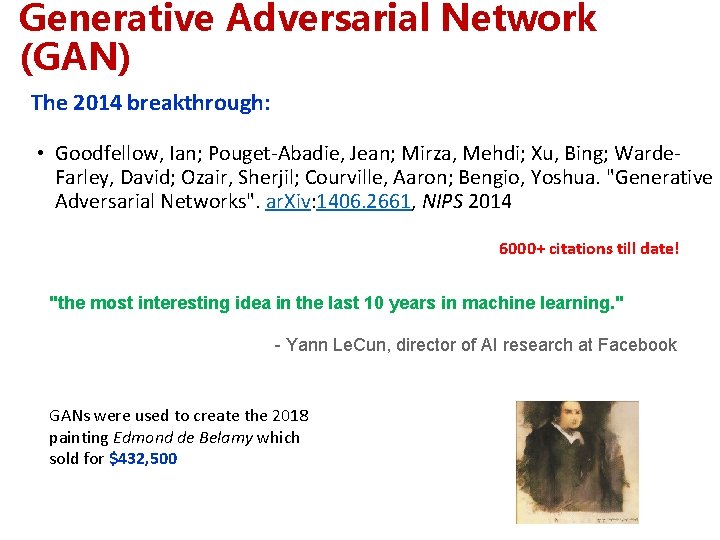
Generative Adversarial Network (GAN) The 2014 breakthrough: • Goodfellow, Ian; Pouget-Abadie, Jean; Mirza, Mehdi; Xu, Bing; Warde. Farley, David; Ozair, Sherjil; Courville, Aaron; Bengio, Yoshua. "Generative Adversarial Networks". ar. Xiv: 1406. 2661, NIPS 2014 6000+ citations till date! "the most interesting idea in the last 10 years in machine learning. " - Yann Le. Cun, director of AI research at Facebook GANs were used to create the 2018 painting Edmond de Belamy which sold for $432, 500
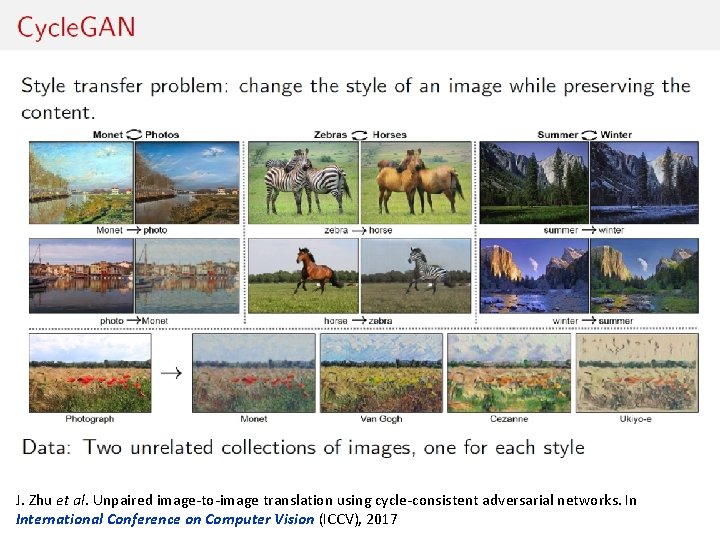
J. Zhu et al. Unpaired image-to-image translation using cycle-consistent adversarial networks. In International Conference on Computer Vision (ICCV), 2017
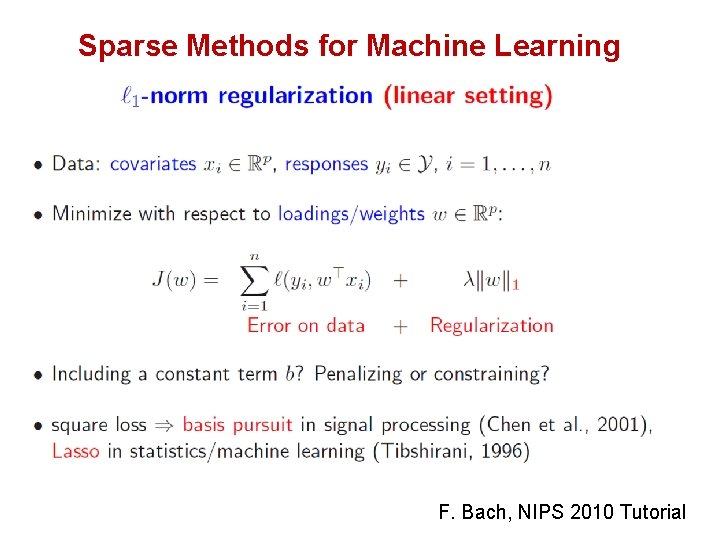
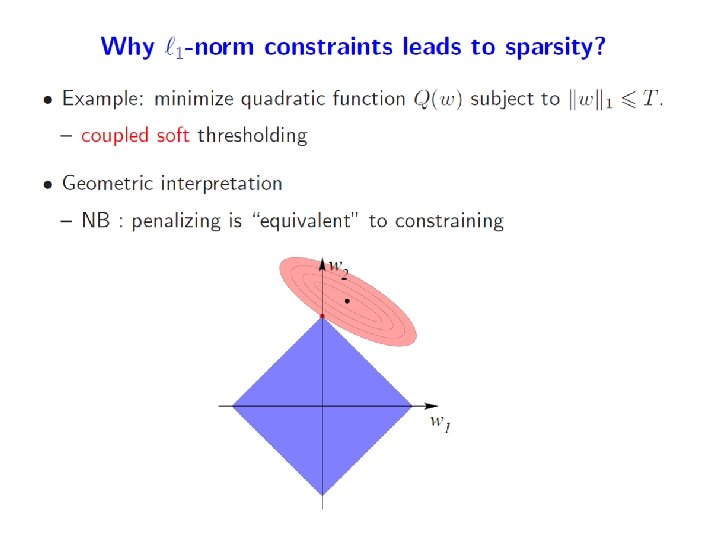
Sparse Methods for Machine Learning F. Bach, NIPS 2010 Tutorial
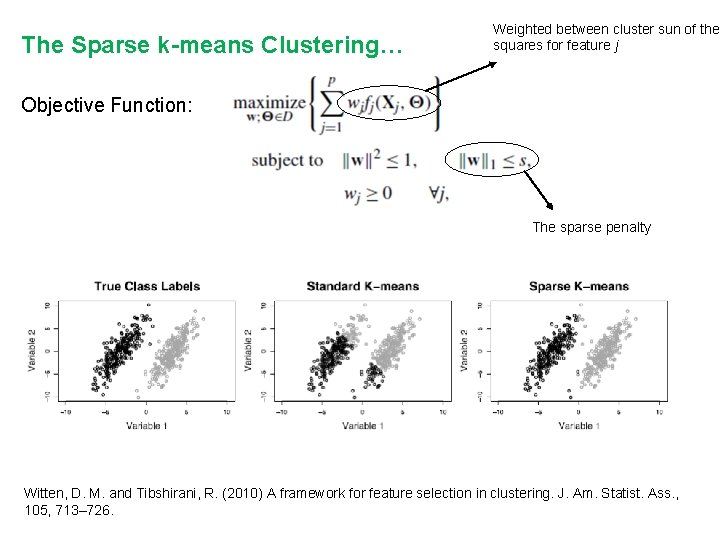
The Sparse k-means Clustering… Weighted between cluster sun of the squares for feature j Objective Function: The sparse penalty Witten, D. M. and Tibshirani, R. (2010) A framework for feature selection in clustering. J. Am. Statist. Ass. , 105, 713– 726.
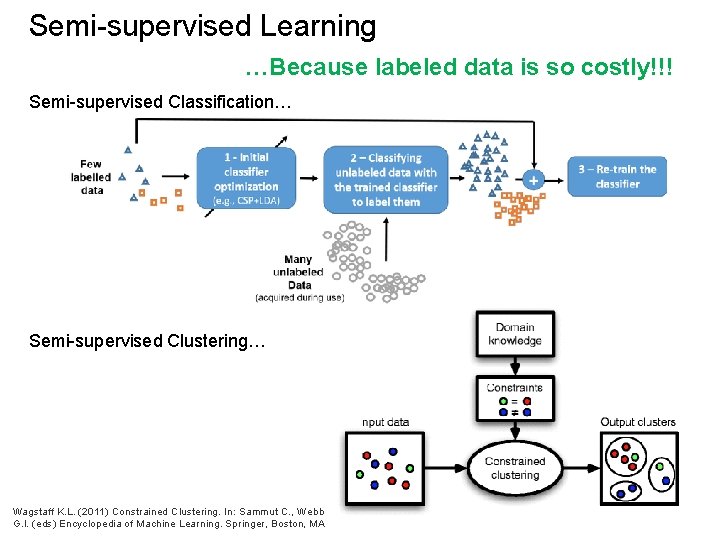
Semi-supervised Learning …Because labeled data is so costly!!! Semi-supervised Classification… Semi-supervised Clustering… Wagstaff K. L. (2011) Constrained Clustering. In: Sammut C. , Webb G. I. (eds) Encyclopedia of Machine Learning. Springer, Boston, MA
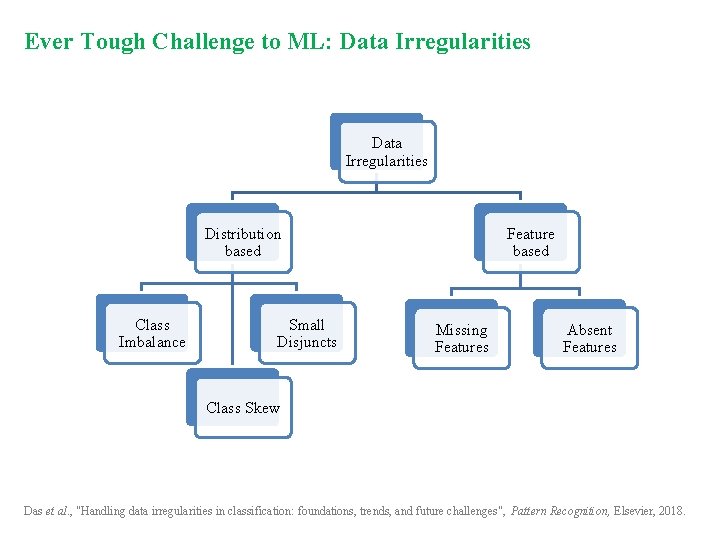
Ever Tough Challenge to ML: Data Irregularities Distribution based Class Imbalance Small Disjuncts Feature based Missing Features Absent Features Class Skew Das et al. , "Handling data irregularities in classification: foundations, trends, and future challenges", Pattern Recognition, Elsevier, 2018.
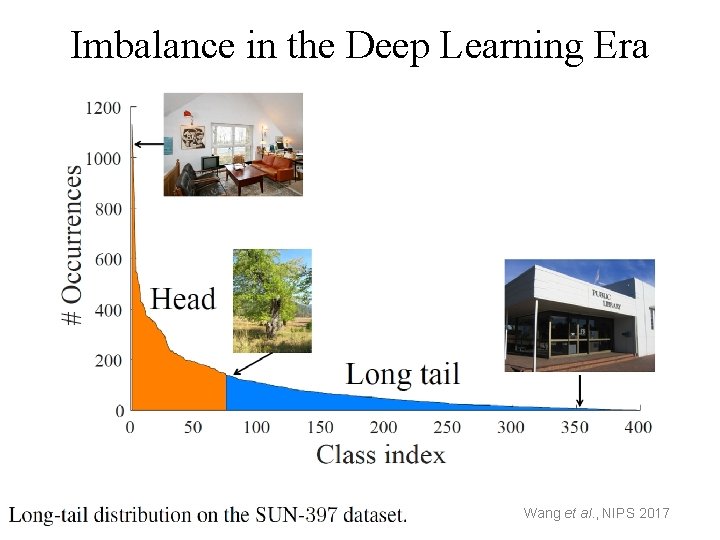
Imbalance in the Deep Learning Era Wang et al. , NIPS 2017
Many other facets of machine learning are gaining momentum…. • Few Shot Learning (ICLR 2019 Open Review: https: //openreview. net/forum? id=Hkx. LXn. Ac. FQ) • Extreme Classification Problems (NIPS 2017 Workshop: http: //manikvarma. org/events/XC 17/index. html) • Privacy preserving learning (Neur. IPS 2018 Workshop on PPML: https: //ppml-workshop. github. io/ppml/) • Multi-label learning (A nice survey in IEEE TKDE: https: //ieeexplore. ieee. org/stamp. jsp? arnumber=6471714) • Meta-learning and learning to learn (see Sebastian Thrun’s homepage: http: //robots. stanford. edu/papers/thrun. book 3. html)
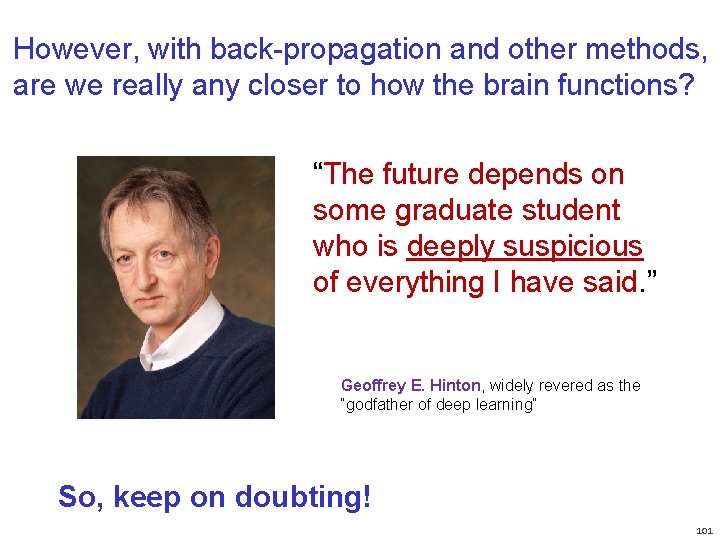
However, with back-propagation and other methods, are we really any closer to how the brain functions? “The future depends on some graduate student who is deeply suspicious of everything I have said. ” Geoffrey E. Hinton, widely revered as the “godfather of deep learning” So, keep on doubting! 101
…and that’s it!
- Slides: 102