
Algo trading in a limit order book prediction
Algo trading in a limit order book prediction using Machine Learning Algorithm Ahlia University 7 th Annual Research Forum Dr. Suresh Subramanian College of Information Technology
Agenda • Introduction • Literature review • Problem statement • Objectives • Proposed System Design • Proposed System • Sample Data Representation • Conclusion 2
Introduction • Financial Exchanges – Exchanges are organized marketplaces where securities (like stocks), commodities and derivatives (among other financial instruments) are traded – Investors need to agree upon a price before exchanging an asset, and this needs to be done centrally so the transactions can be monitored – Exchanges use what is called a Limit Order Book to achieve this coordination 3
Introduction • Limit Order Book (LOB) – The Limit Order Book is a transparent trading system that matches customer orders (bids and asks) using a “price first time second” priority basis – When an order is submitted it contains 3 attributes: › Whether it is an ask (sell) or bid (buy) order › The price limit p(t) › The size of the order v(t) – The order book has two sides, the bid side, containing buy orders, and the ask side, containing sell orders 4
Literature Review [1] Huang, B. , Huan, Y. , Xu, L. D. , Zheng, L. , & Zou, Z. (2019). Automated trading systems statistical and machine learning methods and hardware implementation: a survey. Enterprise Information Systems, 13(1), 132 -144. [2] Tsantekidis, A. , Passalis, N. , Tefas, A. , Kanniainen, J. , Gabbouj, M. , & Iosifidis, A. (2018). Using Deep Learning for price prediction by exploiting stationary limit order book features. ar. Xiv preprint ar. Xiv: 1810. 09965. [3] Chen, S. , & He, H. (2018, October). Stock Prediction Using Convolutional Neural Network. In IOP Conference Series: Materials Science and Engineering (Vol. 435, No. 1, p. 012026). IOP Publishing. [4] Tsantekidis, A. , Passalis, N. , Tefas, A. , Kanniainen, J. , Gabbouj, M. , & Iosifidis, A. (2017, July). Forecasting stock prices from the limit order book using convolutional neural networks. In 2017 IEEE 19 th Conference on Business Informatics (CBI) (Vol. 1, pp. 7 -12). IEEE. [5] Box, G. E. , Jenkins, G. M. , Reinsel, G. C. , & Ljung, G. M. (2015). Time series analysis: forecasting and control. John Wiley & Sons. [6] Cartea, Á. , & Penalva, J. (2012). Where is the value in high frequency trading? . The Quarterly Journal of Finance, 2(03), 1250014. [7] Avellaneda, M. (2011). Algorithmic and High-frequency trading: an overview. In New York University & Finance Concepts LLC Quant Congress USA 2011. 5
Problem Statement Propose a machine learning framework to capture the dynamics of high frequency limit order books in financial equity markets and automate real-time prediction of metrics such as mid-price movement and price spread crossing. • Why Algo Bahrain? • http: //algobahrain. com/#Why. ALGOBahrain? – Algorithmic trading is the concept has introduced in Bahrain in 2017 to interconnect the banks through Fin. Tech technology – Four out of ten customers in the GCC are ready to switch to a digital-first relationship – (http: //www. bizbahrain. com/algo-bahrain-worlds-first-fintech-consortium-islamicbanks/). 6
Objectives • To accomplish the prediction of price movements based on current and past changes occurring in the limit order books • To propose a machine learning framework to capture the dynamics of high frequency limit order books in financial equity markets and automate real-time prediction of metrics such as mid-price movement. • To analyse and evaluate the accuracy of the proposed system using deep learning techniques. • To benchmark with other standard techniques such as Support Vector Machine (SVM) and Regression analysis. 7
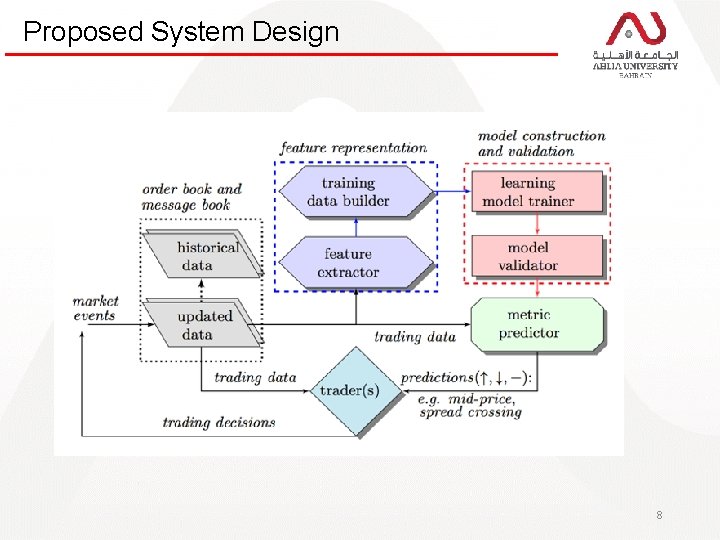
Proposed System Design 8
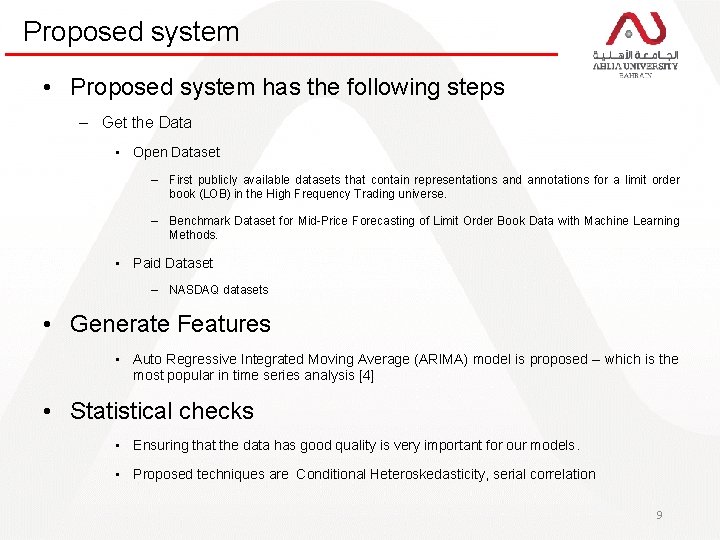
Proposed system • Proposed system has the following steps – Get the Data • Open Dataset – First publicly available datasets that contain representations and annotations for a limit order book (LOB) in the High Frequency Trading universe. – Benchmark Dataset for Mid-Price Forecasting of Limit Order Book Data with Machine Learning Methods. • Paid Dataset – NASDAQ datasets • Generate Features • Auto Regressive Integrated Moving Average (ARIMA) model is proposed – which is the most popular in time series analysis [4] • Statistical checks • Ensuring that the data has good quality is very important for our models. • Proposed techniques are Conditional Heteroskedasticity, serial correlation 9
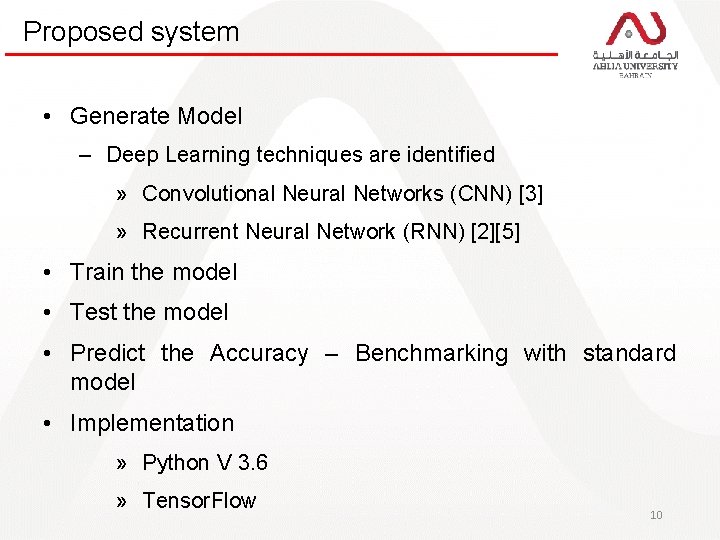
Proposed system • Generate Model – Deep Learning techniques are identified » Convolutional Neural Networks (CNN) [3] » Recurrent Neural Network (RNN) [2][5] • Train the model • Test the model • Predict the Accuracy – Benchmarking with standard model • Implementation » Python V 3. 6 » Tensor. Flow 10
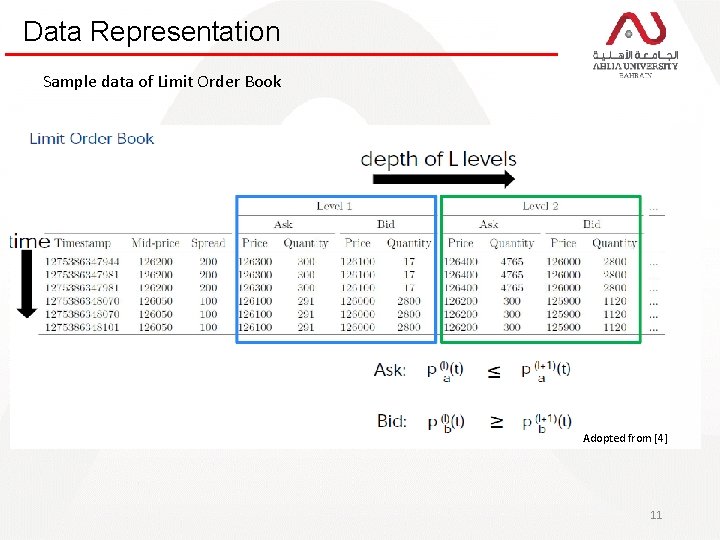
Data Representation Sample data of Limit Order Book Adopted from [4] 11
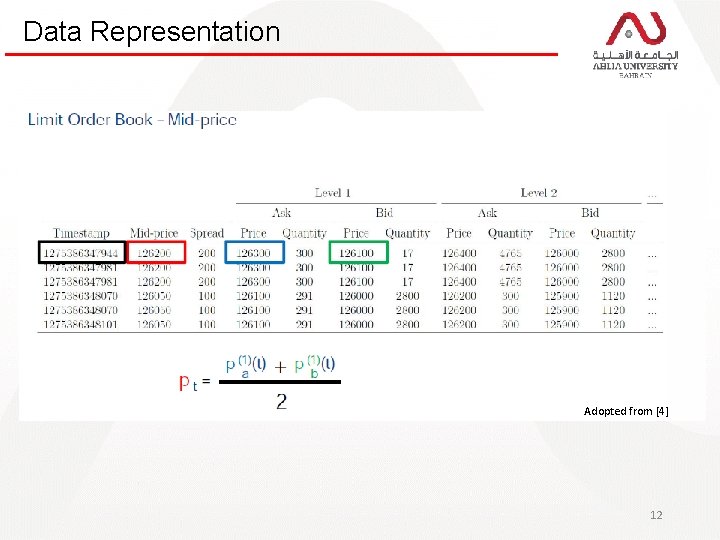
Data Representation Adopted from [4] 12
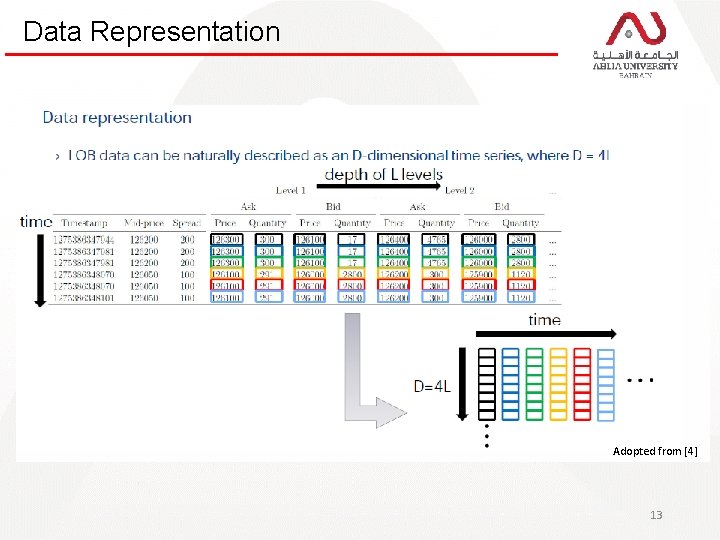
Data Representation Adopted from [4] 13
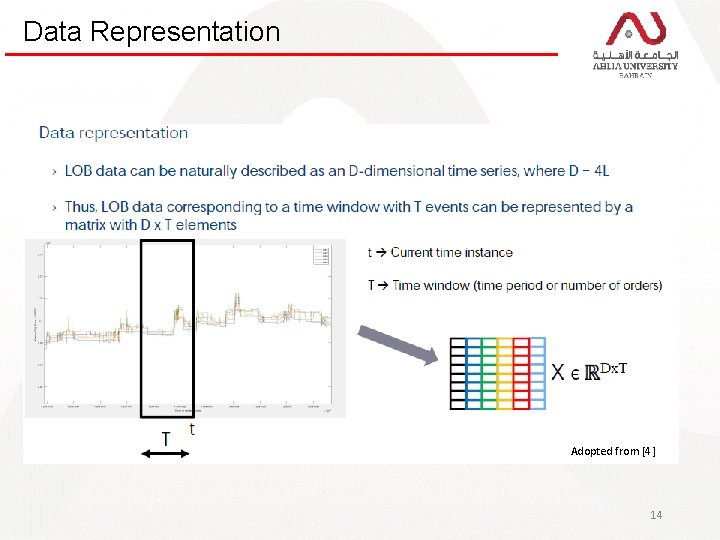
Data Representation Adopted from [4] 14
Conclusion • Proposed work is the Inter-disciplinary work which includes IT and Finance • Suggestions from QS Maple presentation at Ahlia University by Mr. Ashwin • Why Algo Bahrain? • Proposed work is submitted to – Ahlia University - Academic Research Intellectual Contribution Committee (ARICC) • Application for funding to conduct a research (Submitted the application to ARICC) • Primary Investigator : Dr. Suresh Subramanian project Co-Investigator: Dr. Gagan Kukreja • Received the positive feedback from reviewers and comments are addressed in this presentation 15
Conclusion Thank You Any Questions Please ? 16
- Slides: 16