
WORD SENSE DISAMBIGUATION By Mitesh M Khapra Under
WORD SENSE DISAMBIGUATION By Mitesh M. Khapra Under the guidance of Prof. Pushpak Bhattacharyya
MOTIVATION CFILT - IITB One of the central challenges in NLP. Ubiquitous across all languages. Needed in: Machine Translation: For correct lexical choice. Information Retrieval: Resolving ambiguity in queries. Information Extraction: For accurate analysis of text. Computationally determining which sense of a word is activated by its use in a particular context. E. g. I am going to withdraw money from the bank. A classification problem: Senses Classes Context Evidence 2
ROADMAP Knowledge Based Approaches WSD using Selectional Preferences (or restrictions) Overlap Based Approaches CFILT - IITB Machine Learning Based Approaches Supervised Approaches Semi-supervised Algorithms Unsupervised Algorithms Hybrid Approaches Reducing Knowledge Acquisition Bottleneck WSD and MT Summary Future Work 3
KNOWLEDEGE BASED V/S MACHINE LEARNING BASED V/S HYBRID APPROACHES Knowledge Rely Based Approaches on knowledge resources like Word. Net, Thesaurus etc. May use grammar rules for disambiguation. May use hand coded rules for disambiguation. Machine Learning Based Approaches Rely on corpus evidence. Train a model using tagged or untagged corpus. Probabilistic/Statistical models. Hybrid Approaches Use corpus evidence as well as semantic relations form Word. Net. 4
ROADMAP Knowledge Based Approaches WSD using Selectional Preferences (or restrictions) Overlap Based Approaches CFILT - IITB Machine Learning Based Approaches Supervised Approaches Semi-supervised Algorithms Unsupervised Algorithms Hybrid Approaches Reducing Knowledge Acquisition Bottleneck WSD and MT Summary Future Work 5
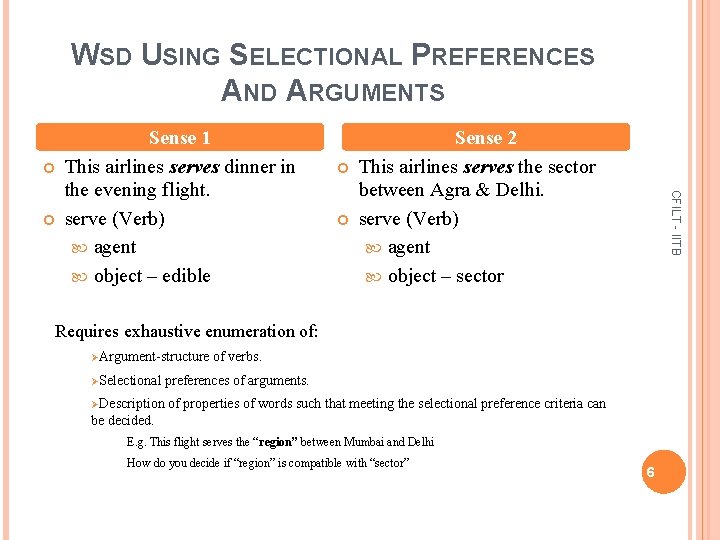
WSD USING SELECTIONAL PREFERENCES AND ARGUMENTS Sense 2 This airlines serves the sector between Agra & Delhi. serve (Verb) agent object – sector CFILT - IITB Sense 1 This airlines serves dinner in the evening flight. serve (Verb) agent object – edible Requires exhaustive enumeration of: ØArgument-structure ØSelectional ØDescription of verbs. preferences of arguments. of properties of words such that meeting the selectional preference criteria can be decided. E. g. This flight serves the “region” between Mumbai and Delhi How do you decide if “region” is compatible with “sector” 6
ROADMAP Knowledge Based Approaches WSD using Selectional Preferences (or restrictions) Overlap Based Approaches CFILT - IITB Machine Learning Based Approaches Supervised Approaches Semi-supervised Algorithms Unsupervised Algorithms Hybrid Approaches Reducing Knowledge Acquisition Bottleneck WSD and MT Summary Future Work 7
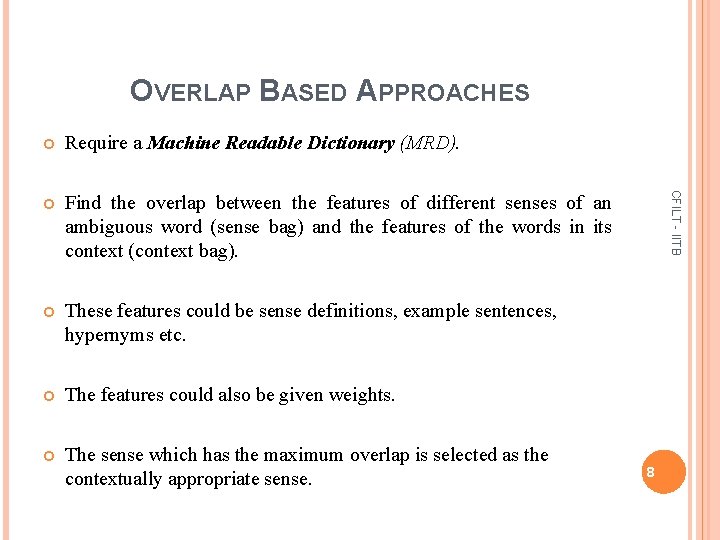
OVERLAP BASED APPROACHES Require a Machine Readable Dictionary (MRD). Find the overlap between the features of different senses of an ambiguous word (sense bag) and the features of the words in its context (context bag). These features could be sense definitions, example sentences, hypernyms etc. The features could also be given weights. The sense which has the maximum overlap is selected as the contextually appropriate sense. CFILT - IITB 8
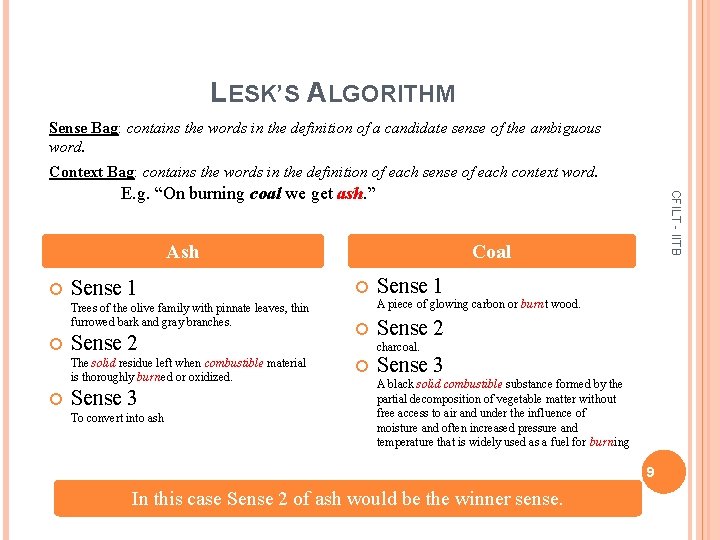
LESK’S ALGORITHM Sense Bag: contains the words in the definition of a candidate sense of the ambiguous word. Context Bag: contains the words in the definition of each sense of each context word. Ash Sense 1 Trees of the olive family with pinnate leaves, thin furrowed bark and gray branches. Sense 2 The solid residue left when combustible material is thoroughly burned or oxidized. Sense 3 To convert into ash CFILT - IITB E. g. “On burning coal we get ash. ” Coal Sense 1 A piece of glowing carbon or burnt wood. Sense 2 charcoal. Sense 3 A black solid combustible substance formed by the partial decomposition of vegetable matter without free access to air and under the influence of moisture and often increased pressure and temperature that is widely used as a fuel for burning 9 In this case Sense 2 of ash would be the winner sense.
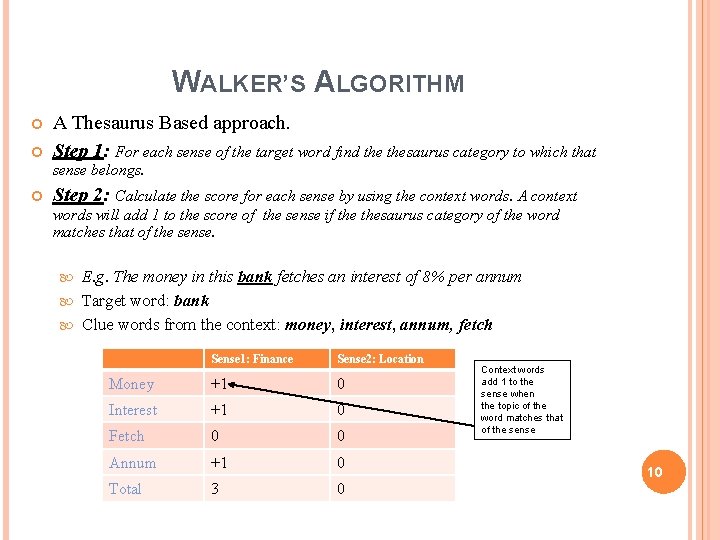
WALKER’S ALGORITHM A Thesaurus Based approach. Step 1: For each sense of the target word find thesaurus category to which that sense belongs. Step 2: Calculate the score for each sense by using the context words. A context words will add 1 to the score of the sense if thesaurus category of the word matches that of the sense. E. g. The money in this bank fetches an interest of 8% per annum Target word: bank Clue words from the context: money, interest, annum, fetch Sense 1: Finance Sense 2: Location Money +1 0 Interest +1 0 Fetch 0 0 Annum +1 0 Total 3 0 Context words add 1 to the sense when the topic of the word matches that of the sense 10
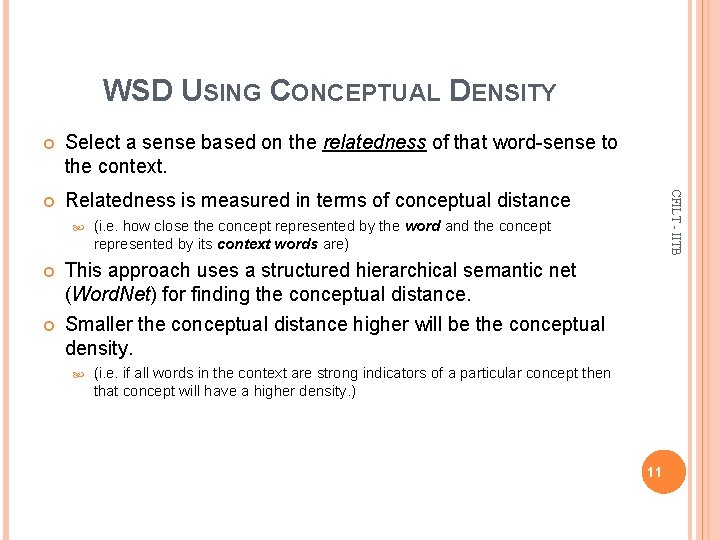
WSD USING CONCEPTUAL DENSITY Select a sense based on the relatedness of that word-sense to the context. Relatedness is measured in terms of conceptual distance CFILT - IITB (i. e. how close the concept represented by the word and the concept represented by its context words are) This approach uses a structured hierarchical semantic net (Word. Net) for finding the conceptual distance. Smaller the conceptual distance higher will be the conceptual density. (i. e. if all words in the context are strong indicators of a particular concept then that concept will have a higher density. ) 11
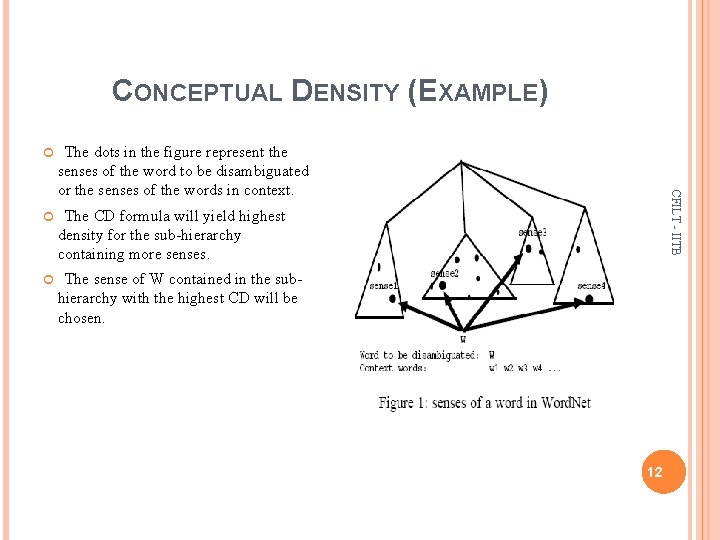
CONCEPTUAL DENSITY (EXAMPLE) The dots in the figure represent the senses of the word to be disambiguated or the senses of the words in context. The CD formula will yield highest density for the sub-hierarchy containing more senses. The sense of W contained in the subhierarchy with the highest CD will be chosen. CFILT - IITB 12
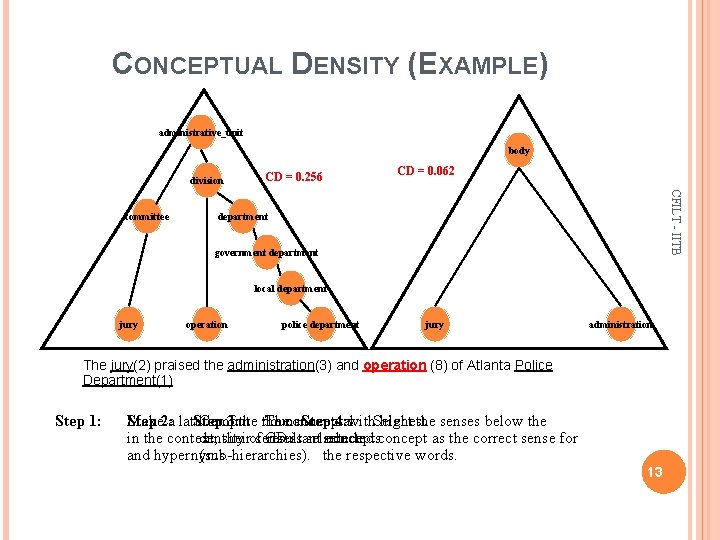
CONCEPTUAL DENSITY (EXAMPLE) administrative_unit body division CD = 0. 062 CFILT - IITB committee CD = 0. 256 department government department local department jury operation police department jury administration The jury(2) praised the administration(3) and operation (8) of Atlanta Police Department(1) Step 1: Step Make 2: a lattice Step Compute of 3: the nouns Theconceptual concept Step 4: with. Select highest the senses below the in the context, density theirofsenses CD resultant is selected conceptsconcept as the correct sense for and hypernyms. (sub-hierarchies). the respective words. 13
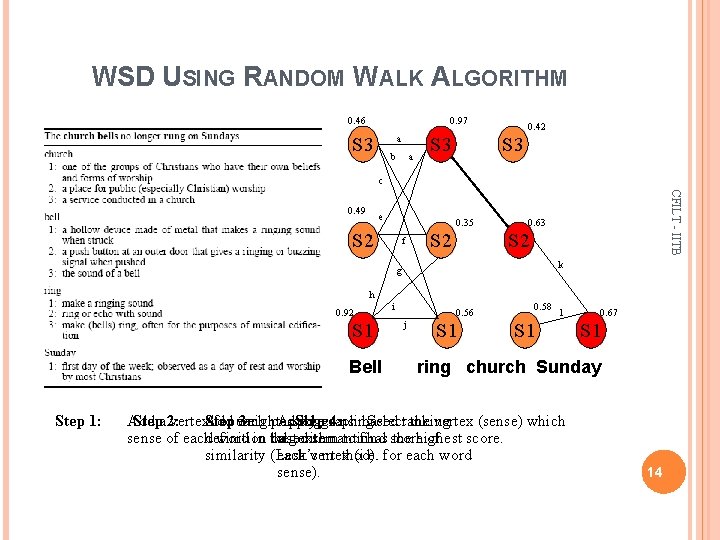
WSD USING RANDOM WALK ALGORITHM 0. 46 0. 97 a S 3 b a S 3 0. 42 S 3 c e 0. 35 S 2 f S 2 CFILT - IITB 0. 49 0. 63 S 2 k g h 0. 92 S 1 Bell Step 1: i 0. 56 j S 1 0. 58 l S 1 0. 67 S 1 ring church Sunday Add Stepa 2: vertex. Step Add for each weighted 3: possible Apply Step edges graph 4: using based Selectranking the vertex (sense) which sense of eachdefinition word in the based algorithm text. semantic to find has score the highest of score. similarity (Lesk’s each vertex method). (i. e. for each word sense). 14
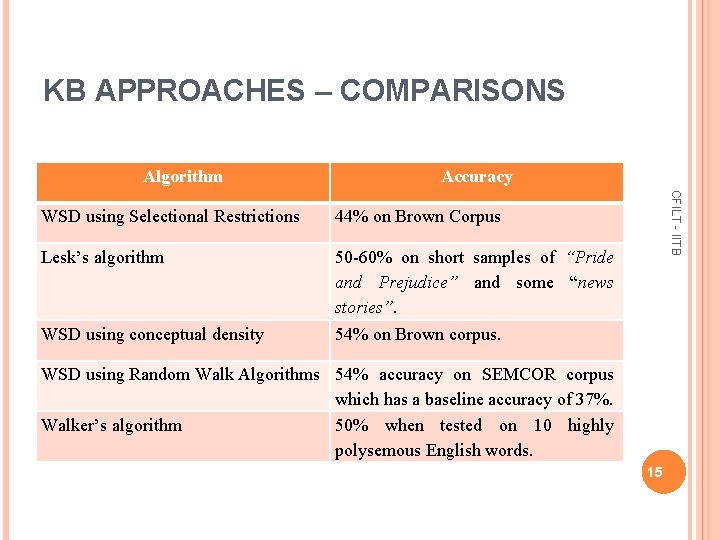
KB APPROACHES – COMPARISONS Algorithm Accuracy 44% on Brown Corpus Lesk’s algorithm 50 -60% on short samples of “Pride and Prejudice” and some “news stories”. WSD using conceptual density 54% on Brown corpus. CFILT - IITB WSD using Selectional Restrictions WSD using Random Walk Algorithms 54% accuracy on SEMCOR corpus which has a baseline accuracy of 37%. Walker’s algorithm 50% when tested on 10 highly polysemous English words. 15
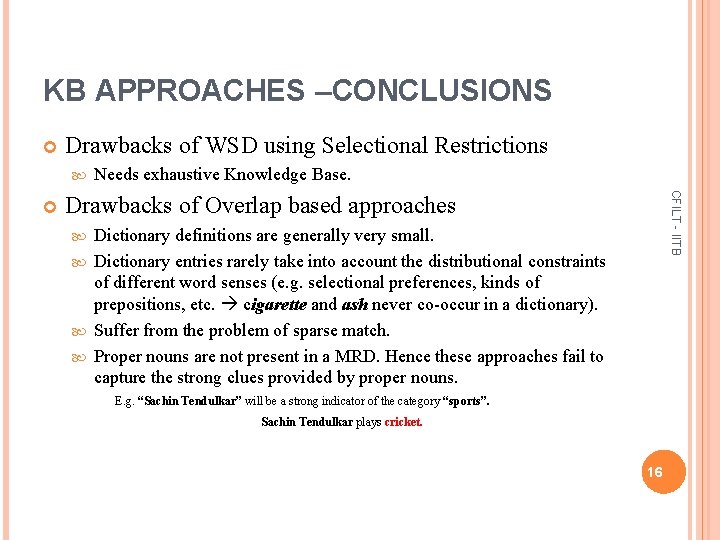
KB APPROACHES –CONCLUSIONS Drawbacks of WSD using Selectional Restrictions CFILT - IITB Needs exhaustive Knowledge Base. Drawbacks of Overlap based approaches Dictionary definitions are generally very small. Dictionary entries rarely take into account the distributional constraints of different word senses (e. g. selectional preferences, kinds of prepositions, etc. cigarette and ash never co-occur in a dictionary). Suffer from the problem of sparse match. Proper nouns are not present in a MRD. Hence these approaches fail to capture the strong clues provided by proper nouns. E. g. “Sachin Tendulkar” will be a strong indicator of the category “sports”. Sachin Tendulkar plays cricket. 16
ROADMAP Knowledge Based Approaches WSD using Selectional Preferences (or restrictions) Overlap Based Approaches CFILT - IITB Machine Learning Based Approaches Supervised Approaches Semi-supervised Algorithms Unsupervised Algorithms Hybrid Approaches Reducing Knowledge Acquisition Bottleneck WSD and MT Summary Future Work 17
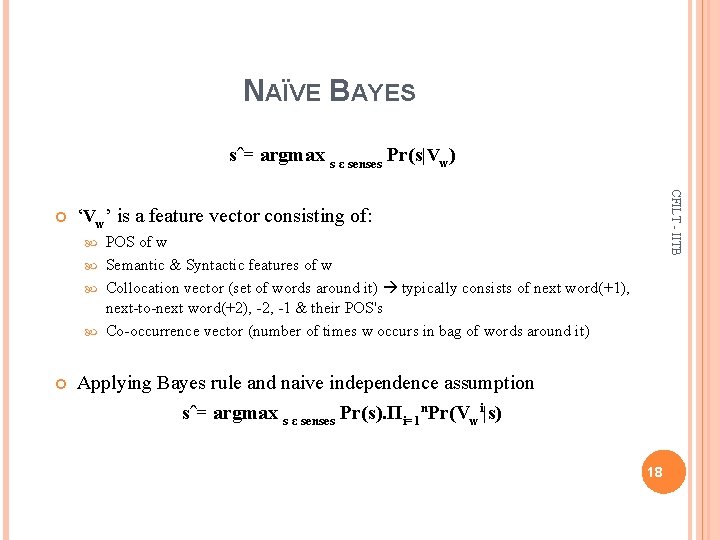
NAÏVE BAYES sˆ= argmax s ε senses Pr(s|Vw) CFILT - IITB ‘Vw’ is a feature vector consisting of: POS of w Semantic & Syntactic features of w Collocation vector (set of words around it) typically consists of next word(+1), next-to-next word(+2), -2, -1 & their POS's Co-occurrence vector (number of times w occurs in bag of words around it) Applying Bayes rule and naive independence assumption sˆ= argmax s ε senses Pr(s). Πi=1 n. Pr(Vwi|s) 18
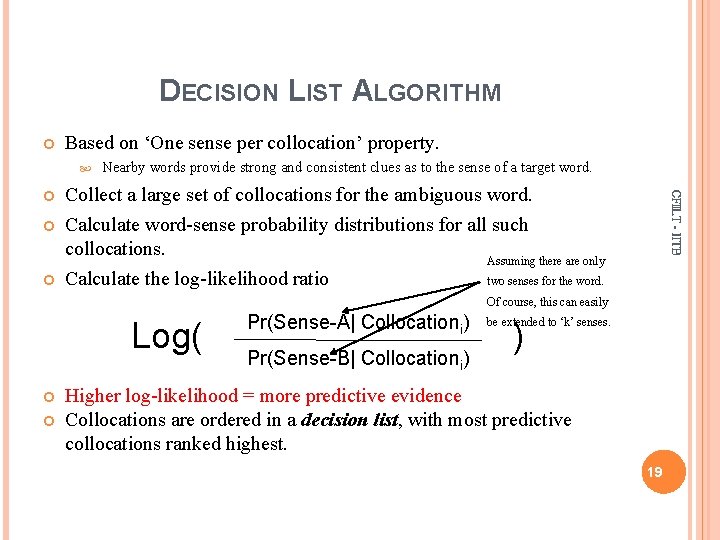
DECISION LIST ALGORITHM Based on ‘One sense per collocation’ property. Collect a large set of collocations for the ambiguous word. Calculate word-sense probability distributions for all such collocations. Assuming there are only Calculate the log-likelihood ratio two senses for the word. CFILT - IITB Nearby words provide strong and consistent clues as to the sense of a target word. Of course, this can easily Log( Pr(Sense-A| Collocationi) Pr(Sense-B| Collocationi) be extended to ‘k’ senses. ) Higher log-likelihood = more predictive evidence Collocations are ordered in a decision list, with most predictive collocations ranked highest. 19
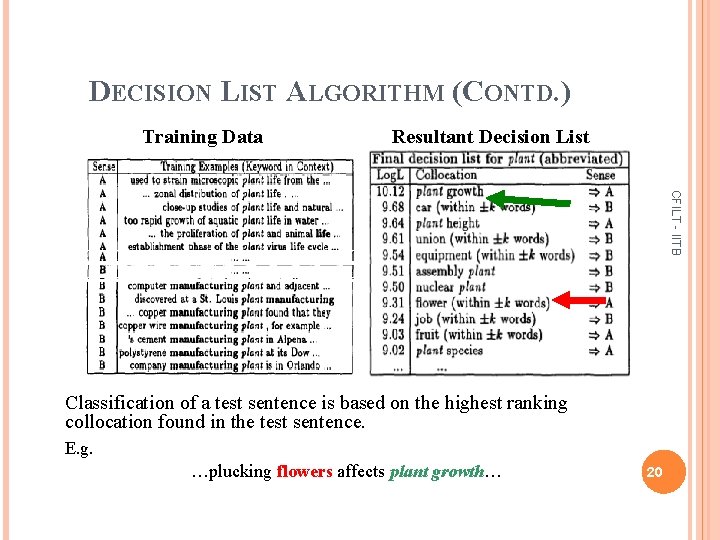
DECISION LIST ALGORITHM (CONTD. ) Training Data Resultant Decision List CFILT - IITB Classification of a test sentence is based on the highest ranking collocation found in the test sentence. E. g. …plucking flowers affects plant growth… 20
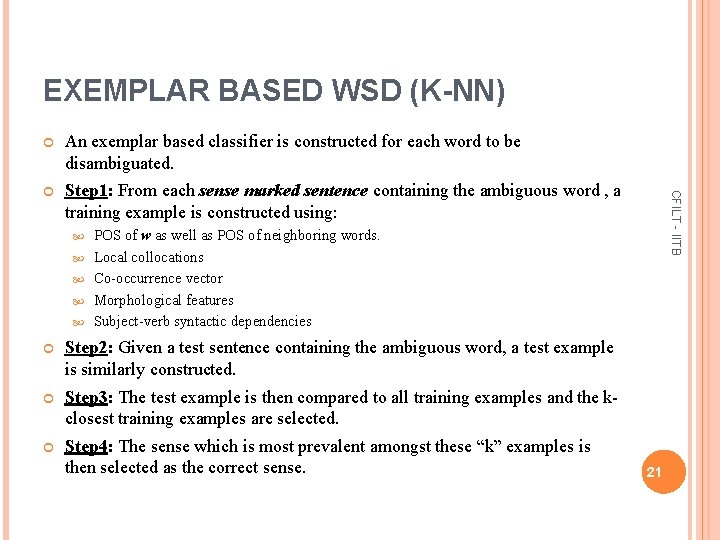
EXEMPLAR BASED WSD (K-NN) An exemplar based classifier is constructed for each word to be disambiguated. Step 1: From each sense marked sentence containing the ambiguous word , a training example is constructed using: CFILT - IITB POS of w as well as POS of neighboring words. Local collocations Co-occurrence vector Morphological features Subject-verb syntactic dependencies Step 2: Given a test sentence containing the ambiguous word, a test example is similarly constructed. Step 3: The test example is then compared to all training examples and the kclosest training examples are selected. Step 4: The sense which is most prevalent amongst these “k” examples is then selected as the correct sense. 21
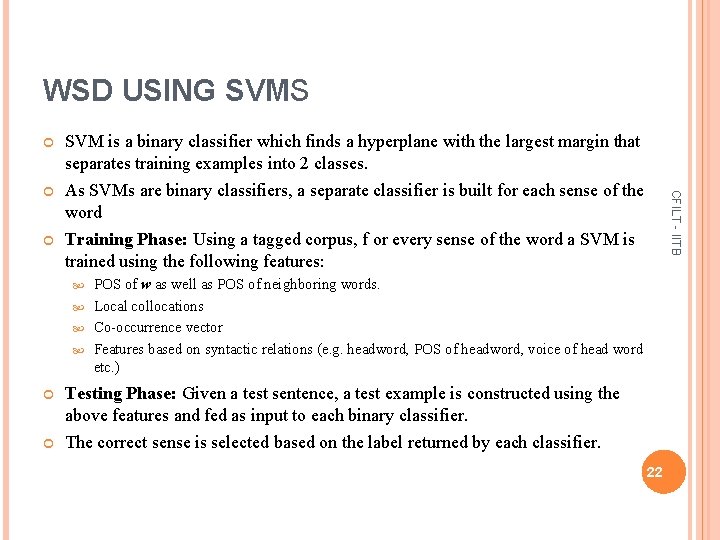
WSD USING SVMS SVM is a binary classifier which finds a hyperplane with the largest margin that separates training examples into 2 classes. As SVMs are binary classifiers, a separate classifier is built for each sense of the word Training Phase: Using a tagged corpus, f or every sense of the word a SVM is trained using the following features: CFILT - IITB POS of w as well as POS of neighboring words. Local collocations Co-occurrence vector Features based on syntactic relations (e. g. headword, POS of headword, voice of head word etc. ) Testing Phase: Given a test sentence, a test example is constructed using the above features and fed as input to each binary classifier. The correct sense is selected based on the label returned by each classifier. 22
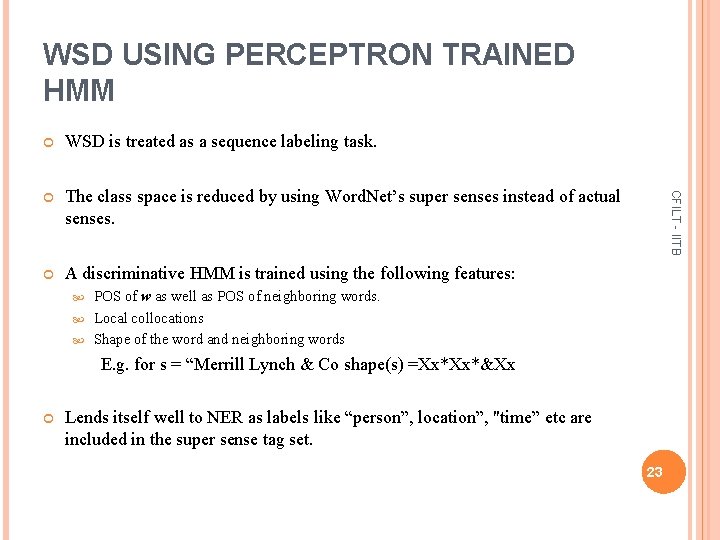
WSD USING PERCEPTRON TRAINED HMM WSD is treated as a sequence labeling task. The class space is reduced by using Word. Net’s super senses instead of actual senses. A discriminative HMM is trained using the following features: CFILT - IITB POS of w as well as POS of neighboring words. Local collocations Shape of the word and neighboring words E. g. for s = “Merrill Lynch & Co shape(s) =Xx*Xx*&Xx Lends itself well to NER as labels like “person”, location”, "time” etc are included in the super sense tag set. 23
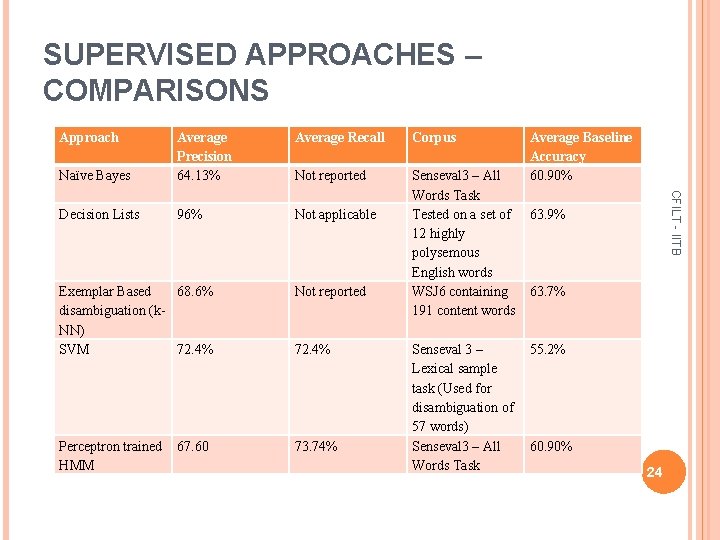
SUPERVISED APPROACHES – COMPARISONS Approach Corpus Not reported Decision Lists 96% Not applicable Senseval 3 – All Words Task Tested on a set of 12 highly polysemous English words WSJ 6 containing 191 content words Exemplar Based 68. 6% disambiguation (k. NN) SVM 72. 4% Not reported Perceptron trained HMM 73. 74% 67. 60 72. 4% Senseval 3 – Lexical sample task (Used for disambiguation of 57 words) Senseval 3 – All Words Task Average Baseline Accuracy 60. 90% CFILT - IITB Average Recall Naïve Bayes Average Precision 64. 13% 63. 9% 63. 7% 55. 2% 60. 90% 24
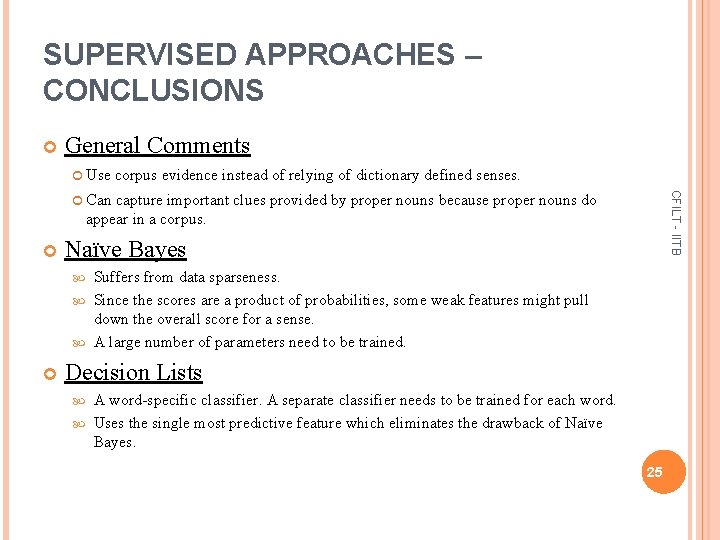
SUPERVISED APPROACHES – CONCLUSIONS Use corpus evidence instead of relying of dictionary defined senses. Can capture important clues provided by proper nouns because proper nouns do appear in a corpus. CFILT - IITB General Comments Naïve Bayes Suffers from data sparseness. Since the scores are a product of probabilities, some weak features might pull down the overall score for a sense. A large number of parameters need to be trained. Decision Lists A word-specific classifier. A separate classifier needs to be trained for each word. Uses the single most predictive feature which eliminates the drawback of Naïve Bayes. 25
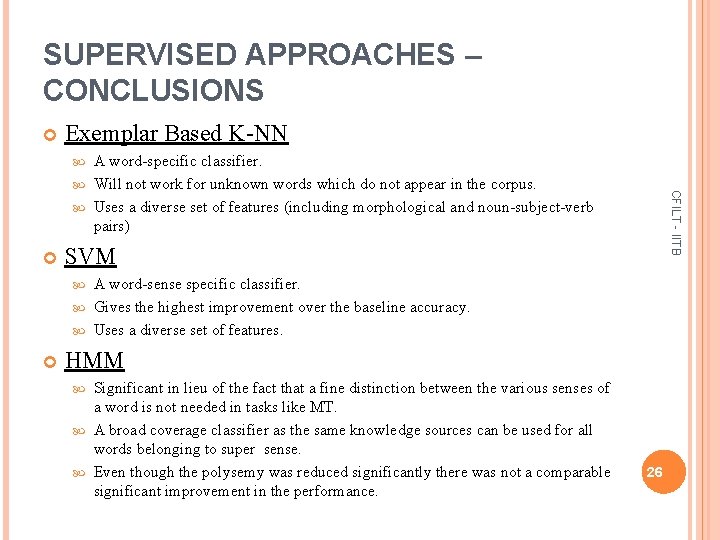
SUPERVISED APPROACHES – CONCLUSIONS Exemplar Based K-NN A word-specific classifier. Will not work for unknown words which do not appear in the corpus. Uses a diverse set of features (including morphological and noun-subject-verb pairs) CFILT - IITB SVM A word-sense specific classifier. Gives the highest improvement over the baseline accuracy. Uses a diverse set of features. HMM Significant in lieu of the fact that a fine distinction between the various senses of a word is not needed in tasks like MT. A broad coverage classifier as the same knowledge sources can be used for all words belonging to super sense. Even though the polysemy was reduced significantly there was not a comparable significant improvement in the performance. 26
ROADMAP Knowledge Based Approaches WSD using Selectional Preferences (or restrictions) Overlap Based Approaches CFILT - IITB Machine Learning Based Approaches Supervised Approaches Semi-supervised Algorithms Unsupervised Algorithms Hybrid Approaches Reducing Knowledge Acquisition Bottleneck WSD and MT Summary Future Work 27
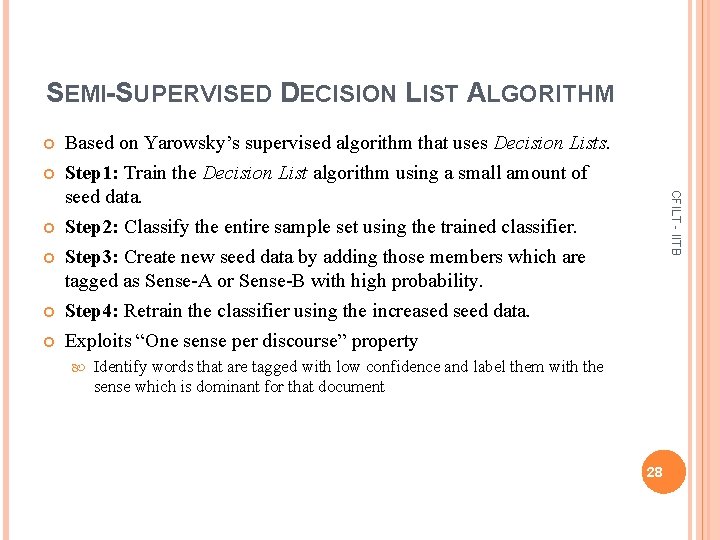
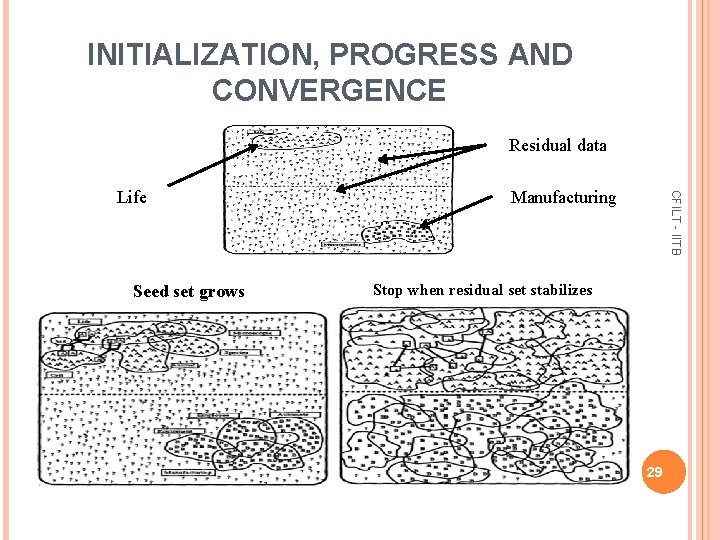
SEMI-SUPERVISED DECISION LIST ALGORITHM CFILT - IITB Based on Yarowsky’s supervised algorithm that uses Decision Lists. Step 1: Train the Decision List algorithm using a small amount of seed data. Step 2: Classify the entire sample set using the trained classifier. Step 3: Create new seed data by adding those members which are tagged as Sense-A or Sense-B with high probability. Step 4: Retrain the classifier using the increased seed data. Exploits “One sense per discourse” property Identify words that are tagged with low confidence and label them with the sense which is dominant for that document 28
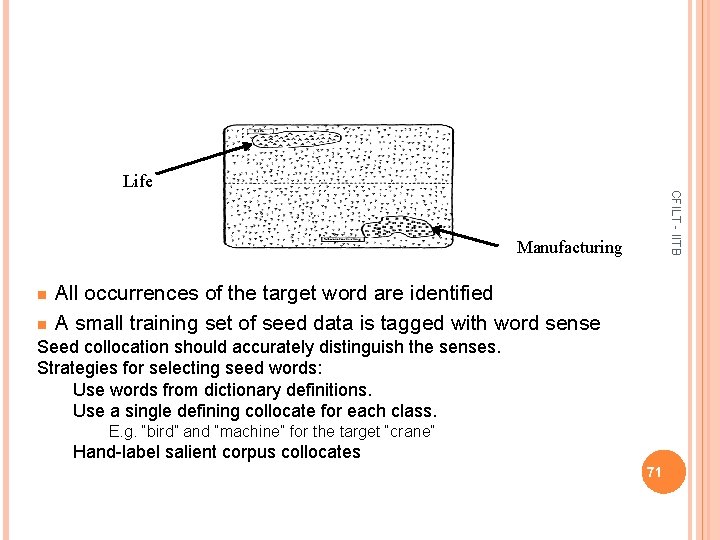
INITIALIZATION, PROGRESS AND CONVERGENCE Residual data Seed set grows Manufacturing CFILT - IITB Life Stop when residual set stabilizes 29
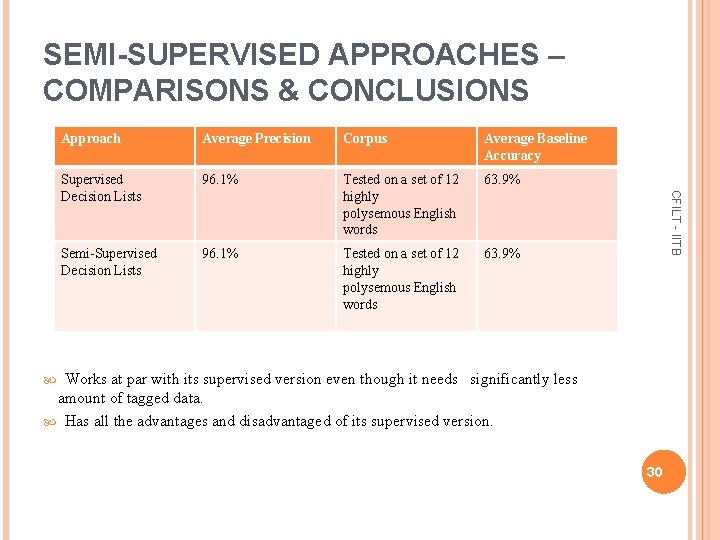
SEMI-SUPERVISED APPROACHES – COMPARISONS & CONCLUSIONS Average Precision Corpus Average Baseline Accuracy Supervised Decision Lists 96. 1% Tested on a set of 12 highly polysemous English words 63. 9% Semi-Supervised Decision Lists 96. 1% Tested on a set of 12 highly polysemous English words 63. 9% CFILT - IITB Approach Works at par with its supervised version even though it needs significantly less amount of tagged data. Has all the advantages and disadvantaged of its supervised version. 30
ROADMAP Knowledge Based Approaches WSD using Selectional Preferences (or restrictions) Overlap Based Approaches CFILT - IITB Machine Learning Based Approaches Supervised Approaches Semi-supervised Algorithms Unsupervised Algorithms Hybrid Approaches Reducing Knowledge Acquisition Bottleneck WSD and MT Summary Future Work 31
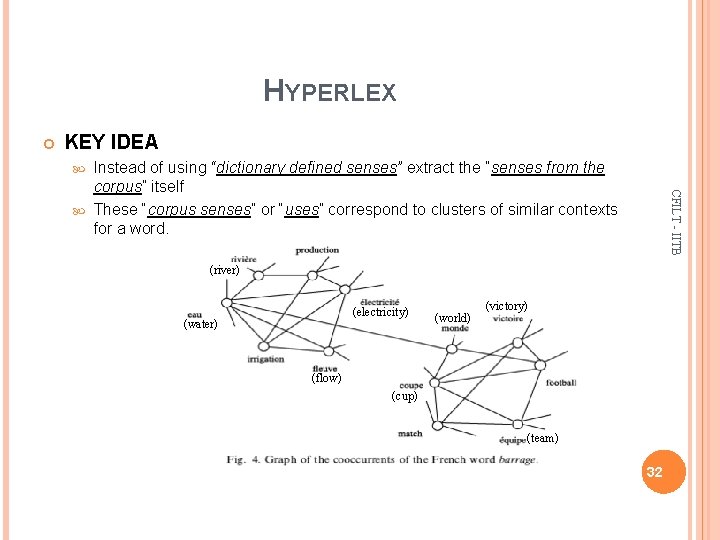
HYPERLEX KEY IDEA Instead of using “dictionary defined senses” extract the “senses from the corpus” itself These “corpus senses” or “uses” correspond to clusters of similar contexts for a word. CFILT - IITB (river) (electricity) (water) (world) (victory) (flow) (cup) (team) 32
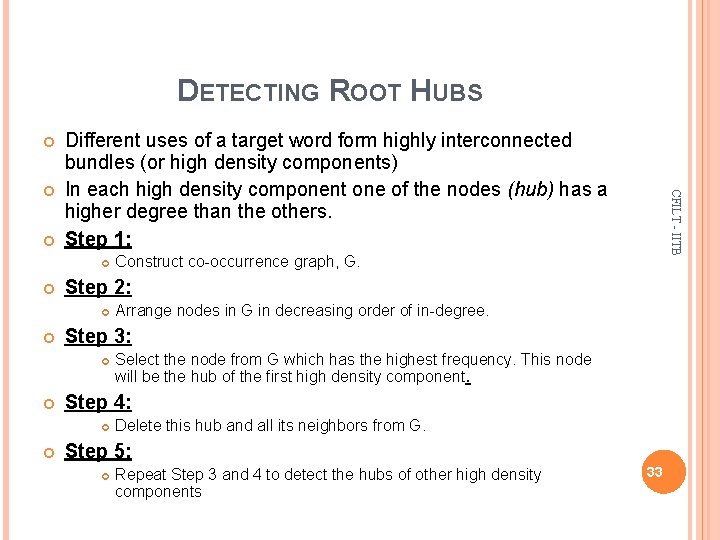
DETECTING ROOT HUBS Select the node from G which has the highest frequency. This node will be the hub of the first high density component. Step 4: Arrange nodes in G in decreasing order of in-degree. Step 3: Construct co-occurrence graph, G. Step 2: CFILT - IITB Different uses of a target word form highly interconnected bundles (or high density components) In each high density component one of the nodes (hub) has a higher degree than the others. Step 1: Delete this hub and all its neighbors from G. Step 5: Repeat Step 3 and 4 to detect the hubs of other high density components 33
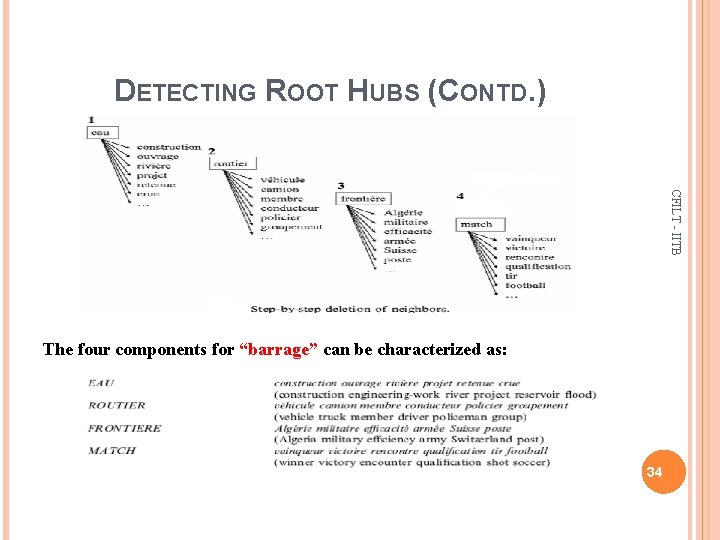
DETECTING ROOT HUBS (CONTD. ) CFILT - IITB The four components for “barrage” can be characterized as: 34
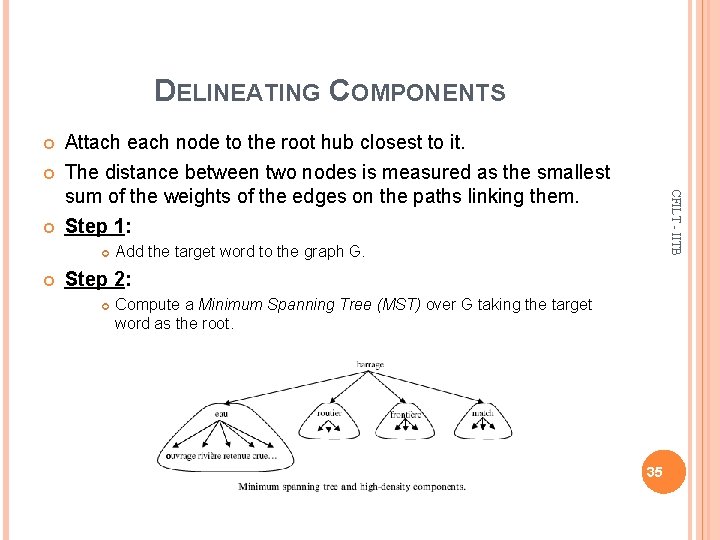
DELINEATING COMPONENTS CFILT - IITB Attach each node to the root hub closest to it. The distance between two nodes is measured as the smallest sum of the weights of the edges on the paths linking them. Step 1: Add the target word to the graph G. Step 2: Compute a Minimum Spanning Tree (MST) over G taking the target word as the root. 35
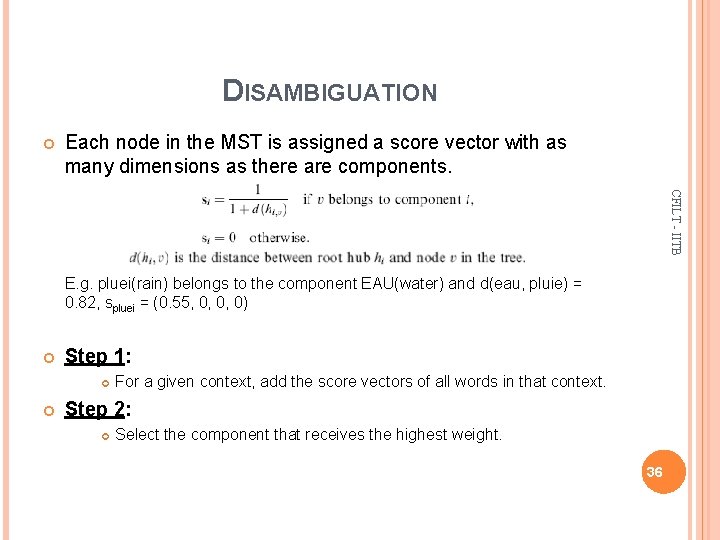
DISAMBIGUATION Each node in the MST is assigned a score vector with as many dimensions as there are components. CFILT - IITB E. g. pluei(rain) belongs to the component EAU(water) and d(eau, pluie) = 0. 82, spluei = (0. 55, 0, 0, 0) Step 1: For a given context, add the score vectors of all words in that context. Step 2: Select the component that receives the highest weight. 36
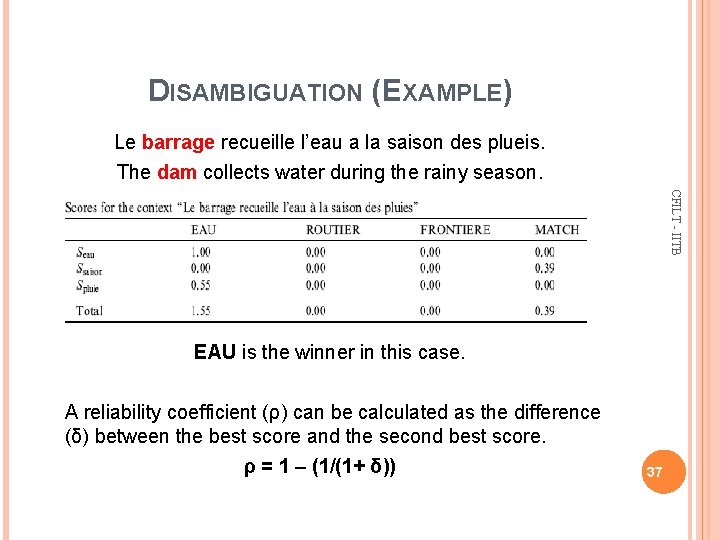
DISAMBIGUATION (EXAMPLE) Le barrage recueille l’eau a la saison des plueis. The dam collects water during the rainy season. CFILT - IITB EAU is the winner in this case. A reliability coefficient (ρ) can be calculated as the difference (δ) between the best score and the second best score. ρ = 1 – (1/(1+ δ)) 37
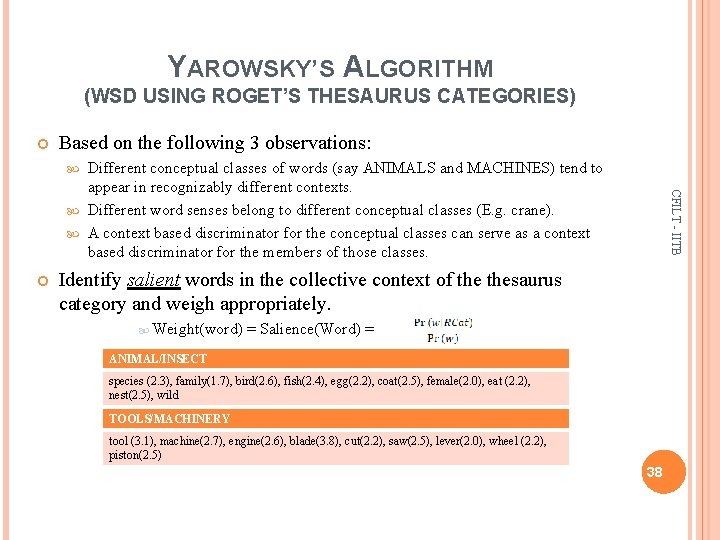
YAROWSKY’S ALGORITHM (WSD USING ROGET’S THESAURUS CATEGORIES) Based on the following 3 observations: Different conceptual classes of words (say ANIMALS and MACHINES) tend to appear in recognizably different contexts. Different word senses belong to different conceptual classes (E. g. crane). A context based discriminator for the conceptual classes can serve as a context based discriminator for the members of those classes. CFILT - IITB Identify salient words in the collective context of thesaurus category and weigh appropriately. Weight(word) = Salience(Word) = ANIMAL/INSECT species (2. 3), family(1. 7), bird(2. 6), fish(2. 4), egg(2. 2), coat(2. 5), female(2. 0), eat (2. 2), nest(2. 5), wild TOOLS/MACHINERY tool (3. 1), machine(2. 7), engine(2. 6), blade(3. 8), cut(2. 2), saw(2. 5), lever(2. 0), wheel (2. 2), piston(2. 5) 38
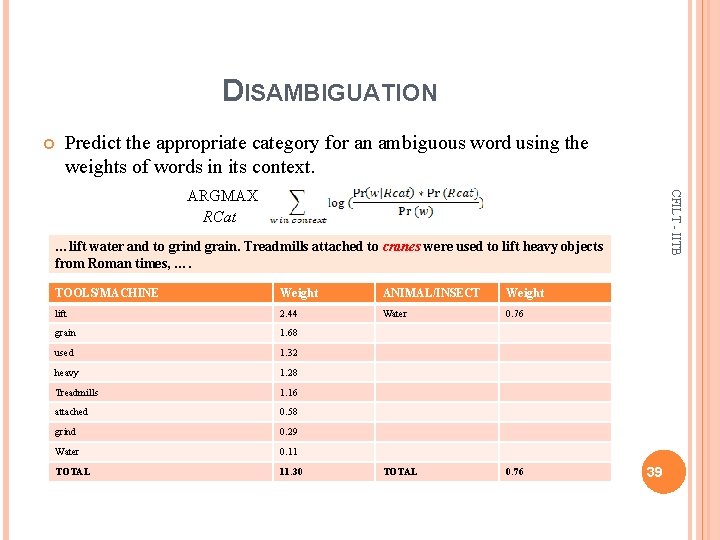
DISAMBIGUATION Predict the appropriate category for an ambiguous word using the weights of words in its context. CFILT - IITB ARGMAX RCat …lift water and to grind grain. Treadmills attached to cranes were used to lift heavy objects from Roman times, …. TOOLS/MACHINE Weight ANIMAL/INSECT Weight lift 2. 44 Water 0. 76 grain 1. 68 used 1. 32 heavy 1. 28 Treadmills 1. 16 attached 0. 58 grind 0. 29 Water 0. 11 TOTAL 11. 30 TOTAL 0. 76 39
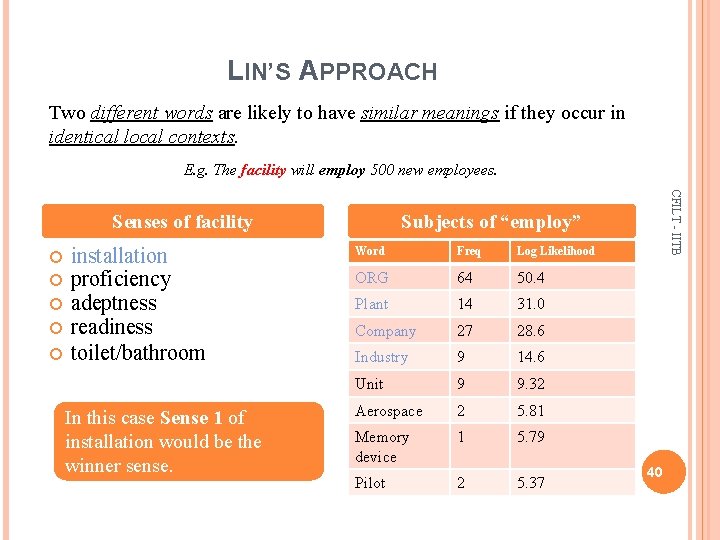
LIN’S APPROACH Two different words are likely to have similar meanings if they occur in identical local contexts. E. g. The facility will employ 500 new employees. installation proficiency adeptness readiness toilet/bathroom In this case Sense 1 of installation would be the winner sense. CFILT - IITB Senses of facility Subjects of “employ” Word Freq Log Likelihood ORG 64 50. 4 Plant 14 31. 0 Company 27 28. 6 Industry 9 14. 6 Unit 9 9. 32 Aerospace 2 5. 81 Memory device 1 5. 79 Pilot 2 5. 37 40
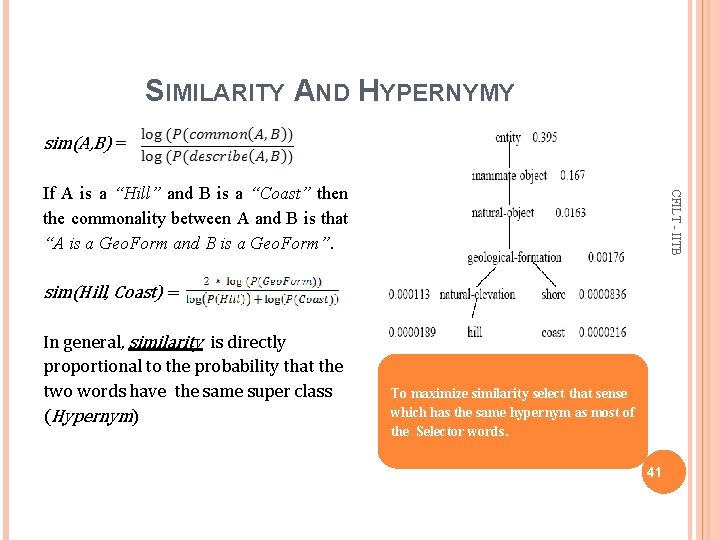
SIMILARITY AND HYPERNYMY sim(A, B) = CFILT - IITB If A is a “Hill” and B is a “Coast” then the commonality between A and B is that “A is a Geo. Form and B is a Geo. Form”. sim(Hill, Coast) = In general, similarity is directly proportional to the probability that the two words have the same super class (Hypernym) To maximize similarity select that sense which has the same hypernym as most of the Selector words. 41
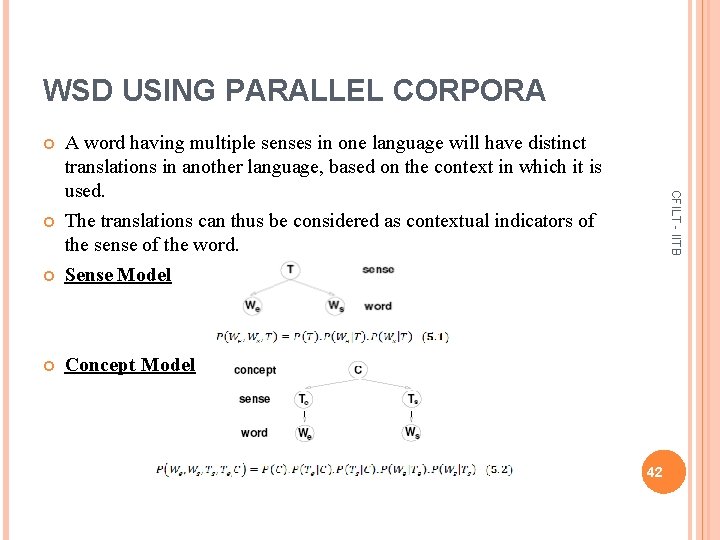
WSD USING PARALLEL CORPORA Sense Model Concept Model CFILT - IITB A word having multiple senses in one language will have distinct translations in another language, based on the context in which it is used. The translations can thus be considered as contextual indicators of the sense of the word. 42
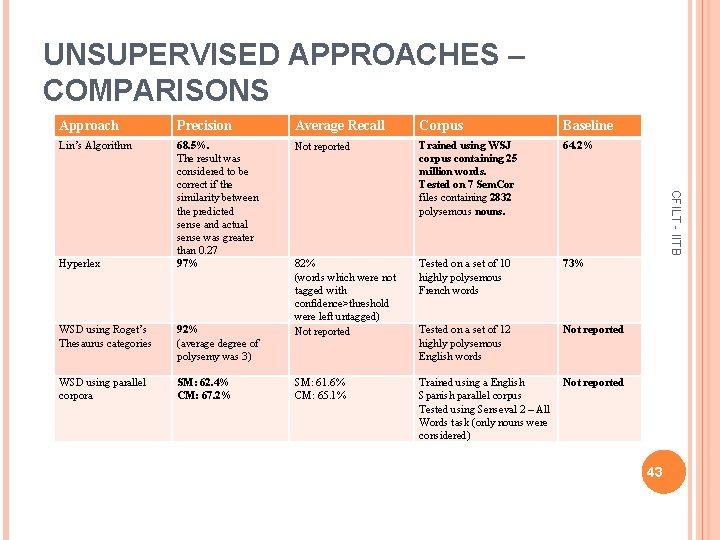
UNSUPERVISED APPROACHES – COMPARISONS Precision Average Recall Corpus Baseline Lin’s Algorithm 68. 5%. The result was considered to be correct if the similarity between the predicted sense and actual sense was greater than 0. 27 97% Not reported Trained using WSJ corpus containing 25 million words. Tested on 7 Sem. Cor files containing 2832 polysemous nouns. 64. 2% 82% (words which were not tagged with confidence>threshold were left untagged) Not reported Tested on a set of 10 highly polysemous French words 73% Tested on a set of 12 highly polysemous English words Not reported SM: 61. 6% CM: 65. 1% Trained using a English Spanish parallel corpus Tested using Senseval 2 – All Words task (only nouns were considered) Not reported Hyperlex WSD using Roget’s Thesaurus categories 92% (average degree of polysemy was 3) WSD using parallel corpora SM: 62. 4% CM: 67. 2% CFILT - IITB Approach 43
UNSUPERVISED APPROACHES – CONCLUSIONS Combine the advantages of supervised and knowledge based approaches. Just as supervised approaches they extract evidence from corpus. Just as knowledge based approaches they do not need tagged corpus. CFILT - IITB General Comments Lin’s Algorithm A general purpose broad coverage approach. Can even work for words which do not appear in the corpus. Hyperlex Use of small world properties was a first of its kind approach for automatically extracting corpus evidence. A word-specific classifier. The algorithm would fail to distinguish between finer senses of a word (e. g. the medicinal and narcotic senses of “drug”) 44
UNSUPERVISED APPROACHES – CONCLUSIONS Yarowsky’s Algorithm A broad coverage classifier. Can be used for words which do not appear in the corpus. But it was not tested on an “all word corpus”. CFILT - IITB WSD using Parallel Corpora Can distinguish even between finer senses of a word because even finer senses of a word get translated as distinct words. Needs a word aligned parallel corpora which is difficult to get. An exceptionally large number of parameters need to be trained. 45
ROADMAP Knowledge Based Approaches WSD using Selectional Preferences (or restrictions) Overlap Based Approaches CFILT - IITB Machine Learning Based Approaches Supervised Approaches Semi-supervised Algorithms Unsupervised Algorithms Hybrid Approaches Reducing Knowledge Acquisition Bottleneck WSD and MT Summary Future Work 46
AN ITERATIVE APPROACH TO WSD CFILT - IITB Uses semantic relations (synonymy and hypernymy) form Word. Net. Extracts collocational and contextual information form Word. Net (gloss) and a small amount of tagged data. Monosemic words in the context serve as a seed set of disambiguated words. In each iteration new words are disambiguated based on their semantic distance from already disambiguated words. It would be interesting to exploit other semantic relations available in Word. Net. 47
SENSELEARNER Uses some tagged data to build a semantic language model for words seen in the training corpus. Uses Word. Net to derive semantic generalizations for words which are not observed in the corpus. Semantic Language Model For each POS tag, using the corpus, a training set is constructed. Each training example is represented as a feature vector and a class label which is word#sense In the testing phase, for each test sentence, a similar feature vector is constructed. The trained classifier is used to predict the word and the sense. If the predicted word is same as the observed word then the predicted sense is selected as the correct sense. CFILT - IITB 48
SENSELEARNER (CONTD. ) CFILT - IITB Semantic Generalizations Improvises Lin’s algorithm by using semantic dependencies form the Word. Net. E. g. if “drink water” is observed in the corpus then using the hypernymy tree we can derive the syntactic dependency “take-in liquid” can then be used to disambiguate an instance of the word tea as in “take tea”, by using the hypernymy-hyponymy relations. 49
STRUCTURAL SEMANTIC INTERCONNECTIONS (SSI) An iterative approach. Uses the following relations hypernymy (car#1 is a kind of vehicle#1) denoted by (kind-of ) hyponymy (the inverse of hypernymy) denoted by (has-kind) meronymy (room#1 has-part wall#1) denoted by (has-part ) holonymy (the inverse of meronymy) denoted by (part-of ) pertainymy (dental#1 pertains-to tooth#1) denoted by (pert) attribute (dry#1 value-of wetness#1) denoted by (attr) similarity (beautiful#1 similar-to pretty#1) denoted by (sim) gloss denoted by (gloss) context denoted by (context) domain denoted by (dl) CFILT - IITB Monosemic words serve as the seed set for disambiguation. 50
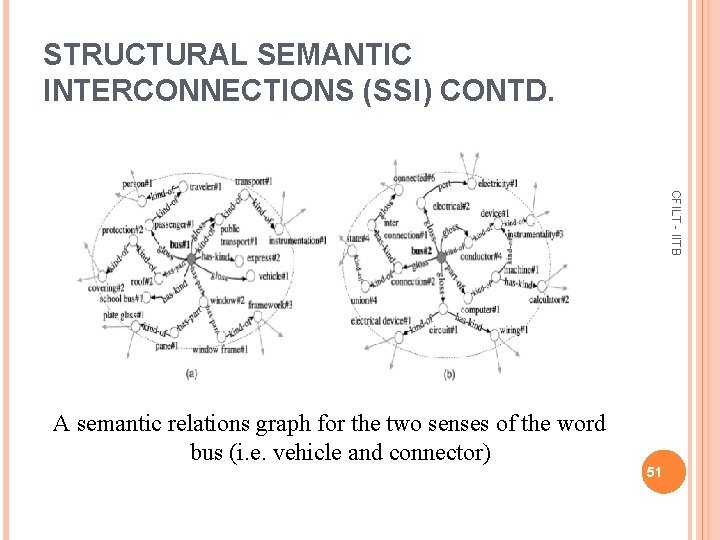
STRUCTURAL SEMANTIC INTERCONNECTIONS (SSI) CONTD. CFILT - IITB A semantic relations graph for the two senses of the word bus (i. e. vehicle and connector) 51
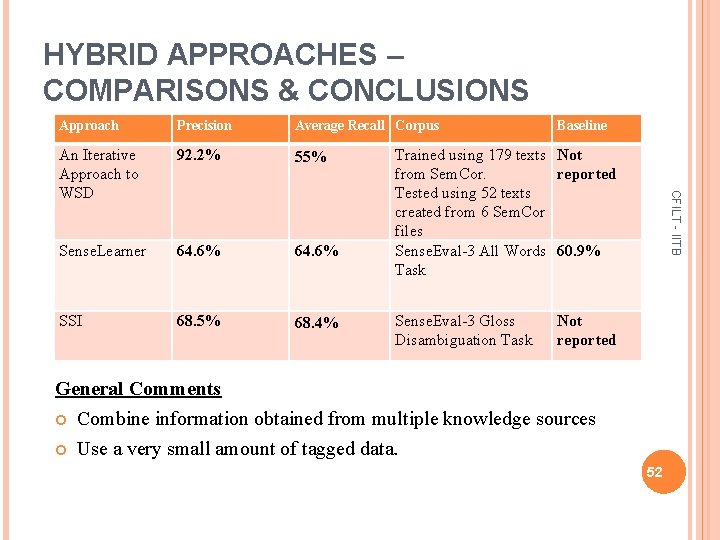
HYBRID APPROACHES – COMPARISONS & CONCLUSIONS Approach Precision Average Recall Corpus An Iterative Approach to WSD 92. 2% 55% Sense. Learner 64. 6% SSI 68. 5% 68. 4% Baseline Sense. Eval-3 Gloss Disambiguation Task CFILT - IITB Trained using 179 texts Not from Sem. Cor. reported Tested using 52 texts created from 6 Sem. Cor files Sense. Eval-3 All Words 60. 9% Task Not reported General Comments Combine information obtained from multiple knowledge sources Use a very small amount of tagged data. 52
ROADMAP Knowledge Based Approaches WSD using Selectional Preferences (or restrictions) Overlap Based Approaches CFILT - IITB Machine Learning Based Approaches Supervised Approaches Semi-supervised Algorithms Unsupervised Algorithms Hybrid Approaches Reducing Knowledge Acquisition Bottleneck WSD and MT Summary Future Work 53
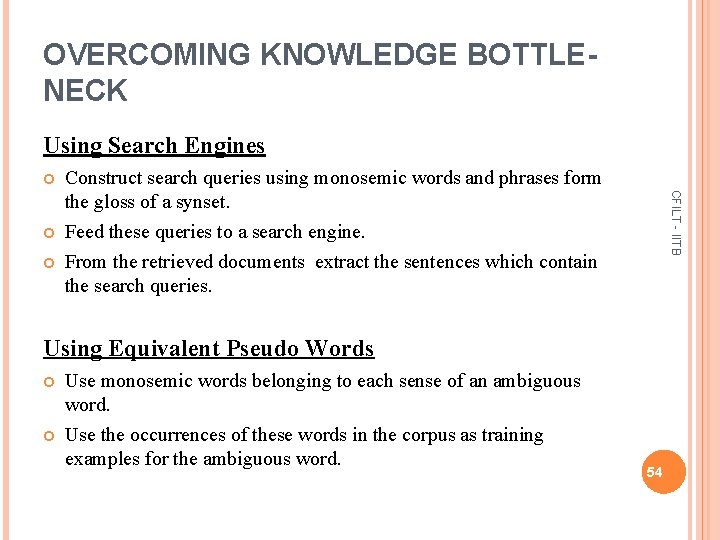
OVERCOMING KNOWLEDGE BOTTLENECK Using Search Engines CFILT - IITB Construct search queries using monosemic words and phrases form the gloss of a synset. Feed these queries to a search engine. From the retrieved documents extract the sentences which contain the search queries. Using Equivalent Pseudo Words Use monosemic words belonging to each sense of an ambiguous word. Use the occurrences of these words in the corpus as training examples for the ambiguous word. 54
ROADMAP Knowledge Based Approaches WSD using Selectional Preferences (or restrictions) Overlap Based Approaches CFILT - IITB Machine Learning Based Approaches Supervised Approaches Semi-supervised Algorithms Unsupervised Algorithms Hybrid Approaches Reducing Knowledge Acquisition Bottleneck WSD and MT Summary Future Work 55
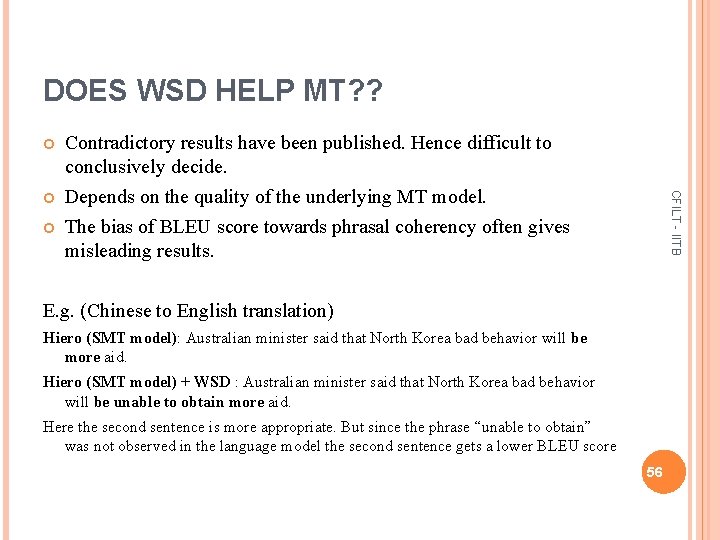
DOES WSD HELP MT? ? CFILT - IITB Contradictory results have been published. Hence difficult to conclusively decide. Depends on the quality of the underlying MT model. The bias of BLEU score towards phrasal coherency often gives misleading results. E. g. (Chinese to English translation) Hiero (SMT model): Australian minister said that North Korea bad behavior will be more aid. Hiero (SMT model) + WSD : Australian minister said that North Korea bad behavior will be unable to obtain more aid. Here the second sentence is more appropriate. But since the phrase “unable to obtain” was not observed in the language model the second sentence gets a lower BLEU score 56
ROADMAP Knowledge Based Approaches WSD using Selectional Preferences (or restrictions) Overlap Based Approaches CFILT - IITB Machine Learning Based Approaches Supervised Approaches Semi-supervised Algorithms Unsupervised Algorithms Hybrid Approaches Reducing Knowledge Acquisition Bottleneck WSD and MT Summary Future Work 57
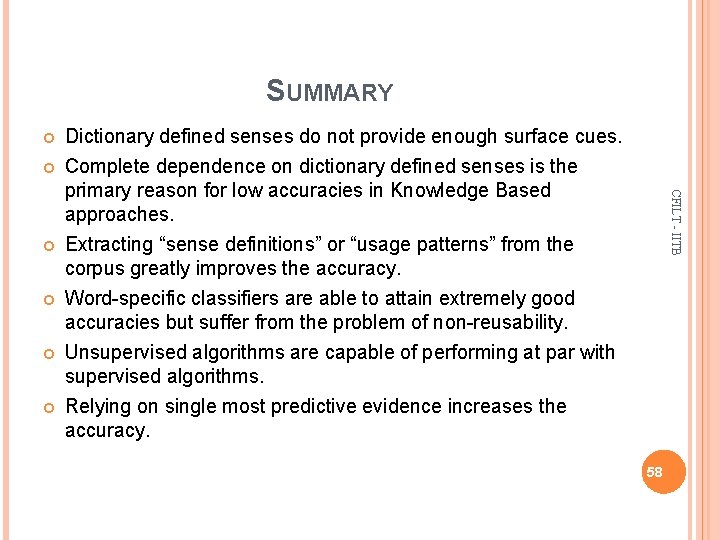
SUMMARY CFILT - IITB Dictionary defined senses do not provide enough surface cues. Complete dependence on dictionary defined senses is the primary reason for low accuracies in Knowledge Based approaches. Extracting “sense definitions” or “usage patterns” from the corpus greatly improves the accuracy. Word-specific classifiers are able to attain extremely good accuracies but suffer from the problem of non-reusability. Unsupervised algorithms are capable of performing at par with supervised algorithms. Relying on single most predictive evidence increases the accuracy. 58
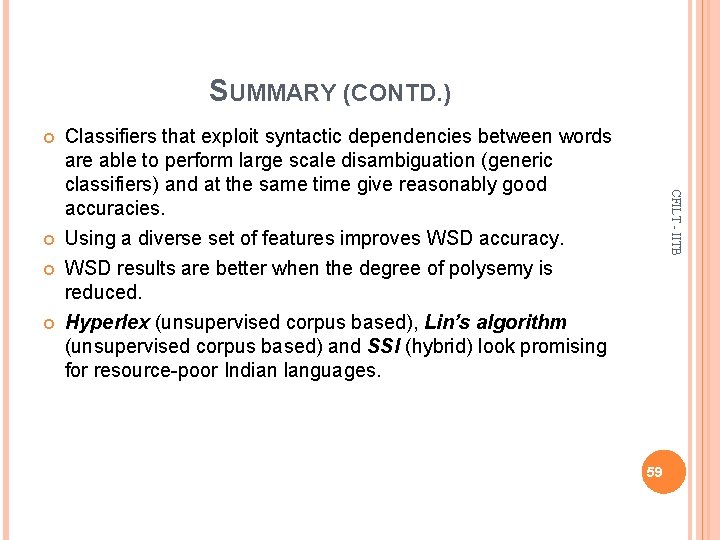
SUMMARY (CONTD. ) CFILT - IITB Classifiers that exploit syntactic dependencies between words are able to perform large scale disambiguation (generic classifiers) and at the same time give reasonably good accuracies. Using a diverse set of features improves WSD accuracy. WSD results are better when the degree of polysemy is reduced. Hyperlex (unsupervised corpus based), Lin’s algorithm (unsupervised corpus based) and SSI (hybrid) look promising for resource-poor Indian languages. 59
ROADMAP Knowledge Based Approaches WSD using Selectional Preferences (or restrictions) Overlap Based Approaches CFILT - IITB Machine Learning Based Approaches Supervised Approaches Semi-supervised Algorithms Unsupervised Algorithms Hybrid Approaches Reducing Knowledge Acquisition Bottleneck WSD and MT Summary Future Work 60
FUTURE WORK Use unsupervised or hybrid approaches to develop a multilingual WSD engine. (focusing on MT) Automatically generate sense tagged data. Explore the possibility of using an ensemble of WSD algorithms. Explore whether it possible to evaluate the role of WSD in MT (the evaluation should be independent of the MT model being used) CFILT - IITB 61
REFERENCES Michael Lesk. 1986. “Automatic sense disambiguation using machine readable dictionaries: how to tell a pine cone from an ice cream cone”, in Proceedings of the 5 th annual international conference on Systems documentation, Toronto, Ontario, Canada, 1986. Walker D. and Amsler R. 1986. "The Use of Machine Readable Dictionaries in Sublanguage Analysis", in Analyzing Language in Restricted Domains, Grishman and Kittredge (eds), LEA Press, pp. 69 -83, 1986. Yarowsky, David. 1992. "Word sense disambiguation using statistical models of Roget's categories trained on large corpora", in Proceedings of the 14 th International Conference on Computational Linguistics (COLING), Nantes, France, 454 -460, 1992. Yarowsky, David. 1994. "Decision lists for lexical ambiguity resolution: Application to accent restoration in Spanish and French", in Proceedings of the 32 nd Annual Meeting of the Association for Computational Linguistics (ACL), Las Cruces, U. S. A. , 8895, 1994. Yarowsky, David. 1995. "Unsupervised word sense disambiguation rivaling supervised methods", in Proceedings of the 33 rd Annual Meeting of the Association for Computational Linguistics (ACL), Cambridge, MA, 189 -196, 1995. Agirre, Eneko & German Rigau. 1996. "Word sense disambiguation using conceptual density", in Proceedings of the 16 th International Conference on Computational Linguistics (COLING), Copenhagen, Denmark, 1996 CFILT - IITB 62
REFERENCES (CONTD. ) Ng, Hwee T. & Hian B. Lee. 1996. "Integrating multiple knowledge sources to disambiguate word senses: An exemplar-based approach", Proceedings of the 34 th Annual Meeting of the Association for Computational Linguistics (ACL), Santa Cruz, U. S. A. , 40 -47. Ng, Hwee T. 1997. "Exemplar-based word sense disambiguation: Some recent improvements", Proceedings of the 2 nd Conference on Empirical Methods in Natural Language Processing (EMNLP), Providence, U. S. A. , 208 -213. Lin, Dekang. 1997. "Using syntactic dependency as local context to resolve word sense ambiguity", in Proceedings of the 35 th Annual Meeting of the Association for Computational Linguistics (ACL), Madrid, 64 -71, 1997. Rada Mihalcea, Dan I. Moldovan, 1999. "An automatic method for generating sense tagged corpora", Proceedings of the sixteenth national conference on Artificial intelligence and the eleventh Innovative applications of artificial intelligence conference innovative applications of artificial intelligence. Orlando, Florida, United States, 1999. Philip Resnik, 1999. "Semantic Similarity in a Taxonomy: An Information-Based Measure and its Application to Problems of Ambiguity in Natural Language", Journal of Artificial Intelligence Research, 1999. CFILT - IITB 63
REFERENCES (CONTD. ) E. Agirre, J. Atserias, L. Padr, G. Rigau, 2000. "Combining Supervised and Unsupervised Lexical Knowledge Methods for Word Sense Disambiguation Computers and the Humanities", Special Double Issue on Sens. Eval. Eds. Martha Palmer and Adam Kilgarriff. 34: 1, 2, 2000. Rada Mihalcea and Dan Moldovan, 2000. "An Iterative Approach to Word Sense Disambiguation", in Proceedings of Florida Artificial Intelligence Research Society Conference (FLAIRS 2000), [pg. 219 -223] Orlando, FL, May 2000. Agirre Eneko, Ansa Olatz, Hovy Eduard, Martinez David, 2001. "Enriching Word. Net concepts with topic signatures", Proceedings of the NAACL workshop on Word. Net and Other lexical Resources: Applications, Extensions and Customizations. Pittsburg, 2001. Mona Diab and Philip Resnik, 2002. "An Unsupervised Method for Word Sense Tagging Using Parallel Corpora", In Proceedings of the 40 th Annual Meeting of the Association for Computational Linguistics, Philadelphia, Pennsylvania, July 2002. Véronis, Jean. 2004. "Hyper. Lex: Lexical cartography for information retrieval", Computer Speech & Language, 18(3): 223 -252, 2004. Rada Mihalcea and Ehsanul Faruque, 2004. "Sense. Learner: Minimally Supervised Word Sense Disambiguation for All Words in Open Text", in Proceedings of ACL/SIGLEX Senseval-3, Barcelona, Spain, July 2004. CFILT - IITB 64
REFERENCES (CONTD. ) Indrajit Bhattacharya, Lise Getoor, Yoshua Bengio, 2004. "Unsupervised sense disambiguation using bilingual probabilistic models", In Proceedings of the 42 nd Annual Meeting on Association for Computational Linguistics, Spain, 2004. Lee, Yoong K. , Hwee T. Ng & Tee K. Chia. 2004. "Supervised word sense disambiguation with support vector machines and multiple knowledge sources", Proceedings of Senseval-3: Third International Workshop on the Evaluation of Systems for the Semantic Analysis of Text, Barcelona, Spain, 137 -140. Mihalcea, Rada. 2005. "Large vocabulary unsupervised word sense disambiguation with graph-based algorithms for sequence data labeling", in Proceedings of the Joint Human Language Technology and Empirical Methods in Natural Language Processing Conference (HLT/EMNLP), Vancouver, Canada, 411 -418, 2005. Marine Carpuat, Dekai Wu, 2005. "Evaluating the Word Sense Disambiguation Performance of Statistical Machine Translation", Marine Carpuat and Dekai Wu, 2005. "Word sense disambiguation vs. statistical machine translation", In Proceedings of the 43 rd Annual Meeting of the Association for Computational Linguistics (ACL’ 05), pages 387 -394, Ann Arbor, Michigan, June 2005. Roberto Navigli, Paolo Velardi, 2005. "Structural Semantic Interconnections: A Knowledge-Based Approach to Word Sense Disambiguation", IEEE Transactions On Pattern Analysis and Machine Intelligence, July 2005. CFILT - IITB 65
REFERENCES (CONTD. ) M Ciaramita, Y. Altun, 2006. "Broad-Coverage Sense Disambiguation and Information Extraction with a Supersense Sequence Tagger", in Proceedings of the Conference on Empirical Methods in Natural Language Processing (EMNLP 2006). Yee Seng Chan, Hwee Tou Ng, 2006. "Estimating class priors in domain adaptation for word sense disambiguation", in Proceedings of the 21 st International Conference on Computational Linguistics and the 44 th annual meeting of the ACL, Sydney, 2006. Roberto Navigli, 2006. "Meaningful clustering of senses helps boost word sense disambiguation performance", in Proceedings of the 21 st International Conference on Computational Linguistics and the 44 th annual meeting of the ACL, Sydney, 2006. Roberto Navigli, 2006. "Ensemble methods for unsupervised WSD", in Proceedings of the 21 st International Conference on Computational Linguistics and the 44 th annual meeting of the ACL, Sydney, 2006. Zhimao Lu, Haifeng Wang, Jianmin Yao, Ting Liu, Sheng Li, 2006. "An equivalent pseudoword solution to Chinese word sense disambiguation", in Proceedings of the 21 st International Conference on Computational Linguistics and the 44 th annual meeting of the ACL, Sydney, 2006. CFILT - IITB 66
REFERENCES (CONTD. ) Yee Seng Chan, Hwee Tou Ng and David Chiang, 2007. "Word Sense Disambiguation Improves Statistical Machine Translation", in Proceedings of the 45 th Annual Meeting of the Association for Computational Linguistics, Prague, 2007. CFILT - IITB 67

CFILT - IITB ? ? THANK YOU! ? ? 68

EXTRA SLIDES
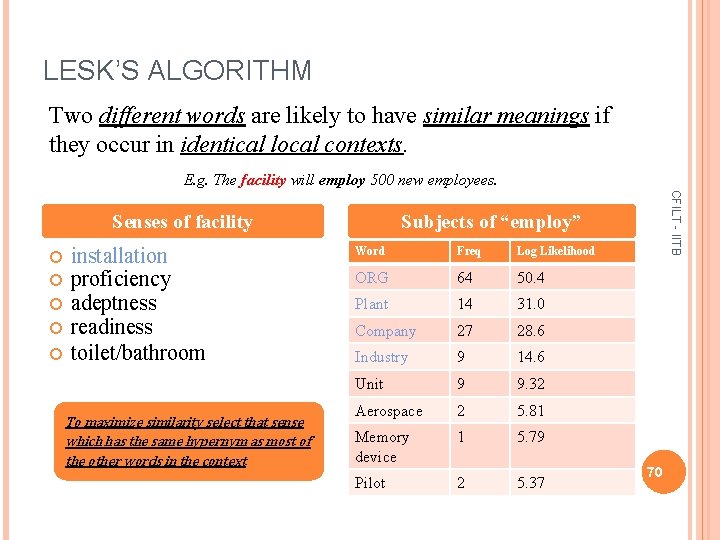
LESK’S ALGORITHM Two different words are likely to have similar meanings if they occur in identical local contexts. E. g. The facility will employ 500 new employees. installation proficiency adeptness readiness toilet/bathroom To maximize similarity select that sense which has the same hypernym as most of the other words in the context CFILT - IITB Senses of facility Subjects of “employ” Word Freq Log Likelihood ORG 64 50. 4 Plant 14 31. 0 Company 27 28. 6 Industry 9 14. 6 Unit 9 9. 32 Aerospace 2 5. 81 Memory device 1 5. 79 Pilot 2 5. 37 70
CFILT - IITB Life Manufacturing n n All occurrences of the target word are identified A small training set of seed data is tagged with word sense Seed collocation should accurately distinguish the senses. Strategies for selecting seed words: Use words from dictionary definitions. Use a single defining collocate for each class. E. g. “bird” and “machine” for the target “crane” Hand-label salient corpus collocates 71
SELECTIONAL PREFERENCES (INDIAN TRADITION) “Desire” of some words in the sentence (“aakaangksha”). “Appropriateness” of some other words in the sentence to fulfil that desire (“yogyataa”). CFILT - IITB I saw the boy with long hair. The verb “saw” and the noun “boy” desire an object here. I saw the boy with long hair. The PP “with long hair” can be appropriately connected only to “boy” and not “saw”. In case, the ambiguity is still present, “proximity” (“sannidhi”) can determine the meaning. E. g. I saw the boy with a telescope. The PP “with a telescope” can be attached to both “boy” and “saw”, so ambiguity still present. It is then attached to “boy” using the proximity check. 72
SELECTIONAL PREFERENCES (RECENT LINGUISTIC THEORY) CFILT - IITB There are words which demand arguments, like, verbs, prepositions, adjectives and sometimes nouns. These arguments are typically nouns. Arguments must have the property to fulfil the demand. They must satisfy selectional preferences. Example Give (verb) agent – animate obj – direct obj – indirect I gave him the book (yesterday in the school) -> adjunct How does this help in WSD? One type of contextual information is the information about the type of arguments that a word takes. 73
CRITIQUE Requires exhaustive enumeration in machine-readable form of: Argument-structure of verbs. Selectional preferences of arguments. Description of properties of words such that meeting the selectional preference criteria can be decided. CFILT - IITB E. g. This flight serves the “region” between Mumbai and Delhi How do you decide if “region” is compatible with “sector” Accuracy 44% on Brown corpus. 74
CRITIQUE Proper nouns in the context of an ambiguous word can act as strong disambiguators. E. g. “Sachin Tendulkar” will be a strong indicator of the category “sports”. Sachin Tendulkar plays cricket. Proper nouns are not present in thesaurus. Hence this approach fails to capture the strong clues provided by proper nouns. Accuracy 50% when tested on 10 highly polysemous English words. 75
CRITIQUE Suffers from sparse match: the possibility of word overlap is very less. Can be misled. E. g. As a result of the forest fire all olive trees were reduced to ash. Here Sense 1 of ash would be incorrectly chosen as the contextually appropriate sense. CFILT - IITB Proper nouns in the context of an ambiguous word can act as strong disambiguators. E. g. “Sachin Tendulkar” will be a strong indicator of the category “sports”. Sachin Tendulkar plays cricket. Proper nouns are not present in the Wordnet. Hence this approach fails to capture the strong clues provided by proper nouns. Accuracy 50 -60% on short samples of “Pride and Prejudice” and some “news stories”. 76
CRITIQUE The Good A non-syntactic approach. Simple Implementation. Does not require a tagged corpus. CFILT - IITB The Bad Suffers from sparse match: the possibility of word overlap is very less. Can be misled. E. g. As a result of the forest fire all olive trees were reduced to ash. Here Sense 1 of ash would be incorrectly chosen as the contextually appropriate sense. Proper nouns in the context of an ambiguous word can act as strong disambiguators. E. g. “Sachin Tendulkar” will be a strong indicator of the category “sports”. Sachin Tendulkar plays cricket. Proper nouns are not present in the Wordnet. Hence this approach fails to capture the strong clues provided by proper nouns. Accuracy 50 -60% on short samples of “Pride and Prejudice” and some “news stories”. 77
CRITIQUE Resolves lexical ambiguity of nouns by finding a combination of senses that maximizes the total Conceptual Density among senses. The Good Does not require a tagged corpus. The Bad CFILT - IITB Fails to capture the strong clues provided by proper nouns in the context. Accuracy 54% on Brown corpus. 78
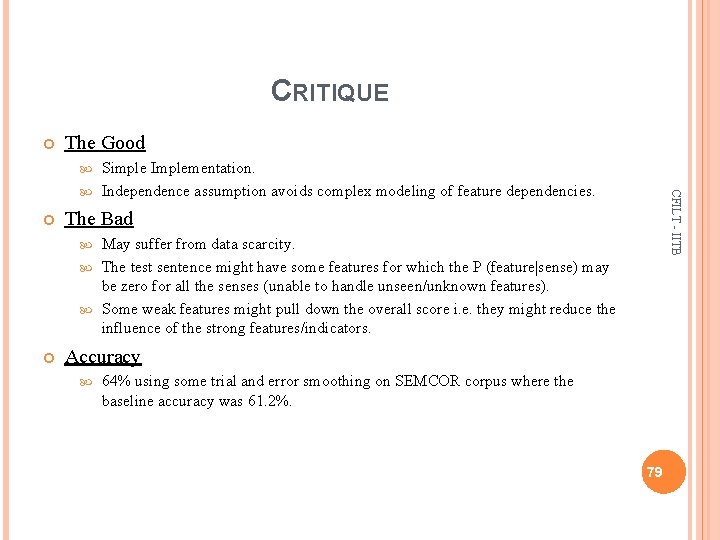
CRITIQUE The Good Simple Implementation. Independence assumption avoids complex modeling of feature dependencies. CFILT - IITB The Bad May suffer from data scarcity. The test sentence might have some features for which the P (feature|sense) may be zero for all the senses (unable to handle unseen/unknown features). Some weak features might pull down the overall score i. e. they might reduce the influence of the strong features/indicators. Accuracy 64% using some trial and error smoothing on SEMCOR corpus where the baseline accuracy was 61. 2%. 79
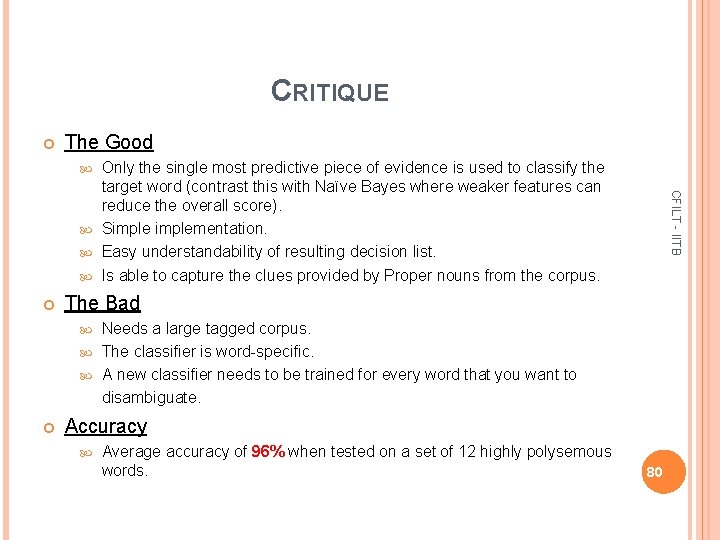
CRITIQUE The Good Only the single most predictive piece of evidence is used to classify the target word (contrast this with Naïve Bayes where weaker features can reduce the overall score). Simplementation. Easy understandability of resulting decision list. Is able to capture the clues provided by Proper nouns from the corpus. CFILT - IITB The Bad Needs a large tagged corpus. The classifier is word-specific. A new classifier needs to be trained for every word that you want to disambiguate. Accuracy Average accuracy of 96% when tested on a set of 12 highly polysemous words. 80
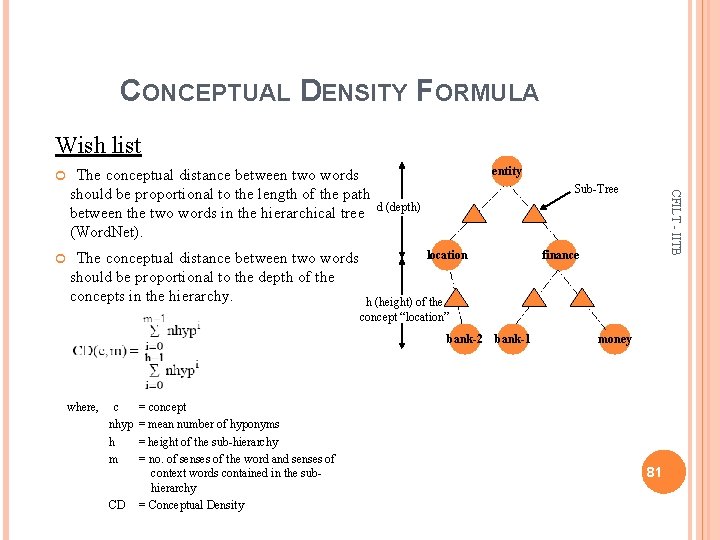
CONCEPTUAL DENSITY FORMULA Wish list The conceptual distance between two words should be proportional to the depth of the concepts in the hierarchy. entity Sub-Tree d (depth) location c nhyp h m CD = concept = mean number of hyponyms = height of the sub-hierarchy = no. of senses of the word and senses of context words contained in the subhierarchy = Conceptual Density finance h (height) of the concept “location” bank-2 bank-1 where, CFILT - IITB The conceptual distance between two words should be proportional to the length of the path between the two words in the hierarchical tree (Word. Net). money 81
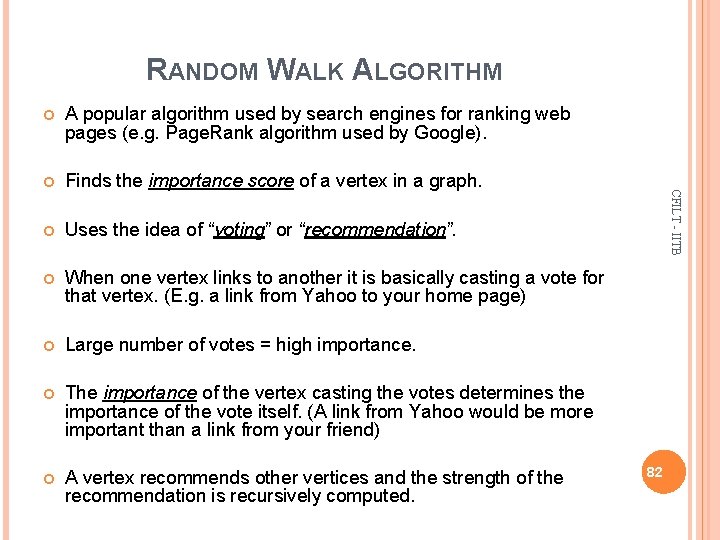
RANDOM WALK ALGORITHM A popular algorithm used by search engines for ranking web pages (e. g. Page. Rank algorithm used by Google). Finds the importance score of a vertex in a graph. Uses the idea of “voting” or “recommendation”. When one vertex links to another it is basically casting a vote for that vertex. (E. g. a link from Yahoo to your home page) Large number of votes = high importance. The importance of the vertex casting the votes determines the importance of the vote itself. (A link from Yahoo would be more important than a link from your friend) A vertex recommends other vertices and the strength of the recommendation is recursively computed. CFILT - IITB 82
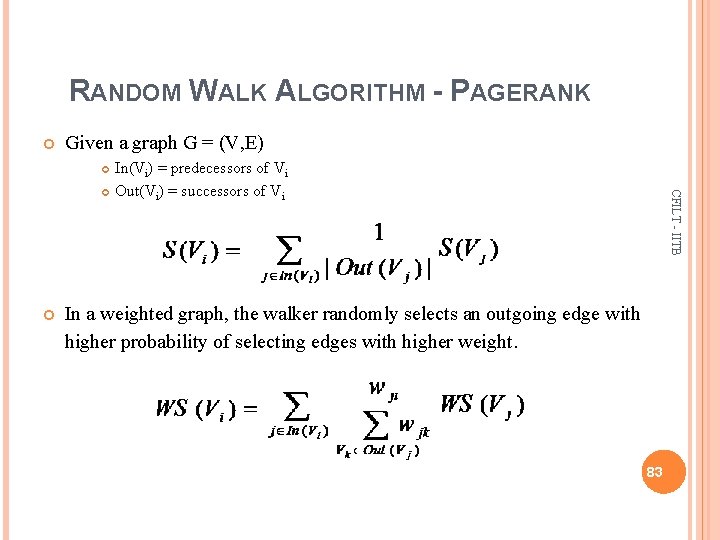
RANDOM WALK ALGORITHM - PAGERANK Given a graph G = (V, E) CFILT - IITB In(Vi) = predecessors of Vi Out(Vi) = successors of Vi In a weighted graph, the walker randomly selects an outgoing edge with higher probability of selecting edges with higher weight. 83
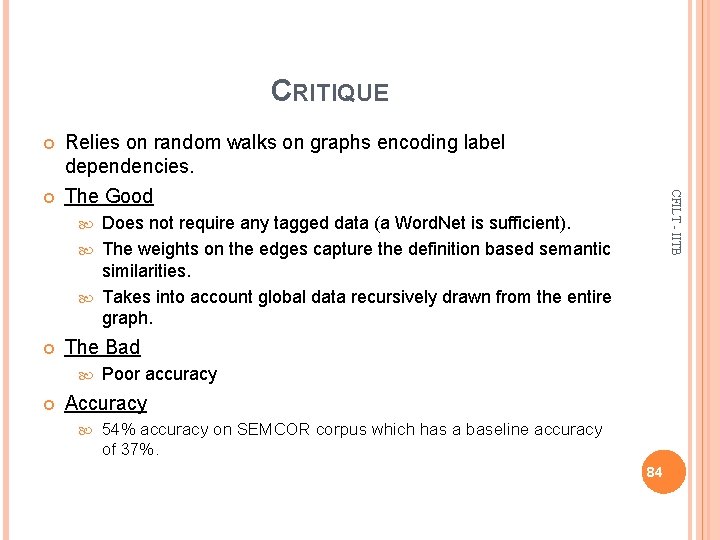
CRITIQUE Relies on random walks on graphs encoding label dependencies. The Good CFILT - IITB Does not require any tagged data (a Word. Net is sufficient). The weights on the edges capture the definition based semantic similarities. Takes into account global data recursively drawn from the entire graph. The Bad Poor accuracy Accuracy 54% accuracy on SEMCOR corpus which has a baseline accuracy of 37%. 84
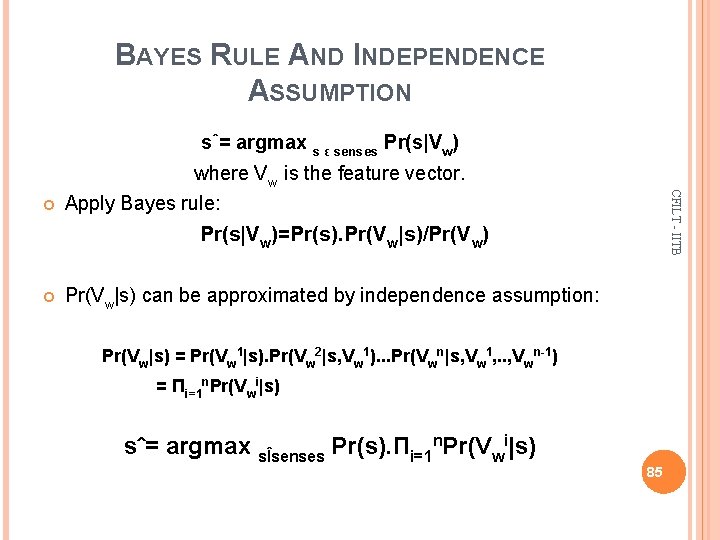
BAYES RULE AND INDEPENDENCE ASSUMPTION sˆ= argmax s ε senses Pr(s|Vw) where Vw is the feature vector. CFILT - IITB Apply Bayes rule: Pr(s|Vw)=Pr(s). Pr(Vw|s)/Pr(Vw) Pr(Vw|s) can be approximated by independence assumption: Pr(Vw|s) = Pr(Vw 1|s). Pr(Vw 2|s, Vw 1). . . Pr(Vwn|s, Vw 1, . . , Vwn-1) = Πi=1 n. Pr(Vwi|s) sˆ= argmax sÎsenses Pr(s). Πi=1 n. Pr(Vwi|s) 85
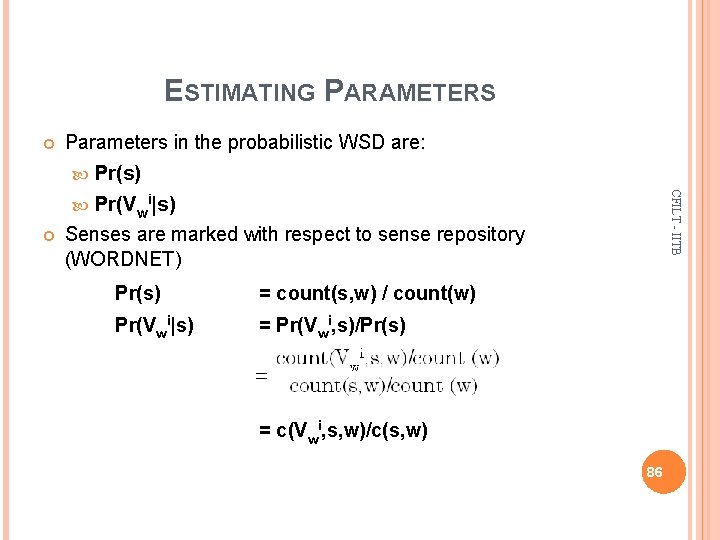
ESTIMATING PARAMETERS Parameters in the probabilistic WSD are: Pr(s) CFILT - IITB Pr(Vwi|s) Senses are marked with respect to sense repository (WORDNET) Pr(s) = count(s, w) / count(w) Pr(Vwi|s) = Pr(Vwi, s)/Pr(s) = c(Vwi, s, w)/c(s, w) 86
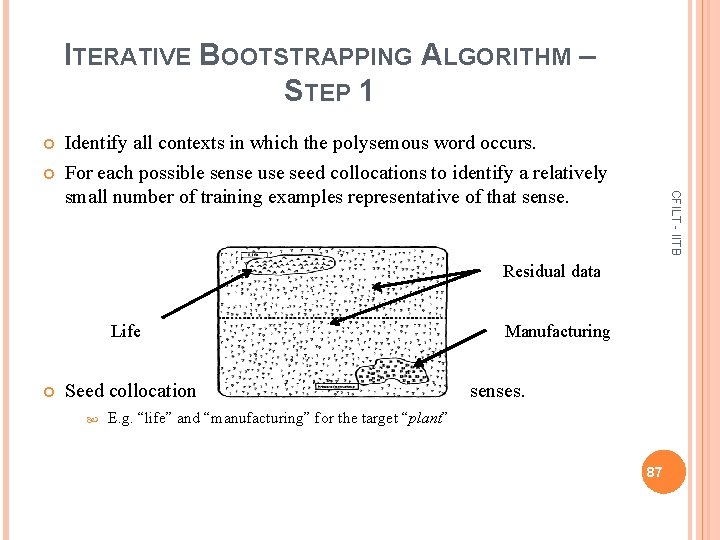
ITERATIVE BOOTSTRAPPING ALGORITHM – STEP 1 CFILT - IITB Identify all contexts in which the polysemous word occurs. For each possible sense use seed collocations to identify a relatively small number of training examples representative of that sense. Residual data Life Manufacturing Seed collocation should accurately distinguish the senses. E. g. “life” and “manufacturing” for the target “plant” 87
ITERATIVE BOOTSTRAPPING ALGORITHM – STEP 2 Train the Decision List algorithm on the seed data. Classify the entire sample set using the trained classifier. Create new seed data by adding those members which are tagged as Sense-A or Sense-B with high probability. Retrain the classifier using the new seed data. These additions will contribute new collocations that are reliably indicative of the 2 senses. CFILT - IITB 88
ONE SENSE PER DISCOURSE The accuracy of the algorithm can be improved by using the “One sense per discourse” property. After algorithm has converged CFILT - IITB Identify words that are tagged with low confidence and label them with the sense which is dominant for that document. After each iteration If there is substantial disagreement concerning which is the dominant sense, all instances in the discourse are returned to the residual set rather than merely leaving their current tags unchanged. This helps improve the purity of the training data. 89
CRITIQUE Harnesses powerful, empirically-observed properties of language. The Good CFILT - IITB Does not require large tagged corpus. Simplementation. Simple semi-supervised algorithm which builds on an existing supervised algorithm. Easy understandability of resulting decision list. Is able to capture the clues provided by Proper nouns from the corpus. The Bad The classifier is word-specific. A new classifier needs to be trained for every word that you want to disambiguate. Accuracy Average accuracy of 96% when tested on a set of 12 highly polysemous words. 90
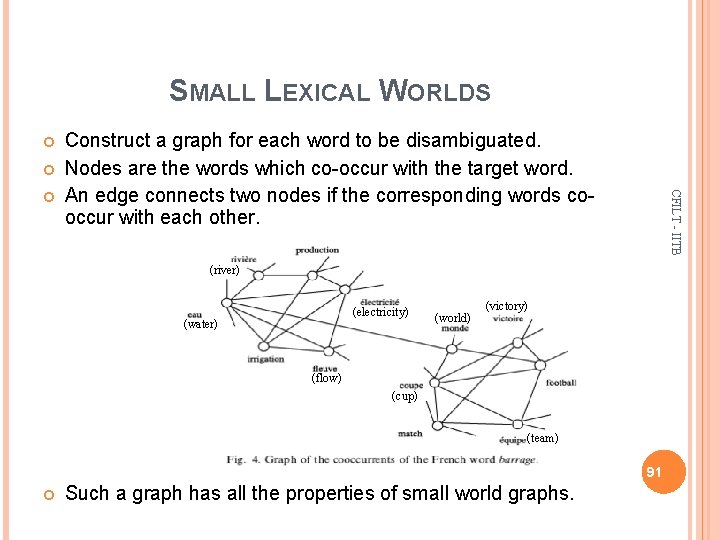
SMALL LEXICAL WORLDS CFILT - IITB Construct a graph for each word to be disambiguated. Nodes are the words which co-occur with the target word. An edge connects two nodes if the corresponding words cooccur with each other. (river) (electricity) (water) (world) (victory) (flow) (cup) (team) 91 Such a graph has all the properties of small world graphs.
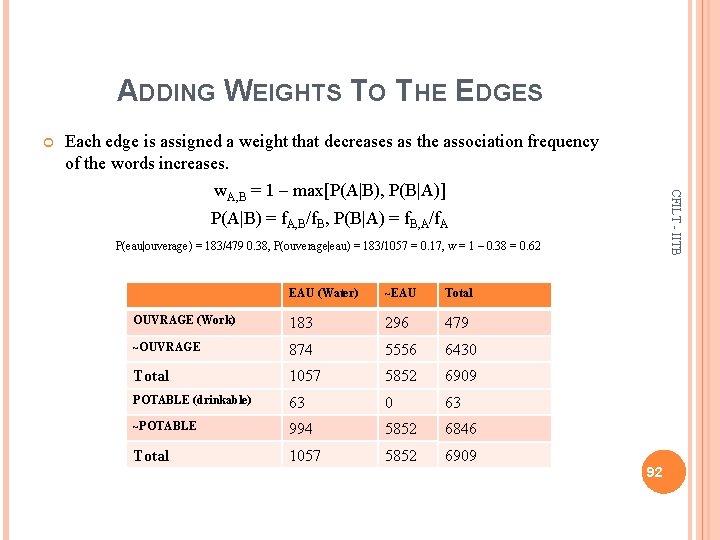
ADDING WEIGHTS TO THE EDGES Each edge is assigned a weight that decreases as the association frequency of the words increases. CFILT - IITB w. A, B = 1 – max[P(A|B), P(B|A)] P(A|B) = f. A, B/f. B, P(B|A) = f. B, A/f. A P(eau|ouverage) = 183/479 0. 38, P(ouverage|eau) = 183/1057 = 0. 17, w = 1 – 0. 38 = 0. 62 EAU (Water) ~EAU Total OUVRAGE (Work) 183 296 479 ~OUVRAGE 874 5556 6430 Total 1057 5852 6909 POTABLE (drinkable) 63 0 63 ~POTABLE 994 5852 6846 Total 1057 5852 6909 92
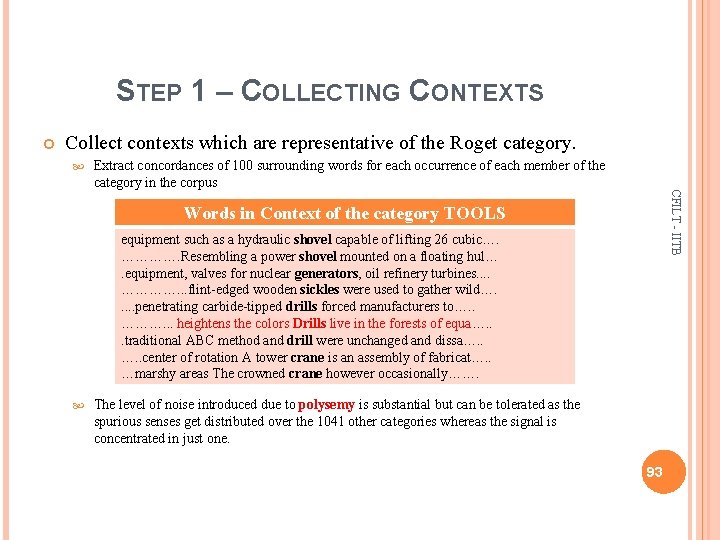
STEP 1 – COLLECTING CONTEXTS Collect contexts which are representative of the Roget category. Extract concordances of 100 surrounding words for each occurrence of each member of the CFILT - IITB category in the corpus Words in Context of the category TOOLS equipment such as a hydraulic shovel capable of lifting 26 cubic…. …………. Resembling a power shovel mounted on a floating hul…. equipment, valves for nuclear generators, oil refinery turbines. . …………. . . flint-edged wooden sickles were used to gather wild…. . . penetrating carbide-tipped drills forced manufacturers to…. . ………. . . heightens the colors Drills live in the forests of equa…. . . traditional ABC method and drill were unchanged and dissa…. . center of rotation A tower crane is an assembly of fabricat…. . …marshy areas The crowned crane however occasionally……. The level of noise introduced due to polysemy is substantial but can be tolerated as the spurious senses get distributed over the 1041 other categories whereas the signal is concentrated in just one. 93
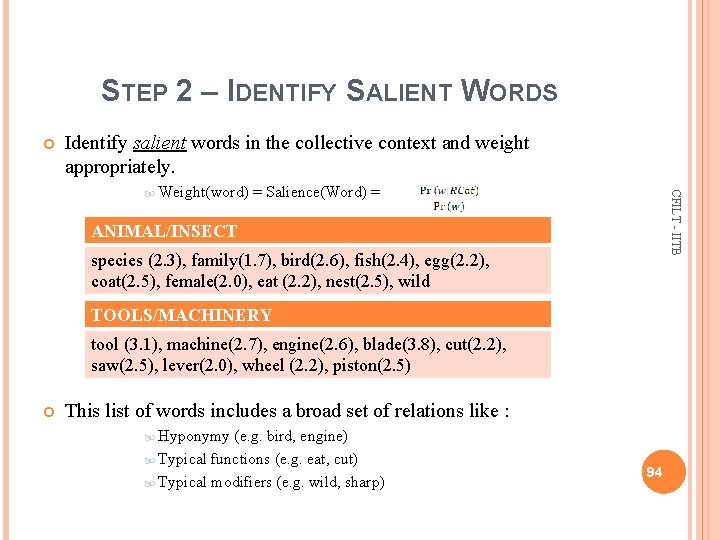
STEP 2 – IDENTIFY SALIENT WORDS Identify salient words in the collective context and weight appropriately. = Salience(Word) = CFILT - IITB Weight(word) ANIMAL/INSECT species (2. 3), family(1. 7), bird(2. 6), fish(2. 4), egg(2. 2), coat(2. 5), female(2. 0), eat (2. 2), nest(2. 5), wild TOOLS/MACHINERY tool (3. 1), machine(2. 7), engine(2. 6), blade(3. 8), cut(2. 2), saw(2. 5), lever(2. 0), wheel (2. 2), piston(2. 5) This list of words includes a broad set of relations like : Hyponymy (e. g. bird, engine) Typical functions (e. g. eat, cut) Typical modifiers (e. g. wild, sharp) 94
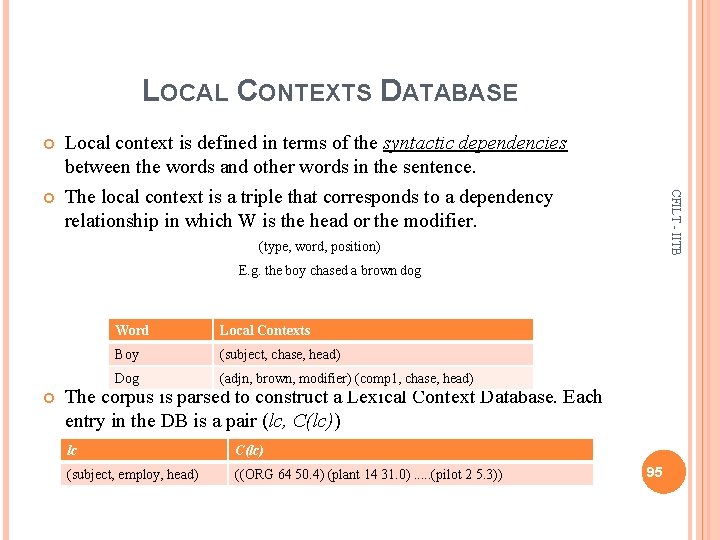
LOCAL CONTEXTS DATABASE CFILT - IITB Local context is defined in terms of the syntactic dependencies between the words and other words in the sentence. The local context is a triple that corresponds to a dependency relationship in which W is the head or the modifier. (type, word, position) E. g. the boy chased a brown dog Word Local Contexts Boy (subject, chase, head) Dog (adjn, brown, modifier) (comp 1, chase, head) The corpus is parsed to construct a Lexical Context Database. Each entry in the DB is a pair (lc, C(lc)) lc C(lc) (subject, employ, head) ((ORG 64 50. 4) (plant 14 31. 0). . . (pilot 2 5. 3)) 95
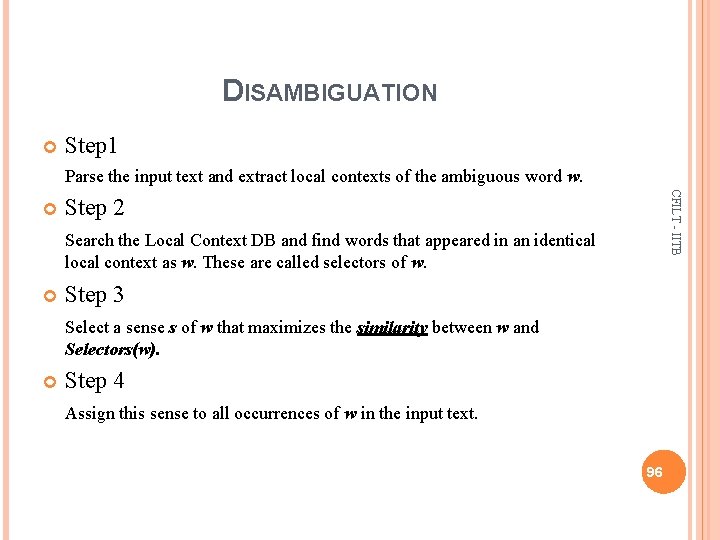
DISAMBIGUATION Step 1 Parse the input text and extract local contexts of the ambiguous word w. CFILT - IITB Step 2 Search the Local Context DB and find words that appeared in an identical local context as w. These are called selectors of w. Step 3 Select a sense s of w that maximizes the similarity between w and Selectors(w). Step 4 Assign this sense to all occurrences of w in the input text. 96
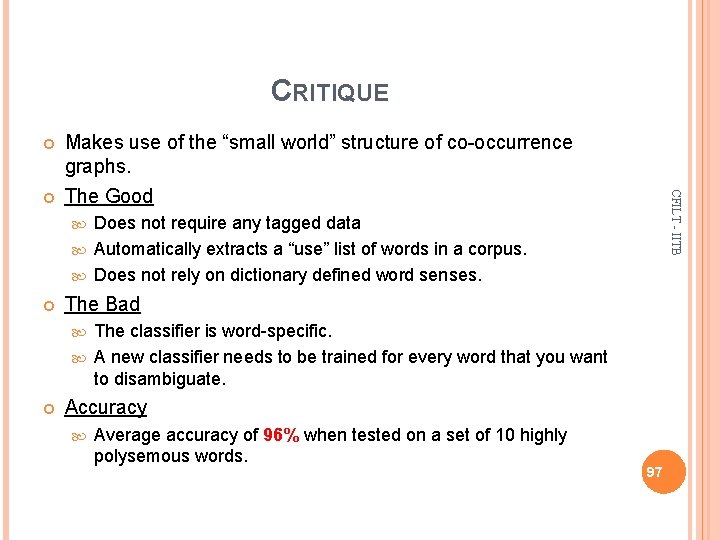
CRITIQUE Makes use of the “small world” structure of co-occurrence graphs. The Good CFILT - IITB Does not require any tagged data Automatically extracts a “use” list of words in a corpus. Does not rely on dictionary defined word senses. The Bad The classifier is word-specific. A new classifier needs to be trained for every word that you want to disambiguate. Accuracy Average accuracy of 96% when tested on a set of 10 highly polysemous words. 97
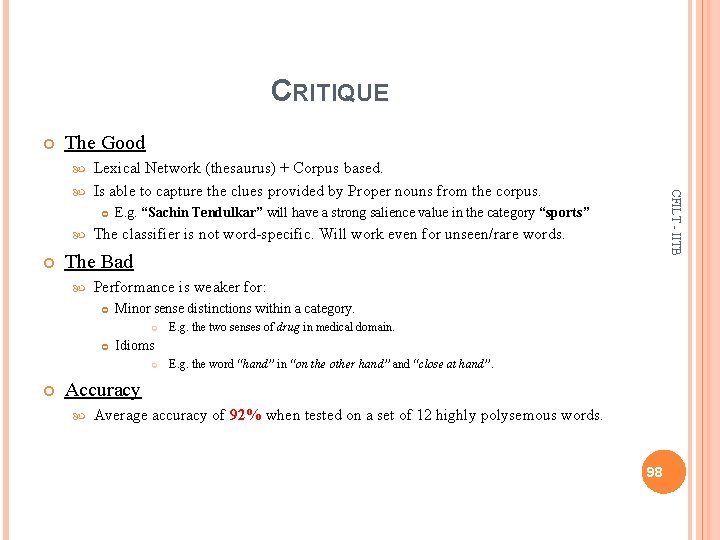
CRITIQUE The Good Lexical Network (thesaurus) + Corpus based. Is able to capture the clues provided by Proper nouns from the corpus. E. g. “Sachin Tendulkar” will have a strong salience value in the category “sports” The classifier is not word-specific. Will work even for unseen/rare words. The Bad Performance is weaker for: Minor sense distinctions within a category. E. g. the two senses of drug in medical domain. Idioms CFILT - IITB E. g. the word “hand” in “on the other hand” and “close at hand”. Accuracy Average accuracy of 92% when tested on a set of 12 highly polysemous words. 98
CRITIQUE The Good The same knowledge sources are used for all words. Can deal with words that are infrequent or do not even appear in the corpus. The classifier is not word-specific. CFILT - IITB The Bad Syntactic dependencies need to be identified from the corpus. This requires an efficient broad coverage parser. Accuracy 74% on Wall Street Journal Corpus. 99
- Slides: 99