Chapter Seven Quantum Theory and the Electronic Structure



- Slides: 70
Chapter Seven Quantum Theory and the Electronic Structure of Atoms
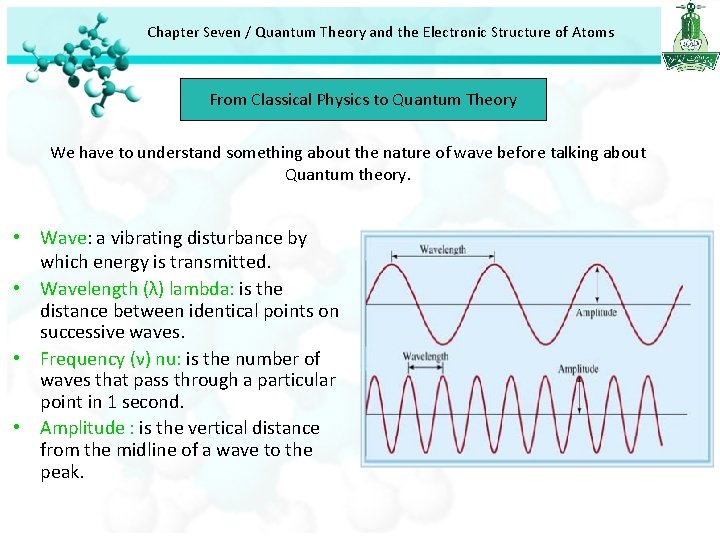
Chapter Seven / Quantum Theory and the Electronic Structure of Atoms From Classical Physics to Quantum Theory We have to understand something about the nature of wave before talking about Quantum theory. • Wave: a vibrating disturbance by which energy is transmitted. • Wavelength (λ) lambda: is the distance between identical points on successive waves. • Frequency (ν) nu: is the number of waves that pass through a particular point in 1 second. • Amplitude : is the vertical distance from the midline of a wave to the peak.
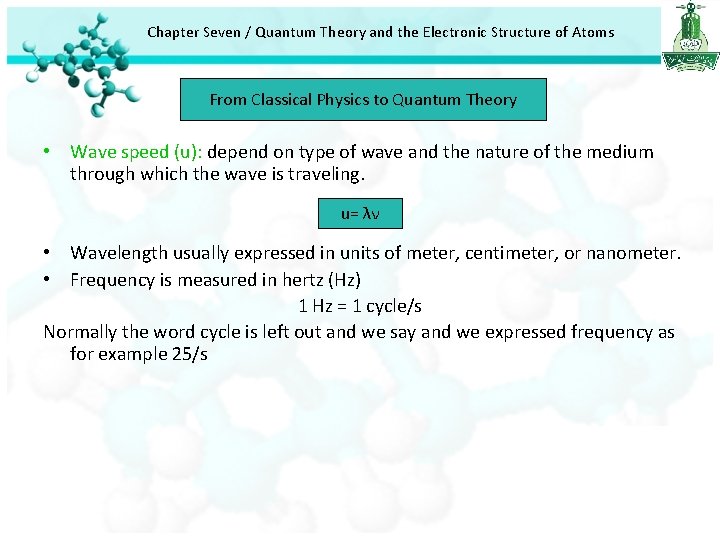
Chapter Seven / Quantum Theory and the Electronic Structure of Atoms From Classical Physics to Quantum Theory • Wave speed (u): depend on type of wave and the nature of the medium through which the wave is traveling. u= λν • Wavelength usually expressed in units of meter, centimeter, or nanometer. • Frequency is measured in hertz (Hz) 1 Hz = 1 cycle/s Normally the word cycle is left out and we say and we expressed frequency as for example 25/s
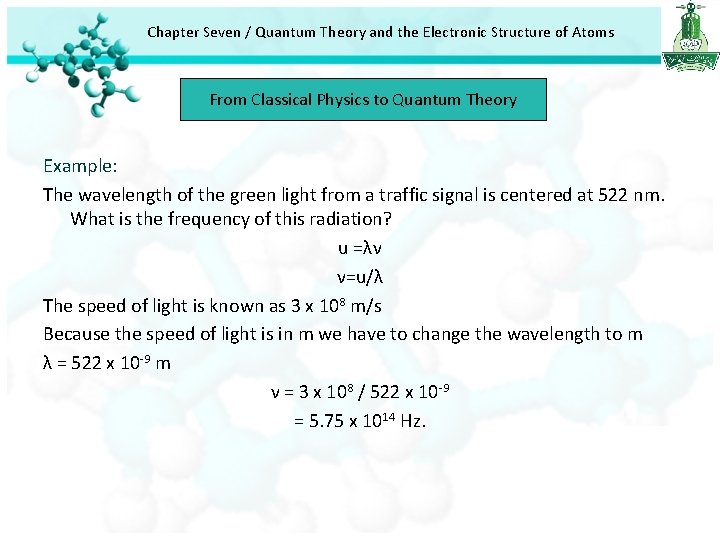
Chapter Seven / Quantum Theory and the Electronic Structure of Atoms From Classical Physics to Quantum Theory Example: The wavelength of the green light from a traffic signal is centered at 522 nm. What is the frequency of this radiation? u =λν ν=u/λ The speed of light is known as 3 x 10⁸ m/s Because the speed of light is in m we have to change the wavelength to m λ = 522 x 10 -9 m ν = 3 x 10⁸ / 522 x 10 -9 = 5. 75 x 1014 Hz.
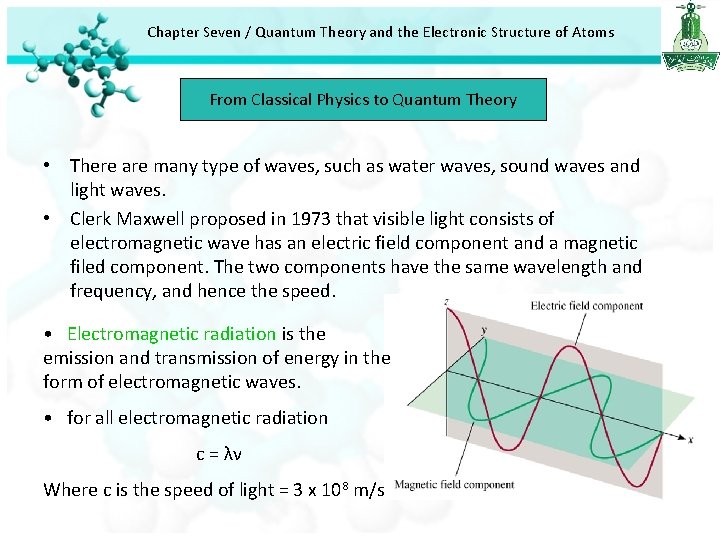
Chapter Seven / Quantum Theory and the Electronic Structure of Atoms From Classical Physics to Quantum Theory • There are many type of waves, such as water waves, sound waves and light waves. • Clerk Maxwell proposed in 1973 that visible light consists of electromagnetic wave has an electric field component and a magnetic filed component. The two components have the same wavelength and frequency, and hence the speed. • Electromagnetic radiation is the emission and transmission of energy in the form of electromagnetic waves. • for all electromagnetic radiation c = λν Where c is the speed of light = 3 x 10⁸ m/s
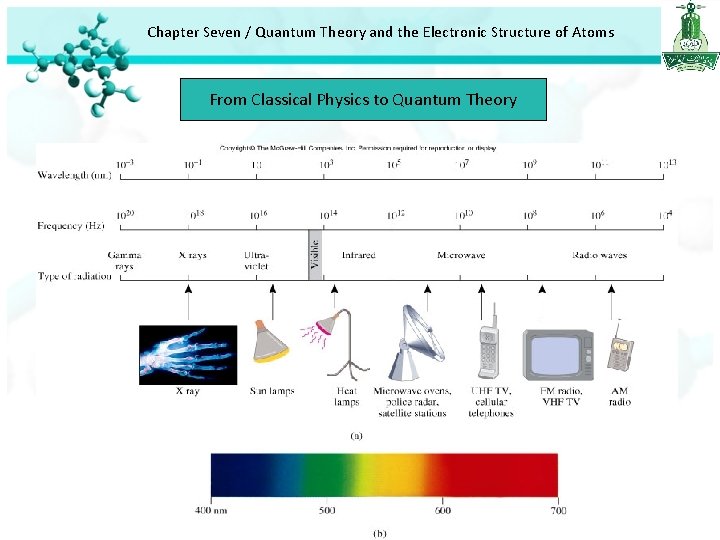
Chapter Seven / Quantum Theory and the Electronic Structure of Atoms From Classical Physics to Quantum Theory
Chapter Seven / Quantum Theory and the Electronic Structure of Atoms From Classical Physics to Quantum Theory Example: A photon has a frequency of 6. 0 x 104 Hz. Convert this frequency into wavelength (nm)? c = λν λ = c/ν = 3 x 10⁸ / 6 x 104 =5 x 10³ m = 5 x 10¹² nm
Chapter Seven / Quantum Theory and the Electronic Structure of Atoms Planck’s Quantum Theory • When solid are heated they emit electromagnetic radiation over a wide range of wavelength. Example is the dull red glow of an electric heater and the bright white light of tungsten light bulb. • the amount of radiant energy emitted by an object at a certain temperature depends on the wavelength • according to Plank the atoms and molecules could emit (or adsorb) energy only in discrete quantities (quantum). • Quantum is the smallest quantity of energy that can be emitted (or absorbed) in the form of electromagnetic radiation. • The energy of a signal quantum (E): Where h is planck’s constant
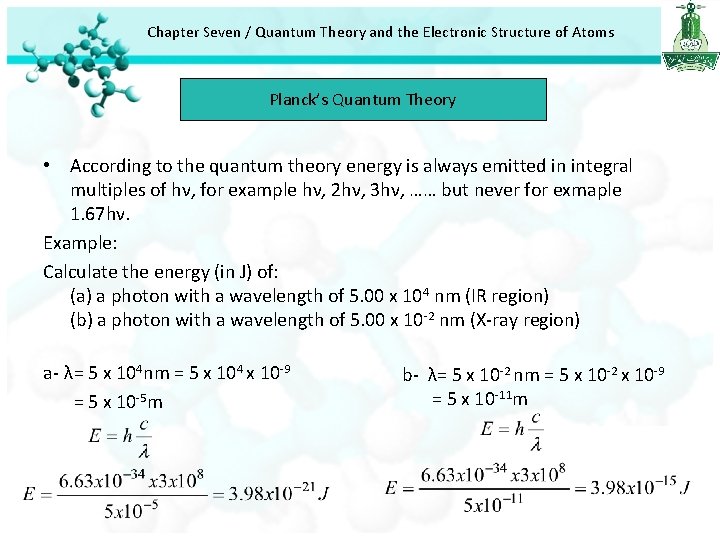
Chapter Seven / Quantum Theory and the Electronic Structure of Atoms Planck’s Quantum Theory • According to the quantum theory energy is always emitted in integral multiples of hν, for example hν, 2 hν, 3 hν, …… but never for exmaple 1. 67 hν. Example: Calculate the energy (in J) of: (a) a photon with a wavelength of 5. 00 x 104 nm (IR region) (b) a photon with a wavelength of 5. 00 x 10 -2 nm (X-ray region) a- λ= 5 x 10⁴ nm = 5 x 104 x 10 -9 = 5 x 10 -5 m b- λ= 5 x 10 -2 nm = 5 x 10 -2 x 10 -9 = 5 x 10 -11 m
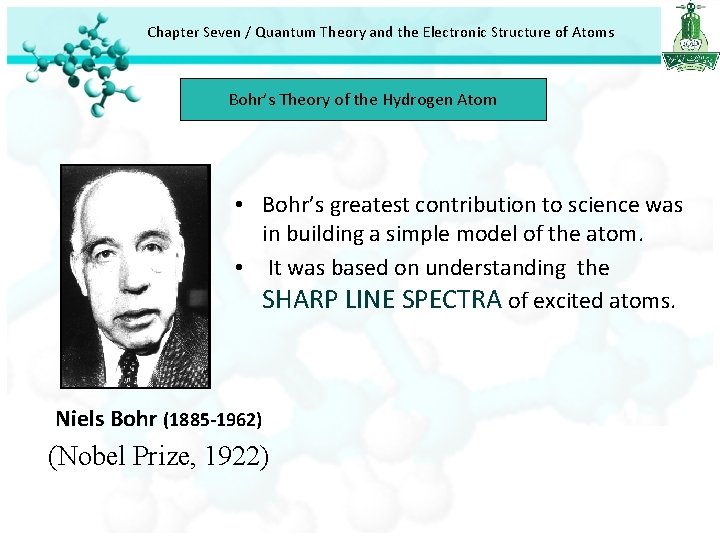
Chapter Seven / Quantum Theory and the Electronic Structure of Atoms Bohr’s Theory of the Hydrogen Atom • Bohr’s greatest contribution to science was in building a simple model of the atom. • It was based on understanding the SHARP LINE SPECTRA of excited atoms. Niels Bohr (1885 -1962) (Nobel Prize, 1922)
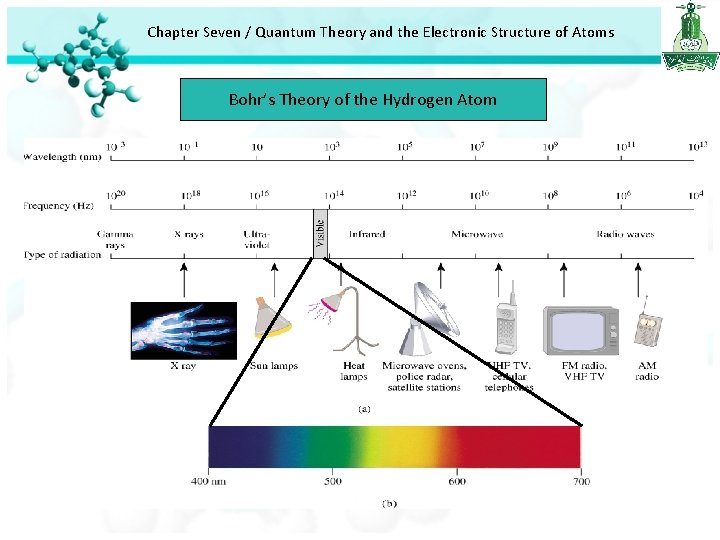
Chapter Seven / Quantum Theory and the Electronic Structure of Atoms Bohr’s Theory of the Hydrogen Atom • Emission spectra is either continuous or line spectra of radiation emitted by substances. • Continuous is a common feature to the emission spectra of the sun and of a heated solid; that is, all wavelengths of visible light are represented in the spectra.
Chapter Seven / Quantum Theory and the Electronic Structure of Atoms Bohr’s Theory of the Hydrogen Atom
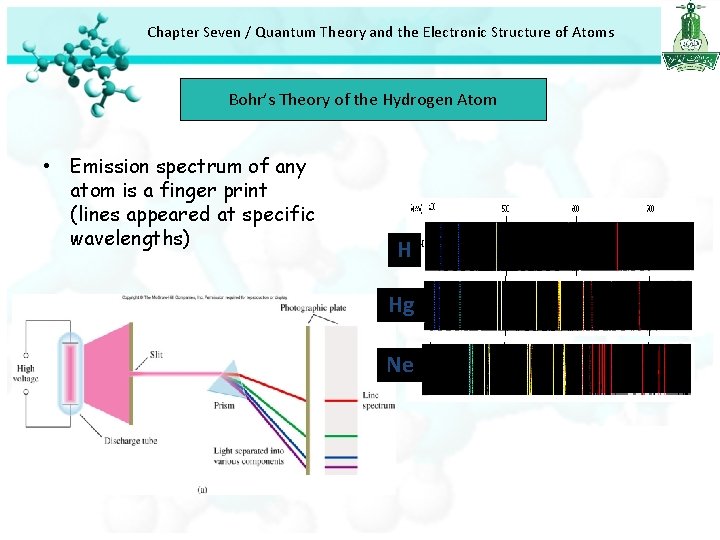
Chapter Seven / Quantum Theory and the Electronic Structure of Atoms Bohr’s Theory of the Hydrogen Atom • Emission spectra is either continuous or line spectra of radiation emitted by substances. • Continuous is a common feature to the emission spectra of the sun and of a heated solid; that is, all wavelengths of visible light are represented in the spectra. • The emission spectra of atoms in the gas phase do not show a continuous spread of wavelengths from red to violet; rather, the atoms produce bright lines in different parts of the visible spectrum. • Line spectra is the light emission only at specific wavelengths. • Excited atoms emit light of only certain wavelengths • The wavelengths of emitted light depend on the element.
Chapter Seven / Quantum Theory and the Electronic Structure of Atoms Bohr’s Theory of the Hydrogen Atom • Emission spectrum of any atom is a finger print (lines appeared at specific wavelengths) H Hg Ne
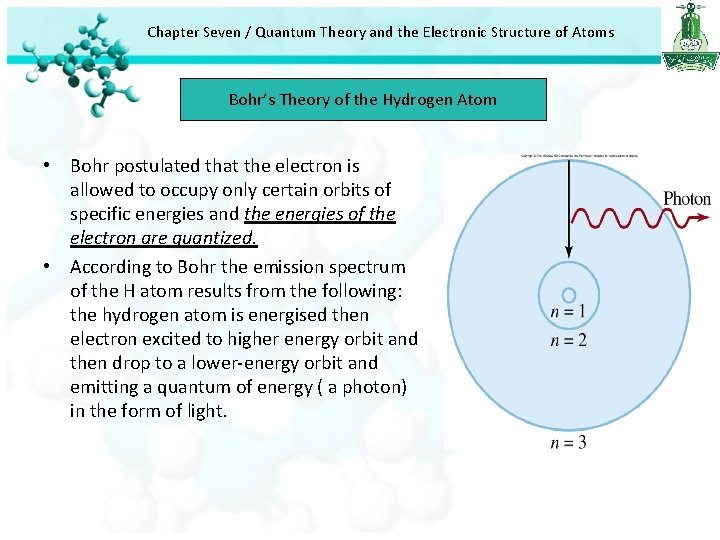
Chapter Seven / Quantum Theory and the Electronic Structure of Atoms Bohr’s Theory of the Hydrogen Atom • Bohr postulated that the electron is allowed to occupy only certain orbits of specific energies and the energies of the electron are quantized. • According to Bohr the emission spectrum of the H atom results from the following: the hydrogen atom is energised then electron excited to higher energy orbit and then drop to a lower-energy orbit and emitting a quantum of energy ( a photon) in the form of light.
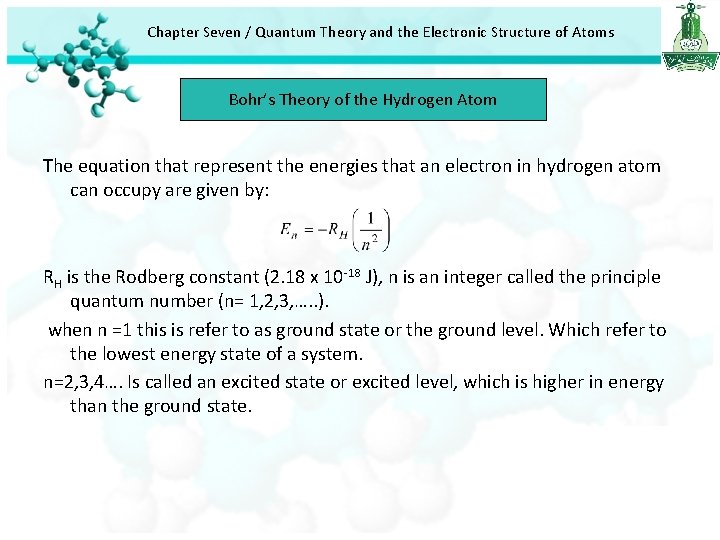
Chapter Seven / Quantum Theory and the Electronic Structure of Atoms Bohr’s Theory of the Hydrogen Atom The equation that represent the energies that an electron in hydrogen atom can occupy are given by: RH is the Rodberg constant (2. 18 x 10 -18 J), n is an integer called the principle quantum number (n= 1, 2, 3, …. . ). when n =1 this is refer to as ground state or the ground level. Which refer to the lowest energy state of a system. n=2, 3, 4…. Is called an excited state or excited level, which is higher in energy than the ground state.
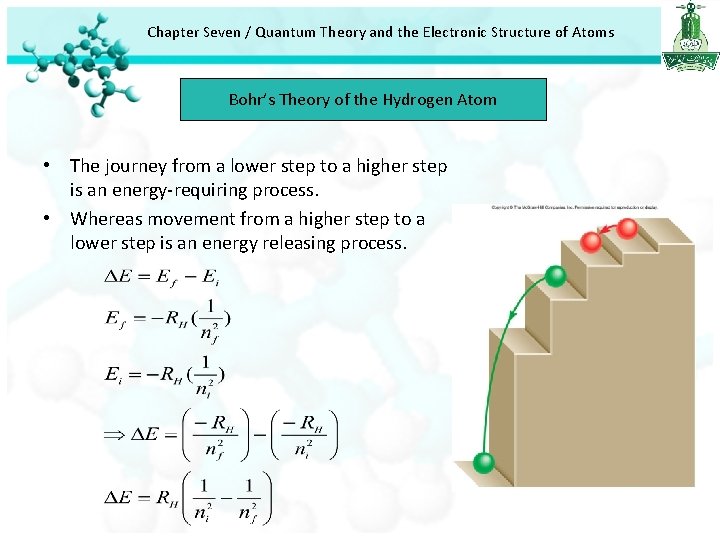
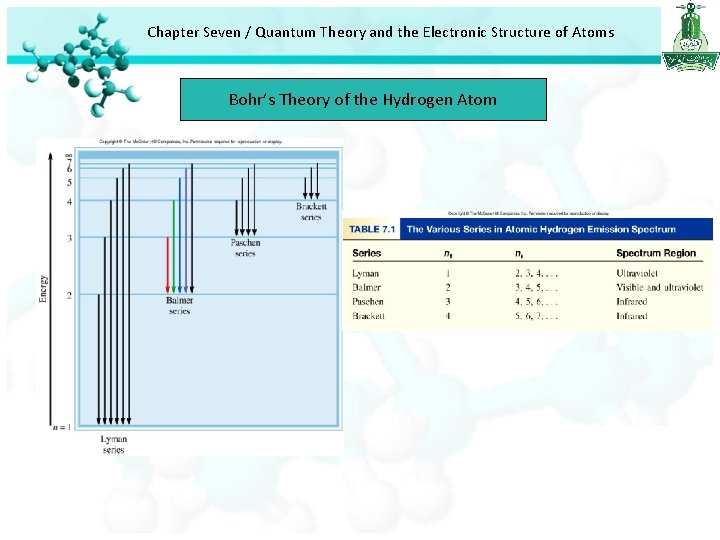
Chapter Seven / Quantum Theory and the Electronic Structure of Atoms Bohr’s Theory of the Hydrogen Atom • The journey from a lower step to a higher step is an energy-requiring process. • Whereas movement from a higher step to a lower step is an energy releasing process.
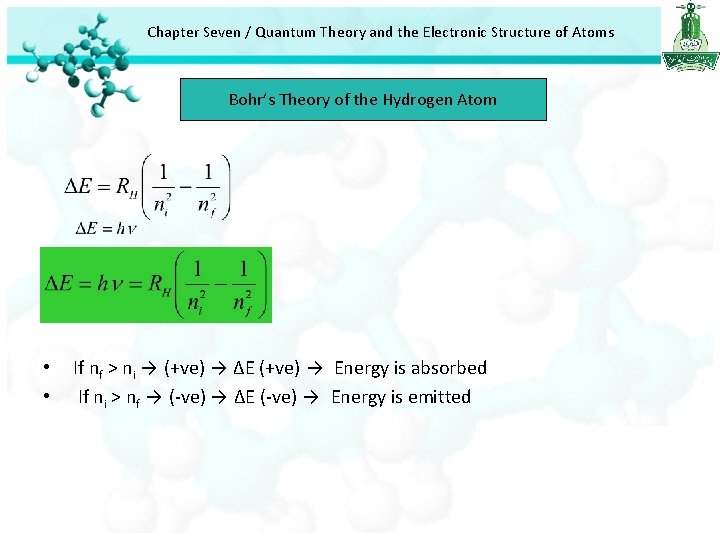
Chapter Seven / Quantum Theory and the Electronic Structure of Atoms Bohr’s Theory of the Hydrogen Atom • • If nf > ni → (+ve) → ΔE (+ve) → Energy is absorbed If ni > nf → (-ve) → ΔE (-ve) → Energy is emitted
Chapter Seven / Quantum Theory and the Electronic Structure of Atoms Bohr’s Theory of the Hydrogen Atom
Chapter Seven / Quantum Theory and the Electronic Structure of Atoms Bohr’s Theory of the Hydrogen Atom Example: What is the wavelength of a photon (in nm) emitted during a transition from the ni = 5 state to the nf = 2 state in the hydrogen atom? ni=5, nf = 2 , λ=?
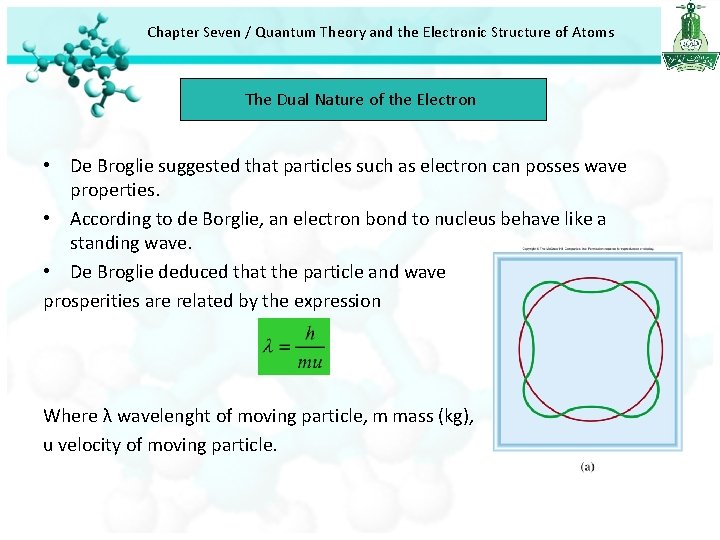
Chapter Seven / Quantum Theory and the Electronic Structure of Atoms The Dual Nature of the Electron • De Broglie suggested that particles such as electron can posses wave properties. • According to de Borglie, an electron bond to nucleus behave like a standing wave. • De Broglie deduced that the particle and wave prosperities are related by the expression Where λ wavelenght of moving particle, m mass (kg), u velocity of moving particle.
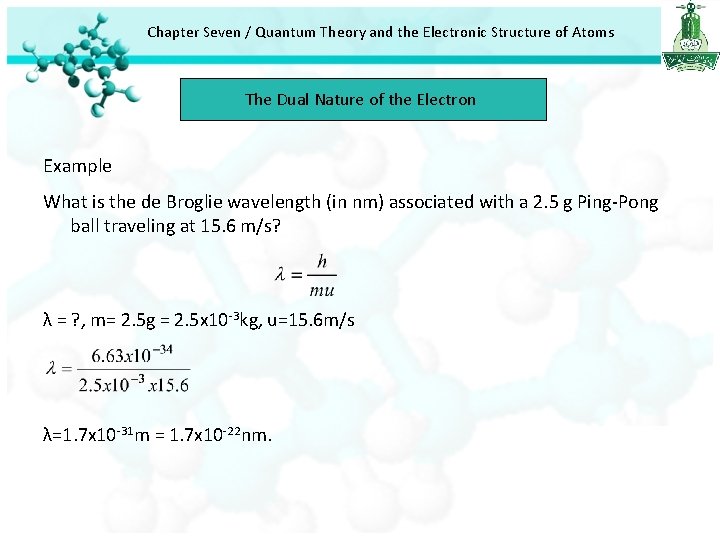
Chapter Seven / Quantum Theory and the Electronic Structure of Atoms The Dual Nature of the Electron Example What is the de Broglie wavelength (in nm) associated with a 2. 5 g Ping-Pong ball traveling at 15. 6 m/s? λ = ? , m= 2. 5 g = 2. 5 x 10 -3 kg, u=15. 6 m/s λ=1. 7 x 10 -31 m = 1. 7 x 10 -22 nm.
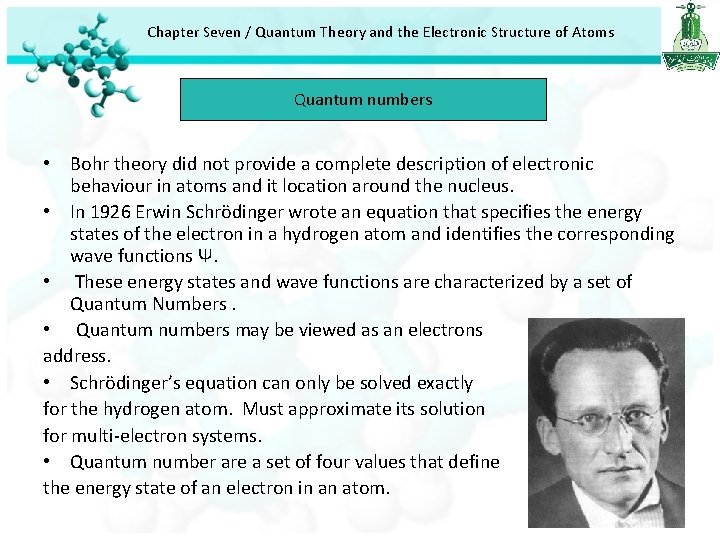
Chapter Seven / Quantum Theory and the Electronic Structure of Atoms Quantum numbers • Bohr theory did not provide a complete description of electronic behaviour in atoms and it location around the nucleus. • In 1926 Erwin Schrödinger wrote an equation that specifies the energy states of the electron in a hydrogen atom and identifies the corresponding wave functions Ψ. • These energy states and wave functions are characterized by a set of Quantum Numbers. • Quantum numbers may be viewed as an electrons address. • Schrödinger’s equation can only be solved exactly for the hydrogen atom. Must approximate its solution for multi-electron systems. • Quantum number are a set of four values that define the energy state of an electron in an atom.
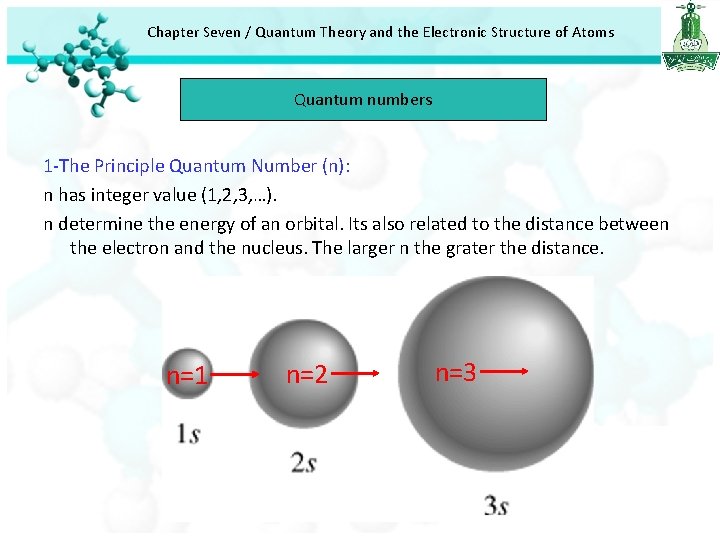
Chapter Seven / Quantum Theory and the Electronic Structure of Atoms Quantum numbers 1 -The Principle Quantum Number (n): n has integer value (1, 2, 3, …). n determine the energy of an orbital. Its also related to the distance between the electron and the nucleus. The larger n the grater the distance. n=1 n=2 n=3
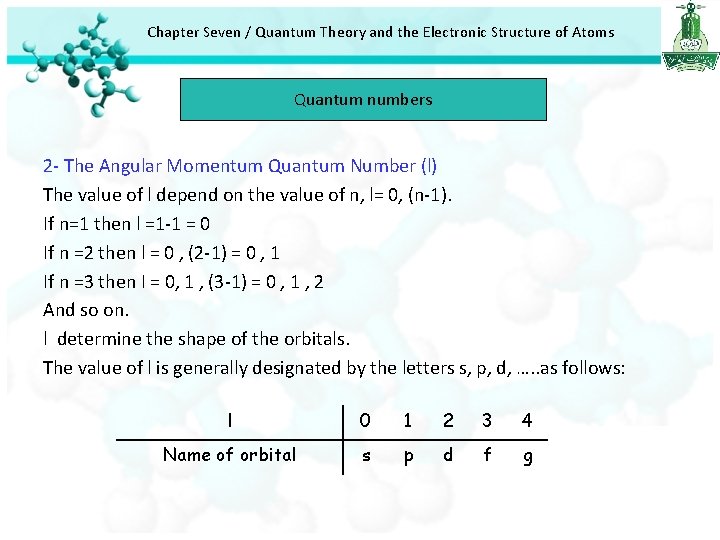
Chapter Seven / Quantum Theory and the Electronic Structure of Atoms Quantum numbers 2 - The Angular Momentum Quantum Number (l) The value of l depend on the value of n, l= 0, (n-1). If n=1 then l =1 -1 = 0 If n =2 then l = 0 , (2 -1) = 0 , 1 If n =3 then I = 0, 1 , (3 -1) = 0 , 1 , 2 And so on. l determine the shape of the orbitals. The value of l is generally designated by the letters s, p, d, …. . as follows: l 0 1 2 3 4 Name of orbital s p d f g
Chapter Seven / Quantum Theory and the Electronic Structure of Atoms Quantum numbers 3 - The Magnetic Number (ml) The value of ml depend on the value of l. ml = -l , ……. 0, ……+l If l=0 then ml =0 If l =1 then ml = -1, 0, 1 If l =2 then ml = -2, -1, 0, 1, 2 And so on. ml describe the orientation of the orbital in space.
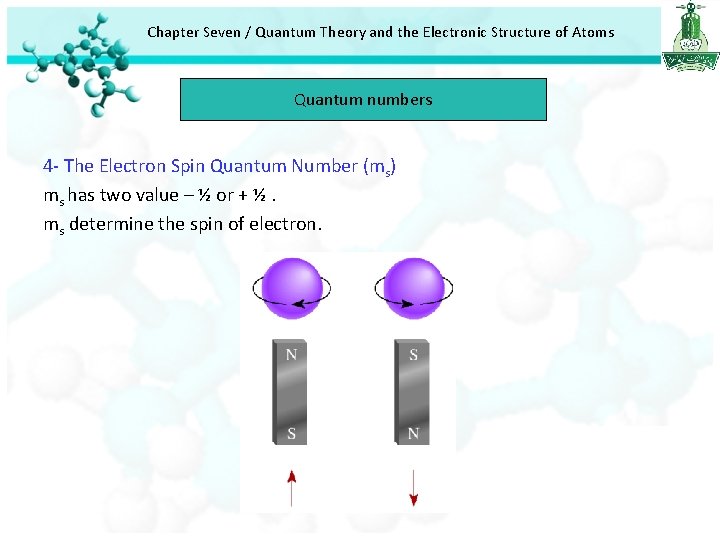
Chapter Seven / Quantum Theory and the Electronic Structure of Atoms Quantum numbers 4 - The Electron Spin Quantum Number (ms) ms has two value – ½ or + ½. ms determine the spin of electron.
Chapter Seven / Quantum Theory and the Electronic Structure of Atoms Quantum numbers Example : List the values of n, l and ml for orbitals in 4 d subshell? What is the total number of orbital in 4 d? n= 4 for d l=2 ml = -2, -1, 0, 1, 2 Number of orbital = 5
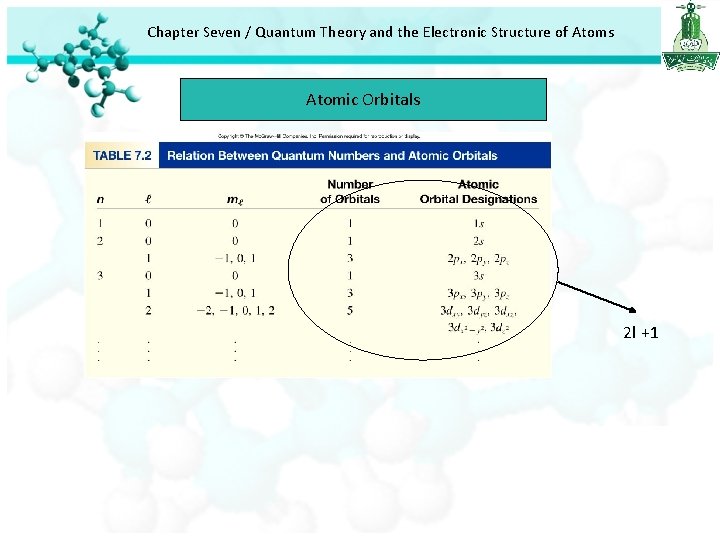
Chapter Seven / Quantum Theory and the Electronic Structure of Atoms Atomic Orbitals 2 l +1
Chapter Seven / Quantum Theory and the Electronic Structure of Atoms Atomic Orbitals Example What is the total number of orbitals associated with the principal quantum number n = 3 ? n=3 l=0, 1, 2 1 - ml = 0 ======> 1 orbital 2 - ml = -1, 0, 1 =====> 3 orbital 2 - ml= -2, -1, 0, 1, 2 ======> 5 orbital Total number of orbital 9 Or (2 x 0 +1) + (2 x 1 +1) + (2 x 2 +1) =1 + 3 + 5 = 9 OR Number of orbital = n 2 = 32 = 9
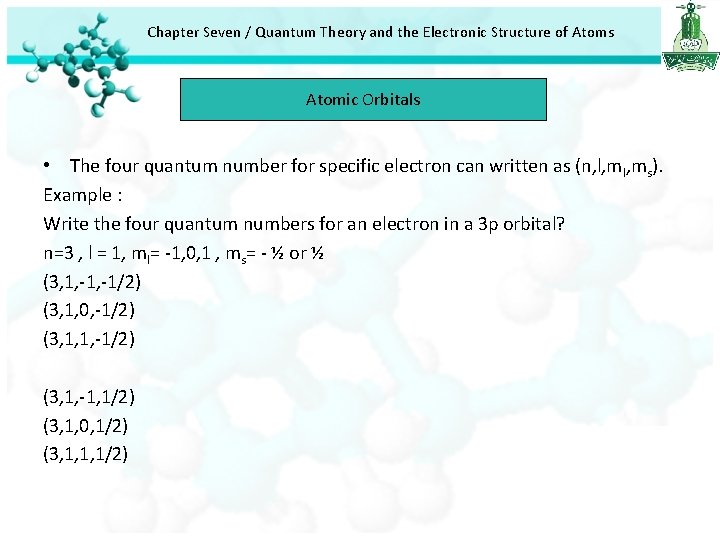
Chapter Seven / Quantum Theory and the Electronic Structure of Atoms Atomic Orbitals • The four quantum number for specific electron can written as (n, l, ms). Example : Write the four quantum numbers for an electron in a 3 p orbital? n=3 , l = 1, ml= -1, 0, 1 , ms= - ½ or ½ (3, 1, -1/2) (3, 1, 0, -1/2) (3, 1, 1, -1/2) (3, 1, -1, 1/2) (3, 1, 0, 1/2) (3, 1, 1, 1/2)
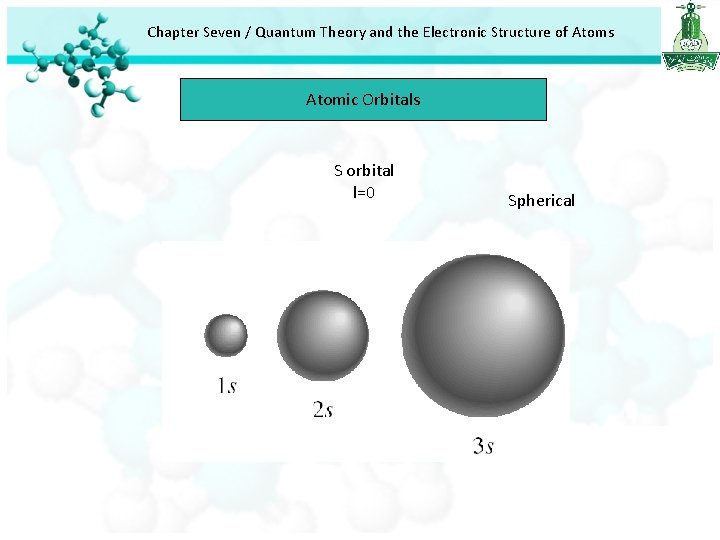
Chapter Seven / Quantum Theory and the Electronic Structure of Atoms Atomic Orbitals S orbital l=0 Spherical
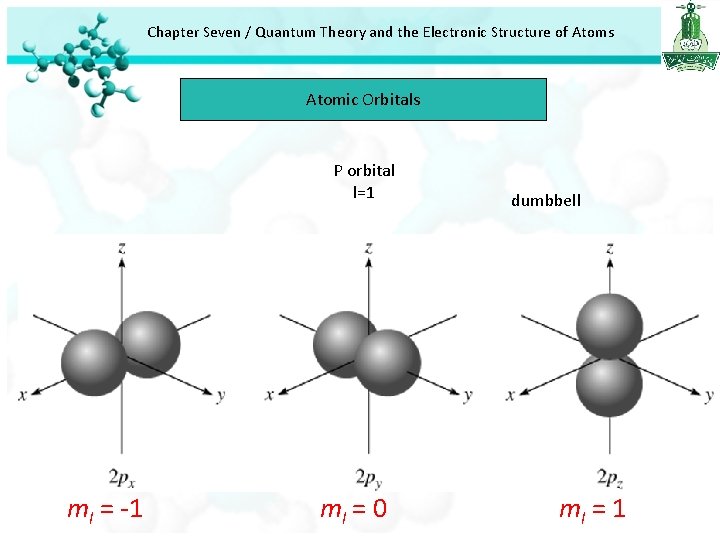
Chapter Seven / Quantum Theory and the Electronic Structure of Atoms Atomic Orbitals P orbital l=1 ml = -1 ml = 0 dumbbell ml = 1
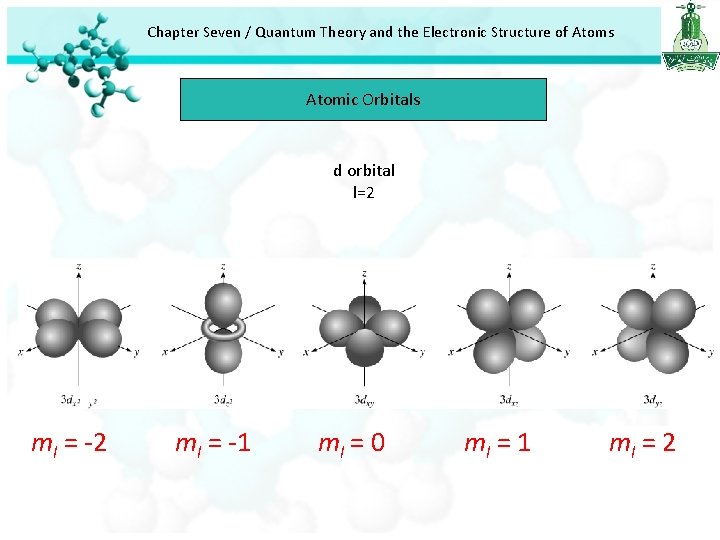
Chapter Seven / Quantum Theory and the Electronic Structure of Atoms Atomic Orbitals d orbital l=2 ml = -1 ml = 0 ml = 1 ml = 2
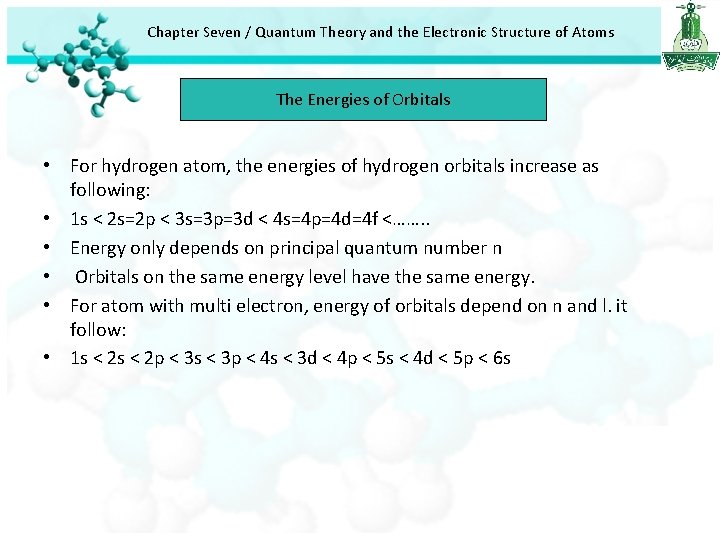
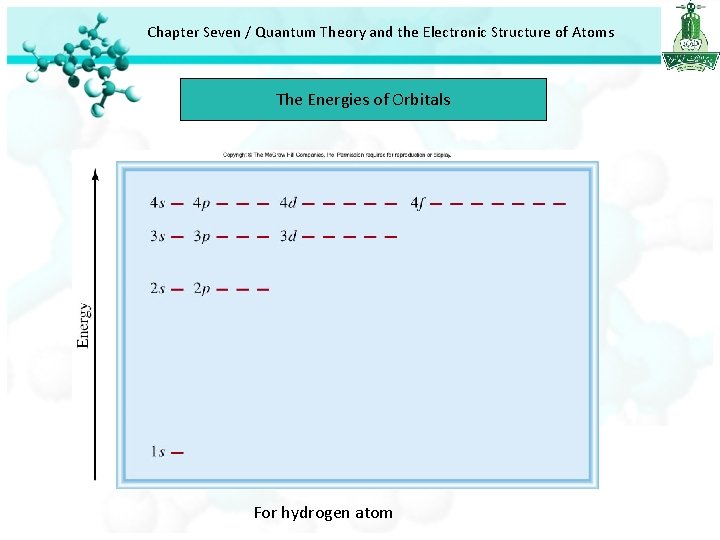
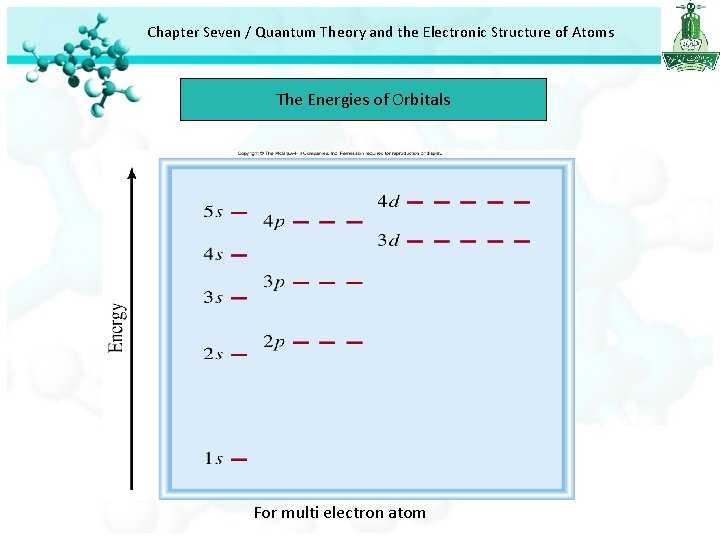
Chapter Seven / Quantum Theory and the Electronic Structure of Atoms The Energies of Orbitals • For hydrogen atom, the energies of hydrogen orbitals increase as following: • 1 s < 2 s=2 p < 3 s=3 p=3 d < 4 s=4 p=4 d=4 f <……. . • Energy only depends on principal quantum number n • Orbitals on the same energy level have the same energy. • For atom with multi electron, energy of orbitals depend on n and l. it follow: • 1 s < 2 p < 3 s < 3 p < 4 s < 3 d < 4 p < 5 s < 4 d < 5 p < 6 s
Chapter Seven / Quantum Theory and the Electronic Structure of Atoms The Energies of Orbitals For hydrogen atom
Chapter Seven / Quantum Theory and the Electronic Structure of Atoms The Energies of Orbitals For multi electron atom
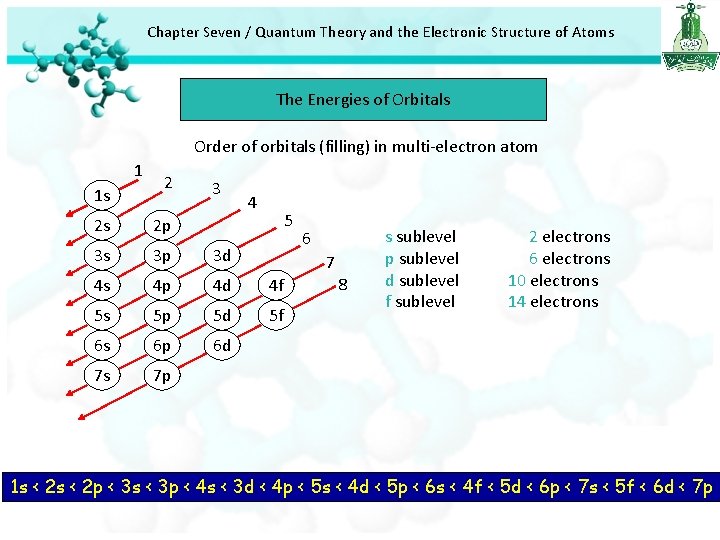
Chapter Seven / Quantum Theory and the Electronic Structure of Atoms The Energies of Orbitals Order of orbitals (filling) in multi-electron atom 1 1 s 2 3 4 5 2 s 2 p 3 s 3 p 3 d 4 s 4 p 4 d 4 f 5 s 5 p 5 d 5 f 6 s 6 p 6 d 7 s 7 p 6 7 8 s sublevel p sublevel d sublevel f sublevel 2 electrons 6 electrons 10 electrons 14 electrons 1 s < 2 p < 3 s < 3 p < 4 s < 3 d < 4 p < 5 s < 4 d < 5 p < 6 s < 4 f < 5 d < 6 p < 7 s < 5 f < 6 d < 7 p
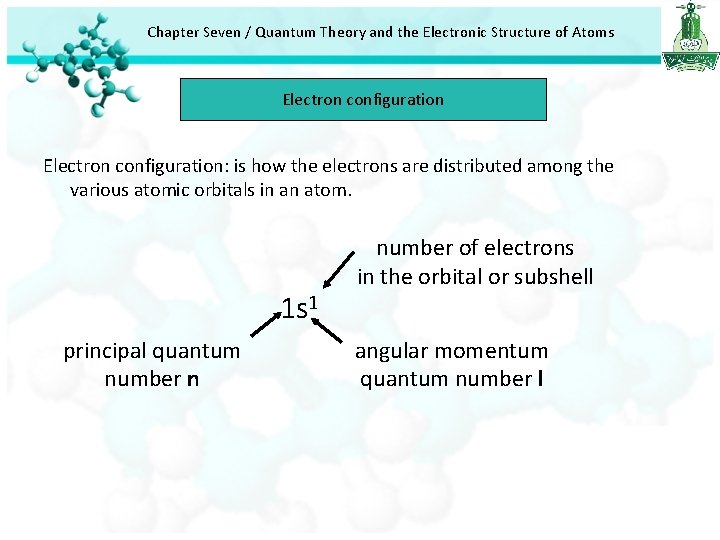
Chapter Seven / Quantum Theory and the Electronic Structure of Atoms Electron configuration: is how the electrons are distributed among the various atomic orbitals in an atom. 1 s 1 principal quantum number n number of electrons in the orbital or subshell angular momentum quantum number l
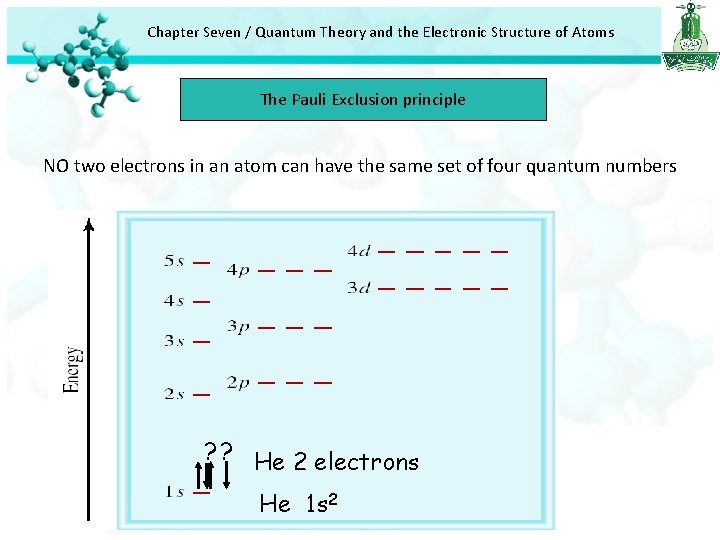
Chapter Seven / Quantum Theory and the Electronic Structure of Atoms The Pauli Exclusion principle NO two electrons in an atom can have the same set of four quantum numbers ? ? He 2 electrons He 1 s 2
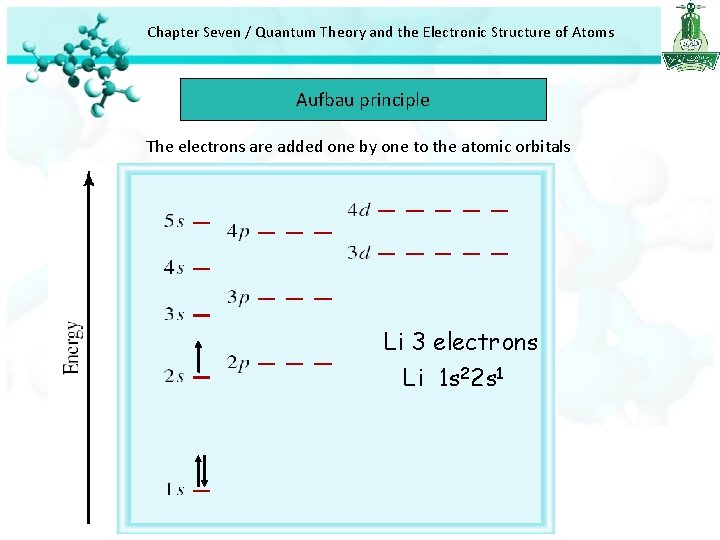
Chapter Seven / Quantum Theory and the Electronic Structure of Atoms Aufbau principle The electrons are added one by one to the atomic orbitals Li 3 electrons Li 1 s 22 s 1
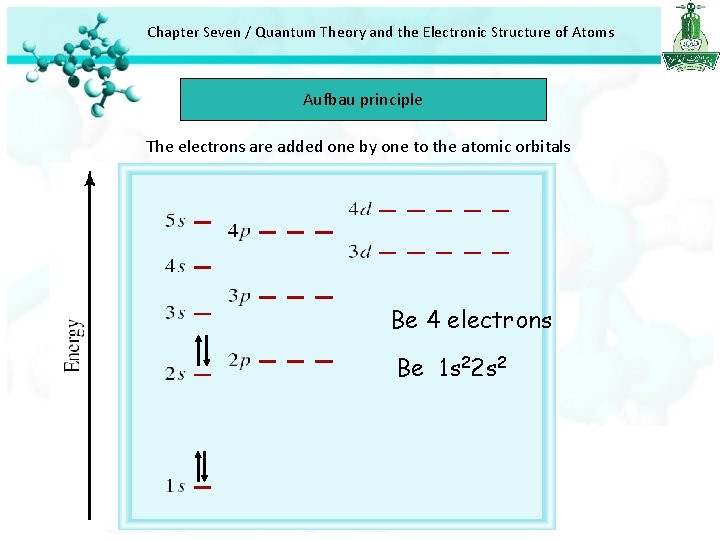
Chapter Seven / Quantum Theory and the Electronic Structure of Atoms Aufbau principle The electrons are added one by one to the atomic orbitals Be 4 electrons Be 1 s 22 s 2
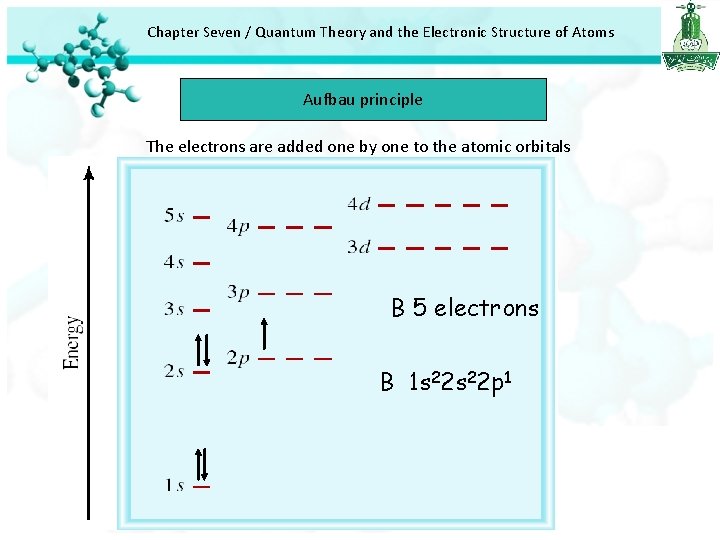
Chapter Seven / Quantum Theory and the Electronic Structure of Atoms Aufbau principle The electrons are added one by one to the atomic orbitals B 5 electrons B 1 s 22 p 1
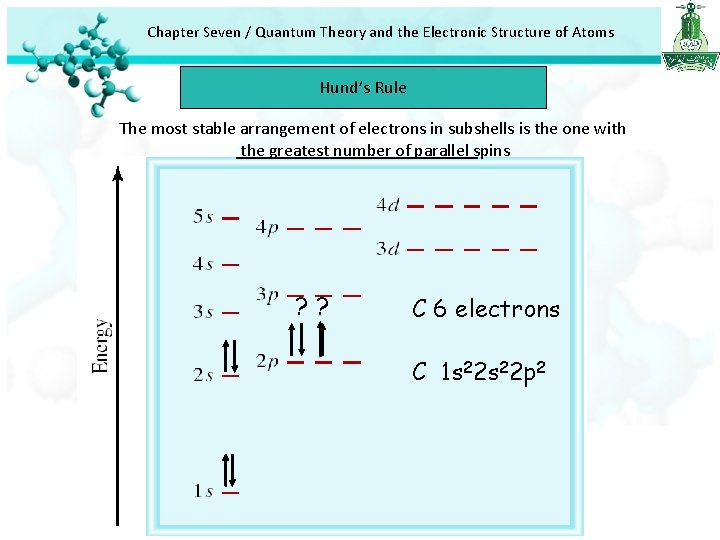
Chapter Seven / Quantum Theory and the Electronic Structure of Atoms Hund’s Rule The most stable arrangement of electrons in subshells is the one with the greatest number of parallel spins ? ? C 6 electrons C 1 s 22 p 2
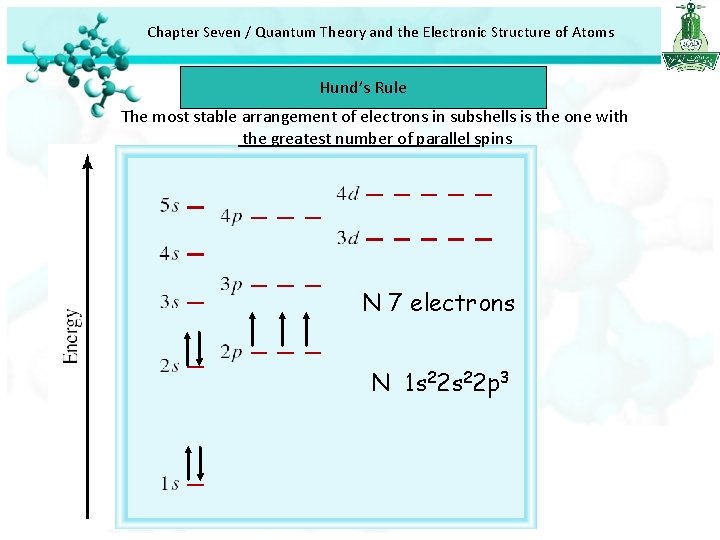
Chapter Seven / Quantum Theory and the Electronic Structure of Atoms Hund’s Rule The most stable arrangement of electrons in subshells is the one with the greatest number of parallel spins N 7 electrons N 1 s 22 p 3
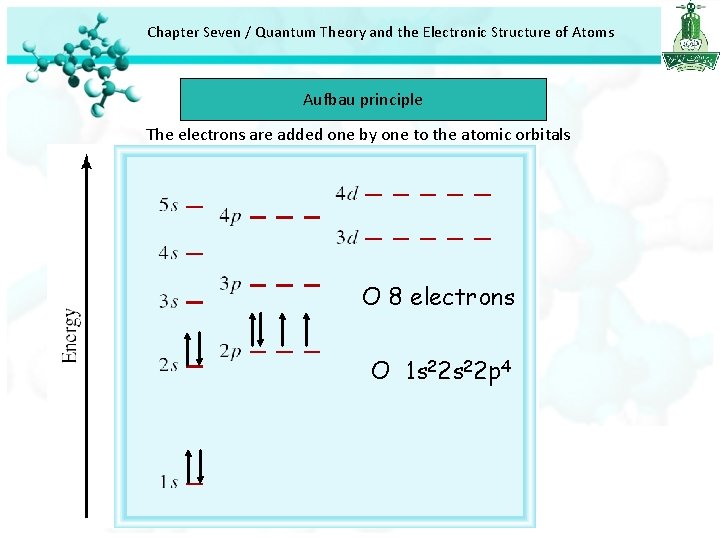
Chapter Seven / Quantum Theory and the Electronic Structure of Atoms Aufbau principle The electrons are added one by one to the atomic orbitals O 8 electrons O 1 s 22 p 4
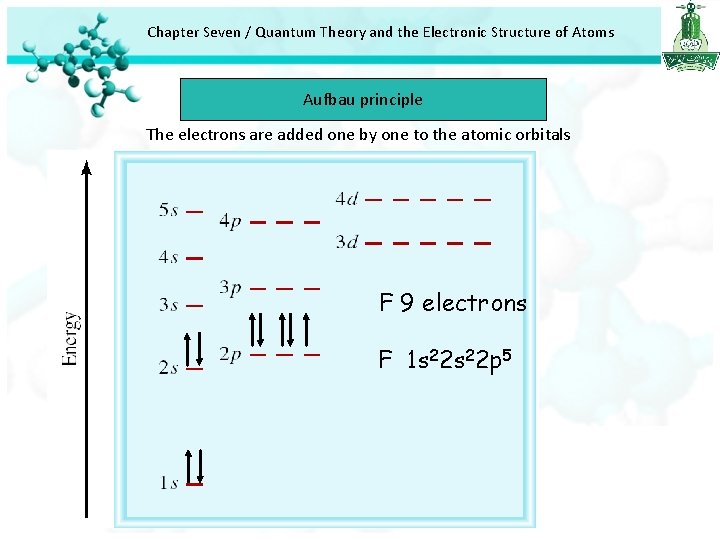
Chapter Seven / Quantum Theory and the Electronic Structure of Atoms Aufbau principle The electrons are added one by one to the atomic orbitals F 9 electrons F 1 s 22 p 5
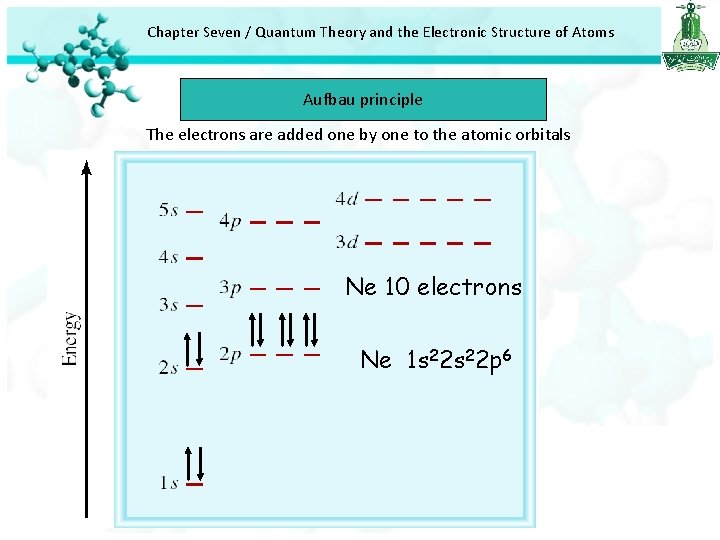
Chapter Seven / Quantum Theory and the Electronic Structure of Atoms Aufbau principle The electrons are added one by one to the atomic orbitals Ne 10 electrons Ne 1 s 22 p 6
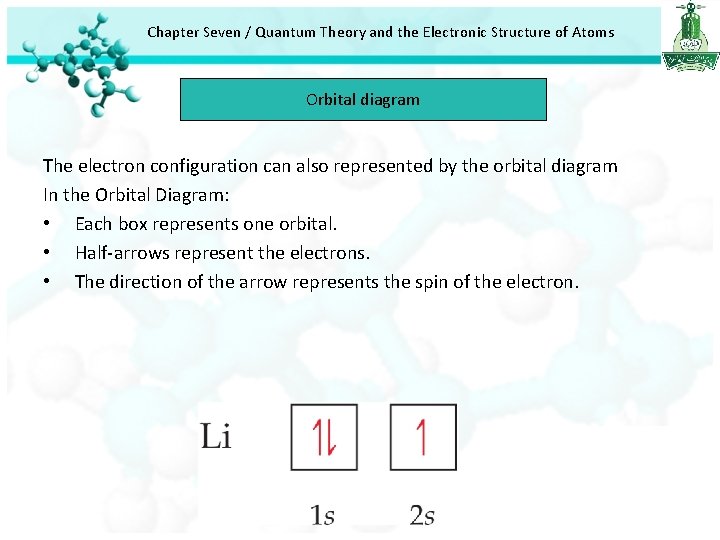
Chapter Seven / Quantum Theory and the Electronic Structure of Atoms Orbital diagram The electron configuration can also represented by the orbital diagram In the Orbital Diagram: • Each box represents one orbital. • Half-arrows represent the electrons. • The direction of the arrow represents the spin of the electron.
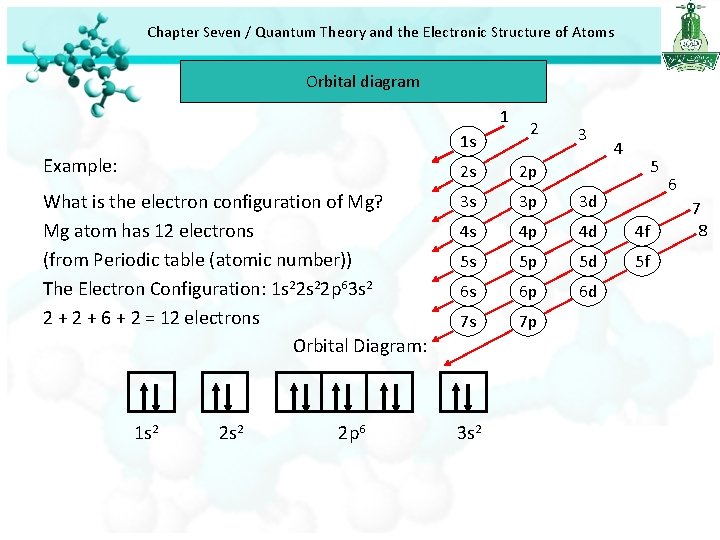
Chapter Seven / Quantum Theory and the Electronic Structure of Atoms Orbital diagram 1 1 s 2 3 4 Example: 2 s 2 p What is the electron configuration of Mg? Mg atom has 12 electrons (from Periodic table (atomic number)) The Electron Configuration: 1 s 22 p 63 s 2 2 + 6 + 2 = 12 electrons Orbital Diagram: 3 s 3 p 3 d 4 s 4 p 4 d 4 f 5 s 5 p 5 d 5 f 6 s 6 p 6 d 7 s 7 p 1 s 2 2 p 6 3 s 2 5 6 7 8
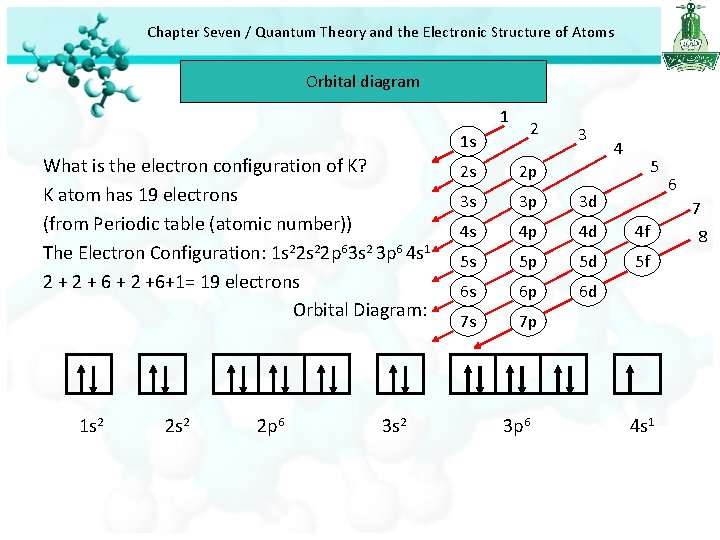
Chapter Seven / Quantum Theory and the Electronic Structure of Atoms Orbital diagram 1 1 s What is the electron configuration of K? K atom has 19 electrons (from Periodic table (atomic number)) The Electron Configuration: 1 s 22 p 63 s 2 3 p 6 4 s 1 2 + 6 + 2 +6+1= 19 electrons Orbital Diagram: 1 s 2 2 p 6 3 s 2 2 3 4 5 2 s 2 p 3 s 3 p 3 d 4 s 4 p 4 d 4 f 5 s 5 p 5 d 5 f 6 s 6 p 6 d 7 s 7 p 3 p 6 6 7 4 s 1 8
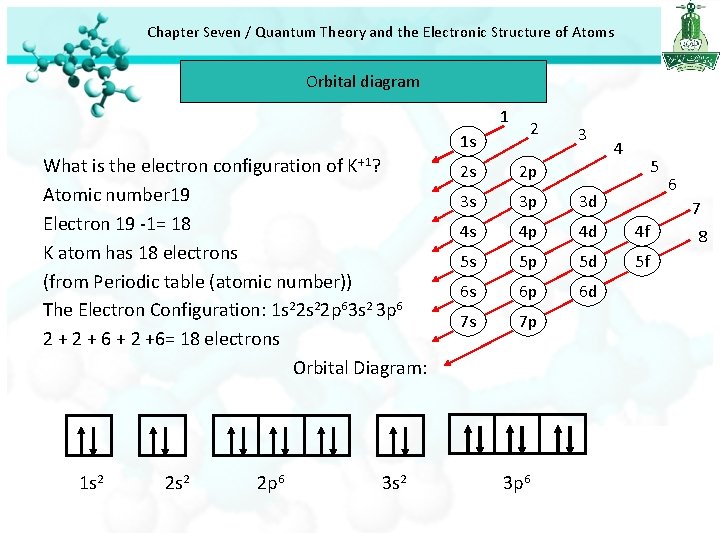
Chapter Seven / Quantum Theory and the Electronic Structure of Atoms Orbital diagram 1 1 s K+1? What is the electron configuration of Atomic number 19 Electron 19 -1= 18 K atom has 18 electrons (from Periodic table (atomic number)) The Electron Configuration: 1 s 22 p 63 s 2 3 p 6 2 + 6 + 2 +6= 18 electrons Orbital Diagram: 1 s 2 2 p 6 3 s 2 2 3 4 5 2 s 2 p 3 s 3 p 3 d 4 s 4 p 4 d 4 f 5 s 5 p 5 d 5 f 6 s 6 p 6 d 7 s 7 p 3 p 6 6 7 8
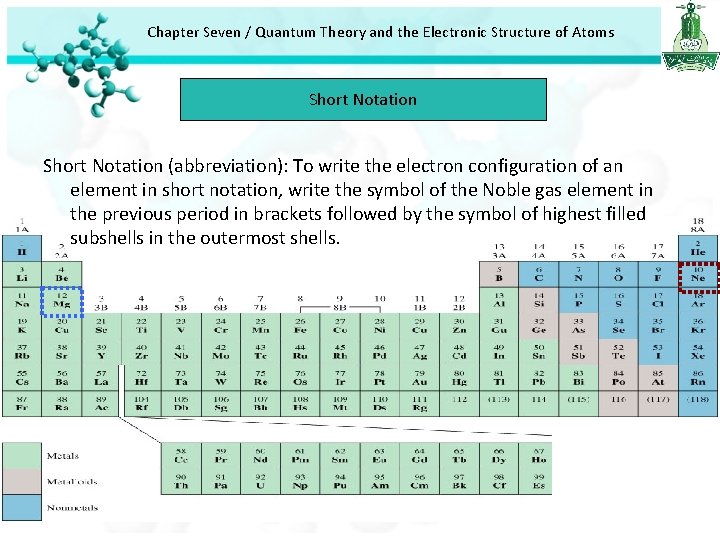
Chapter Seven / Quantum Theory and the Electronic Structure of Atoms Short Notation (abbreviation): To write the electron configuration of an element in short notation, write the symbol of the Noble gas element in the previous period in brackets followed by the symbol of highest filled subshells in the outermost shells.
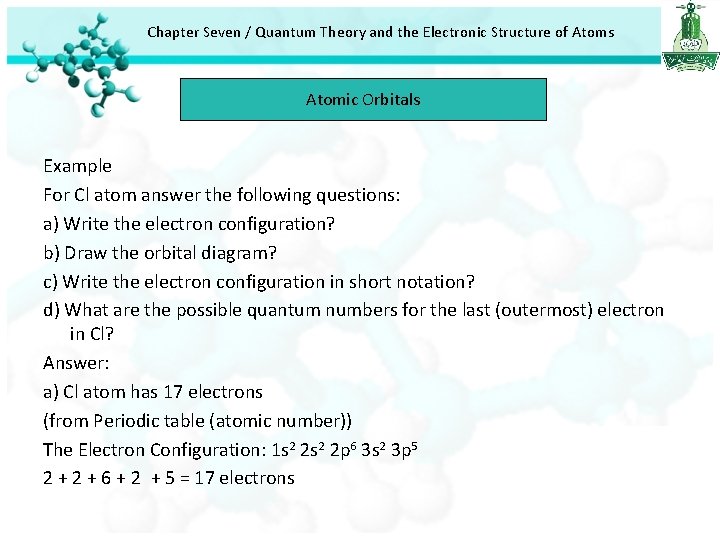
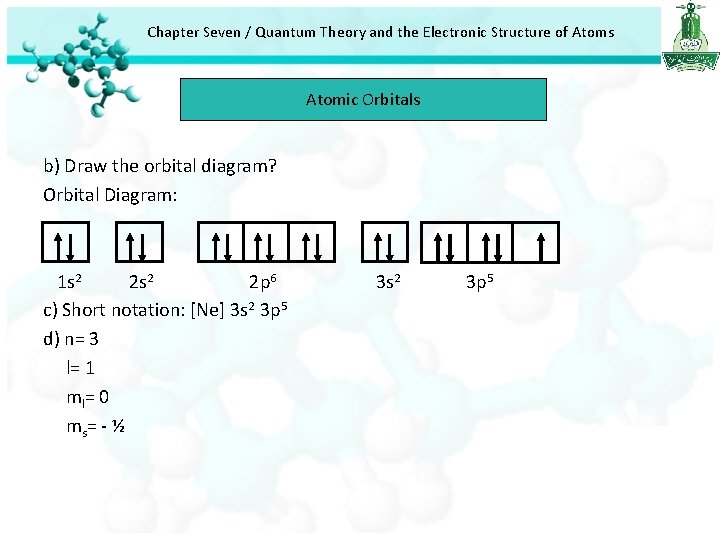
Chapter Seven / Quantum Theory and the Electronic Structure of Atoms Atomic Orbitals Example For Cl atom answer the following questions: a) Write the electron configuration? b) Draw the orbital diagram? c) Write the electron configuration in short notation? d) What are the possible quantum numbers for the last (outermost) electron in Cl? Answer: a) Cl atom has 17 electrons (from Periodic table (atomic number)) The Electron Configuration: 1 s 2 2 p 6 3 s 2 3 p 5 2 + 6 + 2 + 5 = 17 electrons
Chapter Seven / Quantum Theory and the Electronic Structure of Atoms Atomic Orbitals b) Draw the orbital diagram? Orbital Diagram: 1 s 2 2 p 6 c) Short notation: [Ne] 3 s 2 3 p 5 d) n= 3 l= 1 ml= 0 ms= - ½ 3 s 2 3 p 5
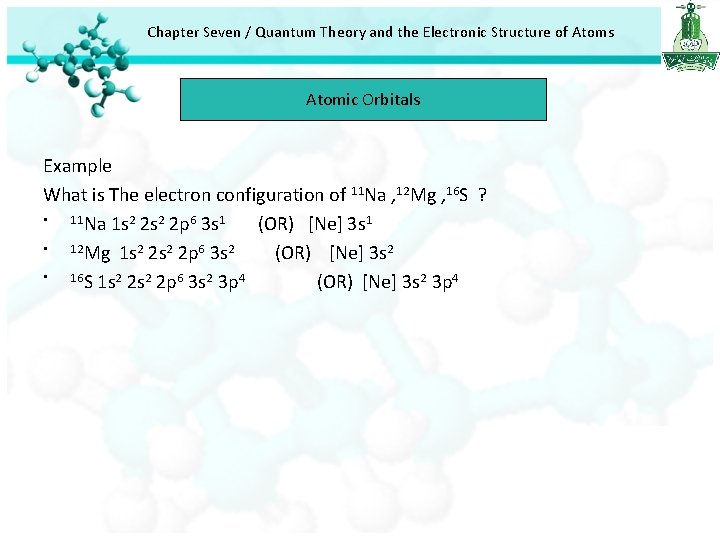
Chapter Seven / Quantum Theory and the Electronic Structure of Atoms Atomic Orbitals Example What is The electron configuration of 11 Na , 12 Mg , 16 S ? • 11 Na 1 s 2 2 p 6 3 s 1 (OR) [Ne] 3 s 1 • 12 Mg 1 s 2 2 p 6 3 s 2 (OR) [Ne] 3 s 2 • 16 S 1 s 2 2 p 6 3 s 2 3 p 4 (OR) [Ne] 3 s 2 3 p 4
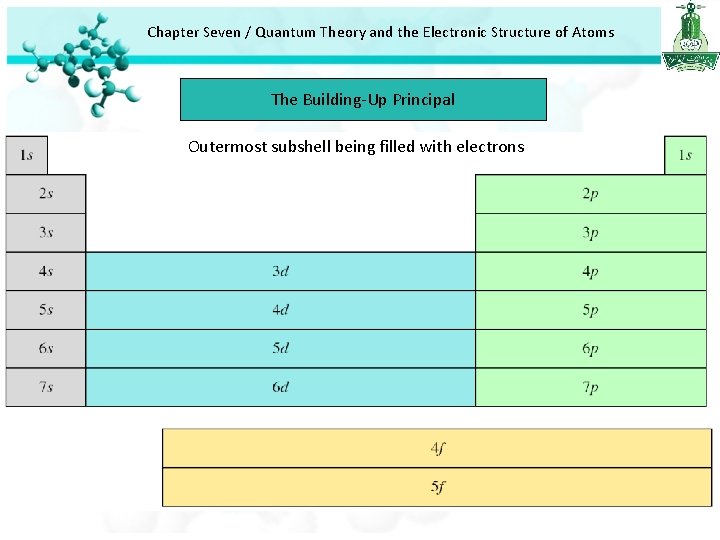
Chapter Seven / Quantum Theory and the Electronic Structure of Atoms The Building-Up Principal Outermost subshell being filled with electrons
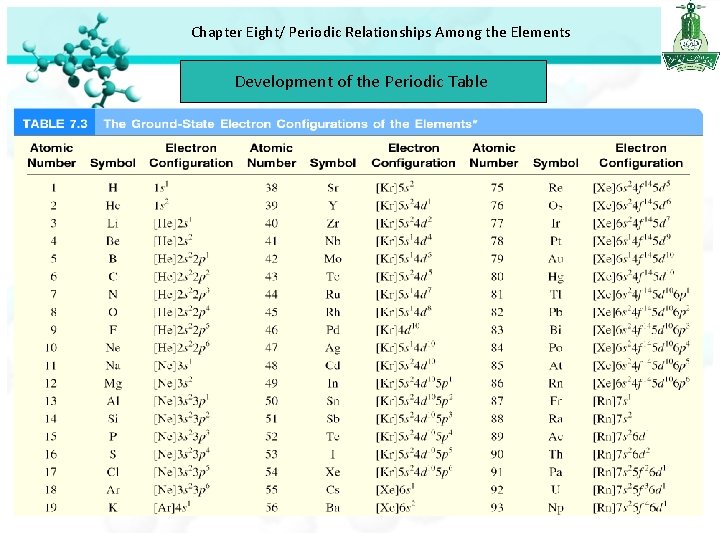
Chapter Eight/ Periodic Relationships Among the Elements Development of the Periodic Table
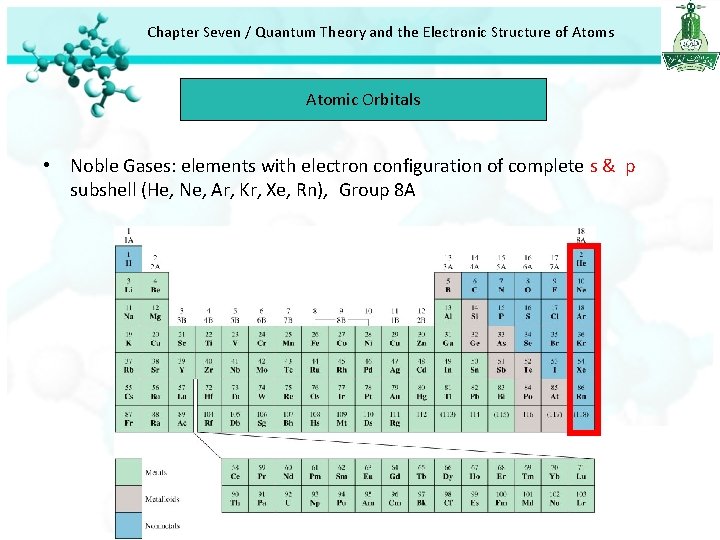
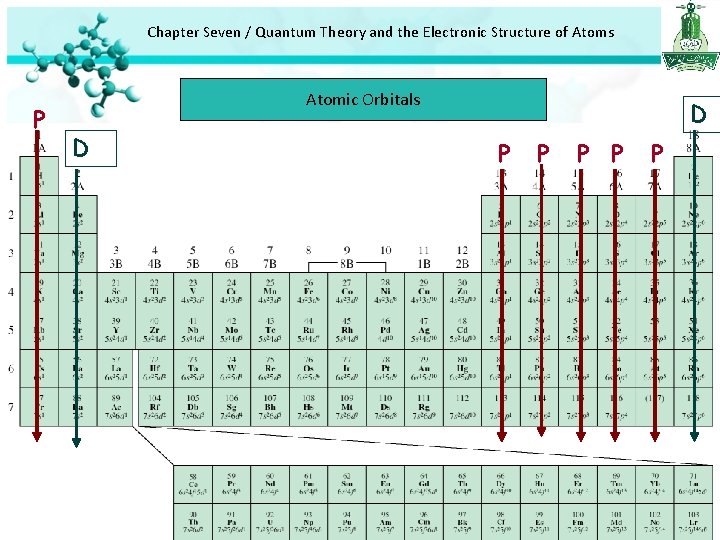
Chapter Seven / Quantum Theory and the Electronic Structure of Atoms Atomic Orbitals • Noble Gases: elements with electron configuration of complete s & p subshell (He, Ne, Ar, Kr, Xe, Rn), Group 8 A
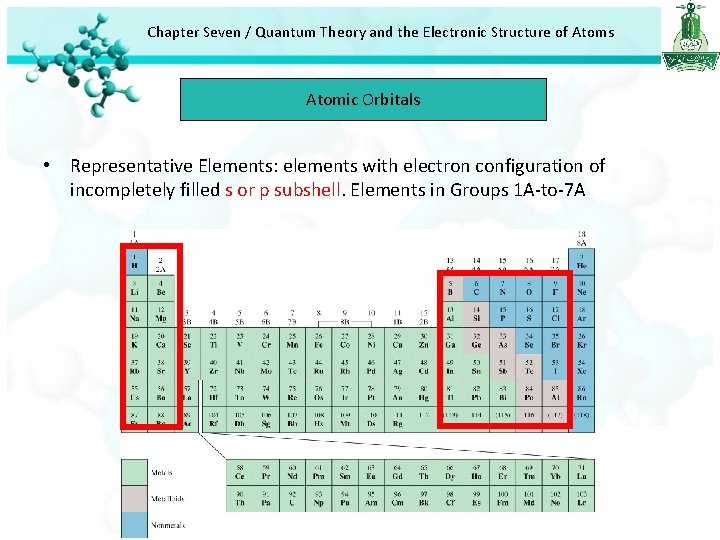
Chapter Seven / Quantum Theory and the Electronic Structure of Atoms Atomic Orbitals • Representative Elements: elements with electron configuration of incompletely filled s or p subshell. Elements in Groups 1 A-to-7 A
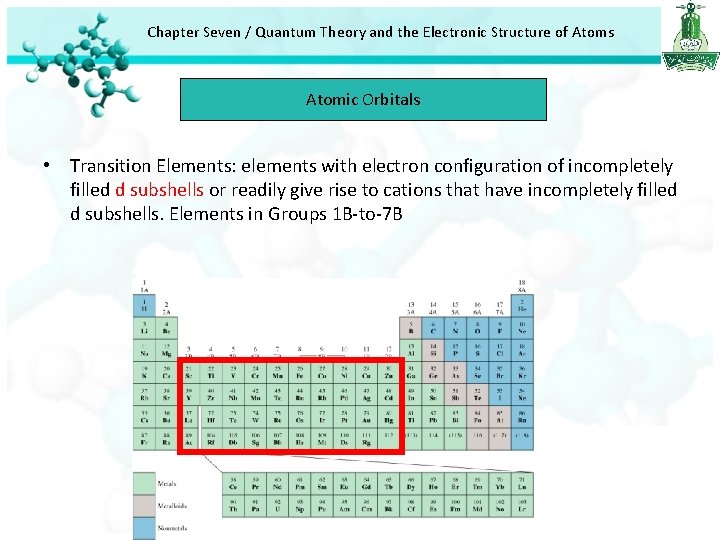
Chapter Seven / Quantum Theory and the Electronic Structure of Atoms Atomic Orbitals • Transition Elements: elements with electron configuration of incompletely filled d subshells or readily give rise to cations that have incompletely filled d subshells. Elements in Groups 1 B-to-7 B
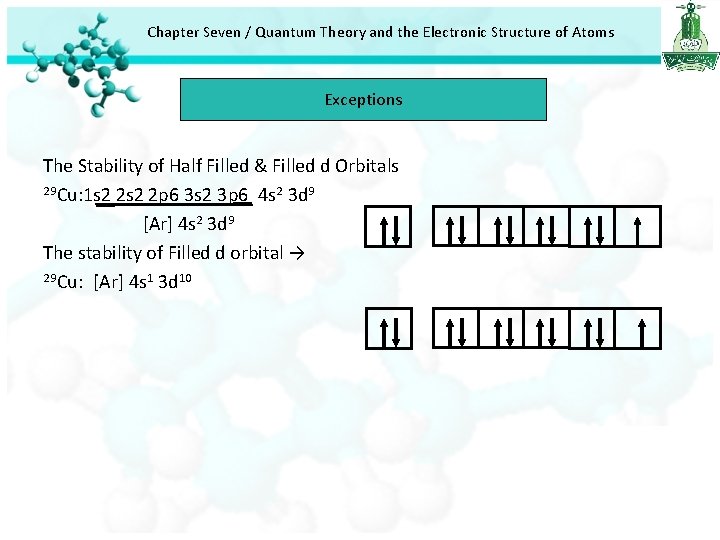
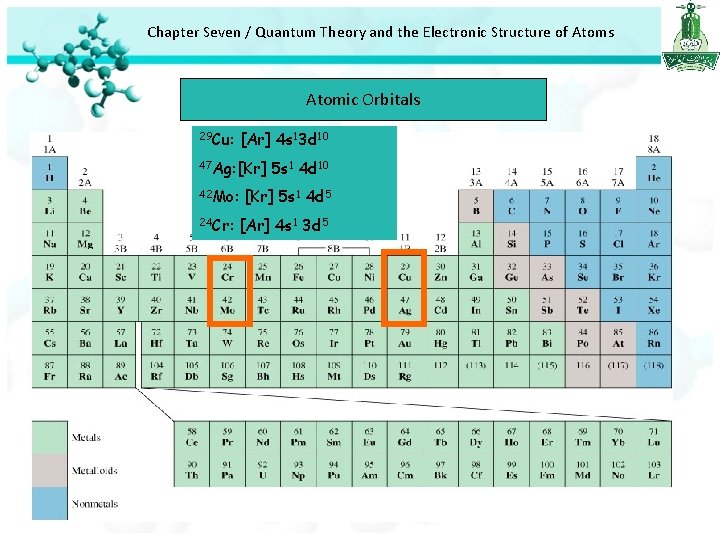
Chapter Seven / Quantum Theory and the Electronic Structure of Atoms Exceptions The Stability of Half Filled & Filled d Orbitals 29 Cu: 1 s 2 2 p 6 3 s 2 3 p 6 4 s 2 3 d 9 [Ar] 4 s 2 3 d 9 The stability of Filled d orbital → 29 Cu: [Ar] 4 s 1 3 d 10
Chapter Seven / Quantum Theory and the Electronic Structure of Atoms Atomic Orbitals 29 Cu: [Ar] 4 s 13 d 10 47 Ag: [Kr] 42 Mo: 24 Cr: 5 s 1 4 d 10 [Kr] 5 s 1 4 d 5 [Ar] 4 s 1 3 d 5
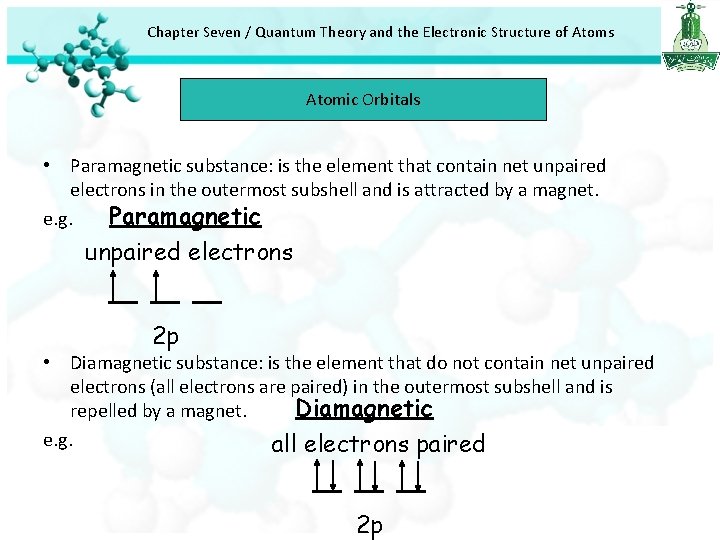
Chapter Seven / Quantum Theory and the Electronic Structure of Atoms Atomic Orbitals • Paramagnetic substance: is the element that contain net unpaired electrons in the outermost subshell and is attracted by a magnet. Paramagnetic e. g. unpaired electrons 2 p • Diamagnetic substance: is the element that do not contain net unpaired electrons (all electrons are paired) in the outermost subshell and is Diamagnetic repelled by a magnet. e. g. all electrons paired 2 p
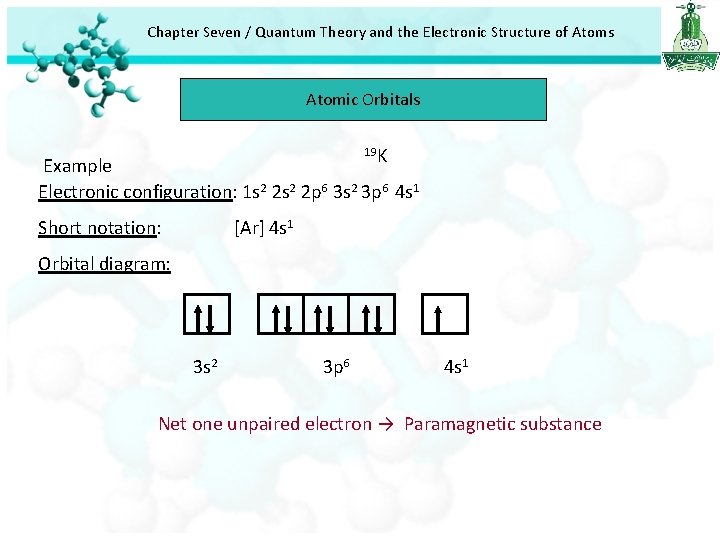
Chapter Seven / Quantum Theory and the Electronic Structure of Atoms Atomic Orbitals 19 K Example Electronic configuration: 1 s 2 2 p 6 3 s 2 3 p 6 4 s 1 Short notation: [Ar] 4 s 1 Orbital diagram: 3 s 2 3 p 6 4 s 1 Net one unpaired electron → Paramagnetic substance
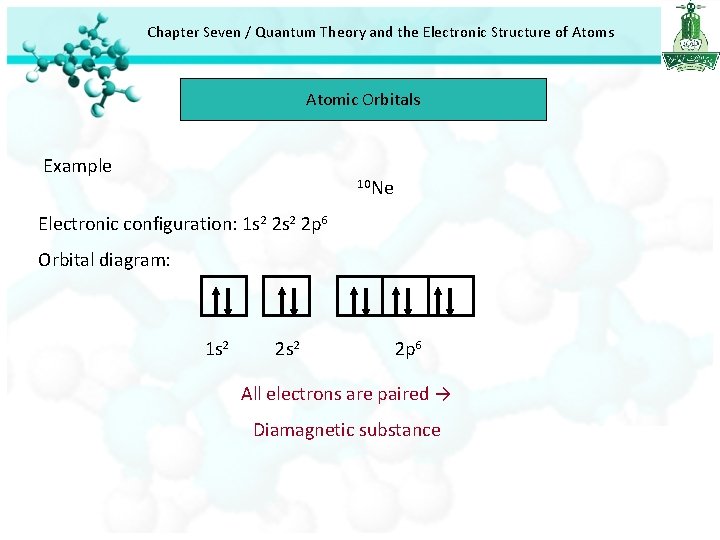
Chapter Seven / Quantum Theory and the Electronic Structure of Atoms Atomic Orbitals Example 10 Ne Electronic configuration: 1 s 2 2 p 6 Orbital diagram: 1 s 2 2 p 6 All electrons are paired → Diamagnetic substance
Chapter Seven / Quantum Theory and the Electronic Structure of Atoms P Atomic Orbitals D D P P P
Chapter Seven / Quantum Theory and the Electronic Structure of Atoms Atomic Orbitals Example What are the valence electrons of vanadium (V)? 23 V: [Ar] 4 s 2 3 d 3 Example What are the valence electrons of Gallium (Ga)? 31 Ga: [Ar] 4 s 2 3 d 10 4 p 1 The valence electrons are 4 s 2 4 p 1
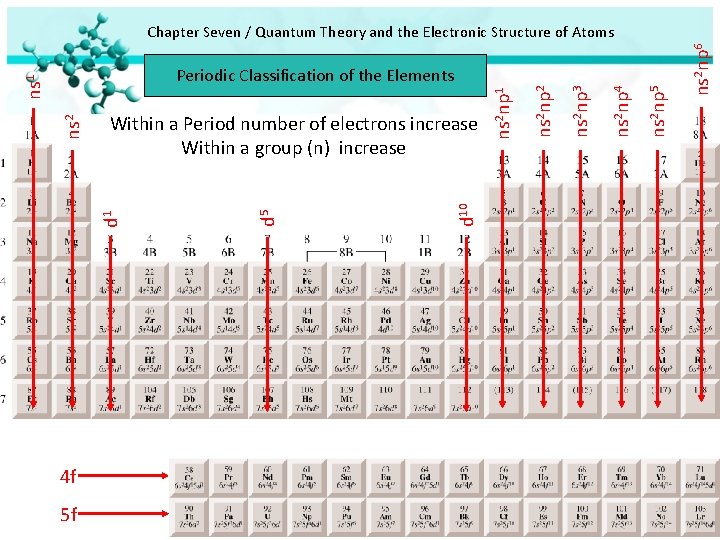
4 f 5 f 69 ns 2 np 6 ns 2 np 5 ns 2 np 4 ns 2 np 3 ns 2 np 1 d 10 d 5 Within a Period number of electrons increase Within a group (n) increase d 1 ns 2 ns 1 Periodic Classification of the Elements ns 2 np 2 Chapter Seven / Quantum Theory and the Electronic Structure of Atoms