Introduction to Quantum Shannon Theory Patrick Hayden Mc
- Slides: 31
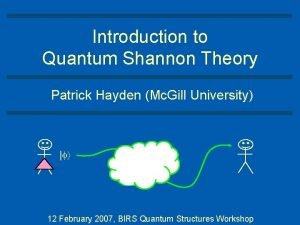
Introduction to Quantum Shannon Theory Patrick Hayden (Mc. Gill University) | 12 February 2007, BIRS Quantum Structures Workshop
Overview § § § What is Shannon theory? Why quantum Shannon theory? Highlights: § § § The brilliant trivialities Basic capacity theorems The grand unified theory
Information theory § A practical question: § § A mathematico epistemological question: § § How to best make use of a given communications resource? How to quantify uncertainty and information? Shannon: Solved the first by considering the second. § A mathematical theory of communication [1948] The §
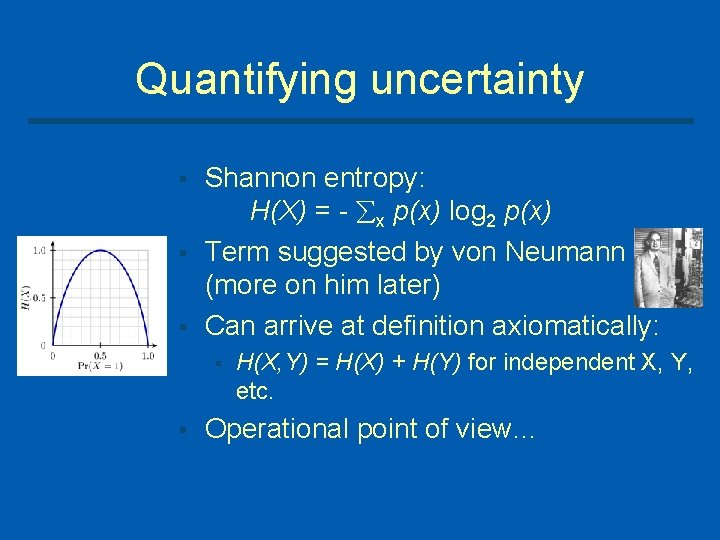
Quantifying uncertainty § § § Shannon entropy: H(X) = x p(x) log 2 p(x) Term suggested by von Neumann (more on him later) Can arrive at definition axiomatically: § § H(X, Y) = H(X) + H(Y) for independent X, Y, etc. Operational point of view…
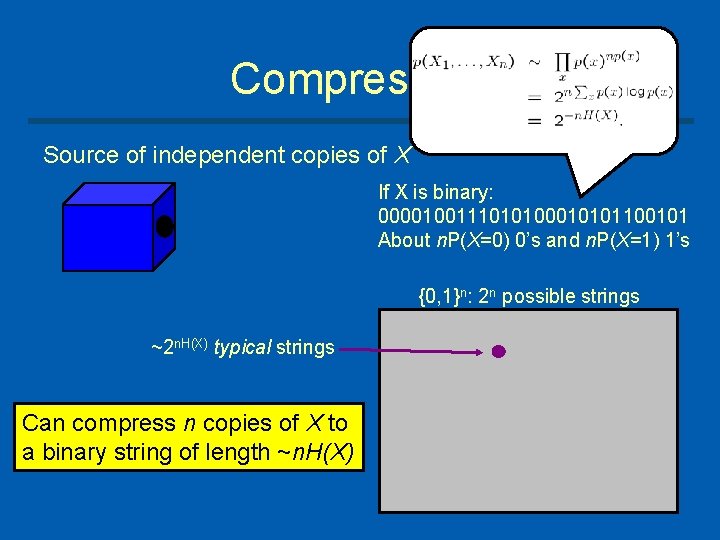
Compression Source of independent copies of X X X 21 X …n If X is binary: 0000100111010100010101100101 About n. P(X=0) 0’s and n. P(X=1) 1’s {0, 1}n: 2 n possible strings ~2 n. H(X) typical strings Can compress n copies of X to a binary string of length ~n. H(X)
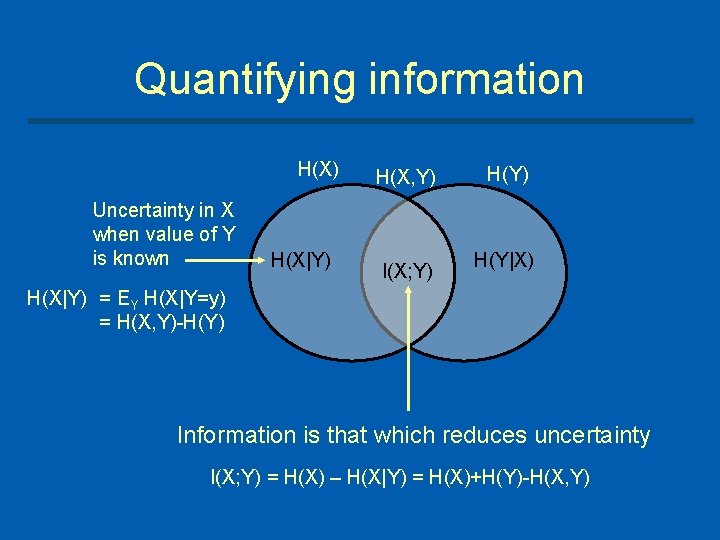
Quantifying information H(X) Uncertainty in X when value of Y is known H(X|Y) H(X, Y) I(X; Y) H(Y|X) H(X|Y) = EY H(X|Y=y) = H(X, Y) H(Y) Information is that which reduces uncertainty I(X; Y) = H(X) – H(X|Y) = H(X)+H(Y) H(X, Y)
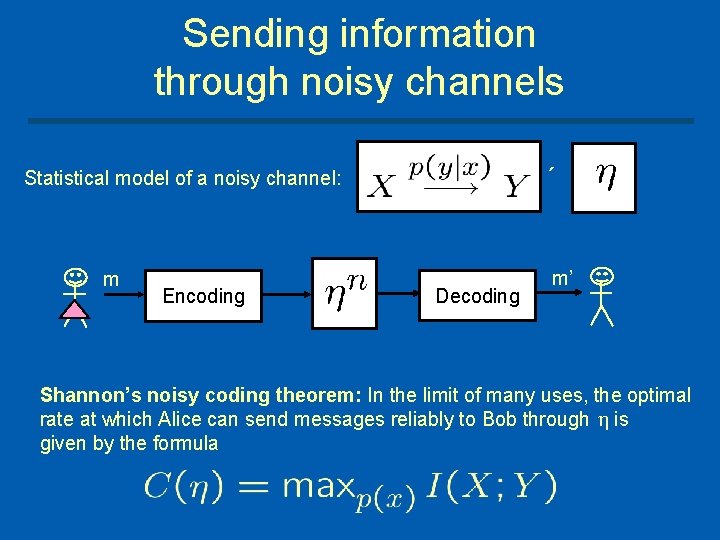
Sending information through noisy channels ´ Statistical model of a noisy channel: m Encoding Decoding m’ Shannon’s noisy coding theorem: In the limit of many uses, the optimal rate at which Alice can send messages reliably to Bob through is given by the formula
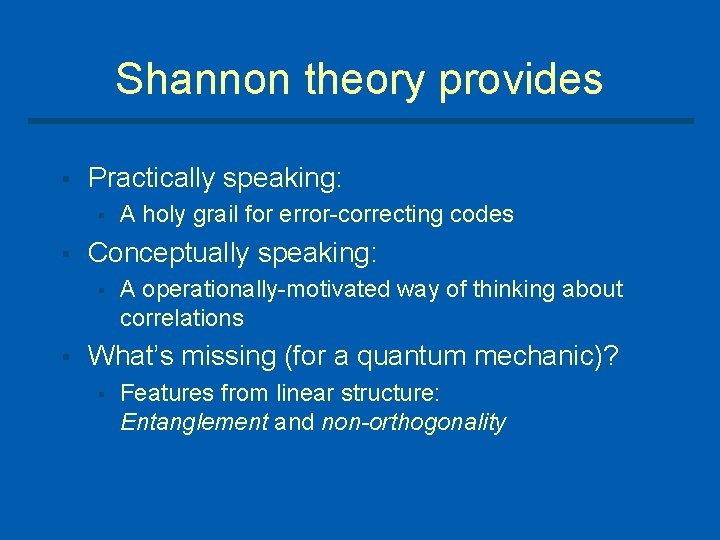
Shannon theory provides § Practically speaking: § § Conceptually speaking: § § A holy grail for error correcting codes A operationally motivated way of thinking about correlations What’s missing (for a quantum mechanic)? § Features from linear structure: Entanglement and non orthogonality
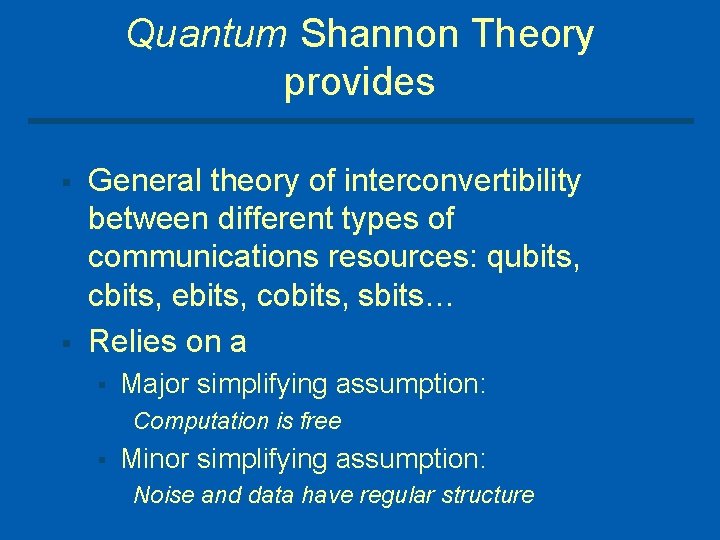
Quantum Shannon Theory provides § § General theory of interconvertibility between different types of communications resources: qubits, cbits, ebits, cobits, sbits… Relies on a § Major simplifying assumption: Computation is free § Minor simplifying assumption: Noise and data have regular structure
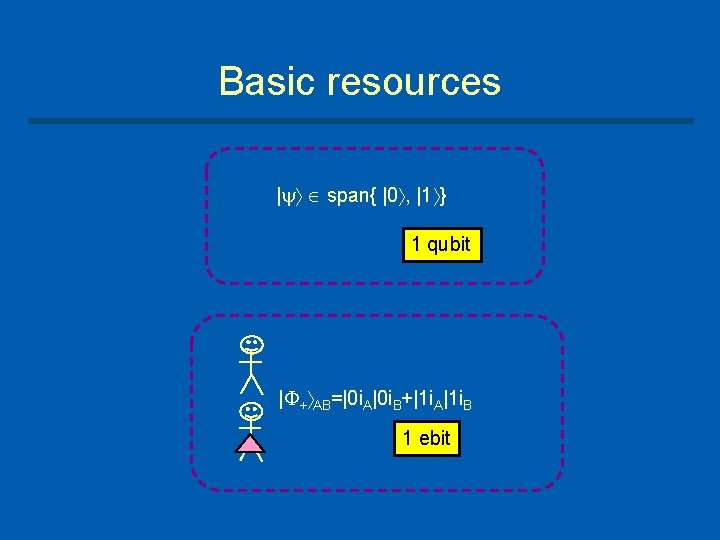
Basic resources | span{ |0 , |1 } 1 qubit | + AB=|0 i. A|0 i. B+|1 i. A|1 i. B 1 ebit
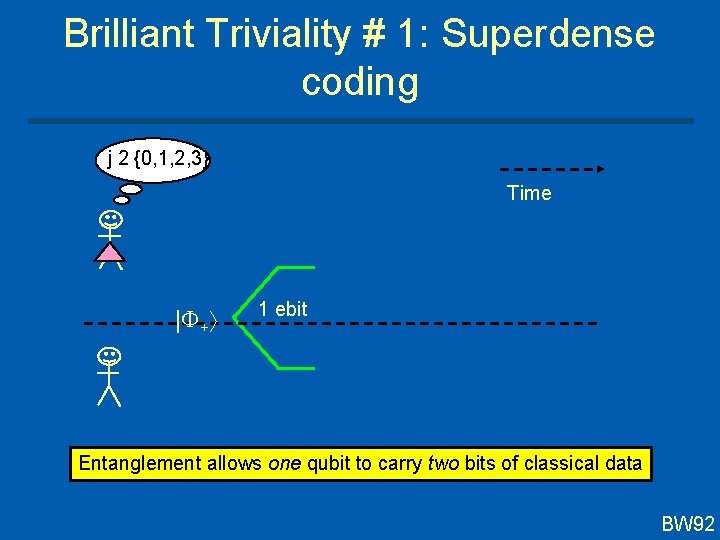
Brilliant Triviality # 1: Superdense coding j 2 {0, 1, 2, 3} Time j | + 1 qubit 1 ebit j: 2 bits Entanglement allows one qubit to carry two bits of classical data BW 92
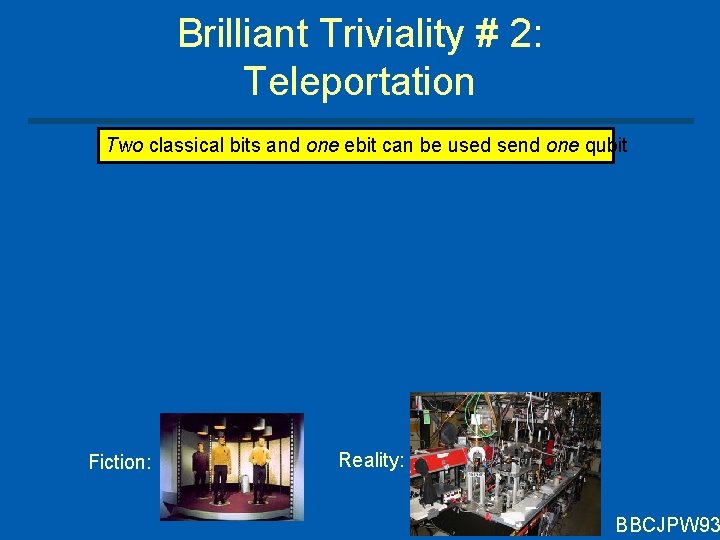
Brilliant Triviality # 2: Teleportation Two classical bits and one ebit can be used send one qubit | Time 1 qubit 2 bits (j) | + 1 ebit j Fiction: | Reality: BBCJPW 93
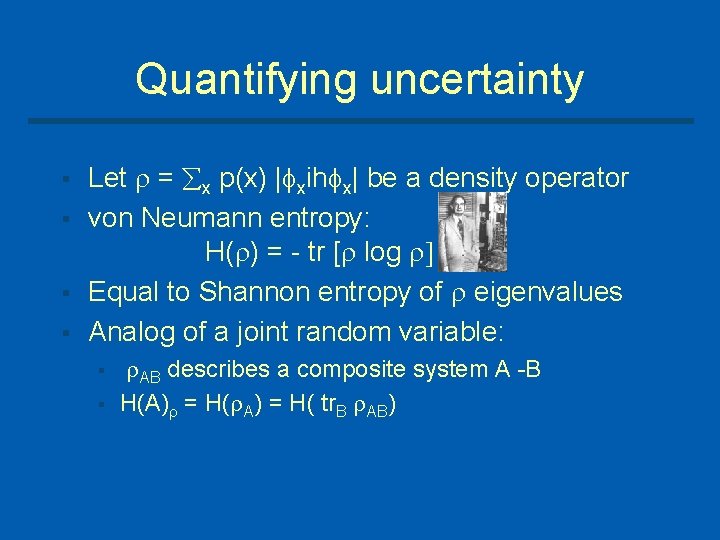
Quantifying uncertainty § § Let = x p(x) | xih x| be a density operator von Neumann entropy: H( ) = tr [ log ] Equal to Shannon entropy of eigenvalues Analog of a joint random variable: § § AB describes a composite system A B H(A) = H( tr. B AB)
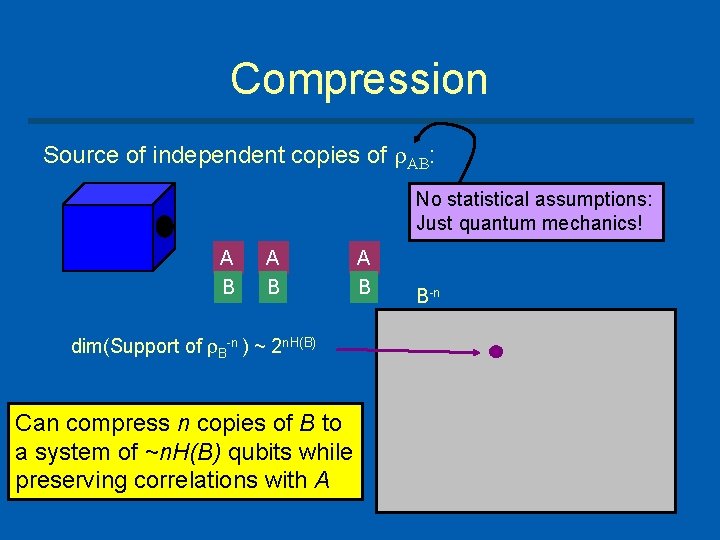
Compression Source of independent copies of AB: No statistical assumptions: Just quantum mechanics! … A B dim(Support of B n ) ~ 2 n. H(B) Can compress n copies of B to a system of ~n. H(B) qubits while preserving correlations with A A B B n
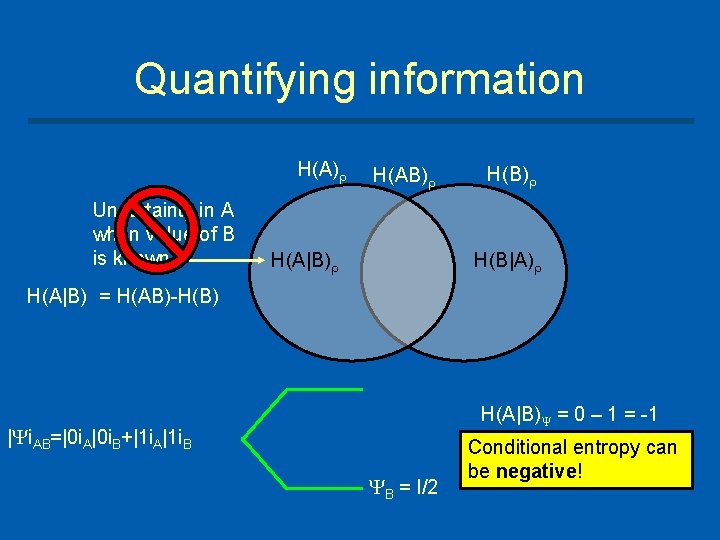
Quantifying information H(A) Uncertainty in A when value of B is known? H(AB) H(B|A) H(A|B) = H(AB) H(A|B) = 0 – 1 = 1 | i. AB=|0 i. A|0 i. B+|1 i. A|1 i. B B = I/2 Conditional entropy can be negative!
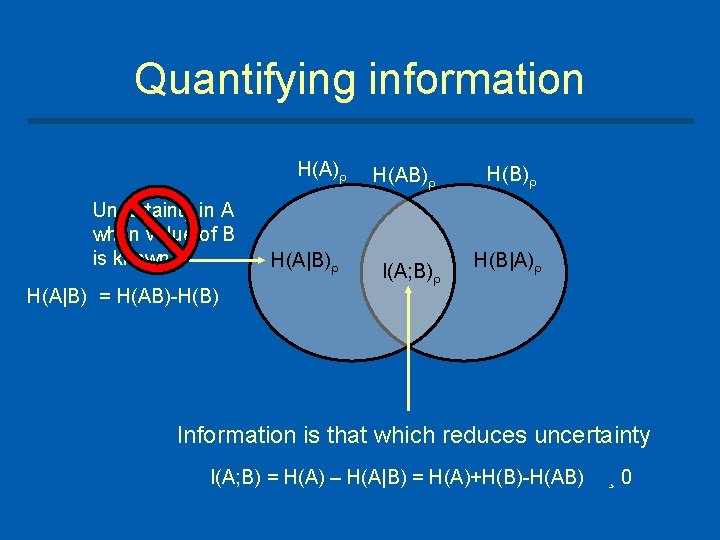
Quantifying information H(A) Uncertainty in A when value of B is known? H(A|B) = H(AB) H(A|B) H(AB) I(A; B) H(B|A) Information is that which reduces uncertainty I(A; B) = H(A) – H(A|B) = H(A)+H(B) H(AB) ¸ 0
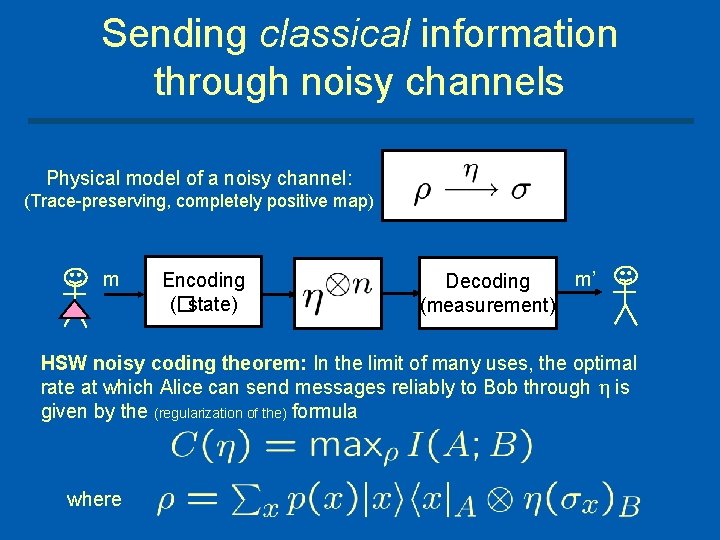
Sending classical information through noisy channels Physical model of a noisy channel: (Trace preserving, completely positive map) m Encoding (�state) m’ Decoding (measurement) HSW noisy coding theorem: In the limit of many uses, the optimal rate at which Alice can send messages reliably to Bob through is given by the (regularization of the) formula where
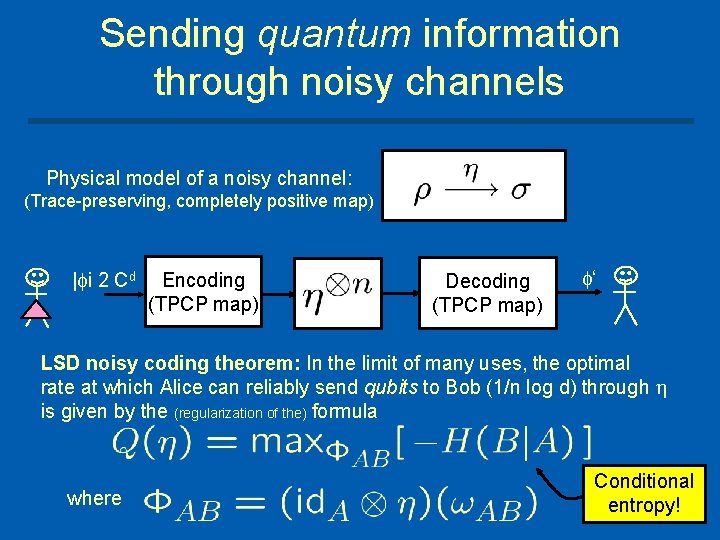
Sending quantum information through noisy channels Physical model of a noisy channel: (Trace preserving, completely positive map) | i 2 Cd Encoding (TPCP map) Decoding (TPCP map) ‘ LSD noisy coding theorem: In the limit of many uses, the optimal rate at which Alice can reliably send qubits to Bob (1/n log d) through is given by the (regularization of the) formula where Conditional entropy!
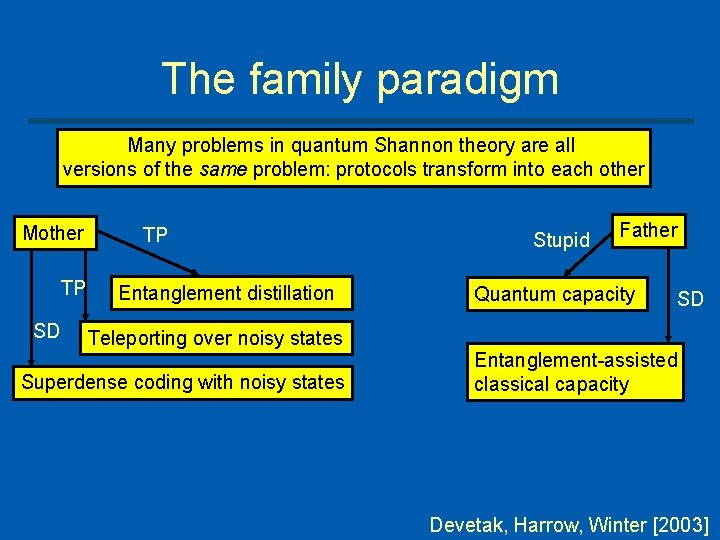
The family paradigm Many problems in quantum Shannon theory are all versions of the same problem: protocols transform into each other Mother TP SD TP Entanglement distillation Teleporting over noisy states Superdense coding with noisy states Stupid Father Quantum capacity SD Entanglement assisted classical capacity Devetak, Harrow, Winter [2003]
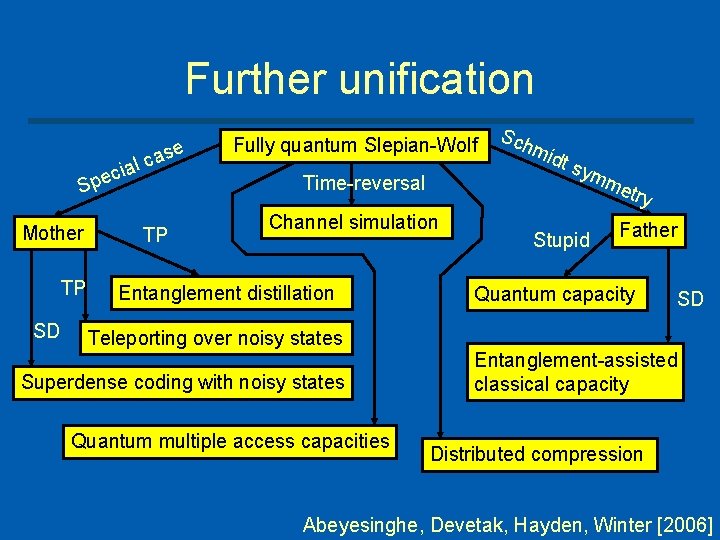
Further unification ase c l ia c e p S Mother TP SD TP Fully quantum Slepian Wolf Time reversal Channel simulation Entanglement distillation Teleporting over noisy states Superdense coding with noisy states Quantum multiple access capacities Sch mid t sy mm e Stupid try Father Quantum capacity SD Entanglement assisted classical capacity Distributed compression Abeyesinghe, Devetak, Hayden, Winter [2006]
The art of forgetting
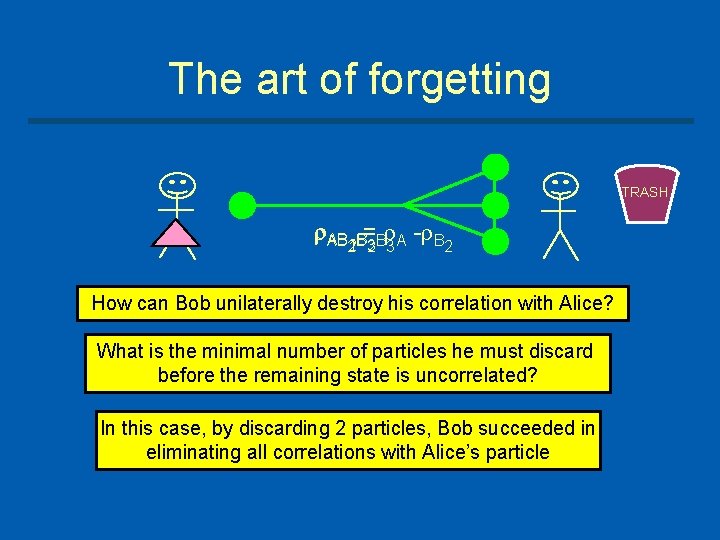
The art of forgetting TRASH AB 2 B=3 B A B 1 2 3 2 How can Bob unilaterally destroy his correlation with Alice? What is the minimal number of particles he must discard before the remaining state is uncorrelated? In this case, by discarding 2 particles, Bob succeeded in eliminating all correlations with Alice’s particle
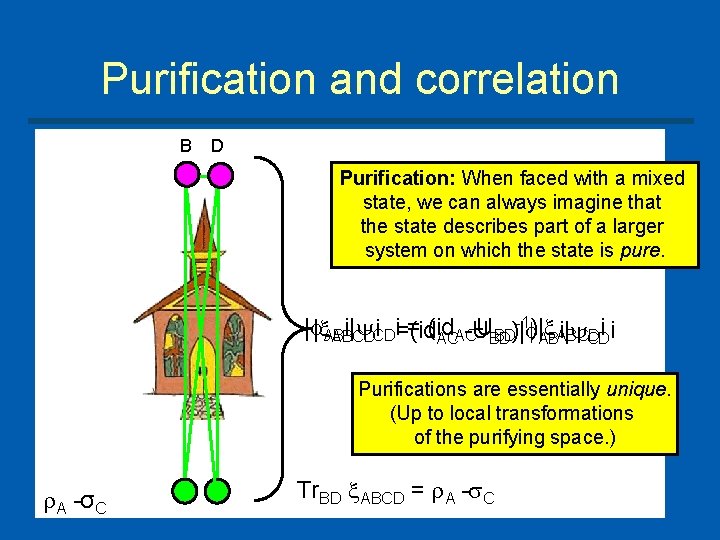
Purification and correlation B D Purification: When faced with a mixed state, we can always imagine that the state describes part of a larger system on which the state is pure. 1)| | | AB i| i = (id U i =(id U )| i| CDi i BD ABABCDCD ACAC BD Purifications are essentially unique. (Up to local transformations of the purifying space. ) A σC Tr. BD ABCD = A C
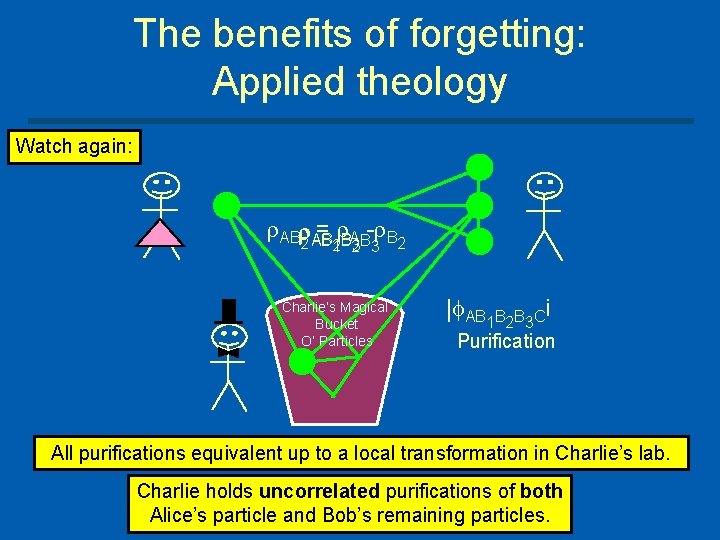
The benefits of forgetting: Applied theology Watch again: AB 2 AB = BAB B 2 2 2 3 3 1 Charlie’s Magical Bucket O’TRASH Particles | AB 1 B 2 B 3 Ci Purification All purifications equivalent up to a local transformation in Charlie’s lab. Charlie holds uncorrelated purifications of both Alice’s particle and Bob’s remaining particles.
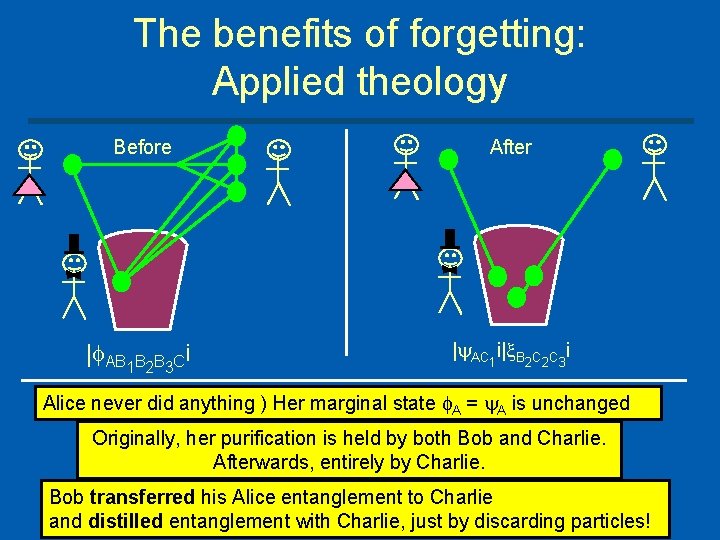
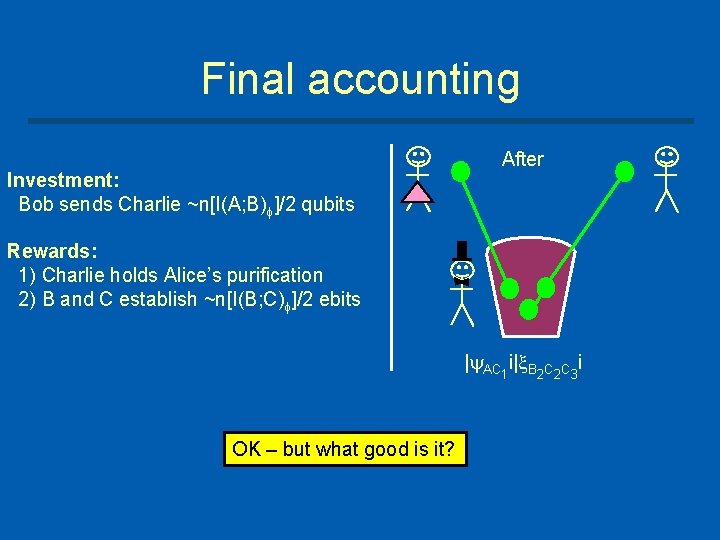
The benefits of forgetting: Applied theology Before TRASH | AB 1 B 2 B 3 Ci After TRASH | AC 1 i| B 2 C 2 C 3 i Alice never did anything ) Her marginal state A = A is unchanged Originally, her purification is held by both Bob and Charlie. Afterwards, entirely by Charlie. Bob transferred his Alice entanglement to Charlie and distilled entanglement with Charlie, just by discarding particles!
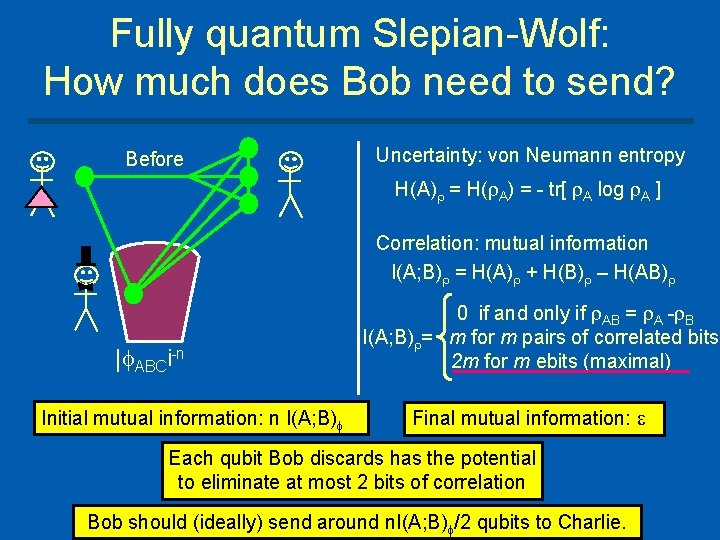
Fully quantum Slepian Wolf: How much does Bob need to send? Before Uncertainty: von Neumann entropy H(A) = H( A) = tr[ A log A ] TRASH | ABCi n Initial mutual information: n I(A; B) Correlation: mutual information I(A; B) = H(A) + H(B) – H(AB) 0 if and only if AB = A B I(A; B) = m for m pairs of correlated bits 2 m for m ebits (maximal) Final mutual information: Each qubit Bob discards has the potential to eliminate at most 2 bits of correlation Bob should (ideally) send around n. I(A; B) /2 qubits to Charlie.
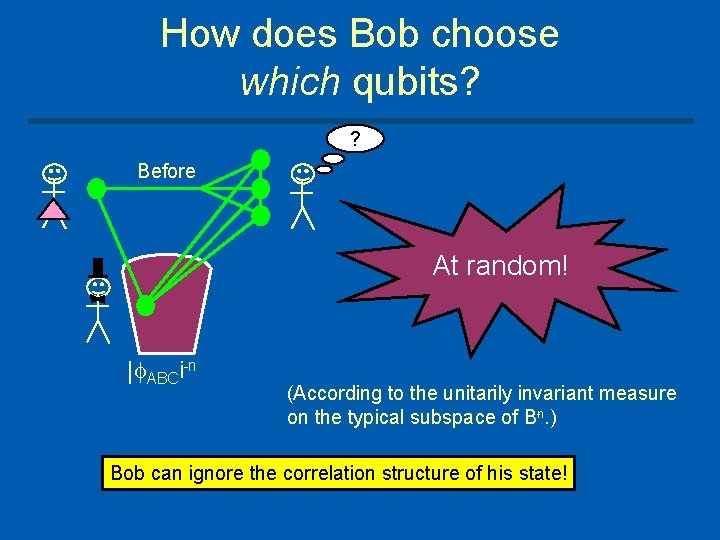
How does Bob choose which qubits? ? Before At random! TRASH | ABCi n (According to the unitarily invariant measure on the typical subspace of B n. ) Bob can ignore the correlation structure of his state!
Final accounting Investment: Bob sends Charlie ~n[I(A; B) ]/2 qubits Rewards: 1) Charlie holds Alice’s purification 2) B and C establish ~n[I(B; C) ]/2 ebits After TRASH | AC 1 i| B 2 C 2 C 3 i OK – but what good is it?
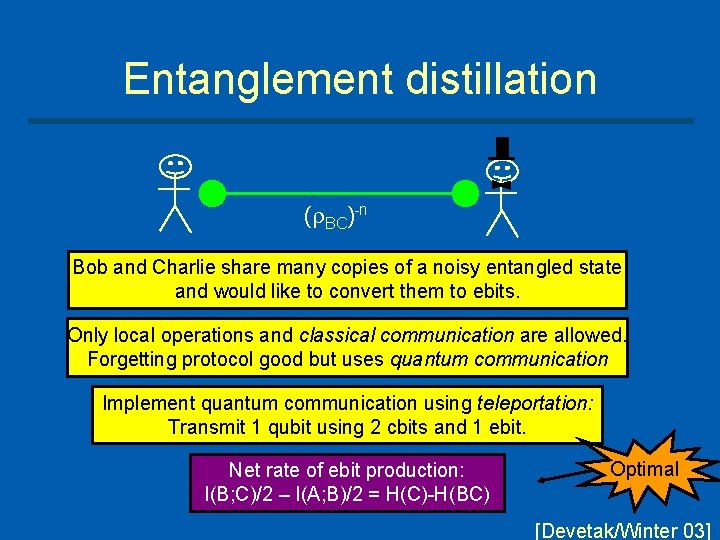
Entanglement distillation ( BC) n Bob and Charlie share many copies of a noisy entangled state and would like to convert them to ebits. Only local operations and classical communication are allowed. Forgetting protocol good but uses quantum communication Implement quantum communication using teleportation: Transmit 1 qubit using 2 cbits and 1 ebit. Net rate of ebit production: I(B; C)/2 – I(A; B)/2 = H(C) H(BC) Optimal [Devetak/Winter 03]
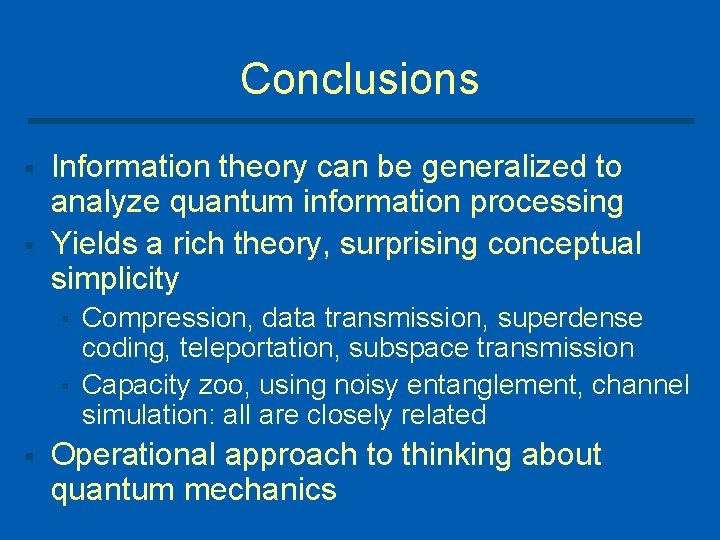
Conclusions § § Information theory can be generalized to analyze quantum information processing Yields a rich theory, surprising conceptual simplicity § § § Compression, data transmission, superdense coding, teleportation, subspace transmission Capacity zoo, using noisy entanglement, channel simulation: all are closely related Operational approach to thinking about quantum mechanics