
Home Blood Pressure Monitoring Hayden Bosworth Ph D
Home Blood Pressure Monitoring Hayden Bosworth, Ph. D. Center for Health Services Research in Primary Care Professor of Medicine, Psychiatry, and Nursing Duke University
Objectives • Define home blood pressure (BP) monitoring • Discuss how it is operationalized and evidence for home BP monitoring • Review the business case for home BP monitoring • Role of home BP monitoring and disparities • Examples of prior programs using home BP monitoring
Background • Self-measured blood pressure monitoring (SMBP) plus additional support is one strategy that can be implemented in communities to reduce the risk of disability or death due to high blood pressure. • SMBP is defined as the regular measurement of blood pressure by the patient outside the clinical setting, either at home or elsewhere. • It is sometimes known as “home blood pressure monitoring. ”
Background • AHRQ Systematic review • This review identified 48 comparative studies that examined the impact of SMBP with or without additional support in the management of hypertension • On a population level, home BP is lower than clinic BP • Patients with white coat hypertension or masked hypertension will be managed differently based on SMBP than those with average BP behavior. • SMBP may confer a small benefit in blood pressure control, but the BP effect beyond 12 months and the attendant long-term clinical consequences remain unclear.
Benefits of home BP monitoring • Because of the larger numbers of readings that can be taken by HBPM than in the office and the elimination of the white-coat effect (the increase of BP during an office visit), home readings are more reproducible than office readings and show better correlations with measures of target organ damage. • Prospective studies that have used multiple home readings to express the true BP have found that home BP predicts risk better than office BP
Benefits of home BP monitoring (1) It is recommended that HBPM should become a routine component of BP measurement in the majority of patients with known or suspected hypertension; (2) Patients should be advised to purchase oscillometric monitors that measure BP on the upper arm with an appropriate cuff size and that have been shown to be accurate according to standard international protocols. They should be shown how to use them by their healthcare providers; (3) Two to 3 readings should be taken while the subject is resting in the seated position, both in the morning and at night, over a period of 1 week. A total of ≥ 12 readings are recommended for making clinical decisions; demonstrated in previous study, minimum of three values over 2 weeks (Bosworth et al. Arch Intern Med 2011)

Benefits of Home BP monitoring (4) HBPM is indicated in patients with newly diagnosed or suspected hypertension, in whom it may distinguish between white-coat and sustained hypertension. If the results are equivocal, ambulatory BP monitoring may help to establish the diagnosis; (5) In patients with prehypertension, HBPM may be useful for detecting masked hypertension; (6) HBPM is recommended for evaluating the response to any type of antihypertensive treatment and may improve adherence; (7) The target HBPM goal for treatment is <135/85 mm Hg or <130/80 mm Hg in high-risk patients;
Benefits of Home BP Monitoring (8) HBPM is useful in the elderly, in whom both BP variability and the white-coat effect are increased; (9) HBPM is of value in patients with diabetes, in whom tight BP control is of paramount importance; (10) Other populations in whom HBPM may be beneficial include pregnant women, children, and patients with kidney disease; (11) HBPM has the potential to improve the quality of care while reducing costs and should be reimbursed
Reimbursement by state for telemedicine http: //atawiki. org. s 161633. gridserver. com/wik i/index. php? title=State_law http: //www. americantelemed. org/policy/state -telemedicine-policy

Take Control of Your Blood pressure (TCYB) NHLBI Grant R 01 HL 070713 (2003 -2008) Pfizer Health Communication Initiative Award (2004 -2006) Established Investigator Award, American Heart Association (2006 -2011)
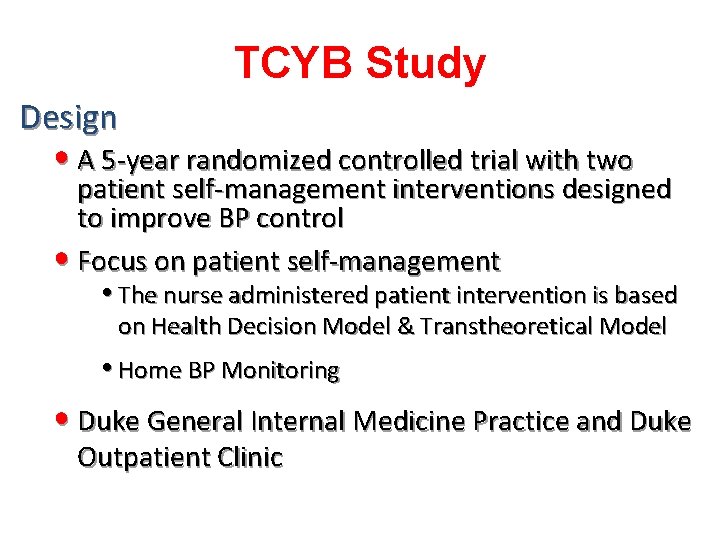
TCYB Study Design • A 5 -year randomized controlled trial with two patient self-management interventions designed to improve BP control • Focus on patient self-management • The nurse administered patient intervention is based on Health Decision Model & Transtheoretical Model • Home BP Monitoring • Duke General Internal Medicine Practice and Duke Outpatient Clinic
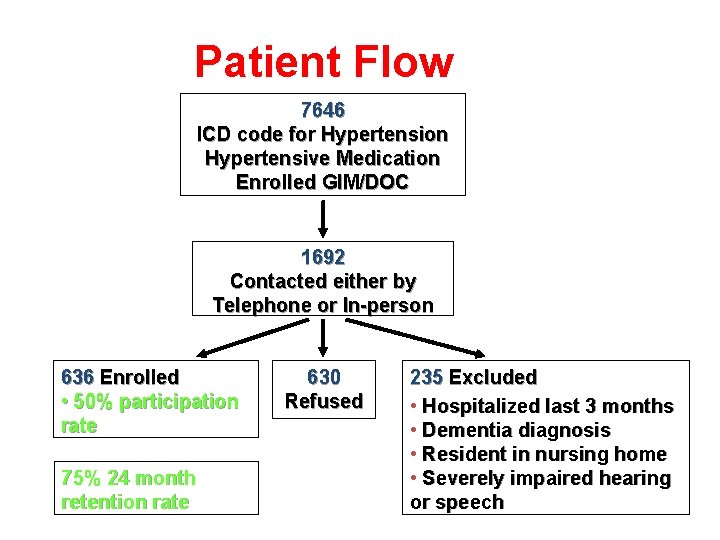
Patient Flow 7646 ICD code for Hypertension Hypertensive Medication Enrolled GIM/DOC 1692 Contacted either by Telephone or In-person 636 Enrolled • 50% participation rate 75% 24 month retention rate 630 Refused 235 Excluded • Hospitalized last 3 months • Dementia diagnosis • Resident in nursing home • Severely impaired hearing or speech
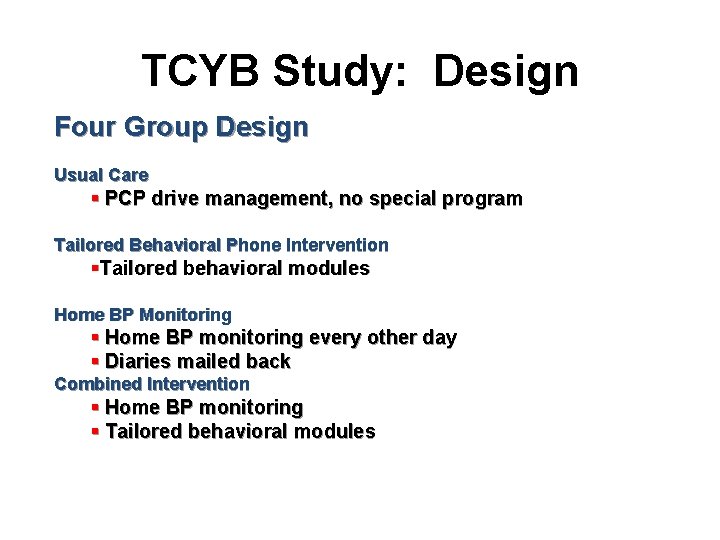
TCYB Study: Design Four Group Design Usual Care § PCP drive management, no special program Tailored Behavioral Phone Intervention §Tailored behavioral modules Home BP Monitoring § Home BP monitoring every other day § Diaries mailed back Combined Intervention § Home BP monitoring § Tailored behavioral modules
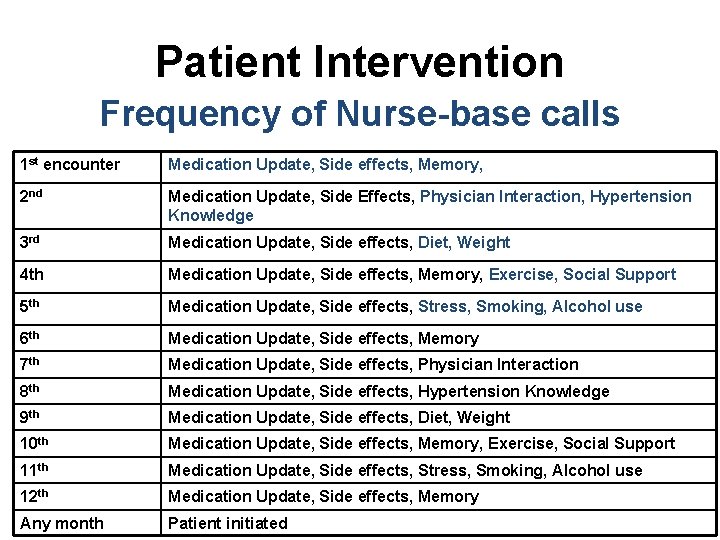
Patient Intervention Frequency of Nurse-base calls 1 st encounter Medication Update, Side effects, Memory, 2 nd Medication Update, Side Effects, Physician Interaction, Hypertension Knowledge 3 rd Medication Update, Side effects, Diet, Weight 4 th Medication Update, Side effects, Memory, Exercise, Social Support 5 th Medication Update, Side effects, Stress, Smoking, Alcohol use 6 th Medication Update, Side effects, Memory 7 th Medication Update, Side effects, Physician Interaction 8 th Medication Update, Side effects, Hypertension Knowledge 9 th Medication Update, Side effects, Diet, Weight 10 th Medication Update, Side effects, Memory, Exercise, Social Support 11 th Medication Update, Side effects, Stress, Smoking, Alcohol use 12 th Medication Update, Side effects, Memory Any month Patient initiated
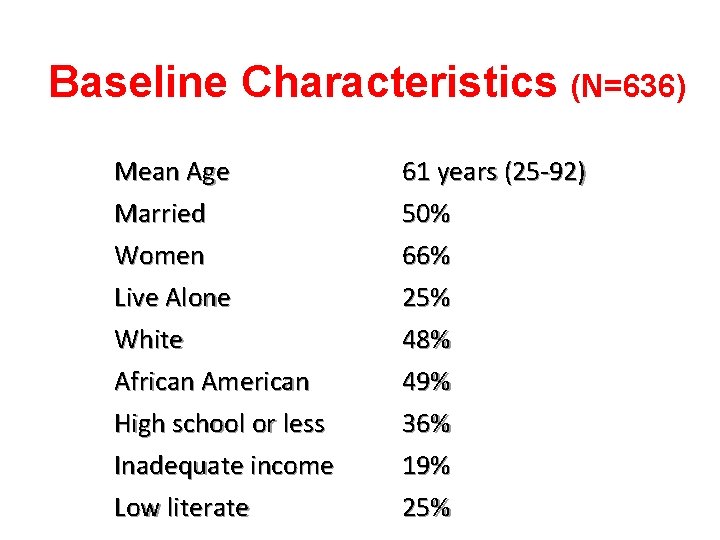
Baseline Characteristics (N=636) Mean Age Married Women 61 years (25 -92) 50% 66% Live Alone White African American High school or less Inadequate income Low literate 25% 48% 49% 36% 19% 25%
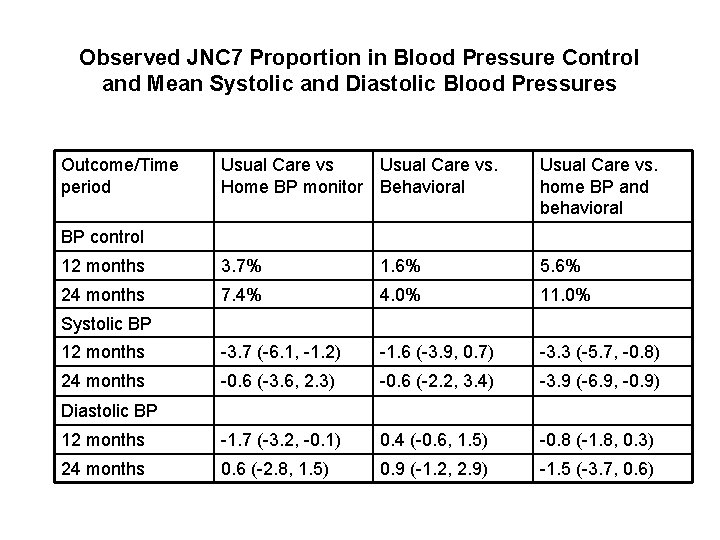
Observed JNC 7 Proportion in Blood Pressure Control and Mean Systolic and Diastolic Blood Pressures Outcome/Time period Usual Care vs. Home BP monitor Behavioral Usual Care vs. home BP and behavioral 12 months 3. 7% 1. 6% 5. 6% 24 months 7. 4% 4. 0% 11. 0% 12 months -3. 7 (-6. 1, -1. 2) -1. 6 (-3. 9, 0. 7) -3. 3 (-5. 7, -0. 8) 24 months -0. 6 (-3. 6, 2. 3) -0. 6 (-2. 2, 3. 4) -3. 9 (-6. 9, -0. 9) 12 months -1. 7 (-3. 2, -0. 1) 0. 4 (-0. 6, 1. 5) -0. 8 (-1. 8, 0. 3) 24 months 0. 6 (-2. 8, 1. 5) 0. 9 (-1. 2, 2. 9) -1. 5 (-3. 7, 0. 6) BP control Systolic BP Diastolic BP
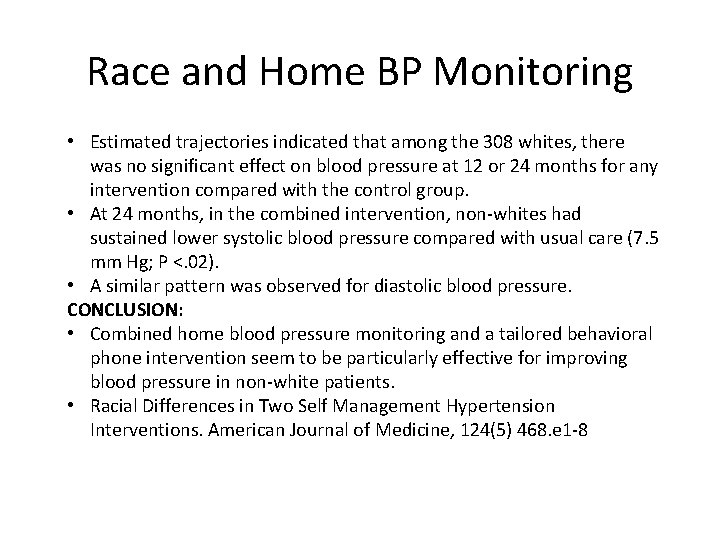
Race and Home BP Monitoring • Estimated trajectories indicated that among the 308 whites, there was no significant effect on blood pressure at 12 or 24 months for any intervention compared with the control group. • At 24 months, in the combined intervention, non-whites had sustained lower systolic blood pressure compared with usual care (7. 5 mm Hg; P <. 02). • A similar pattern was observed for diastolic blood pressure. CONCLUSION: • Combined home blood pressure monitoring and a tailored behavioral phone intervention seem to be particularly effective for improving blood pressure in non-white patients. • Racial Differences in Two Self Management Hypertension Interventions. American Journal of Medicine, 124(5) 468. e 1 -8
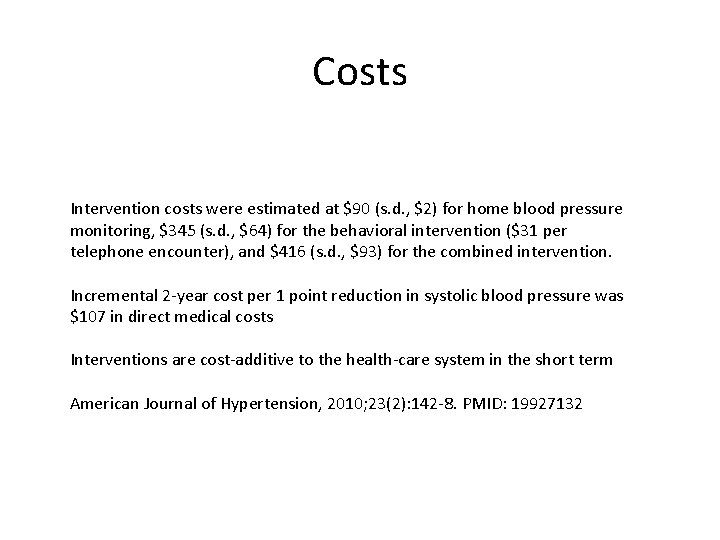
Costs Intervention costs were estimated at $90 (s. d. , $2) for home blood pressure monitoring, $345 (s. d. , $64) for the behavioral intervention ($31 per telephone encounter), and $416 (s. d. , $93) for the combined intervention. Incremental 2 -year cost per 1 point reduction in systolic blood pressure was $107 in direct medical costs Interventions are cost-additive to the health-care system in the short term American Journal of Hypertension, 2010; 23(2): 142 -8. PMID: 19927132
Hypertension Intervention Telemedicine Study (HINTS) Department of Veterans Affairs, Grant IIR 04 -426 (2005 -2008) Career Scientist Award 08 -027 (2008 -2013)
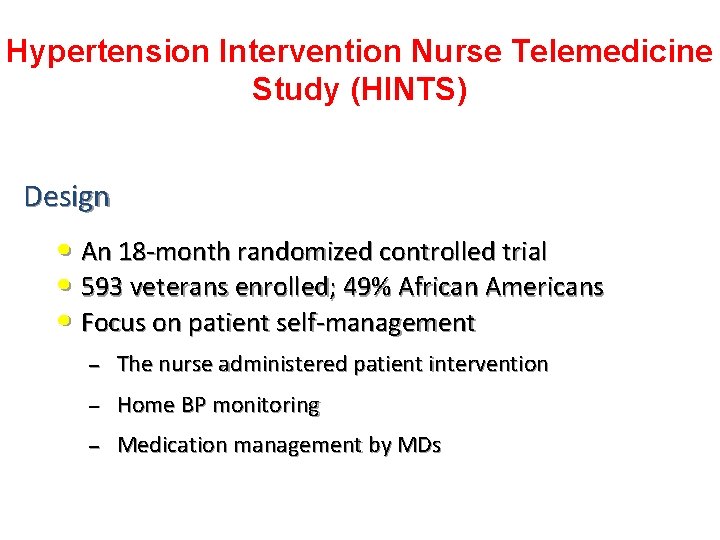
Hypertension Intervention Nurse Telemedicine Study (HINTS) Design • An 18 -month randomized controlled trial • 593 veterans enrolled; 49% African Americans • Focus on patient self-management – The nurse administered patient intervention – Home BP monitoring – Medication management by MDs
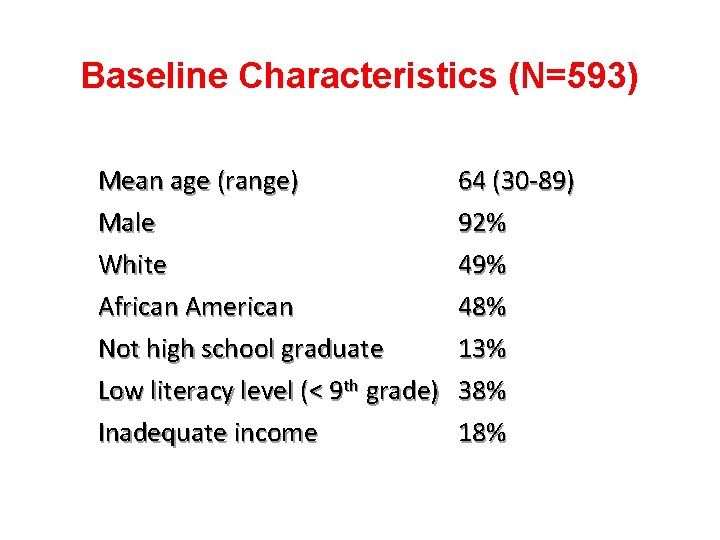
Baseline Characteristics (N=593) Mean age (range) Male White 64 (30 -89) 92% 49% African American Not high school graduate Low literacy level (< 9 th grade) Inadequate income 48% 13% 38% 18%
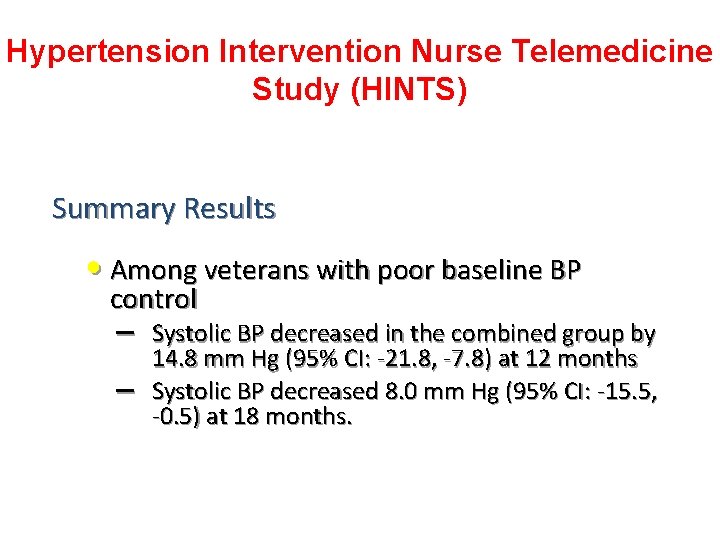
Hypertension Intervention Nurse Telemedicine Study (HINTS) Summary Results • Among veterans with poor baseline BP control – – Systolic BP decreased in the combined group by 14. 8 mm Hg (95% CI: -21. 8, -7. 8) at 12 months Systolic BP decreased 8. 0 mm Hg (95% CI: -15. 5, -0. 5) at 18 months.
Race and Home BP Monitoring • • • Improvement in mean systolic blood pressure post-baseline was greater for African American patients in the combined intervention, compared to African American patients in usual care, at 18 months (9. 7 mm. Hg; -16. 0, -3. 4; p=0. 003). At 18 months, mean diastolic BP was 4. 8 mm. Hg lower (95 % CI: -8. 5, -1. 0; p=0. 01) among African American patients in the combined intervention arm, compared to African American patients in usual care. There were no analogous differences for non-Hispanic white patients. The combination of home BP monitoring, remote medication management, and telephone tailored behavioral self-management appears to be particularly effective for improving BP among African Americans. The effect was not seen among non-Hispanic white patients. Racial Differences in the Effect of a Telephone-Delivered Hypertension Disease Management Program. Journal of General Internal Medicine, 27 (12), 1682 -1689.
Cost In subgroup analysis, patients with poor baseline BP control receiving combined intervention significantly improved BP at 12 and 18 months. Home BP monitoring combined with nurse case management resulted in observed net savings in outpatient care and overall medical care as well as the lowest mean cost difference and total cost, but these differences were not statistically significant relative to the other intervention arms Wang V. , Smith VA. , BOSWORTH HB. , Oddone EZ. , Olsen MK. , Mc. Cant F. , Powers BJ. , Van Houtven CH. (2012). Economic evaluation of three telephone self-management interventions for blood pressure. American Heart Journal, 163(6): 980 -986
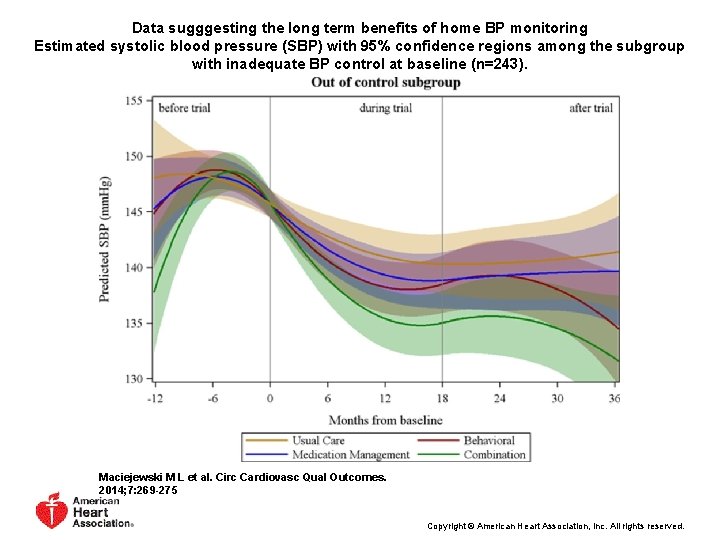
Data sugggesting the long term benefits of home BP monitoring Estimated systolic blood pressure (SBP) with 95% confidence regions among the subgroup with inadequate BP control at baseline (n=243). Maciejewski M L et al. Circ Cardiovasc Qual Outcomes. 2014; 7: 269 -275 Copyright © American Heart Association, Inc. All rights reserved.
Summary • Evidence that Home BP Monitoring beneficial • May be beneficial particularly for some groups who may lack adequate access to health care • Cost appear to be low • Evidence of long term benefits
- Slides: 26