AIA 201 General Conditions to Contract for Construction
- Slides: 87
AIA 201 General Conditions to Contract for Construction A History of the Document and an Analysis of the Changes between 2007 and 2017 Versions By Brandon G. Hummel
What is the AIA 201?
17 Versions of AIA 201 • 17 Versions: 1888, 1911, 1915, 1918, 1925, 1937, 1951, 1958, 1961, 1963, 1966, 1070, 1976, 1987, 1997, 2007, and 2017
AIA 201 Contains 15 Sections and Exhibit A • • • Section 1 - General Provisions Section 2 - Owner Section 3 - Contractor Section 4 - Architect Section 5 - Subcontractors Section 6 - Construction by Owner or by Separate Contractors • Section 7 - Changes in the Work • Section 8 - Time • Section 9 - Payments and Completion
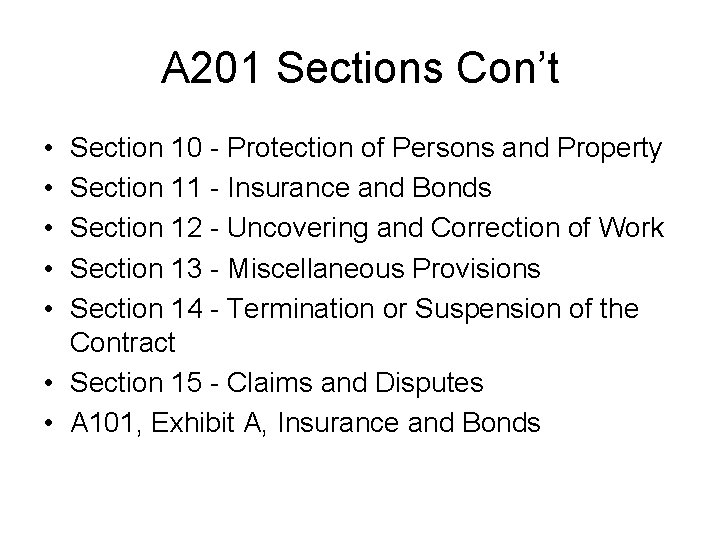
A 201 Sections Con’t • • • Section 10 - Protection of Persons and Property Section 11 - Insurance and Bonds Section 12 - Uncovering and Correction of Work Section 13 - Miscellaneous Provisions Section 14 - Termination or Suspension of the Contract • Section 15 - Claims and Disputes • A 101, Exhibit A, Insurance and Bonds
Goals for Today’s Webinar • We will go through each of the Sections, their significant provisions, what provisions have stayed the same and changed, and what the likely ramifications of the changes might be. • As we do this, please refer to the AIA document highlighting the revisions between the 2007 and 2017 versions of the A 201.
Section 1 – General Provisions • 1. 1 -1. 1. 7 – No substantive changes to definitions of the Contract Documents, the Contract, the Work, the Project, the Drawings, the Specifications or the Instruments of Service.
Revisions to Initial Decision Maker Definition • 1. 1. 8 – Definition of Initial Decision revised slightly. Architect now decides propriety of termination for cause, not Initial Decision Maker can be the Architect or someone else. • New language states that Initial Decision Maker “shall not show partiality to the Owner or Contractor and shall not be liable for results of interpretations or decisions rendered in good faith. ”
No Revisions to Correlation of Contract Documents Provisions Except Severability • 1. 2 – No substantive changes to provision addressing correlation and intent of the Contract Documents except for new severability provision.
New Severability Provision • 1. 2. 1 – New severability clause states that invalid provisions do not affect the validity of other valid provisions in the agreement. In addition, the new provision states that invalid provision(s) “shall be revised to the extent necessary to make that provision legal and enforceable. • In such case, the Contract Documents shall be construed, to the fullest extent permitted by law, to give effect to the parties’ intentions and purposes in executing the Contract. ”
Sections 1. 3 -1. 5 • 1. 3 -1. 5 – no substantive changes to provisions addressing capitalization, interpretation of the contract provisions or ownership and use of the Drawings, Specifications and Other Instruments of Service except reference to new protocols for electronic documents and BIM addressed in Sections 1. 7 and 1. 8.
Section 1. 6 – New Notice Provision • 1. 6. 1 – moved from Section 13. 3 here; requires that each party have a designated representative and states that notice can be effectuated in writing by personal delivery, mail, courier, or by electronic transmission( if a method of electronic transmission is set forth in the Agreement) to the designated representative.
Section 1. 6 – New Notice Provision Con’t • 1. 6. 2 – Notice of claims must be provided in writing and shall be deemed to have been duly served only if delivered to designated representative to whom the notice is addressed by certified or registered mail, or by courier providing proof of delivery.
Section 1. 7 – Instruments of Service Protocols • 1. 7 – requires parties to agree on protocol governing transmission and use of Instruments of Service or any other information or documentation in digital form. • States that parties will use AIA E 203 2013 Building Information Modeling and Digital Data Exhibit to establish the protocols for the development, use, transmission and exchange of digital data.
Section 1. 8 – Reliance On Instruments of Service Without Use of Protocols • 1. 8 – States that where protocols in 1. 7 not agreed upon, the party relying on such information or Instruments of Service does so at their sole risk and without liability to the other party and its contractors and consultants, the authors or contributors of the media, and their agents and employees.
Section 2 - Owner • 2. 2 – revised to provide Contractor with additional protections to assess the Owner’s financial capability to pay for work before commencement of Work and after commencement of Work.
Section 2. 2. 1 – Right to Confirm Owner’s Financial Status Before Work Commences • 2. 2. 1 – revised to allow the Contractor to request and obtain reasonable evidence of Owner’s financial capability to proceed with the Work before commencement of the Work. If Owner does not provide such evidence, Contractor not obligated to commence work and contract time shall be extended appropriately.
Section 2. 2. 2 – Right to Confirm Owner’s Financial Status After Work Commences • 2. 2. 2 – After Work commences, Contractor may only receive reasonable evidence of Owner’s financial capability if Owner fails to pay Contractor pursuant to Contract terms, Contractor identifies in writing reasonable concern regarding Owner’s ability to pay, or a change in the Work materially changes the Contract Sum.
Section 2. 2. 2 Con’t • If under these circumstances the Owner fails to provide reasonable evidence of financial capability within 14 days, Contractor can stop Work. • If request for evidence tied to change in Contract Sum, however, Work can only be stopped on changed portion of Work resulting in increase to Contract Sum. • If Contractor stops due to reasonable concern regarding Owner’s ability to pay, Contractor can obtain additional compensation for shutdown, delay and start-up, plus interest. Contractor can also obtain an extension of the Contract Time.
Sections 2. 3 – 2. 4 – Contractor’s Reliance on Owner Surveys • 2. 3 -2. 4 – no substantive changes to Owner’s responsibility to provide Contractor with surveys of asbuilt conditions of Project site and Contractor’s authorization to rely on same. • Also no substantive change to Owner’s right to stop Work by Contractor if Contractor fails to correct Work not performed in accordance with the Contract Documents.
Section 2. 5 – Owner’s Right to Carry Out Work • 2. 5 – some revisions to provision permitting Owner to carry out the Work; revised to state that where Owner self-corrects Contractor’s improper work, it can, with the Architect’s prior approval, withhold the amounts incurred by Owner from the Contractor’s pay application or back charge the amount to the Contractor including Architect’s fees incurred in connection with the Owner’s efforts to correct the Contractor’s Work. • Also adds language permitting Contractor to dispute the withholding or back charges for Owner’s corrective Work through by submitting a Claim under Section 15.
Section 3 - Contractor • 3. 1 -3. 2 – no substantive changes to Contractor’s definition of general duties and obligations including review of Contract Documents and Field Conditions.
Section 3. 3 – Contractor’s Means and Methods of Construction • 3. 3 – revised to clarify that where Contractor believes means and methods of construction specified by Owner or Architect would be unsafe, Contractor must give timely notice of same to Architect and propose alterative means and methods. Architect required to evaluate alterative means and methods only as it relates to conformity with the design intent of the completed construction. If Architect does not object to alternative means and methods suggested by Contractor, Contractor must utilize the alternative means and methods.
Section 3. 4 – Definition of Labor and Materials • 3. 4 – no substantive changes to definitions of Labor and Materials and Contractor’s responsibility to furnish same.
Section 3. 5 – Contractor’s Warranty • 3. 5 – warranty provision revised to specifically include “all material, equipment, or other special warranties required by the Contract Documents” and that such warranties “shall be issued in the name of the Owner, or shall be transferrable to Owner, and shall commence at the time of Substantial Completion. ”
Sections 3. 5 – 3. 8 – Taxes and Fees, Legal Compliance, Allowances, Superintendent • 3. 5 -3. 8 – no substantive changes to provisions addressing Contractor’s responsibilities for taxes, permits, fees, notices and compliance with laws, concealed and unknown conditions, allowances, and superintendent’s duties.
Section 3. 10 – Construction Schedules • 3. 10 – revised to clarify that Contractor need not prepare its own construction schedule but may have scheduled prepared by third party under Contractor’s direction. • Also revised to insert additional requirements for Contractor’s construction schedule including “the date of commencement of the Work, interim schedule milestone dates, the date of Substantial Completion, an apportionment of the Work by construction activity, the time required for each portion of the Work. ”
Section 3. 10. 2 – Construction Schedules Con’t • 3. 10. 2 – revised to not only require Contractor to provide submittal schedule correlating with overall construction schedule but now states that if Contractor fails to provide submittals in accordance with submittal schedule, that Contractor not entitled to any increase in Contract Sum or Contract Time based on the time required to review late submittals.
Sections 3. 11 – 3. 16 • 3. 11 -3. 16 – no substantive changes to provisions addressing Contractor’s obligations regarding documents and samples to be kept at Project site and definitions of shop drawings, product data and samples and their intended uses, use of the Project site, cutting and patching obligations, clean up obligations, and obligation to provide access to Owner and Architect of Work in progress.
Section 3. 12. 10. 01 – Contractor’s Reliance on Specified Performance and Design Criteria • 3. 12. 10. 01 – revised to state that where Owner or Architect requires certain systems, materials or equipment, the Owner and Architect shall specify all performance and design criteria that the services must satisfy and the Contractor is entitled to rely upon the adequacy and accuracy of the performance and design criteria provided in the Contract Documents. • A licensed design professional must certify and seal the applicable drawings, calculations, specifications, shop drawings, etc.
Section 3. 17 – Copyright and Patent Infringement • 3. 17 – revised to clarify that Contractor not responsible for indemnifying or defending Owner or Architect for copyright or patent infringement where the Owner or Architect specify a particular design, process or product of particular manufacturer or manufacturers in the Contract Documents or where the copyright violations are contained in Drawings, Specifications or other documents prepared by the Owner or Architect.
Section 3. 17 Con’t • However, if the Contractor discovers an infringement or a copyright or patent or is advised of same, it must report such infringement promptly to the Architect. Otherwise, Contractor is responsible for loss occasioned by infringement.
Section 3. 18 - Indemnification • 3. 18 – no substantive changes to indemnification provisions.
Section 4 - Architect • 4. 1 – no substantive changes to provisions addressing definition of Architect • 4. 2 – some revisions to Architect’s obligations regarding administration of the contract.
Section 4. 2. 4 – Communications Among Architect, Owner and Contractor • 4. 2. 4 - provision addressing communications with Architect revised to state that Owner and Contractor must communicate with Architect about any topic that relates to or affects the Architect’s services or professional responsibilities. Architect remains responsible for downstream communications with its consultants and Contractor remains responsible for downstream communications with its subcontractors and suppliers.
Section 4. 2. 6 – Architect Not Responsible for Review or Rejecting Contractor’s Work • 4. 2. 6 – language stating that Architect has no duty to or responsibility to the Contractor, Subcontractors or suppliers to review or reject their Work remains from prior versions.
Section 5 - Subcontractors • 5. 1 -5. 2 – no substantive changes to definitions of Subcontractor or the Owner and Architect’s right to reasonably object to a Subcontractor or supplier. • Language added to required Owner or Architect to reasonably object to proposed Subcontractor or supplier within 14 days of receipt, otherwise objection waived.
Sections 5. 3 – 5. 4 • 5. 3 – revised to require that Subcontractors have written contracts. • 5. 4 – no substantive changes to provisions allowing for contingent assignment of subcontracts if the Contractor is terminated.
Section 6 – Owner and Separate Contractors • 6. 1 – minor revisions to clarify that Owner can contract with Separate Contractors besides the Contractor to perform construction or operations related to the Project, that the Separate Contractor’s Conditions of contract shall be substantially similar to the A 201 (including insurance and waiver of subrogation provisions), and that Owner, Contractor and Separate Contractors must cooperate with the coordination of the Work and the construction schedule. • Contractor still responsible for overall Project construction schedule.
Section 6. 2. 2 – Contractor Duty to Inform Architect of Discrepancies and Defects • 6. 2. 2 – keeps language stating that Contractor must promptly and before proceeding with its work notify Architect of apparent discrepancies or defects in the Owner’s or Separate Contractor’s work that would make it unsuitable for the Contractor to perform its work. Adds language stating that Contractor is not responsible for notifying of discrepancies or defects that are not apparent.
Section 6. 2. 3 – Contractor’s Duty to Reimburse Owner and Separate Contractor • 6. 2. 3 – keeps language stating that if Contractor delays or hinders work of Owner or Separate Contractor it must reimburse Owner for such costs. Likewise, keeps language stating that if Owner or Separate Contractor delay or hinder Contractor Owner must reimburse Contractor for such costs.
Section 7 – Changes to the Work • 7. 1 -7. 3. 3, 7. 4 – no substantive changes to definitions of Change Orders, Change Order Directives and Minor Changes to the Work. Change Orders are executed by Owner, Architect and Contractor. Change Order Directives are issued by Owner and Architect and leave the determination of a change in Contract Sum or Contract Time to a later time. Minor Changes to the Work do not require a Change Order and presumptively do not include an increase or decrease in Contract Sum or Contract Time.
Sections 7. 3. 4 - 7. 3. 7 – Construction Change Directives • New 7. 3. 4 -7. 3. 7 – new language stating that where the Contractor disagrees with the Architect’s determination of Contract Sum or Contract Time through a Construction Change Directive, the Contractor can make a Claim under Section 15 to dispute the determination.
Section 7. 3. 9 – Construction Change Directives Con’t • 7. 3. 9 – Contractor remains able to seek additional compensation through Payment Applications for Work tied to a Construction Change Directive. If and when the Contractor executes the Change Order Directive, the document becomes a binding Change Order.
Section 8 - Time • 8. 1 – no substantive changes to definitions of Contract Time, Date of Commencement of the Work and Substantial Completion. • 8. 2. 2 – revised to clarify that Contractor shall not knowingly, except by agreement or direction from the Owner, commence Work on the Project prior to the effective date of insurance required to be furnished by the Owner and Contractor.
Section 8. 3. 1 – Contractor’s Right to Extension of Contract Time • 8. 3. 1 – keeps and slightly clarifies language allowing Contractor to seek an extension of time (as determined by the Architect) for acts or omissions by the Owner, Architect or other third parties not under contract with or control of Contractor, for changes to the Work, force majeure events, for unexpected adverse weather conditions, and delays authorized by Owner to handle mediation or binding dispute resolution, or by other causes asserted by the Contractor and accepted as appropriate by the Architect.
Section 8. 3. 2 – Delay/Acceleration/Disruption Claims Fall Under Section 15 • 8. 3. 2 – keeps language stating that Claims for a change to the Contract Sum or Contract Time, where initially disagreed upon through the Change Order process, should be submitted as a Claim under Section 15.
Section 9 - Payment • 9. 1. 2 – some revisions to definition of Contract Sum. • Inserts language previously found at Section 7. 3. 4 regarding unit prices which states that “[i]f unit prices are stated in the Contract Documents or subsequently agreed upon, and if quantities originally contemplated are materially changed so that application of such unit prices to the actual quantities causes substantial inequity to the Owner or Contractor, the applicable unit prices shall be equitably adjusted. ”
Section 9. 2 – Schedule of Values • 9. 2 – some revisions to language addressing Contractor’s obligation to prepare a Schedule of Values for processing of Payment Applications where the contract is for a stipulated sum or GMP. Adds obligation that changes in the Schedule of Values as the Project progresses must be submitted to the Architect and include sufficient data to substantiate its accuracy.
Section 9. 3 – Payment Applications • 9. 3 – no substantive changes to language regarding procedures for Contractor’s submission and processing of Payment Applications except additional requirement that Contractor submit with periodic Payment Applications copies of trailing lien waivers (9. 3. 1).
Section 9. 4. – Certificates of Payment • 9. 4. – some clarifications to Architect’s Certificates of Payment. Architect required to respond to Contractor’s Payment Application within seven days and must approve in full, approve in part and provide reasons why certain portions of Payment Application not approved, or deny Payment Application in whole with explanation of reasons for denial.
Section 9. 5. 1 – Architect’s Right to Withhold or Set Off Against Payment Certificate • 9. 5. 1 – keeps language that allows Owner to set off against a Payment Application or withdraw a formerly issued Certificate of Payment where the Architect discovers defective work by the Contractor that needs to be remedied, reasonable evidence of third party claims asserted or to be asserted against the Owner, reasonable evidence that the Contractor will not be able to complete its remaining Work or will not be able to complete pursuant to the construction schedule, damage to work performed by the Owner or a Separate Contractor, or the Contractor has repeatedly failed to meet its obligations under the Contract Documents.
Section 9. 5. 4 – Owner’s Rights to Direct Pay Subcontractors and Suppliers • 9. 5. 4 – keeps language that allows Owner to directly pay Contractor’s subcontractors and suppliers by joint check in the event of a payment dispute.
Section 9. 6 – Contractor’s Timely Payment of Subcontractors and Suppliers • 9. 6 – minor changes to language requiring that Contractor pay its subcontractors within seven days after receipt of payment from Owner and that Owner has the right to request and receive written evidence of payment to Contractor’s subcontractors and their lower tier subcontractors.
Section 9. 6. 7 – Trust Fund Provision • 9. 6. 7 – keeps language stating that funds paid to Contractor by Owner for the benefit of Contractor’s subcontractors and suppliers are trust funds, but that such funds may be commingled with the Contractor’s funds in the same account. The trust fund requirement is removed if the Contractor furnishes the Owner with a payment bond in the full penal sum of the Contract Sum.
Section 9. 6. 8 – Contractor’s Defense and Indemnity of Payment Claims Against Owner • New 9. 6. 8 – adds language stating that where the Owner has met its payment obligations under the Contract Documents, the Contractor must defend and indemnify Owner against lien and other payment claims (including attorneys’ fees). The Contractor, however, may obtain a lien substitution or payment bond to meet its obligation under this provision. Such security must be approved by the applicable court handling the lien or payment claims.
Section 9. 7 – Contractor’s Right to Stop Work for Nonpayment • 9. 7 – keeps language allowing Contractor to stop work after 14 days if the Owner fails to pay it and it is not otherwise barred from payment under other provisions of the Contract Documents. • Provision also allows for an extension of time for nonpayment and reimbursement of Contractor for shutdown, delay and start-up costs.
Sections 9. 8 – 9. 9 – Substantial Completion, Punch Lists, Retention • 9. 8 -9. 9 – no substantive changes to definitions of Substantial Completion, obligations for preparation and completion of punch lists and Partial Occupancy and Use. Substantial Completion remains the commencement date for the Section 3. 5 warranties unless otherwise provided for in the Certificate of Substantial Completion. • Retention monies are also to be paid at the time of Substantial Completion except for incomplete Work or Work not done in accordance with the Contract Documents.
Section 9. 10 – Final Completion and Final Payment • 9. 10 – some revisions to language regarding Final Completion and Payment. Reference to Contractor’s obligation in Section 3. 5 to furnish special manufacturer or subcontractor warranties added. • In addition, new language requiring Contractor to refunds paid to it at Final Payment where liens, claims or other encumbrances are subsequently asserted against the Project and the Owner is compelled to pay such claims. Includes Owner’s attorneys’ fees.
Section 9. 10. 4 – Impact of Owner’s Final Payment to Contractor • 9. 10. 4 – keeps language stating that Final Payment does not waive the Owner’s claims for unsettled liens, security interests and encumbrances arising out of the Contract Documents, failure of Contractor to perform Work in accordance with the Contract Documents, claims for special warranties under the Contract Documents, and for claims discovered by audit after Final Payment.
Section 10 – Protection of Persons and Property • 10. 1 -10. 4 – no substantive changes to provisions addressing Contractor’s safety precautions and programs, procedures to safeguard persons and property, procedures to protect against hazardous materials and substances and emergencies.
Section 11 – Insurance and Bonds • 11. 1 – substantive changes to provisions addressing insurance and bonds. • Description of Contractor’s obligations to procure liability insurance largely moved to A 101, Exhibit A, Insurance and Bonds. New 11. 1 language states that specific requirements for Contractor’s general liability insurance described elsewhere in Agreement. • Notes, however, that the liability insurance must name the Owner, Architect and Architect’s consultants as additional insureds.
Section 11. 1. 2 – Contractor’s Obligation to Procure Surety Bonds • 11. 1. 2 – new language makes general reference to obligation of Contractor to procure surety bonds as otherwise required under the Contract Documents from a company or companies lawfully authorized to issue surety bonds in the jurisdiction where the Project is located.
Sections 11. 1. 3 – Contractor’s Obligation to Furnish Payment Bond to Subcontractor • 11. 1. 3 – states that payment bond beneficiaries of Contractor’s payment bond must be provided copy of Contractor’s payment bond promptly upon request.
Section 11. 2. 1 • 11. 2. 1 – new language makes general reference to Owner’s obligation to obtain insurance as specified in other portions of the Agreement.
Sections 11. 2. 2 – 11. 2. 3 – Ramifications of Owner’s Failure to Get Required Insurance • 11. 2. 2 – addresses the ramifications of the Owner’s failure to purchase required property insurance. • 11. 2. 3 – addresses ramifications of Owner’s failure to advise Contractor of cancellation or expiration of required property insurance.
Section 11. 3. 1 – Waiver of Subrogation • 11. 3. 1 – revises waiver of subrogation provision to clarify that language of A 201 controls over contrary provisions of individual insurance policies addressing carriers’ subrogation rights.
Sections 11. 4 – 11. 5. 2 • 11. 4 -11. 5. 2 – moves prior language here regarding Owner’s right to obtain Loss of Use, Business Interruption, and Delay in Completion Insurance as well as provisions addressing adjustment and settlement of insured losses.
Section 12 – Uncovering and Correction of Work • 12. 1 -12. 2. 5 – no substantive changes to provisions addressing correction of work before and after it is covered except that where work is uncovered and found to incorrectly performed by Architect, Contractor can no longer rely on Owner’s or Separate Contractor’s incorrectly performed work to get out of obligation of paying for corrections.
Sections 12. 2. 2. 3 and 12. 2. 6 • 12. 2. 2. 3 – keeps language stating that Section 3. 5 warranties shall not be extended by corrective work performed by the Contractor following substantial completion. • 12. 2. 6 – keeps language clarifying that one-year correction period is not a statute of limitation with respect to any other obligations the Contractor may have under the Contract Documents.
Section 12. 3 – Owner’s Right to Correct Contractor’s Work and Set-Off • 12. 3 – keeps language permitting the Owner to accept non-conforming work under the Contract Documents and to adjust the Contract Sum downward accordingly.
Section 13 – Miscellaneous Provisions • 13. 1 – clarifies that Contract governed by law of the place where the Project is located excluding that jurisdiction’s choice of law rules. • 13. 2 – no changes to language addressing successors and assigns.
Sections 13. 3 – 13. 5 • 13. 3 -13. 5 – no substantive changes to provisions addressing the parties’ rights and remedies, obligations to arrange and pay for tests and inspections, and the parties’ right to receive interest.
Section 14 – Suspension and Termination • 14. 1 – addresses instances where the Contractor can terminate the Contract with the Owner. Remains largely unchanged. • Instances include court or administrative order, acts of national government including national emergency, non-payment, and lack of reasonable evidence by Owner of financial capability to pay for the Work.
Section 14. 1. 3 • 14. 1. 3 – inserts additional language allowing Contractor to recover reasonable overhead and profit upon its termination of Owner for Work not executed and costs incurred as a result of the termination.
Section 14. 2 – Owner’s Termination for Cause • 14. 2 – few changes to provisions regarding Owner’s termination for cause of Contractor except clarification that Architect must determine the propriety of the Owner’s termination for cause of the Contractor. Basis for termination for cause by Owner and remedies and rights where such has occurred are the same.
Section 14. 3 – Owner’s Suspension for Convenience • 14. 3 – few changes to provisions regarding Owner’s suspension of Contractor for convenience. • Contractor remains entitled to adjustment in Contract Sum and Contract Time caused by suspension including profit, but not entitled to adjustments where its performance is, was or would have been delayed or interrupted by its own actions or inactions or where an adjustment would be precluded by other provisions of the Contract Documents.
Section 14. 4 – Owner’s Termination for Convenience • 14. 4 – few changes to provisions regarding Owner’s termination of Contractor for convenience except that completed work will only be paid for it is properly executed. In addition, removes Contractor’s recovery for reasonable overhead and profit on work not executed. Inserts language allowing for Contractor to recover from Owner for costs it incurs to termination of subcontracts.
Section 15 – Claims and Disputes • 15. 1 – clarifies definition of Claims to include claims for money, time or any other alleged breach of the contract; does not require Owner to file notice of claim to obtain liquidated damages from Contractor.
Section 15. 1. 2 – Statutes of Limitation and Repose • 15. 1. 2 – moves statute of limitation/statute of repose provision from Section 13. 7 and keeps 10 year statute of repose period running from Substantial Completion. • Allows more restrictive statute law on limitations and repose periods to apply, but states that 10 year repose period is applicable if more restrictive periods not available.
Section 15. 1. 3. 1 – Discovery of Claims • 15. 1. 3. 1 – Claims discovered prior to expiration of Section 12 correction period subject to notice provisions of Section 12. • Keeps requirements that Claims discovered after Section 12 correction period must be noticed within 21 days after the occurrence of the event giving rise to the Claim or within 21 days after the claimant first recognizes the condition giving rise to the Claim, whichever is later.
Section 15. 1. 3. 4 – Contractor’s Obligation to Continue Work Pending Claim Resolution • 15. 1. 3. 4 – keeps language stating that Contractor, unless otherwise agreed in writing under Section 9. 7, must to continue to proceed diligently with performance of the Contract while a Claim is pending.
Sections 15. 1. 5 and 15. 1. 6 • 15. 1. 5 – where the Contractor disputes the amount of additional Contract Sum to be paid for changed Work, it must file a Section 15 Claim before proceeding to perform such Work. • 15. 1. 6 – keeps requirement that where Contractor makes Claim for extension of Contract Time, it must include an estimate of the cost and of the probable effect of delay on the progress of its Work.
Section 15. 1. 7 – Waiver of Consequential Damages • 15. 1. 7 – keeps waiver of consequential damages provision unchanged; reiterates that waiver does not cover liquidated damages.
Section 15. 2 – Changes to Initial Decision Duties, Timing of Mediation and Disputes • 15. 2 – keeps Initial Decision Maker as default Architect unless otherwise agreed. Revised to reduce of time necessary to seek mediation or binding dispute resolution. If Initial Decision Maker does not decide on Claim within thirty days, party asserting claim can seek mediation. • In addition, parties can now simultaneously seek mediation and binding dispute resolution simultaneously with the requirement that the binding dispute resolution be stayed for sixty days pending completion of the mediation.
Section 15. 4 – Venue for Arbitrations, Joinder and Consolidation of Arbitrations • 15. 4 – clarified to state that arbitrations are to be conducted in the place where the Project is located unless mutually agreed upon otherwise by the parties. • 15. 4. 4 – no substantive changes to consolidation or joinder rules for arbitration except that default rule is that consolidation and joinder rules of American Arbitration Association apply unless otherwise stated.
Conclusions • Questions or Comments?