The Apocrypha and Christianity Trinity Theological Seminary Of

- Slides: 85
The Apocrypha and Christianity Trinity Theological Seminary Of South Florida
The Apocrypha and Christianity n Outline n n n Historical Background & Timeline Authoritative or not? Books of the Apocrypha
The Apocrypha and Christianity n This course will deal with the historical content of these “hidden” books, their purpose and meaning. Also it’s place in ecclesiastical dogma as well.
Why study the Apocrypha? n n The period “between the Testaments” (400 B. C. to mid-1 st century A. D. ) is a blank to most Protestants The Apocrypha fills in blanks such as: n n n The Maccabean Revolt (and the meaning of Hanukkah) Alexander the Great (356 - 323 B. C. ) and his impact on Palestine The development of theological topics such as Satan, demons, hell, and the resurrection of the dead
Nomenclature n n n The term “apocrypha” comes from a Greek word meaning “hidden” The term “Apocrypha” (capital “A”) refers to a collection of books written in the Inter. Testamental period (and into the 1 st century) In general, these books appeared in the Greek translation of the Old Testament known as the Septuagint, but not in Hebrew versions of the Old Testament
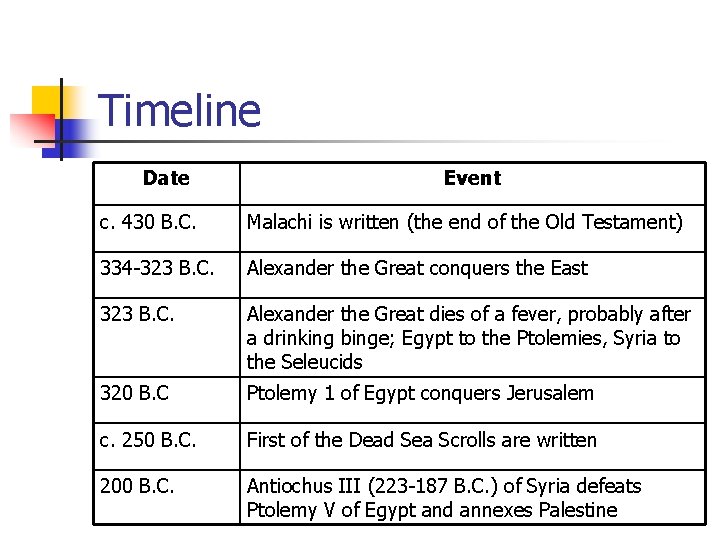
Timeline Date Event c. 430 B. C. Malachi is written (the end of the Old Testament) 334 -323 B. C. Alexander the Great conquers the East 323 B. C. Alexander the Great dies of a fever, probably after a drinking binge; Egypt to the Ptolemies, Syria to the Seleucids 320 B. C Ptolemy 1 of Egypt conquers Jerusalem c. 250 B. C. First of the Dead Sea Scrolls are written 200 B. C. Antiochus III (223 -187 B. C. ) of Syria defeats Ptolemy V of Egypt and annexes Palestine
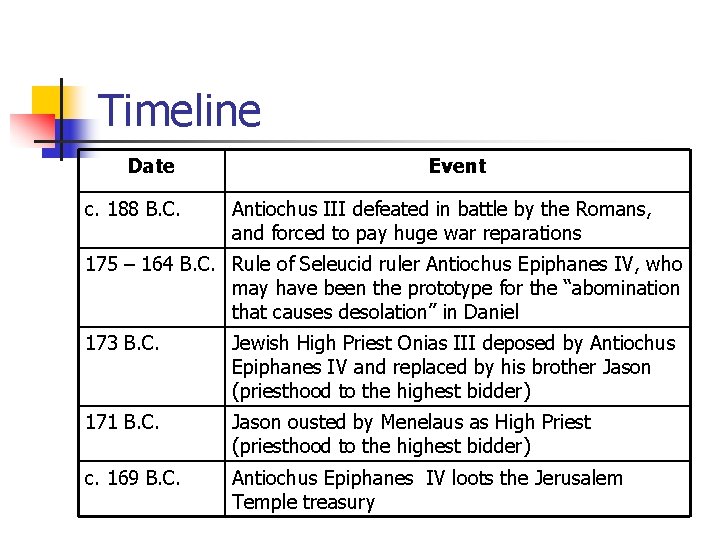
Timeline Date c. 188 B. C. Event Antiochus III defeated in battle by the Romans, and forced to pay huge war reparations 175 – 164 B. C. Rule of Seleucid ruler Antiochus Epiphanes IV, who may have been the prototype for the “abomination that causes desolation” in Daniel 173 B. C. Jewish High Priest Onias III deposed by Antiochus Epiphanes IV and replaced by his brother Jason (priesthood to the highest bidder) 171 B. C. Jason ousted by Menelaus as High Priest (priesthood to the highest bidder) c. 169 B. C. Antiochus Epiphanes IV loots the Jerusalem Temple treasury
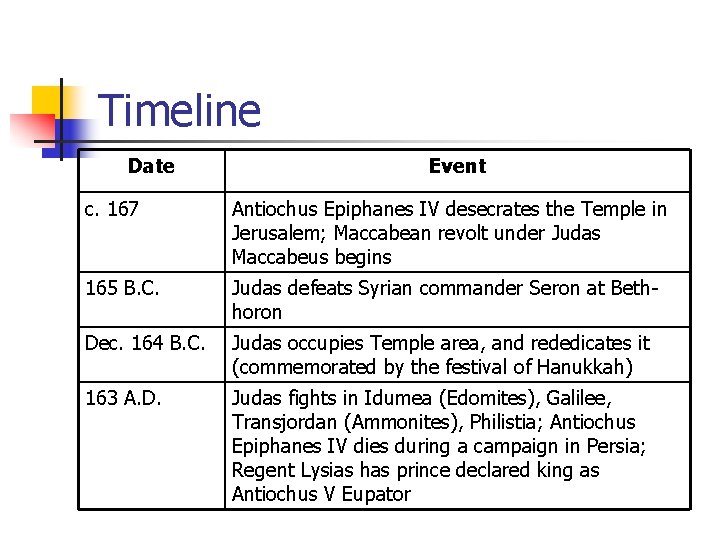
Timeline Date Event c. 167 Antiochus Epiphanes IV desecrates the Temple in Jerusalem; Maccabean revolt under Judas Maccabeus begins 165 B. C. Judas defeats Syrian commander Seron at Bethhoron Dec. 164 B. C. Judas occupies Temple area, and rededicates it (commemorated by the festival of Hanukkah) 163 A. D. Judas fights in Idumea (Edomites), Galilee, Transjordan (Ammonites), Philistia; Antiochus Epiphanes IV dies during a campaign in Persia; Regent Lysias has prince declared king as Antiochus V Eupator
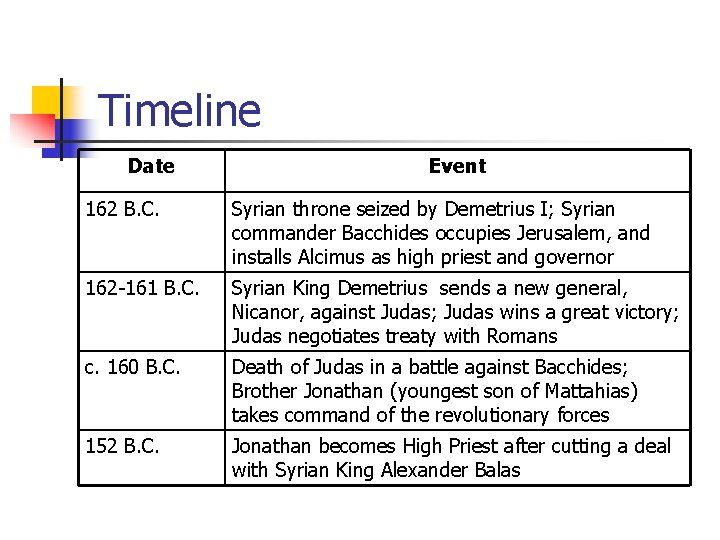
Timeline Date Event 162 B. C. Syrian throne seized by Demetrius I; Syrian commander Bacchides occupies Jerusalem, and installs Alcimus as high priest and governor 162 -161 B. C. Syrian King Demetrius sends a new general, Nicanor, against Judas; Judas wins a great victory; Judas negotiates treaty with Romans c. 160 B. C. Death of Judas in a battle against Bacchides; Brother Jonathan (youngest son of Mattahias) takes command of the revolutionary forces 152 B. C. Jonathan becomes High Priest after cutting a deal with Syrian King Alexander Balas
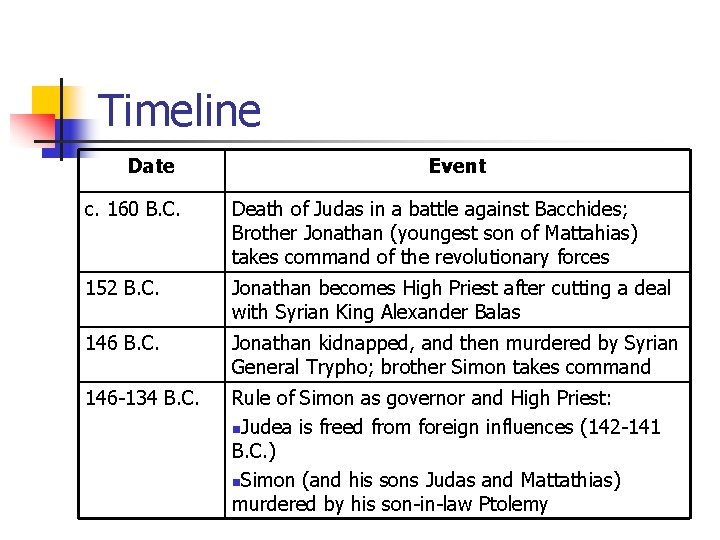
Timeline Date Event c. 160 B. C. Death of Judas in a battle against Bacchides; Brother Jonathan (youngest son of Mattahias) takes command of the revolutionary forces 152 B. C. Jonathan becomes High Priest after cutting a deal with Syrian King Alexander Balas 146 B. C. Jonathan kidnapped, and then murdered by Syrian General Trypho; brother Simon takes command 146 -134 B. C. Rule of Simon as governor and High Priest: n. Judea is freed from foreign influences (142 -141 B. C. ) n. Simon (and his sons Judas and Mattathias) murdered by his son-in-law Ptolemy
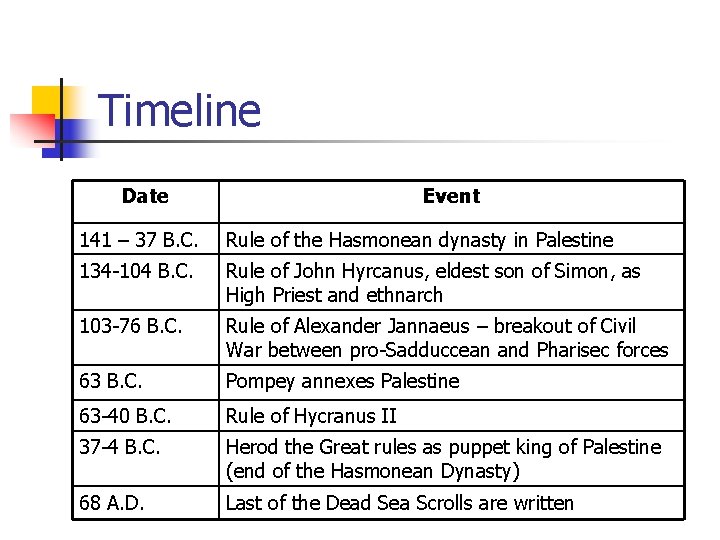
Timeline Date Event 141 – 37 B. C. Rule of the Hasmonean dynasty in Palestine 134 -104 B. C. Rule of John Hyrcanus, eldest son of Simon, as High Priest and ethnarch 103 -76 B. C. Rule of Alexander Jannaeus – breakout of Civil War between pro-Sadduccean and Pharisec forces 63 B. C. Pompey annexes Palestine 63 -40 B. C. Rule of Hycranus II 37 -4 B. C. Herod the Great rules as puppet king of Palestine (end of the Hasmonean Dynasty) 68 A. D. Last of the Dead Sea Scrolls are written
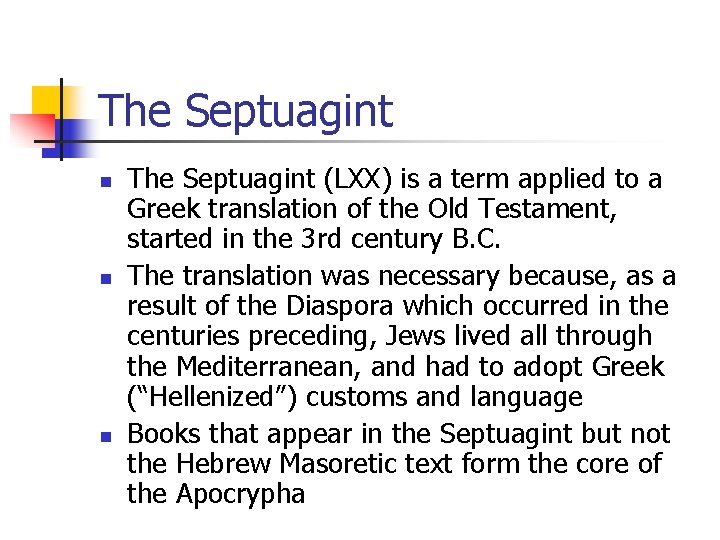
The Septuagint n n n The Septuagint (LXX) is a term applied to a Greek translation of the Old Testament, started in the 3 rd century B. C. The translation was necessary because, as a result of the Diaspora which occurred in the centuries preceding, Jews lived all through the Mediterranean, and had to adopt Greek (“Hellenized”) customs and language Books that appear in the Septuagint but not the Hebrew Masoretic text form the core of the Apocrypha
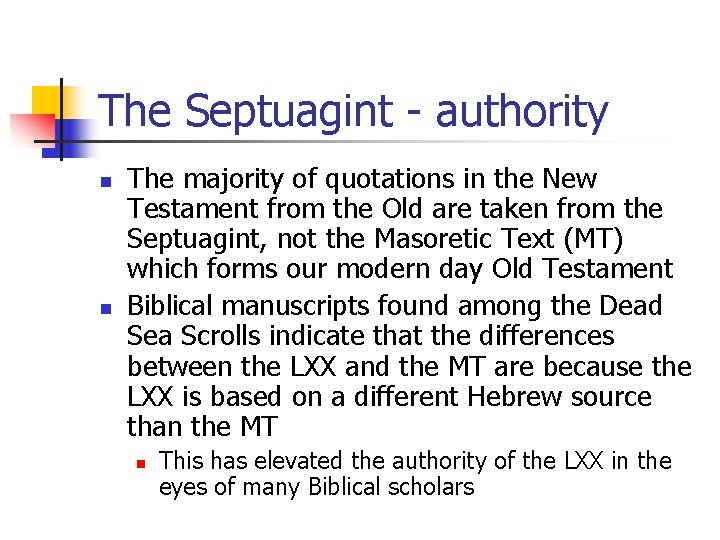
The Septuagint - authority n n The majority of quotations in the New Testament from the Old are taken from the Septuagint, not the Masoretic Text (MT) which forms our modern day Old Testament Biblical manuscripts found among the Dead Sea Scrolls indicate that the differences between the LXX and the MT are because the LXX is based on a different Hebrew source than the MT n This has elevated the authority of the LXX in the eyes of many Biblical scholars
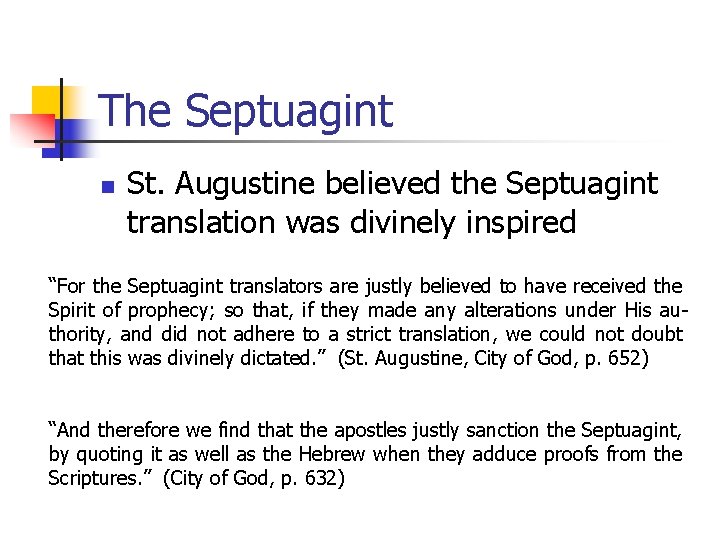
The Septuagint n St. Augustine believed the Septuagint translation was divinely inspired “For the Septuagint translators are justly believed to have received the Spirit of prophecy; so that, if they made any alterations under His authority, and did not adhere to a strict translation, we could not doubt that this was divinely dictated. ” (St. Augustine, City of God, p. 652) “And therefore we find that the apostles justly sanction the Septuagint, by quoting it as well as the Hebrew when they adduce proofs from the Scriptures. ” (City of God, p. 632)
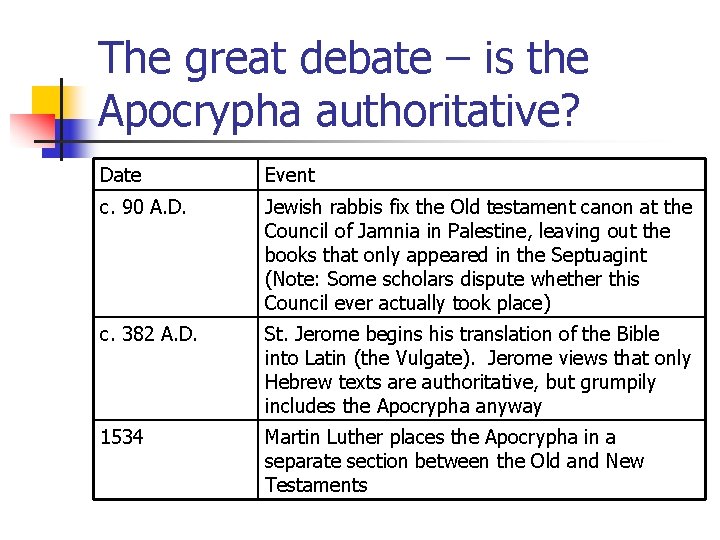
The great debate – is the Apocrypha authoritative? Date Event c. 90 A. D. Jewish rabbis fix the Old testament canon at the Council of Jamnia in Palestine, leaving out the books that only appeared in the Septuagint (Note: Some scholars dispute whether this Council ever actually took place) c. 382 A. D. St. Jerome begins his translation of the Bible into Latin (the Vulgate). Jerome views that only Hebrew texts are authoritative, but grumpily includes the Apocrypha anyway 1534 Martin Luther places the Apocrypha in a separate section between the Old and New Testaments
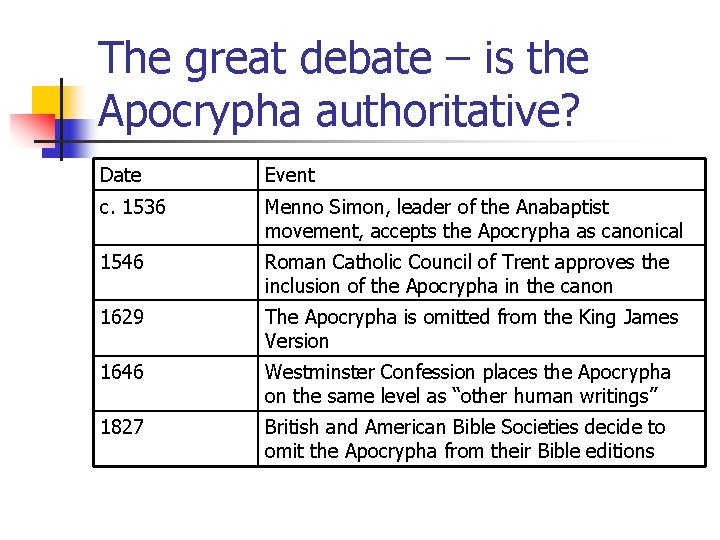
The great debate – is the Apocrypha authoritative? Date Event c. 1536 Menno Simon, leader of the Anabaptist movement, accepts the Apocrypha as canonical 1546 Roman Catholic Council of Trent approves the inclusion of the Apocrypha in the canon 1629 The Apocrypha is omitted from the King James Version 1646 Westminster Confession places the Apocrypha on the same level as “other human writings” 1827 British and American Bible Societies decide to omit the Apocrypha from their Bible editions
Yes n n n The Septuagint was the standard translation used by the early Christians St. Augustine viewed the Septuagint translation as divinely inspired The Dead Sea Scrolls have given new status to the authoritative-ness of the Septuagint, which may have come from a different Hebrew Source than the one later approved by the Jewish Rabbis (the Masoretic Text)
Yes n n The book of Jude in the New Testament refers to two apocryphal works – the Assumption of Moses, and 1 Enoch One of the reasons that the apocryphal books were rejected by the Jewish rabbis is because they believed that the age of revelation ended with Ezra n Christians believe that the age of revelation ended with the death of John the Apostle, theoretically extending the time of revelation to include the period in which the Apocrypha was written
No n n n Not part of the Jewish canon There are no New Testament references to the Apocrypha Jerome rejected the Apocryphal books There are geographical and historical errors in some of the Apocryphal books (Judith) None of the authors of the Apocrypha claimed divine inspiration Lying and assassination are accepted as tools for good in one book (Judith)
Books of the Apocrypha n Guide to abbreviations n n n DSS – Dead Sea Scrolls RC – Roman Catholic Church OC – Orthodox Church EC – Ethiopic Church * - not in the Septuagint
Tobit n n n Date: c. 225 -175 B. C. Original language: Hebrew or Aramaic (DSS) Accepted by: RC, OC Style: Possibly a folk tale Premise: Story of a pious Jew living in Ninevah during the Assyrian occupation of Northern Israel in the 7 th century B. C.
Tobit – the story n n Tobit goes blind from committing an impious act A woman named Sarah is possessed by a demon named Asmodeus, who has killed 7 husbands of hers on their wedding night As the result of prayers of supplication from Sarah and Tobit, the angel Raphael is sent to heal both of them The son of Tobit teams up with Raphael (not knowing that he’s with an angel)
Tobit – the story n n n Tobit’s son (Tobias) marries Sarah Tobias casts out the demon Asmodeus, using a foul-smelling concoction made up of a fish liver and heart recommended by the Angel Raphael Heals his father of his blindness using the same concoction
Tobit – characteristics/message n n Pious are eventually rewarded in this life (similar to the message in Job) Interspersed by flashes of humor n n It is the smell of the fish concoction which drives the demon “to the remotest parts of Egypt” Sarah’s father Raguel tells his servants to dig a grave for young Tobias on the night of his wedding, because of the possibility that he may be killed by the demon before the morning n When a maid discovers that Tobias is quite alive, Raguel has the grave filled in before the sun rises
Tobit – relevance to Christianity n Helps illuminate Jewish interest in angels and demons during the Inter-Testamental period n The angel Raphael is described as an archangel n n “I am Raphael, one of the seven angels who stand ready and enter before the glory of the Lord. ” (Tobit 12: 15, NRSV) The beautiful words spoken by Tobias during his wedding ceremony are used by the Amish in modern-day weddings
Judith n n n Date: 2 nd century B. C. Original language: Hebrew? Accepted by: RC, OC Style: Possibly a folk tale Premise: A beautiful young widow saves a (possibly mythical) Jewish town named Bethulia from the massed troops of King Nebuchadnezzar
Judith – the story n n Bethulia is besieged by almost 200, 000 troops under army commander Holefernes cuts off the city water supply The citizens consider surrendering, but Judith gives a passionate speech to the elders of the town, and convinces them to let her try to save them Judith leaves Bethulia after making herself as alluring as possible
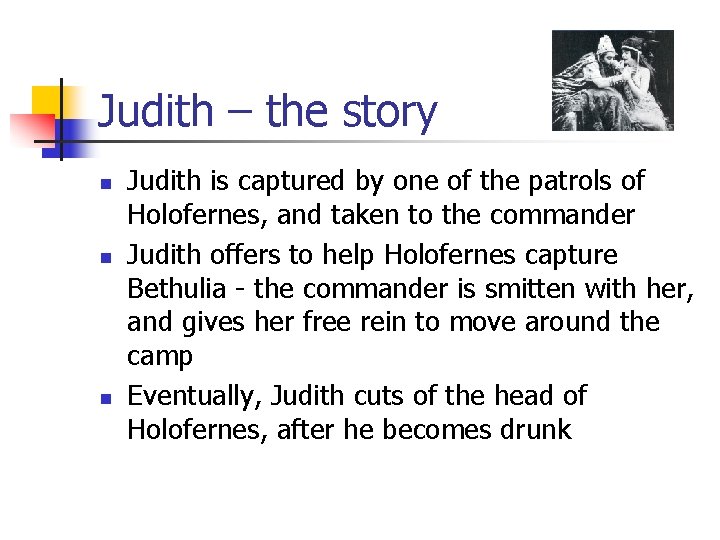
Judith – the story n n n Judith is captured by one of the patrols of Holofernes, and taken to the commander Judith offers to help Holofernes capture Bethulia - the commander is smitten with her, and gives her free rein to move around the camp Eventually, Judith cuts of the head of Holofernes, after he becomes drunk
Judith – the story n Judith returns to Bethulia in triumph, and is praised by the elders “Then Uzziah said to her, ‘O daughter, you are blessed by the Most High God above all other women on earth; and blessed be the Lord God, who created the heavens and the earth, who has guided you to cut off the head of the leader of our enemies. Your praise will never de-part from the hearts of those who remember the power of God. ’” (Judith 13: 1819, NRSV)
Judith – relevance to Christianity n Attracted ire from the Protestant Reformers n Contains historical and geographical errors n n In the first verse of the first chapter, it says that King Nebuchadnezzar ruled over the Assyrians in Nineveh. Nebuchadnezzar was the ruler of the Babylonians, not the Assyrians. The book seems to accept lying, deceit, and assassination, as tools for good
The Greek Esther n n n Date: 2 nd century B. C. Original language: Greek Accepted by: RC, OC Style: Expanded version of the Old Testament Esther Premise: A beautiful young Queen named Esther saves the Jews from being massacred
Greek Esther - notes n Contains six lengthy additions to the original “Hebrew Esther” found in the Old Testament n n Two letters (proclamations) by King Artaxerxes Prayers by Esther and Mordecai A dream (and interpretation of the dream) by Mordecai The word “God” or “Lord” is mentioned over 50 times in the Greek Esther, whereas God isn’t mentioned once in the Hebrew Esther!
Greek Esther - notes n n In the Hebrew Esther, most of the positive action happens as the result of the personal bravery or the resourcefulness of the two heroes, Esther and Mordecai In the Greek Esther, most of the action is as a result of God’s will
Greek Esther - notes n Greek Esther n “Lifting his face, flushed with splendor, he looked at her in fierce anger. The queen faltered, and turned pale and faint, and collapsed on the head of the maid who went in front of her. Then God changed the spirit of the king to gentleness, and in alarm he sprang from his throne and took her in his arms until she came to herself. He comforted her with soothing words. . . ” (Greek Esther 15: 7 -8, NRSV, emphasis added)
Wisdom of Solomon n n Date: 1 st century B. C. Original language: Greek Accepted by: RC, OC Style: Wisdom literature, similar in style to Proverbs or Job Notes: While the work is entitled “The Wisdom of Solomon”, it is more likely the work of a 1 st century B. C. Jew
Wisdom of Solomon – relevance to Christianity n Makes extensive references to an afterlife for the righteous, and a final punishment for the evil “But the righteous live forever, and their reward is with the Lord; the Most High takes care of them. Therefore they will receive a glorious crown and a beautiful diadem from the hand of the Lord, because with his right hand he will cover them, and with his arm he will shield them. ” (Wisdom of Solomon, 5: 1516, NRSV)
Sirach (or Ecclesiasticus) n n n Date: c. 200 B. C. Original language: Hebrew (DSS) Accepted by: RC, OC Style: Wisdom literature, similar in style to Proverbs or Job Notes: Written by Jesus ben Sirach, a Jewish scribe; The Greek translation was done by his grandson in 132 B. C.
Sirach (or Ecclesiasticus) notes n n Contains advice on topics ranging from friendship, women, and the sin of pride, to inappropriate speech Contains perhaps the most famous phrase in all of the Apocrypha n n “Let us now sing the praises of famous men” - In the introduction to a lengthy section describing the fine attributes of various heroes of Jewish history (Enoch, Noah, Abraham, Moses, etc. ) Contains a description of the activities of the Jewish scribes (see Sirach 39: 1 -5)
Baruch n n Date: 2 nd century B. C. Original language: unknown Accepted by: RC, OC Style: Purportedly written by the scribe of the prophet Jeremiah (see Jeremiah 32: 12, 36: 4)
Baruch n Written in three parts n The first part is a prayer of confession and petition read to the deposed King of Judah, Jeconiah n n n It contains a harrowing description of the destruction of the Jews in the time of Nebuchadnezzar The second part is in the Jewish Wisdom tradition (“In praise of wisdom. . . ”), similar to the early chapters of Proverbs The final section contains encouragement for Israel, assuring the faithful that eventually God will return Israel to the Chosen People
Baruch – relevance to Christianity n Some early translations (including the Vulgate) stated in Baruch 3: 37 that God appeared on earth and lived with human kind: n n “[This is our God] Afterward did he shew himself upon earth, and conversed with men. ” (Baruch 3: 37, Ages Software, 1997) It appears that the proper translation, though, (as in NRSV) is that wisdom appeared on earth, and lived with mankind
Letter of Jeremiah n n Date: 3 rd century B. C. – 1 st century A. D. Original language: unknown Accepted by: RC, OC Style: Purports to be: n “A copy of a letter that Jeremiah sent to those who were to be taken to Babylon as exiles by the king of the Babylonians, to give them the message that God had commanded him. ” (Letter of Jeremiah 6: 1, NRSV)
Letter of Jeremiah n The primary theme of the Letter of Jeremiah (see Jeremiah 29: 1 -23 for a description of a similar letter) is to disparage the worship of idols n n The real point seems to be to discourage Hellenized Jews from following foreign ways - and foreign religions Note that in some Bibles, the Letter of Jeremiah appears as Chapter 6 of Baruch
Prayer of Azariah and the Song of the Three Jews n n Date: 2 nd century B. C. Original language: unknown Accepted by: RC, OC Notes: First of three additions in the Septuagint to the book of Daniel n n Inserted between Daniel 3: 23 and 3: 24 Purportedly written by the three youths (Shadrach, Meshach, and Abednego) that are thrown into a furnace by King Nebuchadnezzar when they refused to commit apostasy
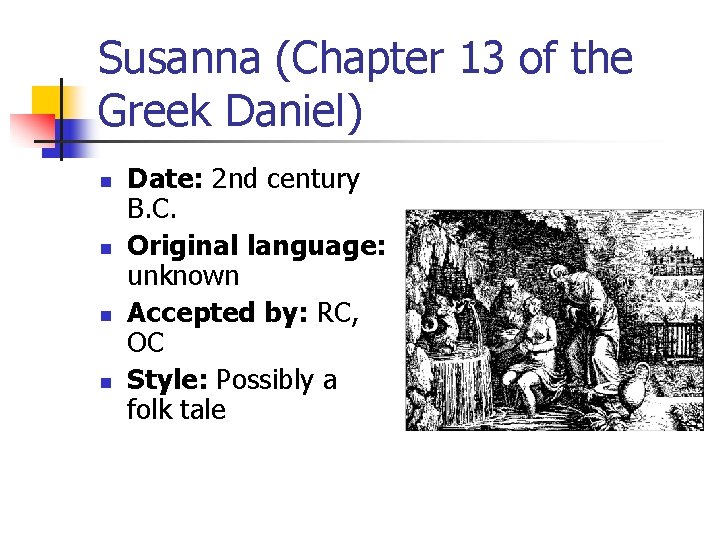
Susanna (Chapter 13 of the Greek Daniel) n n Date: 2 nd century B. C. Original language: unknown Accepted by: RC, OC Style: Possibly a folk tale
Susanna (Chapter 13 of the Greek Daniel) n n Concerns a beautiful woman named Susanna, who is married to a rich man named Joakim Two lecherous elders attempt to seduce Susanna in a private garden n n They tell her that if she doesn’t have sex with them, they will claim that she was committing debauchery with a young man when they came upon her The virtuous Susanna refuses their advances, and is later condemned to death on the false testimony of the elders
Susanna (Chapter 13 of the Greek Daniel) n God “stirred up the holy spirit of a young lad named Daniel”, who says to the people “Return to court, for these men have given false evidence against her” (Susanna 49). n n Daniel separately asks the two elders “under what tree did you see them being intimate with each other? ” (Susanna 54) When the two give different answers, Susanna is found innocent, and the two elders are put to death for bearing false witness n “And from that day onward Daniel had a great reputation among the people. ” (Susanna 64)
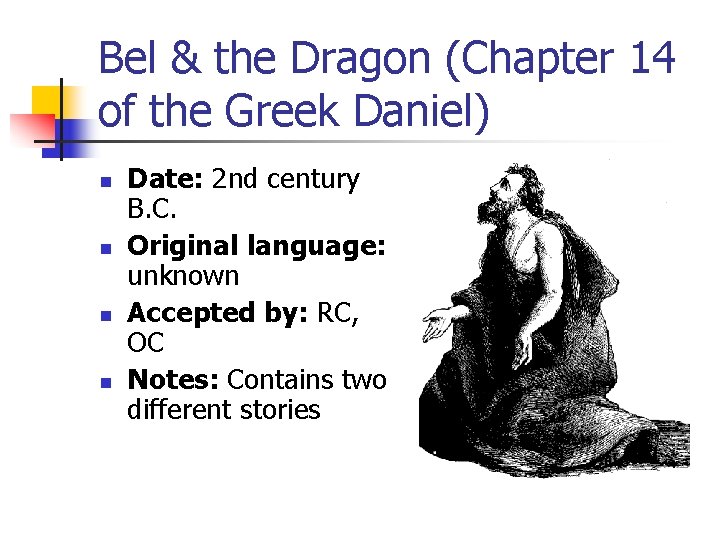
Bel & the Dragon (Chapter 14 of the Greek Daniel) n n Date: 2 nd century B. C. Original language: unknown Accepted by: RC, OC Notes: Contains two different stories
Bel & the Dragon (Chapter 14 of the Greek Daniel) n “Daniel and the Priests of Bel” n n Babylonians are worshipping an idol named Bel Through a clever ploy involving spreading ashes on the floor in a supposedly inaccessible room, Daniel proves to the King that Bel does not actually eat the daily offering of food made to it n n The priests and their families had been sneaking into the room at night through a hidden entrance, and eating the food! “Therefore the king put them to death, and gave Bel over to Daniel, who destroyed it and its temple. ” (Bel and the Dragon 22, NRSV)
Bel & the Dragon (Chapter 14 of the Greek Daniel) n Second story concerns Daniel killing a “great dragon which the Babylonians revered” n n Daniel kills the dragon by feeding it a foul concoction containing “pitch, fat, and hair” Daniel is thrown into a lion’s den by the Babylonians Daniel survives for six days in the den, saved by the miraculous intervention of the prophet Habakkuk On the 7 th day, the King comes to mourn Daniel, and discovers that he is still alive - Daniel is rescued, and his tormenters are thrown into the den and killed
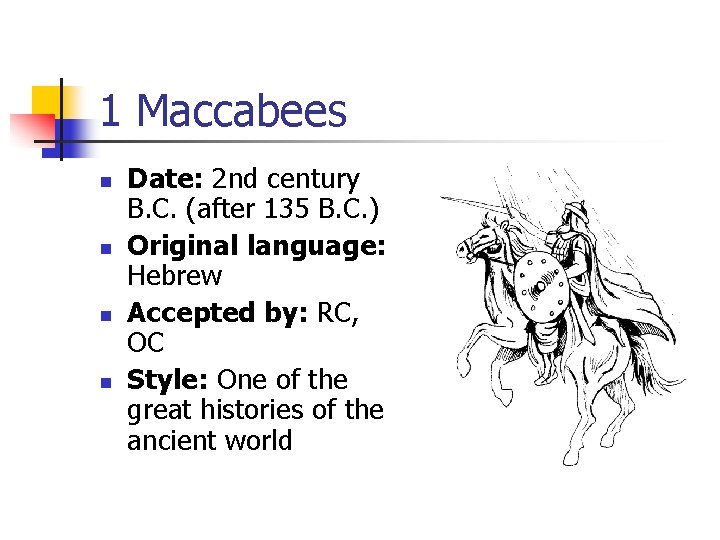
1 Maccabees n n Date: 2 nd century B. C. (after 135 B. C. ) Original language: Hebrew Accepted by: RC, OC Style: One of the great histories of the ancient world
1 Maccabees n n n A key source of information about the Maccabean Revolt Starts with a brief description of the reign of Alexander the Great (334 -323 B. C. ) Most of the work concentrates on the period from about 167 B. C. to 134 B. C. n n Starts with a description of the rebellious actions of the priest Mattathias Ends with a description of the murder of his son Simon (and installation of his grandson, John Hyrcanus, as High Priest)
1 Maccabees – heroes and villains n n The heroes: Judas Maccabeus (“The Hammer”), and his brothers Simon and Jonathan The villain: Seleucid King Antiochus IV, perhaps the “abomination that causes desolation” in Daniel
2 Maccabees n n Date: 1 st century B. C Original language: Greek Accepted by: RC, OC Style: History of the Maccabean Revolt until the defeat and death of Nicanor, while Judas is still alive (c. 161 B. C)
2 Maccabees “ 19 The story of Judas Maccabeus and his brothers, and the purification of the great temple, and the dedication of the altar, 20 and further the wars against Antiochus Epiphanes and his son Eupator, 21 and the appearances that came from heaven to those who fought bravely for Judaism, so that though few in number they seized the whole land pursued the barbarian hordes, 22 and regained possession of the temple famous throughout the world, and liberated the city, and re-established the laws that were about to be abolished, while the Lord with great kindness became gracious to them— 23 all this, which has been set forth by Jason of Cyrene in five volumes, we shall attempt to condense into a single book. ” (2 Maccabees 2: 19 -23, NRSV)
2 Maccabees – differences from 1 Maccabees n n n No discussion of the line of succession of the Hasmonean family Describes the political infighting among the high priests Onias, Jason, and Menelaus is great detail, the last two “buying” the priesthood from Antiochus Epiphanes IV for money Ascribes some of the success of the Jews in the Revolt to direct Divine intervention Some differences in the timeline Especially graphic in describing the horrors of Hellenization, and the indignities forced on the Jews by Antiochus
2 Maccabees – Relevance to Christianity n Strong belief in a resurrection of the dead “ 43 He also took up a collection, man by man, to the amount of two thousand drachmas of silver, and sent it to Jerusalem to provide for a sin offering. In doing this he acted very well and honorably, taking account of the resurrection. 44 For if he were not expecting that those who had fallen would rise again, it would have been superfluous and foolish to pray for the dead. 45 But if he was looking to the splendid reward that is laid up for those who fall asleep in godliness, it was a holy and pious thought. Therefore he made atonement for the dead, so that they might be delivered from their sin. ” (2 Maccabees 12: 43 -45, NRSV)
1 Esdras (Greek for Ezra) n n Date: 100 B. C. Original language: unknown Accepted by: OC, appendix in the Vulgate Notes: Contains most of the Hebrew version of Ezra, plus portions of 2 Chronicles and Nehemiah
1 Esdras additions n n 1 Esdras 3: 1 -4: 63 doesn’t appear anywhere in the Hebrew Bible Describes the story of 3 bodyguards of King Darius who have an argument regarding “what one thing is strongest” n They decide to present their arguments to the King, in hopes of reward
1 Esdras additions n n n One says that wine is the strongest because “it leads astray the minds of all who drink it” The second says that the King is strongest, because “whatever he says to them they must obey” The third, identified as Zerubbabel, starts out with an argument that women are the strongest, because they “gave birth to the king and to every people that rules over sea and land”
1 Esdras additions n n Zerubbabel changes his vote to say that “Great is truth, and strongest of all!” These passages were oft quoted in the Early Church “Wine is unrighteous, the king is unrighteous, women are unrighteous, all human beings are unrighteous, all their works are unrighteous, and all such things. There is no truth in them and in their unrighteousness they will perish. But truth endures and is strong forever, and lives and pre-vails forever and ever. ” (1 Ezdras 4: 37 -38, NRSV)
Prayer of Manasseh * n n Date: 2 nd century B. C. Original language: unknown Accepted by: OC, appendix in the Vulgate Notes: Purports to be the prayer of King of Judah Manasseh mentioned in 2 Chronicles 33: 10 -13
Psalm 151 n n Date: By David? Original language: Hebrew (DSS) Accepted by: OC Notes: Appears in the Septuagint and the DSS as Psalm 151. The Septuagint translator noted that it was “outside the number” of normal versions of the Psalms.
3 Maccabees n n Date: 1 st Century B. C. Original language: Greek Accepted by: OC Notes: Has nothing to do with the Maccabean Revolt or Judas Maccabeus It is set fifty years earlier in the reign of Ptolemy IV Philopator (221 -204 B. C. )
3 Maccabees n n Concerns a lapsed Jew named Dositheus who prevents an assassination plot against Ptolemy A grateful Ptolemy visits Jerusalem laden with gifts, but is prohibited from entering the inner sanctuary of the Temple Ptolemy tries to enter anyway, and is stricken down with a paralysis sent by God Ptolemy swears revenge against the Jews
3 Maccabees n n n Ptolemy orders various measures against the Jews, including deportation, ordering them to commit apostasy, and removing their citizenship Ptolemy orders all Jews to be rounded up and trampled to death by 500 drunk elephants (!) in a hippodrome The Jews are saved by divine intervention
3 Maccabees “Then the most glorious, almighty, and true God revealed his holy face and opened the heavenly gates, from which two glorious angels of fearful aspect descended, visible to all but the Jews. They opposed the forces of the enemy and filled them with confusion and terror, binding them with immovable shackles. Even the king began to shudder bodily, and he forgot his sullen insolence. The animals turned back upon the armed forces following them and began trampling and destroying them. ” (3 Maccabees 6: 18 -21, NRSV)
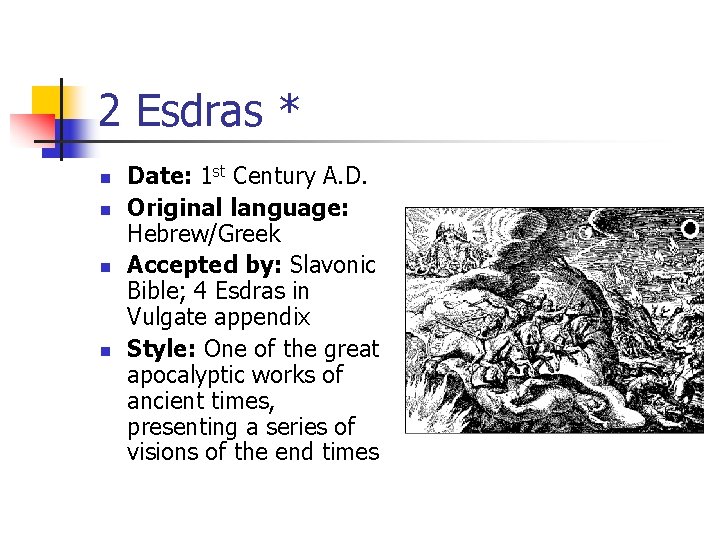
2 Esdras * n n Date: 1 st Century A. D. Original language: Hebrew/Greek Accepted by: Slavonic Bible; 4 Esdras in Vulgate appendix Style: One of the great apocalyptic works of ancient times, presenting a series of visions of the end times
2 Esdras n n n The visions are presented through the device of a dialogue between the prophet Ezra and the archangel Uriel Similar in tone, content, and style to the Book of Revelation Some scholars believe that 2 Esdras 3: 1 is the original Jewish beginning to the work
2 Esdras – relevance to Christianity n The Jewish apocryphal book with the most “Christian” tone and language n n Perhaps Essene in style and theology Proves that, at the time of Christ, there were Jewish sects that believed in many of the same precepts as Christianity, such as original sin, a divine Messiah, and a final judgment day for sinners
2 Esdras – relevance to Christianity Divine Messiah “For my son the Messiah shall be revealed with those who are with him, and those who remain shall rejoice four hundred years. After those years my son the Messiah shall die, and all who draw human breath. ” (2 Esdras 7: 28 -29, NRSV)
2 Esdras – relevance to Christianity Judgment Day “He answered me and said, ‘When the Most High made the world and Adam and all who have come from him, he first prepared the judgment and the things that pertain to the judgment. ’” (2 Esdras 7: 70, NRSV) “For after death the judgment will come, when we shall live again; and then the names of the righteous shall become manifest, and the deeds of the ungodly shall be disclosed. ” (2 Esdras 14: 35, NRSV)
2 Esdras – relevance to Christianity Resurrection of the dead “And I will raise up the dead from their places, and bring them out from their tombs, because I recognize my name in them. ” (2 Esdras 2: 16, NRSV) “Remember your children that sleep, because I will bring them out of the hiding places of the earth, and will show mercy to them; for I am merciful, says the Lord Almighty. ” (2 Esdras 2: 31, NRSV)
2 Esdras – relevance to Christianity Hell as a place of damnation for the wicked “The pit of torment shall appear, and opposite it shall be the place of rest; and the furnace of hell shall be disclosed, and opposite it the para-dise of delight. Then the Most High will say to the nations that have been raised from the dead, ‘Look now, and understand whom you have denied, whom you have not served, whose commandments you have despised. Look on this side and on that; here are delight and rest, and there are fire and torments. ’ Thus he will speak to them on the day of judgment…” (2 Esdras 7: 36 -38, NRSV)
4 Maccabees n n Date: 63 B. C. – 70 A. D. Original language: Greek Accepted by: Appendix to Septuagint Style: Written in the form of a sermon, seemingly to demonstrate that the Greek philosophy of rational judgment being the highest virtue is fully reconcilable with Jewish religious belief, and belief in the Law
4 Maccabees n n n Another telling (see also 2 Maccabees) of the martyrdom of Eleazer and the seven brothers under the reign of Antiochus Epiphanes IV Gives additional details of the evil perpetrated by the High Priest Jason, who had purchased his priesthood from the Seleucid king Assures the faithful that Antiochus Epiphanes IV would be punished for his sins: n “The tyrant Antiochus was both punished on earth and is being chastised after his death…” (4 Maccabees 18: 5, NRSV)
4 Maccabees – relevance to Christianity n n n A stirring tribute to the ability of religious faith to overcome even the direst forms of torture In seeming anticipation of the later Christian martyrs, one of the brothers is quoted as saying “How sweet is any kind of death for the religion of our ancestors” (4 Maccabees 9: 29) Augustine and Origen referred to 4 Maccabees as the epitome of pious martyrdom
1 Enoch * n n Date: 2 nd-1 st century B. C. Original language: Aramaic (DSS) Accepted by: EC, 20 copies found in DSS Style: An apocalyptic work. Purports to be written by Enoch, but probably written by several authors over a period of some years.
1 Enoch n Contains graphic and detailed descriptions of heaven, hell, God on the Throne, and even the Garden of Eden n Parallels to both Revelation and Daniel Contains an elaborate hierarchy of angels and demons, including a lengthy description of the story of the Fall of the Angels (based on Genesis 6: 1 -4) Only Jewish Inter-Testamental work quoted in the New Testament:
1 Enoch – quoted in the New Testament “Behold he comes with ten thousands of his saints, to execute judgement upon them, and destroy the wicked, and reprove all of flesh for every thing which the sinful and ungodly have done, and committed against him. ” (1 Enoch, 2 Chapter, Laurence) “It was also about these that Enoch, in the seventh generation from Adam, prophesied, saying, ‘See, the Lord is coming with ten thousand of his holy ones, to execute judgment on all, and to convict everyone of all the deeds of ungodliness that they have committed in such an un-godly way, and of all the harsh things that ungodly sinners have spoken against him. ’” (Jude 14 -15, NRSV)
1 Enoch - relevance to Christianity Son of man/Elect One (appears to foreshadow Jesus Christ) “[The Ancient of Days] answered and said to me: This is the Son of man, to whom righteousness belongs; with whom righteousness has dwelt; and who will reveal all the treasures of that which is concealed; for the Lord of spirits has chosen him. . . ” (1 Enoch 46: 1, Laurence) “Before the sun and the signs were created, before the stars of heaven were formed, his [this Son of Man] name was invoked in the presence of the Lord of spirits. A support shall he be for the righteous and the holy to lean upon, without falling; and he shall be the light of na-tions. . . All who dwell on earth, shall fall down and worship before him. . . ” (1 Enoch 48: 3 -4, Laurence)
1 Enoch - relevance to Christianity Judgment Day (presided over by the “Son of Man”/the “Elect One”) “O ye kings, O ye mighty, who inhabit the world, you shall behold my Elect one, sitting upon the throne of my glory. And he shall judge Azazeel [Satan], all his associates, and all his hosts, in the name of the Lord of spirits. ” (1 Enoch 54: 5, Laurence) “He sat upon the throne of his glory; and the principal part of the judgment was assigned to him, the Son of man. ” (1 Enoch 68: 39, Laurence)
Apocrypha Summary The Apocrypha is an invaluable aid in understanding the Jewish roots of Christianity, and filling in theological and historical gaps left by the fact that the Old Testament ends 400 years before the New
This concludes this of portion of the lecture. Assignment: Complete a 1, 000 word essay on the Apocrypha and Christianity. The Essay must be in APA format. Make sure to list all citations. Place the completed assignment in the Assignment “Dropbox” located on the website.
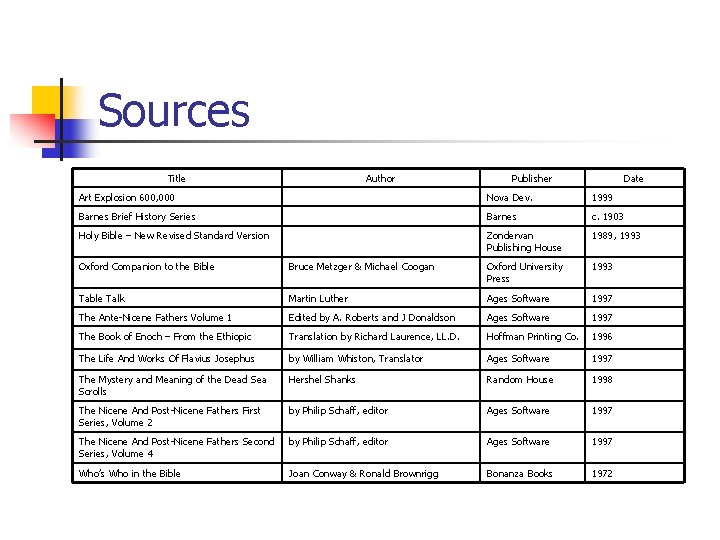
Sources Title Author Publisher Date Art Explosion 600, 000 Nova Dev. 1999 Barnes Brief History Series Barnes c. 1903 Holy Bible – New Revised Standard Version Zondervan Publishing House 1989, 1993 Oxford Companion to the Bible Bruce Metzger & Michael Coogan Oxford University Press 1993 Table Talk Martin Luther Ages Software 1997 The Ante-Nicene Fathers Volume 1 Edited by A. Roberts and J Donaldson Ages Software 1997 The Book of Enoch – From the Ethiopic Translation by Richard Laurence, LL. D. Hoffman Printing Co. 1996 The Life And Works Of Flavius Josephus by William Whiston, Translator Ages Software 1997 The Mystery and Meaning of the Dead Sea Scrolls Hershel Shanks Random House 1998 The Nicene And Post-Nicene Fathers First Series, Volume 2 by Philip Schaff, editor Ages Software 1997 The Nicene And Post-Nicene Fathers Second Series, Volume 4 by Philip Schaff, editor Ages Software 1997 Who’s Who in the Bible Joan Conway & Ronald Brownrigg Bonanza Books 1972