Refactoring Improving the Design of Existing Code Martin

- Slides: 72
Refactoring: Improving the Design of Existing Code Martin Fowler fowler@acm. org © Martin Fowler, 1997 www. martinfowler. com www. thoughtworks. com
What we will cover » An example of refactoring – Blow by blow example of changes – Steps for illustrated refactorings » Background of refactoring – Where it came from – Tools – Why and When Fowler, Refactoring: Improving the Design of Existing Code, Addison. Wesley, 1999
What is Refactoring A series of small steps, each of which changes the program’s internal structure without changing its external behavior » Verify no change in external behavior by – testing – formal code analysis by tool è In practice good tests are essential
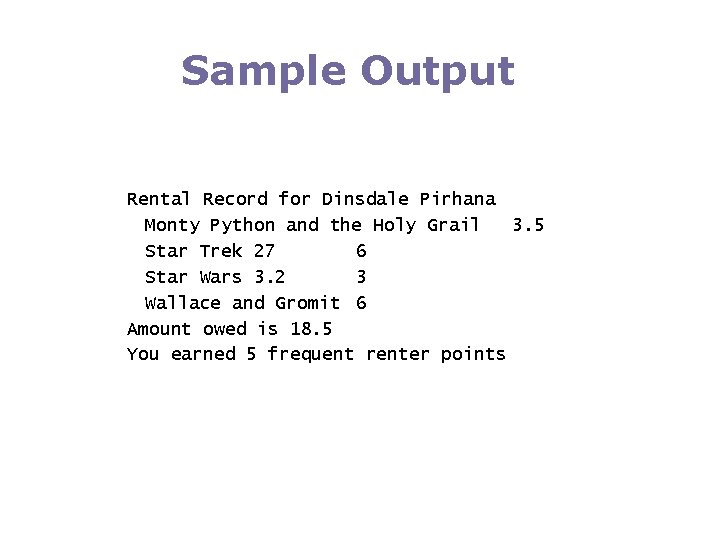
Sample Output Rental Record for Dinsdale Pirhana Monty Python and the Holy Grail 3. 5 Star Trek 27 6 Star Wars 3. 2 3 Wallace and Gromit 6 Amount owed is 18. 5 You earned 5 frequent renter points
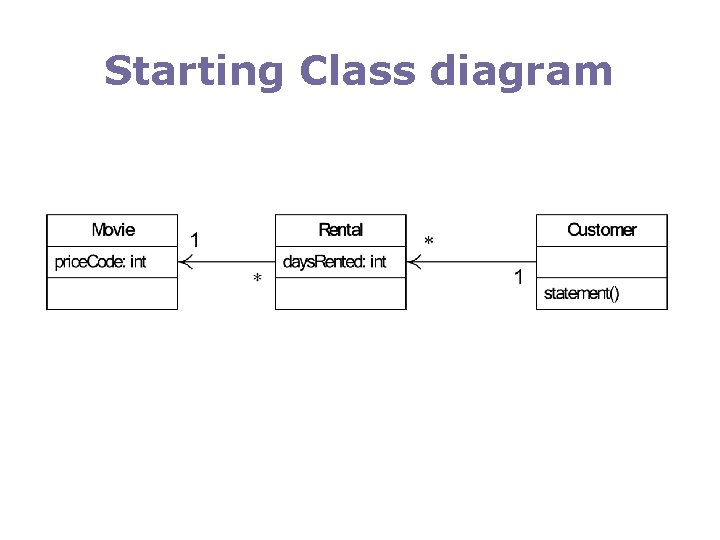
Starting Class diagram
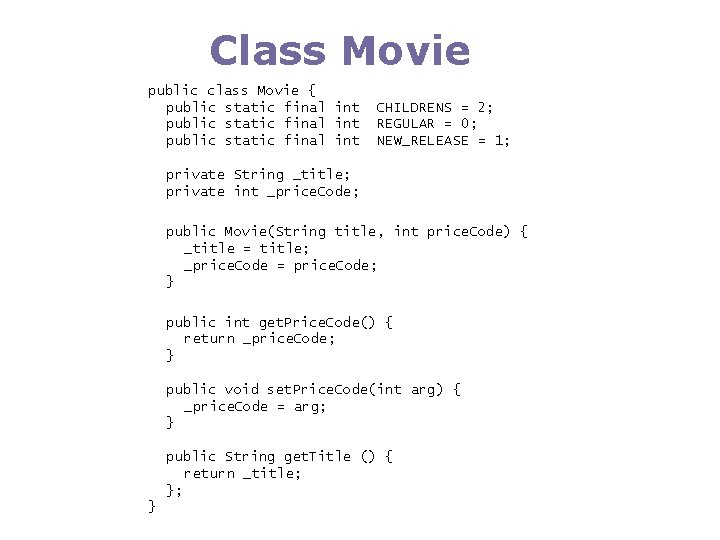
Class Movie public class Movie { public static final int CHILDRENS = 2; REGULAR = 0; NEW_RELEASE = 1; private String _title; private int _price. Code; public Movie(String title, int price. Code) { _title = title; _price. Code = price. Code; } public int get. Price. Code() { return _price. Code; } public void set. Price. Code(int arg) { _price. Code = arg; } public String get. Title () { return _title; }; }
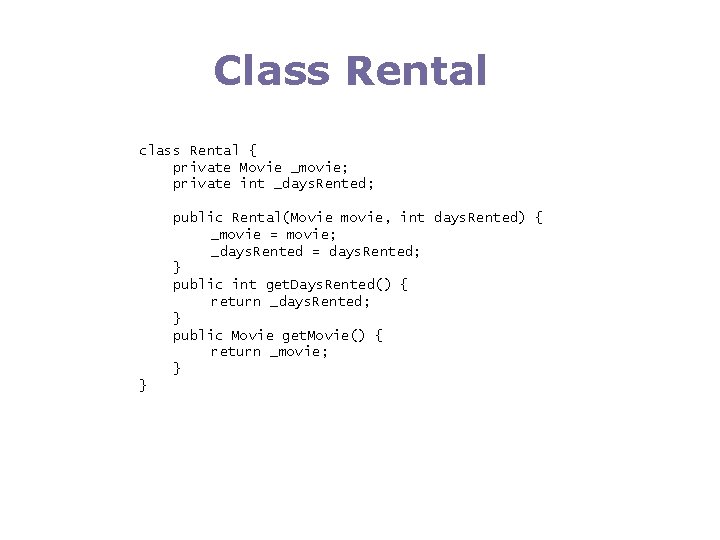
Class Rental class Rental { private Movie _movie; private int _days. Rented; public Rental(Movie movie, int days. Rented) { _movie = movie; _days. Rented = days. Rented; } public int get. Days. Rented() { return _days. Rented; } public Movie get. Movie() { return _movie; } }
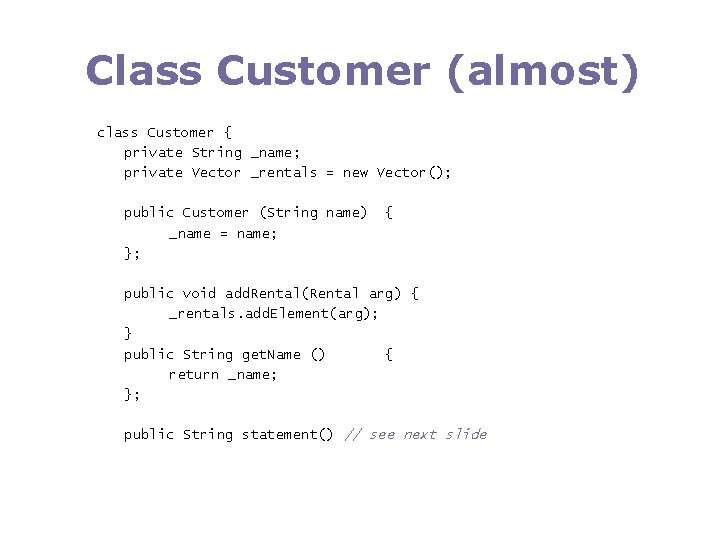
Class Customer (almost) class Customer { private String _name; private Vector _rentals = new Vector(); public Customer (String name) _name = name; }; { public void add. Rental(Rental arg) { _rentals. add. Element(arg); } public String get. Name () { return _name; }; public String statement() // see next slide
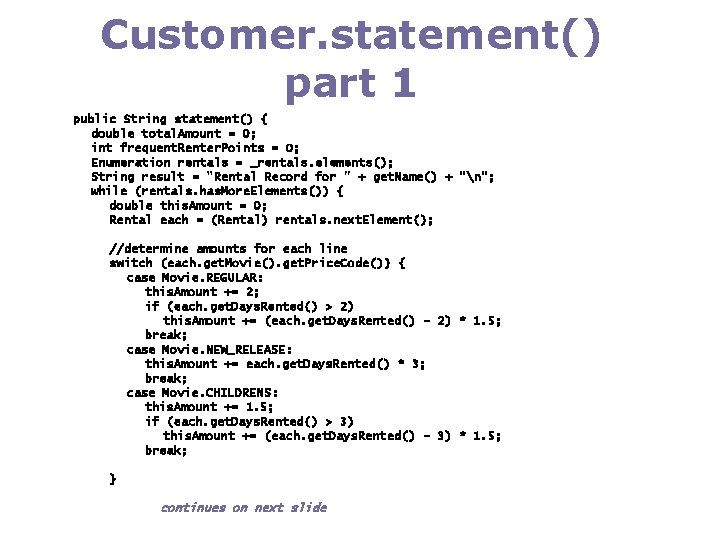
Customer. statement() part 1 public String statement() { double total. Amount = 0; int frequent. Renter. Points = 0; Enumeration rentals = _rentals. elements(); String result = "Rental Record for " + get. Name() + "n"; while (rentals. has. More. Elements()) { double this. Amount = 0; Rental each = (Rental) rentals. next. Element(); //determine amounts for each line switch (each. get. Movie(). get. Price. Code()) { case Movie. REGULAR: this. Amount += 2; if (each. get. Days. Rented() > 2) this. Amount += (each. get. Days. Rented() - 2) * 1. 5; break; case Movie. NEW_RELEASE: this. Amount += each. get. Days. Rented() * 3; break; case Movie. CHILDRENS: this. Amount += 1. 5; if (each. get. Days. Rented() > 3) this. Amount += (each. get. Days. Rented() - 3) * 1. 5; break; } continues on next slide
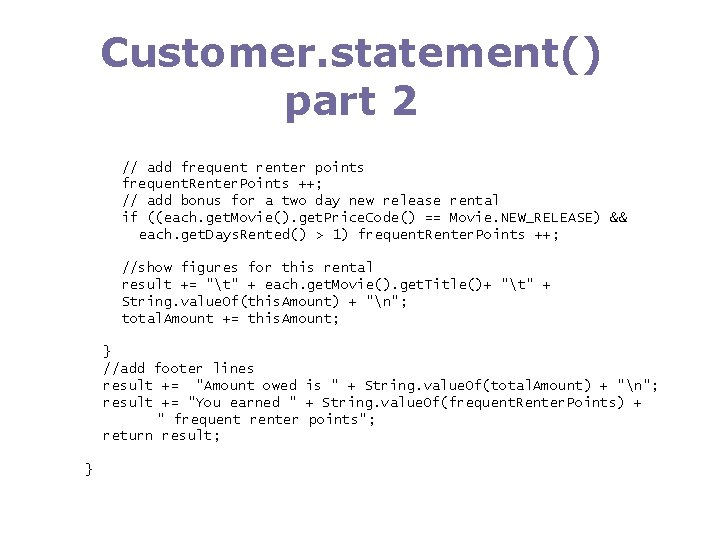
Customer. statement() part 2 // add frequent renter points frequent. Renter. Points ++; // add bonus for a two day new release rental if ((each. get. Movie(). get. Price. Code() == Movie. NEW_RELEASE) && each. get. Days. Rented() > 1) frequent. Renter. Points ++; //show figures for this rental result += "t" + each. get. Movie(). get. Title()+ "t" + String. value. Of(this. Amount) + "n"; total. Amount += this. Amount; } //add footer lines result += "Amount owed is " + String. value. Of(total. Amount) + "n"; result += "You earned " + String. value. Of(frequent. Renter. Points) + " frequent renter points"; return result; }
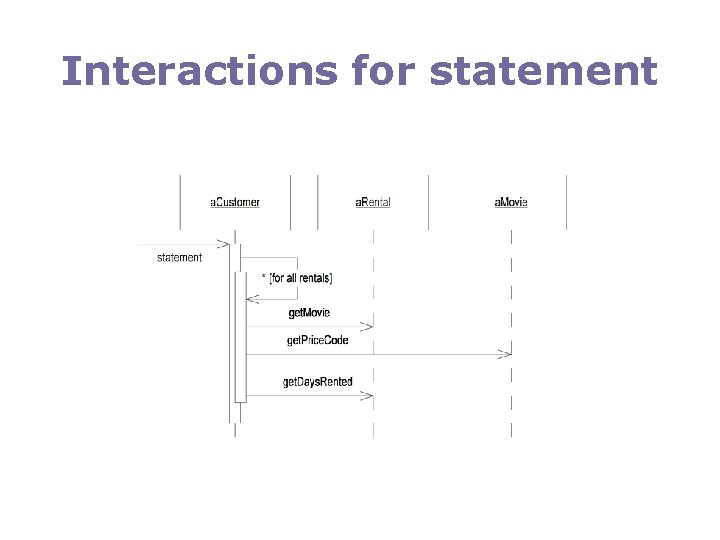
Interactions for statement
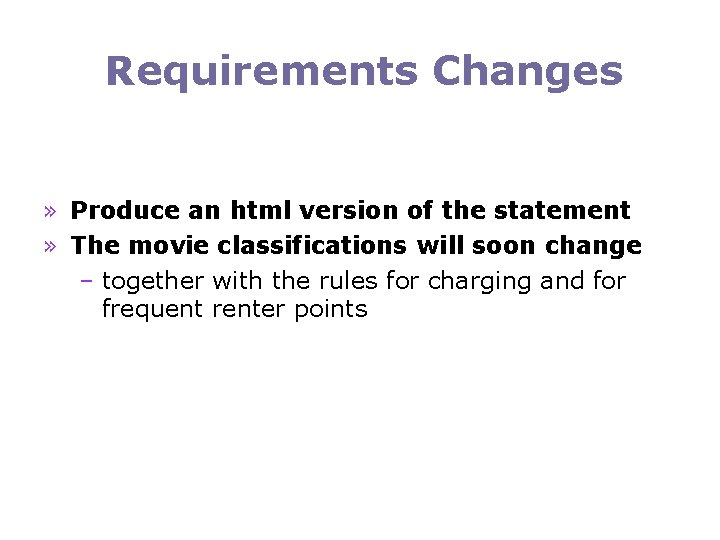
Requirements Changes » Produce an html version of the statement » The movie classifications will soon change – together with the rules for charging and for frequent renter points
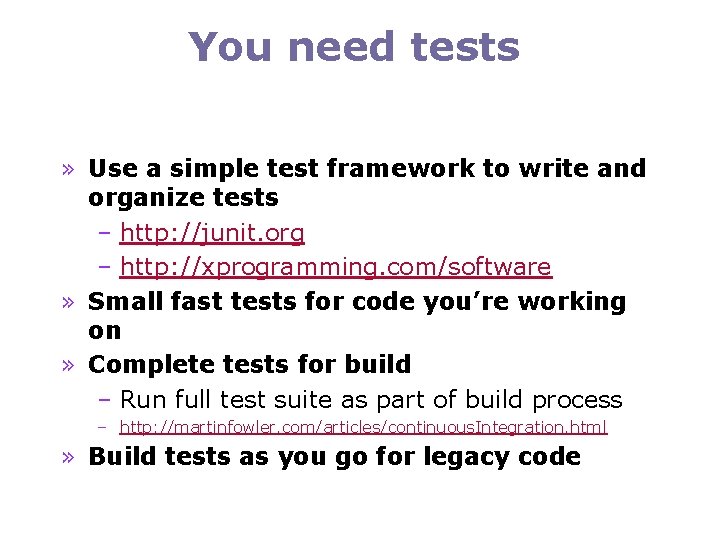
You need tests » Use a simple test framework to write and organize tests – http: //junit. org – http: //xprogramming. com/software » Small fast tests for code you’re working on » Complete tests for build – Run full test suite as part of build process – http: //martinfowler. com/articles/continuous. Integration. html » Build tests as you go for legacy code
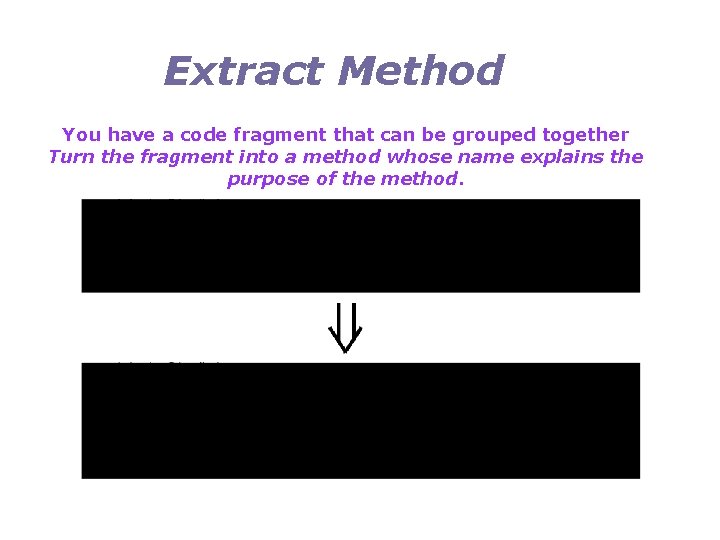
Extract Method You have a code fragment that can be grouped together Turn the fragment into a method whose name explains the purpose of the method.
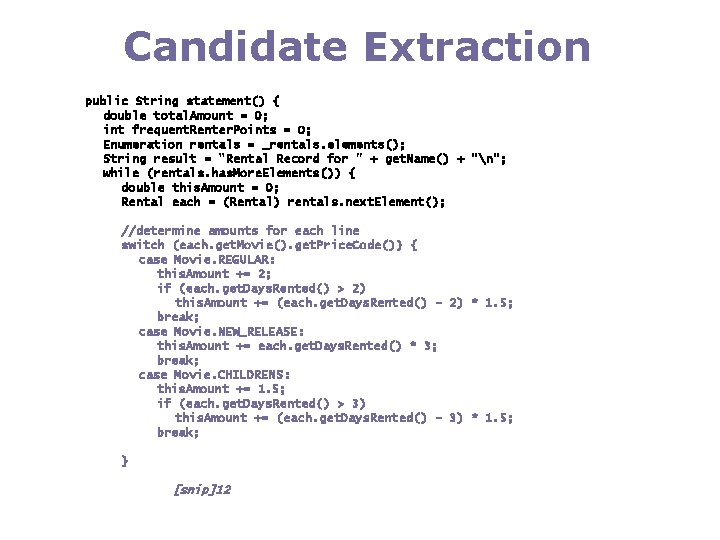
Candidate Extraction public String statement() { double total. Amount = 0; int frequent. Renter. Points = 0; Enumeration rentals = _rentals. elements(); String result = "Rental Record for " + get. Name() + "n"; while (rentals. has. More. Elements()) { double this. Amount = 0; Rental each = (Rental) rentals. next. Element(); //determine amounts for each line switch (each. get. Movie(). get. Price. Code()) { case Movie. REGULAR: this. Amount += 2; if (each. get. Days. Rented() > 2) this. Amount += (each. get. Days. Rented() - 2) * 1. 5; break; case Movie. NEW_RELEASE: this. Amount += each. get. Days. Rented() * 3; break; case Movie. CHILDRENS: this. Amount += 1. 5; if (each. get. Days. Rented() > 3) this. Amount += (each. get. Days. Rented() - 3) * 1. 5; break; } [snip]12
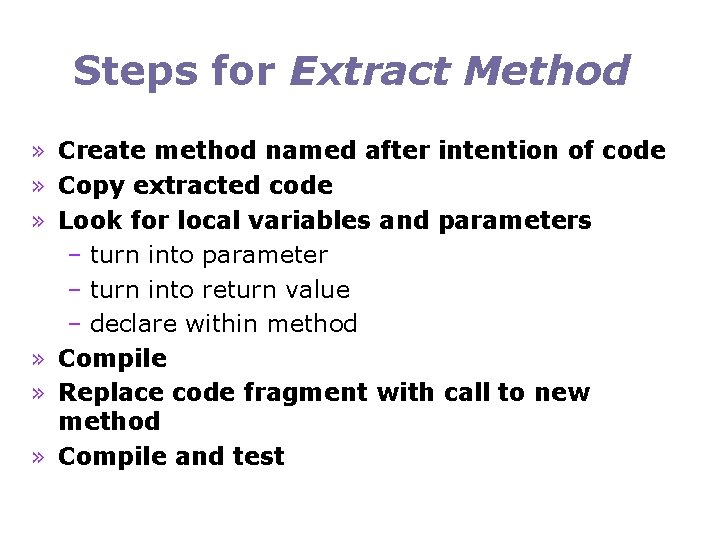
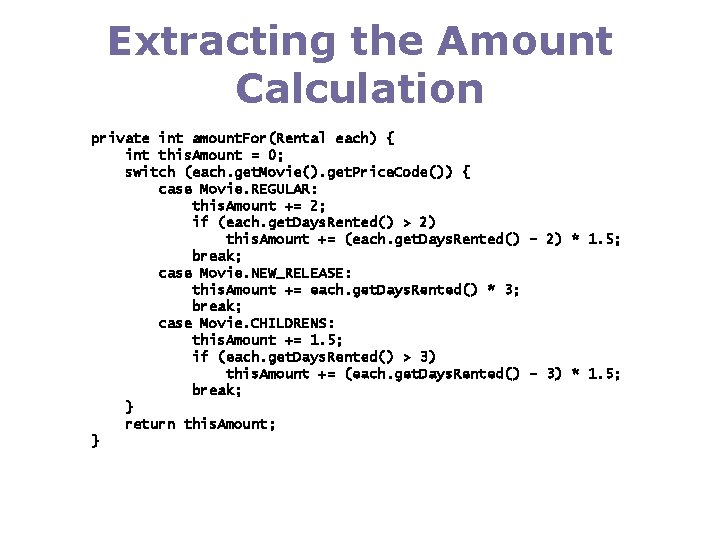
Steps for Extract Method » Create method named after intention of code » Copy extracted code » Look for local variables and parameters – turn into parameter – turn into return value – declare within method » Compile » Replace code fragment with call to new method » Compile and test
Extracting the Amount Calculation private int amount. For(Rental each) { int this. Amount = 0; switch (each. get. Movie(). get. Price. Code()) { case Movie. REGULAR: this. Amount += 2; if (each. get. Days. Rented() > 2) this. Amount += (each. get. Days. Rented() - 2) * 1. 5; break; case Movie. NEW_RELEASE: this. Amount += each. get. Days. Rented() * 3; break; case Movie. CHILDRENS: this. Amount += 1. 5; if (each. get. Days. Rented() > 3) this. Amount += (each. get. Days. Rented() - 3) * 1. 5; break; } return this. Amount; }
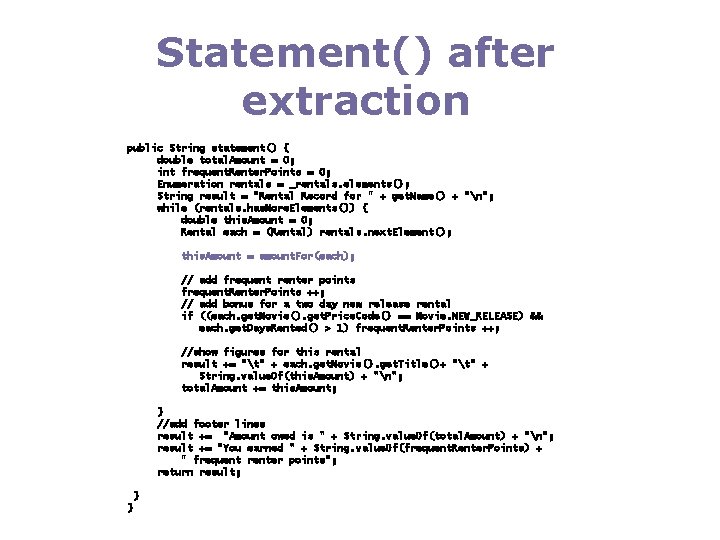
Statement() after extraction public String statement() { double total. Amount = 0; int frequent. Renter. Points = 0; Enumeration rentals = _rentals. elements(); String result = "Rental Record for " + get. Name() + "n"; while (rentals. has. More. Elements()) { double this. Amount = 0; Rental each = (Rental) rentals. next. Element(); this. Amount = amount. For(each); // add frequent renter points frequent. Renter. Points ++; // add bonus for a two day new release rental if ((each. get. Movie(). get. Price. Code() == Movie. NEW_RELEASE) && each. get. Days. Rented() > 1) frequent. Renter. Points ++; //show figures for this rental result += "t" + each. get. Movie(). get. Title()+ "t" + String. value. Of(this. Amount) + "n"; total. Amount += this. Amount; } //add footer lines result += "Amount owed is " + String. value. Of(total. Amount) + "n"; result += "You earned " + String. value. Of(frequent. Renter. Points) + " frequent renter points"; return result; } }
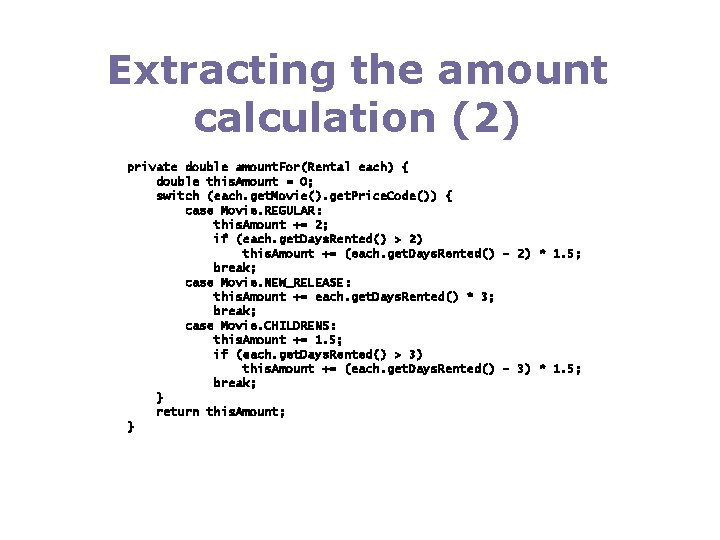
Extracting the amount calculation (2) private double amount. For(Rental each) { double this. Amount = 0; switch (each. get. Movie(). get. Price. Code()) { case Movie. REGULAR: this. Amount += 2; if (each. get. Days. Rented() > 2) this. Amount += (each. get. Days. Rented() - 2) * 1. 5; break; case Movie. NEW_RELEASE: this. Amount += each. get. Days. Rented() * 3; break; case Movie. CHILDRENS: this. Amount += 1. 5; if (each. get. Days. Rented() > 3) this. Amount += (each. get. Days. Rented() - 3) * 1. 5; break; } return this. Amount; }
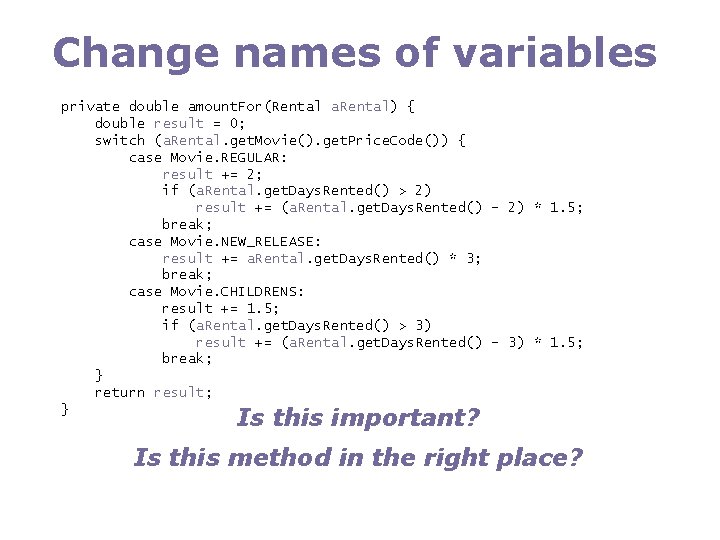
Change names of variables private double amount. For(Rental a. Rental) { double result = 0; switch (a. Rental. get. Movie(). get. Price. Code()) { case Movie. REGULAR: result += 2; if (a. Rental. get. Days. Rented() > 2) result += (a. Rental. get. Days. Rented() - 2) * 1. 5; break; case Movie. NEW_RELEASE: result += a. Rental. get. Days. Rented() * 3; break; case Movie. CHILDRENS: result += 1. 5; if (a. Rental. get. Days. Rented() > 3) result += (a. Rental. get. Days. Rented() - 3) * 1. 5; break; } return result; } Is this important? Is this method in the right place?
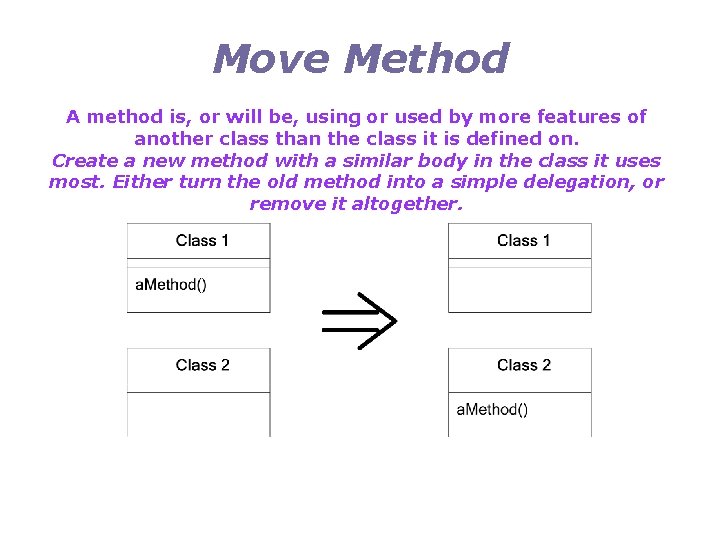
Move Method A method is, or will be, using or used by more features of another class than the class it is defined on. Create a new method with a similar body in the class it uses most. Either turn the old method into a simple delegation, or remove it altogether.
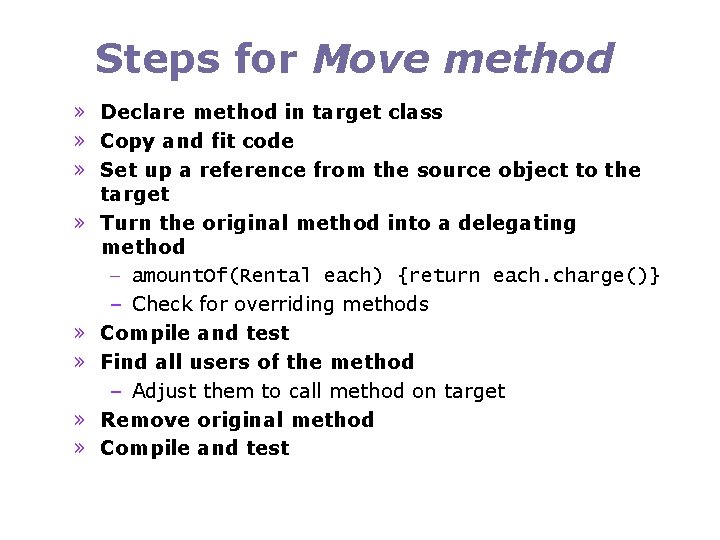
Steps for Move method » Declare method in target class » Copy and fit code » Set up a reference from the source object to the target » Turn the original method into a delegating method – amount. Of(Rental each) {return each. charge()} – Check for overriding methods » Compile and test » Find all users of the method – Adjust them to call method on target » Remove original method » Compile and test
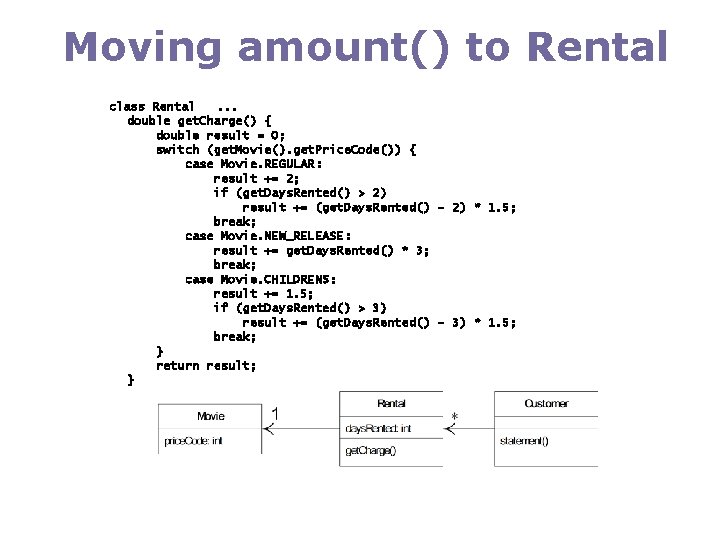
Moving amount() to Rental class Rental. . . double get. Charge() { double result = 0; switch (get. Movie(). get. Price. Code()) { case Movie. REGULAR: result += 2; if (get. Days. Rented() > 2) result += (get. Days. Rented() - 2) * 1. 5; break; case Movie. NEW_RELEASE: result += get. Days. Rented() * 3; break; case Movie. CHILDRENS: result += 1. 5; if (get. Days. Rented() > 3) result += (get. Days. Rented() - 3) * 1. 5; break; } return result; }
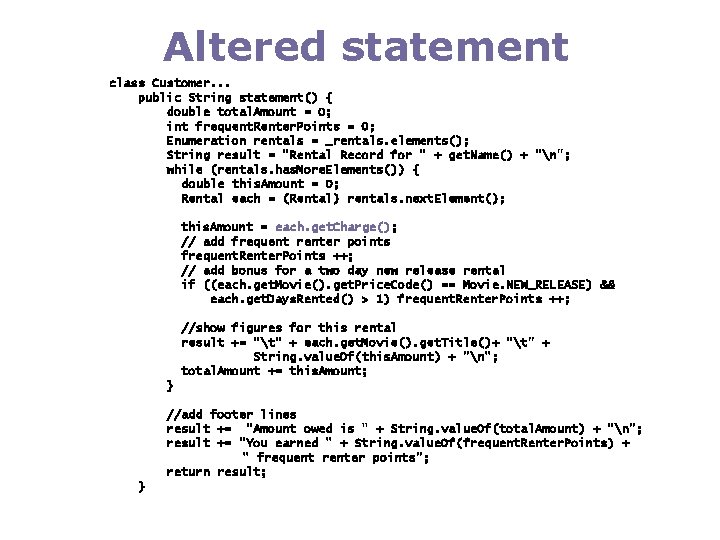
Altered statement class Customer. . . public String statement() { double total. Amount = 0; int frequent. Renter. Points = 0; Enumeration rentals = _rentals. elements(); String result = "Rental Record for " + get. Name() + "n"; while (rentals. has. More. Elements()) { double this. Amount = 0; Rental each = (Rental) rentals. next. Element(); this. Amount = each. get. Charge(); // add frequent renter points frequent. Renter. Points ++; // add bonus for a two day new release rental if ((each. get. Movie(). get. Price. Code() == Movie. NEW_RELEASE) && each. get. Days. Rented() > 1) frequent. Renter. Points ++; //show figures for this rental result += "t" + each. get. Movie(). get. Title()+ "t" + String. value. Of(this. Amount) + "n"; total. Amount += this. Amount; } //add footer lines result += "Amount owed is " + String. value. Of(total. Amount) + "n"; result += "You earned " + String. value. Of(frequent. Renter. Points) + " frequent renter points"; return result; }
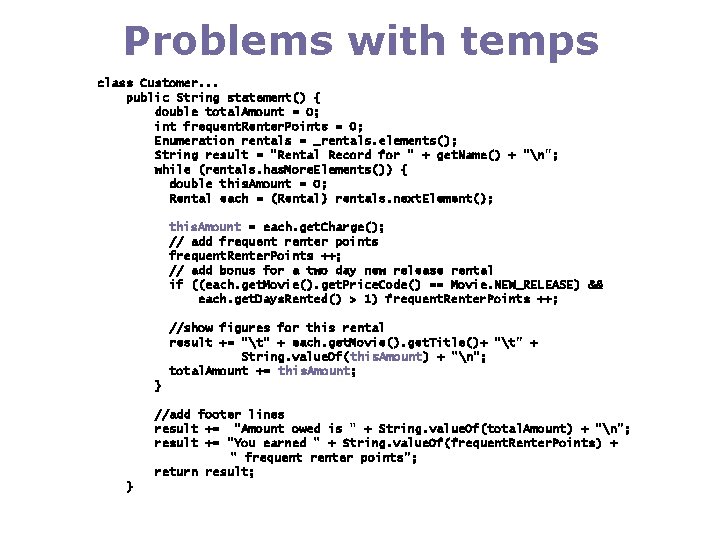
Problems with temps class Customer. . . public String statement() { double total. Amount = 0; int frequent. Renter. Points = 0; Enumeration rentals = _rentals. elements(); String result = "Rental Record for " + get. Name() + "n"; while (rentals. has. More. Elements()) { double this. Amount = 0; Rental each = (Rental) rentals. next. Element(); this. Amount = each. get. Charge(); // add frequent renter points frequent. Renter. Points ++; // add bonus for a two day new release rental if ((each. get. Movie(). get. Price. Code() == Movie. NEW_RELEASE) && each. get. Days. Rented() > 1) frequent. Renter. Points ++; //show figures for this rental result += "t" + each. get. Movie(). get. Title()+ "t" + String. value. Of(this. Amount) + "n"; total. Amount += this. Amount; } //add footer lines result += "Amount owed is " + String. value. Of(total. Amount) + "n"; result += "You earned " + String. value. Of(frequent. Renter. Points) + " frequent renter points"; return result; }
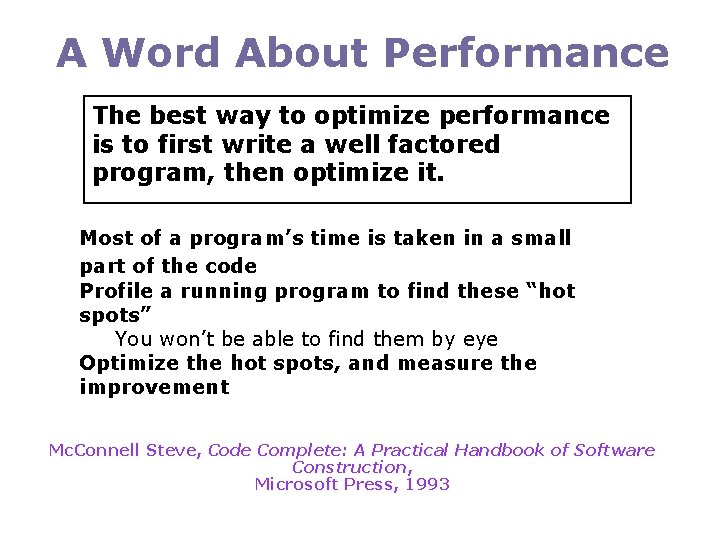
A Word About Performance The best way to optimize performance is to first write a well factored program, then optimize it. Most of a program’s time is taken in a small part of the code Profile a running program to find these “hot spots” You won’t be able to find them by eye Optimize the hot spots, and measure the improvement Mc. Connell Steve, Code Complete: A Practical Handbook of Software Construction, Microsoft Press, 1993
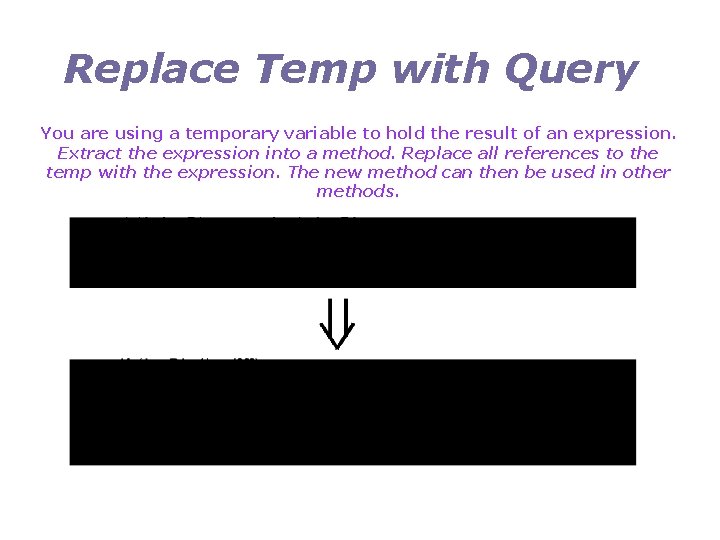
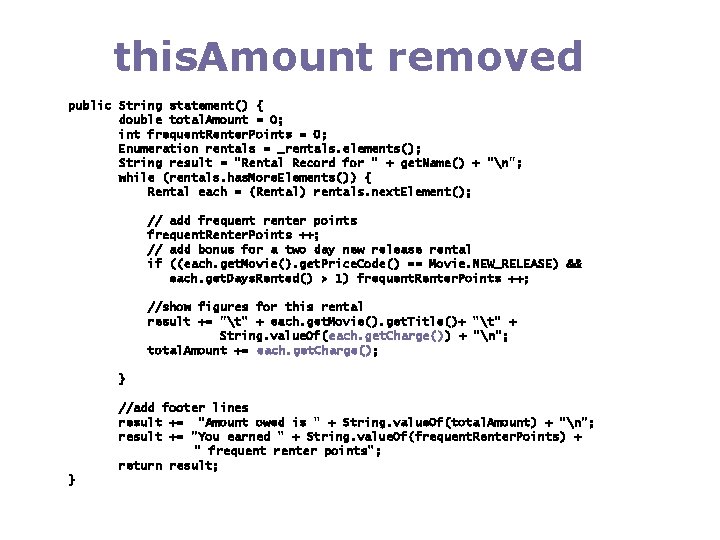
Replace Temp with Query You are using a temporary variable to hold the result of an expression. Extract the expression into a method. Replace all references to the temp with the expression. The new method can then be used in other methods.
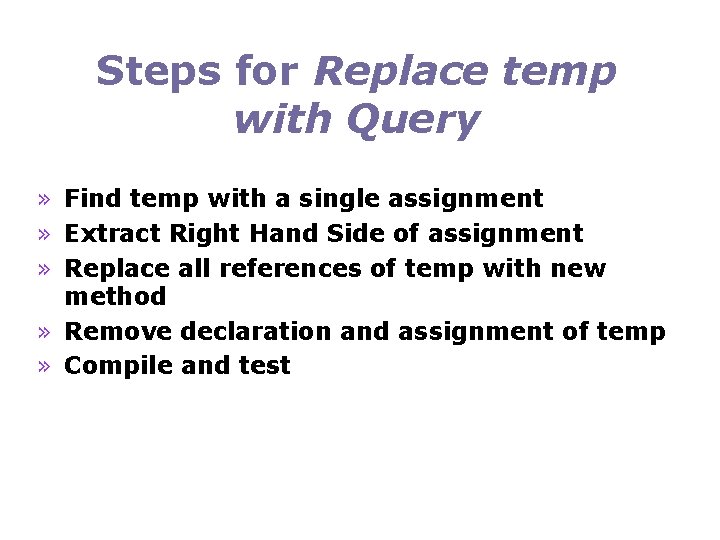
Steps for Replace temp with Query » Find temp with a single assignment » Extract Right Hand Side of assignment » Replace all references of temp with new method » Remove declaration and assignment of temp » Compile and test
this. Amount removed public String statement() { double total. Amount = 0; int frequent. Renter. Points = 0; Enumeration rentals = _rentals. elements(); String result = "Rental Record for " + get. Name() + "n"; while (rentals. has. More. Elements()) { Rental each = (Rental) rentals. next. Element(); // add frequent renter points frequent. Renter. Points ++; // add bonus for a two day new release rental if ((each. get. Movie(). get. Price. Code() == Movie. NEW_RELEASE) && each. get. Days. Rented() > 1) frequent. Renter. Points ++; //show figures for this rental result += "t" + each. get. Movie(). get. Title()+ "t" + String. value. Of(each. get. Charge()) + "n"; total. Amount += each. get. Charge(); } //add footer lines result += "Amount owed is " + String. value. Of(total. Amount) + "n"; result += "You earned " + String. value. Of(frequent. Renter. Points) + " frequent renter points"; return result; }
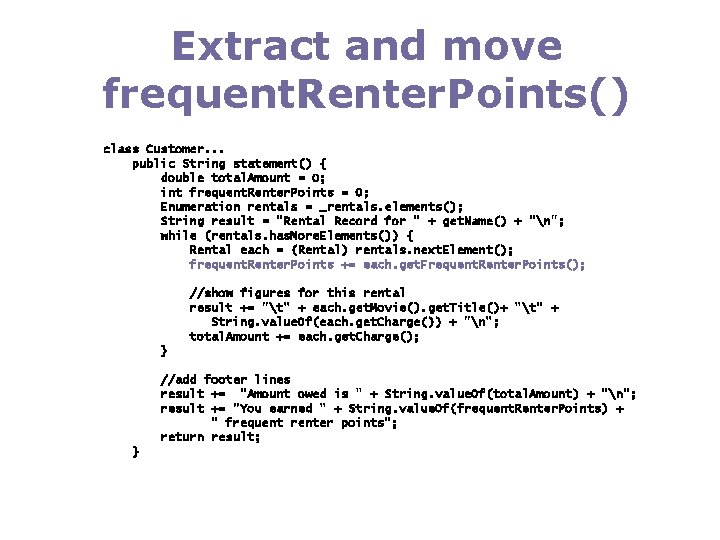
Extract and move frequent. Renter. Points() class Customer. . . public String statement() { double total. Amount = 0; int frequent. Renter. Points = 0; Enumeration rentals = _rentals. elements(); String result = "Rental Record for " + get. Name() + "n"; while (rentals. has. More. Elements()) { Rental each = (Rental) rentals. next. Element(); frequent. Renter. Points += each. get. Frequent. Renter. Points(); //show figures for this rental result += "t" + each. get. Movie(). get. Title()+ "t" + String. value. Of(each. get. Charge()) + "n"; total. Amount += each. get. Charge(); } //add footer lines result += "Amount owed is " + String. value. Of(total. Amount) + "n"; result += "You earned " + String. value. Of(frequent. Renter. Points) + " frequent renter points"; return result; }
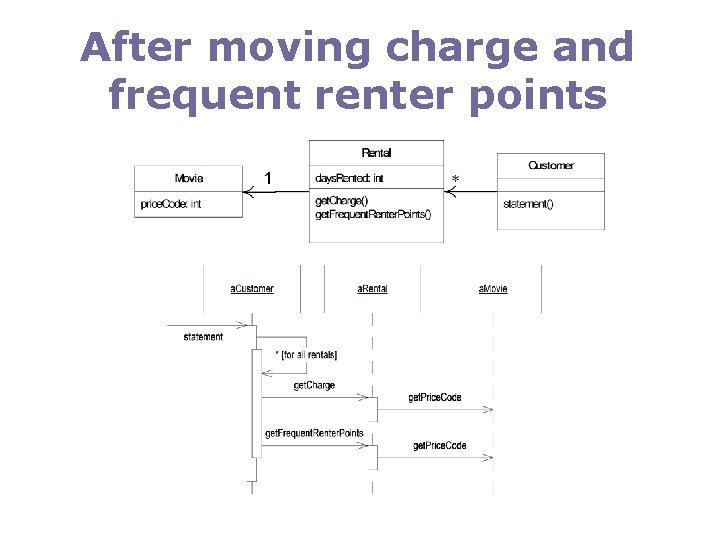
After moving charge and frequent renter points
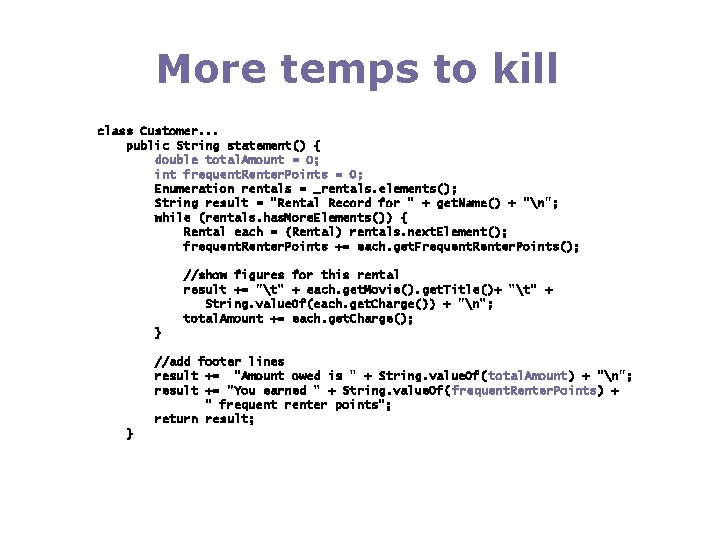
More temps to kill class Customer. . . public String statement() { double total. Amount = 0; int frequent. Renter. Points = 0; Enumeration rentals = _rentals. elements(); String result = "Rental Record for " + get. Name() + "n"; while (rentals. has. More. Elements()) { Rental each = (Rental) rentals. next. Element(); frequent. Renter. Points += each. get. Frequent. Renter. Points(); //show figures for this rental result += "t" + each. get. Movie(). get. Title()+ "t" + String. value. Of(each. get. Charge()) + "n"; total. Amount += each. get. Charge(); } //add footer lines result += "Amount owed is " + String. value. Of( total. Amount) + "n"; result += "You earned " + String. value. Of( frequent. Renter. Points) + " frequent renter points"; return result; }
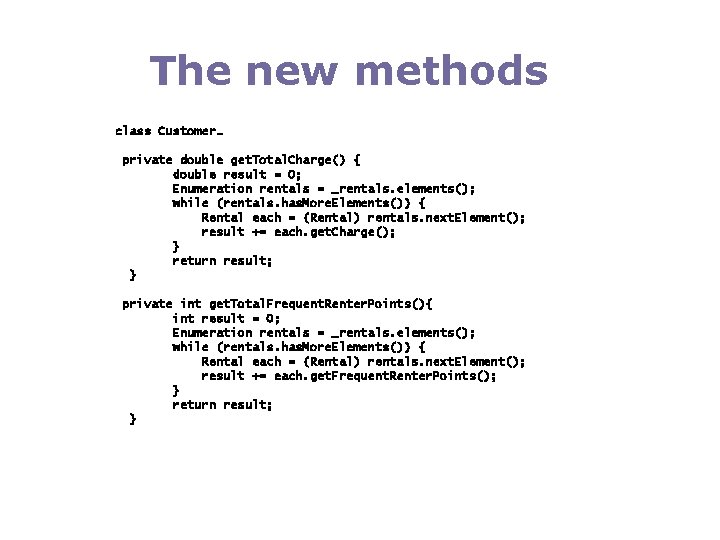
The new methods class Customer… private double get. Total. Charge() { double result = 0; Enumeration rentals = _rentals. elements(); while (rentals. has. More. Elements()) { Rental each = (Rental) rentals. next. Element(); result += each. get. Charge(); } return result; } private int get. Total. Frequent. Renter. Points(){ int result = 0; Enumeration rentals = _rentals. elements(); while (rentals. has. More. Elements()) { Rental each = (Rental) rentals. next. Element(); result += each. get. Frequent. Renter. Points(); } return result; }
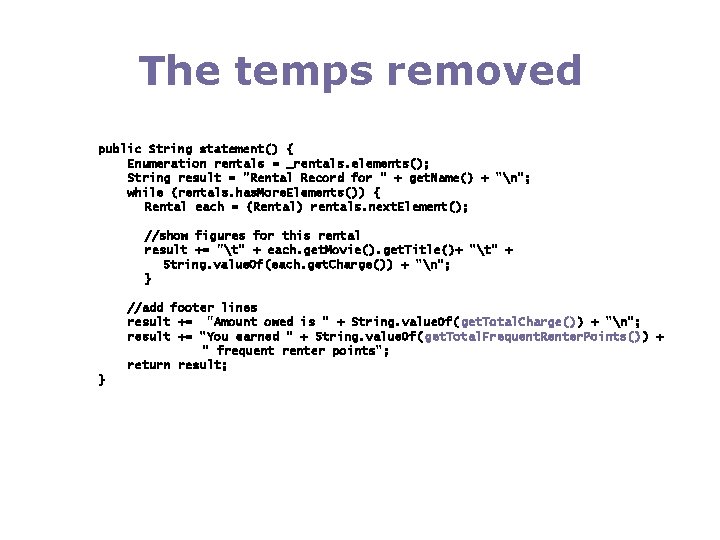
The temps removed public String statement() { Enumeration rentals = _rentals. elements(); String result = "Rental Record for " + get. Name() + "n"; while (rentals. has. More. Elements()) { Rental each = (Rental) rentals. next. Element(); //show figures for this rental result += "t" + each. get. Movie(). get. Title()+ "t" + String. value. Of(each. get. Charge()) + "n"; } //add footer lines result += "Amount owed is " + String. value. Of(get. Total. Charge()) + "n"; result += "You earned " + String. value. Of(get. Total. Frequent. Renter. Points()) + " frequent renter points"; return result; }
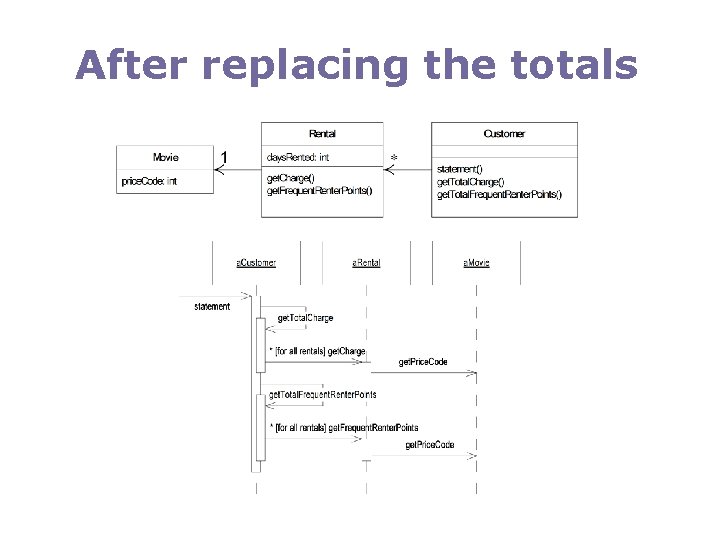
After replacing the totals
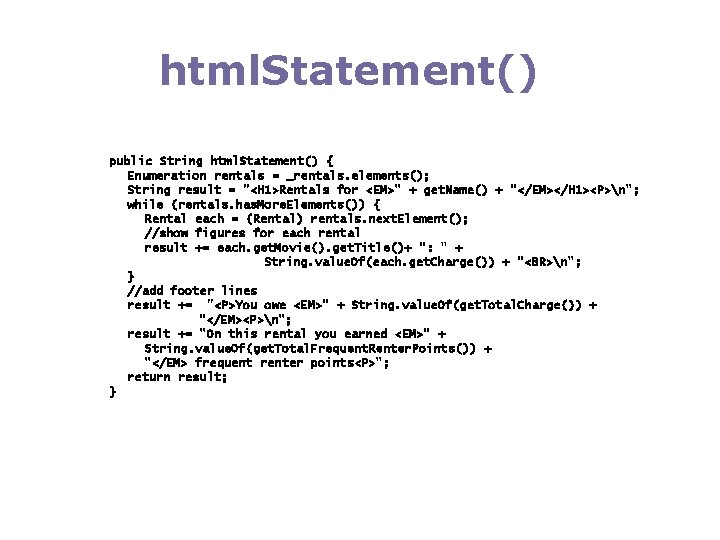
html. Statement() public String html. Statement() { Enumeration rentals = _rentals. elements(); String result = "<H 1>Rentals for <EM>" + get. Name() + "</EM></H 1><P>n"; while (rentals. has. More. Elements()) { Rental each = (Rental) rentals. next. Element(); //show figures for each rental result += each. get. Movie(). get. Title()+ ": " + String. value. Of(each. get. Charge()) + "<BR>n"; } //add footer lines result += "<P>You owe <EM>" + String. value. Of(get. Total. Charge()) + "</EM><P>n"; result += "On this rental you earned <EM>" + String. value. Of(get. Total. Frequent. Renter. Points()) + "</EM> frequent renter points<P>"; return result; }
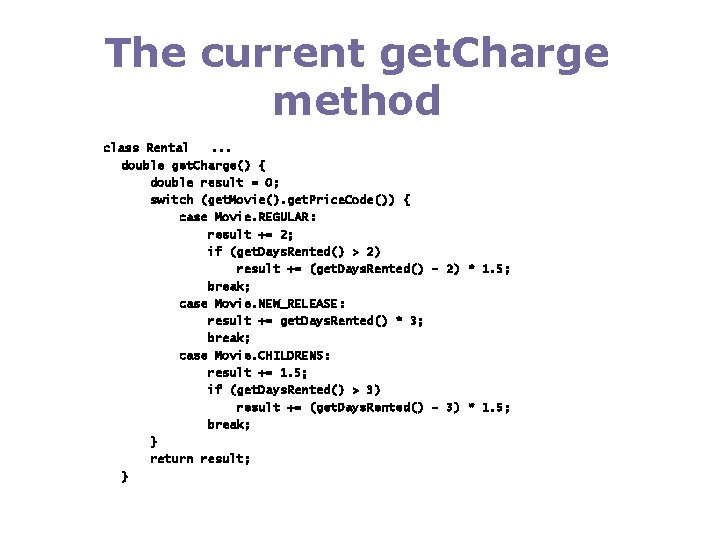
The current get. Charge method class Rental. . . double get. Charge() { double result = 0; switch (get. Movie(). get. Price. Code()) { case Movie. REGULAR: result += 2; if (get. Days. Rented() > 2) result += (get. Days. Rented() - 2) * 1. 5; break; case Movie. NEW_RELEASE: result += get. Days. Rented() * 3; break; case Movie. CHILDRENS: result += 1. 5; if (get. Days. Rented() > 3) result += (get. Days. Rented() - 3) * 1. 5; break; } return result; }
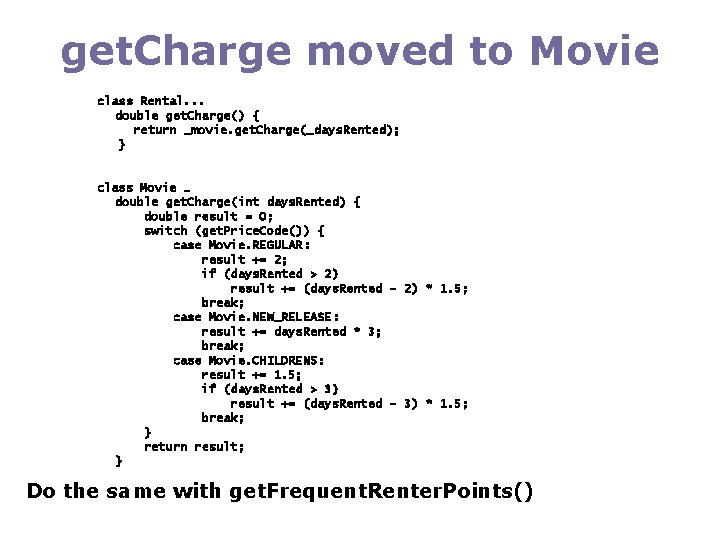
get. Charge moved to Movie class Rental. . . double get. Charge() { return _movie. get. Charge(_days. Rented); } class Movie … double get. Charge(int days. Rented) { double result = 0; switch (get. Price. Code()) { case Movie. REGULAR: result += 2; if (days. Rented > 2) result += (days. Rented - 2) * 1. 5; break; case Movie. NEW_RELEASE: result += days. Rented * 3; break; case Movie. CHILDRENS: result += 1. 5; if (days. Rented > 3) result += (days. Rented - 3) * 1. 5; break; } return result; } Do the same with get. Frequent. Renter. Points()
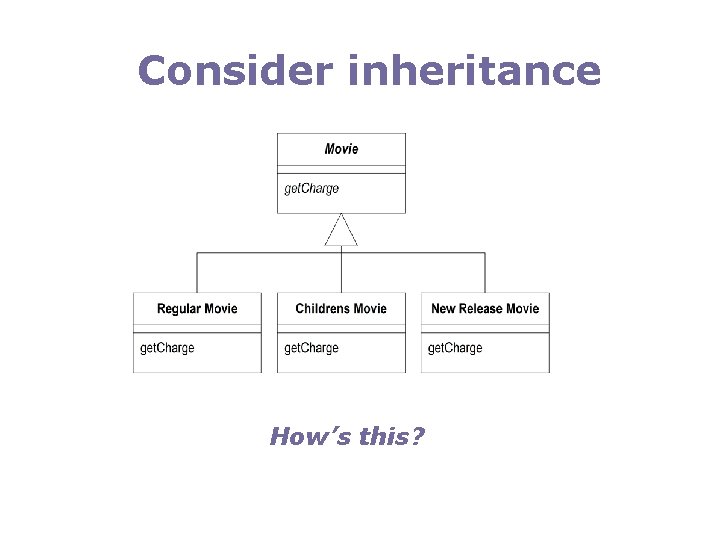
Consider inheritance How’s this?
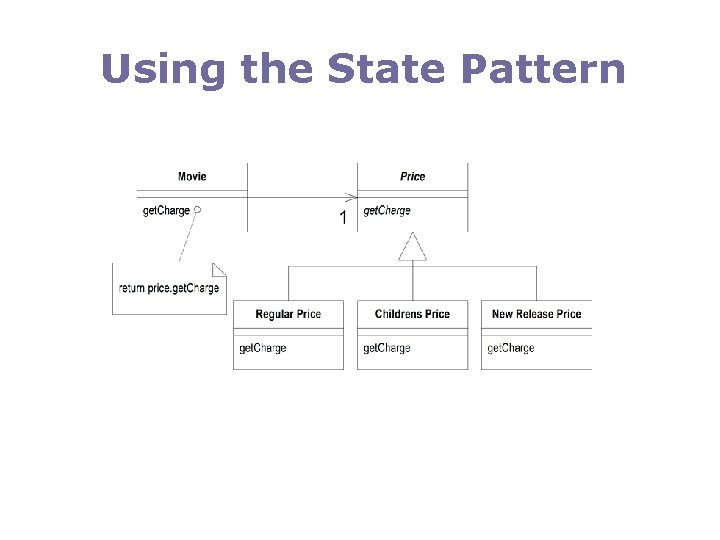
Using the State Pattern
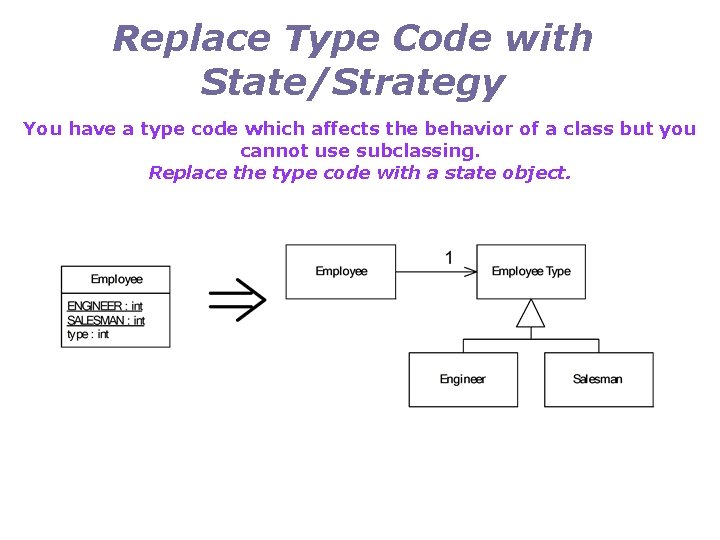
Replace Type Code with State/Strategy You have a type code which affects the behavior of a class but you cannot use subclassing. Replace the type code with a state object.
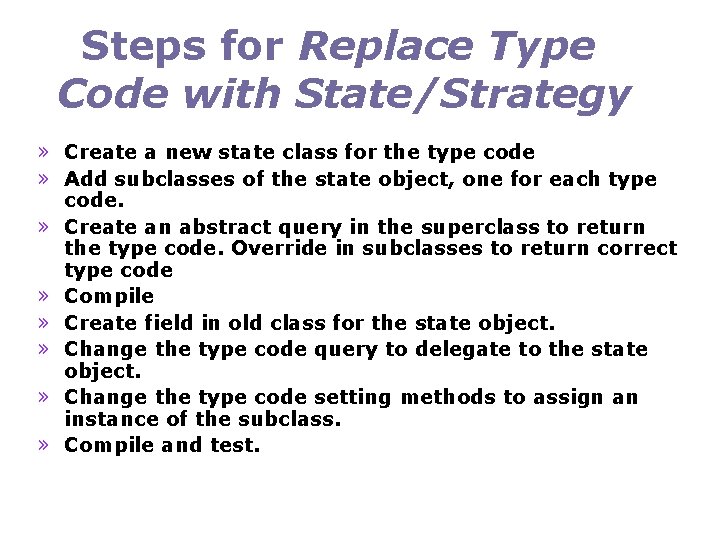
Steps for Replace Type Code with State/Strategy » Create a new state class for the type code » Add subclasses of the state object, one for each type code. » Create an abstract query in the superclass to return the type code. Override in subclasses to return correct type code » Compile » Create field in old class for the state object. » Change the type code query to delegate to the state object. » Change the type code setting methods to assign an instance of the subclass. » Compile and test.
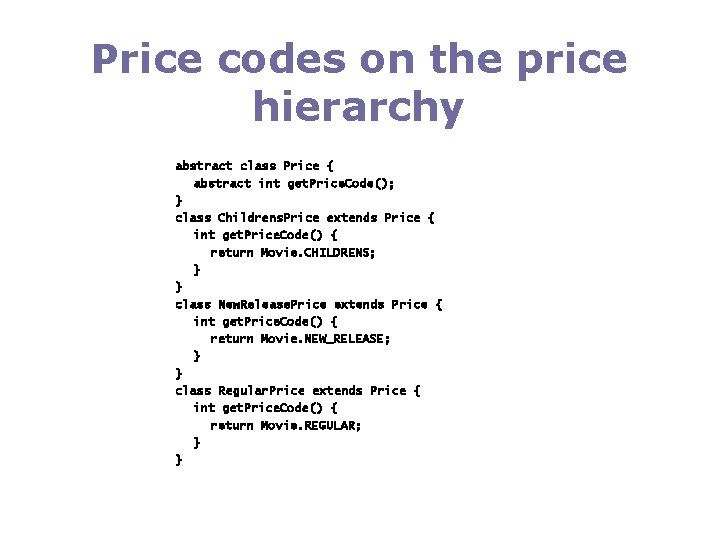
Price codes on the price hierarchy abstract class Price { abstract int get. Price. Code(); } class Childrens. Price extends Price { int get. Price. Code() { return Movie. CHILDRENS; } } class New. Release. Price extends Price { int get. Price. Code() { return Movie. NEW_RELEASE; } } class Regular. Price extends Price { int get. Price. Code() { return Movie. REGULAR; } }
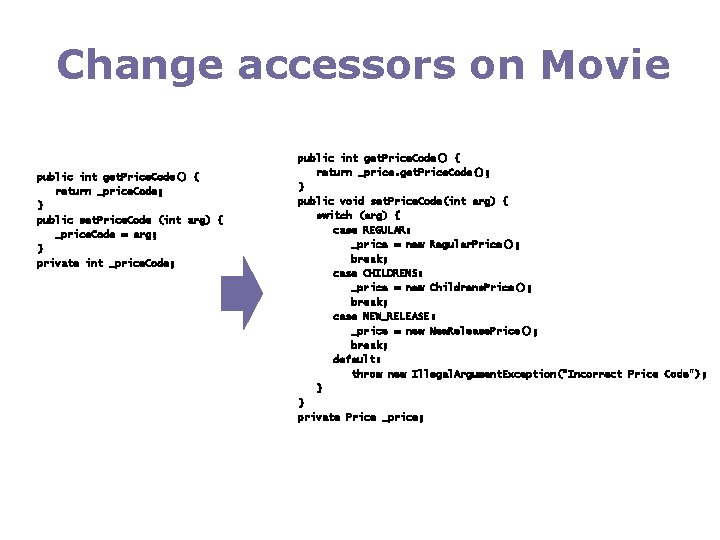
Change accessors on Movie public int get. Price. Code() { return _price. Code; } public set. Price. Code (int arg) { _price. Code = arg; } private int _price. Code; public int get. Price. Code() { return _price. get. Price. Code(); } public void set. Price. Code(int arg) { switch (arg) { case REGULAR: _price = new Regular. Price(); break; case CHILDRENS: _price = new Childrens. Price(); break; case NEW_RELEASE: _price = new New. Release. Price(); break; default: throw new Illegal. Argument. Exception("Incorrect Price Code"); } } private Price _price;
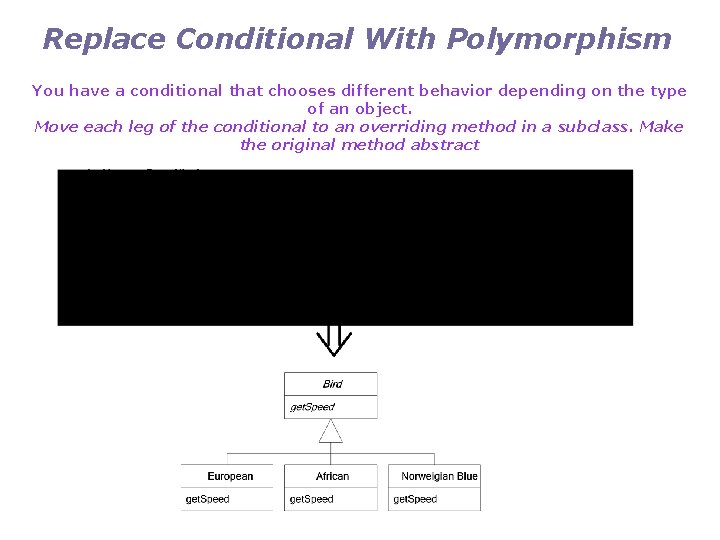
Replace Conditional With Polymorphism You have a conditional that chooses different behavior depending on the type of an object. Move each leg of the conditional to an overriding method in a subclass. Make the original method abstract
Steps for Replace Conditional with Polymorphism » Move switch to superclass of inheritance structure » Copy one leg of case statement into subclass » Compile and test » Repeat for all other legs » Replace case statement with abstract method
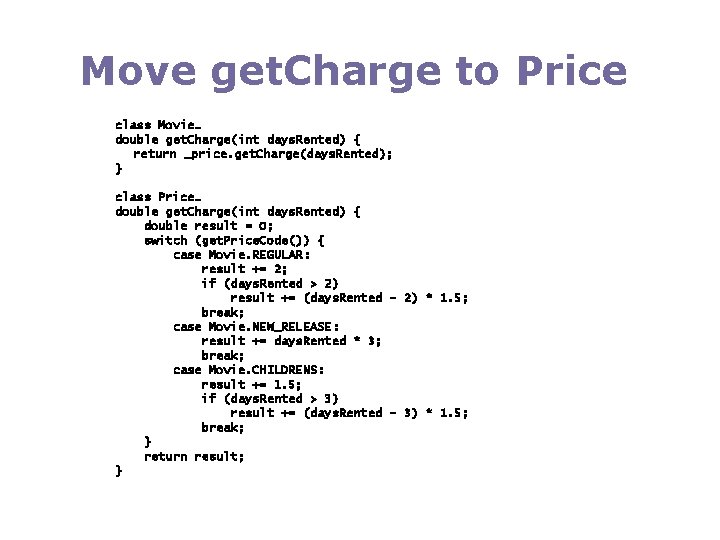
Move get. Charge to Price class Movie… double get. Charge(int days. Rented) { return _price. get. Charge(days. Rented); } class Price… double get. Charge(int days. Rented) { double result = 0; switch (get. Price. Code()) { case Movie. REGULAR: result += 2; if (days. Rented > 2) result += (days. Rented - 2) * 1. 5; break; case Movie. NEW_RELEASE: result += days. Rented * 3; break; case Movie. CHILDRENS: result += 1. 5; if (days. Rented > 3) result += (days. Rented - 3) * 1. 5; break; } return result; }
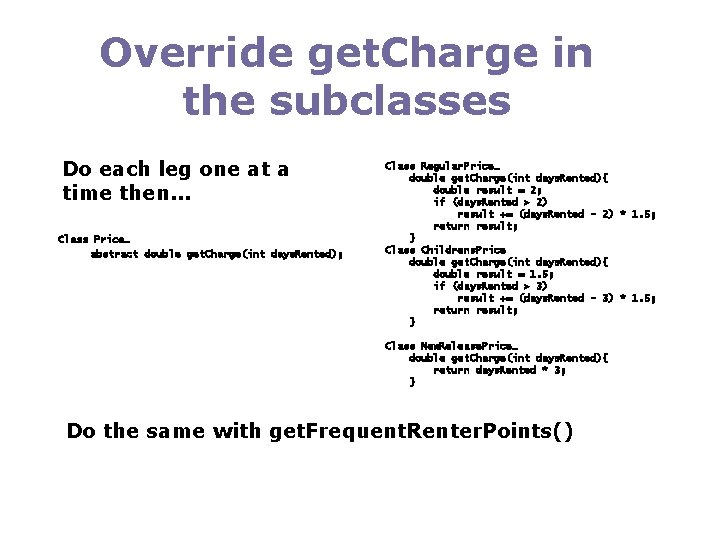
Override get. Charge in the subclasses Do each leg one at a time then. . . Class Price… abstract double get. Charge(int days. Rented); Class Regular. Price… double get. Charge(int days. Rented){ double result = 2; if (days. Rented > 2) result += (days. Rented - 2) * 1. 5; return result; } Class Childrens. Price double get. Charge(int days. Rented){ double result = 1. 5; if (days. Rented > 3) result += (days. Rented - 3) * 1. 5; return result; } Class New. Release. Price… double get. Charge(int days. Rented){ return days. Rented * 3; } Do the same with get. Frequent. Renter. Points()
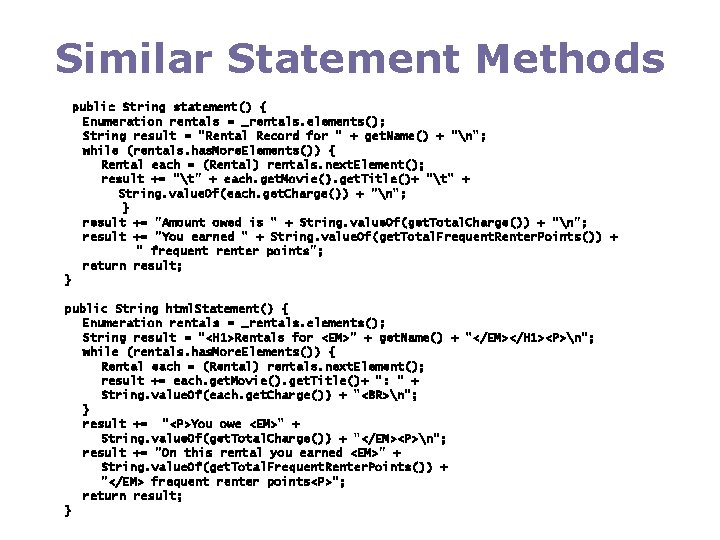
Similar Statement Methods public String statement() { Enumeration rentals = _rentals. elements(); String result = "Rental Record for " + get. Name() + "n"; while (rentals. has. More. Elements()) { Rental each = (Rental) rentals. next. Element(); result += "t" + each. get. Movie(). get. Title()+ "t" + String. value. Of(each. get. Charge()) + "n"; } result += "Amount owed is " + String. value. Of(get. Total. Charge()) + "n"; result += "You earned " + String. value. Of(get. Total. Frequent. Renter. Points()) + " frequent renter points"; return result; } public String html. Statement() { Enumeration rentals = _rentals. elements(); String result = "<H 1>Rentals for <EM>" + get. Name() + "</EM></H 1><P>n"; while (rentals. has. More. Elements()) { Rental each = (Rental) rentals. next. Element(); result += each. get. Movie(). get. Title()+ ": " + String. value. Of(each. get. Charge()) + "<BR>n"; } result += "<P>You owe <EM>" + String. value. Of(get. Total. Charge()) + "</EM><P>n"; result += "On this rental you earned <EM>" + String. value. Of(get. Total. Frequent. Renter. Points()) + "</EM> frequent renter points<P>"; return result; }
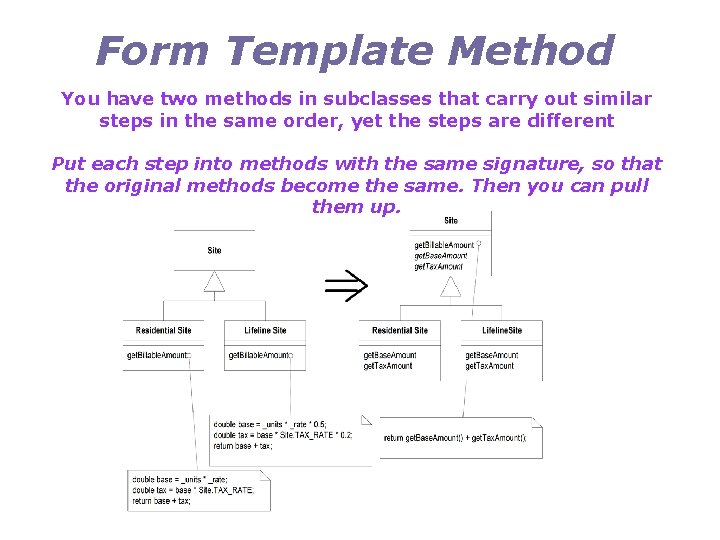
Form Template Method You have two methods in subclasses that carry out similar steps in the same order, yet the steps are different Put each step into methods with the same signature, so that the original methods become the same. Then you can pull them up.
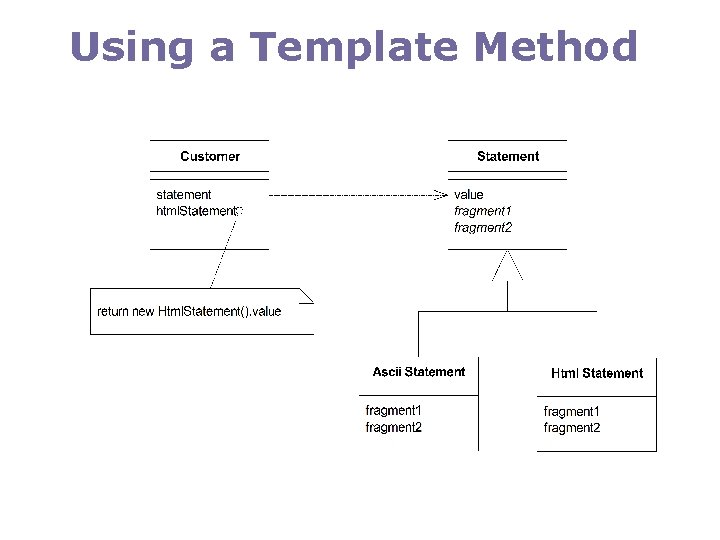
Using a Template Method
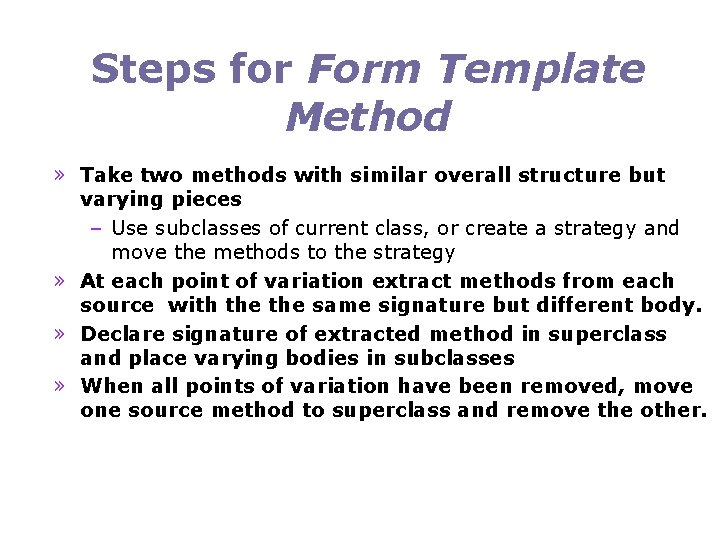
Steps for Form Template Method » Take two methods with similar overall structure but varying pieces – Use subclasses of current class, or create a strategy and move the methods to the strategy » At each point of variation extract methods from each source with the same signature but different body. » Declare signature of extracted method in superclass and place varying bodies in subclasses » When all points of variation have been removed, move one source method to superclass and remove the other.
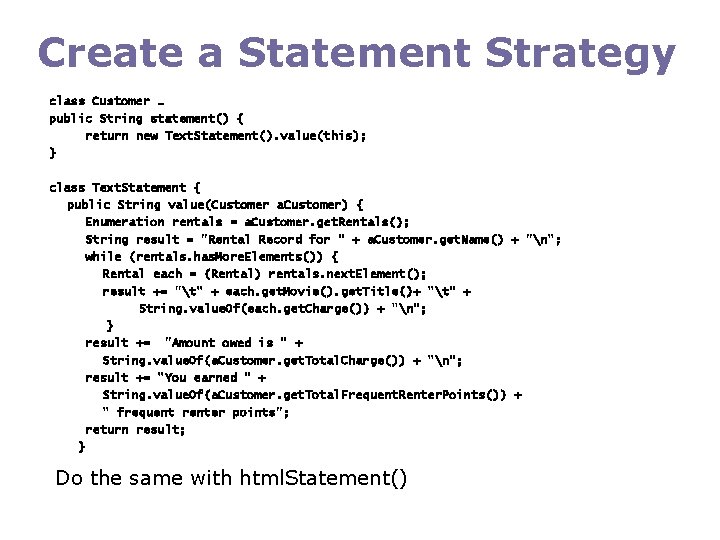
Create a Statement Strategy class Customer … public String statement() { return new Text. Statement(). value(this); } class Text. Statement { public String value(Customer a. Customer) { Enumeration rentals = a. Customer. get. Rentals(); String result = "Rental Record for " + a. Customer. get. Name() + "n"; while (rentals. has. More. Elements()) { Rental each = (Rental) rentals. next. Element(); result += "t" + each. get. Movie(). get. Title()+ "t" + String. value. Of(each. get. Charge()) + "n"; } result += "Amount owed is " + String. value. Of(a. Customer. get. Total. Charge()) + "n"; result += "You earned " + String. value. Of(a. Customer. get. Total. Frequent. Renter. Points()) + " frequent renter points"; return result; } Do the same with html. Statement()
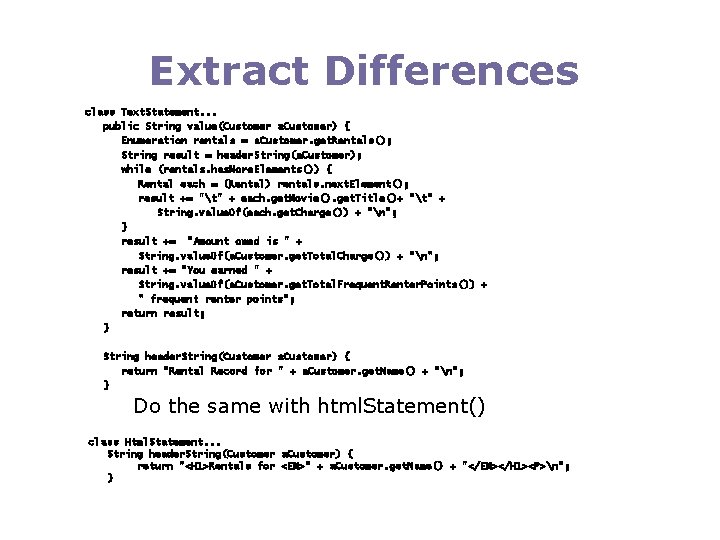
Extract Differences class Text. Statement. . . public String value(Customer a. Customer) { Enumeration rentals = a. Customer. get. Rentals(); String result = header. String(a. Customer); while (rentals. has. More. Elements()) { Rental each = (Rental) rentals. next. Element(); result += "t" + each. get. Movie(). get. Title()+ "t" + String. value. Of(each. get. Charge()) + "n"; } result += "Amount owed is " + String. value. Of(a. Customer. get. Total. Charge()) + "n"; result += "You earned " + String. value. Of(a. Customer. get. Total. Frequent. Renter. Points()) + " frequent renter points"; return result; } String header. String(Customer a. Customer) { return "Rental Record for " + a. Customer. get. Name() + "n"; } Do the same with html. Statement() class Html. Statement. . . String header. String(Customer a. Customer) { return "<H 1>Rentals for <EM>" + a. Customer. get. Name() + "</EM></H 1><P>n"; }
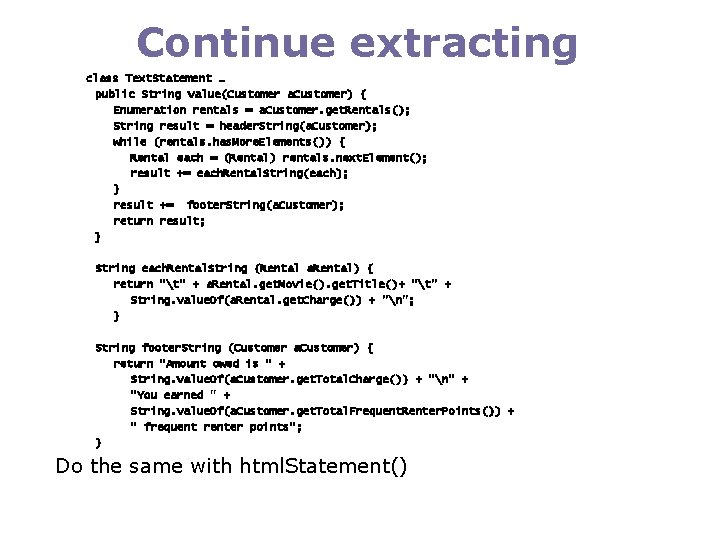
Continue extracting class Text. Statement … public String value(Customer a. Customer) { Enumeration rentals = a. Customer. get. Rentals(); String result = header. String(a. Customer); while (rentals. has. More. Elements()) { Rental each = (Rental) rentals. next. Element(); result += each. Rental. String(each); } result += footer. String(a. Customer); return result; } String each. Rental. String (Rental a. Rental) { return "t" + a. Rental. get. Movie(). get. Title()+ "t" + String. value. Of(a. Rental. get. Charge()) + "n"; } String footer. String (Customer a. Customer) { return "Amount owed is " + String. value. Of(a. Customer. get. Total. Charge()) + "n" + "You earned " + String. value. Of(a. Customer. get. Total. Frequent. Renter. Points()) + " frequent renter points"; } Do the same with html. Statement()
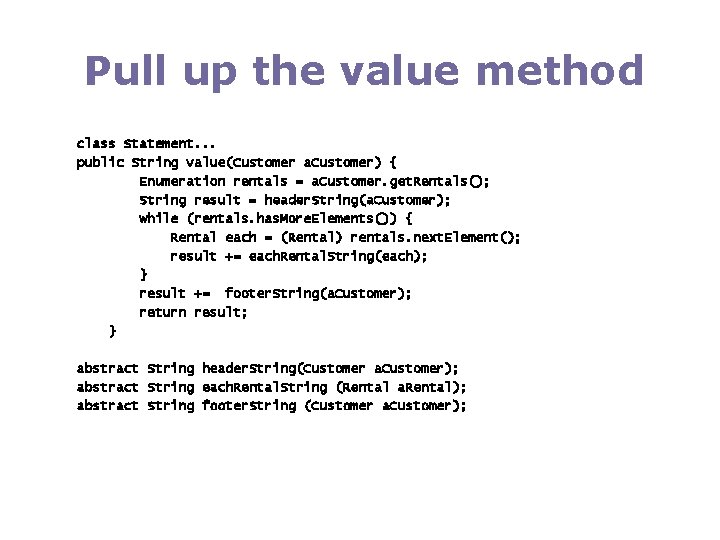
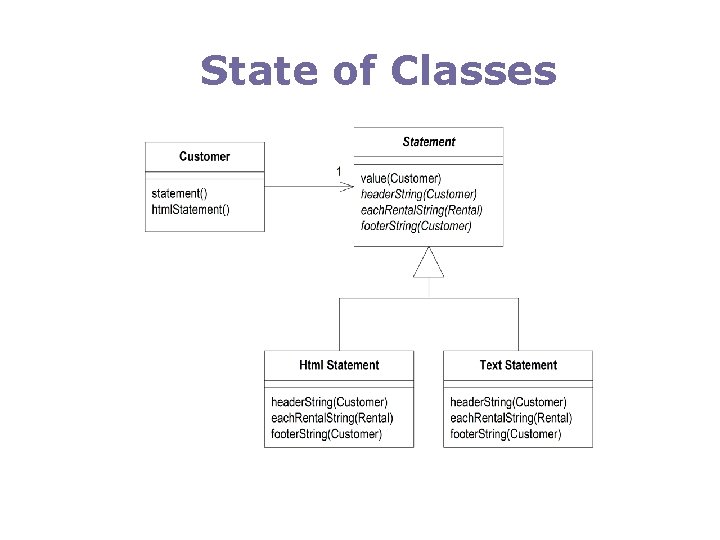
Pull up the value method class Statement. . . public String value(Customer a. Customer) { Enumeration rentals = a. Customer. get. Rentals(); String result = header. String(a. Customer); while (rentals. has. More. Elements()) { Rental each = (Rental) rentals. next. Element(); result += each. Rental. String(each); } result += footer. String(a. Customer); return result; } abstract String header. String(Customer a. Customer); abstract String each. Rental. String (Rental a. Rental); abstract String footer. String (Customer a. Customer);
State of Classes
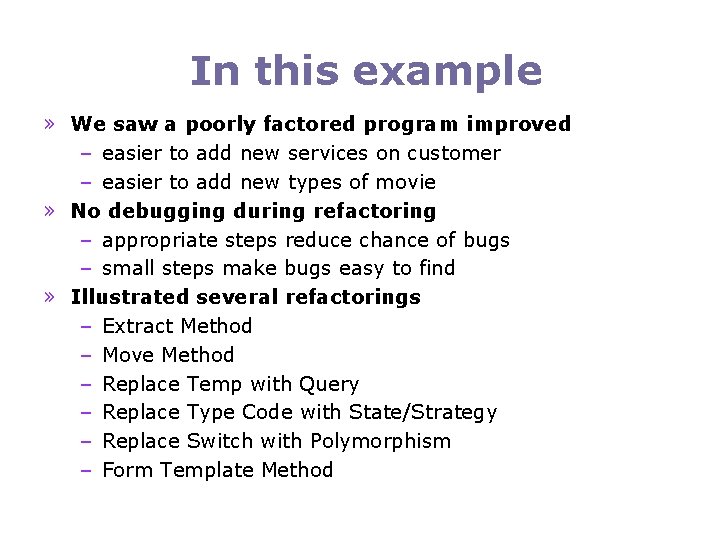
In this example » We saw a poorly factored program improved – easier to add new services on customer – easier to add new types of movie » No debugging during refactoring – appropriate steps reduce chance of bugs – small steps make bugs easy to find » Illustrated several refactorings – Extract Method – Move Method – Replace Temp with Query – Replace Type Code with State/Strategy – Replace Switch with Polymorphism – Form Template Method
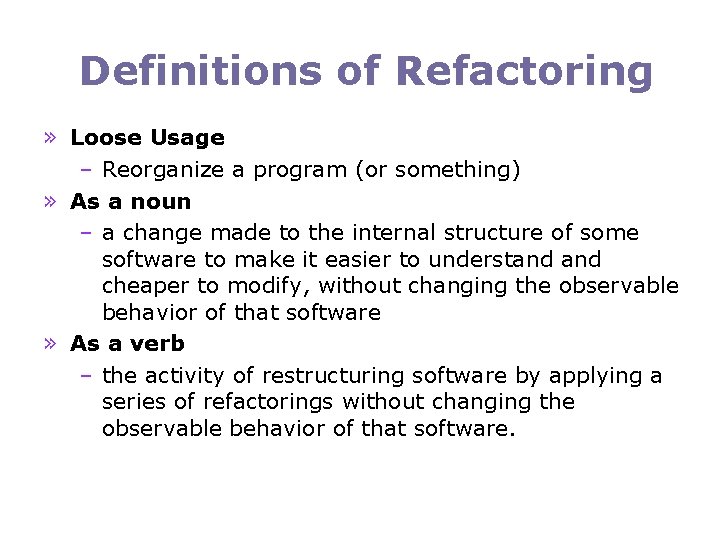
Definitions of Refactoring » Loose Usage – Reorganize a program (or something) » As a noun – a change made to the internal structure of some software to make it easier to understand cheaper to modify, without changing the observable behavior of that software » As a verb – the activity of restructuring software by applying a series of refactorings without changing the observable behavior of that software.
Where Refactoring Came From » Ward Cunningham and Kent Beck –Smalltalk style » Ralph Johnson at University of Illinois at Urbana-Champaign » Bill Opdyke’s Thesis ftp: //st. cs. uiuc. edu/pub/papers/refactoring/opdyke-thesis. ps. Z » John Brant and Don Roberts: The Refactoring Browser
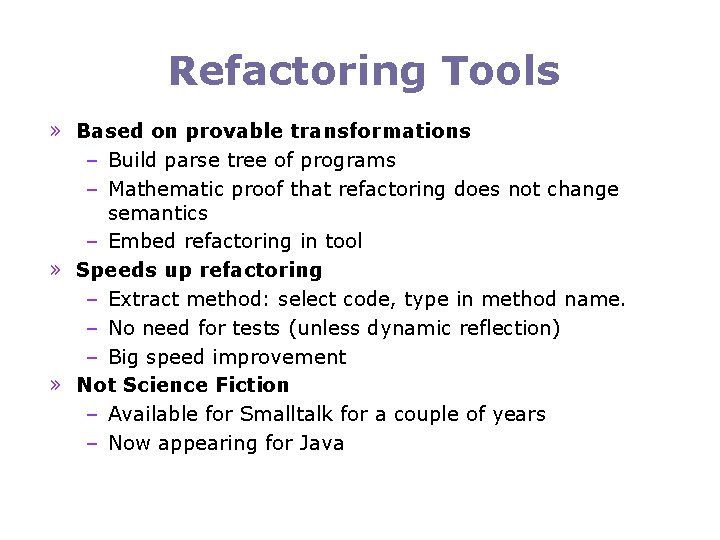
Refactoring Tools » Based on provable transformations – Build parse tree of programs – Mathematic proof that refactoring does not change semantics – Embed refactoring in tool » Speeds up refactoring – Extract method: select code, type in method name. – No need for tests (unless dynamic reflection) – Big speed improvement » Not Science Fiction – Available for Smalltalk for a couple of years – Now appearing for Java
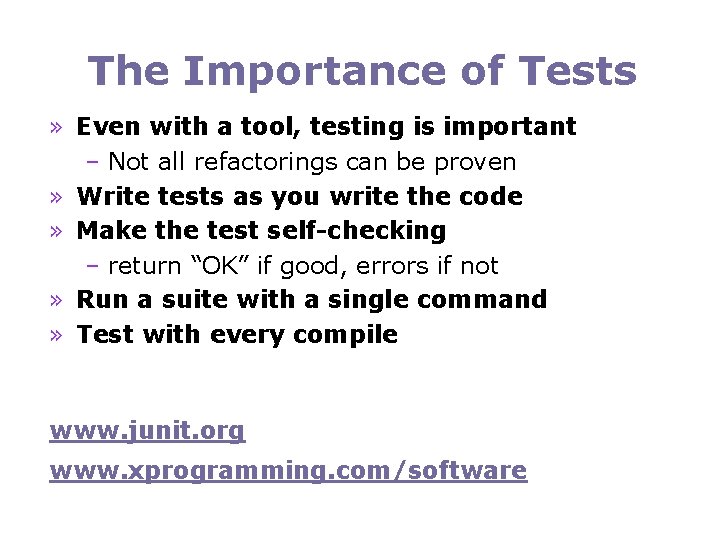
The Importance of Tests » Even with a tool, testing is important – Not all refactorings can be proven » Write tests as you write the code » Make the test self-checking – return “OK” if good, errors if not » Run a suite with a single command » Test with every compile www. junit. org www. xprogramming. com/software
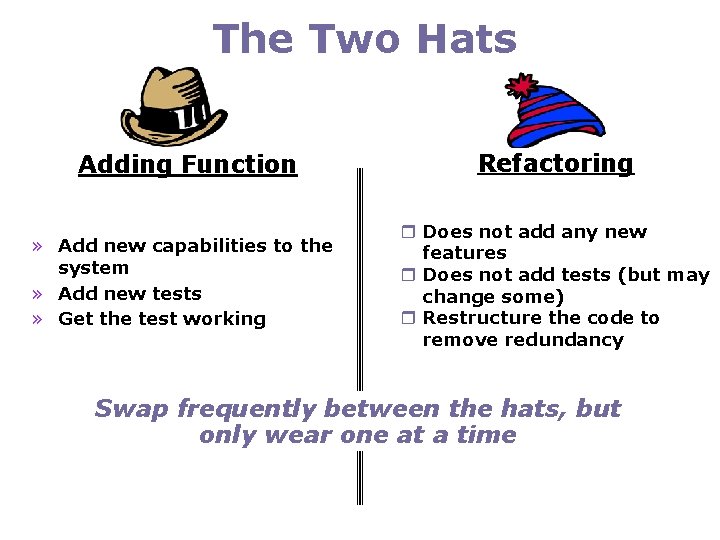
The Two Hats Adding Function » Add new capabilities to the system » Add new tests » Get the test working Refactoring r Does not add any new features r Does not add tests (but may change some) r Restructure the code to remove redundancy Swap frequently between the hats, but only wear one at a time
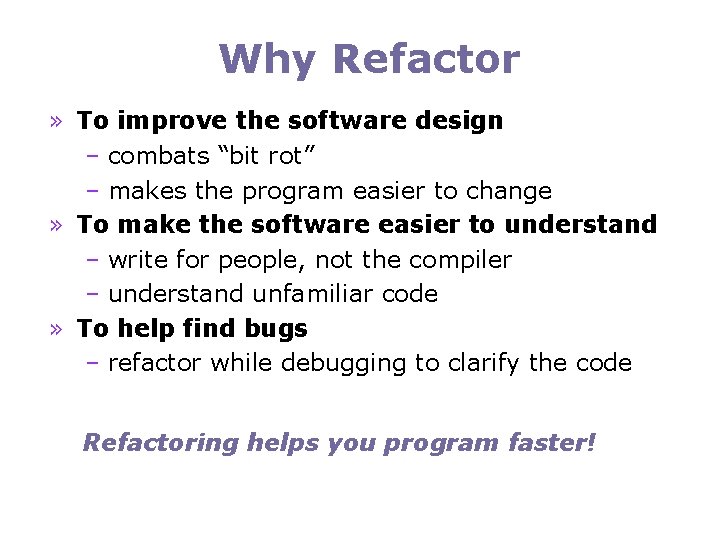
Why Refactor » To improve the software design – combats “bit rot” – makes the program easier to change » To make the software easier to understand – write for people, not the compiler – understand unfamiliar code » To help find bugs – refactor while debugging to clarify the code Refactoring helps you program faster!
When should you refactor? » To add new functionality – refactor existing code until you understand it – refactor the design to make it easy to add » To find bugs – refactor to understand the code » For code reviews – immediate effect of code review – allows for higher level suggestions Don’t set aside time for refactoring, include it in your normal activities
What do you tell your manager » If the manager is really concerned about quality – then stress the quality aspects » Otherwise you need to develop as fast as possible – you’re the professional, so you know to do what makes you go faster
Problems with Refactoring » We don’t know what they are yet » Database Migration – Insulate persistent database structure from your objects – With OO databases, migrate frequently » Published Interfaces – Publish only when you need to – Don’t publish within a development team » Without working tests – Don’t bother
Design Decisions » Planned design – Consider current needs and possible future needs – Design to minimize change with future needs – Patch code if unforeseen need appears » Evolutionary design – Consider current needs and possible future needs – Trade off cost of current flexibility versus cost of later refactoring – Refactor as changes appear martinfowler. com/articles/design. Dead. html
Extreme Programming » Methodology developed by Kent Beck » Designed to adapt to changes » Key Practices – Iterative Development – Self Testing Code – Refactoring – Pair Programming » Leverages refactoring to encourage evolutionary design http: //www. xprogramming. com http: //www. extremeprogramming. org
Team Techniques » Encourage refactoring culture – nobody gets things right first time – nobody can write clear code without reviews – refactoring is forward progress » Provide sound testing base – tests are essential for refactoring – build system and run tests daily » Pair Programming – two programmers working together can be quicker than working separately – refactor with the class writer and a class user
Creating Your Own Refactorings » Consider a change to a program » Should it change the external behavior of the system » Break down the change into small steps – Look for points where you can compile and test » Carry out the change, note what you do – If a problem occurs, consider how to eliminate it in future » Carry it out again, follow and refine the notes » After two or three times you have a workable refactoring
Final Thoughts » The one benefit of objects is that they make it easier to change. » Refactoring allows you to improve the design after the code is written » Up front design is still important, but not so critical » Refactoring is an immature subject: not much written and very few tools