
Refactoring Functional Programs Claus Reinke Simon Thompson TCS
- Slides: 50
Refactoring Functional Programs Claus Reinke Simon Thompson TCS Seminar, 1 October 2001 Refactoring TCS 1. 10. 01
Overview Refactoring: what does it mean? The background in OO … and the functional context. Simple examples. Discussion. Taxonomy. More examples. Case study: semantic tableau. Refactoring TCS 1. 10. 01 2
What is refactoring? Improving the design of existing code … … without changing its functionality. Refactoring TCS 1. 10. 01 3
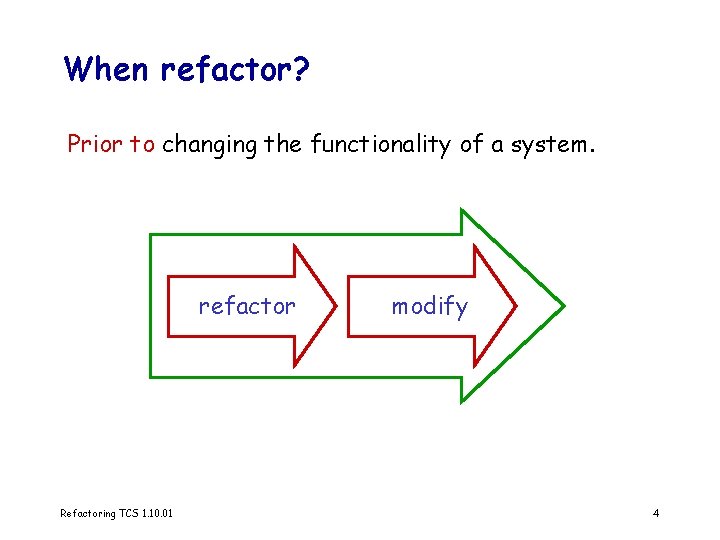
When refactor? Prior to changing the functionality of a system. refactor Refactoring TCS 1. 10. 01 modify 4
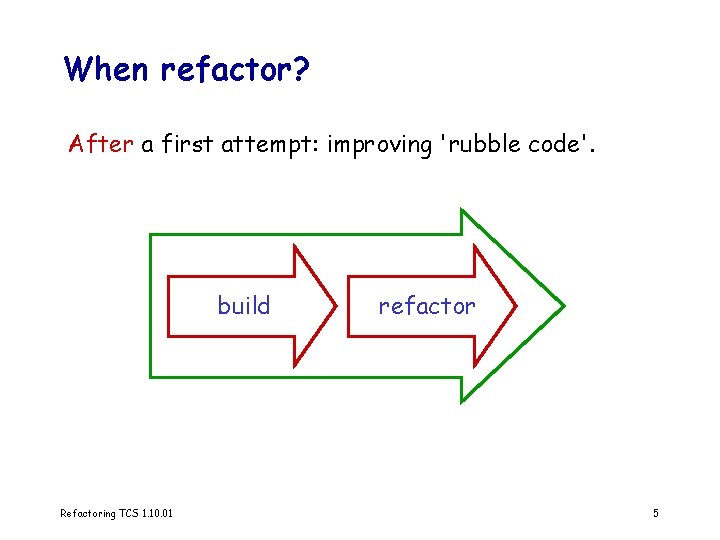
When refactor? After a first attempt: improving 'rubble code'. build Refactoring TCS 1. 10. 01 refactor 5
What is refactoring? • There is no one correct design. • Development time re-design. • Understanding the design of someone else's code. Refactoring happens all the time … … how best to support it? Refactoring TCS 1. 10. 01 6
FP + SE Functional programming provides a different view of the programming process … … however, it's not that different. Software engineering ideas + functional programming • design; • testing; • metrics; • refactoring. Refactoring TCS 1. 10. 01 7
Refactoring functional programs Particularly suited: build a prototype: revise, redesign, extend. Semantic basis supports verified transformations. Strong type system useful in error detection. Testing should not be forgotten. Refactoring TCS 1. 10. 01 8
Genesis Refactoring comes from the OO community … … associated with Martin Fowler, Kent Beck (of extreme programming), Bill Opdyke, Don Roberts. http: //www. refactoring. com http: //st-www. cs. uiuc. edu/users/brant/Refactory/ Loosely linked with the idea of design pattern. Refactoring TCS 1. 10. 01 9
Genesis (2) 'Refactoring comes from the OO community' In fact the SE community got there first … … Program restructuring to aid software maintenance, Ph. D thesis, William Griswold, 1991. OO community added the name, support for OO features and put it all into practice. Refactoring TCS 1. 10. 01 10
Design pattern A stereotypical piece of design / implementation. Often not embodied in a programming construct … … might be in a library, or … more diffuse than that. Refactoring TCS 1. 10. 01 11
What refactoring is not Changing functionality. Transformational programming … in the sense of the squiggol school, say. Refactoring TCS 1. 10. 01 12
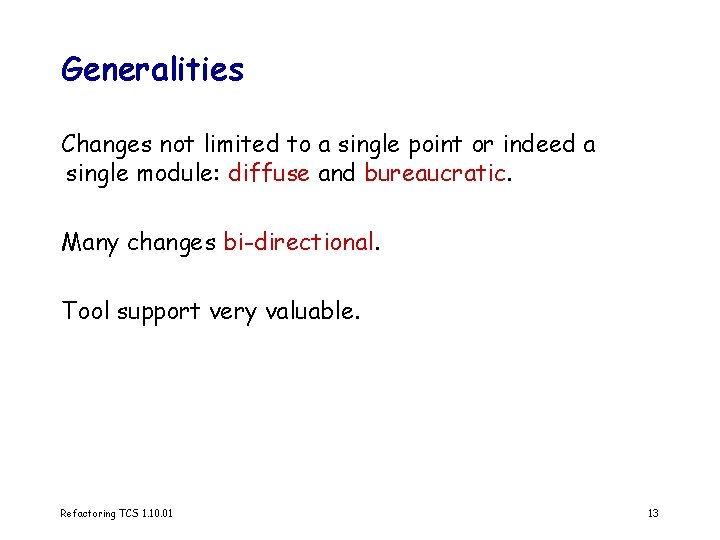
Generalities Changes not limited to a single point or indeed a single module: diffuse and bureaucratic. Many changes bi-directional. Tool support very valuable. Refactoring TCS 1. 10. 01 13
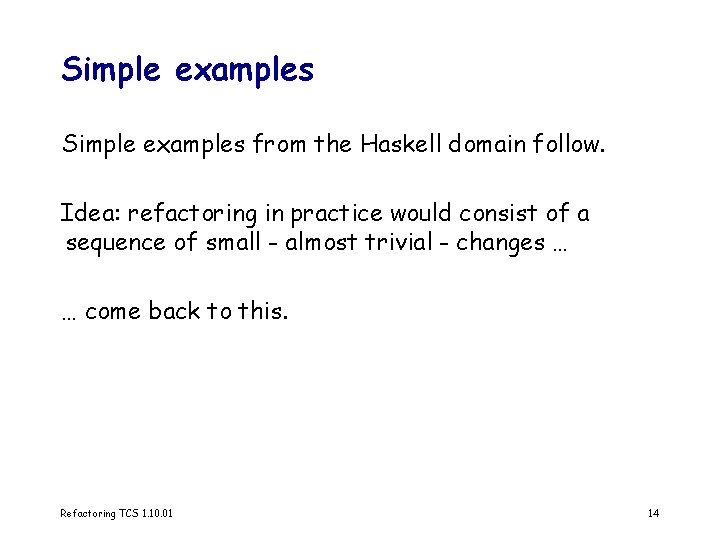
Simple examples from the Haskell domain follow. Idea: refactoring in practice would consist of a sequence of small - almost trivial - changes … … come back to this. Refactoring TCS 1. 10. 01 14
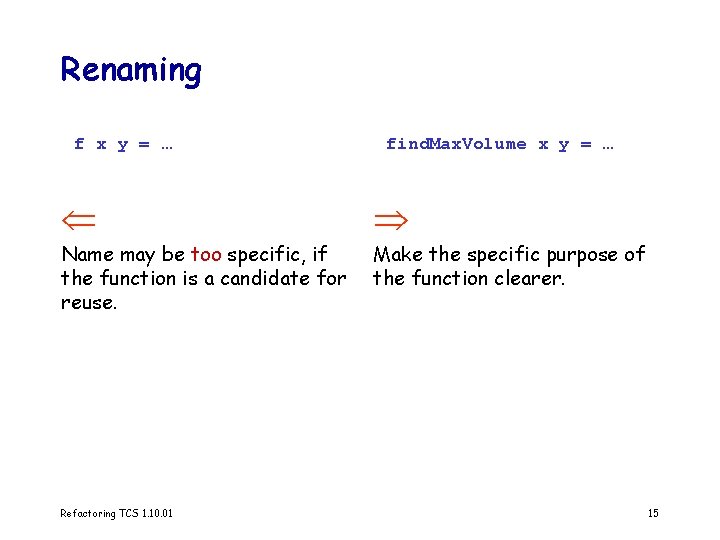
Renaming f x y = … find. Max. Volume x y = … Name may be too specific, if the function is a candidate for reuse. Make the specific purpose of the function clearer. Refactoring TCS 1. 10. 01 15
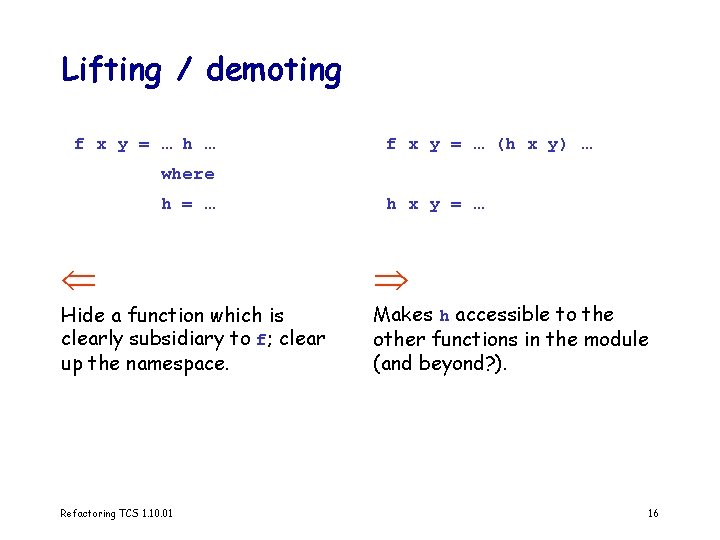
Lifting / demoting f x y = … h … f x y = … (h x y) … where h = … h x y = … Hide a function which is clearly subsidiary to f; clear up the namespace. Makes h accessible to the other functions in the module (and beyond? ). Refactoring TCS 1. 10. 01 16
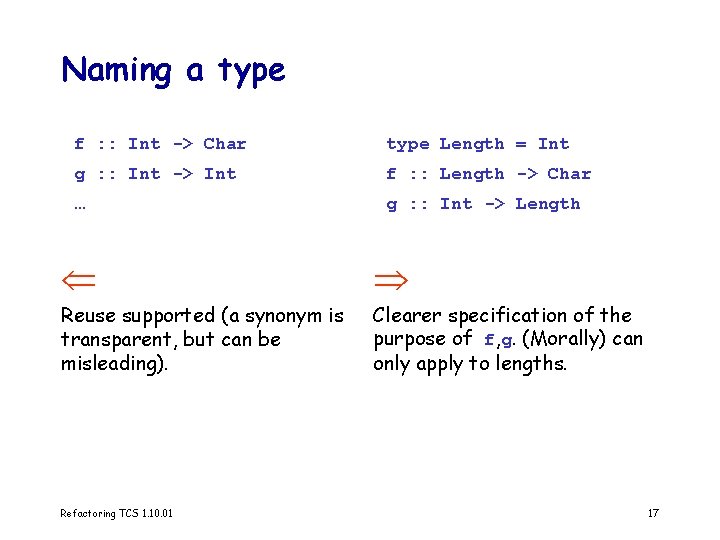
Naming a type f : : Int -> Char type Length = Int g : : Int -> Int f : : Length -> Char … g : : Int -> Length Reuse supported (a synonym is transparent, but can be misleading). Clearer specification of the purpose of f, g. (Morally) can only apply to lengths. Refactoring TCS 1. 10. 01 17
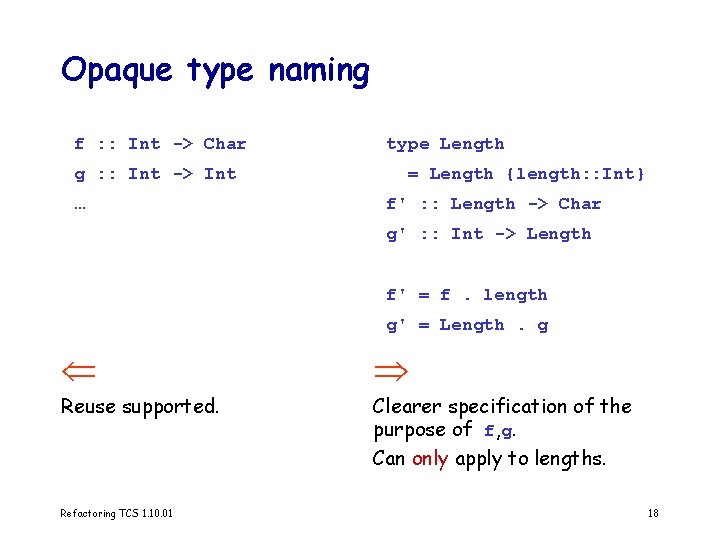
Opaque type naming f : : Int -> Char g : : Int -> Int … type Length = Length {length: : Int} f' : : Length -> Char g' : : Int -> Length f' = f. length g' = Length. g Reuse supported. Clearer specification of the purpose of f, g. Can only apply to lengths. Refactoring TCS 1. 10. 01 18
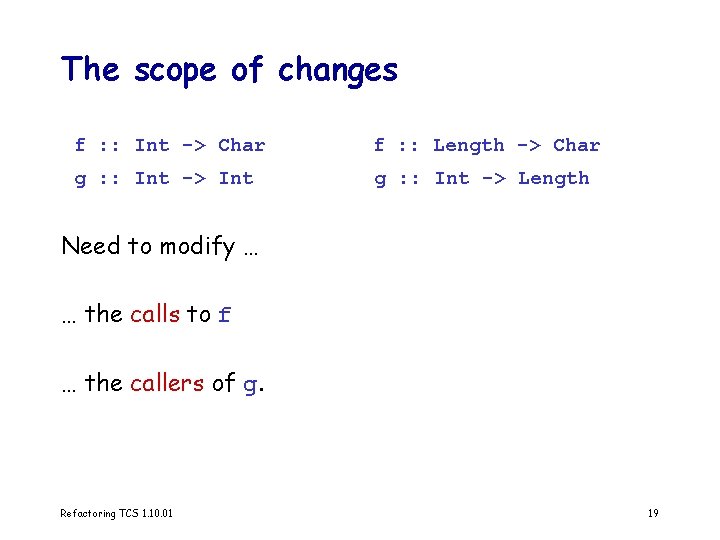
The scope of changes f : : Int -> Char f : : Length -> Char g : : Int -> Int g : : Int -> Length Need to modify … … the calls to f … the callers of g. Refactoring TCS 1. 10. 01 19
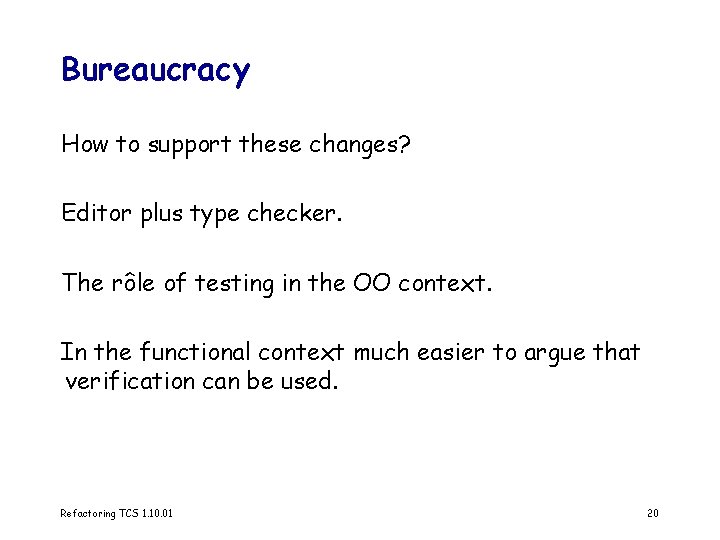
Bureaucracy How to support these changes? Editor plus type checker. The rôle of testing in the OO context. In the functional context much easier to argue that verification can be used. Refactoring TCS 1. 10. 01 20
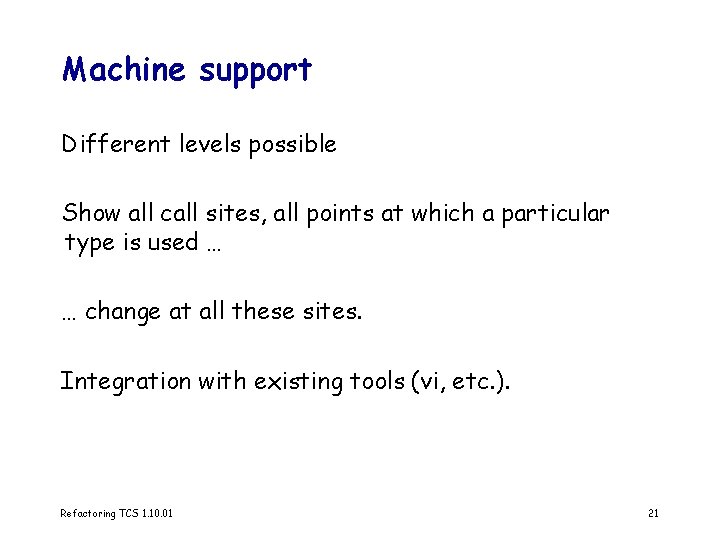
Machine support Different levels possible Show all call sites, all points at which a particular type is used … … change at all these sites. Integration with existing tools (vi, etc. ). Refactoring TCS 1. 10. 01 21
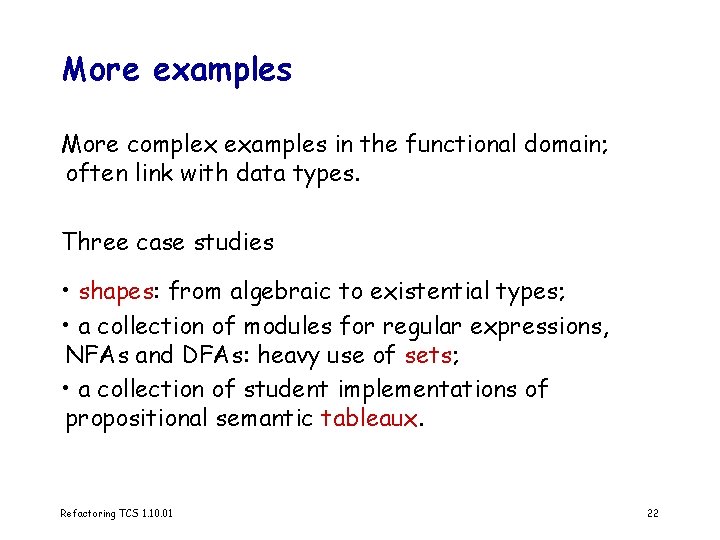
More examples More complex examples in the functional domain; often link with data types. Three case studies • shapes: from algebraic to existential types; • a collection of modules for regular expressions, NFAs and DFAs: heavy use of sets; • a collection of student implementations of propositional semantic tableaux. Refactoring TCS 1. 10. 01 22
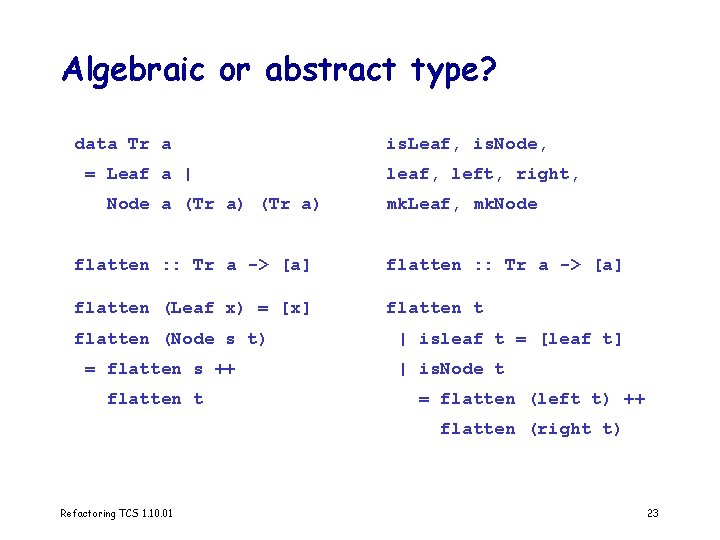
Algebraic or abstract type? data Tr a = Leaf a | Node a (Tr a) is. Leaf, is. Node, leaf, left, right, mk. Leaf, mk. Node flatten : : Tr a -> [a] flatten (Leaf x) = [x] flatten t flatten (Node s t) = flatten s ++ flatten t | isleaf t = [leaf t] | is. Node t = flatten (left t) ++ flatten (right t) Refactoring TCS 1. 10. 01 23
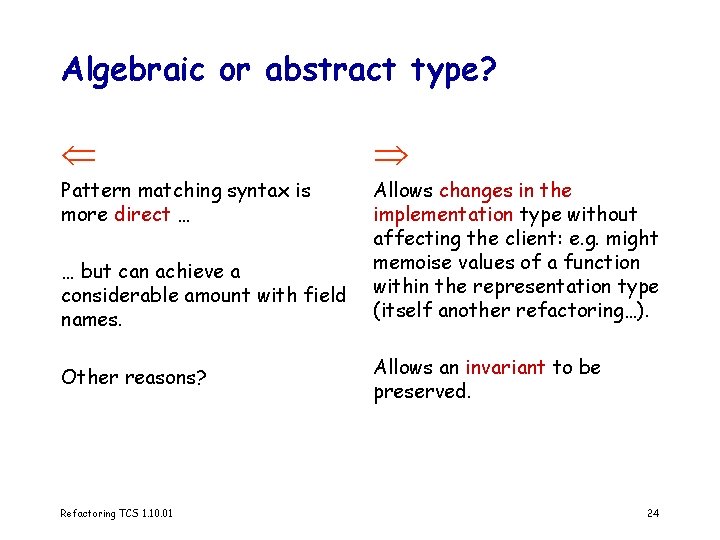
Algebraic or abstract type? Pattern matching syntax is more direct … Allows changes in the implementation type without affecting the client: e. g. might memoise values of a function within the representation type (itself another refactoring…). … but can achieve a considerable amount with field names. Other reasons? Refactoring TCS 1. 10. 01 Allows an invariant to be preserved. 24
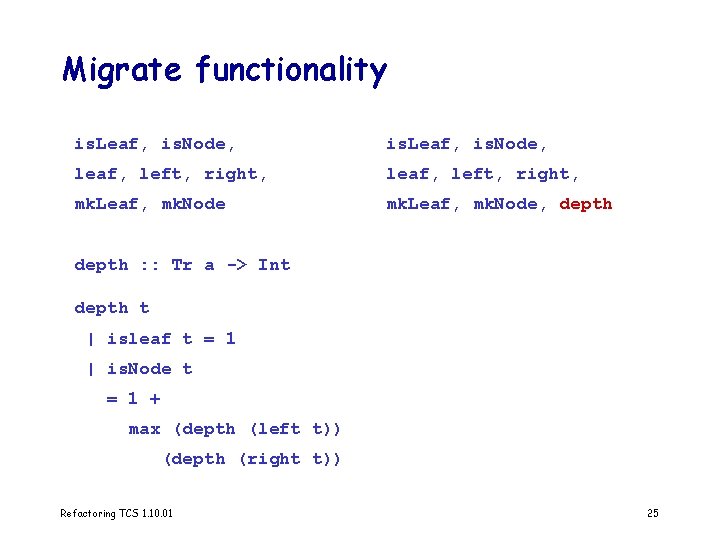
Migrate functionality is. Leaf, is. Node, leaf, left, right, mk. Leaf, mk. Node, depth : : Tr a -> Int depth t | isleaf t = 1 | is. Node t = 1 + max (depth (left t)) (depth (right t)) Refactoring TCS 1. 10. 01 25
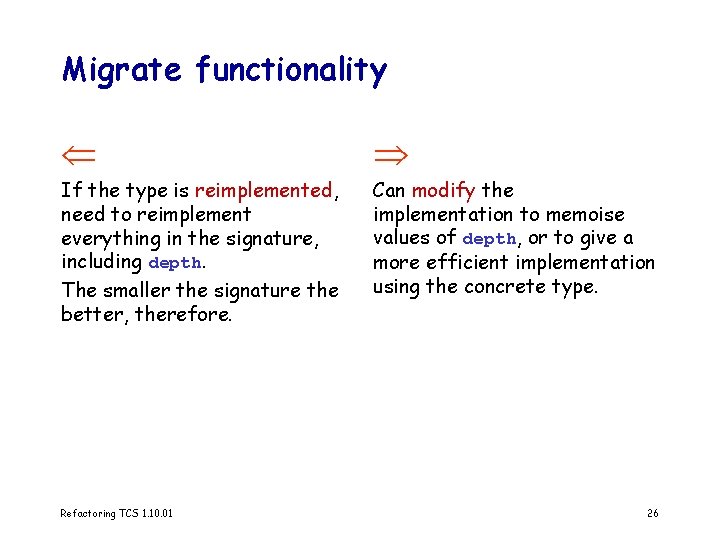
Migrate functionality If the type is reimplemented, need to reimplement everything in the signature, including depth. The smaller the signature the better, therefore. Can modify the implementation to memoise values of depth, or to give a more efficient implementation using the concrete type. Refactoring TCS 1. 10. 01 26
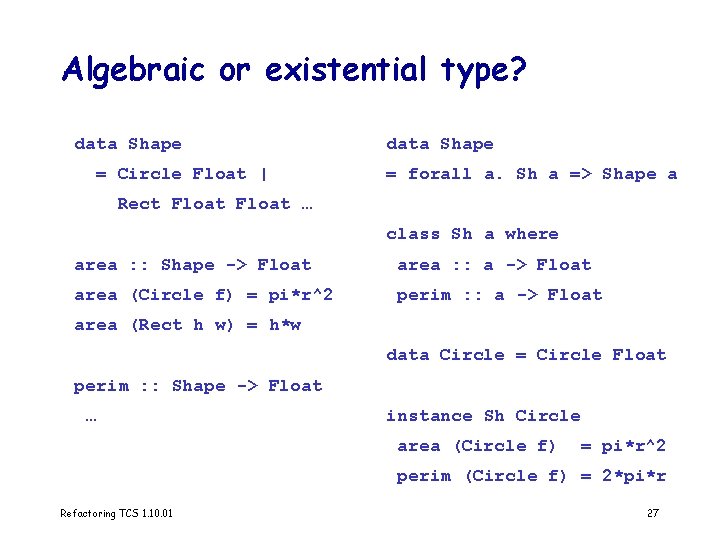
Algebraic or existential type? data Shape = Circle Float | data Shape = forall a. Sh a => Shape a Rect Float … class Sh a where area : : Shape -> Float area : : a -> Float area (Circle f) = pi*r^2 perim : : a -> Float area (Rect h w) = h*w data Circle = Circle Float perim : : Shape -> Float … instance Sh Circle area (Circle f) = pi*r^2 perim (Circle f) = 2*pi*r Refactoring TCS 1. 10. 01 27
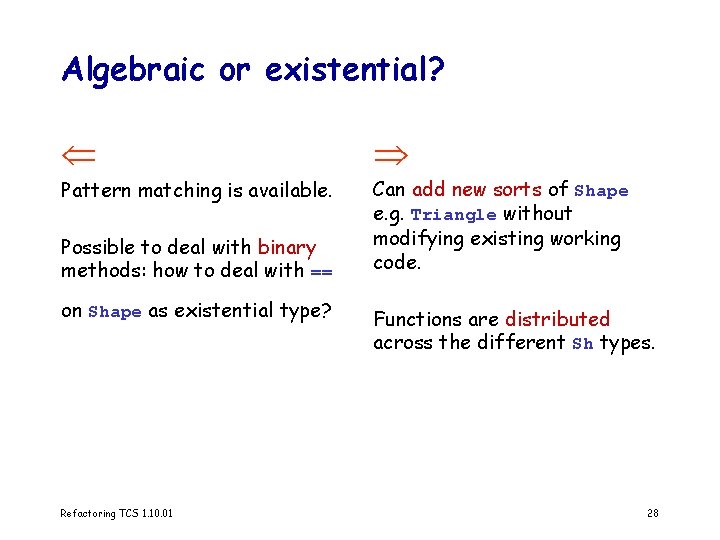
Algebraic or existential? Pattern matching is available. Can add new sorts of Shape e. g. Triangle without modifying existing working code. Possible to deal with binary methods: how to deal with == on Shape as existential type? Refactoring TCS 1. 10. 01 Functions are distributed across the different Sh types. 28
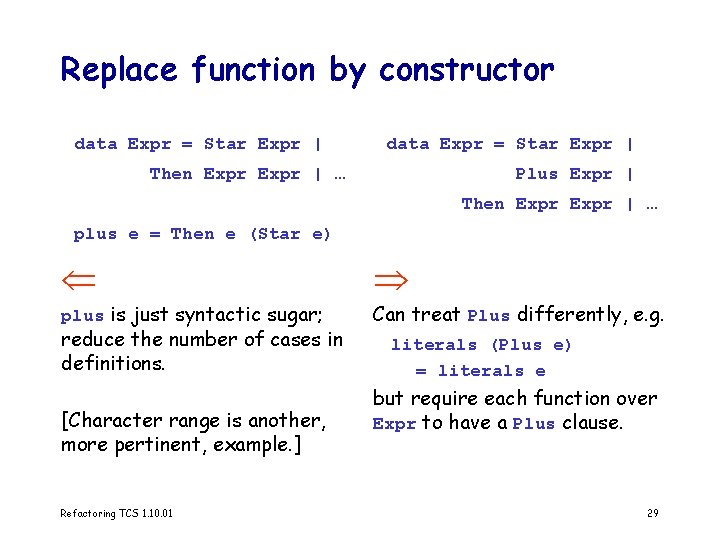
Replace function by constructor data Expr = Star Expr | Then Expr | … Plus Expr | Then Expr | … plus e = Then e (Star e) plus is just syntactic sugar; Can treat Plus differently, e. g. reduce the number of cases in definitions. [Character range is another, more pertinent, example. ] Refactoring TCS 1. 10. 01 literals (Plus e) = literals e but require each function over Expr to have a Plus clause. 29
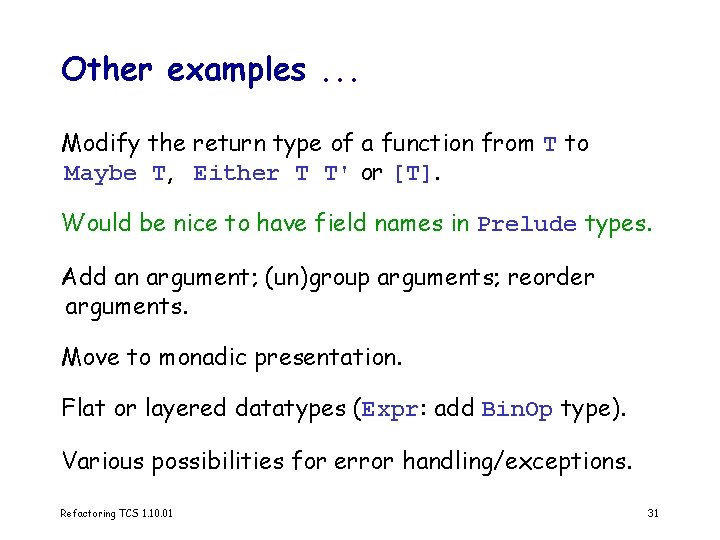
Other examples. . . Modify the return type of a function from T to Maybe T, Either T T' or [T]. Would be nice to have field names in Prelude types. Add an argument; (un)group arguments; reorder arguments. Move to monadic presentation. Flat or layered datatypes (Expr: add Bin. Op type). Various possibilities for error handling/exceptions. Refactoring TCS 1. 10. 01 31
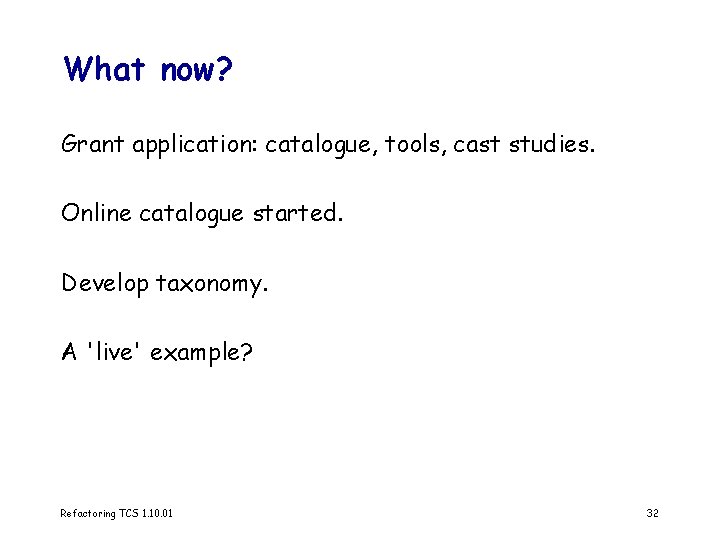
What now? Grant application: catalogue, tools, cast studies. Online catalogue started. Develop taxonomy. A 'live' example? Refactoring TCS 1. 10. 01 32
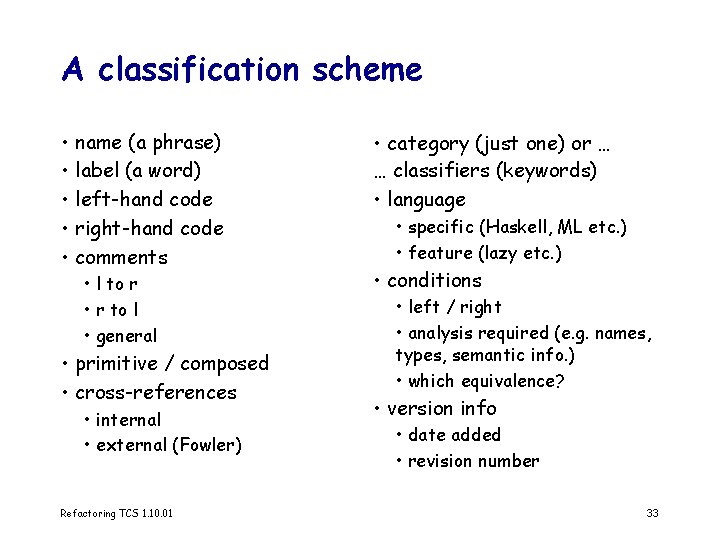
A classification scheme • name (a phrase) • label (a word) • left-hand code • right-hand code • comments • l to r • r to l • general • primitive / composed • cross-references • internal • external (Fowler) Refactoring TCS 1. 10. 01 • category (just one) or … … classifiers (keywords) • language • specific (Haskell, ML etc. ) • feature (lazy etc. ) • conditions • left / right • analysis required (e. g. names, types, semantic info. ) • which equivalence? • version info • date added • revision number 33
Case study: semantic tableaux Take a working semantic tableau system written by an anonymous 2 nd year student … … refactor as a way of understanding its behaviour. Nine stages of unequal size. Reflections afterwards. Refactoring TCS 1. 10. 01 34
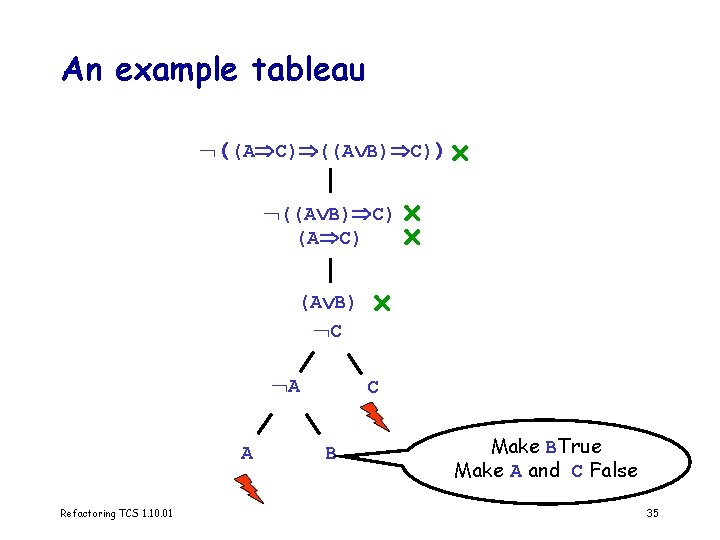
An example tableau ((A C) ((A B) C)) ((A B) C) (A B) C A A Refactoring TCS 1. 10. 01 C B Make BTrue Make A and C False 35
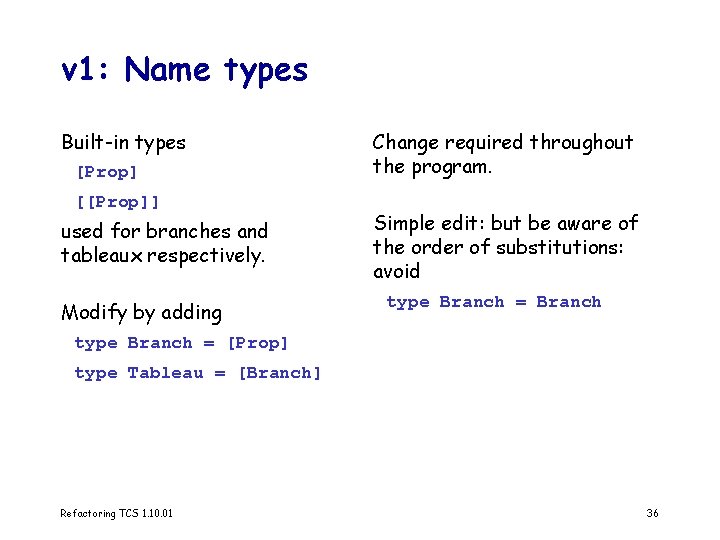
v 1: Name types Built-in types [Prop] [[Prop]] used for branches and tableaux respectively. Modify by adding Change required throughout the program. Simple edit: but be aware of the order of substitutions: avoid type Branch = Branch type Branch = [Prop] type Tableau = [Branch] Refactoring TCS 1. 10. 01 36
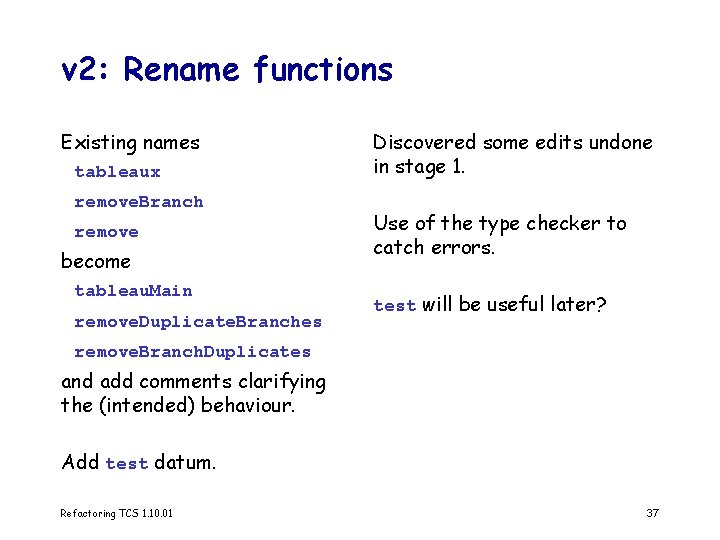
v 2: Rename functions Existing names tableaux remove. Branch remove become tableau. Main remove. Duplicate. Branches Discovered some edits undone in stage 1. Use of the type checker to catch errors. test will be useful later? remove. Branch. Duplicates and add comments clarifying the (intended) behaviour. Add test datum. Refactoring TCS 1. 10. 01 37
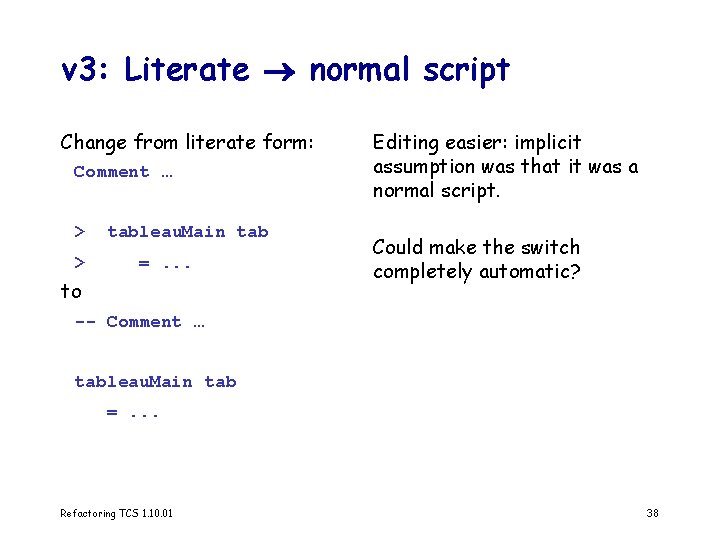
v 3: Literate normal script Change from literate form: Comment … > > tableau. Main tab =. . . to Editing easier: implicit assumption was that it was a normal script. Could make the switch completely automatic? -- Comment … tableau. Main tab =. . . Refactoring TCS 1. 10. 01 38
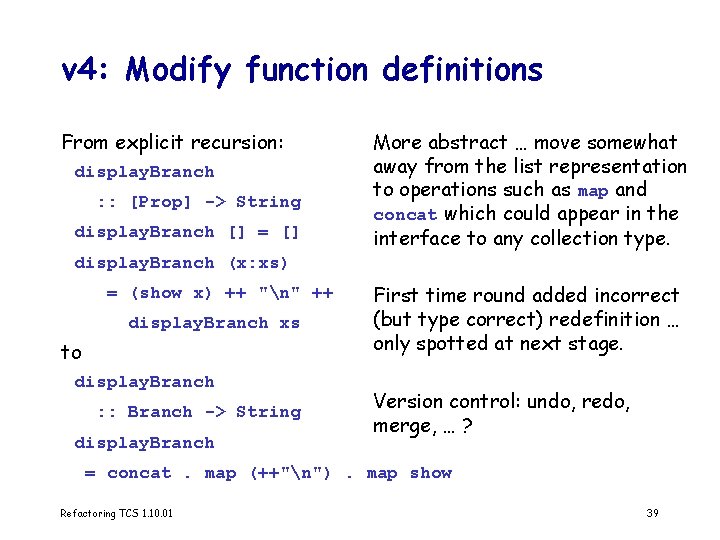
v 4: Modify function definitions From explicit recursion: display. Branch : : [Prop] -> String display. Branch [] = [] More abstract … move somewhat away from the list representation to operations such as map and concat which could appear in the interface to any collection type. display. Branch (x: xs) = (show x) ++ "n" ++ display. Branch xs to display. Branch : : Branch -> String display. Branch First time round added incorrect (but type correct) redefinition … only spotted at next stage. Version control: undo, redo, merge, … ? = concat. map (++"n"). map show Refactoring TCS 1. 10. 01 39
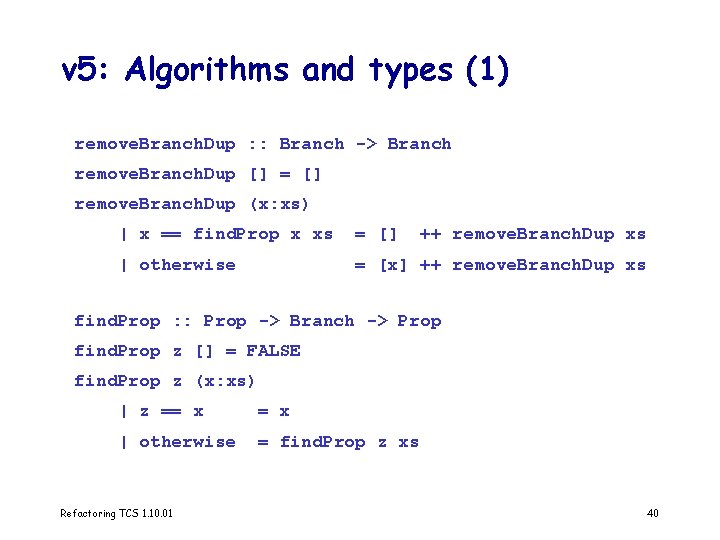
v 5: Algorithms and types (1) remove. Branch. Dup : : Branch -> Branch remove. Branch. Dup [] = [] remove. Branch. Dup (x: xs) | x == find. Prop x xs = [] ++ remove. Branch. Dup xs | otherwise = [x] ++ remove. Branch. Dup xs find. Prop : : Prop -> Branch -> Prop find. Prop z [] = FALSE find. Prop z (x: xs) | z == x | otherwise = find. Prop z xs Refactoring TCS 1. 10. 01 40
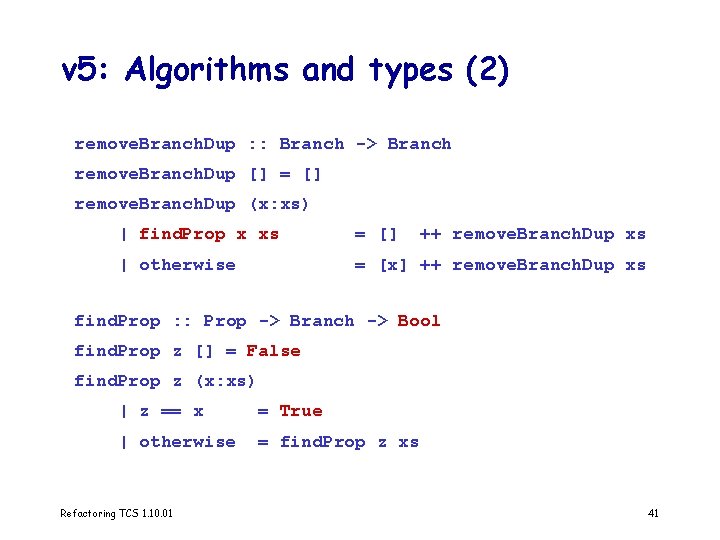
v 5: Algorithms and types (2) remove. Branch. Dup : : Branch -> Branch remove. Branch. Dup [] = [] remove. Branch. Dup (x: xs) | find. Prop x xs = [] ++ remove. Branch. Dup xs | otherwise = [x] ++ remove. Branch. Dup xs find. Prop : : Prop -> Branch -> Bool find. Prop z [] = False find. Prop z (x: xs) | z == x = True | otherwise = find. Prop z xs Refactoring TCS 1. 10. 01 41
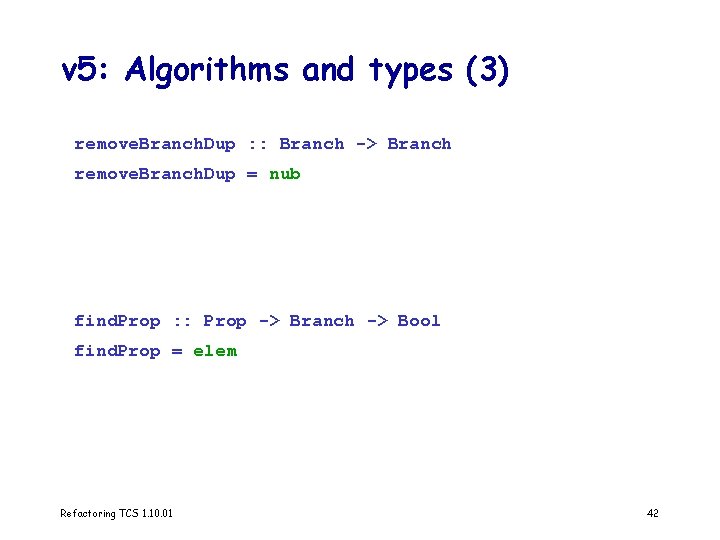
v 5: Algorithms and types (3) remove. Branch. Dup : : Branch -> Branch remove. Branch. Dup = nub find. Prop : : Prop -> Branch -> Bool find. Prop = elem Refactoring TCS 1. 10. 01 42
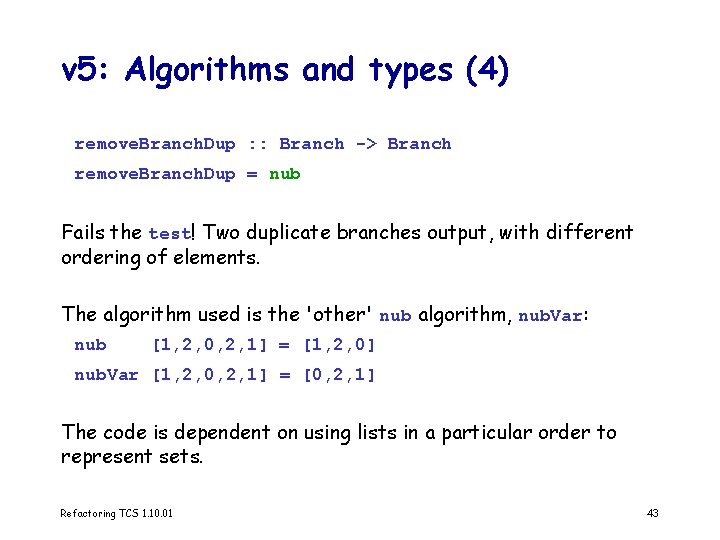
v 5: Algorithms and types (4) remove. Branch. Dup : : Branch -> Branch remove. Branch. Dup = nub Fails the test! Two duplicate branches output, with different ordering of elements. The algorithm used is the 'other' nub algorithm, nub. Var: nub [1, 2, 0, 2, 1] = [1, 2, 0] nub. Var [1, 2, 0, 2, 1] = [0, 2, 1] The code is dependent on using lists in a particular order to represent sets. Refactoring TCS 1. 10. 01 43
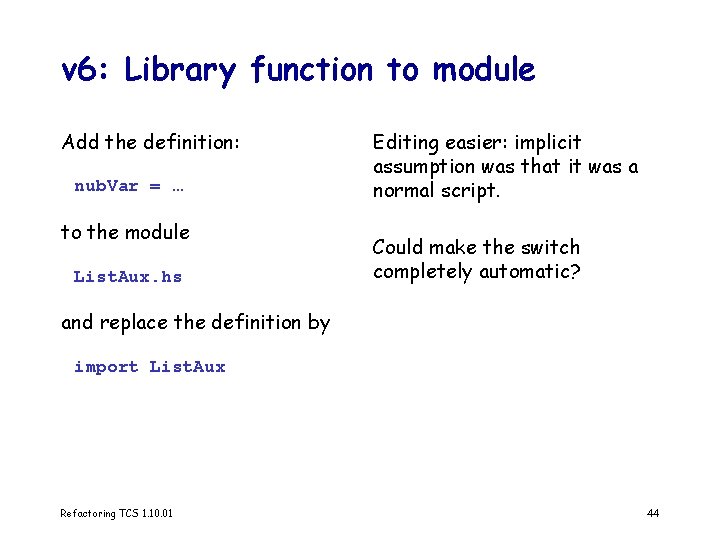
v 6: Library function to module Add the definition: nub. Var = … to the module List. Aux. hs Editing easier: implicit assumption was that it was a normal script. Could make the switch completely automatic? and replace the definition by import List. Aux Refactoring TCS 1. 10. 01 44
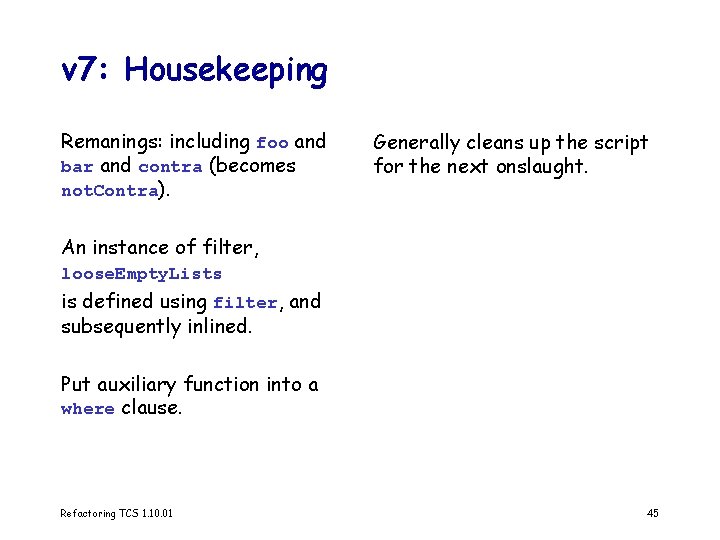
v 7: Housekeeping Remanings: including foo and bar and contra (becomes not. Contra). Generally cleans up the script for the next onslaught. An instance of filter, loose. Empty. Lists is defined using filter, and subsequently inlined. Put auxiliary function into a where clause. Refactoring TCS 1. 10. 01 45
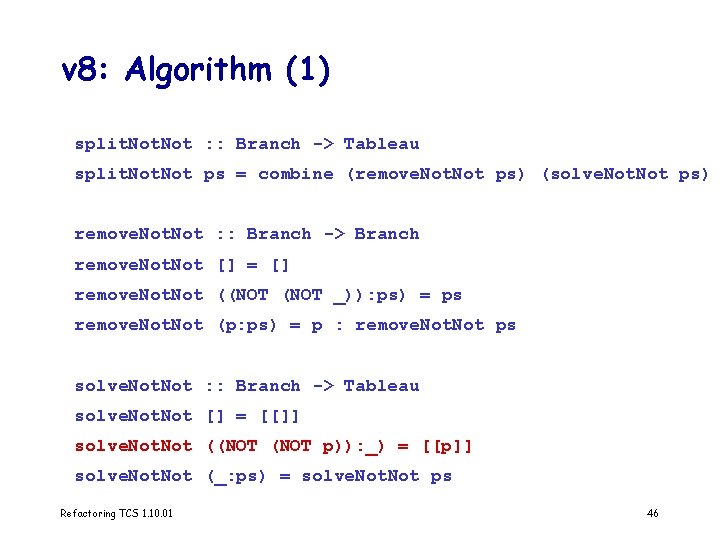
v 8: Algorithm (1) split. Not : : Branch -> Tableau split. Not ps = combine (remove. Not ps) (solve. Not ps) remove. Not : : Branch -> Branch remove. Not [] = [] remove. Not ((NOT _)): ps) = ps remove. Not (p: ps) = p : remove. Not ps solve. Not : : Branch -> Tableau solve. Not [] = [[]] solve. Not ((NOT p)): _) = [[p]] solve. Not (_: ps) = solve. Not ps Refactoring TCS 1. 10. 01 46
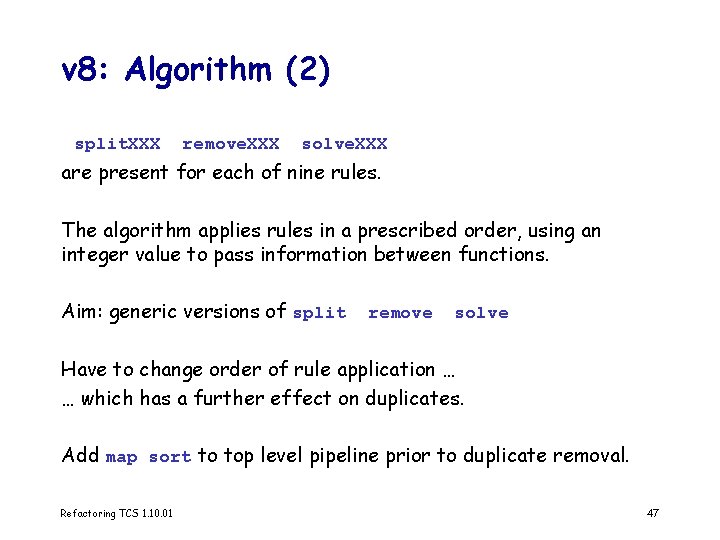
v 8: Algorithm (2) split. XXX remove. XXX solve. XXX are present for each of nine rules. The algorithm applies rules in a prescribed order, using an integer value to pass information between functions. Aim: generic versions of split remove solve Have to change order of rule application … … which has a further effect on duplicates. Add map sort to top level pipeline prior to duplicate removal. Refactoring TCS 1. 10. 01 47
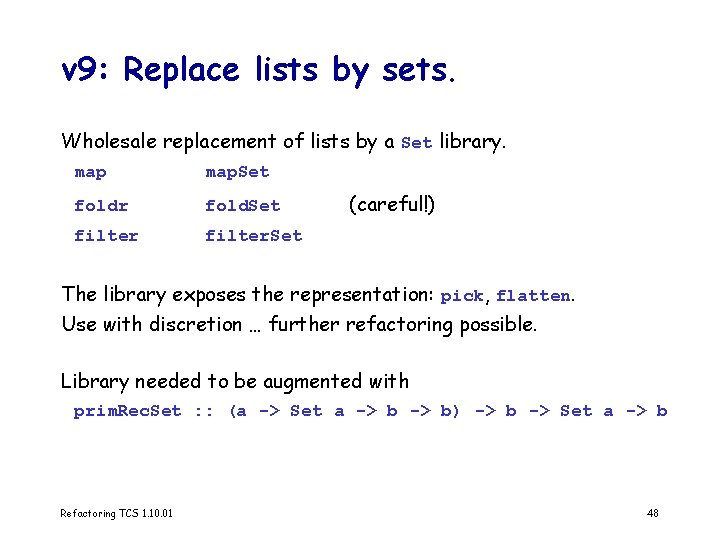
v 9: Replace lists by sets. Wholesale replacement of lists by a Set library. map. Set foldr fold. Set filter. Set (careful!) The library exposes the representation: pick, flatten. Use with discretion … further refactoring possible. Library needed to be augmented with prim. Rec. Set : : (a -> Set a -> b) -> b -> Set a -> b Refactoring TCS 1. 10. 01 48
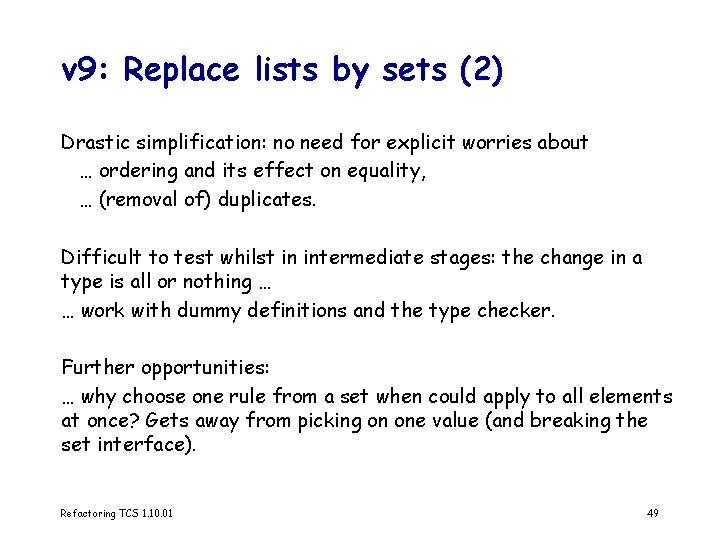
v 9: Replace lists by sets (2) Drastic simplification: no need for explicit worries about … ordering and its effect on equality, … (removal of) duplicates. Difficult to test whilst in intermediate stages: the change in a type is all or nothing … … work with dummy definitions and the type checker. Further opportunities: … why choose one rule from a set when could apply to all elements at once? Gets away from picking on one value (and breaking the set interface). Refactoring TCS 1. 10. 01 49
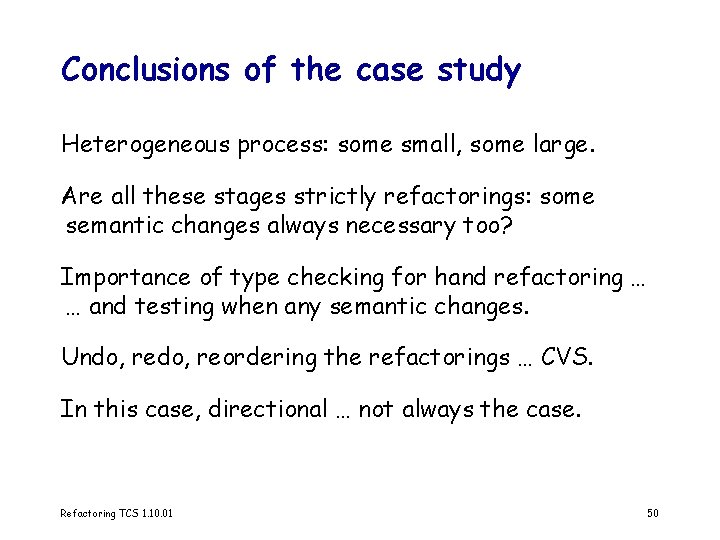
Conclusions of the case study Heterogeneous process: some small, some large. Are all these stages strictly refactorings: some semantic changes always necessary too? Importance of type checking for hand refactoring … … and testing when any semantic changes. Undo, reordering the refactorings … CVS. In this case, directional … not always the case. Refactoring TCS 1. 10. 01 50
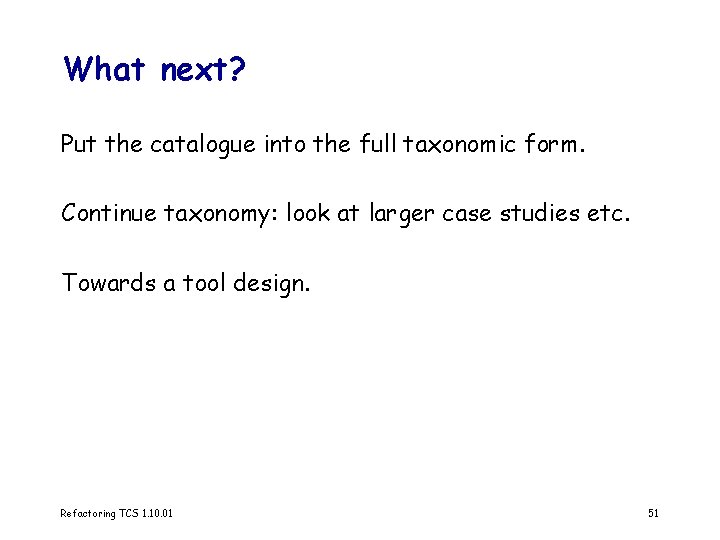
What next? Put the catalogue into the full taxonomic form. Continue taxonomy: look at larger case studies etc. Towards a tool design. Refactoring TCS 1. 10. 01 51