ECECS 757 Advanced Computer Architecture II Instructor Mikko


- Slides: 148
ECE/CS 757: Advanced Computer Architecture II Instructor: Mikko H Lipasti Spring 2017 University of Wisconsin-Madison Lecture notes based on slides created by John Shen, Mark Hill, David Wood, Guri Sohi, Jim Smith, Natalie Enright Jerger, Michel Dubois, Murali Annavaram, Per Stenström and probably others
Lecture 5 Outline • Main Memory and Cache Review • Caches and Replacement Policies • Cache Coherence – Coherence States – Snoopy bus-based Invalidate Protocols – Invalidate protocol optimizations – Update Protocols (Dragon/Firefly) – Directory protocols – Implementation issues Mikko Lipasti-University of Wisconsin 2
Main Memory • DRAM chips • Memory organization – Interleaving – Banking • Memory controller design Mikko Lipasti-University of Wisconsin 3
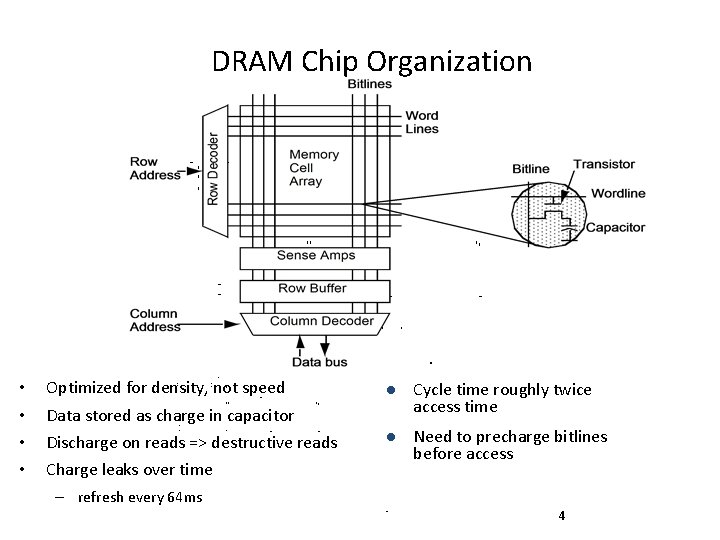
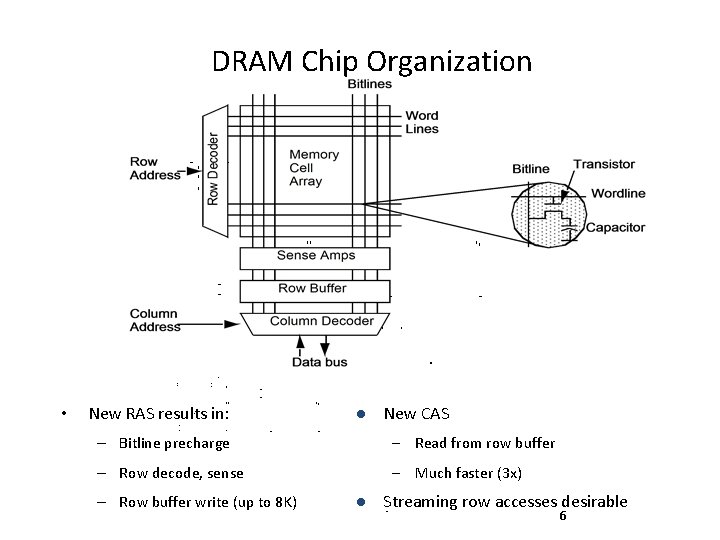
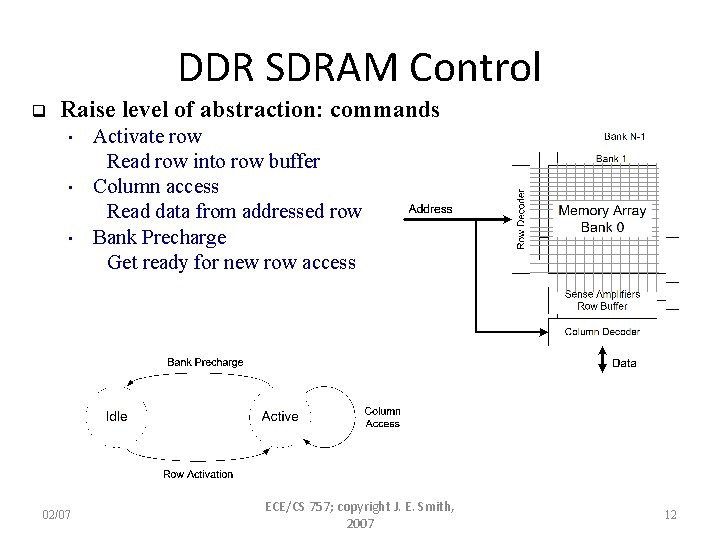
DRAM Chip Organization • • Optimized for density, not speed l Cycle time roughly twice access time l Need to precharge bitlines before access Data stored as charge in capacitor Discharge on reads => destructive reads Charge leaks over time – refresh every 64 ms 4
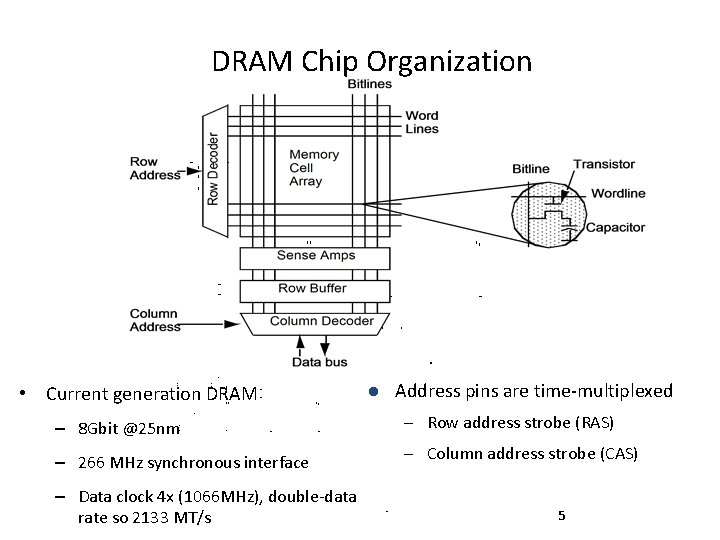
DRAM Chip Organization • Current generation DRAM l Address pins are time-multiplexed – 8 Gbit @25 nm – Row address strobe (RAS) – 266 MHz synchronous interface – Column address strobe (CAS) – Data clock 4 x (1066 MHz), double-data rate so 2133 MT/s 5
DRAM Chip Organization • New RAS results in: l New CAS – Bitline precharge – Read from row buffer – Row decode, sense – Much faster (3 x) – Row buffer write (up to 8 K) l Streaming row accesses desirable 6
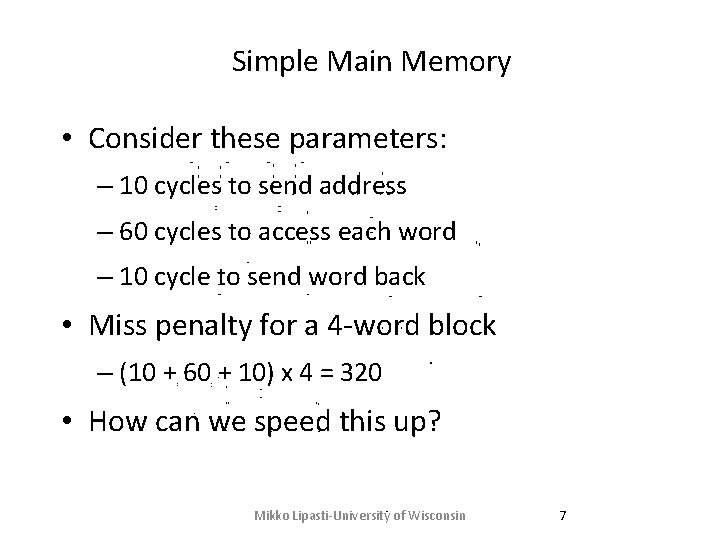
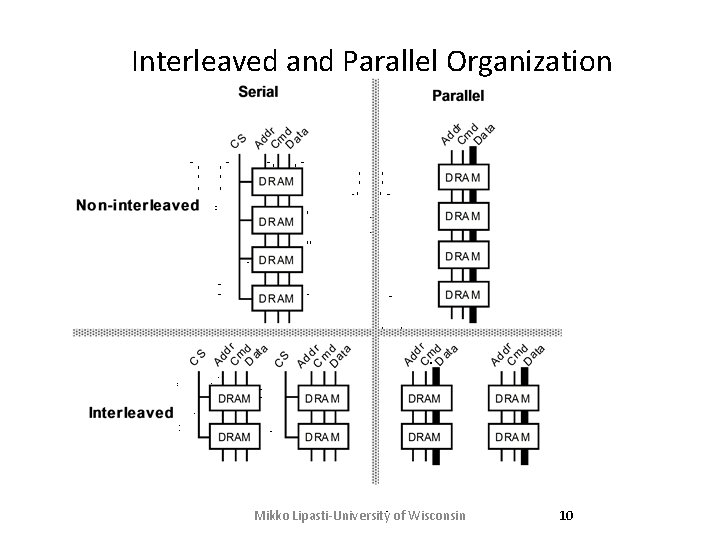
Simple Main Memory • Consider these parameters: – 10 cycles to send address – 60 cycles to access each word – 10 cycle to send word back • Miss penalty for a 4 -word block – (10 + 60 + 10) x 4 = 320 • How can we speed this up? Mikko Lipasti-University of Wisconsin 7
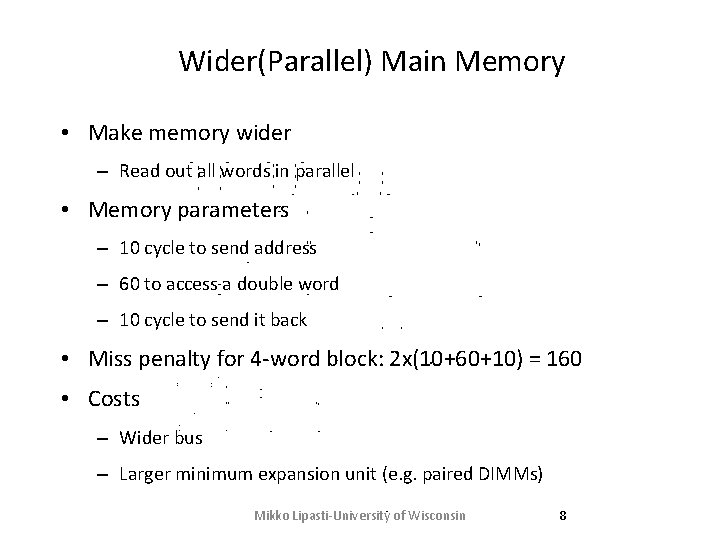
Wider(Parallel) Main Memory • Make memory wider – Read out all words in parallel • Memory parameters – 10 cycle to send address – 60 to access a double word – 10 cycle to send it back • Miss penalty for 4 -word block: 2 x(10+60+10) = 160 • Costs – Wider bus – Larger minimum expansion unit (e. g. paired DIMMs) Mikko Lipasti-University of Wisconsin 8
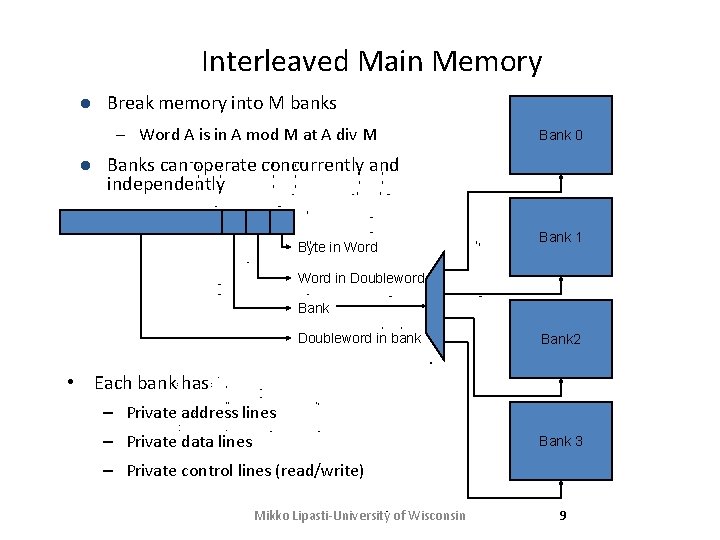
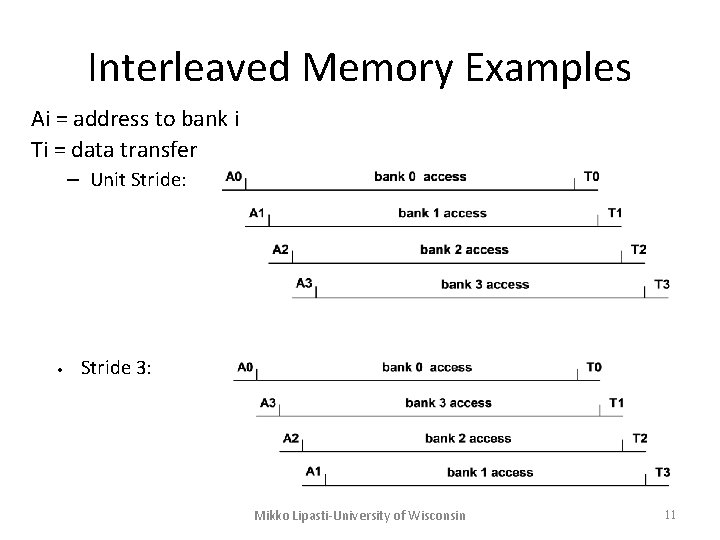
Interleaved Main Memory l Break memory into M banks – Word A is in A mod M at A div M l Bank 0 Banks can operate concurrently and independently Byte in Word Bank 1 Word in Doubleword Bank Doubleword in bank Bank 2 • Each bank has – Private address lines – Private data lines Bank 3 – Private control lines (read/write) Mikko Lipasti-University of Wisconsin 9
Interleaved and Parallel Organization Mikko Lipasti-University of Wisconsin 10
Interleaved Memory Examples Ai = address to bank i Ti = data transfer – Unit Stride: • Stride 3: Mikko Lipasti-University of Wisconsin 11
DDR SDRAM Control q Raise level of abstraction: commands • • • 02/07 Activate row Read row into row buffer Column access Read data from addressed row Bank Precharge Get ready for new row access ECE/CS 757; copyright J. E. Smith, 2007 12
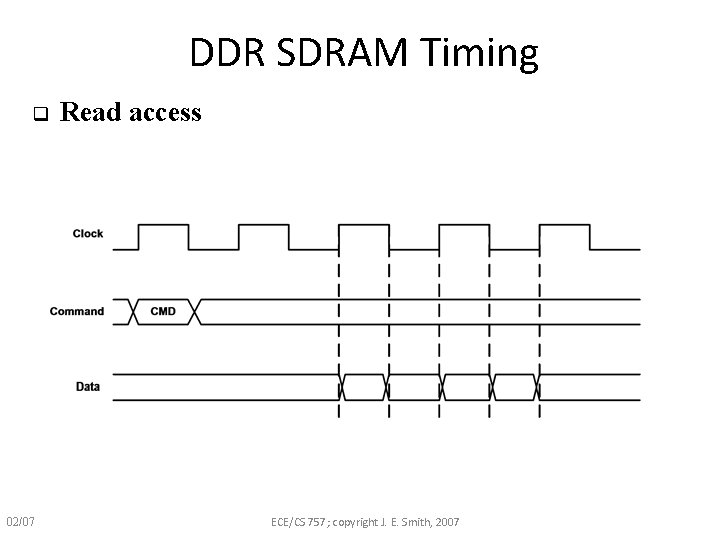
DDR SDRAM Timing q 02/07 Read access ECE/CS 757; copyright J. E. Smith, 2007
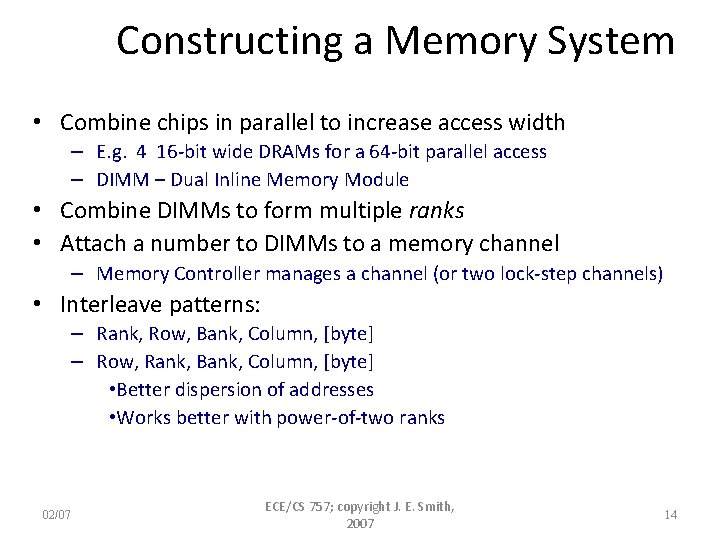
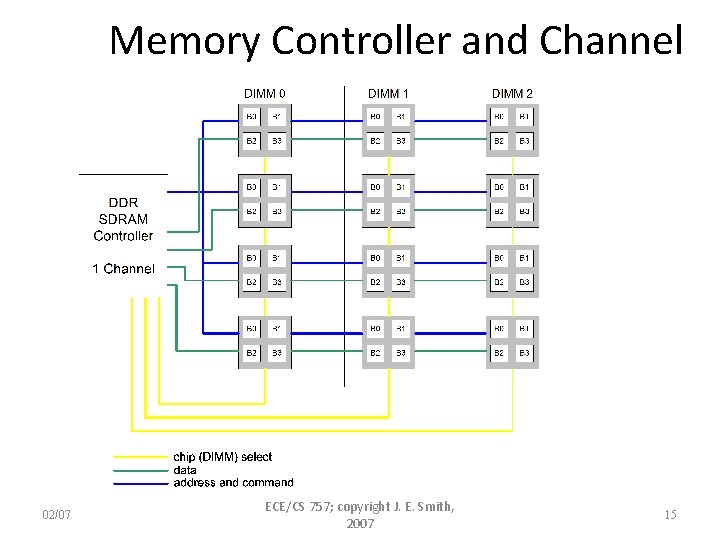
Constructing a Memory System • Combine chips in parallel to increase access width – E. g. 4 16 -bit wide DRAMs for a 64 -bit parallel access – DIMM – Dual Inline Memory Module • Combine DIMMs to form multiple ranks • Attach a number to DIMMs to a memory channel – Memory Controller manages a channel (or two lock-step channels) • Interleave patterns: – Rank, Row, Bank, Column, [byte] – Row, Rank, Bank, Column, [byte] • Better dispersion of addresses • Works better with power-of-two ranks 02/07 ECE/CS 757; copyright J. E. Smith, 2007 14
Memory Controller and Channel 02/07 ECE/CS 757; copyright J. E. Smith, 2007 15
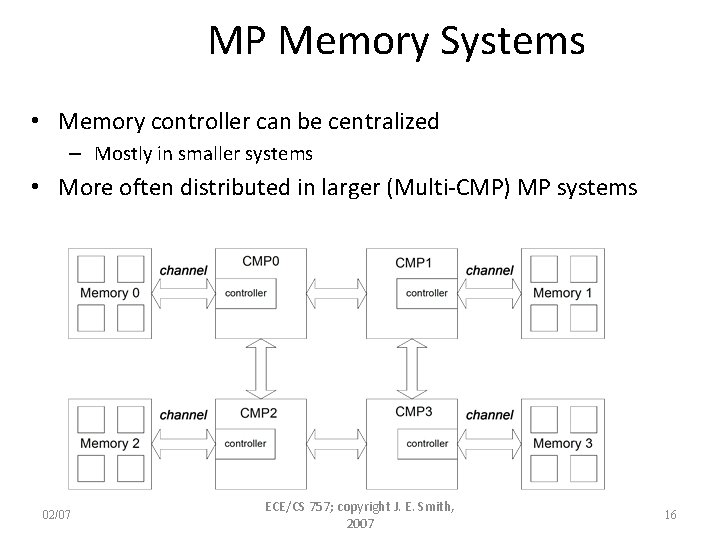
MP Memory Systems • Memory controller can be centralized – Mostly in smaller systems • More often distributed in larger (Multi-CMP) MP systems 02/07 ECE/CS 757; copyright J. E. Smith, 2007 16
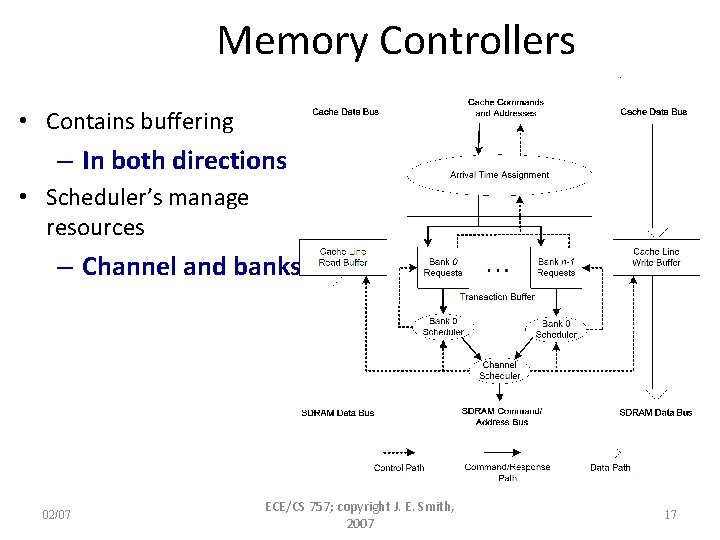
Memory Controllers • Contains buffering – In both directions • Scheduler’s manage resources – Channel and banks 02/07 ECE/CS 757; copyright J. E. Smith, 2007 17
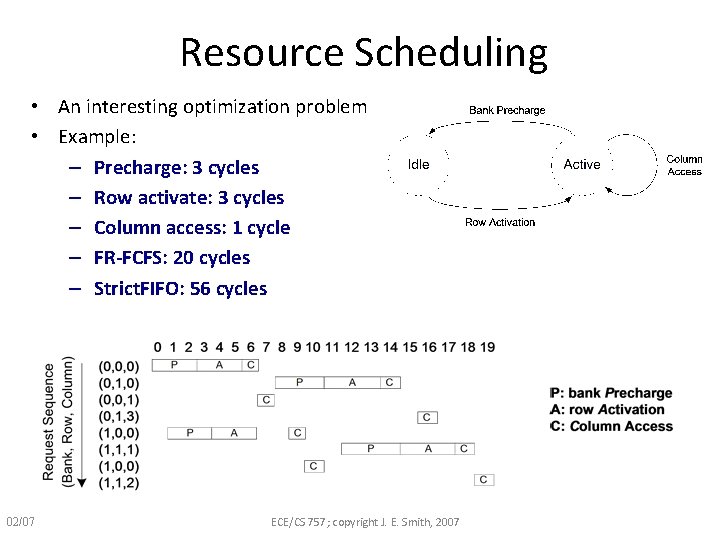
Resource Scheduling • An interesting optimization problem • Example: – Precharge: 3 cycles – Row activate: 3 cycles – Column access: 1 cycle – FR-FCFS: 20 cycles – Strict. FIFO: 56 cycles 02/07 ECE/CS 757; copyright J. E. Smith, 2007
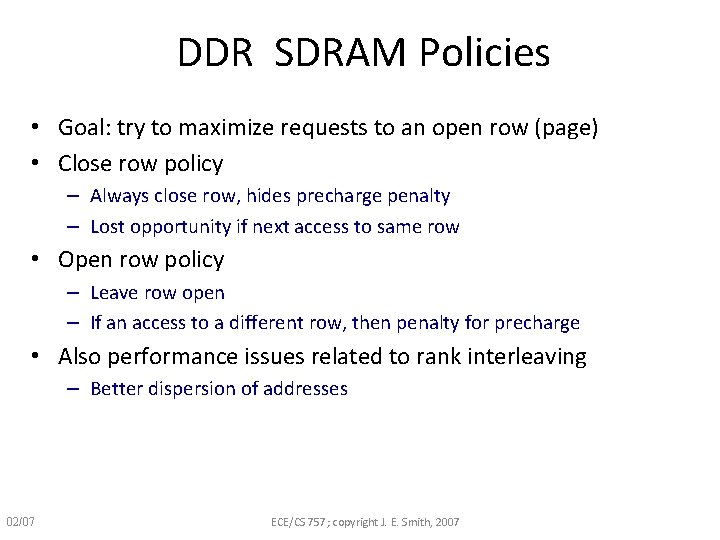
DDR SDRAM Policies • Goal: try to maximize requests to an open row (page) • Close row policy – Always close row, hides precharge penalty – Lost opportunity if next access to same row • Open row policy – Leave row open – If an access to a different row, then penalty for precharge • Also performance issues related to rank interleaving – Better dispersion of addresses 02/07 ECE/CS 757; copyright J. E. Smith, 2007
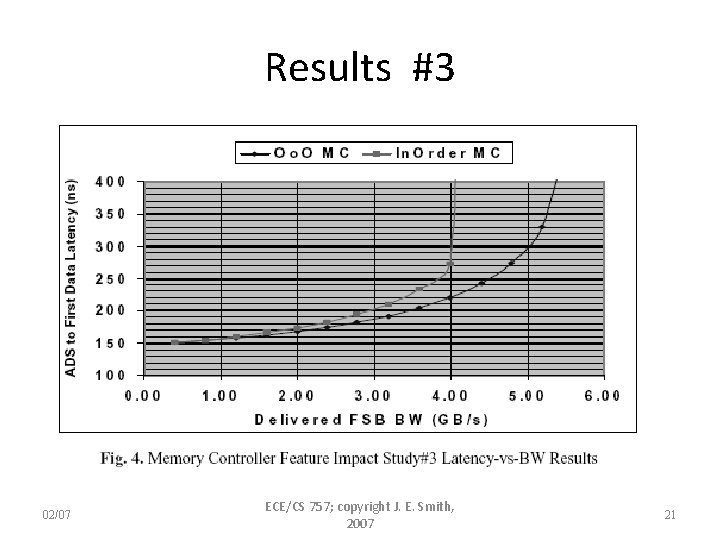
Study by Natarajan et al. [C. Natarajan, B. Christenson, and F. Briggs, “A Study of Performance Impact of Memory Controller Features in Multi-Processor Server Environment, ” Proc. of the 3 rd Workshop on Memory Perf. Issues, June 2004] • Intel Servers – IA-32 : In-order front-side bus to processor – IPF: Out-of-order front-side bus to processor • Use server Benchmarks • Open row (page) policy used in desktop systems – Performs poorly in Server systems • “Open-Policy 2 -0” works much better – Leave open only until there is an idle cycle for the bank; then close 02/07 ECE/CS 757; copyright J. E. Smith, 2007 20
Results #3 02/07 ECE/CS 757; copyright J. E. Smith, 2007 21
Memory Scheduling Contest http: //www. cs. utah. edu/~rajeev/jwac 12/ Clean, simple, infrastructure Traces provided Very easy to make fair comparisons Comes with 6 schedulers Also targets power-down modes (not just page open/close scheduling) • Three tracks: 1. Delay (or Performance), 2. Energy-Delay Product (EDP) 3. Performance-Fairness Product (PFP) • • •
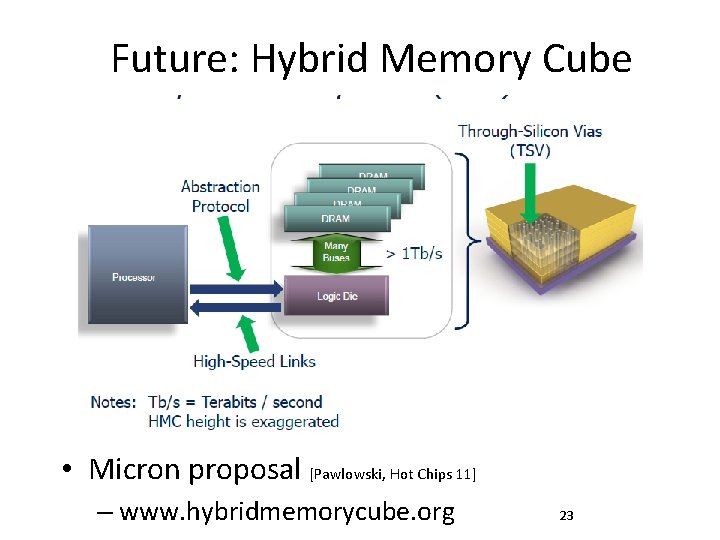
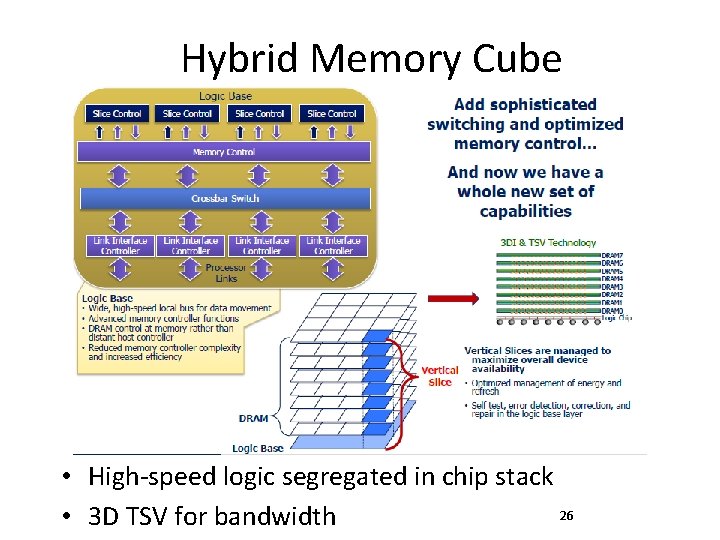
Future: Hybrid Memory Cube • Micron proposal [Pawlowski, Hot Chips 11] – www. hybridmemorycube. org 23
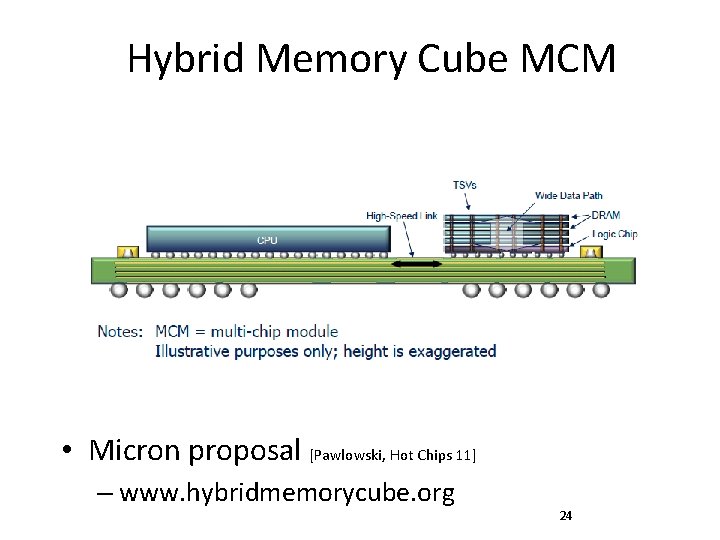
Hybrid Memory Cube MCM • Micron proposal [Pawlowski, Hot Chips 11] – www. hybridmemorycube. org 24
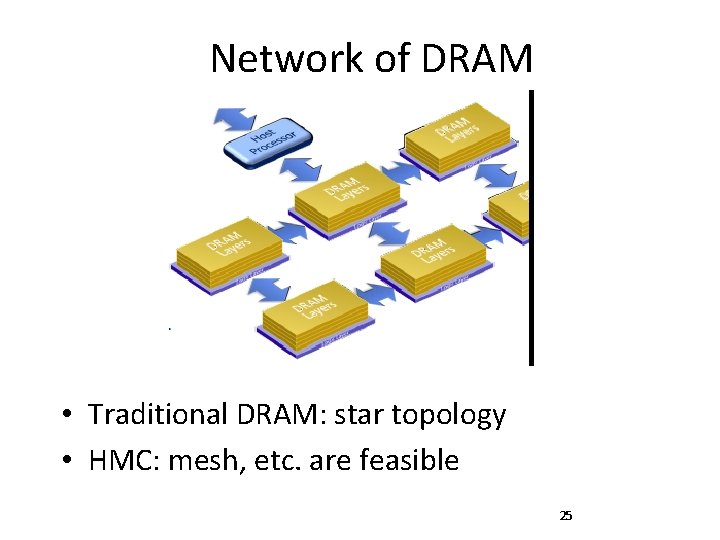
Network of DRAM • Traditional DRAM: star topology • HMC: mesh, etc. are feasible 25
Hybrid Memory Cube • High-speed logic segregated in chip stack 26 • 3 D TSV for bandwidth
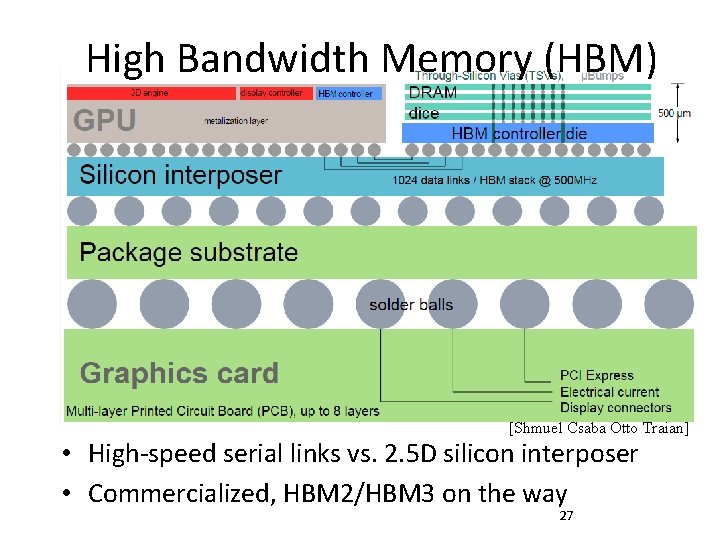
High Bandwidth Memory (HBM) [Shmuel Csaba Otto Traian] • High-speed serial links vs. 2. 5 D silicon interposer • Commercialized, HBM 2/HBM 3 on the way 27
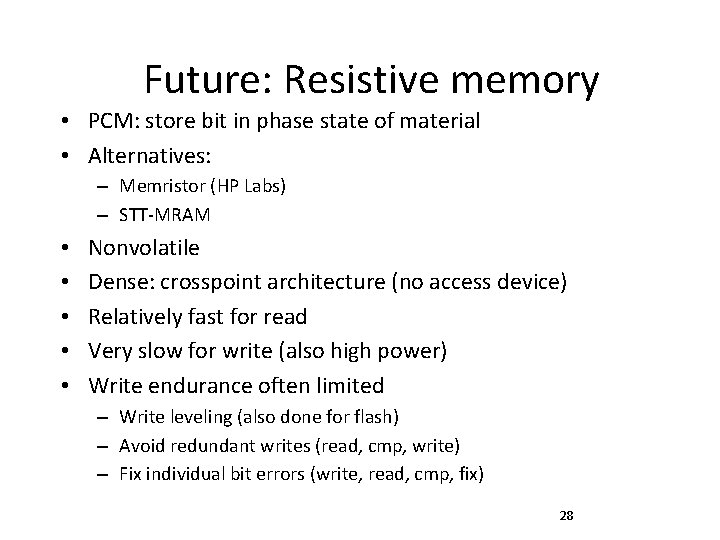
Future: Resistive memory • PCM: store bit in phase state of material • Alternatives: – Memristor (HP Labs) – STT-MRAM • • • Nonvolatile Dense: crosspoint architecture (no access device) Relatively fast for read Very slow for write (also high power) Write endurance often limited – Write leveling (also done for flash) – Avoid redundant writes (read, cmp, write) – Fix individual bit errors (write, read, cmp, fix) 28
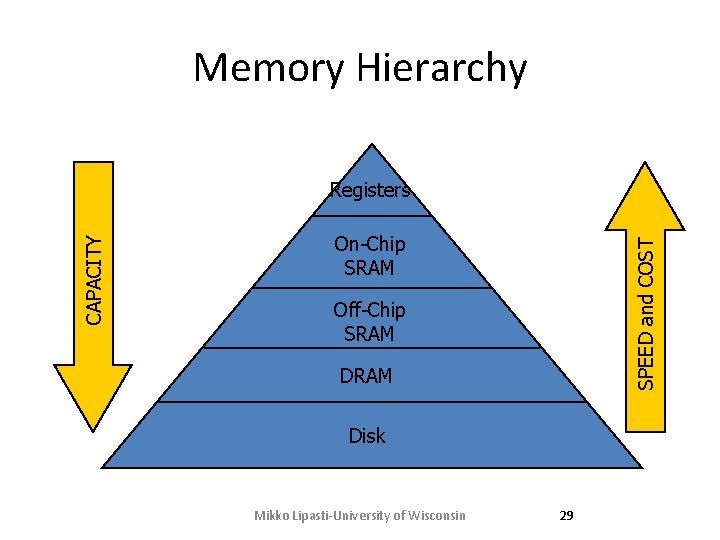
Memory Hierarchy On-Chip SRAM SPEED and COST CAPACITY Registers Off-Chip SRAM Disk Mikko Lipasti-University of Wisconsin 29
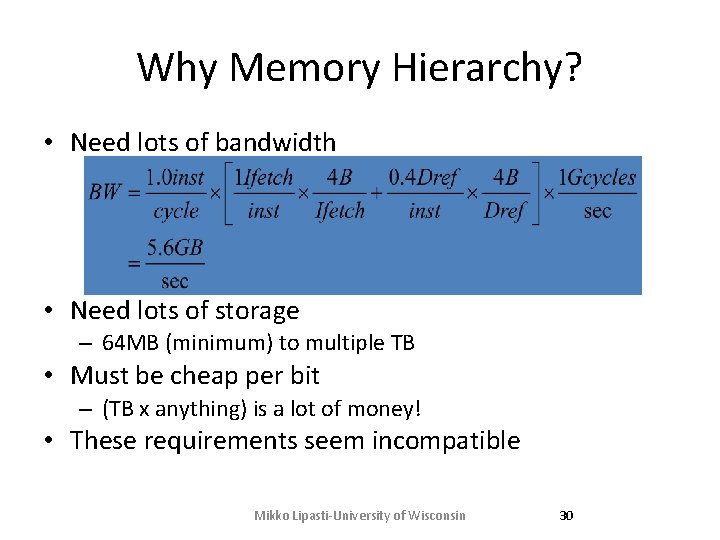
Why Memory Hierarchy? • Need lots of bandwidth • Need lots of storage – 64 MB (minimum) to multiple TB • Must be cheap per bit – (TB x anything) is a lot of money! • These requirements seem incompatible Mikko Lipasti-University of Wisconsin 30
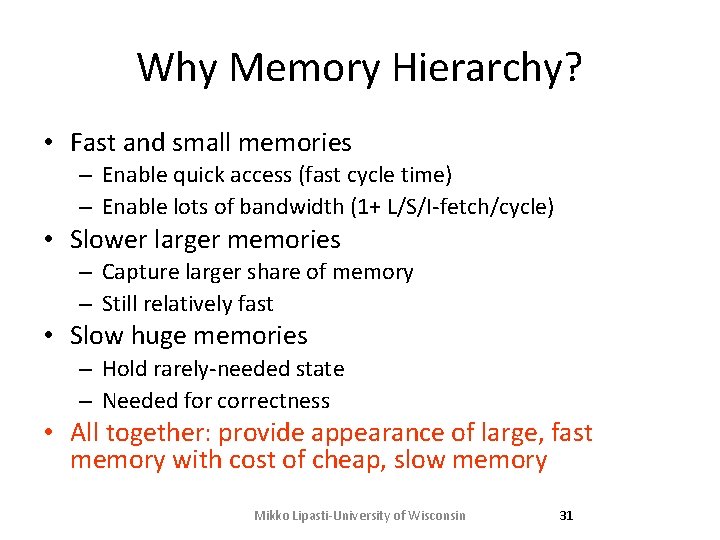
Why Memory Hierarchy? • Fast and small memories – Enable quick access (fast cycle time) – Enable lots of bandwidth (1+ L/S/I-fetch/cycle) • Slower larger memories – Capture larger share of memory – Still relatively fast • Slow huge memories – Hold rarely-needed state – Needed for correctness • All together: provide appearance of large, fast memory with cost of cheap, slow memory Mikko Lipasti-University of Wisconsin 31
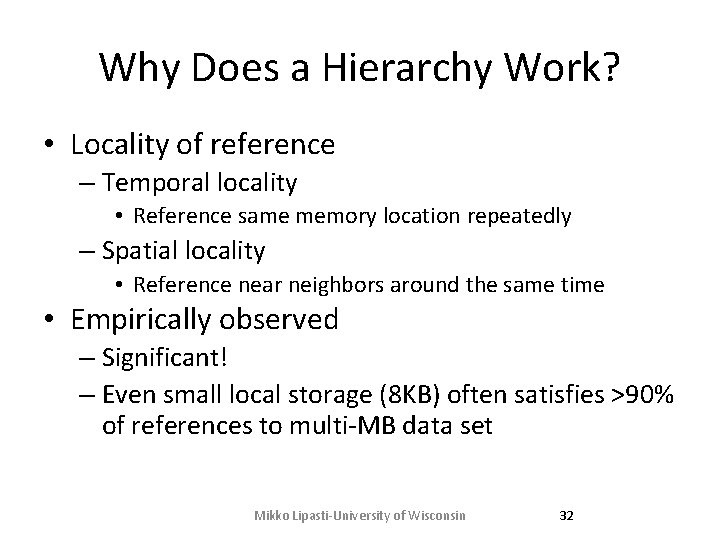
Why Does a Hierarchy Work? • Locality of reference – Temporal locality • Reference same memory location repeatedly – Spatial locality • Reference near neighbors around the same time • Empirically observed – Significant! – Even small local storage (8 KB) often satisfies >90% of references to multi-MB data set Mikko Lipasti-University of Wisconsin 32
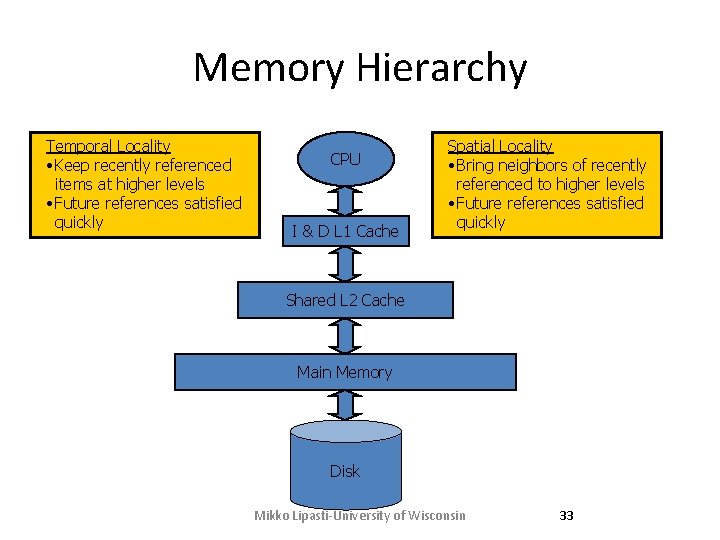
Memory Hierarchy Temporal Locality • Keep recently referenced items at higher levels • Future references satisfied quickly CPU I & D L 1 Cache Spatial Locality • Bring neighbors of recently referenced to higher levels • Future references satisfied quickly Shared L 2 Cache Main Memory Disk Mikko Lipasti-University of Wisconsin 33
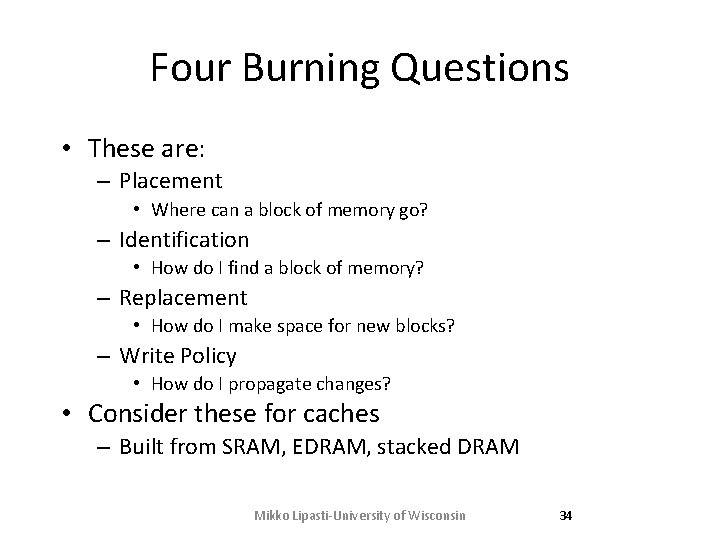
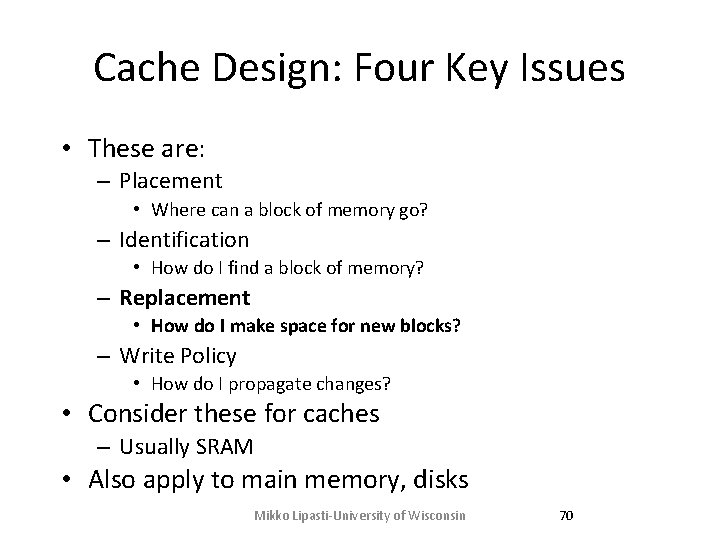
Four Burning Questions • These are: – Placement • Where can a block of memory go? – Identification • How do I find a block of memory? – Replacement • How do I make space for new blocks? – Write Policy • How do I propagate changes? • Consider these for caches – Built from SRAM, EDRAM, stacked DRAM Mikko Lipasti-University of Wisconsin 34
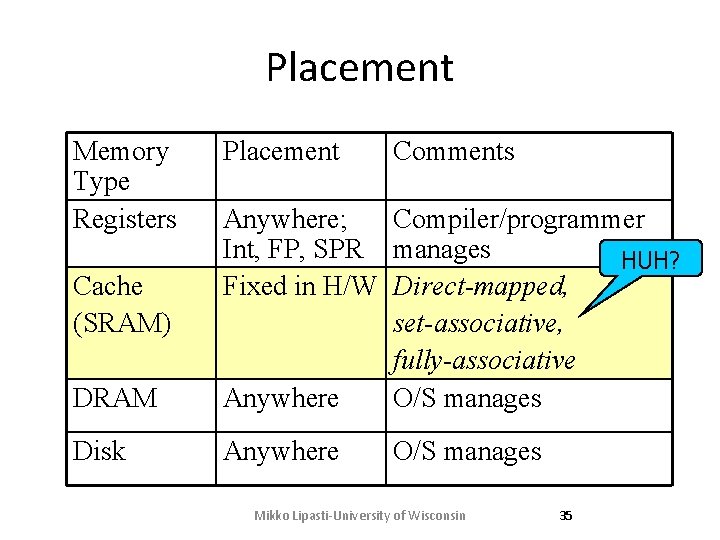
Placement Memory Type Registers Placement Comments DRAM Anywhere; Compiler/programmer Int, FP, SPR manages HUH? Fixed in H/W Direct-mapped, set-associative, fully-associative Anywhere O/S manages Disk Anywhere Cache (SRAM) O/S manages Mikko Lipasti-University of Wisconsin 35
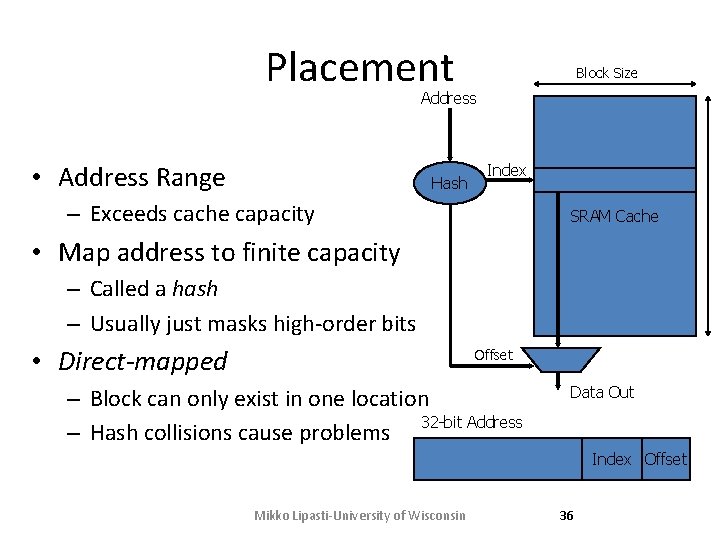
Placement Block Size Address • Address Range Hash Index – Exceeds cache capacity SRAM Cache • Map address to finite capacity – Called a hash – Usually just masks high-order bits • Direct-mapped Offset – Block can only exist in one location 32 -bit Address – Hash collisions cause problems Data Out Index Offset Mikko Lipasti-University of Wisconsin 36
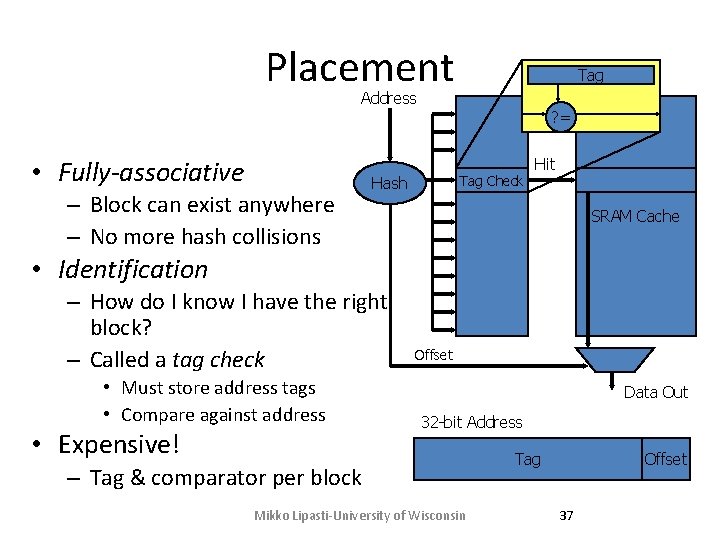
Placement Tag Address ? = • Fully-associative – Block can exist anywhere – No more hash collisions Tag Check Hash Hit SRAM Cache • Identification – How do I know I have the right block? – Called a tag check • Must store address tags • Compare against address • Expensive! Offset Data Out 32 -bit Address – Tag & comparator per block Mikko Lipasti-University of Wisconsin Tag Offset 37
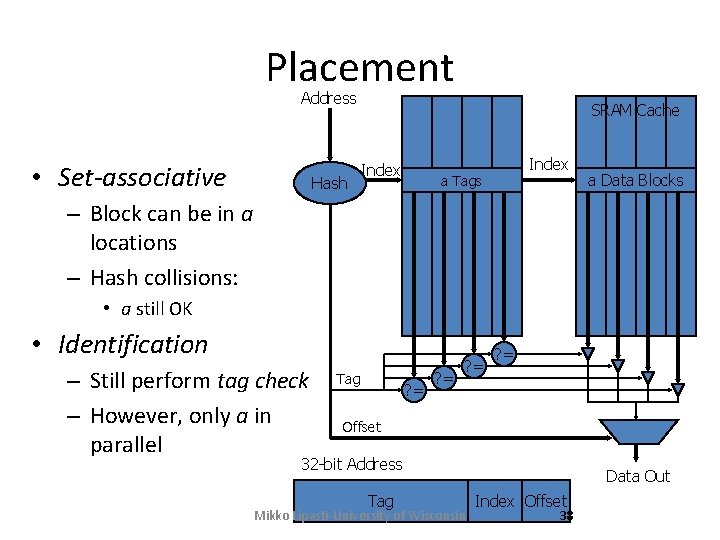
Placement Address • Set-associative Hash SRAM Cache Index a Tags a Data Blocks – Block can be in a locations – Hash collisions: • a still OK • Identification – Still perform tag check – However, only a in parallel Tag ? = ? = Offset 32 -bit Address Tag Mikko Lipasti-University of Wisconsin Data Out Index Offset 38
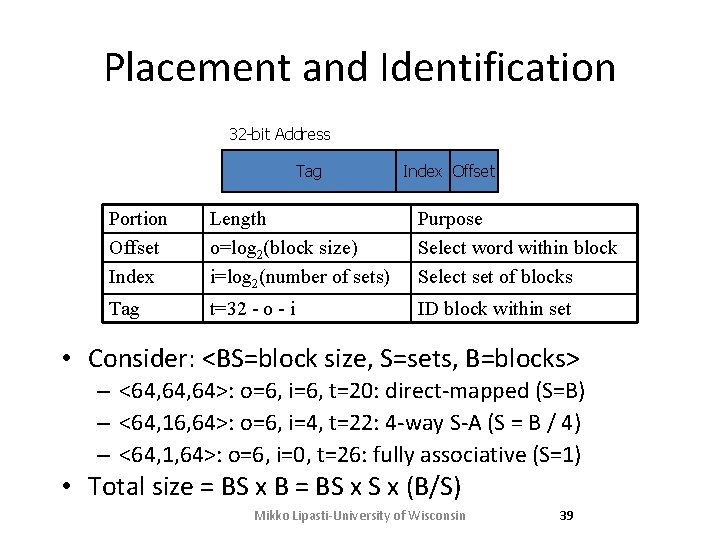
Placement and Identification 32 -bit Address Tag Index Offset Portion Offset Index Length o=log 2(block size) i=log 2(number of sets) Purpose Select word within block Select set of blocks Tag t=32 - o - i ID block within set • Consider: <BS=block size, S=sets, B=blocks> – <64, 64>: o=6, i=6, t=20: direct-mapped (S=B) – <64, 16, 64>: o=6, i=4, t=22: 4 -way S-A (S = B / 4) – <64, 1, 64>: o=6, i=0, t=26: fully associative (S=1) • Total size = BS x B = BS x (B/S) Mikko Lipasti-University of Wisconsin 39
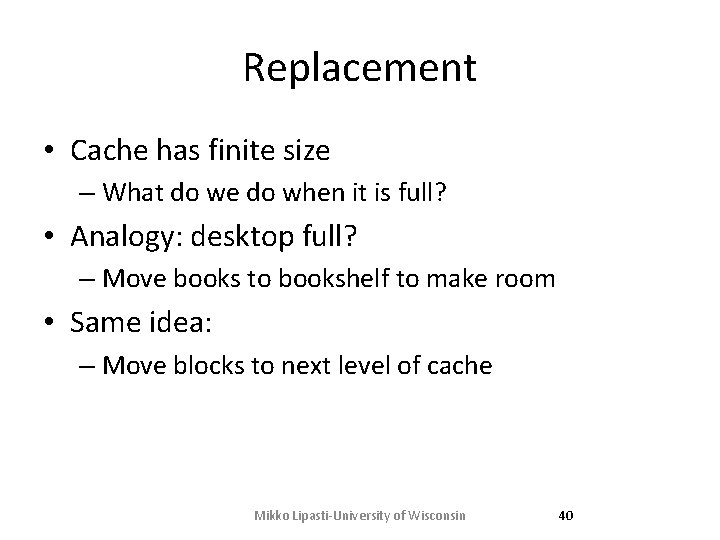
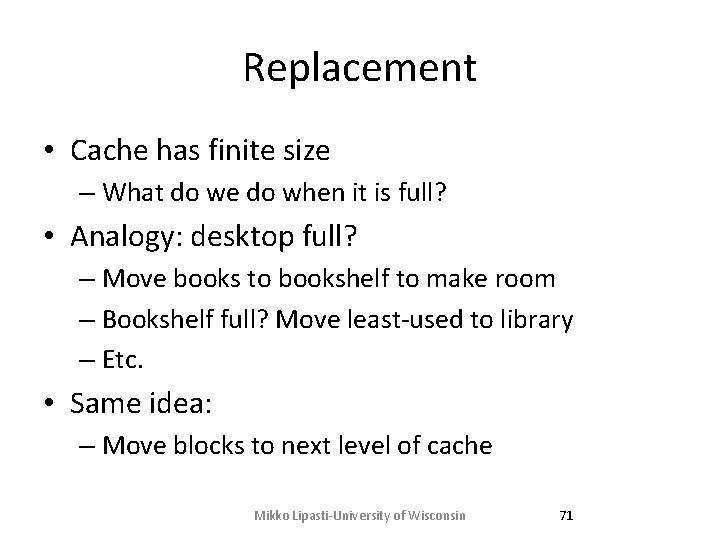
Replacement • Cache has finite size – What do we do when it is full? • Analogy: desktop full? – Move books to bookshelf to make room • Same idea: – Move blocks to next level of cache Mikko Lipasti-University of Wisconsin 40
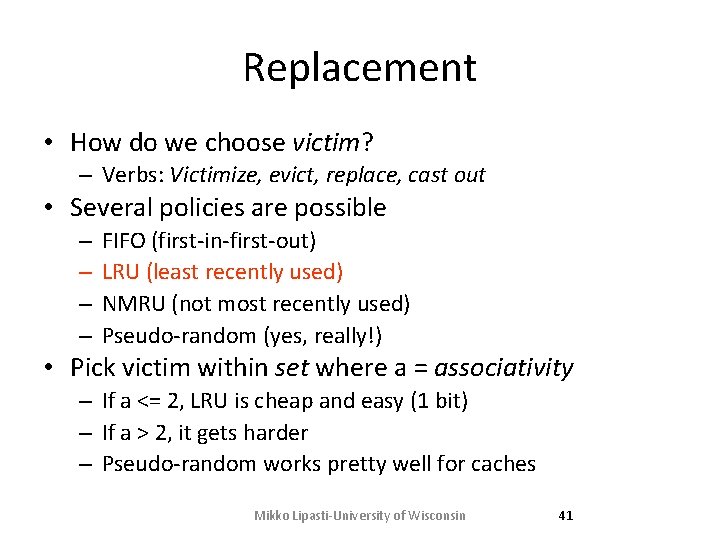
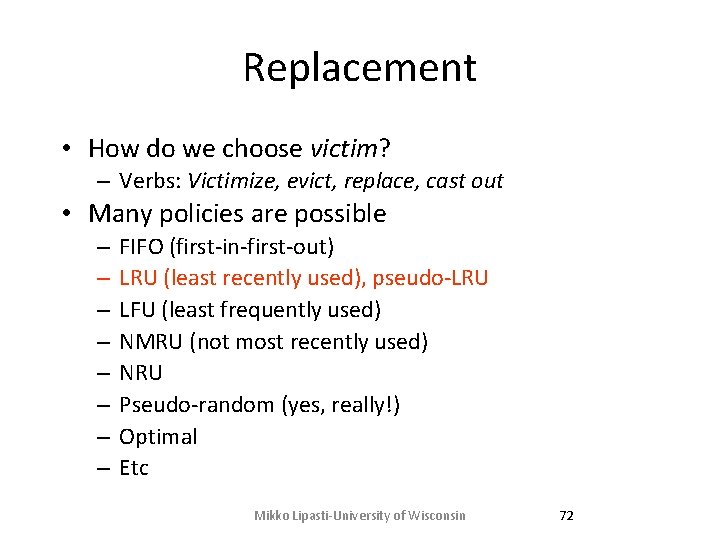
Replacement • How do we choose victim? – Verbs: Victimize, evict, replace, cast out • Several policies are possible – – FIFO (first-in-first-out) LRU (least recently used) NMRU (not most recently used) Pseudo-random (yes, really!) • Pick victim within set where a = associativity – If a <= 2, LRU is cheap and easy (1 bit) – If a > 2, it gets harder – Pseudo-random works pretty well for caches Mikko Lipasti-University of Wisconsin 41
Write Policy • Memory hierarchy – 2 or more copies of same block • Main memory and/or disk • Caches • What to do on a write? – Eventually, all copies must be changed – Write must propagate to all levels • And other processor’s caches (later) Mikko Lipasti-University of Wisconsin 42
Write Policy • Easiest policy: write-through • Every write propagates directly through hierarchy – Write in L 1, L 2, memory, disk (? !? ) • Why is this a bad idea? – Very high bandwidth requirement – Remember, large memories are slow • Popular in real systems only to the L 2 – Every write updates L 1 and L 2 – Beyond L 2, use write-back policy Mikko Lipasti-University of Wisconsin 43
Write Policy • Most widely used: write-back • Maintain state of each line in a cache – Invalid – not present in the cache – Clean – present, but not written (unmodified) – Dirty – present and written (modified) • Store state in tag array, next to address tag – Mark dirty bit on a write • On eviction, check dirty bit – If set, write back dirty line to next level – Called a writeback or castout Mikko Lipasti-University of Wisconsin 44
Write Policy • Complications of write-back policy – Stale copies lower in the hierarchy – Must always check higher level for dirty copies before accessing copy in a lower level • Not a big problem in uniprocessors – In multiprocessors: the cache coherence problem • I/O devices that use DMA (direct memory access) can cause problems even in uniprocessors – Called coherent I/O – Must check caches for dirty copies before reading main memory Mikko Lipasti-University of Wisconsin 45
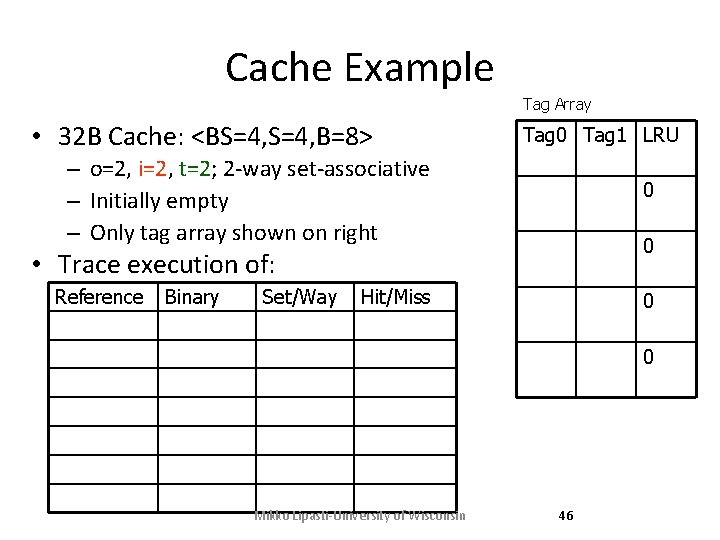
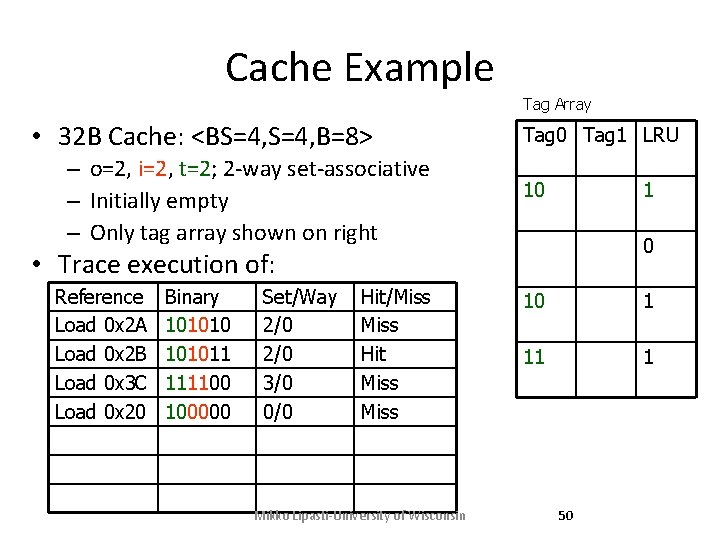
Cache Example Tag Array • 32 B Cache: <BS=4, B=8> Tag 0 Tag 1 LRU – o=2, i=2, t=2; 2 -way set-associative – Initially empty – Only tag array shown on right 0 0 • Trace execution of: Reference Binary Set/Way Hit/Miss 0 0 Mikko Lipasti-University of Wisconsin 46
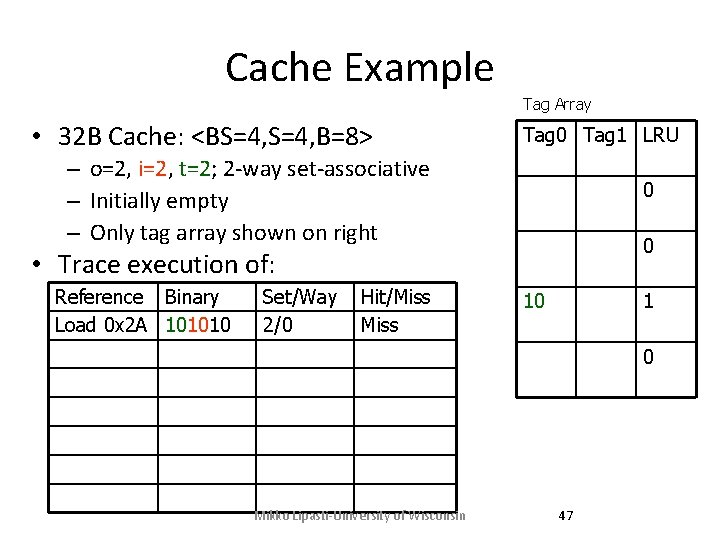
Cache Example Tag Array • 32 B Cache: <BS=4, B=8> Tag 0 Tag 1 LRU – o=2, i=2, t=2; 2 -way set-associative – Initially empty – Only tag array shown on right 0 0 • Trace execution of: Reference Binary Load 0 x 2 A 101010 Set/Way 2/0 Hit/Miss 10 1 0 Mikko Lipasti-University of Wisconsin 47
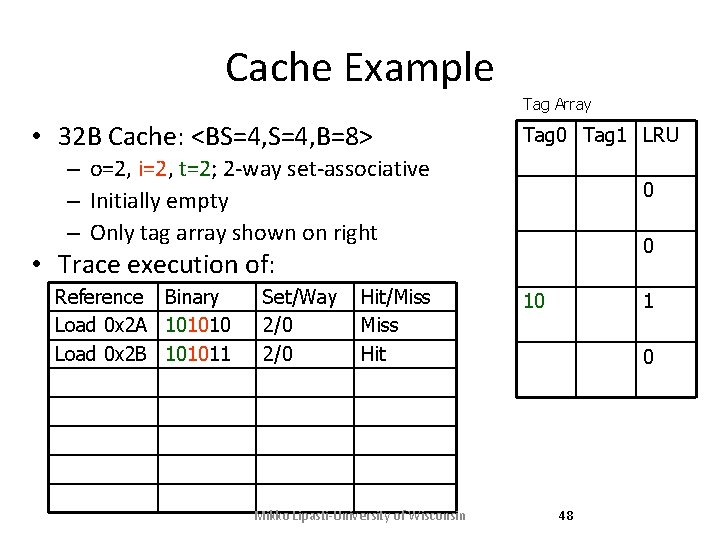
Cache Example Tag Array • 32 B Cache: <BS=4, B=8> Tag 0 Tag 1 LRU – o=2, i=2, t=2; 2 -way set-associative – Initially empty – Only tag array shown on right 0 0 • Trace execution of: Reference Binary Load 0 x 2 A 101010 Load 0 x 2 B 101011 Set/Way 2/0 Hit/Miss Hit Mikko Lipasti-University of Wisconsin 10 1 0 48
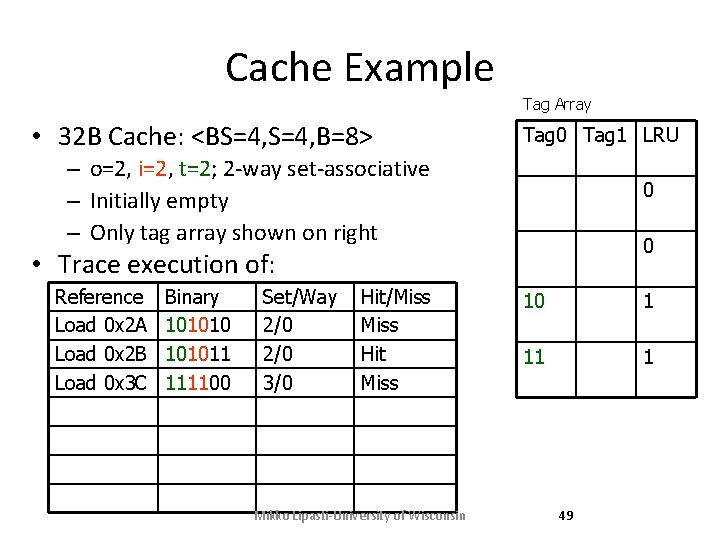
Cache Example Tag Array • 32 B Cache: <BS=4, B=8> Tag 0 Tag 1 LRU – o=2, i=2, t=2; 2 -way set-associative – Initially empty – Only tag array shown on right 0 0 • Trace execution of: Reference Load 0 x 2 A Load 0 x 2 B Load 0 x 3 C Binary 10101011 111100 Set/Way 2/0 3/0 Hit/Miss Hit Miss Mikko Lipasti-University of Wisconsin 10 1 11 1 49
Cache Example Tag Array • 32 B Cache: <BS=4, B=8> – o=2, i=2, t=2; 2 -way set-associative – Initially empty – Only tag array shown on right Tag 0 Tag 1 LRU 10 1 0 • Trace execution of: Reference Load 0 x 2 A Load 0 x 2 B Load 0 x 3 C Load 0 x 20 Binary 10101011 111100 100000 Set/Way 2/0 3/0 0/0 Hit/Miss Hit Miss Mikko Lipasti-University of Wisconsin 10 1 11 1 50
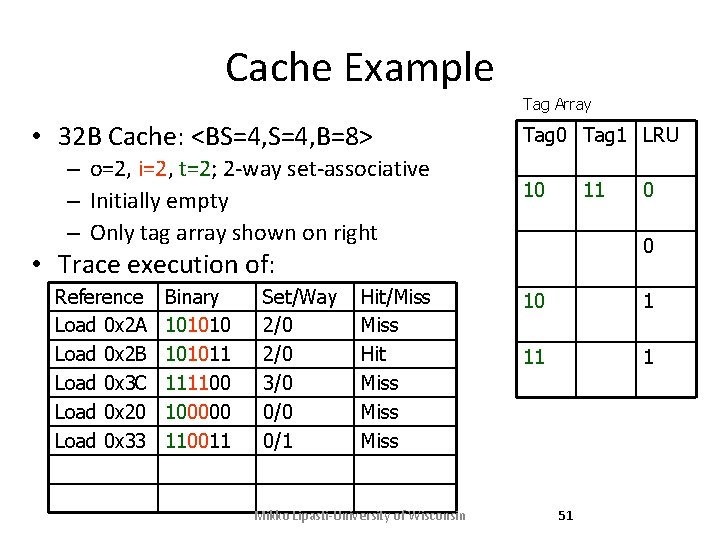
Cache Example Tag Array • 32 B Cache: <BS=4, B=8> – o=2, i=2, t=2; 2 -way set-associative – Initially empty – Only tag array shown on right Tag 0 Tag 1 LRU 10 11 0 • Trace execution of: Reference Load 0 x 2 A Load 0 x 2 B Load 0 x 3 C Load 0 x 20 Load 0 x 33 Binary 10101011 111100 100000 110011 Set/Way 2/0 3/0 0/1 Hit/Miss Hit Miss Mikko Lipasti-University of Wisconsin 0 10 1 11 1 51
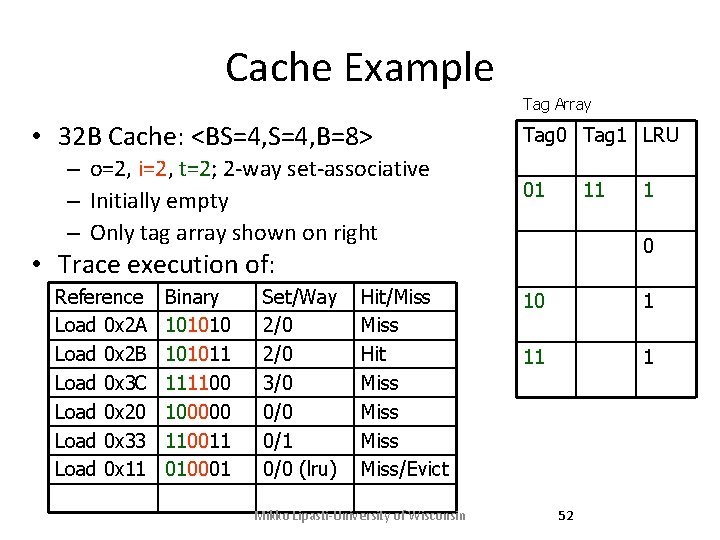
Cache Example Tag Array • 32 B Cache: <BS=4, B=8> – o=2, i=2, t=2; 2 -way set-associative – Initially empty – Only tag array shown on right Tag 0 Tag 1 LRU 01 11 0 • Trace execution of: Reference Load 0 x 2 A Load 0 x 2 B Load 0 x 3 C Load 0 x 20 Load 0 x 33 Load 0 x 11 Binary 10101011 111100 100000 110011 010001 Set/Way 2/0 3/0 0/1 0/0 (lru) Hit/Miss Hit Miss/Evict Mikko Lipasti-University of Wisconsin 1 10 1 11 1 52
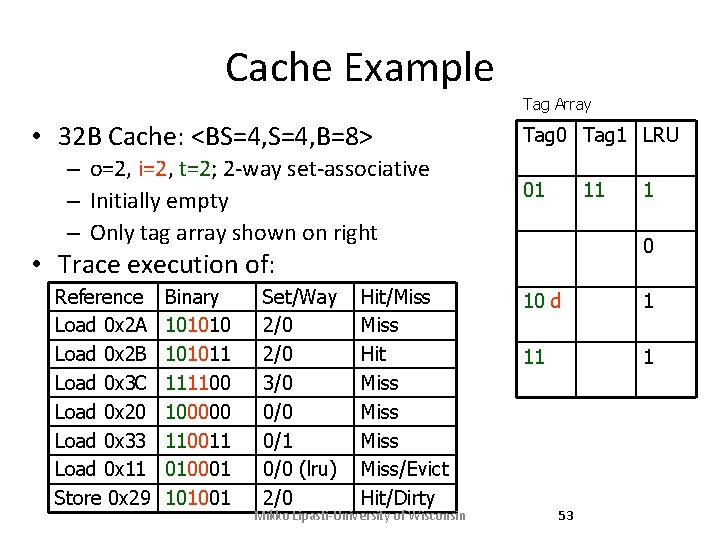
Cache Example Tag Array • 32 B Cache: <BS=4, B=8> – o=2, i=2, t=2; 2 -way set-associative – Initially empty – Only tag array shown on right Tag 0 Tag 1 LRU 01 11 0 • Trace execution of: Reference Load 0 x 2 A Load 0 x 2 B Load 0 x 3 C Load 0 x 20 Load 0 x 33 Load 0 x 11 Store 0 x 29 Binary 10101011 111100 100000 110011 010001 101001 Set/Way 2/0 3/0 0/1 0/0 (lru) 2/0 Hit/Miss Hit Miss/Evict Hit/Dirty Mikko Lipasti-University of Wisconsin 1 10 d 1 11 1 53
Lecture 5 Outline • Main Memory and Cache Review • Caches and Replacement Policies • Cache Coherence – Coherence States – Snoopy bus-based Invalidate Protocols – Invalidate protocol optimizations – Update Protocols (Dragon/Firefly) – Directory protocols – Implementation issues Mikko Lipasti-University of Wisconsin 54
Cache Misses and Performance • Miss penalty – Detect miss: 1 or more cycles – Find victim (replace block): 1 or more cycles • Write back if dirty – Request block from next level: several cycles • May need to find line from one of many caches (coherence) – Transfer block from next level: several cycles • (block size) / (bus width) – Fill block into data array, update tag array: 1+ cycles – Resume execution • In practice: 6 cycles to 100 s of cycles Mikko Lipasti-University of Wisconsin 55
Cache Miss Rate • Determined by: – Program characteristics • Temporal locality • Spatial locality – Cache organization • Block size, associativity, number of sets Mikko Lipasti-University of Wisconsin 56
Improving Locality • Instruction text placement – Profile program, place unreferenced or rarely referenced paths “elsewhere” • Maximize temporal locality – Eliminate taken branches • Fall-through path has spatial locality Mikko Lipasti-University of Wisconsin 57
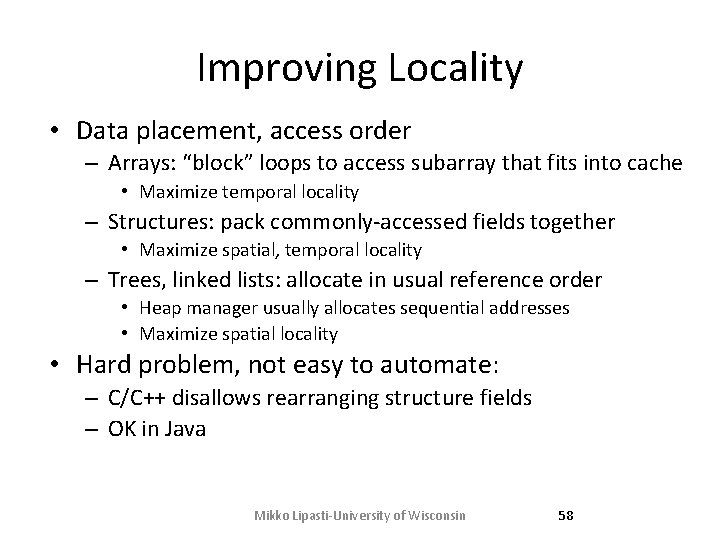
Improving Locality • Data placement, access order – Arrays: “block” loops to access subarray that fits into cache • Maximize temporal locality – Structures: pack commonly-accessed fields together • Maximize spatial, temporal locality – Trees, linked lists: allocate in usual reference order • Heap manager usually allocates sequential addresses • Maximize spatial locality • Hard problem, not easy to automate: – C/C++ disallows rearranging structure fields – OK in Java Mikko Lipasti-University of Wisconsin 58
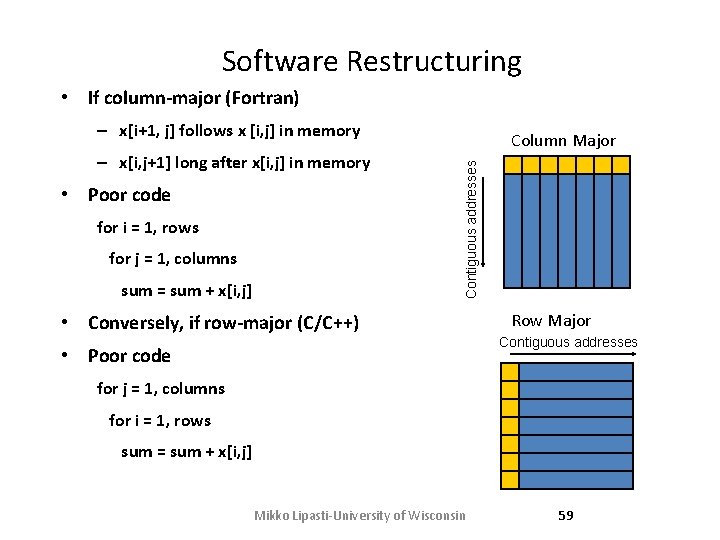
Software Restructuring • If column-major (Fortran) – x[i+1, j] follows x [i, j] in memory • Poor code for i = 1, rows for j = 1, columns sum = sum + x[i, j] Contiguous addresses – x[i, j+1] long after x[i, j] in memory Column Major • Conversely, if row-major (C/C++) Row Major Contiguous addresses • Poor code for j = 1, columns for i = 1, rows sum = sum + x[i, j] Mikko Lipasti-University of Wisconsin 59
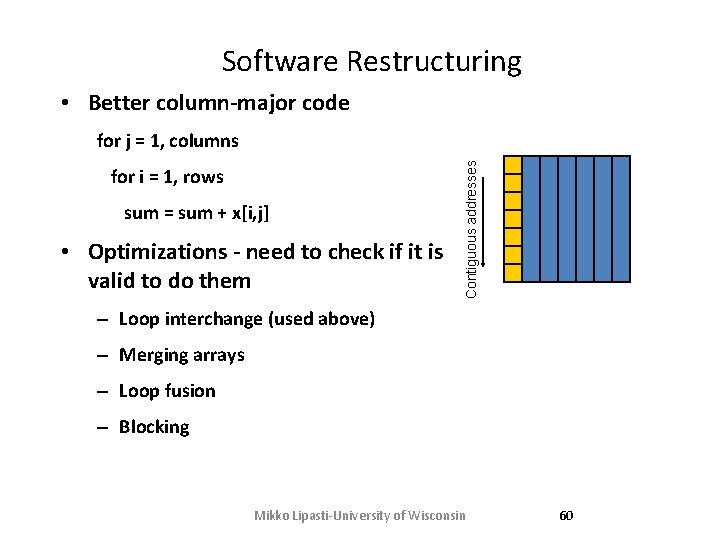
Software Restructuring • Better column-major code for i = 1, rows sum = sum + x[i, j] • Optimizations - need to check if it is valid to do them Contiguous addresses for j = 1, columns – Loop interchange (used above) – Merging arrays – Loop fusion – Blocking Mikko Lipasti-University of Wisconsin 60
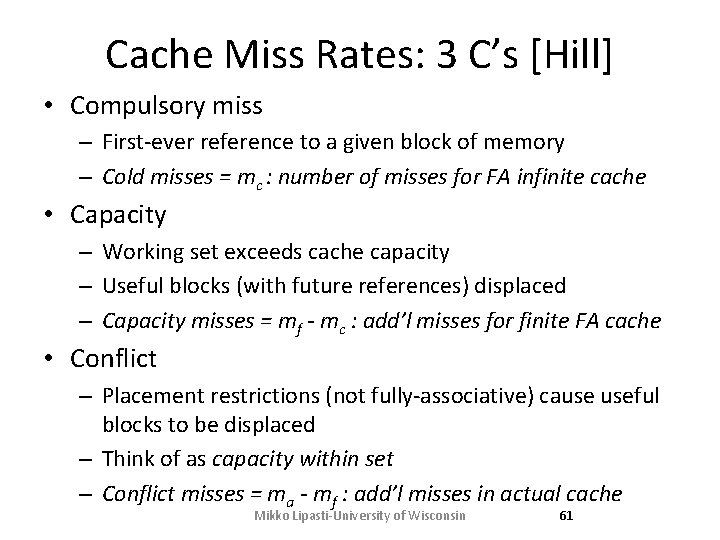
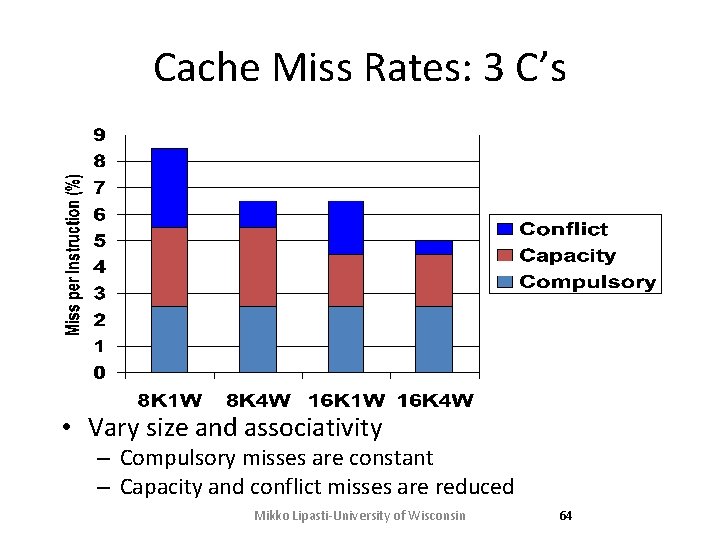
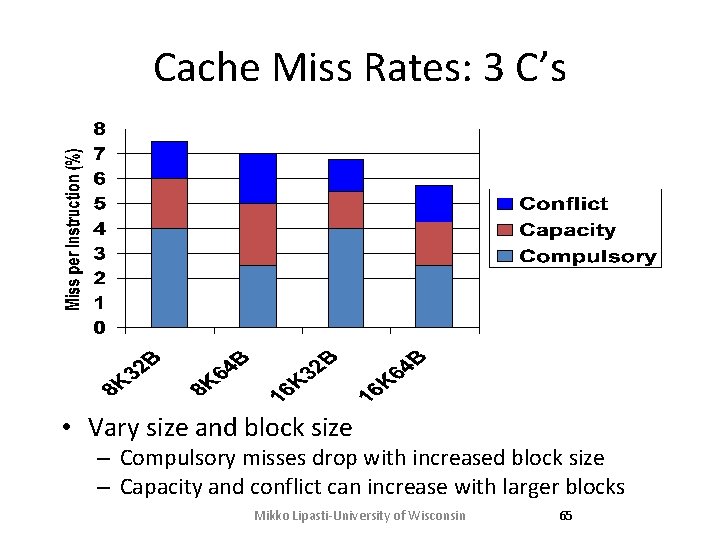
Cache Miss Rates: 3 C’s [Hill] • Compulsory miss – First-ever reference to a given block of memory – Cold misses = mc : number of misses for FA infinite cache • Capacity – Working set exceeds cache capacity – Useful blocks (with future references) displaced – Capacity misses = mf - mc : add’l misses for finite FA cache • Conflict – Placement restrictions (not fully-associative) cause useful blocks to be displaced – Think of as capacity within set – Conflict misses = ma - mf : add’l misses in actual cache Mikko Lipasti-University of Wisconsin 61
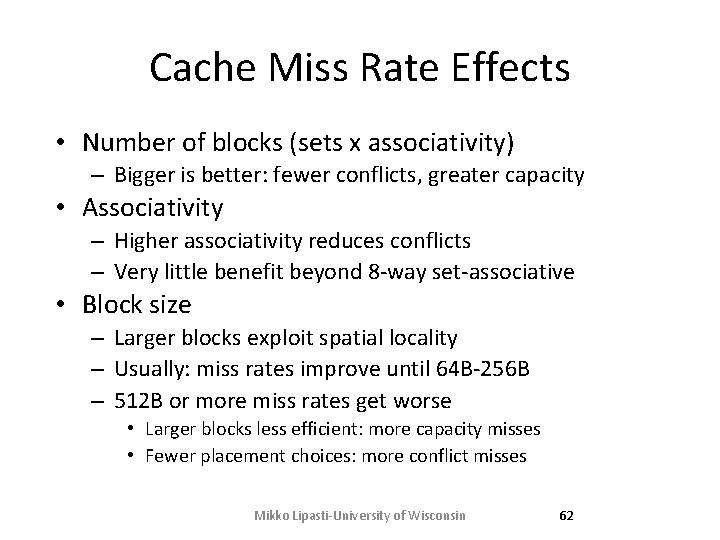
Cache Miss Rate Effects • Number of blocks (sets x associativity) – Bigger is better: fewer conflicts, greater capacity • Associativity – Higher associativity reduces conflicts – Very little benefit beyond 8 -way set-associative • Block size – Larger blocks exploit spatial locality – Usually: miss rates improve until 64 B-256 B – 512 B or more miss rates get worse • Larger blocks less efficient: more capacity misses • Fewer placement choices: more conflict misses Mikko Lipasti-University of Wisconsin 62
Cache Miss Rate • Subtle tradeoffs between cache organization parameters – Large blocks reduce compulsory misses but increase miss penalty • #compulsory ~= (working set) / (block size) • #transfers = (block size)/(bus width) – Large blocks increase conflict misses • #blocks = (cache size) / (block size) – Associativity reduces conflict misses – Associativity increases access time • Can associative cache ever have higher miss rate than direct-mapped cache of same size? Mikko Lipasti-University of Wisconsin 63
Cache Miss Rates: 3 C’s • Vary size and associativity – Compulsory misses are constant – Capacity and conflict misses are reduced Mikko Lipasti-University of Wisconsin 64
Cache Miss Rates: 3 C’s • Vary size and block size – Compulsory misses drop with increased block size – Capacity and conflict can increase with larger blocks Mikko Lipasti-University of Wisconsin 65
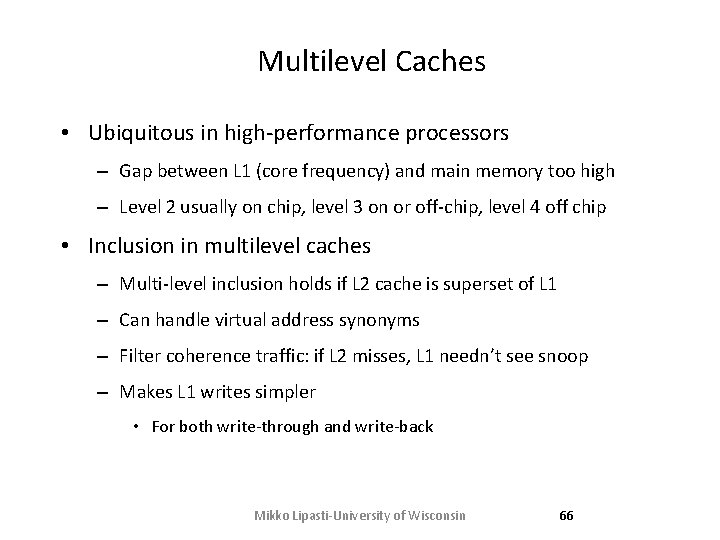
Multilevel Caches • Ubiquitous in high-performance processors – Gap between L 1 (core frequency) and main memory too high – Level 2 usually on chip, level 3 on or off-chip, level 4 off chip • Inclusion in multilevel caches – Multi-level inclusion holds if L 2 cache is superset of L 1 – Can handle virtual address synonyms – Filter coherence traffic: if L 2 misses, L 1 needn’t see snoop – Makes L 1 writes simpler • For both write-through and write-back Mikko Lipasti-University of Wisconsin 66
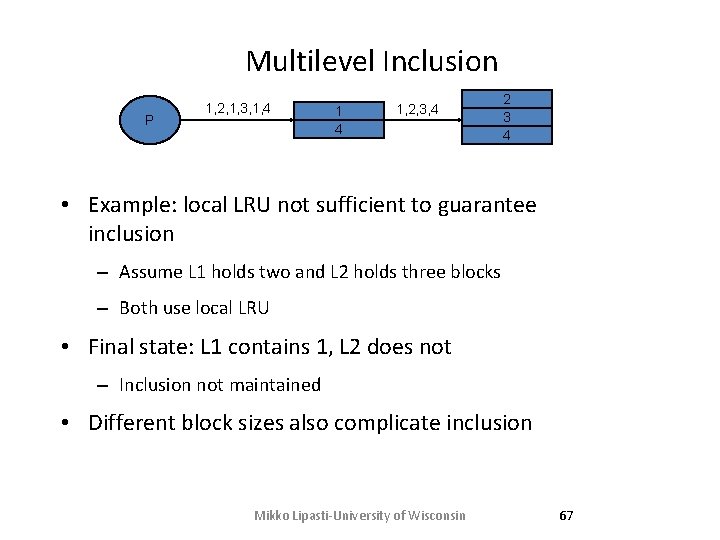
Multilevel Inclusion P 1, 2, 1, 3, 1, 4 1, 2, 3, 4 2 3 4 • Example: local LRU not sufficient to guarantee inclusion – Assume L 1 holds two and L 2 holds three blocks – Both use local LRU • Final state: L 1 contains 1, L 2 does not – Inclusion not maintained • Different block sizes also complicate inclusion Mikko Lipasti-University of Wisconsin 67
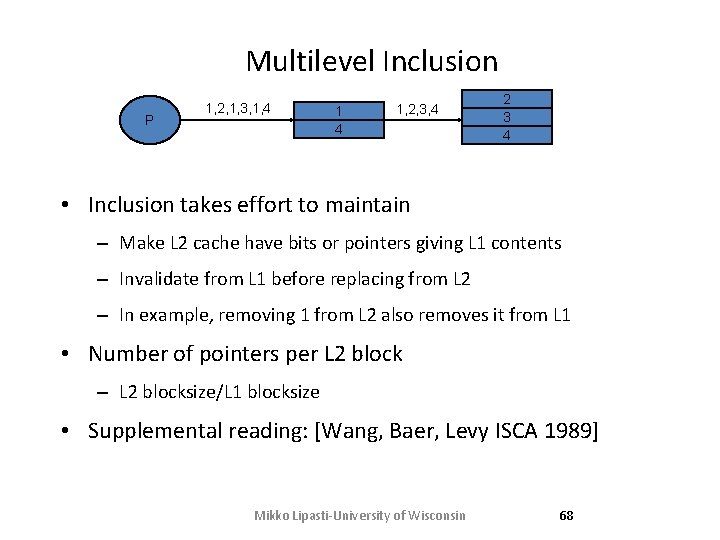
Multilevel Inclusion P 1, 2, 1, 3, 1, 4 1, 2, 3, 4 2 3 4 • Inclusion takes effort to maintain – Make L 2 cache have bits or pointers giving L 1 contents – Invalidate from L 1 before replacing from L 2 – In example, removing 1 from L 2 also removes it from L 1 • Number of pointers per L 2 block – L 2 blocksize/L 1 blocksize • Supplemental reading: [Wang, Baer, Levy ISCA 1989] Mikko Lipasti-University of Wisconsin 68
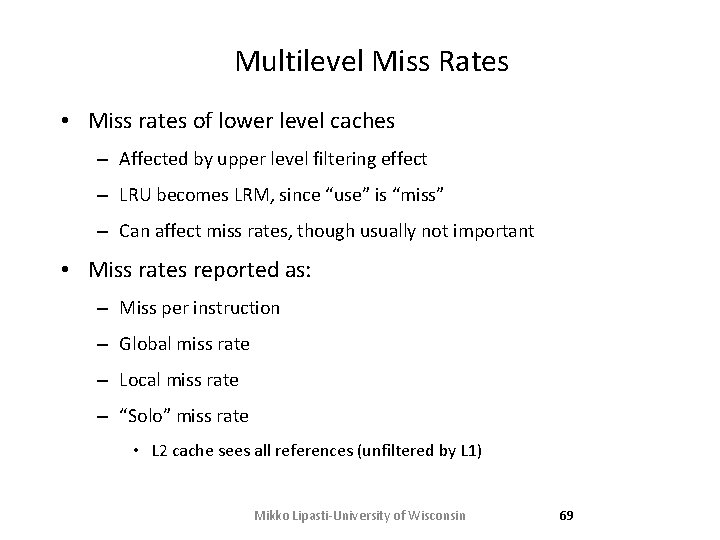
Multilevel Miss Rates • Miss rates of lower level caches – Affected by upper level filtering effect – LRU becomes LRM, since “use” is “miss” – Can affect miss rates, though usually not important • Miss rates reported as: – Miss per instruction – Global miss rate – Local miss rate – “Solo” miss rate • L 2 cache sees all references (unfiltered by L 1) Mikko Lipasti-University of Wisconsin 69
Cache Design: Four Key Issues • These are: – Placement • Where can a block of memory go? – Identification • How do I find a block of memory? – Replacement • How do I make space for new blocks? – Write Policy • How do I propagate changes? • Consider these for caches – Usually SRAM • Also apply to main memory, disks Mikko Lipasti-University of Wisconsin 70
Replacement • Cache has finite size – What do we do when it is full? • Analogy: desktop full? – Move books to bookshelf to make room – Bookshelf full? Move least-used to library – Etc. • Same idea: – Move blocks to next level of cache Mikko Lipasti-University of Wisconsin 71
Replacement • How do we choose victim? – Verbs: Victimize, evict, replace, cast out • Many policies are possible – – – – FIFO (first-in-first-out) LRU (least recently used), pseudo-LRU LFU (least frequently used) NMRU (not most recently used) NRU Pseudo-random (yes, really!) Optimal Etc Mikko Lipasti-University of Wisconsin 72
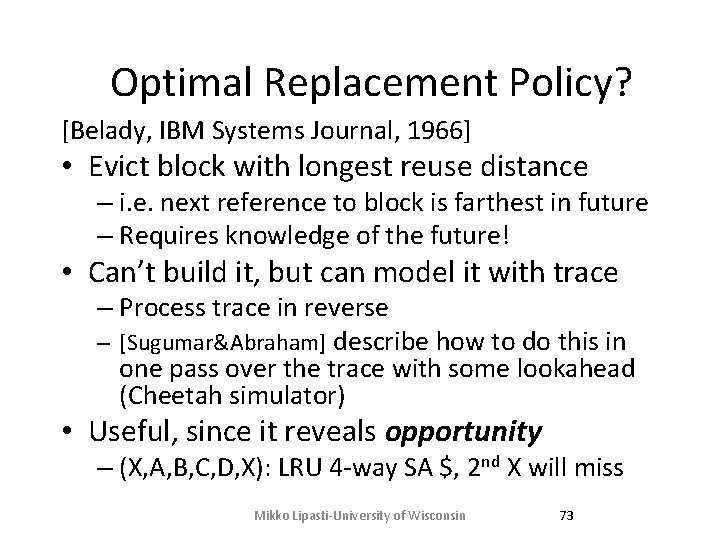
Optimal Replacement Policy? [Belady, IBM Systems Journal, 1966] • Evict block with longest reuse distance – i. e. next reference to block is farthest in future – Requires knowledge of the future! • Can’t build it, but can model it with trace – Process trace in reverse – [Sugumar&Abraham] describe how to do this in one pass over the trace with some lookahead (Cheetah simulator) • Useful, since it reveals opportunity – (X, A, B, C, D, X): LRU 4 -way SA $, 2 nd X will miss Mikko Lipasti-University of Wisconsin 73
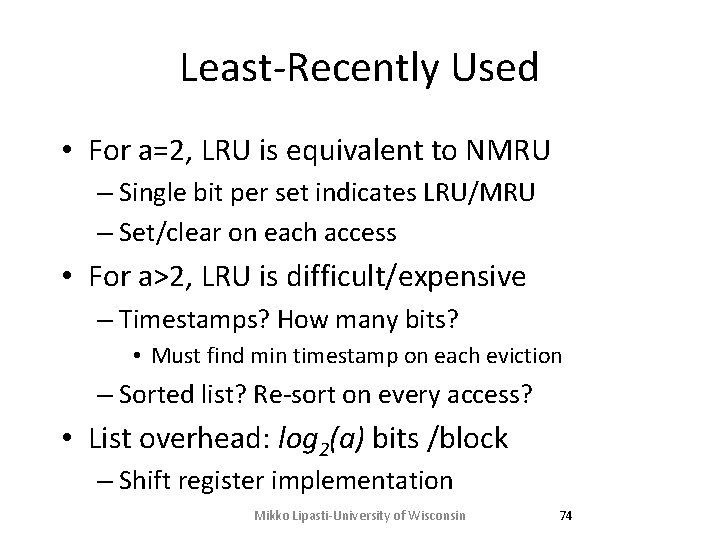
Least-Recently Used • For a=2, LRU is equivalent to NMRU – Single bit per set indicates LRU/MRU – Set/clear on each access • For a>2, LRU is difficult/expensive – Timestamps? How many bits? • Must find min timestamp on each eviction – Sorted list? Re-sort on every access? • List overhead: log 2(a) bits /block – Shift register implementation Mikko Lipasti-University of Wisconsin 74
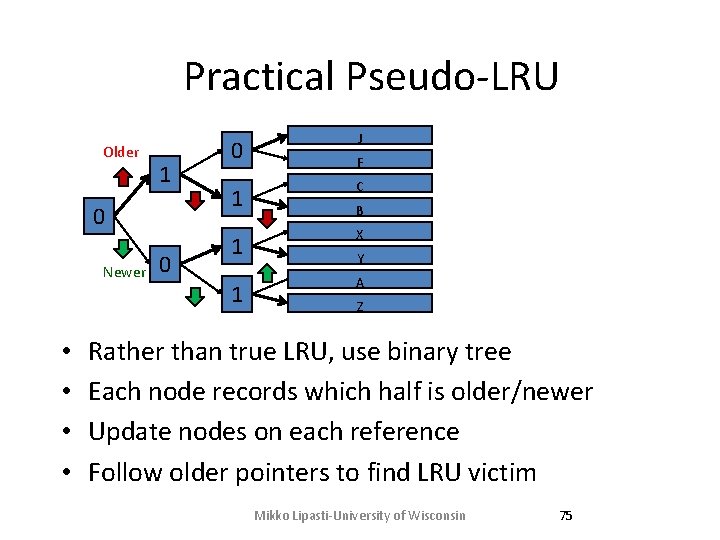
Practical Pseudo-LRU Older 1 0 Newer • • 0 0 1 J F C B 1 X 1 A Y Z Rather than true LRU, use binary tree Each node records which half is older/newer Update nodes on each reference Follow older pointers to find LRU victim Mikko Lipasti-University of Wisconsin 75
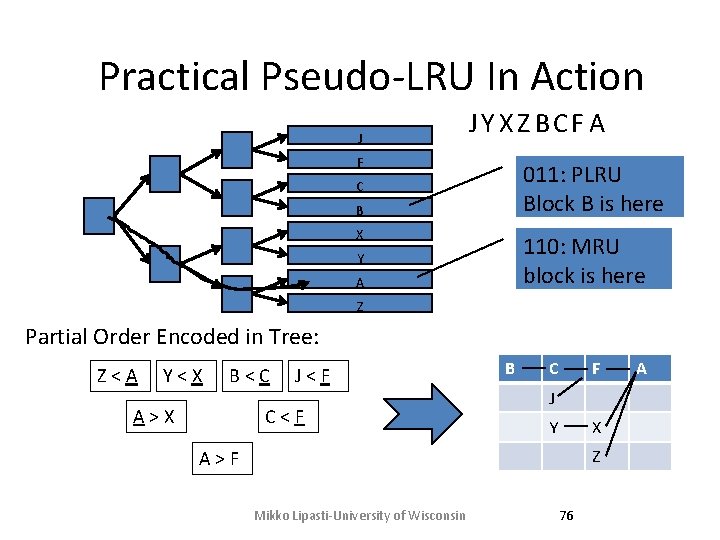
Practical Pseudo-LRU In Action J J Y X Z BC F A F 011: PLRU Block B is here C B X 110: MRU block is here Y A Z Partial Order Encoded in Tree: Z<A Y<X B<C A>X J<F C<F B C F J Y X Z A>F Mikko Lipasti-University of Wisconsin 76 A
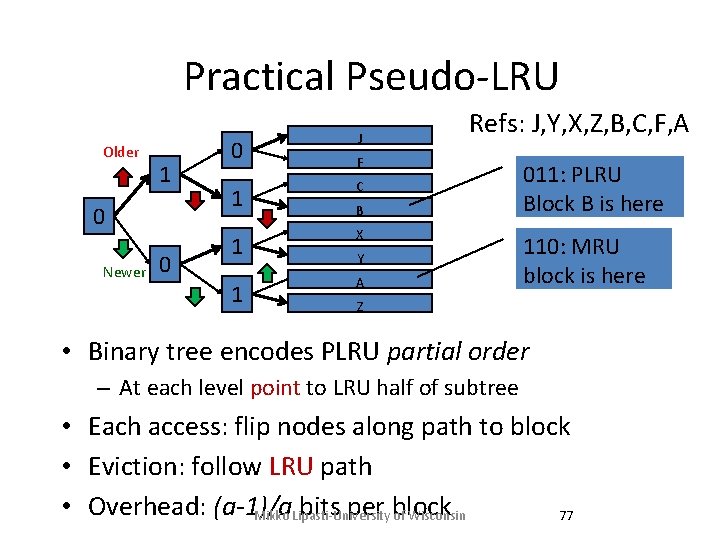
Practical Pseudo-LRU Older 1 0 Newer 0 0 1 J Refs: J, Y, X, Z, B, C, F, A F C B 1 X 1 A Y 011: PLRU Block B is here 110: MRU block is here Z • Binary tree encodes PLRU partial order – At each level point to LRU half of subtree • Each access: flip nodes along path to block • Eviction: follow LRU path • Overhead: (a-1)/a bits per block Mikko Lipasti-University of Wisconsin 77
True LRU Shortcomings • Streaming data/scans: x 0, x 1, …, xn – Effectively no temporal reuse • Thrashing: reuse distance > a – Temporal reuse exists but LRU fails • All blocks march from MRU to LRU – Other conflicting blocks are pushed out • For n>a no blocks remain after scan/thrash – Incur many conflict misses after scan ends • Pseudo-LRU sometimes helps a little bit Mikko Lipasti-University of Wisconsin 78
Segmented or Protected LRU [I/O: Karedla, Love, Wherry, IEEE Computer 27(3), 1994] [Cache: Wilkerson, Wade, US Patent 6393525, 1999] • • Partition LRU list into filter and reuse lists On insert, block goes into filter list On reuse (hit), block promoted into reuse list Provides scan & some thrash resistance – Blocks without reuse get evicted quickly – Blocks with reuse are protected from scan/thrash blocks • No storage overhead, but LRU update slightly more complicated Mikko Lipasti-University of Wisconsin 79
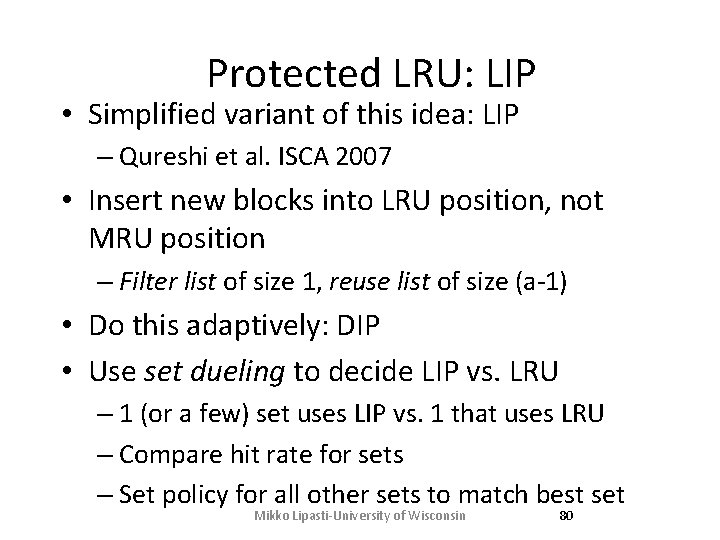
Protected LRU: LIP • Simplified variant of this idea: LIP – Qureshi et al. ISCA 2007 • Insert new blocks into LRU position, not MRU position – Filter list of size 1, reuse list of size (a-1) • Do this adaptively: DIP • Use set dueling to decide LIP vs. LRU – 1 (or a few) set uses LIP vs. 1 that uses LRU – Compare hit rate for sets – Set policy for all other sets to match best set Mikko Lipasti-University of Wisconsin 80
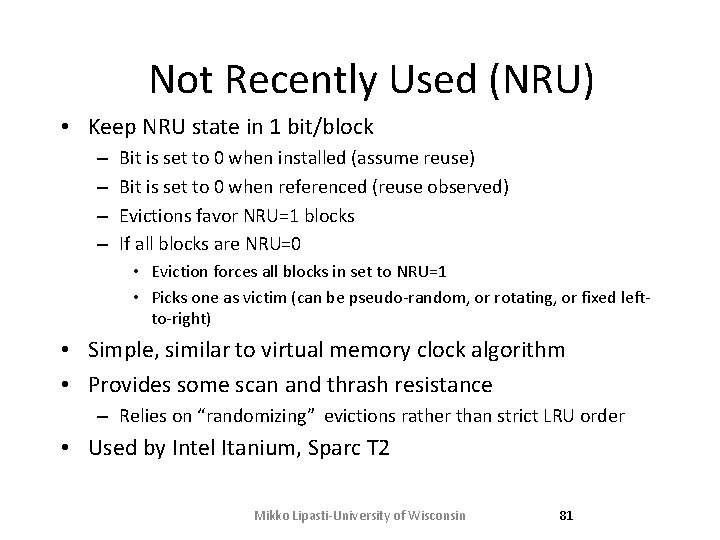
Not Recently Used (NRU) • Keep NRU state in 1 bit/block – – Bit is set to 0 when installed (assume reuse) Bit is set to 0 when referenced (reuse observed) Evictions favor NRU=1 blocks If all blocks are NRU=0 • Eviction forces all blocks in set to NRU=1 • Picks one as victim (can be pseudo-random, or rotating, or fixed leftto-right) • Simple, similar to virtual memory clock algorithm • Provides some scan and thrash resistance – Relies on “randomizing” evictions rather than strict LRU order • Used by Intel Itanium, Sparc T 2 Mikko Lipasti-University of Wisconsin 81
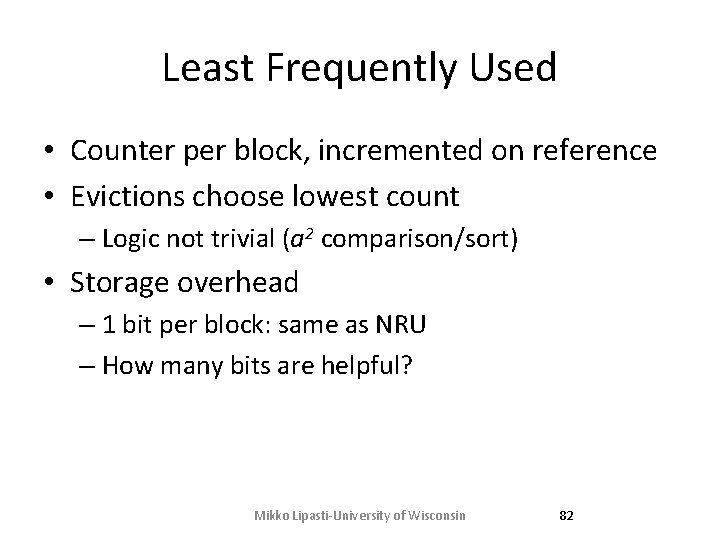
Least Frequently Used • Counter per block, incremented on reference • Evictions choose lowest count – Logic not trivial (a 2 comparison/sort) • Storage overhead – 1 bit per block: same as NRU – How many bits are helpful? Mikko Lipasti-University of Wisconsin 82
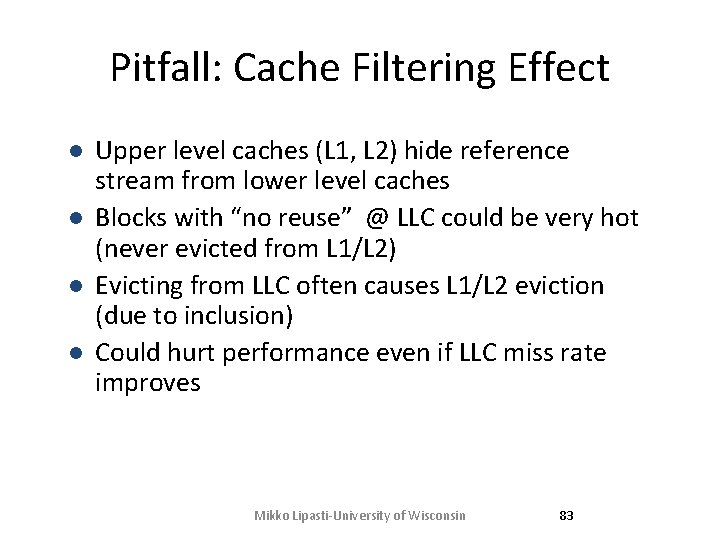
Pitfall: Cache Filtering Effect l l Upper level caches (L 1, L 2) hide reference stream from lower level caches Blocks with “no reuse” @ LLC could be very hot (never evicted from L 1/L 2) Evicting from LLC often causes L 1/L 2 eviction (due to inclusion) Could hurt performance even if LLC miss rate improves Mikko Lipasti-University of Wisconsin 83
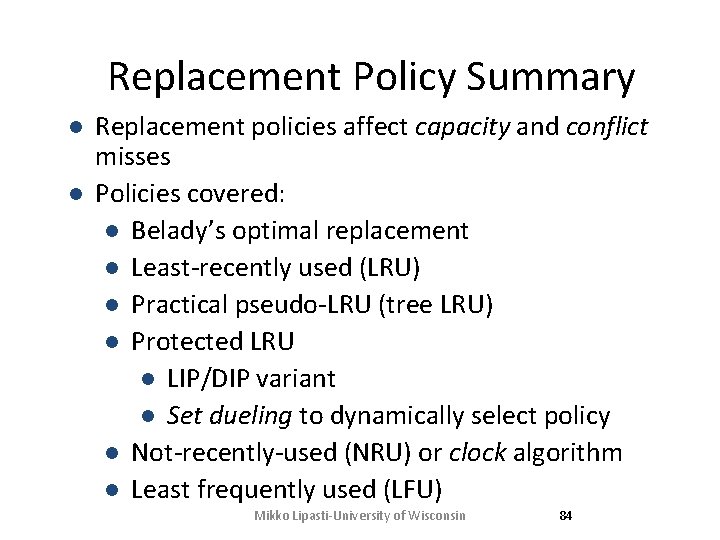
Replacement Policy Summary l l Replacement policies affect capacity and conflict misses Policies covered: l Belady’s optimal replacement l Least-recently used (LRU) l Practical pseudo-LRU (tree LRU) l Protected LRU l LIP/DIP variant l Set dueling to dynamically select policy l Not-recently-used (NRU) or clock algorithm l Least frequently used (LFU) Mikko Lipasti-University of Wisconsin 84
Cache Replacement Championships • First: held at ISCA 2010 – http: //www. jilp. org/jwac-1 • Second: to be held at ISCA 2017 – http: //crc 2. ece. tamu. edu • Good option for a course project – Focus on MP cases Mikko Lipasti-University of Wisconsin 85
Replacement Policy References S. Bansal and D. S. Modha. “CAR: Clock with Adaptive Replacement”, In FAST, 2004. A. Basu et al. “Scavenger: A New Last Level Cache Architecture with Global Block Priority”. In Micro-40, 2007. L. A. Belady. A study of replacement algorithms for a virtual-storage computer. In IBM Systems journal, pages 78– 101, 1966. M. Chaudhuri. “Pseudo-LIFO: The Foundation of a New Family of Replacement Policies for Last-level Caches”. In Micro, 2009. F. J. Corbat´o, “A paging experiment with the multics system, ” In Honor of P. M. Morse, pp. 217– 228, MIT Press, 1969. A. Jaleel, et al. “Adaptive Insertion Policies for Managing Shared Caches”. In PACT, 2008. S. Jiang and X. Zhang, “LIRS: An efficient low inter-reference recency set replacement policy to improve buffer cache performance, ” in Proc. ACM SIGMETRICS Conf. , 2002. T. Johnson and D. Shasha, “ 2 Q: A low overhead high performance buffer management replacement algorithm, ” in VLDB Conf. , 1994. S. Kaxiras et al. Cache decay: exploiting generational behavior to reduce cache leakage power. In ISCA-28, 2001. A. Lai, C. Fide, and B. Falsafi. Dead-block prediction & dead-block correlating prefetchers. In ISCA-28, 2001 D. Lee et al. “LRFU: A spectrum of policies that subsumes the least recently used and least frequently used policies, ” IEEE Trans. Computers, vol. 50, no. 12, pp. 1352– 1360, 2001. Mikko Lipasti-University of Wisconsin 86
Lecture 5 Outline • Main Memory and Cache Review • Caches and Replacement Policies • Cache Coherence – Coherence States – Snoopy bus-based Invalidate Protocols – Invalidate protocol optimizations – Update Protocols (Dragon/Firefly) – Directory protocols – Implementation issues Mikko Lipasti-University of Wisconsin 87
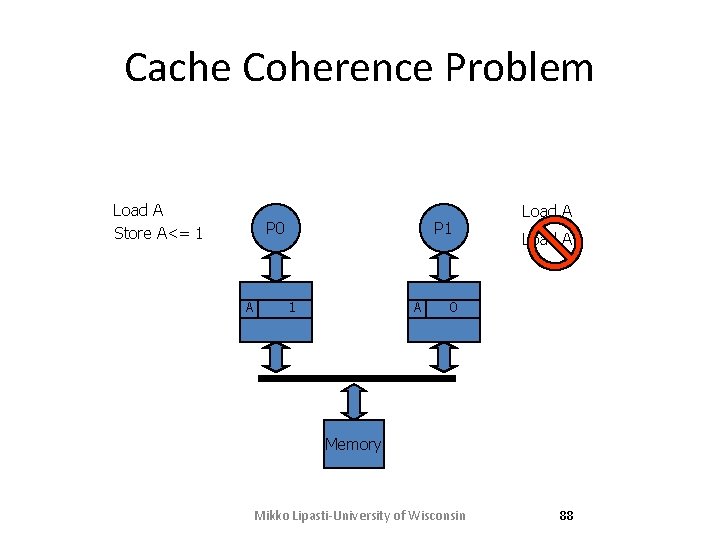
Cache Coherence Problem Load A Store A<= 1 P 0 A P 1 01 A Load A 0 Memory Mikko Lipasti-University of Wisconsin 88
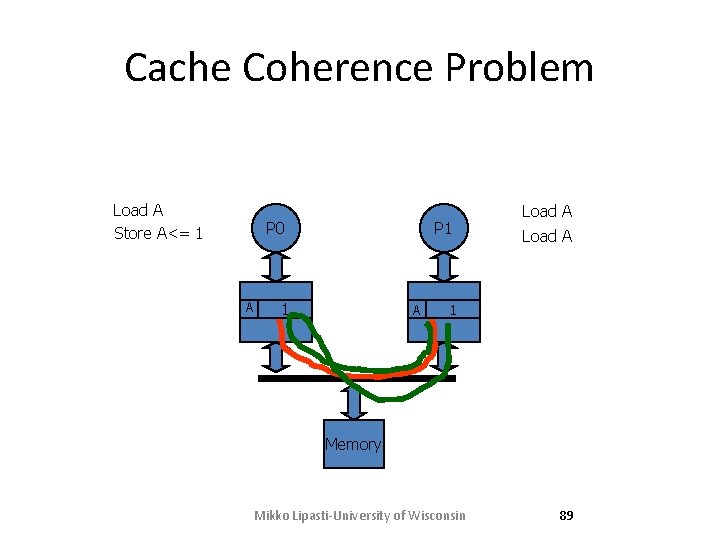
Cache Coherence Problem Load A Store A<= 1 P 0 A P 1 10 A Load A 10 Memory Mikko Lipasti-University of Wisconsin 89
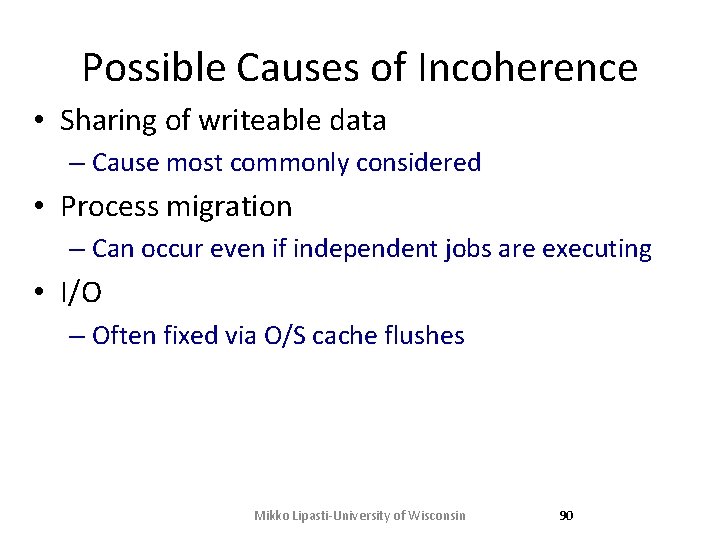
Possible Causes of Incoherence • Sharing of writeable data – Cause most commonly considered • Process migration – Can occur even if independent jobs are executing • I/O – Often fixed via O/S cache flushes Mikko Lipasti-University of Wisconsin 90
Cache Coherence • Informally, with coherent caches: accesses to a memory location appear to occur simultaneously in all copies of the memory location “copies” caches • Cache coherence suggests an absolute time scale -- this is not necessary – What is required is the "appearance" of coherence. . . not absolute coherence – E. g. temporary incoherence between memory and a write-back cache may be OK. Mikko Lipasti-University of Wisconsin 91
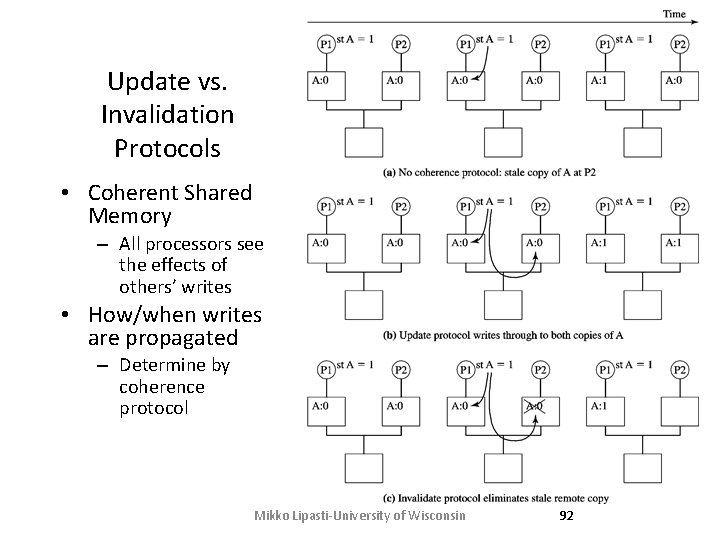
Update vs. Invalidation Protocols • Coherent Shared Memory – All processors see the effects of others’ writes • How/when writes are propagated – Determine by coherence protocol Mikko Lipasti-University of Wisconsin 92
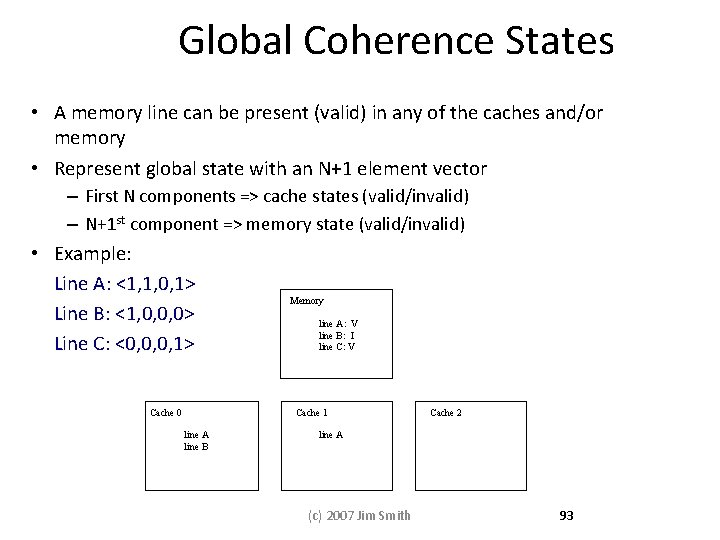
Global Coherence States • A memory line can be present (valid) in any of the caches and/or memory • Represent global state with an N+1 element vector – First N components => cache states (valid/invalid) – N+1 st component => memory state (valid/invalid) • Example: Line A: <1, 1, 0, 1> Line B: <1, 0, 0, 0> Line C: <0, 0, 0, 1> Cache 0 Memory line A: V line B: I line C: V Cache 1 line A line B line A (c) 2007 Jim Smith Cache 2 93
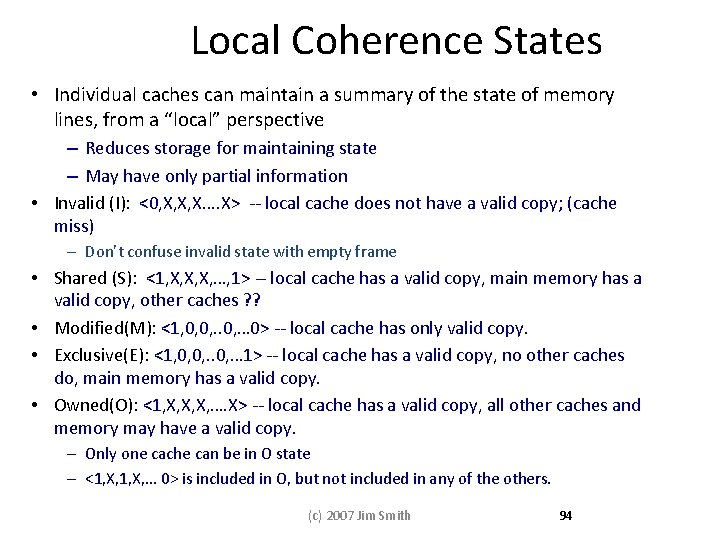
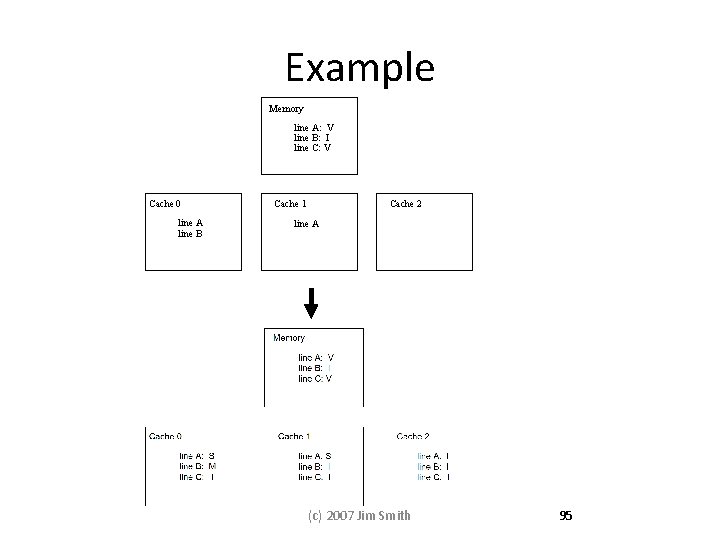
Local Coherence States • Individual caches can maintain a summary of the state of memory lines, from a “local” perspective – Reduces storage for maintaining state – May have only partial information • Invalid (I): <0, X, X, X. . X> -- local cache does not have a valid copy; (cache miss) – Don’t confuse invalid state with empty frame • Shared (S): <1, X, X, X, …, 1> -- local cache has a valid copy, main memory has a valid copy, other caches ? ? • Modified(M): <1, 0, 0, . . 0, … 0> -- local cache has only valid copy. • Exclusive(E): <1, 0, 0, . . 0, … 1> -- local cache has a valid copy, no other caches do, main memory has a valid copy. • Owned(O): <1, X, X, X, …. X> -- local cache has a valid copy, all other caches and memory may have a valid copy. – Only one cache can be in O state – <1, X, … 0> is included in O, but not included in any of the others. (c) 2007 Jim Smith 94
Example Memory line A: V line B: I line C: V Cache 0 line A line B Cache 1 Cache 2 line A (c) 2007 Jim Smith 95
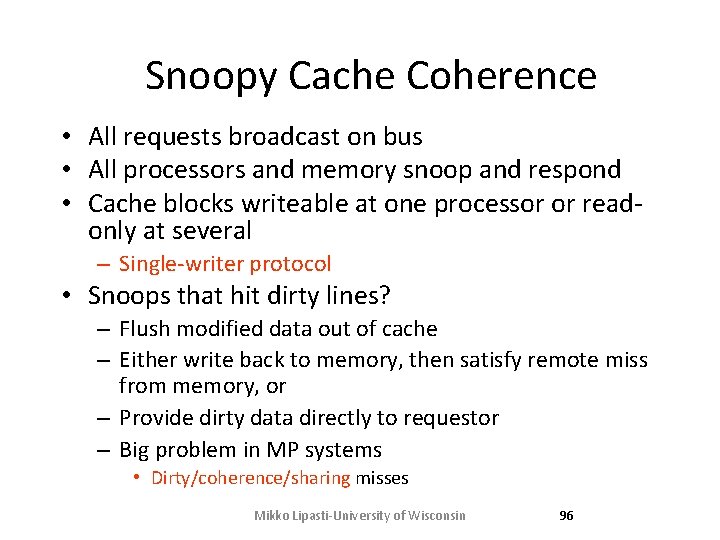
Snoopy Cache Coherence • All requests broadcast on bus • All processors and memory snoop and respond • Cache blocks writeable at one processor or readonly at several – Single-writer protocol • Snoops that hit dirty lines? – Flush modified data out of cache – Either write back to memory, then satisfy remote miss from memory, or – Provide dirty data directly to requestor – Big problem in MP systems • Dirty/coherence/sharing misses Mikko Lipasti-University of Wisconsin 96
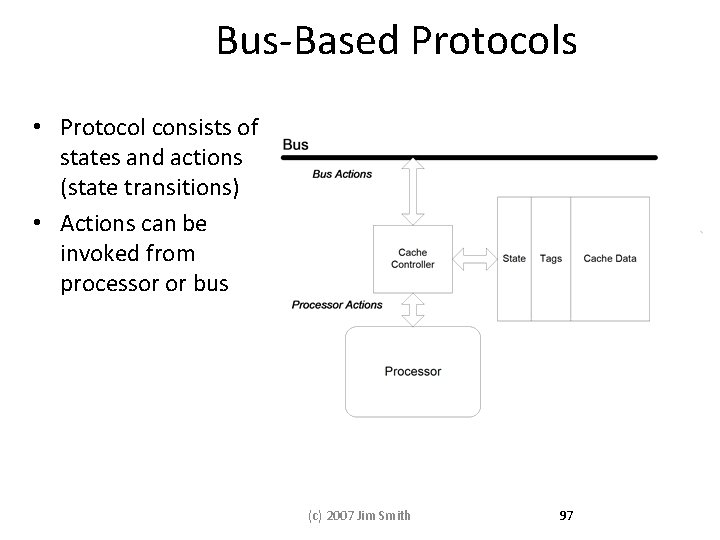
Bus-Based Protocols • Protocol consists of states and actions (state transitions) • Actions can be invoked from processor or bus (c) 2007 Jim Smith 97
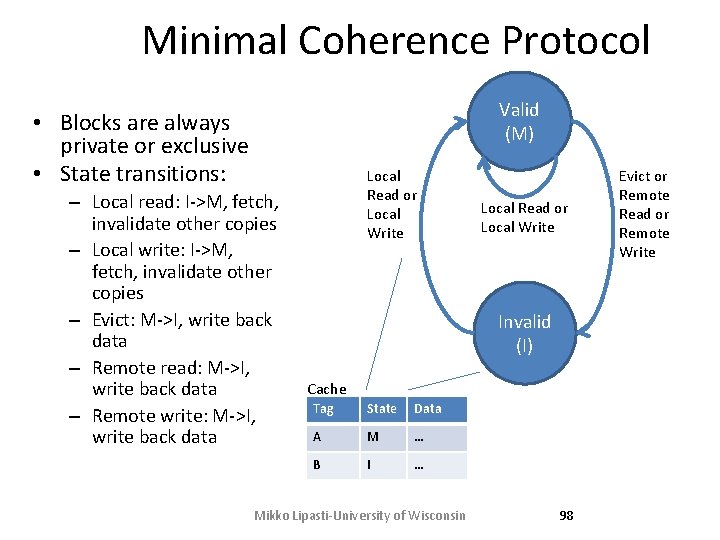
Minimal Coherence Protocol Valid (M) • Blocks are always private or exclusive • State transitions: – Local read: I->M, fetch, invalidate other copies – Local write: I->M, fetch, invalidate other copies – Evict: M->I, write back data – Remote read: M->I, write back data – Remote write: M->I, write back data Local Read or Local Write Invalid (I) Cache Tag State Data A M … B I … Mikko Lipasti-University of Wisconsin 98 Evict or Remote Read or Remote Write
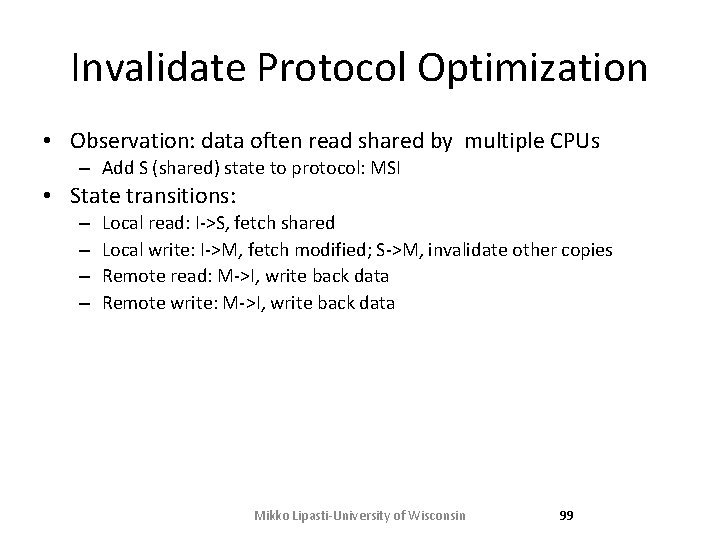
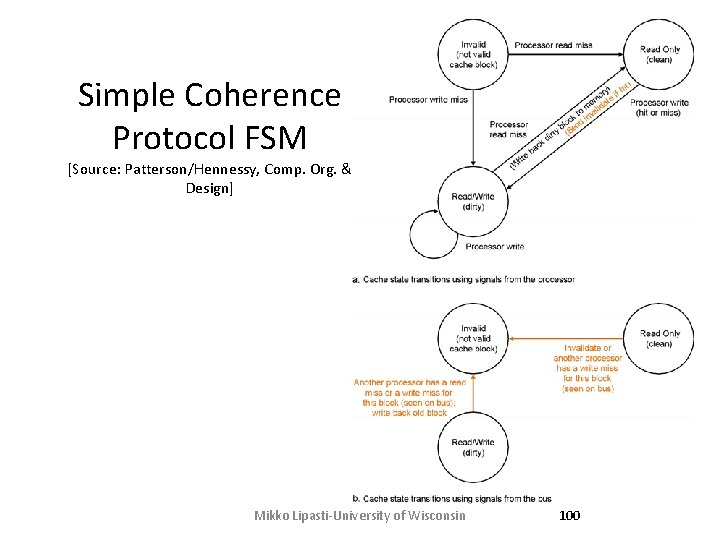
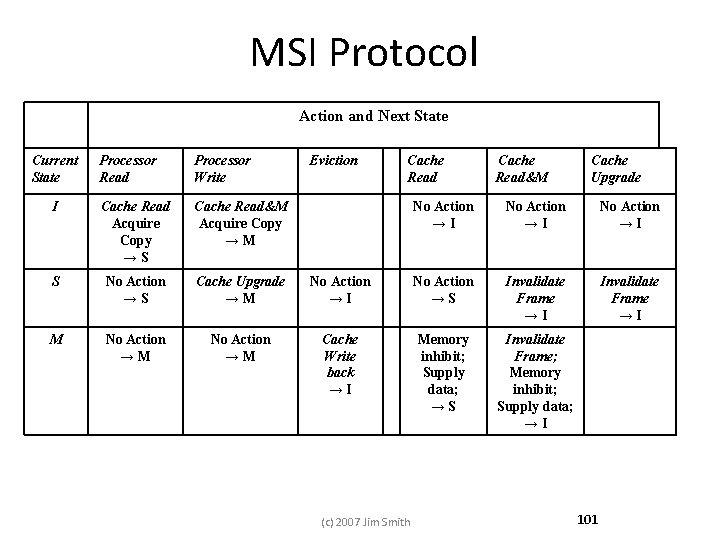
Invalidate Protocol Optimization • Observation: data often read shared by multiple CPUs – Add S (shared) state to protocol: MSI • State transitions: – – Local read: I->S, fetch shared Local write: I->M, fetch modified; S->M, invalidate other copies Remote read: M->I, write back data Remote write: M->I, write back data Mikko Lipasti-University of Wisconsin 99
Simple Coherence Protocol FSM [Source: Patterson/Hennessy, Comp. Org. & Design] Mikko Lipasti-University of Wisconsin 100
MSI Protocol Action and Next State Current State Eviction Cache Read Processor Write I Cache Read Acquire Copy → S Cache Read&M Acquire Copy → M No Action → I S No Action → S Cache Upgrade → M No Action → I No Action → S Invalidate Frame → I M No Action → M Cache Write back → I Memory inhibit; Supply data; → S Invalidate Frame; Memory inhibit; Supply data; → I (c) 2007 Jim Smith Cache Read&M Cache Upgrade 101
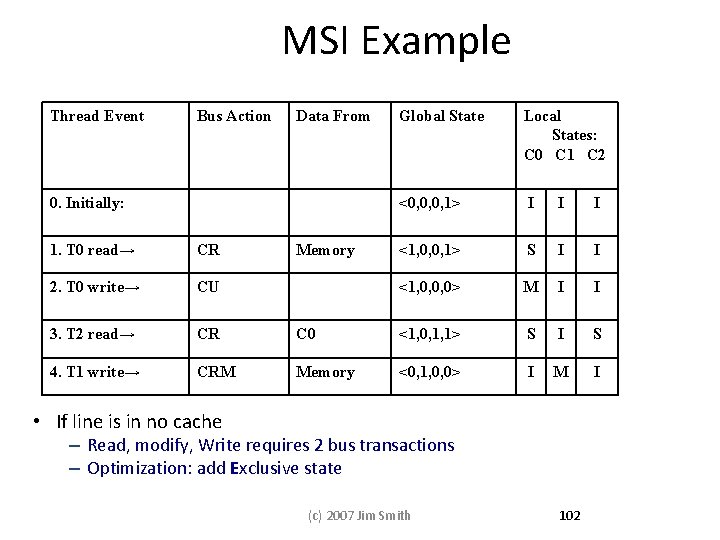
MSI Example Thread Event Bus Action Data From Global State 0. Initially: 1. T 0 read→ CR Memory 2. T 0 write→ CU Local States: C 0 C 1 C 2 <0, 0, 0, 1> I I I <1, 0, 0, 1> S I I <1, 0, 0, 0> M I I 3. T 2 read→ CR C 0 <1, 0, 1, 1> S I S 4. T 1 write→ CRM Memory <0, 1, 0, 0> I M I • If line is in no cache – Read, modify, Write requires 2 bus transactions – Optimization: add Exclusive state (c) 2007 Jim Smith 102
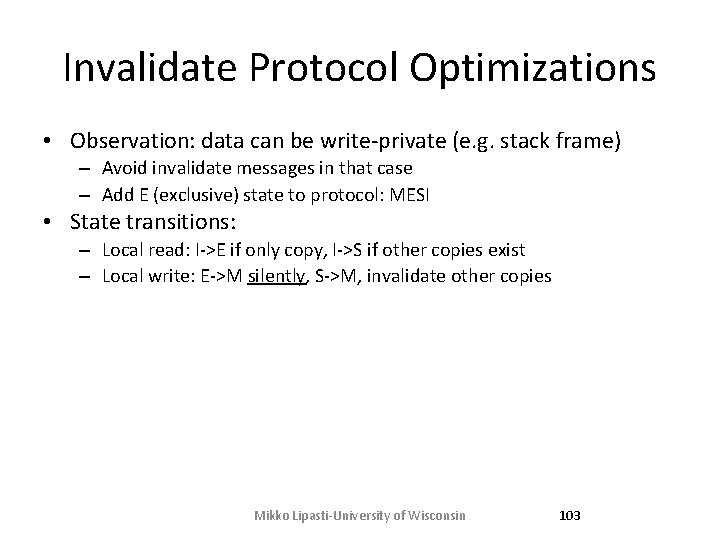
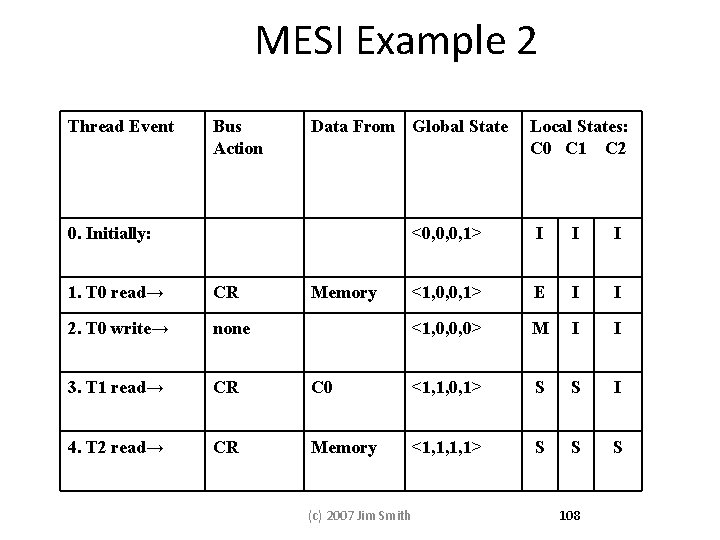
Invalidate Protocol Optimizations • Observation: data can be write-private (e. g. stack frame) – Avoid invalidate messages in that case – Add E (exclusive) state to protocol: MESI • State transitions: – Local read: I->E if only copy, I->S if other copies exist – Local write: E->M silently, S->M, invalidate other copies Mikko Lipasti-University of Wisconsin 103
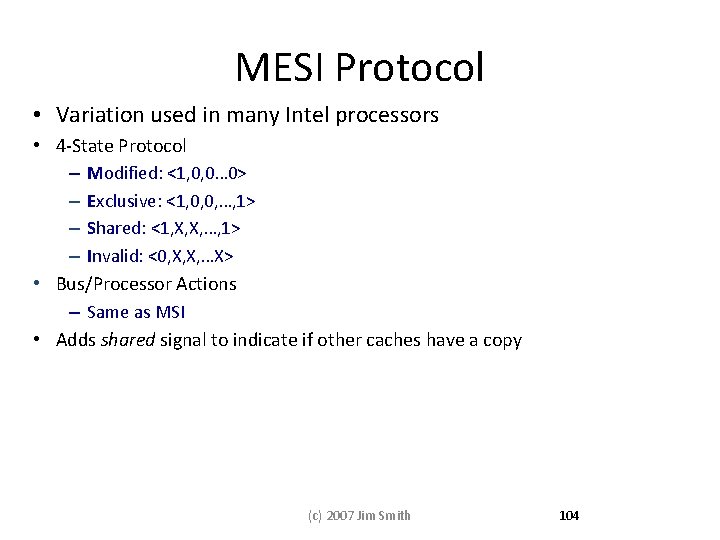
MESI Protocol • Variation used in many Intel processors • 4 -State Protocol – Modified: <1, 0, 0… 0> – Exclusive: <1, 0, 0, …, 1> – Shared: <1, X, X, …, 1> – Invalid: <0, X, X, …X> • Bus/Processor Actions – Same as MSI • Adds shared signal to indicate if other caches have a copy (c) 2007 Jim Smith 104
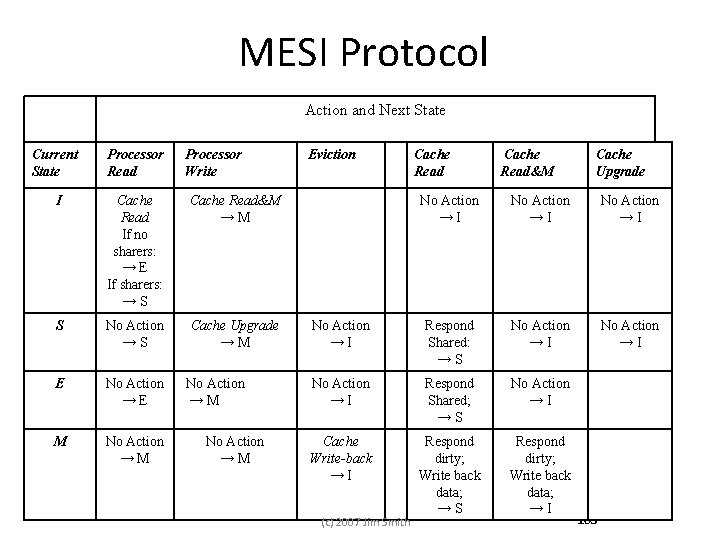
MESI Protocol Action and Next State Current State Processor Read Processor Write Eviction Cache Read&M Cache Upgrade I Cache Read If no sharers: → E If sharers: → S Cache Read&M → M No Action → I S No Action → S Cache Upgrade → M No Action → I Respond Shared: → S No Action → I E No Action → I Respond Shared; → S No Action → I M No Action → M Cache Write-back → I Respond dirty; Write back data; → S Respond dirty; Write back data; → I No Action → M (c) 2007 Jim Smith 105
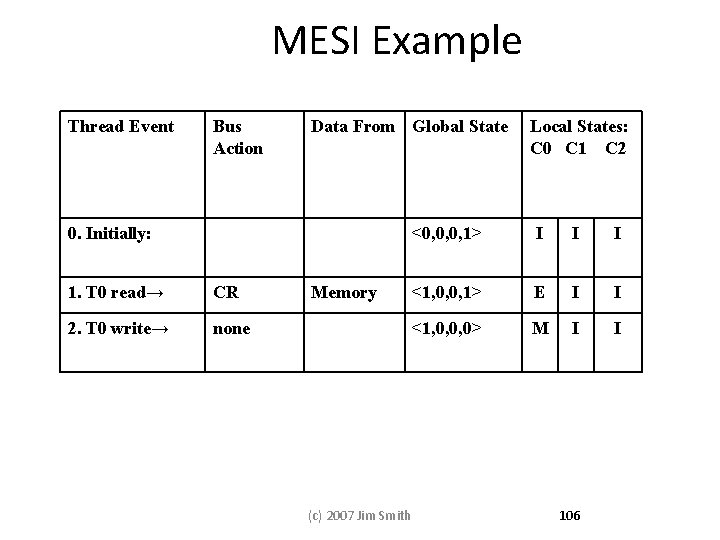
MESI Example Thread Event Bus Action Data From Global State Local States: C 0 C 1 C 2 0. Initially: 1. T 0 read→ CR <0, 0, 0, 1> I I I Memory 2. T 0 write→ none <1, 0, 0, 1> E I I <1, 0, 0, 0> M I I (c) 2007 Jim Smith 106
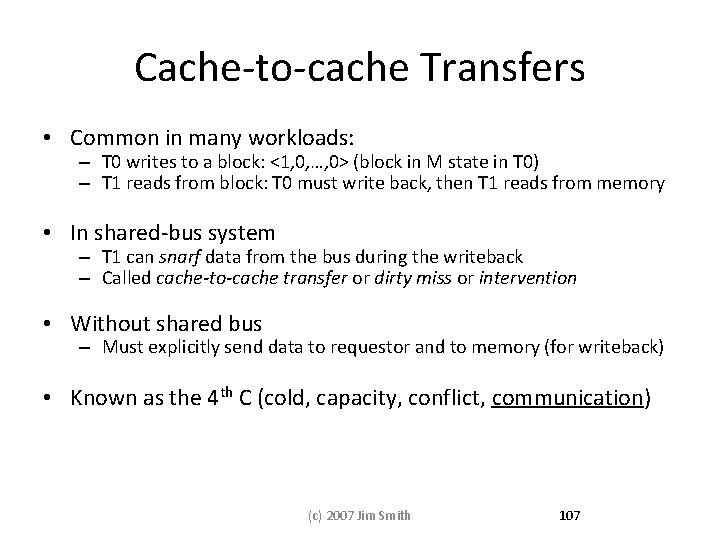
Cache-to-cache Transfers • Common in many workloads: – T 0 writes to a block: <1, 0, …, 0> (block in M state in T 0) – T 1 reads from block: T 0 must write back, then T 1 reads from memory • In shared-bus system – T 1 can snarf data from the bus during the writeback – Called cache-to-cache transfer or dirty miss or intervention • Without shared bus – Must explicitly send data to requestor and to memory (for writeback) • Known as the 4 th C (cold, capacity, conflict, communication) (c) 2007 Jim Smith 107
MESI Example 2 Thread Event Bus Action Data From Global State Local States: C 0 C 1 C 2 0. Initially: 1. T 0 read→ CR <0, 0, 0, 1> I I I Memory 2. T 0 write→ none <1, 0, 0, 1> E I I <1, 0, 0, 0> M I I 3. T 1 read→ CR C 0 <1, 1, 0, 1> S S I 4. T 2 read→ CR Memory <1, 1, 1, 1> S S S (c) 2007 Jim Smith 108
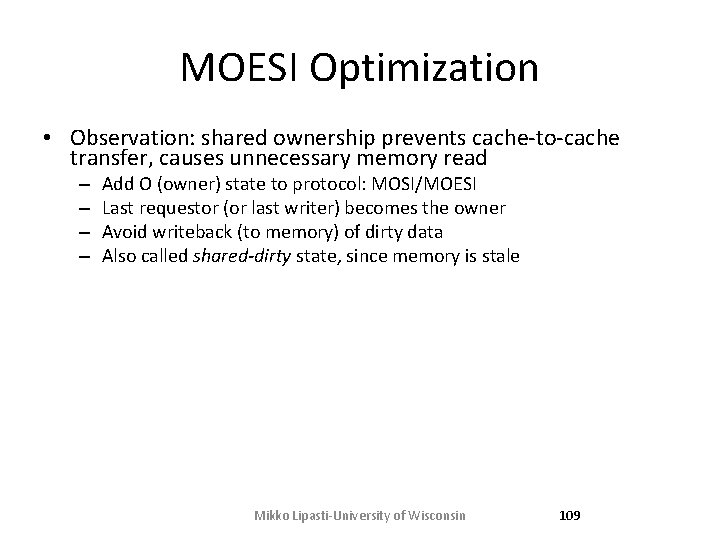
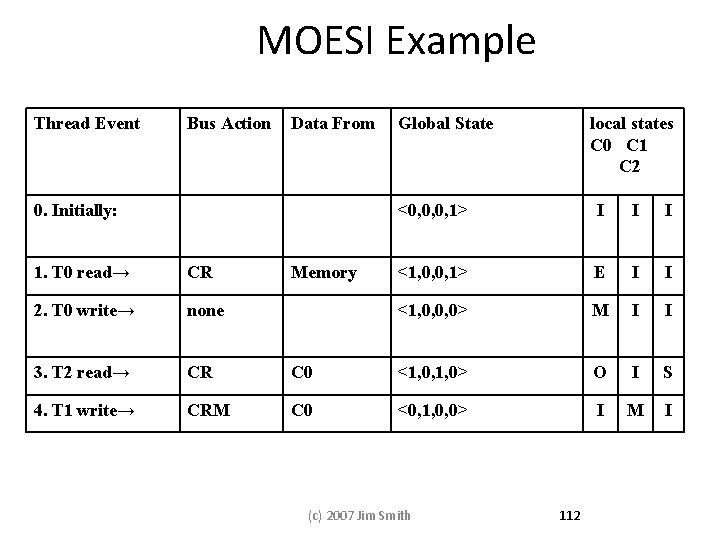
MOESI Optimization • Observation: shared ownership prevents cache-to-cache transfer, causes unnecessary memory read – – Add O (owner) state to protocol: MOSI/MOESI Last requestor (or last writer) becomes the owner Avoid writeback (to memory) of dirty data Also called shared-dirty state, since memory is stale Mikko Lipasti-University of Wisconsin 109
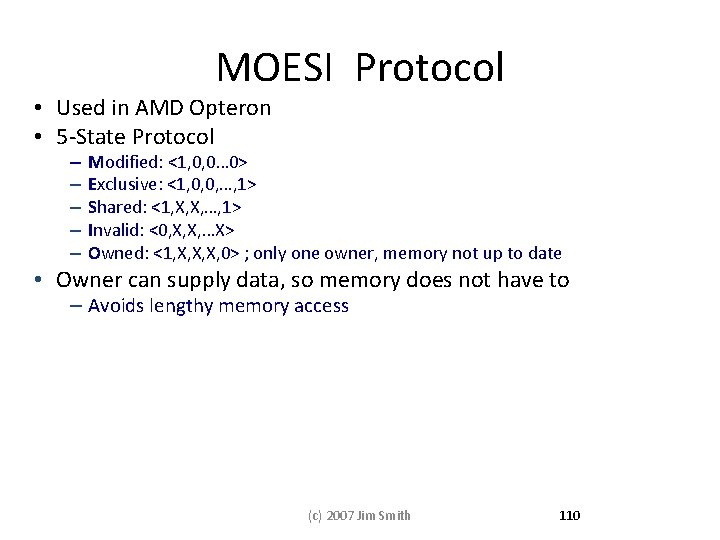
MOESI Protocol • Used in AMD Opteron • 5 -State Protocol – – – Modified: <1, 0, 0… 0> Exclusive: <1, 0, 0, …, 1> Shared: <1, X, X, …, 1> Invalid: <0, X, X, …X> Owned: <1, X, X, X, 0> ; only one owner, memory not up to date • Owner can supply data, so memory does not have to – Avoids lengthy memory access (c) 2007 Jim Smith 110
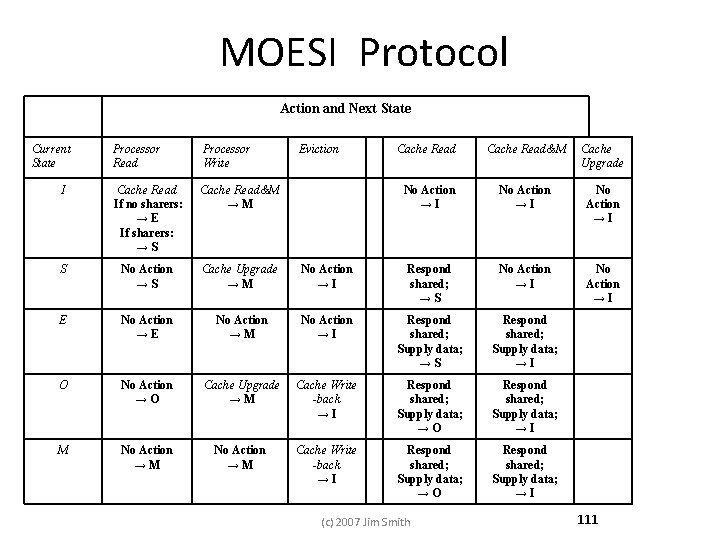
MOESI Protocol Action and Next State Current State Processor Read Processor Write I Cache Read If no sharers: → E If sharers: → S Cache Read&M → M S No Action → S Cache Upgrade → M E No Action → M O No Action → O M No Action → M Eviction Cache Read&M Cache Upgrade No Action → I Respond shared; → S No Action → I Respond shared; Supply data; → S Respond shared; Supply data; → I Cache Upgrade → M Cache Write -back → I Respond shared; Supply data; → O Respond shared; Supply data; → I No Action → M Cache Write -back → I Respond shared; Supply data; → O Respond shared; Supply data; → I (c) 2007 Jim Smith 111
MOESI Example Thread Event Bus Action Data From Global State 0. Initially: 1. T 0 read→ CR Memory 2. T 0 write→ none local states C 0 C 1 C 2 <0, 0, 0, 1> I I I <1, 0, 0, 1> E I I <1, 0, 0, 0> M I I 3. T 2 read→ CR C 0 <1, 0, 1, 0> O I S 4. T 1 write→ CRM C 0 <0, 1, 0, 0> I M I (c) 2007 Jim Smith 112
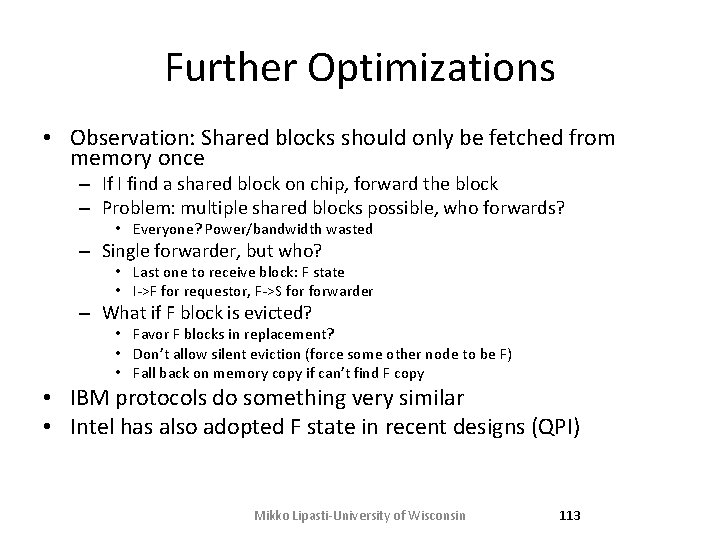
Further Optimizations • Observation: Shared blocks should only be fetched from memory once – If I find a shared block on chip, forward the block – Problem: multiple shared blocks possible, who forwards? • Everyone? Power/bandwidth wasted – Single forwarder, but who? • Last one to receive block: F state • I->F for requestor, F->S forwarder – What if F block is evicted? • Favor F blocks in replacement? • Don’t allow silent eviction (force some other node to be F) • Fall back on memory copy if can’t find F copy • IBM protocols do something very similar • Intel has also adopted F state in recent designs (QPI) Mikko Lipasti-University of Wisconsin 113
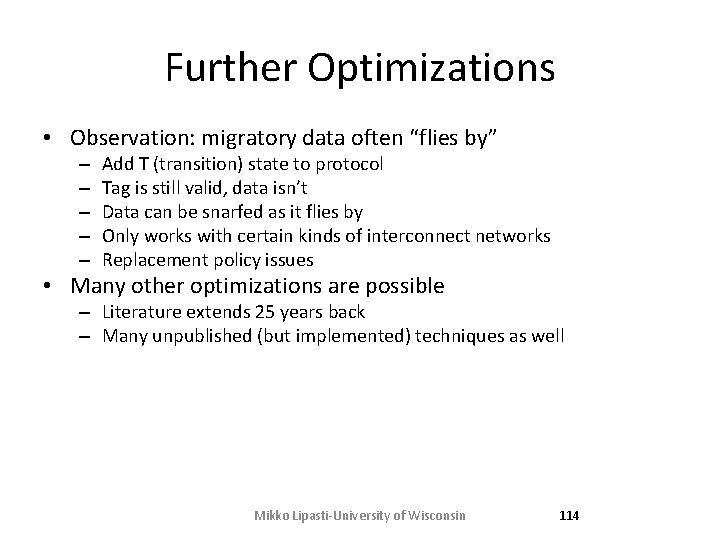
Further Optimizations • Observation: migratory data often “flies by” – – – Add T (transition) state to protocol Tag is still valid, data isn’t Data can be snarfed as it flies by Only works with certain kinds of interconnect networks Replacement policy issues • Many other optimizations are possible – Literature extends 25 years back – Many unpublished (but implemented) techniques as well Mikko Lipasti-University of Wisconsin 114
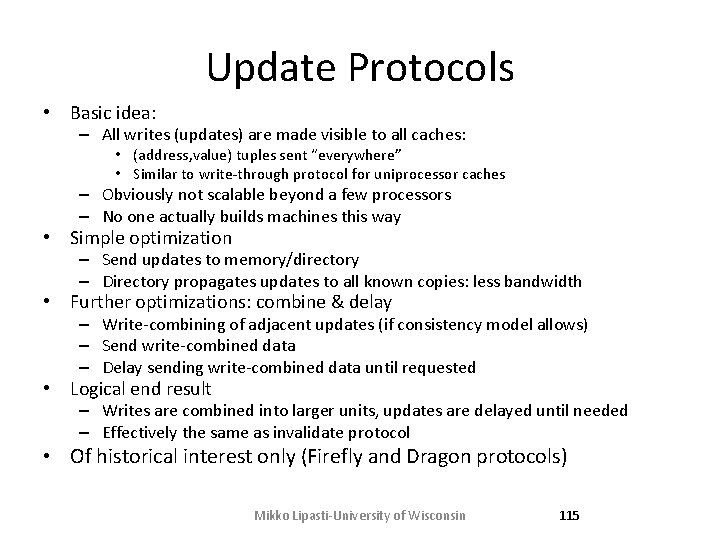
Update Protocols • Basic idea: – All writes (updates) are made visible to all caches: • (address, value) tuples sent “everywhere” • Similar to write-through protocol for uniprocessor caches – Obviously not scalable beyond a few processors – No one actually builds machines this way • Simple optimization – Send updates to memory/directory – Directory propagates updates to all known copies: less bandwidth • Further optimizations: combine & delay – Write-combining of adjacent updates (if consistency model allows) – Send write-combined data – Delay sending write-combined data until requested • Logical end result – Writes are combined into larger units, updates are delayed until needed – Effectively the same as invalidate protocol • Of historical interest only (Firefly and Dragon protocols) Mikko Lipasti-University of Wisconsin 115
Update vs Invalidate • [Weber & Gupta, ASPLOS 3] – Consider sharing patterns • No Sharing – Independent threads – Coherence due to thread migration – Update protocol performs many wasteful updates • Read-Only – No significant coherence issues; most protocols work well • Migratory Objects – Manipulated by one processor at a time – Often protected by a lock – Usually a write causes only a single invalidation – E state useful for Read-modify-Write patterns – Update protocol could proliferate copies Mikko Lipasti-University of Wisconsin 116
Update vs Invalidate, contd. • Synchronization Objects – Locks – Update could reduce spin traffic invalidations – Test&Set w/ invalidate protocol would work well • Many Readers, One Writer – Update protocol may work well, but writes are relatively rare • Many Writers/Readers – Invalidate probably works better – Update will proliferate copies • What is used today? – Invalidate is dominant – CMP has not changed this assessment • Even with plentiful on-chip bandwidth Mikko Lipasti-University of Wisconsin 117
Nasty Realities • State diagram is for (ideal) protocol assuming instantaneous and actions • In reality controller implements more complex diagrams – A protocol state transition may be started by controller when bus activity changes local state – Example: an upgrade pending (for bus) when an invalidate for same line arrives Mikko Lipasti-University of Wisconsin 118
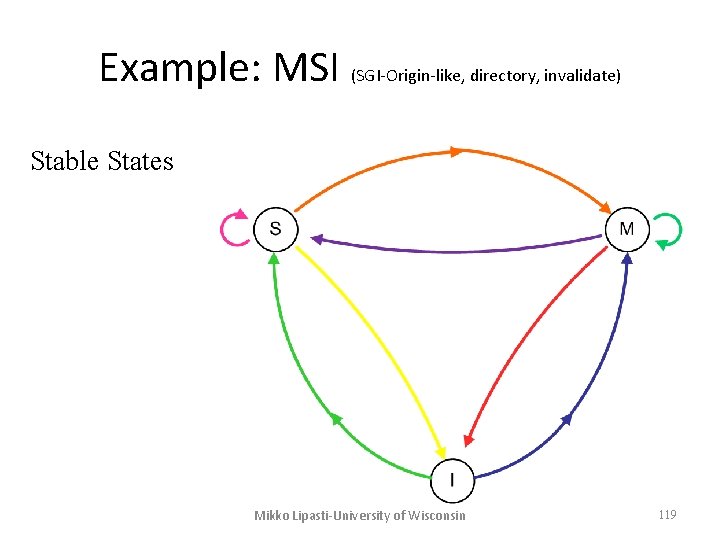
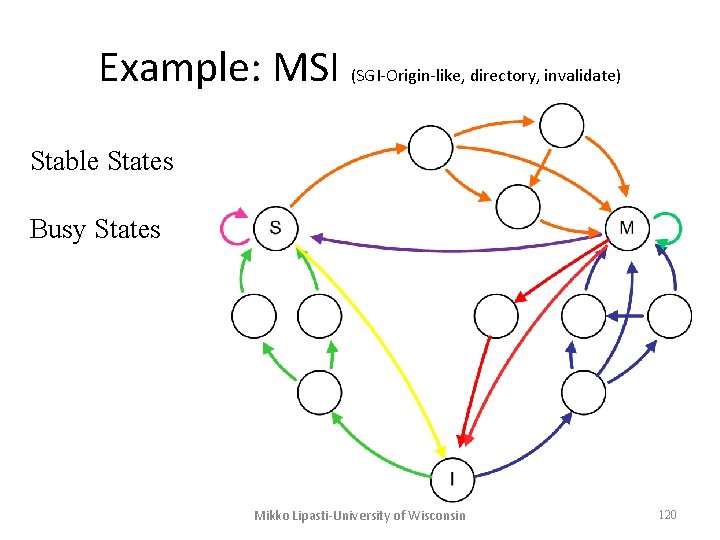
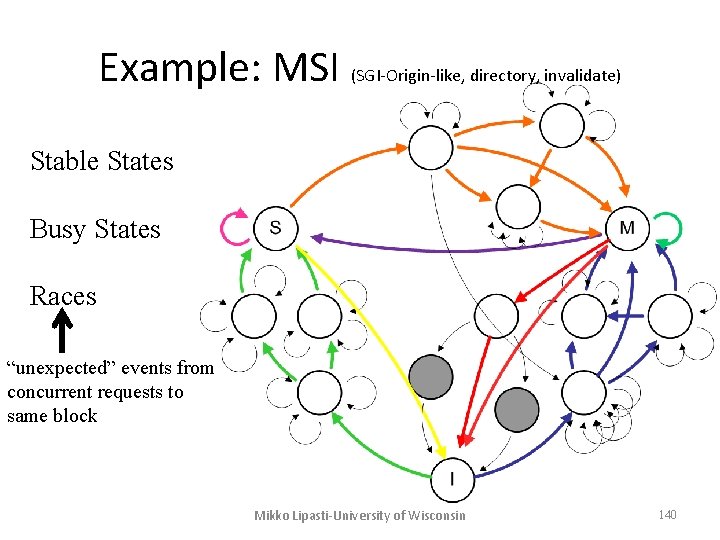
Example: MSI (SGI-Origin-like, directory, invalidate) Stable States Mikko Lipasti-University of Wisconsin 119
Example: MSI (SGI-Origin-like, directory, invalidate) Stable States Busy States Mikko Lipasti-University of Wisconsin 120
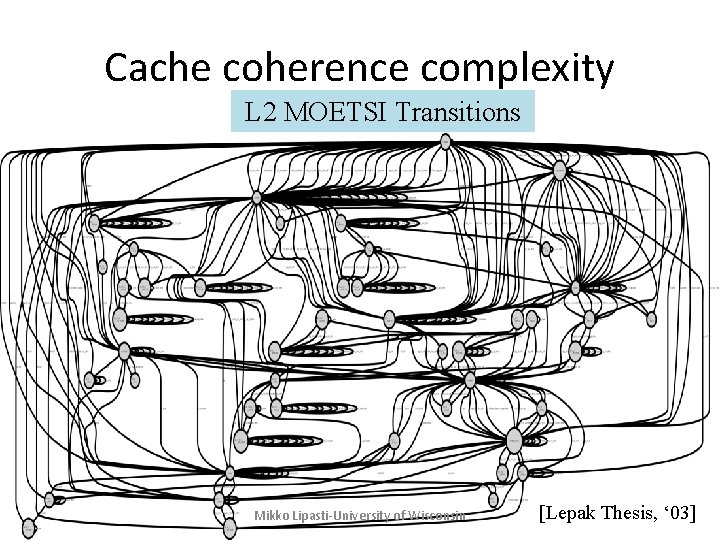
Cache coherence complexity L 2 MOETSI Transitions Mikko Lipasti-University of Wisconsin [Lepak Thesis, ‘ 03] 121
Implementing Cache Coherence • Snooping implementation – – Origins in shared-memory-bus systems All CPUs could observe all other CPUs requests on the bus; hence “snooping” • – Bus Read, Bus Write, Bus Upgrade React appropriately to snooped commands • • Invalidate shared copies Provide up-to-date copies of dirty lines – – • Flush (writeback) to memory, or Direct intervention (modified intervention or dirty miss) Snooping suffers from: – – – Scalability: shared busses not practical Ordering of requests without a shared bus Lots of recent and on-going work on scaling snoop-based systems Mikko Lipasti-University of Wisconsin 122
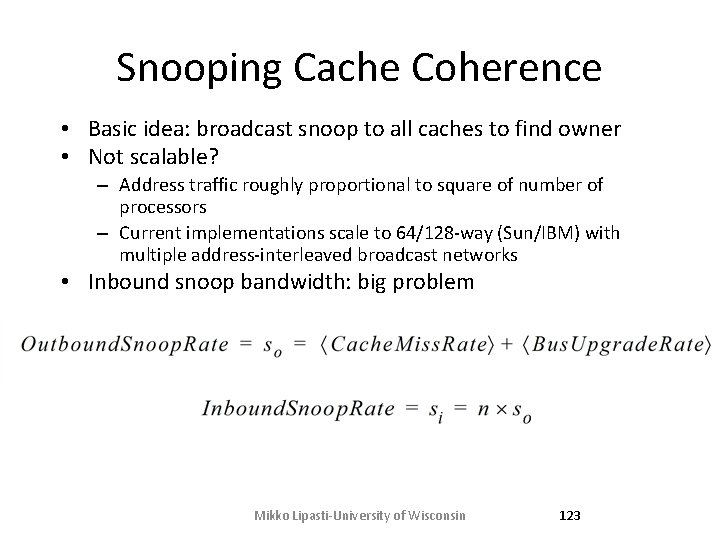
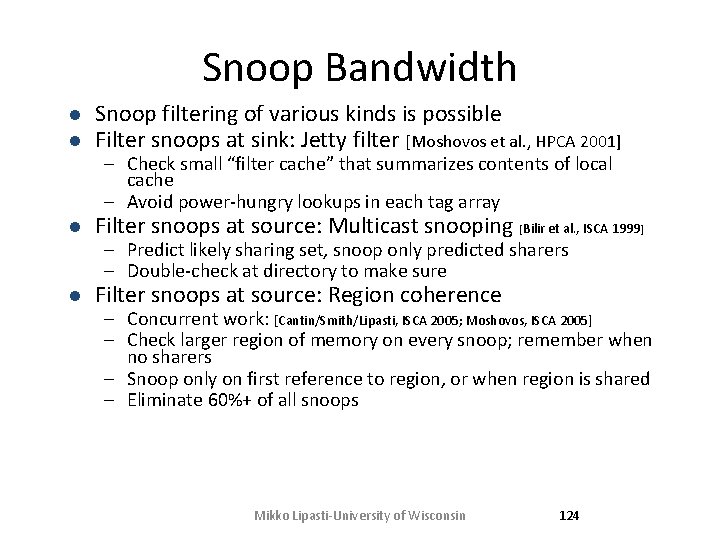
Snooping Cache Coherence • Basic idea: broadcast snoop to all caches to find owner • Not scalable? – Address traffic roughly proportional to square of number of processors – Current implementations scale to 64/128 -way (Sun/IBM) with multiple address-interleaved broadcast networks • Inbound snoop bandwidth: big problem Mikko Lipasti-University of Wisconsin 123
Snoop Bandwidth l l Snoop filtering of various kinds is possible Filter snoops at sink: Jetty filter [Moshovos et al. , HPCA 2001] l Filter snoops at source: Multicast snooping [Bilir et al. , ISCA 1999] l Filter snoops at source: Region coherence – Check small “filter cache” that summarizes contents of local cache – Avoid power-hungry lookups in each tag array – Predict likely sharing set, snoop only predicted sharers – Double-check at directory to make sure – Concurrent work: [Cantin/Smith/Lipasti, ISCA 2005; Moshovos, ISCA 2005] – Check larger region of memory on every snoop; remember when no sharers – Snoop only on first reference to region, or when region is shared – Eliminate 60%+ of all snoops Mikko Lipasti-University of Wisconsin 124
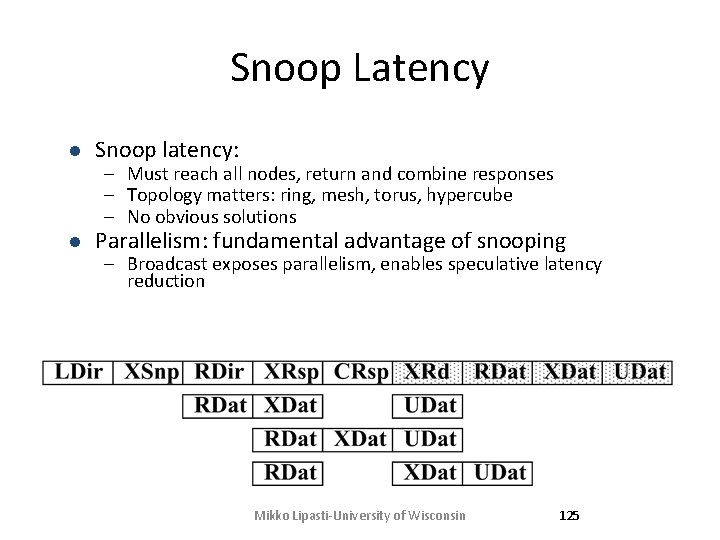
Snoop Latency l Snoop latency: l Parallelism: fundamental advantage of snooping – Must reach all nodes, return and combine responses – Topology matters: ring, mesh, torus, hypercube – No obvious solutions – Broadcast exposes parallelism, enables speculative latency reduction Mikko Lipasti-University of Wisconsin 125
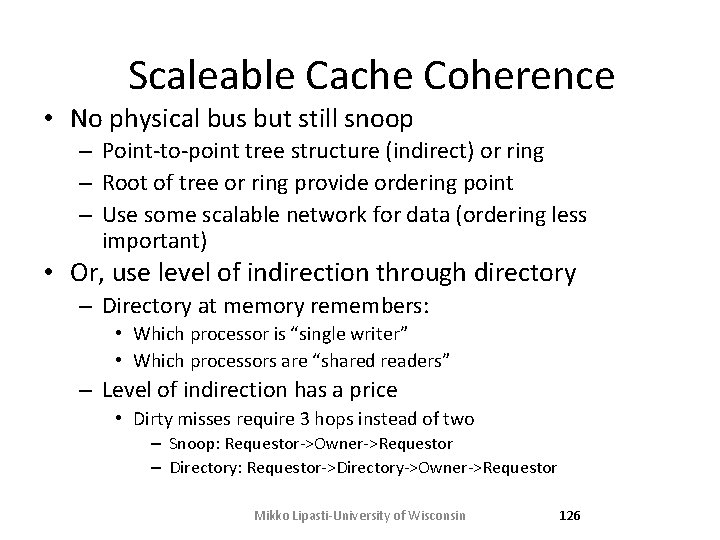
Scaleable Cache Coherence • No physical bus but still snoop – Point-to-point tree structure (indirect) or ring – Root of tree or ring provide ordering point – Use some scalable network for data (ordering less important) • Or, use level of indirection through directory – Directory at memory remembers: • Which processor is “single writer” • Which processors are “shared readers” – Level of indirection has a price • Dirty misses require 3 hops instead of two – Snoop: Requestor->Owner->Requestor – Directory: Requestor->Directory->Owner->Requestor Mikko Lipasti-University of Wisconsin 126
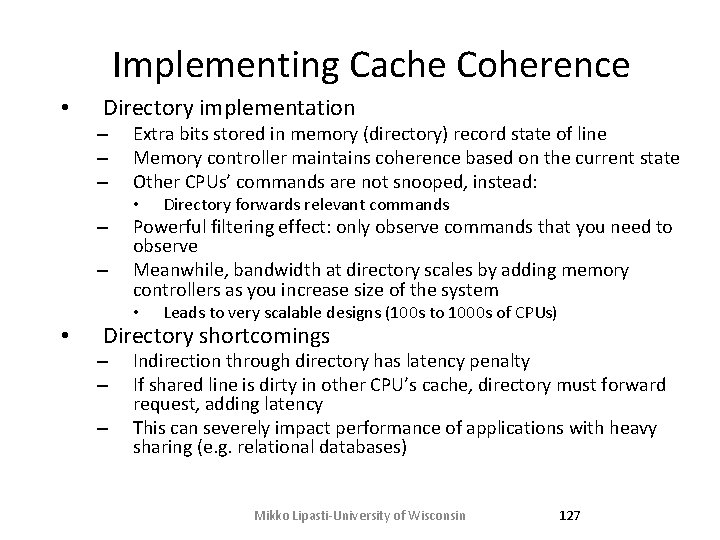
Implementing Cache Coherence • Directory implementation – – – Extra bits stored in memory (directory) record state of line Memory controller maintains coherence based on the current state Other CPUs’ commands are not snooped, instead: • – – • Directory forwards relevant commands Powerful filtering effect: only observe commands that you need to observe Meanwhile, bandwidth at directory scales by adding memory controllers as you increase size of the system • Leads to very scalable designs (100 s to 1000 s of CPUs) Directory shortcomings – – – Indirection through directory has latency penalty If shared line is dirty in other CPU’s cache, directory must forward request, adding latency This can severely impact performance of applications with heavy sharing (e. g. relational databases) Mikko Lipasti-University of Wisconsin 127
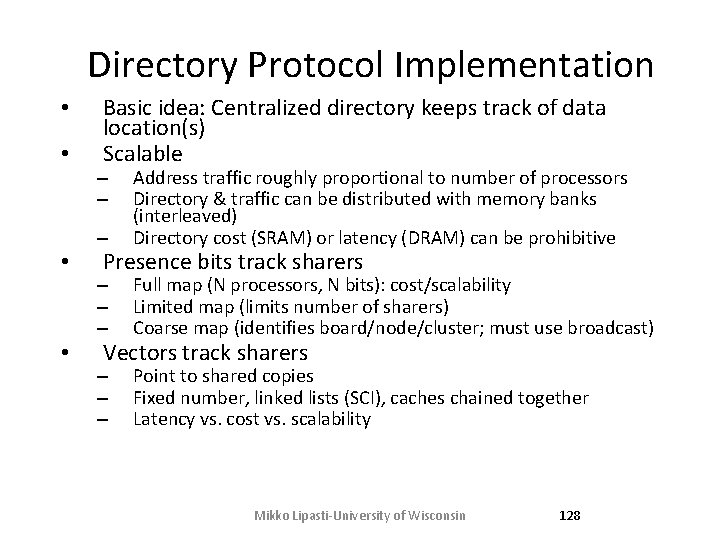
Directory Protocol Implementation • • Basic idea: Centralized directory keeps track of data location(s) Scalable – Address traffic roughly proportional to number of processors Directory & traffic can be distributed with memory banks (interleaved) Directory cost (SRAM) or latency (DRAM) can be prohibitive – – – Full map (N processors, N bits): cost/scalability Limited map (limits number of sharers) Coarse map (identifies board/node/cluster; must use broadcast) – – – Point to shared copies Fixed number, linked lists (SCI), caches chained together Latency vs. cost vs. scalability – – Presence bits track sharers Vectors track sharers Mikko Lipasti-University of Wisconsin 128
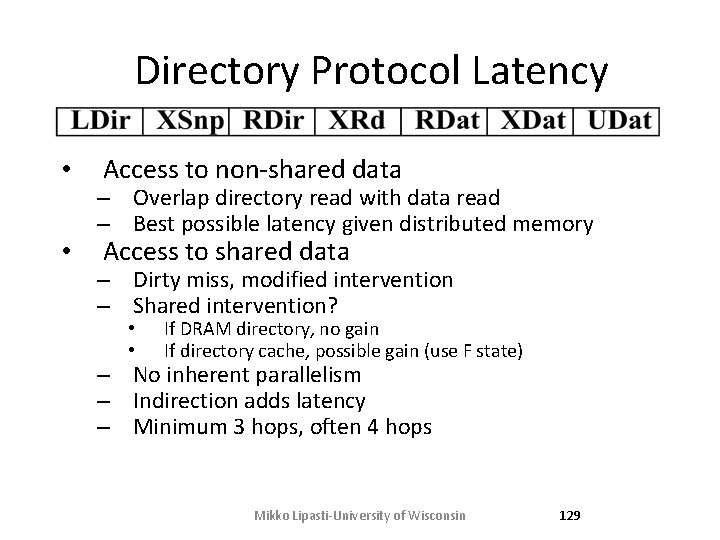
Directory Protocol Latency • • Access to non-shared data – Overlap directory read with data read – Best possible latency given distributed memory Access to shared data – Dirty miss, modified intervention – Shared intervention? • • If DRAM directory, no gain If directory cache, possible gain (use F state) – No inherent parallelism – Indirection adds latency – Minimum 3 hops, often 4 hops Mikko Lipasti-University of Wisconsin 129
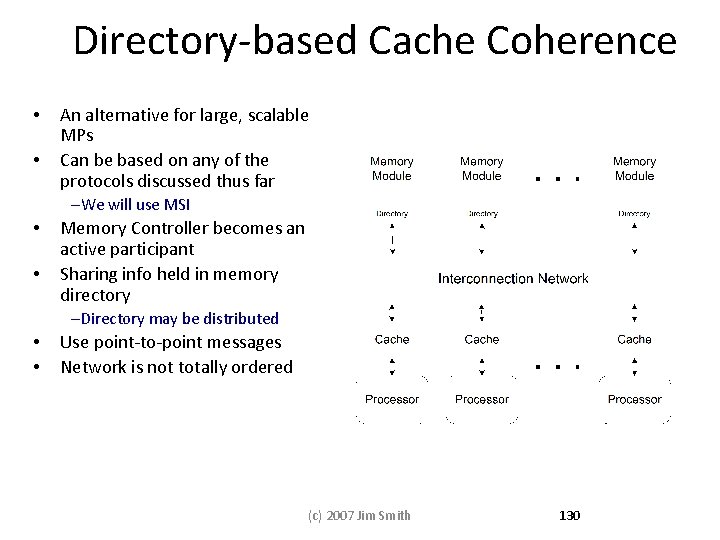
Directory-based Cache Coherence • • An alternative for large, scalable MPs Can be based on any of the protocols discussed thus far –We will use MSI • • Memory Controller becomes an active participant Sharing info held in memory directory –Directory may be distributed • • Use point-to-point messages Network is not totally ordered (c) 2007 Jim Smith 130
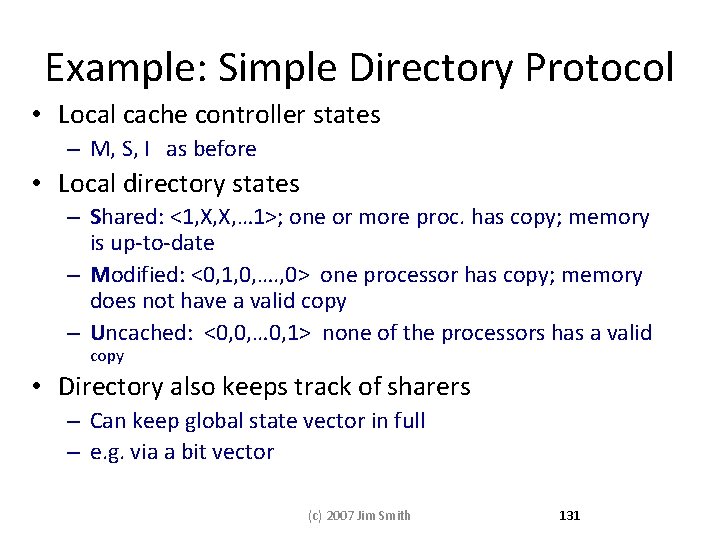
Example: Simple Directory Protocol • Local cache controller states – M, S, I as before • Local directory states – Shared: <1, X, X, … 1>; one or more proc. has copy; memory is up-to-date – Modified: <0, 1, 0, …. , 0> one processor has copy; memory does not have a valid copy – Uncached: <0, 0, … 0, 1> none of the processors has a valid copy • Directory also keeps track of sharers – Can keep global state vector in full – e. g. via a bit vector (c) 2007 Jim Smith 131
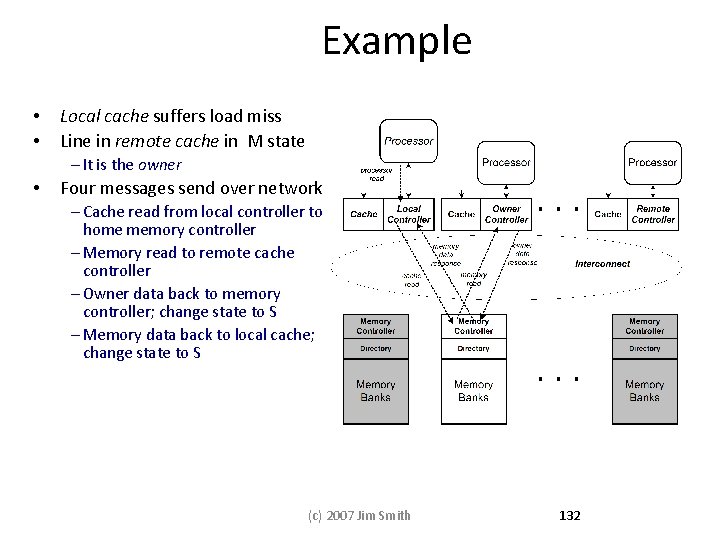
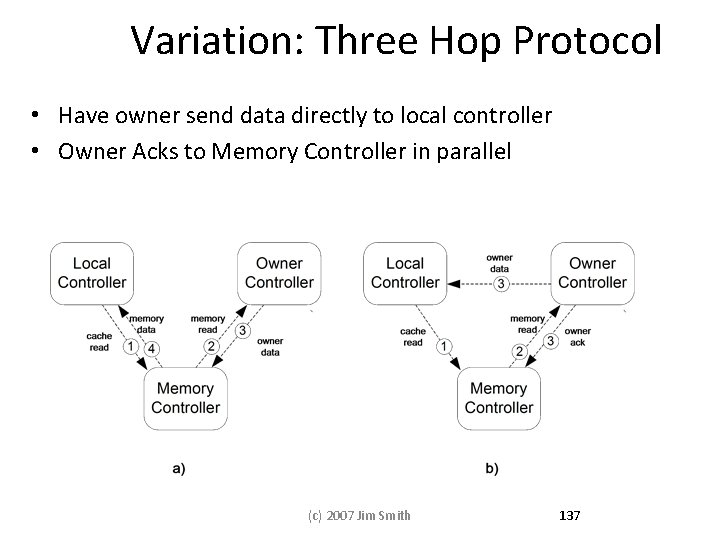
Example • • Local cache suffers load miss Line in remote cache in M state – It is the owner • Four messages send over network – Cache read from local controller to home memory controller – Memory read to remote cache controller – Owner data back to memory controller; change state to S – Memory data back to local cache; change state to S (c) 2007 Jim Smith 132
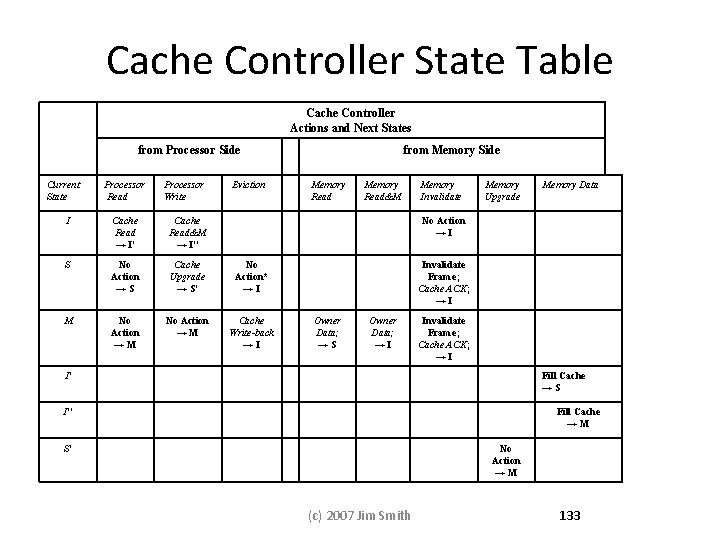
Cache Controller State Table Cache Controller Actions and Next States from Processor Side Current State Processor Read Processor Write from Memory Side Eviction Memory Read&M Memory Invalidate Memory Upgrade I Cache Read → I' Cache Read&M → I'' No Action → I S No Action → S Cache Upgrade → S' No Action* → I Invalidate Frame; Cache ACK; → I M No Action → M Cache Write-back → I Owner Data; → S Invalidate Frame; Cache ACK; → I Owner Data; → I I' Memory Data Fill Cache → S I'' Fill Cache → M S' No Action → M (c) 2007 Jim Smith 133
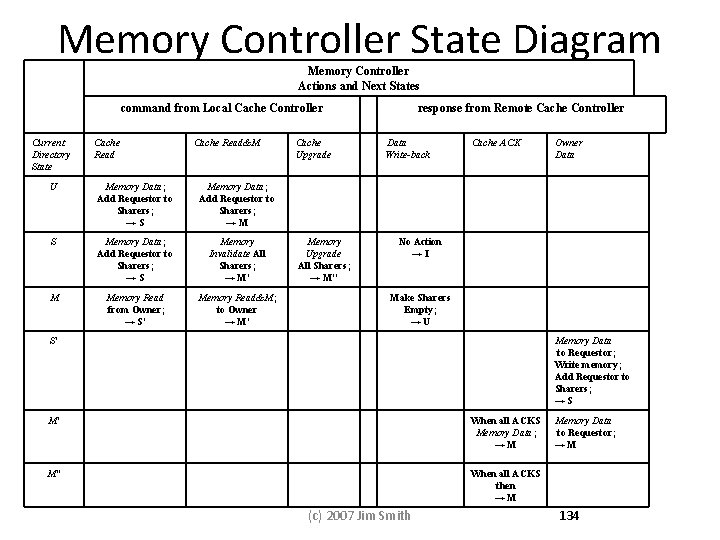
Memory Controller State Diagram Memory Controller Actions and Next States command from Local Cache Controller Current Directory State U S M Cache Read&M response from Remote Cache Controller Cache Upgrade Memory Data; Add Requestor to Sharers; → S Memory Data; Add Requestor to Sharers; → M Memory Data; Add Requestor to Sharers; → S Memory Invalidate All Sharers; → M' Memory Upgrade All Sharers; → M'' Memory Read from Owner; → S' Memory Read&M; to Owner → M' Data Write-back Cache ACK Owner Data No Action → I Make Sharers Empty; → U S' M' When all ACKS Memory Data; → M M'' Memory Data to Requestor; Write memory; Add Requestor to Sharers; → S Memory Data to Requestor; → M When all ACKS then → M (c) 2007 Jim Smith 134
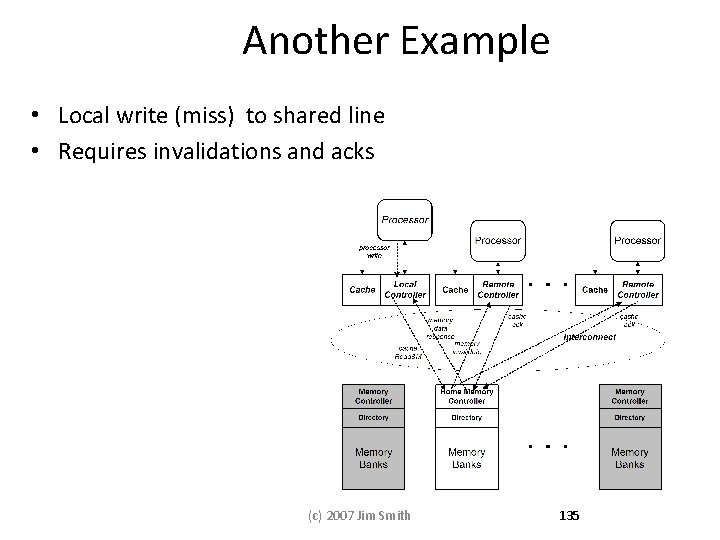
Another Example • Local write (miss) to shared line • Requires invalidations and acks (c) 2007 Jim Smith 135
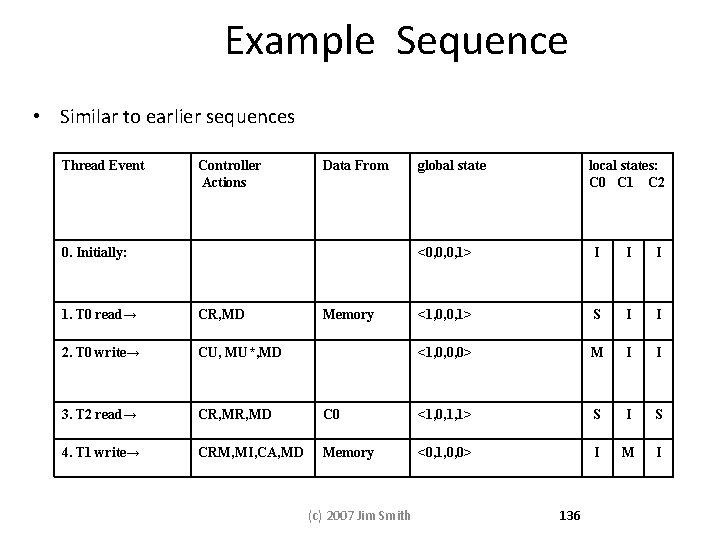
Example Sequence • Similar to earlier sequences Thread Event Controller Actions Data From 0. Initially: Memory global state local states: C 0 C 1 C 2 <0, 0, 0, 1> I I I <1, 0, 0, 1> S I I <1, 0, 0, 0> M I I 1. T 0 read→ CR, MD 2. T 0 write→ CU, MU*, MD 3. T 2 read→ CR, MD C 0 <1, 0, 1, 1> S I S 4. T 1 write→ CRM, MI, CA, MD Memory <0, 1, 0, 0> I M I (c) 2007 Jim Smith 136
Variation: Three Hop Protocol • Have owner send data directly to local controller • Owner Acks to Memory Controller in parallel (c) 2007 Jim Smith 137
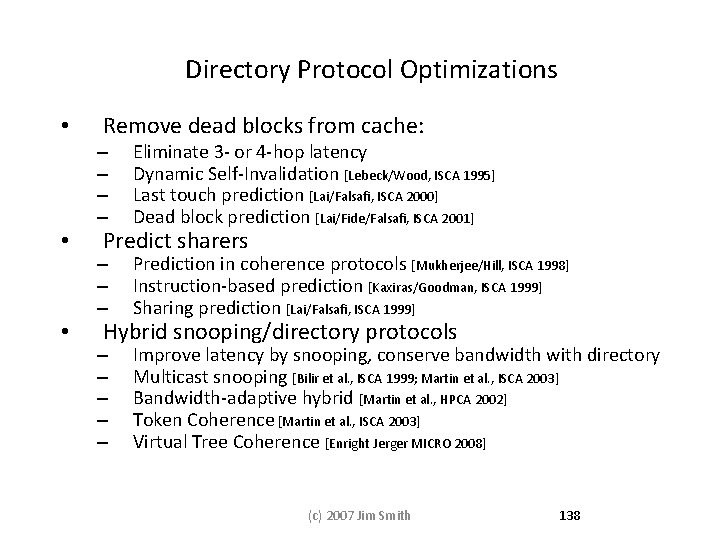
Directory Protocol Optimizations • • • Remove dead blocks from cache: – – Eliminate 3 - or 4 -hop latency Dynamic Self-Invalidation [Lebeck/Wood, ISCA 1995] Last touch prediction [Lai/Falsafi, ISCA 2000] Dead block prediction [Lai/Fide/Falsafi, ISCA 2001] – – – Prediction in coherence protocols [Mukherjee/Hill, ISCA 1998] Instruction-based prediction [Kaxiras/Goodman, ISCA 1999] Sharing prediction [Lai/Falsafi, ISCA 1999] – – – Improve latency by snooping, conserve bandwidth with directory Multicast snooping [Bilir et al. , ISCA 1999; Martin et al. , ISCA 2003] Bandwidth-adaptive hybrid [Martin et al. , HPCA 2002] Token Coherence [Martin et al. , ISCA 2003] Virtual Tree Coherence [Enright Jerger MICRO 2008] Predict sharers Hybrid snooping/directory protocols (c) 2007 Jim Smith 138
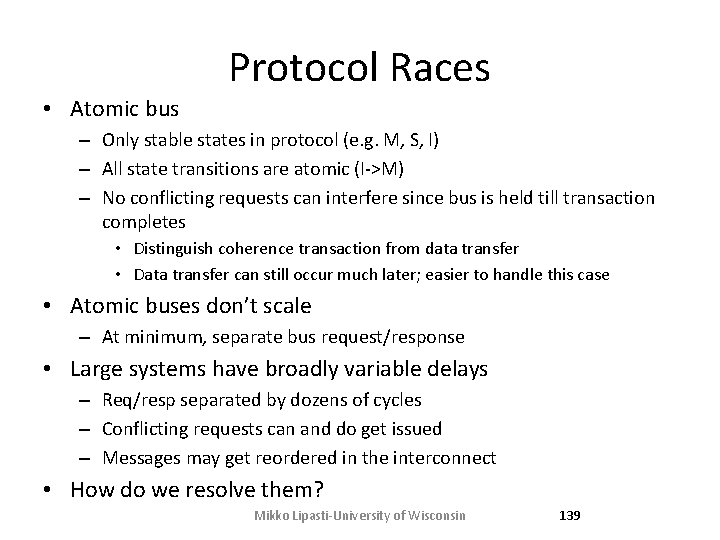
Protocol Races • Atomic bus – Only stable states in protocol (e. g. M, S, I) – All state transitions are atomic (I->M) – No conflicting requests can interfere since bus is held till transaction completes • Distinguish coherence transaction from data transfer • Data transfer can still occur much later; easier to handle this case • Atomic buses don’t scale – At minimum, separate bus request/response • Large systems have broadly variable delays – Req/resp separated by dozens of cycles – Conflicting requests can and do get issued – Messages may get reordered in the interconnect • How do we resolve them? Mikko Lipasti-University of Wisconsin 139
Example: MSI (SGI-Origin-like, directory, invalidate) Stable States Busy States Races “unexpected” events from concurrent requests to same block Mikko Lipasti-University of Wisconsin 140
Resolving Protocol Races • Req/resp decoupling introduces transient states – E. g. I->S is now I->Ito. X->Ito. S_nodata->S • Conflicting requests to blocks in transient states – NAK – ugly; livelock, starvation potential – Keep adding more transient states … • Directory protocol makes this a bit easier – Can order at directory, which has full state info – Even so, messages may get reordered Mikko Lipasti-University of Wisconsin 141
Common Protocol Races • Read strings: P 0 read, P 1 read, P 2 read – Easy, since read is nondestructive – Can rely on F state to reduce DRAM accesses – Forward reads to previous requestor (F) • Write strings: P 0 write, P 1 write, P 2 write – Forward P 1 write req to P 0 (M) – P 0 completes write then forwards M block to P 1 – Build string of writes (write string forwarding) • Read after write (similar to prev. WAW) • Writeback race: P 0 evicts dirty block, P 1 reads – Dirty block is in the network (no copy at P 0 or at dir) – NAK P 1, or force P 0 to keep copy till dir ACKs WB • Many others crop up, esp. with optimizations Mikko Lipasti-University of Wisconsin 142
Lecture 5 Outline • Main Memory and Cache Review • Caches and Replacement Policies • Cache Coherence – Coherence States – Snoopy bus-based Invalidate Protocols – Invalidate protocol optimizations – Update Protocols (Dragon/Firefly) – Directory protocols – Implementation issues Mikko Lipasti-University of Wisconsin 143
Additional Slides • For reference only Mikko Lipasti-University of Wisconsin 144
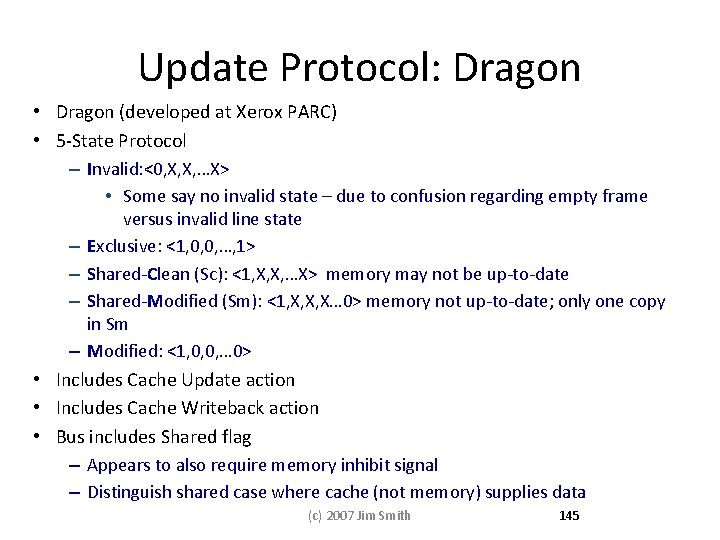
Update Protocol: Dragon • Dragon (developed at Xerox PARC) • 5 -State Protocol – Invalid: <0, X, X, …X> • Some say no invalid state – due to confusion regarding empty frame – – – versus invalid line state Exclusive: <1, 0, 0, …, 1> Shared-Clean (Sc): <1, X, X, …X> memory may not be up-to-date Shared-Modified (Sm): <1, X, X, X… 0> memory not up-to-date; only one copy in Sm Modified: <1, 0, 0, … 0> – • Includes Cache Update action • Includes Cache Writeback action • Bus includes Shared flag – Appears to also require memory inhibit signal – Distinguish shared case where cache (not memory) supplies data (c) 2007 Jim Smith 145
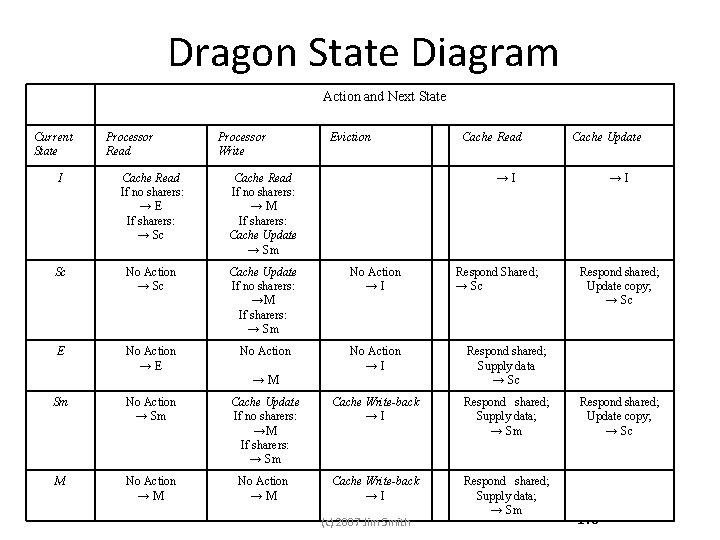
Dragon State Diagram Action and Next State Current State Processor Read Processor Write Eviction Cache Read If no sharers: → E If sharers: → Sc Cache Read If no sharers: → M If sharers: Cache Update → Sm Sc No Action → Sc Cache Update If no sharers: →M If sharers: → Sm No Action → I E No Action → E No Action → M No Action → I Respond shared; Supply data → Sc Sm No Action → Sm Cache Update If no sharers: →M If sharers: → Sm Cache Write-back → I Respond shared; Supply data; → Sm M No Action → M Cache Write-back → I Respond shared; Supply data; → Sm (c) 2007 Jim Smith Cache Update → I Respond Shared; → Sc → I Respond shared; Update copy; → Sc 146
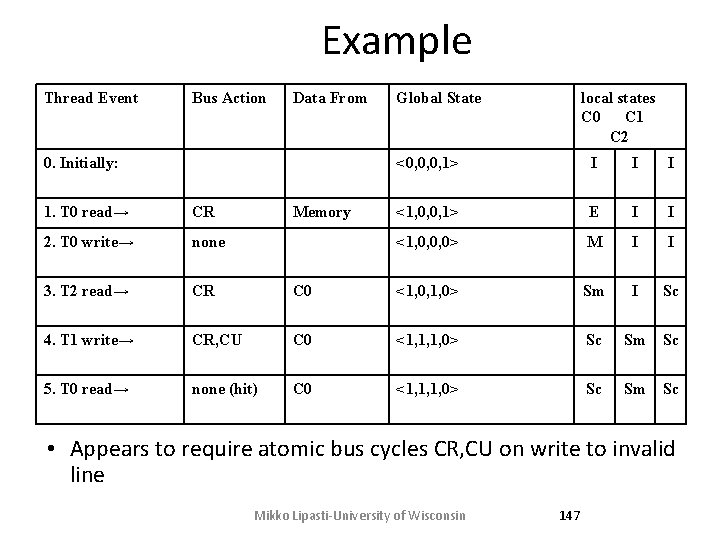
Example Thread Event Bus Action Data From 0. Initially: 1. T 0 read→ CR Memory 2. T 0 write→ none Global State local states C 0 C 1 C 2 <0, 0, 0, 1> I I I <1, 0, 0, 1> E I I <1, 0, 0, 0> M I I 3. T 2 read→ CR C 0 <1, 0, 1, 0> Sm I Sc 4. T 1 write→ CR, CU C 0 <1, 1, 1, 0> Sc Sm Sc 5. T 0 read→ C 0 <1, 1, 1, 0> Sc Sm Sc none (hit) • Appears to require atomic bus cycles CR, CU on write to invalid line Mikko Lipasti-University of Wisconsin 147
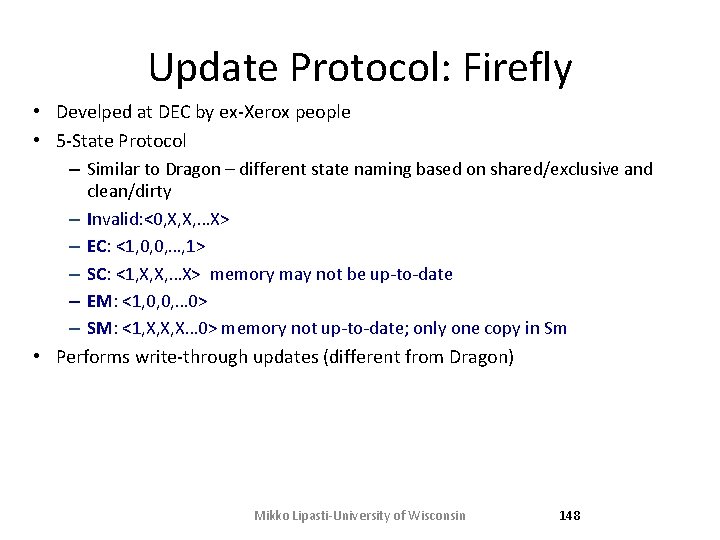
Update Protocol: Firefly • Develped at DEC by ex-Xerox people • 5 -State Protocol – Similar to Dragon – different state naming based on shared/exclusive and clean/dirty Invalid: <0, X, X, …X> EC: <1, 0, 0, …, 1> SC: <1, X, X, …X> memory may not be up-to-date EM: <1, 0, 0, … 0> SM: <1, X, X, X… 0> memory not up-to-date; only one copy in Sm – – – • Performs write-through updates (different from Dragon) Mikko Lipasti-University of Wisconsin 148