
Parks Wildlife Finland Mikko Tiira Development manager LIFE
- Slides: 91
Parks & Wildlife Finland Mikko Tiira, Development manager LIFE capacity building training Tallinn, Estonia 15. – 16. 12. 2016 1
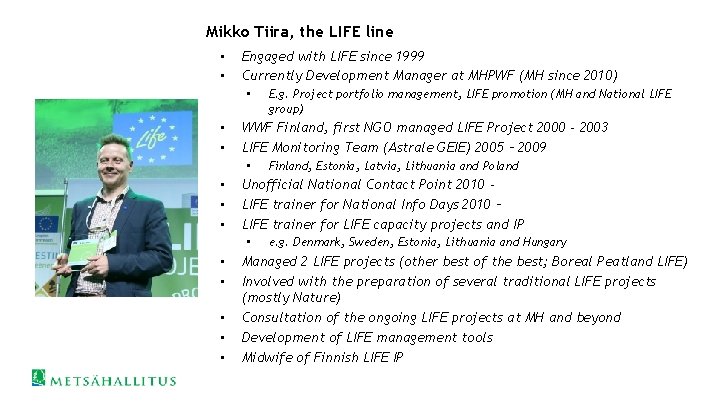
Mikko Tiira, the LIFE line • • Engaged with LIFE since 1999 Currently Development Manager at MHPWF (MH since 2010) • • • WWF Finland, first NGO managed LIFE Project 2000 - 2003 LIFE Monitoring Team (Astrale GEIE) 2005 – 2009 • • Finland, Estonia, Latvia, Lithuania and Poland Unofficial National Contact Point 2010 LIFE trainer for National Info Days 2010 – LIFE trainer for LIFE capacity projects and IP • • • E. g. Project portfolio management, LIFE promotion (MH and National LIFE group) e. g. Denmark, Sweden, Estonia, Lithuania and Hungary Managed 2 LIFE projects (other best of the best; Boreal Peatland LIFE) Involved with the preparation of several traditional LIFE projects (mostly Nature) Consultation of the ongoing LIFE projects at MH and beyond Development of LIFE management tools Midwife of Finnish LIFE IP
Program in nutshell 1. MH PWF in brief 2. LIFE projects of MH PWF 3. What is the LIFE programme? 4. LIFE characteristics 5. LIFE technical and financial issues – general conditions and typical pitfalls 6. Trouble tree, stakeholder analysis and logical framework as tool for project preparation 7. LIFE tools 8. Good quality LIFE proposal with e. Proposal 9. Projects and their management at MH PWF 10. Developing the project ideas with Logframe Continuous and open discussion!
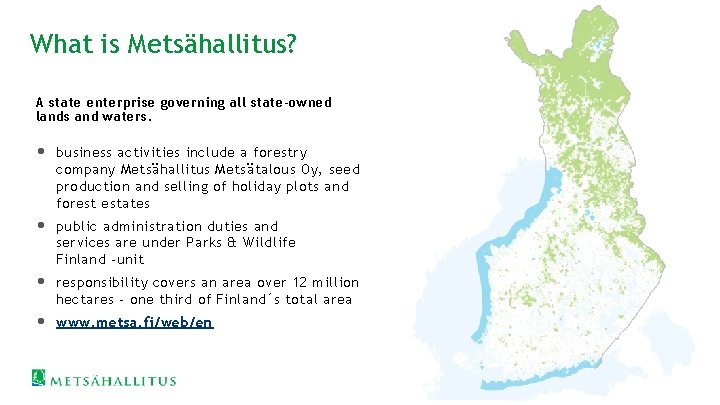
What is Metsähallitus? A state enterprise governing all state-owned lands and waters. • business activities include a forestry company Metsähallitus Metsätalous Oy, seed production and selling of holiday plots and forest estates • public administration duties and services are under Parks & Wildlife Finland -unit • responsibility covers an area over 12 million hectares - one third of Finland´s total area • www. metsa. fi/web/en
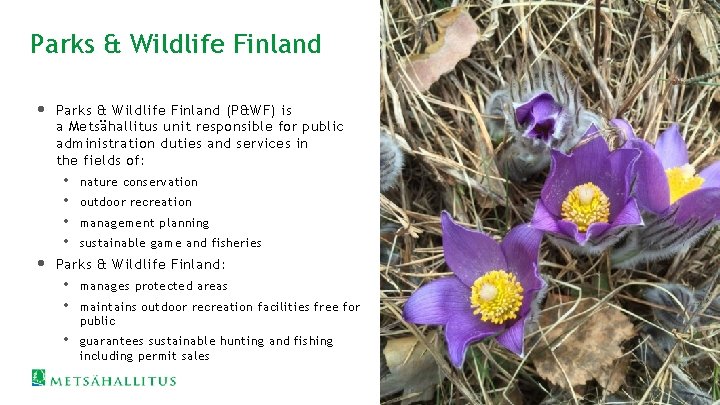
Parks & Wildlife Finland • • Parks & Wildlife Finland (P&WF) is a Metsähallitus unit responsible for public administration duties and services in the fields of: • • nature conservation outdoor recreation management planning sustainable game and fisheries Parks & Wildlife Finland: • • manages protected areas • guarantees sustainable hunting and fishing including permit sales maintains outdoor recreation facilities free for public
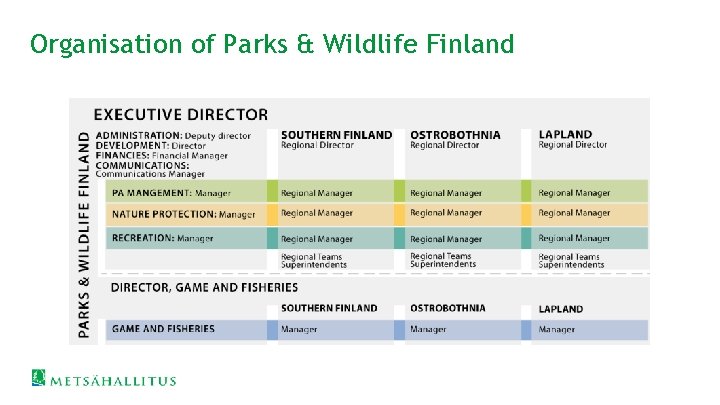
Organisation of Parks & Wildlife Finland
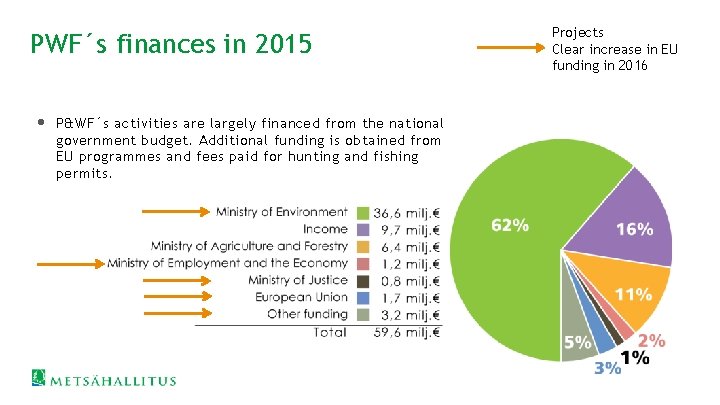
PWF´s finances in 2015 • P&WF´s activities are largely financed from the national government budget. Additional funding is obtained from EU programmes and fees paid for hunting and fishing permits. Projects Clear increase in EU funding in 2016
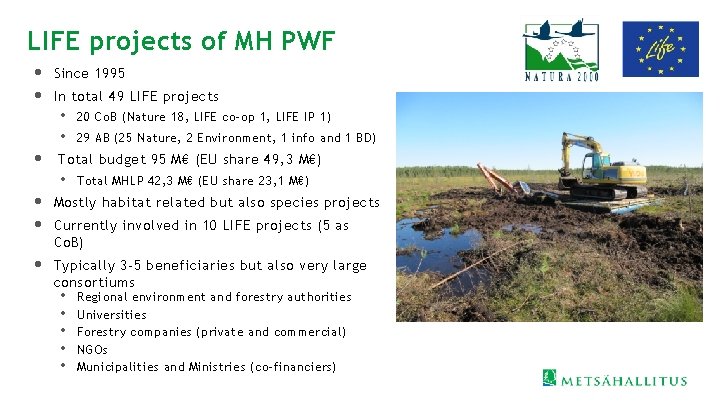
LIFE projects of MH PWF • • • Since 1995 In total 49 LIFE projects • • 20 Co. B (Nature 18, LIFE co-op 1, LIFE IP 1) 29 AB (25 Nature, 2 Environment, 1 info and 1 BD) Total budget 95 M€ (EU share 49, 3 M€) • Total MHLP 42, 3 M€ (EU share 23, 1 M€) • • Mostly habitat related but also species projects • Typically 3 -5 beneficiaries but also very large consortiums Currently involved in 10 LIFE projects (5 as Co. B) • • • Regional environment and forestry authorities Universities Forestry companies (private and commercial) NGOs Municipalities and Ministries (co-financiers)
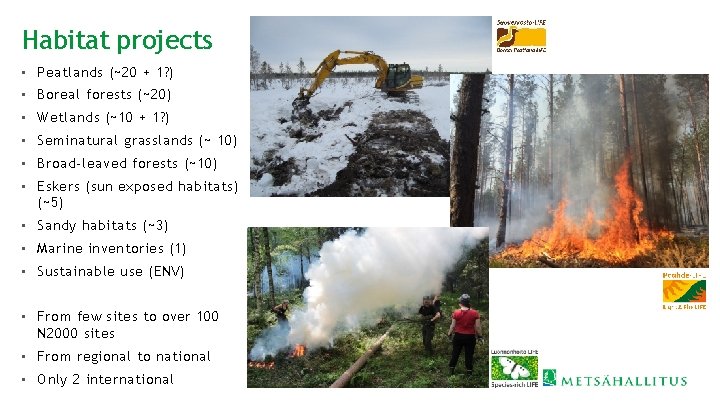
Habitat projects • Peatlands (~20 + 1? ) • Boreal forests (~20) • Wetlands (~10 + 1? ) • Seminatural grasslands (~ 10) • Broad-leaved forests (~10) • Eskers (sun exposed habitats) (~5) • Sandy habitats (~3) • Marine inventories (1) • Sustainable use (ENV) • From few sites to over 100 N 2000 sites • From regional to national • Only 2 international
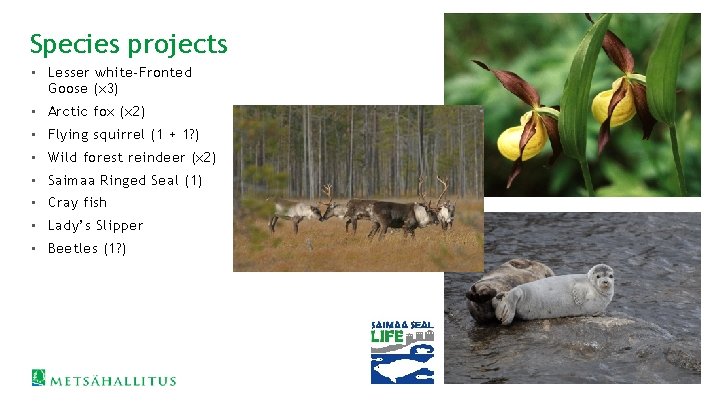
Species projects • Lesser white-Fronted Goose (x 3) • Arctic fox (x 2) • Flying squirrel (1 + 1? ) • Wild forest reindeer (x 2) • Saimaa Ringed Seal (1) • Cray fish • Lady’s Slipper • Beetles (1? )
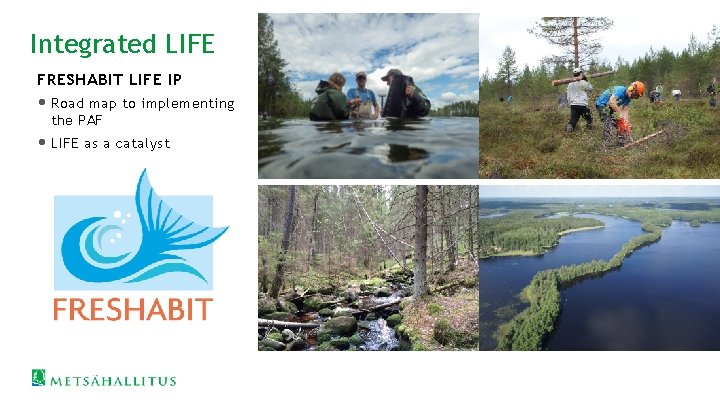
Integrated LIFE FRESHABIT LIFE IP • Road map to implementing the PAF • LIFE as a catalyst
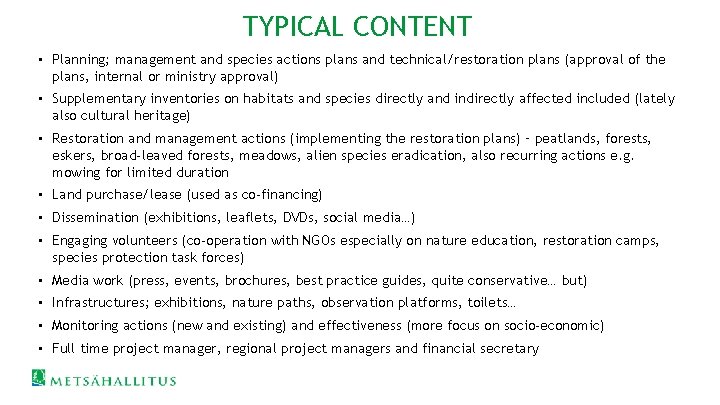
TYPICAL CONTENT • Planning; management and species actions plans and technical/restoration plans (approval of the plans, internal or ministry approval) • Supplementary inventories on habitats and species directly and indirectly affected included (lately also cultural heritage) • Restoration and management actions (implementing the restoration plans) – peatlands, forests, eskers, broad-leaved forests, meadows, alien species eradication, also recurring actions e. g. mowing for limited duration • Land purchase/lease (used as co-financing) • Dissemination (exhibitions, leaflets, DVDs, social media…) • Engaging volunteers (co-operation with NGOs especially on nature education, restoration camps, species protection task forces) • Media work (press, events, brochures, best practice guides, quite conservative… but) • Infrastructures; exhibitions, nature paths, observation platforms, toilets… • Monitoring actions (new and existing) and effectiveness (more focus on socio-economic) • Full time project manager, regional project managers and financial secretary
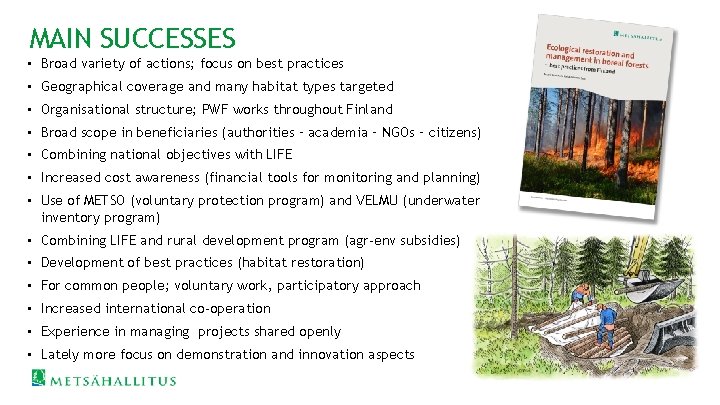
MAIN SUCCESSES • Broad variety of actions; focus on best practices • Geographical coverage and many habitat types targeted • Organisational structure; PWF works throughout Finland • Broad scope in beneficiaries (authorities – academia – NGOs – citizens) • Combining national objectives with LIFE • Increased cost awareness (financial tools for monitoring and planning) • Use of METSO (voluntary protection program) and VELMU (underwater inventory program) • Combining LIFE and rural development program (agr-env subsidies) • Development of best practices (habitat restoration) • For common people; voluntary work, participatory approach • Increased international co-operation • Experience in managing projects shared openly • Lately more focus on demonstration and innovation aspects
What is the LIFE Programme? Dedicated solely to the implementation of the EU environmental policies
Components of LIFE • "Traditional" Projects”: • LIFE Environment and Resource Efficiency (ENV) • LIFE Nature and Biodiversity (NAT) • LIFE Environmental Governance and Information (GIE) • LIFE Climate Change Mitigation (CCM) • LIFE Climate Change Adaptation (CCA) • LIFE Climate Governance and Information (GIC) • • Preparatory Projects Integrated Projects (sub-programme for environment ) Technical Assistance Projects (sub-programme for environment ) Capacity Building Projects
LIFE ENVIRONMENT AND RESOURCE EFFICIENCY • Objective: Implementation, updating and development of various • • Community environmental policy and legislation Actions related to Union policy on water, air, soil, urban environment, noise, chemicals, environment and health, waste and natural resources, forests Focus: To bridge the gap between research and development results and widespread implementation, and to promote innovative solutions with a public dimension Approach: Must be (EU wide) demonstration and/or pilot Fulfilling at least one project topic (MAWP) and preferable included in the indicative list topics for application round
LIFE ENVIRONMENT AND RESOURCE EFFICIENCY Linked to the following thematic priorities • • • Water, including the marine environment Waste Resource Efficiency, including soil and forests, and green and circular economy Environment and Health, including chemicals and noise Air quality and emissions, including urban environment LIFE Environment proposals should NOT focus on: • • Research and technological development activities Studies not specifically addressing the objective aimed at by the proposal Development of industrial capacity Project focusing solely or largely to climate issues (LIFE CLIMA)
LIFE NATURE AND BIODIVERSITY Nature • contributes to the implementation of the Birds and Habitats Directives (Council Directives 79/409 EEC and 92/43/EEC) –inside Natura 2000 network or contributing to its integrity Biodiversity • contributes to the implementation of the objectives of the Biodiversity Strategy to 2020 including Natura 2000 - must address wild fauna/flora
LIFE NATURE • Contributes to the implementation of the Birds and Habitats Directives (Council Directives 79/409 EEC and 92/43/EEC) • Must be best practice and/or demonstration projects and/or pilot • Long-term sustainable investments in Natura 2000 sites and on the conservation of species and habitats targeted by the Birds and Habitats Directives (focus on ‘unfavourables’) • Must contain Concrete Conservation Actions (CCA) (at least 25% of the LIFE project's budget) • Must fulfill compeletely at least one (max two) project topics of MAWP • EU funding up to 75% (for priority habitats or species, solely)
LIFE BIODIVERSITY • Contributes to the implementation of the objectives of the Biodiversity Strategy to 2020 • Best practice, demonstration or pilot (depending on the topic!) • The demonstration of measures and practices that contribute to halting the loss of biodiversity in the EU, other than those related to the implementation of the objectives of the Birds and Habitats Directives • Budget allocation minimum 25% for CCA • Proposals should focus on the project topics (MAWP); e. g. ecosystem services, green/blue infra, no-net-loss, alien invasive species • Compatible with national and/or regional strategies for biodiversity (if exists) • Proposals must address natural habitats and/or wild fauna/flora
LIFE CLIMATE ACTION LIFE Climate Change Mitigation contributes to the reduction of greenhouse gas emissions LIFE Climate Change Adaptation supports efforts leading to increased resilience to climate change
LIFE CLIMATE ACTION General objectives • to contribute to the shift towards a resource-efficient, low- carbon and climate-resilient economy • to improve the development, implementation and enforcement of Union climate policy and legislation • to act as a catalyst for, and promote, the integration and mainstreaming of climate objectives into other Union policies and public and private sector practice; • to support better climate governance at all levels, including better involvement of civil society, NGOs and local actors
LIFE CLIMATE ACTION Specific objectives/ conditions: • Improving and apply knowledge base in practice • Develop and implement integrated strategies and action plans • Develop and demonstrate innovative technologies, systems, methods and instruments for replication, transfer or instreaming, best practice • Emphasising the synergies with other policies • Small scale pilot, demonstration or best practice • Linked to project topics (MAWP) and preferably to the priorities for the application round
LIFE GOVERNANCE AND INFORMATION General objectives • • to promote awareness raising on environmental matters, including generating public and stakeholder support of Union policy-making in the field of the environment, and to promote knowledge on sustainable development and new patterns for sustainable consumption to support communication, management, and dissemination of information in the field of the environment, and to facilitate knowledge sharing on successful environmental solutions and practice, including by developing cooperation platforms among stakeholders and training; to promote and contribute to more effective compliance with and enforcement of Union environmental legislation, in particular by promoting the development and dissemination of best practices and policy approaches to promote better environmental governance by broadening stakeholder involvement, including NGOs, in consultation on and implementation of policy.
LIFE GOVERNANCE AND INFORMATION • Information and communication actions, awareness raising campaigns and skills development for implementing, updating and developing European environmental policy and legislation • Best practice sharing • Preferably related to the priorities set for the application round • Have to target a specific environmental problem • No need for demonstration or innovation
LIFE PROJECT CHARACTERISTICS • General issues common for all • LIFE NAT and BD specifics • Important administrative and financial conditions for proposal and the implementation • General advice • Problems/ pitfalls to avoid
LIFE PROJECT CHARACTERISTICS • Project period up to 10 years, but usually 5 -7 years • No budget limitations but over 10 M€ projects rare • Pure research actions not favored but OK if linked to the concrete actions or clearly justified for reaching the objectives • Ongoing actions not eligible if not clearly modified or justified that would be continued without LIFE funding • Sustainability of the results should be guaranteed and possible future funding convincingly explained • Complementary funding properly justified i. e. why LIFE and not other EU funds
LIFE PROJECT CHARACTERISTICS • Replicability and transferability should be included in the project and continue beyond the project period • Actions generally inside EU (exceptions apply in LIFE Nature and BD) • (True) international projects favoured
LIFE PROJECT CHARACTERISTICS • EU financing 60% (LIFE Nat max, 75%), Environment down to 50% from • • 2018 onwards Indicative national allocations until 2017, after which merit only Personnel cost, limitation for permanent staff of public bodies (2% rule) External assistance max 35% if not properly justified Durable goods, special depriciation rules apply (note the purchase date)
SPECIAL FEATURES OF LIFE NATURE AND BD • Recurring actions only limited duration (max 2/3 of the project duration) • • New recurring actions with demonstrative value OK Commitment for the continuity Sustainability: commitment from private landowners (min. 20 years), sustainablity of the project results (usually clear inside N 2000 areas) Approval processes e. g. for management plans approved before the end date, new methods/recommendations adopted – relevant authorities supporting (form A 8)
SPECIAL FEATURES OF LIFE NATURE AND BD • Land purchase for permanent protection OK if needed to reach the project objectives (check the checklist) • • • Not possible between public bodies Necessary for the concrete actions Areas bordering targeted habitats/species occurrence sites Short term lease OK for demonstration/pilot actions Actions for non SDF listed species/habitats not OK (unless Mo. E committed to supplement) Species reintroduction possible (check the checklist) • Feasibility (clear benefit, chance of suggest, financially viable, area under threat…)
SPECIAL FEATURES OF LIFE NATURE AND BD • Habitat actions outside N 2000 possible in principle but • • Direct benefits to Natura to be proofed (e. g. coherence), Site actions also appropriate legal or contractual protection to quarantee sustainability Exception for infrastructures linked to migration corridors; guarantee of sustainability Note that for species actions explanation how guaranteed in long term is sufficient no obligation for legal protection
LIFE BASIC FINANCIAL AND ADMINISTRATIVE CONDITIONS • Large infrastructure (over 500 000€) not (usually) eligible • Overhead max. 7% on direct eligible costs excludind the land acquisition • VAT eligible if non-recoverable and not related to public authority actions, VAT certificate from tax authorities and public authority action justification from the beneficiary • Full-time project manager favoured; pay attention to the project management • Actions generally: preparatory, concrete, monitoring, dissemination and management • Few mandatory actions (monitoring indicators, socio-economic and ecosystem function assessment, audit and LIFE dissemination actions)
LIFE BASIC FINANCIAL AND ADMINISTRATIVE CONDITIONS All based on • LIFE+ regulation • General conditions (Part A – Legal and Administrative Provisions Part B – Financial Provisions and Reporting) • Financial and administrative guidelines Check the LIFE homepage: http: //ec. europa. eu/environment/life/toolkit/pmtools/index. htm
LIFE BASIC FINANCIAL AND ADMINISTRATIVE CONDITIONS • Roles: Beneficiaries (Co. B, AB), Co-financiers, Subcontractors • Beneficiaries (legal person) registered in EU; public bodies, private • • • commercial and private not commercial (incl. NGO) All beneficiaries contribute own financing and receive EU funding (at least 1 euro), Arrange a proper project management (book keeping, personnel) All beneficiaries jointly responsible Ensure that all invoices and tendering documents bear reference to the project (code and name) No service or product procurement between beneficiaries
LIFE BASIC FINANCIAL AND ADMINISTRATIVE CONDITIONS Coordinating beneficiary • Signs the grant agreement • Concludes agreements with the associated beneficiaries describing their technical and financial participation in the project • It is granted a ‘mandate’ to represent all beneficiaries • Single Contact point for the Commission/Agency • Only participant reporting/establishing payment requests directly to the Commission/Agency • Ensures that payments are made to all partners (30 days after receiving payment from the Agency/Commission)
LIFE BASIC FINANCIAL AND ADMINISTRATIVE CONDITIONS Associated beneficiary • Provide the coordinating beneficiary with all supporting documents necessary for technical and financial reporting – information needed to write reports, financial statements, etc. (regularly, preferably every 3 months…) • Inform the CB of any change that might affect project implementation • Inform the CB of any change in its legal, financial, organisational or ownership situation (usually requires modification of the grant agreement)
LIFE BASIC FINANCIAL AND ADMINISTRATIVE CONDITIONS Co-financiers • Contribute financially to the project • Not involved in the implementation of project activities • Projects involving business-sector co-financing which contributes to the sustainability of project results – favourably considered during the evaluation process • Should not pay any invoices i. e. transfers euros for beneficiaries
LIFE BASIC FINANCIAL AND ADMINISTRATIVE CONDITIONS Subcontractors • Provide external services to the beneficiaries and receive the corresponding full price • Best value for money taking also the quality into account • No financial investment in the project • Public tendering for public beneficiaries (follow the process in every detail); EU and national legislation + internal rules • Private beneficiaries: for purchase exceeding € 130 000: open tendering procedure • Details of the work in the invoices (tasks implemented and dates)
LIFE BASIC FINANCIAL AND ADMINISTRATIVE CONDITIONS Subcontractors • Provide external services to the beneficiaries and receive the corresponding full price • Best value for money taking also the quality into account • No financial investment in the project • Public tendering for public beneficiaries (follow the process in every detail) • Private beneficiaries: for purchase exceeding € 130 000: open tendering procedure • Details of the work in the invoices (works and dates)
LIFE BASIC FINANCIAL AND ADMINISTRATIVE CONDITIONS Technical and financial reports • Every 18 months according to the guidelines at LIFE page • Report includes technical and a concise financial report • Comparison between realised and foreseen • Cost per action • Follow up of the time plan, deliverables and milestones • All reporting preferably in English • Financial sums by November for the Commission • Mid-term and final report including detailed financial report
LIFE BASIC FINANCIAL AND ADMINISTRATIVE CONDITIONS Payments of the EU contribution • General rule max 80% as prepayments and 20% as balance • 1 st pre-financing 30 % of contribution max. amount • 2 nd and 3 rd pre-financing = max 20% each • Final payment = balance maximum 30% • After at least 100 % of 1 st pre-financing has been used • Submitting the details re. auditor (Art. II. 24. 2) • Paid upon approval by the Agency/Commission of a request for payment and the technical progress report + statement of expenditure
LIFE BASIC FINANCIAL AND ADMINISTRATIVE CONDITIONS Payments of the EU contribution • General rule max 80% as prepayments and 20% as balance • 1 st pre-financing 30 % of contribution max. amount • 2 nd and 3 rd pre-financing = max 20% each • Final payment = balance maximum 30% • After at least 100 % of 1 st pre-financing has been used • Submitting the details re. auditor (Art. II. 24. 2) • Paid upon approval by the Agency/Commission of a request for payment and the technical progress report + statement of expenditure
LIFE BASIC FINANCIAL AND ADMINISTRATIVE CONDITIONS Eligible costs • Provided for in the budget of the project or have been authorized (when required) through an amendment to the grant agreement • Directly linked to, and necessary for, carrying out the project • Reasonable and comply with the principles of sound financial management • Compliant with applicable tax and social legislation • Incurred and recorded in the beneficiaries accounts during the lifetime of the project (except cost related to request for payment of balance & audit)
LIFE BASIC FINANCIAL AND ADMINISTRATIVE CONDITIONS Eligible costs • Indicated in the estimated budget and accepted by the Contracting Authority as necessary for project implementation • Costs are identifiable and verifiable (recorded in the accounting system) • They comply with the requirements of applicable tax and social legislation • They are reasonable and justified
LIFE BASIC FINANCIAL AND ADMINISTRATIVE CONDITIONS Flexibility rules • Changes in provisional budget (transfer between or within cost categories) less than 20% of the overall estimated costs acceptable • Check the changes with the Co. B and Monitoring Team/EASME beforehand • Costs inside budget category and between areas may be shifted between actions if targets are not jeopardised
LIFE BASIC FINANCIAL AND ADMINISTRATIVE CONDITIONS Flexibility rules • Changes in provisional budget (transfer between or within cost categories) less than 20% of the overall estimated costs acceptable • Check the changes with the Co. B and Monitoring Team/EASME beforehand • Costs inside budget category and between areas may be shifted between actions if targets are not jeopardised
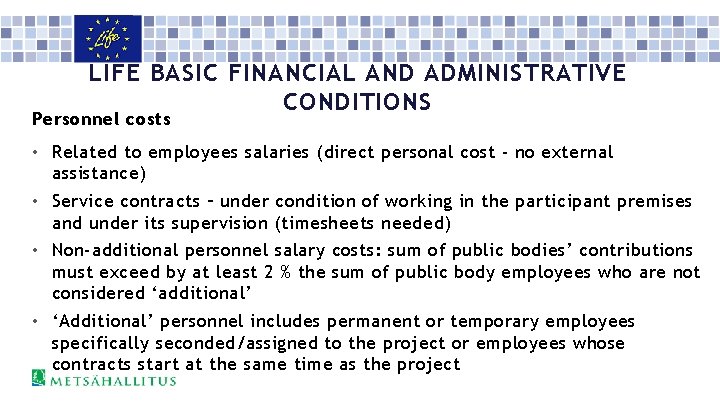
LIFE BASIC FINANCIAL AND ADMINISTRATIVE CONDITIONS Personnel costs • Related to employees salaries (direct personal cost - no external assistance) • Service contracts – under condition of working in the participant premises and under its supervision (timesheets needed) • Non-additional personnel salary costs: sum of public bodies’ contributions must exceed by at least 2 % the sum of public body employees who are not considered ‘additional’ • ‘Additional’ personnel includes permanent or temporary employees specifically seconded/assigned to the project or employees whose contracts start at the same time as the project
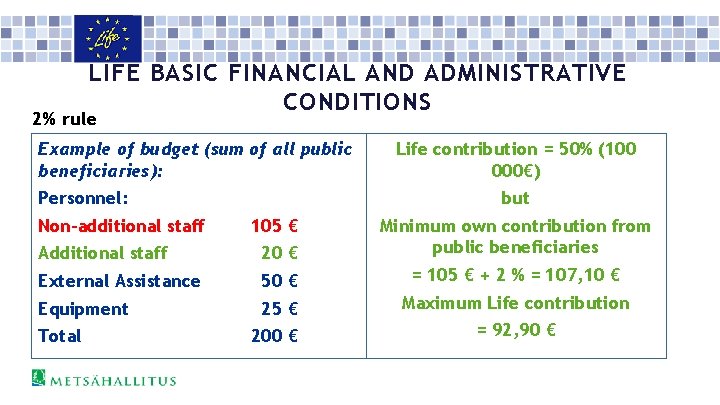
LIFE BASIC FINANCIAL AND ADMINISTRATIVE CONDITIONS 2% rule Example of budget (sum of all public beneficiaries): Personnel: Non-additional staff Life contribution = 50% (100 000€) but 105 € Additional staff 20 € Minimum own contribution from public beneficiaries External Assistance 50 € = 105 € + 2 % = 107, 10 € Equipment 25 € Maximum Life contribution Total 200 € = 92, 90 €
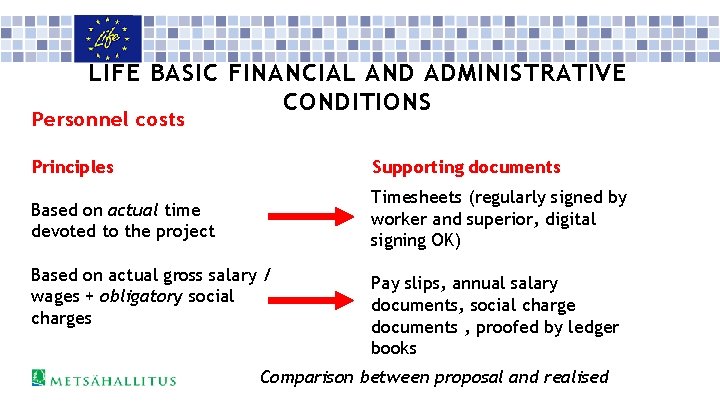
LIFE BASIC FINANCIAL AND ADMINISTRATIVE CONDITIONS Personnel costs Principles Supporting documents Based on actual time devoted to the project Timesheets (regularly signed by worker and superior, digital signing OK) Based on actual gross salary / wages + obligatory social charges Pay slips, annual salary documents, social charge documents , proofed by ledger books Comparison between proposal and realised
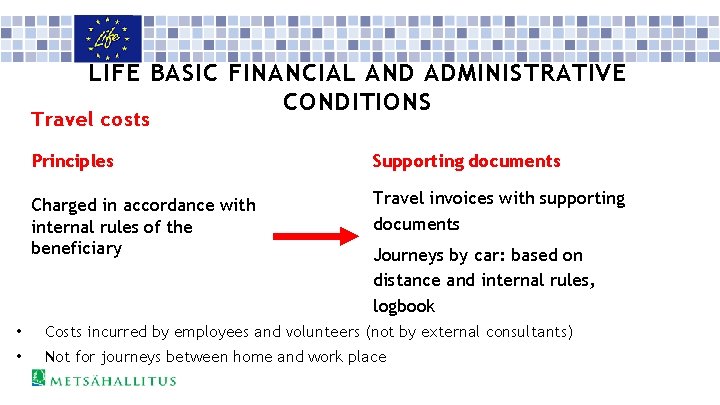
LIFE BASIC FINANCIAL AND ADMINISTRATIVE CONDITIONS Travel costs Principles Supporting documents Charged in accordance with internal rules of the beneficiary Travel invoices with supporting documents Journeys by car: based on distance and internal rules, logbook • Costs incurred by employees and volunteers (not by external consultants) • Not for journeys between home and work place
LIFE BASIC FINANCIAL AND ADMINISTRATIVE CONDITIONS External assistance Principles Supporting documents Follow applicable rules on tendering Tendering documentation Detailed invoices issued by the sub-contractor, with clear reference to the LIFE project and to the purchase order or the contract Clear info and tasks provided and dates Includes short term lease of land (expires prior to project end date, for Life NAT only)
LIFE BASIC FINANCIAL AND ADMINISTRATIVE CONDITIONS Durable goods • Charges relating to durable goods are eligible when the goods are : • Placed on the beneficiary's inventory of durable goods • Treated as capital expenditure • Depriciated yearly • Depreciation of durable goods already owned by beneficiaries at the start of the project is not eligible for LIFE funding • Each beneficiary shall apply its internal accounting standard/rules to calculate the actual depreciation charges
LIFE BASIC FINANCIAL AND ADMINISTRATIVE CONDITIONS Durable goods • Charges relating to durable goods are eligible when the goods are : • Placed on the beneficiary's inventory of durable goods • Treated as capital expenditure • Depriciated yearly • Depreciation of durable goods already owned by beneficiaries at the start of the project is not eligible for LIFE funding • Each beneficiary shall apply its internal accounting standard/rules to calculate the actual depreciation charges
LIFE BASIC FINANCIAL AND ADMINISTRATIVE CONDITIONS Durable goods • Exception for LIFE NAT • Infrastructure, equipment : • • 100% for public or non commercial beneficiaries • depreciated for other beneficiaries (25% / 50%) Reference to the project in the invoices (when possible, ask for new invoices)
LIFE BASIC FINANCIAL AND ADMINISTRATIVE CONDITIONS Land acquistion • Land purchase, one-off compensation payment, land swaps (!) • Approved foreseen areas in the proposal • Contracts (clause), parcel data, maps, area, taxes, costs, GIS data Consumable material / other costs • Explicitly used for project purposes
LIFE BASIC FINANCIAL AND ADMINISTRATIVE CONDITIONS Ineligible costs • • Costs in any category of expenditure over and above that foreseen in the budget (budget transfers accepted in line with art II. 22) Recoverable VAT and VAT of public authorities (unless public authorities provide an official certificate stating that VAT cannot be recovered for costs related to the project, only relevant for non-authority measures) Costs incurred in relation to activities not foreseen in the project Costs incurred for the purchase of durable goods or communication material not bearing the LIFE logo (and the Natura 2000 logo, when applicable)
LIFE BASIC FINANCIAL AND ADMINISTRATIVE CONDITIONS Ineligible costs • Costs incurred for an action which benefits from aid under other Union financial instruments • Costs related to any action considered as a compensatory measure • Costs related to management plans, action plans and similar plans, drafted or modified in the context of a LIFE project, if the related plan is not legally operational before the project end date • Exchange losses • Inkind contribution…. and many more….
GENERAL HINTS • Provide a clear, logical and coherent story; actions linked to objectives • • and related to clearly defined threats and problems Check that you engage the correct beneficiaries for reaching objectives Engage other beneficiaries at an early stage Analyse also which stakeholders are important to reach and influence Provide sufficient details for cost items Pay attention to the coherence between technical and financial parts Reserve enough time, invest in full-time project manager (if possible) Read the guidelines and address issues included in them! Check the general conditions (rules of the game)
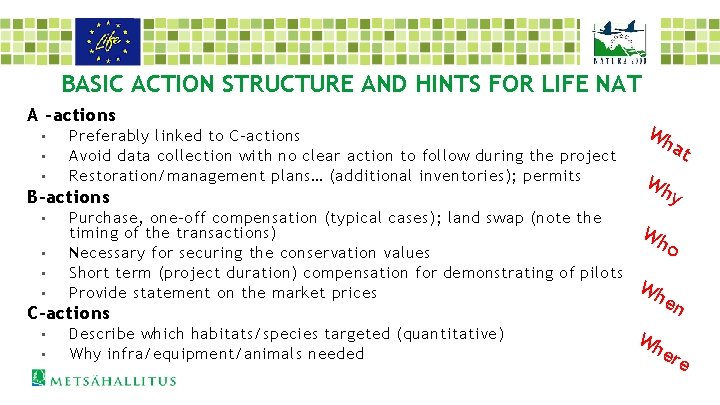
BASIC ACTION STRUCTURE AND HINTS FOR LIFE NAT A –actions • • • Preferably linked to C-actions Avoid data collection with no clear action to follow during the project Restoration/management plans… (additional inventories); permits B-actions • • Purchase, one-off compensation (typical cases); land swap (note the timing of the transactions) Necessary for securing the conservation values Short term (project duration) compensation for demonstrating of pilots Provide statement on the market prices C-actions • • Describe which habitats/species targeted (quantitative) Why infra/equipment/animals needed Wh a t Wh y Wh o Wh e n Wh e re
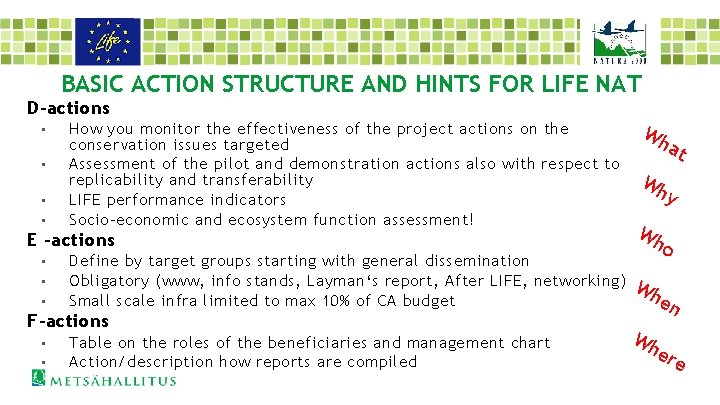
BASIC ACTION STRUCTURE AND HINTS FOR LIFE NAT D-actions • • How you monitor the effectiveness of the project actions on the conservation issues targeted Assessment of the pilot and demonstration actions also with respect to replicability and transferability LIFE performance indicators Socio-economic and ecosystem function assessment! E –actions • • • Define by target groups starting with general dissemination Obligatory (www, info stands, Layman‘s report, After LIFE, networking) Small scale infra limited to max 10% of CA budget F-actions • • Table on the roles of the beneficiaries and management chart Action/description how reports are compiled Wh a t Wh y Wh o Wh e n Wh e re
PROBLEMS TO AVOID • • • Actions not linked to objectives Actions vaguely described Links between actions missing, no coherent story Expected results not clearly measurable, lack of quantitave aspects Actions have only limited outcomes; locally important but not at EU level Sustainalibility not addressed Consortium not right for solving the problem Missing evidence on the effects of the actions Monitoring not clearly linked to the actions and effect of the project
PROBLEMS TO AVOID • • Dissemination and analysis of demonstration actions missing Over ambitious both for actions and timetable Project not related to the project topics or LIFE in general Lack of commitment for permits, legal adoption of plans Budget too vaguely described Links between technical and financial part missing 25% rule concrete conservation measures not fulfilled 2% rule i. e. too much permanent staff
GENERAL TOOLS FOR PROJECT PLANNING • • • Logical framework Problem tree Stakeholder analysis
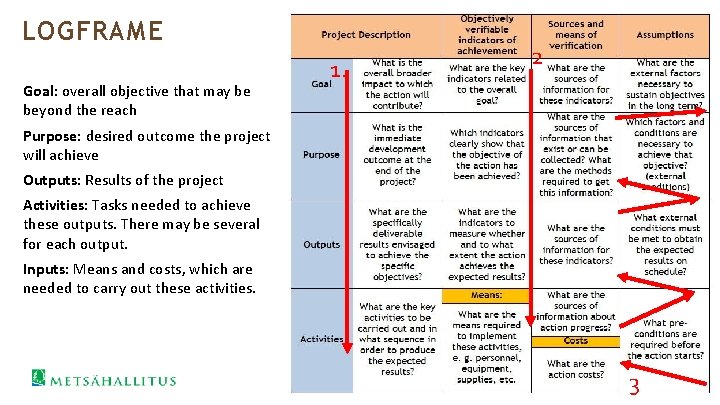
LOGICAL FRAMEWORK - LOGFRAME Why? - Ensures that the project is logically structured - Defining linkages between the project and external factors - During implementation, the logframe serves as the main reference for drawing up detailed work plans, terms of reference, budgets, etc. - A logframe provides indicators against which the project progress and achievements can be assessed - It provides a shared methodology and terminology among governments, donor agencies, contractors and clients Check e. g. http: //www. sswm. info/content/logical-framework-approach
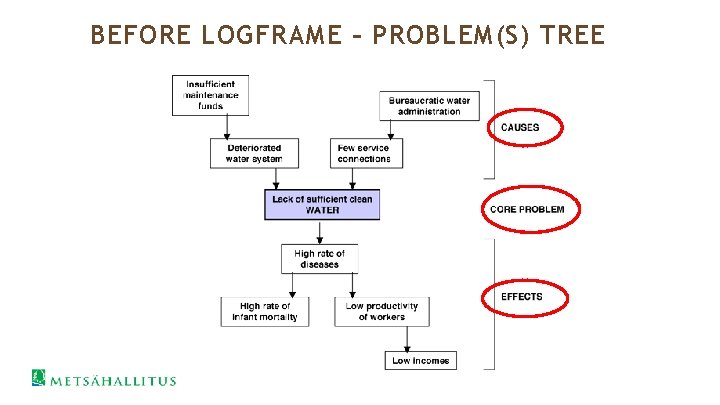
BEFORE LOGFRAME – PROBLEM(S) TREE
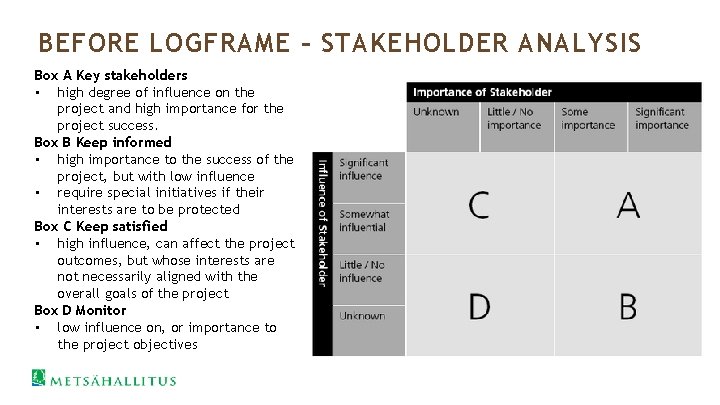
BEFORE LOGFRAME – STAKEHOLDER ANALYSIS Box A Key stakeholders • high degree of influence on the project and high importance for the project success. Box B Keep informed • high importance to the success of the project, but with low influence • require special initiatives if their interests are to be protected Box C Keep satisfied • high influence, can affect the project outcomes, but whose interests are not necessarily aligned with the overall goals of the project Box D Monitor • low influence on, or importance to the project objectives
LOGFRAME Goal: overall objective that may be beyond the reach 1. 2 Purpose: desired outcome the project will achieve Outputs: Results of the project Activities: Tasks needed to achieve these outputs. There may be several for each output. Inputs: Means and costs, which are needed to carry out these activities. 3
LOGICAL FRAMEWORK – LIFE VERSION See: separate doc-file
LIFE excel for budget Info needed for each budget heading General and Hydrology LIFE
e. Proposal
PROJECT ORGANISATION AT METSÄHALLITUS
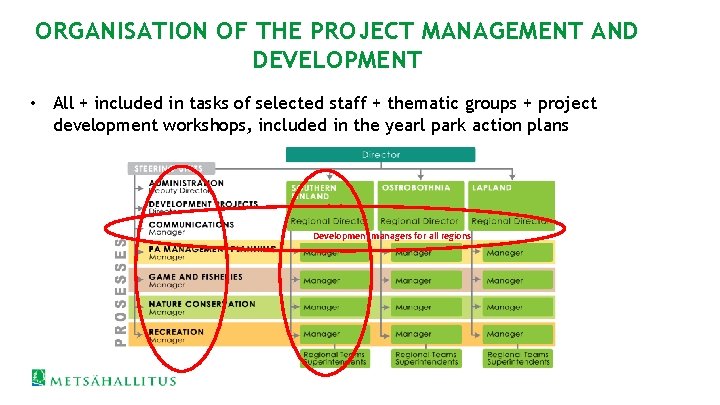
ORGANISATION OF THE PROJECT MANAGEMENT AND DEVELOPMENT • All + included in tasks of selected staff + thematic groups + project development workshops, included in the yearl park action plans Development managers for all regions
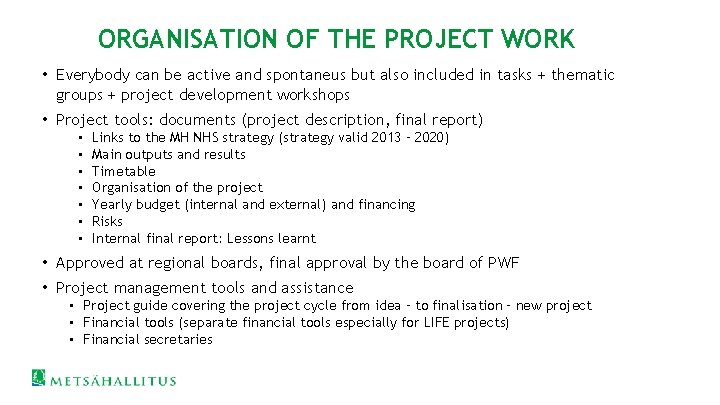
ORGANISATION OF THE PROJECT WORK • Everybody can be active and spontaneus but also included in tasks + thematic groups + project development workshops • Project tools: documents (project description, final report) • • Links to the MH NHS strategy (strategy valid 2013 – 2020) Main outputs and results Timetable Organisation of the project Yearly budget (internal and external) and financing Risks Internal final report: Lessons learnt • Approved at regional boards, final approval by the board of PWF • Project management tools and assistance • Project guide covering the project cycle from idea – to finalisation – new project • Financial tools (separate financial tools especially for LIFE projects) • Financial secretaries
LIFE ORGANISATION National level • LIFE Nature working group with key beneficiaries • Managed by the Mo. E (LIFE National Contact Point) • 1 -2 meetings a year; experience and ideas • Support for the project funding (and project proposal) MH level • Full time project manager for preparing proposal (at least for 6 months) • Nature conservation core • LIFE project team for each project (PM, LIFE expert and substance experts) • Workshops for engaging all processes, other sectors of MH and other beneficiaries • Project linked to core business, MH PWF Co. B, in other AS
LIFE PROPOSAL- GENERAL ISSUES • Use logical framework - logical story, actions linked to objectives (or relevant strategy conservation plan) • Project manager for each proposal • Coordination of the proposal • Partner meetings • Majority of the writing • No need for earlier LIFE experience required • Other person for preparing the budget, consistency, LIFE budgeting tables • Service unit for preparing maps • Aim to have the full proposal ready 3 weeks before the DL – time for fine tuning • Project analysis meeting app. 2 -3 weeks before the DL • More focus on transferability, replicability, uptake – capacity building
LIFE TOOLS LIFE financial management • Embedded in the financial management systems since 2010; careful coding and advising • Full time project secretaries (work effort always budgeted as direct cost) • All invoices checked and coded by expert, project manager, project secretary and approved by supervisor • LIFE timesheets embedded in time registry system • Yearly technical reporting from ABs – table format • Financial management meetings with ABs at the start of the project!!! • Link to financial tool • Link to simple technical reporting format • Link to time registry system
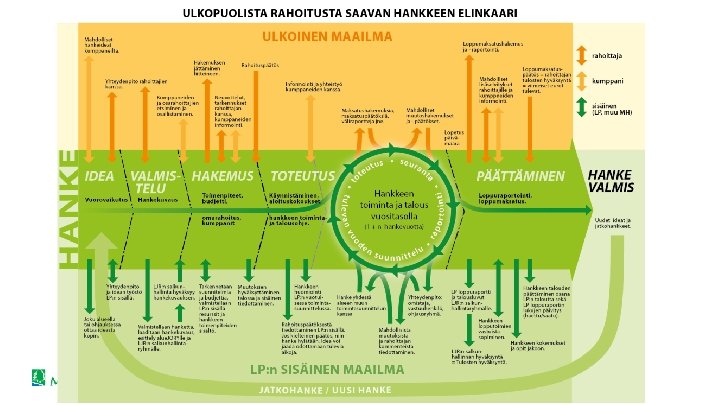
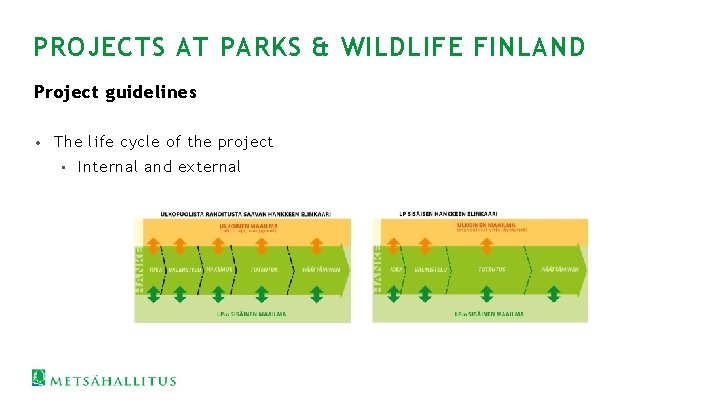
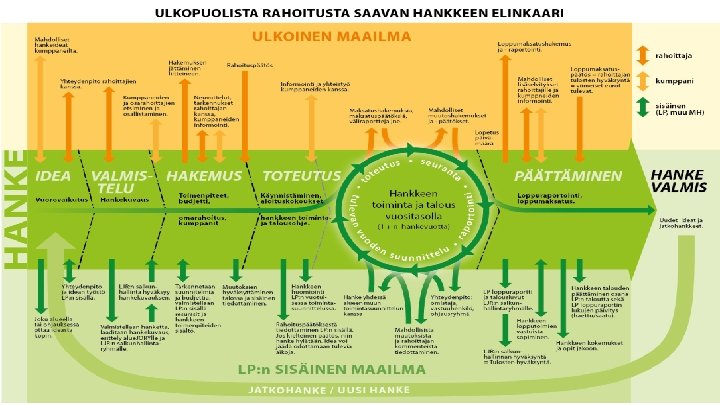
PROJECTS AT PARKS & WILDLIFE FINLAND Project guidelines • The life cycle of the project • Internal and external
PROJECTS AT PARKS & WILDLIFE FINLAND Project guidelines – general key issues • Project as part of overall operation of MH PWF • Defined roles: owner, responsible person, project manager, project secretary (development team, financial team) • Short summary of key funding mechanisms • Vocabulary! • Sections: project planning and implementation
PROJECTS AT PARKS & WILDLIFE FINLAND Planning the projects • Logframe with samples • instructions for the budget planning (e. g. personnel costs, VAT, indirect costs) • Communication inside MHPWF, with partners and with financiers • Communication actions in projects • Sample applications • Necessary annexes to the proposals e. g. VAT certificate, official signateurs, tax certificates
PROJECTS AT PARKS & WILDLIFE FINLAND Implementing projects • Preparation of technical and financial guidelines for all projects (defined structure) • Financial management and monitoring – general principles and tools • Yearly technical and financial planning as part of MH operations • Internal and external opening meetings (defined agenda) • Public procurement with samples documents • Audit • Implementing communication • Data and document management • Sample reports
PROJECTS AT PARKS & WILDLIFE FINLAND • Currently app. 150 projects ongoing funded from several sources • Internal projects • Nature conservation process changes to project based process • Additional funding from state budget • Also management plans and investments • External funding from various sources • Project types managed with project code series and funding program specific fundng codes
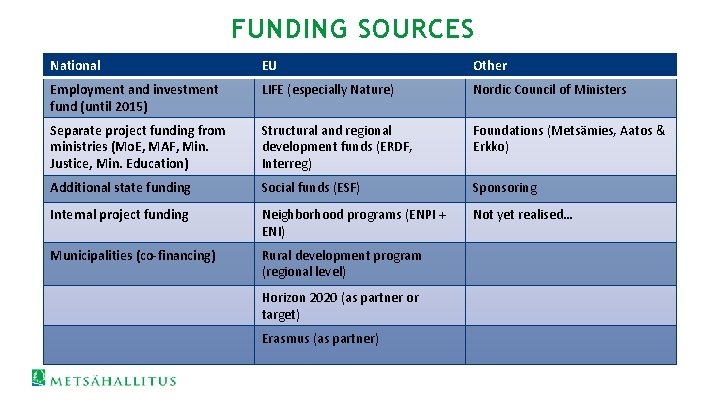
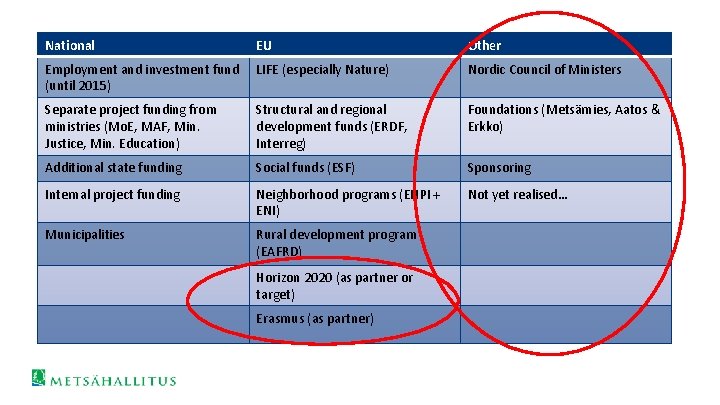
FUNDING SOURCES National EU Other Employment and investment fund (until 2015) LIFE (especially Nature) Nordic Council of Ministers Separate project funding from ministries (Mo. E, MAF, Min. Justice, Min. Education) Structural and regional development funds (ERDF, Interreg) Foundations (Metsämies, Aatos & Erkko) Additional state funding Social funds (ESF) Sponsoring Internal project funding Neighborhood programs (ENPI + ENI) Not yet realised… Municipalities (co-financing) Rural development program (regional level) Horizon 2020 (as partner or target) Erasmus (as partner)
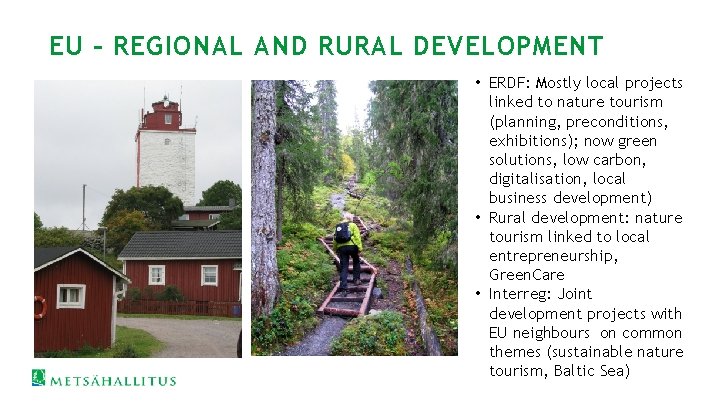
EU – REGIONAL AND RURAL DEVELOPMENT • ERDF: Mostly local projects linked to nature tourism (planning, preconditions, exhibitions); now green solutions, low carbon, digitalisation, local business development) • Rural development: nature tourism linked to local entrepreneurship, Green. Care • Interreg: Joint development projects with EU neighbours on common themes (sustainable nature tourism, Baltic Sea)
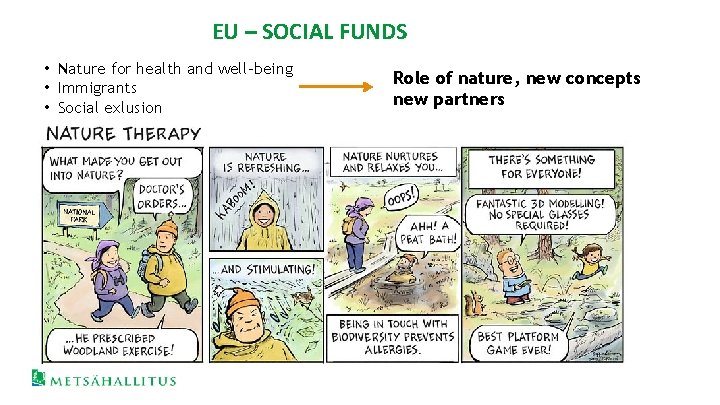
EU – SOCIAL FUNDS • Nature for health and well-being • Immigrants • Social exlusion Role of nature, new concepts new partners
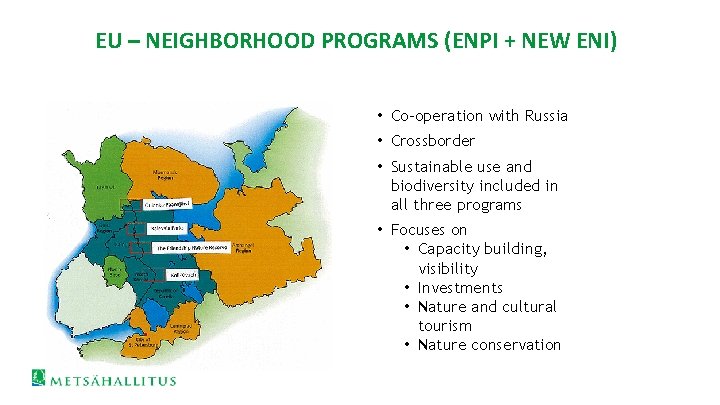
EU – NEIGHBORHOOD PROGRAMS (ENPI + NEW ENI) • Co-operation with Russia • Crossborder • Sustainable use and biodiversity included in all three programs • Focuses on • Capacity building, visibility • Investments • Nature and cultural tourism • Nature conservation
National EU Other Employment and investment fund (until 2015) LIFE (especially Nature) Nordic Council of Ministers Separate project funding from ministries (Mo. E, MAF, Min. Justice, Min. Education) Structural and regional development funds (ERDF, Interreg) Foundations (Metsämies, Aatos & Erkko) Additional state funding Social funds (ESF) Sponsoring Internal project funding Neighborhood programs (ENPI + ENI) Not yet realised… Municipalities Rural development program (EAFRD) Horizon 2020 (as partner or target) Erasmus (as partner)