Traces of Low German Influence on Finnish in
- Slides: 12
Traces of Low German Influence on Finnish in the Middle Ages Mikko Bentlin University of Greifswald, Germany mikko. bentlin@uni-greifswald. de
� Moi!
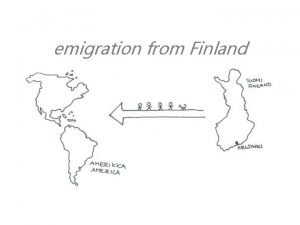
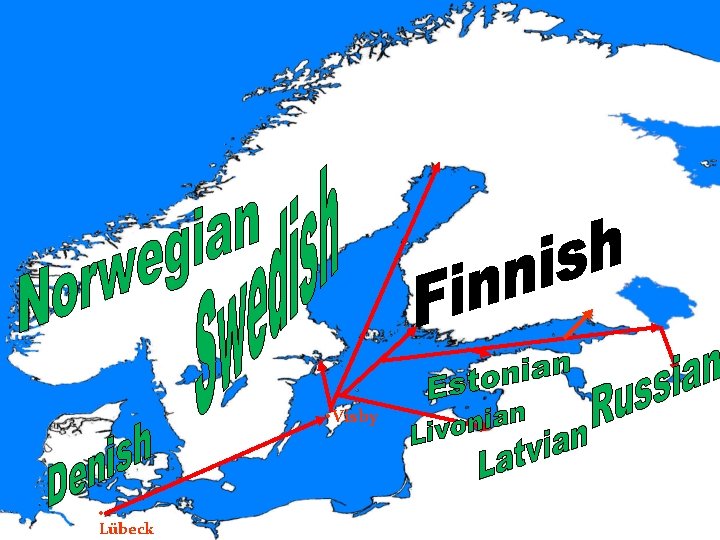
Finland in the th 12 Century �Politics: Incorporation into the Swedish realm �Religion: Christianization from both East and West �Economy: Beginning domination of the Hanseatic League around the whole Baltic Sea, combined with German eastward expansion on the Southern and Eastern shores �Finns came into contact with Low-German speakers on all these areas of life
• Visby • Lübeck
Chronology of Low German �Separate language within the West Germanic branch of Germanic, Fi. alasaksa, Germ. Niederdeutsch �Old Saxon = Old Low German about 800– 1150/1200 AD, had great similarities with Old Dutch, being at the same time rather different from Old High German. �Gap in documentation between appr. 1150 and 1250 �Middle Low German about 1250– 1600, always under pressure from the more prestigious High German
Chronology of Low German (2) �Reformation and Luther‘s Bible translation speeded up the decline of Low German as a literary language �In the Baltics, the use of Low German ended quite rapidly because there were almost no native speakers in the numerally larger lower classes and thus no relevant dialectal basis for further development �Even in areas with Low German-speaking majorities, the language lost its position as written standard.
Swedish or Low German? �A great part of the Swedish lexicon is of Low German origin �Swedish was the language of administration and dominated up to the 20 th century �Influence from both Standard Swedish and Swedish dialects spoken in Finland �Low German was the dominanat language in economic affairs �The institution of the city was introduced according to German models and until 1471 Germans were supposed to hold half of the posts in city councils and mayors‘ offices
Possible distinction criteria � 1. Phonetical criteria: �Difficult, because most possible Swedish and Low German originals are more or less identical �Remarkable exception: Sequence /ouv/ (e. g. in rouva 'lady', touvi 'rope') points to Low German origin �Germanic feminine nouns ending in a vowel that has been replaced by Fi. -u/-y e. g. Fi. lykky 'luck' as Swedish retained -o/-u in oblique cases much longer than Low German
Possible distinction criteria � 2. ) Semantic criteria �Non-existence of a word in either Low German or Swedish: �E. g. Fi. dial. laatta 'sand bank' should be of Low German origin, while laatta 'plate' can be borrowed from either Swedish or Low German
Possible distinction criteria �Most Low German borrowings in the fields of �a) Church and Christian religion (kirkko 'church', rauha 'peace', ? sielu 'soul') �b) Fishery (monni 'wels catfish, silurus glanis', rysä 'fish trap') �c) Craft, trade and urban life (ammatti 'profession', rouva 'lady', räätäli 'tailor')
Possible distinction criteria � 3. ) Distributional criteria �Most obvious Low German loans are found in South Eastern dialects that historically belonged to the economical hinterland of the city Vyborg (Viipuri). �Another gate into Finland may have been the valley of the River Kokemäenjoki where some words of Low German origin must have lived for centuries without spreading into other Finnish dialects. (e. g. asikko 'small salmon or trout', katve 'shadow')
Conclusion �Low German loanwords in Finnish open quite a new perspective on cross-cultural contacts in the Baltic Sea area as well as the history of both languages. �Low German loanwords in Finnish cover a wide range of medieval everyday life. Borrowed conjunctions and particles such as entä and vaan seem to have had some structural influence on Finnish. �Low German loanwords are obviously more numerous than e. g. the more widely known Indo-Iranian loanword layer in Finnish.