Finnish Education Evaluation Centre FINEEC Independent expert organisation
- Slides: 29
Finnish Education Evaluation Centre
FINEEC • Independent expert organisation • 1 st of May 2014 → • Responsible for external evaluation at all levels of education in Finland • Finnish higher evaluation council over 20 years
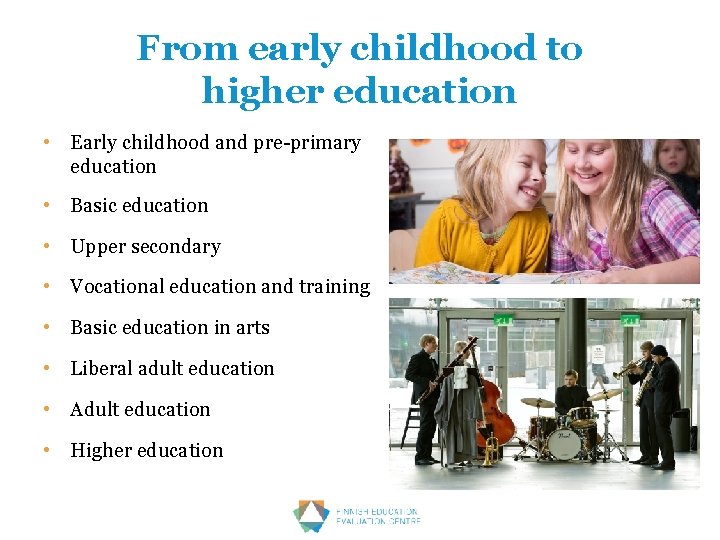
From early childhood to higher education • Early childhood and pre-primary education • Basic education • Upper secondary • Vocational education and training • Basic education in arts • Liberal adult education • Adult education • Higher education
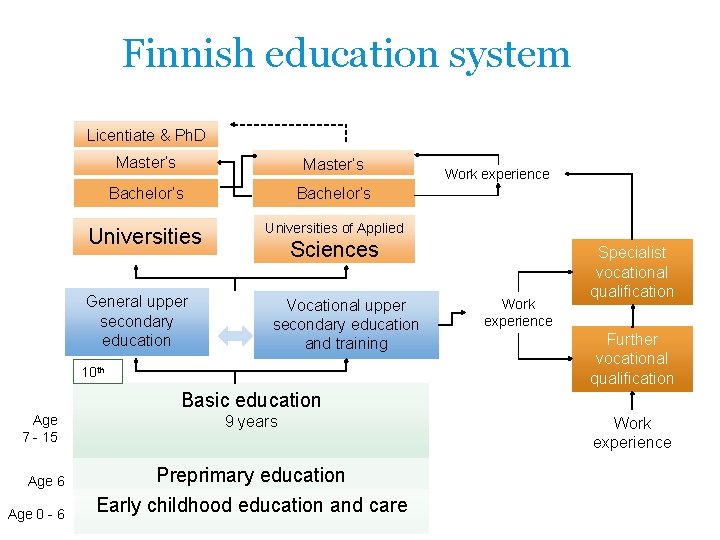
Finnish education system Licentiate & Ph. D Master’s Bachelor’s Universities of Applied General upper secondary education Work experience Sciences Vocational upper secondary education and training 10 th Work experience Specialist vocational qualification Further vocational qualification Basic education Age 7 - 15 Age 6 Age 0 - 6 9 years Preprimary education Early childhood education and care Work experience
FINEEC’s organisation
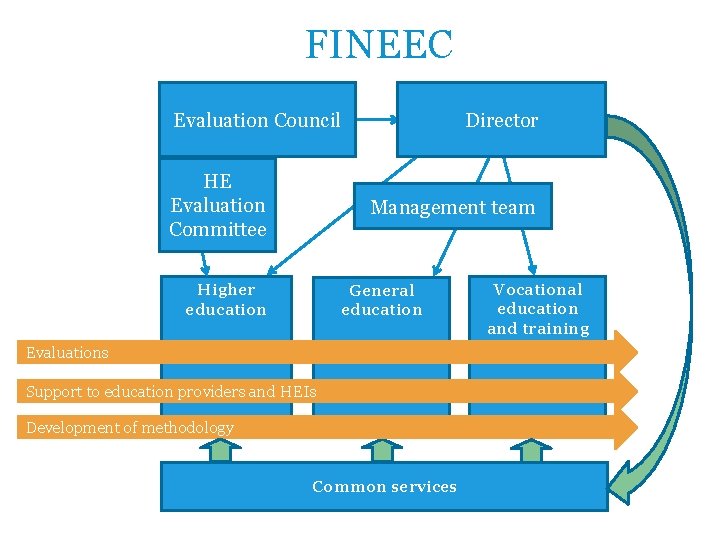
FINEEC Evaluation Council HE Evaluation Committee Director Management team Higher education General education Evaluations Support to education providers and HEIs Development of methodology Common services Vocational education and training
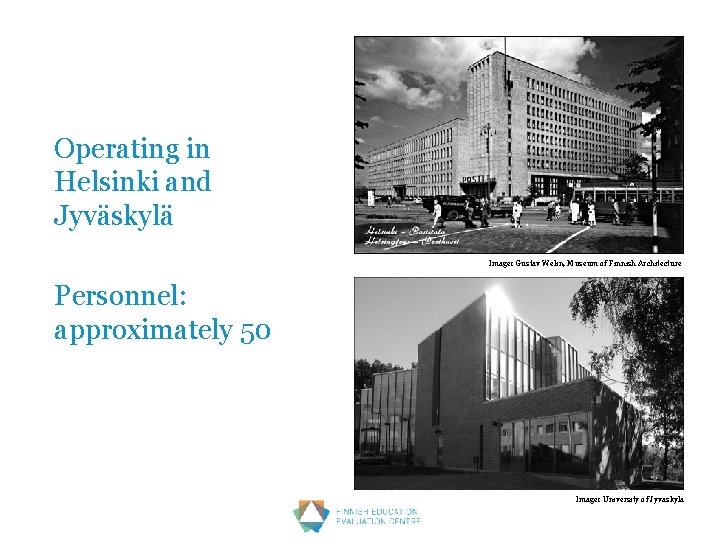
Operating in Helsinki and Jyväskylä Image: Gustav Welin, Museum of Finnish Architecture Personnel: approximately 50 Image: University of Jyväskylä
Operating principles • Decision-making is independent of external influence • Follows the principle of enhancement-led evaluation • Actively disseminates the results of evaluations
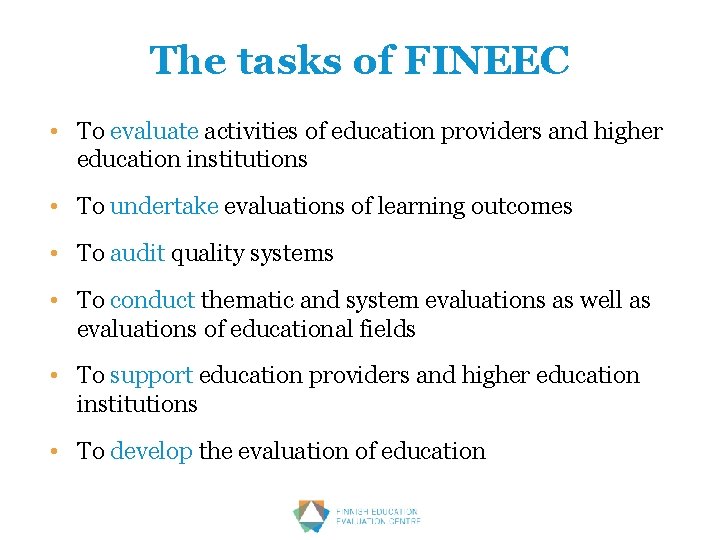
The tasks of FINEEC • To evaluate activities of education providers and higher education institutions • To undertake evaluations of learning outcomes • To audit quality systems • To conduct thematic and system evaluations as well as evaluations of educational fields • To support education providers and higher education institutions • To develop the evaluation of education
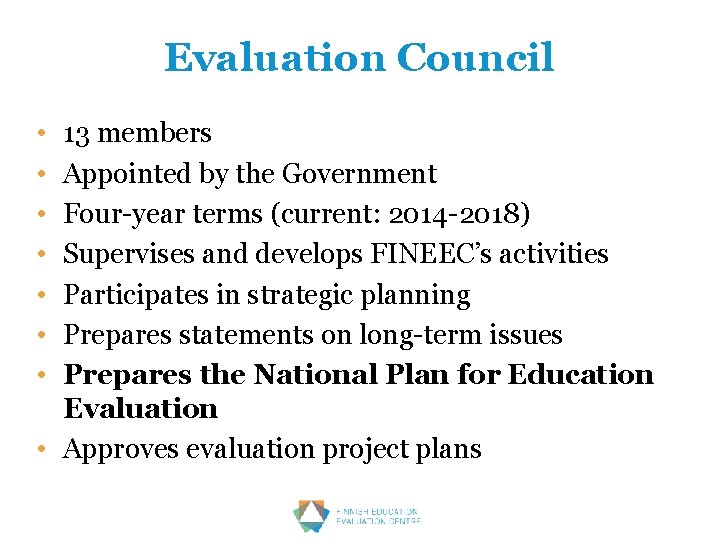
Evaluation Council • • 13 members Appointed by the Government Four-year terms (current: 2014 -2018) Supervises and develops FINEEC’s activities Participates in strategic planning Prepares statements on long-term issues Prepares the National Plan for Education Evaluation • Approves evaluation project plans
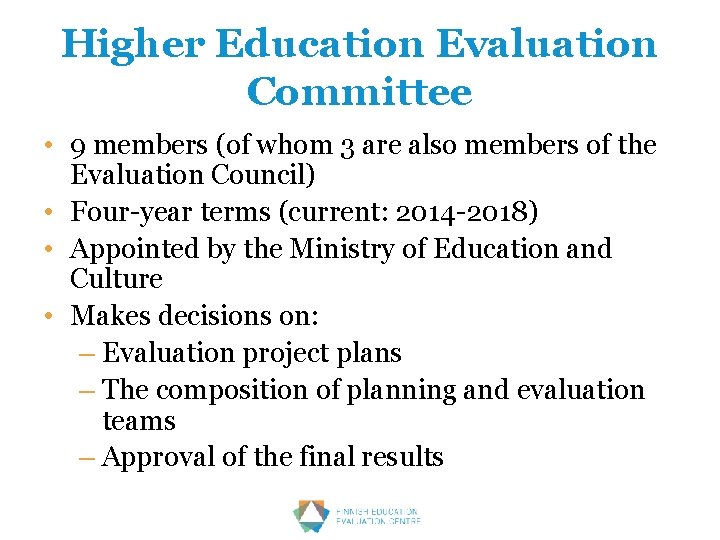
Higher Education Evaluation Committee • 9 members (of whom 3 are also members of the Evaluation Council) • Four-year terms (current: 2014 -2018) • Appointed by the Ministry of Education and Culture • Makes decisions on: – Evaluation project plans – The composition of planning and evaluation teams – Approval of the final results
FINEEC’s strategy: Foresight and effective evaluation 2020
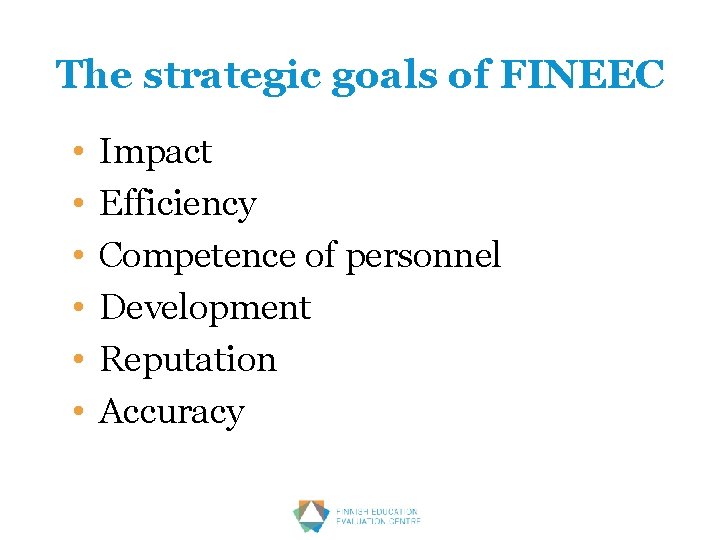
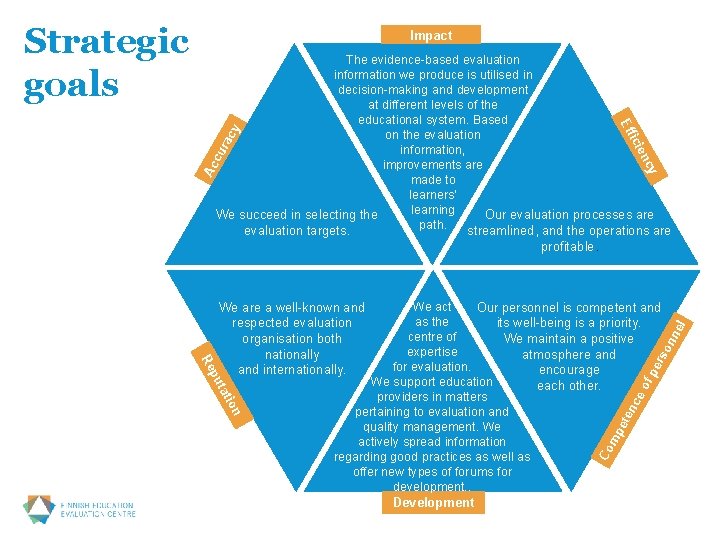
The strategic goals of FINEEC • • • Impact Efficiency Competence of personnel Development Reputation Accuracy
ici rac y Eff The evidence-based evaluation information we produce is utilised in decision-making and development at different levels of the educational system. Based on the evaluation information, improvements are made to learners’ learning We succeed in selecting the Our evaluation processes are path. evaluation targets. streamlined, and the operations are cy cu en Ac profitable. of pe rso nn el We act Our personnel is competent and as the its well-being is a priority. centre of We maintain a positive expertise atmosphere and for evaluation. encourage We support education each other. providers in matters pertaining to evaluation and quality management. We actively spread information regarding good practices as well as offer new types of forums for development. . Development pe ten ce n tio uta p Re We are a well-known and respected evaluation organisation both nationally and internationally. Co m Strategic goals Impact
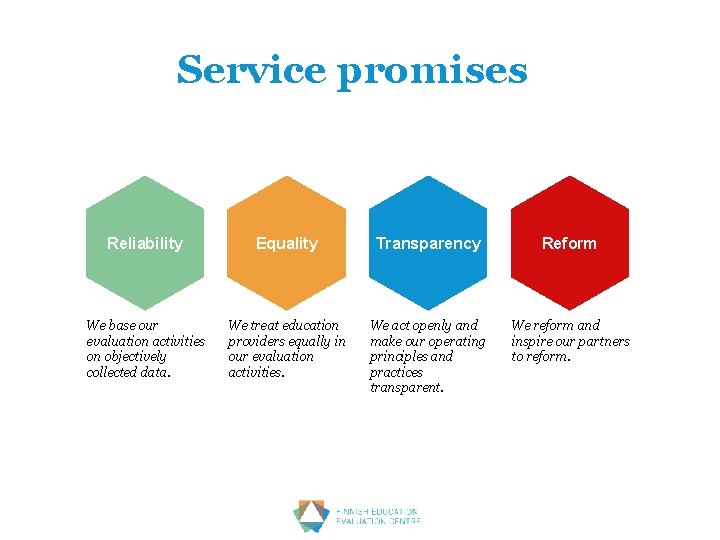
Service promises Reliability Equality Transparency Reform We base our evaluation activities on objectively collected data. We treat education providers equally in our evaluation activities. We act openly and make our operating principles and practices transparent. We reform and inspire our partners to reform.
The National Plan for Education Evaluation 2016 -2019
The Evaluation Plan 2016 -2019 • Formulated by the Evaluation Council • FINEEC heard its key stakeholders in the process of preparing the plan • Approved by the Ministry of Education and Culture in March 2016
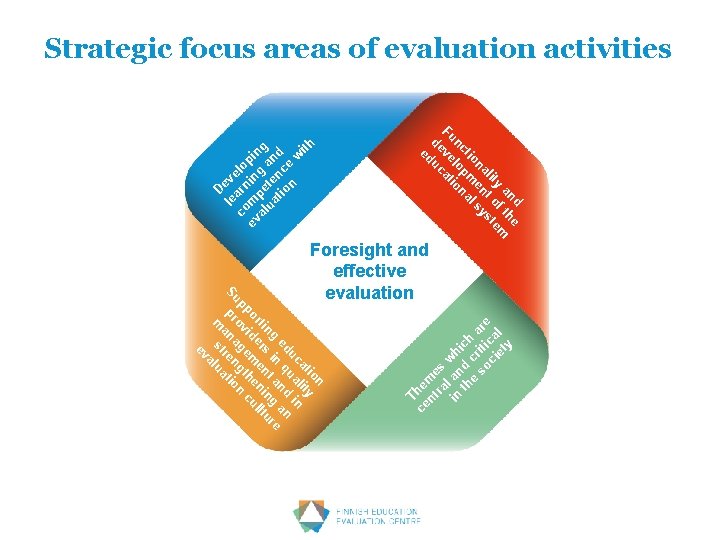
Foresight and effective evaluation n io at lity uc ua in ed q nd an g in t a g re tin rs en in ltu or ide m hen ul pp ov ge gt n c Su pr ana ren tio m st lua a ev T ce he nt me ra s in l an wh th d ich e cr a so iti re ci ca et l y d e an th m y f lit t o ste na en sy tio pm al nc lo ion Fu ve at de duc e D le eve c ar lo ev om nin pin al pe g a g ua te n tio nc d n ew ith Strategic focus areas of evaluation activities
Evaluations of early childhood and pre-primary education 2016 -2019 • The implementation and process of early childhood education • Supporting early childhood education providers in quality management and the development of an evaluation model
Evaluations of basic education and upper secondary education • Assessment of learning outcomes • Mathematics, mother tongue (Finnish and Swedish) periodically • Sample-based assessments • No ranking lists • Control concerning equal educational opportunities (gender, place of residence, home background) • Thematic and system evaluations
Examples of evaluations of basic and upper secondary education 2016 -2019: • Assessments of learning outcomes – Finnish as a second language – Sami language – Finnish sign language – Romany language – Longitudinal assessment in mathematics – Bilingualism and multilingualism in Swedishspeaking schools
Examples of evaluations of basic and upper secondary education 2016 -2019: • Thematic and system evaluations – Self-evaluation and quality management procedures of basic education and general upper secondary education providers – Pupil assessment in basic education and general upper secondary education – Evaluation of the implementation of the national core curriculum for pre-primary and basic education
Evaluations of vocational education and training 2016 -2019 • Assessments of learning outcomes (e. g. ): – Vehicle technology – Information technology – Music – Textiles and clothing – Youth and leisure instruction – Processing industry – Audio-visual communication
Evaluations of vocational education and training 2016 -2019 • Meta-evaluation of the assessment of learning outcomes and developing the evaluation system • Evaluation of the reform of the vocational qualification requirements • Supporting education providers in quality management and evaluation • External evaluation of quality systems
Evaluations of higher education 2016 -2019 • Audits of quality systems – Universities and universities of applied sciences • Engineering programme accreditations – EUR-ACE • Thematic evaluations – e. g. maritime education, teacher education qualifying to teach Swedish as the second national language
Cross-sectoral and thematic evaluations 2016 -2019 Examples: – The impact of national budget cuts on educational and cultural rights (early childhood → secondary education + art and adult education) – Peaceful and safe learning environments in schools and educational institutions (early childhood → secondary education) – Integration of immigrants to the educational system (early childhood → adult education)
Cross-sectoral and thematic evaluations 2016 -2019 Examples (continued): - Students’ transitions and study paths at educational transition phases (primary → adult education) - Entrepreneurship and innovative capacity (vocational → higher education) - Changes in the role of teachers; an evaluation of teacher education and continuing education (early childhood → higher education)
International activities • ENQA – European Association for Quality Assurance in Higher Education (FINEEC’s external review in 2016) • EQAR – European Quality Assurance Register for Higher Education • NOQA, INQAAHE – International networks for external quality assurance agencies • EUR-ACE – European Accreditation of Engineering Programmes • Quality Audit Network • Twinning projects (higher education) in Armenia and Azerbaijan • Nordic Council of Ministers (Conference on June 14, 2016!) • Nordiska evalueringsnätverket • Nordiska nätverket för prov och bedömning • PISA, Pirls, TIMMS etc.