Higher Education Evaluations Audit model Helka Keklinen Ph

- Slides: 24
Higher Education Evaluations Audit model Helka Kekäläinen, Ph. D, Head of Unit 16. 5. 2016 Armenian visit
WARMLY WELCOME TO FINEEC!
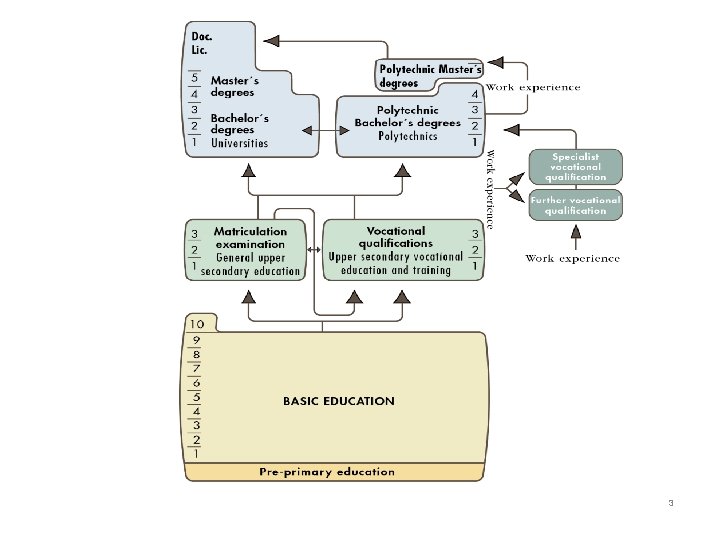
3
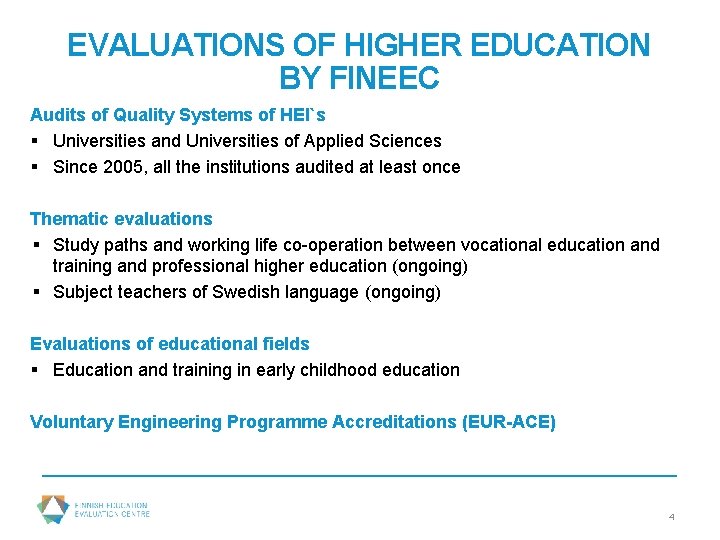
EVALUATIONS OF HIGHER EDUCATION BY FINEEC Audits of Quality Systems of HEI`s § Universities and Universities of Applied Sciences § Since 2005, all the institutions audited at least once Thematic evaluations § Study paths and working life co-operation between vocational education and training and professional higher education (ongoing) § Subject teachers of Swedish language (ongoing) Evaluations of educational fields § Education and training in early childhood education Voluntary Engineering Programme Accreditations (EUR-ACE) 4
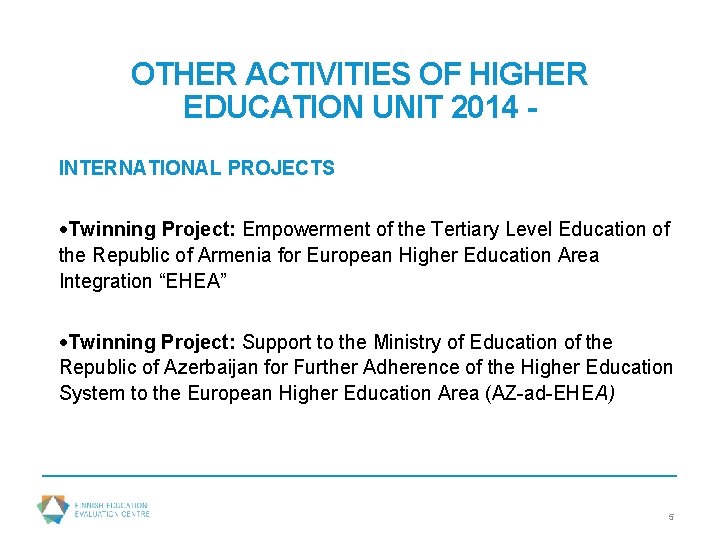
OTHER ACTIVITIES OF HIGHER EDUCATION UNIT 2014 INTERNATIONAL PROJECTS Twinning Project: Empowerment of the Tertiary Level Education of the Republic of Armenia for European Higher Education Area Integration “EHEA” Twinning Project: Support to the Ministry of Education of the Republic of Azerbaijan for Further Adherence of the Higher Education System to the European Higher Education Area (AZ-ad-EHEA) 5
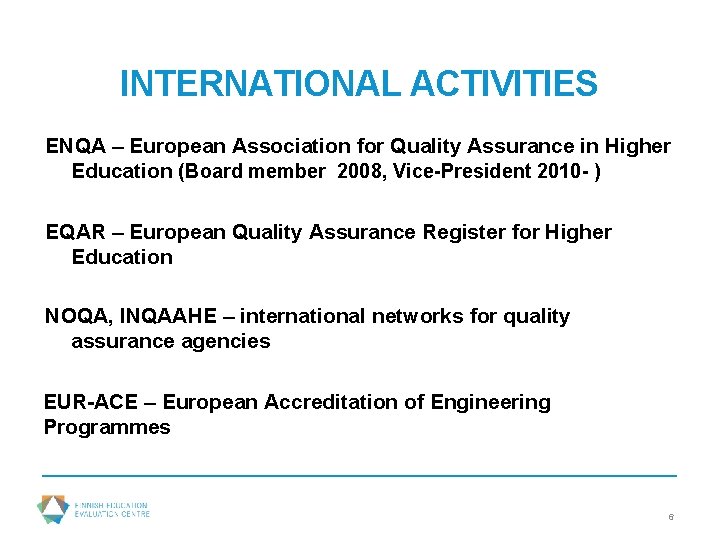
INTERNATIONAL ACTIVITIES ENQA – European Association for Quality Assurance in Higher Education (Board member 2008, Vice-President 2010 - ) EQAR – European Quality Assurance Register for Higher Education NOQA, INQAAHE – international networks for quality assurance agencies EUR-ACE – European Accreditation of Engineering Programmes 6
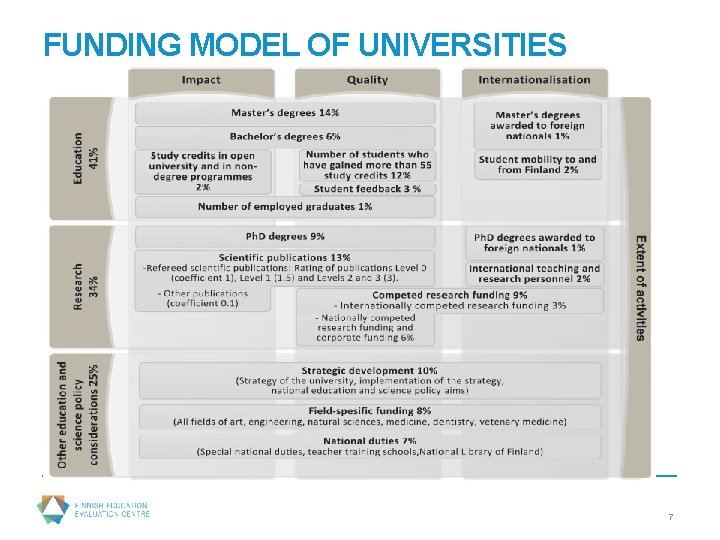
FUNDING MODEL OF UNIVERSITIES 7
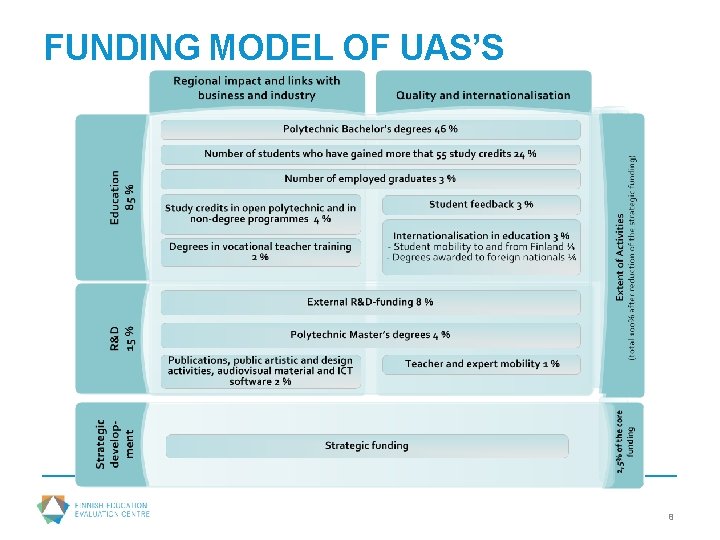
FUNDING MODEL OF UAS’S 8
FINEEC AUDITS AND THEIR IMPACT ON HIGHER EDUCATION
FINEEC AUDIT – BACKGROUND AND PHILOSOPHY • Finland’s response to the request of the Bologna process to develop a comprehensive national higher education QA system (”system of accreditation, certification or comparable procedure”) • Institutional approach – the same model for both higher education sectors (universities and universities of applied sciences) • Comprehensive approach – covers research/RDI, education and social impact – and overall quality management • External assessment of internal QA - reflects institutions’ autonomy and responsibility, and a large measure of trust Ø HEIs are responsible for the quality of their operations Ø Each institution develops its quality system based on its own needs and goals 10
ENHANCEMENT-LED APPROACH • Aim to support HEIs in the enhancement of quality and establishment of quality culture by (1) producing information to assist HEIs to develop their activities, and by (2) exchanging and disseminating good practices among other HEIs • As a result of the audit, an institution either passes the audit and receives a quality label or is subject to a subsequent reaudit − Institutions are neither rewarded for a positive result nor punished for a negative one – there are no financial incentives or loss of degreeawarding powers 11
AUDIT MANUAL: PROCESS AND CRITERIA • Audits are based on FINEEC Audit Manual (process and criteria) http: //karvi. fi/app/uploads/2015/02/KARVI_0215. pdf • Full cycle of audits conducted during the years 2005 -2012, the second audit round going on (until 2018) Ø Feedback from the audited Finnish HEIs shows that they have been quite satisfied with the audits Ø The model refined four times Ø Well-established and stable procedure • Impact studies, institutions’ feedback and follow-up reports: Improvement of management and feedback systems as well as results of activities, new operational and quality cultures in HEIs 12
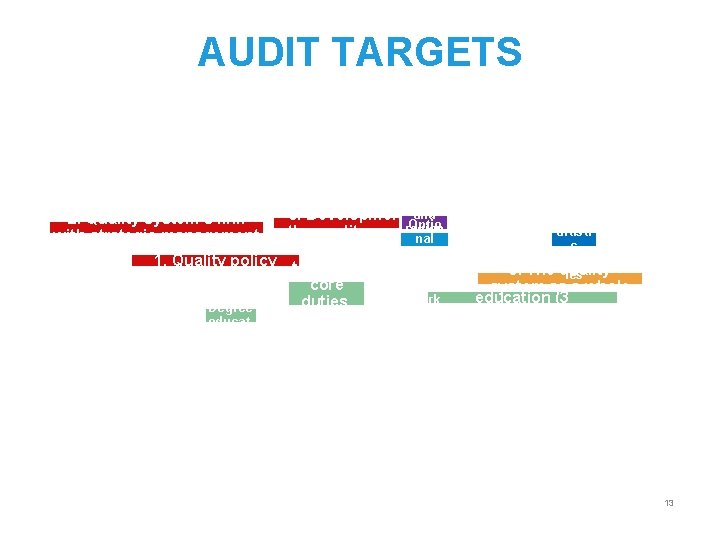
AUDIT TARGETS 2. Quality system’s link with strategic management 1. Quality policy 4 a) Degree educat ion 4 c) Societ al inter 4. action 4 d) and 3. Quality Development of Optio region the quality system manage nal al ment of audit devel target the HEI’s opme nt 5. core work duties, incl. essential services supporti ng these 4 b) RDI & artisti c activit The quality ies 6. Samples of as degree system a whole education (3 programmes) 13
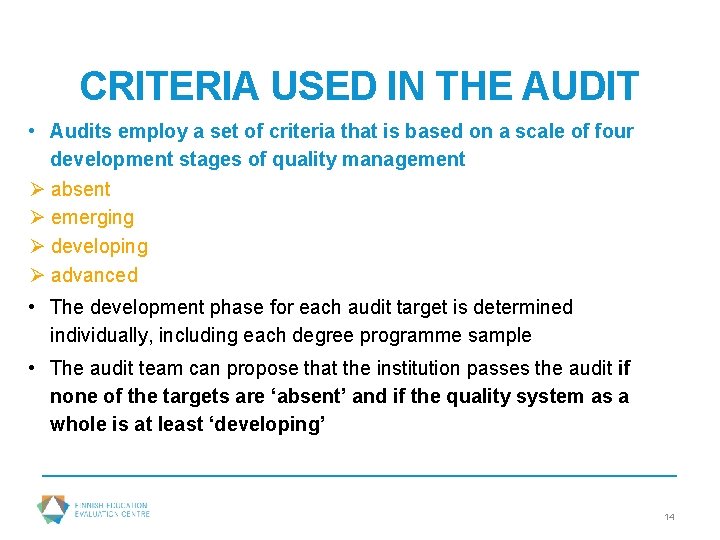
CRITERIA USED IN THE AUDIT • Audits employ a set of criteria that is based on a scale of four development stages of quality management Ø absent Ø emerging Ø developing Ø advanced • The development phase for each audit target is determined individually, including each degree programme sample • The audit team can propose that the institution passes the audit if none of the targets are ‘absent’ and if the quality system as a whole is at least ‘developing’ 14
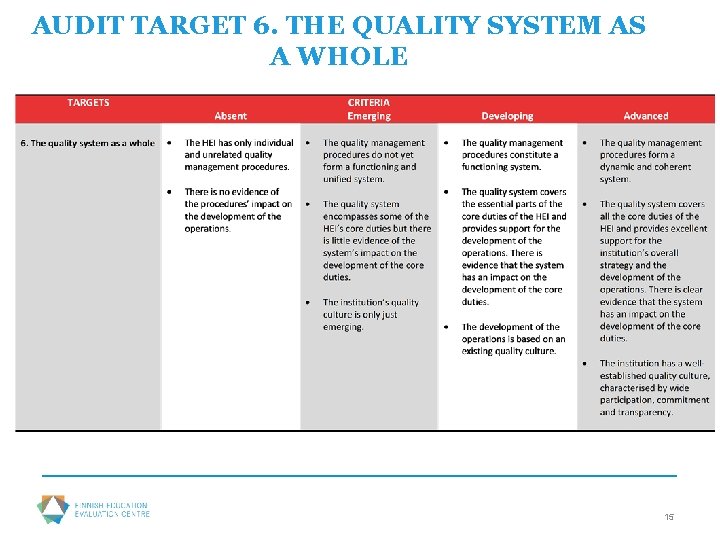
AUDIT TARGET 6. THE QUALITY SYSTEM AS A WHOLE 15
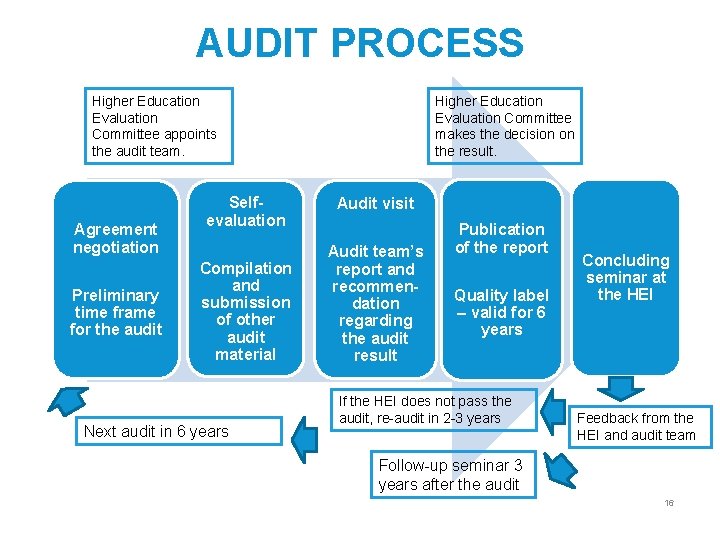
AUDIT PROCESS Higher Education Evaluation Committee appoints the audit team. Agreement negotiation Preliminary time frame for the audit Higher Education Evaluation Committee makes the decision on the result. Selfevaluation Audit visit Compilation and submission of other audit material Audit team’s report and recommendation regarding the audit result Next audit in 6 years Publication of the report Quality label – valid for 6 years If the HEI does not pass the audit, re-audit in 2 -3 years Concluding seminar at the HEI Feedback from the HEI and audit team Follow-up seminar 3 years after the audit 16
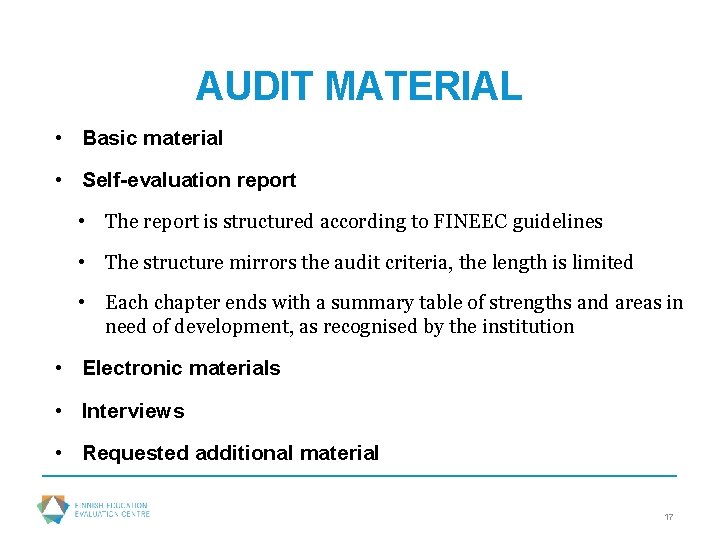
AUDIT MATERIAL • Basic material • Self-evaluation report • The report is structured according to FINEEC guidelines • The structure mirrors the audit criteria, the length is limited • Each chapter ends with a summary table of strengths and areas in need of development, as recognised by the institution • Electronic materials • Interviews • Requested additional material 17
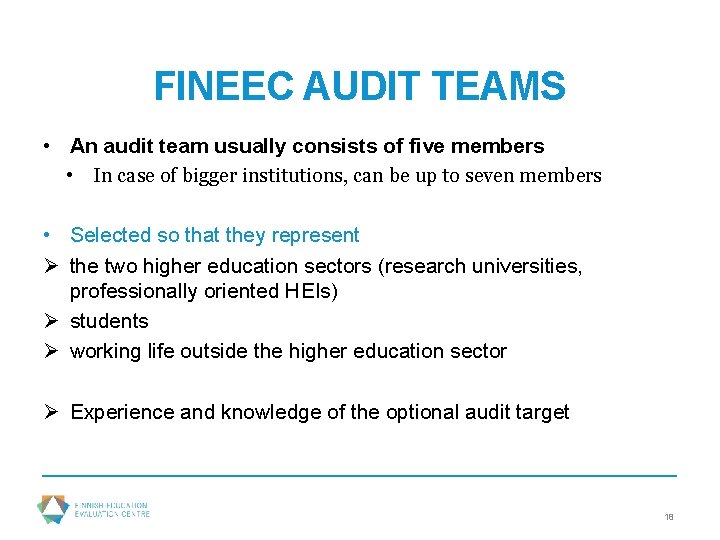
FINEEC AUDIT TEAMS • An audit team usually consists of five members • In case of bigger institutions, can be up to seven members • Selected so that they represent Ø the two higher education sectors (research universities, professionally oriented HEIs) Ø students Ø working life outside the higher education sector Ø Experience and knowledge of the optional audit target 18
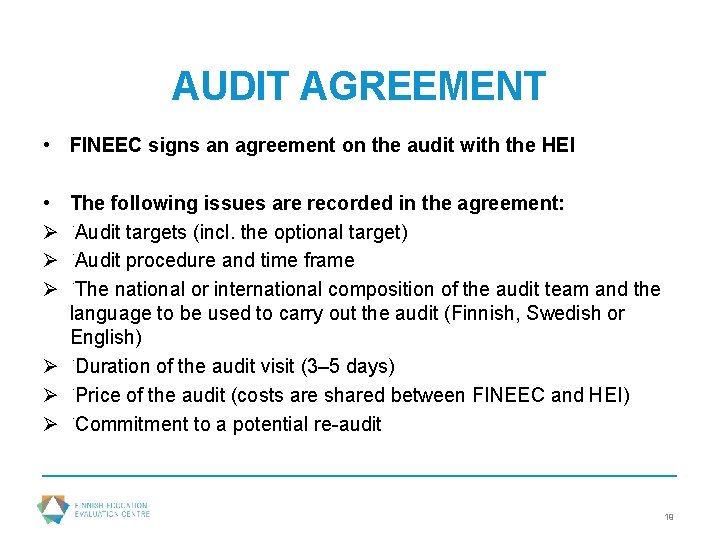
AUDIT AGREEMENT • FINEEC signs an agreement on the audit with the HEI • Ø Ø Ø The following issues are recorded in the agreement: Audit targets (incl. the optional target) Audit procedure and time frame The national or international composition of the audit team and the language to be used to carry out the audit (Finnish, Swedish or English) Ø Duration of the audit visit (3– 5 days) Ø Price of the audit (costs are shared between FINEEC and HEI) Ø Commitment to a potential re-audit 19
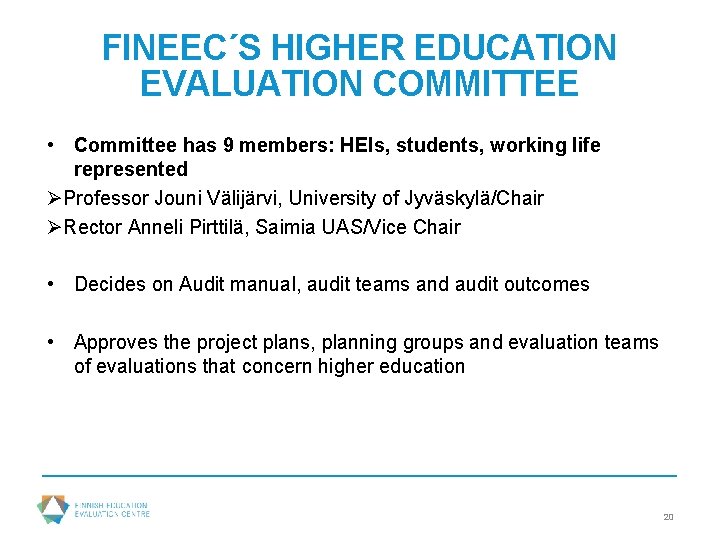
FINEEC´S HIGHER EDUCATION EVALUATION COMMITTEE • Committee has 9 members: HEIs, students, working life represented ØProfessor Jouni Välijärvi, University of Jyväskylä/Chair ØRector Anneli Pirttilä, Saimia UAS/Vice Chair • Decides on Audit manual, audit teams and audit outcomes • Approves the project plans, planning groups and evaluation teams of evaluations that concern higher education 20
OUTCOME OF AN AUDIT • The FINEEC Higher Education Evaluation Committee decides on the audit result on the basis of the proposal by the audit team and on the audit report • The task of the Committee is to ensure that decisions are impartial • HEIs that pass the audit receive a quality label and are added to the register of audited institutions maintained on FINEEC’s website http: //karvi. fi/en/higher-education/audits-quality-systems/audit-register/ 21
GENERAL REMARKS ON THE FIRST AUDIT ROUND • Nearly one in five audits (18%) resulted in a re-audit decision § 14% of the UASs vs. 24% of the universities • Feedback from the audited HEIs § On the whole, HEIs quite satisfied with the audits; satisfaction remained relatively constant throughout the first audit round § UASs slightly more satisfied than universities § The management and central administration had the most positive view on the quality work in both higher education sectors 22
HEIS’ VIEWS ON THE IMPACT OF THE AUDIT • Improvement of management systems, strengthening of strategic work • Several UASs report on the link between the quality system and the improved results of their activities (regarding, e. g. , dropout rate, progression and completion of studies) • Improvement of feedback systems (student, working life and alumni) • Participation of students and external stakeholders in the development of operations enhanced and supported • Dissemination of good practices within and between HEIs • More cooperation within institutions between different units and between HEIs, benchmarking activities have increased • New evaluation cultures – external evaluations now seen as more significant tools in the development (international evaluations utilised at different organisational levels) 23
CONCLUSIONS • Audits as enhancement-led evaluations have received wide acceptance § Mutual trust § Open and supportive communication • Audits have contributed to the development of Finnish higher education by § Changing quality and operational cultures in HEIs and by increasing cooperation within the whole field of higher education § Inclining HEIs to learn from one another and share information and good practices with one another, also between the two higher education sectors – mutual understanding and collaboration between the sectors have been enhanced 24