
ECE 757 Review Parallel Processors Prof Mikko Lipasti

- Slides: 56
ECE 757 Review: Parallel Processors © Prof. Mikko Lipasti Lecture notes based in part on slides created by John Shen, Mark Hill, David Wood, Guri Sohi, Jim Smith, Erika Gunadi, Mitch Hayenga, Vignyan Reddy, Dibakar Gope
Parallel Processors • • • Thread-level parallelism Synchronization Coherence Consistency Multithreading Multicore interconnects
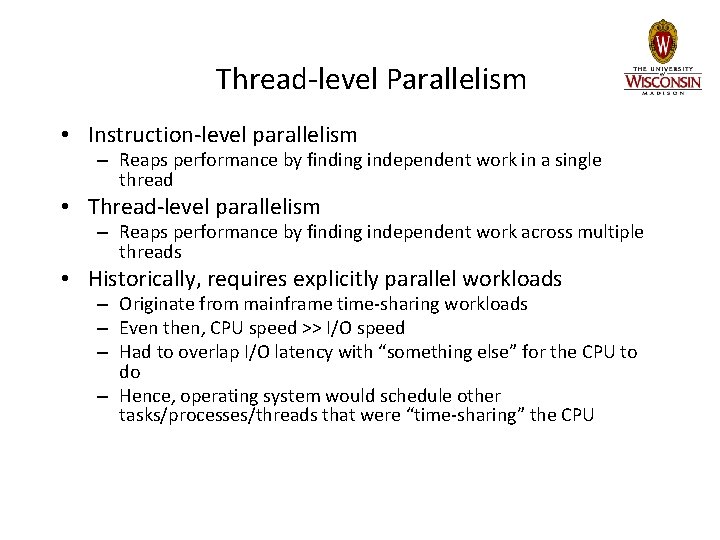
Thread-level Parallelism • Instruction-level parallelism – Reaps performance by finding independent work in a single thread • Thread-level parallelism – Reaps performance by finding independent work across multiple threads • Historically, requires explicitly parallel workloads – Originate from mainframe time-sharing workloads – Even then, CPU speed >> I/O speed – Had to overlap I/O latency with “something else” for the CPU to do – Hence, operating system would schedule other tasks/processes/threads that were “time-sharing” the CPU
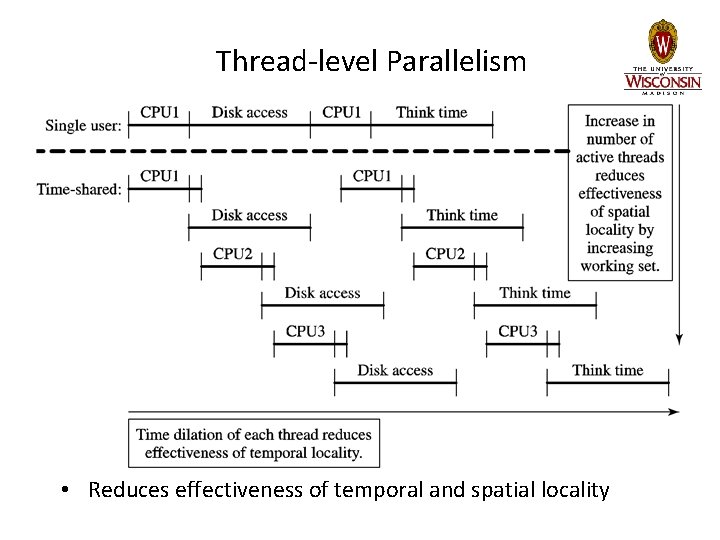
Thread-level Parallelism • Reduces effectiveness of temporal and spatial locality
Thread-level Parallelism • Initially motivated by time-sharing of single CPU – OS, applications written to be multithreaded • Quickly led to adoption of multiple CPUs in a single system – Enabled scalable product line from entry-level single-CPU systems to high-end multiple-CPU systems – Same applications, OS, run seamlessly – Adding CPUs increases throughput (performance) • More recently: – Multiple threads per processor core • Coarse-grained multithreading (aka “switch-on-event”) • Fine-grained multithreading • Simultaneous multithreading – Multiple processor cores per die • Chip multiprocessors (CMP) • Chip multithreading (CMT)
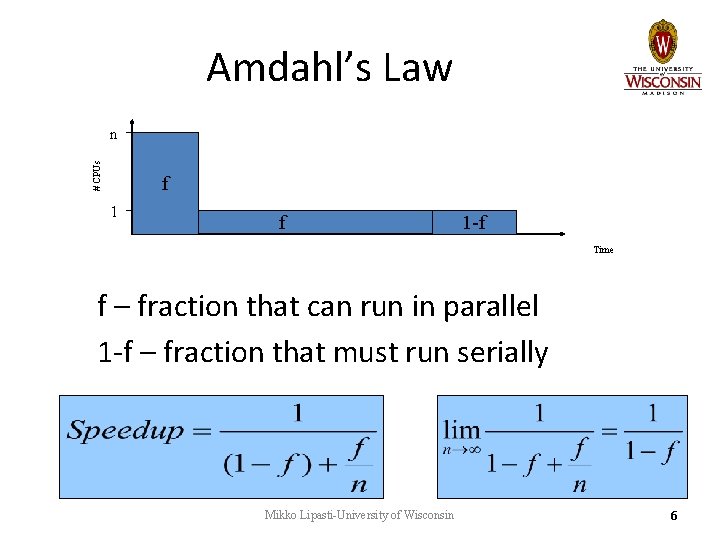
Amdahl’s Law # CPUs n f 1 -f Time f – fraction that can run in parallel 1 -f – fraction that must run serially Mikko Lipasti-University of Wisconsin 6
Thread-level Parallelism • Parallelism limited by sharing – Amdahl’s law: • Access to shared state must be serialized • Serial portion limits parallel speedup – Many important applications share (lots of) state • Relational databases (transaction processing): GBs of shared state – Even completely independent processes “share” virtualized hardware through O/S, hence must synchronize access • Access to shared state/shared variables – Must occur in a predictable, repeatable manner – Otherwise, chaos results • Architecture must provide primitives for serializing access to shared state
Synchronization
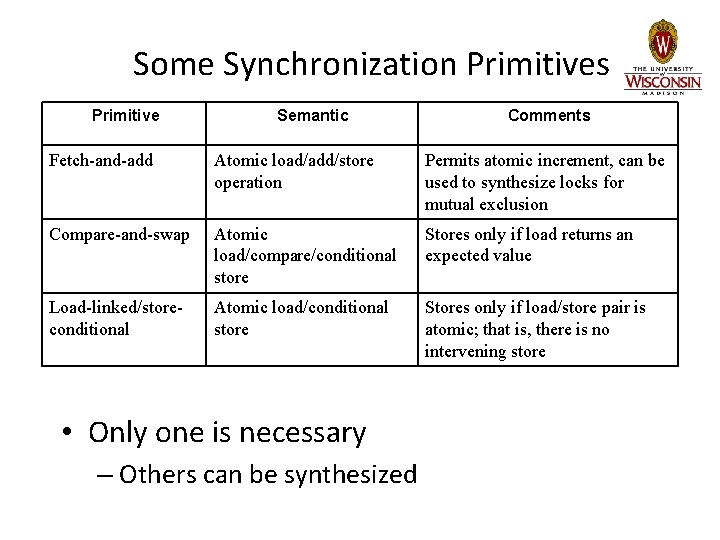
Some Synchronization Primitives Primitive Semantic Comments Fetch-and-add Atomic load/add/store operation Permits atomic increment, can be used to synthesize locks for mutual exclusion Compare-and-swap Atomic load/compare/conditional store Stores only if load returns an expected value Load-linked/storeconditional Atomic load/conditional store Stores only if load/store pair is atomic; that is, there is no intervening store • Only one is necessary – Others can be synthesized
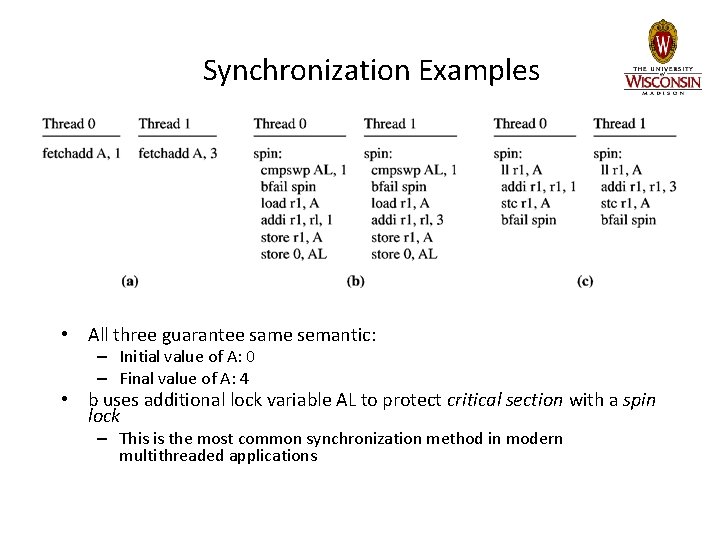
Synchronization Examples • All three guarantee same semantic: – Initial value of A: 0 – Final value of A: 4 • b uses additional lock variable AL to protect critical section with a spin lock – This is the most common synchronization method in modern multithreaded applications
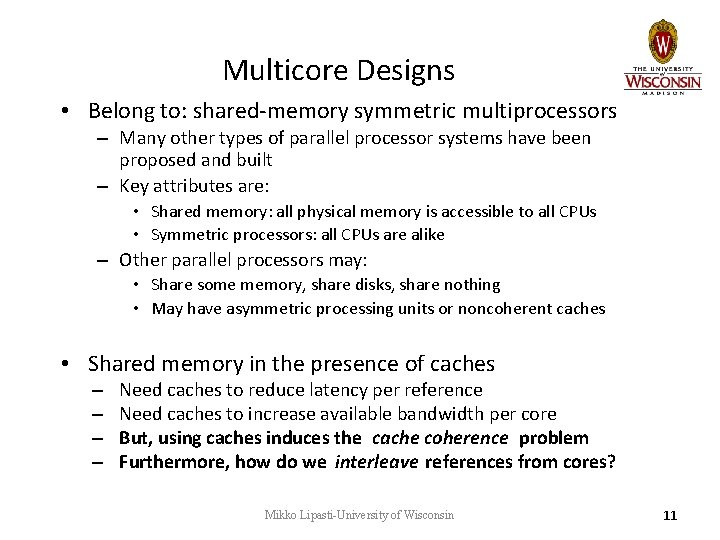
Multicore Designs • Belong to: shared-memory symmetric multiprocessors – Many other types of parallel processor systems have been proposed and built – Key attributes are: • Shared memory: all physical memory is accessible to all CPUs • Symmetric processors: all CPUs are alike – Other parallel processors may: • Share some memory, share disks, share nothing • May have asymmetric processing units or noncoherent caches • Shared memory in the presence of caches – – Need caches to reduce latency per reference Need caches to increase available bandwidth per core But, using caches induces the cache coherence problem Furthermore, how do we interleave references from cores? Mikko Lipasti-University of Wisconsin 11
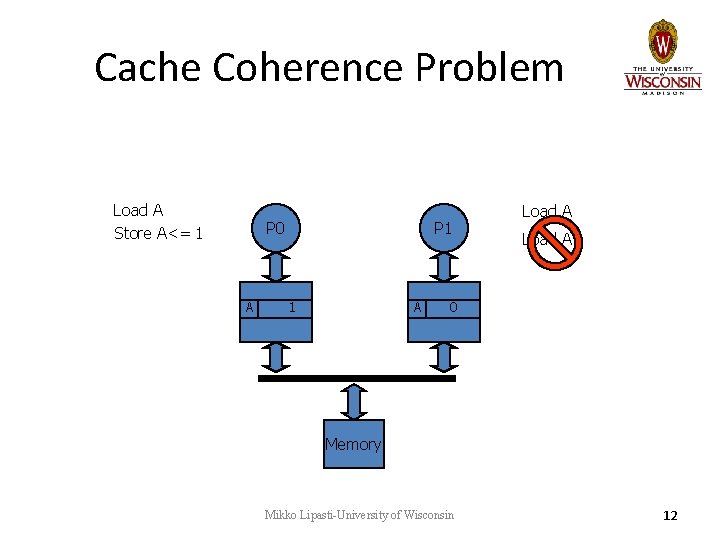
Cache Coherence Problem Load A Store A<= 1 P 0 A P 1 01 A Load A 0 Memory Mikko Lipasti-University of Wisconsin 12
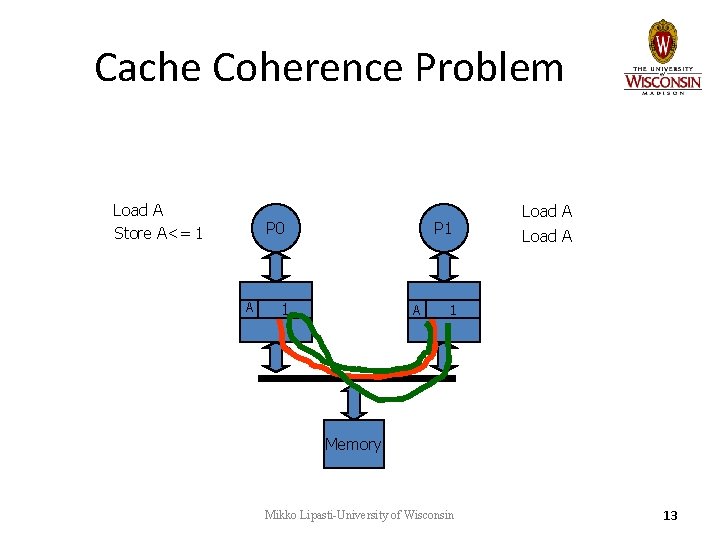
Cache Coherence Problem Load A Store A<= 1 P 0 A P 1 10 A Load A 10 Memory Mikko Lipasti-University of Wisconsin 13
Invalidate Protocol • Basic idea: maintain single writer property – Only one processor has write permission at any point in time • Write handling – – On write, invalidate all other copies of data Make data private to the writer Allow writes to occur until data is requested Supply modified data to requestor directly or through memory • Minimal set of states per cache line: – Invalid (not present) – Modified (private to this cache) • State transitions: – Local read or write: I->M, fetch modified – Remote read or write: M->I, transmit data (directly or through memory) – Writeback: M->I, write data to memory Mikko Lipasti-University of Wisconsin 14
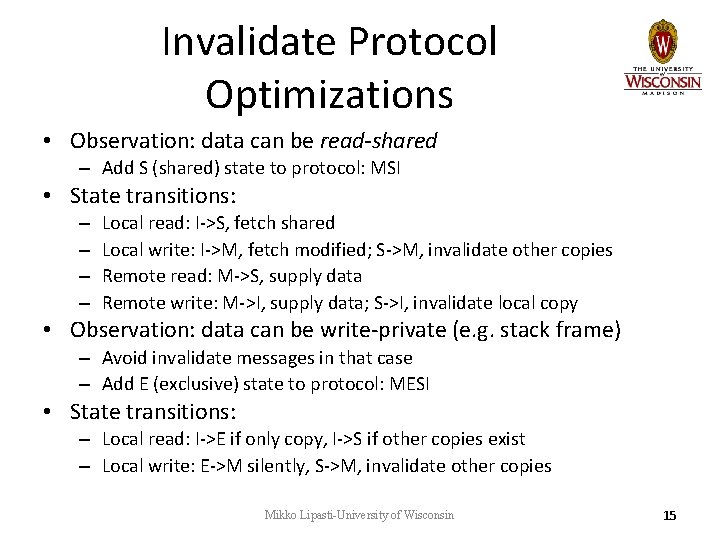
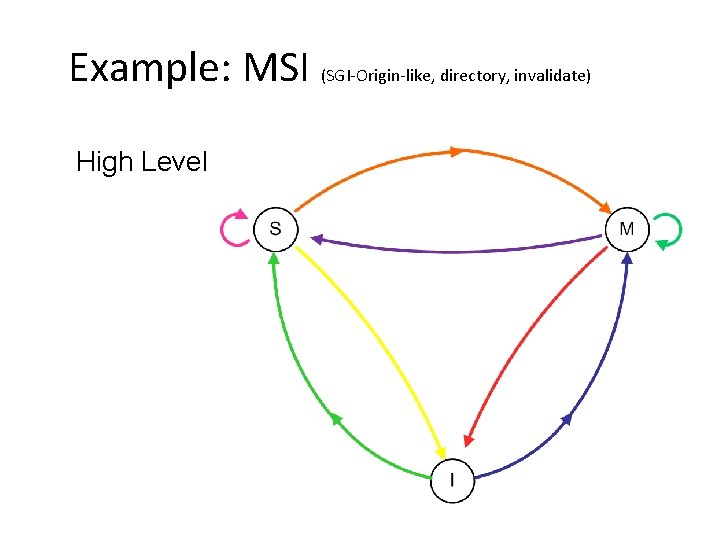
Invalidate Protocol Optimizations • Observation: data can be read-shared – Add S (shared) state to protocol: MSI • State transitions: – – Local read: I->S, fetch shared Local write: I->M, fetch modified; S->M, invalidate other copies Remote read: M->S, supply data Remote write: M->I, supply data; S->I, invalidate local copy • Observation: data can be write-private (e. g. stack frame) – Avoid invalidate messages in that case – Add E (exclusive) state to protocol: MESI • State transitions: – Local read: I->E if only copy, I->S if other copies exist – Local write: E->M silently, S->M, invalidate other copies Mikko Lipasti-University of Wisconsin 15
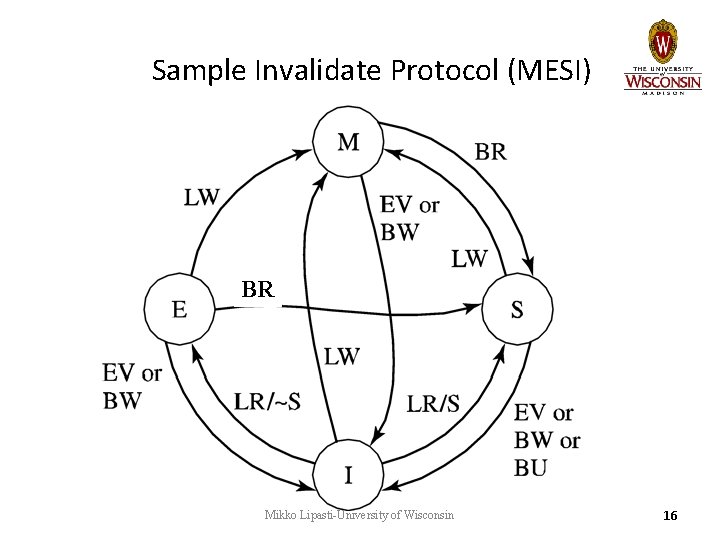
Sample Invalidate Protocol (MESI) BR Mikko Lipasti-University of Wisconsin 16
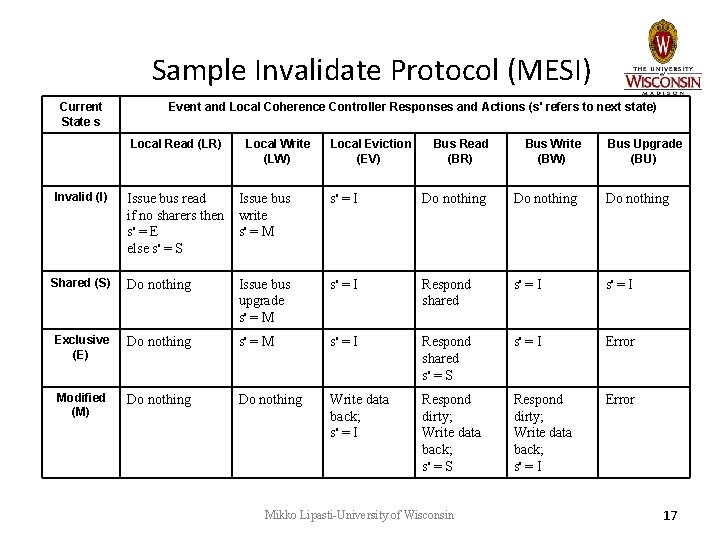
Sample Invalidate Protocol (MESI) Current State s Event and Local Coherence Controller Responses and Actions (s' refers to next state) Local Read (LR) Invalid (I) Local Write (LW) Local Eviction (EV) Bus Read (BR) Bus Write (BW) Bus Upgrade (BU) Issue bus read if no sharers then s' = E else s' = S Issue bus write s' = M s' = I Do nothing Shared (S) Do nothing Issue bus upgrade s' = M s' = I Respond shared s' = I Exclusive (E) Do nothing s' = M s' = I Respond shared s' = S s' = I Error Modified (M) Do nothing Write data back; s' = I Respond dirty; Write data back; s' = S Respond dirty; Write data back; s' = I Error Mikko Lipasti-University of Wisconsin 17
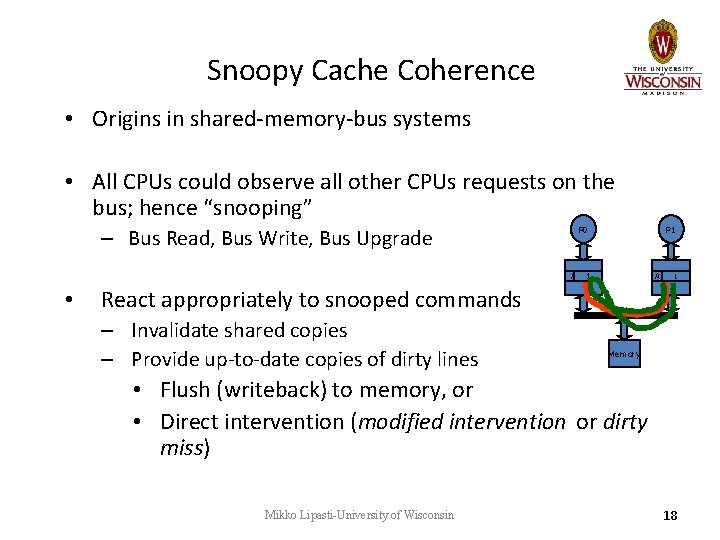
Snoopy Cache Coherence • Origins in shared-memory-bus systems • All CPUs could observe all other CPUs requests on the bus; hence “snooping” P 0 – Bus Read, Bus Write, Bus Upgrade A • P 1 10 AA 10 React appropriately to snooped commands – Invalidate shared copies – Provide up-to-date copies of dirty lines Memory • Flush (writeback) to memory, or • Direct intervention (modified intervention or dirty miss) Mikko Lipasti-University of Wisconsin 18
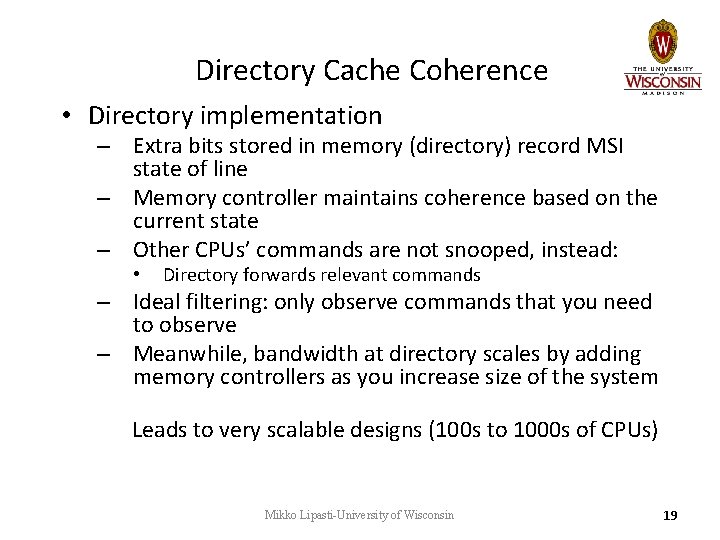
Directory Cache Coherence • Directory implementation – Extra bits stored in memory (directory) record MSI state of line – Memory controller maintains coherence based on the current state – Other CPUs’ commands are not snooped, instead: • Directory forwards relevant commands – Ideal filtering: only observe commands that you need to observe – Meanwhile, bandwidth at directory scales by adding memory controllers as you increase size of the system Leads to very scalable designs (100 s to 1000 s of CPUs) Mikko Lipasti-University of Wisconsin 19
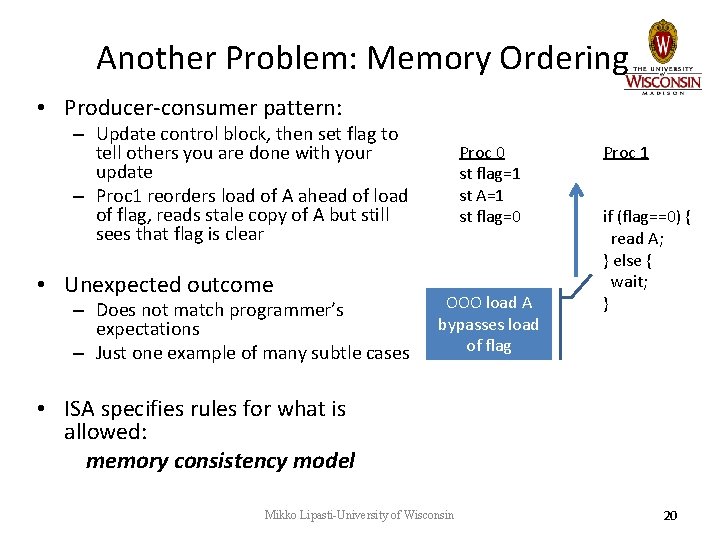
Another Problem: Memory Ordering • Producer-consumer pattern: – Update control block, then set flag to tell others you are done with your update – Proc 1 reorders load of A ahead of load of flag, reads stale copy of A but still sees that flag is clear • Unexpected outcome – Does not match programmer’s expectations – Just one example of many subtle cases Proc 0 st flag=1 st A=1 st flag=0 OOO load A bypasses load of flag Proc 1 if (flag==0) { read A; } else { wait; } • ISA specifies rules for what is allowed: memory consistency model Mikko Lipasti-University of Wisconsin 20
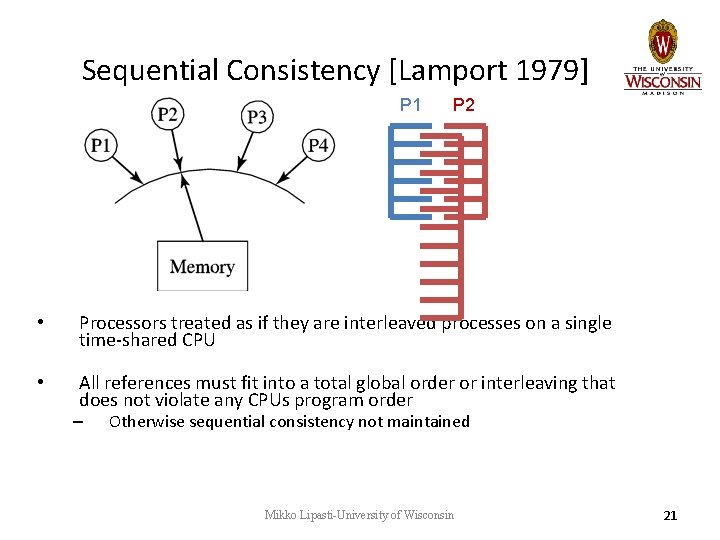
Sequential Consistency [Lamport 1979] P 1 P 2 • Processors treated as if they are interleaved processes on a single time-shared CPU • All references must fit into a total global order or interleaving that does not violate any CPUs program order – Otherwise sequential consistency not maintained Mikko Lipasti-University of Wisconsin 21
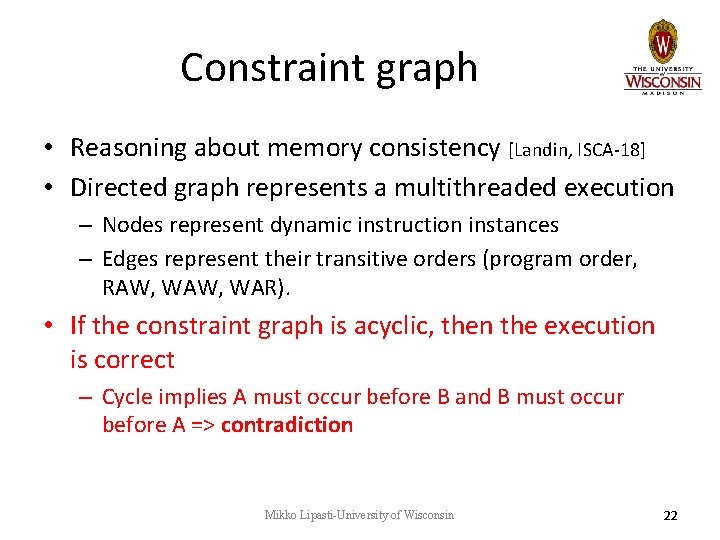
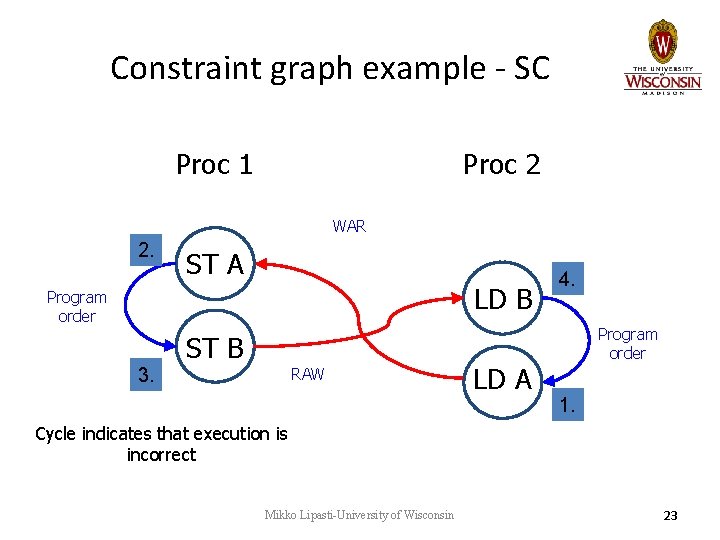
Constraint graph • Reasoning about memory consistency [Landin, ISCA-18] • Directed graph represents a multithreaded execution – Nodes represent dynamic instruction instances – Edges represent their transitive orders (program order, RAW, WAR). • If the constraint graph is acyclic, then the execution is correct – Cycle implies A must occur before B and B must occur before A => contradiction Mikko Lipasti-University of Wisconsin 22
Constraint graph example - SC Proc 1 Proc 2 WAR 2. ST A LD B Program order ST B RAW 3. LD A 4. Program order 1. Cycle indicates that execution is incorrect Mikko Lipasti-University of Wisconsin 23
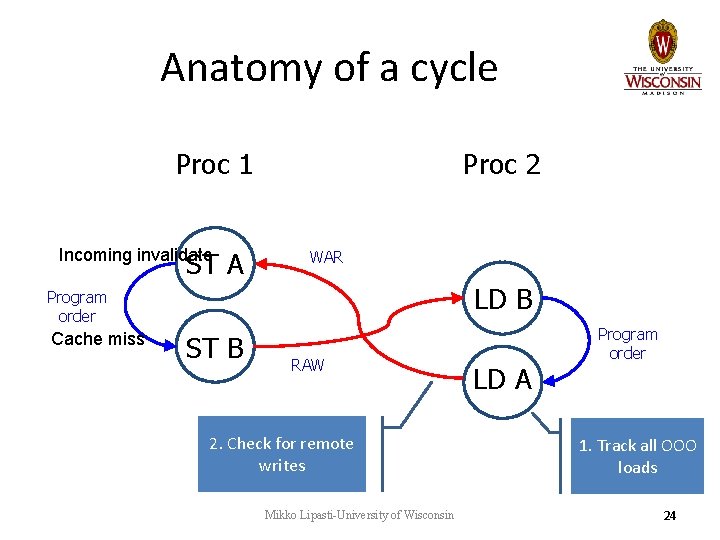
Anatomy of a cycle Proc 1 Incoming invalidate ST A Proc 2 WAR LD B Program order Cache miss ST B RAW 2. Check for remote writes Mikko Lipasti-University of Wisconsin LD A Program order 1. Track all OOO loads 24
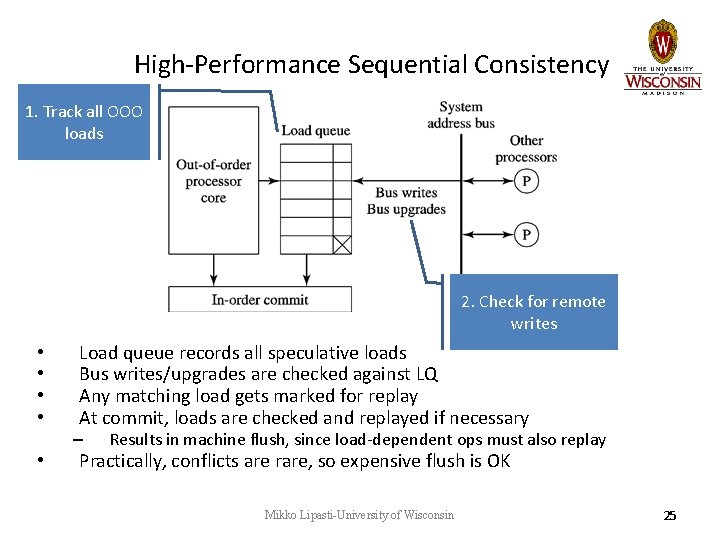
High-Performance Sequential Consistency 1. Track all OOO loads 2. Check for remote writes • • • Load queue records all speculative loads Bus writes/upgrades are checked against LQ Any matching load gets marked for replay At commit, loads are checked and replayed if necessary – Results in machine flush, since load-dependent ops must also replay Practically, conflicts are rare, so expensive flush is OK Mikko Lipasti-University of Wisconsin 25
Recapping • Multicore processors need shared memory • Must use caches to provide latency/bandwidth • Cache memories must: – Provide coherent view of memory must solve cache coherence problem • Cores and caches must: – Properly order interleaved memory references must implement memory consistency correctly Mikko Lipasti-University of Wisconsin 26
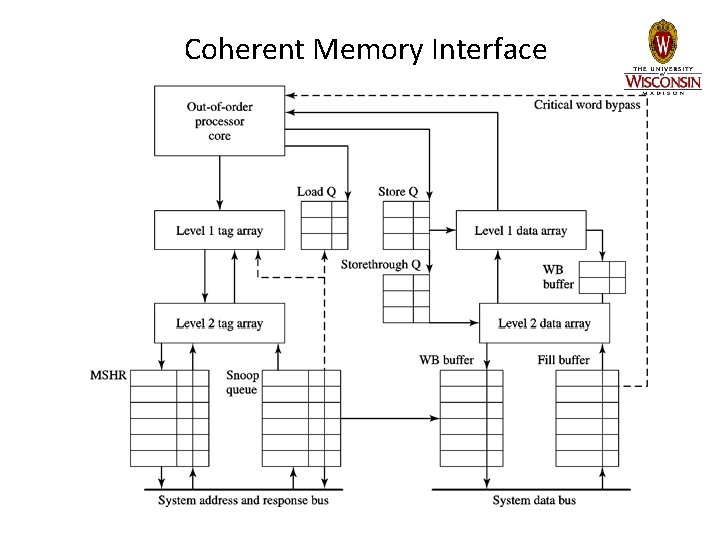
Coherent Memory Interface
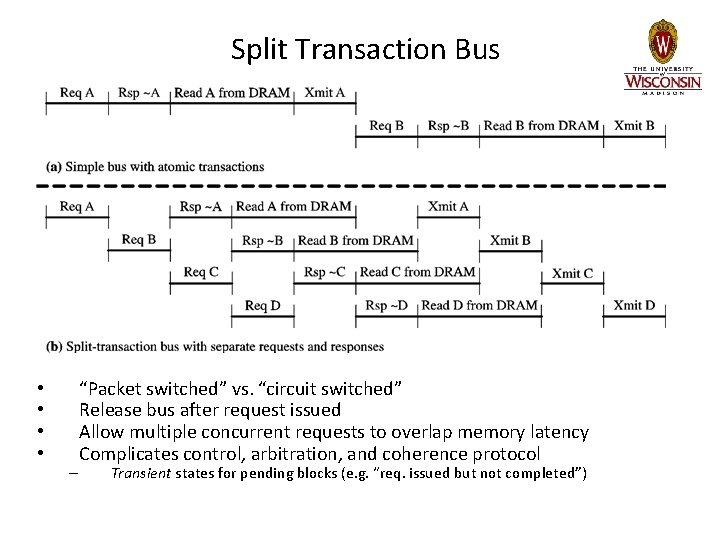
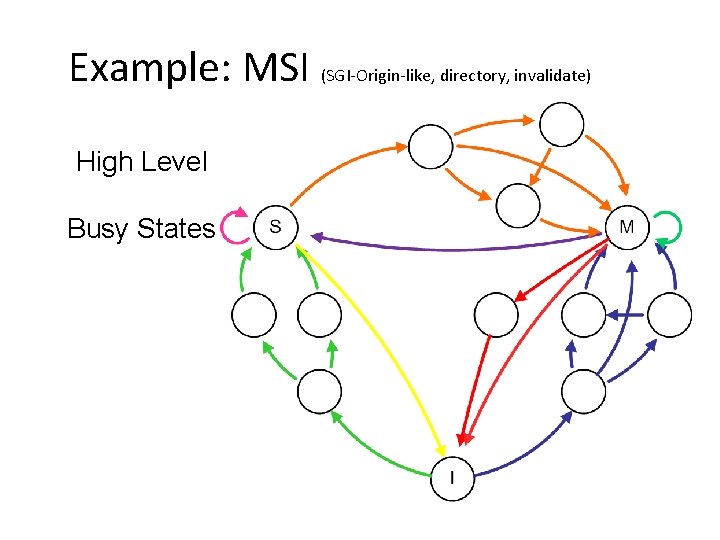
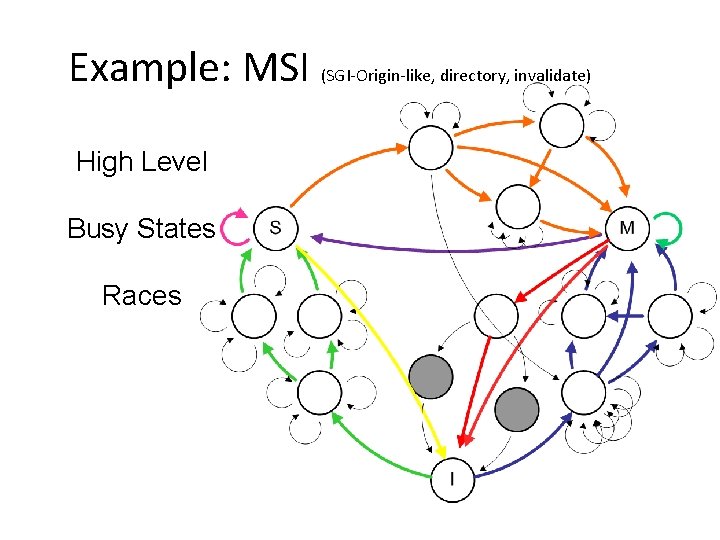
Split Transaction Bus • • – “Packet switched” vs. “circuit switched” Release bus after request issued Allow multiple concurrent requests to overlap memory latency Complicates control, arbitration, and coherence protocol Transient states for pending blocks (e. g. “req. issued but not completed”)
Example: MSI (SGI-Origin-like, directory, invalidate) High Level
Example: MSI (SGI-Origin-like, directory, invalidate) High Level Busy States
Example: MSI (SGI-Origin-like, directory, invalidate) High Level Busy States Races
Multithreaded Cores • Basic idea: – CPU resources are expensive and should not be idle • 1960’s: Virtual memory and multiprogramming – Virtual memory/multiprogramming invented to tolerate latency to secondary storage (disk/tape/etc. ) – Processor-disk speed mismatch: • microseconds to tens of milliseconds (1: 10000 or more) – OS context switch used to bring in other useful work while waiting for page fault or explicit read/write – Cost of context switch must be much less than I/O latency (easy) 32
Multithreaded Cores • 1990’s: Memory wall and multithreading – Processor-DRAM speed mismatch: • nanosecond to fractions of a microsecond (1: 500) – H/W task switch used to bring in other useful work while waiting for cache miss – Cost of context switch must be much less than cache miss latency • Very attractive for applications with abundant thread-level parallelism – Commercial multi-user workloads 33
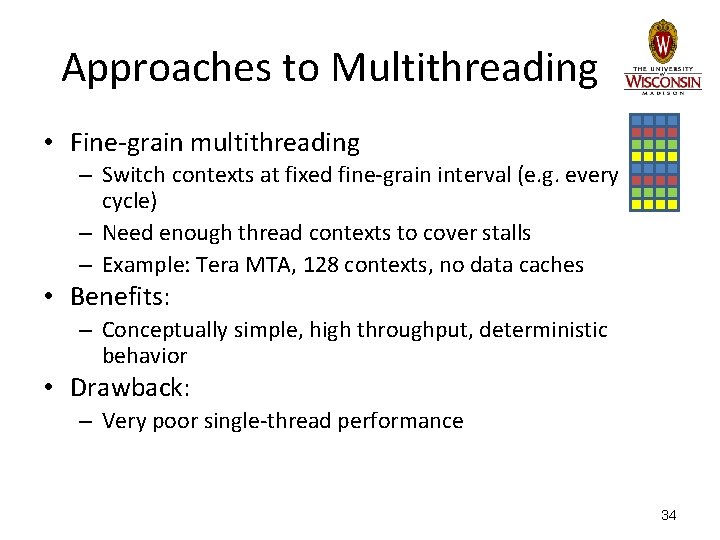
Approaches to Multithreading • Fine-grain multithreading – Switch contexts at fixed fine-grain interval (e. g. every cycle) – Need enough thread contexts to cover stalls – Example: Tera MTA, 128 contexts, no data caches • Benefits: – Conceptually simple, high throughput, deterministic behavior • Drawback: – Very poor single-thread performance 34
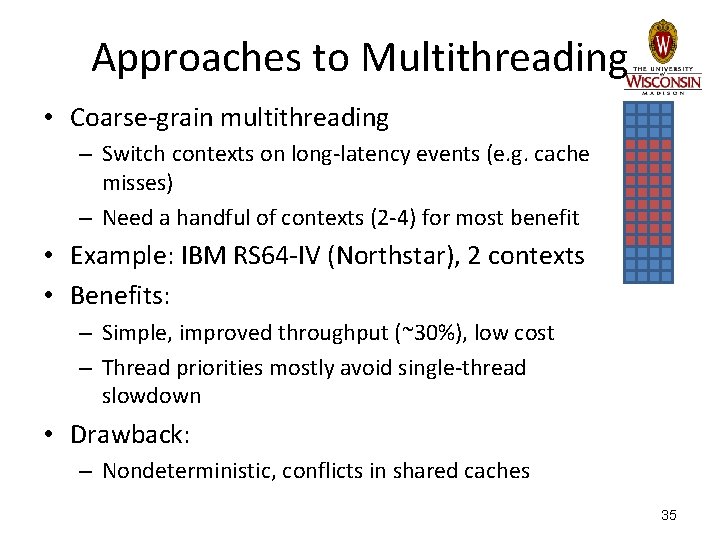
Approaches to Multithreading • Coarse-grain multithreading – Switch contexts on long-latency events (e. g. cache misses) – Need a handful of contexts (2 -4) for most benefit • Example: IBM RS 64 -IV (Northstar), 2 contexts • Benefits: – Simple, improved throughput (~30%), low cost – Thread priorities mostly avoid single-thread slowdown • Drawback: – Nondeterministic, conflicts in shared caches 35
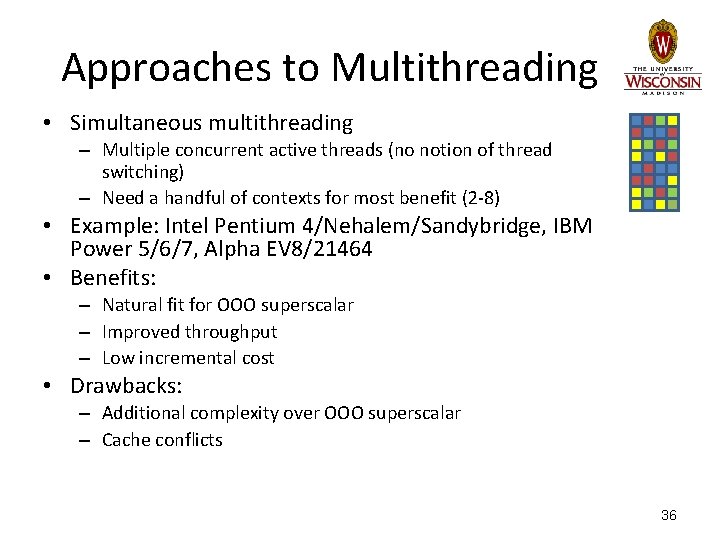
Approaches to Multithreading • Simultaneous multithreading – Multiple concurrent active threads (no notion of thread switching) – Need a handful of contexts for most benefit (2 -8) • Example: Intel Pentium 4/Nehalem/Sandybridge, IBM Power 5/6/7, Alpha EV 8/21464 • Benefits: – Natural fit for OOO superscalar – Improved throughput – Low incremental cost • Drawbacks: – Additional complexity over OOO superscalar – Cache conflicts 36
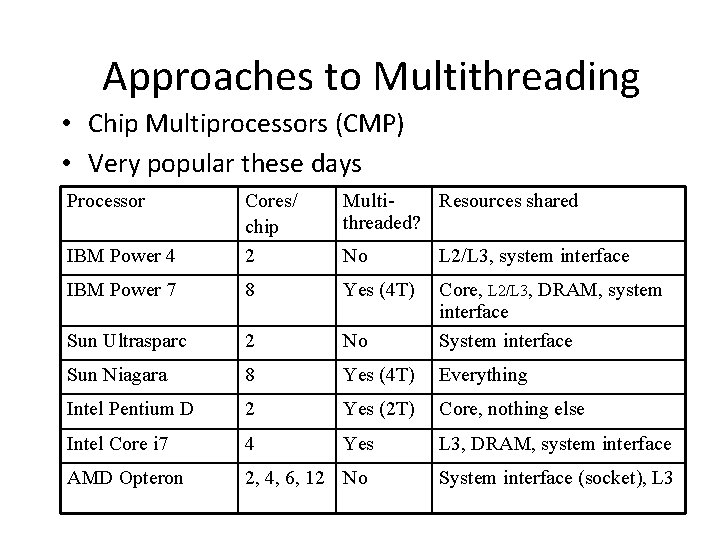
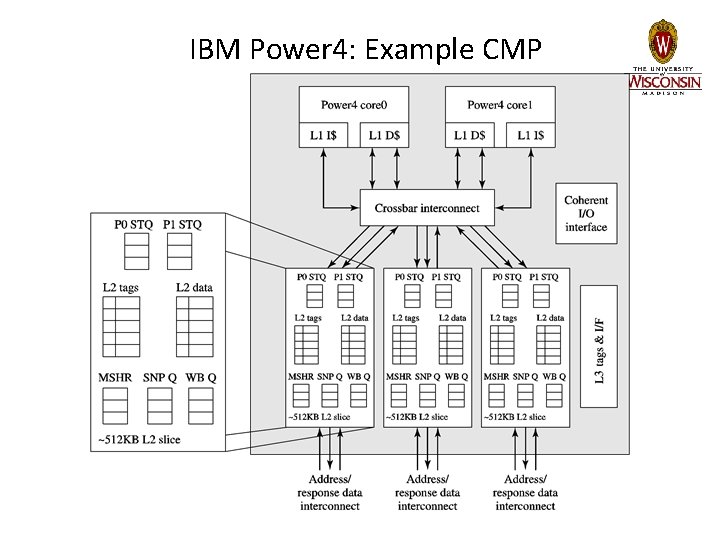
Approaches to Multithreading • Chip Multiprocessors (CMP) • Very popular these days Processor Multi. Resources shared threaded? IBM Power 4 Cores/ chip 2 No L 2/L 3, system interface IBM Power 7 8 Yes (4 T) Sun Ultrasparc 2 No Core, L 2/L 3, DRAM, system interface Sun Niagara 8 Yes (4 T) Everything Intel Pentium D 2 Yes (2 T) Core, nothing else Intel Core i 7 4 Yes L 3, DRAM, system interface AMD Opteron 2, 4, 6, 12 No System interface (socket), L 3
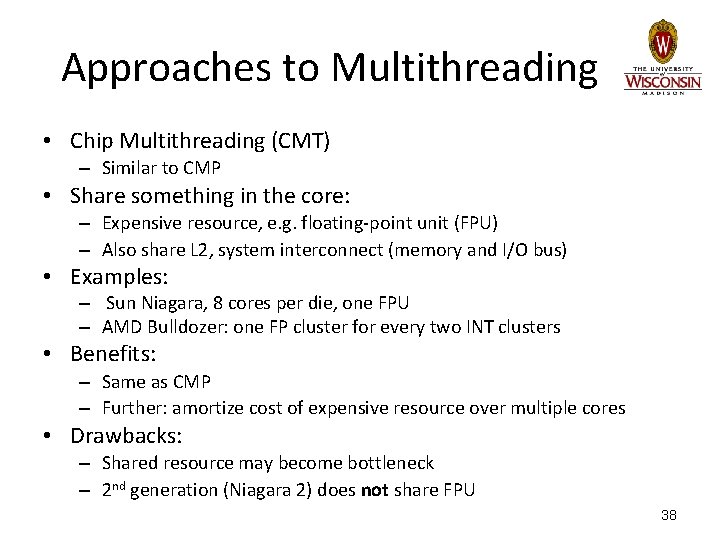
Approaches to Multithreading • Chip Multithreading (CMT) – Similar to CMP • Share something in the core: – Expensive resource, e. g. floating-point unit (FPU) – Also share L 2, system interconnect (memory and I/O bus) • Examples: – Sun Niagara, 8 cores per die, one FPU – AMD Bulldozer: one FP cluster for every two INT clusters • Benefits: – Same as CMP – Further: amortize cost of expensive resource over multiple cores • Drawbacks: – Shared resource may become bottleneck – 2 nd generation (Niagara 2) does not share FPU 38
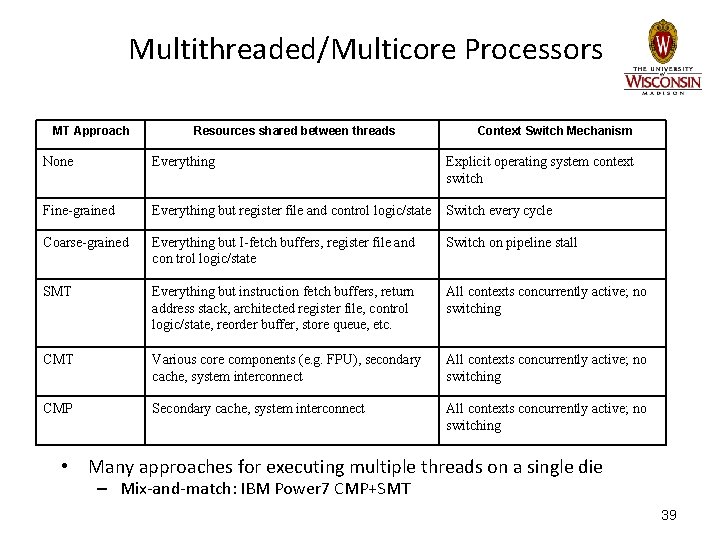
Multithreaded/Multicore Processors MT Approach Resources shared between threads Context Switch Mechanism None Everything Explicit operating system context switch Fine-grained Everything but register file and control logic/state Switch every cycle Coarse-grained Everything but I-fetch buffers, register file and con trol logic/state Switch on pipeline stall SMT Everything but instruction fetch buffers, return address stack, architected register file, control logic/state, reorder buffer, store queue, etc. All contexts concurrently active; no switching CMT Various core components (e. g. FPU), secondary cache, system interconnect All contexts concurrently active; no switching CMP Secondary cache, system interconnect All contexts concurrently active; no switching • Many approaches for executing multiple threads on a single die – Mix-and-match: IBM Power 7 CMP+SMT 39
IBM Power 4: Example CMP
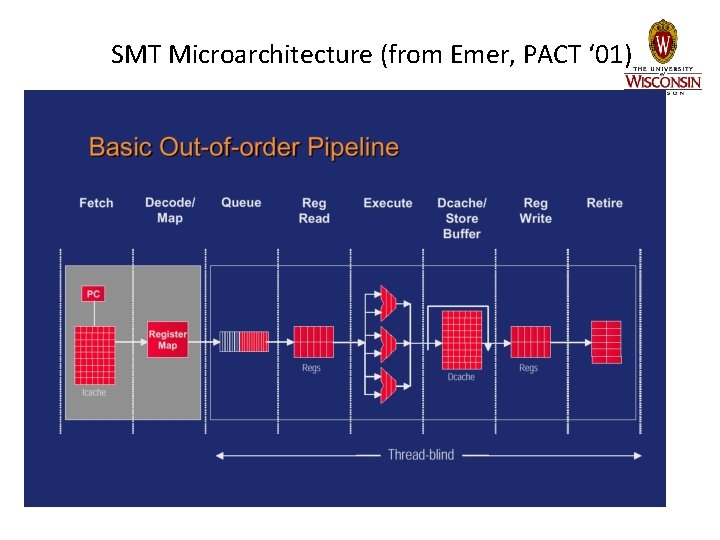
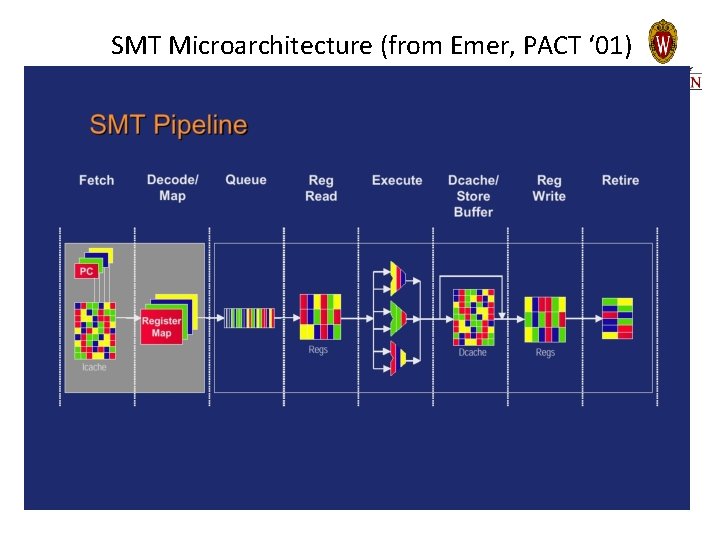
SMT Microarchitecture (from Emer, PACT ‘ 01)
SMT Microarchitecture (from Emer, PACT ‘ 01)
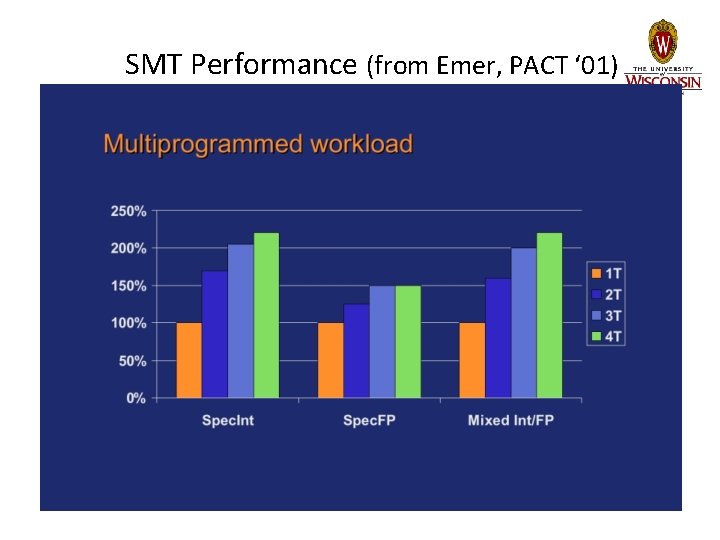
SMT Performance (from Emer, PACT ‘ 01)
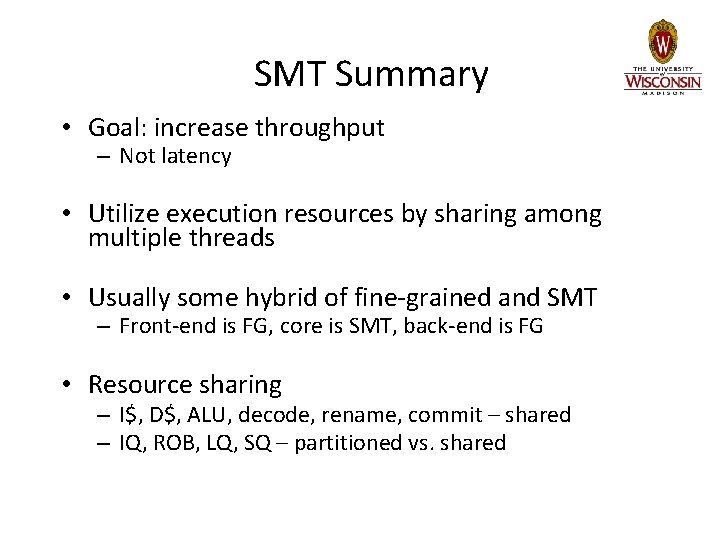
SMT Summary • Goal: increase throughput – Not latency • Utilize execution resources by sharing among multiple threads • Usually some hybrid of fine-grained and SMT – Front-end is FG, core is SMT, back-end is FG • Resource sharing – I$, D$, ALU, decode, rename, commit – shared – IQ, ROB, LQ, SQ – partitioned vs. shared
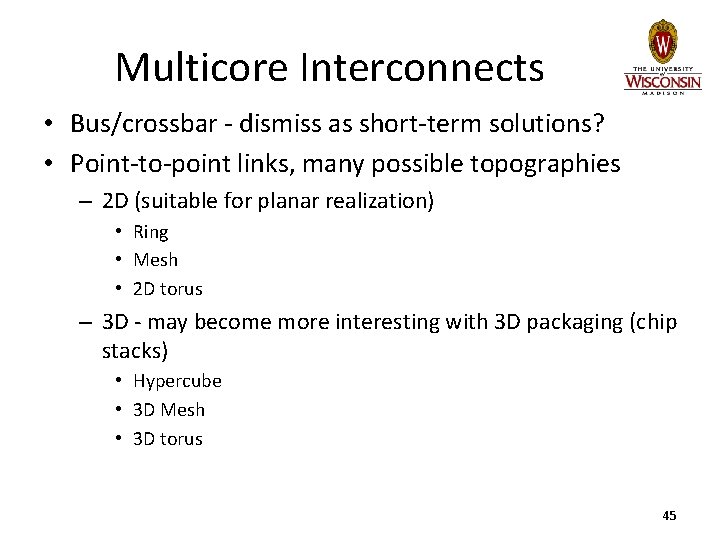
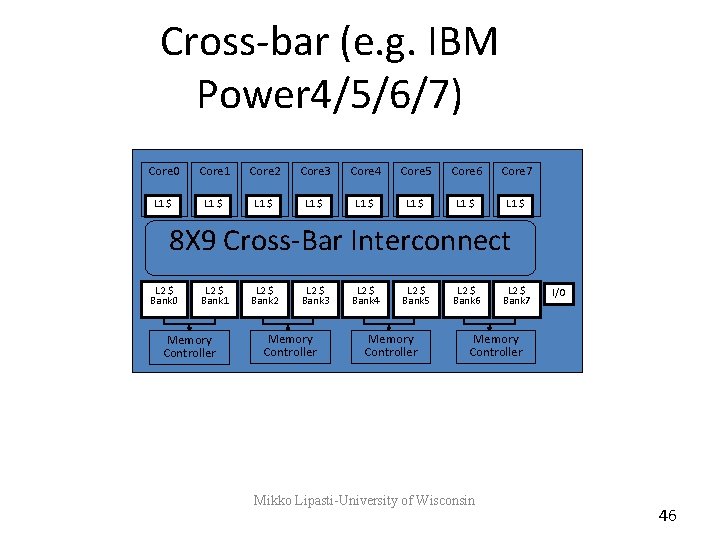
Multicore Interconnects • Bus/crossbar - dismiss as short-term solutions? • Point-to-point links, many possible topographies – 2 D (suitable for planar realization) • Ring • Mesh • 2 D torus – 3 D - may become more interesting with 3 D packaging (chip stacks) • Hypercube • 3 D Mesh • 3 D torus 45
Cross-bar (e. g. IBM Power 4/5/6/7) Core 0 Core 1 Core 2 Core 3 Core 4 Core 5 Core 6 Core 7 L 1 $ L 1 $ 8 X 9 Cross-Bar Interconnect L 2 $ Bank 0 L 2 $ Bank 1 Memory Controller L 2 $ Bank 2 L 2 $ Bank 3 Memory Controller L 2 $ Bank 4 L 2 $ Bank 5 Memory Controller L 2 $ Bank 6 L 2 $ Bank 7 I/O Memory Controller Mikko Lipasti-University of Wisconsin 46
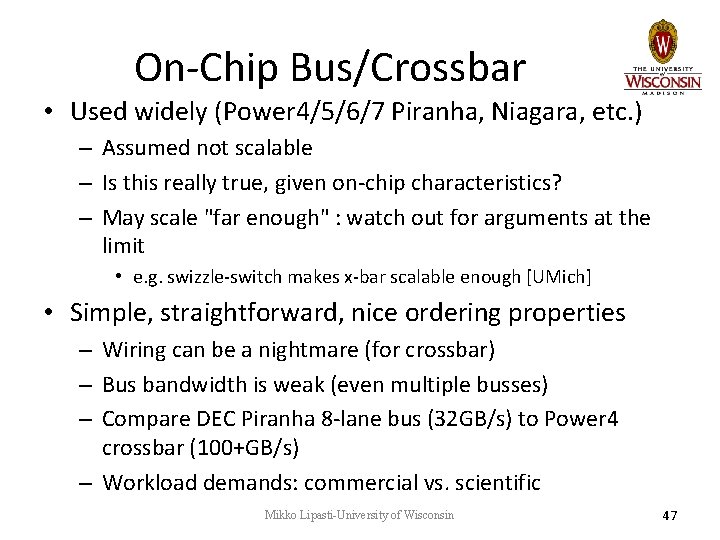
On-Chip Bus/Crossbar • Used widely (Power 4/5/6/7 Piranha, Niagara, etc. ) – Assumed not scalable – Is this really true, given on-chip characteristics? – May scale "far enough" : watch out for arguments at the limit • e. g. swizzle-switch makes x-bar scalable enough [UMich] • Simple, straightforward, nice ordering properties – Wiring can be a nightmare (for crossbar) – Bus bandwidth is weak (even multiple busses) – Compare DEC Piranha 8 -lane bus (32 GB/s) to Power 4 crossbar (100+GB/s) – Workload demands: commercial vs. scientific Mikko Lipasti-University of Wisconsin 47
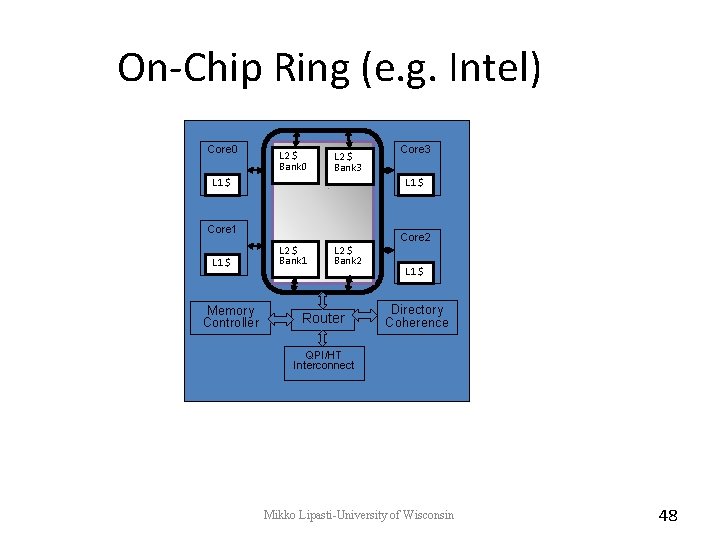
On-Chip Ring (e. g. Intel) Core 0 L 2 $ Bank 3 L 1 $ Core 1 L 1 $ Memory Controller Core 3 L 2 $ Bank 1 L 2 $ Bank 2 Router Core 2 L 1 $ Directory Coherence QPI/HT Interconnect Mikko Lipasti-University of Wisconsin 48
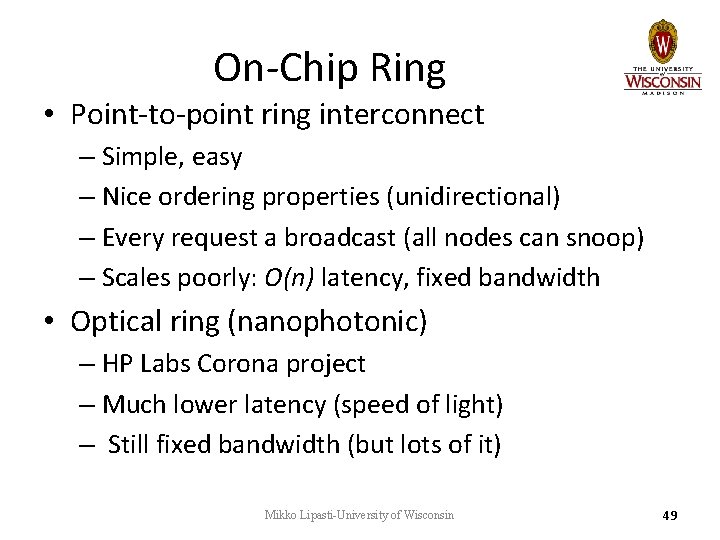
On-Chip Ring • Point-to-point ring interconnect – Simple, easy – Nice ordering properties (unidirectional) – Every request a broadcast (all nodes can snoop) – Scales poorly: O(n) latency, fixed bandwidth • Optical ring (nanophotonic) – HP Labs Corona project – Much lower latency (speed of light) – Still fixed bandwidth (but lots of it) Mikko Lipasti-University of Wisconsin 49
On-Chip Mesh • Widely assumed in academic literature • Tilera [Wentzlaff], Intel 80 -core prototype • Not symmetric, so have to watch out for load imbalance on inner nodes/links – 2 D torus: wraparound links to create symmetry • Not obviously planar • Can be laid out in 2 D but longer wires, more intersecting links • Latency, bandwidth scale well • Lots of recent research in the literature Mikko Lipasti-University of Wisconsin 50
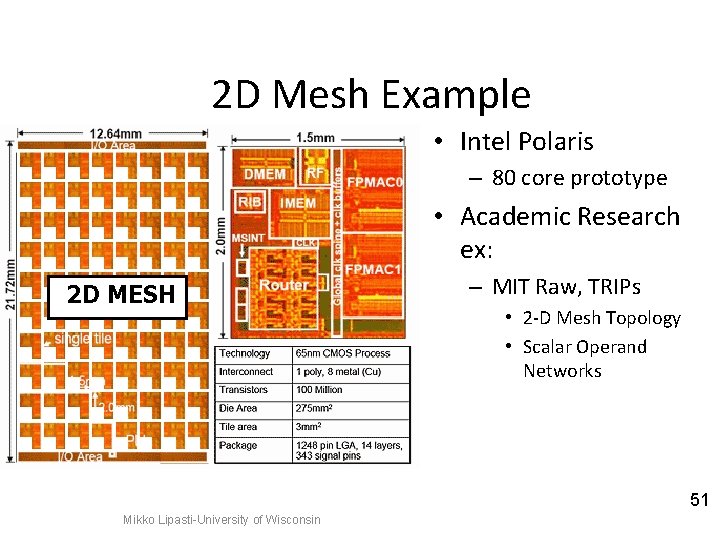
2 D Mesh Example • Intel Polaris – 80 core prototype • Academic Research ex: 2 D MESH – MIT Raw, TRIPs • 2 -D Mesh Topology • Scalar Operand Networks 51 Mikko Lipasti-University of Wisconsin
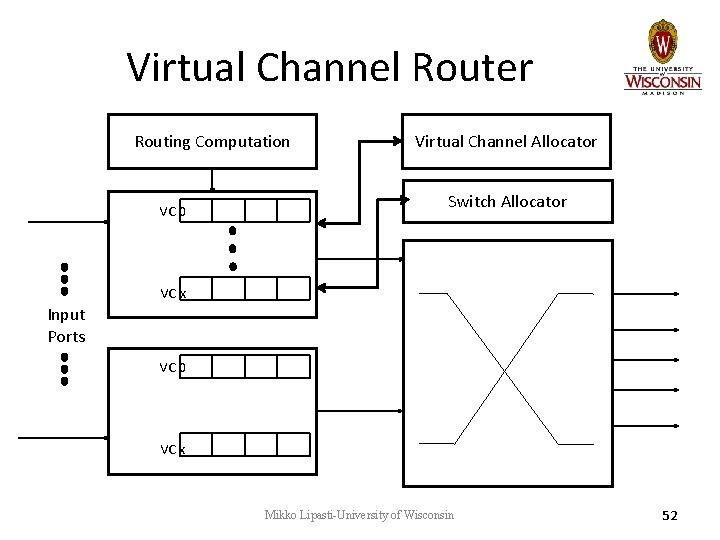
Virtual Channel Router Routing Computation Virtual Channel Allocator Switch Allocator VC 0 VC x MVC 0 Input Ports VC 0 MVC 0 VC x Mikko Lipasti-University of Wisconsin 52
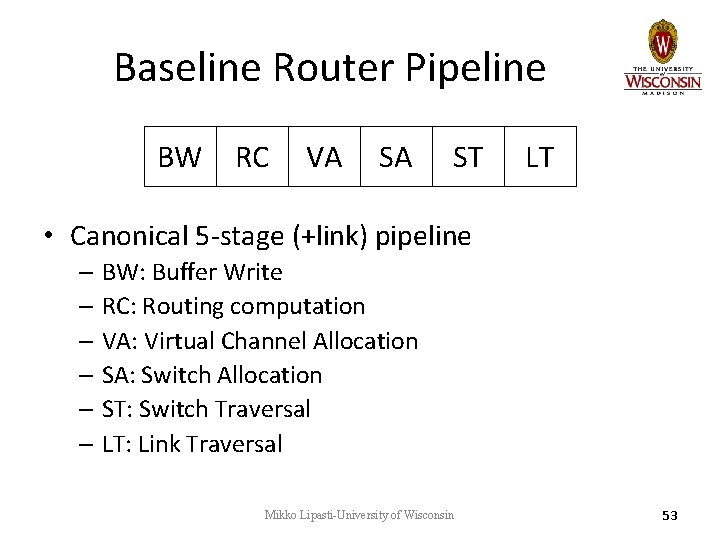
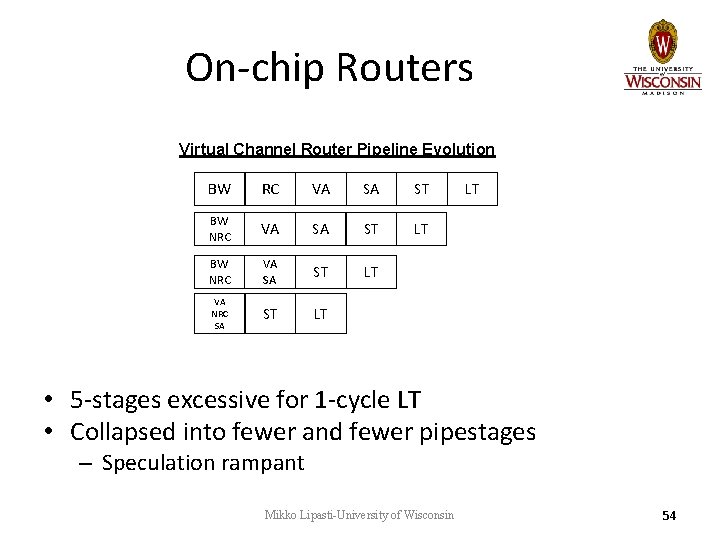
Baseline Router Pipeline BW RC VA SA ST LT • Canonical 5 -stage (+link) pipeline – BW: Buffer Write – RC: Routing computation – VA: Virtual Channel Allocation – SA: Switch Allocation – ST: Switch Traversal – LT: Link Traversal Mikko Lipasti-University of Wisconsin 53
On-chip Routers Virtual Channel Router Pipeline Evolution BW RC VA SA ST BW NRC VA SA ST LT VA NRC SA ST LT LT • 5 -stages excessive for 1 -cycle LT • Collapsed into fewer and fewer pipestages – Speculation rampant Mikko Lipasti-University of Wisconsin 54
On-Chip Interconnects • More coverage in ECE/CS 757 (usually) • Synthesis lecture: – Natalie Enright Jerger & Li-Shiuan Peh, “On-Chip Networks”, Synthesis Lectures on Computer Architecture – http: //www. morganclaypool. com/doi/abs/10. 220 0/S 00209 ED 1 V 01 Y 200907 CAC 008 55
Lecture Summary • ECE 757 Topics reviewed (briefly): – Thread-level parallelism – Synchronization – Coherence – Consistency – Multithreading – Multicore interconnects • Many others not covered