Higher PE The Physical Factor JD Plagiarism Warning

- Slides: 80
Higher PE The Physical Factor JD
Plagiarism Warning Throughout this power point there are sample answers. Please note that these sample answers are not to be used as your own work they are for reference only. If you fail to comply with this request you will be at risk of failing the course.
Cycle of Analysis (How do we get better at. . ) � Investigate (Testing/observing) � Analyse (Interpret results, pinpoint strengths & weaknesses) � Develop (Training to develop weaknesses) � Evaluate (Re testing, observing, has training worked? )
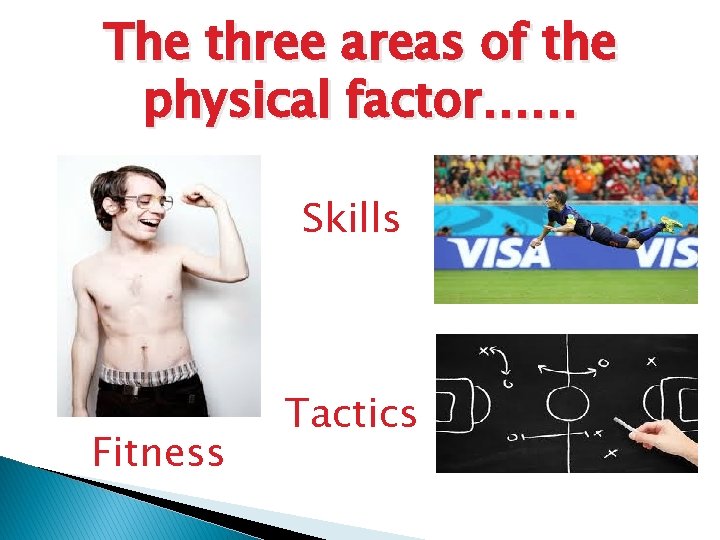
The three areas of the physical factor…… Skills Fitness Tactics
Fitness
Aspects of Fitness �There are two sections within fitness, these are: �Physical �Skill Fitness Related Fitness
Physical Fitness These are all the aspects of physical fitness, copy them into you jotter. �Aerobic endurance �Anaerobic endurance �Speed endurance �Flexibility �Strength �Muscular endurance �Speed �Power Write these in your jotter now!
Group Task Get into a group of 3 or 4 people. Give each person in your group a number from 1 -3 or 1 -4. Assign each person in your group one or two aspects of physical fitness making sure all are covered. Each person has to create a definition for that aspect and share with the group and then the class.
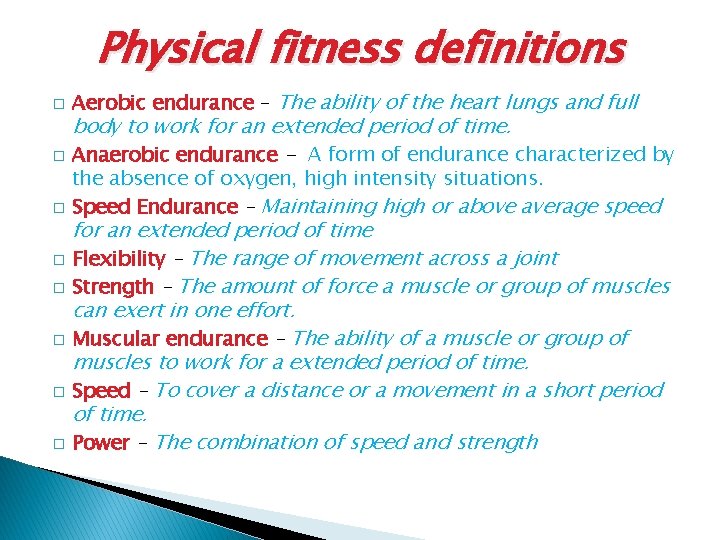
Physical fitness definitions � Aerobic endurance – The ability of the heart lungs and full body to work for an extended period of time. � Anaerobic endurance - A form of endurance characterized by � the absence of oxygen, high intensity situations. Speed Endurance – Maintaining high or above average speed for an extended period of time � Flexibility – The range of movement across a joint � Strength – The amount of force a muscle or group of muscles can exert in one effort. � Muscular endurance – The ability of a muscle or group of muscles to work for a extended period of time. � Speed – To cover a distance or a movement in a short period of time. � Power – The combination of speed and strength
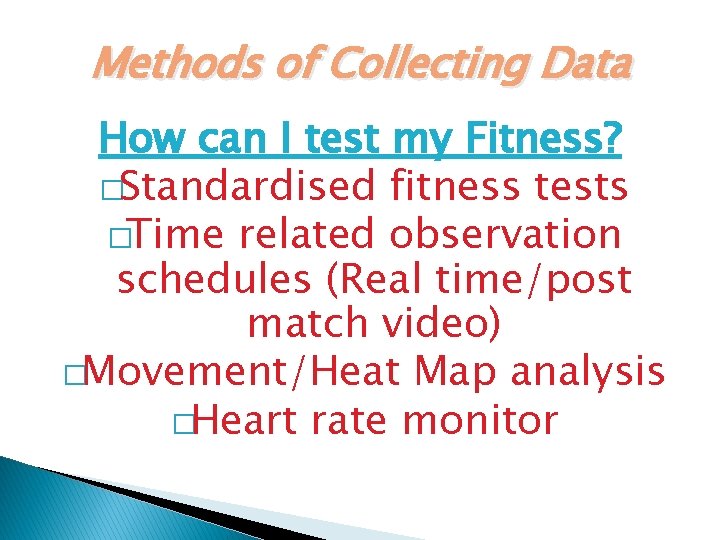
Methods of Collecting Data How can I test my Fitness? �Standardised fitness tests �Time related observation schedules (Real time/post match video) �Movement/Heat Map analysis �Heart rate monitor
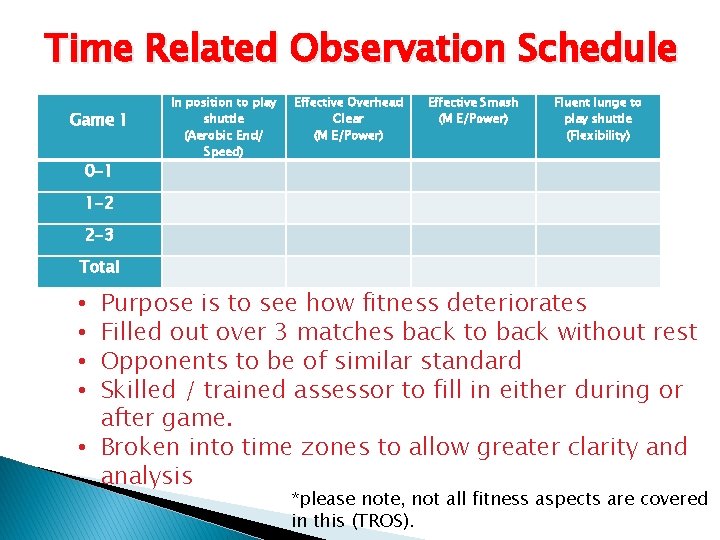
Time Related Observation Schedule In position to play shuttle (Aerobic End/ Speed) Effective Overhead Clear (M E/Power) Effective Smash (M E/Power) Fluent lunge to play shuttle (Flexibility) 1 -2 2 -3 Total Game 1 0 -1 Purpose is to see how fitness deteriorates Filled out over 3 matches back to back without rest Opponents to be of similar standard Skilled / trained assessor to fill in either during or after game. • Broken into time zones to allow greater clarity and analysis • • *please note, not all fitness aspects are covered in this (TROS).
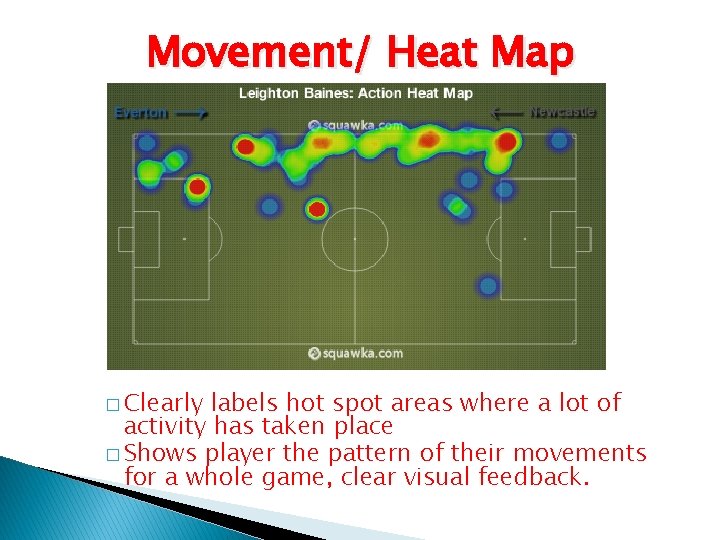
Movement/ Heat Map � Clearly labels hot spot areas where a lot of activity has taken place � Shows player the pattern of their movements for a whole game, clear visual feedback.
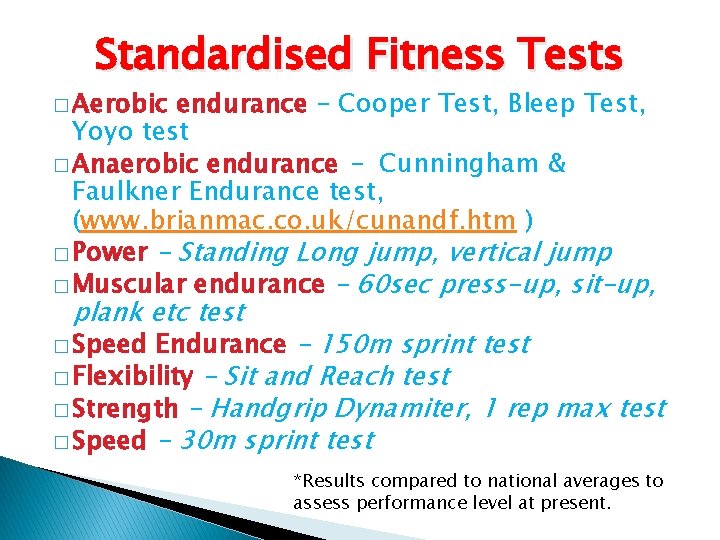
Standardised Fitness Tests � Aerobic endurance – Cooper Test, Bleep Test, Yoyo test � Anaerobic endurance - Cunningham & Faulkner Endurance test, (www. brianmac. co. uk/cunandf. htm ) � Power – Standing Long jump, vertical jump � Muscular endurance – 60 sec press-up, sit-up, plank etc test Endurance – 150 m sprint test � Flexibility – Sit and Reach test � Strength – Handgrip Dynamiter, 1 rep max test � Speed – 30 m sprint test � Speed *Results compared to national averages to assess performance level at present.
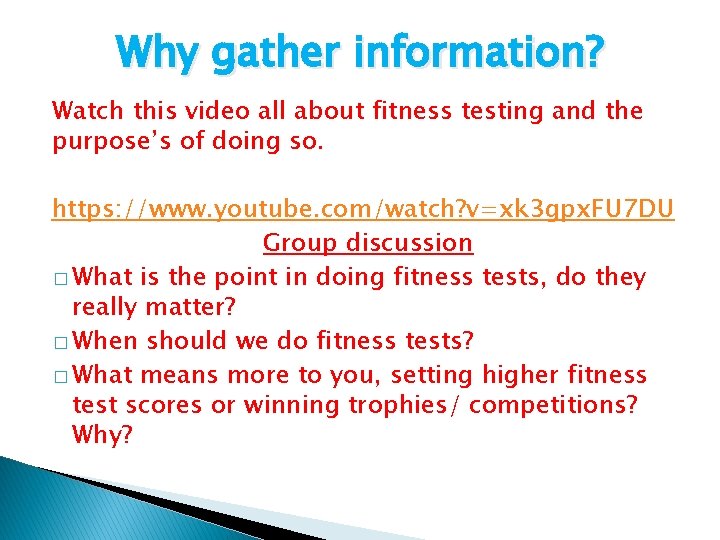
Why gather information? Watch this video all about fitness testing and the purpose’s of doing so. https: //www. youtube. com/watch? v=xk 3 gpx. FU 7 DU Group discussion � What is the point in doing fitness tests, do they really matter? � When should we do fitness tests? � What means more to you, setting higher fitness test scores or winning trophies/ competitions? Why?
Fitness Task (a) Describe two methods you used to gather information about your performance from the physical factor. (4) Or……. . (b) Outline two ways in which you examined your physical fitness. (4) Pick one of the questions above to answer.
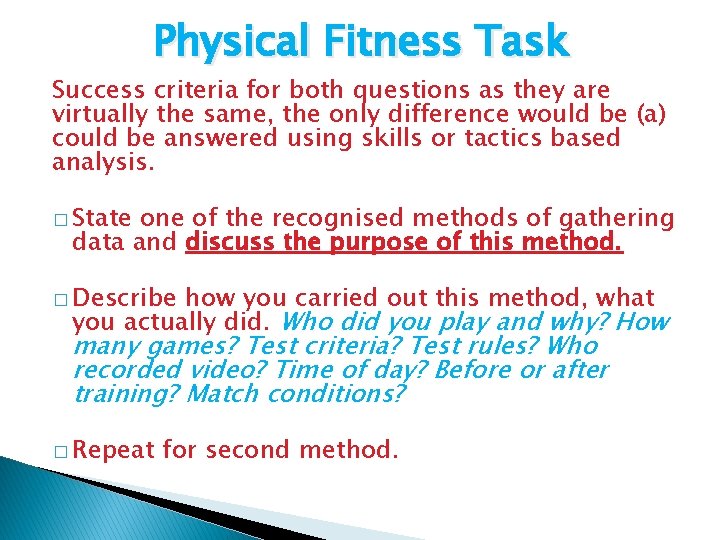
Physical Fitness Task Success criteria for both questions as they are virtually the same, the only difference would be (a) could be answered using skills or tactics based analysis. � State one of the recognised methods of gathering data and discuss the purpose of this method. � Describe how you carried out this method, what you actually did. Who did you play and why? How many games? Test criteria? Test rules? Who recorded video? Time of day? Before or after training? Match conditions? � Repeat for second method.
Physical Fitness Task (a) Choose one physical fitness investigation method you have used and evaluate one benefit and one limitation of using this method to collect information. (4)
Possible Benefits…… � Clear feedback for you to see strengths and weaknesses relatively soon after performance � Motivation to improve due to score, classification � Test criteria is the same so it is reliable � Short term and long term targets can be set as a result � Training programme aimed to specifically target weaknesses can be formulated
Possible limitations…. . � Lack of time to complete � Different opponents, training partners � Untrained observers � Rules / test criteria not fully observed � Environment, time of day, lack of facility etc. � Negativity due to boredom � Honesty?
Development Approaches for Physical Fitness � Aerobic / Anerobic Endurance – Fartlek training, Interval Training, Continuous Training https: //www. youtube. com/watch? v=G 0 flp 8 u. S 1 Eg � Muscular Endurance – Circuit Training � Speed – Sprints, Weights, Plyometric’s https: //www. youtube. com/watch? v=8 Lu. ZWIk. Oqr. Q � Strength – Weight training � Power – Body weight / weight training, Explosive drills specific to sport demands.
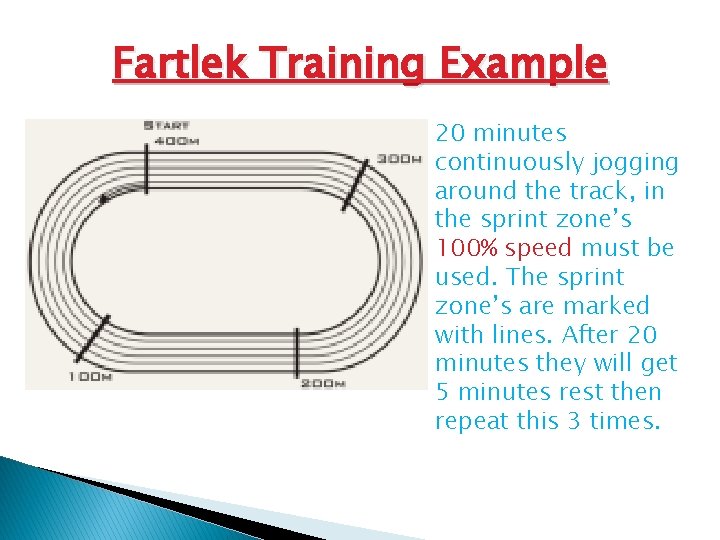
Fartlek Training Example 20 minutes continuously jogging around the track, in the sprint zone’s 100% speed must be used. The sprint zone’s are marked with lines. After 20 minutes they will get 5 minutes rest then repeat this 3 times.
Why use Fartlek? � Easily adapted to suit your facility and set up. � Easily progress to make more complex or easier if needed. � Includes realistic high intensity bursts similar to your activity eg, Football, Badminton, Rugby Etc. � Will dramatically improve aerobic and anaerobic endurance. � Challenging mentally and physically.
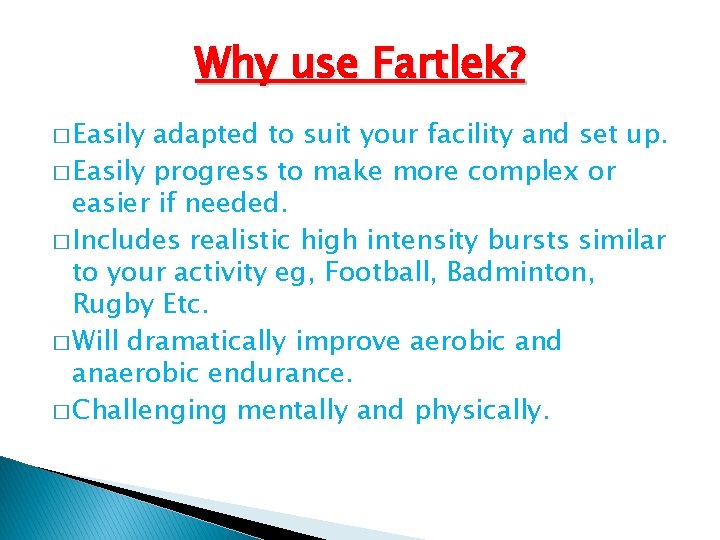
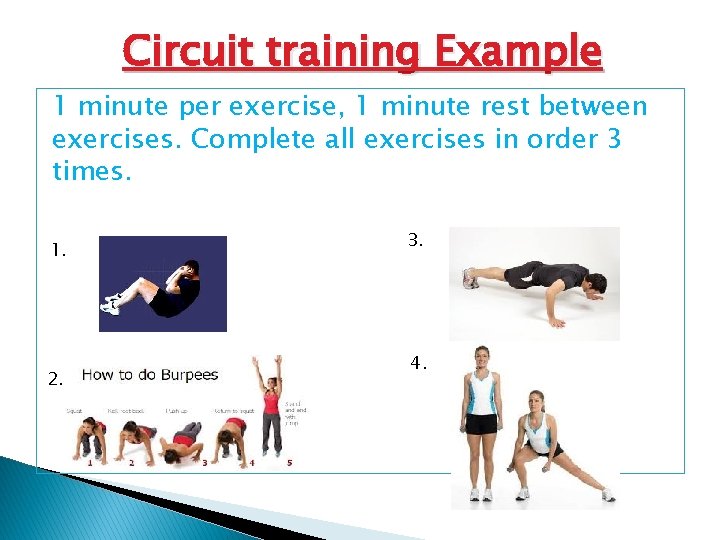
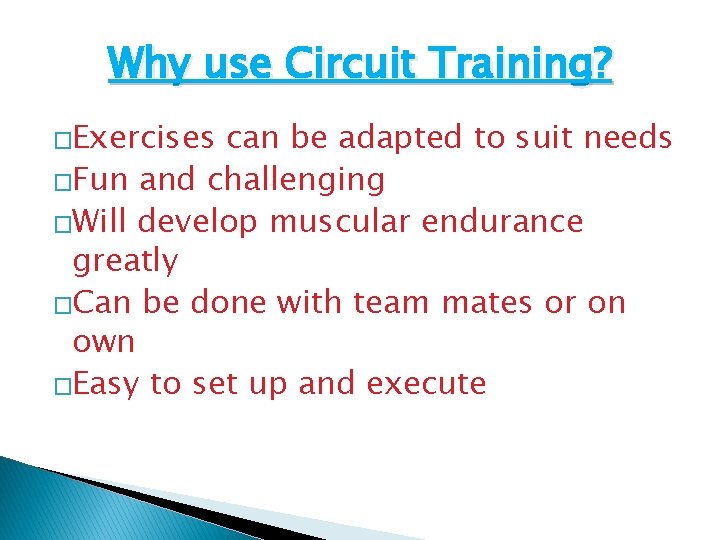
Circuit training Example 1 minute per exercise, 1 minute rest between exercises. Complete all exercises in order 3 times. 1. 2. 3. 4.
Why use Circuit Training? �Exercises can be adapted to suit needs �Fun and challenging �Will develop muscular endurance greatly �Can be done with team mates or on own �Easy to set up and execute
Power Example The video you are about to watch shows a training session to develop power in the legs which helps jumping & kicking. https: //www. youtube. com/watch? v=Qr. Ux. LSGJr Tk
� Will Why use plyometrics/body weight/weights exercises? really improve power in specific areas of body � Fun and challenging � Can be easy to set up � Targets and scores can be easily made to set targets � Will have minor benefits to other aspects of fitness.
The Principles of Training When creating a training programme, you need to go about it sensibly, you need to follow some simple guidelines. https: //www. youtube. com/watch? v=Upqj p 6 I 5 e. OE
Principles of Training In order for training to be effective and relevant you need to apply the Principles of Training: � Specificity – Weakness, sport, role in sport. � Progressive Overload – Gradually making training more complex, can be done by (F. I. D) � Frequency – how many times you train � Intensity – how hard you train � Duration – how long you train for � Reversibility - adapting training various reasons, injury, lack of facility etc.
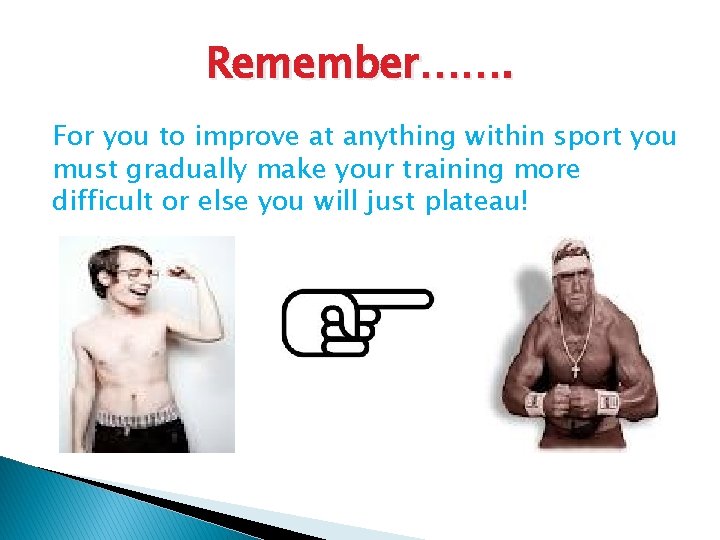
Remember……. For you to improve at anything within sport you must gradually make your training more difficult or else you will just plateau!
Fitness Task In your jotter, draw a 3 week training programme. The programme must develop two aspects of physical fitness only and it must show progressive overload. You must have 3 fitness training sessions per week with the first session lasting 20 minutes.
Fitness Task 2 Discuss why you chose your selected method’s of training. (4) Eg. Fartlek training to improve aerobic endurance, why did I use this? Describe some possible decisions you might have to make after the first week of training? (2)
Phases of Training There are three phases of training: • Micro – pre season • Macro – during season • Miso – transition During these phases the types of training vary greatly. Discuss and list five reasons why Micro training must be different to Macro training. Then discuss why Miso training is important at all give two reasons to support your thoughts.
Skill Related Fitness These are the aspects of Skill Related Fitness, write them down in your jotter: � Agility � Balance Core stability � Reaction time � Coordination �
Skill Related Fitness Defined � AGILITY– Is the ability to move the body quickly and precisely. � BALANCE - Is the ability to maintain the centre of gravity above the base of support. Static balances require You HOLD a position. Dynamic balance requires you to maintain balance in ever changing circumstances � CORE STABILITY – Strength in the mid region of your body allowing balanced movement � REACTION TIME – Is the time taken between the recognition of a signal and the start of your movement. � CO-ORDINATION - Is the ability to control movements smoothly and fluently. Groups of muscles must work in sequence to produce an effective performance.
Personal Task Select three aspects of Skill Related Fitness, write a paragraph in your jotter as to why you need a high degree of ability within these aspects to perform successfully from any sport you wish. Make reference to particular skills from you chosen sport where these aspects of skill related fitness are needed greatly. (6) Extension task Using the three aspects of Skill related fitness you spoke about in your previous answer, draw and describe a training drill or practice that would develop your ability in all three aspects from your chosen sport.
Methods of Investigating (SRF) � General observation schedule � Scatter diagram � Digital analysis � Coach feedback � Skills testing
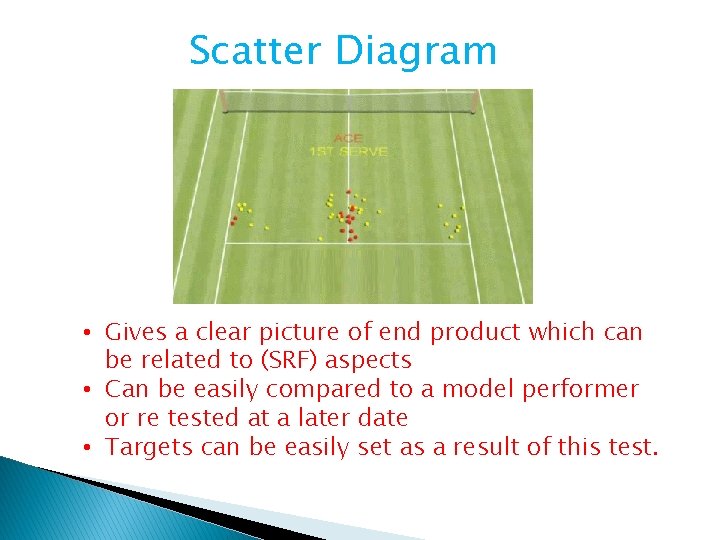
Scatter Diagram • Gives a clear picture of end product which can be related to (SRF) aspects • Can be easily compared to a model performer or re tested at a later date • Targets can be easily set as a result of this test.
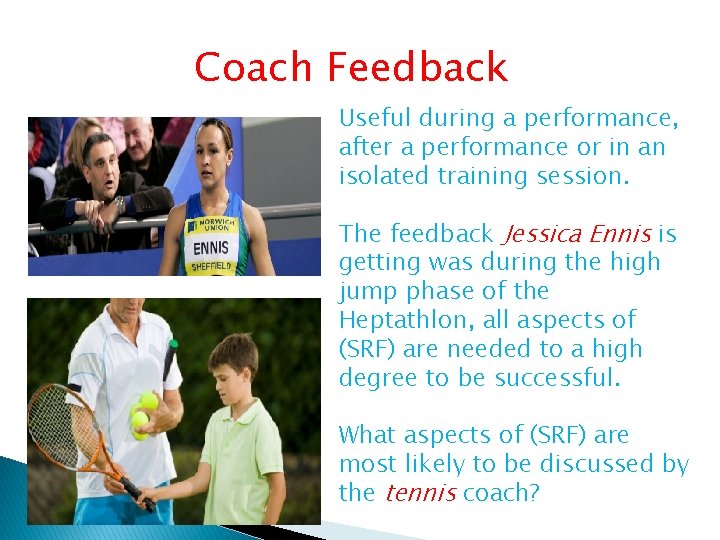
Coach Feedback Useful during a performance, after a performance or in an isolated training session. The feedback Jessica Ennis is getting was during the high jump phase of the Heptathlon, all aspects of (SRF) are needed to a high degree to be successful. What aspects of (SRF) are most likely to be discussed by the tennis coach?
Skills Testing Homework For each aspect of skill related fitness (SRF) research and write a short description, with diagrams, a test for that aspect.
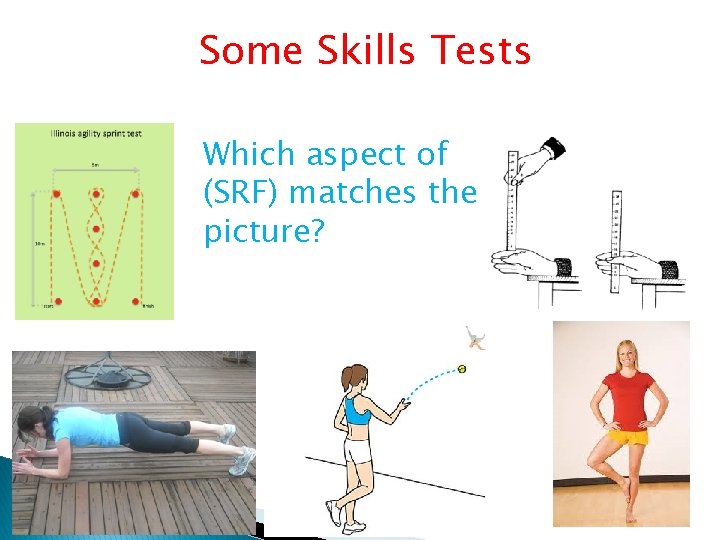
Some Skills Tests Which aspect of (SRF) matches the picture?
Monitoring Tools �Training Diary �Results from matches �Video analysis �Observation schedules �Coach feedback
Why monitor training? �To check training is effective, relevant to development needs, long term targets. �Make sure short term targets are met, progress is being made. �Provide motivation to further improve. �Make adaptations to training if necessary. �Ensure strengths are maintained while weaknesses improved.
Monitoring training task Question 1 Describe why it is important to monitor and evaluate performance. (2) Question 2 Explain at least two difficulties that might be encountered when investigating and monitoring the impact of physical factors on performance. (6)
Question 1 – Success Criteria 1 mark can be awarded for each relevant point, or development of a point, of explanation of the purpose of monitoring and evaluating performance. 0 marks for no explanation of monitoring or evaluation. Examples of possible points of explanation about the purpose of monitoring and evaluating performance include: • obtaining baseline information • tracking progress of any approach to develop any factor • or any other acceptable response.
Question 2 – Success Criteria 1 mark can be awarded for each relevant point, or development of a point, of explanation of difficulties that might be encountered when monitoring and evaluating the impact of physical factors on performance, up to three marks for each difficulty. 0 marks for no explanation of problems encountered. Examples of difficulties encountered when monitoring and evaluating the impact of physical factors on performance include: • It might be difficult to get baseline information, depending on which tool is used because of variable test criteria such as…… • If an observation schedule is used to monitor and the criteria is not understood properly then… • Due to injury / lack of facility l wasn’t able to carry out the test therefore…… • The difficulty of doing fitness tests alone made some content incorrect such as……. • or any other acceptable response.
Skills
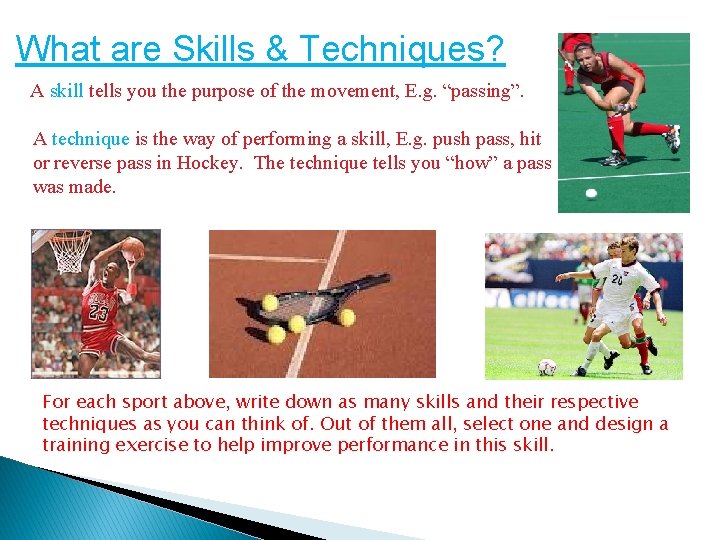
What are Skills & Techniques? A skill tells you the purpose of the movement, E. g. “passing”. A technique is the way of performing a skill, E. g. push pass, hit or reverse pass in Hockey. The technique tells you “how” a pass was made. For each sport above, write down as many skills and their respective techniques as you can think of. Out of them all, select one and design a training exercise to help improve performance in this skill.
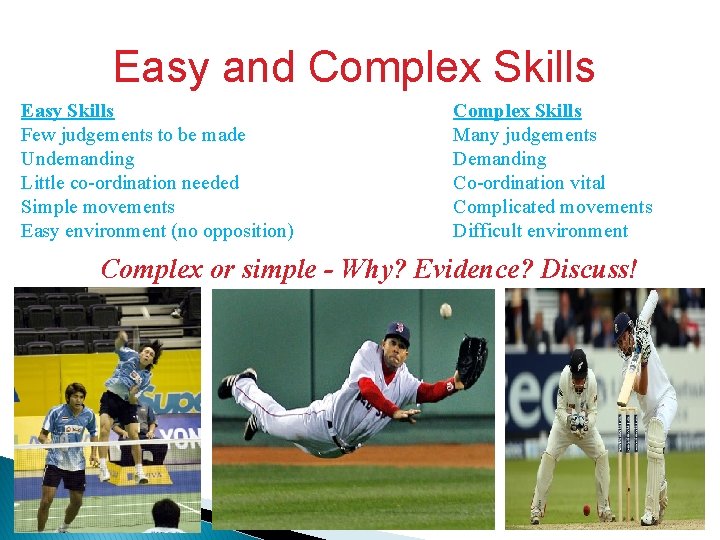
Easy and Complex Skills Easy Skills Few judgements to be made Undemanding Little co-ordination needed Simple movements Easy environment (no opposition) Complex Skills Many judgements Demanding Co-ordination vital Complicated movements Difficult environment Complex or simple - Why? Evidence? Discuss!
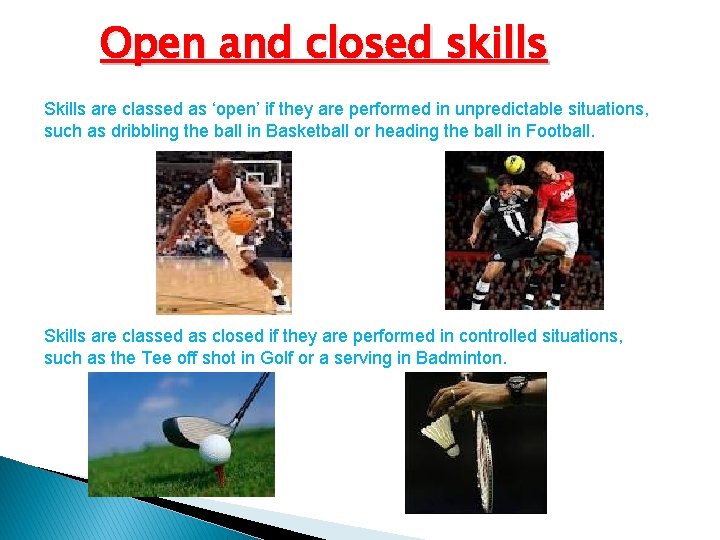
Open and closed skills Skills are classed as ‘open’ if they are performed in unpredictable situations, such as dribbling the ball in Basketball or heading the ball in Football. Skills are classed as closed if they are performed in controlled situations, such as the Tee off shot in Golf or a serving in Badminton.
Stages of Skill Learning There are 3 important stages when learning and developing skills These are: Cognitive stage Associative stage Autonomous stage
The Cognitive Stage The performer needs to: Get a mental picture of the skill or technique to aid learning Understand the basics of what is to be learned Break the skill down, prep, act, recovery Receive information in small chunks, this will aid information processing Receive corrective feedback
The Associative Stage The performer can: Understand what is expected in performing the skill Focus on improving the basics learnt Handle more specific information Attempt to recognise and correct their own errors (kinaesthetic awareness) Make better sense of external feedback given, due to an enhanced knowledge of the skill’s sub routines.
The Autonomous Stage The performer can now: Select and apply skills without conscious thought Perform skills to a consistently high degree Detect own errors and adapt/refine performance accordingly Concentrate more on tactics and strategies
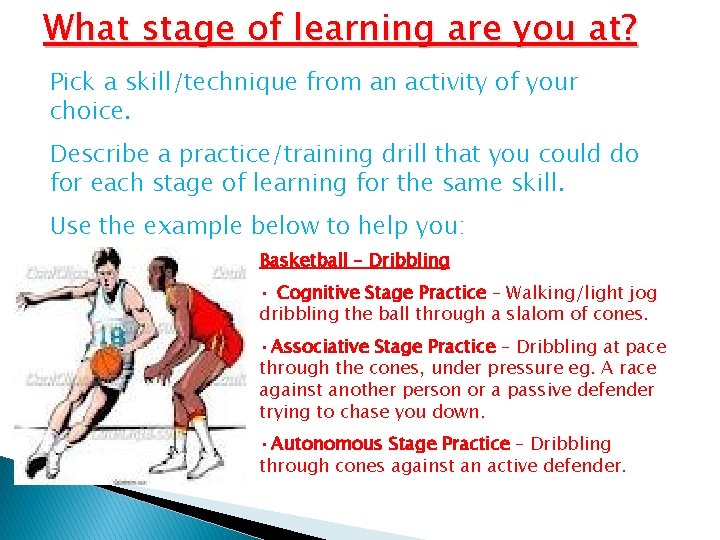
What stage of learning are you at? Pick a skill/technique from an activity of your choice. Describe a practice/training drill that you could do for each stage of learning for the same skill. Use the example below to help you: Basketball – Dribbling • Cognitive Stage Practice – Walking/light jog dribbling the ball through a slalom of cones. • Associative Stage Practice – Dribbling at pace through the cones, under pressure eg. A race against another person or a passive defender trying to chase you down. • Autonomous Stage Practice – Dribbling through cones against an active defender.
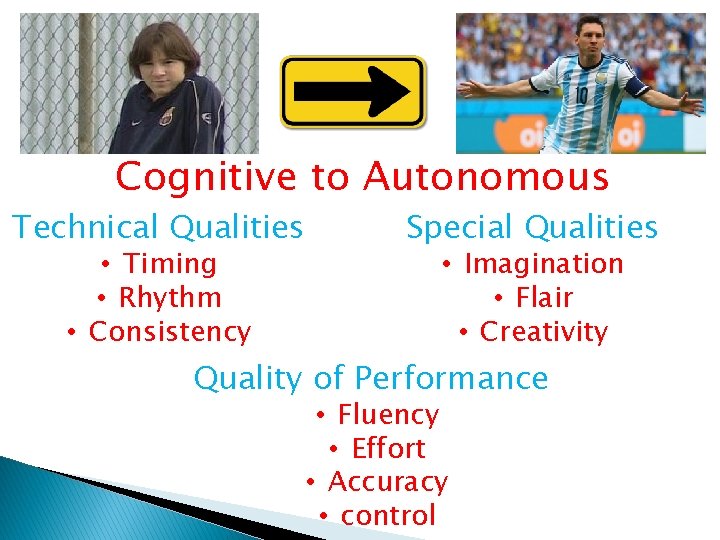
Cognitive to Autonomous Technical Qualities • Timing • Rhythm • Consistency Special Qualities • Imagination • Flair • Creativity Quality of Performance • Fluency • Effort • Accuracy • control
Select one of the sports people and write a paragraph in your jotter detailing the technical or special qualities they have. Explain how these qualities have led them to achieve high degrees of success in their sport. Give examples of their qualities and how they use them.
Methods of investigation How can I investigate my skills? Ø Games skills analysis (Ob Schedule) �Video analysis �Skills tests �Coach feedback
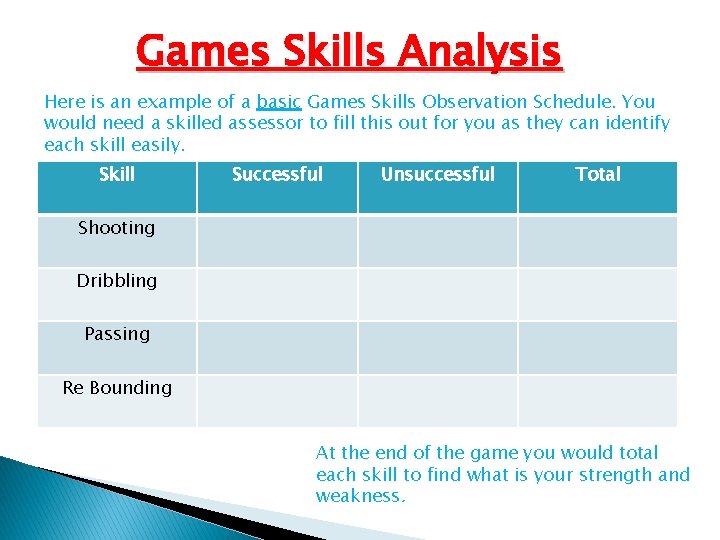
Games Skills Analysis Here is an example of a basic Games Skills Observation Schedule. You would need a skilled assessor to fill this out for you as they can identify each skill easily. Skill Successful Unsuccessful Total Shooting Dribbling Passing Re Bounding At the end of the game you would total each skill to find what is your strength and weakness.
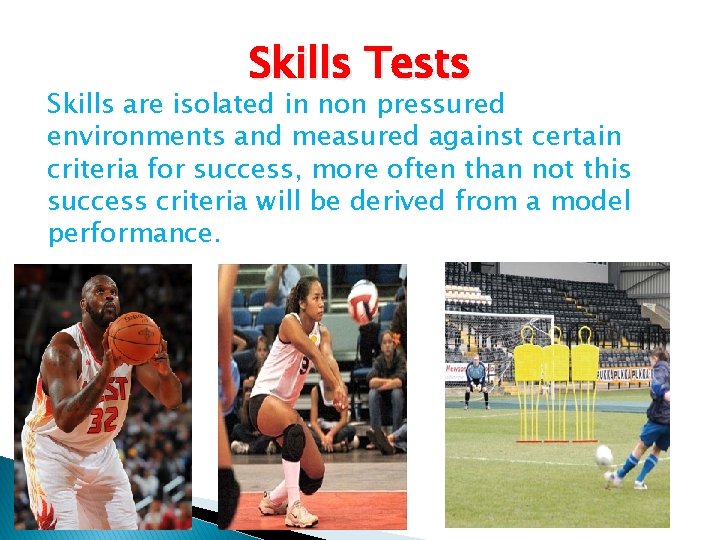
Skills Tests Skills are isolated in non pressured environments and measured against certain criteria for success, more often than not this success criteria will be derived from a model performance.
Coach Feedback and Video analysis Take notes during this video in your jotter, it will help you greatly as there is a task coming up. http: //www. youtube. com/watch? v=h. Gzy 9 i 309 k. A
Skills Task Compare and contrast the effectiveness of Video analysis with a game skills observation schedule or isolated skills testing. To conclude, offer your opinion on which is most useful for you as a coach. (8) 3, 3, 2 break down of marks
A simple Question……. Describe one method you used to investigate your performance within the physical factor (skills)? (4)
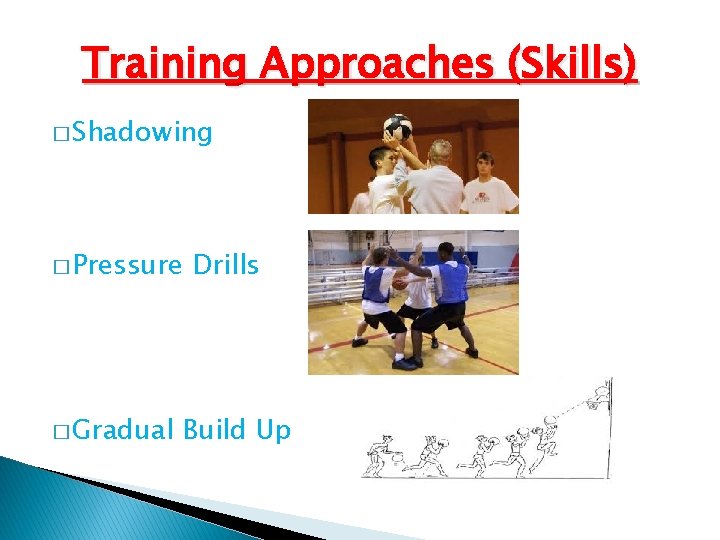
Training Approaches (Skills) � Shadowing � Pressure � Gradual Drills Build Up
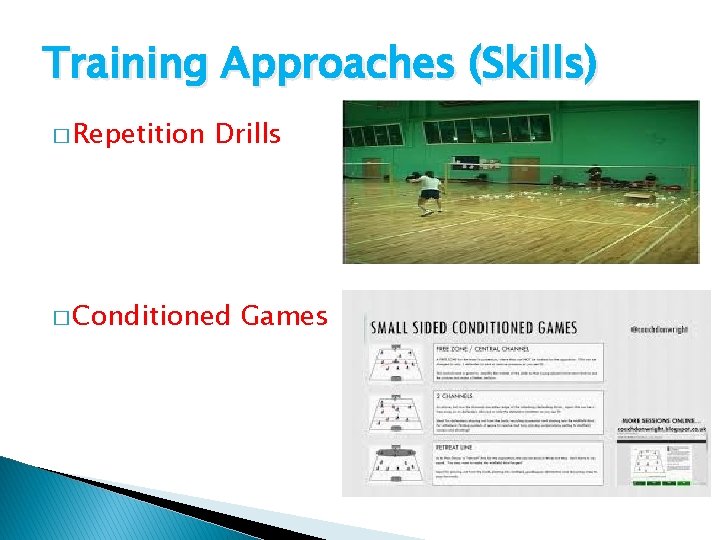
Training Approaches (Skills) � Repetition Drills � Conditioned Games
Skill Training Example Training Approach – Repetition Drill Skill – Shooting Technique – Lay –up Drill – I would perform 10 lay up’s with my right hand beginning my run up from the same spot each time. There is no defender. After each set of 10 Lay Up’s I will record how many l get in in my training diary. I will do 5 sets in total. To make this drill more complex I could add in a passive defender or set myself targets to achieve.
Skills Training Task As a coach, working with a team of performers at the autonomous stage of learning, Compare and Contrast the effectiveness of conditioned games to pressure drills. Conclude by stating which you feel to be most effective and why. (8) 3, 3, 2 break down of marks
Principles of Effective practice So that your practice is of the best quality each time you should incorporate the principles of effective practice, These will stop training from becoming boring, too easy or difficult or not make any real progress in getting better. The principles are: �Progression �Work to rest ratio �SMARTER target setting
Principles of Effective Practice SMARTER – Goal Target Setting � S – Specific, to stage � M – Measurable, this of learning, activity or task helps the performer assess their progress and set comparisons to model performers � A – Agreed, usually between coach and performer to ensure appropriate methods of practice have been selected � R – Realistic, challenging targets, not too hard or easy � T – Time-phased, a set time to reach a goal or certain level of performance � E – Exciting, keeps the performer motivated, use of variety and challenge needed here � R – Recorded – ensures commitment to practice and to skill development. Clear feedback.
Monitoring Tools �Training Diary �Results from matches �Video analysis �Observation schedules �Coach feedback �Skills tests
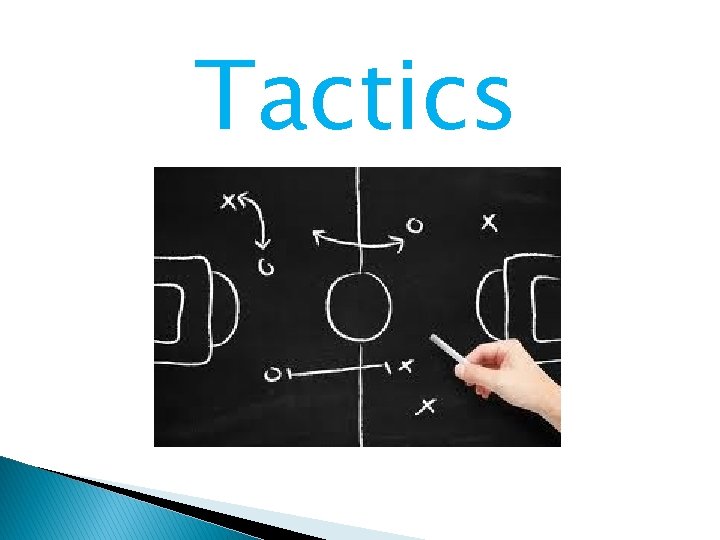
Tactics
Tactics There are two main areas within tactics, these are: �Performance considerations �Principles of play
Performance Considerations Things to think of: � Your own strengths & weaknesses � Your team’s strengths & weaknesses � The type of surface you using � The weather � Previous performance’s, matches against opponent etc.
Principles of Play These are things to think about during and before the game, they are more technical than performance considerations. Principles of play are: � Width � Depth � Delay
Tactics Task Choose one of the following tactics: The Offside trap - Football High & Long Serve - Badminton Two player block - Volleyball Man to man marking - Basketball For your chosen tactic which form of gathering data (testing) would be most effective for you to use, explain your answer in detail.
Methods of Collecting Data How can I test my tactics? �Match tactics Ob Schedule �Video analysis �Coach feedback �Knowledge of results
Development Approaches �Passive / active defenders as opponents �Walk / jog / run through drills �Conditioned Games
Tactics Task 1 Select an Activity Use the tactical development methods to create 3, 45 minute training sessions for your activity. Try to vary the type and difficulty of training approach to keep motivation and interest high during the session. You may use diagrams. Please give as much detail as possible. (9)
Monitoring Tools �Training Diary �Results from matches �Video analysis �Observation schedules �Coach feedback
Tactics Task 2 Select one tactical development method that you have used to address a tactical weakness within your own or your teams performance. Explain why you chose this method, how you monitored your progress throughout your team of using the method and the positives that using this method has had on your performance as a whole. (9)
1. 2. 3. 4. 5. 6. 7. Revision What is a complex skill? Name 3 aspects of physical fitness and a test for each. Give three reasons why it is important to monitor training? Describe for four marks, how you carried out a (TROS). Name two development methods for improving skills? Describe your strengths within the physical factor. Detail your development needs within the physical factor.