Chapter 3 Consciousness and the Two Track Mind

- Slides: 63
Chapter 3 Consciousness and the Two. Track Mind Josef F. Steufer/Getty Images
Chapter Overview • Consciousness: Some Basic Concepts • Sleep and Dreams • Drugs and Consciousness
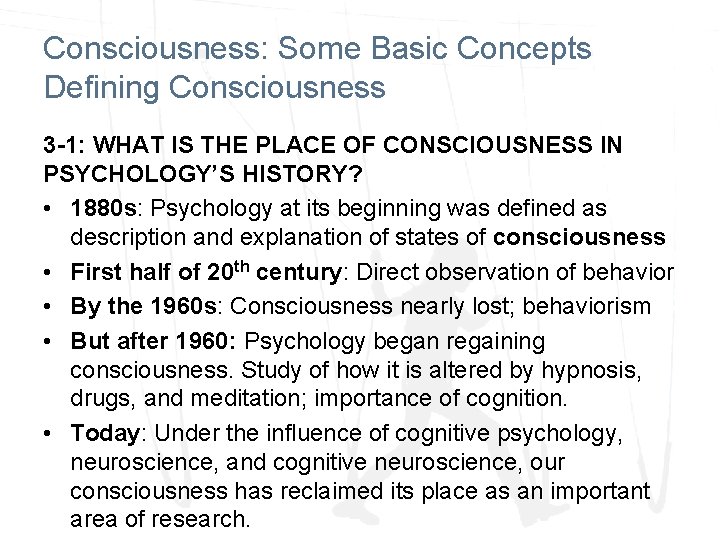
Consciousness: Some Basic Concepts Defining Consciousness 3 -1: WHAT IS THE PLACE OF CONSCIOUSNESS IN PSYCHOLOGY’S HISTORY? • 1880 s: Psychology at its beginning was defined as description and explanation of states of consciousness • First half of 20 th century: Direct observation of behavior • By the 1960 s: Consciousness nearly lost; behaviorism • But after 1960: Psychology began regaining consciousness. Study of how it is altered by hypnosis, drugs, and meditation; importance of cognition. • Today: Under the influence of cognitive psychology, neuroscience, and cognitive neuroscience, our consciousness has reclaimed its place as an important area of research.
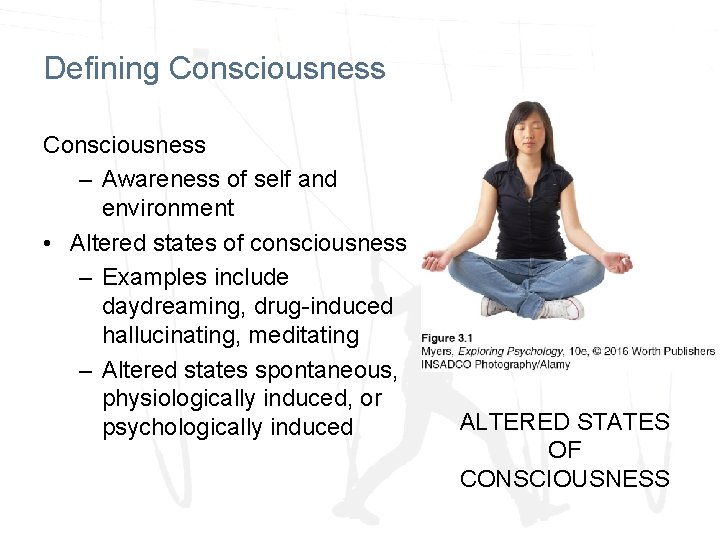
Defining Consciousness – Awareness of self and environment • Altered states of consciousness – Examples include daydreaming, drug-induced hallucinating, meditating – Altered states spontaneous, physiologically induced, or psychologically induced ALTERED STATES OF CONSCIOUSNESS
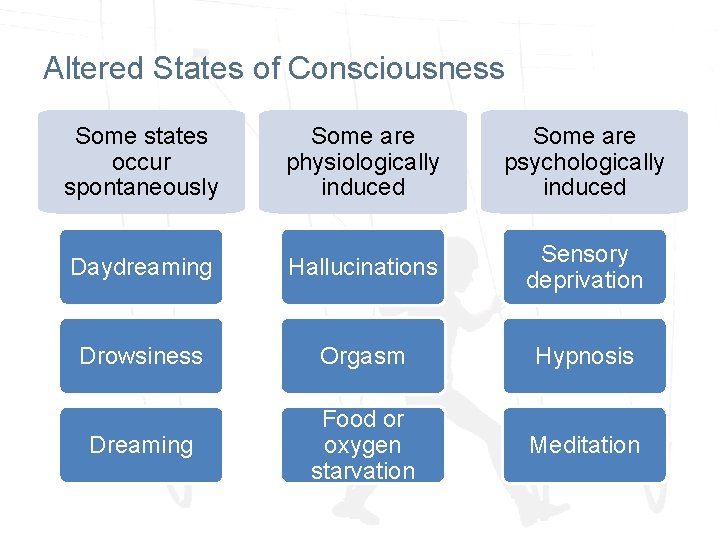
Altered States of Consciousness Some states occur spontaneously Some are physiologically induced Some are psychologically induced Daydreaming Hallucinations Sensory deprivation Drowsiness Orgasm Hypnosis Dreaming Food or oxygen starvation Meditation
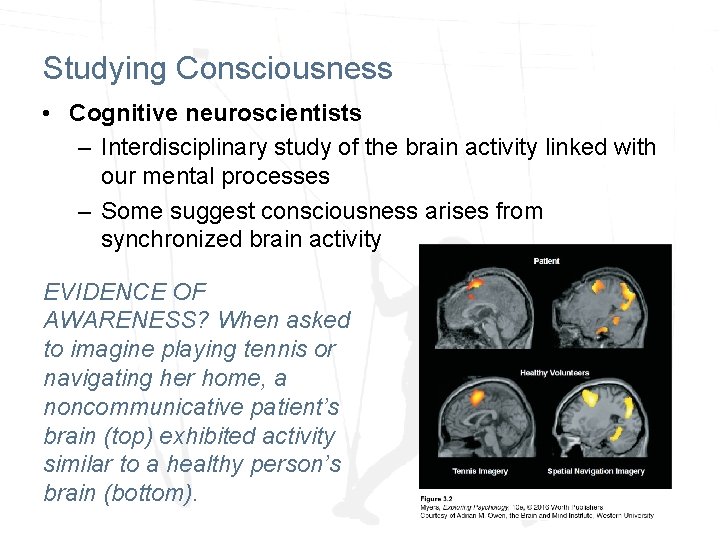
Studying Consciousness • Cognitive neuroscientists – Interdisciplinary study of the brain activity linked with our mental processes – Some suggest consciousness arises from synchronized brain activity EVIDENCE OF AWARENESS? When asked to imagine playing tennis or navigating her home, a noncommunicative patient’s brain (top) exhibited activity similar to a healthy person’s brain (bottom).
Selective Attention 3 -2: HOW DOES SELECTIVE ATTENTION DIRECT OUR PERCEPTIONS? Selective attention • Focusing conscious awareness on a particular stimulus • Estimates indicate that our five senses take in 11, 000 bits of information per second • We consciously process about 40 bits of these • Our minds unconsciously process the rest. • Cocktail party effect: our ability to attend to relevant bits of information and ignoring irrelevant bits.
Selective Attention and Accidents • Rapid toggling between activities is common today. – Multitasking distracts brain resources allocated to driving; brain activity in areas vital to driving decreases average of 37 percent when conversation occurs. – Cell-phone use increases accident risk fourfold (even with hands-free use). – Teen crashes or near-crashes increase sevenfold when dialing or reaching for phone.
Selective Inattention • Inattentional blindness – Failure to see visible objects when our attention is directed elsewhere. – It is a by-product of focusing attention on some part of the environment. • Change blindness – Failing to notice changes in the environment. • We experience popout when our attention is unintentionally drawn to distinct stimuli in the environment; they draw our eye and demand our attention.
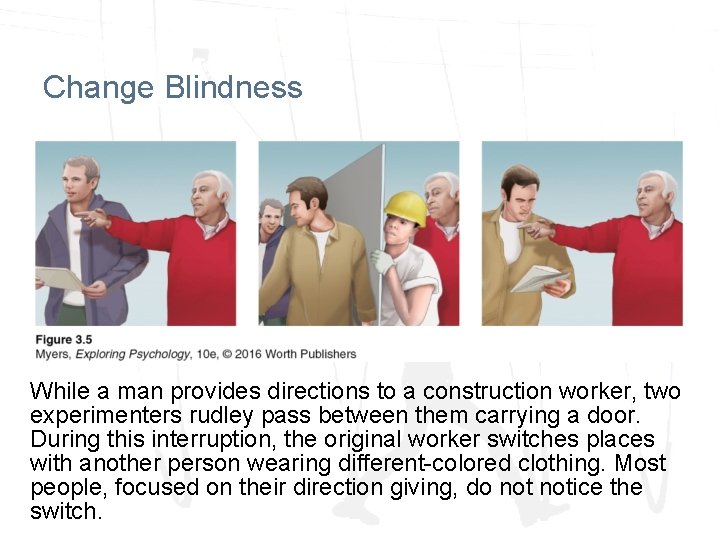
Change Blindness While a man provides directions to a construction worker, two experimenters rudley pass between them carrying a door. During this interruption, the original worker switches places with another person wearing different-colored clothing. Most people, focused on their direction giving, do notice the switch.
Dual Processing: The Two-Track Mind 3 -3: WHAT IS THE DUAL PROCESSING BEING REVEALED BY TODAY’S COGNITIVE NEUROSCIENCE? Dual processing – Principle that information is often simultaneously processed on separate conscious and unconscious tracks – Perceptions, memory, attitudes, and other cognitions all operate on two levels, a conscious, deliberate “high road” and an unconscious, automatic “low road” Blindsight – Condition in which a person can respond to a visual stimulus without consciously experiencing it
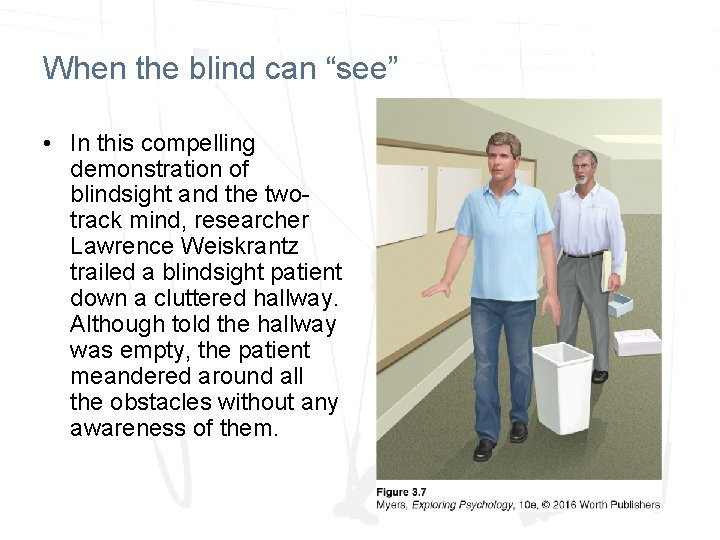
When the blind can “see” • In this compelling demonstration of blindsight and the twotrack mind, researcher Lawrence Weiskrantz trailed a blindsight patient down a cluttered hallway. Although told the hallway was empty, the patient meandered around all the obstacles without any awareness of them.
Dual Processing: The Two-Track Mind Parallel processing • Processing many aspects of a problem simultaneously; the brain’s natural mode of information processing for many functions • Unconscious parallel processing is faster than conscious sequential processing. • Both processes are essential. Parallel processing enables your mind to take care of routine business. Sequential processing is needed for solving new problems, which require your focused attention.
Sleep and Dreams 3 -4: WHAT IS SLEEP? Sleep – Periodic, natural loss of consciousness—as distinct from unconsciousness resulting from a coma, general anesthesia, or hibernation (Adapted from Dement, 1999).
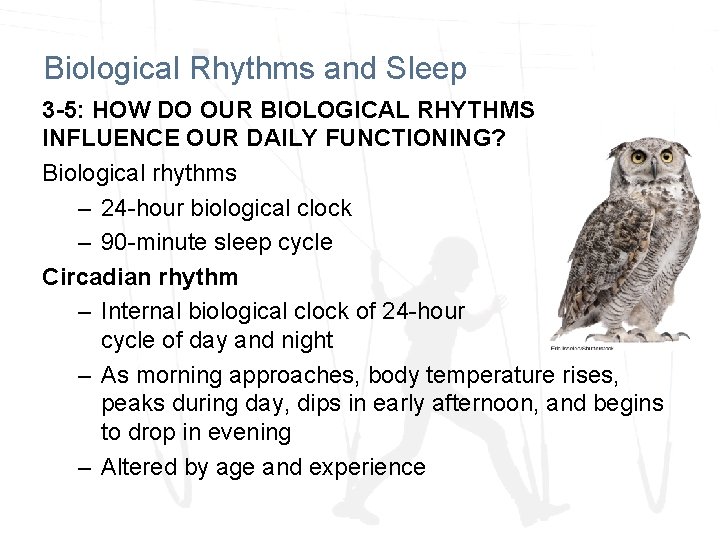
Biological Rhythms and Sleep 3 -5: HOW DO OUR BIOLOGICAL RHYTHMS INFLUENCE OUR DAILY FUNCTIONING? Biological rhythms – 24 -hour biological clock – 90 -minute sleep cycle Circadian rhythm – Internal biological clock of 24 -hour cycle of day and night – As morning approaches, body temperature rises, peaks during day, dips in early afternoon, and begins to drop in evening – Altered by age and experience
Sleep Stages 3 -6: WHAT IS THE BIOLOGICAL RHYTHM OF OUR SLEEPING AND DREAMING STAGES? Four distinct stages, about every 90 minutes, including REM sleep (rapid eye movement sleep), first discovered in 1952 with these observations: – Periods of fast jerky eye movements – Energetic brain activity accompanies these – Awakened people report dreaming during these periods
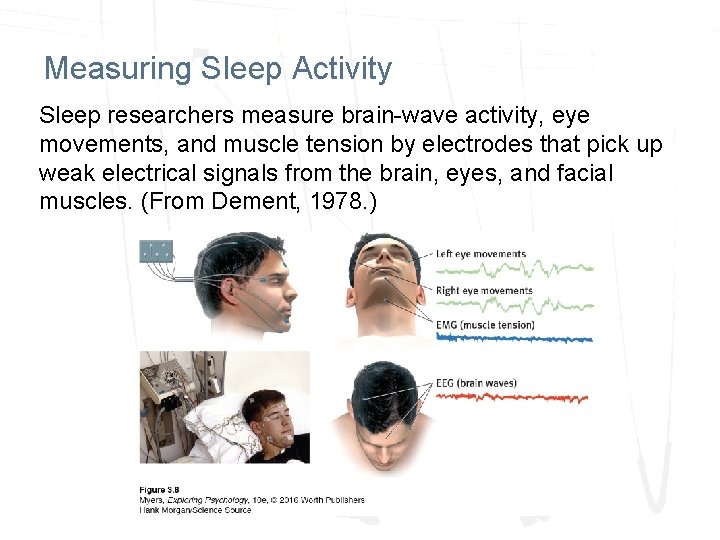
Measuring Sleep Activity Sleep researchers measure brain-wave activity, eye movements, and muscle tension by electrodes that pick up weak electrical signals from the brain, eyes, and facial muscles. (From Dement, 1978. )
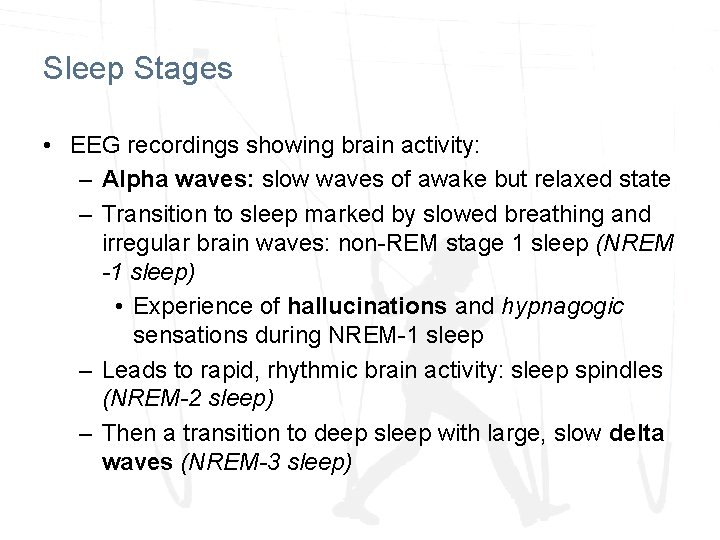
Sleep Stages • EEG recordings showing brain activity: – Alpha waves: slow waves of awake but relaxed state – Transition to sleep marked by slowed breathing and irregular brain waves: non-REM stage 1 sleep (NREM -1 sleep) • Experience of hallucinations and hypnagogic sensations during NREM-1 sleep – Leads to rapid, rhythmic brain activity: sleep spindles (NREM-2 sleep) – Then a transition to deep sleep with large, slow delta waves (NREM-3 sleep)
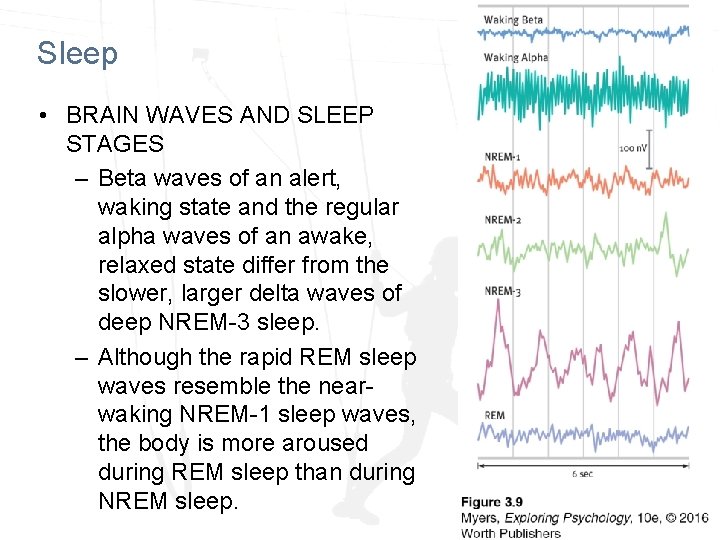
Sleep • BRAIN WAVES AND SLEEP STAGES – Beta waves of an alert, waking state and the regular alpha waves of an awake, relaxed state differ from the slower, larger delta waves of deep NREM-3 sleep. – Although the rapid REM sleep waves resemble the nearwaking NREM-1 sleep waves, the body is more aroused during REM sleep than during NREM sleep.
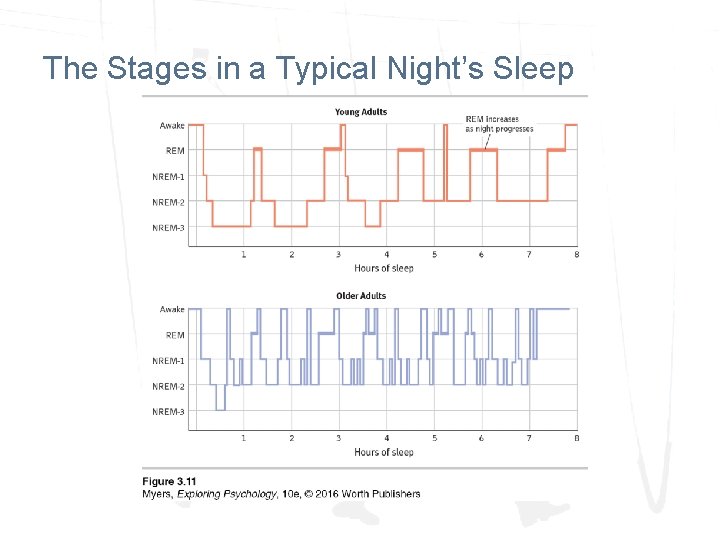
Sleep Stages: REM Sleep About an hour after you first fall asleep, you ascend from your initial sleep dive, returning through NREM-2 sleep to REM sleep. – Each about 10 minutes; 20 to 25 percent of sleep – Heart rate rises, breathing becomes rapid and irregular, and every half-minute or so your eyes dart around – Dreaming occurs during these periods – Genitals aroused, regardless of dream’s content (except for very scary dreams) – REM sleep is paradoxical sleep: The body is internally aroused, with waking-like brain activity, yet asleep and externally calm
The Stages in a Typical Night’s Sleep
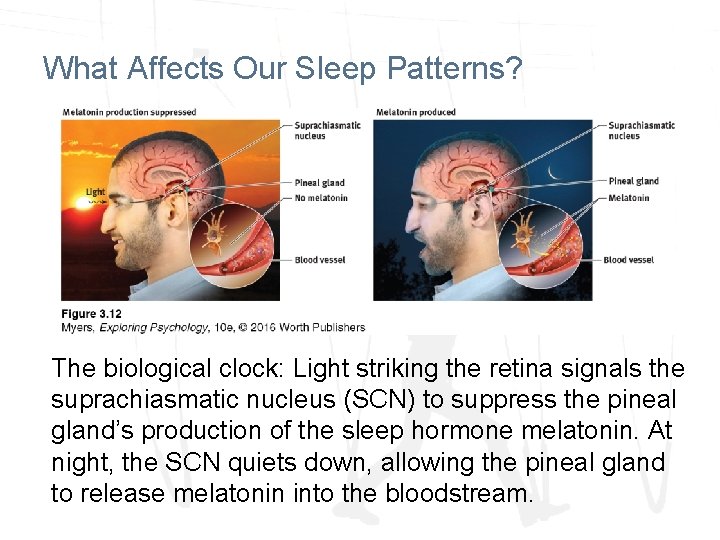
What Affects Our Sleep Patterns? 3 -7: HOW DO BIOLOGY AND ENVIRONMENT INTERACT IN OUR SLEEP PATTERNS? Sleep patterns are genetically and culturally influenced. – Bright morning light activates light-sensitive retinal proteins. These trigger the suprachiasmatic nucleus (SCN) to cause the pineal gland to decrease production of melatonin, a sleep-inducing hormone. – Melatonin production increases at night. – Modern lighting, lifestyles, and diversions may lead to sleep deprivation. As with waking behavior, biology and environment interact.
What Affects Our Sleep Patterns? The biological clock: Light striking the retina signals the suprachiasmatic nucleus (SCN) to suppress the pineal gland’s production of the sleep hormone melatonin. At night, the SCN quiets down, allowing the pineal gland to release melatonin into the bloodstream.
Why Do We Sleep? 3 -8: WHAT ARE SLEEP’S FUNCTIONS? • Sleep played a protective role for our distant ancestors by keeping them safe during potentially dangerous periods. • Sleep helps people recuperate (for example, by restoring and repairing damaged neurons). • Sleep helps strengthen neural connections that build enduring memories. • Sleep promotes creative problem solving the next day. • During deep sleep, the pituitary gland secretes a growth hormone necessary for muscle development.
Sleep Deprivation and Sleep Disorders Effects of Sleep Loss 3 -9: HOW DOES SLEEP LOSS AFFECT US, AND WHAT ARE THE MAJOR SLEEP DISORDERS? Sleep deprived college and university students report: – Feeling tired – Having little energy – Conflicts in friendships and romantic relationships – Depression – Function below their peak
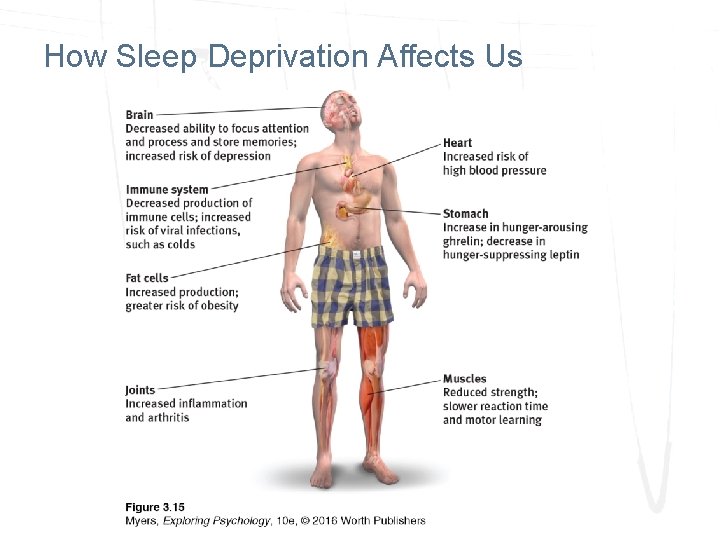
Sleep Deprivation and Sleep Disorders Effects of Sleep Loss Lack of sleep also associated with: • Weight gain • Suppressing immune cells that battle infections and diseases • Decreasing the life span • Accident proneness • Inability to pay attention
How Sleep Deprivation Affects Us
Major Sleep Disorders • Insomnia: Recurring problems in falling or staying asleep • Narcolepsy: Sudden uncontrollable sleep attacks, with sufferer sometimes lapsing directly into REM sleep • Sleep apnea: Stopping of breathing while asleep and repeated momentary awakenings; associated with obesity, especially in overweight men • Night terrors: High arousal and appearance of being terrified, target children during first few hours of NREM-3 sleep • Sleepwalking and sleeptalking (mostly childhood disorders): Occur during NREM-3 sleep; diminish with age
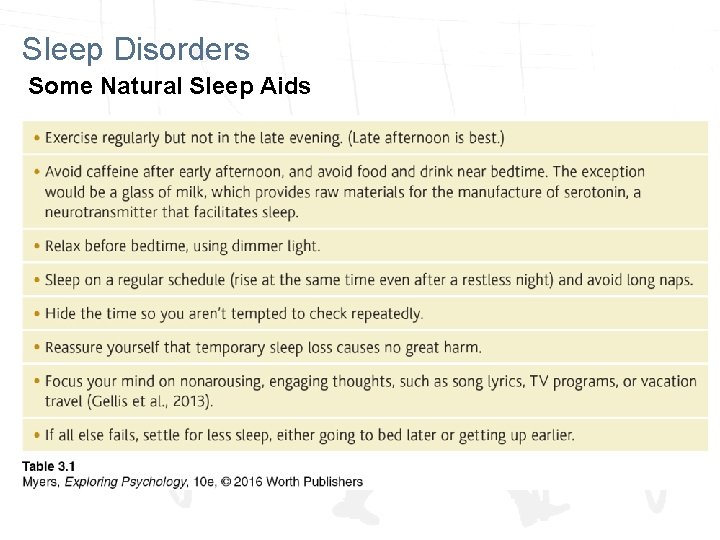
Sleep Disorders Some Natural Sleep Aids
Dreams 3 -10: WHAT DO WE DREAM? • Dreams are sequence of images, emotions, and thoughts passing through a sleeping person’s mind • Dreams are generally difficult to remember; even those that momentarily awaken us are generally forgotten by morning. • Dream story lines generally incorporate traces of previous days’ nonsexual experiences and preoccupations
What We Dream We usually dream of ordinary events and everyday experiences, most involving some anxiety or misfortune. • While daydreams tend to involve familiar details of our life, REM dreams are vivid, emotional, and often bizarre—so vivid we may confuse them with reality • For both men and women, 8 in 10 dreams are marked by at least one negative event or emotion • Dreams with sexual imagery occur less commonly than believed, with one study finding just 1 in 10 among young men and 1 in 30 among young women • Dreams incorporating previous days’ experience are the most common
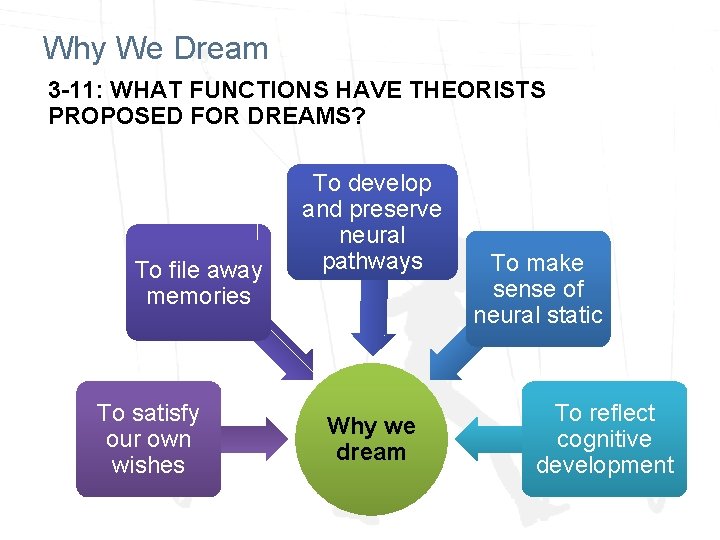
Why We Dream 3 -11: WHAT FUNCTIONS HAVE THEORISTS PROPOSED FOR DREAMS? To file away memories To satisfy our own wishes To develop and preserve neural pathways Why we dream To make sense of neural static To reflect cognitive development
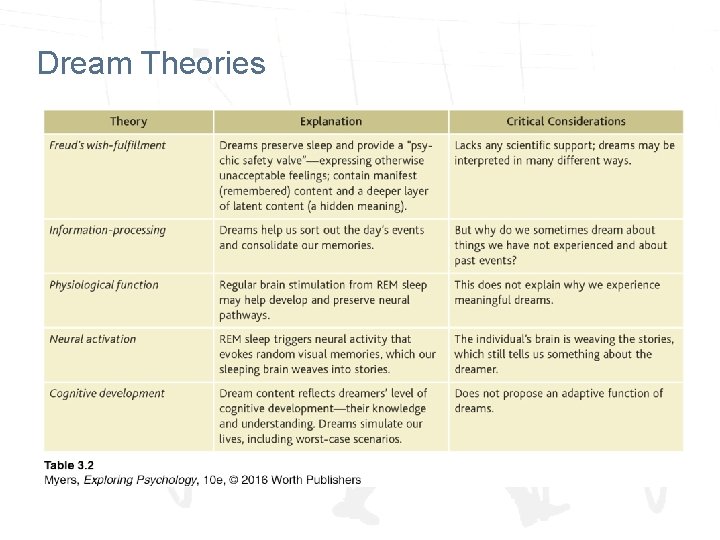
Dream Theories
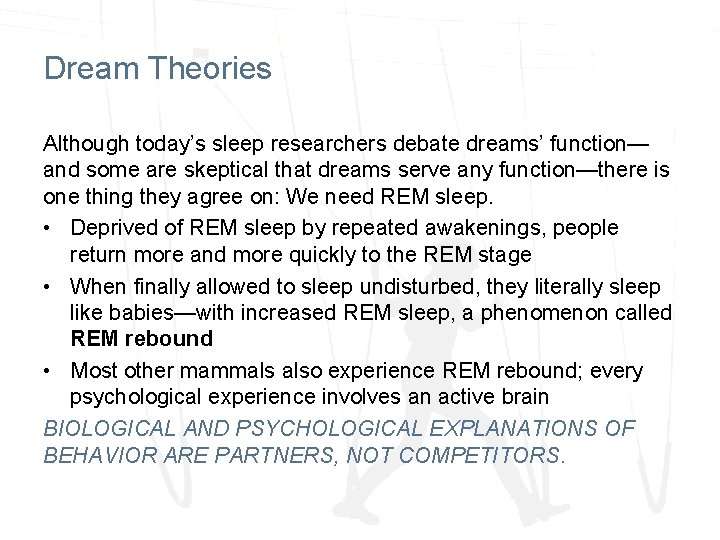
Dream Theories Although today’s sleep researchers debate dreams’ function— and some are skeptical that dreams serve any function—there is one thing they agree on: We need REM sleep. • Deprived of REM sleep by repeated awakenings, people return more and more quickly to the REM stage • When finally allowed to sleep undisturbed, they literally sleep like babies—with increased REM sleep, a phenomenon called REM rebound • Most other mammals also experience REM rebound; every psychological experience involves an active brain BIOLOGICAL AND PSYCHOLOGICAL EXPLANATIONS OF BEHAVIOR ARE PARTNERS, NOT COMPETITORS.
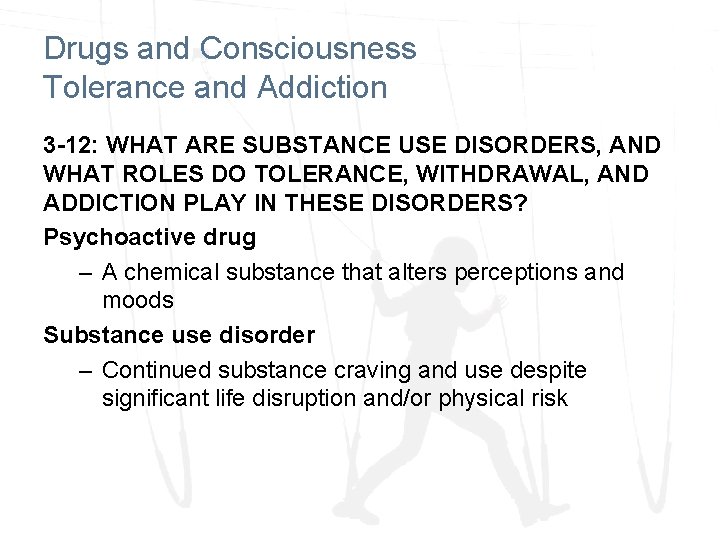
Drugs and Consciousness Tolerance and Addiction 3 -12: WHAT ARE SUBSTANCE USE DISORDERS, AND WHAT ROLES DO TOLERANCE, WITHDRAWAL, AND ADDICTION PLAY IN THESE DISORDERS? Psychoactive drug – A chemical substance that alters perceptions and moods Substance use disorder – Continued substance craving and use despite significant life disruption and/or physical risk
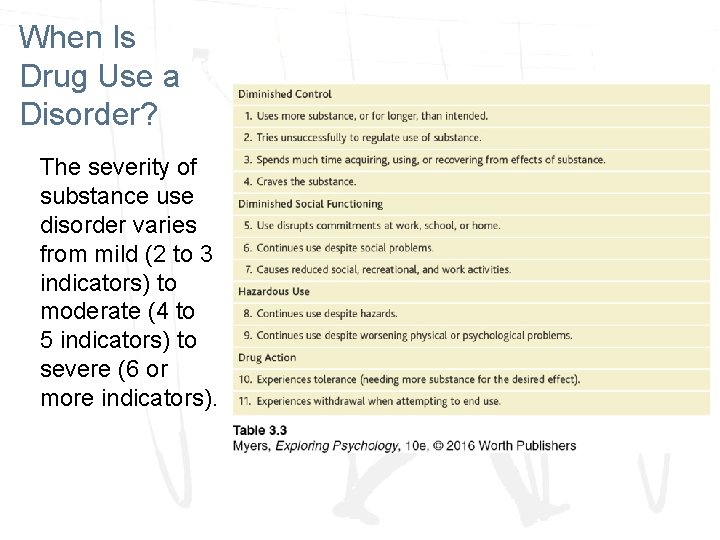
When Is Drug Use a Disorder? The severity of substance use disorder varies from mild (2 to 3 indicators) to moderate (4 to 5 indicators) to severe (6 or more indicators).
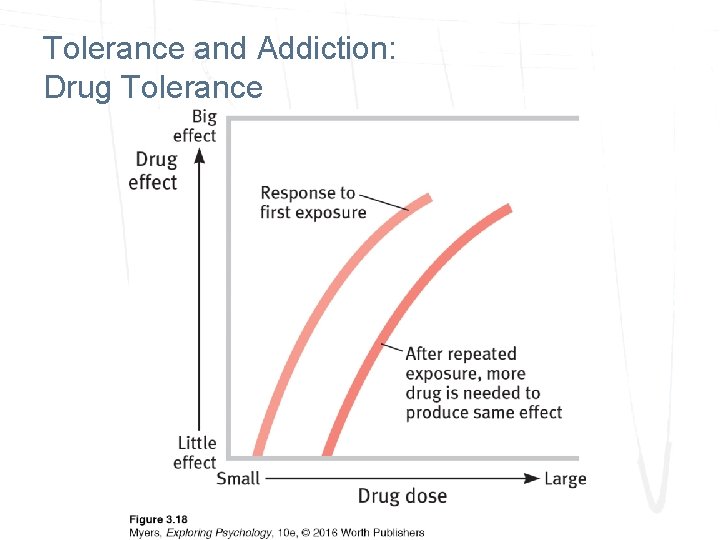
Tolerance and Addiction Tolerance – The diminishing effect with regular use of the same dose of a drug, requiring the user to take larger and larger doses before experiencing the drug’s effect. – Neuroadaptation: the user’s brain chemistry adapts to offset the drug effect. – Tolerance occurs with continued use of alcohol and some other drugs (but not marijuana)
Tolerance and Addiction: Drug Tolerance
Tolerance and Addiction – Compulsive craving of drugs or certain behaviors (such as gambling) despite known harmful consequences Withdrawal – Discomfort and distress that follow discontinuing an addictive drug or behavior
Addiction 3 -13: HOW HAS THE CONCEPT OF ADDICTION CHANGED? • Concept of addiction – Extended to cover many behaviors – Degree and scope debated • Addiction as disease needing treatment – Offered for many driven, excessive behaviors that become compulsive and dysfunctional – Labeling a behavior doesn’t explain it • APA (2013) manual proposes further study of Internet gaming disorder
Types of Psychoactive Drugs: Depressants 3 -14: WHAT ARE DEPRESSANTS, AND WHAT ARE THEIR EFFECTS? Depressants: Drugs such as alcohol, barbiturates (tranquilizers), and opiates that calm neural activity and slow body functions Alcohol – Acts as disinhibitor – Slows neural processing and is a potent sedative when paired with sleep deprivation – Disrupts memory and has long-term effect on brain and cognition; impairs growth of synaptic connections – Reduces self-awareness and self-control; produces myopia by focusing on arousing situation at expense of normal inhibitions and future consequence
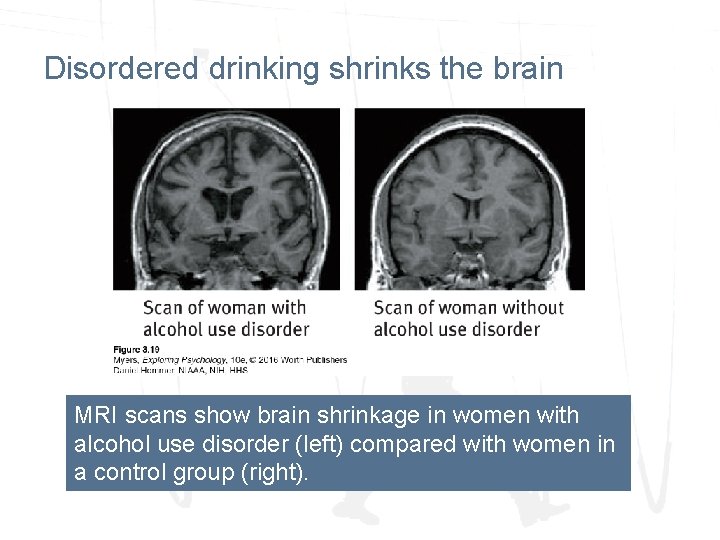
Disordered drinking shrinks the brain MRI scans show brain shrinkage in women with alcohol use disorder (left) compared with women in a control group (right).
Alcohol Expectancy Effects Expectations influence behavior – Being able to attribute social behaviors or sexual responses to alcohol releases inhibitions – Fourteen intervention studies with college students lowered positive expectations of alcohol and reduced drinking in the ensuing month Alcohol use disorder (popularly known as alcoholism) – Alcohol use marked by tolerance, withdrawal, and a drive to continue problematic use
Depressants In addition to alcohol, this type of psychoactive drug includes: Barbiturates – Depress the activity of the central nervous system, reducing anxiety but impairing memory and judgment – Can impair cognitive functioning; potentially lethal when combined with alcohol – Includes Nembutal, Seconal, and Amytal Opiates – Include opium and its derivatives, such as heroin; includes the narcotics (codeine, morphine, methadone) – Constricts pupils, slows breathing, causes lethargy – Depress neural activity, lessening pain and anxiety – Withdrawal when repeated ingestion is stopped; brain stops producing natural endorphins
Types of Psychoactive Drugs: Stimulants 3 -15: WHAT ARE STIMULANTS, AND WHAT ARE THEIR EFFECTS? – Stimulants: Drugs (such as caffeine, nicotine, and the more powerful amphetamines, cocaine, Ecstasy [MDMA], and methamphetamine) that excite neural activity and speed up body functions – Involves dilation of pupils, increase in heart and breathing rates, rise in blood sugar, and drop in appetite – Often involves increase in energy and self-confidence
Stimulants: Nicotine – Is the stimulating and highly addictive psychoactive drug in tobacco – Signals the central nervous system to release a flood of neurotransmitters – Diminishes appetite, boosts alertness and mental efficiency, calms anxiety, and reduces sensitivity to pain – Addiction to nicotine involves acute craving and withdrawal symptoms which contribute to relapse; symptoms gradually dissipate over six months – Smoking correlates with higher depression, chronic disability, and divorce, and a reduced life expectancy
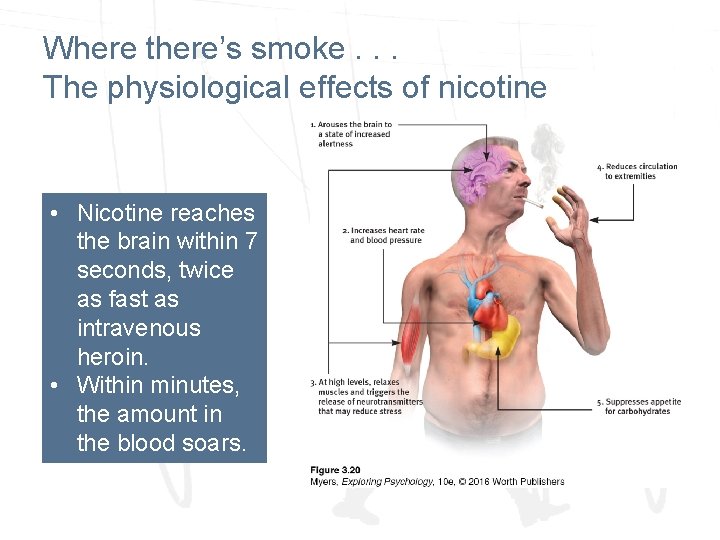
Where there’s smoke. . . The physiological effects of nicotine • Nicotine reaches the brain within 7 seconds, twice as fast as intravenous heroin. • Within minutes, the amount in the blood soars.
Stimulants: Cocaine – A powerful and addictive stimulant derived from the coca plant; produces temporarily increased alertness and euphoria – Leads to a crash of agitated depression within the hour, after rush of neurotransmitters depletes the brain’s supply as the drug’s effect wears off – Psychological effects depend partly on dosage and form consumed, but also the situation and user’s expectations and personality
Stimulants: Methamphetamine – Related to its parent drug, amphetamine; triggers release of neurotransmitter dopamine – Stimulates brain cells and enhances energy and mood – Aftereffects include irritability, insomnia, hypertension, seizures, social isolation, depression, occasional violence – Over time, use reduces baseline dopamine levels in the user
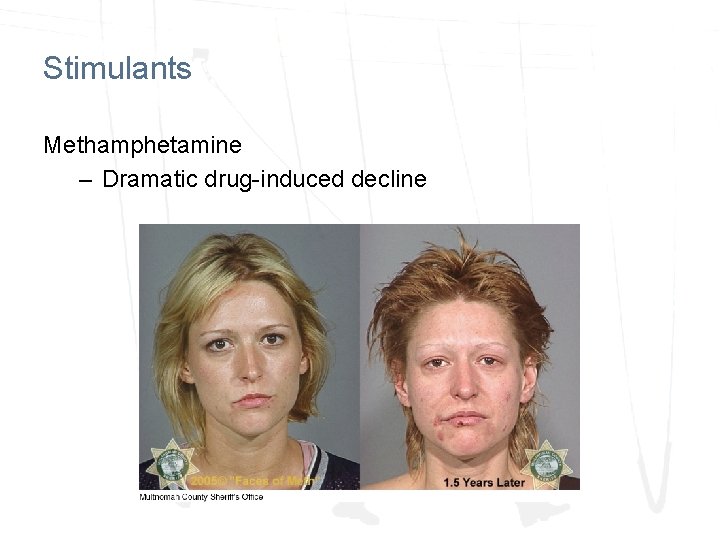
Stimulants Methamphetamine – Dramatic drug-induced decline
Stimulants Ecstasy (street name for MDMA) – Is a synthetic stimulant and a mild hallucinogen – Produces euphoria and social intimacy – Leads to short-term health risks and longer term harm to serotonin-producing neurons and mood and cognition – Also known as the hug drug, and known as Molly in its powdered form
Types of Psychoactive Drugs: Hallucinogens 3 -13: WHAT ARE HALLUCINOGENS, AND WHAT ARE THEIR EFFECTS? Hallucinogens – Psychedelic (“mind-manifesting”) drugs that distort perceptions and evoke sensory images in the absence of sensory input
Hallucinogens – Can be derived synthetically (such as LSD and MDMA) or from natural substances (such as marijuana) – As experienced hallucinations begin to peak, people frequently feel separated from their body – Dream-like scenes experienced – Whether provoked by drugs, loss of oxygen, or extreme sensory deprivation, the brain hallucinates in basically the same way
Hallucinogens Sensations experienced with hallucinogens are strikingly similar to the near-death experience: – An altered-state of consciousness reported after a close brush with death (such as cardiac arrest) – Such experiences are often similar to drug-induced hallucinations – Reported by about 10 to 15 percent of patients revived from cardiac arrest
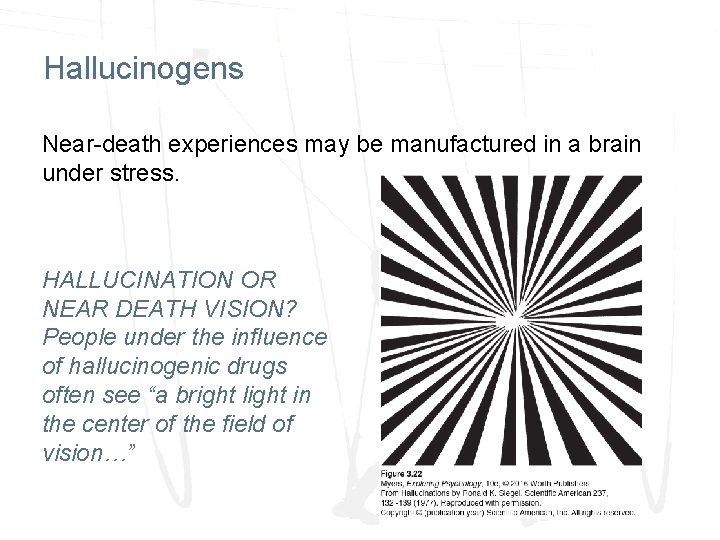
Hallucinogens Near-death experiences may be manufactured in a brain under stress. HALLUCINATION OR NEAR DEATH VISION? People under the influence of hallucinogenic drugs often see “a bright light in the center of the field of vision…”
Hallucinogens LSD – Powerful hallucinogenic drug; also known as acid (lysergic acid diethylamide) – Emotions of an LSD trip range from euphoria to detachment to panic – Users’ current mood and expectations color the emotional experience, but the perceptual distortions and hallucinations have some commonalities
Hallucination Marijuana – Leaves contain THC (delta-9 -tetrahydrocannabinol); when smoked or eaten amplifies sensitivity to colors, sounds, tastes, and smells; lingers in body longer than other drugs such as alcohol – Synthetic marijuana (K 2, Spice) mimics THC and has very harmful side effects – Relaxes, disinhibits, and may produce euphoria – Is mild hallucinogen which amplifies sensory sensitivity, impairs motor coordination, perceptual skills, and reaction time – Disrupts memory formation and immediate recall – Medical inhaler best for medicinal use to avoid smoke
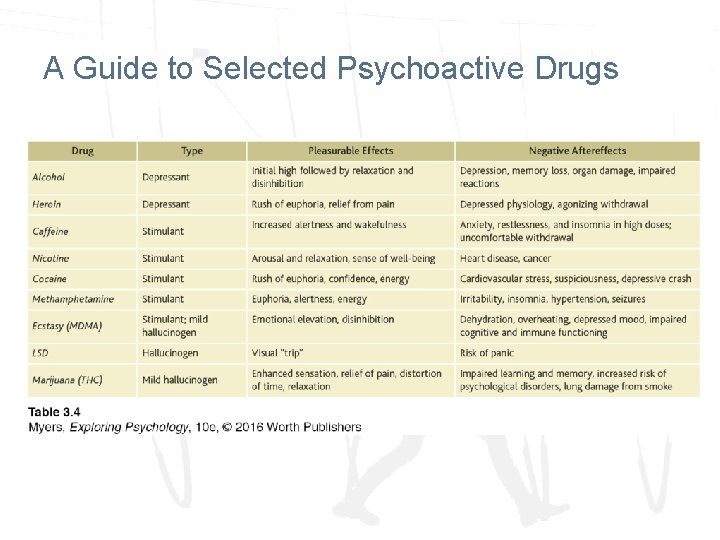
A Guide to Selected Psychoactive Drugs
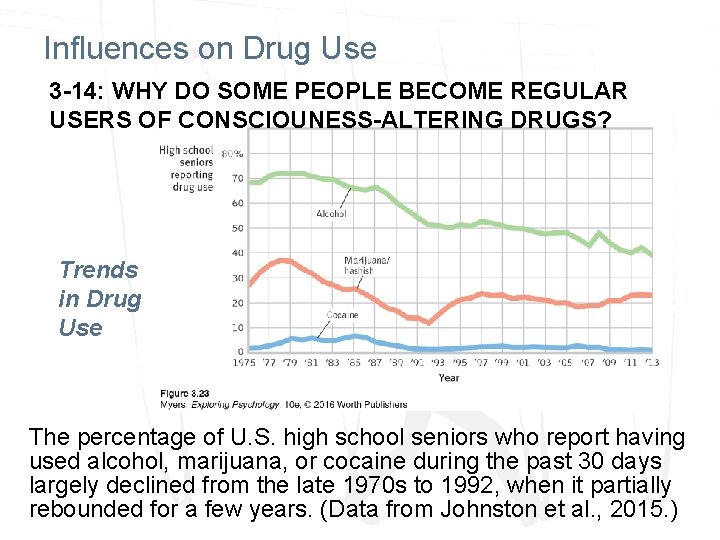
Influences on Drug Use 3 -14: WHY DO SOME PEOPLE BECOME REGULAR USERS OF CONSCIOUNESS-ALTERING DRUGS? Trends in Drug Use The percentage of U. S. high school seniors who report having used alcohol, marijuana, or cocaine during the past 30 days largely declined from the late 1970 s to 1992, when it partially rebounded for a few years. (Data from Johnston et al. , 2015. )
Influences on Drug Use The biopsychosocial approach enables researchers to investigate disordered drug use from complementary perspectives: biological, psychological, and social-cultural. Biological influences: • Increased risk when seen in identical twins, fraternal twins, siblings, and biological parents • Genetic predispositions and genetically influenced traits • Culprit genes that may produce deficiencies in the brain’s natural dopamine reward system
Influences on Drug Use Psychological influences: • Lacking sense of purpose • Significant stress • Psychological disorders, such as depression Social-cultural influences: • Difficult environment • Cultural acceptance of drug use • Negative peer influences
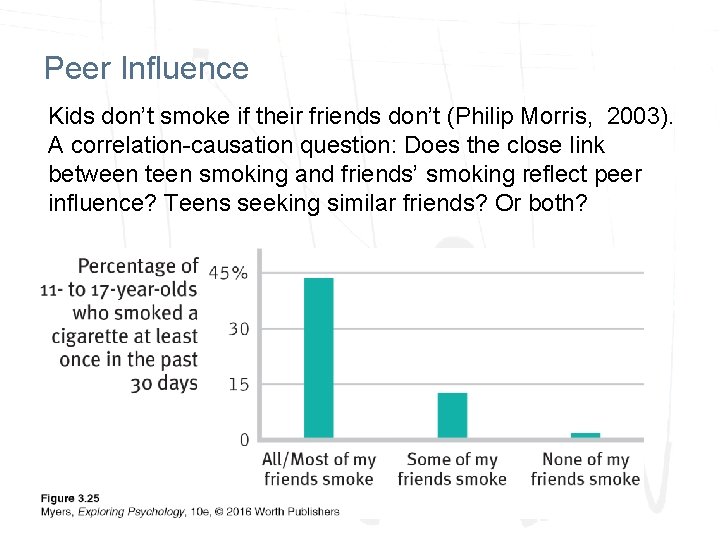
Peer Influence Kids don’t smoke if their friends don’t (Philip Morris, 2003). A correlation-causation question: Does the close link between teen smoking and friends’ smoking reflect peer influence? Teens seeking similar friends? Or both?
Influences on Drug Use Research findings on drug use suggest three channels of influence for drug prevention and treatment programs: • Educate young people about the long-term costs of a drug’s temporary pleasures. • Help young people find other ways to boost their selfesteem and discover their purpose in life. • Attempt to modify peer associations or to “inoculate” youths against peer pressures by training them in refusal skills.