Psychology Chapter 4 Consciousness Copyright 2016 2012 Pearson
- Slides: 57
Psychology Chapter 4 Consciousness Copyright © 2016, 2012 Pearson Education, Inc. All Rights Reserved
Module 9 Sleep and Dreams Copyright © 2016, 2012 Pearson Education, Inc. All Rights Reserved
Learning Objectives 9. 1 Describe the various stages of consciousness. 9. 2 Distinguish between explicit and implicit processing. 9. 3 Understand the circadian rhythm and its relation to sleep. 9. 4 Outline theories about the functions of sleep. 9. 5 Describe the characteristics of the sleep cycle. 9. 6 Identify the types of sleep disorders. 9. 7 Compare perspectives on the functions of dreams. Copyright © 2016, 2012 Pearson Education, Inc. All Rights Reserved
Consciousness Learning Objective 9. 1: Describe the various states of consciousness. • Consciousness – A person’s awareness of everything that is going on around him or her at any given moment – https: //www. youtube. com/watch? v=j. Re. X 7 q. KU 2 yc Copyright © 2016, 2012 Pearson Education, Inc. All Rights Reserved
States of Consciousness Learning Objective 9. 1: Describe the various states of consciousness. • Waking Consciousness – State in which thoughts, feelings, and sensations are clear and organized, and the person feels alert • Altered State of Consciousness – State in which there is a shift in the quality or pattern of mental activity as compared to waking consciousness Copyright © 2016, 2012 Pearson Education, Inc. All Rights Reserved
Processing Learning Objective 9. 2: Distinguish between explicit and implicit processing. • Explicit Processing – processing that is conscious, in which you are aware of your thought process and are focusing your full attention at the task at hand (effortful processing) • Implicit Processing – processing that happens without conscious awareness, in which you can perform an action before you even become aware of it (automatic processing) Copyright © 2016, 2012 Pearson Education, Inc. All Rights Reserved
Why Do We Need to Sleep? Learning Objective 9. 3: Understand the circadian rhythm and its relation to sleep. • The Biology of Sleep – Sleep is human body’s biological rhythm § Natural cycle of activity that the body must go through § https: //www. youtube. com/watch? v=r. MHus-0 w. FSo • Circadian Rhythms – the sleep-wake cycle – From Latin words “circa” (about) and “diem” (day) – Most people experience sleep at least once in a day – Controlled by the brain through the hypothalamus (the tiny section of the brain that influences the glandular system) Copyright © 2016, 2012 Pearson Education, Inc. All Rights Reserved
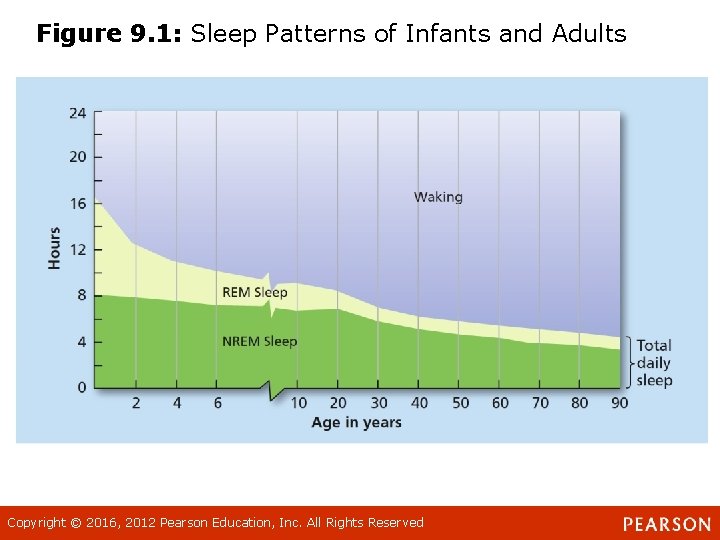
How Much Sleep Do We Need? Learning Objective 9. 3: Understand the circadian rhythm and its relation to sleep. • Varies from person to person – – Young adults – 7 to 9 hours Short sleepers – 4 to 5 hours Long sleepers – more than 9 hours Older people – 6 hours or less • Sleep deprivation: any significant loss of sleep – Results in irritability and problems with concentration Copyright © 2016, 2012 Pearson Education, Inc. All Rights Reserved
Figure 9. 1: Sleep Patterns of Infants and Adults Copyright © 2016, 2012 Pearson Education, Inc. All Rights Reserved
Theories of Sleep Learning Objective 9. 4: Outline theories about the functions of sleep. • Adaptive Theory – proposes that animals and humans evolved sleep patterns to avoid predators by sleeping when predators are most active • Restorative Theory – proposes that sleep is necessary to the physical health of the body and serves to replenish chemicals and repair cellular damage Copyright © 2016, 2012 Pearson Education, Inc. All Rights Reserved
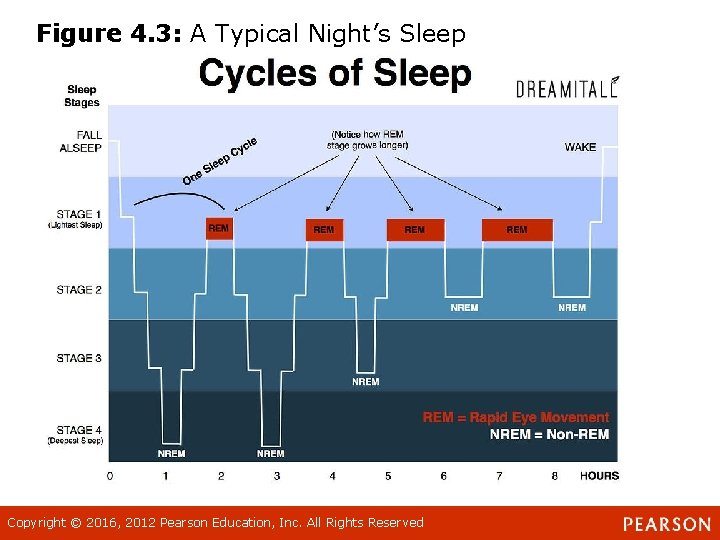
Types of Sleep Learning Objective 9. 5: Describe the characteristics of the sleep cycle. • Rapid eye movement (REM) – Active type of sleep, dreams takes place – Voluntary muscles are inhibited, less movement of the body • NREM (non-REM) – Much deeper, restful type of sleep – Body is free to move around Copyright © 2016, 2012 Pearson Education, Inc. All Rights Reserved
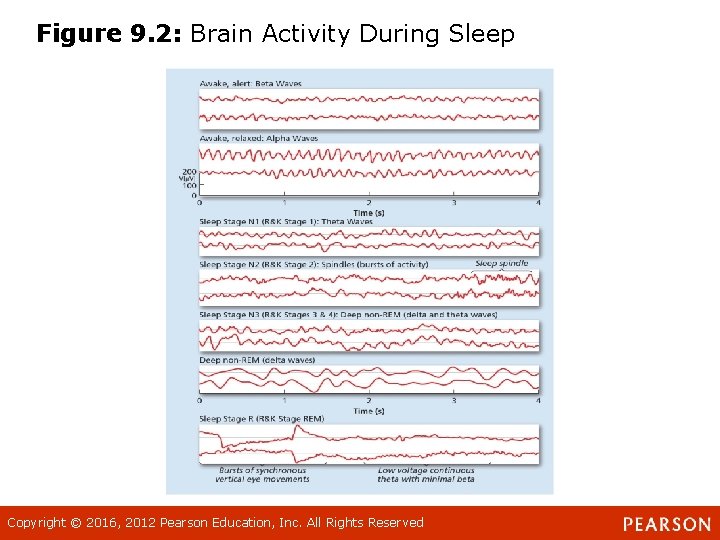
Brainwave Patterns Learning Objective 9. 5: Describe the characteristics of the sleep cycle. • Electroencephalograph (EEG) – Allows scientists to see the brainwave activity as a person passes through various stages of sleep § beta waves – Very small and very fast waves, shows when the person is wide awake and mentally active § alpha waves – Slightly larger and slower waves, shows when the person relaxes and gets drowsy § theta waves – Slower and larger waves, leading to deep sleep § delta waves – Largest and slowest waves, shows when the person is in the deepest stage of sleep Copyright © 2016, 2012 Pearson Education, Inc. All Rights Reserved
Figure 9. 2: Brain Activity During Sleep Copyright © 2016, 2012 Pearson Education, Inc. All Rights Reserved
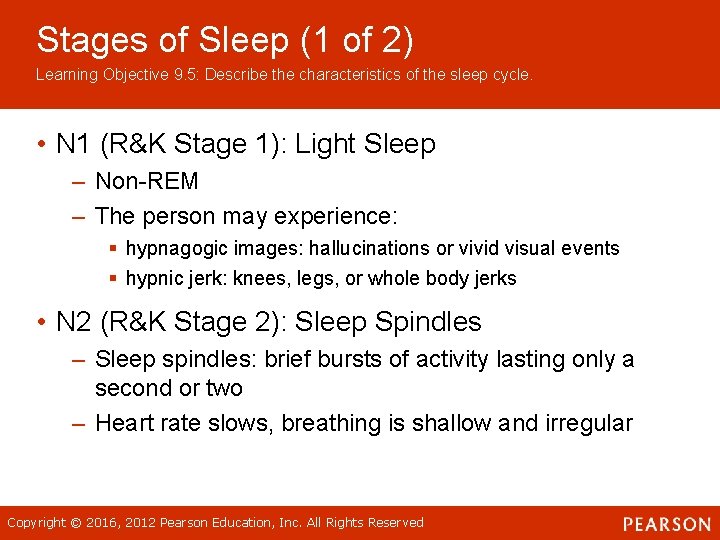
Stages of Sleep (1 of 2) Learning Objective 9. 5: Describe the characteristics of the sleep cycle. • N 1 (R&K Stage 1): Light Sleep – Non-REM – The person may experience: § hypnagogic images: hallucinations or vivid visual events § hypnic jerk: knees, legs, or whole body jerks • N 2 (R&K Stage 2): Sleep Spindles – Sleep spindles: brief bursts of activity lasting only a second or two – Heart rate slows, breathing is shallow and irregular Copyright © 2016, 2012 Pearson Education, Inc. All Rights Reserved
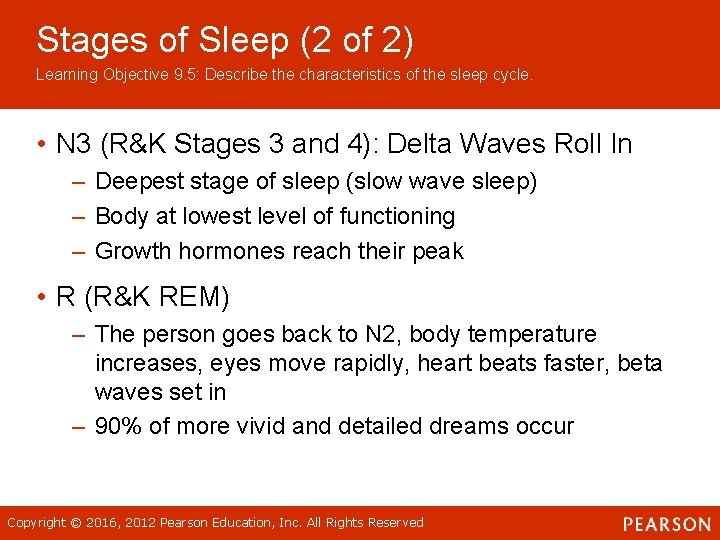
Stages of Sleep (2 of 2) Learning Objective 9. 5: Describe the characteristics of the sleep cycle. • N 3 (R&K Stages 3 and 4): Delta Waves Roll In – Deepest stage of sleep (slow wave sleep) – Body at lowest level of functioning – Growth hormones reach their peak • R (R&K REM) – The person goes back to N 2, body temperature increases, eyes move rapidly, heart beats faster, beta waves set in – 90% of more vivid and detailed dreams occur Copyright © 2016, 2012 Pearson Education, Inc. All Rights Reserved
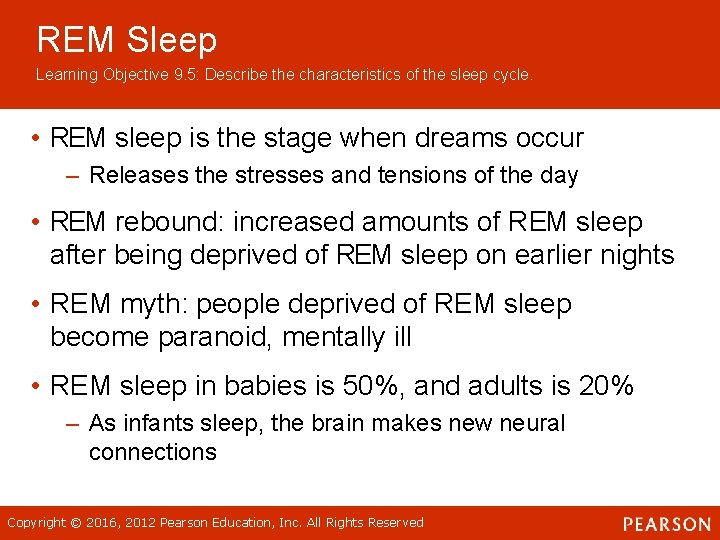
REM Sleep Learning Objective 9. 5: Describe the characteristics of the sleep cycle. • REM sleep is the stage when dreams occur – Releases the stresses and tensions of the day • REM rebound: increased amounts of REM sleep after being deprived of REM sleep on earlier nights • REM myth: people deprived of REM sleep become paranoid, mentally ill • REM sleep in babies is 50%, and adults is 20% – As infants sleep, the brain makes new neural connections Copyright © 2016, 2012 Pearson Education, Inc. All Rights Reserved
Figure 4. 3: A Typical Night’s Sleep Copyright © 2016, 2012 Pearson Education, Inc. All Rights Reserved
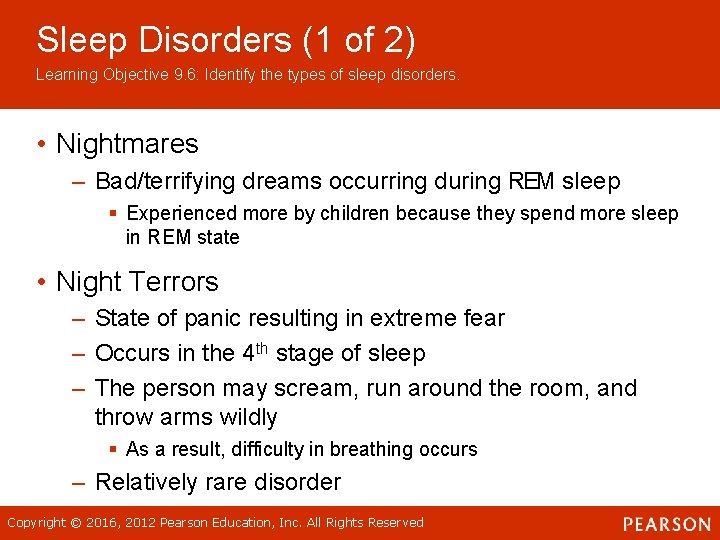
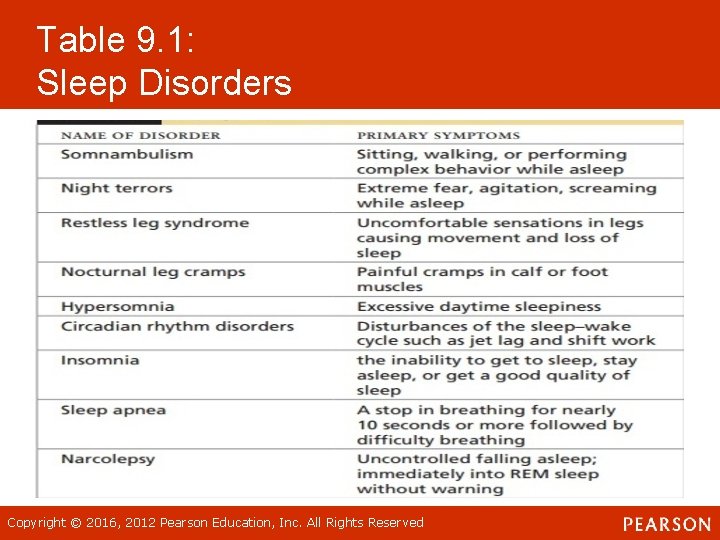
Sleep Disorders (1 of 2) Learning Objective 9. 6: Identify the types of sleep disorders. • Nightmares – Bad/terrifying dreams occurring during REM sleep § Experienced more by children because they spend more sleep in REM state • Night Terrors – State of panic resulting in extreme fear – Occurs in the 4 th stage of sleep – The person may scream, run around the room, and throw arms wildly § As a result, difficulty in breathing occurs – Relatively rare disorder Copyright © 2016, 2012 Pearson Education, Inc. All Rights Reserved
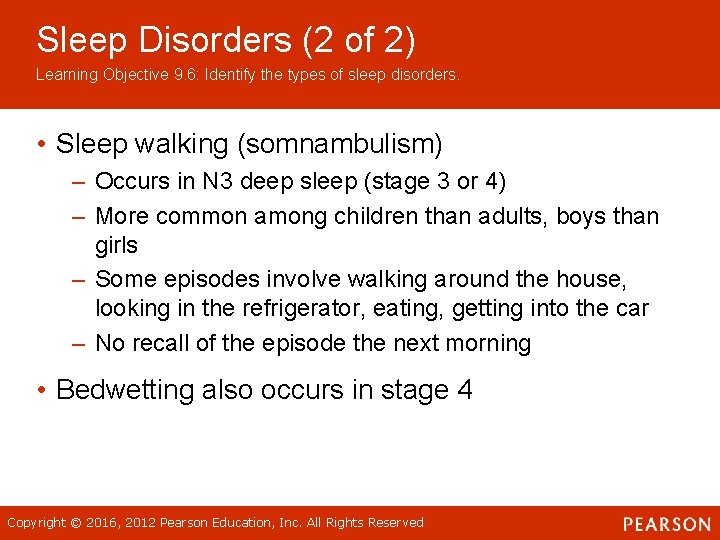
Sleep Disorders (2 of 2) Learning Objective 9. 6: Identify the types of sleep disorders. • Sleep walking (somnambulism) – Occurs in N 3 deep sleep (stage 3 or 4) – More common among children than adults, boys than girls – Some episodes involve walking around the house, looking in the refrigerator, eating, getting into the car – No recall of the episode the next morning • Bedwetting also occurs in stage 4 Copyright © 2016, 2012 Pearson Education, Inc. All Rights Reserved
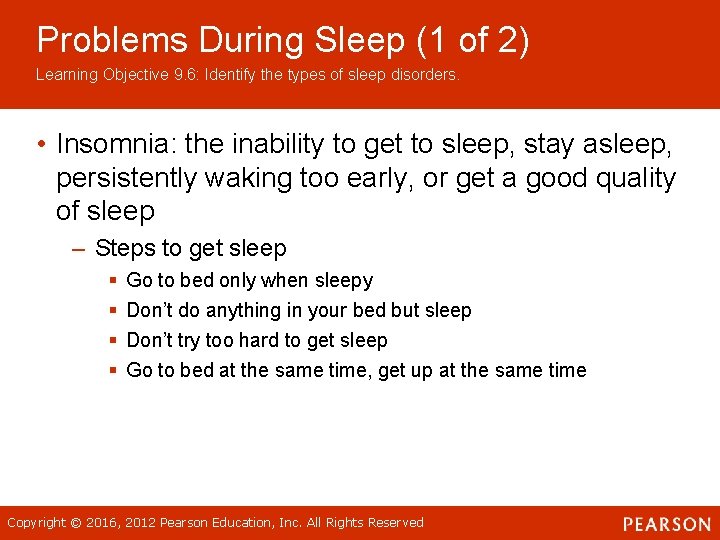
Problems During Sleep (1 of 2) Learning Objective 9. 6: Identify the types of sleep disorders. • Insomnia: the inability to get to sleep, stay asleep, persistently waking too early, or get a good quality of sleep – Steps to get sleep § § Go to bed only when sleepy Don’t do anything in your bed but sleep Don’t try too hard to get sleep Go to bed at the same time, get up at the same time Copyright © 2016, 2012 Pearson Education, Inc. All Rights Reserved
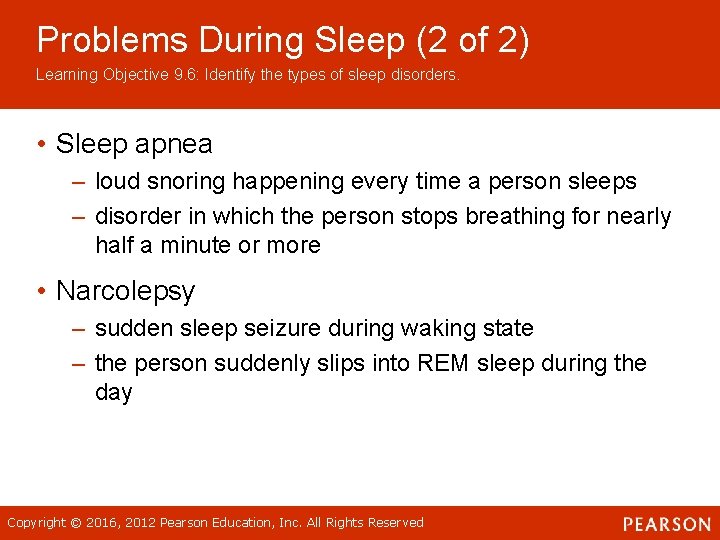
Problems During Sleep (2 of 2) Learning Objective 9. 6: Identify the types of sleep disorders. • Sleep apnea – loud snoring happening every time a person sleeps – disorder in which the person stops breathing for nearly half a minute or more • Narcolepsy – sudden sleep seizure during waking state – the person suddenly slips into REM sleep during the day Copyright © 2016, 2012 Pearson Education, Inc. All Rights Reserved
Table 9. 1: Sleep Disorders Copyright © 2016, 2012 Pearson Education, Inc. All Rights Reserved
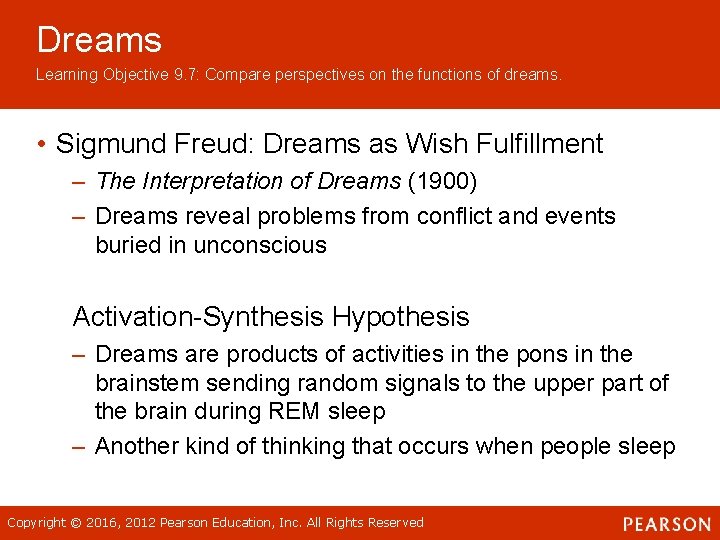
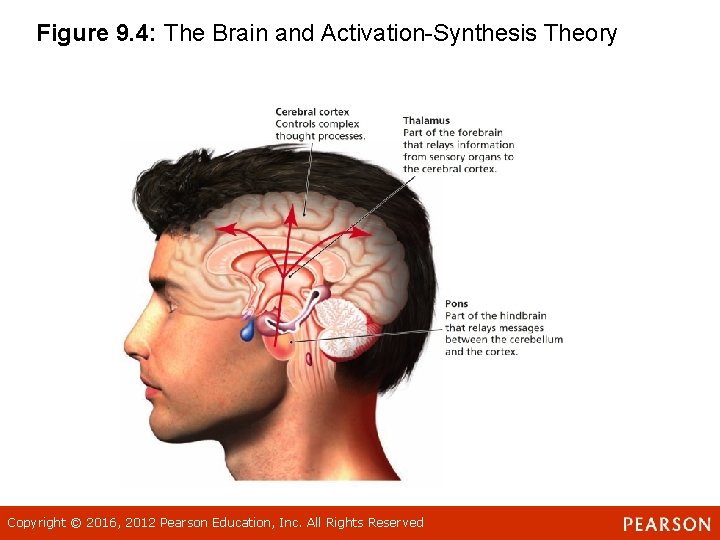
Dreams Learning Objective 9. 7: Compare perspectives on the functions of dreams. • Sigmund Freud: Dreams as Wish Fulfillment – The Interpretation of Dreams (1900) – Dreams reveal problems from conflict and events buried in unconscious Activation-Synthesis Hypothesis – Dreams are products of activities in the pons in the brainstem sending random signals to the upper part of the brain during REM sleep – Another kind of thinking that occurs when people sleep Copyright © 2016, 2012 Pearson Education, Inc. All Rights Reserved
Figure 9. 4: The Brain and Activation-Synthesis Theory Copyright © 2016, 2012 Pearson Education, Inc. All Rights Reserved
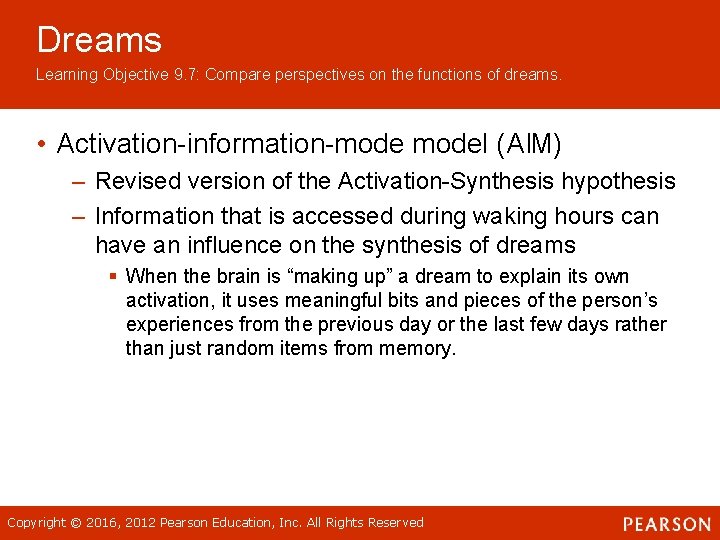
Dreams Learning Objective 9. 7: Compare perspectives on the functions of dreams. • Activation-information-model (AIM) – Revised version of the Activation-Synthesis hypothesis – Information that is accessed during waking hours can have an influence on the synthesis of dreams § When the brain is “making up” a dream to explain its own activation, it uses meaningful bits and pieces of the person’s experiences from the previous day or the last few days rather than just random items from memory. Copyright © 2016, 2012 Pearson Education, Inc. All Rights Reserved
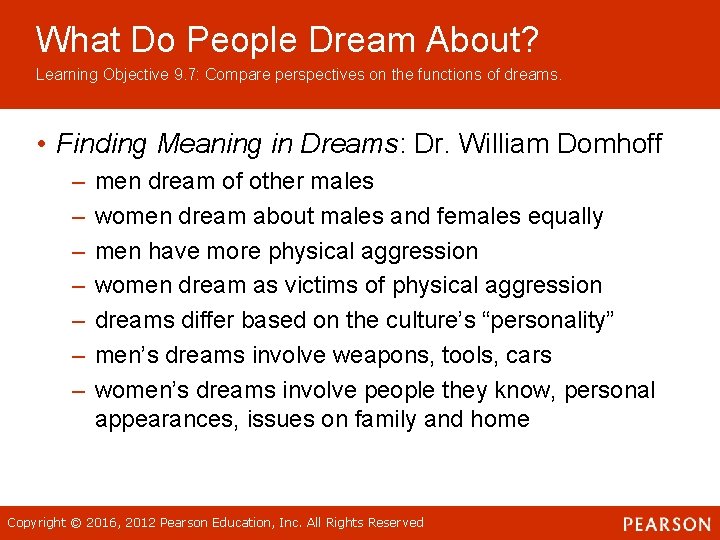
What Do People Dream About? Learning Objective 9. 7: Compare perspectives on the functions of dreams. • Finding Meaning in Dreams: Dr. William Domhoff – – – – men dream of other males women dream about males and females equally men have more physical aggression women dream as victims of physical aggression dreams differ based on the culture’s “personality” men’s dreams involve weapons, tools, cars women’s dreams involve people they know, personal appearances, issues on family and home Copyright © 2016, 2012 Pearson Education, Inc. All Rights Reserved
Module 10 Hypnosis and Drugs Copyright © 2016, 2012 Pearson Education, Inc. All Rights Reserved
Learning Objectives 10. 1 Describe hypnosis and issues surrounding its nature and use. 10. 2 Understand meditation and relaxation and their effects. 10. 3 Describe the nature of flow states. 10. 4 Explain how psychoactive drugs act at the synaptic level. 10. 5 Evaluate the physiological and psychological effects of psychoactive drugs. 10. 6 Describe the major categories of psychoactive drugs and their effects. 10. 7 Describe how culture and expectations influence the use and experience of • drugs. Copyright © 2016, 2012 Pearson Education, Inc. All Rights Reserved
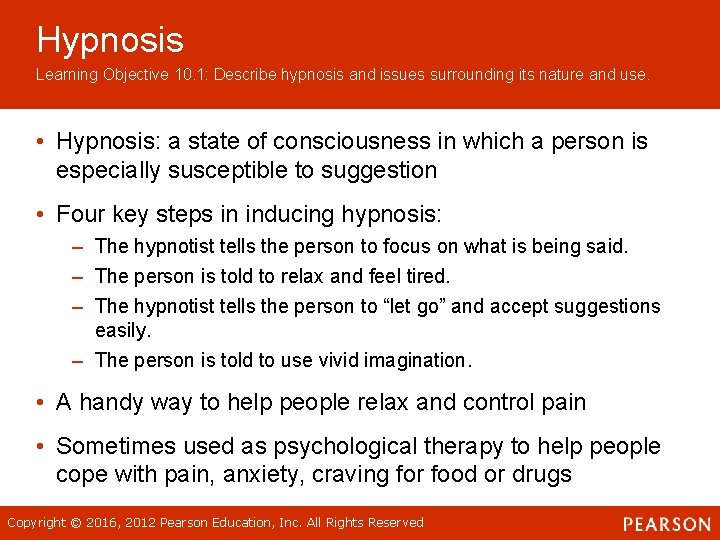
Hypnosis Learning Objective 10. 1: Describe hypnosis and issues surrounding its nature and use. • Hypnosis: a state of consciousness in which a person is especially susceptible to suggestion • Four key steps in inducing hypnosis: – The hypnotist tells the person to focus on what is being said. – The person is told to relax and feel tired. – The hypnotist tells the person to “let go” and accept suggestions easily. – The person is told to use vivid imagination. • A handy way to help people relax and control pain • Sometimes used as psychological therapy to help people cope with pain, anxiety, craving for food or drugs Copyright © 2016, 2012 Pearson Education, Inc. All Rights Reserved
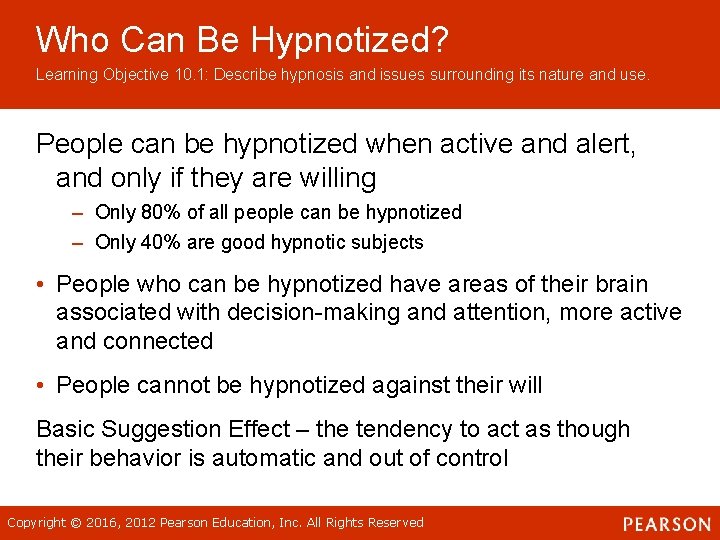
Who Can Be Hypnotized? Learning Objective 10. 1: Describe hypnosis and issues surrounding its nature and use. People can be hypnotized when active and alert, and only if they are willing – Only 80% of all people can be hypnotized – Only 40% are good hypnotic subjects • People who can be hypnotized have areas of their brain associated with decision-making and attention, more active and connected • People cannot be hypnotized against their will Basic Suggestion Effect – the tendency to act as though their behavior is automatic and out of control Copyright © 2016, 2012 Pearson Education, Inc. All Rights Reserved
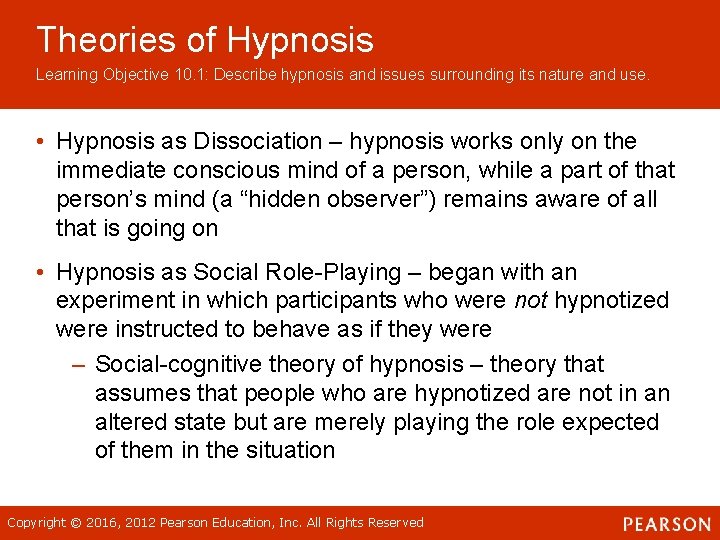
Theories of Hypnosis Learning Objective 10. 1: Describe hypnosis and issues surrounding its nature and use. • Hypnosis as Dissociation – hypnosis works only on the immediate conscious mind of a person, while a part of that person’s mind (a “hidden observer”) remains aware of all that is going on • Hypnosis as Social Role-Playing – began with an experiment in which participants who were not hypnotized were instructed to behave as if they were – Social-cognitive theory of hypnosis – theory that assumes that people who are hypnotized are not in an altered state but are merely playing the role expected of them in the situation Copyright © 2016, 2012 Pearson Education, Inc. All Rights Reserved
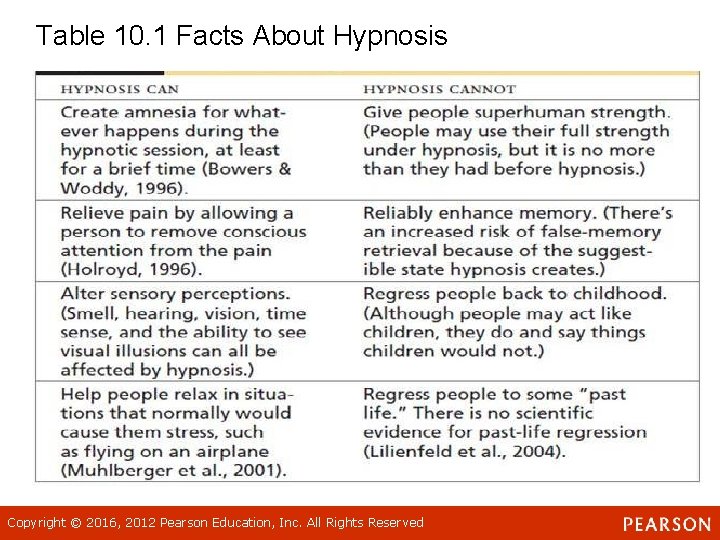
Table 10. 1 Facts About Hypnosis Copyright © 2016, 2012 Pearson Education, Inc. All Rights Reserved
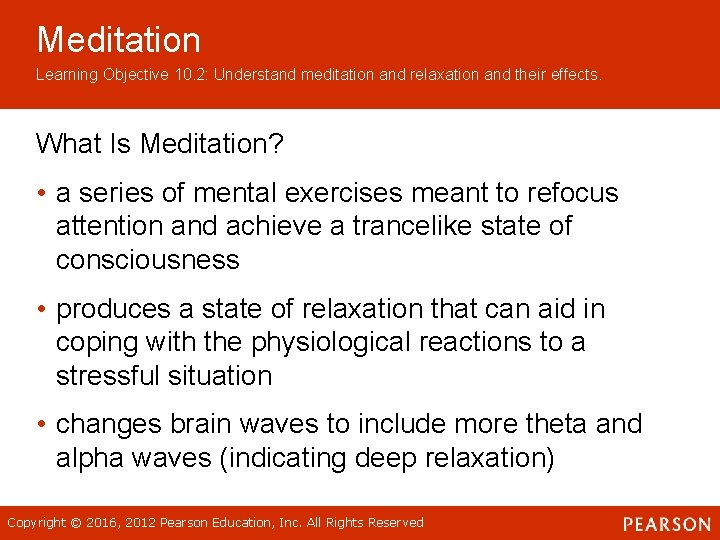
Meditation Learning Objective 10. 2: Understand meditation and relaxation and their effects. What Is Meditation? • a series of mental exercises meant to refocus attention and achieve a trancelike state of consciousness • produces a state of relaxation that can aid in coping with the physiological reactions to a stressful situation • changes brain waves to include more theta and alpha waves (indicating deep relaxation) Copyright © 2016, 2012 Pearson Education, Inc. All Rights Reserved
Benefits of Meditation Learning Objective 10. 2: Understand meditation and relaxation and their effects. The benefits of meditation • lowers blood pressure • increases the amounts of melatonin secreted at night • reduces the levels of chronic pain • reduces the symptoms of anxiety, depression, and hostility • reduces the risk of heart disease • reduces stress levels in cancer patients Copyright © 2016, 2012 Pearson Education, Inc. All Rights Reserved
Where Did the Time Go? (1 of 2) Learning Objective 10. 3: Describe the nature of flow states. • Dr. Mihaly Csikszentmihalyi’s Theory of Flow states: – an outgrowth of positive psychology as events that challenge our skills enough to grow and improve in the skill, but not so difficult that the challenge creates anxiety – we lose ourselves in the activity and our sense of time is transformed in a way that fits the needs of the activity – the rewards of flow activities are intrinsic and are the product of a merging of the self and the activity so it becomes automatic and almost effortless Copyright © 2016, 2012 Pearson Education, Inc. All Rights Reserved
Where Did the Time Go? (2 of 2) Learning Objective 10. 3 : Describe the nature of flow states. Some of the experiences that reflect the nature of flow states are: • athletes describe being in the zone • entertainers describe being lost in the music • artists describe their medium as an extension of themselves as they produce their works Copyright © 2016, 2012 Pearson Education, Inc. All Rights Reserved
Psychoactive Drugs Learning Objective 10. 4: Explain how psychoactive drugs act at the synaptic level. • Psychoactive drugs are chemical substances that alter thinking, perception, memory, or some combination of those abilities. – Can pose serious risks to one’s health and may even cause death when taken for pleasure, to get “high, ” or to dull psychological pain, or when taken without the supervision of a qualified medical professional – Have the potential to create either physical or psychological dependence, both of which can lead to a lifelong pattern of abuse as well as the risk of taking increasingly larger doses, leading to drug overdose Copyright © 2016, 2012 Pearson Education, Inc. All Rights Reserved
Physical Dependence Learning Objective 10. 4: Explain how psychoactive drugs act at the synaptic level. • Physical Dependence – condition that occurs when a person’s body becomes unable to function normally without a particular drug – Signs of Physical Dependence § The user’s body craves for the drug § Drug tolerance, as the person continues to use the drug, larger and larger doses of the drug are needed to achieve the same initial effects of the drug § The user experiences symptoms of withdrawal (nausea, pain, tremors, crankiness, and high blood pressure) when deprived of the drug § Many users will take more of the drug to alleviate the symptoms of withdrawal, which makes the entire situation worse § Negative reinforcement, the tendency to continue a behavior that leads to the removal of or escape from unpleasant circumstances or sensations Copyright © 2016, 2012 Pearson Education, Inc. All Rights Reserved
Role of the Brain Learning Objective 10. 4: Explain how psychoactive drugs act at the synaptic level. Brain plays an important part in drug dependency. • When a drug enters the body, it goes to the area, known as the brain’s “reward pathway, ” releasing dopamine and causing intense pleasure. Copyright © 2016, 2012 Pearson Education, Inc. All Rights Reserved
Psychological Dependence Learning Objective 10. 5: Evaluate the physiological and psychological effects of psychoactive drugs. • Psychological Dependence – the belief that the drug is needed to continue a feeling of emotional or psychological well-being – The body may not need the drug but they continue to use it because they think they need it – There is no withdrawal, can last forever Copyright © 2016, 2012 Pearson Education, Inc. All Rights Reserved
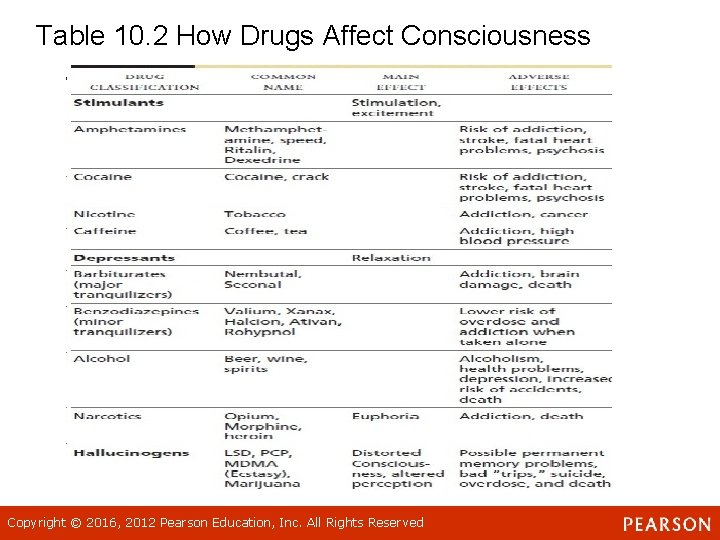
Psychoactive Drugs Learning Objective 10. 6: Describe the major categories of psychoactive drugs and their effects. • The effect of a particular drug depends on the category to which it belongs and the particular neurotransmitter the drug affects. • Major drug categories – Stimulants: drugs that increase the functioning of the nervous system – Depressants: drugs that decrease the functioning of the nervous system – Hallucinogenics: drugs that alter perceptions and may cause hallucinations Copyright © 2016, 2012 Pearson Education, Inc. All Rights Reserved
Stimulants: Up, and Away Learning Objective 10. 6: Describe the major categories of psychoactive drugs and their effects. • Stimulants are a class of drugs that cause either the sympathetic division or the central nervous system (or both) to increase levels of functioning, temporarily. • Stimulants “speed up” the neurons – the heart may beat faster or the brain may work faster, thus they are called “uppers. ” Copyright © 2016, 2012 Pearson Education, Inc. All Rights Reserved
Stimulants Learning Objective 10. 6: Describe the major categories of psychoactive drugs and their effects. • Amphetamines – Benzedrine, Methedrine, Dexedrine • Cocaine • Nicotine • Caffeine Copyright © 2016, 2012 Pearson Education, Inc. All Rights Reserved
Amphetamines Learning Objective 10. 6: Describe the major categories of psychoactive drugs and their effects. • Synthesized in laboratories • A related compound, methamphetamine, is used very rarely to treat attention-deficit/hyperactivity disorder or narcolepsy • “Crystal meth” is a crystalline form, smoked and used by recreational drug users • Amphetamine psychosis: condition causing addicts to become delusional and paranoid – they think people are out to “get” them; violence is a likely outcome, both against the self and others Copyright © 2016, 2012 Pearson Education, Inc. All Rights Reserved
Cocaine Learning Objective 10. 6: Describe the major categories of psychoactive drugs and their effects. • Found in coca plant leaves • Produces feelings of euphoria, energy, power, and pleasure • Deadens pain and suppresses the appetite • Highly dangerous drug – Some people have convulsions and may even die when using cocaine for the first time. – Children born to mothers who use cocaine have been associated with increased risk of learning disabilities, delayed language development, and an inability to cope adequately with stress. Copyright © 2016, 2012 Pearson Education, Inc. All Rights Reserved
Nicotine Learning Objective 10. 6: Describe the major categories of psychoactive drugs and their effects. • Relatively mild but nevertheless toxic stimulant • Produces a slight “rush” or sense of arousal as it raises blood pressure and accelerates the heart • Provides a rush of sugar into the bloodstream • Has a relaxing effect on most people and seems to reduce stress • The physical withdrawal symptoms can be as bad as those resulting from alcohol, cocaine, or heroin abuse Copyright © 2016, 2012 Pearson Education, Inc. All Rights Reserved
Caffeine Learning Objective 10. 6: Describe the major categories of psychoactive drugs and their effects. • A mild stimulant that almost everyone uses • Found in coffee, tea, most sodas, chocolate, and even many over-the-counter drugs • Helps maintain alertness, and can increase the effectiveness of some pain relievers such as aspirin • Often added to pain relievers and is the key ingredient in medications meant to keep people awake Copyright © 2016, 2012 Pearson Education, Inc. All Rights Reserved
Depressants: Down in the Valley Learning Objective 10. 6: Describe the major categories of psychoactive drugs and their effects. • Commonly known as tranquilizers or sleeping pills, barbiturates are drugs that have a sedative (sleepinducing) effect • Overdose can lead to death • Benzodiazepines – used to lower anxiety and reduce stress (Valium, Xanax, Halcion, Ativan, and Librium) • Common types: alcohol and narcotics Copyright © 2016, 2012 Pearson Education, Inc. All Rights Reserved
Alcohol Learning Objective 10. 6: Describe the major categories of psychoactive drugs and their effects. • Most commonly used and abused depressant • Obvious health risks to the liver, brain, and heart • Associated with loss of work time, loss of a job, and loss of economic stability • Indirectly stimulates the release of a neurotransmitter called GABA, the brain’s major depressant • GABA slows down or stops neural activity Copyright © 2016, 2012 Pearson Education, Inc. All Rights Reserved
Narcotics Learning Objective 10. 6: Describe the major categories of psychoactive drugs and their effects. • A type of depressant that suppresses the sensation of pain • Binds and stimulates the nervous system’s natural receptor sites for endorphins • Slows down the action of the nervous system • Derivative of a particular plant-based substance, opium • Opium mimics the effects of endorphins, the nervous system’s natural painkillers Copyright © 2016, 2012 Pearson Education, Inc. All Rights Reserved
Morphine Learning Objective 10. 6: Describe the major categories of psychoactive drugs and their effects. • Created by dissolving opium in an acid and then neutralizing the acid with ammonia • Still used today to control severe pain, in controlled doses for very short periods • Heroin, a derivative of morphine, does not have many of the disagreeable side effects of morphine Copyright © 2016, 2012 Pearson Education, Inc. All Rights Reserved
Hallucinogens: Higher and Higher Learning Objective 10. 6: Describe the major categories of psychoactive drugs and their effects. • Causes the brain to alter its interpretation of sensations and produces sensory distortions very similar to synesthesia • False sensory perceptions, called hallucinations, are often experienced, especially with more powerful hallucinogens • Two basic types of hallucinogens – created in a laboratory (manufactured highs) – from natural sources (nonmanufactured highs) Copyright © 2016, 2012 Pearson Education, Inc. All Rights Reserved
Manufactured Highs Learning Objective 10. 6: Describe the major categories of psychoactive drugs and their effects. • LSD, or lysergic acid diethylamide, is synthesized from a grain fungus called ergot – A very tiny drop of LSD makes people get that high feeling, colors seem more intense, sounds more beautiful, and so on. – Experience is not always a pleasant one. • PCP (phenyl cyclohexyl piperidine or phencyclidine) – Depending on the dosage, it can be a hallucinogen, stimulant, depressant, or an analgesic drug. • MDMA (a “designer drug” known as Ecstasy or simply X) and PCP are now classified as stimulatory hallucinogenics Copyright © 2016, 2012 Pearson Education, Inc. All Rights Reserved
Nonmanufactured High Learning Objective 10. 6: Describe the major categories of psychoactive drugs and their effects. • Marijuana, a hallucinogenic drug, comes from the leaves and flowers of the hemp plant called cannabis sativa – Psychoactive cannabinoid, and the active ingredient in marijuana, is tetrahydrocannabinol (THC) – Produces a feeling of wellbeing, mild intoxication, and mild sensory distortions or hallucinations – Marijuana creates a powerful psychological dependency, it does not produce physical dependency Copyright © 2016, 2012 Pearson Education, Inc. All Rights Reserved
Table 10. 2 How Drugs Affect Consciousness Copyright © 2016, 2012 Pearson Education, Inc. All Rights Reserved
Who Uses Drugs? Learning Objective 10. 7: Describe how culture and expectations influence the use and experience of drugs. • Those who cannot deal with psychological pressures from the outside world • Those who are depressed, who feel their lives are meaningless, hopeless, and directionless • Those who have recently left home or who suffer from anger, anxiety, or insomnia Copyright © 2016, 2012 Pearson Education, Inc. All Rights Reserved
Influence of Culture on Drugs Learning Objective 10. 7: Describe how culture and expectations influence the use and experience of drugs. • External forces can play a role in drug use as well – Peer pressure – Alcohol and other drugs are often found at parties • Culture also plays a role in substance use and abuse – Some cultures incorporate the use of drugs into religious rituals and ceremonies. – Some countries/states legalized the use of drugs for recreation. Copyright © 2016, 2012 Pearson Education, Inc. All Rights Reserved