
Altered States of Consciousness at the EndofLife James
- Slides: 24
Altered States of Consciousness at the End-of-Life James Hallenbeck, MD Director, Palliative Care Services, VA Palo Alto HCS Assistant Professor of Medicine
Psychiatric Consultation Situation: A psychiatric consultation is called for a patient with metastatic small cell carcinoma of the lung to determine “competency” (sic) regarding decision making and because the patient has been intermittently sleepy and agitated, calling out to unseen people. What approach do you take to such a consult?
Common Approach to Problem n n Medical review - ? Brain metastases Medication review u On morphine sustained release 150 mg q 12 with 30 mg morphine q 2 for breakthrough pain u Decadron 6 mg qd. Metabolic review: at risk for hypercalcemia, hyponatremia Interview patient – assess orientation and perhaps perform mini-mental status exam.
By the end of this talk you should be able to Discuss whether this might be normal dying or not n Identify whether this is this a toxic delirium, a terminal delirium or a “normal altered state” of dying n Discuss how these different states might be assessed and managed at the end-of-life n
Delirium – a problem of definitions… n. Latin – delirare to be deranged. Definition 1: “A state of temporary mental confusion. ” u Definition 2: “A state of uncontrolled emotion, esp. excitement. ” as in “Deliriously happy” u Websters II New College Dictionary
DSMIV Definition of Delirium n n Disturbance of consciousness (reduced clarity of awareness of environment) Change in cognition (memory deficit, disorientation, language disturbance) or the development of a perceptual disturbance not otherwise accounted for Development of the disturbance during a short time period with a tendency to fluctuate. Evidence that the disturbance is caused by the direct physiological consequences of a general medical condition.
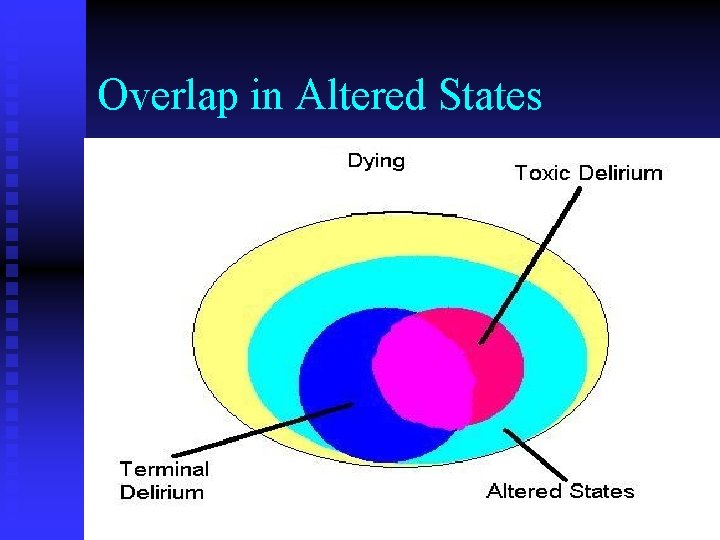
Altered State of Consciousness n Definition: A state of consciousness that is other than normal wakefulness u Can be good, neutral or bad qualitatively n Bad altered states can be called delirium
Altered States at the End-of-Life Common – prevalence of 25 -85% n Exist along spectrums: u Normal ---------Abnormal u Pleasant/ecstatic ----Very Disturbing u Reversible--------Irreversible n
Toxic (standard issue) Delirium Reversible – often has correctable cause n Associated with periodic agitated states n Psychedelic colors, rhythmic patterns (green ants, purple cows) n Tends to occur earlier in the dying trajectory n Suspect if sudden change in functional and health status or with change in medication n
Terminal Delirium Occurs in patient identified as being very close (days) to death n Relatively irreversible n May mix components of toxic delirium with dream-like stories involving people n
Overlap in Altered States
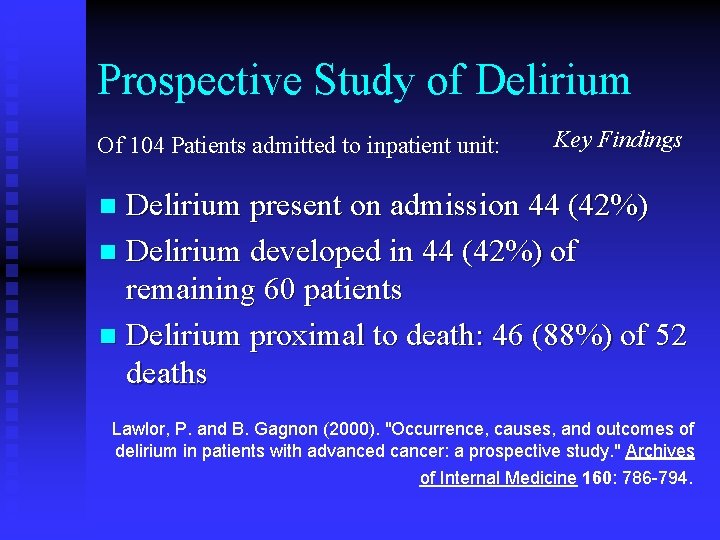
Prospective Study of Delirium Of 104 Patients admitted to inpatient unit: Key Findings Delirium present on admission 44 (42%) n Delirium developed in 44 (42%) of remaining 60 patients n Delirium proximal to death: 46 (88%) of 52 deaths n Lawlor, P. and B. Gagnon (2000). "Occurrence, causes, and outcomes of delirium in patients with advanced cancer: a prospective study. " Archives of Internal Medicine 160: 786 -794.
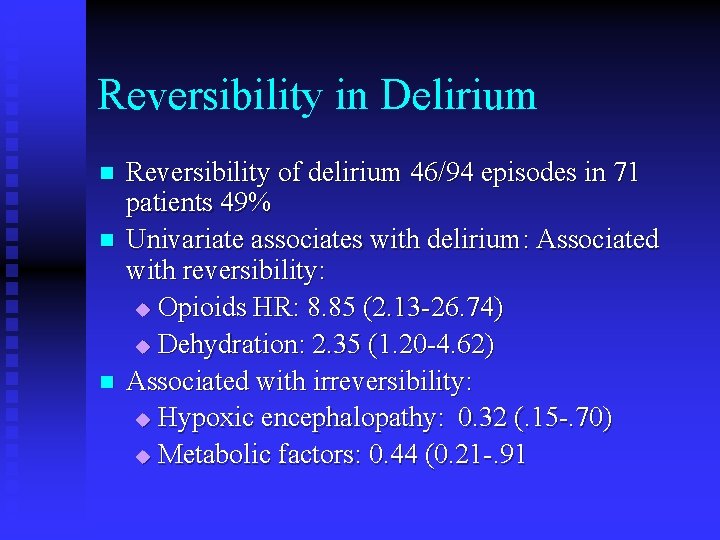
Reversibility in Delirium n n n Reversibility of delirium 46/94 episodes in 71 patients 49% Univariate associates with delirium: Associated with reversibility: u Opioids HR: 8. 85 (2. 13 -26. 74) u Dehydration: 2. 35 (1. 20 -4. 62) Associated with irreversibility: u Hypoxic encephalopathy: 0. 32 (. 15 -. 70) u Metabolic factors: 0. 44 (0. 21 -. 91
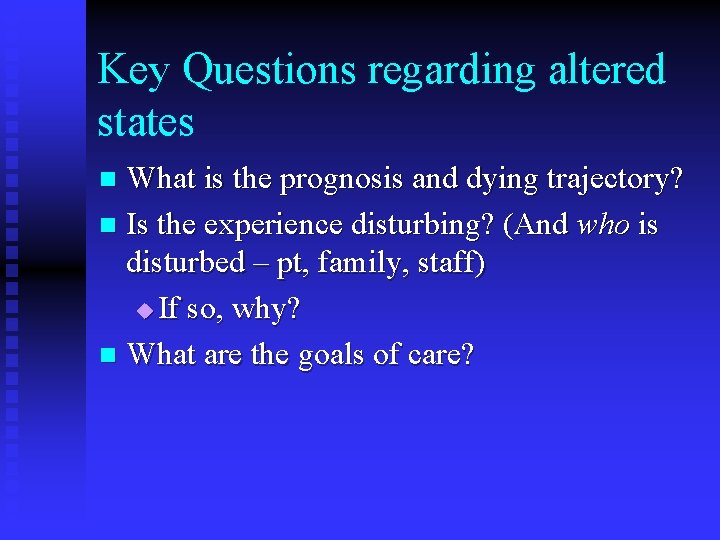
Key Questions regarding altered states What is the prognosis and dying trajectory? n Is the experience disturbing? (And who is disturbed – pt, family, staff) u If so, why? n What are the goals of care? n
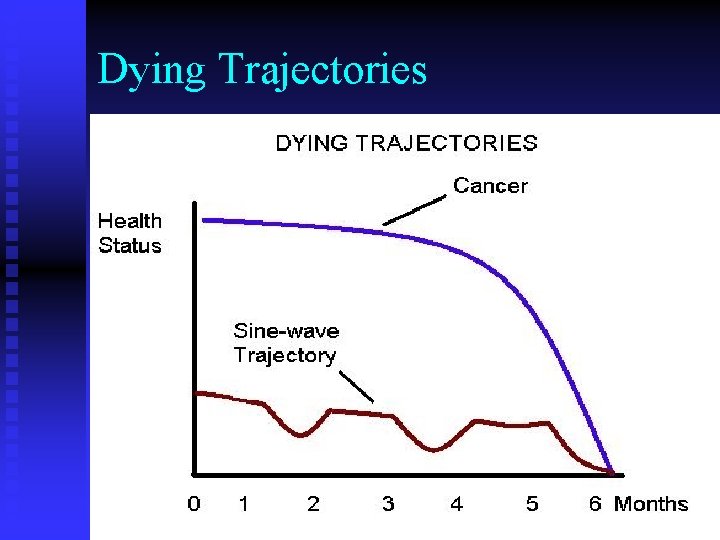
Dying Trajectories
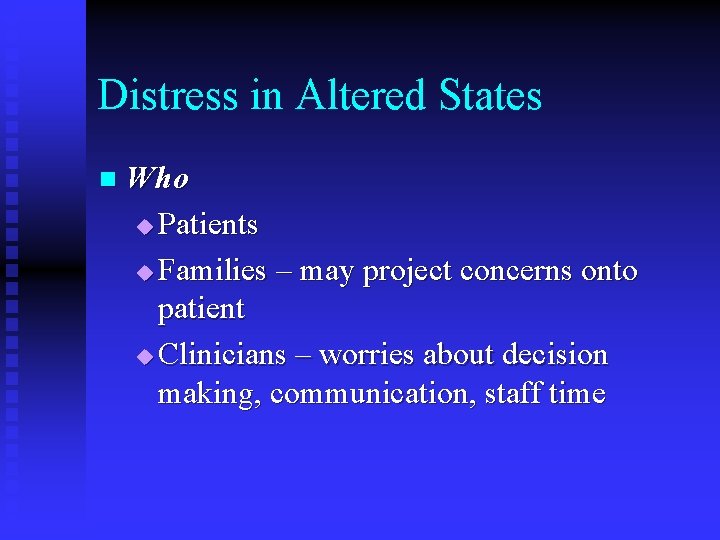
Distress in Altered States n Who u Patients u Families – may project concerns onto patient u Clinicians – worries about decision making, communication, staff time
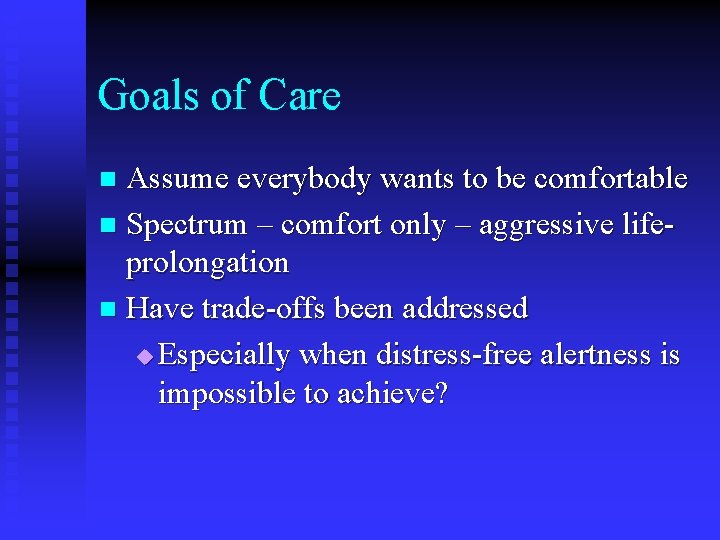
Goals of Care Assume everybody wants to be comfortable n Spectrum – comfort only – aggressive lifeprolongation n Have trade-offs been addressed u Especially when distress-free alertness is impossible to achieve? n
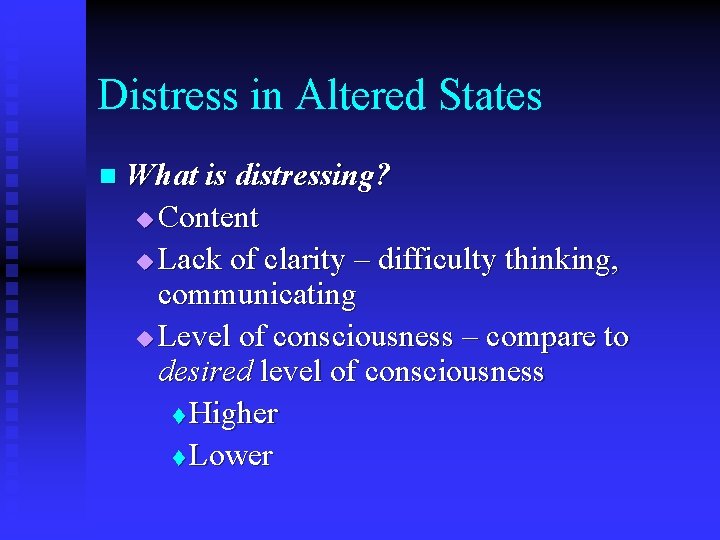
Distress in Altered States n What is distressing? u Content u Lack of clarity – difficulty thinking, communicating u Level of consciousness – compare to desired level of consciousness t Higher t Lower
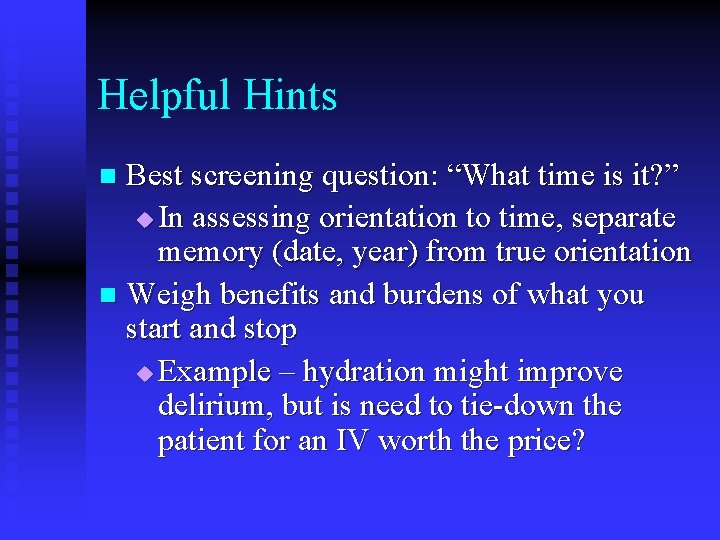
Helpful Hints Best screening question: “What time is it? ” u In assessing orientation to time, separate memory (date, year) from true orientation n Weigh benefits and burdens of what you start and stop u Example – hydration might improve delirium, but is need to tie-down the patient for an IV worth the price? n
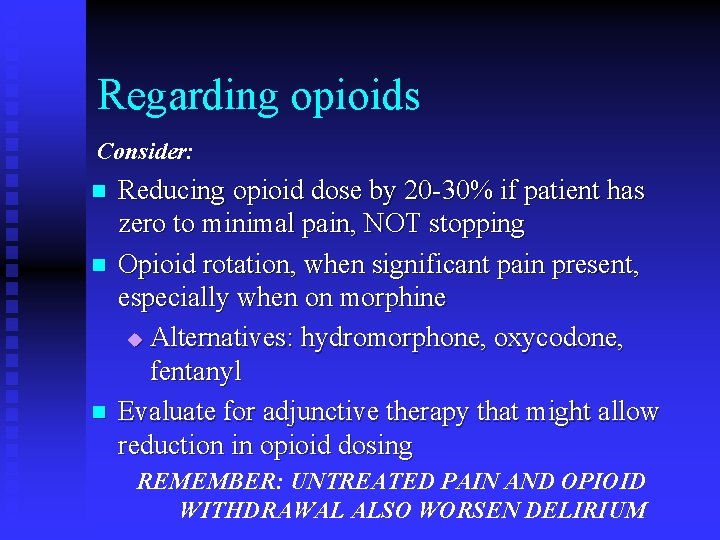
Regarding opioids Consider: n n n Reducing opioid dose by 20 -30% if patient has zero to minimal pain, NOT stopping Opioid rotation, when significant pain present, especially when on morphine u Alternatives: hydromorphone, oxycodone, fentanyl Evaluate for adjunctive therapy that might allow reduction in opioid dosing REMEMBER: UNTREATED PAIN AND OPIOID WITHDRAWAL ALSO WORSEN DELIRIUM
Medications n Key question: To what extent are you trying to reorient, sedate or do both? u Re-orient – non-sedating neuroleptics u Sedate – benzodiazepines, sedating neuroleptics (chlorpromazine) barbiturates u Both – chlorpromazine
Visitations n n Incidence: at least 25% of dying people Trans-cultural – not associated with religiosity Rarely disturbing to patients Visitors: u Deceased relatives and friends u Guardian spirits/angels u Babies and children Key Point: Seeing angels is not an indication for Haloperidol!
Common themes Travel n Crossing-over, barriers n Reuniting n Unfinished business n Flash-backs and fears n
SUMMARY Altered states are common n Not all altered states are bad or abnormal or reversible n Need for flexibility in management n More research is needed in both understanding and managing such states n