Chapter 17 Thermochemistry PreAP Chemistry Charles Page High


- Slides: 72
Chapter 17 “Thermochemistry” Pre-AP Chemistry Charles Page High School Stephen L. Cotton
Section 17. 1 The Flow of Energy – Heat and Work u OBJECTIVES: • Explain how energy, heat, and work are related. 2
Section 17. 1 The Flow of Energy – Heat and Work u OBJECTIVES: • Classify processes as either exothermic or endothermic. 3
Section 17. 1 The Flow of Energy – Heat and Work u OBJECTIVES: • Identify the units used to measure heat transfer. 4
Section 17. 1 The Flow of Energy – Heat and Work u OBJECTIVES: • Distinguish between heat capacity and specific heat capacity (also called simply specific heat). 5
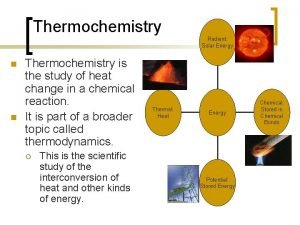
Energy Transformations u “Thermochemistry” - concerned with heat changes that occur during chemical reactions u Energy - capacity for doing work or supplying heat • weightless, odorless, tasteless • if within the chemical substancescalled chemical potential energy 6
Energy Transformations u Gasoline contains a significant amount of chemical potential energy u Heat - represented by “q”, is energy that transfers from one object to another, because of a temperature difference between them. • only changes can be detected! • flows from warmer cooler object 7
Exothermic and Endothermic Processes u Essentially all chemical reactions and changes in physical state involve either: a) release of heat, or b) absorption of heat
Exothermic and Endothermic Processes u In studying heat changes, think of defining these two parts: • the system - the part of the universe on which you focus your attention • the surroundings - includes everything else in the universe
Exothermic and Endothermic Processes u Together, the system and it’s surroundings constitute the universe u Thermochemistry is concerned with the flow of heat from the system to it’s surroundings, and vice-versa.
Exothermic and Endothermic Processes u The Law of Conservation of Energy states that in any chemical or physical process, energy is neither created nor destroyed. • All the energy is accounted for as work, stored energy, or heat.
Exothermic and Endothermic Processes u Heat flowing into a system from it’s surroundings: • defined as positive • q has a positive value • called endothermic –system gains heat (gets warmer) as the surroundings cool down
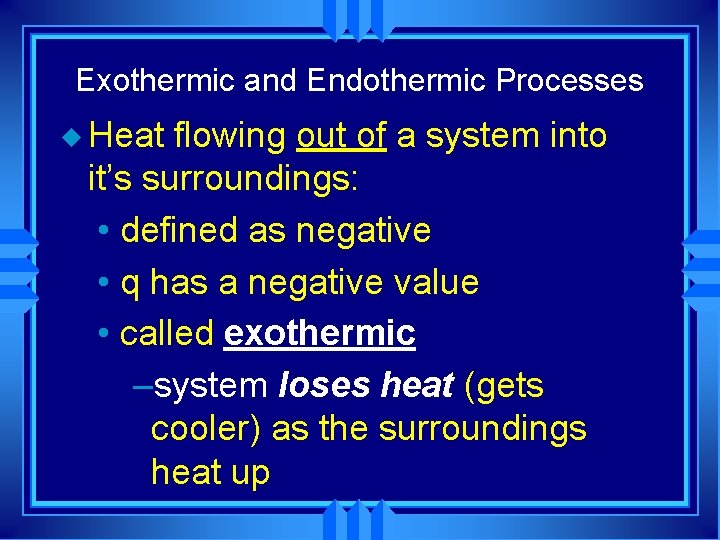
Exothermic and Endothermic Processes u Heat flowing out of a system into it’s surroundings: • defined as negative • q has a negative value • called exothermic –system loses heat (gets cooler) as the surroundings heat up
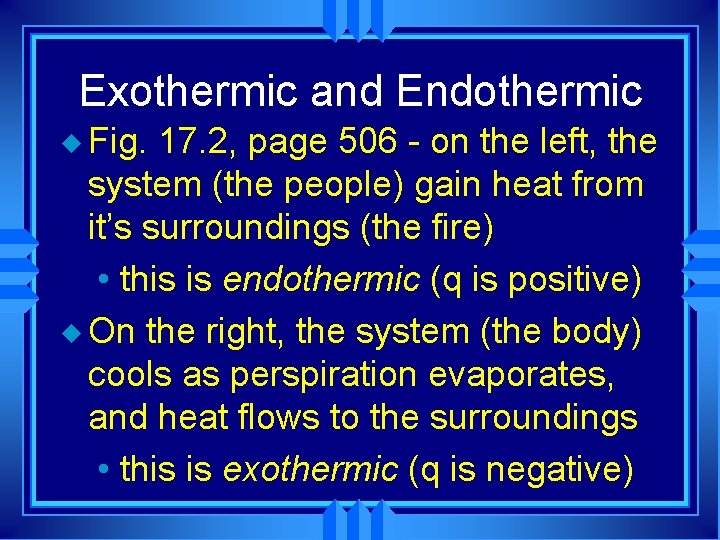
Exothermic and Endothermic u Fig. 17. 2, page 506 - on the left, the system (the people) gain heat from it’s surroundings (the fire) • this is endothermic (q is positive) u On the right, the system (the body) cools as perspiration evaporates, and heat flows to the surroundings • this is exothermic (q is negative)
Exothermic and Endothermic u Every reaction has an energy change associated with it u ** Gummy Bear Sacrifice ** u Exothermic reactions release energy, usually in the form of heat. u Endothermic reactions absorb energy u Energy is stored in bonds between atoms 15
Units for Measuring Heat Flow 1) A calorie is defined as the quantity of heat needed to raise the temperature of 1 g of pure water 1 o. C. • • • Used except when referring to food a Calorie, (written with a capital C), always refers to the energy in food 1 Calorie = 1 kilocalorie = 1000 cal. 16
Units for Measuring Heat Flow 2) The calorie is also related to the Joule, the SI unit of heat and energy • named after James Prescott Joule • 4. 184 J = 1 cal u Heat Capacity - the amount of heat needed to increase the temperature of an object exactly 1 o. C • Depends on both the object’s mass and its chemical composition 17
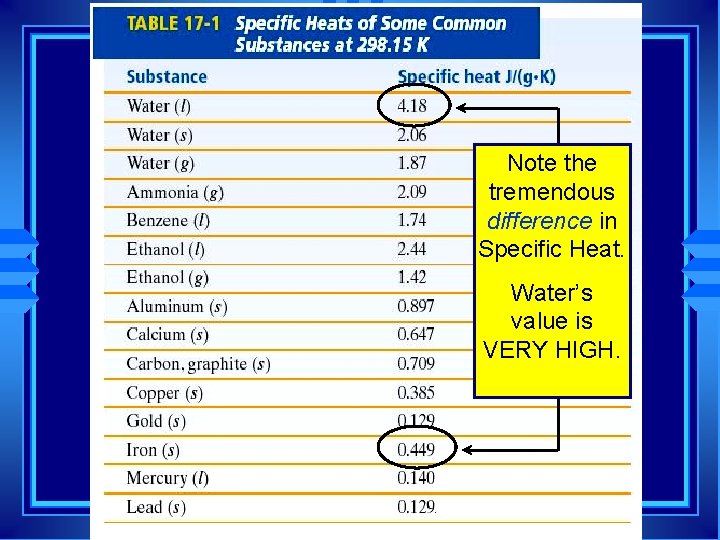
Heat Capacity and Specific Heat u Specific Heat Capacity (abbreviated “C”) - the amount of heat it takes to raise the temperature of 1 gram of the substance by 1 o. C • often called simply “Specific Heat” • Note Table 17. 1, page 508 (next slide) has a HUGE value, when it is compared to other chemicals u Water 18
Note the Table of Specific Heats tremendous difference in Specific Heat. Water’s value is VERY HIGH.
Heat Capacity and Specific Heat u For water, C = 4. 18 J/(g o. C) in Joules, and C = 1. 00 cal/(g o. C) in calories. u Thus, for water: • it takes a long time to heat up, and • it takes a long time to cool off! u Water is used as a coolant! • Note Figure 17. 4, page 509 20
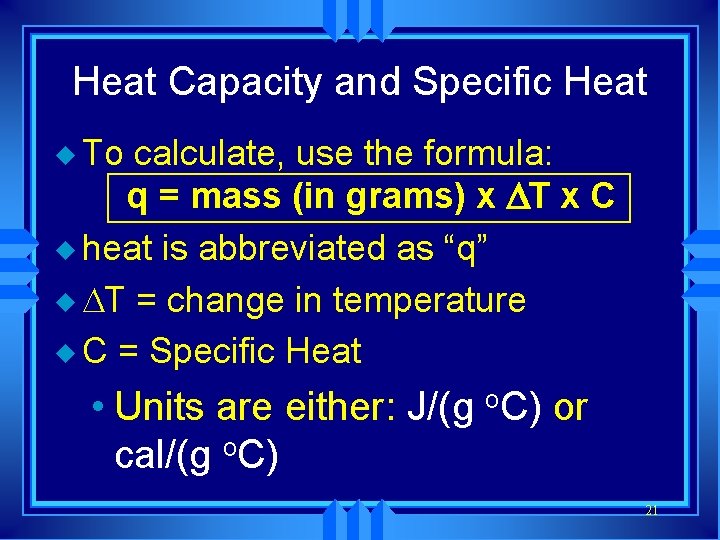
Heat Capacity and Specific Heat u To calculate, use the formula: q = mass (in grams) x T x C u heat is abbreviated as “q” u T = change in temperature u C = Specific Heat • Units are either: J/(g o. C) or cal/(g o. C) 21
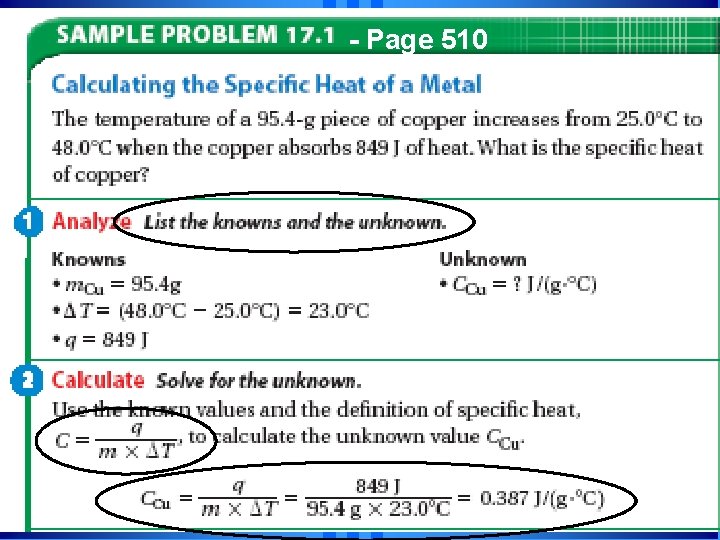
- Page 510
Section 17. 2 Measuring and Expressing Enthalpy Changes u OBJECTIVES: • Describe how calorimeters are used to measure heat flow. 23
Section 17. 2 Measuring and Expressing Enthalpy Changes u OBJECTIVES: • Construct thermochemical equations. 24
Section 17. 2 Measuring and Expressing Enthalpy Changes u OBJECTIVES: • Solve for enthalpy changes in chemical reactions by using heats of reaction. 25
Calorimetry u Calorimetry - the measurement of the heat into or out of a system for chemical and physical processes. • Based on the fact that the heat released = the heat absorbed u The device used to measure the absorption or release of heat in chemical or physical processes is called a “Calorimeter”
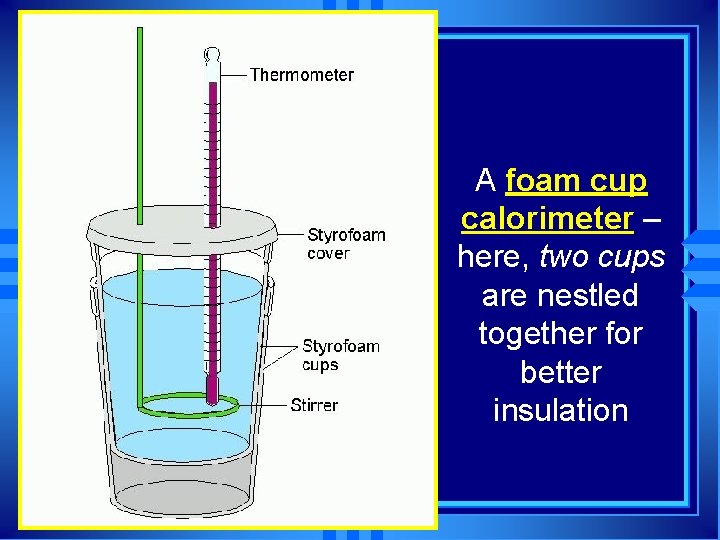
Calorimetry u Foam cups are excellent heat insulators, and are commonly used as simple calorimeters under constant pressure. (They are good because they are well-insulated. ) • Fig. 17. 5, page 511 • What about a Dewar’s flask? u For systems at constant pressure, the “heat content” is the same as a property called Enthalpy (H) of the system
A foam cup calorimeter – here, two cups are nestled together for better insulation
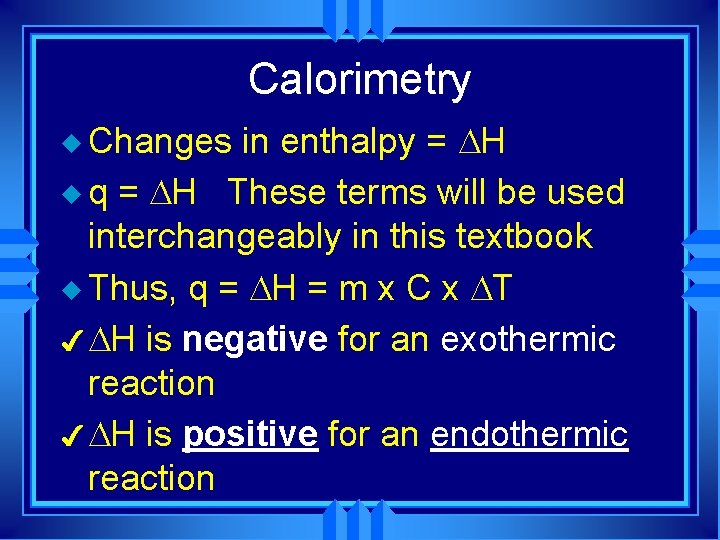
Calorimetry in enthalpy = H u q = H These terms will be used interchangeably in this textbook u Thus, q = H = m x C x T 4 H is negative for an exothermic reaction 4 H is positive for an endothermic reaction u Changes
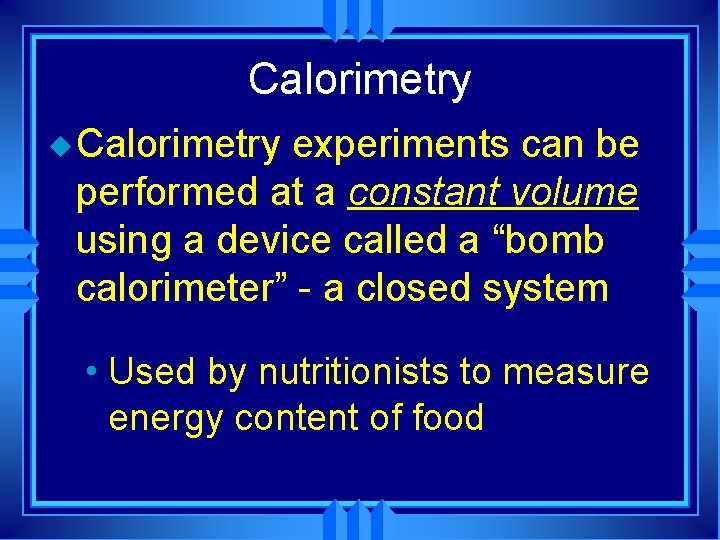
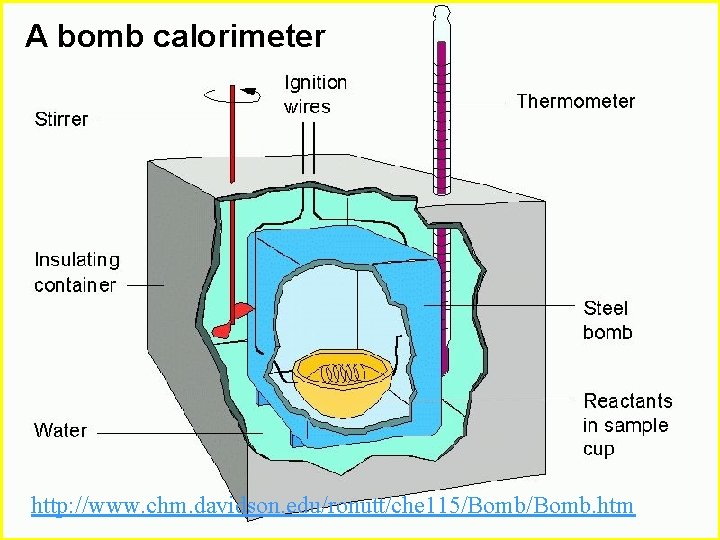
Calorimetry u Calorimetry experiments can be performed at a constant volume using a device called a “bomb calorimeter” - a closed system • Used by nutritionists to measure energy content of food
A bomb calorimeter A Bomb Calorimeter http: //www. chm. davidson. edu/ronutt/che 115/Bomb. htm
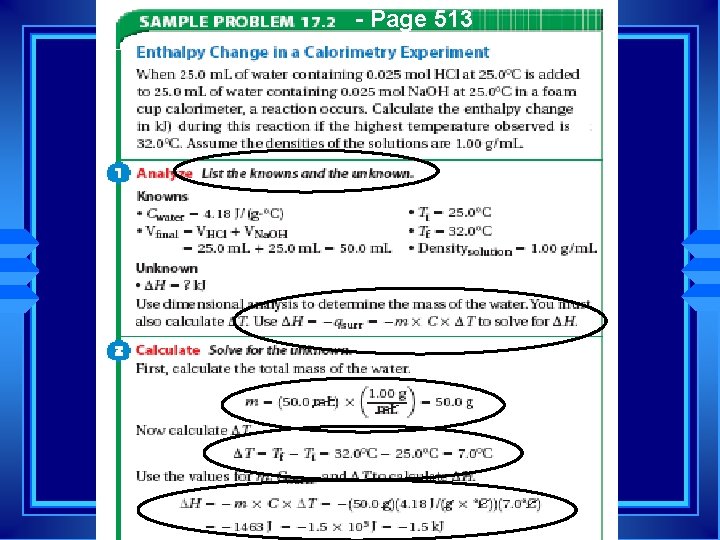
- Page 513
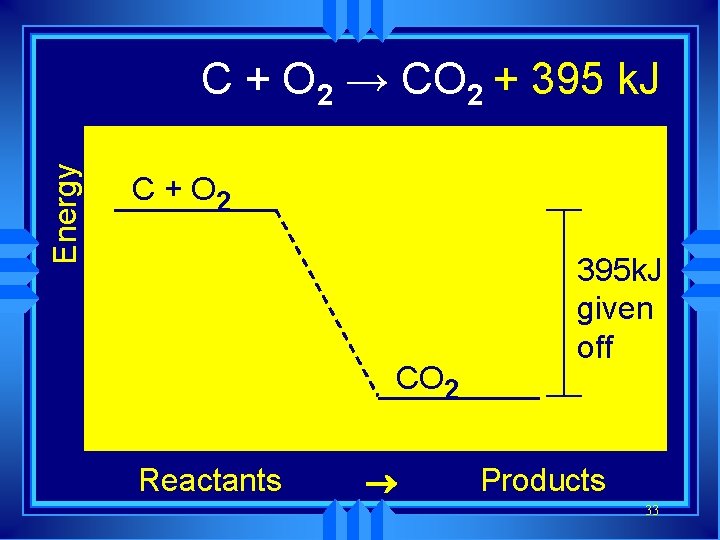
Energy C + O 2 → CO 2 + 395 k. J C + O 2 CO 2 Reactants ® 395 k. J given off Products 33
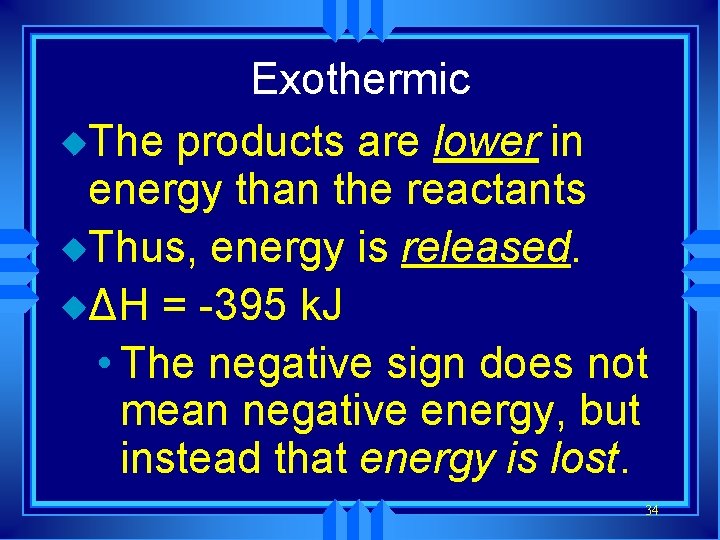
Exothermic u. The products are lower in energy than the reactants u. Thus, energy is released. uΔH = -395 k. J • The negative sign does not mean negative energy, but instead that energy is lost. 34
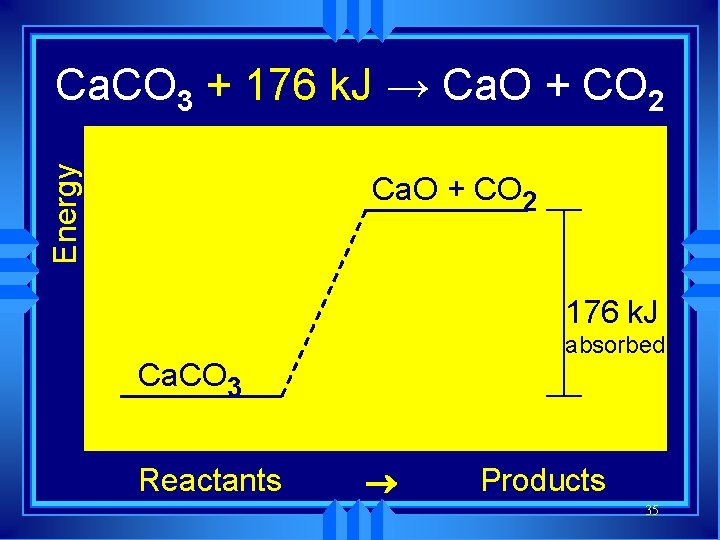
Energy Ca. CO Ca. O + CO+2 CO 2 Ca. CO → Ca. O 3 →k. J 3 + 176 Ca. O + CO 2 176 k. J absorbed Ca. CO 3 Reactants ® Products 35
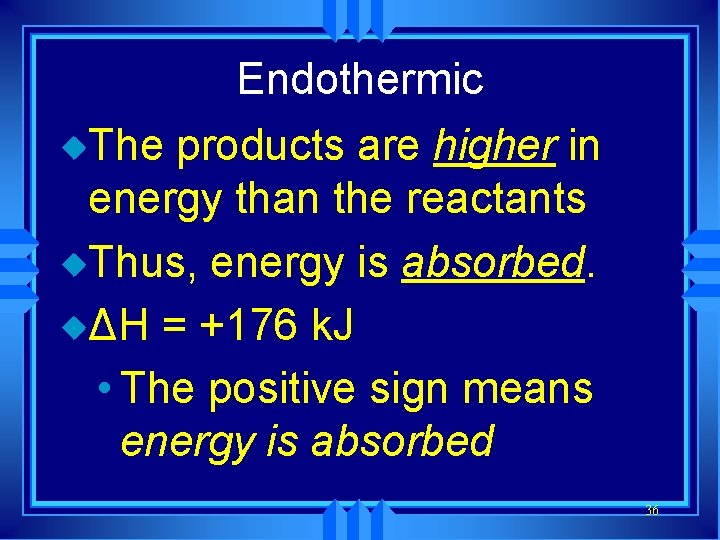
Endothermic u. The products are higher in energy than the reactants u. Thus, energy is absorbed. uΔH = +176 k. J • The positive sign means energy is absorbed 36
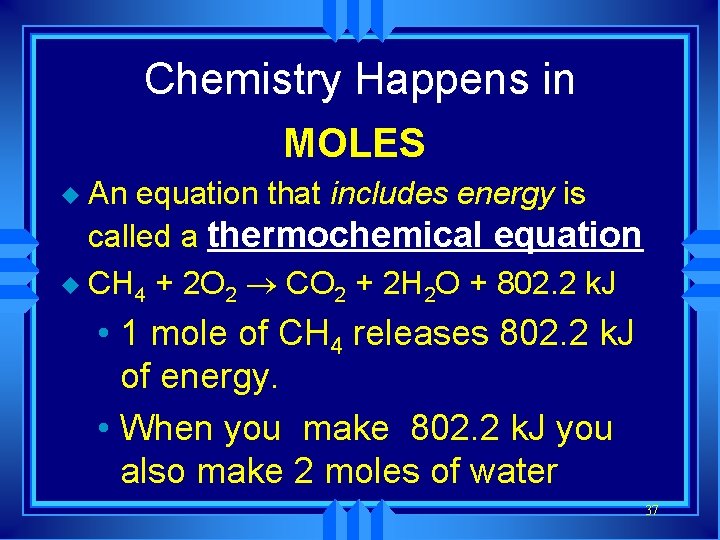
Chemistry Happens in MOLES An equation that includes energy is called a thermochemical equation u CH 4 + 2 O 2 CO 2 + 2 H 2 O + 802. 2 k. J u • 1 mole of CH 4 releases 802. 2 k. J of energy. • When you make 802. 2 k. J you also make 2 moles of water 37
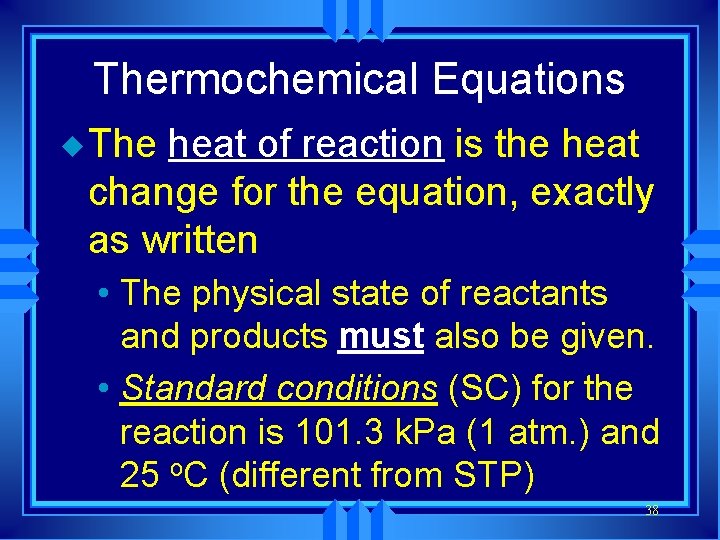
Thermochemical Equations u The heat of reaction is the heat change for the equation, exactly as written • The physical state of reactants and products must also be given. • Standard conditions (SC) for the reaction is 101. 3 k. Pa (1 atm. ) and 25 o. C (different from STP) 38
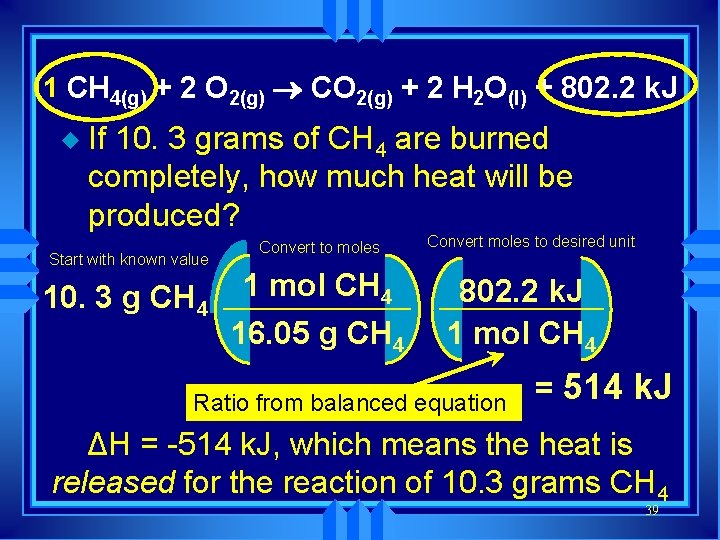
1 CH 4(g) + 2 O 2(g) ® CO 2(g) + 2 H 2 O(l) + 802. 2 k. J u If 10. 3 grams of CH 4 are burned completely, how much heat will be produced? Start with known value 10. 3 g CH 4 Convert to moles 1 mol CH 4 16. 05 g CH 4 Convert moles to desired unit 802. 2 k. J 1 mol CH 4 Ratio from balanced equation = 514 k. J ΔH = -514 k. J, which means the heat is released for the reaction of 10. 3 grams CH 4 39
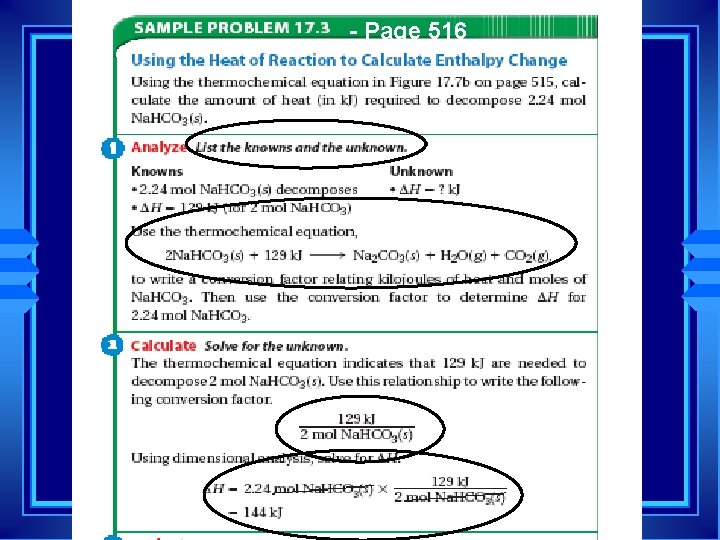
- Page 516
Summary, so far. . .
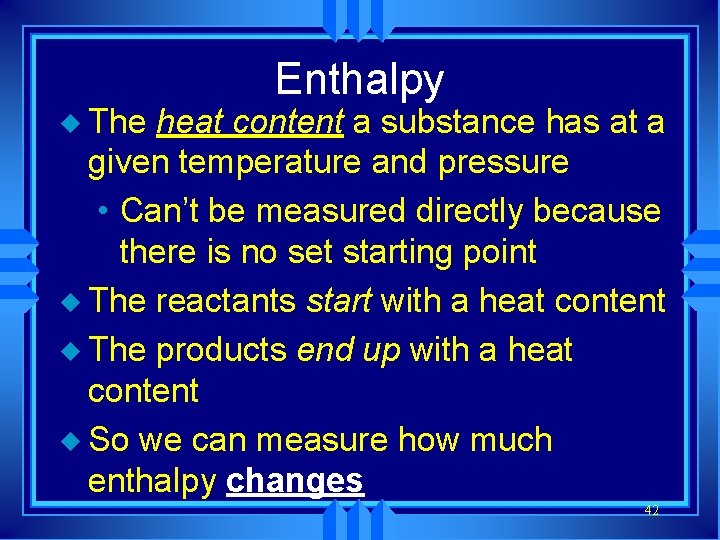
u The Enthalpy heat content a substance has at a given temperature and pressure • Can’t be measured directly because there is no set starting point u The reactants start with a heat content u The products end up with a heat content u So we can measure how much enthalpy changes 42
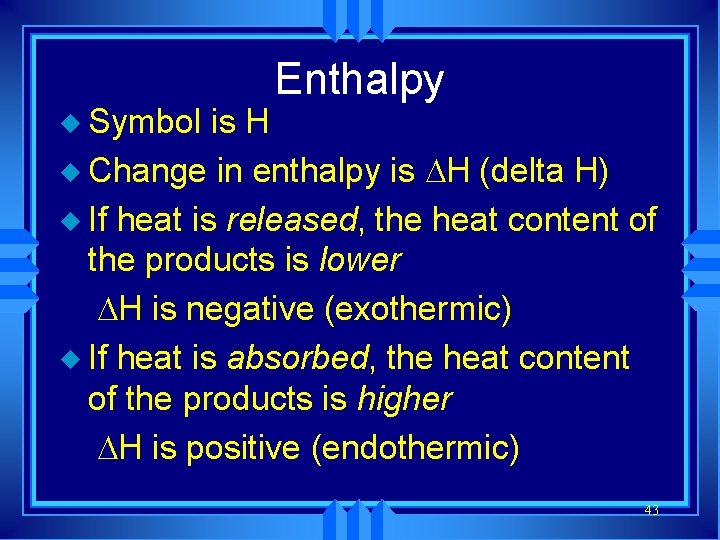
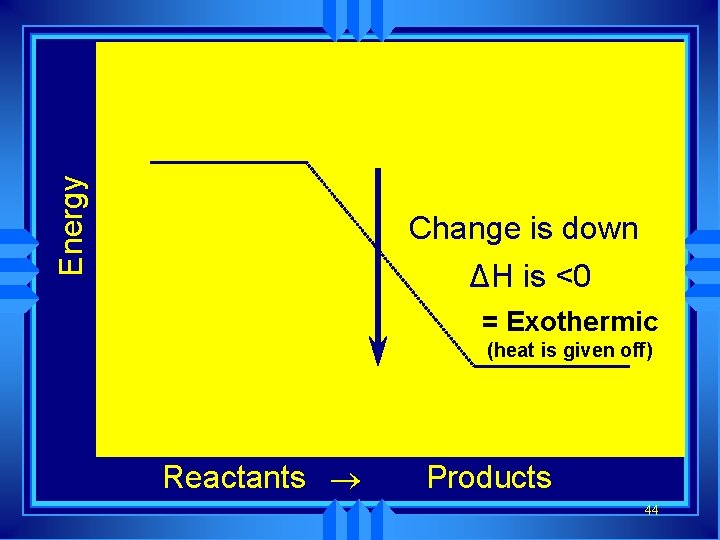
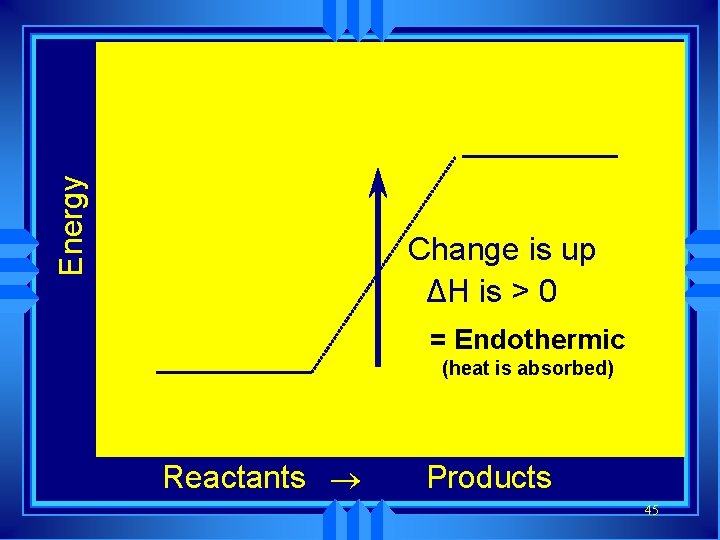
u Symbol Enthalpy is H u Change in enthalpy is H (delta H) u If heat is released, the heat content of the products is lower H is negative (exothermic) u If heat is absorbed, the heat content of the products is higher H is positive (endothermic) 43
Energy Change is down ΔH is <0 = Exothermic (heat is given off) Reactants Products 44
Energy Change is up ΔH is > 0 = Endothermic (heat is absorbed) Reactants Products 45
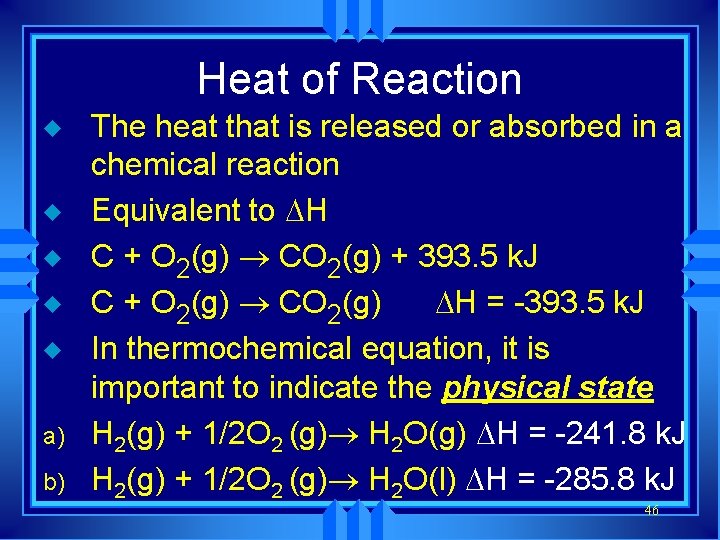
Heat of Reaction u u u a) b) The heat that is released or absorbed in a chemical reaction Equivalent to H C + O 2(g) CO 2(g) + 393. 5 k. J C + O 2(g) CO 2(g) H = -393. 5 k. J In thermochemical equation, it is important to indicate the physical state H 2(g) + 1/2 O 2 (g) H 2 O(g) H = -241. 8 k. J H 2(g) + 1/2 O 2 (g) H 2 O(l) H = -285. 8 k. J 46
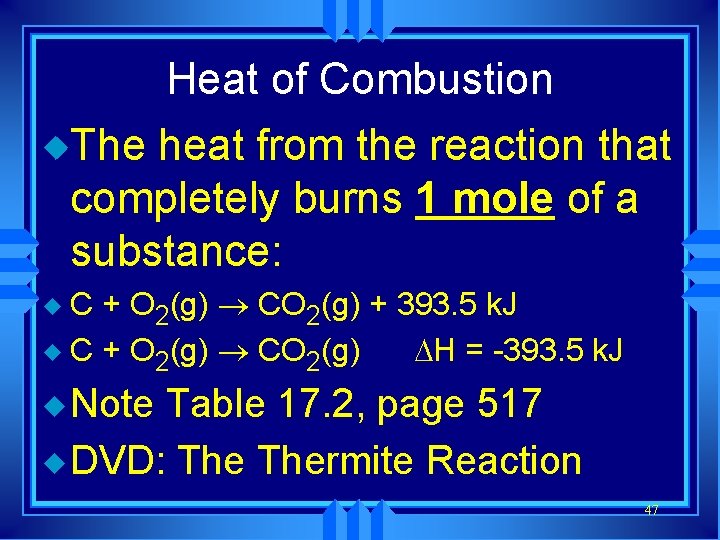
Heat of Combustion u. The heat from the reaction that completely burns 1 mole of a substance: C + O 2(g) CO 2(g) + 393. 5 k. J u C + O 2(g) CO 2(g) H = -393. 5 k. J u u Note Table 17. 2, page 517 u DVD: Thermite Reaction 47
Section 17. 3 Heat in Changes of State u OBJECTIVES: • Classify the enthalpy change that occurs when a substance: a) melts, b) freezes, c) boils, d) condenses, or e) dissolves. 48
Section 17. 3 Heat in Changes of State u OBJECTIVES: • Solve for the enthalpy change that occurs when a substance: a) melts, b) freezes, c) boils, d) condenses, or e) dissolves. 49
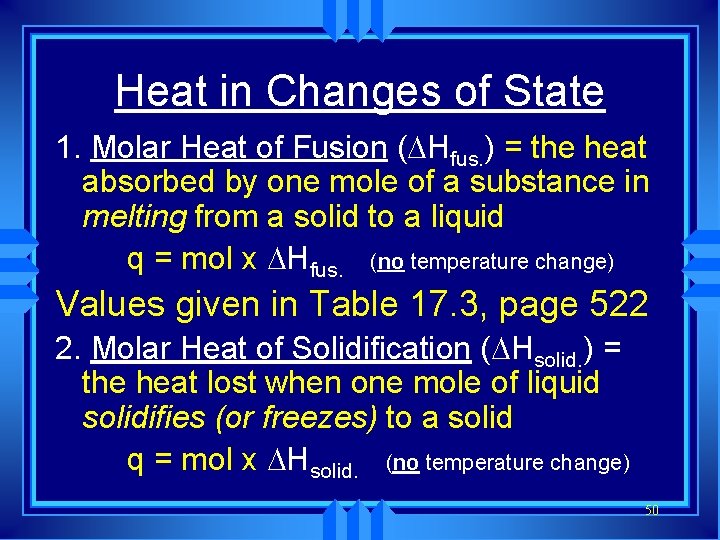
Heat in Changes of State 1. Molar Heat of Fusion ( Hfus. ) = the heat absorbed by one mole of a substance in melting from a solid to a liquid q = mol x Hfus. (no temperature change) Values given in Table 17. 3, page 522 2. Molar Heat of Solidification ( Hsolid. ) = the heat lost when one mole of liquid solidifies (or freezes) to a solid q = mol x Hsolid. (no temperature change) 50
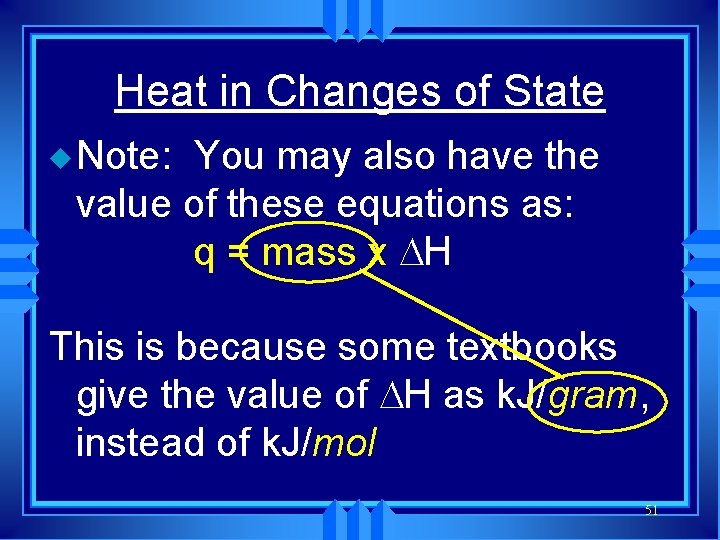
Heat in Changes of State u Note: You may also have the value of these equations as: q = mass x H This is because some textbooks give the value of H as k. J/gram, instead of k. J/mol 51
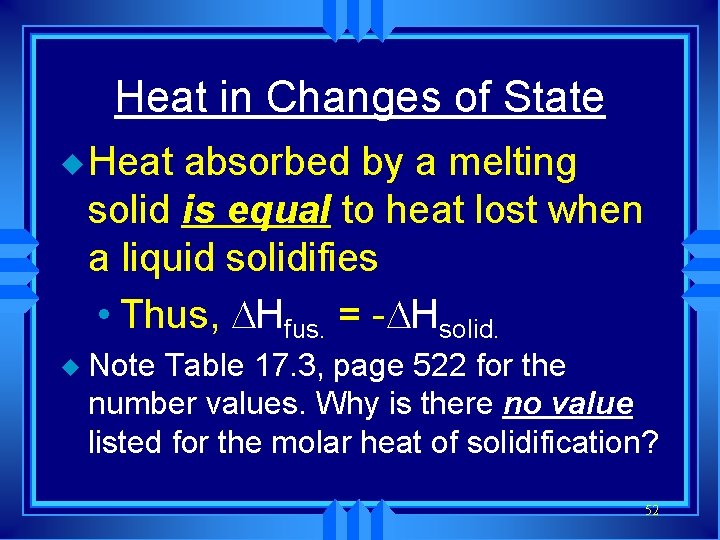
Heat in Changes of State u Heat absorbed by a melting solid is equal to heat lost when a liquid solidifies • Thus, Hfus. = - Hsolid. u Note Table 17. 3, page 522 for the number values. Why is there no value listed for the molar heat of solidification? 52
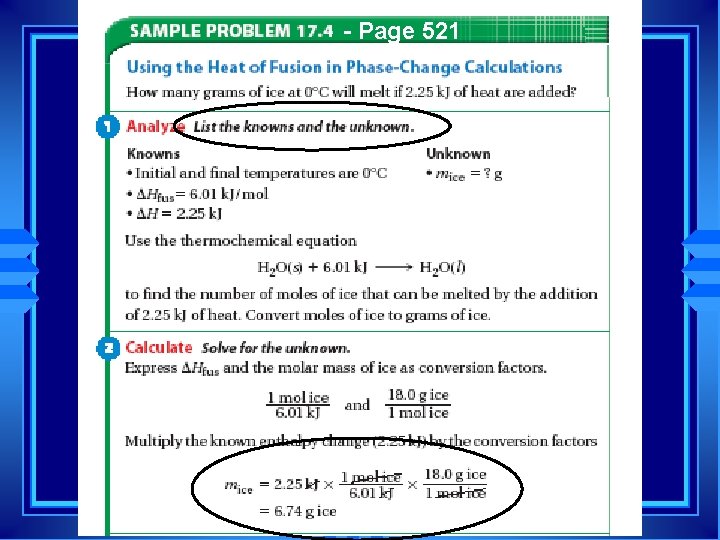
- Page 521
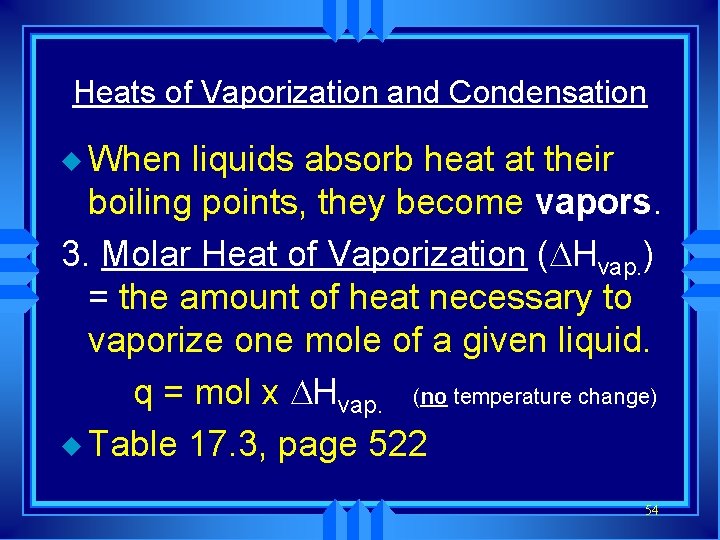
Heats of Vaporization and Condensation u When liquids absorb heat at their boiling points, they become vapors. 3. Molar Heat of Vaporization ( Hvap. ) = the amount of heat necessary to vaporize one mole of a given liquid. q = mol x Hvap. (no temperature change) u Table 17. 3, page 522 54
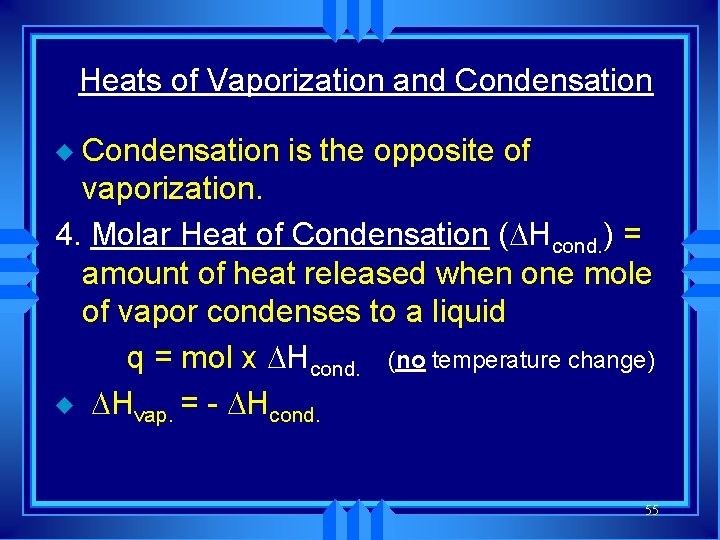
Heats of Vaporization and Condensation is the opposite of vaporization. 4. Molar Heat of Condensation ( Hcond. ) = amount of heat released when one mole of vapor condenses to a liquid q = mol x Hcond. (no temperature change) u Hvap. = - Hcond. u 55
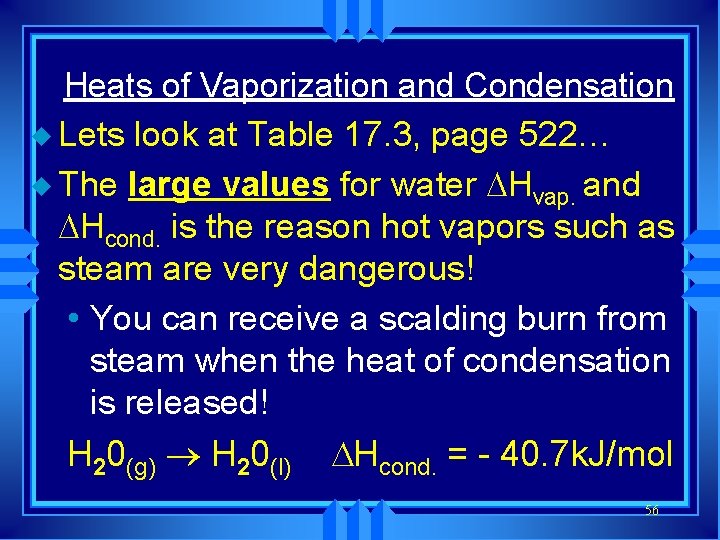
Heats of Vaporization and Condensation u Lets look at Table 17. 3, page 522… u The large values for water Hvap. and Hcond. is the reason hot vapors such as steam are very dangerous! • You can receive a scalding burn from steam when the heat of condensation is released! H 20(g) H 20(l) Hcond. = - 40. 7 k. J/mol 56
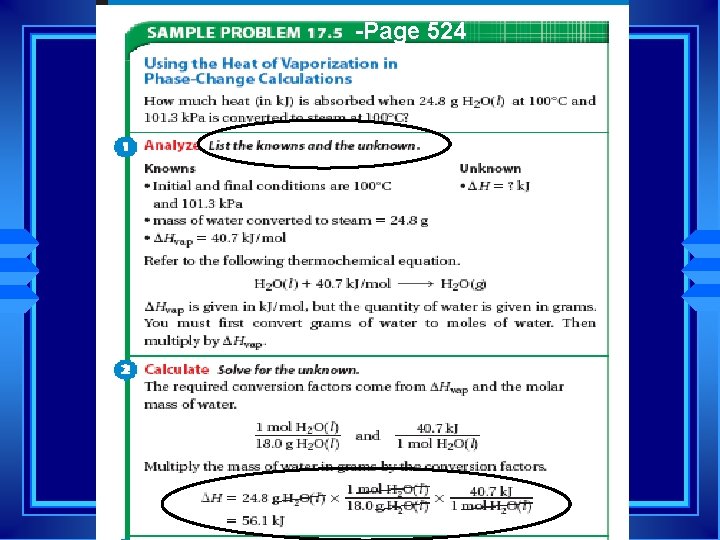
-Page 524
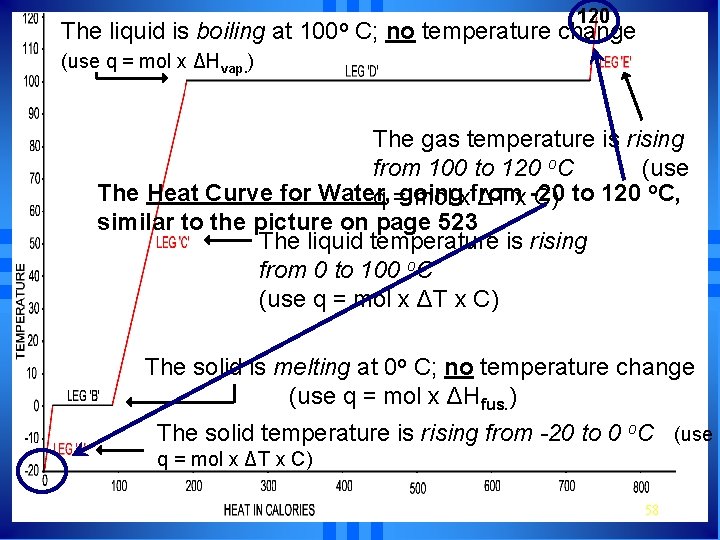
The liquid is boiling at 100 o 120 C; no temperature change (use q = mol x ΔHvap. ) The gas temperature is rising from 100 to 120 o. C (use The Heat Curve for Water, q =going mol xfrom ΔT x -20 C) to 120 o. C, similar to the picture on page 523 The liquid temperature is rising from 0 to 100 o. C (use q = mol x ΔT x C) The solid is melting at 0 o C; no temperature change (use q = mol x ΔHfus. ) The solid temperature is rising from -20 to 0 o. C (use q = mol x ΔT x C) 58
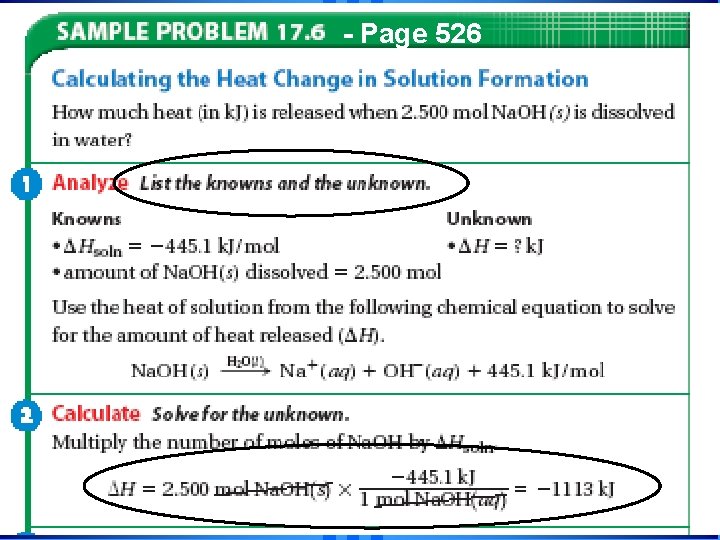
Heat of Solution Heat changes can also occur when a solute dissolves in a solvent. 5. Molar Heat of Solution ( Hsoln. ) = heat change caused by dissolution of one mole of substance q = mol x Hsoln. (no temperature change) u Sodium hydroxide provides a good example of an exothermic molar heat of solution (next slide) u 59
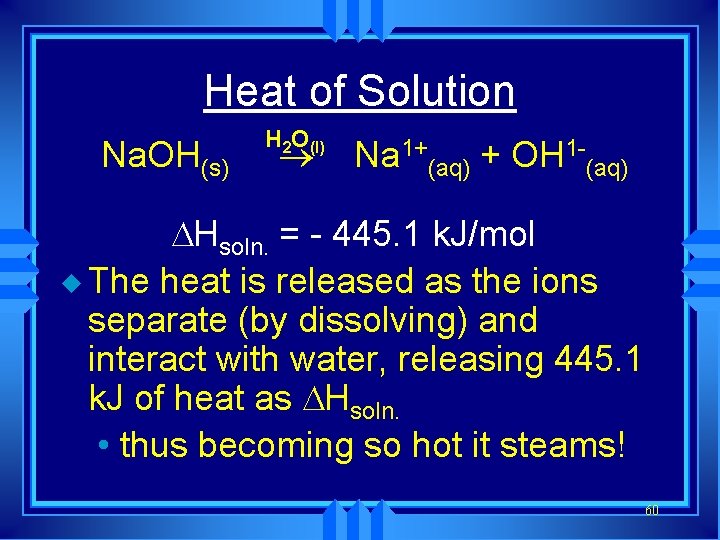
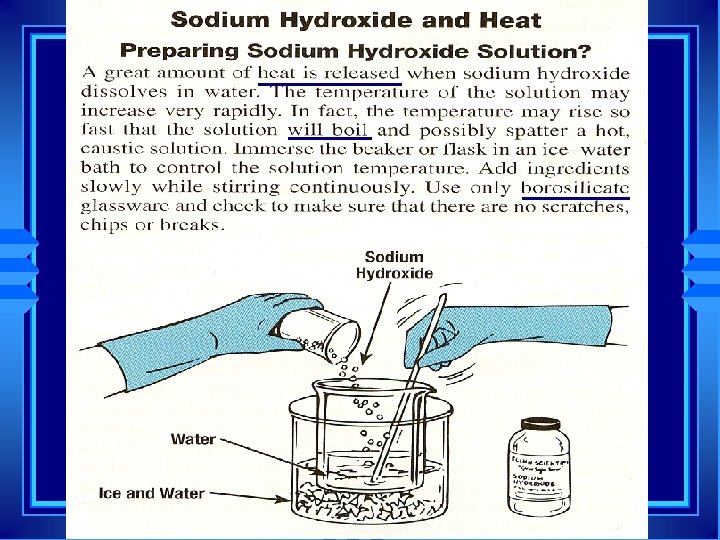
Heat of Solution Na. OH(s) H 2 O(l) Na 1+(aq) + OH 1 -(aq) Hsoln. = - 445. 1 k. J/mol u The heat is released as the ions separate (by dissolving) and interact with water, releasing 445. 1 k. J of heat as Hsoln. • thus becoming so hot it steams! 60
- Page 526
Section 17. 4 Calculating Heats of Reaction u OBJECTIVES: • State Hess’s Law of Heat Summation, and describe how (or why) it is used in chemistry. 63
Section 17. 4 Calculating Heats of Reaction u OBJECTIVES: • Solve for enthalpy changes by using Hess’s law or standard heats of formation. 64
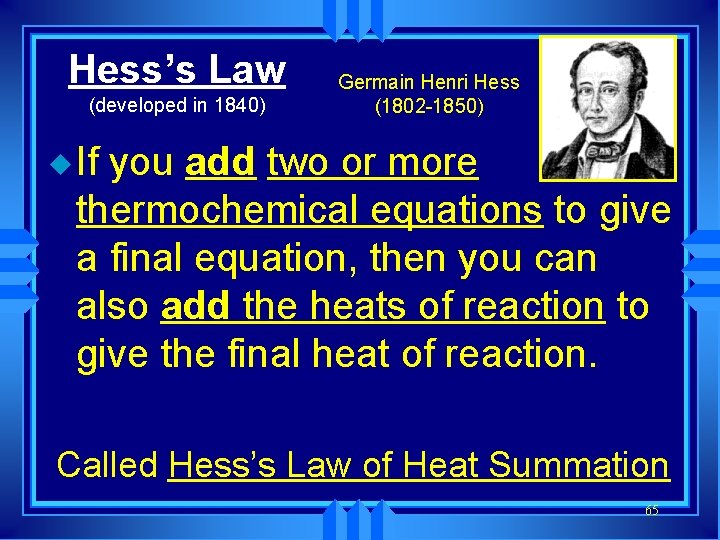
Hess’s Law (developed in 1840) Germain Henri Hess (1802 -1850) u If you add two or more thermochemical equations to give a final equation, then you can also add the heats of reaction to give the final heat of reaction. Called Hess’s Law of Heat Summation 65
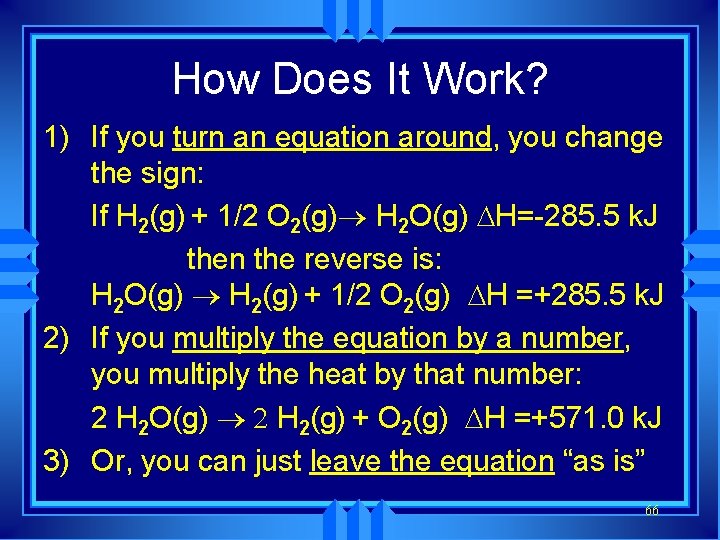
How Does It Work? 1) If you turn an equation around, you change the sign: If H 2(g) + 1/2 O 2(g) H 2 O(g) H=-285. 5 k. J then the reverse is: H 2 O(g) H 2(g) + 1/2 O 2(g) H =+285. 5 k. J 2) If you multiply the equation by a number, you multiply the heat by that number: 2 H 2 O(g) 2 H 2(g) + O 2(g) H =+571. 0 k. J 3) Or, you can just leave the equation “as is” 66
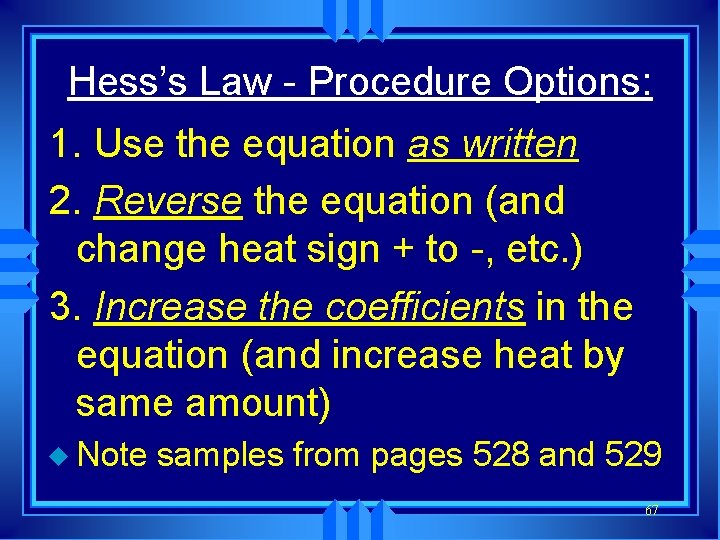
Hess’s Law - Procedure Options: 1. Use the equation as written 2. Reverse the equation (and change heat sign + to -, etc. ) 3. Increase the coefficients in the equation (and increase heat by same amount) u Note samples from pages 528 and 529 67
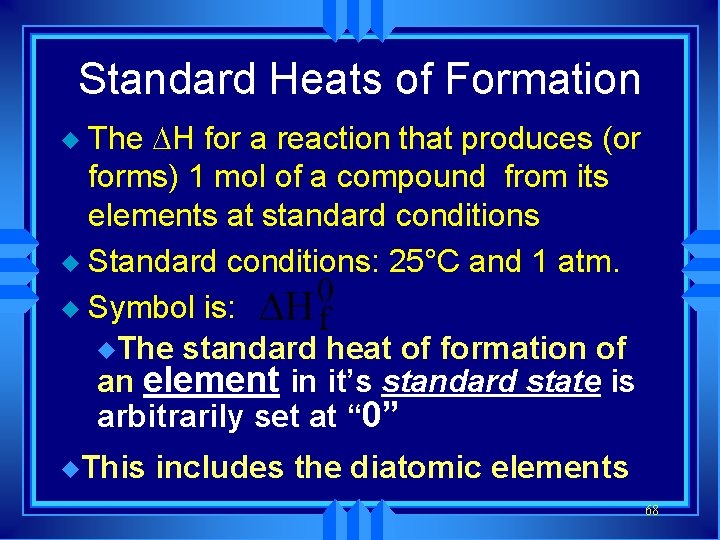
Standard Heats of Formation The H for a reaction that produces (or forms) 1 mol of a compound from its elements at standard conditions u Standard conditions: 25°C and 1 atm. u Symbol is: u. The standard heat of formation of an element in it’s standard state is arbitrarily set at “ 0” u u. This includes the diatomic elements 68
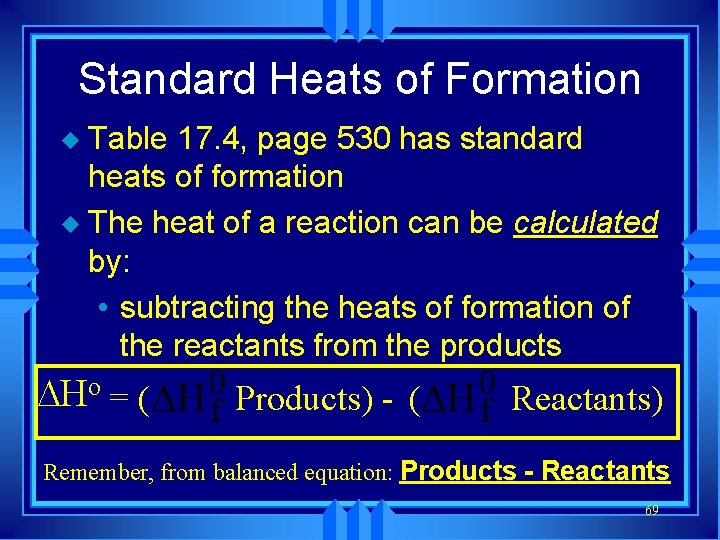
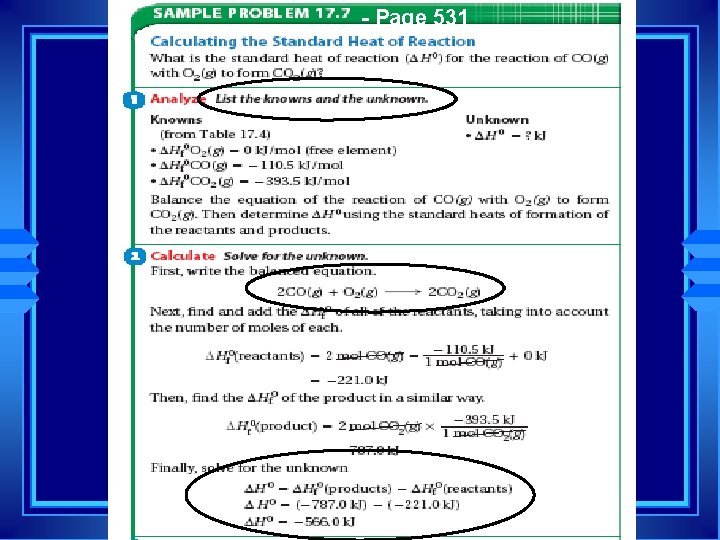
Standard Heats of Formation Table 17. 4, page 530 has standard heats of formation u The heat of a reaction can be calculated by: • subtracting the heats of formation of the reactants from the products u Ho = ( Products) - ( Reactants) Remember, from balanced equation: Products - Reactants 69
- Page 531
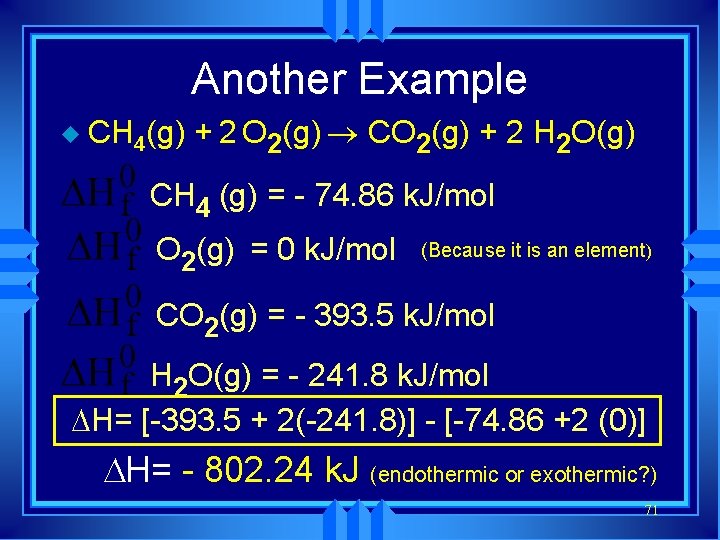
Another Example u CH 4(g) + 2 O 2(g) CO 2(g) + 2 H 2 O(g) CH 4 (g) = - 74. 86 k. J/mol O 2(g) = 0 k. J/mol (Because it is an element) CO 2(g) = - 393. 5 k. J/mol H 2 O(g) = - 241. 8 k. J/mol H= [-393. 5 + 2(-241. 8)] - [-74. 86 +2 (0)] H= - 802. 24 k. J (endothermic or exothermic? ) 71
72