
Measuring and Expressing Enthalpy in Thermochemical Equations I

- Slides: 9
Measuring and Expressing Enthalpy in Thermochemical Equations
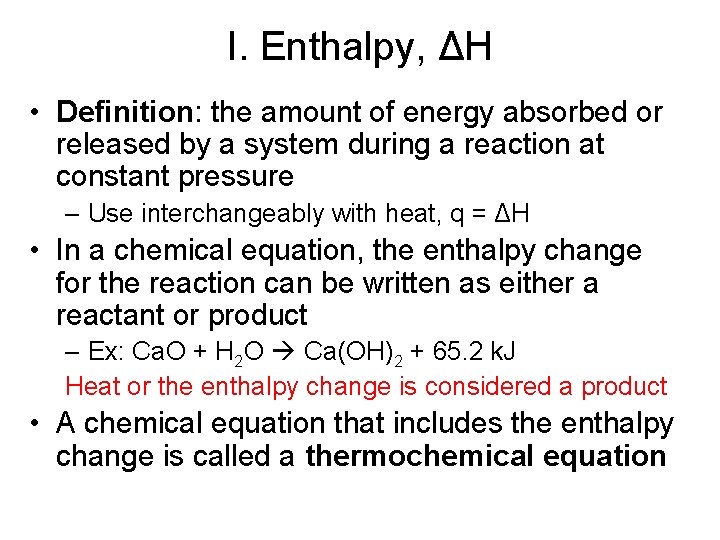
I. Enthalpy, ΔH • Definition: the amount of energy absorbed or released by a system during a reaction at constant pressure – Use interchangeably with heat, q = ΔH • In a chemical equation, the enthalpy change for the reaction can be written as either a reactant or product – Ex: Ca. O + H 2 O Ca(OH)2 + 65. 2 k. J Heat or the enthalpy change is considered a product • A chemical equation that includes the enthalpy change is called a thermochemical equation
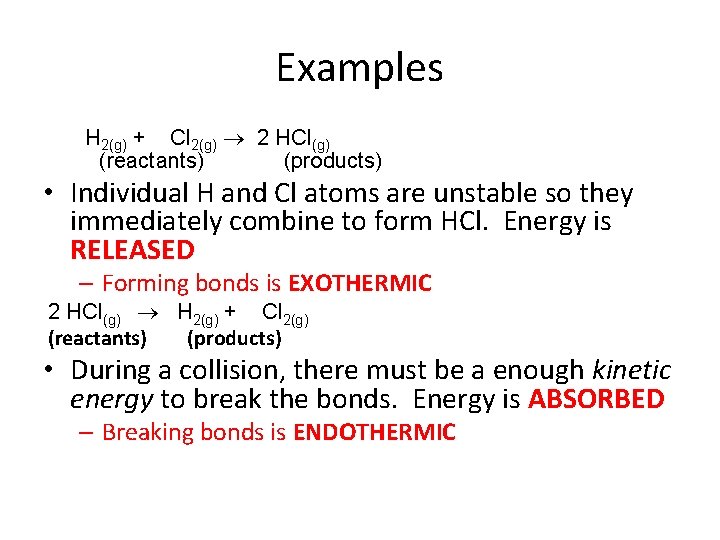
Examples H 2(g) + Cl 2(g) 2 HCl(g) (reactants) (products) • Individual H and Cl atoms are unstable so they immediately combine to form HCl. Energy is RELEASED – Forming bonds is EXOTHERMIC 2 HCl(g) H 2(g) + Cl 2(g) (reactants) (products) • During a collision, there must be a enough kinetic energy to break the bonds. Energy is ABSORBED – Breaking bonds is ENDOTHERMIC
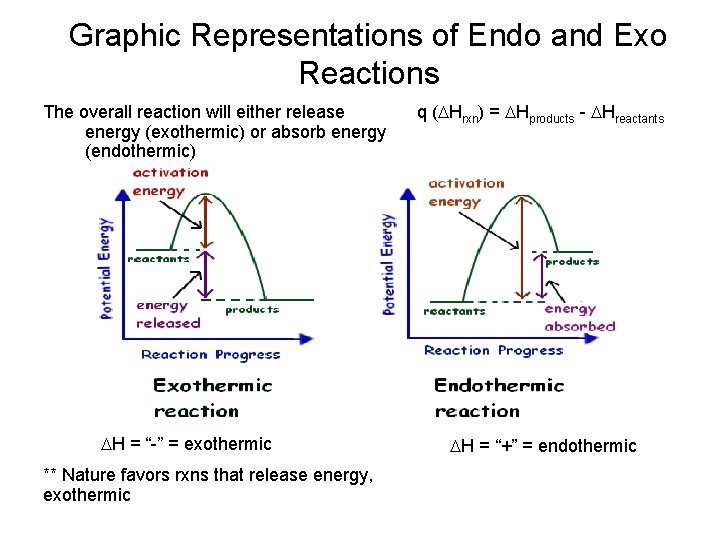
Graphic Representations of Endo and Exo Reactions The overall reaction will either release energy (exothermic) or absorb energy (endothermic) H = “-” = exothermic ** Nature favors rxns that release energy, exothermic q ( Hrxn) = Hproducts - Hreactants H = “+” = endothermic
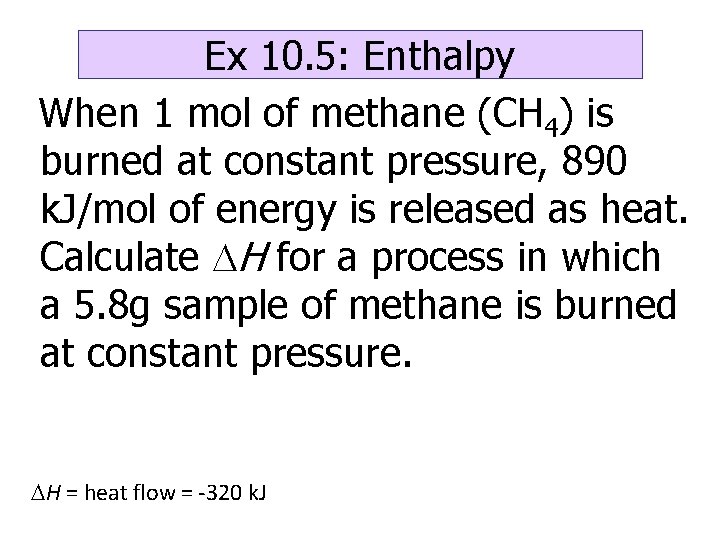
Ex 10. 5: Enthalpy When 1 mol of methane (CH 4) is burned at constant pressure, 890 k. J/mol of energy is released as heat. Calculate H for a process in which a 5. 8 g sample of methane is burned at constant pressure. H = heat flow = -320 k. J
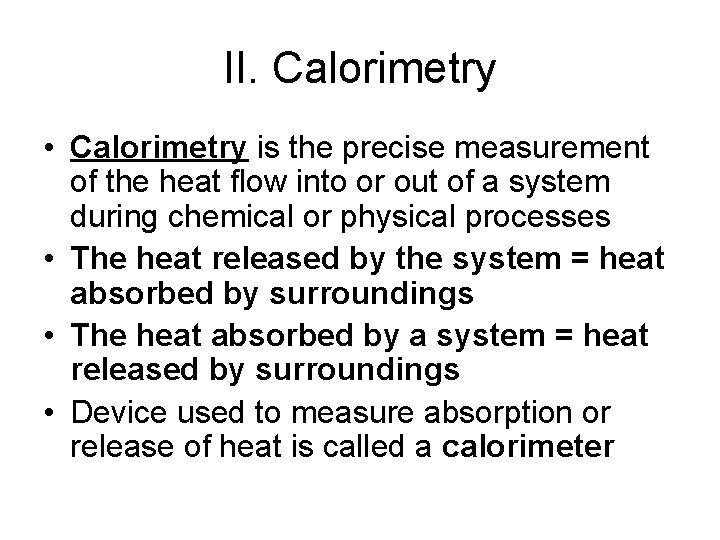
II. Calorimetry • Calorimetry is the precise measurement of the heat flow into or out of a system during chemical or physical processes • The heat released by the system = heat absorbed by surroundings • The heat absorbed by a system = heat released by surroundings • Device used to measure absorption or release of heat is called a calorimeter
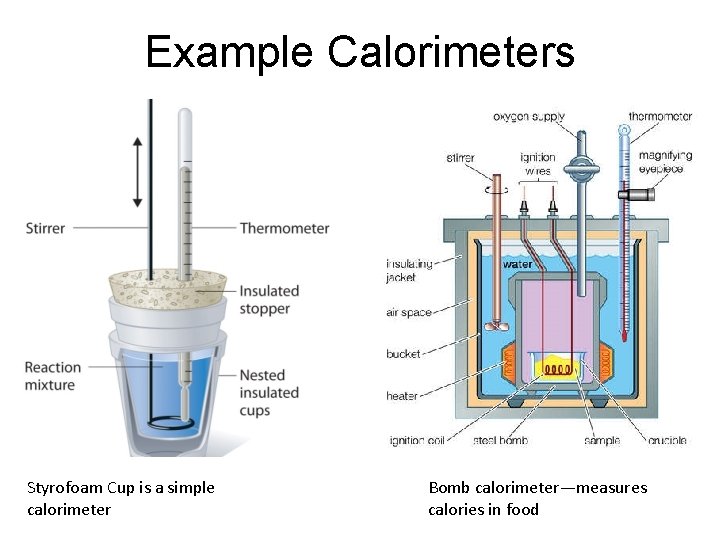
Example Calorimeters Styrofoam Cup is a simple calorimeter Bomb calorimeter—measures calories in food
III. Expressing Enthalpy in Thermochemical Equations Exothermic Example: H 2(g) + Cl 2(g) 2 HCl(g) + k. J H = -184. 6 k. J Endothermic Example: N 2(g) + 2 O 2(g) + 66. 2 k. J 2 NO 2(g) H = +66. 2 k. J *Units: 1 k. J/mol = 1000 J/mol
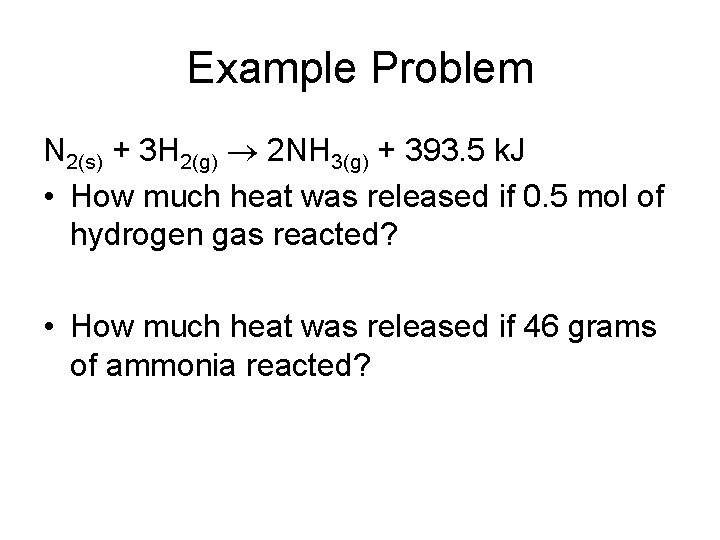
Example Problem N 2(s) + 3 H 2(g) 2 NH 3(g) + 393. 5 k. J • How much heat was released if 0. 5 mol of hydrogen gas reacted? • How much heat was released if 46 grams of ammonia reacted?